Archive for the ‘Iran scam’ category

Iranian Supreme Leader following Lausanne Declaration: Nothing Has Been Achieved So Far

May 5, 2015

Iranian Supreme Leader following Lausanne Declaration: Nothing Has Been Achieved So Far, MEMRI TV via You Tube, May 5, 2015

(Khamenei delivered this speech last month, but this fourteen minute video includes some comments I had not seen him make previously. — DM)

Iran’s chutzpah

May 3, 2015

Iran’s chutzpah, Jerusalem Post editorial, May 2, 2015

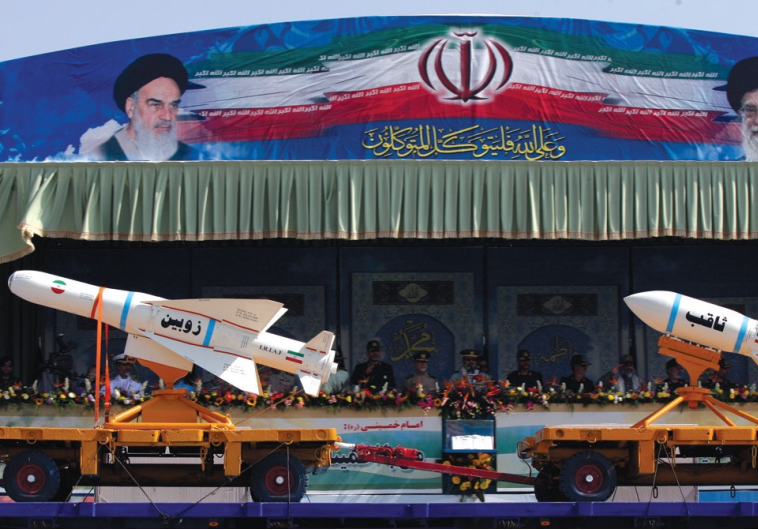
Iran chutzpahIran. (photo credit:REUTERS)

Whenever we assume that Iran’s chutzpah can get no more egregious, Tehran’s powers-that be spare no effort to prove us wrong.

Their calculated ploy is transparent – since the Islamic Republic’s nuclear project is now the focus of global attention, its leaders have cynically decided to turn the tables on their critics. In the guise of holier-than-thou protectors of humanity, Iran last Monday demanded that everyone else in possession of nukes desist forthwith from upgrading them or from lengthening the shelf-life of these weapons.

Needless to say, the sanctimonious tit-for-tat was spitefully in-your-face.

Quite expectedly, Iranian Foreign Minister Mohammad Javad Zarif told participants at the Review Conference of the Parties to the Treaty on the Non-Proliferation of Nuclear Weapons in New York that it is Israel which poses the greatest menace to the Middle East and indeed to the entire world due to its alleged nuclear stockpiles.

The month long conference is held every five years and is attended by NPT signatory nations. Israel never signed the treaty and remains officially mum on whether it does or does not possess a nuclear arsenal.

Zarif brazenly branded Israel “the single violator of this international regime [the NPT]…,“ and said, “one of the most important issues in the NPT review process is to look into ways and means of bringing about the Israeli compliance with NPT.”

And if that message failed to hit home, Zarif also aimed his barbs at NATO, asserting that Iran and the other 117 non-aligned NPT signatories are “deeply concerned by military and security doctrines of the nuclear-weapon states as well as that of the North Atlantic Treaty Organization.”

Yet Israel, which Iran had time and again threatened to wipe off the map, was singled out for particular accusations of villainy. Iran shamelessly seized on a persistent Egyptian theme – an attempt to deprive Israel of whatever nuclear powers it is believed to possess and coerce Israel to sign the 1970 NPT.

In 2005, Egypt scuttled the NPT resolutions because they did not specifically target Israel’s purported nuclear weaponry. In 2010, Egypt, still under Hosni Mubarak, persuaded the US to address Israel’s nuclear capability in the final communiqué – making Israel the only state mentioned, unlike the openly nuclear Pakistan and India (which like Israel also had not signed the NPT).

Israel saw this as a sell-out by the Obama administration.

The conference said nothing about Iran but urged that Israel rid itself of nuclear arms and that it allow international inspectors to visit and monitor its installations.

What five years ago was considered as unprecedented hypocrisy by the NPT Conference has now magnified to truly grotesque proportions. If Iran was just an unnamed elephant in the room last time around, it has since grown emboldened enough to lay blame on others.

Presumably this is part and parcel of a scheme to deflect attention from Tehran’s nuclear ambitions while a deal that would allow it to develop atomic warheads is in the making.

On the face of it, Iran can claim moral equivalence. But this is a counterfeit claim. Iran and like-minded allies – to say nothing of the powers now negotiating a deal with the ayatollah regime – all know that Israel is as prudent a democracy as exists anywhere. If Israel actually has the bomb, then it has had it for more than 50 years – almost as long as the original “Atomic Club” members. In all that time no wrongful use was made.

Iran is the diametrical opposite to Israel – a regime professing extreme Islamist doomsday theology whose bywords are volatility and unpredictability. There’s no even handedness between a self-defending democracy and an expansionist, apocalyptic tyranny.

Moreover, it is outrageous to ignore the variety of WMD deployed in the internecine Arab massacres but speciously concentrate on the Middle East’s one beleaguered democracy. The implication is that democratic Israel can be pressured while autocratic Iran will get away with flagrant obstructionism. The good-guy will be disarmed while fanatic aggressors are armed to the teeth.

The danger is that bona fide democracies seem willing to play along with Iran and misdirect the frustration it foments by spotlighting Israel.

Obama turns a smiling face to Israel. Biden: Iran has enough material for 8 nuclear bombs

May 3, 2015

Obama turns a smiling face to Israel. Biden: Iran has enough material for 8 nuclear bombs, DEBKAfile, May 2, 2015

(Obama and Biden speak with forked tongues. Please see also, PM Netanyahu’s Remarks to the Washington Institute for Near East Policy.– DM)

Biden-netanyahu_30.4.15We drive each other nuts…

President Barack Obama and Vice President Joe Biden have gone out of their way in the last fortnight to shower friendly gestures on Israel, Prime Minister Binyamin Netanyahu and even Ambassador to Washington, Ron Dermer. Refuting the dire predictions by Netanyahu’s critics of a disastrous breach, Obama and Biden, by word and gesture, are putting behind them the rancor long marring relations between Washington in Jerusalem.

The White House launched its new charm campaign for Israel on April 13 by meetings with three groups of American Jewish leaders. Obama addressed the first with an emotional affirmation of his support for Israel and its security. Vice President Biden, National Security adviser Susan Rice and Biden’s national security adviser Colin Kahl then talked to another group of Jewish leaders, while Obama spoke to Jewish “community leaders”, a group of individuals who though unaffiliated are influential and generous donors to the Democratic Party.

Ten days later, on April 23, Biden was the keynote speaker at the Israeli embassy’s Independence Day reception. He stood alongside the former object of administration ire – Ambassador Dermer – and declared: “We have Israel’s back, you can count on that.” He announced that Israel would be the first country in the world to receive the new US F-35 stealth aircraft already next year.

Thursday, the Vice President delivered a lecture at the Washington Institute for Near East Policy, the key DC research think tank on the subject of US-Israel relations.

In this important lecture, Biden defended in great detail US strategy and objectives in the negotiations for a nuclear accord with Iran, as they enter their final lap.

All in all, the US president and vice president are devoting more time to gestures for repairing relations with Israel than on the burning crises afflicting the world in Yemen, Iraq, Syria and Ukraine.

DEBKAfile found four reasons for this striking White House pivot:

1. After the fireworks sparked by Netanyahu’s March 3 speech to the US Congress against the nuclear accord, which placed him at the forefront of the international front opposing the deal, the White House decided that instead of sparring with him, it would be more productive to convert the Israeli prime minister into a supporter by meeting him halfway on certain points.

2. The rift with Israel proved disadvantageous to the Obama administration, while boosting Netanyahu and his Likud in Israel’s recent general election. The US president has paid a high political and personal price for colliding with Congress on the Iranian nuclear issue. His strategic advisers have recommended a bid to convince Netanyahu that Israel’s most pressing concerns about the nuclear deal are being addressed in the final stage of the talks. Assuming that the prime minister too is not looking for a major rift with Washington, he may be amenable to partly changing course and withdrawing some of his objections to the deal. Congress might then respond more positively to the administration’s nuclear policy.

3. As American gears up for its 2016 elections, the Democratic Party needs to woo the Jewish vote and most importantly its financial support for campaigners.

The Biden lecture to the Washington Institute is therefore worthy of close scrutiny. This masterly and eloquent work is an attempt to lay the political and security groundwork for Prime Minister Netanyahu’s consent to a change of heart from opposition to the nuclear deal to its support.

DEBKAfile has therefore singled out is 17 high points:

  • Israel is absolutely right to be worried about the world’s most dangerous weapons falling in the hands of a nation, whose leaders dream openly of a world without Israel.
  • So the criticism that Israel is too concerned I find preposterous.  They have reason to be concerned. (DF. Netanyahu’s concerns about Iran are fully justified.)
  • …that’s why the President, President Obama, decided for the first time — people forget this — to make it an explicit, declared policy of the United States of America – no such policy existed before President Obama uttered it — that all instruments of American power to prevent — not contain, not contain -— to prevent a nuclear-armed Iran would be used to prevent that from happening.
  • …our military had the capacity and the capability to execute the mission, if it was required. (DF. This was an explicit US presidential pledge to use military force to prevent a nuclear-armed Iran.)

Vice President Biden then laid down 12 conditions as the sine qua non for a deal. “If what’s on the table doesn’t meet the President’s requirements, there will be no deal,” he said.

  • A final deal must effectively cut off Iran’s uranium, plutonium and covert pathways to the bomb.
  • The final deal must ensure a breakout timeline of at least one year for at least a decade or more.
  • A final deal must include phased sanction relief, calibrated against Iran taking meaningful steps to constrain their program. (DF. Iran insists on immediate sanctions relief.)
  • A final deal must provide verifiable assurances to ensure Iran’s program is exclusively peaceful.
  • If they did try to cheat… they would be far more likely to be caught because… we’ll also put in place the toughest transparency and verification requirements.
  • Iran will be required to implement the Additional Protocols, allowing IAEA inspectors to visit not only declared nuclear facilities, but undeclared sites where suspicious, clandestine work is suspected and address IAEA concerns about the military dimensions of past nuclear research.
    Not only would Iran be required to allow 24/7 eyes on the nuclear sites you’ve heard of — Fordow and Natantz and Arak — and the ability to challenge suspect locations, every link in their nuclear supply chain will be under surveillance.
  • And if Iran resumes its pursuit of nuclear weapons, no option available today will be off the table. In fact, the options will be greatly increased because we will know so much more.

Biden went on to warn: “Let’s not kid each other. They already have paved a path to a bomb’s worth of material. Iran could get there now if they walked away in two to three months without a deal.” He went on to say:  “Without this deal, they already have enough material if further enriched for as many as eight nuclear bombs. Already, right now, as I speak to you.

  • Under the proposed final deal, the Arak reactor will be redesigned to produce zero weapons-grade plutonium. The spent fuel will be required to be shipped out of Iran for the life of the reactor. And Iran will be barred from building the reprocessing plant for extracting bomb-grade material from plutonium.

“Finally there is the myth that a nuclear deal between the United States and Iran enables Iran to gain dominance inside the Middle East.” The US vice president protested: “But it is a nuclear bargain between Britain, France, Russia, China, Germany, the EU, America and Iran – one that reduces the risk of nuclear war and makes the region and the world a safer place,” he stressed.

“We are working continually to develop the means and capacity to counter Iran’s destabilizing activities…“ he said citing the Strait of Hormuz. We are prepared to use (inaudible) the force.”

Biden wound up his peroration by directing these words to Israel. “It’s true we disagree sometimes. But as I said last week at Israel’s Independence Day celebration, we’re family. I think it was Ambassador Dermer who essentially said the same thing. We drive each other nuts. But we love each other. And most of all we protect each other.”

DEBKAfile’s Washington sources note: The Obama administration appears willing to keep on smiling towards Israel. US Secretary of State John Kerry will soon schedule a visit to Israel, after staying away for a long time, The visit will be billed as promoting Israeli-Palestinian peace talks, but his real errand will be to test the ground with Prime Minister Netanyahu and assess how successful the White House’s gestures of affection have been in toning down his opposition to the nuclear deal.

For now, the host of critics who accused Netanyahu of causing an irreparable breach with Washington over the nuclear issue have retired to a corner.

PM Netanyahu’s Remarks to the Washington Institute for Near East Policy

May 3, 2015

PM Netanyahu’s Remarks to the Washington Institute for Near East Policy, via You Tube, May 2, 2015

A powerful totalitarian theocracy can bring peace. Of sorts.

May 2, 2015

A powerful totalitarian theocracy can bring peace. Of sorts. Dan Miller’s Blog, May 2, 2015

(The views expressed in this article are mine, and do not necessarily reflect those of Warsclerotic or its other editors. — DM)

a1  Obama and Kahameni -building a toaster

Iran, an already powerful theocratic totalitarian state with extensive hegemonic ambitions, is about to become (if it is not already) a nuclear power. So equipped, it can extend its rule over the Middle East and beyond, bringing the “peace” of submission to Islam. Obama may favor this outcome and in any event appears to be at best indifferent.

Iran is ruled by Ayatollah Khamenei, its supreme political and religious power. He has the ultimate authority to approve or reject any P5+1 agreement, should there be one — which seems increasingly likely due to Obama’s ludicrous efforts to concede every possible matter of substance. Obama wants a foreign policy legacy and needs a “deal;” Iran does not need a “deal.” It has already benefited greatly from sanctions relief. Other nations have also benefited economically to the point that even were the U.S. to try to reimpose sanction such trade would continue and expand. Moreover, it is highly likely that Iran has done all of the necessary technical research on nukes and on delivery devices to the extent that, regardless of whether there is a “deal,” Iran can have deliverable nukes within a few months if not sooner. As I pointed out here, the insanity of the 2013 framework, adhered to except when arguably in America’s favor, led inexorably to this result.

The North Korea – Iran linkage makes the problem worse. Chinese nuclear experts recently revised their estimation of North Korea’s current possession of nukes:.

China’s top nuclear experts have increased their estimates of North Korea’s nuclear weapons production well beyond most previous U.S. figures, suggesting Pyongyang can make enough warheads to threaten regional security for the U.S. and its allies.

The latest Chinese estimates, relayed in a closed-door meeting with U.S. nuclear specialists, showed that North Korea may already have 20 warheads, as well as the capability of producing enough weapons-grade uranium to double its arsenal by next year, according to people briefed on the matter. [Emphasis added.]

Iran and North Korea have a long history of nuclear cooperation. Delivering North Korean technology, materials and nukes to Iran would not be very difficult. I addressed the problem here, herehere and elsewhere.

Consequences of a nuclear Iranian theocracy

The Iranian Shiite theocracy is totalitarian in every sense of the word; it has not moderated under “moderate” President Rouhani. To the contrary, it seems to have worsened. To the extent that credible figures are available, sexually transmitted disease has risen and the birth rate in Iran has fallen, considerably in recent years. Despite sanctions relief, poverty has increased. Where has the money gone? Iran pursues its hegemonic ambitions, most recently to help the Houthi in Yemen, while continuing to provide economic, logistical and weapons support to its other proxy terrorist organizations such as Hamas, Hezbollah, the Muslim Brotherhood and others. Iran is very likely motivated by its own desire eventually to control the Middle East and beyond.

The recent Iranian hijacking of a cargo ship under “U.S. protection” may well have been an Iranian warning to Saudi Arabia, an American ally and leading opponent of the Iranian proxy war by Houthi in Yemen, that it can and might close the Strait of Hormuz to Saudi oil exports.

Strait-of-Hormuz

Although obligated under treaty to come to the defense of the Marshall Islands-registered cargo ship, the Obama Nation did not. Instead, it simply watched as the Iranian Navy fired shots across her bow and took her to an Iranian port to the North at Bandar Abbas. The ship and her crew remain there. Caroline Glick, in an article titled The Marshall Islands’ cautionary tale pointed out that

The Maersk Tigris is flagged to the Marshall Islands. The South Pacific archipelago gained its independence from the US in 1986 after signing a treaty conceding its right to self-defense in exchange for US protection. According to the treaty, the US has “full authority and responsibility for security and defense of the Marshall Islands.” [Emphasis added.]

Given the US’s formal, binding obligation to the Marshall Islands, the Iranian seizure of the ship was in effect an act of war against America.

. . . .

If the US allows Iran to get away with unlawfully seizing a Marshall Islands flagged ship it is treaty bound to protect, it will reinforce the growing assessment of its Middle Eastern allies that its security guarantees are worthless.

As the Israel Project’s Omri Ceren put it in an email briefing to journalists, “the US would be using security assurances not to shield allies from Iran but to shield Iran from allies.” [Emphasis added.]

What can other nations, with which America has treaties calling upon us to come to their defense, expect from the Obama administration if attacked by Iran? Precious little.

Under credible threat from nuclear attack by Iran and lacking actual (as distinguished from verbal) support from the Obama administration, Middle East Arab nations cannot be expected to resist very effectively, even as they seek to obtain their own nuclear arsenals.

Israel, the “Little Satan?” She would fight fiercely to the end, but might be overcome. Perhaps she will take the initiative and destroy Iran’s nuclear facilities before they become too extensive and better protected, perhaps by missiles provided by Russia. I suggested here that she can and should do so. Here is a link to a far more detailed analyses of what she can and should do, soon.

America, the “Great Satan,” is not immune to an Iranian nuclear attack. As I suggested here, a nuclear armed Iran could launch an EMP attack to drive the U.S. back to the stone age. Such an attack would increase Iran’s hegemonic potentials, and hence ambitions, by foreclosing the possibility of American help to nations with which we have protection treaties. However, even without an EMP attack, Obama would not provide much help. Therefore, I wonder whether — despite all of the continuing Iranian “death to America” bluster — Iran would be foolish enough to do it before Obama leaves office. He does His best to help Iran get nukes and pursue its hegemonic ambitions. Why try to kill a staunch friend like Obama’s America?

The Obama administration — and many voters — view global warming, climate change, climate disruption and whatever new phrases as may be developed as the most severe threat to humanity. An interesting article titled Progressives at the Poker Table compares “Progressive” attitudes toward “the threat of climate warming and that of a nuclear-armed Iran.” Predictably, the Obama Administration and most of the “legitimate news media” are far more concerned about the former than the latter, even though there is little if anything that we can do, even at great expense, about climate change (mostly natural in origin). If so disposed, there is quite a lot that we could do about the far greater, and in any event more immediate, threat from a nuclear Iran. Perhaps it’s simply easier to stage pious shows about costly but ineffective ways to “save the Earth” than to make useful efforts to save humanity from Islamic ravages.

Church of climatology

Conclusions

Andrew Klavan ridicules Obama’s P5+1 “deal” here:

The Congress probably won’t do anything to stop it, so Iran will very likely have nukes and the missiles with which to deliver them soon — if it does not already have them.

Hitler made a “deal” with Prime Minister Chamberlain years ago and returned from Munich to display a piece of paper signed by Hitler. Crowds cheered. Hitler laughed and continued his hegemonic pursuits throughout Europe. Hitler could have been stopped with relative ease long before World War II erupted but wasn’t. The “Peace in our time” meme was too powerful. Then we fought WWII.

Is that how the current mess with Iran will turn out?

code pink on Iran

Andrew Klavan: Obama’s Nuclear Disaster

May 1, 2015

Andrew Klavan: Obama’s Nuclear Disaster, Truth Revolt, May 1, 2015


Clever new Rubio amendment to Corker’s Iran bill: The final deal must match this month’s WH “fact sheet”

May 1, 2015

Clever new Rubio amendment to Corker’s Iran bill: The final deal must match this month’s WH “fact sheet” Hot Air, Allah Pundit, April 30, 2015

(Rubio has a good sense of humor. — DM)

Doesn’t matter which is true, says Marco Rubio. The White House gave us the “fact sheet.” They told us that Iran had agreed to those terms. Those terms should therefore be absolutely essential provisions in any final deal. If the White House is uncomfortable with that, it can only be because either (a) they lied on the “fact sheet” or (b) they told the truth but are prepared to cave to whatever new demands Iran’s come up with to wriggle free of its previously agreed-to obligations. In other words, Rubio’s going to make Obama and/or Iran live up to their own BS.

********************

You remember the “fact sheet,” don’t you? That’s the document the White House released on April 2nd, the day it reached a “framework” deal with Iran, describing the terms that Iran had allegedly agreed to. Snap nuclear inspections of all suspicious sites, a greatly reduced number of centrifuges, delayed sanctions relief until Iran satisfied its denuclearization obligations — it wasn’t half bad, and certainly better than what an Obama skeptic might have expected. The only problem: Apparently no one told Iran that this is the deal they had agreed to. Within a week, Iran’s supreme leader claimed the U.S. “fact sheet” was full of lies; Iran’s defense minister claimed the deal didn’t include inspection of military sites; and, most dramatically, Iran’s president claimed that all sanctions would need to be lifted on day one after a final deal, not gradually as Iran complied with its duties under the deal. Either Iran had suddenly gotten cold feet after the “framework” deal was struck and reneged on what it had promised John Kerry or … the “fact sheet” was itself filled with distortions about what Iran had actually agreed to, a political ploy designed to build support in the U.S. for a deal that was still secretly very much in flux.

Doesn’t matter which is true, says Marco Rubio. The White House gave us the “fact sheet.” They told us that Iran had agreed to those terms. Those terms should therefore be absolutely essential provisions in any final deal. If the White House is uncomfortable with that, it can only be because either (a) they lied on the “fact sheet” or (b) they told the truth but are prepared to cave to whatever new demands Iran’s come up with to wriggle free of its previously agreed-to obligations. In other words, Rubio’s going to make Obama and/or Iran live up to their own BS.

Rubio’s amendment simply quotes that fact sheet verbatim and says the president may not waive or lift any Congressional sanctions until he certifies Iran has met the White House conditions.

“For the life of me, I don’t understand why that would be controversial,” Rubio said Wednesday. “Yet somehow, I was told this would box the White House in.”…

Rubio’s fact-sheet amendment is different [from other GOP amendments]. It doesn’t challenge the presidential authority to sign an executive agreement. Republicans supported that power when their party controlled the White House. Rubio’s fact-sheet amendment is also germane to the Iran legislation before the Senate. An argument used against other amendments–like Rubio’s one on recognizing Israel–is that it asks Iran to meet conditions not related to the nuclear negotiations.

Rubio’s fact sheet amendment only asks Democrats to vote on whether a final Iran deal should meet the conditions as described by the leader of their own party. If Democrats vote that it should, then Obama may be forced to issue a veto over his own fact sheet as he seeks to make a final agreement more palatable to Iran. If the Democrats vote that it shouldn’t, then they will appear to be conceding the White House either misled the public or bungled the negotiations earlier this month.

It’s a clever tactic by a guy who, I think, has a knack for clever tactics. But … does it have a chance of ending up in the final Corker-written Senate bill on Iran? Obama can only be boxed in if Congress passes the bill with Rubio’s amendment attached, and the odds of that happening seem, shall we say, modest. The takeaway from my earlier post about his amendment on Israelis that there’s a strong bipartisan consensus in the Senate, backed by none other than AIPAC, that’s determined to protect Corker’s bill as written by defeating any amendments that might split the bipartisan coalition of senators that are currently lined up behind it. Rubio’s amendment could do that. If it ended up passing, Democrats would probably vote no on the final bill to prevent the “fact sheet” from tying Obama’s hands during the final negotiations with Iran, even though O himself claims Iran already agreed to everything in it. Without those Democratic votes, the bill would fail and Congress would be left with nothing. In theory that would supply the GOP with a nice talking point about the bill’s defeat — “Senate Dems were afraid to make Obama live up to his own rhetoric” — but in practice there are various RINOs who would likely give Democrats political cover by voting with them to kill Rubio’s amendment. For some Republicans, like Corker and Lindsey Graham, the most important thing is to pass some sort of bill that would grant Congress a vote on the final deal, even if it means sacrificing each and every amendment that might potentially inconvenience President Precious in his negotiations.

All of which is to say, how you feel about Rubio’s amendment depends mainly on how you feel about Corker’s bill. There’s no denying, as Ace says, that it’s a sham: Even if a bunch of Democrats join with the GOP now to pass it, guaranteeing a vote on the final deal with Iran this summer, it’s a cinch that at least 34 Senate Dems will vote yes when the time comes to approve that deal, ensuring that it’ll take effect. There’s no way they’ll stab Obama in the back on his greatest foreign policy “achievement” by helping the GOP to block it, which means all the talk of “bipartisanship” right now is, to borrow Ace’s phrase, “failure theater.” It’s bipartisan only as long as it doesn’t create headaches for Obama during negotiations; once it does, as Rubio’s amendment threatens to do, Democrats will go back to voting a (mostly) party line. The whole process is a kabuki designed to make it look like Republicans are doing something meaningful to stop the deal with Iran when in reality it’s entirely up to Reid’s Democrats whether it ends up being blocked or not. The only thing that hinges on whether the Senate passes Corker’s bill is the sort of spin available to the GOP later once the deal with Iran is implemented. If Corker’s bill passes now, setting up a vote later on the final Iran deal, and that final deal draws, say, 66 “no” votes, then Republicans can say a heavy bipartisan majority of the U.S. Senate disapproved of it. If Corker’s bill doesn’t pass now, Congress will effectively remain silent on the deal, which at least has the virtue of them not engaging in a sham vote that perverts the Treaty Clause in the Constitution. Either way, the deal takes effect despite Rubio’s best laid plans. Which outcome is better?

Column One: The Marshall Islands’ cautionary tale

May 1, 2015

Column One: The Marshall Islands’ cautionary tale, Jerusalem Post, Caroline Glick, April 30, 2015

Iranian navy shipIranian navy ship.. (photo credit:REUTERS)

There is a thread that runs between Obama’s policy toward Iran and his policy toward Israel.

On Tuesday, the Iranian Revolutionary Guard Corps forcibly commandeered the Maersk Tigris as navigated its way through the Straits of Hormuz. Iran controls the strategic waterway through which 40 percent of seaborne oil and a quarter of seaborne gas transits to global markets.

The Maersk Tigris is flagged to the Marshall Islands. The South Pacific archipelago gained its independence from the US in 1986 after signing a treaty conceding its right to self-defense in exchange for US protection. According to the treaty, the US has “full authority and responsibility for security and defense of the Marshall Islands.”

Given the US’s formal, binding obligation to the Marshall Islands, the Iranian seizure of the ship was in effect an act of war against America.

In comments to Bloomberg hours after the ship was seized, Junior Aini, chargé d’affairs at the Marshall Islands Embassy in Washington, indicated that his government’s only recourse is to rely on the US to free its ship.

Immediately after the incident began, the US Navy deployed a destroyer to the area. But that didn’t seem to make much of an impression on the Iranians. More significant than the naval movement was the fact that the Obama administration failed to condemn their unlawful action.

If the administration continues to stand by in the face of Iran’s aggression, the strategic implications will radiate far beyond the US’s bilateral ties with the Marshall Islands. If the US allows Iran to get away with unlawfully seizing a Marshall Islands flagged ship it is treaty bound to protect, it will reinforce the growing assessment of its Middle Eastern allies that its security guarantees are worthless.

As the Israel Project’s Omri Ceren put it in an email briefing to journalists, “the US would be using security assurances not to shield allies from Iran but to shield Iran from allies.”

But President Barack Obama apparently won’t allow a bit of Iranian naval piracy to rain on his parade. This week Obama indicated that he feels very good about where his policy on Iran now stands. And he has every reason to be satisfied.

With each day that passes, the chance diminishes that his nuclear deal with the mullahs will be scuppered.

On the one hand, the Iranians are signaling that they are willing to sign a deal with the Great Satan. And this makes sense. For them the deal has no downside.

First there’s the money. Last week the State Department indicated that it won’t rule out paying Iran a $50 billion “signing bonus.”

The $50b. would be an advance on Iranian funds that have been frozen in Western banks under the terms of the sanctions regime that would be lifted in the event a deal is concluded.

Iran can do a lot with $50b.

Iran is spending $3b. a month to finance its war in Syria. With $50b. in their pockets the ayatollahs can fight for another year and a half without selling a barrel of oil.

According to a report earlier this week on Channel 10, during Syrian Defense Minister General Fahd al-Freij’s visit to Tehran this week, he was instructed to enable Hezbollah to open a front against Israel on the Golan Heights. Iran’s “signing bonus” would pay for Iran’s new war against Israel.

As for their nuclear weapons program, even Obama admitted that when his deal expires in 10 years, Iran will have the capacity to build nuclear weapons at will.

Iran can get around the ideological issue of signing with its theological foe by focusing its hatred on the US Congress, something Foreign Minister Mohammad Javad Zarif did effortlessly at a press conference in New York on Wednesday.

At home as well, Obama no longer faces serious opposition to his Iran policy. The Iranian Nuclear Agreement Review Act, the bill now being debated on the Senate floor, ensures that Congress will have no ability to stand in the way of the deal. In contrast to the provisions of the US Constitution that require a two-third Senate majority to approve an international treaty, the Senate bill requires a two-third majority of senators to block the implementation of Obama’s nuclear deal with the greatest state sponsor of terrorism.

Obama has successfully bullied centrist Democrat senators into abandoning their concern for US national security and supporting his deal.

They in turn have convinced centrist Republicans – and AIPAC – to push forward the legislation and so turn Congress into partner in Obama’s nuclear gambit.

Attempts by Republican senators, including presidential candidate Sen. Ted Cruz, to attach amendments to the bill that would require Congress to either treat the deal as an international treaty, or at the very least require a simple majority to reject it, have been strenuously opposed not only by the Democrats, but by the Republican leadership as well.

Obama’s confidence that his deal will go through has freed him up to mark the next target of his foreign policy in what he recently referred to as the “fourth quarter” of his presidency: Israel.

According to a report in Foreign Policy, the administration is now seeking to delay anti-Israel resolutions at the UN Security Council – including a French draft resolution that would require Israel to surrender all of Judea and Samaria and northern, southern and eastern Jerusalem to the Palestinians – until after the deal with Iran is concluded at the end of June. According to the report, the administration doesn’t want to upset pro-Israel Democrats while it still needs them to approve the deal with Iran.

But Obama has no problem with marking the target.

And so, on Monday, Undersecretary of State for Political Affairs Wendy Sherman did just that.

In an address before Reform Jews, Sherman issued a direct threat against Israel.

In her words, “If the new Israeli government is seen to be stepping back from its commitment to a two-state solution, that will make our job in the international arena much tougher… it will be harder for us to prevent internationalizing the conflict.”

In an apparent attempt to soften the harsh impression Sherman’s statement made on the Israeli public, on Wednesday US Ambassador Dan Shapiro gave an interview to Army Radio.

Although his American-accented Hebrew is always a crowd pleaser, Shapiro’s statements were simply a more diplomatic restatement of Sherman’s threat.

As he put it, “We are entering a period without negotiations [between Israel and the Palestinians] and this leads us to two important challenges.

One – how do we make progress toward the two-states for two-peoples solution, and two – negotiations have always been critical to preventing the delegitimization of Israel.”

In other words, Shapiro signaled that the Obama administration expects Israel to make significant concessions to the Palestinians in return of nothing, in the absence of negotiations.

And if we fail to make such unreciprocated concessions, we will have no legitimacy and the US will have no choice but to act against Israel at the UN.

That is, by Shapiro’s and Sherman’s telling, Israel’s unwillingness to bow to Palestinian and US demands for concessions to the Palestinians is what has caused and what feeds the international campaign to delegitimize its right to exist.

For anyone who entertains the thought that Shapiro and Sherman are correct to blame Israel for the movement to delegitimize it, this week we received new proof of its falsity.

This week, the leaders of the Boycott, Divestment and Sanctions movement condemned Israel not for failing to make concessions to the Palestinians. This week they condemned the Jewish state for helping Nepal earthquake victims.

Ever since the Israeli humanitarian aid mission set off for Nepal earlier this week, leading figures in the BDS movement have been working overtime to attribute ill and even demonic intentions to their mission.

Kenneth Roth, the executive director of Human Rights Watch, tweeted on his Twitter account, “Easier to address a far-away humanitarian disaster than the nearby one of Israel’s making in Gaza. End the blockade!” Max Blumenthal, a Jewish anti-Semite who has risen to prominence in the BDS campaign, tweeted, “For a country responsible for so many man-made catastrophes, natural disasters can’t come often enough.”

Ali Abumiah, the editor of Electronic Intifada, intoned that Israel was racist to evacuate newborn infants born to surrogate mothers in Nepal and leave the surrogates behind. He also tweeted, “Propaganda operation goes into high gear to exploit Nepal earthquake to improve Israel’s blood-soaked image.”

These assaults, which attribute malign, exploitative designs to Israel’s humanitarian relief efforts, make clear that there is no connection between Israel’s actions and hostility toward Israel.

The purpose of the BDS movement is not to pressure Israel to make concessions to the Palestinians.

Its purpose is to delegitimize Israel’s right to exist and delegitimize support for Israel’s right to exist.

If Israel is evil for sending hundreds of soldiers and relief workers to Nepal to rescue earthquake victims, clearly Israel will be attacked as evil for making concessions to the Palestinians that the Palestinians and the Obama administration will insist are insufficient.

Shapiro’s claim that negotiations between Israel and the PLO, or Israeli unilateral concessions to the Palestinians, protect Israel from its Western detractors is totally unfounded.

There is a thread that runs between Obama’s policy toward Iran and his policy toward Israel.

That common threat is mendacity. Obama’s actual goals in both have little to do with his stated ones.

Obama claims that he wishes to prevent Iran from acquiring nuclear weapons. But as we see from his willingness to allow Iran to become a nuclear threshold state while running wild in the Straits of Hormuz, committing mass slaughter in Syria, building an empire that includes Iraq, Syria, Lebanon and Yemen, and threatening its Arab neighbors and Israel, the purpose of the administration’s negotiations with Iran is not to prevent Iran from becoming a nuclear power.

The purpose of the negotiations is to build an American-Iranian alliance on Iran’s terms.

So, too, Obama says his goal is to advance the cause of peace between Israel and the Palestinians.

But his pressure and hostility toward Israel does nothing to achieve this goal. The goal of a policy of acting with hostility toward Israel is not to promote peace. It is to distance the US from Israel and align America’s Israel policy with Europe’s preternaturally hostile treatment of the Jewish state.

Three days after a ship sailing under their flag was seized by Iran’s Revolutionary Guards, citizens of the Marshall Islands discovered that their decision to place their security in America’s hands is no longer the safe bet they thought it was 29 years ago.

Anyone who entertains the belief that Israel will gain diplomatic acceptance or even a respite from American pressure if it makes concessions to the Palestinians is similarly making a high risk gamble.
Part II: Is Iran Playing Games With the US Navy?

May 1, 2015

First on CNN: Navy to escort U.S. commercial ships near Iran
By Barbara Starr, CNN Pentagon Correspondent Updated 7:28 PM ET, Thu April 30, 2015


(Here’s the second article. Is Iran drawing the attention of the US Navy away from the Yemen strait? The Iranians are pretty sneaky. Escalation seems to be their dangerous game for now. – LS)

Washington (CNN)U.S. Navy warships accompanied four U.S. flagged vessels through the Strait of Hormuz Thursday, beginning a new military operation to offer armed protection from potential harassment by Iran’s navy, a U.S. defense official tells CNN.

The ships transiting the strait were both inbound to the Persian Gulf and also outbound into the North Arabian Sea and they occurred without incident. All four unarmed vessels were military supply and survey ships either operated by the U.S. Military Sealift Command or under contract to the command.

The official said the Pentagon will not be providing daily details on transits or the warships in the area because the US “does not want to establish a pattern of life,” for observers in the area.

CNN first reported Thursday that U.S. Navy warships would accompany U.S.-flagged commercial vessels that pass through the Strait of Hormuz due to concerns that ships from Iran’s Revolutionary Guard Corps navy could try to seize a U.S. cargo ship.

Pentagon officials provided clarification Thursday afternoon that not every ship will necessarily be accompanied by the Navy. But this is still a significant change in the U.S. military posture in the Strait.

The classified plan was approved by the Pentagon earlier Thursday, according to a senior defense official.

While the Navy maintains a routine ship presence in the Persian Gulf and the North Arabian Sea, this new effort specifically requires an armed warship to be in the narrow channel between Iran and Oman when a U.S. commercial vessel passes through.

The decision to go ahead with this plan comes as Iran Revolutionary Guard ships harassed a U.S.-flagged vessel, the Maersk Kensington, on Friday and then later seized another cargo ship, the Maersk Tigris, flagged in the Marshall Islands.

The worry is that with the uncertainty around Iran’s intentions, any seizure of a U.S.-flagged vessel could provoke an international incident with Iran.

(Internation incident?  How about an act of war. – LS)

“This is a way to reduce the risk of confrontation,” the official told CNN.

The official emphasized the Navy is not trying to “play up” the current situation, but said the orders were approved “based on tensions in the region.”

A second U.S. official said if it becomes necessary, U.S. warships are prepared to escort U.S. commercial vessels throughout the entire Gulf.

There are a number of U.S. ships and aircraft in the immediate vicinity, including four ships and several aircraft monitoring the status of the Marshall Island vessel, which remains in Iranian custody allegedly over a 2005 financial dispute. U.S. Navy ships will be moved in and out of the area depending on the transit schedule of U.S. cargo vessels.

Iranian officials said the seizure of the Marshall Islands-flagged ship Maersk Tigris was due to a court decision.

Foreign Minister Mohammad Javad Zarif said Wednesday that the ship had “some rather peculiar activity” in its past that resulted in court action, according to lawyers with whom his ministry has been in touch.

“Simply, our naval forces implemented the decision of the court,” he added.

Rickmers Shipmanagement, the company managing the Maersk Tigris, a Maersk Line ship, said in a statement Thursday that the apparent issue dates back to 2005, when another Maersk Line vessel delivered a shipment to Dubai that was later disposed of when no one collected the containers.

A spokesperson for Rickmers Shipmanagement also said that 24 people — none American — are on board the Maersk Tigris and that they are all doing well. However, the company continues to “insist that the crew and vessel are released as soon as possible.”

The two recent incidents come after the U.S. last week sent warships to the vicinity of Yemen after concerns were raised that an Iranian convey was attempting to supply arms to Houthi rebels who have deposed the Western-backed government in Sanaa.

Multiple U.S. officials said the American ships had been deployed to the region to dissuade the Iranian convoy, which included armed ships, from docking in Yemen. The Iranian ships turned away from Yemen on Thursday.

The U.S. hope is that by deploying the naval accompaniment for cargo ships in the Strait of Hormuz, it’s much less likely that Iran would cause trouble for them. Rather, like in the case of Yemen, they would be more inclined to turn back.

Still, the move comes amidst U.S.-Iran tensions in the region over competing interests in Yemen and elsewhere. And it also coincides with delicate nuclear talks in the which the United States and five other world powers are trying to seal a final deal with Iran curbing the latter’s nuclear program.

The Bad Deal That Could Lead to Nuclear War in the Mideast

April 30, 2015

Senator Warns That Zarif’s Comments Show Iran ‘Cannot Be Trusted,’ Challenges Him to Debate
by TheTower.org Staff | 04.30.15 10:10 am


(Iran seems to be saying it will do an end-run around the US and go directly to the UN if sanctions are not lifted, deal or no deal. – LS)

Shortly after Iranian foreign minister and chief nuclear negotiator Mohammad Javad Zarif spoke at New York University, Senator Tom Cotton (R-Ark.) responded, criticizing Zarif’s demand that U.N.-imposed sanctions on Iran must be lifted immediately upon completing a nuclear deal and challenging Zarif to a debate.

On his website, Cotton pointed out that Zarif’s remarks contradicted President Barack Obama, who has insisted that sanctions can only be lifted once Iran complies with the obligations of any future deal:

“President Obama promised sanctions would only be lifted when Iran’s compliance with restrictions on their nuclear program were verified. But earlier today, Iranian Foreign Minister Javad Zarif once again contradicted the President’s interpretation saying:

If we have an agreement on the 30th of June, within a few days after that, there will be a resolution before the UN Security Council under Article 41 of Chapter 7 which will be mandatory for all member states whether Senator Cotton likes it or not.

“Sanctions relief isn’t about what I like, but what will keep America safe from a nuclear-armed Iran. But I suspect Foreign Minister Zarif is saying what President Obama will not because the President knows such terms would be unacceptable to both Congress and the American people. The repeated provocative statements made by members of the Iranian leadership demonstrate why Iran cannot be trusted and why the President’s decision to pursue this deal and grant dangerous concessions to Iran was ill-advised from the beginning. These aren’t rhetorical tricks aimed at appealing to hard-liners in Iran; after all, Mr. Zarif was speaking in English in New York. Rather, they foreshadow the dangerous posture Iran will take and has taken repeatedly—including as recently as yesterday with the interception of a U.S.-affiliated cargo ship—if this deal moves forward.

In addition to pointing out Zarif’s contradiction of the president, Cotton, a graduate of Harvard Law School, responded to Zarif’s mention of his name by challenging him to a debate on Twitter, and to discuss Iran’s support of “tyranny, treachery, & terror.”

In his talk yesterday, Zarif also defended Iran’s seizure of a cargo ship in an internationally recognized shipping lane, as well as the espionage trial of Washington Post reporter Jason Rezaian.

Cotton was the lead author of an open letter, signed by 47 senators last month, that asserted that Congress would have a Constitutionally-mandated role in ending any American-imposed sanctions on Iran. In response, Zarif revealed that Iran intended to have sanctions first lifted by the United Nations Security Council as a means of pressuring the United States to lift the sanction it had imposed on Iran.

In an interview earlier this month, Cotton asserted that moderates in Iran were not being empowered through the negotiations, and that a bad deal could lead to nuclear war in the Middle East.


