Schrödinger’s Nuke: How Iran’s Nuclear Weapons Program Exists – And Doesn’t Exist – At The Same Time – Analysis, Eurasi Review, John R. Haines, May 26, 2015
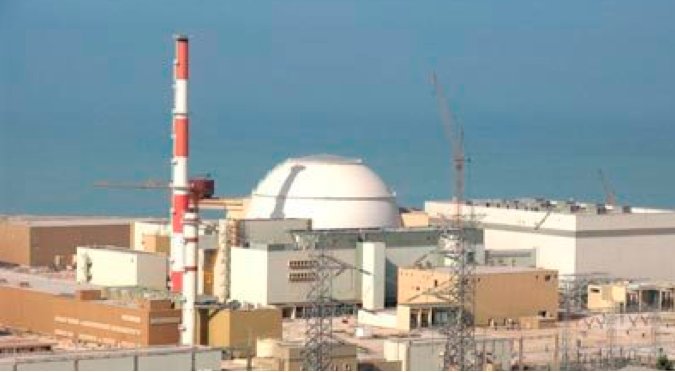
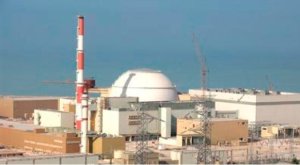 Iran’s Bushehr Nuclear Power Plant
“If we master nuclear technology, we will be transformed into a regional superpower and will dominate 17 Muslim countries in this neighborhood…We have reached a very important stage and we need to pay a price for making Iran powerful.” – Major General Moshen Reza’i, 24 March 2006, Secretary General, State Expediency Council, Former Commander, Iranian Revolutionary Guard Corps (1981-1997)
______________________________
“Schrödinger’s cat” is a classic thought-experiment in which a cat concealed in a box is said to be simultaneously alive and dead though obviously it is one or the other. The paradox’s basis is that each outcome is equally uncertain, and it is unknown which outcome is false. Thus, in the absence of actually knowingwhich outcome is false, the two mutually exclusive outcomes are said to be equally “true.”
And so it is with Iran’s nuclear weapon program. The Islamic Republic of Iran has a nuclear weapon program -indeed, it has had one for decades[1]—and, at the same time, it does not. This article probes the roots of that paradox. It begins by parsing the meaning of the “nuclear weapons program” triad, viz., uranium enrichment and plutonium reprocessing; explosive nuclear device fabrication; and weapon delivery systems.
In the early 1980s the leaders of the Islamic Republic quickly revived Iran’s Pahlavi-era nuclear program amidst a bitter struggle with neighboring Iraq.
“The Government of Iran’s 1982 decision to reinstitute the Pahlavi regime’s nuclear program […] ironically […] continued what many scholars see as the Pahlavi regime’s strategy of running a parallel weapons program, using Iran’s openly declared civil nuclear power program as a springboard for developing weapon grade fuel, and as cover to mask its development of the technical know-how for weapons design and manufacturing.[2]
A principal basis for claiming today that Iran does not have a nuclear weapons program is a November 2007 United States National Intelligence Estimate.[3] In that document, the Director of National Intelligence averred, “We judge with high confidence that in fall 2003, Tehran halted its nuclear weapons program,” defined as “Iran’s nuclear weapon design and weaponization work and covert uranium conversion-related and uranium enrichment-related work.”[4] However, the 2007 NIE also states that because of “intelligence gaps,” the Department of Energy and the National Intelligence Council could “assess only with moderate confidence that the halt to those activities represents a halt to Iran’s entire nuclear weapons program.” It leaves unresolved how Iran unlearned things once learned, or how it un-mastered technical and engineering challenges earlier mastered.
The 2007 NIE neither specified exactly what nuclear weapons efforts Iran halted nor what it achieved prior to the 2003 “halt” nor explained how halting one element of a complex program—even if, as the 2007 NIE contends, Iran’s enrichment and reprocessing activities ceased by late 2003—meant that the Islamic Republic’s nuclear weapons program as a whole suddenly ceased to exist. The document goes on:
“This NIE does not assume that Iran intends to acquire nuclear weapons. Rather, it examines the intelligence to assess Iran’s capability and intent (or lack thereof) to acquire nuclear weapons, taking full account of Iran’s dual-use uranium fuel cycle and those nuclear activities that are at least partly civil in nature.”[5]
The 2007 NIE’s controversial claims regarding Iranian “capabilities and intent” are based on a series of judgments, some or all of which are presumably informed in part by classified material that has not been released. Thus the basis for many seemingly contestable claims remains a subject for speculation but in the end is unknown. What is known, however, is that the NIE’s claims were based on conditional “assessments and judgments,” qualified as “In all cases…not intended to imply that we have ‘proof’ that shows something to be a fact.”[6]
Jack Davis pioneered analytic tradecraft at CIA. He once described what he called the “intelligence food chain.” Atop the food chain sit Facts, followed byFindings and Forecasts, and at the bottom, ungrounded judgments that Davis dismissed as Fortune Telling. The 2007 NIE’s claims about Iranian “capabilities and intent” sit somewhere between fortune telling to findings, but self-admittedly fall short of facts.[7]
Much has been said concerning nuclear weapons and the Islamic Republic of Iran. While some of this commentary is thoughtful and well informed, much of it—on both sides of the question—is—lamentably—neither.
The narrow question here is whether there is a credible basis for believing Iran possesses a working nuclear weapon of some configuration, and/or whether Iran has mastered all the techniques required to fabricate one. This article is based on open-source materials unless expressly noted as reflecting the author’s belief. The author has in all cases avoided the use of documents that cannot be found in the public domain.
A quick note about what this essay does not presume to cover. It offers no special insight into Iran’s enrichment/reprocessing activities and capabilities, or its missile delivery platforms. Both of these important subjects are extensively and competently covered elsewhere, and readers are left to peruse that material on their own. Nor does this essay offer any special insight into Iranian intentions other than to suggest plausible contours of a governing nuclear doctrine. Here, the author takes sharp issue with how that doctrine is portrayed conventionally—a view surprisingly common to those who claim, respectively, that Iran has, and does not have, a nuclear weapons program—which the author suggests are based on a shared reductive mis-analogy.
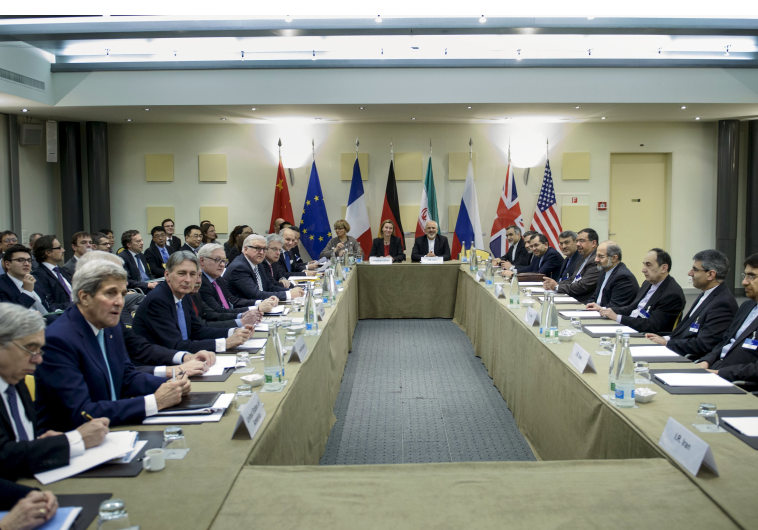
The current “P5+1″ discussions are represented as seeking to impose limits on Iran’s ability to “go nuclear.” That representation is inaccurate in the author’s view. The current talks—neither side’s self-declared “understandings” have yet been reduced to writing and/or accepted by the other side—are focused on imposing time-restricted limits on Iran’s uranium enrichment and plutonium reprocessing activities. Iran’s development of advanced medium (and possibly, intermediate) range missile platforms lies outside the bounds of the P5+1 talks. What also is outside the bounds of the restarted discussions is the matter of exactly what Iran has achieved in the nuclear realm since the 1970s, including clarity on the question of the Islamic Republic’s earlier efforts to acquire contraband nuclear weapons and weapons-grade fissile material from proliferator-states and non-state traffickers.
I. Configuring Iran’s Nuclear Weapon Triad
“He who knows how to advance, but has not learned to retreat under certain difficult conditions, will not triumph in war.” – Vladimir Lenin
From a realist perspective, the Islamic Republic’s development of nuclear weapons was wholly predictable, given the strategic environment that Iran faced in the late 1970s and early 1980s. As those threats mitigated or neutralized, however, Iran never changed its doctrinal objectives. Balance of power considerations were the impetus for its nuclear weapons program; bureaucratic politics inside the Islamic Republic have ensured its continued pursuit.[8]
It is plausible that Iran at some point managed to accumulate sufficient weapon-grade fissile material—the source of which, if true, is likely a combination of material produced by Iran’s indigenous enrichment/reprocessing program; illicit material diverted from another nuclear state (likely a former Soviet republic); and/or material sourced directly from nuclear charges diverted from another state (same likely origin)—to field a limited number of defensive, tactical-as-battlefield nuclear weapons.[9] If so, Iran likely re-ordered the nuclear weapon triad to prioritize the fabrication of explosive nuclear devices paired with a simple delivery system. If, as the November 2007 NIE claimed, Iran in fact had temporarily suspended enrichment/reprocessing activities, one possible explanation for such a step is that it had adequate material on hand, suspending enrichment/reprocessing as a subterfuge.[10]
For the balance of this essay, we will employ the definition of a nuclear weaponas comprising three parts formulated by a senior counselor in the Russian Foreign Affairs Ministry, Vladimir Rybachenkov: a nuclear munition; a nuclear charge; and a delivery vehicle and its associated control system. A nuclear munition is the component of a delivery vehicle (e.g., a missile, torpedo, air bomb, or artillery projectile) that contains a nuclear charge, which is the device that produces a nuclear explosion.[11] For reasons stated earlier, the discussion that follows focuses on nuclear munitions and charges rather than delivery systems.
What land war doctrine might be associated with the Islamic Republic acquiring and/or fabricating a nuclear munition and incorporating it into a simple delivery vehicle, e.g., an artillery shell or land mine? With a land area roughly equal to that of Alaska, Iran’s land war doctrine is built around a flexible, layered defense that exploits the country’s strategic depth and terrain. The Islamic Republic evolved a parallel set of armed forces each with its own subservices (army, navy & air force). On one side there is the Islamic Republic of Iran Army (“IRIA”), the country’s regular military also known as Artesh.[12] On the other side there is the Islamic Revolutionary Guard Corps (IRGC). IRIA ground forces form a first line of defense against an invading force while IRGC ground forces form a second line of defense and act as a reserve.
One point raised consistently in the context of any discussion of Iran’s suspected nuclear weapons program is its ballistic missile program, which operates under the control of the IRGC. It is true that the ballistic missile force has taken on an increasingly central place in Iran’s deterrence strategy, and is at least implicitly linked to IRGC-controlled Chemical, Biological, Radiological, Nuclear, and Explosives (CBRNe) programs. It is also likely that one or more of Iran’s ballistic missile force platforms—for example, the Shahab-3 medium-range ballistic missile—were developed for use as nuclear delivery platforms. There is no open-source evidence, however, to establish whether or not Iran has mastered miniaturization, weaponization and other tasks associated with mounting and delivering a nuclear missile warhead. There is compelling evidence that it did not possess this capability in the period in question here, i.e., the 1980s and 1990s. A bona fide nuclear role for the ballistic missile force would force the Islamic Republic leadership to reassess its missile doctrine, which today is countervalue—targeting population centers[13]—rather thancounterforce.
Iran’s overall military doctrine is based on a denial strategy known as a mosaic defense.[14] It seeks to nullify numeric and/or technological advantages enjoyed by a superior enemy force by requiring that force to find, isolate and defeat each “tile” of the defensive mosaic. While the enemy force might bypass defensive strong points during an initial thrust into the Iranian heartland, sooner or later it must deal with each “tile.” Iran in the meantime would launch full spectrum warfare against the enemy, to include military, political and economic counter-pressure. In the words of the Head of the IRGC Center of Strategy, Brigadier General Mohammad Ali Jafari:
“As the likely enemy is far more advanced technologically than we are, we have been using what is called ‘asymmetric warfare’ methods… We have gone through the necessary exercises and our forces are now well prepared for this.”[15]
Similarly, IRIA Minister of Defense and Logistics Major General Mostafa Mohammad-Najjar said in February 2006, “The armed forces of the Islamic Republic of Iran enjoy a unique superiority in asymmetrical defense in the entire region, relying on their own defense capabilities.”[16]
The Islamic Republic evolved a defensive doctrine against threats posed by states with nuclear, biological and chemical weapons, and a minimum deterrent doctrine against states with formidable conventional military capabilities.[17] Gregory Giles points out in his work on Iran’s unconventional weapons doctrine that, while too often overlooked, the Islamic State’s posture on chemical weapons at the end of the Iraq war implied a “no first-use” policy, in lieu of which Iran followed a second-strike doctrine to deter follow-on unconventional attacks.[18] The question is whether this doctrine carried over into the nuclear realm.
To be an effective deterrent, a second-strike nuclear capability must be perceived as able to survive a first-strike counterforce engagement. However difficult this may seem, it is equally difficult for an attacker, whose counterforce first-strike must have near-certainty of destroying Iran’s second-strike capability. The mutual deterrent effect of a nuclear-ambiguous Iran would limit potential adversaries’ freedom of action by making unacceptable the expected cost of military action—here, an attack on the Iranian homeland, or on, say, suspected nuclear facilities. Robert Jervis postulates that states like Iran also can use a mutual deterrent relationship as strategic cover for local aggression, something referred to as the “stability–instability paradox.”[19]
The available evidence seems to support this reading. In December 2001, Ali Akbar Hashemi Rafsanjani “invoked a hypothetical Muslim nuclear capability. Importantly, he seemed to posit such a capability as a second-strike deterrent against the [existential threat] posed by pre-emptive attacks by Israel or the United States against Iran.”[20] Rafsanjani’s emphasis on a second-strike capability for the Islamic Republic to deter Israel and the United States may indicate that Iran, like China before its 1964 nuclear weapon test, planned for a nuclear deterrent capability in the long term, but was willing to settle for a defensive doctrine—denying an invader’s military objectives—in the interim.[21]
One factor to keep in mind is that in the absence of alliances, Iran is forced to balance regional threats by itself. This unambiguously forces Iran towards deterrence as a way to maintain its sovereignty and to assert political power within the region. A 2010 Pentagon report summarized Iran’s deterrence strategy this way:
“Iran is developing technological capabilities applicable to nuclear weapons and, at a minimum, is keeping open the option to develop nuclear weapons, if it chooses to do so. […] Iran’s military strategy is designed to defend against external or ‘hard’ threats from the United States and Israel. Iran’s principles of military strategy include deterrence, asymmetrical retaliation, and attrition warfare. Iran’s nuclear program and its willingness to keep open the possibility of developing nuclear weapons is a central part of its deterrent strategy. Iran can conduct limited offensive operations with its strategic ballistic missile program and improved naval forces.”[22]
Iranian perceptions aside, it is highly unlikely that either the United States or Israel would attack unless Iran was known to be on the threshold of mobilizing or using nuclear weapons. Thus contrary to acting as a deterrent, anunambiguous nuclear program would increase rather than deter the threat of Iran being attacked.[23] Accordingly, Iran has adopted a posture of nuclear ambiguity, a perception fostered by the conflict between its well-known, serial efforts to acquire nuclear munitions and weapon-grade fissile material; and at the same time, the Islamic Republic’s repeated denial of any nuclear ambitions.[24]
In this context the objective of using tactical nuclear weapons is to cause “gridlock” or stalemate on the battlefield.[25] This has direct bearing on the choice of a delivery system to produce optimal gridlock. The radiation contamination associated with an airburst weapon (e.g., Iran’s Shahab-3) is confined and lasts only 24-96 hours. The additional of chemical contamination may extend that period to 2-4 days, but the important point is that the relatively confined geographic area that is contaminated means it can be easily bypassed, avoiding gridlock. A surface burst weapon in contrast contaminates a far larger (3x) area and so is harder to bypass.[26]
The author maintains that the Islamic Republic’s armed forces have, for at least a decade, been adequate to deter conventional aggression by regional adversaries. Iranian opacity regarding nuclear weapons enlarges the deterrent effect of its conventional forces by an order of magnitude, dissuading potential adversaries from mounting an existential threat to the Iranian homeland. Atactical-as-battlefield nuclear force dovetails cleanly into Iran’s mosaic defense doctrine. This is textbook Cold War nuclear strategy circa 1960s and 1970s—here is one example from a mid-1960s Soviet thought-piece about a war in central Europe:
“NATO command attaches a great deal of importance to the employment of nuclear land mines, especially at the outbreak of war. […] An important army group must have at least 250 nuclear land mines which may be deployed for the purpose of delaying an attack of the enemy ground forces and for forcing them to concentrate in an area where they can advantageously destroy them by nuclear and conventional means.”[27]
Here is another from a c.1970s Central Intelligence Agency assessment of Soviet intentions:
“The introduction of nuclear-capable artillery will provide low-yield tactical nuclear weapons and delivery systems with sufficient accuracy to permit employment in close proximity to Pact forces.”[28]
If as argued later in this essay, the Islamic Republic in fact has managed to secure—or to the same effect, if potential adversaries think it likely that Iran has secured—a limited number of tactical, possibly fractional-yield nuclear weapons, then Iran would have to develop some controlling doctrine to regulate their use. Iran of course denies possessing or seeking nuclear weapons, so there would be no public articulation of such a doctrine. It is reasonable to speculate that the leadership of the Islamic Republic might look to other states for doctrinal models.
II. A Template for Iran? Ultime Avertissement & Strategic Depth
‘‘So long as others have the means to destroy her, France will need to have the means to defend itself.’’ – President Charles de Gaulle, 11 April 1961
Two nations offer a useful guide to infer a plausible Iranian nuclear weapons doctrine and to establish its place in Iran’s national security structure. The first is France, which announced a new nuclear deterrence doctrine in January 2006. The second is Iran’s neighbor, Turkey.
President Jacques Chirac reinstated the ultime avertissement (“final warning”) that previous French leaders discontinued in the early 1990s. In doing so he declared, “We still maintain, of course, the right to employ a final warning to signify our determination to protect our vital interests.”[29] Along with its companion phrase pre-strategic, the original intent of an ultime avertissementstrike was to halt a Soviet westward offensive. Its 2006 reformulation adopted the principle of a flexible and scalable counter-force strike to impose “irreparable damage,” for example, targeting smaller-yield warheads at a aggressor’s “decision centers.” Restoring deterrence[30]—restaurer la dissuasion—might require as limited an action as a single nuclear strike. One rationale for the revised doctrine was the idea of counter-deterrence, or ensuring France is not susceptible to blackmail or pressure by a regional power that possesses weapons of mass destruction.
Chirac’s use of the conditional envisageraient (“would envisage”) was purposeful—”the leaders of states who would envisage using, in one way or another, weapons of mass destruction, must understand that they expose themselves to a firm and appropriate response on our part”—in employingambiguity as a doctrinal instrument. While Chirac himself offered no elaboration, a commentary published in Le Monde interpreted his use of the conditional tense as intended to open the door to a preemptive or preventive nuclear strike against an adversary that threatened French vital interests.[31]
Even a modest nuclear capability allows a state to claim a nuclear deterrent. The deterrent effect is based on the attacker’s uncertainty whether even a massive preemptive or preventive strike would completely destroy the target state’s entire nuclear arsenal to obviate the possibility of a retaliatory strike. Ambiguityfurther deters potential attackers. It has multiple variations. There is ambiguity associated with whether a given state in fact has a nuclear arsenal; ambiguity associated with nuclear doctrine (offensive or defensive use); ambiguity associated with employment (strategic or tactical); ambiguity associated with targeting (counter-force or counter-value); and ambiguity associated with delivery and control systems.
A hypothesized Iranian nuclear force of whatever size and sophistication could follow the French model. The Islamic Republic leadership might expropriateultime avertissement to deter adversaries from menacing the Iranian homeland, subject to the limits of its delivery and control systems. Likewise, they might expropriate restaurer la dissuasion and re-orientate it to deter regional adversaries’ conventional forces, and in Israel’s case, its conventional and nuclear forces. Iran has created sufficient doubt about whether it has nuclear weapons of one sort or another to allow it to assert these principles while preserving the cloak of ambiguity, and some statements by members of its leadership are consistent with this view.
The question then turns to defining a geostrategic place for an Iranian nuclear force. Here, we turn to Iran’s neighbor and regional competitor, Turkey, as a useful analogue. Ahmet Davutoğlu was chief foreign policy advisor to Prime Minister Recep Erdoğan before Erdoğan appointed him Foreign Affairs Minister in 2009.[32] His 2000 book Strategic Depth[33] developed a Turkey-centric geostrategic doctrine predicated on two tenets, historical depth andgeographical depth, respectively. Davutoğlu defined historical depth as the product of a state residing “at the epicenter of [historical] events,”[34] a status Turkey—legatee of the Ottoman Empire—shares (in Davutoğlu’s thesis) with Britain, Russia, Austro-Hungary, France, Germany, China, and Japan. Turkey’s historical depth conferred “a unique set of relations with countries and communities around us.” These in turn confer geographic depth—a “geostrategic location [e.g., astride the Bosporus] in the midst of a vast geography,”[35] e.g., the Balkans, the Middle East, and the Caucasus extending into Central Asia. Turkey’s historical and geographical depth make it a “core country,” a center state in the international system, on which basis Davutoğlu claims Turkey should (re)design its foreign and regional policies.[36]
This largely metaphoric conception of strategic depth differs from a strictly military one, which represents a tradeoff between space—geographic distance from the front line to the heartland—and time—how long after absorbing an initial thrust to withdraw, organize a responsive defense, and counterattack? In the case of Iran, it has unquestioned historical and geographic depth à la Davutoğlu, but not unlike Pakistan, more metaphorical than practical strategic depth. The imperative, then, is to optimize its use of strategic depth. Two means are of interest here. One is time, in terms of slowing the enemy’s advance, a task for which fractional, sub-kiloton tactical nuclear weapons were purpose-designed in the 1950s and 1960s. The other is modeled on Israel’s strategy during the Yom Kippur War, which was to threaten strategic centers of gravity outside the conflict’s operational space and inside the adversary’s (in this case, Syria’s) strategic depth. Threatening the enemy’s strategic centers of gravity created the conditions for its strategic defeat.[37] Again, fractional tactical nuclear weapons mounted on short- to medium-range delivery vehicles (or in a pinch, smuggled into these centers by irregular or proxy forces) are well suited for such a “decontainment” mission.[38]
III. “The Road To Nuclear Weapons Is Best Paved With Ambiguity.” Did Iran Obtain Illicit Nuclear Material & Munitions?[39]
“When fissile material itself is on sale, the traditional source of leverage on the nonproliferation challenge disappears… nuclear leakage enables states to leap over the hardest part of acquiring nuclear weapons.”[40] – Graham Allison
Nuclear weapons have significant value by the mere fact of possession. A state that has already demonstrated it is worth billions of dollars, as well as international approbation, to pursue its own fissile material production capacity will logically turn to the black market in order to save both time and money. As one commentator wrote two decades ago:
“[I]t is difficult to persuasively argue that a country willing to engage in expensive, time-consuming programs of covert indigenous fissile material development would not enthusiastically avail itself of relatively inexpensive and readily available black market fissile material.”[41]
The Islamic Republic is no exception to that rule. Iran’s nuclear weapons program is too complex to have spontaneously generated. Its overall nuclear strategy is to publicly disavow any interest in nuclear weapons while developing every allowable capability. The real goal is to “hedge” nuclear weapons development—described as a commitment to a “nuclear ‘surge capacity’ if not a full arsenal of weapons”[42]—until such time that the Islamic Republic’s leaders deign it appropriate to fully cross the nuclear threshold.[43] Iran may maintain steadfast nuclear ambiguity but its opacity is conditional and situational. While government ministers invariably proclaim peaceful intentions for Iran’s nuclear power program, they are quick to promise a decisive military reprisal of a sort impossible without nuclear weapons. And without admitting to nuclear weapons, Islamic Republic leaders make recurring references to overwhelming military power, real or imagined.[44]
A. Background
Erecting a credible nuclear deterrent for the Islamic Republic begins with establishing sufficient grounds for an adversary to believe three propositions. The first is that Iran may possess some number of nuclear munitions, however crude. The second is that if Iran does possess nuclear munitions, it is capable of delivering them to a target—something as simple as nuclear artillery or land mines would suffice, and human proxies could extend their range. Third and finally, if Iran possesses some number of deliverable nuclear munitions, it is willing to use them in its own defense against a perceived existential threat. The third proposition—Iran’s will to use nuclear munitions in its own defense—is not subject to serious contention. Nor is the second proposition given the associated low technical bar. So the question is reduced to the first proposition—whether Iran possesses some number of nuclear munitions, however rudimentary, for use in defending its own territory.
As with Schrödinger’s cat, the inability of potential adversaries to knowdefinitively whether the Islamic Republic satisfies the first condition means that Iran has a credible nuclear deterrent irrespective of the factual answer to the first proposition. Iran’s nuclear ambiguity and opacity create a condition under which it appears sufficiently likely Iran has satisfied the first condition such that a rational adversary has to act on the basis of that inference. The condition ofminimum deterrence is the lowest bar on the nuclear ladder since it requires very few nuclear munitions and simple means of delivering them while still deterring potential aggressors.
A state does not need industrial-scale uranium enrichment or plutonium reprocessing to support minimum deterrence. Nor does it require a large arsenal or sophisticated delivery options. It may aspire to these, but none are necessary to get a foot on the deterrence ladder. If potential adversaries believea state has nuclear munitions—and that state is suitably ambiguous about the truth—whether or not it actually has them is of secondary importance. That statehas a nuclear deterrent because its adversaries think it has a nuclear deterrent, or at least think it likely enough to avoid wanting to test the proposition.
While the importance of constraining Iran’s domestic uranium enrichment and plutonium reprocessing capacity is self-evident, it is not the only pathway to a nuclear weapon. From the mid-1980s when President Akbar Hashemi Rafsanjani restarted Iran’s nuclear program, the Islamic Republic engaged in a concerted effort to acquire contraband weapon-grade fissile material and nuclear munitions.[45] This effort continued in earnest through at least the late 1990s, when the its primary emphasis may have shifted to developing and scaling its indigenous uranium enrichment and plutonium reprocessing capabilities.[46]
Iran during the 1980s and 1990s unambiguously sought contraband fissile material and nuclear munitions through illicit channels, both from proliferator-states like Pakistan and from the constituent (and later, former) Soviet republics which found themselves in possession of fissile material and nuclear munitions as the Soviet Union unwound and ultimately dissolved. Two questions arise here. First, did Iran succeed in obtaining contraband weapons-grade fissile material; and if so, did it acquire enough to fabricate one or more nuclear munitions? Second and subject to the same conditions, did Iran acquire some number of contraband nuclear munitions?
It should be understood that what evidence exists dates to the late 1980s and early to mid-1990s. As with most intelligence information that makes its way into open source literature, it is largely circumstantial and incomplete. The relevant question is whether those circumstances are plausible. It is fair to say that the Islamic Republic signaled its intent to acquire a nuclear weapons capability. This alone, however, falls short of substantiating whether it succeeded in doing so. It does put in context incidents for which there is some basis to claim that Iran attempted to do so (and possibly, in a smaller number of cases, succeeded).
Why would the Islamic Republic seek contraband weapon-grade fissile material and nuclear munitions? Why else, one might respond. The only plausible reason is that possessing sufficient weapons-grade fissile material—which there is persuasive evidence that Iran could not produce through indigenous enrichment/reprocessing in the period in question—is the main barrier to fabricating a working nuclear munition. In this context, there are three reasons why the Islamic Republic wanted a contraband nuclear munition. The first is self-evident, i.e., to use it as a weapon, assuming Iran acquired working launch codes, which is unlikely based on the author’s belief and knowledge. This leaves two other reasons—to use it as a template from which to reverse engineer a workable weapon design, and/or to extract from it weapons-grade fissile material.
B. The Islamic Republic of Iran’s Known Efforts to Acquire Nuclear Weapons: A Partial Accounting
Captured Iraqi intelligence records are one source to document Iran’s efforts to acquire nuclear weapons. The first references occur in 1980, with the onset of the Iran-Iraq War the year after the Islamist regime came to power in Tehran. As that war wound down in the late 1980s, Iraq’s efforts to recruit high-level Iranian officials and individuals involved in the nuclear program began to bear fruit. The frequency of intelligence reports increased and continued at that level through the 1990s. In contrast, the first mention of an Iranian nuclear weapon program by the United States intelligence community (or at least the first one that has been declassified) was a draft national intelligence estimate produced in the fall of 1991.[47]
In 1984, West German intelligence determined that the Islamic Republic had renewed Iran’s Pahlavi-era interest in nuclear weapons. It supported its finding with observations by German engineers in Iran to assess wartime damage to two unfinished Pahlavi-era nuclear reactors. That same year, the Iranian Revolutionary Guard Corps (IRGC) allegedly established a covert research institute at Mo’allem Kalaych. It housed uranium enrichment gas centrifuges installed by China and Pakistan (and possibly laser enrichment equipment, too) as well as nuclear weapon development activities.[48]
The Islamic Republic pursued the acquisition of contraband fissile material and nuclear munitions on parallel tracks. Down one lay the former Soviet republics that possessed legacy weapon-grade fissile material and/or nuclear munitions that Iran could target for theft, purchase or diversion. Down the other lay Pakistan, a key proliferator-state during the period:
“One European official in Tehran said Iran may have sought help from Pakistan to enrich a large quantity of uranium concentrate it acquired from South Africa in the late 1980s—about the time Iraqi officials were saying privately that Pakistan was helping Iran develop nuclear weapons. Pakistan recently denied the allegations. The U.S. government has confirmed that Islamabad rebuffed an Iranian offer of money for nuclear weapons technology.”[49]
The Iranian offer was reportedly communicated through Mirza Aslam Beg, who at the time was Pakistan’s Chief of Army staff (1988-1991).[50] According to a published account, Beg in 1988 “came back from Tehran with an offer of $5 billion in return for nuclear know-how, but [Pakistani Prime Minister Nawaz] Sharif rejected the offer.”[51]
The chaos that ensued after the dissolution of the Soviet Union created favorable conditions for opportunistic “loose nukes” theft and diversion. Legacy Soviet-era nuclear weapons and fissile material remained in unsecure conditions in Russia and the three “nuclear” (and newly independent) former Soviet republics—Belarus, Ukraine and Kazakhstan. As one period commentary noted, “Never before…had a government that possessed 30,000 nuclear warheads and bombs, spread across its vast territory, completely disappeared.[52] While “the West has been extraordinarily fortunate to date to have avoided a flood of nuclear contraband from the former Soviet Union,” William Potter warned in August 1994, “I think that our luck has just run out.”[53] Potter’s warning reflected that between May and August 1994, German police on four separate occasions seized material believed to originate in Russian nuclear facilities. The Islamic Republic pursued these opportunities with alacrity.
Russian organized criminal networks targeted nuclear materials for theft and sale abroad. How much material was stolen or diverted remains unknown given Russia’s abysmal accounting and inventory procedures.[54] As one analyst noted, “the only thing that has limited what organized crime groups in Russia have sold, is what they did not have an opportunity to acquire, or the risk involved was not justified by the potential benefits to be gained.”[55]
What was clear then and now, however, was “‘the existence of a latent, potential nuclear smuggling infrastructure.”[56] It exploited security chasms in fissile material handling by Russia’s Ministry of Atomic Energy, which eventually consolidated its civilian-side material at four main locations—the so-called “closed” cities of Chelyabinsk, Tomsk, Krasnoyarsk, and Sverdlovsk[57]—and at a handful of research laboratories. Bad as security was at the Ministry’s sites, it was worse at Russian naval facilities. At the Murmansk naval complex, “even the potatoes were guarded better.”[58]
Iraqi intelligence records suggest the intent of Iran’s nuclear quest (including technology and materials needed to re-start its nuclear program) was more for deterrence than actual or intended use.[59] A March 1992 Iraqi intelligence service[60] report summarized a 10 November 1991 discussion at a meeting of the Iranian National Security Council, on which basis the report’s author makes certain conclusions and recommendations.
“The Iranian government […] tasked Dr. Mahdi Jamran (sic), who was handling intelligence activities since 1968. Dr. Jamran…met a high-level official from Kazakhstan who has a detailed offer for supplying Iran with nuclear weapons from the Soviet inventory. […] Dr. Jamran returned to Kazakhstan in early October 1991 to complete the final agreement of the contract details. Iran agreed to pay an amount of 130-150 million dollars for the purchase of the three nuclear weapons. Three million [dollars] was paid as a down payment to one of the banks in Manteaux, Switzerland, and other letters of credit opened with banks in Germany.” […]
“The main decisions [for developing nuclear weapons] were reached in one week in mid-November 1991. […] At the end of the meeting, President Rafsanjani announced the meeting’s decision, saying ‘Iran must have nuclear weapons for the benefit of the region, only because the Arabs proved that they are incapable of doing so. Such weapons will be necessary for [Islamic] solidarity and to refresh Islamic unity.’ President Rafsanjani pointed out the American threats regarding the likeliness of Iran obtaining nuclear weapons. ‘Under the current international circumstances, the Iranian people must depend on their [own] capabilities and power.’ […] The Minister of Foreign Affairs Ali Akbar Wilayati completed a tour of the Soviet Republics of Central Asia [in late November 1991]…A high-ranking employee at the Ministry of Foreign Affairs in Kyrgyzstan said, ‘Iran used Wilayati and the accompanying delegation to send a number of intelligence officers to be sure of the smuggling routes and the movement of parts of nuclear weapons and other relevant equipment.’ The parts and the equipment were transferred by vehicles and trains through the Turkmenistan Republic, as there are no checkpoints on the border with Iran.”
“All available evidence strongly indicates that Iran had obtained all of what it needs to assemble three tactical nuclear weapons by the end of 1991. At the beginning of January 1992, there was an indication that an assembly process started for three nuclear weapons in Iran, from parts that were obtained from Kazakhstan. A highly reliable Iranian official source confirmed in late January 1992 that Iran had obtained three nuclear bombs and a number of Soviet specialists and experts who are in Iran, in the al-Kubra area. […] Because the parts of the [nuclear] weapons arrived from different sources, Iran could have obtained the two types [air-dropped gravity bomb and missile warhead] of nuclear weapons.”[61]
Whether the report is credible in whole or in part is unknown. The referenced “Dr. Mahdi Jamran” is actually Mehdi Chamran[62] (aka Mehdi Chamran Savei). He directed the Islamic Revolutionary Guards Corps’ Quds Force, which operates as an external intelligence arm.[63]
The following warning appeared in a 1992 article published in Air Force Magazine:
“Tehran is apparently pursuing the wherewithal to build nuclear weapons. CIA and other analysts say there are signs that Iran has initiated a nuclear development program and that, given the state of Iranian technical expertise and the rate at which the program is moving, Iran could probably produce a nuclear bomb around the turn of the century.”[64]
In March of that same year Iran reportedly secured a pair of nuclear warheads from Kazakhstan (shipped by indirect route via Bulgaria) but not the necessary launch codes required to use the warheads nor the missile system to carry them.[65] This incident was disclosed by Paul Muenstermann of West Germany’sBundesnachrichtendienst federal intelligence service. His account is corroborated by a period Iraqi intelligence reporting which identified:
“[A] high-level official from Kazakhstan who had a detailed offer for supplying Iran with nuclear weapons from the Soviet inventory. The [Kazakhstan] official stated that he has close contacts with Kurchatov Institute in Moscow and the [Semipalatinsk] Establishment.”[66] [emphasis in original document]
Iran also allegedly purchased four 152mm nuclear shells, reputedly from former Soviet officers who stole them. In fairness, this alleged incident was denied at the time by both Iran’s Foreign Ministry and by Lieutenant General Sergey Zalentsov, senior commander of the CIS United Armed Forces and deputy-in-charge of nuclear arms. The United States intelligence community evidently believed Iran intended to pursue the endpoint of a nuclear capability: witness the Joint Atomic Energy Intelligence Committee’s February 1993 report, Iran’s Nuclear Program: Building a Weapons Capability, the declassified version of which is redacted in its entirety except for the first paragraph on the first page.[67]
Also in 1992, Iranian agents reportedly attempted to buy weapons-grade uranium stored at the Ulba Metallurgy Plant near Ust-Kamenogorsk in northern Kazakhstan. That facility produced highly enriched uranium fuel stock for the Soviet Union’s secret ALFA submarine program and for nuclear-powered satellites. The United States eventually intervened and in November 1994 removed 581kg (1278 lbs.) of weapons-grade uranium under the auspices of Project SAPPHIRE.[68]
An Israeli newspaper in January 1993 published what it claimed was an English language transcript of a December 1992 telephone call between two senior Iranian diplomats that was intercepted by an unnamed European intelligence service. The two diplomats discussed Iran’s acquisition of four nuclear warheads from an unnamed ex-Soviet Central Asian republic.[69]
By the mid-1990s, the Central Intelligence Agency was openly discussing its finding that the Islamic Republic had an active nuclear weapons program:
“Iran is attempting to develop the capability to produce both plutonium and highly enriched uranium. In an attempt to shorten the timeline to a weapon, Iran has launched a parallel effort to purchase fissile material, mainly from sources in the former Soviet Union.”[70]
It expanded on this finding six years hence:
“Iran has continued to attempt using its civilian nuclear energy program to justify its efforts to establish domestically or otherwise acquire assorted nuclear fuel-cycle capabilities. Such capabilities, however, are well suited to support fissile material production for a weapons program, and we believe it is this objective that drives Iran’s efforts to acquire relevant facilities. We suspect that Tehran is interested in acquiring foreign fissile material and technology for weapons development as part of its overall nuclear weapons program.”[71]
Perhaps the most explicit (and surprising) public acknowledgement that the Islamic Republic possessed nuclear munition was made by a Russian Army senior officer, General Yury Nikolayevich Baluyevsky, who disclosed it unexpectedly in a wide-ranging 31 May 2002 Moscow press conference:
“Iran does have nuclear weapons. Of course, these are non-strategic nuclear weapons. I mean they are not ICBMs with a range of more than 5500 kilometers and more. But as a military man, I see no danger of aggression against Russia by Iran.”[72]
In a December 2007 E-Note, FPRI Senior Fellow Rensselaer Lee expanded on Baluyevsky’s disclosure:
“Baluyevsky did not elaborate on how Iran acquired the weapons or the wherewithal to manufacture them. In a later statement, the general maintained that ‘Iran would not be able to develop nuclear weapons either in the near or in the distant future,’ but the context of the remarks indicated that he was referring to Iran’s indigenous enrichment program, which would explain the contradiction. Baluyevsky’ s assertion is compatible with the NIE’s judgment that Iran stopped its nuclear weapons program in 2003; conceivably have gotten much of what it wanted by then.
“Of course, it is hard to distinguish fact from fiction (or disinformation) in deciphering commentary on proliferation issues. Yet given Russia’s history of leaky nuclear stockpiles, the warnings about Iran have the ring of plausibility. While Western experts debate the sophistication and spin speed of Tehran’s centrifuges, Iran already could have obtained a nuclear weapons capability of sorts through clandestine transfers from the former USSR.”[73]
This is not to say all reported transfers of nuclear weapons to Iran from Soviet-era caches were or should be accepted at face value. Case in point, an April 2006Novaya Gazeta report that Ukraine sold 250 nuclear warheads to Iran instead of returning them to Russia.[74] While this story likely reflected tension between Russia and Ukraine, many such stories were dismissed by Western intelligence analysts as lacking a credible source, and often dismissed them as disinformation propagated by unreliable Iranian dissident groups.
IV. An Indigenous Iranian Nuclear Weapon from Contraband Materials?
That Iran managed to develop a nuclear weapons capability should come as no surprise: after all, the South African apartheid regime earlier built an indigenous nuclear weapons program under the weight of robust United Nations sanctions and an international embargo. Starting in the mid-1970s, South Africa built half a dozen nuclear weapons in a decade at a cost of about USD900 million.[75]
A nuclear-weapons program is complex, but the basics of nuclear weapon design are well known and publicly available: in fact, many details from the early weapons programs in the United States and elsewhere have been declassified and appear in the open literature.[76] Thus, the acquisition of weapons-grade uranium or plutonium, not theoretical physics, is the main hurdle to creating a nuclear weapon. Limiting the discussion to uranium for the moment, the two broadest possibilities are the theft or diversion of enriched uranium for use in an explosive device; and the theft or diversion of un-enriched uranium, which must then be enriched clandestinely, a process requiring extensive resources and time to complete. This leaves the enriched phases of the uranium production cycle as the most likely target for the theft or diversion of weapons-usable fissile material.[77]
While not impossible—the South African examples proves that point—it is nevertheless unlikely that an aspiring nuclear state could long produce weapons-grade fissile material undetected. Stolen enriched material allows an aspiring nuclear state to avoid all obstacles inherent in the production of fissile material, essentially nullifying the entire process-based prevention system. It is only a starting point albeit an important one. While a state might acquire stolen or diverted fissile material from a witting state-proliferator or non-state trafficker—and use that material to fashion some number of nuclear munitions, however crude—sooner or later it must master the nuclear fuel cycle if it is to have asustainable nuclear weapon program. This entails an indigenous, industrial-scale program to enrich uranium and/or reprocess plutonium if it is to produce weapon-grade fissile material in sufficient quantity.[78]
There is some basis for believing the Islamic Republic successfully acquired contraband fissile material (including material in nuclear munitions) during the 1980s and 1990s which if true could have allowed Iran to fashion some number of likely small-yield nuclear munitions. It is generally accepted that today Iran has an industrial-scale uranium enrichment infrastructure capable, or nearly so, of producing weapons-grade highly enriched uranium in sufficient quantity to support an ongoing nuclear weapons program. It is likely capable of the same with respect to plutonium reprocessing.
Given this, how long would it take Iran to build a nuclear weapon if it started with, variably, contraband and/or indigenous enriched weapon-grade uranium? The question is important since it is a main contention of this essay that if Iran did acquire adequate weapon-grade fissile material, the pathway to a nuclear weapon is relatively straightforward. The author further contends that it is likely Iran acquired contraband weapons-grade fissile material before 2000, either from Soviet-era nuclear munitions or contraband material itself (or worse, both). If so, how long would it likely have taken Iran to build a nuclear weapon?
A 2006 study by the Naval Postgraduate School Systems Engineering Department estimated the time and resources required to produce an indigenous “first nuclear weapon,” which the study’s authors defined as “a first small batch of crude nuclear weapons.” For a covert program beginning with yellowcake uranium, they estimated a first nuclear weapon could be produced within 260 to 338 weeks, or five to six and a half years. As explained in the footnote below, the timeline would be substantially abbreviated if the process started with highly enriched uranium, even at the low end of the enrichment range (≅ 20%) that would have to be further enriched to weapon-grade, which the authors put at a concentration of the isotope 235U ≥85%.[79]
If, however, “the proliferator obtains 300 kg (≅660 lbs.) of stolen HEU [highly enriched uranium] directly from a third party,” the time is reduced to “208 weeks to complete a first batch of 6 weapons” noting that “with no organic source of HEU, that may also be the only batch of weapons he will ever be able to produce.” The author estimates that the least case—a single nuclear device with a 1-kiloton yield under unfavorable assumptions—requires a starting quantity of 59.3kg (130 lbs.) of 93.5% 235U enriched uranium. The associated assembly time is an inconsequential two to twenty days.
The hurdle posed by the requirement to secure the requisite amount of highly enriched uranium is formidable and should not be underrated. It emphasizes the desirability of acquiring existing nuclear munitions with intact nuclear charges. While the German government alone reported more than 300 attempts to sell genuine nuclear material during the period 1992-1994 (and an equal number of fraudulent attempts)—begging the question: what quantity eluded counter-proliferation detection?[80]—the sample-sized quantity (and varying quality) involved in many of these incidents likely meant it was of greater use in creating the appearance of a nuclear weapons program than the reality. That does not dismiss the significant likelihood, however, of undetected or undisclosed incidents involving large caches of contraband fissile material, especially if some of the interdicted materials were samples of larger caches.
Large quantities of Soviet-era, weapons-grade material remains unaccounted for, and if the Islamic Republic succeeded in acquiring enough to kick-start a nuclear weapons program, that is the likely source. This inventory-accounting problem is by no means exclusive to the former Soviet Union: the United States Energy Department has acknowledged that almost six metric tons of fissile material, including plutonium, highly enriched uranium, and uranium-233—enough for at least several hundred nuclear explosives—has been declared “material unaccounted for” (MUF). The Energy Department’s explanation for the large amount of MUF is that material was sent to scrap, mixed in with other waste, stuck in piping, and otherwise characterized as “normal operating losses.”[81]
The supporting role of known state-proliferators during the period like Pakistan also should be given full weight. Chaim Braun and Christopher Chyba suggest that states like the Islamic Republic looked to three proliferation pathways. The first involves latent proliferation, by which the state maintains a facade of compliance with the Nuclear Non-Proliferation Treaty while covertly developing weapons capabilities. The second pathway is what they call “first-tier proliferation,” where fissile material is stolen or bought as feedstock for a nuclear weapons development program. Their third and final pathway is “second tier proliferation,” where developing countries with varying degrees of nuclear capability assist other such states with their proliferation programs.[82]
V. Is There an Iranian “Nuclear Fatwa”?
President Obama in September 2013 articulated a major tenet of his Administration’s belief that the Islamic Republic neither has nor intends to develop nuclear weapons, viz., that “Iran’s supreme leader [Ayatollah Ali Khamenei] has issued a fatwa against the development of nuclear weapons.” This conclusion, respectfully, misapprehends the principle of expediency in the Islamic Republic and the place of political Mahdism in Iranian politics today.
A thorough examination of the fatwa question by two scholars at the Washington Institute for Near East Studies, Michael Eisenstadt and Mehdi Khalaji, concluded:
“Despite significant circumstantial evidence that Iran is pursuing the means to produce nuclear weapons, skeptics point to Tehran’s claims that the Islamic Republic does not seek the bomb because Islam bans weapons of mass destruction.
“Khamenei’s nuclear fatwa is consistent with a corpus of rulings in Islamic tradition that prohibit weapons that are indiscriminate in their effects and therefore likely to kill women, children, and the elderly. Nevertheless, a significant countervailing tradition permits the use of any means to cow and intimidate nonbelievers or to prevail over them in warfare.
“Moreover, fatwas are issued in response to specific circumstances and can be altered in response to changing conditions. Ayatollah Khomeini modified his position on a number of issues during his lifetime—for instance, on taxes, military conscription, women’s suffrage, and monarchy as a form of government. Thus nothing would prevent Khamenei from modifying or supplanting his nuclear fatwa should circumstances dictate a change in policy.
“Shiite tradition permits deception and dissimulation in matters of life and death, and when such tactics serve the interests of the Islamic umma(community). Such considerations have almost certainly shaped Iran’s nuclear diplomacy, though it should be kept in mind that nearly every proliferator has also engaged in deception to conceal its nuclear activities.”[83]
Accepting that Ayatollah Khamenei actually issued the fatwa—it is said to be an October 2003 oral one of which no official text has been released—its restraining effect on an Iranian nuclear weapons program is questionable, as Eisenstadt and Khalaji as well as analyses by The Washington Post and others have argued.[84] Eisenstadt expands on this point:
“The context surrounding the original, rather expansive, nuclear fatwa and subsequent formulations that only prohibit the use of nuclear weapons demonstrates an important point: fatwas arise in response to specific circumstances and can be amended or reversed as circumstances change. Khamenei’s original fatwa was probably issued to deflect international pressure following the revelations regarding the Natanz centrifuge enrichment plant, and in response to concerns that after invading Iraq, the United States might invade Iran. Fatwas are not immutable, and no religious principle would prevent Khamenei from modifying or supplanting his initial fatwa if circumstances were to change.”[85]
Chemical weapons provide a good analogue. The Islamic Republic ratified the Chemical Weapons Convention in 1997. In 2004 Iran informed the United States that it had a chemical weapons capability but maintained a policy not to resort to these weapons, i.e., that the Islamic Republic produced chemical weapons agents but had not so far weaponized them.[86] Consider now what Ayatollah Khamenei said about nuclear weapons in a March 2003 speech:
“Nuclear technology is different than producing nuclear bomb. Nuclear technology is considered to be a scientific progress in a field that has lots of benefits. Those who want nuclear bomb can pursue that field and get the bomb. We do not want bomb. We are even against chemical weapons. Even when Iraq attacked us by chemical weapons, we did not produce chemical weapons.”
The reality is that Iran did not respond in kind with chemical weapons in the war with Iraq because it lacked the ability to do so at the time. Eventually, however, it developed a limited chemical warfare capability—said to be for deterrence purposes only—but never used chemical agents or munitions during the Iraq war, which at the time was coming to an end.[87] A comparable parsing of the nuclear weapon question might go something like this:
Iran has pursued the development of nuclear technology, one result of which is a limited nuclear warfare capability that, while unacknowledged, is intended to deter the Islamic Republic’s adversaries. Iran has, as Ayatollah Muhammad Taqi Mesbah-Yazdi claimed, a right to “special weapons” that other countries currently possess. Like its production of chemical agents, the Islamic Republic maintains a studied opacity regarding its possession and possible weaponization of weapons-grade fissile material. While not expressed publicly, Iran’s official policy is not to resort to nuclear weapons. That policy, however, is subordinate to the Islamic Republic’s survival, and subject to change or abandonment in the event of an existential threat to the Iranian homeland.
If the author’s parsing is correct, the purported October 2003 “nuclear fatwa” only conditionally restrains the leaders of the Islamic Republic from using nuclear weapons, and should be treated as substantively irrelevant to arms control.
VI. Concluding Thoughts
This essay begs a simple question: why does Iran want nuclear weapons? The Islamic Republic’s priority is to deter regional powers from invading the Iranian homeland; and, informed by Iraqi chemical weapons during the 1980-1988 war, to deter any future use of weapons of mass destruction against it. Iran’s leaders perceived nuclear weapons as the only class of weapons to provide a credible and self-reliant deterrent. Iran had to strike a balance if it was to fulfill its deterrence doctrine. It had to establish a condition of nuclear ambiguity under which potential adversaries believe on balance the Islamic Republic’s possesses nuclear weapons and would use them to repel an attack. At the same time, it officially disavows any nuclear weapon ambitions. This allows Iran a “when and if” option—a “nuclear hedge”—under which the Islamic Republic’s leaders can at any time and occasion walk back earlier commitments to a “peaceful” nuclear program and overtly cross the nuclear threshold. Absent opacity, Iran’s nuclear program would risk greater security problems than it would solve. That opacity depended (and continues to do so today) on what one analyst calls the four “components of the insecurity myth”:
- Nuclear weapons are un-Islamic
- Nuclear weapons will undermine Iran’s international commitments.
- Iran’s possession of nuclear weapons would make it more, not less vulnerable to external attack.
- Although Iran is not pursuing nuclear weapons, it is Iran’s right under the Nuclear Non-Proliferation Treaty to develop all aspects of non-military uses of nuclear power.[88]
For at least a decade, most analysts have taken the answer to whether Iran isseeking nuclear weapons as a given—it is—and focused instead on ascertaining whether Iran is actually producing them. The United Nations International Atomic Energy Agency in 2011 documented Iran’s work on an indigenous nuclear weapon design including “details on the design and construction of, and the manufacture of components for, a nuclear explosive device.”[89] Nuclear ambiguity notwithstanding, Iran’s pursuit of nuclear weapons is unambiguous. If the author is correct, the Islamic Republic has had a minimal deterrence nuclear force in place for some years. If not and that presumed nuclear force is hollow—if Iran successfully propagated a fiction—then it, like Schrödinger’s cat, existed and did not exist at one and the same time.
As to current efforts to constrain Iran’s enrichment and reprocessing activities, the P5+1 should be mindful that only one nation in history—apartheid-era South Africa—developed a nuclear weapons program, then dismantled and declared it for international inspection.[90] The South African government disclosed in 1993 that its nuclear weapons program produced six indigenous gun-type nuclear devices in the 10-18kt range—the first weapon was completed in November 1979, and subsequent devices were produced at a rate of one every 18 months.[91] South Africa’s estimated inventory of enriched uranium when the program terminated was some 731kg (± 24kg) of 90% enriched uranium, all produced from natural ore mined domestically. However, South Africa produced an estimated 1000kg of 90% enriched uranium during the life of its program. Two explanations have been offered for the relatively large discrepancy—as large as two additional nuclear munitions’ worth of highly enriched uranium. Either it simply went unaccounted, or South Africa used more highly enriched uranium to produce nuclear weapons than previously estimated.[92] Whether either or both are true is unclear, and the South African government steadfastly refused to disclose how much highly enriched uranium was actually produced during the life of its nuclear weapons program. With no disclosures regarding Iran’s nearly four decades-long pursuit of nuclear weapons, many similar questions will likely go unanswered.
Analogizing nuclear weapons to the chemical weapons Iraq used against Iran in the 1980s, Ali Akbar Hashemi Rafsanjani said in 1988 while he was chairman of the Iranian parliament:
“With regard to […] radiological weapons training, it was made very clear during the war that these weapons are very decisive. It was also made very clear that the moral teachings of the world are not very effective when war reaches a serious stage and the world does not respect its own resolutions and closes its eyes to the violations and all the aggressions that are committed on the battlefield. […] We should fully equip ourselves both in the offensive and defensive use of…radiological weapons. From now on, you should make use of the opportunity and perform this task.”[93]
Four years later, Rafsanjani said in a November 1992 speech that Iran has “every right to purchase the weapons it requires for defensive purposes,”[94] which he predicated in part on the continued likelihood of American intervention in regional affairs even as America’s role decreased.
History teaches that nuclear programs and the drive toward acquiring nuclear weapons as a rule are unidirectional. Only one state—South Africa—ever built nuclear weapons and then abolished them, and no other state so far has rolled back an acknowledged nuclear weapon capability.[95] Few observers believe Iran’s drive to nuclear weapons has had any effect on the region other than abject disruption, and will end anywhere other than a regional nuclear arms race.[96]
Iran’s argued pursuit of contraband fissile material and nuclear munitions in the 1980s and 1990s gave it an alternate pathway to a minimum nuclear deterrent—opportunistically ambiguous and pragmatically opaque—while it developed an indigenous nuclear program. The product of that early effort is only dimly understood, if at all. The author’s purpose is not to criticize the P5+1 process or its ambition to limit Iran’s enrichment and reprocessing activities, which are fundamental to Iran expanding the nuclear force it denies it has or wants. The objective of this essay is to refresh the historical memory of past Iranian actions, and to remind readers of the probability—difficult to rate, but easily argued—that the Islamic Republic already has nuclear weapons. If true, the question becomes how to contain a nuclear Iran. Perhaps to paraphrase Thomas Wolfe, we have to see a thing a thousand times before we see it once.










 WarSclerotic
Recent Comments