Archive for the ‘Iran scam’ category

UN: US, other nations strangely silent on Iranian sanctions violations

June 10, 2015

UN: US, other nations strangely silent on Iranian sanctions violations, Hot Air, Ed Morrissey, June 10, 2015

(Please see also, US finds peeling back the Iran sanctions onion no easy task.– DM)

It’s not that they’re likely to cheat. Even the Obama administration admits that much, but their answer has been that the deal will have strict requirements for verification. That’s the problem. If the Obama administration won’t call out cheating that actually takes place now, why would anyone trust that they’ll call out violations that take place after a deal is cut — when those violations will make Obama and other world leaders look like saps?

**********************

How tough will the Obama administration be on Iran when it comes to holding them to the terms of a deal on nuclear development? If the track record on reporting sanctions violations gives any indication, we’re all in big trouble. Sanctions violations have become so brazen that even the United Nations wonders why other countries are not reporting Iran. They even have pictures showing the head of the Quds force flouting a travel ban to meet up with Tehran’s proxies, Bloomberg reports:

“The current situation with reporting could reflect a general reduction of procurement activities by the Iranian side or a political decision by some member states to refrain from reporting to avoid a possible negative impact on ongoing negotiations” between Iran and six world powers, said a panel of experts for the UN committee on Iran sanctions in its latest report, dated June 1 and made public Tuesday.

While the panel found that Iran “implemented its commitments” under an interim framework easing economic sanctions in return for curbs on its nuclear activities, the report raised questions about whether countries, including the U.S. and its European allies, have looked the other way on some sanctions violations.

No country reported that General Qassem Suleimani, commander of the elite Quds force of the Islamic Revolutionary Guard Corps, violated a UN-mandated travel ban despite “a number of media reports with photographs and videos” showing him in Iraq, Syria and Lebanon, “reportedly organizing and training militia and regular forces in those countries.” The report included examples of such photos.

The Quds force operates the proxies by which Iran invests in terrorism in the region. Thats why the UN placed a travel ban on Suleimani as part of the overall sanctions on Iran, a sanction that applied directly to their support for international terrorism. Nor is that the only blatant violation cited by the UN; Iran has also established a “nuclear procurement network” linked to UN-blacklisted firms, a violation that the UK did report.

In short, the UN report establishes that Iran intends on continuing its nuclear-weapons program and expanding its proxy terror operations. Why are other nations remaining silent about this? It seems as though Barack Obama isn’t alone in desiring his Neville Chamberlain moment.  Small wonder that Israel has declined to quietly play the role of Czechoslovakia in this replay of Munich:

The report provides fresh ammunition for critics, including Israeli Prime Minister Benjamin Netanyahu and members of both parties in the U.S. Congress who say that President Barack Obama and America’s allies are too eager for a deal with Iran. The Islamic Republic, they say, is likely to cheat on any nuclear accord reached in negotiations that face a self-imposed June 30 deadline.

It’s not that they’re likely to cheat. Even the Obama administration admits that much, but their answer has been that the deal will have strict requirements for verification. That’s the problem. If the Obama administration won’t call out cheating that actually takes place now, why would anyone trust that they’ll call out violations that take place after a deal is cut — when those violations will make Obama and other world leaders look like saps?

Even if the Iranians don’t build a nuclear weapon, the lifting of sanctions will keep Suleimani et al busy enough spending the windfall of cash Iran will receive on expanded terror operations. Joint Chiefs chair Gen. Martin Dempsey told Israelis on his recent visit to expect that outcome, but they’ll just have to prepare for it:

U.S. General Martin Dempsey, on a visit to Israel, said he shared a core Israeli fear that sanctions relief for Iran following a nuclear agreement would allow Tehran to give more money to its military and its guerrilla proxies.

“My assessment is that I share their concern. If the deal is reached and results in sanctions relief … it’s my expectation that it’s not all going to flow into their economy,” he said.

“I think that they will invest in their surrogates. I think they will invest in additional military capability,” Dempsey, the chairman of the Joint Chiefs of Staff, told a small group of reporters in Jerusalem.

But Dempsey said the long-term prospects were “far better” with an Iran that was not a nuclear weapons power.

Sure, but that assumes that sanctions relief precludes nuclearization. That would only happen if the West provides dire consequences for violations of the deal. Given the track record, it looks much more likely that Iran will get both the cash and the nuclear weapons, prospects that are far worse than what we had a year ago, both in the near- and long-term.

US finds peeling back the Iran sanctions onion no easy task

June 10, 2015

US finds peeling back the Iran sanctions onion no easy task, Israel Hayom, June 10, 2915

(For Obama, principles are as flexible as words.

Humpty words

— DM)

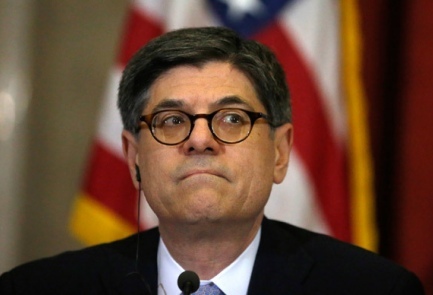
143393177342310791a_bU.S. Treasury Secretary Jacob Lew | Photo credit: Reuters

Under the sanctions developed over decades, hundreds of companies and individuals have been penalized not only for their roles in the country’s nuclear program but also for ballistic missile research, terrorism, human rights violations and money laundering.

Officials say the administration can meet its obligations because of how it interprets nuclear sanctions.

For example, they say measures designed to stop Iran from acquiring ballistic missiles are nuclear-related because they were imposed to push Iran into the negotiations. Also, they say sanctions that may appear non-nuclear are often undergirded by previous actions conceived as efforts to stop Iran’s nuclear program.

***********************

The Obama administration may have to backtrack on its promise that it will suspend only nuclear-related economic sanctions on Iran as part of an emerging nuclear agreement, officials and others involved in the process told The Associated Press Tuesday.

The problem derives from what was once a strong point of the broad U.S. sanctions effort that many credit with bringing Iran to the negotiating table in the first place.

Administration officials vehemently reject that any backtracking is taking place, but they are lumping sanctions together, differently from the way members of Congress and critics of the negotiations separate them.

Under the sanctions developed over decades, hundreds of companies and individuals have been penalized not only for their roles in the country’s nuclear program but also for ballistic missile research, terrorism, human rights violations and money laundering.

Now the administration is wending its way through that briar patch of interwoven economic sanctions.

The penalties are significant. Sanctioned foreign governments, companies or individuals are generally barred from doing business with U.S. citizens and businesses, or with foreign entities operating in the American financial system. The restrictions are usually accompanied by asset and property freezes as well as visa bans.

Negotiators hope to conclude a final nuclear deal by June 30. According to a framework reached in April, the U.S. will be required to lift sanctions that are related to Iran’s nuclear program but could leave others in place. President Barack Obama can suspend almost all U.S. measures against Iran, though only Congress can revoke them permanently.

“Iran knows that our array of sanctions focused on its efforts to support terrorism and destabilize the region will continue after any nuclear agreement,” Treasury Secretary Jack Lew told a gathering of American Jews in a weekend speech. U.S. officials will “aggressively target the finances of Iranian-backed terrorist groups and the Iranian entities that support them,” he said, including the Lebanese militant group Hezbollah and Iran’s Quds Force.

The Treasury Department’s sanctions point man, Adam Szubin, has been tasked with sorting out the mess, according to U.S. officials, though no clear plan has yet been finalized.

Officials say the administration can meet its obligations because of how it interprets nuclear sanctions.

For example, they say measures designed to stop Iran from acquiring ballistic missiles are nuclear-related because they were imposed to push Iran into the negotiations. Also, they say sanctions that may appear non-nuclear are often undergirded by previous actions conceived as efforts to stop Iran’s nuclear program.

The officials who provided information for this story spoke only on condition of anonymity because they were not authorized to speak publicly on the private discussions.

After years of negotiations, U.S. officials believe a deal is within reach that for a decade would keep Iran at least a year from being able to build a nuclear weapon.

In return, the U.S. would grant billions of dollars in relief from sanctions that have crippled Iran’s economy. But the whole package risks unraveling if the U.S. cannot provide the relief without scrapping sanctions unrelated to Iran’s nuclear program.

Administration officials say they are examining a range of options that include suspending both nuclear and some non-nuclear sanctions, a step that would face substantial opposition in Congress and elsewhere. Under one scenario, the U.S. could end non-nuclear restrictions on some entities, then slap them back on for another reason. But Iran could then plausibly accuse the U.S. of cheating on its commitments.

U.S. President Barack Obama has spoken about Iran potentially recouping up to $150 billion in assets trapped overseas. The process for how that would take place is still being worked through, said officials.

The Iranian Central Bank may prove the most glaring example of the administration’s dilemma, and officials acknowledge there is no way to give Iran the sanctions relief justified by its compliance without significantly easing restrictions on the institution.

The bank underpins Iran’s entire economy, and for years the U.S. avoided hitting it with sanctions, fearing such action would spread financial instability and raise oil prices. By late 2011, with Iran’s nuclear program advancing rapidly, Obama and Congress did order penalties, declaring the bank a “primary money laundering concern” and linking its activity to ballistic missile research, terror financing and support for Syrian President Bashar Assad.

The effects were far-reaching: Petroleum exports fell by 60%, Iran suffered runaway inflation, cash reserves dried up and industrial output in several sectors plummeted. And Iran agreed to talk about its nuclear program with the United States and five other world powers.

Now that the nuclear agreement is so close, Iran wants these sanctions lifted. The administration officials say all sanctions on the bank are nuclear-related.

Lew told the Jewish conference in New York that a nuclear accord would include the suspension of all “secondary” oil, trade and banking restrictions — those that apply to U.S. and non-U.S. banks, as well as foreign governments.

Many of these measures overlap with American sanctions tied to Iran’s nuclear program, and that has officials considering new sanctions to keep certain Iranian institutions under pressure.

Eliminating the secondary sanctions across the board could have wide-ranging implications, making it easier for Iran’s Revolutionary Guard Corps and its police, intelligence services and paramilitary groups to do business.

That possibility has Iran’s rivals in the region, including Israel and the Sunni monarchies of the Middle East, gravely worried.

“I share their concern,” Gen. Martin Dempsey, the Joint Chiefs of Staff chairman, said Tuesday in Jerusalem.

“If the deal is reached and results in sanctions relief, which results in more economic power and more purchasing power for the Iranian regime, it’s my expectation that it’s not all going to flow into the economy to improve the lot of the average Iranian citizen,” he said.

“I think they will invest in their surrogates. I think they will invest in additional military capability.”

Iran’s Revolutionary Guard is under U.S. sanctions because of its proliferation of weapons of mass destruction. But because the U.S. views the corps as so pernicious, the administration is considering new measures to help block it from meddling in the internal conflicts of Iraq, Lebanon, Syria and Yemen.

Of the 24 Iranian banks currently under U.S. sanctions, only one — Bank Saderat, cited for terrorism links — is subject to clear non-nuclear sanctions. The rest are designated because of nuclear and ballistic missile-related financing, while several are believed to be controlled by the Revolutionary Guard.

Will they be cleared for business with the world? U.S. officials still cannot say one way or another. Congress, too, has not received a list of banks and institutions that would be released from sanctions under the deal.

If the United States cannot deliver on its promises, it could take the blame for a collapse of the years-long negotiations toward a nuclear deal, putting the world — in the words of Obama and other U.S. officials — on a path toward military confrontation. At the same time, an Iran unburdened by sanctions could redouble efforts toward nuclear weapons capacity, while international unity and the global sanctions architecture on Tehran fray.

Op-Ed: Core Synergies in Israel’s Strategic Planning

June 9, 2015

Op-Ed: Core Synergies in Israel’s Strategic Planning, Harvard Law School National Security Journal via Israel National News, Prof. Louis René Beres, June 9, 2016

(Rather “high brow,” but well worth considering seriously. — DM)

Significantly, the most insidious synergy of all could involve a rudimentary failure to understand that belligerent enemy intentions ultimately depend for their efficacy upon confused, partial, or inadequately thoughtful Israeli responses.

*****************

To best serve Israel, the country’s strategic studies community should favor more conceptual or “molecular” assessments of expected security perils. Going forward therefore, it will not suffice for this community to operate in ways that are roughly comparable to the purely reportorial activities of journalists and pundits, that is, of ordinary observers who focus exclusively on current personalities and events. With this timely warning in mind, the following brief essay explains and argues for a specifically enhanced Israeli consideration of enemy “synergies.”

For the most part, the concept of synergy is already familiar to capable scientists and scholars. It signifies, above all, that the usually binding axioms of geometry can sometimes be overridden by various intersecting phenomena. Applied to Israel, this concept suggests that certain identifiable threats to the Jewish State should no longer be considered as wholly separate or discrete, but instead, as more-or-less interpenetrating and mutually-reinforcing.

The most obvious and portentous example of pertinent synergy for Jerusalem is represented by Iranian nuclear weapons and Palestinian statehood.[1]

At first, any such talk of “synergy” may sound needlessly pretentious, or at least more contrived, concocted, or complicated than is really the case. In medicine, after all, it would already seem plain that the dangers of smoking cigarettes and drinking alcohol together must exceed either one behavior without the other. This is because the synergistic effect is presumptively much greater than those consequences ascertained by merely adding these two injurious activities together.

For Israeli planners, the still-widely-unrecognized synergy between Iranian nuclearization and “Palestine” should finally be treated with a more emphatic intellectual regard.[2] Notwithstanding the declared assumptions of virtually all acknowledged national strategists, Iran and Palestine,[3] as “negative force multipliers,”[4] do not represent thoroughly separate or unrelated hazards to Israel. To continue to assess each one independently of the other would be a serious conceptual error. It would be to consciously obscure what is potentially most revealing and most ominous.

Israel’s main security policies must involve carefully nuanced considerations of active defense, as well as of deterrence, preemption, and war-fighting. The country’s multilayered missile defenses are central to national survival. As long as incoming rocket aggressions from Gaza, West Bank, and/or Lebanon (Hezbollah) were to remain “only” conventional, the inevitable leakage could still be tolerable. But once these rockets were fitted with chemical and/or biological materials, such porosity could quickly prove “unacceptable.[5] This means, among other things, that the projected harms of rocket attacks upon Israel would depend not only upon the inherent dangers posed by a particular weapon system, but also upon the ways in which these individual harms would intersect.[6]

Once facing Iranian nuclear missiles, Israel’s “Arrow” ballistic missile defense system would require a fully 100% reliability of interception. To achieve any such level of reliability, however, would be impossible. Now, assuming that the prime minister has already abandoned any residual hopes for a cost-effective eleventh-hour preemption against pertinent Iranian nuclear assets , this means that Israeli defense planners must prepare instead, and longer-term, for stable deterrence.[7]

Theory is a net. Only those who cast, can catch.[8] Because of the expectedly corrosive interactive effects involving Iranian nuclear weapons and Palestinian statehood, for example, Israel will need to update and refine its existing theories of deterrence.

Looking ahead, there are various antecedent issues of theoretical concern. For one, Israel’s leaders will have to accept that certain more-or-less identifiable leaders of prospectively overlapping enemies might not necessarily satisfy the complex criteria of rational behavior in world politics. In such partially improbable but still conceivable circumstances, assorted Jihadist adversaries in Palestine, Iran, Syria, Iraq, Lebanon, or elsewhere might sometime refuse to renounce certain still-contemplated aggressions against Israel.[9]

By definition, these irrational enemies could exhibit such more-or-less plausible refusals even in anticipation of fully devastating Israeli reprisals. But, would they still remain subject to alternative threats or forms of deterrence? And might an entire state sometime exhibit such non-rational orientations, thereby becoming, in essence, a suicide terrorist writ large?

These utterly core questions can no longer be ignored. Sooner rather than later, and facing new and prospectively incalculable synergies from Iranian and Palestinian aggressions, Israel will need to take appropriate steps to assure that: (1) it does not become the object of any non-conventional attacks from these enemies; and (2) it can successfully deter all possible forms of non-conventional conflict. To meet this ambitious but indispensable goal, Jerusalem, inter alia, absolutely must retain its recognizably far-reaching conventional superiority in pertinent weapons and capable manpower, including effective tactical/operational control over the Jordan Valley.

In this connection, a Palestinian state could make Israeli military and civilian targets more opportune for Iranian rockets. It could simultaneously undermine the Jewish State’s critical early-warning systems.

Maintaining a qualitative edge in conventional war-fighting capacity could reduce Israel’s overall likelihood of ever actually having to enter into a chemical, biological, or even nuclear exchange with regional adversaries. CorrespondinglyIsrael should plan to begin to move incrementally beyond its increasingly perilous posture of “deliberate nuclear ambiguity.”[10] By preparing to shift toward prudently selective and partial kinds of “nuclear disclosure” – in other words, by getting ready to take its “bomb” out of the “basement,” but in carefully controlled phases[11] – Israel could best ensure that its relevant enemies will remain sufficiently subject to Israeli nuclear deterrence.

In matters of defense strategy, truth may emerge through paradox. Israeli planners, it follows, may soon have to acknowledge that the efficacy and credibility of their country’s nuclear deterrence posture could sometime vary inversely with enemy perceptions of Israeli nuclear destructiveness. However ironic or counter-intuitive, enemy views of a too-large or too-destructive Israeli nuclear deterrent force, or of an Israeli force that is not sufficiently invulnerable to first-strike attacks,[12] could substantially undermine this deterrence posture.

Here, too, carving “Palestine” out of the still-living body of Israel (whatamounts to the unhidden Palestinian Authority plan for a “one state solution”), could impact the Iranian nuclear threat, and vice-versa. Once again, Israel’s defense planning must account for possible and prospectively prohibitive synergies.

Also critical, of course, is that Israel’s current and future adversaries will always acknowledge the Jewish State’s nuclear retaliatory forces as “penetration capable.” This suggests forces that will seem “assuredly capable” of penetrating any Arab or Iranian aggressor’s active defenses. Naturally, a new state of Palestine would be non-nuclear itself, but it could still present a new “nuclear danger” to Israel by its probable impact upon the prevailing regional “correlation of forces.”[13] Palestine, therefore, could represent an indirect but nonetheless markedly serious nuclear threat to Israel. Here, yet again, is an example of the need for Israeli planners to think synergistically.

More remains to be done. Israel should continue to strengthen its active defenses, but Jerusalem must also do everything possible to improve each critical and interpenetrating component of its nuanced deterrence posture. In this bewilderingly complex and dialectical[14] process of strategic dissuasion, the Israeli task may require more incrementally explicit disclosures of nuclear targeting doctrine, and, accordingly, a steadily expanding role for cyber-defense and cyber-war.

Even before undertaking such delicately important refinements, Israel will need to more systematically differentiate between adversaries that are presumably rational,[15] irrational, or “mad.”[16]

Overall, the success of Israel’s national deterrence strategies will be contingent, inter alia, upon an informed prior awareness of enemy preferences, and of specific enemy hierarchies of preferences. In this connection, altogether new and open-minded attention will need to be focused on the seeming emergence of “Cold War II” between Russia and the United States. Any such emergence, of course, could have meaningful effects upon both Israeli and adversarial military postures.[17]

If, within a pattern of “Cold War II,” a newly-formalized state of Palestine does not find itself in the same ideological orbit as Iran, the net hazard to Decision-makers will then need to explore and acknowledge what amounts, paradoxically, to a geometry of chaos. Israel could still exceed the sum of relevant intersecting threats. While attempting to survive amid growing regional disorder, therefore, Israel’s leaders should learn to understand the profound strategic limits of normal “geometry”—where, quite mundanely, the whole is always expected to equal to the sum of its parts—and to augment an enhanced understanding with certain new geometric orthodoxies. In essence, these decision-makers will then need to explore and acknowledge what amounts, paradoxically, to a geometry of chaos.

Still, even this long-hidden geometry could reveal a discernible sense of symmetry and form, including the precise shape of certain critically interwoven enemy threats. Wherever the belligerent whole might add up to more than the sum of its constituent parts, Israel’s leaders could discover lethal hazards of adversarial synergies. Significantly, the most insidious synergy of all could involve a rudimentary failure to understand that belligerent enemy intentions ultimately depend for their efficacy upon confused, partial, or inadequately thoughtful Israeli responses.

When Pericles delivered his famous Funeral Oration, with its meticulously elaborate praise of Athenian civilization, his geostrategic perspective was applicable to more than the particular struggle at hand. Recorded by Thucydides, Pericles had expressed confidence in a military victory for Athens (a confidence, of course, that turned out to be misplaced), but also grave concern for any self-imposed limitations along the way: “What I fear more than the strategies of our enemies,” he had warned, “is our own mistakes.” However unforeseen, there is a vital lesson here for present-day Israel: In observing enemy preparations for war and terror, never forget that the ultimate success of these preparations will depend upon Israel’s selected responses.

There exists an overarching or determinative synergy between certain individual or intersecting enemy preparations and Israel’s own prepared policies and reactions.

In all world politics, but especially in the Middle East, we are present at the gradual unveiling of a “big picture,” but the nucleus of meaning—the essential truth of what is taking place—involves what is left out. For the foreseeable future, Israel’s enemies will continue with their ardent preparations for every form of war and terrorism. Unaffected by any civilizing expectations of international law of comity, these calculated preparations will proceed largely on their own track, culminating, if left suitably unobstructed, in new and ever more serious aggressions against Israel. The Jewish State must remain vigilant of such an emergent “big picture,” but also of every imaginable intersection or pattern of intersections between its component parts.

Always, Israel’s leaders and planners must reflect, core dangers to national security are profoundly synergistic.

Always, Israeli policy must recall, these fundamental dangers are potentially much greater than the additive sum of their  respective parts.

Always, Jerusalem must insightfully recognize, even a bewildering geometry of chaos has potentially meaningful sense and form.

Always, it must be Israel’s consuming task, to discover this synergistic truth.

Sources: 

[1] There are other still more complex synergies that need to be examined. These concern, especially, the intersecting roles of ISIS and al-Qaeda, including pertinent sub/state-state relationships with Syria, Iran, Libya, Lebanon, Yemen, and Saudi Arabia. Also worth exploring, in this connection, is the plausible escalation of “Cold War II,” a broadly transforming context of world politics that could create a “synergy of synergies.” Although all such bewildering hypotheticals may be intimidating or annoying to scholars and policy-makers, there remains no reasonable explanatory alternative to taking them into account.

[2] Rabbi Eleazar quoted Rabbi Hanina, who said: “Scholars build the structure of peace in the world.” See: The Babylonian Talmud, Order Zera’im, Tractate Berakoth, and IX.

[3] Once a Palestinian state were created, it would more likely become subject to destruction by assorted Arab forces, than by Israel. Plausibly, in this connection, ISIS forces fighting their way westward across Jordan could quickly arrive at the West Bank (Judea/Samaria), and make fast work of any now indigenous Hamas/PA national “army.” In such dire circumstances, the citizens of “Palestine” would assuredly rue the day of their recently-declared “independence.”

[4] This is a term that will likely be favored by the generals, over synergy.

[5] See, on this issue: Louis René Beres and (Major-General/IDF/Res.) Isaac Ben-Israel, “Think Anticipatory Self-Defense,” The Jerusalem Post, October 22, 2007; Professor Beres and MG Ben-Israel, “The Limits of Deterrence,” Washington Times, November 21, 2007; Professor Beres and MG Ben-Israel, “Deterring Iran,”Washington Times, June 10, 2007; Professor Beres and MG Ben-Israel, “Deterring Iranian Nuclear Attack,” Washington Times, January 27, 2009; and Professor Beres and MG Ben-Israel, “Defending Israel from Iranian Nuclear Attack,” The Jewish Press, March 13, 2013. See also: Louis René Beres and (General/USAF/ret.) John T. Chain, “Could Israel Safely Deter a Nuclear Iran?” The Atlantic, August 9, 2012; Professor Beres and General Chain, “Living With Iran,” BESA Center for Strategic Studies, Israel, May 2014; and Louis René Beres and (Lt.General/USAF/ret.) Thomas McInerney, “Obama’s Inconceivable, Undesirable, Nuclear-Free Dream,” U.S. News & World Report, August 29, 2013.

[6] Here, it warrants mention that Palestinian statehood could represent an enlarged set of risks to Israel’s Dimona nuclear reactor. Already, in 1991 and 2014, this small reactor came under missile and rocket attack from Iraqi and Hamas aggressions respectively. For authoritative assessments of these attacks and related risks, see: Bennett Ramberg, “Should Israel Close Dimona? The Radiological Consequences of a Military Strike on Israel’s Plutonium-Production Reactor,” Arms Control Today, May 2008, pp. 6-13.

[7] With particular reference to nuclear deterrence, the primary function of Israel’s nuclear forces must always be dissuasion ex ante, rather than revenge ex post.

[8] This convenient metaphor is generally attributed to Novalis, the late 18th-century German poet and scholar. See, for example, introductory citation by Karl R. Popper, in his The Logic of Scientific Discovery (1959). Ironically, perhaps, Novalis’ fellow German poet, Goethe, had declared, in his early Faust fragment (Urfaust): “All theory, dear friend, is grey. But the golden tree of life is green.” (Grau, theurer Freund, ist alle Theorie, Und grűn des Lebens goldner Baum.)

[9] See, on this point: Louis René Beres, “Religious Extremism and International Legal Norms: Perfidy, Preemption, and Irrationality,” Case Western Reserve Journal of International Law, Vol. 39, No.3., 2007-2008, pp. 709-730.

[10] See: Louis René Beres, “Like Two Scorpions in a Bottle: Could Israel and a Nuclear Iran Coexist in the Middle East,” The Israel Journal of Foreign Affairs, Vol. 8, No. 1., 2014, pp. 23-32; Louis René Beres, “Facing Myriad Enemies: Core Elements of Israeli Nuclear Deterrence,” The Brown Journal of World Affairs, Vol. XX, Issue 1., Fall/Winter 2013, pp. 17-30; Louis René Beres, “Lessons for Israel from Ancient Chinese Military Thought: Facing Iranian Nuclearization with Sun-Tzu,”Harvard National Security Journal, 2013; Louis René Beres, “Striking Hezbollah-Bound Weapons in Syria: Israel’s Actions Under International Law,” Harvard National Security Journal, 2013; Louis René Beres, “Looking Ahead: Revising Israel’s Nuclear Ambiguity in the Middle East,” Herzliya Conference presentation, 2013; March 2013; IDC, Herzliya; Louis René Beres and (General/USAF/ret) John T. Chain, “Could Israel Safely Deter a Nuclear Iran?” The Atlantic, 2012.

[11] On identifying alternative nuclear disclosure options, see: Louis René Beres, “Israel’s Strategic Doctrine: Updating Intelligence Community Responsibilities,”International Journal of Intelligence and Counterintelligence, Vol. 28, No. 1, Spring, 2015, pp. 89-104.

[12] On Israeli submarine basing measures, see: Louis René Beres and (Admiral/USN/ret.) Leon “Bud” Edney, “Israel’s Nuclear Strategy: A Larger Role for Submarine-Basing,” The Jerusalem Post, August 17, 2014; and Professor Beres and Admiral Edney, “A Sea-Based Nuclear Deterrent for Israel,” Washington Times, September 5, 2014.

[13] See: Louis René Beres, “Understanding the Correlation of Forces in the Middle East: Israel’s Urgent Strategic Imperative,” The Israel Journal of Foreign Affairs,Vol. IV, No. 1 (2010).

[14] Dialectic formally originated in the fifth century BCE, as Zeno, author of the Paradoxes, had been acknowledged by Aristotle as its inventor. In the middle dialogues of Plato, dialectic emerges as the supreme form of philosophical/analytic method. Here, Plato describes the dialectician as one who knows best how to ask and answer questions. This particular knowledge – how to ask, and to answer questions, sequentially – should now be insistently transposed to the organized study of Israeli security issues.

[15] Israelis, like Americans, are inclined to project their own dominant sense of rationality upon adversaries. Acknowledging that western philosophy has always oscillated between Plato and Nietzsche, between rationalism and irrationalism, we have all routinely cast our psychological lot with the Greek thinkers and their inheritors. Significantly, however, Israel is now up against a steadily transforming ordering of the geostrategic universe; now, Israel’s strategists might sometimes be better advised to read Dostoyevsky and Kafka, than to dwell too fixedly on Platonic rationalism.

[16] “Do you know what it means to find yourselves face to face with a madman,” inquires Luigi Pirandello, “with one who shakes the foundations of all you have built up in yourselves, your logic, and the logic of all your constructions? Madmen, lucky folk, construct without logic, or rather, with a logic that flies like a feather.”

[17] On this point, see: Louis René Beres, “Staying Strong: Enhancing Israel’s Essential Strategic Options,” Harvard National Security Journal, Harvard Law School, June 13, 2014.

 

US Diplomats Reveal EU Sanctions Assault After Iran Deal

June 9, 2015

US Diplomats Reveal EU Sanctions Assault After Iran Deal, Israel National News, Ari Yashar, June 9, 2015

EU flagEU flag (illustration)Flash 90

Israel has been fighting the Iran nuclear deal due to the great danger it poses, but senior Western officials have revealed it is also doing so because once a deal is reached, the European Union (EU) and UN are planning a diplomatic offensive targeting the Jewish state.

The political assault is meant to force Israel into returning to yet more peace talks with the Palestinian Authority (PA) and making dangerous concessions in the process – and reportedly the EU already has a list of sanctions ready to force Israel to bend.

A senior Western diplomat told Ma’ariv in a report published Tuesday that “a diplomatic attack against Israel is expected soon that will surprise even the pessimists in Jerusalem.”

“In the (UN) Security Council, in western capitals and at EU headquarters, they are just waiting for the Iran deal to be signed and for it to be approved by the American Congress,” warned the diplomatic source.

It appears that the waiting period will likely expire in September, at which time a UN General Assembly will open in tandem with the first shots of the diplomatic barrage against Israel.

Diplomatic sources familiar with Western European positions vis-a-vis Israel said the EU already has a list ready, itemizing sanctions against Israel in the fields of trade, agriculture, science and culture.

That list is to be translated into an economic assault – unless Israel presents a new set of concessions it is willing to make for a new round of peace talks, after the last set of talks was torpedoed by the PA signing a unity deal with the Hamas terrorist organization.

“S‭enior officials in Jerusalem are aware of the existence of sanctions documents at EU headquarters, some of which have even fallen into their hands,” one diplomatic source revealed to Ma’ariv.

The source added that US President Barack Obama’s threat made in an Israeli interview this month, according to which he may cut US support for Israel at the UN, specifically was referring to “the sanctions file” against Israel which is currently biding its time at the EU headquarters.

The US is reportedly weighing its responses, as the current Israeli government does not appear to be likely to launch a new series of peace talks after the massive failure of the last round, and the PA’s unilateral moves in the international arena in breach of the 1993 Oslo Accords that founded it.

“The make-up of the government is such that no faction or minister will stand up to the lack of an initiative from Prime Minister (Binyamin) Netanyahu,” a diplomat from New York told Ma’ariv. “The coming months will be difficult for Israel. This time Israel will pay a heavy price for continued stagnation. This time, it is also uncertain if Uncle Sam will succeed in saving Israel, and maybe he won’t want to do so.”

Leaked Information: Khamenei’s Lies Exposed

June 9, 2015

Leaked Information: Khamenei’s Lies Exposed, Front Page Magazine, June 9, 2015

(?????????????????? — DM)

1.29.13-Ayatollah-Ali-Khamenei-431x350

[W]hat the ayatollah is announcing to the media — that basically the Islamic Republic does not desire to seal a final nuclear deal with the six world powers — is not the truth.  The leaked information (in Persian language) indicates that the Supreme Leader has already instructed the nuclear negotiating team and his advisors to ignore his public statements and seal the final nuclear deal.

******************

Iran’s paramount religious leader can be described as one of the longest-ruling dictators in the Middle East who still enjoys the throne. An ideologue and a Shiite Islamist, he is also a shrewd Machiavellian politician.

Although he attempts to project himself to the Muslim world as a united religious leader who pursues truth, faith, and honesty, his double-faced character can easily be detected in the discrepancies among his statements and policies.

When Khamenei came to power, he lacked the charisma of his predecessor, Ayatollah Ruhollah Khomeini. To rule, he continued the major policies of his predecessor, relying on hard power and hardliners to suppress domestic opposition, making different statements to the public than in private, and funding Shiite or non-Shiite extremists groups in the region such as Hezbollah and the Houthis.

In addition, he created the Office of the Supreme Leader, comprised of close advisors and excluding the presidential and other major offices in order to further consolidate his power and prevent the leaking of information. The Islamic Republic’s major domestic and foreign policy decisions are made in the small gilded circle of his office and he is the final decision-maker of the country.

To rule, the ayatollah began wielding power without being held accountable. In order to do so, his government pre-select a handful of candidates to become president. Presidents do not have any actual power, but would be held accountable, blamed for any gaffes such as economic mismanagements and failure in nuclear talks, among other things. This system has so far worked for the ayatollah.

His predecessor and founder of the Islamic Republic came to power by promising people that oil revenues will be distributed among the population and that people do not have to pay for major bills such as electricity or water (in a speech that he gave in Behesht e Zahra). The videos and audios of that speech were removed from public access. Now, one can even be punished or executed by the Islamic Republic if the government finds that particular speech in one’s possession.  Ayatollah Khamenei also continued this dual policy of deceiving the public.

Most recently, with regards to the marathon nuclear negotiations, Mr. Khamenei’s double standards have become more obvious due to leaked information.

In less than a month, the six world powers (known as the P5+1; the United States, China, Germany, United Kingdom, France, and Russia) and the Islamic Republic will be reaching the deadline for their marathon nuclear talks, marking one the lengthiest international negotiations of our generation.

The position and opinion of the Islamic Republic’s paramount leader, Ayatollah Ali Khamenei, on the nuclear negotiations and the terms of the final nuclear deal can be characterized as the most crucial factor in determining whether a final deal will be reached by the end of June or not.

Khamenei recently stated, “We will never yield to pressure… We will not accept unreasonable demands… Iran will not give access to its (nuclear) scientists,” he added, “They say we should let them interview our nuclear scientists. This means interrogation… I will not let foreigners talk to our scientists and to interrogate our dear children… who brought us this extensive (nuclear) knowledge… We will not allow the privacy of our nuclear scientists or any other important issue to be violated.”

Nevertheless, what the ayatollah is announcing to the media — that basically the Islamic Republic does not desire to seal a final nuclear deal with the six world powers — is not the truth.  The leaked information (in Persian language) indicates that the Supreme Leader has already instructed the nuclear negotiating team and his advisors to ignore his public statements and seal the final nuclear deal.

The Supreme Leader’s double-standards and the difference in what he states publicly and what he instructs behind the scenes, indicate that he indeed needs the final nuclear deal and he will be more likely willing to allow inspections in order to obtain the deal. Ayatollah Khamenei is cognizant of the fact that the final nuclear deal is geopolitically, economically, and ideologically a win for him. Iran’s nuclear infrastructure will not be dismantled, Iran’s break-time to become a nuclear state will shrink from one year to zero in the next few years, Iran’s economy will be strengthened, and the US will likely ignore Iran’s increasing influence and their proxy wars in the region because of the nuclear deal.

Khamenei is being disingenuous with the public and other nations for several reasons. First of all, The fact that Iran’s negotiating team are continuing with the talks, sitting at the same table with Obama administration’s diplomats, and the fact that there is contradiction between what the Supreme Leader and his advisors stated publicly and behind the scenes indicates that Khamenei is giving a green light to the nuclear team to get a nuclear agreement from the White House, the major player in the talks.  Secondly, by showing that Iran is not in need of such a deal, Khamenei is giving leverage to the Iranian negotiating team to obtain more concessions from the West.

Khamenei attempts to publicly show that he is a strong religious and nationalistic leader who is totally against foreign inspection and monitoring of his country. Finally, he desires to project the picture that he is not desperate for the final nuclear deal in order to get as many concessions as he can from the Obama’s administration. And so far, his tactics and dual policies have worked for him in further strengthening his throne and power.

Super Power Poker – Live From Iran

June 9, 2015

Super Power Poker – Live From Iran, Clarion Project via You Tube, June 9, 2015

The stakes are the highest they’ve ever been. Nuclear Iran. The US, Iran, Saudi Arabia and Israel play for the security of the world. This is the ultimate hold’em game. Who holds the aces, who will go all in, who is bluffing and who has a tell that will leave them with nothing but a mushroom cloud. No nukes for Iran.


Syria Asks IAEA for Help Converting Nuclear Reactor

June 8, 2015

Syria Asks IAEA for Help Converting Nuclear Reactor, Jewish Press, Hana Levi JulianJune 8, 2015

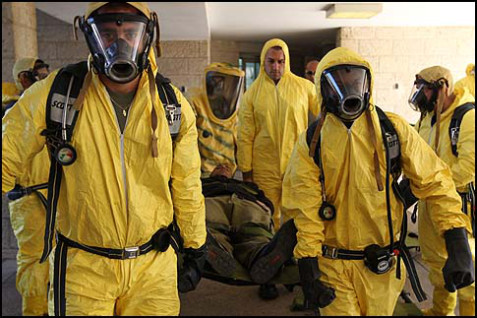
The border police run an exercise, while they train for chemical , biological or atomic. warfare. Feb 14 2011.  Photo by Nati Shohat/Flash90. *** Local Caption *** îâá éøåùìéí  àéîåï àáë çìéôåú îéâåï àéîåï úéøâåì úøâéì Israeli’s Border Police training for chemical, biological, and nuclear attacks. Photo Credit: Nati Shohat / Flash 90

IAEA head Yukiya Amano told reporters Monday that Syria has told the agency it would ship the higher-grade uranium abroad.

However, it is not clear where Syria would ship the higher-grade uranium — Iran is Syria’s closest ally – and neither is it clear what grade its uranium currently is.

**********************

The regime of Syrian President Bashar al-Assad has asked the United Nations International Atomic Energy Agency for help with a nuclear reactor near Damascus, international media agencies reported Tuesday.

The UN agency is studying the Syrian request to help convert the reactor, which currently runs on highly-enriched uranium, into one that uses lower grade nuclear fuel.

IAEA head Yukiya Amano told reporters Monday that Syria has told the agency it would ship the higher-grade uranium abroad.

However, it is not clear where Syria would ship the higher-grade uranium — Iran is Syria’s closest ally – and neither is it clear what grade its uranium currently is.

Low enriched uranium is defined as that which is enriched to less than five percent of fissile purity. Weapons quality uranium is enriched above 20 percent but that which is used to fuel an atomic bomb is enriched to 90 percent.

Amano said the IAEA is studying the request and has yet to make a decision.

Shoshana Bryen: The Kurds: A Guide for U.S. Policymakers

June 7, 2015

Shoshana Bryen: The Kurds: A Guide for U.S. Policymakerssecurefreedom via You Tube, June 5, 2015

Shoshana Bryen, Senior Director, Jewish Policy Center; Former Senior Director for Security Policy, Jewish Institute for National Security Affairs (JINSA):


Why Does the Iranian Regime Rape its Own Citizens?

June 7, 2015

Why Does the Iranian Regime Rape its Own Citizens? The Clarion Project,  Elliot Friedland, June  7, 2015

(Don’t worry. Once The Islamic Republic of Iran gets the bomb, it may become as civilized as the Islamic State. — DM)

Iran-Basij-Hooded-Men-IP_1In 2009 the Basij militia (pictured here) raped protesters as a matter of policy. (Photo: Reuters)

In prisons, virgin girls who are sentenced to death (the death penalty covers a wide variety of crimes, including the nebulous charge of Moharabeh, “enmity against God”) are typically forced into “temporary marriages” with the prison guards and raped on the night before their execution.

According to the Iran Human Rights Documentation Center this is “because the guards believed young girls executed while virgins would go to heaven” and they wanted to prevent that.

Rape and other forms of sexual assault are a means of humiliation and degrading the regime’s opponents – and are also a potent means of intimidating others into cowed obedience.

******************

Like all countries which use sharia law as state law, the Islamic Republic of Iran institutionalizes a litany of women’s rights abuses.

These include:

  • The husband is the head of the family, and his wife is legally bound to obey him. Article 1,105 of the civil code states: “In relations between husband and wife, the position of the head of the family exclusively belongs to the husband.”
  • A married woman cannot leave the country without her husband’s permission.
  • A woman’s testimony as a witness is worth half that of a man, in compliance with the Sharia basis of the legal system.
  • Women are forced to wear the hijab, a headscarf, in all public places. More broadly, Islamic modesty requirements are enforced by a morality police.
  • Polygamy and temporary marriage are permitted for men (up to four wives are allowed, subject to certain restrictions), but not for women.

Moreover, women are frequently subject to honor killings. In cases where the father kills his daughter, he is not liable for the death penalty, but only for imprisonment. This is further compounded as when someone is murdered, the family of the victim can forgive the murderer and choose to forgo punishment.

As harsh as the everyday discrimination is, however, the most serious violations are meted out against dissenters.

Use of rape as a method of torture against political opponents has been deployed widely against both men and women, as well as sexual taunts, threats and other forms of assault.

The International Campaign for Human Rights in Iran told PBS that in the aftermath of the disputed 2009 election, “rape was routinely practiced as a matter of policy to intimidate young ordinary people from ever coming out to protest again.”

In prisons, virgin girls who are sentenced to death (the death penalty covers a wide variety of crimes, including the nebulous charge of Moharabeh, “enmity against God”) are typically forced into “temporary marriages” with the prison guards and raped on the night before their execution.

According to the Iran Human Rights Documentation Center this is “because the guards believed young girls executed while virgins would go to heaven” and they wanted to prevent that.

A former Iranian Basij militia man spoke to The Jerusalem Post on the condition of anonymity and recorded his role in perpetrating these rapes when he was a prison guard.

He said, “I could tell that the girls were more afraid of their ‘wedding’ night than of the execution that awaited them in the morning. And they would always fight back, so we would have to put sleeping pills in their food. By morning, the girls would have an empty expression; it seemed like they were ready or wanted to die. I remember hearing them cry and scream after [the rape] was over. I will never forget how this one girl clawed at her own face and neck with her fingernails afterwards. She had deep scratches all over her.”

Rape and other forms of sexual assault are a means of humiliation and degrading the regime’s opponents – and are also a potent means of intimidating others into cowed obedience.

Thus, the Islamic Republic inflicts on the bodies of its citizens the purest demonstration of raw power, reminding them who rules Iran.

Forfeiting America’s Military Leverage

June 6, 2015

Forfeiting America’s Military Leverage, American ThinkerAbraham Katsman, June 6, 2015

International diplomacy, it is said, is the art of letting the other party have your way.  While there are numerous diplomatic strategies to accomplish that, one of history’s more effective means of pursuing foreign policy goals was for a superior power to conspicuously display naval forces in the waters of the weaker power, posing a military threat until satisfactory terms with the weaker nation could be reached. Such “gunboat diplomacy” could be remarkably persuasive.

But if there is such a thing as the opposite of gunboat diplomacy, we are witnessing it in the nuclear negotiations with Iran.  There will be repercussions.

The United States and other leading nations taking part in the negotiations have military capabilities that dwarf those of Iran, at best a second-rate power. Yet, in spite of the huge military advantages — not to mention the moral gulf between the U.S and Iran, or the huge stakes of allowing Iran to go nuclear — negotiations have proceeded as if between equals.

U.S. military spending is greater than that of the next seven countries combined. Superpower America has a near-monopoly on those gunboats, as well as military aircraft and cruise missiles. But that power is only useful if there is a willingness to use it — or, more precisely, if America’s enemies believe that that there is such a willingness.

If there were ever thoughts that the U.S. under Obama would lay down the law with Iran and order, under overt military threat, the “voluntary” dismantling of the mullah’s nuclear program, they have passed quietly. Sure, President Obama occasionally makes some perfunctory mention that the military option is still on the table, but no one takes his half-hearted warning seriously, least of all the Iranians.

It doesn’t help matters when Obama says, as he did on Israeli TV this week, “A military solution will not fix [the Iranian nuclear problem]. Even if the United States participates, it would temporarily slow down an Iranian nuclear program but it will not eliminate it.”

Obama has effectively forfeited America’s military leverage. He has taken the position that the only alternative to his Iranian appeasement approach is war, and that war is not an outcome acceptable to him under any circumstances.

No Iranian misconduct disrupts Obama’s pacifism. Against American interests and those of America’s allies, Iran has expanded its reach into Syria, Lebanon, Iraq, and Yemen, ethnically cleansing Sunni communities in Iraq. It has seized a cargo ship under U.S. protection, and holds several Americans hostage (complete with an ongoing farcical “trial” against Washington Post reporter Jason Rezaian for espionage). It has increased its nuclear stockpile and violated its existing international agreements, including regarding type and number of centrifuges it may operate, and announced that it will build additional reactors with the help of China and Russia.

In fact, America’s gunboats notwithstanding, it is Iran that has been dictating the terms of a prospective agreement. Iran’s intransigence in the nuclear negotiations has been rewarded: the U.S. has already backed off demands regarding Iranian nuclear enrichment, centrifuges, missile technology, and duration of the prospective agreement — and gotten nothing in return.

Not only is the United States administration going along with all this, but it has released some $11 billion in cash assets to the Islamic Republic. On top of that, it is offering a “signing bonus” of tens of billions of additional dollars to Iran for coming to a nuclear agreement, irrespective of Iranian behavior, support for terror or holding Americans prisoners.

In this context, with no credible American military threat on the table, we should not be surprised that Iran is getting everything it wants from the negotiations at no cost and no risk. As a bonus, it gets to show the world how unserious its American arch-enemy has become.

For the last century, the United States has asserted a global foreign policy, the core of which is being ready, willing, and able to impose its military might to protect its vital interests. Is there a more compelling current American interest than to keep nuclear weapons out of the reach of a rabidly anti-American, anti-Semitic, destabilizing, theocratic, apocalyptic regime, which also threatens the world’s major oil suppliers and is the world’s greatest supporter of terror? If Obama cannot even consider the military protection of that interest, he has rendered American foreign policy impotent, and its military capabilities irrelevant.

That abandonment of longstanding American projection of military power to protect global interests does not go unnoticed, by either friend or foe. The American military’s deterrent effect has been eroded; its security umbrella to its allies looks a lot less secure. The effect on alliances both current and future is corrosive.

From Riyadh to Taipei to Jerusalem, from Moscow to Beijing to Pyongyang, the world is paying close attention. As much as these nuclear negotiations are about Iran, they are even more about America.