Thursday and Friday, April 16-17, two branches of Al Qaeda took the lead in violent conflicts, catapulting key areas of the Middle East into greater peril than ever. In Yemen, Al Qaeda in the Arabian Peninsula (AQAP) and in Iraq, the Islamist State in Iraq and the Levant (ISIS), launched new offensives 3.050 kilometer apart.
DEBKAfile’s military sources report that both branches of the Islamist terror movement used the absence of professional adversarial troops on the ground – American and Saudi – to push forward in the two arenas. Washington and Riyadh alike had decided to trust local forces to carry the battle – Iran-backed Shiite militias alongside Iraqi troops against ISIS in Iraq, and the Yemeni army against Iran-backed Houthi rebels in Yemen.
This gave Al Qaeda a free passage to carry on, especially when offered the further benefit of contradictions in the Obama administration’s attitude toward its foe, Tehran: On the one hand, Iran was offered lead role in the region for the sake of a nuclear deal; on the other, it faced US opposition for its support of rebel forces in Yemen.
The conflict in Yemen is no longer a straight sectarian proxy war between Sunni-ruled Saudi Arabia and Shiite Iran (that also stretches to Iraq and Syria.), as a result of what happened Thursday, April 16.
AQAP embarked on a broad offensive in southern Yemen’s Hadhramaut region on the shore of the Gulf of Aden and captured the important seaport of Mukalla as well as the coatal towns of Shibam and Ash-Shirh. The group also overran Yemen’s Ryan air base in the absence of real resistance from the Yemen army’s 27th Brigade and 190th Air Defense Brigade – both of which are loyal to the escaped president Mansour Hadi.
This winning AQAP offensive was instructive in four ways:
1. For the first time in two decades, Al Qaeda in Arabia is operating on professional military lines. Its sweep across Yemen’s southern coastland showed the Islamists to be plentifully armed with antiair missiles and other air defense systems.
2. AQAP’s smuggling rings run a large fleet of vessels which collaborate with Somali pirates. This fleet is now preparing to seize control of the strategic Socotra archipelago of four islands opposite Hadhramaut and only 80 kilometers from the Horn of Africa. Socotra sits in the bottleneck for shipping from the Arabian Sea and Persian Gulf to the Gulf of Aden and on to the Suez Canal.
On one of the Socotra islands, the US set up an air base and deployed special forces in 2011, in readiness for an attack on Iran’s nuclear facilities. AQAP does not have enough strength to capture this island, but is capable of holding it siege and under barrage from sea and land.
3. The Arabian branch of Al Qaeda has for the first time gained control of a large sweep of territory in Yemen, a feat analogous to its fellow branch’s advances in Iraq since last June.
4. Hadramauth is bounded to the north and the east by the Saudi Arabian Rub’ al Khali or Empty Quarter, which is the world’s second largest desert region. AQAP has therefore gained proximity to the oil kingdom through its desolate back door.
Our military sources note that Saudi Arabian and United Arab Emirate air forces have controlled Yemeni air space since March 26, supported by US intelligence assistance. They might have been expected to bomb AQAP units and stall their advance through Hadhramaut.
But they refrained from doing so for a simple reason: Both Riyadh and its Gulf ally are unwilling to throw their own ground forces into the war against the Shiite Houthi rebels. Still in proxy mode, they expect Al Qaeda’s Arabian jihadis to save them the trouble of putting their troops on the ground to vanquish the Shiite rebels.
The same principle guides Washington in Iraq – albeit with different players. There, the Americans rely increasingly on the pro-Iranian Iraqi Shiite militias, under the command of Iranian Revolutionary Guards officers, rather than the Iraq army, to cleanse the ground of ISIS conquests.
Two weeks after Western publications trumpeted the militias’ success in liberating the Iraqi town of Tikrit from its ISIS conquerors, it turns out that the fighting is still ongoing and the jihadis are still in control of some of the town’s districts.
Iraqi Prime Minister Haidar al-Abadi, while on a visit to Washington this week, told reporters that, after the Tikrit “victory,” his army was to launch an offensive to recapture the western province of Anbar on the Syrian border from the grip of ISIS.
The situation on the ground is a lot less promising. As Abadi and President Barack Obama discussed future plans for the war to rid Iraq of the Islamists, ISIS launched fresh offensives for its next goals, Ramadi, a town of half a million inhabitants 130 kilometers west of Baghdad, and the oil refinery town of Baiji
The jihadis have already moved in on Ramadi’s outskirts after the Iraqi army defenders started falling back.
If inspections, sanctions, sabotage and political isolation ever had a chance to stop Iran from getting the bomb (this was always a dicey proposition), that certainly is no longer the case. It is more evident than ever that only military action can stop a determined state such as the Islamic Republic of Iran from building a nuclear bomb. It remains to be seen whether Israel has elected the leader to live up to this historic challenge.
***********************
The debate over the pros and cons of the Iran nuclear framework agreement negotiated between the P5+1 and Iran at Lausanne (April 2, 2015) is simply irrelevant. The search for truth in the conflicting versions about the details of the deal coming out of Washington and Tehran is of no consequence. And the steps suggested by Israel and other critics to improve the efficacy of the deal (by more stringent inspections and so on) will not change much. The deal is basically dangerous in nature, and needs to be rejected outright.
The deal permits Iran to preserve stockpiles of enriched uranium, to continue to enrich uranium, and to maintain illegally-built facilities at Fordow and Arak. Even in the absence of a signed full agreement, the U.S. and its negotiating partners already have awarded legitimacy to Iran’s nuclear threshold status. In all likelihood, the United States, quite desperate to get a formal deal, will make additional concessions in order to have a signed formal deal — which won’t be worth the paper on which it is printed.
This outcome has been a foregone conclusion since November 2013, when the U.S. agreed to the “Joint Plan of Action” on Iran’s nuclear program. Already back then, the U.S. decided not to insist any longer on the goal of rolling back the Iranian nuclear program, ignoring several U.N. Security Council resolutions demanding no uranium enrichment, as well as discarding the security concerns of American allies in the Middle East (primarily Israel, Saudi Arabia and Egypt — who better understand the regional realities).
Middle Easterners clearly discern an Iranian diplomatic victory in this accord, which should not surprise anybody. Iranians are much more adept at negotiating than Americans. Iran is getting more or less what it wanted: the capability to produce enriched uranium and to research weapon design; agreement to keep its missile program intact; and no linkages to Iranian behavior in the region. The deal is a prelude to nuclear breakout and Iranian regional hegemony.
Indeed, with no attempt to roll back the Iranian nuclear program, as was done in Libya, we are progressing toward the North Korean model. Those two are the only options in dealing with nuclear programs of determined states such as Iran. Iran’s nuclear program benefited in many ways from assistance that originated in Pakistan and in North Korea (both are nuclear proliferators despite American opposition). Compare the recent statements by President Obama to the speeches of President Clinton justifying the agreement with North Korea (October 1994). Their similarities are amazing; an indication of the incredible capacity of great powers for self-delusion.
What counts is not the Obama’s administration expression of satisfaction with the prospective deal, but the perceptions of Middle East actors. For example, Saudi Arabia and Egypt have deplored the fact that the U.S. is bestowing international legitimacy on Iran’s status as a nuclear threshold state. They probably believe the interpretations of the deal offered by Tehran more than those professed in Washington. Therefore, they will do their best to build a similar infrastructure leading inevitably to nuclear proliferation in the region — a strategic nightmare for everybody.
Unfortunately, no better deal is in the offing. Whatever revisions are introduced cannot change its basic nature. The accord allows Iran to have fissionable material that can be enriched to weapons grade material in a short time and Tehran can always deny access to inspectors any time it chooses. This is the essence of the North Korean precedent.
Obama is right that the only alternative to this deal is an Iranian nuclear fait accompli or the bombing of the Iranian nuclear infrastructure. Obama’s penchant for engagement, his reluctance to use force, and his liberal prism on international relations (which adds rosy colors to international agreements) has led to this miserable result.
Netanyahu is wrong in demanding a better deal because no such deal exists. Yet denying its ratification by the U.S. Congress could create better international circumstances for an Israeli military strike. In fact, criticism of Obama’s deal with Iran fulfills only one main function — to legitimize future military action. Indeed, Netanyahu is the only leader concerned enough about the consequences of a bad deal with the guts and the military capability to order a strike on the Iranian key nuclear installations.
If inspections, sanctions, sabotage and political isolation ever had a chance to stop Iran from getting the bomb (this was always a dicey proposition), that certainly is no longer the case. It is more evident than ever that only military action can stop a determined state such as the Islamic Republic of Iran from building a nuclear bomb. It remains to be seen whether Israel has elected the leader to live up to this historic challenge.
(“If you like your country you can keep it.” Even if Obama’s phrasings were not ambiguous, and they are, he could not be trusted. Moreover, since Obama’s talking points about the “once in a lifetime deal” and those of his Iranian counterparts are very different, there is no way of knowing now whether there will be a deal, whether the U.S. Congress will block it, or what it will be. — DM)
In his lengthy interview with Thomas Friedman of The New York Times, President Obama makes many statements about Israel’s security and how the proposed deal with Iran enhances it. These words from the interview are key:
“I have to respect the fears that the Israeli people have,” he added, “and I understand that Prime Minister Netanyahu is expressing the deep-rooted concerns that a lot of the Israeli population feel about this, but what I can say to them is: Number one, this is our best bet by far to make sure Iran doesn’t get a nuclear weapon, and number two, what we will be doing even as we enter into this deal is sending a very clear message to the Iranians and to the entire region that if anybody messes with Israel, America will be there.”
What does “messes with Israel” mean? No one has the slightest idea. The president unfortunately uses this kind of diction too often, dumbing down his rhetoric for some reason and leaving listeners confused. Today, Iran is sending arms and money to Hamas in Gaza, and has done so for years. Is that “messing with Israel?” Iran has tried to blow up several Israeli embassies, repeating the successful attack it made on Israel’s embassy in Buenos Aires in 1992. Fortunately Israel has foiled the more recent plots, but is attempting to bomb Israeli embassies “messing with Israel?” Iranian Revolutionary Guards, along with Hezbollah troops, are in southern Syria now near the Golan. Is that “messing with Israel?” And what does the president mean by “America will be there?” With arms? With bandages? With the diplomatic protection his administration is now considering removing at the United Nations?
Later in the interview, the president says this:
“Now, what you might hear from Prime Minister [Benjamin] Netanyahu, which I respect, is the notion, ‘Look, Israel is more vulnerable. We don’t have the luxury of testing these propositions the way you do,’ and I completely understand that. And further, I completely understand Israel’s belief that given the tragic history of the Jewish people, they can’t be dependent solely on us for their own security. But what I would say to them is that not only am I absolutely committed to making sure that they maintain their qualitative military edge, and that they can deter any potential future attacks, but what I’m willing to do is to make the kinds of commitments that would give everybody in the neighborhood, including Iran, a clarity that if Israel were to be attacked by any state, that we would stand by them. And that, I think, should be … sufficient to take advantage of this once-in-a-lifetime opportunity to see whether or not we can at least take the nuclear issue off the table.”
This is not much help. For one thing, the president says “attacked by any state,” presumably leaving out Hamas and Hezbollah, and for that matter the Islamic State group and al-Qaida. One has to assume he means “attacked by Iran,” but what does “we would stand by them” mean? It doesn’t add much to “America will be there.” There will be no conventional war between Israel and any Arab state in the foreseeable future, so Hezbollah is the most likely problem and is presumably excluded from the president’s formulation. What Israel worries about today is a nuclear attack by Iran or a terrorist group like Hezbollah to which Iran has given the bomb. No doubt that qualifies as “messing with Israel,” but were that to occur what exactly would “America will be there” and “stand by them” mean? Take in refugees from the destroyed State of Israel after the nuclear attack on it? The president’s language about “commitment” suggests that he may envision a formal defense commitment by the United States to Israel. Israel has not wanted such a treaty because it has always said it wants to defend itself, not have Americans dying to defend it. That position has served the U.S.-Israel relationship well for 67 years. Should it really be changed now, and would that really help Israel? What would the value of such a commitment be? To ask the question another way, are not Poles and Estonians wondering right now about the value of their membership in NATO, if Mr. Putin “messes” with them?
There were other problems in the interview, such as this language:
“There has to be the ability for me to disagree with a policy on settlements, for example, without being viewed as … opposing Israel. There has to be a way for Prime Minister Netanyahu to disagree with me on policy without being viewed as anti-Democrat, and I think the right way to do it is to recognize that as many commonalities as we have, there are going to be strategic differences. And I think that it is important for each side to respect the debate that takes place in the other country and not try to work just with one side. … But this has been as hard as anything I do because of the deep affinities that I feel for the Israeli people and for the Jewish people. It’s been a hard period.”
“You take it personally?” Friedman asked.
“It has been personally difficult for me to hear … expressions that somehow … this administration has not done everything it could to look out for Israel’s interest — and the suggestion that when we have very serious policy differences, that that’s not in the context of a deep and abiding friendship and concern and understanding of the threats that the Jewish people have faced historically and continue to face.”
“Respect the debate?” “Personally difficult?” This is the White House whose high officials called the prime minister of Israel a “chickens—” and a “coward,” in interviews meant to be published — not off the record. And the officials who said those things remain in place; no effort was ever made to identify and discipline them.
But the deeper problem is that the reassurances the president is offering to Israel … are simply not reassuring. Iran is already, right now, while under sanctions that are badly hurting its economy, spending vast amounts of money and effort to “mess with Israel.” This administration’s reaction has been to seek a nuclear deal that will give Iran more economic resources to dedicate to its hatred and violence against Israel, but will in no way whatsoever limit Iran’s conventional weapons and its support for terrorism.
Several times in this interview the president went out of his way to suggest that he fully understands Israel’s security problems, but the full text suggests that he does not — because he believes that his statements that “if anybody messes with Israel, America will be there” and would “stand by them” actually solve any of those problems. Time alone undermines the value of those statements, because he will not be president in 22 months. The words he used are sufficiently vague to undermine their value as well. It is hard to believe that many Israelis will be reassured by the interview, especially if they read the Iranian press and see what, in their own interviews, Iranian officials are claiming they got out of the new nuclear agreement.
(The views expressed in this article are mine and do not necessarily reflect those of Warsclerotic or any of its other editors. — DM)
It has been suggested that Israel should seriously consider destroying Iranian nuclear facilities, but Israeli officials obviously haven’t said, and won’t say, if, how or when she might.
Speaking to Arutz Sheva Friday, Professor Efraim Inbar, who heads the Begin-Sadat Center for Strategic Studies, said the deal had realized Israel’s worst fears by leaving Iran’s nuclear program essentially intact.
The Islamic Republic’s nuclear program has been granted “legitimacy” by the agreement, which still allowed it to continue enriching uranium and to maintain a reactor capable of producing enriched plutonium, he said. “And that’s what worries Israel, that they (Iran) will be able within a short time frame to reach a nuclear bomb.”
“I hold the view that the only way to stop Iran in its journey to a nuclear bomb is through military means,” Inbar maintained, suggesting that “Israel needs to seriously consider striking a number of important nuclear facilities” to head off the threat.
On March 28, former U.S. Ambassador Bolton said that it should be done.
The P5+1 nuclear “deal,” proudly announced by President Obama on April 2nd, is a sham. There is no “deal,” and public announcements by Iran and Obama cast it in very different lights. According to Iran, all sanctions will be lifted immediately when an agreement is reached on or before June 30th. According to Obama, sanctions relief will be gradual and based on Iran’s compliance with invasive inspections and other conditions. Even National Public Radio (NPR) has pointed out differences. NPR observed that, according to Iran,
all sanctions relief – U.N., EU and U.S. – would be immediate. It was unequivocal. It stated that Iran under the deal was free to pursue industrial scale enrichment to fuel its own reactors – unequivocal. It stated that Iran was unhindered in its ability to conduct centrifuge R&D.
Iran has also emphasized that its intention to destroy Israel is non-negotiable, and the Obama Administration has rejected any efforts to make Iran recognize Israel’s right to exist, on the ground that
“This is an agreement that is only about the nuclear issue,” State Department spokeswoman Marie Harf told reporters on Friday night, according to Fox News. “This is an agreement that doesn’t deal with any other issues, nor should it.” [Emphasis added.]
Israeli Prime Minister Netanyahu has said that Israel’s right to exist is non-negotiable.
Iran is very unlikely to retreat from its perception of the “deal,” Obama is very likely to retreat in Iran’s favor, and Israel is very unlikely to retreat from its perceptions about Iran, the “deal” or Israel’s right to exist.
What should Israel do?
In Martin Archer’s novel Islamic War, which I reviewed here, Israel dispatched elderly, large and substantially refurbished remove controlled aircraft, full of high explosives, from Somalia to half dozen nuclear facilities operated by hostile nations. They flew circuitous routes at varying altitudes to avoid detection until it was too late to stop them. Over a period of weeks, they crashed into and destroyed their targets, amid speculation about who had done it and why. Israel was not suspected. Would that have been possible then? Now? I don’t know.
It has been reported that Saudi Arabia has given Israel clearance to use her airspace for an attack on Iran’s nuclear facilities.
Fox News reports that US Defense sources claim the Saudis are conducting tests on their air defense systems after giving Israel permission to to enter a narrow corridor to shorten the distance to attack Iran.
The testing would make sure that Saudi jets don’t get scrambled when Israel entered Saudi airspace. Once the IAF planes complete their mission and exit Saudi airspace, Saudi defenses would go back online again. [Emphasis added.]
Might Saudi Arabia, Egypt and perhaps other Gulf States go beyond not interfering with an Israeli attack to provide air support and other help? They seem to be as displeased with the “deal” as Israel is.
Assuming that Israel is not overly concerned about being identified as the attacker and is willing to act alone, she might:
Detonate one or more high-altitude atomic bombs to emit sufficient electromagnetic pulses (EMP) to fry all above-ground Iranian electronics. That would substantially disable Iranian above-ground command and control facilities as well as other communications, hence diminishing (but not eliminating) the possibility of counter-strikes by Iran and/or its proxies. Perhaps she has other, non-nuclear, means of generating EMPs; she hasn’t said.
Immediately thereafter, drop whatever suitable bombs she may have on all Iranian military and nuclear facilities. Does Israel have bunker-buster bombs? Probably not of U.S. manufacture, but that does not mean that she has not developed her own. It would be surprising if she had not.
Obama and other “leaders of the free world” would complain and the U.N. would emit fits of angry censures. However, that happens with great frequency in any event, and would be an insufficient reason for Israel to commit national suicide through inaction against Iran.
I am no “military expert” and would appreciate any comments on the suggestions I have made as well as any other suggestions anyone might care to offer.
(Hitler did tell the truth occasionally, in Mein Kampf for example. It was generally ignored until too late. “Death to America and Israel” are spouted by the Iranian Supreme Leader at every opportunity. Obama, et al, ignore it. Will Israel be Obama’s Czechoslovakia? And then what?– DM)
Our dishonor in Lausanne, as with Munich, may avoid a confrontation in the present, but our shame will guarantee a war in the near future.
*********************
Once again our leaders are needlessly appeasing a hostile state that shows them nothing but contempt.
The Western capitulation to Adolf Hitler in the 1938 Munich Agreement is cited as classic appeasement that destroyed Czechoslovakia, backfired on France and Britain, and led to World War II. All of that is true.
But there was much more that caused the Munich debacle than simple Western naiveté. The full tragedy of that ill-fated agreement should warn us on the eve of the Obama’s administration’s gullible agreement with Iran on nuclear proliferation. Fable one is the idea that most people saw right through the Munich folly. True, Europeans knew that Hitler had never once told the truth and was already murdering German citizens who were Jews, Communists, or homosexuals. But Europeans did not care all that much.
Instead, the Western world was ecstatic over the agreement. After the carnage of World War I, Europeans would do anything to avoid even a small confrontation — even if such appeasement all but ensured a far greater bloodbath than the one that began in 1914.
Another myth was that Hitler’s Wehrmacht was strong and the democracies were weak. In fact, the combined French and British militaries were far larger than Hitler’s. French Char tanks and British Spitfire fighters were as good as, or superior to, their German counterparts.
Czechoslovakia had formidable defenses and an impressive arms industry. Poland and perhaps even the Soviet Union were ready to join a coalition to stop Hitler from dissolving the Czech state.
It is also untrue that the Third Reich was united. Many of Hitler’s top generals did not want war. Yet each time Hitler successfully called the Allies’ bluff — in the Rhineland or with the annexation of Austria — the credibility of his doubters sank while his own reckless risk-taking became even more popular.
Munich was hardly a compassionate agreement. In callous fashion it immediately doomed millions of Czechs and put Poland on the target list of the Third Reich.
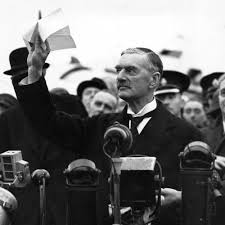
Munich was directly tied to the vanity of Neville Chamberlain. In the first few weeks after Munich, Chamberlain basked in adulation, posing as the humane savior of Western civilization. In contrast, loud skeptic Winston Churchill was dismissed by the media and public as an old warmonger.
Hitler failed to appreciate the magnanimity and concessions of the French and British. He later called his Munich diplomatic partners “worms.” Hitler said of the obsequious Chamberlain, “I’ll kick him downstairs and jump on his stomach in front of the photographers.”
The current negotiations with the Iranians in Lausanne, Switzerland, have all the hallmarks of the Munich negotiations.
Most Westerners accept that the Iranian government funds terrorist groups such as Hezbollah and Hamas. It has all but taken over Iraq, Lebanon, Syria, and Yemen. Yet the idea of stronger sanctions, blockades, or even force to stop Iranian efforts to get a bomb are considered scarier than Iran getting a bomb that it just possibly might not threaten to use.
The U.S. and its NATO partners are far stronger than Iran in every imaginable measure of military and economic strength. The Iranian economy is struggling, its government is corrupt, and its conventional military is obsolete. Iran’s only chance of gaining strength is to show both its own population and the world at large that stronger Western powers backed down in fear of its threats and recklessness.
Iran is not united. It is a mishmash nation in which over a third of the population is not Persian. Millions of protestors hit the streets in 2009. An Iranian journalist covering the talks defected in Switzerland — and said that U.S. officials at the talks are there mainly to speak on behalf of Iran.
By reaching an agreement with Iran, John Kerry and Barack Obama hope to salvage some sort of legacy — in the vain fashion of Chamberlain — out of a heretofore failed foreign policy.
There are more Munich parallels. The Iranian agreement will force rich Sunni nations to get their own bombs to ensure a nuclear Middle East standoff. A deal with Iran shows callous disagreed for our close ally Israel, which is serially threatened by Iran’s mullahs. The United States is distant from Iran. But our allies in the Middle East and Europe are within its missile range.
Supporters of the Obama administration deride skeptics such as Democratic senator Robert Menendez and Israeli prime minister Benjamin Netanyahu as if they were doubting old Churchills.
Finally, the Iranians, like Hitler, have only contempt for the administration that has treated them so fawningly. During the negotiations in Switzerland, the Iranians blew up a mock U.S. aircraft carrier. Their supreme leader, Ayatollah Khamenei, did his usual “death to America” shtick before adoring crowds. Our dishonor in Lausanne, as with Munich, may avoid a confrontation in the present, but our shame will guarantee a war in the near future.
The downside to playing on the same team as the Iranian regime, even in just this one military campaign against ISIS, is that we are helping to enable a far more dangerous power than ISIS to extend its hegemonic dominance throughout the entire region.
****************
Iraq’s defense minister Khalid al-Obeidi is claiming victory over ISIS forces in the city of Tikrit, which ISIS had captured last summer as its forces advanced across large swaths of territory in northern and western Iraq. “We have the pleasure, with all our pride, to announce the good news of a magnificent victory,” Obeidi said. The Pentagon and a spokesman for the U.S.-led coalition were a bit more cautious, noting some residual ISIS resistance. However, they too reported that significant progress had been made in wresting control of Saddam Hussein’s birthplace from ISIS’s grip.
The next strategic military objective in pushing ISIS back from the territories it controls in Iraq is to re-take Iraq’s second largest city, Mosul.
Iran supplied significant military support to the Shiite militia forces, who were a major part of the Iraqi counter-offensive on the ground. At the same time, U.S. air strikes seemed to have helped in supporting the Iraqi ground forces’ advance into Tikrit. The precise extent of any behind-the-scenes direct or indirect coordination between the U.S. and Iran is unknown at the present time. However, according to DebkaFile {March 26, 2015), “In the last two weeks of the Tikrit operation, liaison between the US and Iranian military in Iraq was routed through the office of the Iraqi Prime Minister in Baghdad.”
There is little question that without the Iranian-backed Shiite militia and substantial military support on the ground from Iran, ISIS would most likely still be in control of Tikrit today. U.S. airstrikes may have been necessary to soften ISIS’s resistance, but only ground troops with Iran’s support could dislodge them.
The downside to playing on the same team as the Iranian regime, even in just this one military campaign against ISIS, is that we are helping to enable a far more dangerous power than ISIS to extend its hegemonic dominance throughout the entire region.
As General David Petraeus, who certainly knows something about Iraq, told the Washington Postrecently:
In fact, I would argue that the foremost threat to Iraq’s long-term stability and the broader regional equilibrium is not the Islamic State; rather, it is Shiite militias, many backed by — and some guided by — Iran… Longer term, Iranian-backed Shia militia could emerge as the preeminent power in the country, one that is outside the control of the government and instead answerable to Tehran.
Without downplaying ISIS’s horrific acts, its rapid-fire successes in Syria and Iraq (even with the setback in Tikrit), and its growing allegiances in Libya, Nigeria and areas further away from its home base including Afghanistan, the fact is that ISIS’s ambitions far exceed its current means for achieving them. ISIS is proficient in using social media for recruitment, propaganda and intimidation purposes, but that can only take ISIS so far.
Iran, by contrast, has built up its military capabilities to the point that it can back up its aggressive threats in the region. And that’s even without the nuclear arms capability that President Obama seems to be willing to risk allowing Iran to achieve in order to secure his legacy with a deal.
As a result, America’s traditional Sunni allies in the region such as Saudi Arabia and other Persian Gulf states are doubting whether they can continue to count on the United States for support. And they are taking matters into their own hands, including a decision to form a multinational Arab military force to respond to Iranian aggression and other perceived threats.
As explained by Gamal Abdel Gawad Soltan, a political scientist at the American University in Cairo and quoted by the New York Times: “The U.S. is much less trusted as an ally, as an insurance policy towards the security threats facing the governments in the region, and so those governments decide to act on their own.”
These governments know their neighborhood well and see Iran as a much graver threat to regional peace and security than ISIS. Iran’s military and financial support of the Shiite Houthi rebels in taking control of major parts of Yemen was the last straw. Saudi Arabia on its own initiative decided to launch an air campaign against Houthi positions in Yemen and has not ruled out a ground attack along with the military forces of other Arab countries.
In response to the air and sea blockade of Yemen that Saudi Arabia is imposing on Yemen, Iran’s supreme leader Ayatollah Ali Khamenei decided to dispatch “two naval task forces to sail to the Red Sea,” according to DebkaFile (March 31, 2015). “The naval task forces are being sent to draw a sea shield around the Houthi forces to defend them against Saudi-Egyptian assaults. This maneuver was orchestrated by the Al Qods Brigades chief Gen. Qassem Soleimani,” DebkaFile reported.
Soleimani certainly gets around. Earlier this month he popped up in Iraq to lead the Shiite militias in their fight against ISIS. Now the man who fought on the same side as us against ISIS in Iraq is apparently coordinating Iran’s fight to hold onto the Houthis’ gains in Yemen where they forced the American and Saudi Arabian-backed president to flee.
Soleimani is “the puppet master controlling numerous Iranian surrogates in various countries,” said Jim Phillips, Middle East analyst for the Heritage Foundation. “His organization is drenched in American blood,” Phillips added. “It’s infused with an anti-American philosophy and a cooperation with him or his followers would not be on a sustainable basis. The U.S. would regret it.”
The Obama administration is now scrambling to catch up with Iran’s multi-pronged offensives, some of which are under Soleimani’s coordination. Thus, President Obama decided to support the Sunni Gulf coalition and Egypt against Iranian-backed action by the Shiite Houthi rebels to take control of Yemen.
However, the Obama administration’s reactive tactics in dealing with the crisis in Yemen are too little too late. Saudi Arabia is reportedly looking to Pakistan for help in acquiring its own nuclear arms to counter the Saudis’ well-founded suspicions that any deal negotiated by the Obama administration with Iran will not prevent Iran from becoming a nuclear armed power. And while Obama finally lifted the arms freeze he imposed against Egypt two years ago, clearing the way for the delivery of F-16 aircraft, Harpoon missiles and tanks, he also decided to end Egypt’s ability to finance purchases of American arms by drawing credits in advance based on future aid Egypt expects to receive starting in the 2018 fiscal year. Obama also wants to reduce Egypt’s flexibility in what it can purchase with the future military aid. Thus, the Egyptian government can be expected to continue on its course to find other sources for military aid and weapons including Russia, because of doubts that the U.S. will remain a reliable supplier.
The Obama administration has been willing to sacrifice the confidence of its Arab allies, not to mention the United States’ historically close alliance with Israel, in a vain effort to lure the Iranian regime into acting as a responsible party in the Middle East that can help stabilize this volatile region. Instead, Obama should listen to the expert on Iraq, General Petraeus, whose surge victory Obama undermined completely with his precipitous withdrawal of all U.S. troops from Iraq in 2011:
The current Iranian regime is not our ally in the Middle East. It is ultimately part of the problem, not the solution. The more the Iranians are seen to be dominating the region, the more it is going to inflame Sunni radicalism and fuel the rise of groups like the Islamic State…Iranian power in the Middle East is thus a double problem. It is foremost problematic because it is deeply hostile to us and our friends. But it is also dangerous because, the more it is felt, the more it sets off reactions that are also harmful to our interests — Sunni radicalism and, if we aren’t careful, the prospect of nuclear proliferation as well.
We can rejoice in the pushback of ISIS out of Tikrit. Perhaps it is a sign of more victories over ISIS to come. However, we should not delude ourselves into thinking that we have more in common with the Iranian regime in combatting ISIS in Iraq or Syria than the Iranian regime ultimately has in common with ISIS. They may be bitter enemies in the struggle over which set of fanatical jihadists should get to rule the global Islamic ummah or caliphate they both fantasize about. However, both fervently believe in the fundamental ideological goal of universal Islamic supremacy. And both are willing to sacrifice the lives of millions of people to reach that goal, no matter how long it takes them. The difference is that a nuclear-armed Iran would be much more capable of carrying out its jihadists’ apocalyptic vision than ISIS and in a much shorter period of time.
(The views expressed in this article are not necessarily mine or those of Warsclerotic or its other editors. — DM)
Today, April fool’s day first, Obama was abducted by aliens from Venus who were concerned about His warlike stance toward the peaceful Islamic Republic of Iran.
Mars is the god of war, Venus is the goddess of peace. Aliens from Mars had been slightly disturbed that Obama’s efforts to give Iran nuclear weapons might fail, but had seen that her status as a nuclear power was inevitable and hence did nothing. Aliens from Venus were equally pleased with the prospects of Iranian nuclear weapons but were very concerned that Obama, by failing adequately to praise Iranian attempts to extend its hegemony over the entire Middle East and beyond, had retarded those praiseworthy efforts on behalf of true Islamic peace. Hence, they secretly abducted Him this morning as He deplaned from Air Force One following an off-the-books trip to His spiritual birth place in Manchuria.
Since Obama’s abduction and remedial training required only a few minutes He was not missed, even by His dear soul mate, Valerie Jarrett. Ms. Jarrett was, therefore, pleasantly surprised when Obama called a press conference in the Rose Garden to make an announcement, following a splendid rendition of Hail to the Chief:
Fellow world citizens, I have finally awakened from my slumbers to realize that Iran is the only country in the world capable of bringing true peace through submission in accord with the word of Allah, may His Holy name be forever praised by all. Israel claims to desire peace, but only through war. Saudi Arabia, Egypt, Jordan and other misbegotten specs of excrement on the face of our dear planet — now in peril of imminent death due to climate change to which their vile oil has contributed massively — have dared even to challenge Iran’s peaceful pursuits of peace throughout the Middle East in Iraq, Syria, Yemen and elsewhere.
Henceforth, it will be My supreme duty as your Commander in Chief to promote and otherwise to assist Iran in her glorious efforts for peace. I know in my heart that that’s the principal reason that you, My people, elected Me as your very own Supreme Leader. Accordingly, I pledge that My efforts will be unstintingly directed to the end that you desire.
May Allah bless Iran, Damn America, Israel and all other enemies of true peace, and give a blessed day to you all, inshallah.
Iran’s leaders, due to their extensive relations with the aliens who had abducted Obama, were not at all surprised but pretended that they were. Supreme Leader Khamenei personally accepted Supreme Leader Obama’s gracious words by saying that Obama had finally managed to tame the Great Satan and promised to do everything within his power to help, inshallah. He also commented favorably on Secretary Kerry’s use of “inshallah” in rebutting suggestions by defeatists that the P5+1 negotiations would collapse without giving Iran nuclear weapons.
Even those who had previously viewed Obama as weak and indecisive will now be forced to see Him as He truly is, a towering beacon of strength and light to a world beset with tribulation, turmoil and darkness. His legacy as the Greatest Peace Maker, Ever, is assured, inshallah.
[B]y the U.S. being so concentrated on a nuclear deal and President Obama being so focused on leaving behind a historic legacy regarding a nuclear deal with Iran, the unintended consequences of such an inefficient foreign policy are being ignored and overshadowed. Although the U.S. has military bases in the region, it has evidently chosen to ignore Iran’s military expansion.
********************
Often, scholars and politicians have made the argument that regional powers in the Middle East are opposed to a nuclear deal between Iran and the six world powers due to the nuclear technicalities of the deal or restoring relationships between Tehran and the U.S. Nevertheless, this premise fails to shed light on the underlying concerns, nuances and intricacies of such a nuclear deal as well as Iran’s multi-front role in the region.
The underlying regional concerns are not primarily linked to the potential reaching of a final nuclear deal with the Islamic Republic or easing of ties between the West and Tehran. At the end of the day, regional powers would welcome and be satisfied with a nuclear deal that can ratchet down regional tension, eliminate the possibility of the Islamic Republic to become a nuclear state, and prevent a nuclear arms race.
But what is most worrying is the expanding empire of the Islamic Republic across the Arab world from Beirut to Baghdad, and from Sanaa to Damascus, as the nuclear talks reach the final stages and as no political will exists among the world powers to cease Iran’s military expansion.
Establishing another proxy in Yemen
Iran’s Quds forces have long being linked to the Houthis. The Islamic Republic continues to fund and provide military support to the Houthis (by smuggling weapons such as AK-47s, surface-to-air missiles as well as rocket-propelled grenades) in order to establish another proxy in the Arab world.
Iran’s long-term strategic and geopolitical objectives in Yemen are clear. The Islamic Republic’s attempt to have a robust foothold near the border of Saudi Arabia, as well as in the Gulf Peninsula, will tip the balance of power in favor of Tehran.
By empowering the Houthis, Tehran would ensure that Saudi Arabia is experiencing grave national security concerns, the possibility of conflict spill-over, and internal instability. In addition, by influencing Yemeni politics through the Houthis, Iranian leaders can pressure Saudi Arabia to accept Iran’s political, strategic and economic dominance in Iraq, Syria, and Lebanon as well.
The latest advancement of the Houthis supported the interests of the Islamic Republic until recently. There was a need for robust action against Iran’s hegemonic ambitions. Nevertheless, the West was resistant to act.
From geopolitical, strategic and humanitarian perspective, the robust military action, Operation Decisive Storm, is a calculated and intelligent move to send a strong signal to the Islamic Republic that its interference in another Arab state will not be overlooked. In other words, Arab states do not have to wait for the West to act against Iran’s covert activities and support for Shiite loyalist-militias in the region.
The tightening grip over another Arab capital
As the nuclear talks between Britain, China, France, Russia and the United States – the five permanent members of the Security Council – plus Germany (P5+1) and the Islamic Republic appear to show progress towards a final agreement to curb Iran’s nuclear ambitions, the world powers (specifically the United States) have chosen to turn a blind eye on Iran’s military expansion in the Arab states, and particularly in Yemen.
Iran’s long term strategic and geopolitical agenda should not be overlooked. Iranian leaders’ hegemonic ambition is to consolidate and strengthen its grip on the Arab states, and to have control over Arab capitals from Beirut to Baghdad and from Sanaa to Damascus.
The Islamic Republic’s ambitions to expand its empire during the nuclear talks and regional insecurities are carried out through several platforms. Central figures, such as Quds Force commander General Qassem Soleimani, hardliners such as Ali Reza Zakani, Tehran’s representative in the Iranian parliament and a close figure to the Iranian supreme Leader Ayatollah Ali Khamenei, and the Supreme Leader himself, play a crucial role in fulfilling Iran’s regional hegemonic ambitions.
Iranian leaders are not even concerned about repercussions from boasting about their grip over Arab capitals. Zakani recently bragged about having control over Arab capitals, “Three Arab capitals have today ended up in the hands of Iran and belong to the Islamic Iranian revolution”. He added that Sanaa will soon be under the grip on the Islamic Republic as well. According to him, most of Yemen’s territories will soon be under the power of the Shiite group, the Houthis, supported by the Islamic Republic.
The second platform that the Islamic Republic utilizes is sponsoring, financing, equipping, training and advising loyalist and heterodox Shiite groups across the region. The number of these militia groups is on the rise and they operate as a pawn to serve the geopolitical, strategic, economic, ideological and national interests of the ruling clerics.
America’s lack of political willingness to act
As the Islamic Republic creates such Shiite groups across the region to “protect” Arab capitals, Tehran centralizes its power across the region. In addition, after the creation of new Shiite groups, the elimination of these proxies will not be a simple task, for they will be ingrained in the socio-political and socio-economic fabric of the society.
In addition, these loyalist militia groups are game changers in the region, tipping the balance of power further in favor of the Islamic Republic and its regional hegemonic ambitions.
The expansion of Iran’s military and loyalist-militia groups in the region transcends Tehran’s political ambitions. The ideological tenet of this expansion and of Tehran’s overall growing regional empire (under the banner of Popular Mobilization Forces: an umbrella institution of Shiite armed groups) are crucial facets to analyze.
More fundamentally, as the final nuclear deal approaches, and as Tehran witnesses the weakness of Washington and other powers when deciding to overlook Iran’s militaristic and imperialistic activities in the region, Tehran has become more emboldened and vocal when it comes to its military expansion.
Iranian leaders boast about their role in Arab states projecting Tehran as a savior for the Arab world. As Zakani stated, according to Iran’s Rasa new agency “had Hajj Qassem Soleimani not intervened in Iraq, Baghdad would have fallen, and the same applies to Syria; without the will of Iran, Syria would have fallen”.
Nevertheless, by the U.S. being so concentrated on a nuclear deal and President Obama being so focused on leaving behind a historic legacy regarding a nuclear deal with Iran, the unintended consequences of such an inefficient foreign policy are being ignored and overshadowed. Although the U.S. has military bases in the region, it has evidently chosen to ignore Iran’s military expansion.
The concerns of regional countries about the nuclear deal is not solely linked to the nuclear technicalities of the deal or Iran-West rapprochement, but are primarily related to Iran’s growing empire as well as the consequences of such a nuclear deal leading Tehran to apply more assertive and expansionist foreign policy in the region.
Regional robust actions such as Operation Decisive Storm are sometimes required in order to set limits to Iran’s hegemonic, imperialistic objectives, and interference in other Arab states’ affairs, as well as in order to prevent the destabilizing effects emanating from the growing militia rebels sponsored by the Islamic Republic.
(Don’t worry! Be Happy! Obama is in charge so everything will come up roses for sure.
Just ask Obama, the all-wise, all-knowing. He will set it right, as soon as Iran uses the nukes she deserves. — DM)
American warplanes have begun bombing the Islamic State-held Iraqi city of Tikrit in order to bail out the embattled, stalled ground campaign launched by Baghdad and Tehran two weeks ago. This operation, billed as “revenge” for the Islamic State (IS) massacre of 1,700 Shiite soldiers at Camp Speicher last June, was launched without any consultation with Washington and was meant to be over by now, three weeks after much triumphalism by the Iraqi government about how swiftly the terrorist redoubt in Saddam Hussein’s hometown was going to be retaken.
U.S. officials have variously estimated that either 23,000 or 30,000 “pro-government” forces were marshaled for the job, of which only slender minority were actual Iraqi soldiers. The rest consisted of a consortium of Shiite militia groups operating under the banner of Hashd al-Shaabi, or the Population Mobilization Units (PMU), which was assembled in answer to afatwahissued by Iraq’s revered Shiite cleric Ayatollah Ali Sistani in June 2014 following ISIS’s blitzkrieg through northern Iraq. To give you a sense of the force disparity, the PMUs are said to command 120,000 fighters, whereas the Iraqi Army has only got 48,000 troops.
Against this impressive array of paramilitaries, a mere 400 to 1,000 IS fighters have managed to hold their ground in Tikrit, driving major combat operations to a halt. This is because the Islamic State is resorting to exactly the kinds of lethal insurgency tactics which al Qaeda in Iraq (its earlier incarnation) used against the more professional and better-equipped U.S. forces. BuzzFeed’s Mike Giglio has ably documented the extent to which IS has relied upon improvised explosive devices, and just how sophisticated these have been. Even skilled explosive ordnance disposal teams — many guided by Iranian specialists — are being ripped apart by what one termed the “hidden enemy” in Tikrit.
Because IS controls hundreds of square miles of terrain in Iraq, it has an unknown number of bomb manufacturing plants, and because it knows the terrain so well, it’s been able to booby-trap houses and roads. Even Shiite prayer beads left lying on the ground are thought to be rigged to explosives. One Kurdish official told Giglio that the Kurdish Peshmerga fighters alone have “defused or detonated more than 6,000 IEDs along their 650-mile front with ISIS since the war began in August.”
The toll this has taken on the militias is extraordinary. Cemetery workers in Najaf told the Washington Postthat as many as 60 corpses are arriving per day. Former Defense Intelligence Agency officer Derek Harvey tweeted last week that an Iraqi Shiite source told him the number of militia war dead from the Tikrit offensive so far may be as high as 6,000. So the militias’ triumphalism, much of it no doubt manufactured by Iran’s propaganda machine, proved to be misplaced. Jeffrey White, another former DIA analyst now at the Washington Institute for Near East Policy, notes “there’s a failure of will on the part of the militias and government forces. They just didn’t have the sufficient desire and determination to take the fight forward given the casualties they’ve been sustaining.”
So now, the same Iraqi government which earlier dismissed the need for U.S. airpower had to put in an eleventh-hour request for it, lest an easy victory descend into embarrassing folly. But the past few months ought to have shown that even indirectly relying on Iranian agents to conduct a credible ground war against Sunni extremists was always a lousy idea for three reasons: those agents hate the United States and have threatened to attack its interest in Iraq; they’re guilty of IS-style atrocities themselves; and they’re lousy at fighting an entrenched jihadist insurgency.
Chairman of the Joint Chiefs Martin Dempsey told Congress on March 3: “What we are watching carefully is whether the militias — they call themselves the popular mobilization forces — whether when they recapture lost territory, whether they engage in acts of retribution and ethnic cleansing.” He needn’t watch any longer. They are engaging in exactly that.
The crimes of war
On March 10, the United Nations Office of the High Commissioner for Human Rights (OHCHR) released a comprehensive study of human rights violations committed by both IS and pro-Iraqi forces. The Islamic State, OHCHR concluded, has likely committed genocide against the Yazidis, a ethno-religious minority in Iraq, in a catalogue of war crimes and crimes against humanity that include gang-rape and sexual slavery. But OHCHR’s language is equally unambiguous in condemning the other side on the battlefield: “Throughout the summer of 2014,” the report noted, “[PMUs], other volunteers and [Shiite] militia moved from their southern heartlands towards [Islamic State]-controlled areas in central and northern Iraq. While their military campaign against the group gained ground, the militias seem to operate with total impunity, leaving a trail of death and destruction in their wake.” [Italics added.]
Sunni villages in Amerli and Suleiman Bek, in the Salah ad-Din province, have been looted or destroyed by militiamen operating on the specious assumption that all inhabitants once ruled by IS must be IS sympathizers or collaborators. Human Rights Watch has also lately discovered that the “liberation” of Amerli last October — another PMU/Iranian-led endeavor, only this one abetted by U.S. airstrikes in the early stages — was characterized by wide-scale abuses including the looting and burning of homes and business of Sunni residents of villages surrounding Amerli. The apparent aim was ethnic cleansing. Human Rights Watch concluded, from witness accounts, that “building destruction in at least 47 predominantly Sunni villages was methodical and driven by revenge and intended to alter the demographic composition of Iraq’s traditionally diverse provinces of Salah al-Din and Kirkuk.”
Sunnis weren’t the only demographic subjected to collective punishment. A 21-year-old Shiite Turkmen from the Yengija village was “burned with cigarettes and tied to a ceiling fan” by militants of Saraya Tala’a al-Khorasani, another Iran-backed militia. He told Human Rights Watch: “They kept saying, ‘You are ISIS,’ and I kept denying it. They were beating me randomly on my face, head, shoulders using water pipes and the butts of their weapons…. They went to have lunch and then came back and beat us for an hour and half. Later that night they asked me if I was Shia or Sunni. I told them I was Shia Turkoman and they ordered me to prove it by praying the Shia way…. They kept me for nine days.”
This account tracks with a mountain of social media-propagated video and photographic evidence showing that Iraq’s Shiite militias are behaving rather like the Islamic State — beheading and torturing people they assail as quislings, and then exhibiting these atrocities as a means of recruitment. More worrying, a six-month investigation by ABC News has found that U.S.-trained Iraqi Security Force personnel are also guilty of anti-Sunni pogroms, with officers from Iraq’s Special Forces shown in one video accusing an unarmed teenaged boy of being a shooter (a charge the boy denies) before opening fire on him.
Looking the other way
The Obama administration’s counterterrorism-driven policy for the Middle East, and a quietly pursued diplomatic reconciliation with Iran, has resulted in America’s diminishment of grave war crimes committed by Iran’s clients and proxies, and the problem is hardly just confined to Iraq. In Syria, for instance, the National Defense Force, a conglomerate of militias trained and equipped by Iran’s Revolutionary Guards Corps-Quds Force (IRGC) — a U.S.-designated terrorist entity — has been accused by the Syrian Network for Human Rights and the Euro-Mid Observer for Human Rights, of “[burning] at least 81 people to death, including 46 civilians; 18 children, 7 women, and 35 of the armed opposition fighters,” along with other pro-Assad forces. The State Department has offered condolences to Iran’s President Hasan Rouhani on the death of his mother; to date, it has not said a word about the immolation of these Syrians at the hands of a Quds Force-built guerrilla army.
All of which raises the question: Does the United States have a “common interest,” as Secretary of State John Kerry phrased it, with a regime in Tehran whose proxies are currently burning people alive in their houses, playing soccer with severed human heads, and ethnically cleansing and razing whole villages to the ground?
It really ought to surprise no one in the U.S. government that what amounts to an Iranian occupation of the Levant and Mesopotamia would lead to an increase in jihadist bloodletting. Dempsey has less of an excuse than most. A four-star general, he formerly commanded the First Armored Division in Baghdad, which in 2004 was the unit redirected, as it was about to go home, to fight the Shiite militias who had taken over Karbala and other southern cities, so he would have seen the precursor to the PMUs in action. Yet somehow managed to brief legislators that the Islamic Republic’s role in Iraq might yet prove “positive” — provided, that is, it didn’t lead to an uptick in sectarianism. This is like arguing that death wouldn’t be so bad if it didn’t result in being dead. It did not take much, however, for the scales to fall from Dempsey’s eyes. He took a helicopter tour of Baghdad last week and noticedthe “plethora of flags, only one of which happens to be the Iraqi flag,” The rest, he told reporters to evident dismay, belonged to Shiite militias. (He might have also added that posters of Ayatollah Ruhollah Khomeini and Ayatollah Ali Khamenei are now omnipresent in the Iraqi capital where ones of Saddam Hussein used to be.)
Everyone from Gen. David Petraeus to Kurdish intelligence chief Masrour Barzani is acknowledging the obvious: that Shiite militias pose more of a long-term threat to the stability of Iraq than does the Islamic State. Even Ayatollah Sistani has made noises lately about the rampant abuses committed by the “volunteers” he assembled through a religious edict.
While it is true that most Iraqis do not wish to live in a state of vassalage to Iran, it also true that most of the “units” in the PMUs are well-known subsidiaries of the Quds Force. “The indoctrination they’ve been getting is anti-American, Khomeinist ideology,” said Phillip Smyth, an expert on Shiite militias and author of a comprehensive survey of them put out by the Washington Institute for Near East Policy. “Sectarianism has been promoted whether we like it or not.”
According to Chris Harmer, a former U.S. Naval officer and now an analyst at the Institute for the Study of War, there really is no dressing up who the supposed “good guys” in Iraq now are. “They killed hundreds of Americans during the war,” Harmer said. “These are not ‘affiliated’ organizations — they are same guys, the same organizations. And can you find me anybody stupid enough to say that what Iran wants is a stable, unified, secular, non-sectarian Iraq?”
The enemies of our enemy are our enemy
Indeed, quite apart from having American blood on their hands and American interests furthest from their mind, Shiite militias — following Tehran’s favorite playbook — have also taken to conspiratorially blaming the United States for inventing and militarily supporting the Islamic State, while decrying any American anti-IS involvement in Iraq. Take, for instance, the Badr Corps, headed by Hadi al-Amiri, the commander of Hashd al-Shaabi, and a man infamous for “using a power drill to pierce the skulls of his adversaries,” or so the State Department found in a 2009 cable to Washington, which also alleged that al-Amiri “may have personally ordered attacks on up to 2,000 Sunnis.” (Despite this grim record, al-Amiri was invited to the Obama White House in 2011 when he was Iraq’s transportation minister.)
Lately al-Amiri taken to both boasting that Stuart Jones, the current U.S. ambassador to Iraq, personally offered him close air support, whilereprehending those Iraqis who “kiss the hands of the Americans and get nothing in return.” But when it comes to Tehran, he’s full of praise for the “unconditional” support his country has received. Now al-Amiri has found a more modest tongue. He told the Guardian’s Martin Chulov on March 26: “We did not ask for [U.S. airstrikes on Tikrit] and we have no direct contact with the Americans. From what I understand, Prime Minister Haidar al-Abadi made the request. However, we respect his decision.”
Kataeb Hezbollah may be the only Iraqi Shiite militia in Iraq to be designated a terrorist entity by the United States, but that hasn’t stopped it from driving around in Abrams tanks, Humvees, armored personnel carriers, MRAPs, and toting M4 and M16 rifles — all the accidental largesse of Uncle Sam, which has sent $1 billion in military equipment to Baghdad, but has no oversight as to which actors, foreign or domestic, ultimately receive what. An abundance of U.S. weapons hasn’t dissuaded Kataeb Hezbollah from openly inciting violence against the American-led coalition to destroy the Islamic State.
“Recently we had them accusing the United States of supplying [IS] via helicopters,” said Smyth. “Kataeb Hezbollah then came out with a bullshit article claiming that they shot down a British cargo plane carrying arms to [IS]. They also said they were going to move antiaircraft missile batteries in Anbar and north of Baghdad to counter U.S. airdrops to [IS]. Whenever they sense too much of a U.S. influence in Iraq, they start to threaten American soldiers.” Kataeb Hezbollah, it bears mentioning, is headed by Abu Mahdi al-Muhandis, an Iranian spy who is widely believed to have planned the bombings of both the U.S. and French embassies in Kuwait in the 1980s. There’s even a photograph of him holding up a Kuwaiti newspaper fingering him for this act of international terrorism. Kataeb Hezbollah has also been caught on video playing bongos with severed human heads.
Another prominent Shiite militia is Asaib Ahl al-Haq, or the League of the Righteous, which in 2007 set an ambush which killed 5 U.S. servicemen in Karbala. It, too, now also happily motors around Iraq in U.S. armored vehicles, some of them thought to have been stolen from the U.S. consulate in Basra. One unnamed U.S. official told Al Jazeera that Asaib was most recently responsible for burning down homes in Albu Ajil, a village near Tikrit in retaliation for massacres carried out by the Islamic State. It has also been implicated in the abduction and murder of Sheik Qassem Sweidan al-Janabi, one of the Sunni tribal leaders who worked cheek-by-jowl with U.S. forces in fighting al Qaeda in Iraq during the so-called Awakening period.
Remarkably, the demagogic Shiite cleric Muqtada al-Sadr, once the bane of U.S. forces in Baghdad, condemned al-Janabi’s murder — in language more severe than anything contrived by the U.S. State Department’s Marie Harf or Jennifer Psaki. “Did not I tell you that Iraq will suffer from the brazen militias?” al-Sadr was quoted as saying. “Did I tell you that the army must handle the reins?” Al-Sadr demanded that Shiite head-loppers be punished and actually backed up his rhetoric with action, suspending the participation of his own al-Salam Brigades and al-Yaom ak-Mawood military in ongoing operations. (He unsuspended these militias a week ago to help with the battle in Tikrit, but so far, because of the frozen nature of the ground campaign, none of the Sadrists have seen any real action.)
Assad’s friends in Iraq want to kill Americans
The Basij-ization of Iraq of was both inevitable, given the defunct and corrupted state of the U.S.-trained military, and Iran’s outsize influence in Baghdad even before ISIS conquered a third of the country. “When the Iraqi Army was destroyed last July, this was a gift to Iran to build up these militias,” Gen. Najim Jibouri, the former mayor and police chief of Tal Afar, a crucial Iraqi border town now held by the Islamic State, said in a recent interview. “A few days ago, Khaled al-Obaidi, Iraq’s minister of defense, went to Tikrit, but the militias wouldn’t allow him to enter. He had to stay in Samarra.”
All of which makes risible U.S. officials’ continued emphasis that there is no direct American coordination with Iran or its proxies. Gen. James Terry, the U.S. commander of the coalition, claims that the “ongoing Iraqi and coalition air strikes are setting the conditions for offensive action to be conducted by Iraqi forces currently surrounding Tikrit. Iraqi security forces supported by the coalition will continue to gain territory.”
One of the authors personally witnessed in Baghdad how the IRGC targets make their way into the U.S. targeting queue. Shiite militia commanders pass Quds Force-selected targets to Badr-affiliated Iraqi Security Force commanders on the ground (many of whom are, in fact, agents of the militias), who then pass them on as legitimate targets to Iraq’s Defense Ministry representatives in the Joint Operations Centers where U.S. advisors then put those targets into a queue for aerial sorties. This is the pattern of target development that U.S. forces tried to stop during the American occupation of Iraq — when there was actually a military strategy for countering Iranian influence in the country.
But this nefarious chain of putting intelligence into action — and making the United States do the dirty work — has been resurrected. Soleimani knows it, al-Muhandis knows it, al-Amiri and his Badr agents in the Iraq Security Forces know it — so, too, should the Pentagon, whatever claims to the contrary it puts out. Iranian intelligence operatives are now America’s eyes on the ground.
What does this mean for Tikrit? The Islamic State will no doubt be flushed from the city or bombed to death eventually, but it will be a tactical loss for IS, not a strategic one. They’ll still have Mosul and most of Anbar province. The Institute for the Study of War’s Chris Harmer notes that this will have a direct bearing on bigger fights ahead. “These militiamen will say, ‘This is how badly we got beat up in Tikrit, who wants to volunteer to storm that castle in Mosul?’”
Even if Iran’s proxies do end up massing on Mosul, they’ll remain the ultimate occupying force in post-Islamic State Tikrit. The Washington Post’s Loveday Morris tweeted on March 26 that Kataeb Hezbollah and Asaib Ahl al-Haq have now “suspended” their operations in the city, no doubt out of a desire to not appear to be coordinating with the hated United States. But once the Pentagon declares victory, the militias will no doubt try to hijack it and move right in to serve as the occupying force in Tikrit.
Despite reports on Thursday that three Shiite militias were “withdrawing” from operations in objection to U.S. airstrikes, now the news has come that they’ve called off their boycott, largely owing to another edict by Ayatollah Sistani. Even an alleged accidental hit by U.S. warplanes on Asaib Ahl al-Haq barely raised that militia’s pique, according to the New York Times. A Badr Corps representative also told the newspaper, “We haven’t retreated from our positions near Tikrit.” Still, others have indicated that they’re not going to let a good turn go unpunished and intend to strike at American soldiers in Iraq.
Akram al-Kabi, the leader of the Al Nujabaa Brigade, which has also fought with the Assad regime in Syria, has said: “We are staying in Tikrit, we are not leaving and we are going to target the American led coalition in Tikrit and their creation, ISIS.” Today, one of al-Kabi’s spokesmen reiterated thatthreat. Al-Kabi was once a deputy in Asaib Ahl al-Haq and was associatedwith that militia’s attacks against U.S. and British troops in 2008-2011, including an incident in which British contractors were abducted from the Iraqi Finance Ministry and later murdered. CENTCOM commander Gen. Lloyd Austin’s nevertheless briefed the Senate on Thursday with a straight face that “[c]urrently, there are no [Shiite] militia and as reported by the Iraqis today, no [PMU] in that area as well.” This is either propaganda or sheer ignorance about what is transpiring in Austin’s theatre of operations. The Guardian’s Chulov, who just returned from Tikrit, confirmed to one of the authors, in fact, that both al-Amiri and al-Muhandis were indeed in the center of the city on March 26.
Recrimination and resentment by these militias is no light matter. According to Politico, U.S. military planners are now worried that any decision to engage or isolate the Assad regime in Syria will encourage Iran or its cut-outs to attack the some 3,000 U.S. military trainers currently stationed in Iraq. It’s hard to tell where genuine concern bleeds into further excuse-making on the part of an Obama administration that has shown no intention of engaging or isolating the Assad regime, which is responsible for the vast majority of war dead and war crimes in Syria. Regardless, the result is the same: Washington is now behaving as if it needs Tehran’s permission to pursue its own anti-IS strategy, if it can even be called that.
You call this a plan?
“What strategy?” asks Chris Harmer. “We have only consequentially intervened in one part in Syria — Kobani. What’s the plan for countering [the Islamic State] there? Training 5,000 Syrian rebels per year. That is laughable when you consider the 200,000 dead from four years of attritional warfare, the four million refugees, and slow-motion destruction of the country. Five thousand doesn’t even get you into the ballgame. You have to have a significant portion of the population on your side. Moderate Syrians should be on our side. They’re saying the Americans are unreliable, they’re not on our side. This is why the moderate opposition has collapsed and the beneficiaries of that collapse have been al Qaeda, the Islamic State and Assad.”
The loss of confidence in the United States by moderate Sunnis in Syria is mirrored in Iraq. New polling data has confirmed that most Mosulawis, for instance, welcomed IS back into Iraq’s second city not out of ideological sympathy for the terror group, but out of deep-seated political grievances with the Iraqi government. Yet the Obama administration is doing next to nothing to redress these grievances. The Anbar tribal leader Sheikh Ahmed Abu Risha, whose charismatic brother was notoriously gunned down by al Qaeda just days after meeting with President George W. Bush in Baghdad in 2007, simply could not get a meeting with any significant official in White House during a 10-day tour of Washington last February. Vice President Joe Biden was good enough to drop in on a lesser confab, mainly to smile and pat them on the head and tell them to work constructively with the new government of Prime Minister Haider al-Abadi.
“Many of the people in Mosul will stand with [the Islamic State] if Shiite militias invade,” said Gen. Najim Jibouri. “Eighty percent of the population is does not like [IS], but if the militias are involved — 80 percent will stand very strong with [IS]. I told the Americans before, the image now is not like it was in 2003. Now the Sunni people want American forces. They will throw the flowers on them now, because the battle now is not between them and the United States and [IS], it’s between the Sunnis and Iran.” Yet far too many Sunnis still see the United States as aligned with Iran against them, Jibouri said.
Whether or not a nuclear agreement with Iran gets signed in Lausanne this weekend, whether or not Obama inaugurates a perestroika with Tehran as a result, the unshakable truth is that most of Iraq looks in the long term to remain a satrapy of the mullahs. This will only lead to further sectarian violence and civil war. “I met with almost two dozen national leaders in Iraq last week,” Ali Khedery, the longest consecutively serving U.S. diplomat in the Green Zone, told us. “I heard from Sunni, Shiite, Kurdish officials and virtually all of them told me that the real prime minster of the country is Qasem Soleimani and his deputy is Abu Mahdi al-Muhandis.”







 anneinpt
 artaxes
 danmillerinpanama
 davidking1530
 Peter Hofman
 Joseph Wouk
 Peter
Peter Louisiana Steve
 WarSclerotic

Recent Comments