Archive for the ‘Iran in Yemen’ category

Khamenei Smashes Terms of Nuclear Agreement

April 12, 2015

Khamenei Smashes Terms of Nuclear Agreement, Clarion ProjectRyan Mauro, April 12, 2015

(Obama demands, don’t mention Iran’s mumblings about his once in a lifetime deal. Partisan wrangling must stop!– DM)
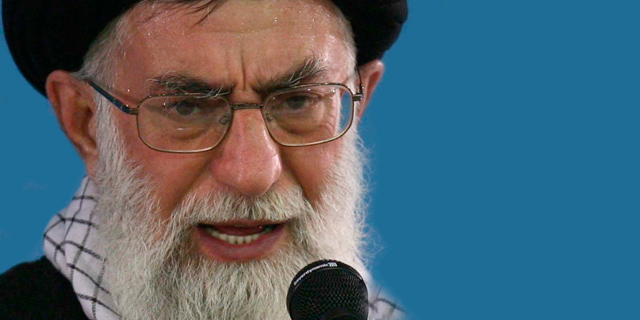
Iran-Ayatollah-Khamenei-HP_3Iranian Supreme Leader Ayatollah Kamenei (Photo: © Reuters)

Khamenei’s accusations make Saudi Arabia a legitimate target under any understanding of jihad. He even went so far as to say the Saudis’ actions are equivalent to Israel’s so-called “genocide” in Gaza. This implies that a violent jihad against Saudi Arabia is as justifiable as one against Israel.

Iran believes that these end times prophesies correlate to the death of Saudi King Abdullah, the Houthis’ overthrow of the Yemeni government, the civil war in Syria, Saudi military action and the fierce fighting in Iraq. The regime sees the confluence of all these crises as beyond the realm of coincidence and signaling the imminent arrival of the “Hidden Imam” which will herald military victory for Iran.

Before the “Hidden Imam” can arrive, two other condition must be fulfilled: instability in Saudi Arabia and the march of a prophetic figure titled “Yamani” who will lead Shiite forces from Yemen into Mecca. The Houthis recently pledged to invade Saudi territory, capture Mecca and overthrow the royal family in Riyadh. They were likely referring to this prophecy.

“We’re not going to respond to every public statement made by Iranian officials or negotiate in public,” said State Department spokesman Jeff Rathke during a daily press briefing.

********************

Iranian Supreme Leader Ayatollah Khamenei ended his eerie silence since the nuclear framework agreement was announced with a fiery speech accompanied with “Death to America” chants. Khamenei essentially smashed the viability of the nuclear framework to pieces, signalled a major escalations in the war in Yemen and essentially endorsed a violent jihad against the Saudi royal family.

Wishful thinkers can’t dismiss the speech as theater for a domestic audience. Khamenei tweeted highlights in English to make sure the world, especially Americans, saw them. The threats and demands are so unequivocal that failing to follow through would sacrifice his entire credibility and prestige.

The Iranian Supreme Leader is unsatisfied with the nuclear framework agreement even though it generously permits Iran to retain the ability to produce nuclear weapons while getting major sanctions relief.

First, he said that the fact sheet published by the U.S. contains lies and does not reflect what Iran agreed to. The statement obliges the regime to seek significant revisions shortly after it gave President Obama the go ahead to make a high-profile victory lap.

Khamenei’s demands are inescapably incompatible with America’s requirements for a deal.

First, Iran is demanding that all sanctions be lifted on the first day that a final deal is signed. The framework only agrees to lift sanctions in phases and only those related to nuclear activity, not terrorism or human rights. Doing so would unfreeze the assets of individuals and entities involved in terrorism around the world, sparking a massive growth in Iran’s terrorist apparatus and proxy warfare.

The inherently flawed hope by the West that “moderate” President Rouhani and other Iranian figures can reign in Khamenei can be immediately ruled out, since Rouhani said the same exact thing.

Iran-Khamenei-Nuke-Tweets

Second, Iran is insisting that there will be no “unconventional,” “special” or “foreign” inspections or monitoring. In other words, Iran will not be subject to exceptionally intrusive inspections. Khamenei’s tweets do not specify Iran’s standards, but it is clear that Iran does not intend to give the IAEA unlimited access.
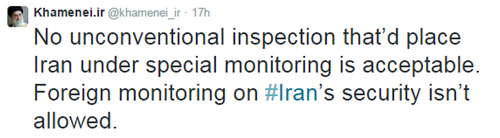
Iran-Khamenei-Rejects-Inspections-Tweets

This is almost definitely a reference to military sites, to which Iran consistently says it has the option of denying access. Iran wants the ability to deny access to any location by declaring it a military institution.

This is how Iran denies access to the critical Parchin site, where damning evidence may exist to prove that Iran conducted major nuclear weapons research until at least 2003. An Iranian opposition group identified an alleged nuclear site in February that is within a military compound. It is claimed that the facility is used for uranium enrichment and the production of advanced centrifuges.

Notice the language of the tweets, which was reported to be equally non-compromising in Farsi. There is no wiggle room. Khamenei would have left some ambiguity if he was willing to budge. If you believe this is just talk, then you must believe that Khamenei made the calculated decision to cause an easily avoidable self-inflicted wound for no reason.

Another flurry of tweets related to the war in Yemen, where Iran is backing the Shiite Houthi rebels who have overthrown the government.

A U.S.-supported coalition of Sunni countries intervened militarily to support President Hadi and stop Iran from threatening the strategic Bab al-Mandeb Strait. This alliance includes Saudi Arabia, Egypt, Bahrain, Qatar, Kuwait, the United Arab Emirates, Jordan, Morocco, Turkey, Pakistan and Sudan. The last two are especially significant because of their close ties to Iran. Separately, Al-Qaeda is gaining ground in Yemen and the Islamic State (ISIS) is rising up as a competitor.

Interestingly, the tweets only threatened Saudi Arabia and did not mention any of these other participants by name. Khamenei stopped just short of a formal declaration of jihad, instead laying out the justification for it.
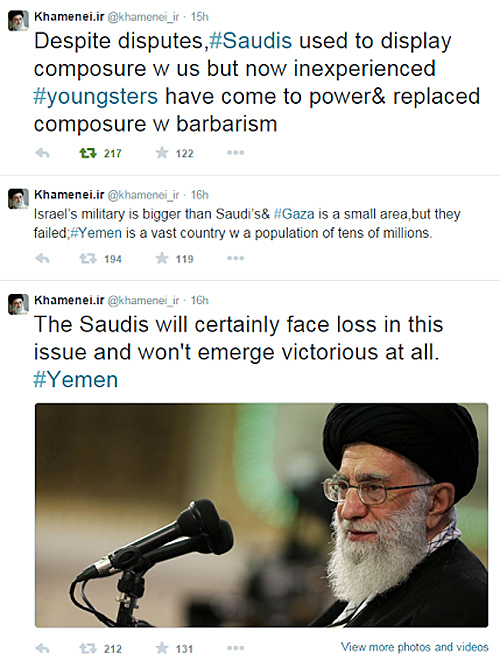
Iran-Khamenei-Yemen-1-Tweets
Iran-Khamenei-Yemen-2-Tweets

Khamenei’s accusations make Saudi Arabia a legitimate target under any understanding of jihad. He even went so far as to say the Saudis’ actions are equivalent to Israel’s so-called “genocide” in Gaza. This implies that a violent jihad against Saudi Arabia is as justifiable as one against Israel.

Don’t be comforted by Khamenei’s mentioning of prosecuting Saudi leaders in international courts. This is not meant to substitute jihad. Khamenei is making a point about how blatant the Saudi crimes are. He’s not even saying that this is Iran’s chosen course of action.

This comes as Iran dispatches two ships to the front in Yemen, including a destroyer to “safeguard naval routes” — meaning it will challenge the challenge the Saudi-Egyptian naval blockade.

Iran sent a flotilla to Bahrain in 2011 after Saudi and Emirati forces intervened to stomp out a revolution against the Sunni monarchy. The regime blinked at the last moment when the Arabs made it clear they would use force to stop it. However, the Yemen conflict has significant differences that Khamenei’s tweets help explain.

Khamenei is signaling that unprecedented hostilities with Saudi Arabia will now commence. The previous Saudi leaders, he says, could be dealt with. The new Saudi King and his circle must be handled more toughly.

However, Iran orchestrated massive terrorist attacks on Saudi interests even under the previous “composed” leaders, a campaign that put the U.S. economy and homeland at risk.

For example, in 2011, the U.S. prevented an Iranian Revolutionary Guards’ plot to assassinate the Saudi ambassador in Washington, D.C. by blowing up a restaurant, which inevitably would have taken the lives of American citizens as well. The scheme involved hiring a Mexican drug cartel to perpetrate the attack, along with bombings of the Israeli embassy in D.C. and the Israeli and Saudi embassies in Argentina.

In 2012, Iran launched a cyber attack on the Saudi Aramco oil company in response to the country’s policies in Bahrain and Syria. Aramco said the hackers tried to take down the country’s oil and gas production (which failed), but they did erase the data on 30,000 computers, three-fourths of the corporate computers.

Khamenei says that the new Saudi leadership is committing far worse crimes, so we should expect a far worse response.

We must also remember the prophecies cited by the Iranian regime.  Iran believes that these end times prophesies correlate to the death of Saudi King Abdullah, the Houthis’ overthrow of the Yemeni government, the civil war in Syria, Saudi military action and the fierce fighting in Iraq. The regime sees the confluence of all these crises as beyond the realm of coincidence and signaling the imminent arrival of the “Hidden Imam” which will herald military victory for Iran.

Before the “Hidden Imam” can arrive, two other condition must be fulfilled: instability in Saudi Arabia and the march of a prophetic figure titled “Yamani” who will lead Shiite forces from Yemen into Mecca. The Houthis recently pledged to invade Saudi territory, capture Mecca and overthrow the royal family in Riyadh. They were likely referring to this prophecy.

Khamenei’s speech wasn’t the typical bluster we are used to hearing from Islamist radicals and dictators. The timing, language and high-profile nature makes it very significant.

Even though the U.S. State Dept. responded by saying that sanctions against Iran would be removed gradually based on verification that Iran had kept its commitments, its response lacked conviction:

“We’re not going to respond to every public statement made by Iranian officials or negotiate in public,” said State Department spokesman Jeff Rathke during a daily press briefing.
Yemen war: Saudis prevented Russian evacuations by air, bombed Moscow’s spy center in Aden

April 7, 2015

Yemen war: Saudis prevented Russian evacuations by air, bombed Moscow’s spy center in Aden, DEBKAfile, April 7, 2015

Russias_Yemen_consulate_damaged_in_Saudi-led_airstrikes_1.4.15Russia’s bombed out consulate in Aden

Saudi Arabia has gone head to head with Russia as Iran’s ally in Yemen.

Moscow claims to have evacuated hundreds of Russian nationals from Yemen by an air lift running out of Sanaa airport, but DEBKAfile’s exclusive intelligence and military sources reveal that not a single Russian plane has taken off from any Yemeni airport since March 27, when Saudi Arabia launched its military offensive against the pro-Iranian Houthi rebels.

The Saudiis warned Russia that they would not be responsible for the safety of any flights landing at a Yemeni airport or the passengers assembled there for evacuation, while their air force conducted strikes against the rebels. Having achieved control of Yemen’s skies in the early stages of their intervention, the Saudis declared its air space a no-fly zone.

This warning gained substance when, on April 1, Saudi F-15 warplanes bombed the Russian consulate in the second largest Yemeni city, Aden. A Russian witness said that not a single window was left in the building and all Russian citizens would have to leave the town.

According to DEBKAfile’s sources, the building was in fact completely demolished in order to dismantle Russia’s regional intelligence-gathering center which operated out of the consulate building and fed Iranian intelligence with data on military movements in the neighborhood.

It functioned according to the same system as Russian spy stations in Syria, which routinely keep their Iranian colleagues au fait with military activities, including Israeli army movements.

The intelligence gathered by the Aden facility was no doubt passed on by Iranian agents to the Houthi commanders, certainly after Al Qods Brigades chief Gen. Qassem Soleimani arrived in Sanaa to direct the rebel offensive after the Saudi offensive was launched.

In normal times, the Russian spy facility would have been responsible for surveillance over navigation through the Bab el-Mandeb Strait and the warships sailing between Red Sea, the Gulf of Aden and the Indian Ocean.

The next chapter of the Russian evacuation story unfolded on Thursday, April 2, the day after the consulate was razed: The Russians tried activating their connections in Cairo to obtain Saudi permission to land a plane in Sanaa, where hundreds of Russians had crowded to await passage to safety.

The Saudis relayed their refusal to Moscow through Cairo.

Then, on Friday, April 3, a flight landed at Moscow’s Chkalovsky Airport carrying Russian evacuees from Yemen, followed by a second flight which landed at an unnamed Russian military airport.

DEBKAfile’s sources report that neither of those planes were actually permitted to take off from Sanaa, but flew in from Cairo. After the Saudi ban on flights through Yemeni airports, Moscow had no choice but to rescue its nationals from the embattled country by sea aboard ships that carried them to Egypt.


Humor? Obama abducted by aliens

April 1, 2015

Obama abducted by aliens, Dan Miller’s Blog, April 1, 2015

(The views expressed in this article are not necessarily mine or those of Warsclerotic or its other editors. — DM)

Today, April fool’s day first, Obama was abducted by aliens from Venus who were concerned about His warlike stance toward the peaceful Islamic Republic of Iran.

Venus

Organizing for Action logo 1

Mars is the god of war, Venus is the goddess of peace. Aliens from Mars had been slightly disturbed that Obama’s efforts to give Iran nuclear weapons might fail, but had seen that her status as a nuclear power was inevitable and hence did nothing. Aliens from Venus were equally pleased with the prospects of Iranian nuclear weapons but were very concerned that Obama, by failing adequately to praise Iranian attempts to extend its hegemony over the entire Middle East and beyond, had retarded those praiseworthy efforts on behalf of true Islamic peace. Hence, they secretly abducted Him this morning as He deplaned from Air Force One following an off-the-books trip to His spiritual birth place in Manchuria.

Since Obama’s abduction and remedial training required only a few minutes He was not missed, even by His dear soul mate, Valerie Jarrett. Ms. Jarrett was, therefore, pleasantly surprised when Obama called a press conference in the Rose Garden to make an announcement, following a splendid rendition of Hail to the Chief:


Fellow world citizens, I have finally awakened from my slumbers to realize that Iran is the only country in the world capable of bringing true peace through submission in accord with the word of Allah, may His Holy name be forever praised by all. Israel claims to desire peace, but only through war. Saudi Arabia, Egypt, Jordan and other misbegotten specs of excrement on the face of our dear planet — now in peril of imminent death due to climate change to which their vile oil has contributed massively — have dared even to challenge Iran’s peaceful pursuits of peace throughout the Middle East in Iraq, Syria, Yemen and elsewhere.

Henceforth, it will be My supreme duty as your Commander in Chief to promote and otherwise to assist Iran in her glorious efforts for peace. I know in my heart that that’s the principal reason that you, My people, elected Me as your very own Supreme Leader. Accordingly, I pledge that My efforts will be unstintingly directed to the end that you desire.

May Allah bless Iran, Damn America, Israel and all other enemies of true peace, and give a blessed day to you all, inshallah.

Iran’s leaders, due to their extensive relations with the aliens who had abducted Obama, were not at all surprised but pretended that they were. Supreme Leader Khamenei personally accepted Supreme Leader Obama’s gracious words by saying that Obama had finally managed to tame the Great Satan and promised to do everything within his power to help, inshallah. He also commented favorably on Secretary Kerry’s use of “inshallah” in rebutting suggestions by defeatists that the P5+1 negotiations would collapse without giving Iran nuclear weapons.

Kerry34

Even those who had previously viewed Obama as weak and indecisive will now be forced to see Him as He truly is, a towering beacon of strength and light to a world beset with tribulation, turmoil and darkness.  His legacy as the Greatest Peace Maker, Ever, is assured, inshallah.

Smoking pot is lots better than making war!

Smoke ganja. War is for sissies!

Let’s hope it’s just April Fool’s Day nonsense.

Satrapy fishing in the Yemen

April 1, 2015

Satrapy fishing in the Yemen, Israel Hayom, Clifford D. May, April 1, 2015

Bab_el-Mandeb_strait_31.3.15

Three years ago, film-goers were treated to “Salmon Fishing in the Yemen,” which critic Kenneth Turan called a “pleasant fantasy” about the Middle East. Today, of course, Yemen is the hub of a bloody conflict, one which U.S. President Barack Obama persists in viewing with equal unreality.

Most obviously: Yemen is not, as the administration has touted, a “success” brought about by its “smart diplomacy.” Most importantly: Iran has a plan. Yemen is a vital component.

Prime Minister Benjamin Netanyahu sees that. So does Saudi King Salman (and no, I will not dwell on the pun). His foreign minister, Saud al-Faisal, last week called Iran “an aggressive state that is intervening and operating forces in the Arab world.” Iran’s nuclear weapons program, he added, represents “a threat to the Gulf and the entire world.”

A quick tour of the neighborhood: Much of Syria is already an Iranian satrapy. Hezbollah, Iran’s terrorist foreign legion, is the most powerful force in Lebanon. Iranian military advisors and Iranian-backed Shia militias increasingly call the shots in Iraq. And now Iran is aggressively supporting the Houthi rebels in Yemen.

Over the weekend, a Houthi spokesman directly threatened the Saudis. “When we decide to invade,” he said, “we won’t stop in the city of Mecca, but will continue on to Riyadh to topple the government institutions.” While that invasion may not be imminent, Iran’s strategy and objectives are now apparent.

Iran has begun what Netanyahu called a “pincer movement.” To the east of Saudi Arabia is the Persian Gulf, in and around which is the world’s largest repository of known oil and gas reserves — vital to the international economy. The Gulf’s only outlet to open waters is the 24-mile-wide Strait of Hormuz. More than a third of the petroleum traded by sea passes through this strait which Iran’s rulers have for years referred to as their “territorial waters.” On a number of occasions, U.S. ships in the strait have been harassed by Iranian vessels.

To the west of Saudi Arabia is the Red Sea. Iranian domination of Yemen would mean control of Bab-el-Mandeb, the “Gateway of Tears.” This 20-mile-wide strait separates Yemen and the Arabian Peninsula from Djibouti and Africa. Whoever controls Bab-el-Mandeb also controls marine traffic in and out of the Red Sea which has, at its northern end, Egypt’s Suez Canal.

Control of these two waterways would give Iran an economic choke hold on Europe and Asia. With Iraq, Syria, Lebanon and Yemen already under Iranian domination, other Arab nations would soon come under severe pressure to accept the suzerainty — and perhaps the hegemony — of what could legitimately be called a new Persian empire.

What about al-Qaida and the Islamic State group? The Arab nations might decide their interests are best served by supporting them (beyond the clandestine support that may have been provided in the past) so long as they continue to fight against, rather than collaborate with, Iranian imperialism. Even so, Iran’s rulers are doubtless confident that, over time, they will defeat their Sunni jihadi rivals — with Americans continuing to assist the effort.

It’s an ambitious plan. Nothing would do more to bolster it than for America and Europe to lift economic sanctions and end their opposition to Iran’s nuclear weapons program. That appears to be where the delayed and drawn-out talks are heading.

Consider: On November 24, 2013, when negotiations with Iran produced a Joint Plan of Action, Obama announced: “We have halted the progress of the Iranian nuclear program.” The interim agreement, Secretary of State John Kerry added, will ensure that Iran “cannot build a nuclear weapon.”

Last week, however, Kerry implicitly acknowledged how wrong that earlier appraisal has been. “So this is not a choice, as some think it is, between the Iran of long ago and the Iran of today,” he said. “It’s not a choice between this moment and getting them to give up their entire nuclear program, as some think. It’s not going to happen.”

Over the weekend, Amir Hossein Motaghi, an Iranian public relations aide, defected to the West. According to the Telegraph (U.K.), he revealed that American diplomats have been carrying Iran’s water. “The U.S. negotiating team are mainly there to speak on Iran’s behalf with other members of the 5+1 countries and convince them of a deal,” he said in an interview.

Summing up the current state of affairs, Lt. Gen. Michael Flynn, former chief of the Defense Intelligence Agency — a position from which he was forced to resign in 2014 because his analyses contradicted the Obama administration’s rosy narratives — told Fox’s Chris Wallace that “Iran is clearly on the march,” in response to which the White House has adopted a policy of “willful ignorance,” and that the only way to limit the damage now is to “stop all engines on this nuclear deal.”

It is unlikely that Obama and his envoys will give up their pleasant fantasies about the Islamic Republic of Iran. On the contrary, “smart diplomacy” may soon include awarding both economic and nuclear weapons to jihadi revolutionaries vowing to annihilate America’s allies and, in time, bring “Death to America!” as well. So if Iran’s supreme leader does become a 21st century emperor, he’ll have the United States to thank — and may do so in creative ways.

Those members of Congress who see this situation clearly need to speak out loudly and push back powerfully. That’s harder for Democrats than for Republicans — I get that. But if they can’t do their jobs now, they might just as well go fishing.

Khamenei sends Iranian navy to Bab el-Mandeb Straits. Iran arms store for Hamas bombed in Libya

March 31, 2015

Khamenei sends Iranian navy to Bab el-Mandeb Straits. Iran arms store for Hamas bombed in Libya, DEBKAfile, March 31, 2015

Bab_el-Mandeb_strait_31.3.15

Control of the Red Sea Bab el-Mandeb Straits passed Tuesday, March 31 to pro-Iranian Yemeni forces when the Yemeni Army’s 117th Brigade loyal to the former Yemeni President Ali Saleh handed positions guarding the waterway to two Houthi commando battalions trained by Iranian Revolutionary Guards. This is revealed by DEBKAfile’s military and intelligence sources.

In another development Tuesday involving Iran’s spreading tentacles, DEBKAfile’s military sources reveal that unidentified aircraft bombed Burak, a small military base in the Fezzan province of southwestern Libya, which serves Iran as a transit store for arms purchased in Sudan for the Palestinian Hamas. 

The weapons, which recently reached the Libyan base through Chad, were destroyed. They were scheduled to be smuggled through Egypt and Sinai and onto Gaza. Western military sources attributed responsibility for the bombardment to the Egyptian or Israeli air forces. Both Israel and Egypt have declined to comment on the report.

To strengthen Iran’s grip on the key Red Sea gateway, Iran’s supreme leader Ayatollah Ali Khamenei has ordered two naval task forces to sail to the Red Sea. They are to fend off a Saudi-Egyptian offensive to dislodge the Houthi battalions now holding a point linking the Red Sea and the Indian Ocean and Persian Gulf.

The naval task forces are being sent to draw a sea shield around the Houthi forces to defend them against Saudi-Egyptian assaults. This maneuver was orchestrated by the Al Qods Brigades chief Gen. Qassem Soleimani.
Our sources report that the 33rd task force set out on its mission Tuesday night from the Gulf port of Bandar Abbas.

Analysis: Iranian Reactions to Operation Decisive Storm

March 31, 2015

Analysis: Iranian Reactions to Operation Decisive Storm, Long War Journal, March 30, 2015

(As P5+1 rolls along, Iranian Middle East hegemony expands. — DM)

A win for the coalition conducting Operation Decisive Storm would at most mean that Iran’s ability to co-opt local forces in the Arabian Peninsula has been challenged. But given Iran’s clear linkage of the crisis in Yemen to other theaters of conflict in the Middle East, it and its allies will retain incentives for responding asymmetrically and elsewhere, and that is something in which the Islamic Republic excels.

******************

Yemen’s Houthi rebels, who for roughly six-months have been ascendant and on the offensive, were met with airstrikes from a coalition of 10 countries on Wednesday evening. Designed to “defend and support the legitimate government of Yemen,” the airstrikes prominently feature Gulf Cooperation Council (GCC)planes, with 100 of them reportedly from the Royal Saudi Air Force (RSAF).

Despite being a local force indigenous to Yemen and of the Fiver-Zaydi branch of Shiite Islam (Iran is of the Twelver variety), the Houthis have reaped significant dividends from their new and evolving relationship with the Islamic Republic of Iran. In fact, a December 2014Reuters report confirmed “Iranian military and financial support to the Houthis before and after their takeover of Sanaa on Sept. 21” based on divergent sourcing. It is exactly this kind of involvement that Operation Decisive Storm aims to break.

In September 2014, Iran’s Armed Forces Chief of Staff, Major General Seyyed Hassan Firoozabadi, describedIran’s relationship with Ansar-Allah, the Arabic name for the Houthi movement, as follows: “we only pray for them.” This stance was later amended by Ali-Akbar Velayati, a former Foreign Minister of Iran and currently an International Affairs Advisor to Supreme Leader Ayatollah Seyyed Ali Khamenei. In an October 2014 statement, Velayati touted: “We are hopeful that Ansar-Allah has the same role in Yemen as Hezbollah has in eradicating the terrorists in Lebanon.”

A recent (March 20th) arms-shipment of roughly 185 tons “of weapons and military equipment” at the al-Saleef port in Yemen by Iran may be one way of transforming Ansar-Allah into a new Hezbollah. Additionally, as has been well-documented, Iran doesmore than “only pray” for Hezbollah. That may best explain why Hezbollah, long recognized as an Iranian proxy in Lebanon, has come out so strongly against Operation Decisive Storm. In their reported statement, Hezbollah called the operation a “Saudi-American attack on the people and army of Yemen and the infrastructure of this country.”

That then brings us to Iranian responses to Operation Decisive Storm. Firstly, before addressing the position of Iran’s political and military elite, an assessment of the operation in Iranian media outlets by journalists and analysts is in order. This allows readers to diagnose the level of A) narrative vs. fact-reporting which is present and B) how much the operation is seen through the prism of the Saudi-Iran rivalry. In that regard, as would have been expected, Fars News Agency has taken the lead, promoting a regime-centric narrative castigating the Saudis. On March 26th, Fars ran a primer with links to varying elements of the war. The piece ran the following as part of a title: “The Cries of Thousands of Yemenis in Sana’a: Yemen will be the Graveyard of Saudi Agents.” Another title in Fars, this time on March 27th, paraphrased the journalist Ali-Reza Karimi, proclaiming: “Yemen, a Bite Too Big to Swallow for the Decrepit Kings of Saudi.”

Close-behind however, was Iran’s Khabar-Online, which is allegedly close to Ali Larijani, the current conservative Speaker of Iran’s Parliament [Majlis]. An article penned by a writer named Mohammed-Reza Noroozipour on March 26th, elucidated a broad retaliatory strategy for the Houthi’s. It noted that: “The Houthi’s have currently obtained the necessary excuse for engaging in any military or retaliatory operation whether it be deep in the land of Saudi Arabia, or be it in Bab al-Mandeb, the Red Sea, or even the Strait of Hormuz.” It further noted, and perhaps eerily recommended, that “The first and most valuable target for them will be the oil-wells, oil-tankers, and mother industries.”

Elsewhere, Fars ran a piece quoting a member of the Yemeni Scholars Organizing Committee, Sheikh Ali-Khaled al-Shammari, who touted: “The Yemeni Scholars Organizing Committee invited the people of this country to carry arms and [engage in] jihad after the invasion of the Saudi regime to Yemen and the targeting of innocent Yemeni citizens.” In another piece, Hassan Zaid, the Secretary-General of the al-Haq Party, reportedly“affiliated with the Houthis,” was quoted describing the operation as having taken “place with the decision of Benyamin Netanyahu, the Prime Minister of Israel.”

Members of Iran’s analytical community, such as Sa’ad-Allah Zaraei, an Iranian Middle East Analyst, drew attention to the lack of legal cover the operation was believed to have. Zaraei stated that: “The action[s] of Saudi Arabia against the people of Yemen is an atrocious action and lacks any legal basis.” He then assessed Saudi intentions as follows: “By militarily attacking Sana’a and Sa’ada via air, the Saudis seek to suspend the tide of progress of the revolutionaries and Ansar-Allah until they can create special security conditions in Yemen based on the perspectives of [Saudi] Arabia and America.”

Zaraei further proclaimed that “pouring bullets on the heads of the Yemeni people will not have any interest for the people of [Saudi] Arabia.” Zarei additionally stressed a solution where Saudi Arabia would disengage from the conflict and allow the continuation of the political process in Yemen.

Yadollah Javani, another political analyst who focused more on Saudi Arabia, proclaimed: “This regime has fallen for the tricks of America and the Zionists, since with this action, they desire to make-up for their consecutive defeats in these years, but they will face [yet] another defeat.” Javani’s linkage of U.S. allies making up for any/all perceived shortcomings by the U.S. in the region is instructive. It further highlights long-held beliefs about regime-centric analysis in Iran – namely the inability to ascribe agency to local actors regardless of their political orientation. Javani continued to display this trend of over-linkage: “The military attack of [Saudi] Arabia against Yemen is related to the issues of West Asia, including the issue of Syria, the occupied territories, and Iraq.” Lastly, Javani linked Yemen’s resistance against a foreign aggressor to Iranian historical experiences.

Formally, the Islamic Republic’s Deputy Foreign Minister for Arab and African Affairs, Hossein Amir-Abdollahian, has discussed the issue of Yemen during his recent trip to the Russian Federation. But commentary by Abdollahian does not book-end the perspectives of Iran’s political elite on the current crisis. Mohammad-Javad Zarif, Iran’s Foreign Minister recently proclaimed that “The events in Yemen are a bitter event taking place in the region today.” Zarif called for an immediate end to the conflict, in addition to reminding the international community that Iran would spare no effort to “inhibit the crisis in Yemen.”

Members of the hawkish National Security and Foreign Policy Committee of Iran’s Parliament also weighed in on the crisis, often analyzing the conflict through the broader prism of the Saudi-Iranian Cold-War. The Committee’s Chairman, Ala al-Din Boroujerdi, hoped for a swift political resolution to Yemen’s crisis, but did not fall short of blaming Saudi Arabia: “[Saudi] Arabia’s igniting the flames of a new conflict in the region is an indicator of its inattentiveness and irresponsibility to the problems of the Islamic nation [Ummah], and the smoke of this fire will go into the very eyes of [Saudi] Arabia since war is never limited to one area,” he said. Picking up on the “smoke” analogy was Mohammad-Saleh Jokar, another member of the same Parliamentary Committee. He echoed that “the smoke of this operation will go into the eyes of the Saudis and invaders and it will create chaos in the region.”

Another member of the Parliamentary Committee, Esmaeil Kowsari, chose to broaden his criticism to the United Nations, noting “it is better if this organization is rounded-up and disbanded,” since, according to his perception, “This organization has allowed [Saudi] Arabia, with America’s guiding to attack the nation of Yemen, which has a domestic issue and within its country has developed a revolution.” Kowsari additionally re-iterated the line that the attack was not in the interests of the Saudi people, and they should “protest in relation to this issue.”

Iran’s former nominee to the United Nations (now an aide to President Hassan Rouhani) Hamid Aboutalebi, also joined the fray, attempting to refocus attention on Riyadh by pointing out seeming hypocrisy by the Kingdom: “Can [Saudi] Arabia logically explain its contradictory actions in supporting the developments in Egypt after Morsi from one side, and supporting the President of Yemen from the other?”

Thus far, in addition to Iran’s Foreign Ministry censuring the operation, Iranian Foreign Minister Mohammad-Javad Zarif has pushed back against foreign leaders like President Erdogan of Turkey, who accused Iran earlier of seeking regional supremacy. Should Iran continue to support the Houthis, even as they appear outgunned, that may translate into the loss of states like Turkey as a pseudo-ally of Iran, which is already opposed to Iran in Syria (over President Bashar al-Asad) and has formerly engaged in a sanctions-busting scheme benefiting Iran. But beyond that, despite the media-spin by Persian sources, should those partaking in Operation Decisive Storm successfully push-back the Houthis, it should not be taken as a clear loss for Iran. Indeed, while the Islamic Republic has armed and backed the Houthis, its focus remains clearly on the Levant given its steep investments in that region spanning over decades. And with nuclear negotiations reaching an apex, Iran will be inclined to pay most attention (at present) to the theaters where members of its Islamic Revolutionary Guard Corps Qods-Force (IRGC-QF) are dying.

A win for the coalition conducting Operation Decisive Storm would at most mean that Iran’s ability to co-opt local forces in the Arabian Peninsula has been challenged. But given Iran’s clear linkage of the crisis in Yemen to other theaters of conflict in the Middle East, it and its allies will retain incentives for responding asymmetrically and elsewhere, and that is something in which the Islamic Republic excels.


