Archive for the ‘Iran – human rights’ category

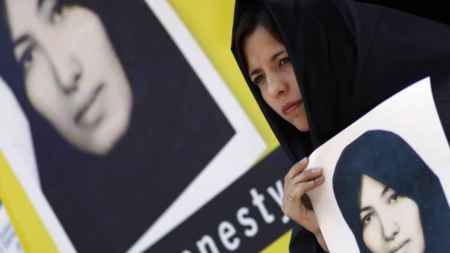
Stop the Hanging of a Child Bride in Iran

October 19, 2016

Stop the Hanging of a Child Bride in Iran, Front Page MagazineDr. Majid Rafizadeh, October 19, 2016

childbrideexecution

Zeinab can be executed any day. Instead of continuing with sanctions relief and appeasement policies, the Obama administration should bring attention to Iran’s crimes against humanity. Iran ranks as the world’s top executioner per capita. 

*****************************

She was born into poverty and an abusive family. As a young child she was forced by her family to marry an older man. According to the Islamic and Sharia law of Iran, this was a perfectly legal and moral arrangement. Islam encourages young girls to become child brides. Iranian authorities point out that the Prophet Muhammad’s life also demonstrates a similar model for his followers.

After being forced to marry, Zeinab Sekaanvand Lokran was repeatedly raped. But in Iran’s Islamist law, even if a husband beats and forces his wife into having sex with him, it is not considered rape or abuse of any kind, since they are married.  According to the clerics, a wife’s duty is to please the man. The Quran in Sura (Chapter) 2:223 says: Your women are your fields, so go into your fields whichever way you like.

Zeinab was also repeatedly beaten after her wedding day. Despite the risk she knew she faced, she attempted to leave her husband multiple times, but with no success. She begged the police to help her, but they ignored her complaints, and reprimanded her for leaving her tormentor. The Islamist law of the land does not provide any protection for girls like her. In addition, neither her family nor friends would accept her if she left her husband.

More tragedies were to unfold for Zeinab. Her husband’s brother began also repeatedly raping her.

She begged for a divorce, but her husband would not accept her request for one. She did not have any legal base according to Iran’s Islamist codes to get a divorce. Everything was against this brave, unyielding girl. Yet, the worst was still to come.

At the age of 17, her husband was found stabbed to death. Because Zeinab had tried to escape him so many times, her community accused her of perpetrating her husband’s death. She was arrested and tortured for the next few months. After endless abuse and torment, she was forced to confess that she was a murderer.

It did not take long for the judge to issue a death sentence for Zeinab. She was not allowed to have access to a lawyer at any point of her trial. Once more, men made the decisions about her life and her death.

Zeinab insisted that her brother-in-law was the one who killed her husband. He threatened her to be silent, and told her that if she pleaded guilty, he would pardon her, according to Islamic law, so she wouldn’t be executed.

Just as she was about to be executed by the medieval method of hanging, it was discovered that she was pregnant. Soon after, she gave birth to a stillborn child, most likely due to the stress and physical abuse that she endured at the hands of her captors. Not long after she gazed at her lifeless baby, she was told by the Iranian authorities to be ready for execution.

Philip Luther, Amnesty International’s research and advocacy director for the Middle East and North Africa, said: “This is an extremely disturbing case. Not only was Zeinab Sekaanvand under 18 years of age at the time of the crime, she was also denied access to a lawyer and says she was tortured after her arrest by male police officers through beatings all over her body.”

Mansoureh Mills, the Iran campaigner at Amnesty International, pointed out:

“I can only imagine how extremely difficult her life must have been. That is why this case is extremely shocking and disturbing, She was relying on adults to protect her and unfortunately no adults were able to do that. Not the authorities and not her family. She tried the police, but they wouldn’t help. She tried her family and they wouldn’t take her back. And she is just a teenager so she had nowhere to turn and so she was forced back to this allegedly abusive marriage until the day her husband was killed.”

The Islamic Republic has hypocritically signed on to the Convention on the Rights of the Child, which prohibits the death penalty for and execution of children. But Iran repeatedly uses the death penalty to execute people under 18.

Zeinab is one case of many female children who live such tragic lives and then get executed. Last year, Iran executed Fatemeh Salbehi for reportedly killing her abusive husband at the age of 17.

According to the Islamic penal code of Iran, girls are treated as adults when they reach the age of nine.

Zeinab can be executed any day. Instead of continuing with sanctions relief and appeasement policies, the Obama administration should bring attention to Iran’s crimes against humanity. Iran ranks as the world’s top executioner per capita. It is incumbent on human rights organizations, the UN, Amnesty International and the international community to stop this execution and many other similar child executions, which are occurring in the Islamic Republic of Iran.

Iran Rejects UN Chief’s Human Rights Report as Fundamentally Flawed

October 5, 2016

Iran Rejects UN Chief’s Human Rights Report as Fundamentally Flawed, Tasnim “News” Agency, October 5, 2016

(It all depends on the meaning of the phrase “human rights.” — DM)

humanrightsiniran

TEHRAN (Tasnim) – Iran’s Foreign Ministry spokesman slammed UN Secretary-General Ban Ki-moon’s recent report on human rights situation in Iran as baseless, saying there are fundamental flaws in the report, which has been drafted on the basis of unfair resolutions with political purposes.

“Such reports have fundamental flaws in essence and that is why they lack validity from Iran’s viewpoint,” Foreign Ministry Spokesman Bahram Qassemi said on Wednesday, after the UN chief gave a negative assessment of human rights in Iran in a 19-page report, released this week.

Ban has said he remains “deeply troubled” by what he called accounts “of executions, floggings, arbitrary arrests and detentions, unfair trials, denial of access to medical care and possible torture and ill-treatment” in Iran.

In response, Qassemi said the report lacks credibility since it has been prepared on the basis of “cruel, unfair and politically-motivated resolutions” with the purpose of exerting pressure on Iran.

What casts more doubt on the credibility of the report is that it has used unclear and unreliable sources, he added.

“The report makes an unfair, one-sided and incorrect judgement on Iran’s human rights situation and has missed the opportunity for an evenhanded and fair assessment based on facts,” the spokesman added.

Highlighting Iran’s efforts to promote human rights and protect civil rights under the Constitution, Qassemi said Ban’s report has ignored the Islamic Republic’s struggle against major challenges, such as the fight against narcotics trafficking and dealing with cruel sanctions.

The spokesman finally warned of erosion of trust in the United Nations as a result of continued politicization of issues, adoption of double standards on human rights and turning a blind eye to the killing of women and children in Yemen.

Such a poor performance dashes hopes about the UN’s role in promoting the human rights situation in the world, he deplored.

Iranian Fatwa: Women May Not Ride Bicycles

October 3, 2016

Iranian Fatwa: Women May Not Ride Bicycles, Front Page MagazineDr. Majid Rafizadeh, October 3, 2016

(When will Obama instruct us that such fatwas by The Islamic Republic’s Imam in Chief have nothing to do with Islam? When will Hillary tell us that Trump’s “fat shaming” of an obese beauty pageant contestant was worse than such fatwas? — DM)

fg

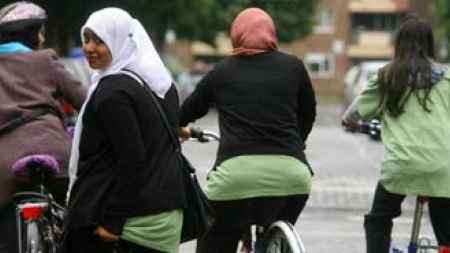
Iran’s Supreme Leader and autocrat, Ayatollah Ali Khamenei, has issued an Islamic fatwa regarding officially banning women from riding bicycles. This is only the latest in a growing multitude of activities that the Islamic Republic of Iran had declared haram (religiously forbidden).

A mullah from the Islamic Republic once described the reasoning behind this fatwa to me. He explained that if a male sees a woman in the act of riding a bicycle he would be exposed to her body physique, which will cause him to become aroused. In other words, Iran’s clerics believe that a man cannot control his sexual desires when he sees a woman on a bicycle even when she is fully covered.

Merely for engaging in an activity that millions of women around the world participate in, many women across Iran have recently been arrested. Signs declaring the new law have been installed on the streets reading, “Bicycle riding for women is prohibited.”

This is not the only absurd restriction that the women of Iran must endure. They are also prohibited from watching men’s volleyball games. A British-Iranian woman, Ghonche Ghavami, was detained and jailed in solitary confinement in Evin, notorious political prison, for attempting to watch a men’s volleyball game.

Iran’s President, the so-called moderate, has not raised any objection to this law or similar ones. In fact, under his presidency, the repressive and restrictive laws against women and their inalienable rights have increased.

What are the reasons behind the most recent fatwa and Islamic law? According to the Muslim clerics of Iran, if a man observes a woman riding a bicycle, it will lead to corruption in the society. They list all kinds of terrible consequences, including corruption that will lead to crime, sexual offenses, financial crimes, spiritual infidelity, religious disobedience, and numerous others.

Ayatollah Khamenei pointed out that “riding bicycles often attracts the attention of men and exposes the society to corruption, and thus contravenes women’s chastity, and it must be abandoned,” according to Iran’s state-run media.

So what can a woman do for fun or exercise if she can’t sing, listen to music, ride a bicycle, wear what she likes, etc.? According to the Islamic and sharia laws of Iran, she should focus all of her attention on being a good mother.

This is reflected in the societal belief that women should only stay at home, bear children, raise children, cook, wash clothes, and satisfy the husband’s sexual desires when he comes home after work. There are no pleasures or luxuries allowed for women, aside from the pleasure they are expected to take in serving others.

Ayatollah Khamenei defined women’s only “role and mission” as “motherhood and housekeeping.”

Aside from these ridiculous reasons for issuing the anti-bicycling fatwa, the underlying drive behind the restrictions and lies is the fact that the ruling Islamist clerics desire to exert control through their male-dominated system and religion.

In fact, there are other constitutional laws preventing women from working outside the house. Article 1117 of Civil Code states: “The husband can prevent his wife from an occupation or technical profession which is incompatible with the family’s interests or the dignity of him or his wife.”

In its latest report, the Foreign and Commonwealth Office stated that women’s situation in Iran has worsened. According to the Foreign and Commonwealth Office,

“Women do not enjoy the same rights and privileges as men in Iran. We expect that the next round of the UN Human Rights Council will be dominated by women’s rights issues, which will raise awareness of this issue; we hope to see progress as a result…Two proposed bills which were making their way through the Iranian parliament in 2015 caused outrage both inside and outside Iran. Human rights groups said the bills would set Iranian women back decades and reduce them to ‘baby-making machines’. The bills were drafted after the Supreme Leader, Ayatollah Ali Khamenei, described family planning as an imitation of Western lifestyles, and requested that Iran’s population be doubled.”

Rather than praising Rouhani’s so-called moderate government, it is incumbent on the United Nations and human rights organizations to pay more attention to the increasing anti-woman Islamist laws of Iran that subjugate, dehumanize and oppress women.

Obama Turns Blind Eye to Iranian Offenses in UN Speech

September 27, 2016

Obama Turns Blind Eye to Iranian Offenses in UN Speech, Clarion Project, Jennifer Breedon, September 27, 2016

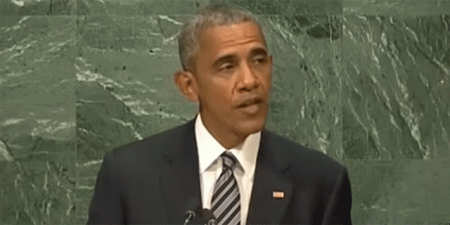
obama-un-address-2016-hpU.S. President Barack Obama addresses the UN General Assembly on Sept. 20, 2016. (Photo: video screenshot)

The Iranian leader rightfully fears a future administration that may not be willing to tolerate a total disregard for international law or human rights, given that even President Obama’s positive nod to Iran at the UN was met with the label of “continued animosity.” 

****************************

In 2015, President Obama stated that Iran’s “support for terrorism” and “its use of proxies to destabilize parts of the Middle East” was problematic, despite the Joint Comprehensive Plan of Action (the nuclear deal) that had been reached by that time that allowed Iran access to millions of previously frozen funds.

Yet, bafflingly, just five minutes after mentioning terror proxies in his 2016 UN address last week, President Obama seemed to turn a blind eye to Iran’s ongoing offenses by saying, “When Iran agrees to accept constraints on its nuclear program, that enhances global security and enhances Iran’s ability to work with other nations.”

Today, Iran is poised to move funds to its global terror proxies more easily due to the infusion of cash created by the unfreezing of their assets.  Even John Kerry admitted in 2015 that some of the money going back to Iran through sanctions relief would undoubtedly go to fund terrorism.

So, we all know it is happening and yet nothing is being done to stop them or to even state this obvious fact aloud before the very body that is designed to protect against such international violations.

The UN Convention that prohibits terrorism financing explicitly outlines the illegality of any government that commits such an offense when it

“directly or indirectly, unlawfully and willfully, provides or collects funds with the intention that they should be used or in the knowledge that they are to be used, in full or in part, in order to carry out . . . act(s) intended to cause death or serious bodily injury to a civilian, or to any other person not taking an active part in the hostilities in a situation of armed conflict, when the purpose of such act, by its nature or context, is to intimidate a population, or to compel a government or an international organization to do or to abstain from doing any act” (Article 2(1)).  

Iran is guilty in spades of all of this.

Additionally, the Iranian government remains the U.S. State Department’s top proxy war and terror sponsor. Previous reports from the U.S. State Department note that Iran remains “unwilling to bring to justice senior al-Qaeda (AQ) members [and has] previously allowed AQ facilitators to operate a core facilitation pipeline through Iran.”

The State Department has also highlighted Iran’s provision of “hundreds of millions of dollars in support of H[e]zballah in Lebanon and has trained thousands of its fighters . . . in direct support of the Assad regime in Syria” as well as terrorist groups in Palestine (Hamas), Yemen (Houthis) and “throughout the Middle East.”

President Obama’s appeals to the oppressive government of Iran have clearly fallen on deaf ears.  In a one-on-one with MSNBC’s Chuck Todd merely 24 hours after Obama’s UN speech, Iranian President Rouhani stated, “If the future administration of the United States wishes to continue animosity, it will receive the appropriate response.”

The Iranian leader rightfully fears a future administration that may not be willing to tolerate a total disregard for international law or human rights, given that even President Obama’s positive nod to Iran at the UN was met with the label of “continued animosity.”

No amount of vocal, material or financial appeasement can ease relations with the State Department’s leading state sponsor of terrorism.  Despite repeated efforts by President Obama, it will not get better until the Iranian regime abandons its practice of funding terrorism, inciting proxy wars throughout the Middle East, and oppressing their own people by using their resources to build and test weapons before providing the infrastructure needed to create a stable economy and free society for their people.

While Iranian civilians and citizens were in dire economic straits with very little government reprieve or resource allocation to ease their conditions prior to the Nuclear Deal sanctions relief, the Iranian regime was spending over $6 billion per year to support the Assad regime in Syria in its efforts to ensure a Shiite majority in the region.

The Iranian regime must be held accountable for its non-adherence to international law and its desire to finance terror globally in places like Yemen, Iraq, Lebanon, and Syria.

It must be held responsible for using funds to bankroll violence and oppression instead of providing basic necessities and freedoms for its own people.  As Obama said at the UN this year, Iran must “listen to voices of young people everywhere who call out for freedom, and dignity, and the opportunity to control their own lives.”

Rouhani made it clear that, despite all of the steps we’ve taken, including acknowledging them positively at the UN General Assembly, nothing the U.S. has done has thawed our relationship with Iran or helped to improve the security of people living in the areas ruled by Iran or its terror proxies.

Our leaders must continue to speak out against Iran’s human rights violations and the financing of terror if we ever hope to see change and remain a positive beacon of democracy and freedom.


In Contrast To Rohani Allegations In UNGA, Senior Iranian Officials Confirm U.S. Has Met Its Obligations Under JCPOA

September 24, 2016

In Contrast To Rohani Allegations In UNGA, Senior Iranian Officials Confirm U.S. Has Met Its Obligations Under JCPOA, MEMRI,  Y. Carmon and A. Savyon* September 23, 2016

Introduction

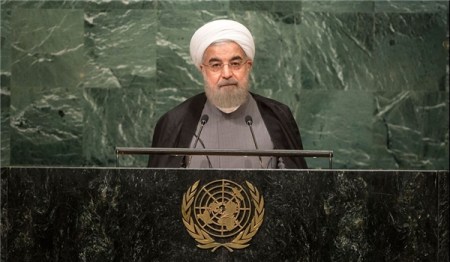
In his September 22, 2016 speech at the UN General Assembly, Iranian President Hassan Rohani accused that the U.S. is not meeting its obligations towards Iran under the JCPOA. He said: “The lack of compliance with the deal on the part of the United States in the past several months represents a flawed approach that should be rectified forthwith… Any failure on the part of the United States in implementing it (the deal) would constitute an international wrongful act and would be objected to by the international community.”[1] 

30061Rohani at the UNGA (Image: Farsnews.com, September 22, 2016)

Rohani’s statements, which are part of an Iranian attempt in recent weeks to create a false impression that the U.S. has not met its obligations towards Iran, are in stark contradiction to statements made by senior members of the Iranian negotiation team who explicitly admitted that the U.S. has in fact met its obligations under the JCPOA (see below).

This Iranian measure is a response to the refusal of Western banks to conduct transactions with Iran in dollars, despite the lifting of the nuclear sanctions in January 2016, because the initial sanctions imposed on Iran by Congress for human rights violations and for terrorism are still in force. As will be recalled, Iran refuses to negotiate with the West on issues of terrorism, on the grounds that these issues are internal sovereign matters.

Below is a MEMRI report on this issue published on August 15, 2016.

As the first year of the JCPOA is marked, and in light of Western banks’ rejection of Iranian transactions in dollars, Iranian Supreme Leader Ali Khamenei and his supporters in the West have launched a campaign to pressure the U.S. to lift the initial sanctions imposed on Iran by Congress for human rights violations and for terrorism. Their aim is to have these sanctions lifted without negotiations and without giving anything in return.

As will be recalled, Iran from the outset restricted the framework of the negotiations to the nuclear issue, and refused to allow them to include other issues such as human rights, terrorism, or missiles, which it considers internal sovereign matters. Therefore, the initial American sanctions concerning these areas remain in force.

A demand for lifting of all the sanctions, including the initial ones, was made by Supreme Leader Ali Khamenei in the months after the JCPOA was achieved in July 2015.[2] Perhaps Tehran thought that with the lifting of the nuclear sanctions, the entire sanctions regime would collapse, including those concerning human rights, terrorism, and missiles. But this did not happen. The U.S. Treasury Department is following the letter and the spirit of U.S. law, and is warning banks worldwide that the initial sanctions remain in force.[3]

In light of this situation, Iran and the supporters of its regime in the West are now working to create a false impression that the U.S. has not met its obligations towards Iran. They claim that, in order to fulfill its commitments towards Iran in the JCPOA, the U.S. is obligated to revoke or circumvent the initial sanctions imposed on Iran by Congress, which currently prevent banks from dealing freely with Iran.  For example, Tyler Cullis, member of the Iranian lobby in the U.S., the National Iranian American Council (NIAC), stated in a recent policy paper that “the United States is committed to ensuring that neither U.S. law nor policy is standing in the way of non-U.S. banks resuming correspondent banking relations with their Iranian counterparts… If U.S. laws or policies are interfering with Iran realizing the full benefit of the lifting of sanctions on Iran’s financial institutions, then the U.S. is required to take steps to ensure that those laws or policies no longer are running such interference. To do so could require additional changes to U.S. laws or policies governing the issue.”[4]

Iranian Deputy Foreign Minister and negotiating team member Majid Takhtravanchi also demanded that the U.S. take explicit steps to remove any obstacles currently preventing banks from dealing with Iran. He said on June 27, 2016,: “Two [contradictory] messages are coming out of Washington: The State Department says that there is no problem carrying out banking and financial transactions with Iran, while the OFAC says the opposite… We want the OFAC… to guarantee that there is no problem for the banks that are cooperating with Iran…”[5]

It should be mentioned that the Iranian implication that the U.S. has not met its obligations towards Iran stands in contradiction to explicit statements made recently by Iranian officials, mainly negotiation team members from Iran’s pragmatic camp, who confirmed that the U.S. had upheld its part of the JCPOA. Deputy Foreign Minister and senior negotiating team member ‘Abbas Araghchi said on a television special marking the first anniversary of the JCPOA: “Both sides have met their obligations under the JCPOA… In order to benefit from the JCPOA… we must carry out several steps because there are restrictions that are not connected to the JCPOA… The other side has implemented its obligations, and if it had not, that would have been a violation of the JCPOA, and we would have handled it in the Joint Committee…

“The JCPOA was meant to remove the obstacles of the sanctions from Iran’s economic path. [Indeed], these obstacles have been removed, but there are other obstacles, such as the initial sanctions by America, FATF [Financial Action Task Force on Money Laundering], and laws connected to money-laundering, which require time [to take care of].

“From the outset, [the other side] was not meant to lift the sanctions that are not connected to the nuclear issue; that is written even in the [2013] Geneva Joint Plan of Action [about the lifting of] ‘sanctions related to the nuclear [issue], because we were negotiating about the nuclear issue [alone]…

“The sanctions on the dollar and the use of the financial apparatus of America belong to the initial sanctions imposed long ago because of issues that are not nuclear-related… We raised the matter in the negotiations, but the Americans did not agree to lift these sanctions… and demanded additional concessions [from us] in matters that were part of our red lines…

“The Americans are serious about maintaining their initial sanctions; this is the essence of America. Iran is Iran and America is America, and as long as we do not negotiate on bilateral relations [with the U.S.], these sanctions will remain in force. The American Treasury Department tells [the banks worldwide] that these sanctions are in force, and has warned them not to get in trouble because of them. These sanctions are not related to the JCPOA.”[6]

Deputy Foreign Minister and negotiating team member Hamid Ba’idinejad said at a press conference marking the first anniversary of the JCPOA: “Up to this very moment, the members of the [Iranian] negotiating team believe that the JCPOA has not been violated [by the U.S.], and still believe that it is possible to solve the problems [concerning transactions in dollars] with discussions, recommendations, and talks… From the outset, the task set out [for the Iranian negotiating team] was to resolve the nuclear issue [alone]. So far, the Islamic Republic has made no decision to negotiate with America on [the other] issues in dispute…

“Our regime never expected us to achieve the lifting of the sanctions for human rights [in the framework] of the nuclear talks.”[7]

Expediency Council head Ali Akbar Hashemi Rafsanjani said: “America is telling [the banks worldwide] that it has not lifted the [initial] sanctions because this problem is related to human rights, terrorism, Palestine, and Lebanon. These [issues] too we could have solved.”[8]

However, after Khamenei warned, on August 1, 2016, that the U.S. had violated its commitments, the negotiating team heads fell into line with him, and began to state that the U.S. had indeed violated its obligations and to demand further changes in U.S. policies and laws.

A U.S. capitulation to these Iranian demands would be a blow to the authority of Congress, which imposed the initial sanctions, and to the separation of powers in the U.S. Moreover, it would constitute U.S. support for Iran’s ideological camp – Khamenei, Iran’s Islamic Revolutionary Guard Corps (IRGC), the Basij, and the ayatollahs connected to them – and not to the pragmatic camp, and would also stand in contradiction to President Obama’s commitment that the JCPOA deals only with the nuclear issue.


* Y. Carmon is President of MEMRI; A. Savyon is the director of MEMRI’s Iran Media Project


Endnotes:


[1] Farsnews.com, September 22, 2016.

[2] See MEMRI Special Dispatch No. 6151, Khamenei Declares That He Will Not Honor The Agreement If Sanctions Are Merely Suspended And Not Lifted, September 4, 2015.

[3] See MEMRI Inquiry and Analysis No. 1249, Post-JCPOA, The IRGC Is The Factor Stopping Iran From Integration Into The Western Economy, May 20, 2016.

[4] Niacouncil.org, August 2016.

[5] Tabnak (Iran), July 27, 2016.

[6] Fars (Iran), July 11, 2016.

[7] Fars (Iran), July 13, 2016.

[8] Fars (Iran), August 10, 2016.

Iran uses medieval torture techniques on their prisoners

September 22, 2016

Iran uses medieval torture techniques on their prisoners, Iran Focus, September 22, 2016

torture-700

London, 22 Sep – It is no secret that Iran uses medieval torture techniques on their prisoners but a recent report by a Baluch prisoner has detailed the horrific practices used on him.

Ajab Gol Nour Zehi, who is imprisoned in Iranshahr Prison in Sistan & Baluchistan province, wrote: “They ruthlessly subjected me to beating with cables on the head and face and back such that after nearly one and half years the signs of the flogging with cables can be seen on my body.”

They would hang him, beat him and stab him.

The stab wounds were inflicted on the soles of his feet to make walking near impossible, on the left side of the abdomen and near the bladder to cause damage to his internal organs.

Their beatings fractured the tibia bones in his legs and created a hole so large that a finger could be placed inside.

He wrote: “One of the tortures they used was to staple my ears. They stapled my both ears which caused bleeding from both ears and blood would run down my shoulders towards my chest. I could not do anything except moaning and screaming.”

They even attempted to force a murder confession out of him.

When that didn’t work, they stripped him naked and began mocking him.

He wrote: “They burned sensitive parts of my body in 21 areas with lighters such that a lot of pus still comes out of the wounds.”

He lost consciousness during the torture sessions but they revived him in order to torture him more.

When he still did not confess to crimes that he hadn’t committed, he was transferred to the intelligence office in Zahedan where the torture began again.

He wrote: “They would hang me every day under the scorching sun from 9 a.m. to 2 p.m. and these tortures continued for one week.”
He named some of his torturers:

He named some of his torturers:

• Pasdar (Revolutionary Guard)
• Akbari, head of the intelligence office in Iranshahr
• Basiji (member of mobilization force)
• Omid Siah Khani
• Basiji Kalak

He called for international human rights organisations to hold a trial into human rights in Iran and asked for a meeting with the United Nations Special Rapporteur for Human Rights in Iran to discuss his treatment within the Iranian prison system.

This report was originally posted on the National Council of Resistance of Iran’s (NCRI) website.

Iran Sanctions Have Ended – and the Mass Executions Have Restarted

September 22, 2016

Iran Sanctions Have Ended – and the Mass Executions Have Restarted, American ThinkerMansour Kashfi, September 22, 2016

The crippling global sanctions on Iran cost the country hundreds of billions of dollars and decimated the economy. Inflation rose to over 40 percent and unemployment levels reached 33 percent. Consequently, the majority of citizens experienced an astronomical cost of living and lack of government services. Therefore, news of negotiations and lifting of sanctions was very well received by Iranians and generated optimism for a life of less hardship after sanctions.

However, since the agreement ending sanctions was signed between the Islamic Republic (IR) and the international powers last January, nothing has improved regarding the everyday life of the Iranian people. Not even one of the critical civil issues that was promised by the so-called “moderate”, “pragmatic” president, Hassan Rouhani, to be addressed after sanctions ended, has been opened for discussion by the IR officials.

Regardless of the rather rapid increase in Iranian crude oil and petrochemical sales and the release of billions of dollars of frozen money by a number of international oil companies and foreign governments, the nation-wide tax in all categories remarkably increased, and a limited welfare to needy senior citizens has been discontinued.

Despite the rosy promises of the IR’s authorities, especially Hassan Rouhani, to bring justice for all and raise the standards of living of the people, amazingly nothing has been done to improve Iranians’ living conditions, and no social freedom and justice is on the horizon. On the contrary, tougher repression and mass executions are the only gift by the IR to the Iranian people after sanctions ended.

Release of Assets

US officials claimed that IR had more than $100 billion of frozen assets abroad during the sanctions era, the equivalent of 28 percent of the country’s gross domestic product, which has been returning to the IR after sanctions ended. A good portion of this money was balance payments of crude oil sold by IR to its customers during the sanction years, including Royal Dutch Shell, Italy’s Saras, Greece’s Hellenic, Emirates National Oil Company, the Indian Reliance and Essar oil refiner, the Netherlands and Japan. All unfrozen money has been transferring to IR’s Central Bank by way of the SWIFT global transactions network. President Hassan Rouhani announced last March that the government of IR has access to all unfrozen assets.

Further, according to the International Energy Agency, IR is currently exporting about 2.14 million barrels of crude and over 200,000 barrels of gas condensates daily. The IR’s oil ministry reported the oil revenues from 2016 until mid-July were about $20 billion.

During negotiations with the IR last year the Obama administration agreed to pay $400 million plus interest of $1.3 billion to settle a failed arms sale to Iran that was initiated during the monarchical government before 1979. The first payment equivalent of $400 million in cash in the form of Swiss francs and euros was airlifted from Geneva, Switzerland to Tehran on January 17, and in return four Iranian-American hostages in IR’s jail were released. Further, officials of the State and Treasury departments confirmed on September 6 that two remaining installments of the $1.3 billion were sent to Tehran in the same manner through Geneva on January 22 and February 5.

With all this windfall money nothing tangible in terms of infrastructure renovations, civil reform and the rise of standard of living has taken place in the country. On the contrary, poverty has increased, over one-third of Iranians presently live under the poverty line, and thousands of citizens escape the country everyday to find a safer place to live. Worst of all, in testimonies of various human rights advocates and organizations, the ignoring of human rights by the IR is always an ever-growing issue in Iran, particularly after the ending of sanctions.

Human Rights Issues

The level of repression inside Iran has increased since Hassan Rouhani took office as president in 2013. Since then, the number of executions has grown rapidly. In 2014, the number of death sentences in Iran reached the largest number of executions in the world except for China. In 2015, according to Ahmed Shaheed, the U.N. Special Rapporteur on human rights in Iran, the number exceeded 1,000.

The U.N. General Assembly’s human rights committee passed a resolution last November that expressed its deepest concern about human rights violations by the Islamic regime. Amnesty International has also called on regime authorities to stop the hanging, particularly of juvenile offenders who are convicted on dubious evidence.  Amnesty International time and again has published reports on physical and psychological torture in Iran, saying that the number of torture and ill-treatment cases is increasing in Iran, making it clear that these violations of human rights not only continue in this time of a moderate President, but are noticeably becoming widespread and in most places systematic.

In January of 2016, finally the expected moment of change arrived, and sanctions were lifted. But immediately, political pressure and religious discrimination began increasing daily. The penalty for apostasy is still death. Any female regardless of age that does not wear veils is arrested and faces harsh punishments. Cultural dissidents, artists, and homosexuals on most occasions would receive capital punishment. Mass executions for political prisoners which were common practice for over a decade after the so-called revolution have now restarted primarily for non-Shi’a citizens.

There was a hanging of 20 innocent Sunni-Kurdish citizens in Karaj, a suburb of Tehran on August 3, 2016, the execution of an Iranian nuclear scientist on August 7, the hanging of 5 minority citizens in the western province of Azerbaijan on August 14, and another hanging of 3 minority citizens accused of exploding the oil pipeline in the southwest province of Khuzestan on August 16. Although U.N. Representative Ahmed Shaheed firmly requested the IR stop the systematic executions, 12 more allegedly accused of possession of illegal drugs were hanged in Karaj prison on August 27. There were a total of 41 executions officially of innocent citizens just in one month. In addition many young male and female citizens disappear every day, and their decomposed bodies are occasionally found in the remote parts of their hometowns. These systematic executions reveal that the nature of the Islamic regime has not changed at all, sanctions or no sanctions. IR claims they were executed for “purported terrorism and related activities” as reported by Zeid Ra’ad Al Hussein, the U.N. High Commissioner for Human Rights.

Ed Royce, the Chairman of the House Foreign Affairs Committee, introduced on September 6 a bill to censure President Obama for his rewarding a terrorist government for its hostage taking as IR presently still has three Iranian-Americans in prison.

It is inhuman for these executions to take place after an unfair trial, absent of any attorneys on behalf of defendants, and obviously based entirely on coerced confessions. In most cases such executions take place without any trial at all, and the Islamic regime has never allowed Ahmed Shaheed to visit Iran to make a precise assessment on human rights violations.

Iran as a member of the United Nations and other international human rights communities has systematically violated nearly every provision of these institutions and the Universal Declaration of Human Rights. IR’s officials have openly opted to ridicule the concept of universal human rights, and they brand the principle of human rights as a tool of the “Great Satan” and Western imperialism.

Where does the money go?

Evidently, the released money after sanctions ended was not intended for citizens’ welfare and the improvement of the living conditions in Iran. The IR officials have been apathetic since the welfare and health of the Iranian people is of the lowest priority in their eyes, considering the huge expense of their active terrorist groups in the Middle East. The money has already reached the IR’s Revolutionary Guard Corps (IRGC) for their efforts to export the Islamic revolution to neighboring countries and carry on the IR’s hostile engagements in Syria, Iraq, and Yemen, arming and financially supporting terrorist groups around the world including Hamas in Gaza, Hezb’llah in Lebanon, Shi’a groups in Bahrain, Houthis in Yemen, and the drug traffickers in South America. The IRGC is the most powerful extralegal organization and richest entity in Iran. The associated IRGC units own over one-third of the listed companies of the Tehran Stock Exchange. Further, according to Bloomberg, the IR Supreme Leader Mullah Khamenei is the owner of an economic empire of about $95 billion.

Now we know where the money goes.

Sharia USA

September 7, 2016

Sharia USA, American ThinkerAynaz Anni Cyrus, September 7, 2016

The present danger that Islam poses to this nation is very real, despite what our leftist government and media would have you believe. And because of the willful blindness and corruption within our government and media, America is now in grave danger vis-à-vis Islamic Supremacism and Jihad. I am witness to the hidden war between Islam and the West, and I see clearly, with great sadness and fear, that we are losing.

***************************

Fourteen years ago my life changed forever as I arrived in the United States, holding tightly to hope and a promise.

That promise was freedom and a dream of a better life.

I entered this beautiful country as a documented immigrant at the age of 18 in August 2002, almost one year after 9/11. After surviving 15 years of oppression under Sharia in Iran, I felt older than my years. I had seen too much and I knew all too well the suffering of those who were subjected to Islam. What I had witnessed and experienced had left my soul weary. But in America, I felt safe. I was able to breathe, and I could stop looking over my shoulder and living in fear.

I could now believe in miracles. Here I was, the newest member of the greatest country in the world. It was my rebirth into freedom. I was in a new place that viewed me as a human; someone of value to society. Finally, my life mattered. I was a daughter of liberty; a citizen of the U.S.A.

I’ve never forgotten those who I left behind — and I have dedicated my life to them. How could I turn my back on them, when I know all too well the vicious suffering women endure in Islamic-ruled countries?

At the age of 9, Qur’anic teachings and Islamic traditions forced me into womanhood. My thoughts, my actions and my life were no longer my own. From that moment on, I lost all rights as a person, as my instruction in preparation to marry and bear children became my only purpose in life. No longer would I be allowed in public without my hijab; prayer and submission would dominate my days. The life of a carefree child at play came to an abrupt and sudden end.

For the next 9 years, I would suffer terrible cruelty under Islam. Rape, lashings, arrests and beatings were my life because I was regarded as property to be “handled” rather than a human being to be loved. During those nine years, I was sold into marriage to a much older man who abused me terribly. A bruised body and broken bones became a common reality for me, and there was little I could do to stop it. Divorce was not an option. Islamic law offers women little support in abusive marriages.

I was trapped, like so many other young girls and women around me were. My silent screams of desperation would remain unheard — until the day I decided I would rather die escaping than continue to live my life as a slave.

Fourteen years have now passed since I gained my freedom and began my mission to help and liberate those still trapped in Islamic countries. I do my best to be a voice for the voiceless who are still living a nightmare under the tyrannical rule of Islam.

I also fight for my fellow Americans. The present danger that Islam poses to this nation is very real, despite what our leftist government and media would have you believe. And because of the willful blindness and corruption within our government and media, America is now in grave danger vis-à-vis Islamic Supremacism and Jihad. I am witness to the hidden war between Islam and the West, and I see clearly, with great sadness and fear, that we are losing.

There are those voices amongst us that argue that Sharia is compatible with American life and can coexist harmoniously alongside the U.S. Constitution. Sorry, but I know Sharia. I know Islam. The coexistence of Sharia with the U.S. Constitution is impossible. And it is crucial to crystallize this fact and to expose exactly what Sharia is because it is now making significant gains on our territory.

Sharia severely limits individual rights, and every country ruled by Sharia forces its citizens to adhere to a strict code of living in accordance with the Qur’an, Hadith and the Supreme leader’s ruling. The concept of free speech, for instance, is anathema to Islam. So is the notion of the individual. In Islam, it is “Allah” who dictates and defines the limits on acceptable and unacceptable actions. In Islam, it is the Qur’an that dictates the lives of the believers, and they have no freedom of choice in regard to anything they do.

Sharia denies its followers basic human dignity. In Islamic countries, women are second-class citizens, mere property, and denied many of the rights Americans take for granted. The right to initiate divorce, travel alone, or own property unless permitted by a man is denied to a woman in Islam.

Submission of the individual is also evident in Islam’s denial of freedom of religion. Under Sharia, you must practice Islam. Anyone born in an Islamic country is, by law, a Muslim, regardless of heritage. Attempting to change your faith is punishable by death.

In my homeland, the Islamic Republic of Iran, Sharia is the law of the land. To speak out against it has dire consequences. Because of Sharia, Iran has one of the highest number of executions in the world. Reports and evidence of crimes against humanity come out of the Islamic Republic daily, many from released prisoners and their families.  Patterns of torture, abuse and death of political prisoners are an undeniable truth.

I am saying all of this because today, as I look at what is happening in America, I see our freedom gravely threatened. Islam is at war with us, and it will stop at nothing in its deliberate and sustained attack on our freedoms. Islamization of the West is occurring at a very fast pace and one of the vehicles Supremacists are using to achieve it is the flooding of Western countries with Muslim refugees. Islamic Obama has opened the floodgates and Hillary intends to escalate the process.

Our leadership and media, meanwhile, perpetrate the lie that accepting these refugees is somehow about tolerance. It is not about tolerance — it is about our values being exploited by our enemies to assist us in cultural suicide and leaving ourselves vulnerable to jihadist attacks.

The dire danger to America lies in the lies told by our leftist government and media and the ignorance of many Americans about Islam’s true character and purpose. I fear that Americans have become blind to how precious and rare freedom is and how it must be protected and fought for without pause. I can’t help but fear that what is coming to America is what came to my homeland in 1979 — and I refuse to be silenced again. And because I refuse to be silent today, I know that certain Islamic forces have targeted me. But I will continue to speak out.

I tell you these things not to gain your sympathy, but to help you understand that our freedom is under fire. Our country is headed down a very dangerous path. The Left has succeeded in making resistance to Islamization appear to be racism and hatred. We must fight this malicious lie. We must fight to become well-informed and educated about Islam in order to defeat leftist and Islamist propaganda. By remaining silent, being afraid to be called names and ignoring reality, we will be surrendering our freedoms to the enemy.

Time is short. Every day that passes is one day we cannot spare. My hope for freedom and a better life was realized when I stepped on American soil fourteen years ago. But what frightens me is that the pernicious evil I escaped from is now coming here. I see it with my own eyes – and, catastrophically, this nation is sleepwalking like a zombie into disaster. I will not allow my freedom to be taken away again without fighting till my last breath. I hope my fellow Americans who love their country as much as I do will join me and other freedom fighters in our battle to save it.

Newly Unearthed Audio Details Iran’s Mass Executions

August 24, 2016

Newly Unearthed Audio Details Iran’s Mass Executions, Front Page MagazineDr. Majid Rafizadeh, August 24, 2016

(But how is this possible? With the Iran Scam, Iran — which frequently vituperates Israel for her gross “abuses of human rights” — has been recognized as a respected member of the world community. — DM)

grand-ayatollah-hossein-a-001

Shocking audio was released recently on the Internet in the Persian language. Immediately, Iranian officials ordered its removal. The audio clearly shows that the so-called “moderate” Iranian leaders are in fact world-class criminals based on every legal or humanitarian standard. The audio sheds light on horrific crimes against humanity that are not that distinct from those egregious crimes committed by the Nazis.

In the audio, Ayatollah Hussein Ali Montazeri, the ex-heir of Iran’s Supreme Leader, reveals the true character of the Islamic Republic and crimes committed by it in the name of Islam. Montazeri was born in Esfahan, Iran, and was one of the founding fathers of the Islamic Republic. He was an Islamic theologian and the designated successor to the Islamic revolution’s Supreme Leader, Ayatollah Rooh Allah Khomeini, until the very last moments of Khomeini’s life. His pictures were posted next to Khomeini’s in the streets. Nevertheless, Montazeri’s fate changed dramatically, as he could not stay silent and felt compelled to speak out.

Montazeri’s son, Ahmad, posted the audio on his website, but was ordered by Iranian intelligence (Etela’at) to remove it.

“You [Iranian officials] will in the future be etched in the annals of history as criminals,” Montazeri warns the Islamic Republic in the audio. “The greatest crime committed under the Islamic Republic, from the beginning of the Revolution until now, which will be condemned by history, is this crime [mass executions] committed by you.”

In reference to one of the worst mass executions in the modern history of the Middle East being carried by the Iranian government officials, Montazeri stated that “I am a straight-talking person. I don’t hold back what is in my heart. In contrast to some gentlemen who do what is politically expedient…. Believe me, I haven’t been able to sleep and this issue (executions) occupies my mind 2-3 hours every night … How will you respond to the families? How much did the Shah execute? Compare our executions to his!”

When an official asked him for his permission to execute 200 people, Montazeri retorted fiercely, “I don’t give permission at all. I am even against a single person being executed.”

Many members of those who were executed were from the opposition group, MEK, which is led currently by Maryam Rajavi. Amnesty International estimates that in the summer of 1988, the total number of people executed was 4,500. Some estimates reach as high as over 30,000 people.

Executions included all range of innocent people, including children and pregnant women. The audio continues:

So, now, without [the prisoners] having carried out any new activities, we go and execute them. This means that all of us screwed up, our entire judicial system is wrong. Isn’t that what it means? We are among ourselves here. I mean, we want to take stock … This one guy, his brother was in prison. Eventually when, you know, he got caught up in this, they said his sister was also a suspect. So they went and brought the sister. They executed the guy. The sister — it was only two days since they had brought her — when they told her [of the brother’s death], she said, I liked these people. They said the sister was 15 or 16 years old. They said, now that her brother has been executed and after what she said, execute her too, and they did. In Esfahan, a pregnant woman was among [those massacred]. In Esfahan they executed a pregnant woman…. [In clerical jurisprudence] one must not execute a woman even if she is a mohareb [enemy of God]. I reminded [Khomeini] of this, but he said they must be executed. In the month of Moharram … the month of God and the Prophet, it shouldn’t be like this. At least feel some shame before Imam Hussein. Cutting off all meetings and suddenly engaging in such butchery, dragging them out and bang! Bang! Does this happen anywhere in the world?

The government could not eliminate Montazeri the way it did with other opposition leaders due to his religious authority and the large number of followers he had. A few months before he was supposed to replace the Supreme Leader, Khomeini removed him from being the successor. He was put under house arrest, and his speeches and activities were heavily controlled. The regime chose the current Supreme Leader, Khamenei, who was a junior cleric, to be the Supreme Leader. He was a low-risk figure and total puppet of the Islamic Revolutionary Guard Corps (IRGC).

Ironically, all those people Montazeri is speaking to and warning in the audio — and all of those who were involved in these crimes — appear to have higher positions in the government currently.

For example, Mostafa Pourmohammadi was a representative of the Intelligence Ministry to the notorious Evin prison, and he was recently appointed by the so-called moderate president Hassan Rouhani to be justice minister. Ebrahim Raeisi was a public prosecutor and currently he is the head of Astan Quds Razavi, which has billions of dollars in revenues. Hussein Ali Nayeri was a judge and currently is the deputy of the Supreme Court of Iran. In his memoir, Montazeri writes that he told Nayeri to stop the executions at least in the month of Moharram, but Nayeri said, “We have executed so far 750 people in Tehran… we will get the job done with another 200 people and then we will listen to whatever you say.” Montazeri wrote several letters to Khomeini warning him as well.

What is crucial to point out is that realistically speaking, the above-mentioned people are only tje tip of the iceberg of those who are involved in such large scale crimes against humanity in Iran. But they have been awarded higher positions, power, and more money.

Montazeri advised the ruling politicians, “Beware of 50 years from now, when people will pass judgment on the leader [Khomeini] and will say he was a bloodthirsty, brutal and murderous leader…. I do not want history to remember him like that[.]”

The International Criminal Court, the UN, human rights originations and liberal institutions and activists should push to bring these officials to justice the way the international community did for some members of the Nazi Party. Finally, we should remember that these are world-class criminals and we are easing sanctions against a brutal regime, giving them more money from taxpayers, shaking hands with them, and calling them the moderates. How are we going to respond to millions of families whose members have been executed and tortured? What are we going to say in the future when asked why we allied with such criminals, appeased them, and gave them billions of dollars?

Iranian Dissidents Visit Israel, View Iran after the Nuclear Deal

August 21, 2016

Iranian Dissidents Visit Israel, View Iran after the Nuclear Deal, Jerusalem Center via YouTube, August 21, 2016