Archive for the ‘Iran and Israel’ category

Iran Slams PGCC’s Statement against Hezbollah

March 3, 2016

Iran Slams PGCC’s Statement against Hezbollah, Tasnim News Agency, March 3, 2016

Iran and Hezbollah

TEHRAN (Tasnim) – Iranian Foreign Ministry Spokesman Hossein Jaberi Ansari on Thursday strongly denounced a recent move by the Persian Gulf Cooperation Council to call the Lebanese Resistance Movement, Hezbollah, a terrorist group, saying such stances are against the interests of the Muslim world.

“The Lebanese Islamic Resistance Movement, Hezbollah, ended decades of lethargy in countering the occupiers of Palestine through perseverance and resistance to the Zionist regime and all-out solidarity with the innocent nation and resistance movement of Palestine,” Jaberi Ansari said Thursday.

It was Hezbollah that gained the first major victory of Arabs and Muslims in the history of anti-Zionist conflict and turned to the distinguished symbol of resistance to the occupation and racism of Zionism, he underlined.

The Iranian spokesman added that Hezbollah is “the living and diligent representative” of the Muslims’ lasting aspirations to achieve independence, freedom, justice, honor, dignity, and fight against tyranny, occupation, racism, and state-sponsored terrorism of the Zionist regime and the Takfiri blind terrorism and extremism.

The opposition of certain Arab governments with such a movement does not justify their conformity to the occupiers of Palestine in labeling the Resistance movement a terrorist group, he stated.

Jaberi Ansari went on to say that those making such stances are “intentionally or unintentionally” acting against the interests of Muslim countries.

Earlier today, Iranian Deputy Foreign Minister for Arab and African Affairs Hossein Amir Abdollahian also said those who recently declared Hezbollah a terrorist group are damaging the unity and security of Lebanon.

“Referring to Hezbollah, the most influential resistance movement, as a terrorist group, and ignoring the Zionist regime’s crimes is a new mistake that is not in the interest of regional stability and security,” Amir Abdollahian said.

The Arab monarchies of the Persian Gulf on Wednesday declared Hezbollah movement, which has been fighting terrorist groups in Syria and the Israeli occupation, a “terrorist group.”

The six-nation (Persian) Gulf Cooperation Council officially added Hezbollah and all groups affiliated to its so-called list of “terrorist” organizations.

Iran uses Syrian truce to deploy hundreds of Palestinian terrorists on Golan border

February 27, 2016

Iran uses Syrian truce to deploy hundreds of Palestinian terrorists on Golan border, DEBKAfile, February 27, 2016

Al-Sabirin-logo

Under cover of the Syrian ceasefire that went into effect Saturday, Feb. 27, and the Russian air umbrella, Iran’s Revolutionary Guards Corps finally managed to secretly install hundreds of armed Palestinian terrorists on the Syrian-Israeli border face-to-face with the IDF’s Golan positions.

This is reported exclusively by DEBKAfile’s military and intelligence sources.

These Palestinians belong to Al-Sabirin, a new terrorist organization the Iranian Guards and Hizballah are building in the refugee camps of Lebanon and the Gaza Strip. Their agents clandestinely recruited the new terrorists from among young Palestinians who fled the Yarmouk refugee camp outside Damascus and sought refuge in Lebanon. Hizballah organized their return to Syria through south Lebanon – but not before training and arming them for penetration deep inside Israel to carry out mass-casualty assaults on IDF positions, highways and civilians.

So Iran and Hizballah have finally been able to achieve one of the most cherished goals of their integration in the Syria civil war, namely, to bring a loyal terrorist force right up to Israel’s border.

Israel’s military planners went to extreme lengths to prevent this happening. Last December, Samir Quntar, after being assigned by Tehran and Hizballah to establish a Palestinian-Druze terror network on the Golan, was assassinated in Damascus.

Twelve months before that, on Jan. 18, an Israeli air strike hit an Iranian-Syrian military party surveying the Golan in search of jumping-off locations for Hizballah terror squads to strike across the border against Israeli targets. The two senior officers in the party, Iranian General Allah-Dadi and Hizballah’s Jihad Mughniyeh, were killed.

The hubbub in the run-up to the Syrian truce, coupled with Russia’s protective military presence, finally gave the Islamic Republic and its Lebanese proxy the chance to outfox Israeli intelligence and secretly bring forward a terrorist force to striking range against Israel

This discovery was one of the causes of Prime Minister Binyamin Netanyahu’s urgent phone call to President Vladimir Putin Wednesday, Feb. 24, two days before the ceasefire went into effect. He reminded the Russian leader of the understandings they had reached regarding the deployment of pro-Iranian terrorists on the Syrian-Israeli border. He also sent emissaries to Moscow to intercede with Russian officials.

Putin’s answers to Israel’s demarches were vague and evasive, on the lines of a promise to look into their complaints.

He also tried to fob Netanyahu off by inviting President Reuven Rivlin for a state visit to Russia. Putin promised to use that occasion for a solemn Russian pledge of commitment to upholding Israel’s security in a tone that would leave Tehran in no doubt of Moscow support for the Jewish state.
The Rivlin visit has been scheduled for March 16.

But it is clear that the prime minister and defense minister Moshe Ya’alon were too slow to pick up on the new terrorist menace Iran had parked on Israel’s border. Now their hands are tied, say DEBKAfile’s sources. An IDF operation to evict the pro-Iranian Palestinian Al-Sabirin network from the Syrian Golan, before it digs in, would lay Israel open to the charge of jeopardizing, or even sabotaging, the inherently fragile Syrian ceasefire initiated jointly by the US and Russia.

The Moral Cost of Appeasing Iran

February 24, 2016

The Moral Cost of Appeasing Iran, Gatestone InstituteMohshin Habib, February 24, 2016

♦ The leaders of both France and Italy set aside their values to appease the president of Iran.

♦ In France, protesters demanded that President François Hollande challenge the Iranian president about his country’s human rights abuses. France’s leadership, however, raised no questions of that sort. Instead, Mr. Rouhani was welcomed as a superstar.

♦ According to a 659-page report by Human Rights Watch, Iran’s human rights violations under Mr. Rouhani’s governance have been increasing. Social media users, artists and journalists face harsh sentences on dubious security charges.

♦ In November, the Iranian Supreme Court upheld a criminal court ruling sentencing Soheil Arabi to death for Facebook posts “insulting the Prophet” and “corruption on earth.”

Right after signing the Iran nuclear deal with itself — Iran still has not signed it, and even if it did, the deal would not be legally binding — members of the P5+1 (the five permanent members of the UN Security Council plus Germany) have been showing their eagerness to establish improved relations with their imaginary partner.

Last month, after the lifting of international sanctions, Iran’s president, Hassan Rouhani, went on a five-day trip to Italy and France.

Officials from the host countries were so enthusiastic to welcome the Iranian president, it was as if they were unaware of Iran’s multiple violations of The Treaty on the Non-Proliferation of Nuclear Weapons (NPT) — which Iran did sign in 1968. They also seemed unaware of Iran’s expansion into Syria, Lebanon and Yemen, as well as Iran’s continuing role in sponsoring global terrorism.

Although both the leaders of France and Italy seemed eager to appease the president of Iran, in Paris, thousands of demonstrators gathered on the streets to protest Mr. Rouhani’s visit, and staged mock executions to highlight Iran’s dire human rights violations. In 2014, for instance, at least nine people were executed on the charge of moharebeh (“enmity against God”).

Even today, dozens of child offenders remain on death row in Iran. According to Iranian law, girls who reach the age of 9 and boys who reach the age of 15 can be sentenced to capital punishment. A recent report by Amnesty International called Iran one of the world’s leading offenders in executing juveniles. Despite the country’s ratification of the Convention on the Rights of the Child — which abolishes the use of the death penalty against offenders under the age of 18 — the UN estimates that 160 minors remain on death row.

The Iranian delegation, according to The New York Times, had asked Italian officials to hide all statues leading to the grand hall of the Capitoline Museums — where a news conference between Prime Minister Matteo Renzi and the Iranian president took place — to avoid any “embarrassment” for Rouhani, who casts himself as a moderate and reform-seeker. So on the first stop of Mr. Rouhani’s European visit, statues were encased in tall white boxes. In addition, “The lectern, was placed to the side — not the front — of an equestrian statue of the emperor Marcus Aurelius, apparently to avoid having images of the horse’s genitals appear in news photographs.”

As any kind of image is haram (forbidden) in Islam, any form of statue is considered idolatry.

Many Italians expressed their outrage over the decision to censor the statues. They accused the government of betraying Italian history and culture for the sake of economic interests.

An Iranian women’s rights organization, My Stealthy Freedom, condemned the Italian government’s decision. In a post on their Facebook page, the group wrote:

“Italian female politicians, you are not statues, speak out. Rome covers nude statues out of respect for Iran’s president in Italy and Islamic Republic of Iran covers Italian female politicians in Iran. Dear Italy. Apparently, you respect the values of the Islamic Republic, but the problem is the Islamic Republic of Iran does not respect our values or our freedom of choice. They even force non-Muslim women to cover up in Iran…”

In France, protesters demanded that President François Hollande challenge the Iranian president about his country’s human rights abuses. France’s leadership, however, raised no questions of that sort. Instead, Mr. Rouhani was welcomed as a superstar.

Big business deals were signed. France’s car-maker Peugeot and Iran’s leading vehicle manufacturer, Khodro, are engaged in a €400 million partnership. France’s energy giant, Total, signed a Memorandum of Understanding to buy crude oil from Iran. Total will reportedly begin importing 160,000 barrels of oil per day starting on February 16. Twelve days after the West lifted economic sanctions, Airbus announced that Iran Air had agreed to purchase 118 new planes. The deal is estimated at $25 billion.

Prime Minister of France Manual Valls hailed his country’s trade agreements with Iran. “France is available for Iran,” he said.

During a recent visit to Tehran, Germany’s Foreign Minister, Frank Walter Steinmeier, asked the Iranian president to keep Germany in mind as a future stop on his next trip to Europe.

Meanwhile, according to a US State Department report, Iran has pledged to continue its assistance to Shiite militias in Iraq. Many of these militias have poured into Syria and are now fighting alongside the Assad regime. Rouhani’s government also continues to support its Lebanese proxy Hezbollah, and Palestinian militants in Gaza.

For many years, the Iranian president has kept up close ties with leaders of Hezbollah, including Abbas Moussavi (the former leader of Hezbollah who was killed in 1992) and Hassan Nasrallah. In March 2014, Mr. Rouhani publicly pledged support for Hezbollah.

Rouhani’s Defense Minister is a former Islamic Revolutionary Guards Corps (IRGC) officer, Brig. Gen. Hossein Dehghan. He commanded IRGC forces in Lebanon is Syria during Hezbollah’s founding years from 1982-1984.

Last September, Dehghan said that Tehran will continue arming Hezbollah, Hamas and any group that is part of the “resistance” against the U.S. and Israel. Iran, he explained, considers America to be the Great Satan.

“Hizbullah,” Dehghan stated, “does not need us to supply them with rockets and arms. Israel and the U.S. need to know this. Today, Hamas, the Islamic Jihad, and Hizbullah have the capability of producing their own resources and weapons themselves. Nevertheless, we shall not refrain from supporting them.”

As well as Dehghan, almost all of Rouhani’s appointments are either former members of the IRGC or other revolutionary institutions, such as Iran’s Judiciary and Intelligence Ministries.

Iran’s human rights violations under Rouhani’s governance have been increasing. A 659-page report published by Human Rights Watch concludes that Iranian authorities have repeatedly clamped down on free speech and dissent. “In a sharp increase from previous years, Iran also executed more than 830 prisoners.”

806Since Hassan Rouhani (right) became the president of Iran, the surge in executions has given Iran the world’s highest death penalty rate per capita.

Social media users, artists and journalists face harsh sentences on dubious “security” charges. In May 2014, four young men and three unveiled women were arrested after a video showing them dancing to the popular song “Happy” went viral on YouTube. They were sentenced to up to a year in prison and 91 lashes on several charges, including “illicit relations.”

In November, the Iranian Supreme Court upheld a criminal court ruling sentencing Soheil Arabi to death for Facebook posts “insulting the Prophet” and “corruption on earth.”

What to Expect in Iran

February 22, 2016

What to Expect in Iran, Gatestone InstituteJagdish N. Singh, February 22, 2016

♦ “The destruction of Israel is non-negotiable.” — Mohammad Neza Naghdi, Commander of Iran’s Basij paramilitary force.

♦ Sanctions relief will mainly benefit Ayatollah Khamenei and members of the Revolutionary Guards: they control up to one-third of Iran’s economy.

♦ Part of the Iranian regime’s grand strategy is to inflict “death to America” and replace it with its own radical version of Islamic governance. Ayatollah Khamenei himself called for America’s destruction amid nuclear negotiations.

♦ Officials also believe Iran is indirectly funding the Islamic State (IS) in the Sinai. “Suitcases of cash” are sent directly to Hamas officials in the Gaza Strip; part of the money is then transferred to IS.

♦ Iran now poses an even greater threat. If democracies today continue their present policies towards Iran, it will only embolden Iran’s regime to continue its quest to obtain nuclear weapons as well as its terrorism and human rights violations.

Humanity seldom seems to learn its lessons. The governments of the world’s leading democracies appear to be suffering from this predicament in their nuclear dealings with the Islamic Republic of Iran. To avoid catastrophe, democracies need quickly to correct their course.

One of the fatal blunders of Western democracies is their repeated commitment to appeasing and delaying action against aggressive regimes. Between the two World Wars, despite plenty of evidence of the widely-declared global racist agenda of Germany’s Adolf Hitler, democratic powers waited to take action until it was too late. Hitler was able to carry out a genocide that continues to haunt many nations.

Today, Western democratic governments, with their Eastern counterparts such as India, seem on a similar course in dealing with the Islamic Republic of Iran.

The domestic and international agenda of the Khomeinist government is publicly documented. Since the Iranian Revolution of 1979, part of the regime’s open grand strategy is to inflict “death to America,” the leader of the free world, and replace it with its own radical version of Islamic governance. Under the current Supreme Leader Ayatollah Ali Khamenei and his Islamic Revolutionary Guards Corps (IRGC), Iran has been gaining influence across the Middle East, Latin America, the Caribbean and South Asia. Despite nuclear talks with the West, Iran’s goal of “death to America” remains. The Ayatollah himself even called for America’s destruction amid nuclear negotiations.

Currently, Iran is a major player in aiding the autocratic regime of Basher al-Assad in Syria, the Houthis in Yemen, Hezbollah in Lebanon, Palestinian Islamic Jihad and Hamas in the West Bank and Gaza and the Islamic State (IS) in Egypt’s Sinai Peninsula.

To advance its imperial agenda, Iran has proceeded to develop its conventional and nuclear ballistic missile program. According to Director of National Intelligence James Clapper, Iran has “one of the largest inventories of ballistic missiles in the Middle East.”

In line with Iran’s missile development program, Iran’s Revolutionary Guard Navy Rear Commander, Ali Fadavi, announced: “Based on the fifth five-year plan, we should materialize our objective of mass-producing military speedboats with the speed of 80 knots per hour… and are equipped with missiles with a range of 100km; the vessels no one can catch.”

Aside from its military aspirations, since the fall of the Shah in 1979, successive Iranian governments have voiced their plans to annihilate the State of Israel, the only pluralist democracy in the Middle East, and an effective military deterrent to Iran’s designs in the region.

Hostile messages have been pouring forth from Iran. Mohammad Neza Naghdi, Commander of the Basij paramilitary force, stated in clear terms in April 2015, that, “The destruction of Israel is non-negotiable.”

Major General Yahya Rahim Safavi, a former IRGC commander and a top military aide to Khamenei, warned in May 2015, that “More than 80,000 missiles are ready to rain down on Tel Aviv and Haifa.”

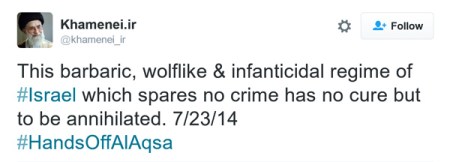
As late as November, Iran’s Supreme Leader Khamenei himself tweeted, “This barbaric, wolflike & infanticidal regime of #Israel which spares no crime has no cure but to be annihilated.”
1477

Bewilderingly, Western democracies have chosen to overlook Iran’s speeches and actions. They chose instead to appease the regime. Last July, despite genuinely serious reservations expressed by international strategic and military experts (including retired American military officers), the United States, United Kingdom, France and Germany – the four democracies in the P5+1 — concluded a nuclear deal with themselves that they proposed to Iran. Iran so far has not signed the deal, and apparently even if it did, according to the U.S. Department of State, the deal would not be legally binding.

Tehran will greatly benefit financially from the terms of the nuclear agreement in the months to come. Under the administration of President Barack Obama, nuclear sanctions against Iran have been lifted. To advance the deal and make it more appealing to Iran, the president has also agreed to pay Iran a $1.7 billion settlement for $400 million in “frozen” assets held in the United States since 1981.

The Society for Worldwide Interbank Financial Telecommunication (SWIFT), “the electronic bloodstream of the global financial system,” had disconnected 15 Iranian banks from its system in 2012. after coming under pressure from both the United States and the European Union at the height of efforts to curb Iran’s nuclear ambitions. Today, SWIFT is ready to let those banned banks, including the Central Bank of Iran, use its system once again. Iran now has an even greater ability to fund its terrorist proxies around the world.

European political and business leaders have been rushing to Tehran to sign new agreements. On January 28, in Paris, Iran’s President Hassan Rouhani and France’s President Francois Hollande signed major business deals, including a joint venture between car-makers PSA Peugeot Citroen and Iran’s Khodro. Iran is in the process of buying 118 Airbus passenger planes to update its aging fleet. The construction group Bouygues and the French airport operator ADP are now set to build an extension for Tehran’s airport, while Vinci, another construction firm, has been commissioned to design, build and operate new terminals for the Mashhad and Isfahan airports. The French oil company Total has agreed to buy Iranian crude oil, and agreements in shipping, health, agriculture and water provision have also been signed.

Democratic India is also cultivating relations with Iran. In a meeting in May, India’s Minister of Road Transport and Highways, Nitin Gadkari, and Iranian Transport and Urban Development Minister, Abbas Ahmad Akhoundi signed a Memorandum of Understanding on India’s participation in the development of the Chabahar Port in Iran.

The Chabahar project will impart strategic leverage to India and its access to Afghanistan and energy-rich Central Asia by bypassing Pakistan. The distance between the Chabahar Port and Gujarat – India’s westernmost state, located near the Persian Gulf, is less than the distance between Delhi and Mumbai. Transit times are estimated to be reduced by a third. Indian firms have already agreed to lease two existing berths at the port and operate them as container and multi-purpose cargo terminals.

The Chabahar project, New Delhi calculates, will be highly beneficial. As India has invested over $2 billion in Afghanistan, the Indian government plans to link the Chabahar port with the Zaranj-Delaram road it built in Afghanistan, thereby opening alternative routes to Afghanistan and enhancing access to regional and global markets.

Russia and China, permanent members of the UN Security Council, are also strengthening their cooperation with Iran. Both Russia and China adopted a policy of ambivalence towards Iran and saw to it that sanctions imposed by the West were not too tough. They also repeatedly blocked attempts at sanctioning Iran’s ally, the current Syrian regime, out of concern over financial ties in the region.

China is also capitalizing on the lifting of sanctions against Iran. Chinese President Xi Jinping rushed to Iran after the so-called nuclear agreement to discuss a 25-year strategic cooperation plan. In a landmark deal worth up to $600 billion, Xi committed to increase trade between the two nations during the next decade. Beijing and Tehran also agreed to enhance security cooperation through intelligence-sharing, counter-terror measures, military exchanges and coordination. Incidentally, despite international sanctions, China-Iran trade increased from $3 billion in 2001 to more than $50 billion in 2014.

Given its fanatical and sectarian ideological agenda, Iran is likely to use the new funds to boost its armament program and ongoing clandestine terror acts. Sanctions relief will mainly benefit Khamenei and members of the IRGC: they control up to one-third of Iran’s economy.

Iran now poses an even greater threat to the entire civilized world. The pattern of Tehran’s behavior shows the government can never be trusted on any promises it makes not to advance its nuclear weapons program. Khamenei has made an open declaration that Tehran will not allow effective inspections of its military sites or interviews with its nuclear scientists.

The links of the IRGC’s Qods Force with Hezbollah, Hamas, Palestinian Islamic Jihad, the Houthis and other terror militias pose a major threat to peace and stability in the Middle East.

Hezbollah’s networks have expanded over the years, infiltrating Latin America and the Caribbean through Shiite cultural centers in the region. According to an official Argentine report, Tehran has established its terrorist, intelligence and operational networks throughout Latin America as far back as the 1980s. Iran’s intelligence activities in the region are being conducted directly by Iranian officials or through its proxy, Hezbollah. Criminal activity may already be underway in Brazil, Colombia, Chile, Paraguay, Uruguay, Suriname and Trinidad and Tobago. Iran’s involvement in the cocaine trade has bolstered the regimes regional access and strengthened ties with its allies in Venezuela, Ecuador, Bolivia and elsewhere.

According to senior Western intelligence officials, the IRGC has transferred tens of millions of dollars to Hamas to be used for weapons, military equipment and training, and that Iran also delivers arms and funds to Hamas through the Red Sea and the Sinai. Officials also believe Iran is indirectly funding the Islamic State (IS) in the Sinai. “Suitcases of cash” are sent directly to Hamas officials in the Gaza Strip; part of the money is then transferred to IS.

Tehran’s links with Hamas and IS are part of a grander strategy of using proxy forces to gain hegemony over the Middle East and undermining American allies such as Egypt and Israel. In Lebanon, Iraq and Syria, Iran seeks to preserve its influence. By fighting IS, Iran strengthens existing pro-Iran regimes and maintains its relevance in the region.

While Iran does support IS indirectly in the Sinai, the government’s goal is to weaken the current Egyptian regime and the Sunni Arab alliance between Egypt, Saudi Arabia and Jordan. It has no problem with IS gaining strength in the Sinai right now. If IS does gain more power in the Sinai, Iran can use it to impose its own agenda in the future. Tehran evidently wants to use IS victories against Sunni states as an opportunity to take over.

Iran also supports the Gaza-based terror group al-Sabireen [“The Patient Ones”], established in the wake of previous tensions between Iran, Hamas and Islamic Jihad. The group has about 400 followers and its emblem is identical to that of Hezbollah. Each member receives a monthly salary of $250-$300, while senior members receive at least $700. Annually, the terror group receives a budget of $10 million from Iran, smuggled in suitcases through tunnels along the border with Egypt. Potential members are wooed by al-Sabireen through familiar channels of philanthropy and education. The group’s publications refer to the United States as “the source of superpower terrorism,” and its slogan is, “The road to the liberation of Palestinian goes through Karbala” — a Shiite holy city in Iraq.

Al-Sabireen has extended its operations from the Gaza Strip to the West Bank and Jerusalem with Iran’s backing. Hisham Salim, the founder of al-Sabireen, admitted that his group is directly financed by Iran. “We have an armed branch whose goal is to wage war on the Israeli occupation everywhere,” Salim said. “Within this framework we have members in the West Bank and Jerusalem.”

The Obama administration has forged ahead with its Iran policies despite knowing the regime’s support of global terrorism. U.S. President Barack Obama himself spoke about Iran’s terror activities in a press conference last year. “Now, we’ll still have problems with Iran’s sponsorship of terrorism; its funding of proxies like Hezbollah that threaten Israel and threaten the region; the destabilizing activities that they’re engaging in, including place like Yemen,” he said, adding that the nuclear “deal is not contingent on Iran changing its behavior. Its not contingent on Iran suddenly operating like a liberal democracy.”

History urges those living in democracies today to rein in their governments and correct their fatal Iran policies. The world cannot afford to overlook the damage of these governments. If democracies today continue their present policies towards Iran, it will only embolden Iran’s regime to continue its quest to obtain nuclear weapons as well as its terrorism and human rights violations.
Hizballah Using Advanced, Iranian Anti-Tank Missiles in Syria

February 2, 2016

Hizballah Using Advanced, Iranian Anti-Tank Missiles in Syria, Investigative Project on Terrorism, February 2, 2016

Israel frequently has voiced concerns over Hizballah acquiring sophisticated weaponry – including new Iranian anti-tank missiles – that could end up being utilized against in a future battle between Israel and the Shi’ite terrorist organization.

*****************

Hizballah terrorists are using Iranian-made anti-tank missiles in Syria that could be used against Israel in a future confrontation, the Investigative Project on Terrorism (IPT) has learned.

On Sunday, Iranian news agency ABNA reported that Hizballah is using Toophan anti-tank missiles manufactured by Iran’s Aerospace Industries Organization.

The Toophan is a reverse-engineered version of the American military BGM-71 TOW missile, with a payload of 3.6 kg warhead that is capable of penetrating up to 550mm of steel armor. The missile can reach a top speed of 310 m/s, with a range of 3,850m.

Israel frequently has voiced concerns over Hizballah acquiring sophisticated weaponry – including new Iranian anti-tank missiles – that could end up being utilized against in a future battle between Israel and the Shi’ite terrorist organization.

This development comes amid growing Iranian expansion in Syria and throughout the region. Since the launch of Iran’s October ground operation in northern Syria, more than 135 Iranian Revolutionary Guard Corps (IRGC) troops have been killed, according to a report written by Raz Zimmt – an expert on Iran’s political and social networks.

Click here for the full analysis published by the Meir Amit Intelligence and Terrorism Information Center.

The commander of IRGC’s Qods Force – Qassem Soleimani – was also seen in public Jan. 21, his first appearance since he was reported injured in Syria. Soleimani spoke at a memorial service for an IRGC brigadier general killed in an alleged Israeli airstrike in January 2015 near Quneitra in the southern Golan Heights. That airstrike also killed six Hizballah terrorists, including Jihad Mugniyeh, son of arch-terrorist Imad Mugniyeh.

Iran is working with Hizballah and other terrorist organizations, including the Palestinian Islamic Jihad, to set up a base of operations along the Syrian border to target the Jewish state.

Iran has also increased its interventions in Iraq and Yemen in recent months, as the Islamic Republic seeks to expand its presence throughout the Middle East in an effort to achieve regional hegemony.


A European-Iranian honeymoon

January 31, 2016

A European-Iranian honeymoon, Israel Hayom, Prof. Eyal Zisser, January 31, 2016

Last week, the European dam burst. While the continent was turning a cold shoulder to Israel and European entities continued with their threats of boycott, its gates were thrown open to Iran. European leaders put their obsession with Israel aside for an hour or two, and after paying the necessary lip service to International Holocaust Memorial Day, gave Iranian President Hassan Rouhani a royal welcome.

The Iranian president, the smiling face of the Islamic republic, arrived for visits to Italy and France. It was the first visit of its kind since the nuclear deal was signed, a visit that signaled the start of a European-Iranian honeymoon, a visit that will be followed by others like it all over the continent. Rouhani’s visit came days after the economic sanctions on Iran were lifted. It’s no wonder that during the visit, announcements were made about contact between the Iranians and a number of Italian and French companies on deals including a return to European cars being manufactured in Iranian plants and, of course, contracts to purchase Iranian oil. The Iranians are hungry for Europe’s products and technology, while European companies are hungry for Iranian money.

As Rouhani was being received in Europe as an honored guest, Iran’s spiritual leader Ayatollah Ali Khamenei was busy with his longtime hobby of denying the Holocaust. He posted a clip on his website in which he called to investigate whether or not the Holocaust had actually happened, as the Zionists claim it did. But no one in Europe bothered Rouhani with any minor matter like that. After all, it was U.S. Secretary of State John Kerry who urged people not to take Tehran’s calls to annihilate Israel and the U.S. seriously, saying it was only talk. The Europeans also didn’t bother to raise the question of Iranian involvement in regional destabilization, such as in Yemen and Syria, or about Tehran’s support of terrorism. Even questions about respecting human rights and freedom of expression and promoting democracy in Iran itself were removed out of respect for the agenda of the day. Europe, as we know, only asks those questions of Israel.

Indeed, despite Rouhani’s smiles, no change has taken place yet in Iran itself. The conservative camp continues to rule with a fist of iron and supreme leader Khamenei remains firmly at the wheel, or in the hands of the Revolutionary Guard and not Rouhani and his people. So while Rouhani was trying to spread the slogan of a “new Iran” throughout Europe and asking his hosts to turn over a new leaf in the relations between Iran and Europe, the conservatives at home were preparing an unpleasant surprise. Most of the reform camp’s candidates for the parliamentary election scheduled to take place on February 26 were rejected. Even the grandson of late Ayatollah Ruhollah Khomeini, Ahmed Khomeini, who wanted to be elected to the Council of Experts — the Iranian body that oversees the supreme spiritual leader and is responsible for choosing his successor — was rejected on the grounds of “not proving appropriate religious capabilities.”

Iran should be judged not by its words, but by its actions, but the Iranian record speaks for itself. A mere two months after it signed the nuclear agreement with the major world powers in July 2015, Tehran sent thousands of soldiers to Syria to fight on the side of Syrian President Bashar Assad. Painful pictures are coming out of Syria of children dying of hunger in cities under siege by Assad’s forces, Hezbollah fighters, and members of the Iranian Revolutionary Guard. But Iran has been rewarded for its doings in Syria and invited by the U.N. and western countries to take part in a discussion on Syria’s future. The Iranian record also includes ballistic missile tests, to show us what Iranian’s military ambitions are; the arrest of U.S. sailors in the Persian Gulf; and — just like in the good old days — an angry mob setting fire to the Saudi Arabian embassy in Tehran.

The Europeans are choosing to ignore all that as they announce a new chapter in Iranian-European relations. The bill for the honeymoon will be footed by others — in Syria, the Persian Gulf, and Israel.

American blackmail

January 8, 2016

American blackmail, Israel Hayom, Sarah N. Stern, January 8, 2016

Yossi Melman, noted Israeli author and security analyst, who is certainly no right-winger, wrote a piece in a recent edition of The Jerusalem Report which opens with: “The U.S administration is concerned about the possibility of a new confrontation with Prime Minister Benjamin Netanyahu following the International Atomic Energy Agency’s latest nuclear shenanigans. ‘We hope it won’t happen,’ a senior U.S. official tells The Jerusalem Report, ‘but if it does, it will be a completely different ball game. The administration will not sit idly by this time, and it will be vindictive.'”

This is akin to telling parents that a known child predator wants to abduct their children and has expressed the explicit desire to murder them, but if they notify the police, it will be a completely different ball game. The local government will not sit idly by this time, and it will be vindictive — against the parents who have the responsibility of protecting their children.

In actuality, the Obama administration’s outrage is completely legitimate, but it is directed at the wrong target: Israel. However, after seven years of the Orwellian world that we now inhabit, we have become conditioned to believe that this statement is almost normal.

Under international law, however, this is clearly upside-down and backward. It is Iran, after all, that violated U.N. Security Council Resolution 1929 (by firing missiles), the understandings reached in the July nuclear agreement and the United Nations Universal Declaration of Human Rights. Therefore, Iran should legitimately be the target of American as well as international outrage.

Iran is guilty of conspiracy to commit genocide. The IAEA is complicit in this guilt by closing the file on Iran’s nuclear program despite the fact that certain fundamental questions regarding prior military dimensions remain unanswered. The IAEA admitted as much on December 2, 2015, yet still decided to close the Iran file under what can only be explained as political pressure.

In 1948, in the immediate aftermath of the Holocaust, the U.N. passed United Nations General Assembly Resolution 260, the Convention on the Punishment and the Crime of Genocide. Article 3 of this convention lists crimes that should be punished as (a) genocide; (b) conspiracy to commit genocide; (c) direct and public incitement to commit genocide; (d) attempt to commit genocide and (e) complicity in genocide.

The Jerusalem Center for Genocide Prevention has compiled an outstanding collection of remarks made by Iranian Supreme Leader Ayatollah Ali Khamenei between 2000 and 2015. The center came up with a few significant findings, including the fact that “Iranian state incitement against Israel has been explicit in its calls for destruction of the Jewish state. Pre-war Nazi propaganda used euphemisms and never explicitly called for the destruction of the Jews.” Official Iranian threats and incitement have “lasted for more than 30 years, as compared with Nazi governmental incitement, which lasted 12 years.”

They also found that the frequency and the intensity of Iran’s incitement to commit genocide has only increased the more the international community eased sanctions.

In fact, shortly after the July 14 agreement was reached, Khamenei issued a book titled “Palestine,” outlining in painstaking detail the steps that should be taken to annihilate Israel, which he described as “a cancerous tumor” whose elimination would mean that “the threats and hegemony of the United States will be replaced by Iran.”

The book sketches out how to eliminate Israel through an eternal chain of low-intensity assaults that will eventually make life so unbearable for Israelis that they will pack their bags and leave. He also wrote that the Iranian nuclear bomb would inhibit the Israelis against any sort of retaliation.

Since the Joint Comprehensive Plan of Action was reached on July 14, both Iran and U.S. President Barack Obama have behaved in predictable ways. Iran has conducted two missile tests, one on Oct. 10 and one on Nov. 21, and on Dec. 29 fired a rocket within 1,500 yards of an American aircraft carrier, the USS Harry S. Truman in the Strait of Hormuz.

While Obama was trying to sell the JCPOA to Congress and a skeptical American public last summer, we were constantly assured of “immediate, snapback sanctions.”

According to a report in The Wall Street Journal last month, the U.S. Department of Treasury notified Congress that approximately a dozen companies or individuals in Hong Kong, the UAE and Iran were to face sanctions for working on the Iranian missile program, which not only violated the JCPOA but also U.N. Security Resolution 1929.

The Iranian government was quick to denounce the threat of new sanctions, calling them, “unilateral, arbitrary and illegal.” And just as swiftly and predictably, Obama caved under Iranian pressure and decided to delay imposing new sanctions, for an unspecified period of time. And now Iran has publicly unveiled a new underground missile site.

According to a report in The Washington Free Beacon, Democratic members of Congress who backed the deal are disappointed with the White House. Rep. Steny Hoyer of Maryland said: “We are always in a sensitive moment in our dealings with Iran, and there is never a perfect time to take such actions. … But Iran must know with certainty that violating U.N. Security Council resolutions, both inside and outside the scope of the Joint Comprehensive Plan of Action, will be met with serious consequences.”

Senator Chris Coons (D-Del.) told The Wall Street Journal: “I believe in the power of vigorous enforcement that pushes back on Iran’s bad behavior. If we don’t do that, we invite Iran to cheat.”

It appears that America’s moral backbone, the IAEA and all the Democratic members of Congress who believed Obama’s reassurances of “immediate snapback sanctions” are currently being blackmailed by Obama’s quest for a foreign policy legacy.

Yes, Obama will, indeed, have a foreign policy legacy, but it will prove to be the same as Neville Chamberlain’s.

A Strategy to Defeat Islamic Theo-fascism

January 7, 2016

A Strategy to Defeat Islamic Theo-fascism, American ThinkerG. Murphy Donovan, January 7, 2016

Surely, whatever passed for American foreign or military policy in the past three decades is not working. Just as clearly, in case anyone keeps score these days, the dark side of Islam is ascendant at home and abroad. What follows here is a catalogue of policy initiatives that might halt the spread of Islamic fascism and encourage religious reform in the Ummah.

Some observers believe that the Muslim problem is a matter of life and death. Be assured that the need for Islamic reform is much more important than either. The choices for Islam are the same as they are for Palestine Arabs; behave or be humbled. Europe may still have a Quisling North and a Vichy South; but Russia, China, and even America, at heart, are still grounded by national survival instincts – and Samuel Colt.

Call a spade a spade

The threat is Islam, both kinetic and passive aggressive factions. If “moderate” Islam is real, then that community needs to step up and assume responsibility for barbaric terror lunatics and immigrants/refugees alike. Neither America nor Europe has solutions to the Islamic dystopia; civic incompetence, strategic illiteracy, migrants, poverty, religious schisms, or galloping irredentism. The UN and NATO have no remedies either. Islamism is an Ummah, Arab League, OIC problem to solve. Absent moral or civic conscience, unreformed Islam deserves no better consideration than any other criminal cult.

Western Intelligence agencies must stop cooking the books too. The West is at war and the enemy is clearly the adherents of a pernicious ideology. A global war against imperial Islam might be declared, just as angry Islam has declared war on civilization.  A modus vivendi might be negotiated only after the Ummah erects a universal barrier between church and state globally. Islam, as we know it, is incompatible with democracy, civility, peace, stability, and adult beverages.

Oxymoronic “Islamic” states need to be relegated to the dustbin of history. If the Muslim world cannot or will not mend itself, Islamism, like the secular fascism of the 20th Century, must be defeated, humbled in detail. Sooner is better.

Answer the Ayatollahs

Recent allied concessions to Tehran may prove to be a bridge too far. If the Persian priests do not abide by their nuclear commitments, two red lines might be drawn around Israel. Firstly, the ayatollahs should be put on notice, publicly, that any attack against Israel would be considered an attack against America — and met with massive Yankee retaliation. Secondly, any future cooperation with NATO or America should be predicated on an immediate cessation of clerical hate speech and so-called fatwas, those arbitrary death sentences.

Clerical threats to “wipe Israel off the face of the earth” and “death to America” injunctions are designed to stimulate jihad and terror globally. The only difference between a Shia ayatollah and a Sunni imam in this regard these days seems to be the torque in their head threads.

Ostracize the Puppeteers

Strategic peril does not emanate from Sunni tacticians like Osama bin Laden, Mullah Omar, or Abu Bakr al-Baghadadi. Nor does the real threat begin with or end with al Qaeda, the Taliban, Hezb’allah, Hamas, or the Islamic State. Lethal threat comes, instead, on four winds: toxic culture, religious politics, fanatic fighters, and furtive finance, all of which originate with Muslim state sponsors. The most prominent of these are Saudi Arabia, the Emirates, Turkey, Iran, and Pakistan.

Put aside for a moment the Saudi team that brought down the Twin Towers in New York. Consider instead, the House of Saud as the most egregious exporter of Salifism (aka Wahabbism) doctrine, clerics, imams, and mosques from which ultra-irredentist ideologies are spread. The Saudis are at once the custodians of Islam’s sacredshrines and at the same time the world’s most decadent, corrupt, and duplicitous hypocrites. Imam Baghdadi is correct about two things: the venality of elites in Washington and Riyadh. The House of Saud, an absolutist tribal monarchy, does not have the moral standing to administer “holy” sites of any description — Mecca, Medina, or Disneyland.

The cozy relationship between Europe, the European Union, and Arabia can be summarized with a few words; oil, money, arms sales, and base rights. This near-sighted blend of Mideast obscenities has reached its sell-by date. The “white man’s burden” should have expired when Edward Said vacated New York for paradise.

Jettison Turkey and Pakistan

What Saudi Arabia is to toxic ideology in North Africa, Turkey and Pakistan are to perfidy in the Levant and South Asia. Turkey and Pakistan are Islam’s most obvious and persistent grifters. Turkey supports the Islamic State and other Sunni terror groups with a black market oil racket. Pakistan supports the Taliban, al Qaeda, and ISIS with sanctuary and tolerance of the world’s largest opium garden. Oil and drug monies from Arabia, Turkey, and South Asia are financing the global jihad. Turkey also facilitates the migration of Muslims west to Europe while sending Islamist fighters and weapons south to Syria and Iraq.

With the advent of Erdogan and his Islamist AKP, Turkey has morphed into NATO’s Achilles Heel, potentially a fatal flaw.  Turkey needs to be drummed out of NATO until secular comity returns to Ankara. Pakistan needs to be restrained, too, with sanctions until it ceases to provide refuge for terrorists. Pakistani troops harassing India could be more prudently redeployed to exterminate jihadists.

Sanctions against Russia and Israel are a study in moral and political fatuity whilst Arabs and Muslims are appeased midst a cultural sewer of geo-political crime and human rights abuses. If NATO’s eastern flank needs to be anchored in trust and dependability, Russia, Kurdistan, or both, would make better allies than Turkey. Ignoring Turkish perfidy to protect ephemeral base rights confuses tactical necessity with strategic sufficiency.

Recognize Kurdistan

Aside from Israel, Kurdistan might be the most enlightened culture in the Mideast. The Kurds are also the largest ethnic group in the world not recognized as a state. While largely Muslim, the Kurds, unlike most of the Ummah, appreciate the virtues of religious diversity and women’s rights. Indeed, Kurdish women fight alongside their men against Turkish chauvinism and Sunni misogyny with equal aplomb. For too long, the Kurds have been patronized by Brussels and Washington.

While Kurdish fighters engage ISIS and attempt to control the Turkish oil black market, Ankara uses American manufactured NATO F-16s to bomb Kurds in Turkey and Syria. Turkish ground forces now occupy parts of Iraq too. In eastern Turkey, Ergdogan’s NATO legions use ISIS as an excuse for bookend genocide, a cleansing of Kurds that might rival the Armenian Christian genocide (1915-1917).

195876_5_Kurdish angel of death

All the while, American strategic amateurs argue for a “no-fly” zone in contested areas south of Turkey. Creating a no-fly zone is the kind of operational vacuity we have come to expect from American politicians and generals. Such a stratagem would foil Kurdish efforts to flank ISIS and allow the Erdogan jihad, arms, and oil rackets to flourish. A no-fly zone is a dangerous ploy designed to provoke Russia, not protect Muslim “moderates.”

Putin, Lavrov, and the Russians have it right this time; Turkish and Erdogan family subterfuges are lethal liabilities, not assets.

Washington and European allies have been redrawing the map in Eastern Europe, North Africa, South Asia, and the Mideast since the end of WWII. The time has come to put Kurdistan on the map too. Kurdistan is a unique and exemplary case of reformed or enlightened Islam; indeed, a nation that could serve as a model for the Muslim world.  If base rights are a consideration, Kurdistan would be an infinitely more dependable ally than Turkey or any corrupt tribal autocracy in Arabia. America has a little in common with desert dictators — and fewer genuine friends there either. Indeed, at the moment America is allied with the worst of Islam.

Create New Alliances

NATO, like the European Union, has become a parody of itself. Absent a threat like the Soviet Union or the Warsaw Pact, Brussels has taken to justifying itself by meddling in East Europe and resuscitating a Cold War with the Kremlin. Indeed, having divided Yugoslavia, NATO now expands to the new Russian border with reckless abandon; in fact, fanning anti-Russian flames now with neo-Nazi cohorts in former Yugoslavia, Georgia, and Ukraine.

NATO support for the Muslims of one-time Yugoslavia is of a piece with support for Islamic troublemakers in Chechnya and China too. Throughout, we are led to believe that jihad Uighurs and caliphate Chechens are freedom fighters. Beslan, Boston, Paris, and now San Bernardino put the lie to any notion that Islamists are “victims” (or heroes). Indeed, the Boston Marathon bombing might have been prevented had Washington a better relationship with Moscow.

Truth is, America has more in common with Russia and China these days than we do with any number of traditional European Quislings. Indeed, it seems that Europe and America can’t take yes for an answer.

The Cold War ideological or philosophical argument has been won. Moscow and Beijing have succumbed to market capitalism. Islamism, in stark contrast, is now a menace to Russian, Chinese, and American secular polities alike. The logic of a cooperative or unified approach to a common enemy seems self-evident. America, China, and Russia, at least on issues like toxic Islam, is a match made in Mecca.

The late great contest with Marxist Russia and China was indeed a revolution without guns. Now the parties to that epic Cold War struggle may have to join forces to suppress a theo-fascist movement that, like its Nazi predecessor, will not be defeated without guns. The West is at war again, albeit in slow motion. Withal, questions of war are not rhetorical. Saying that you are not at war does not make it so. Once declared, by one party or the other, the only relevant question about war is who wins and who loses. Losers do not make the future.

If America and Europe were as committed to Judeo/Christian secular values as Islamists are committed to a sick religious culture, then the war against pernicious Islam would have been won decades ago. Or as Jack Kennedy once put it: “Domestic policy can only defeat us; foreign policy can kill us.

Trump Footnote

Donald Trump made several policy suggestions on the Islamism issue, one on immigration, the other on Mideast oil. On the former, he suggests a hiatus on Muslim immigration until America develops a plan or reliable programs to vet migrants. On Arab oil, he suggests, given the lives and treasure spent liberating Kuwait and Iraqi oil fields, America should have held those resources in trust and use oil revenues to finance the war against jihad, however long that takes. The problem with both Trump ideas is that they come perilously close to common sense, an American instinct in short supply these days.


Thumbing nose at US, Iran unveils depot for nuclear-capable missiles

January 5, 2016

Thumbing nose at US, Iran unveils depot for nuclear-capable missiles, DEBKAfile, January 5, 2016

In clear defiance of the Obama administration, Iran revealed on Tuesday a second underground facility for storing ballistic missiles capable of carrying nuclear warheads.

In a one-minute video shown on Iranian state-run television,  Ali Larijiani, speaker of Iran’s parliament, was shown inspecting the depot of “Emad” ballistic missiles along with officers from Iran’s Revolutionary Guard Corps.

DEBKAfile military sources: The Emad, which has a 750-kilogram warhead and a range of 1,700 kilometers, is capable of striking any point in Israel. Iran carried out a successful test of the missile four months ago, in October 2015.

Washington announced that the test was a violation of the nuclear agreement between Iran and Western powers. Tehran replied that it never agreed in any stage of the negotiations to limit its missile program in the framework of the agreement.

At the end of December, the Obama administration announced that it was weighing the possibility of imposing fresh sanctions on Iran following the launch of the missile. Several days later, however, Washington withdrew the plan after Tehran threatened that it would view the imposition of new sanctions as a breach of the nuclear agreement.

On Tuesday, Iran not only said it will continue to develop the Emad, but claimed the weapon is already in operational use by the Revolutionary Guard Corps.

Hizballah blows up “Mossad” patrol, sparks border clash with Israel

January 4, 2016

Hizballah blows up “Mossad” patrol, sparks border clash with Israel, DEBKAfile, January 4, 2016

Shortly after DEBKAfile’s forecast of a Hizballah revenge strike for the Samir Quntar assassination, a Hizballah roadside bomb blew up against an IDF patrol at the Shebaa Farms on the Hermon slopes Monday afternoon, Jan. 4.  No casualties were caused. The Israeli force responded with tank artillery fire on the southern Lebanese town of Al-Wazzani and was answered by rocket fire from Lebanon

Hizballah announced that it had targeted an Israeli patrol with a bomb on the ceasefire line at the Shebaa Farms targeting a civilian car carrying a “senior Mossad officer”.

The next Hizballah communiqué said: The Martyr al-Quntar Unit blew up a bomb against an Israeli patrol in the Shebaa Farms, destroying a military vehicle and causing casualties.

In a third communiqué, Hizballah said the car attacked carried a “senior Israeli army officer” – amending its previous claim of a Mossad officer.

The Israeli army has closed all northern roads to civilian traffic in case the Hizballah attack spreads into a major clash.

DEBKAfile reported earlier Monday that the rising tension between Tehran and Riyadh may serve Iran and its Lebanese proxy as an oportunity to attack Israel. The leader of that proxy, Hizballah’s Hassan Nasrallah, had repeatedly threatened to punish Israeli for the assassination of its high profile terrorist planner Samir Quntar in Damascus on Dec, 20. Quntar was freed by Israel as part of a prisoner swap in 2008, three decades after he was convicted of killing four Israelis. In September, the United States placed Quntar on its terror blacklist, saying he had “played an operational role, with the assistance of Iran and Syria, in building up Hizballah’s terrorist infrastructure in the Golan Heights.”