Archive for the ‘International Community’ category

Iran’s advances create alarm in Saudi Arabia and the Gulf

March 14, 2015

Iran’s advances create alarm in Saudi Arabia and the Gulf, the Guardian,  March 13, 2015

Arabs believe Baghdad, Damascus, Beirut and Sana’a are in effect under Iranian control – and power may shift further if US sanctions are eased.
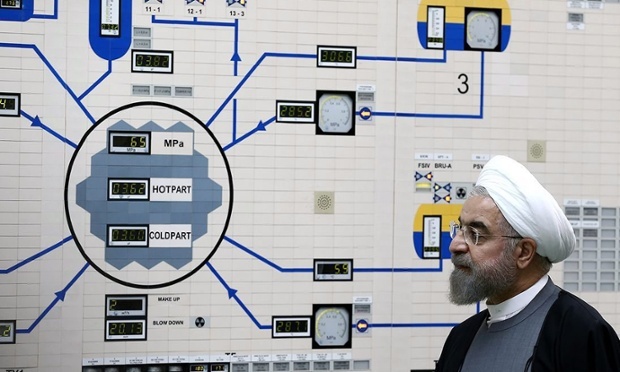
c0ac3569-93da-4ae8-8b51-29dc6991ee13-620x372 Hassan Rouhani, the Iranian president, visiting Bushehr nuclear power plant in southern Iran this year. Photograph: Presidential official handout/EPA

Iran’s great advantage, suggests Emile Hokayem, an analyst, is its commitment and competence, in Syria and beyond. “The expertise, experience and strategic patience it deployed in support of the Syrian regime to a great extent facilitated Assad’s recovery from serious setbacks in 2012. In contrast, the war in Syria has exposed not only the political and operational limitations of the Gulf states, but also the rivalries among them.”
*********************

The commanders of Iran’s Islamic Revolutionary Guard Corps (IRGC) have been working overtime recently, flaunting their achievements across the Middle East and flexing muscles as international negotiations over the country’s nuclear programme enter their critical and perhaps final phase.

On Wednesday it was the turn of Major-General Mohammad Ali Jafari, the IRGC’s most senior officer. “The Islamic revolution is advancing with good speed, its example being the ever-increasing export of the revolution,” he declared. “Not only Palestine and Lebanon acknowledge the influential role of the Islamic Republic but so do the people of Iraq and Syria. They appreciate the nation of Iran.”

Last month a similarly boastful message was delivered by General Qassem Suleimani, who leads the IRGC’s elite Quds force — and who is regularly photographed leading the fightback of Iraqi Shia miltias against the Sunni jihadis of the Islamic State (Isis) as well as against western and Arab-backed rebels fighting Bashar al-Assad in southern Syria. “Imperialists and Zionists have admitted defeat at the hands of the Islamic Republic and the resistance movement,” Suleimani said.

Iran’s advances are fuelling alarm in Saudi Arabia and the Gulf, where Tehran has been a strategic rival since the days of the Shah, and which now, it is said with dismay, in effect controls four Arab capitals – Baghdad, Damascus and Beirut and in the last month Sana’a in Yemen – which is uncomfortably close to home.

Iran’s regional position has certainly improved. Its high-profile role fighting Isis in Iraq, Assad’s retention of control in Syria with the help of its Lebanese ally Hezbollah, and the Houthi rebel takeover in Yemen have all been deeply discomfiting for the Saudis. Anti-government protests in Shia-majority Bahrain are also often blamed on Tehran — though that ignores the domestic roots of the unrest.

In Riyadh King Salman has dropped his preoccupation with the Muslim Brotherhood in favour of building a united Sunni Arab front to confront the Iranians, diplomats say, though translating that strategy into action is another matter. The message from Saudi Arabia and the United Arab Emirates is that whatever the outcome of the nuclear talks, Iran is bent on expanding its power and influence. “The Iranians have scored major victories but only where there are Shia minorities,” a senior Gulf official told the Guardian. “Our concern is that the nuclear issue will become a tool of their foreign policy.”

Arab alarm is shared by Israel. Binyamin Netanyahu used identical arguments in his recent speech to the US Congress, timed to influence next week’s nuclear endgame in Geneva. “The Saudis will be incredibly worried that we are getting close to a point where the Iranians will be players because of the nuclear issue and the way the Americans have effectively ended up on the same side as the Iranians in Iraq,” said one veteran Saudi-watcher. “But the noise they are making is in inverse proportion to their ability to do anything about it.”

Arab governments are not reassured by the promises of John Kerry, the US secretary of state, that Washington is not seeking a “grand bargain” with Tehran that will allow it to “destabilise” the Middle East, bolstered by the easing of economic sanctions. Saud Al Faisal, the Saudi foreign minister, warned of Tehran’s “hegemonic” ambitions as the IRGC supported the military operation to retake the Iraqi town of Tikrit from Isis. In Gulf capitals Hassan Rouhani, the emollient Iranian president, is seen as less important than the hardline supreme leader, Ayatollah Ali Khamenei.

It is hard to disentangle propaganda from reality. But independent analysts argue that Iran is inflating its gains for both foreign and domestic consumption. “If you listen to Suleimani there is a degree of exaggeration,” argues Ali Ansari of St Andrews University. “It’s rhetorical reassurance. He is saying to Iranians: ‘We are powerful and and everyone is worried about this’ – partly to make the point that they are not really under pressure. People outside can see what Iran’s strengths and weaknesses are. But there is this belief that you need to negotiate from a position of strength and that if you are weak you will be trampled on.”

Iran-watcher Hossein Rassam also detects a domestic calculation in the IRGC statements. “Critics of Rouhani’s policy of rapprochement with the international community inside Iran can turn to the supreme leader and say there wasn’t really much need for that softer tone because now we have more bargaining chips in our hands. Iran is the only power in the region which can actually fight Isis and the west needs us for that.”

Meir Litvak, an Israeli expert on Iran, sees both genuine belief and posturing in Tehran’s stance. “The Iranians believe they have been able to save the Assad regime from total collapse and there is at least stalemate in Syria,” he said. “That means they have been able to maintain the link with Hezbollah and maybe open a second front by proxy against Israel on the Golan Heights. The Houthi rebellion in Yemen was initially a genuinely domestic affair but the Iranian regime saw it as an opportunity. And it has become a bonus for it – even if they are not that active inYemen. But if the Saudis are scared that’s a plus for the Iranians.”

Arab diplomatic sources say they expect to see an IRGC and Hezbollah presence in Yemen, helped by a new agreement on regular flights between Tehran and Sana’a.

Iran’s role in Bahrain, where the Shia majority remains locked in confrontation with the Saudi-backed Sunni monarchy, is more about scoring propaganda points than material support – despite claims in Manama about Iran’s sinister role.

Still, in the heartlands of Iranian influence, Iraq and Syria, there have been significant costs as well as benefits, including the deaths of two senior IRGC commanders. Continuing sanctions and low oil prices – seen in Tehran as a deliberate strategy by the Saudis – have also made it harder to shell out billions of dollars to subsidise the Assad regime.

Iran’s great advantage, suggests Emile Hokayem, an analyst, is its commitment and competence, in Syria and beyond. “The expertise, experience and strategic patience it deployed in support of the Syrian regime to a great extent facilitated Assad’s recovery from serious setbacks in 2012. In contrast, the war in Syria has exposed not only the political and operational limitations of the Gulf states, but also the rivalries among them.”

It’s Not Just Islam, It’s the Tribal Mentality

March 12, 2015

It’s Not Just Islam, It’s the Tribal Mentality, Front Page Magazine, March 12, 2015

fft-450x253

Islam in part is the “theologizing” of the tribal mentality. Islam’s important innovation was to redefine the “tribe” as the whole umma of believers, creating in effect a “super tribe” that transcends mere blood as the bonding agent. But the tribal warrior ethos persists–– in the doctrine of jihad, tribal atrocities in contemporary terror and its gruesome videos, the privileging of men in polygamy, honor killings, and social restrictions on women, the disdain for the infidel “other” in the Koranic belief that Muslims are the “best of nations,” the betrayal of alliances in the religious sanction of lying to infidels (taqiyya), and the obsession with “honor” that today we find in violent Muslim reactions to “blasphemy” against Mohammed or the Koran.

Ignoring the tribal mentality is as dangerous for our foreign policy as downplaying Islamic doctrine.

The Obama administration’s serial appeasement of Iran––currently the “strongest tribe” spreading its influence throughout the region–– has damaged our prestige among allies like Jordan, Saudi Arabia, and Egypt, who are already shopping around for a more reliable and forceful partner. If we want to destroy the jihadists, check Iran’s nuclear ambitions, and protect our interests, we must again become the “strongest tribe.”

********************

The “nothing to do with Islam” mantra took a hit recently in one of the premier organs of liberal received wisdom, The Atlantic. Many have greeted as a revelation Graeme Wood’s article on the Islamic doctrines behind ISIS’s atrocities. Regular readers of FrontPage and Jihad Watch will not be as impressed. For years they have understood the link between jihadism and Islam. In 1994 Andy McCarthy made this connection when he prosecuted the perpetrators of the first World Trade Center bombing the previous year, a connection that the FBI ignored or discounted at the time––a failure, by the way, that has become a pernicious tradition for those charged with protecting our nation’s security and interests. For everyone else who has been paying attention to the rise of modern jihadism, Wood’s article is a dog bites man story.

One can hope that perhaps now, with the truth revealed by one of the Acela corridor’s oracles, the jihad deniers will wise up, though I wouldn’t bet on it. Unexamined opinions comprise the bulk of the progressive mind, and are notoriously resistant to empirical evidence and sound argument. But the current mess in the Middle East results from more than just Islam and its traditional belligerence, supremacist pretensions, and illiberal religious laws and doctrines. These characteristics reflect variations on the mentality of the tribe, one antithetical to modernity and the principles of liberal democracy, and still powerful in the Middle East, the region once described as “tribes with flags.”

For all the differences among tribal peoples, the components of this mentality are consistent, from the ancient Gauls and Germans Caesar conquered and the Vikings terrorizing much of Europe, to the American Indians the U.S. Cavalry fought and the jihadist gangs rampaging in the Middle East.

First, there is little notion of a common humanity that transcends ethnicity or culture. Universal principles are scarce, and personal identity is found solely in the collective customs and traditions of the tribe. Outsiders are to be distrusted, plundered, or conquered when possible. Loyalty is not to principle, but to blood. Most tribal peoples consider their tribe the acme of humanity, the only genuine humans. Hence their word for “human” is usually identical to the name of their tribe. They are literally ethnocentric.

Second, violence, particularly against outsiders, is an acceptable instrument for resolving conflict and asserting tribal superiority. Not just the violence of war, but also the cruel torture and slaughter of outsiders, including women and children, are legitimate for serving the interests of the tribe. Indeed, what we call terrorism was a tactic of tribal warfare to prevent a full-scale war by so terrorizing enemies that they would give up without a fight, a phenomenon common in the various Indian wars of American history. Hence the scary face-paint, tattoos, war cries, bizarre hairstyles, tortures like scalping, mutilation of enemies, or slaughter of their women and children, all of which are meant to frighten and demoralize the enemy. The same intent explains the blustering threats, braggadocio, and insults typical of tribal warfare and diplomacy. These practices can be documented in tribal societies from the Iroquois to the ancient Gauls.

Next, loyalty in tribal societies counts only for those within the tribe. Alliances with other tribes or peoples are ad hoc and contingent on the immediate interests of the tribe. They can be abandoned or betrayed if circumstances or perceptions change. Moreover, respect for others beyond the tribe is based solely on their capacity to inflict violence on their enemies. The “strongest tribe,” a status based on its effectiveness and success in conflict, will attract allies, who will abandon the hegemon once it loses that perception of its strength. Thus during Caesar’s wars in Gaul various Gallic and Germanic tribes would ally with the Romans when they appeared dominant, and betray them in an instant if they thought them weak. Likewise during the U.S. Cavalry’s wars against the Plains Indians, many tribes victimized by the Sioux or Apache or Cheyenne would ally with the Americans if they seemed to be winning, then switch sides the moment they seemed weak.

Finally, tribal societies are centered on the male warrior and his honor. Forget the Women’s Studies fantasies of matriarchal tribal societies. Tribal cultures privilege males, for men fight, and the survival and honor of the tribe depends on martial valor. Women bear children and work, as the skeletons of pre-contact American Indian remains demonstrate. Female bones show much more damage from hard physical labor than do male. This doesn’t mean that women had no status within the tribe, or did not enjoy somewhat more equality than women in more sophisticated civilizations. But warrior males still dominated, and culture in the main centered on men and their prowess in war, which earned honor, what we call prestige, for the whole tribe.

Sound familiar? It should, for Islam in part is the “theologizing” of the tribal mentality. Islam’s important innovation was to redefine the “tribe” as the whole umma of believers, creating in effect a “super tribe” that transcends mere blood as the bonding agent. But the tribal warrior ethos persists–– in the doctrine of jihad, tribal atrocities in contemporary terror and its gruesome videos, the privileging of men in polygamy, honor killings, and social restrictions on women, the disdain for the infidel “other” in the Koranic belief that Muslims are the “best of nations,” the betrayal of alliances in the religious sanction of lying to infidels (taqiyya), and the obsession with “honor” that today we find in violent Muslim reactions to “blasphemy” against Mohammed or the Koran.

Ignoring the tribal mentality is as dangerous for our foreign policy as downplaying Islamic doctrine. The chronic disorder in northern Iraq today is not just about the Sunni-Shi’a divide, or ISIS’s dream of a caliphate. It also reflects the bewildering number of tribes and clans in the region, whose complex alliances and enmities continually shift depending on circumstances and the perceptions of which tribe is the stronger. Our ally today can instantly become our enemy tomorrow. Factions that appear “moderate” today can become jihadist terrorists tomorrow. Our “friends” will tell us what we want to hear today, and then betray their words tomorrow. Most important, anything we do that creates the perception of weakness––especially concessions, or failure to inflict revenge, or acts of mercy––will also damage our prestige as the “strongest tribe” and invite tribes to abandon us.

These tribal practices defined most peoples, including Europeans, before the advent of modernity. They have survived among Middle Eastern Muslims because they were encoded in religious doctrines that promise global power for the tribe of the faithful in this life, and paradise in the next, especially for jihadist warriors. This amalgamation in part explains the spectacular success of Muslim warriors for a 1000 years, a record of martial achievement the memory of which today fuels the resentment and anger of those Muslims who wish to restore that lost honor. It also contributes to the difficulty of many Muslim societies to reconcile with modernity, particularly liberal democracy and its cargo of human rights, confessional tolerance, and equality for women and those of other faiths.

Of course, worldwide millions of Muslims have managed to transcend tribalism and adjust their faith to modernity. But millions more haven’t, and it is they who are fomenting most of the mayhem and murder on every continent except Antarctica. Our tactics and strategies in confronting this threat must indeed be based on a correct understanding of the spiritual imperatives that motivate the jihadists. But they also must take into account the tribal mentalities that respect force and honor the strong.

The Obama administration’s serial appeasement of Iran––currently the “strongest tribe” spreading its influence throughout the region–– has damaged our prestige among allies like Jordan, Saudi Arabia, and Egypt, who are already shopping around for a more reliable and forceful partner. If we want to destroy the jihadists, check Iran’s nuclear ambitions, and protect our interests, we must again become the “strongest tribe.”

Presidential Commitments Then and Now

March 11, 2015

Presidential Commitments Then and Now, Commentary Magazine, March 11, 2015

(Please see also State Dept Describes Iran Deal as ‘Nonbinding’ — DM)

The White House “outrage” at the “open letter” to Iran signed by 47 senators, led by Sen. Tom Cotton, was reinforced by Vice President Biden’s formal statement, which intoned that “America’s influence depends on its ability to honor its commitments,” including those made by a president without a vote of Congress. Perhaps we should welcome Biden’s belated insight. As Jonathan Tobin notes, President Obama on taking office in 2009 refused to be bound by the 2004 Gaza disengagement deal in the letters exchanged between President George W. Bush and Israeli Prime Minister Ariel Sharon. His secretary of state, Hillary Clinton, announced that such commitments were “unenforceable”–that they were non-binding on the new administration. In 2009, Obama disregarded previous commitments not only to Israel but also to Poland, the Czech Republic, and Georgia; he “fundamentally transformed” America’s previous commitments, as he likes to describe the essential element of his entire presidency.

The Gaza disengagement deal was (1) approved by Congress; (2) included in the Gaza disengagement plan presented to the Israeli Knesset, and (3) relied on by Israel in withdrawing from Gaza later in 2005. The history of the deal (which the current secretary of state endorsed at the time as a U.S. “commitment”) is set forth here, and the reason Obama sought to undo it is discussed here. In 2009, the Obama administration refused at least 22 times to answer whether it considered itself bound by the deal; in 2011 it openly reneged on key aspects of it.

President Obama is currently negotiating an arms control agreement in secret, refusing to disclose the details of the offers his administration has made to Iran, a terrorist state according to his own State Department, and a self-described enemy of the United States since 1979. He has opposed not only a congressional debate before he concludes the deal but also a congressional vote afterwards. If he closes a deal with Iran on that basis, it will not be binding on any future president–at least not if that president chooses to follow the precedent Obama himself set in 2009.

If the administration is now seeking to restore the credibility of presidential commitments, the president might consider taking two steps: (1) acknowledge that the U.S. is bound by the disengagement deal negotiated by President Bush with Israel, endorsed by a vote of Congress; and (2) promise to put his prospective deal with Iran to a similar congressional vote once the deal is done. If not, perhaps a reporter at his next press conference will ask how he reconciles his position that (a) he could ignore President Bush’s congressionally approved deal with his view that (b) future presidents must honor the non-congressionally approved one he is negotiating now.

Netanyahu, Churchill and Congress

March 2, 2015

Netanyahu, Churchill and Congress, The Gatestone InstituteRichard Kemp, March 1, 2015

There are striking similarities between the objectives of Churchill’s speech nearly 75 years ago and Netanyahu’s today; both with no less purpose than to avert global conflagration. And, like Churchill’s in the 1930s, Netanyahu’s is the lone voice among world leaders today.

There is no doubt abut Iran’s intent. It has been described as a nuclear Auschwitz. Israel is not the only target of Iranian violence. Iran has long been making good on its promises to mobilize Islamic forces against the US, as well as the UK and other American allies. Attacks directed and supported by Iran have killed an estimated 1,100 American troops in Iraq in recent years. Iran provided direct support to Al Qaeda in the 9/11 attacks.

Between 2010 and 2013, Iran either ordered or allowed at least three major terrorist plots against the US and Europe to be planned from its soil. Fortunately, all were foiled.

Iran’s ballistic missile program, inexplicably outside the scope of current P5+1 negotiations, brings Europe into Iran’s range, and future development will extend Tehran’s reach to the US.

It is not yet too late to prevent Iran from arming itself with nuclear weapons. In his 1941 speech to Congress, Churchill reminded the American people that five or six years previously it would have been easy to prevent Germany from rearming without bloodshed. But by then it was too late.

This vengeful and volatile regime must not in any circumstances be allowed to gain a nuclear weapons capability, whatever the P5+1 states might consider the short-term economic, political or strategic benefits to themselves of a deal with Tehran.

In a few days, Israeli Prime Minister Benjamin Netanyahu will address the US Congress for the third time. The only other foreign leader to have had that privilege was Winston Churchill. Like Churchill when he first spoke to Congress in December 1941, Netanyahu is taking a risk.

For Churchill the risk was to his life — he had to make a hazardous transatlantic voyage aboard the battleship HMS Duke of York through stormy, U-boat infested waters. For Netanyahu the risk is to his own political life and to his country’s relationship with the United States, given the intense presidential opposition to his speech.

But like Churchill was, Netanyahu is a fighting soldier and, like Churchill, a tough political leader, unafraid to shoulder such risks when so much is at stake. And in both cases, the stakes could not be higher, greater than their own lives, political fortunes or rivalries and affecting not just their own countries and the United States, but the whole of the world.

961Israel’s Prime Minister Benjamin Netanyahu addresses a joint session of U.S. Congress on May 24, 2011. (Image source: PBS video screenshot)

There are striking similarities between the objectives of Churchill’s speech nearly 75 years ago and Netanyahu’s today: both with no less a purpose than to avert global conflagration.

Speaking days after the Japanese attack on Pearl Harbor, Churchill summarized the course of the war thus far but then concluded with a dramatic appeal to the American people for Anglo-American unity to prevent conflict in the future, reminding them that “twice in a single generation, the catastrophe of world war has fallen upon us.”

“Do we not owe it to ourselves, to our children, and to mankind,” he asked, “to make sure that these catastrophes do not engulf us for the third time?”

No less profound, and no less far-reaching, will be Netanyahu’s appeal for American-Israeli unity in the face of a new danger. A danger perhaps even greater than Churchill was able to comprehend in pre-nuclear 1941. Whereas Churchill spoke of a future, as yet unknown peril, Netanyahu will focus on the clear and present threat to world peace if Iran is allowed to produce nuclear weapons.

And like Churchill in the 1930s, Netanyahu’s is a lone voice among world leaders today.

In pursuit of both uranium and plutonium tracks to a bomb, as well as the development of long-range ballistic missiles, there is no doubt about Iran’s intent. It has been described as a nuclear Auschwitz.

It is Netanyahu’s duty to sound the alarm against such a prospect. It is Israel’s survival that is at stake. It is Israel that will have to conduct military intervention if the US will not. And it is Israelis who will die in any subsequent regional conflagration.

But this is not only an existential threat to Israel — it is a danger to other states in the Middle East and to us all. Doubtful of Western resolve, Saudi Arabia, Egypt and Turkey are already investigating the development of their own nuclear capabilities.

An agreement that leaves Iran with the potential to achieve nuclear breakout will trigger a Middle East arms race that will exponentially increase the risks of global nuclear war, a risk multiplied by the vulnerability of regional governments to overthrow by extremists.

Iran’s ballistic missile program, inexplicably outside the scope of current P5+1 negotiations, brings Europe into Iran’s range, and future development will extend Tehran’s nuclear reach to the US. The world’s number one sponsor of terrorism, the regime of the ayatollahs would have no qualms about supplying their terrorist proxies with nuclear weapons.

This is the greatest threat the world faces today. Yet all the signals suggest that the P5+1, driven by President Obama’s apparent desperation for détente with Tehran, is already set on a path towards 1930s-style appeasement that will end with Iran’s acquisition of nuclear weapons.

The view that Cold War style containment and mutual deterrence could prevent this apocalyptic, fanatical regime from using its nuclear weapons is dangerously naïve. Yet the Western leaders who seem to be on the verge of reaching an agreement are not naïve. Lacking the moral strength to face down Iran, they see deception and appeasement as the only way out of their dilemma.

To gauge their intentions, we do not need to rely just on frequent Iranian threats, such as those of General Hossein Salami, who said recently, with negotiations still under way: “As long as the US continue to use the Islamic world as the scene for their regional policies, all the forces of the Islamic world will undoubtedly be mobilized against them.” In the same interview, he threatened Israel too: “The very existence of the Zionist entity and its collapse are of crucial importance.”

Iran’s determination to bring about the violent collapse of the “Zionist entity” is continuously manifested in its directing and funding of armed attacks against Israeli soldiers and civilians at home and overseas, by proxies including Hizballah, Hamas and Palestinian Islamic Jihad. The Gaza conflict last summer, for example, owed much to Iranian funding and weaponry.

Just a few weeks ago, Islamic Revolutionary Guard Corps General Mohammad Allahadi was operating with senior Hizballah commanders to set up a new front on Syrian territory in the Golan, from which to launch attacks against Israel. He was killed by an Israeli air strike while visiting his planned area of operations.

Israel is not the only target of Iranian violence. Iran has long been making good on its promises to mobilize Islamic forces against the US, as well as the UK and other American allies. Attacks directed and supplied from Tehran killed an estimated 1,100 American troops in Iraq in recent years. Strikes have been facilitated in Afghanistan, killing US, British and other Coalition soldiers.

Iran provided direct support to Al Qaeda in the 9/11 attacks and continues to harbor Al Qaeda terrorists. Between 2010 and 2013, Tehran either ordered or allowed at least three major terrorist plots against the US and Europe to be planned from its soil. Fortunately, all were foiled. Direction, support and facilitation to both Sunni and Shia terrorist groups in planning attacks against the US and its allies continues today.

This vengeful and volatile regime must not in any circumstances be allowed to gain a nuclear weapons capability, whatever the P5+1 states might consider the short-term economic, political or strategic benefits to themselves of a deal with Tehran.

Even before the world’s first experience of nuclear bombing in August 1945, Churchill and Roosevelt both understood the dangers of allowing their enemies and potential enemies to acquire such capability. When Allied intelligence identified a Nazi uranium production plant in Oranienburg in eastern Germany, 612 bombers destroyed it in a single raid in March 1945 with 1,506 tons of high explosives and 178 tons of incendiary bombs, to prevent it falling into the hands of advancing Russian troops.

Only a strong stand by the West, and rejection of an agreement that allows development of nuclear weapons, will ensure that such action does not in the future become necessary against Iran. In his 1941 speech to Congress, Churchill reminded the American people that five or six years previously it would have been easy to prevent Germany from rearming without bloodshed. But by then it was too late, and the world was engulfed in unprecedented violence.

It is not yet too late to prevent Iran from arming itself with nuclear weapons. The American people, the American government and the West as a whole must heed Netanyahu’s clear warning not to reach a deal that will allow the mendacious and malevolent Iranian regime to acquire nuclear weapons. Instead, sanctions that stand a chance of compelling Tehran to abandon its world-threatening ambitions must be maintained, and if necessary, increased.

4-Star Admiral Slams Obama: Muslim Brotherhood Infiltrated All Of Our National Security Agencies

February 11, 2015

4-Star Admiral Slams Obama: Muslim Brotherhood Infiltrated All Of Our National Security Agencies, You Tube, January 28, 2015

During a press conference on how to combat radical Islamic extremism, Admiral James A. “Ace” Lyons (U.S. Navy, Ret.), former Commander-in-Chief, U.S. Pacific Fleet, stated that under the leadership of Barack Obama the Muslim Brotherhood have infiltrated all of the National Security Agencies of the United States. Furthermore, Lyons said that Obama is deliberately unilaterally disarming the military and spoke to the need for the new GOP controlled congress and Military leaders to stand up to the administration and uphold their oaths.


Scandal Rocks the U.N.

February 6, 2015

Scandal Rocks the U.N., National Review Online, Anne Bayefsky, February 6, 2015

UN Flag

Setting aside all the legal verbiage, the politics are painfully clear. Criminalizing Israel’s efforts to exercise its right of self-defense against a foe openly committed to genocide strikes at the heart of the sovereignty, well-being, and legitimacy of the Jewish state. Demonizing a democratic society that is ready, willing, and able to ensure the accountability of its armed forces is not about protecting Palestinians. It is about endangering Israelis.

Human-rights law is being perverted for anti-human-rights ends, and it is about time human-rights lawyers — and all those who care about defeating the enemies of rights and freedoms — stood up and objected.

*********************

A report on human-rights violations has been compromised not once but twice.

Four days ago, on February 2, the head of a U.N. commission of inquiry created to investigate war crimes in Gaza was forced to resign after it was revealed that he had taken money from the PLO for providing legal advice. William Schabas’s U.N. job was to expose war criminals and recommend how to hold them “accountable.” William Schabas’s PLO job was to show them how to use the International Criminal Court (ICC) to hold Israeli war criminals accountable. He didn’t think there was a problem.

His conflict of interest did not surface, however, until after the inquiry he was heading had “largely completed” its evidence-gathering, and the writing of the requisite report had begun, according to Schabas himself. But instead of taking the only legitimate route and setting aside the whole tainted exercise, the president of the U.N. Human Rights Council, Joachim Rücker of Germany, claimed he was “preserving the integrity” of the inquiry simply by accepting Schabas’s resignation.

The council — the U.N.’s top human-rights body — had voted to create the Schabas inquiry in the middle of the Gaza War last July. Palestinians garnered support from council members and human-rights authorities like China, Russia, Saudi Arabia, and the United Arab Emirates. The United States and the members of the European Union either voted against or abstained. A majority of the states that have seats on the council are not “fully free” (on the Freedom House scale).

The idea of the inquiry was to open a second front in the war, conducted by international lawyers, to tie the hands of Israeli decision-makers — political and military — behind their backs.

Hence, the Schabas inquiry’s mandate was to examine human-rights violations “in the occupied Palestinian territory,” not “in Israel.” The date cited for the beginning of the inquiry was June 13, 2014, because Palestinian terrorists had kidnapped (and later murdered) three Israeli teenagers the day before — and Israeli aggression was a given of the investigation. The mandate never mentioned “Hamas” or its terror tunnels, almost half of which opened into Israel.

With the terms of the “inquiry” set to ensure the desired outcome, Schabas and two others became the council’s tools. They were selected by President Rücker “in consultation” with the Palestinians in the belief that they could be counted upon to deliver a guilty verdict.

Little wonder, then, that Schabas was miffed about the council’s newfound concern over his past activities. He had earlier had plenty to say in public about the subject matter covered by his new position. In 2012, on camera, he lectured about “crimes against humanity, war crimes, and the crime of aggression, all of which I think it can be shown have been perpetrated at various times during the history of the State of Israel. . . . The International Criminal Court is in a position to exercise jurisdiction over crimes committed on the territory of Palestine . . . So much of my effort these times is addressed to try to get . . . the Court . . . to take up this burning, important issue. . . . With a bit of luck and by twisting things and maneuvering, we can get them before the courts.”

This was just the kind of lawyer who the U.N. Human Rights Council would think satisfied its rule requiring the “independence, impartiality, personal integrity, and objectivity” of all its “mandate-holders.”

The council could even be sure Schabas would go after Israel’s prime minister personally. Said Schabas on camera before he was hired: “My favorite would be Netanyahu in the dock at the International Criminal Court.”

His manifest bias, thought Schabas, should have saved him from his not-so-manifest conflict of interest. So he decided not to go quietly, even if it meant taking the council down with him. In his letter of resignation he divulged: “[W]hen I was asked if I would accept nomination to the Commission of Inquiry, I was not requested to provide any details of my past statements and other activities concerning Palestine and Israel.” He assumed that because his “views on Israel and Palestine . . . were well known,” the council was getting exactly what it wanted. And so was he.

What finally clued Schabas in to the fact that the jig was up? Shortly before he resigned, the council tried to save face all around by pretending “this matter” was so very complicated that it required an opinion from the U.N.’s legal office.

With Schabas gone, the legal opinion on the meaning of impartiality has been shelved — though it is a lesson the council evidently still needs. President Rücker moved the deck chairs around, appointing one of the two remaining members of the inquiry, the American Mary McGowan Davis, as chair, and fancies it is now business as usual.

The February 3 letter from Rücker to Schabas accepting his resignation thanks him for his “work over the past six months,” says that the “appearance” of a problem has now been solved, and says that Rücker is “looking forward” to the report, due out in March. Six months preparing the report, a month to go before publication, and the U.N. imagines all appearances of impropriety and contamination have vanished into thin air.

Rücker told McGowan Davis: “I am convinced that you will . . . uphold the highest standards of integrity, particularly the principles of independence, impartiality and objectivity.”

Seriously? Unlike Schabas, McGowan Davis previously worked for the same U.N. employer on the same subject! In 2010 and 2011 she was a member of a Human Rights Council committee responsible for promoting the implementation of the council’s infamous Goldstone Report on the 2008–09 Gaza War. She chaired this follow-up committee in the last months of its work. The Goldstone Report’s central lie was its claim that Israel set out to kill Palestinian civilians deliberately. After Goldstone himself retracted the slander, McGowan Davis told the Jerusalem Post his statement “does not have any impact” and she would continue “to take his report as a given.”

At that time, McGowan Davis had the specific task of assessing whether Israel had adequately responded to the Goldstone Report’s defamatory accusations — and lo and behold, in her own report she found Israel’s response wanting. Apparently her assessment of Israeli “proceedings” in one Gaza war between Israel and rocket-launching Palestinian terrorists leaves her “impartial” and “objective” about Israel’s “accountability measures” in the subsequent Gaza war between Israel and rocket-launching Palestinian terrorists. Her 2011 finding that Israel did not conform to the “international standards” required to avoid the dominion of the International Criminal Court mirrors precisely the end game of her current job.

Furthermore, throughout her work for the U.N. Human Rights Council, McGowan Davis has been a member of the board of directors of the American Association of the International Commission of Jurists, which according to its website is “an affiliated organization of the ICJ in Geneva.” The ICJ participated in the July council session that adopted the resolution creating the 2014 Gaza inquiry. Prior to the vote and only two weeks into the war, this group of lawyers made a statement to the council, judging Israel guilty of war crimes and making a specific suggestion: “[T]he ICJ calls on this Council to establish a commission of inquiry to investigate all breaches of international humanitarian law and gross violations of human rights committed during the Israeli military operations in Gaza.”

Not only did the council adopt the ICJ’s recommendation, it appointed a member of the board of directors of the ICJ’s American affiliate to do the job — Mary McGowan Davis.

Three days ago, she accepted Schabas’s chair with alacrity and promised “a report that meets the highest standards of independence and impartiality.”

In what universe?

There is a reason why the council — along with its Palestinian partners, who are working furiously behind the scenes to salvage the fiasco — is so desperate to plow ahead. We now know that Schabas provided the Palestinians with legal advice about how to move forward with the prosecution of Israelis before the ICC, a step that they subsequently took. There is no doubt that the Schabas/McGowan Davis report will immediately be sent to the ICC prosecutor to assist in deciding whether a “preliminary examination” already underway should become a full-fledged “investigation.” The report’s lack of credibility has put the credibility of the ICC in question.

Setting aside all the legal verbiage, the politics are painfully clear. Criminalizing Israel’s efforts to exercise its right of self-defense against a foe openly committed to genocide strikes at the heart of the sovereignty, well-being, and legitimacy of the Jewish state. Demonizing a democratic society that is ready, willing, and able to ensure the accountability of its armed forces is not about protecting Palestinians. It is about endangering Israelis.

Human-rights law is being perverted for anti-human-rights ends, and it is about time human-rights lawyers — and all those who care about defeating the enemies of rights and freedoms — stood up and objected.

How to lose friends and empower radicals: the peace prize president’s more dangerous world

January 29, 2015

How to lose friends and empower radicals: the peace prize president’s more dangerous world, Breitbart,  Dr. Sebastian Gorka, January 29, 2015

(Please see the video at the link. — DM)

obama-binoculars-AP-640x480AP Photo/Susan Walsh

Since 2008, the world has become a significantly more dangerous place. In every region, new threats have emerged or old ones have reasserted them. The scorecard is clear: the bad guys are winning and America’s interests are being undermined daily.

As a nation, America has yet to recover from the experience of September 11th, 2001. Public opinion on our national response to the attacks against the World Trade Center, the Pentagon, and Flight 93 is today divided. On one side we have the “Bush lied, People Died!” crowd who portray President George W. Bush’s response in terms of a conspiracy, despite the fact that we now know Saddam Hussein indeed possessed thousands of WMD warheads (and had used them in the past).

On the other, we have conservatives who are themselves split between the unsophisticated isolationists/non-interventionists who believe that an American withdrawal from the world will make us safe, and the quietly resurgent neoconservatives who see in the rise of ISIS/The Islamic State a justification for more foreign engagements.

For a moment, let us put Operations Enduring Freedom (Afghanistan), and Operations Iraqi Freedom (OIF), to one side. Instead, let us take an unemotional snap-shot of the global geostrategic situation to see whether the administration whose head was awarded a Nobel Peace Prize during his first year in office has indeed make the world a safer and more peaceful place.

Europe: During most of the last century, American security was tied directly to the continent of Europe. Whether is was the generational genocide of World War One, the racial genocide of WWII, or the class-based totalitarianism of the Cold War, Europe was the source of strategic, and at times existential, threats to America.

During the first Obama Administration, Secretary of State Hilary Clinton declared a “Pivot to Asia” which would deemphasize Europe’s importance and see Washington focus more on our Pacific partners than on old Atlantic Allies.

Since that announcement, an emboldened Vladimir Putin has seen fit to break an almost 70-year-old international taboo by using force to redraw national borders with his annexation of Crimea. This includes, incredibly, the shooting down of a civilian jet-liner by forces armed by Moscow.

At the same time, we have seen the European Union become evermore centralizing and undemocratic as untenable economic and fiscal policies are propped up by a Brussels bureaucracy in the name of “broader and deeper union.” This has naturally led to two types of responses: the unprecedented success of a paleo-conservative backlash,f best typified by the insurgent victories of UKIP in Great Britain, as well the reverse: Utopian socialist populists such as the victorious Syriza party of Greece.

Then there are Europe’s ties to the Global Jihadist Movement. The recent slaughter in Paris, the beheading of a British serviceman on the streets of the UK, and Spanish and Belgian terror-related arrests all attest to the failure of the current international campaign against Islamist terrorism.

The flawed immigration policies of many EU nations have also facilitated the establishment of literally hundreds of ethnic and religious enclaves across the continent where integration is seen as a bad thing and where radical talent spotters for groups such as Al Qaeda and ISIS/IS identify, indoctrinate and recruit murderers such as the Charlie Hebdo killers, as well as thousands of fighters for The Islamic State.

This has led to a grass-roots response from Europeans afraid of the future survival of their countries embodied in the ever-broadening PEGIDA movement that Breitbart London has covered in great detail. The failure of multiculturalist immigration policies has not only encouraged the enclave phenomenon, but is also clearly linked to the disturbing rise of anti-Semitism on the continent which has led to unprecedented numbers of European jews deciding to leave the nations of their birth for good.

If we include Turkey in our European snapshot, the situation is even worse, as we have seen the one viable example of a secular Muslim state slip even deeper into the corruption-ridden maelstrom of Islamic fundamentalism under the Erdogan government which is either incapable or unwilling to prevent Turkey becoming a pre-deployment site for jihadist fighters traveling into Syria and Iraq. All this from a formal NATO ally of the US.

Asia: The much-vaunted Pivot to Asia has clearly not worked. China has, over the last several years, openly challenged the post-Cold War peace in the region with a commitment to its own military build-up coupled with a concerted campaign of intimidation against its smaller and weaker neighbors.

While challenging and intimidating our regional partners, China has continued to grow economically at such a rate that the nation which was once universally ridiculed as the maker of plastic toys for McDonalds Happy Meals has now surpassed the US economy in terms of gross output.  At the same time, China is waging a covert war against America in the cyber domain, stealing not only state secrets for use in developing its new weapons systems, but also billions of dollars worth of intellectual property and commercial secrets from American businesses. See the remarkable report from Mandiant on scale of the threat.

North Korea has also used the internet to assault American interests as the Sony hacking attack attests, while Washington has proven totally ineffective in undermining the world’s last truly fully-fledged Stalinist regime, or its regionally destabilizing nuclear weapons capabilities.

Africa: A giant continent, with threats as bad as they were in 2008, or in several cases much worse. The Global Jihadist Movement continues to consolidate its control in Nigeria through the horrific attacks of Boko Haram, the group made famous for the kidnapping of the girls from Chibok, an attack which is just one part of a vast campaign targeting Christians and anyone who does not want to live under a theocratically run system based upon sharia and 7th century interpretation of the Koran.

In addition to the insurgent-like threat of Boko Haram, we have also witnessed horrific hit and run terrorist tactics used by other African jihadists, as in the Westgate Mall attack in Nairobi by Al Shabaab. At the same time, China proceeds to build its vast network of economic interests in the continent in ways that far outstrip American geostrategic investment in Africa.

Australasia: Of course, the Pivot to Asia should have pleased our Antipodean allies. But the concrete consequences of the declarations and speeches by Secretary Clinton and the White House have amounted to little more than the deployment of a handful of US Marines from Camp Pendleton to Australia. Instead of the security situation improving, Australia faced its own Jihadist attack just before Christmas last year as a self-styled imam took hostages and brought the violent jihad so familiar to New York, London, Madrid, and Paris, to the streets of Sydney.

The Americas: Canada likewise became a direct victim of the Global Jihadist Movement after a spate of attacks against its armed forces and even its parliament which was only stopped when a brave sergeant-at-arms applied deadly force in the face of a rampaging jihadi.

Those who like illicit quality cigars may be celebrating the White House’s “normalization” of relations with Communist Cuba, but if statements by the Castro regime are to be credited as expressing Havana’s true intentions, then the deal was good for the dictatorship and bad for America. And despite the US government’s historic decision, conditions inside Cuba have remained the same, or in many case deteriorated, with last year seeing record-breaking numbers of political arrests on the island nation. And Cuba’s anti-democratic influence is a problem for the region, not just its wretched population, with Raul Castro’s secret police providing aid and expertise in the oppression of dissidentsto the government of Venezuela.

The Middle East and North Africa: Leaving the worst for last we have, of course, the Middle East, and North Africa. The highs hopes for the Arab Spring turned very rapidly into a “Christian Winter” and a victory for the fundamentalist and anti-Democratic forces of the Muslim Brotherhood. One after another, one-man authoritarian regimes fell to Islamist MB governments, or collapsed into deadly civil wars which are still being fought in places like Syria and Libya. Throughout the region, proto-democrats and vulnerable minorities, especially ancient Christian communities, have been targeted for death or persecution, or have been forced to flee.

The one ray of hope, the people’s revolt in Egypt against the Brotherhood government of Mohammad Morsi, which led to his being ousted by a secular military, was rejected by the US administration as a coup, despite the fact that General, now President, Sisi, has been fighting his own war against Jihadi fundamentalists since he was the Chief of the Egyptian Armed Forces.

And now Yemen, which was lauded just a few months ago by President Obama as the poster-child of his successful counterterrorism strategy, has collapsed under insurgent attacks and the resignation of the government in Sanaa.

Then there is Iran, which, much like Cuba, has squeezed concession after concession out of the administration without either stopping its acquisition of nuclear weapons capability, or curtailing its support of Shiite terrorist fighters in either Iraq or Syria.

I said I would leave Afghanistan and Iraq of our the equation, but nevertheless, it is important to recognize that this is a new jihadist threat that is even more dangerous than Al Qaeda. ISIS, the Islamic State, is today a full-fledged insurgency, one that in four dimensions is much more of a threat that [Sic] Al Qaeda ever was.

The Islamic State is more than a terrorist group, it now functions as a quasi-state and controls territory equivalent to the size of the UK. It is the richest non-state threat group in human history. It has an incredibly sophisticated understanding of information warfare and how to use social media as a propaganda platform, and lastly – and relatedly – it has recruited ten of thousands of young Muslim men from around the world, including Europe and the US, to fight for the new Caliphate of Abu Bakr al Baghdadi. Bin Laden dreamt of being this powerful. The Islamic State has turned his dream into a horrific reality.

There is not one area of the world of import to America in which we have either not lost friends, or failed to help our allies to defend themselves against the common enemies that threaten us all. Whatever your politics, or whomever you favor for the next Commander-in-Chief of the United States, one thing is certain: without resolute American leadership the world can become, and now is, a much more dangerous place.

“Unity”? About What Exactly?

January 22, 2015

Unity”? About What Exactly? The Gatestone Institute, Jeremy Havardi, January 22, 2015

Meanwhile, Saudi Arabia tried to fool the world by joining France’s “Unity March” for free speech just two days after a young Saudi blogger, Raif Badawi, received the first installment of 50 lashes — out of the 1000 he is to get — “very severely,” the lashing order says. Badawi still has 950 lashes to complete.

Mahmoud Abbas, whose genocidal, jihadi partner, Hamas, was just declared not a terrorist group by the European Union, joined the forefront of the “Unity March” at the same time as a Palestinian human rights groups published a report accusing the Palestinian Authority of “waging war” against university students in the West Bank.

What “Islamophobia” motivated the killing of Jewish customers in a kosher supermarket? What had those victims done to deserve that?

We may like to imagine that this is not Islam, and that the faith promotes peace and nothing else. But the murderers say it is Islam, and they act accordingly.

Much of the media has offered up a context for these killings that is false.

The real story is that despite a few sporadic incidents, there has been no backlash against the Muslim community.

The recent rally for free speech and against the terrorism in Paris initially appeared to have generated a surge of defiance and resolve, not just in France but around the world. People were actually talking about a turning point in the battle against terrorism and radical Islam.

If only it were true.

The reality is that much of the political class and media remain in denial about the events in Paris.

Ban Ki Moon explained that the tragic events had nothing to do with religion. Signing a condolence book for the victims of the attacks, he said: “This is not a country, a war against religion or between religions… This is a purely unacceptable terrorist attack – criminality.”

France’s President François Hollande said that the Charlie Hebdo fanatics had “nothing to do with Islam,” and he was joined in this view by commentators on France24, as well as the German Interior Minister, Thomas de Maizière.

The Guardian’s Jonathan Freedland condemned the actions of a “handful of wicked fanatics against the rest of us.” The implication was that they merely acted in the name of Islam — purely coincidentally, as it were.

In the Daily Mail, Piers Morgan wrote that the perpetrators were “not ‘real’ Muslims” and that this was “not a religious war.” Why he thought he could act as the arbiter on that question is still unclear.

As for President Obama, he has effectively outlawed the term “Islamic terror.”

The United States, in what was widely seen as a snub, was only represented at the rally by the U.S. Ambassador to France, Jane Hartley. Since the President had declared in 2012 that “[t]he future must not belong to those who slander the prophet of Islam” — the implication was that they were not acting purely coincidentally.

There is in those comments a mixture of political correctness, wishful thinking and staggering ignorance. It is understandable and commendable not to lump a majority of law-abiding, patriotic and peaceful Muslims together with their violent counterparts. But calling for “unity” in a march leaves one asking: Unity about what exactly?

To pretend that there is a complete disconnect between Islam and terror is to ignore reality. Jihadis are gaining ideological succour from the tenets of their faith, drawing upon teachings promulgated by imams, including the late Anwar al Awlaki. We may like to imagine that this is not Islam, and that the faith promotes peace and nothing else. But the murderers say it is Islam, and they act accordingly.

To confront this problem properly, the ideological underpinnings of jihad need to be tackled comprehensively at source.

It is not enough to unite against terrorism, as every community must. We need to know what we are uniting for — free speech. And we need to know what we are uniting against — namely the militant war of extremist Islamism.

It is equally inaccurate to describe these jihadis as “lone wolves.” They will have spent time gaining combat experience abroad, perhaps in Yemen, Syria or Iraq, and will have received ideological indoctrination and funding from a network of other jihadis. They are recruits in a theocratic, totalitarian death-cult spread across the planet. It comes in different forms: Boko Haram, which slaughtered 2,000 people in Nigeria the weekend before last; the Taliban, which murdered schoolchildren in Pakistan; Hamas with its genocidal doctrine and many years of bombings, and the Islamic State, which seems busy ethnically cleansing nearly everyone in Syria and Iraq.

The murders in Paris, therefore, were merely the latest salvo in a global confrontation between jihadist Islam and its declared enemies, this time in the West.

Much of the media has offered up a context for these killings that is false. Within hours of the massacre at Charlie Hebdo, the Telegraph led with a feature on the growing problem of “Islamophobia” in France. The Guardian, too, weighed in; one story headlined: “Muslims fear backlash after Charlie Hebdo deaths as Islamic sites attacked”. The Spectator spoke of the killings as an “attack on Islam;” and Robert Fisk in the UK Independent referred to the legacy of the Algerian war as a motive for the attackers. Other news outlets voiced fears of a “backlash” against Muslims in France and elsewhere.

But the real story is that while there have been some sporadic incidents against mosques and Muslim owned businesses in France following the Charlie Hebdo attacks, there has been no backlash against the Muslim community. Muslims across France even joined in the unity rally, an act that would have been impossible were there a climate of widespread public hostility.

The majority of hate crimes in France, as in a number of other countries, affects the Jewish community. It was a Jewish supermarket that was attacked. This does not mean that there will not be attacks — all of them naturally deplorable — against Muslim innocents, only that fears of a major widespread assault seem highly exaggerated. The same fears of widespread attacks against the Muslim community also proved unfounded after the 7/7 London bomb attacks.

Lumping terrorism and “Islamophobia” together ignores the real motivation of the latest killers in France. One of them, Amedy Coulibaly, pledged allegiance to the Islamic State in a video address prior to the supermarket attack. This hardly suggests a rant against perceived intolerance or racism. Invoking racism here also suggests, in a shifting of blame, that we in the West are somehow at fault for the violent behaviour of these Islamist terrorists. What “Islamophobia” motivated the killing of Jewish customers in a kosher supermarket? What had those victims done to deserve that?

Another reason this is no turning point is that the press continues to engage in self-righteous self-censorship. Not one broadcaster — including the BBC, Fox, NBC and CNN — showed any of the Charlie Hebdo images that had been deemed provocative. Those outlets were joined by the Associated Press, which deliberately cropped a photograph of the magazine’s now-dead editor to avoid showing an image of the Prophet Muhammad. In a cringe replicated across almost all of Europe, not one major British newspaper published any of Charlie Hebdo’s satirical images of Islam, and only The Guardian showed the full front cover of the edition that the survivors published after the attack.

Big mistake. These newspapers and broadcasters are denying the public a dispassionate view of what the killers themselves say is causing them to kill. Worse again, by drawing a line against possibly offending Muslims — many of whom seem to have no problem offending Jews and Christians, among others, if not killing them — the media have acted as if there is already in place an unofficial blasphemy law: the terrorists’ key demand.

A violent mob, disastrously undermining Western values, is effectively dictating the boundaries of free speech.

It is all very well to praise Charlie Hebdo as an icon of free speech, but after the riots that followed the publishing of Muhammad cartoons in Denmark’s Jyllands Posten in 2006, Charlie Hebdo was virtually alone in reprinting them, and it was condemned widely for doing so.[1]

Time magazine, in 2011, likened Charlie Hebdo’s reprinting the cartoons as “the right to scream ‘fire’ in an increasingly over-heated theater.” In other words, the “Islamophobic” cartoonists were to blame for their own misfortune. There is a notion permeating Europe, that if you speak out, not only can you can be put on trial — as is the Dutch MP, Geert Wilders[2] — but that it will also, in an Orwellian twist, be your own fault; if you had just kept quiet, nothing unpleasant would be happening to you. Try telling that to the four Jews lying murdered on the floor of the French supermarket. What did they ever say?

Meanwhile, Saudi Arabia tried to fool the world by joining France’s “Unity March” for free speech just two days after a young Saudi blogger, Raif Badawi, received the first installment of 50 lashes — out of the 1000 he is to get — “very severely,” the lashing order says. He was taken after Friday prayers to a public square outside a mosque in Jeddah. His declared “crime” is “insulting Islam,” for writing thoughts such as, “My commitment is to reject any repression in the name of religion… a goal we will reach in a peaceful and law-abiding way.” Badawi still has 950 lashes to complete. If he lives. There is no medical help.

Palestinian Authority President Mahmoud Abbas — whose genocidal, jihadi partner, Hamas, was, in a burst of surrealism, declared not a terrorist group by the European Union — joined the forefront of the Unity March in Paris at the same time as a report was published by a Palestinian human rights group, accusing the Palestinian Authority of “waging war” against university students in the West Bank.

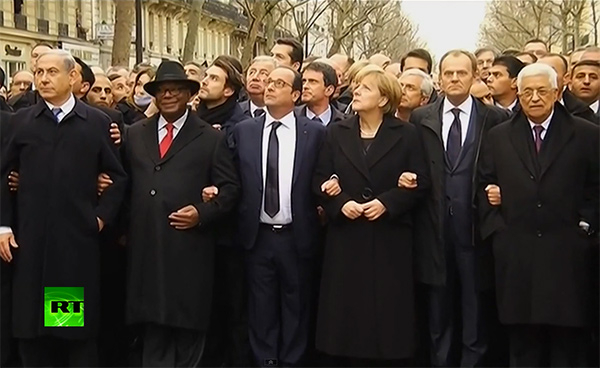
883World leaders link arms at the Paris anti-terror rally on January 11, 2014. Palestinian Authority President Mahmoud Abbas stands at the far right of the front row. (Image source: RT video screenshot)

Turkey, “named the world’s biggest jailor of journalists in 2012 and 2013” according to theWashington Post, was also there. Turkey “ended 2014 by detaining a number of journalists … including Ekrem Dumanli, editor in chief of Zaman, a leading newspaper” with links to an opposition movement.

Meanwhile, between January 8 and January 14, as over three million copies of Charlie Hebdowere selling out and four million more being printed, there was already talk in France of hardening its laws against free speech. So this may not be a turning point either for free speech or against radical Islam. So it may be a while before we can truly say, “Nous sommes Charlie.”

Jeremy Havardi is a historian and journalist based in London. His books include The Greatest Briton, analytical essays on Churchill.


[1] Ezra Levant, who reprinted the cartoons in Canada, was then compelled to appear before the Alberta Human Rights Commission to defend their publication, because of a complaint lodged by Syed Soharwardy of the Islamic Supreme Council of Canada and the Edmonton Council of Muslim Communities.

[2] As also was Lars Hedegaard (for speaking in his own drawing room), Suzanne Winters, Elisabeth Sabaditsch-Wolff, or at the very east need round-the-clock-bodyguards, such asFrench journalist Eric Zemmour, for saying that France might be facing a virtual civil war.

The Free World Under Siege

January 16, 2015

The Free World Under Siege, Front Page Magazine, Robert Spencer, January 16, 2015

(As “radical” Islam becomes stronger and more assertive, the collective we become weaker and more compliant. — DM)

belgium

The free world is under siege. And its appointed guardians are swinging wide the gates.

*****************

Twelve cartoonists are dead in Paris for violating Islam’s blasphemy law. Four Jews are dead for being among the people that the Qur’an claims are “the most intense of the people in animosity toward the believers” (5:82). Muslims have recently attacked and killed police officers in New York City, Canada, and France. And Thursday, Muslims fired on police who were raiding their terror operations, and two of the jihadis were killed. Europe is under siege. As is the free world.

Murderous jihad attacks are coming more frequently than ever, and there is no reason to think they’re going to slow down. In a new Islamic State video, a jihadi declares: “I say to all French people who think that the Islamic State won’t arrive in Europe, with God’s help, we will arrive in Europe. We will expand across all of Europe, to France, Belgium, Germany, Switzerland and also the USA. I say to all my brothers that cannot immigrate and join the Islamic caliphate, try to resist with all means, kill them, slaughter them, burn their cars and homes. I say to my brothers, if you see a police officer—kill him. Kill them all. Kill all infidels that you see in the streets.”

Regarding Belgium in particular, “three Islamic State militants threatened attacks on Belgium in a video broadcast on Wednesday, the Belga news agency reported.” And the next day jihadis carried through on their threats. “I heard a sort of explosion, followed by several gunshots,” said a witness. Another added that “machine guns were firing for about 10 minutes.” A third said he saw two North African men “dressed all in black carrying a bag of the same color.” Still another said: “I heard two explosions. I left, then I saw two young people run — Arab types between 25 and 30 — who hurtled down in the dark with woolly hats on their heads.”

Said Thierry Werts of the Belgian federal prosecutor’s office: “This operational cell of about ten people, some of whom had returned from Syria, was on the point of launching significant terrorist attacks in Belgium. During the search, certain suspects immediately opened fire at special forces of the police with automatic weapons. They opened fire for several minutes. Two suspects were killed and a third was arrested.” He added that “even after one of the suspects was lying on the ground injured, he continued to fire.”

They were, in other words, what Western authorities have shown no indication of being: determined and tenacious, even to the point of death. In the wake of the Charlie Hebdo jihad murders, there have been very few Western media outlets with the courage to stand up to the jihadis’ violent Sharia intimidation and demonstrate their commitment to defending the freedom of speech by republishing the Muhammad cartoons. Instead, most have given the jihadis exactly what they killed for: submission to Islamic laws forbidding criticism of Muhammad.

This submission heralds the death of free society. Once an idea – any idea — is established as beyond criticism, its adherents are free to exert their will on the larger population unchallenged. If that idea is Islam, it involves the imperative to kill or subjugate unbelievers that jihadis worldwide are acting upon. The shared objective of groups like the Organization of Islamic Cooperation and of jihadis who kill cartoonists is to intimidate the West into criminalizing criticism of Islam, which will hinder or obliterate altogether the ability of Western officials to understand the motives and goals  of the jihadis. Then the jihad can proceed unopposed.

That’s why it isn’t just ill-judged, it is nothing short of disastrous that so many Western media outlets declined to reprint the cartoons, and that so many Western leaders have made statements assuring us that they believe in free expression, but of course within proper limits, and one should not offend people’s religious sensibilities. The free world is under siege. And its appointed guardians are swinging wide the gates.

Suppose Islam Had a Holocaust and No One Noticed

January 16, 2015

Suppose Islam Had a Holocaust and No One Noticed, Front Page Magazine, Daniel Greenfield, January 16, 2015

(Nothing to see here. Islam is the “religion of peace,” as its adherents demonstrate daily. Right? — DM)

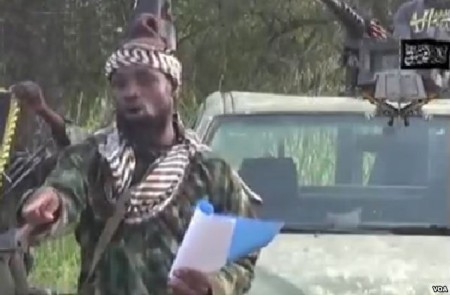
Abubakar_Shekau_2_octobre_2014-450x295

[W]e don’t pay much attention to what happens in Nigeria unless there’s a hashtag. No one has yet thought up a clever hashtag for the murder of 2,000 people. #Bringbackourdead doesn’t really work.

The Islamic wars from Nigeria to Israel, from Iraq to Kashmir, are genocidal. Israel may become the first Western country to suffer Islamic genocide, but it will not be the last. 9/11 was the first Islamic mass murder of thousands of Americans, but it will not be the last.

******************

While Western newspapers were debating whether or not to reprint the Mohammed cartoons, in Nigeria as many as 2,000 people were massacred by the Islamic State in Nigeria, also known as Boko Haram, in what is being called the deadliest attack by the Muslim group to date.

Survivors described the Islamic State setting up efficient killing teams and massacring everyone while shouting “Allahu Akbar”.

“For five kilometers (three miles), I kept stepping on dead bodies until I reached Malam Karanti village, which was also deserted and burnt,” one survivor said.

There’s a word for that. It’s genocide.

The Islamic State in Nigeria had reportedly managed to kill 2,000 people last year. This year they did it in one week.

But we don’t pay much attention to what happens in Nigeria unless there’s a hashtag. No one has yet thought up a clever hashtag for the murder of 2,000 people. #Bringbackourdead doesn’t really work.

The Islamic State’s next target is Maiduguri, the largest city in Borno with a population of over a million. Known as the “Home of Peace”, if Maiduguri falls, the death toll will be horrific.

The Catholic Archbishop, Ignatius Kaigama, warned that the killing wouldn’t stop in Nigeria. “It’s going to expand. It will get to Europe and elsewhere.”

Of course it already has, but not on the same scale.

“We will conquer Europe one day. It is not a question of (if) we will conquer Europe, just a matter of when that will happen,” an Islamic State spokesman had warned. “The Europeans need to know that when we come, it will not be in a nice way. It will be with our weapons.”

“Those who do not convert to Islam or pay the Islamic tax will be killed.”

Imagine that the burning towns and villages aren’t in Nigeria or Syria. Imagine them in France or Sweden. It’s not that great of a leap from armed cells carrying out attacks to a militia capturing entire towns and villages. They’re different phases in the same conflict.

Al Qaeda in Iraq went from a terror group carrying out suicide bombings to running a state in a decade. So did Hamas in Israel. There are already zones in Europe under the control of unofficial Sharia police. France has fewer Muslims than Nigeria and a more stable government with professional police and military forces. These two factors are the only ones keeping Islamic genocide at bay.

The massacres in France were carried out by the same types of men and movements responsible for the killings in Nigeria and Iraq. They just aren’t organized enough and still lack the numbers to conduct the same large scale genocide that they are already carrying out in Nigeria, Syria and Iraq.

Two Islamic States, one in Nigeria and another in Iraq/Syria, are engaged in genocide. Obama delayed responding to ISIS until it was already engaged in genocide and was moving on Baghdad. His people have done everything possible to avoid responding to the Boko Haram genocide in Nigeria.

The usual excuses are there. The central governments are compromised, incompetent and corrupt. The only possible solution is political. The real issue is poverty. Meanwhile the killing and the denial go on.

The foreign policy infrastructure, the human rights NGOs and the self-important scribblers who presume to tell the world what is important in the pages of the New York Times and the Washington Post have fought hard to avoid connecting the killings by the Islamic State in Nigeria to the killings by the Islamic State in Iraq and Syria. And they have fought hardest of all to avoid connecting these killings to the thousands murdered in the streets of New York and the latest bodies strewn about Paris.

The killings can be connected with three simple words; global Islamic genocide.

The European intellectuals of the last century were too fixated on their vision of a better world to understand what was happening in Germany and Japan. And what had to be done about it. While they dreamed of a world government that would do away with war, the killing had already begun.

The intellectuals of this century are equally unwilling to take their attention away from microfinance, climate change and world government to see the beginnings of a worldwide Holocaust underway.

Genocide isn’t new to Africa or the Middle East so they put it down to local tribal conflicts. Terrorism isn’t new to America or Europe, so they blame political extremism. Like the elephant and the blind men who touched its trunk and thought it was a snake, they respond to the local manifestation of Islamic genocide by seeing a familiar local phenomenon; tribal war, political extremism or minority problems.

And anyone who sees the big picture is instantly denounced as an Islamophobe.

But what if the Muslim genocide of Hindus and Buddhists in Asia and the Muslim genocide of Christians and Jews in the Middle East are part of the same phenomenon?

What if the Islamic State killers in Nigeria who shout “Allahu Akbar” during their massacres share a motive with the 9/11 hijackers who were told to “shout ‘Allahu Akbar,’ because this strikes fear in the hearts of the non-believers”?

What if a common bloody thread of Koran verses runs through the massacres of non-Muslims in the Philippines and Kenya, in Israel and Australia, in France and China, in Thailand and Syria?

What if the acts of terror on the evening news are not random events, workplace violence, mental illness and political extremism, but the beginning of another global Islamic genocide?

The rise of Islam was not based on faith, but on mass murder.

Within a few centuries of the time that Mohammed had ordered the ethnic cleansing of Jews and Christians from the Arabian Peninsula, the massacre of millions of Christians, Jews, Hindus and Buddhists was underway across the Middle East through India and as far as Afghanistan.

The Islamic Holocaust was the greatest act of mass murder in human history. And it is still taking place today over a thousand years later.

“Those who cannot remember the past are condemned to repeat it,” George Santayana wrote.

It would be a terrible thing indeed if we were condemned to repeat the mass murder of hundreds of millions and the eradication of entire civilizations under the black flag of the Jihad because we refused to remember the past or acknowledge the present.

Because we were too afraid of being called Islamophobic to speak out for the dead around the world.

It would be a terrible thing if the Nigerian village of today were to become a Swedish village tomorrow. It would be an even worse thing if the Muslim conquests of India were to be repeated in Europe.

Genocide is an ugly word.

It’s a word that we have come to associate with villages in Africa or with old concentration camps in Europe. We don’t think of it as something that can happen to us or to our children.

But we should.

The Islamic wars from Nigeria to Israel, from Iraq to Kashmir, are genocidal. Israel may become the first Western country to suffer Islamic genocide, but it will not be the last. 9/11 was the first Islamic mass murder of thousands of Americans, but it will not be the last.

In the face of genocide, our first duty is to warn the world.