Archive for the ‘Hungary’ category

Hungarian Paper Slams Merkel: ‘No Bastards On Earth More Abominable Than Liberal Pigs Digging Europe’s Grave’

January 14, 2016

Hungarian Paper Slams Merkel: ‘No Bastards On Earth More Abominable Than Liberal Pigs Digging Europe’s Grave’ Breitbart, Sarkis Zeronian, January 14, 2016

MERKEL-640

East European political leaders and their media allies have attacked ‘politically correct’ Germans in the wake of the New Year’s Eve migrant sex assaults in Cologne and other cities, labelling the assailants “nothing but hyenas”.

In a huge “we told you so” gesture, politicians from across Eastern Europe have turned their fire on the German state’s welcoming and tolerant attitude to the migrant crisis. Having warned Chancellor Merkel that her actions and the politically correct tyranny of media opinion risked bringing Europe to ruin, they now feel vindicated by events in Cologne, reports Spiegel Online.

Robert Fico, the left-nationalist Prime Minister of Slovakia, told a televised debate that the media plays down the problem as migrants are a “protected species”. Using Cologne to support his argument, he has called for an urgent EU summit to deal with the cultural and security issues thrown up by the ongoing migrant crisis, including the creation of “parallel societies”.

Mr. Fico said Slovakia would not tolerate women being insulted in the streets, nor insular Muslim communities. In his support, Slovakian media outlets slammed the politically correct media in Germany and a naive “subculture of do-gooders”.

Hungary’s Prime Minister Viktor Orbán feels equally vindicated. He used the occasion of his weekly radio broadcast to speak of the crisis in liberalism that meant reporting the sex assaults in Cologne had been suppressed in Germany. He said it showed that the media is more free to speak in Hungary than in the West, and that his government is right to be calling for a halt to immigration.

The strongest language was used by Zsolt Bayer, a friend of Mr. Orbán and co-founder of his Fidesz Party. Writing for Magyar Hirlap the journalist known for his trenchantly right-wing views described the Cologne assailants as “North African and Arabic animals – nothing but hyenas”. He added that Mrs. Merkel is letting her family and children get eaten by them.

Another Hungarian media outlet, the quasi-official government newspaper Magyar Idök, wrote:

“There are no bastards on this earth more abominable and more destructive than these liberal pigs who are digging Europe’s grave.”

In Romania, former President Traian Basescu said his country, like other Eastern European nations, would oppose a European Union quota system for refugees. He said Muslim migrants were brought up in the spirit of the Koran and could not adapt to European culture.

The leading Conservative-Liberal Romanian MEP Traian Ungureanu has described Mrs. Merkel and her open-door invitation to Germany as the “disaster of the century”. He also criticised “official censorship” of the events of Cologne he says prevails in Germany, adding:

“Every protest, every hint against gang rape is immediately classified as racism or extremism. It is the duty of public bodies to hide the facts and to deny.”

Why the Paris Massacre Will Have Limited Impact

November 15, 2015

Why the Paris Massacre Will Have Limited Impact, Daniel Pipes Org., Daniel Pipes, November 14, 2015

The murder of some 127 innocents in Paris by a jihadi gang on Friday has again shocked the French and led to another round of solidarity, soul searching, and anger. In the end, however, Islamist violence against Westerners boils down to two questions: How much will this latest atrocity turn public opinion? And how much will it further spur the Establishment to deny reality?

As these questions suggest, the people and the professionals are moving in opposite directions, the former to the right, the latter to the left. In the end, this clash much reduces the impact of such events on policy.

Public opinion moves against Islamists specifically and Islam more generally when the number of deaths are large enough. America’s three thousand dead on 9/11 stands out as by far the largest mortality but many other countries have had their equivalent – the Bali bombings for Australia, the railroad bombing for Spain, the Beslan school massacre for Russia, the transportation bombings for Britain.

Sheer numbers are not the only consideration. Other factors can multiply the impact of an assault, making it almost the political equivalent of mass carnage: (1) The renown of those attacked, such as Theo van Gogh in the Netherlands and the Charlie Hebdo office in France. (2) The professional status of the victim, such as soldiers or police. (3) High-profile circumstances, such as the Boston Marathon bombing.

In addition to the over 27,000 attacks globally connected to Islam since 9/11, or more than 5 per day (as counted by TheReligionOfPeace.com), a huge increase in illegal immigration from the Middle East recently exacerbated feelings of vulnerability and fear. It’s a one-way street, with not a single soul ever heard to announce, “I used to worry about Islamism but I don’t any more.”

These cases make more Westerners worried about Islam and related topics from the building of minarets to female infibulation. Overall, a relentless march rightwards is underway. Surveys of European attitudes show 60 to 70 percent of voters expressing these concerns. Populist individuals like Geert Wilders of the Netherlands and parties like the Sweden Democrats are surging in the polls.

But when it comes to the Establishment – politicians, the police, the press, and the professors – the unrelenting violence has a contrary effect. Those charged with interpreting the attacks live in a bubble of public denial (what they say privately is another matter) in which they feel compelled to pretend that Islam has no role in the violence, out of concern that to recognize it would cause even more problems.

These 4-P professionals bald-facedly feign belief in a mysterious “violent extremist” virus that seems to afflict only Muslims, prompting them to engage in random acts of barbaric violence. Of the many preposterous statements by politicians, my all-time favorite is what Howard Dean, the former governor of Vermont, said about the Charlie Hebdo jihadis: “They’re about as Muslim as I am.”

This defiance of common sense has survived each atrocity and I predict that it will also outlast the Paris massacre. Only a truly massive loss of life, perhaps in the hundreds of thousands, will force the professionals to back off their deeply ingrained pattern of denying an Islamic component in the spate of attacks.

That pattern has the very consequential effect of shutting out the fears of ordinary voters, whose views thereby have negligible impact on policy. Worries about Shari’a, rape gangs, exotic diseases, and bloodbaths are dismissed with charges of “racism” and “Islamophobia,” as though name-calling addresses these real issues.

More surprising yet, the professionals respond to the public’s move to the right by themselves moving to the left, encouraging more immigration from the Middle East, instituting more “hate speech” codes to suppress criticism of Islam, and providing more patronage to Islamists. This pattern affects not just Establishment figures of the Left but more strikingly also of the Right (such as Angela Merkel of Germany); only Eastern European leaders such as Hungary’s Viktor Orbán permit themselves to speak honestly about the real problems.

3301Viktor Orbán’s Hungary may not last long in the EU. Or maybe he is the group’s future leader?

Eventually, to be sure, voters’ views will make themselves heard, but decades later and more weakly than democratically should have been the case.

Placing the murderous rampage in Paris into this context: it will likely move public sentiments substantially in one direction and Establishment policies in quite the opposite way, therefore ultimately having only a limited impact.

Mr. Pipes (DanielPipes.org, @DanielPipes) is president of the Middle East Forum.

Hungary’s Migrant Crisis Ends, Europe’s Has Just Begun

November 12, 2015

Hungary’s Migrant Crisis Ends, Europe’s Has Just Begun, The Gatestone InstituteGeorge Igler, November 12, 2015

(Please see also, The annihilating of our western society. — DM)

  • “[H]alf any given year’s total migrants arrive by the start of October. The other half arrives between October and the end of December… If these tendencies remain relevant, we should expect the very opposite of a winter break, and should prepare instead for an increasing flood of people.” — Viktor Orbán, Prime Minister of Hungary, September 21, 2015.
  • The UN High Commission for Refugees announced on Nov. 2 that the number of people who illegally migrated to Europe in October alone (218,394) nearly outstripped the number of those who entered throughout the whole of 2014 (219,000).
  • The reality at Hungary’s central railway station in Budapest had to be seen to be believed. Hungarians were easily outnumbered 200 to 1 by predominantly young Muslim males. These newcomers engaged in sporadic violence, rioted at the sight of camera crews, and left the station littered with human excrement.
  • According to Björn Höcke, of the populist Alternative for Germany Party (AfD), by the end of 2016 there will be as many Muslim males of military age in Germany (5.5 million), as there are young German men of that age.
  • On Nov. 2, Libya threatened to send to Europe millions of migrants from Africa, unless the EU recognizes its self-declared (Islamist) government.

Earlier this year, Hungary’s ferociously articulate Prime Minister Viktor Orbán became the bête noir of European politics. Since then, Orbán has transitioned from being castigated as a threat to European values, into the most recognized defender of his continent’s Christian identity.

In a Europe whose central policy-makers seem in thrall to multiculturalism, Hungarians, after centuries of invasions and attempted invasions, appear unapologetically immune to political correctness. Even in their language, the colloquial phrase for communicating with the bluntest possible candor is magyarul mondva, literally “speaking in Hungarian.”

As over 400,000 predominantly Muslim migrants crossed illegally into Hungary before the completion of a border fence — which ground such incursions to an effective halt by the end of October — there has been a sanctimonious effort in the world’s press either to mischaracterize realities on the ground, or omit them altogether.

The concealment of sobering truths, openly reported in Hungary – ironically a nation whose press freedom has been criticized under Orbán’s leadership – can only have serious long-term consequences, in migrant-friendly countries such as Belgium, Sweden and Germany, especially the scale.

The United Nations High Commission for Refugees (UNHCR) announced on November 2 that the number of people who illegally migrated to Europe in October alone (218,394) nearly outstripped the number of those who entered throughout the whole of 2014 (219,000).

The figures, which even shocked members of the UNCHR, constitute the greatest monthly entry of illegal migrants into the European Union to date. Many had apparently felt that the legal imposition of quotas, initiated on September 22, and aimed at relocating migrants across EU member states, would have at least begun to tackle the EU’s migrant problem.

The quota scheme, which pivoted on forcing non-consenting member states to accept illegal migrants, has, in fact, been an abject failure. Only Sweden has participated directly.

Meanwhile, crossings from Turkey to nearby islands in Greece, the first step in the so-called Western Balkan route — the dominant corridor for illegal migrants at present — have far from peaked, and are accelerating. As winter seas make Mediterranean conditions more difficult, the journey is apparently being offered at a discount.

To observers who speak Hungarian, however, the UNHCR’s figures probably come as no surprise.

Addressing his nation’s parliament, on September 21, and calling this year’s mass migration to Europe an “invasion,” Viktor Orbán declared:

There will be no such thing as a winter hiatus with respect to the illegal immigration issue … If one looks at the tables, graphs and statistics — often available in the public domain — which show the month-by-month influx of illegal immigrants to date, what one sees largely is that half any given year’s total migrants arrive by the start of October. The other half arrives between October and the end of December.

Unlike his European partners, Orbán sees this year’s events not as an unprecedented “crisis,” but the result of a steady and entirely predictable escalation, centered on the unwillingness of member states to defend the union’s external frontiers from human smuggling, which is an obligation under the EU’s freedom-of-movement Schengen Treaty.

Orbán’s analysis led him to conclude:

There will be no let up; we should expect escalating pressure. There is no reason for us to think that people-smugglers will arrange their affairs and the routes they exploit any differently this year than they have in previous years. If these tendencies remain relevant, we should expect the very opposite of a winter break, and should prepare instead for an increasing flood of people.

As Hungary constructed its southern border fence, in line with its Prime Minister’s calculations and in consultation with Israel, experts worldwide called the move both pointless and counter-productive.

Currently, as Germany is opening new migrant reception centers weekly, Hungary is winding up its own.

On November 3, Hungary’s parliament voted overwhelmingly to reject the imposition of mandatory quotas, paving the way for legal action against the EU, in concert with the left-wing government of Slovakia led by Robert Fico. Poland is very likely to follow suit.

Many political analysts have concurred that Orbán has cynically exploited the migration issue to shore up waning domestic popularity. This could not be more wrong. Although Orbán’s poll numbers certainly took a slide in 2014, analysts similarly agreed in April that his national consultation on migration constituted a catastrophic miscalculation.

It is easy to see why. Hungarians, after the 1956 uprising against the Soviet Union, are extremely conscious of their own historic status as genuine refugees. Some national billboards accompanying the nationwide survey were even defaced, as the consultation had posed robust questions on the likely consequences of mass Muslim immigration, which most Hungarians had yet to witness, and which some found discomfiting.

But public opinion swung firmly in Orbán’s favor, with the effective occupation of Budapest’s central railway station (Keleti pályaudvar).

The realities on the ground at Hungary’s international railway terminus had to be seen to be believed. Hungarians were easily outnumbered 200 to 1 by predominantly young Muslim males. These newcomers engaged in sporadic violence; rioted at the sight of passing camera crews, and left the station littered with human excrement.

Migrants refusing to cooperate with authorities who wanted to take them to reception centers, to participate in the EU’s compulsory EURODAC asylum registration process, chanted “no fingerprint” in unison. Frustrated, many charged down motorways towards Austria, a move that led to the closure of major transport arteries.

Unlike the domestic Hungarian media, the international press reported little of the full gravity of events in Hungary. The international press failed to warn nations from Austria to Finland of what was headed their way. Journalists concentrated instead on the handful of children present, to sell a sob story.

Such reporting led Croatia to charge Hungary with the “inhumane” treatment of “refugees,” while Austria claimed, astonishingly, that Hungary’s behavior was reminiscent of the Holocaust. As migrants arrived in those nations, however, both countries rapidly backtracked.

While Hungary was being castigated for supposed xenophobia and for Orbán’s rhetoric, no one seemed to have considered that perhaps the most historically-invaded country in Europe knew what an invasion actually looked like, better than most.

Nor did many of the people criticizing Hungary stop to think that maybe, with such a prominent awareness of once being refugees themselves, Hungarians might be more cognizant of the gratitude, relief and forbearance that marks the conduct of a genuine refugee.

Instead, Hungary was confronted by aggressive economic migrants in numbers so huge that the authorities were “all but submerged.” As the migrants demanded transit to welfare states they had paid handsomely to reach, they threw food and water back at the same Hungarian officials being pilloried by the world’s media for their own efforts to cope.

The nadir of the global press coverage of Hungary came with a defensive action involving tear gas and water cannons, when, on September 16, its frontier post at Röszke was closed to illegal entry. The false story sold by the world’s media led the UN Secretary General, Ban Ki-moon, to condemn Hungary.

No mention was made outside the country of how Hungary’s police had reacted solely with non-lethal crowd control tactics — resorting to these only after a three hour standoff that injured 20 police officers, who had resisted persistent violent efforts to storm the country’s border.

The most conspicuous press failure, however, concerns the key question: With the EU’s border agency Frontex confirming on November 4 that 800,000 have illegally crossed into Europe so far in 2015, each likely paying $1000 to $5000 to a people-smuggler, how is this colossal total expenditure — entirely outside the means of genuine refugee camp residents in Turkey or Jordan — being funded?

Georg Spöttle, an Arabic-speaking German national security expert resident in Hungary, with unique access to the intelligence communities in both countries, has been studying the sources of money used by migrants to traverse Europe. He has frequently identified Gulf States, including Saudi Arabia and the United Arab Emirates, as the true source of the funds.

Spöttle has also examined some of the thousands of pictures and videos found on mobile phones discarded by migrants before entering Hungary. Many images, in his view, are likely to be in the possession only “of those either sympathetic to terrorism or terrorists themselves.”

For other observers, the most alarming evidence thrown up in central Europe by this year’s migrant influx lies in the nature of the identity documents being discarded, at the last stop on the Western Balkan route, before migrants head towards the EU’s freedom-of-movement zone.
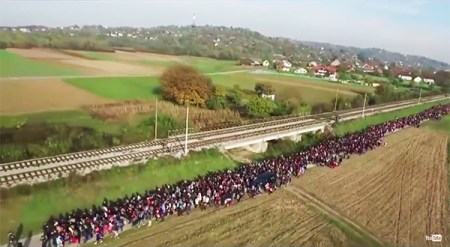
1340Thousands of migrants cross illegally into Slovenia on foot, in this screenshot from YouTube video filmed in October 2015.

In Serbia, the price of superglue has increased 100-fold, given that, when spread across a person’s fingertips, it temporarily allows an imprint of bogus fingerprints on a biometric EURODAC scanner.

Many of the documents thrown away at the Hungarian border include genuine Syrian civilian and military identity papers that would automatically entitle their holder to residence in Germany. The act seems highly irregular: Serbian identity papers, valid Swedish residency documents, papers confirming political refugee status from Jordan, and European passports, have all been found strewn across the border.

The only conclusion that can be drawn from such evidence collected at the EU’s external frontier, argues Hungary’s most notable security analyst, is that it points to the behavior of individuals intent on establishing jihadist sleeper cells in Europe. Or alternatively, that many Muslims with criminal records, already resident in the EU, could be exploiting the migrant crisis to establish entirely new identities for themselves before disappearing across the continent.

The only solution to an ever increasing influx, first from the Middle East, and then, in Orbán’s view, of even greater numbers from Africa, is to intercept and safely return migrant boats to their points of departure. On May 11, however, this “pushback” policy was utterly repudiated by Federica Mogherini, the European Commission’s foreign policy chief. Her announcement may well have acted as the spark for this year’s unprecedented migrant figures.

Orbán’s proposal, a combined European effort to police the narrow stretch of water between Turkey and nearby islands of Greece, has been rejected by the EU’s leaders. As a result, hundreds of thousands of people are still being allowed to enter the EU illegally, thanks to the newly strengthened Islamist government of Turkish President Recep Tayyip Erdoğan. At the moment, he is trying to bully Brussels into giving Turkey the features of an actual European Union membership step-by-step.

Hungary, perhaps to demonstrate how a combined border-protection initiative could work, is already using a joint cooperation force to defend its own EU frontier, with local partners from Slovakia, the Czech Republic and Poland.

The presence and power of Mogherini, whose fondness for political Islam has already been analyzed at the Gatestone Institute, is a damning indictment of the European Union’s claim to democratic legitimacy.

Thanks to what many felt was a profound dissatisfaction with mass migration into the EU, Europe experienced a marked turn to the political right in the 2014 European parliamentary elections.

A conservative European Commission was “elected” in turn — but it nevertheless appointed Mogherini, a former Italian Communist, to the most senior border-protection role in Europe. No matter how its people vote, the commitment of the EU’s institutions to a borderless Europe, both internally and externally, appears to remain undaunted.

It is clear, however, from remarks delivered in his nation’s capital on October 31, that Viktor Orbán’s patience with the EU has finally been exhausted. “Europe is being betrayed,” he told a Christian conference in Budapest. “It is being taken from us.”

Thousands of migrants shipped to the EU daily, Orbán argued, are “not a result of indecisiveness,” but the product of a conscious “left-wing” conspiracy to curb the relevance of Europe’s sovereign nation states by undermining their ethnic foundations.

With the EU having no perceptible mandate, this effort amounts to “treason,” he said, which must be countered by national democracies turning to their people. If not, he said, these people risk losing the ownership of their continent unless a Europe-wide consultation on mass migration immediately takes place.

The next migrant wave (50,000) is scheduled to arrive at the Austrian border next week. A ferry strike in Greece has caused a backlog, which is now moving its way through the Balkans.

According to Björn Höcke, of the populist Alternative for Germany Party (AfD), by the end of 2016 there will be as many Muslim males of military age in Germany (5.5 million), as there are young German men of that age.

Meanwhile, on November 2, Libya threatened to send to Europe millions of migrants from Africa, unless the EU recognizes its self-declared (Islamist) government.

Why the West should listen to Hungary on Muslim refugees

September 26, 2015

Why the West should listen to Hungary on Muslim refugees, Front Page MagazineRaymond Ibrahim, September 21, 2015

lk_1

Some central and east European countries are being criticized by more “progressive” Western nations for not wanting to take in Muslim refugees.

Chief among them is Hungary, specifically in the person of Prime Minister Viktor Orbán.  Western media are characterizing him as “xenophobic,” “full of hate speech,” and Europe’s “creeping dictator.” Sounding like the mafia boss of the Left, theGuardian simply refers to him as a “problem” that needs to be “solved.”

Orbán’s crime is that he wants to secure his nation’s borders against Muslims and preserve its Christian identity. According to Hungary’s prime minister:

Those arriving have been raised in another religion, and represent a radically different culture. Most of them are not Christians, but Muslims.  This is an important question, because Europe and European identity is rooted in Christianity….  We don’t want to criticize France, Belgium, any other country, but we think all countries have a right to decide whether they want to have a large number of Muslims in their countries. If they want to live together with them, they can. We don’t want to and I think we have a right to decide that we do not want a large number of Muslim people in our country. We do not like the consequences of having a large number of Muslim communities that we see in other countries, and I do not see any reason for anyone else to force us to create ways of living together in Hungary that we do not want to see….

The prime minister went on to invoke history—and not in the politically correct way, to condemn Christians and whitewash Muslims, but according to reality:

I have to say that when it comes to living together with Muslim communities, we are the only ones who have experience because we had the possibility to go through that experience for 150 years.

Orbán is referring to Islam’s conquest and occupation of Hungary from 1541 to 1699.  Then, Islamic jihad, terrorism, and Christian persecution were rampant.

Nor was Hungary alone. Much of southeastern Europe and portions of modern-day Russia were conquered, occupied, and terrorized by the Turks—sometimes in ways that make Islamic State atrocities seem like child’s play.  Think of the beheadings, crucifixions, massacres, slave markets, and rapes that have become IS trademarks—but on a much grander scale, and for centuries.

Still, to Western progressives, such distant memories are lost. In an article titled “Hungary has been shamed by Viktor Orbán’s government,” the Guardian mocks and trivializes the prime minister’s position:

Hungary has a history with the Ottoman empire, and Orbán is busy conjuring it. The Ottoman empire is striking back, he warns. They’re taking over! Hungary will never be the same again!… Hence the wire; hence the army; hence, as from today, the state of emergency; hence the fierce, unrelenting rhetoric of hatred. Because that is what it has been from the very start: sheer, crass hostility and slander.

Similarly, the Washington Post, after acknowledging that Hungary was once occupied by the Ottomans—though without any mention of the countless atrocities it experienced—opined that “it’s somewhat bizarre to think this rather distant past of warlords and rival empires ought to influence how a 21st century nation addresses the needs of refugees.”

The Washington Post ignores the fact that, blended in among the thousands of Muslim refugees, are operatives from the Islamic State, which is currently reliving the Ottoman days in Iraq, Syria, Libya, and elsewhere, and which plans on reliving them in Hungary and southeastern Europe.  Already, Muslims trying to force their way into Hungary are shouting Islam’s ancient war cry, “Allah Akbar!”

As for the other “regular” Muslim refugees, many of them will never assimilate, will abuse and exploit the weak—particularly women and children—and will enforce Islamic law in their enclaves.  That’s exactly what Orbán was referring to when he said, “We do not like the consequences of having a large number of Muslim communities that we see in other countries.”

To be sure, those “other countries” are not limited to Europe.  For example, in Myanmar (Burma), non-indigenous Muslim minorities are behind the same sort of anti-infidel mayhem, violence, and rape.

In response, anti-Muslim sentiment has grown among Buddhist majorities, followed by the usual Western media criticism.

Thus popular Buddhist leader Ashin Wirathu, whom the media refer to as the “Burmese bin Laden,” staunchly opposes Muslim presence in Myanmar: “You can be full of kindness and love, but you cannot sleep next to a mad dog,” he said in reference to Muslims: “I call them troublemakers, because they are troublemakers.”

Reminiscent of Hungary’s Orbán, Wirathu also warns that: “If we are weak, our land will become Muslim.”  The theme song of his party speaks of people who “live in our land, drink our water, and are ungrateful to us”—a reference to Muslims—and how “We will build a fence with our bones if necessary” to keep them out.

Again, sounding like Hungary’s Orbán, Wiranthu’s pamphlets say “Myanmar is currently facing a most dangerous and fearful poison that is severe enough to eradicate all civilization.”

To this, the NYT scoffs, arguing that “Buddhism would seem to have a secure place in Myanmar. Nine in 10 people are Buddhist…  Estimates of the Muslim minority range from 4 percent to 8 percent…”

Justifying Muslim presence in non-Muslim nations on the basis that far outnumbered Muslims can never be a problem is par for the course.  After expressing puzzlement at Orbán’s stress on history, the Washington Post expresses amazement at “the fact that Muslims comprise less than 1 percent of the country’s [Hungary’s] population.”

This media canard ignores Islam’s unwavering Rule of Numbers: whenever and wherever Muslims grow in numbers, the same “anti-infidel” violence endemic to Muslim-majority nations grows with them.

Consider the words of Fr. Daniel Byantoro, a Muslim convert to Christianity, discussing the ramifications of Islam’s slow entry into what was once a non-Muslim nation but today is the largest Muslim nation:

For thousands of years my country (Indonesia) was a Hindu Buddhist kingdom.  The last Hindu king was kind enough to give a tax exempt property for the first Muslim missionary to live and to preach his religion. Slowly the followers of the new religion were growing, and after they became so strong the kingdom was attacked, those who refused to become Muslims had to flee for their life… Slowly from the Hindu Buddhist Kingdom, Indonesia became the largest Islamic country in the world. If there is any lesson to be learnt by Americans at all, the history of my country is worth pondering upon. We are not hate mongering, bigoted people; rather, we are freedom loving, democracy loving and human loving people. We just don’t want this freedom and democracy to be taken away from us by our ignorance and misguided “political correctness”, and the pretension of tolerance. (Facing Islam, endorsement section).

Nations as diverse as Hungary and Burma—and leaders as diverse as the Christian Orbán and the Buddhist Wiranthu—are acquainted with the entry of Islam.  Accordingly, when it comes to the Islamic influx—whether by the sword or in the guise of refugees—instead of judging them, Western nations would do well to learn from their experiences.

Otherwise, they are destined to learn the hard way.