Archive for the ‘Hamas’ category

Britain: The “Struggle of Our Generation”

August 10, 2015

Britain: The “Struggle of Our Generation”, The Gatestone InstituteSamuel Westrop, August 10, 2015

  • “We’ve got to show that if you say ‘yes I condemn terror — but the Kuffar are inferior’, or ‘violence in London isn’t justified, but suicide bombs in Israel are a different matter’ — then you too are part of the problem. Unwittingly or not, and in a lot of cases it’s not unwittingly, you are providing succour to those who want to commit, or get others to commit to, violence.” — Prime Minister David Cameron.
  • In a series of religious rulings published on its website, the Islamic Network charity advocated the murder of apostates; encouraged Muslims to hate non-Muslims; stated that when non-Muslims die, “the whole of humanity are relieved;” and described Western civilisation as “evil.”
  • The Charity Commission’s solution, however, was to give the charity’s trustees booklets titled, “How to manage risks in your charity,” and warn them not to do it again.

On July 20, Prime Minister David Cameron outlined his government’s plans to counteract Islamic extremism, which he described as the “struggle of our generation.”

In a speech before Ninestiles School, in the city of Birmingham, Cameron articulated a view of the Islamist threat that, just a couple of years ago, few else in British politics would have dared to support.

In a report for BBC Radio 4, the journalist John Ware described Cameron’s speech, and the government’s proposed counter-extremism measures, as “something no British government has ever done in my lifetime: the launch of a formal strategy to recognize, challenge and root out ideology.”

Cameron’s speech was wide-ranging. It addressed the causes, methods and consequences of Islamist extremism.
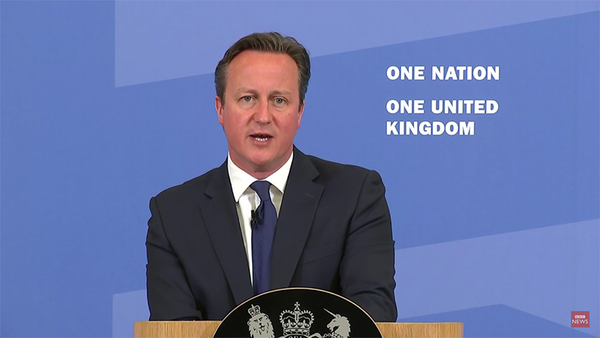
1199(Image source: BBC video screenshot)

We must recognize, Cameron reasoned, that Islamist terror is the product of Islamist ideology. It is definitely not, he argued, “because of historic injustices and recent wars, or because of poverty and hardship. This argument, what I call the grievance justification, must be challenged. … others might say: it’s because terrorists are driven to their actions by poverty. But that ignores the fact that many of these terrorists have had the full advantages of prosperous families or a Western university education.”

“Extreme doctrine” is to blame — a doctrine that is “hostile to basic liberal values … Ideas which actively promote discrimination, sectarianism and segregation. … which privilege one identity to the detriment of the rights and freedoms of others.” This is a doctrine “based on conspiracy: that Jews exercise malevolent power; or that Western powers, in concert with Israel, are deliberately humiliating Muslims, because they aim to destroy Islam.”

People are drawn to such extremist ideas, Cameron argued, because:

“[Y]ou don’t have to believe in barbaric violence to be drawn to the ideology. No-one becomes a terrorist from a standing start. It starts with a process of radicalisation. When you look in detail at the backgrounds of those convicted of terrorist offences, it is clear that many of them were first influenced by what some would call non-violent extremists.

“It may begin with hearing about the so-called Jewish conspiracy and then develop into hostility to the West and fundamental liberal values, before finally becoming a cultish attachment to death. Put another way, the extremist world view is the gateway, and violence is the ultimate destination.”

To counteract the extremist threat, Cameron concludes, the government will “tackle both parts of the creed — the non-violent and violent. This means confronting groups and organisations that may not advocate violence — but which do promote other parts of the extremist narrative.”

Further, no longer will extremist groups be able to burnish their moderate credentials by pointing to ISIS as the Islamic bogeyman:

“We’ve got to show that if you say ‘yes I condemn terror — but the Kuffar are inferior’, or ‘violence in London isn’t justified, but suicide bombs in Israel are a different matter’ – then you too are part of the problem. Unwittingly or not, and in a lot of cases it’s not unwittingly, you are providing succour to those who want to commit, or get others to commit to, violence.

For example, I find it remarkable that some groups say ‘We don’t support ISIL’ as if that alone proves their anti-extremist credentials. And let’s be clear Al-Qaeda don’t support ISIL. So we can’t let the bar sink to that level. Condemning a mass-murdering, child-raping organisation cannot be enough to prove you’re challenging the extremists.”

Rather radically for a Western leader, Cameron also asserted that, “simply denying any connection between the religion of Islam and the extremists doesn’t work… it is an exercise in futility to deny that. And more than that, it can be dangerous. To deny it has anything to do with Islam means you disempower the critical reforming voices; the voices that are challenging the fusing of religion and politics…”

Cameron’s speech was groundbreaking. No previous Prime Minister in past decades would have dared to make such statements. This is not to say, however, that it is without fault.

Cameron is not just talk. An “Extremism Analysis Unit” has been set up within the Home Office, which will serve to tackle Islamist extremism, including “non-violent” groups. According to the journalist John Ware, the new body is currently preparing lists of extremist preachers and groups.

More importantly, a variety of new legislation is being brought before Parliament. However, some of the proposed laws, critics argue, are draconian. “Banning Orders” will outlaw designated “extremist groups.” “Extremism Disruption Orders,” meanwhile, will restrict designated “extremists” from appearing on television, or publishing without the authorities’ approval. And “Closure Orders” will allow the government to close any institution deemed guilty of promoting extremism.

Cameron has correctly and radically diagnosed the problem of Islamic extremism. His solutions, however, do not appear promising.

A more useful next step would be for the government to tackle its own relationships with extremist groups. Britain’s registered charities offer a particularly vivid example of Islamist extremism going unchallenged.

In 2014, I wrote about the Islamic Network, a group that describes itself as “a da’wah[proselytizing] organisation which aims to promote awareness and understanding of the religion of Islam.”

In a series of religious rulings published on its website, the Islamic Network charity advocated themurder of apostates; encouraged Muslims to hate non-Muslims; stated that when non-Muslims die, “the whole of humanity are relieved;” and described Western civilisation as “evil.” Further, the Islamic Network directed a great deal of hatred towards the Jews. Its website claimed: “The Jews strive their utmost to corrupt the beliefs, morals and manners of the Muslims. The Jews scheme and crave after possessing the Muslim lands, as well as the lands of others.”

In spite of these views, the Islamic Network is a registered charity, which means it is entitled to subsidy from the taxpayer.

As a result of revealing the material published on the Islamic Network’s website, as well as several complaints submitted to the Charity Commission, the government opened an inquiry into the charity. After a year of deliberation, the Charity Commission published its report, which concluded that the Islamic Network had indeed published extremist material.

The Charity Commission’s solution, however, was to give the charity’s trustees booklets titled, “How to manage risks in your charity,” and warn them not to do it again.

Britain may finally have a government that understands the problem of Islamist extremism, but if government bodies fail to challenge extremist charities such as the Islamic Network, then what use is this enlightenment?

The Islamic Network is but one of many dozens of examples. Why is the British organizationInterpal, for example, still allowed to be a registered charity? Interpal is a designated terrorist organization under United States law. Its trustees regularly meet with senior leaders of the terror group Hamas. In 2013, for instance, Interpal trustee Essam Yusuf took part in a ceremony with the Hamas leader Ismail Haniyeh, at which they expressed praise for Hamas’ military wing, the Al Qassam Brigades, and glorified “martyrdom.”

Or what of Islamic Relief, one of Britain’s largest charities? Established by the Muslim Brotherhood, Islamic Relief’s directors have included Ahmed Al-Rawi, a Muslim Brotherhood leader who, in 2004, supported jihad against British and American troops in Iraq; and Essam El-Haddad, who is accused by an Egyptian court of divulging Egyptian state secrets to Hamas, Hezbollah and Iran, and using Islamic Relief to finance global terrorism.

Despite Islamic Relief’s links to Islamist extremism, the charity continues to receive millions of pounds from the British government.

David Cameron’s speech on July 20 should be applauded. If another political party had won the recent general election, no such speech would have been made. But before the Prime Minister turns his hand to censorship, perhaps the government should address extremist groups closer to home.
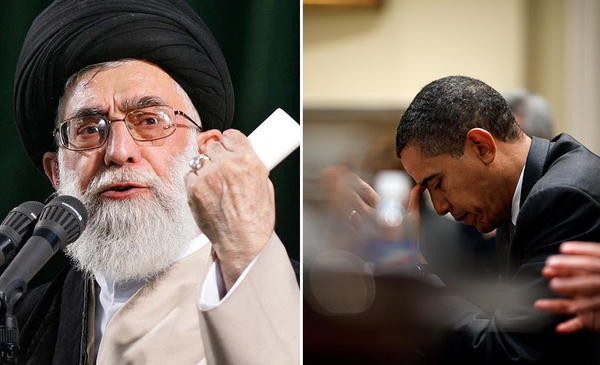
Iran’s Supreme Leader Khameni publishes book on how to eliminate Israel

August 2, 2015

Iran’s Supreme Leader Khameni publishes book on how to eliminate Israel, American ThinkerThomas Lifson, August 2, 2015

Ayatollah Ali Khameni has published his version of Mein Kampf, a 416 page book outlining his strategy to eliminate Israel, which he describes as  “a cancerous tumor.” Although it is currently available only in Iran, an Arabic translation is underway, and sooner or later it will achieve wide readership in the Muslim world. The Obama administration is no doubt hoping it will achieve no notice in the United States until after the Iran deal is voted upon, because the plan advocated will be immensely aided by its implementation.

Amir Taheri of the New York Post obtained a copy from Iran:

Khamenei makes his position clear from the start: Israel has no right to exist as a state.

He uses three words. One is “nabudi” which means “annihilation.” The other is “imha” which means “fading out,” and, finally, there is “zaval” meaning “effacement.”

Khameni does not call for wiping out Israel with a nuclear bomb. He states that one of his fondest desires is to pray in Jerusalem. Instead, his plan is one of terrorism and pressure, keeping Israel from fighting back against Iran, the sponsor of terror, with the implicit threat of nuclear retaliation.

 What he recommends is a long period of low-intensity warfare designed to make life unpleasant if not impossible for a majority of Israeli Jews so that they leave the country.

His calculation is based on the assumption that large numbers of Israelis have double-nationality and would prefer emigration to the United States and Europe to daily threats of death.

Iran has many allies in this effort, including the BDS movement in the United States. Cripple Israel economically, and her economically productive people will leave. Make the political cost of supporting Israel high. That will pave the way for an internationally-sponsored plebiscite engineered to produce a Muslim state:

Under Khamenei’s scheme, Israel, plus the West Bank and Gaza, would revert to a United Nations mandate for a brief period during which a referendum is held to create the new state of Palestine.

All Palestinians and their descendants, wherever they are, would be able to vote, while Jews “who have come from other places” would be excluded.

Double standards are inherent in Islamic thinking. Any land that once fell under Muslim control belongs to Muslims by right. So Israelis who only boast a few generations in Israel are excluded, while Arabs whose families once lived in Israel generations ago are automatically qualified.

Khamenei does not mention any figures for possible voters in his dream referendum. But studies by the Islamic Foreign Ministry in Tehran suggest that at least eight million Palestinians across the globe would be able to vote against 2.2 million Jews “acceptable” as future second-class citizens of new Palestine. Thus, the “Supreme Guide” is certain of the results of his proposed referendum.

With a $150 billion war chest, thanks to the Obama deal, and the prospect of oil exploration and other business expansion in Iran, there will be plenty of money available to subsidize Hezb’allah, Hamas, and other terror attacks against Israelis and Jews (such as the attack on the Jewish Community Center in Buenos Aires).

Khamenei boasts about the success of his plans to make life impossible for Israelis through terror attacks from Lebanon and Gaza. His latest scheme is to recruit “fighters” in the West Bank to set up Hezbollah-style units.

“We have intervened in anti-Israel matters, and it brought victory in the 33-day war by Hezbollah against Israel in 2006 and in the 22-day war between Hamas and Israel in the Gaza Strip,” he boasts.

Far from a spittle-flecked madman, Khameni is coldly calculating, and explains a plan that is already underway with considerable success. And he has many allies in this country, some of them in high places.


Palestinian Summer Camps Preach Jihad and Train Youth to Become Terrorists

July 30, 2015

Palestinian Summer Camps Preach Jihad and Train Youth to Become Terrorists, Investigative Project on Terrorism, July 30, 2015

(In Gaza and at the Al-Aqsa Mosque in Jerusalem: raising a new generation of Palestinian children yearning to be free kill Jews for Allah, virgins, their parents and Palestine.  — DM)

Hamas hopes to provide 25,000 children and teenagers with military training to seed future terrorist operations against Israel. Similar to the Al-Aqsa camp, the Hamas camp heavily emphasizes religious indoctrination and radical jihadist brainwashing, according to a news report translated by MEMRI.

******************

Palestinian summer camps in Jerusalem and Gaza are actively indoctrinating young children with radical jihadist ideology and preparing them for martyrdom (suicide) operations, the Middle East Media Research Institute (MEMRI) reports.

In an Islamic summer camp at Al-Aqsa Mosque in Jerusalem, little children are subjected to a radical sheikh’s lecture on the virtues of martyrdom.


“The martyr is absolved with the first drop of his blood…the martyr also gets to vouch for seventy family members (on Judgment Day)… the martyr gets two virgins of Paradise, but the murabit [someone guarding Islam against the infidel] gets 70 – 35 times more than the martyr,” preached radical cleric Khaled Al-Maghrabi.

The children generally appear like most children their age – fidgeting, looking around, some playing with toys, seemingly disinterested in the lecture. Al-Magrabi still appears determined to impart jihadist indoctrination into the next generation of Palestinians at a very early age.

A Palestinian bystander even confronts Al-Maghrabi and tells him his message isn’t appropriate for children.

“Listen, sheik, they do not understand what you are saying. They are children…you are talking to them about ribat, martyrdom, and the virgins of Paradise. Shame on you. You can teach these lessons to (adults) like us, not to them,” said the Palestinian man.

Unfortunately, Palestinians standing up against radicalization is all too rare of an occurrence. Al-Maghrabi carried on after the distraction, leading the children in chanting, “We shall sacrifice our souls and our blood for you, Al-Aqsa!” the children chant.

In a second video illustrating Palestinian indoctrination of its young people with hate, viewers are taken inside a Hamas summer camp called “Vanguard of Liberation.” Hamas hopes to provide 25,000 children and teenagers with military training to seed future terrorist operations against Israel. Similar to the Al-Aqsa camp, the Hamas camp heavily emphasizes religious indoctrination and radical jihadist brainwashing, according to a news report translated by MEMRI.

“The goal of the camps is to instil the spirit of Jihad and of fighting in these cubs, these youth, so that they will become the next generation of liberation,” says a masked Hamas operative and camp counselor.


“Liberation” in this context means taking over all of Israel since Hamas is openly dedicated to the destruction of the Jewish state in any form.

The video features the youth running through military style courses, weapons training, and even shows a junior version of a Hamas naval commando unit dedicated to infiltrating Israel and conducting terrorist attacks.

Obama’s Gamble with Iran’s Theocratic Regime

July 28, 2015

Obama’s Gamble with Iran’s Theocratic Regime, The Gatestone InstituteRobert D. Onley, July 28, 2015

[T]he gravest consequence of Obama’s Iran deal, and the most damning of its continued defense, is that the world bestowed ideological legitimacy on the Islamic Republic’s radical theocracy, and in so doing has consigned the people of Iran to near permanent rule under the iron fist of Twelver Shi’a Islamism.

************************

  • Obama’s Iran deal is a direct manifestation of the President’s fundamentally misguided worldview, one that wishes away danger and then believes in the wishes.
  • Even more concerning is that the Iran deal may directly conflict with U.S. obligations as a signatory of the Non-Proliferation Treaty. The Iran deal may be unconstitutional, violate international law and feature commitments that President Obama could not otherwise lawfully make. By seeking approval of the deal under the UN Security Council, Obama has bound the U.S. under international law without Senate consent.
  • The gravest consequence of Obama’s Iran deal is that the world bestowed ideological legitimacy on the Islamic Republic’s radical theocracy, and in so doing has consigned the people of Iran to near permanent rule under the iron fist of Shi’a Islamism.
  • A total reversal of the Iranian regime’s behavior should have been, and still can be, a precondition for the removal of any sanctions related to Iran’s nuclear program. An end to Iran’s financial and material support for terrorist forces such as Hezbollah and Hamas must be demanded, along with the return of the four American hostages Iran is holding.
  • There is still time for a better deal that can be had.

As President Obama and Secretary Kerry dominated the airwaves with rounds of media interviews to defend the Iran deal last week, German Vice Chancellor and Economic Minister Sigmar Gabriel flew straight to Tehran for the first of what are certain to be countless meetings by P5+1 leaders to capitalize on new business opportunities in Iran.

In Europe, it seems, there is no debate to be had over the Iran deal; rather, it is a fait accompli.

But in the United States, the domestic debate is heating up, fueled by a Presidential primary campaign and increasingly justified bipartisan anxiety over the bill.

Independent of these political realities, however, the immediacy and tenacity of the White House’s defense of the Iran deal (which now has its own @TheIranDeal Twitter account, no less), betrays an acute unspoken discomfort by many Democrats with the practical flaws and global security dangers that the deal presents.

Obama’s Iran deal is a direct manifestation of the President’s fundamentally misguided worldview, one that wishes away danger and then believes in the wishes.

Haunted by his electorally-motivated premature withdrawal from Iraq in 2011; his refusal in 2013 to confront Syria’s Bashar Assad when he used chemical weapons on his own people; his betrayal by Russia’s Vladimir Putin to whom he had offered a reset button, and his impotence in failing to respond to the aggressive expansionist moves of Russia, ISIS, Iran and China, the President and Democrat Party, in signing the Iran deal, seem to be trying to absolve the United States of its role at the forefront of the global fight against Islamic radicalism and other threats.

Citing the failed EU-led negotiations with Iran in 2005, which resulted in Iran’s massive expansion of centrifuge production, defenders of the deal, such as Fareed Zakaria, have painted a bleak and zero-sum counterfactual argument. It is claimed that the result of Congress’s opposition will be an international community that forges ahead on renewed trade relations with Iran, while leaving the United States outside the prevailing global reconciliation and supposed love-in with the Islamic Republic.

There are several serious problems with this defense, and similarly with the White House’s blitzkrieg public relations campaign to fend off detractors of the Iran deal, with Secretary of State John Kerry commanding the preemptive, and often totally inaccurate, strikes against Congress. In consideration of the colossal failure represented by the North Korea nuclear precedent, let us consider the issues unique to Iran.

Foremost, opponents of the Iran deal are not universally suggesting the Iran deal be killed outright or immediately resort to “war.” This is simply disingenuous. Instead, the opponents’ fundamental premise is that a better deal was left on the table, and thus remains available. The very fact that the Iranian regime was at the negotiating table was indeed a sign of Iran’s weakness; any timelines for the P5+1 to “close” the deal were artificial constraints that surely erased further achievable concessions.

Second, much ink has already been spilled about the technical weaknesses of the Iran deal. Namely: that Iran’s vast nuclear infrastructure remains in place; that the most important restrictions expire in 10 years (a mere blip for humanity); that Iran’s uncivilized domestic and regional behavior was a naughty unmentionable; and finally, that the deal undoubtedly initiated a regional nuclear arms race while supercharging the Iranian regime’s finances.

Third, the gravest consequence of Obama’s Iran deal, and the most damning of its continued defense, is that the world bestowed ideological legitimacy on the Islamic Republic’s radical theocracy, and in so doing has consigned the people of Iran to near permanent rule under the iron fist of Twelver Shi’a Islamism.

This capitulation occurred precisely at a time when the West and the broader Middle East are facing off against the Islamic State — a terrorist force which, when stripped of its social media allure, is ultimately a Sunni-branded spin-off of the extremist Shi’a Islamism that has ruled in Iran since 1979.

The Iranians may be convenient allies as enemies of our enemies today, but not for one second have Iran’s rulers suggested their ultimate intent is anything other than the all too familiar “Death to America” and “Death to Israel” propaganda seen for the past 36 years. In what is objectively and wholly a strange deadly obsession, the Supreme Leader of Iran, Ayatollah Khamenei, has been rousing crowds with calls for the destruction of two nation-states both during and after nuclear negotiations.

In spite of this public malice, defenders of the deal suggest that “the [Obama] administration is making a calculated bet that Iran will be constrained by international pressure.” Why exactly then is Khamenei making clear the opposite?

1173

President Obama’s willingness to concede Iran’s new-found normalized membership in the community of nations on the basis of this nuclear deal is an affront to the liberal, free, democratic principles that have stood against the forces of tyranny throughout American history.

It is also an affront the American political system and to the members of both parties who are now being cornered by the President into supporting, or not supporting, such an intrinsically dangerous and needlessly flawed bargain with an avowed enemy.

Even more concerning is that the Iran deal may directly conflict with U.S. obligations as a signatory of the Non-Proliferation Treaty (NPT). As a number of critics have pointed out, the Iran deal may be unconstitutional, violate international law and feature commitments that President Obama could not otherwise lawfully make.

By seeking approval of the deal under the UN Security Council, President Obama has bound the United States under international law without Senate consent.

If the United States is to remain the vanguard of human liberty, President Obama must distinguish between the vain pursuit of his legacy, and the civilized world’s deepest need at this consequential hour for the American President to defend comprehensively the fundamental principles that underpin the modern order. Unless his desired legacy is actually to destroy it.

As opponents of the Iran deal have noted, there is still time for a better deal that can be had.

To start, a total reversal of the Iranian regime’s behavior should have been, and still can be, a precondition for the removal of any sanctions related to Iran’s nuclear program. Congress can lobby for this change, and should maintain American sanctions and applicable provisions in the U.S. Treasury Department’s SWIFT terrorist tracking finance program.

Next, while Iran’s regional malignancy may run deep in the regime’s veins (through the many twisted arms of Tehran’s Islamic Revolutionary Guards Corps), an end to Iran’s financial and material support for terrorist forces such as Hezbollah and Hamas must be demanded, along with the return of the four American hostages Iran is holding.

Third, those who argue that Iran’s human rights record was not “on the table” in Geneva have needlessly abdicated the West’s moral and intellectual high ground to the forces of barbarism and hate that are now waging war across the region. Respect for international humanitarian norms should never be discarded in such negotiations.

At the end of the day, the deeper questions for Obama and the entire P5+1 are this: By whose standards were negotiations conducted? And whose worldview will rule the 21st century?

In defense of Obama’s approach, the deal’s supporters point out that the Iranians are a “proud, nationalistic people,” which is undoubtedly true, but irrelevant, just as it was for the leadership of Germany’s Third Reich.

The Iranian regime, by virtue of its radical religious nature, weak economy and political experiment with theocracy, should have borne the burden of coming to the negotiating table with the most to lose. Instead, President Obama, on behalf of the free world, is allowing this pariah state to guarantee its place among the nations, lavishly rewarded for having violated the Non-Proliferation Treaty, and in all its about-to-be-well-funded lethality.

Op-Ed The consequences of a bad deal with Iran

July 26, 2015

Op-Ed The consequences of a bad deal with Iran, LA Times, John Bolton, July 26, 2015

American weakness has brought us to this difficult moment. While we obsessed about its economic discomfort, Iran wore its duress with pride. It was never an even match. We now have to rely on a tiny ally to do the job for us. But unless we are ready to accept a nuclear Iran (and, in relatively short order, several other nuclear Middle Eastern states), get ready. The easy ways out disappeared long ago.

***************************

President Obama has made an art form of attacking his opponents rather than substantively defending his own policies, most recently regarding the Vienna agreement on Iran’s nuclear program. Essentially, Obama argues that we must either accept his wretched deal or go to war to prevent Iran from acquiring nuclear weapons.

As is typical, Obama posits the wrong choice, apparently to distract from the unpleasant reality that the agreement won’t work. It will not prevent Iran from getting nuclear weapons. So the real choice we are faced with is dealing with the consequences of military action or the consequences of a nuclear Iran. Neither is palatable, but the latter is far worse. If the real objective is stopping Iran from getting nuclear weapons, preemptive military action is now inescapable.

This rock-and-hard-place outcome has long been foreseeable. Iran’s dogged determination to become a nuclear-weapons state was fiercer and stronger than the West’s frail response. Assuming Iran scrupulously complies with every provision agreed to in Vienna — an absurdly unlikely scenario given the ayatollahs’ objectives and history — its ambitions for nuclear weapons will simply have been delayed eight to 10 years.

In all likelihood, the ayatollahs are already at work violating the accords. After all, Iran has systematically breached its voluntarily-assumed obligations under the Nuclear Non-Proliferation Treaty for more than 30 years. Now the president’s deal will allow Iran to keep the fruits of its violations. Yes, the deal includes restrictions on uranium enrichment, but Tehran can retain its enrichment program, with guaranteed international assistance in improving it. These concessions are fatal mistakes.

Moreover, Iran’s ballistic missile efforts — its development of the means to deliver nuclear weapons all over the world — will barely be touched. Nor does the deal in any way address Iran’s clandestine weaponization efforts, which it has denied and hidden from the International Atomic Energy Agency with great skill.

Last week, the news that the administration has not even seen the texts of two agreements between the energy agency and Iran, both crucial to implementation of the Vienna accords, only raises further doubts. President Obama must provide the texts of these “side deals” to Congress before any serious consideration of the overall agreement is possible.

Some critics of Obama’s plan advocate scuttling the deal and increasing economic sanctions against Iran instead. They are dreaming. Iran and the United States’ negotiating partners have already signed the accords and are straining at their leashes to implement them. There will be no other “better deal.” Arguments about what Obama squandered or surrendered along the way are therefore fruitless. As for sanctions, they were already too weak to prevent Iran’s progress toward the bomb, and they will not be reset now. To paraphrase Bruce Springsteen, “These sanctions are going boys, and they ain’t coming back.”

Patrick Clawson, the director for research at the Washington Institute for Near East Policy, provided the most recent thumbs-down assessment of sanctions: “Iran has muddled through the shock of the sanctions imposed in 2012, and its structural [economic] problems are not particularly severe compared to those of other countries.” He estimates Iran’s nuclear and terrorism-support programs to cost only about $10 billion annually. No wonder administration officials have testified that sanctions (including those imposed piecemeal before 2012) did not slow Iran’s nuclear efforts.

Nor will the deal’s “snapback” mechanism (intended to coerce Iran back into compliance if it breaches its obligations) change that reality. Tehran’s belligerent response is expressly stated in the agreement’s text: “If sanctions are reinstated in whole or in part, Iran will treat that as grounds to cease performing its commitments … in whole or in part.” Tehran does risk losing some future economic benefits should sanctions snap back, but by then it will have already cashed in the assets the deal unfreezes and signed new lucrative trade and investment contracts.

Once those benefits begin flowing all around, the pressure on world governments will only increase to ignore Iranian violations, or to treat them as minor or inadvertent, certainly not warranting the reimposition of major sanctions. The ayatollahs have dusted off Lenin’s barb that “the capitalists will sell us the rope with which we will hang them,” and applied it to the age of nuclear proliferation.

If diplomacy and sanctions have failed to stop Iran, diplomacy alone will fail worse. Like it or not, we now face this unpleasant reality: Iran probably will violate the deal; it may not be detected doing so and if detected, it will not be deterred by “snapback” sanctions. So we return to the hard question: Are we prepared to do what will be necessary to stop Iran from getting nuclear weapons?

Obama most certainly is not, which means the spotlight today is on Israel.

If Israel strikes, there will be no general Middle East war, despite fears to the contrary. We know this because no general war broke out when Israel attacked Saddam Hussein’s Osirak reactor in 1981, or when it attacked the North Korean-built Syrian reactor in 2007. Neither Saudi Arabia nor other oil-producing monarchies wanted those regimes to have nuclear weapons, and they certainly do not want Iran to have them today.

However, Iran may well retaliate. At that point, Washington must be ready to immediately resupply Israel for losses incurred by its armed forces in the initial attack, so that Israel will still be able to effectively counter Tehran’s proxies, Hamas and Hezbollah, which will be its vehicles for retaliation. The United States must also provide muscular political support, explaining that Israel legitimately exercised its inherent right of self-defense. Whatever Obama’s view, public and congressional support for Israel will be overwhelming.

American weakness has brought us to this difficult moment. While we obsessed about its economic discomfort, Iran wore its duress with pride. It was never an even match. We now have to rely on a tiny ally to do the job for us. But unless we are ready to accept a nuclear Iran (and, in relatively short order, several other nuclear Middle Eastern states), get ready. The easy ways out disappeared long ago.

ISIS infiltrates Egyptian special forces, joins with Hamas to occupy N. Sinai, liquidate Sisi

July 23, 2015

ISIS infiltrates Egyptian special forces, joins with Hamas to occupy N. Sinai, liquidate Sisi, DEBKAfile, July 23, 2015

islamic-State-Corvette-AttackThe ISIS Kornet missile attack on Egyptian Navy vessel

Islamic State affiliates in Sinai and Libya have banded together with the Palestinian Hamas rulers of the Gaza Strip for the shared goals of capturing northern Sinai from the Egyptian army and staging an assassination coup against President Abdel-Fatteh El-Sisi, DEBKAfile’s exclusive military and intelligence sources report.

They are in the throes of four steps for promoting their objectives:

1.  Monday, June 29, a rogue group of Egyptian Special Forces accessed the heavily-guarded upscale Cairo district of Heliopolis to plant a bomb car, which they remotely detonated as the convoy of their target, Egypt’s general prosecutor Hisham Barakat, went by. He was killed on the spot. The assassins were members of the Egyptian elite force which had defected to the Islamic State of Iraq and the Levant.

Three weeks later, on July 16, notwithstanding reinforced security in Heliopolis, ISIS killers reached inside the neighborhood once again and planted a roadside bomb. It was detonated as an Interior Ministry special forces security patrol moved past.

Because of the tight official blackout on the event, there are no reliable accounts on casualties. The authorities in Cairo reported that one Egyptian soldier was injured, but this is no doubt only part of the picture.

The following day, July 17, a violent clash erupted In the Talibiya neighborhood of Giza near the pyramids between Egyptian Special Forces and Muslim Brotherhood’s underground cells. Five MB adherents were reported killed, but again no word on military losses.

2. On July 1, ISIS forces launched their most ambitious offensive to date against Egyptian military and police facilities in northern Sinai. Still ongoing three weeks later, the losses the Egyptian military have sustained to date are estimated at 120 dead and hundreds injured. Though fighting fiercely, Egyptian troops have not been able to repel the continuous Islamist assault or contain its advance through the northeastern section of the peninsula.

Tuesday, July 21, Hamas terrorists arrived at ISIS positions in northern Sinai for a joint assault on the base of the Multinational Observer Force at El Gorah, not far from the embattled town of Sheik Zuwaid. It was the first major attack on the US-led force that was installed in Sinai to monitor the 1979 Egyptian-Israeli peace accord – and is still going on..

Here, too, the MFO command and Cairo have combined to impose a blackout on the situation in the camp and the extent of casualties..

3. On July 17, the Islamic state of Sinai sank an Egyptian coast guard vessel with a sophisticated guided Kornet anti-tank missile. The ship was patrolling the Mediterranean shore of Rafah to prevent the smuggling of arms and fighters from Egypt proper and Libya into northern Sinai. This was a landmark incident in that it was the first time ISIS is known to have sunk an adversary’s vessel at sea.

Cairo reported at first that a fire broke out on the ship and there were no casualties.

4.  On July 22, an audio message began making the rounds in Cairo and other Egyptian cities claiming to be the voice of Hisham al-Ashmawy, an Egyptian Special Forces officer who defected to ISIS. He said the country had been “overpowered by the new pharaoh” and called on all Egyptians “to come together to confront the enemy.” The message concluded with the words: “Do not fear them, but fear Allah if you are true believers.”

Western and Middle East counter-terror experts have concluded that it was Hisham al-Ashmawy who orchestrated the assassination of the general prosecutor last month. They tag him as the leader of the group of Egyptian officers and men who defected to ISIS. Egypt’s elite military units would appear therefore to be heavily penetrated by the Islamic State.

For Egyptian rulers this is a recurring menace. Thirty-years ago in October 1981, President Anwar Sadat was assassinated by a senior Egyptian intelligence officer who had secretly joined the radical Egyptian Islamic Jihad, one of Al Qaeda’s two parent groups, and went AWOL a short time earlier.

Israeli deterrence in the eye of the hurricane

July 12, 2015

Israeli deterrence in the eye of the hurricane, Jerusalem PostLouis Rene Beres, July 12, 2015

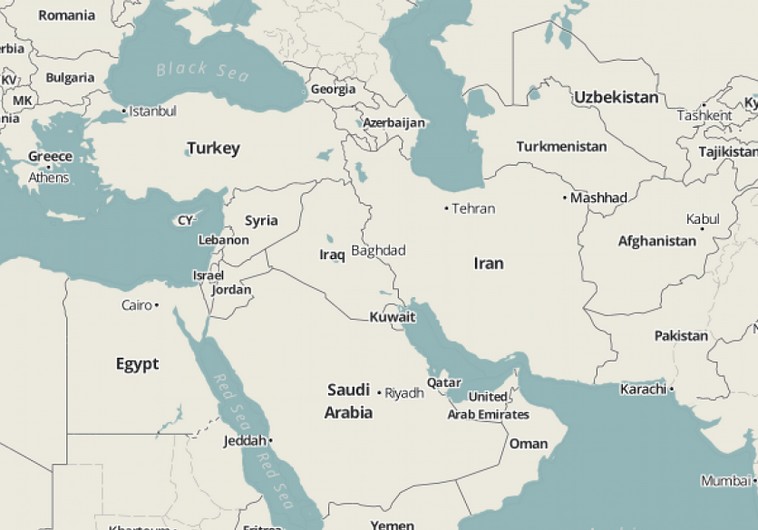
ShowImage (1)Map of Middle East. (photo credit:Courtesy)

Everything is very simple in war, but the simplest thing is difficult.”
– Carl von Clausewitz, On War

To prevent a nuclear war amid steadily growing regional chaos, especially as Iran will soon be fully nuclear (and the grateful beneficiary of US President Barack Obama’s pretend P5+1 diplomacy), Israel will need suitably complementary conventional and nuclear deterrents.

**********************

Left to themselves, especially as more “normal” hostilities dissolve into a full-blown regional chaos, Israel’s adversaries could drive the Jewish state toward an unconventional war. This fateful endangerment could be produced singly or collaboratively, by deliberate enemy intent or by the “collateral damage” of sectarian strife. Militarily, these Islamic adversaries of Israel, both Sunni and Shi’ite, could be either non-nuclear, or, in the future, nuclear.

They might also include certain wellarmed sub-state or terrorist forces. Already, Iranian-backed Hezbollah may have more usable missiles than all NATO countries combined.

To most effectively deal with such interpenetrating threats – including reasonably expected “synergies” and “force multipliers” – Israel’s leaders will first need to consider some largely-opaque factors. These include: 1) probable effects of regional chaos upon enemy rationality; 2) disruptive implications of impending Palestinian statehood; and 3) re-emergence of a corrosively Cold War-style polarity between Russia and the United States. Apropos of a “Cold War II,” there is already evidence of growing contact between Russia and Saudi Arabia, the world’s two largest oil producers.

In essence, Jerusalem must take all necessary steps to successfully manage an expectedly unprecedented level of adversarial complexity and weaponization. Israel’s leaders, in this connection, must take proper measures to ensure that any conceivable failures of its national deterrent would not spark biological or nuclear forms of regional conflict. To accomplish this indispensable goal, the IDF, inter alia, must continue to plan carefully around the core understanding that nuclear deterrence and conventional deterrence are inherently interrelated and meaningfully “seamless.”

Sometimes, in strategic matters, seeing requires distance. A nuclear war in the Middle East is not beyond possibility. This is a sensible assessment even if Israel were to remain the only nuclear weapons state in the region.

How is this possible? A bellum atomicum could come to Israel not only as a “bolt from the blue” enemy nuclear attack (either by a state or by a terrorist group), but also as the result, intended or otherwise, of certain uncontrolled military escalations.

Needed prudence in such narratives calls for additional specificity and precision. If particular Arab/Islamic enemy states were to launch conventional attacks upon Israel, Jerusalem could then respond, sooner or later, with calculated and more-or-less calibrated nuclear reprisals. Alternatively, if some of these enemy states were to launch large-scale conventional attacks, Jerusalem’s own still-conventional reprisals could then be met, perhaps even in the not-too-distant future, with enemy nuclear counterstrikes.

How should Israel prepare for such perilous contingencies? More than likely, Israel has already rejected any doctrinal plans for fielding a tactical/theater nuclear force, and for assuming any corollary nuclear war fighting postures. It would follow further from any such well-reasoned rejection that Israel should do whatever is needed to maintain a credible conventional deterrent.

By definition, such a measured threat option could then function reliably across the entire foreseeable spectrum of non-nuclear threats.

Still, any such strategy would need to include an appropriately complementary nuclear deterrent, a distinctly “last resort” option that could display a “counter-value” (counter-city) mission function. Si vis pacem, para bellum atomicum: “If you want peace, prepare for atomic war.”

A persuasive Israeli conventional deterrent, at least to the extent that it might prevent a wide range of enemy conventional attacks in the first place, could reduce Israel’s growing risk of escalatory exposure to nuclear war. In the always arcane lexicon of nuclear strategy, a complex language that more-or-less intentionally mirrors the tangled coordinates of atomic war, Israel will need to maintain firm control of “escalation dominance.” Otherwise, the Jewish state could find itself engaged in an elaborate but ultimately lethal pantomime of international bluster and bravado.

The reason for Israel’s obligation to control escalatory processes is conspicuous and unassailable. It is that Jerusalem’s main enemies possess something that Israel can plainly never have: Mass.

At some point, as nineteenth century Prussian military thinker Carl von Clausewitz asserts in On War: “Mass counts.”

Today, this is true even though Israel’s many enemies are in chaotic disarray. Now, amid what Clausewitz had famously called “friction” and the “fog of war,” it could become harder for Israel to determine real and pertinent differences between its allies, and its adversaries.

As an example, Jordan could soon become vulnerable to advancing IS forces.

Acknowledging this new vulnerability, an ironic question will come immediately to mind: Should Israel support the Jordanian monarchy in such a fight? And if so, in what specific and safe operational forms? Similarly ironic questions may need to be raised about Egypt, where the return to military dictatorship in the midst of surrounding Islamist chaos could eventually prove both fragile and transient.

Should President Abdel Fattah Sisi fail to hold things together, the ultimate victors could be not only the country’s own Muslim Brotherhood, but also, in nearby Gaza, Palestinian Hamas. Seemingly, however, Hamas is already being targeted by Islamic State, a potentially remorseless opposition suggesting, inter alia, that the principal impediment to Palestinian statehood is not really Israel, but another Sunni Arab terrorist organization. Of course, it is not entirely out of the question that IS’s Egyptian offshoot, the so-called “Sinai Province of Islamic State,” could sometime decide to cooperate with Hamas – the Islamic Resistance Movement – rather than plan to it.

To further underscore the area’s multiple and cross-cutting axes of conflict, it is now altogether possible that if an IS conquest of Sinai should spread to Gaza, President Sisi might then “invite” the IDF to strike on Egypt’s behalf. Among other concerns, Egypt plainly fears that any prolonged inter-terrorist campaign inside Gaza could lead to a literal breaking down of border fences, and an uncontrolled mass flight of Palestinians into neighboring Sinai.

Credo quia absurdum. “I believe because it is absurd.” With such peculiar facts in mind, why should Israel now sustain a conventional deterrent at all? Wouldn’t enemy states, at least those that were consistently rational, steadfastly resist launching any conventional attacks upon Israel, for fear of inciting a nuclear reprisal? Here is a plausible answer: suspecting that Israel would cross the nuclear threshold only in extraordinary circumstances, these national foes could be convinced, rightly or wrongly, that as long as their initial attacks were to remain conventional, Israel’s response would remain reciprocally non-nuclear. By simple extrapolation, this means that the only genuinely effective way for Israel to continually deter large-scale conventional war could be by maintaining visibly capable and secure conventional options.

As for Israel’s principal non-state adversaries, including Shi’ite Hezbollah and Sunni IS, their own belligerent calculations would be detached from any assessments of Israeli nuclear capacity and intent. After all, whatever attacks they might sometime decide to consider launching against the Jewish state, there could never be any decipherable nuclear response.

Nonetheless, these non-state jihadist foes are now arguably more threatening to Israel than most enemy national armies, including the regular armed forces of Israel’s most traditional enemies – Egypt, Jordan and Syria.

Some other noteworthy nuances now warrant mention. Any still-rational Arab/ Islamic enemy states considering firststrike attacks against Israel using chemical and/or biological weapons would likely take Israel’s nuclear deterrent more seriously. But a strong conventional capability would still be needed by Israel to deter or to preempt certain less destructive conventional attacks, strikes that could escalate quickly and unpredictably to assorted forms of unconventional war.

If Arab/Islamic enemy states did not perceive any Israeli sense of expanding conventional force weakness, these belligerent countries, now animated by credible expectations of an Israeli unwillingness to escalate to nonconventional weapons, could be more encouraged to attack. The net result here could be: 1) defeat of Israel in a conventional war; 2) defeat of Israel in an unconventional (chemical/biological/ nuclear) war; 3) defeat of Israel in a combined conventional/unconventional war; or 4) defeat of Arab/Islamic enemy states by Israel in an unconventional war.

For Israel, even the presumptively “successful” fourth possibility could prove too costly.

Perceptions are vitally important in all calculations of nuclear deterrence. By continuing to keep every element of its nuclear armaments and doctrine “opaque,” Israel could unwittingly contribute to the injurious impression among its regional enemies that Jerusalem’s nuclear weapons were unusable. Unconvinced of Israel’s willingness to actually employ its nuclear weapons, these enemies could then decide to accept the cost-effectiveness of striking first.

With any such acceptance, Israeli nuclear deterrence will have failed.

If enemy states should turn out to be correct in their calculations, Israel could find itself overrun, and thereby rendered subject to potentially existential harms.

If they had been incorrect, many states in the region, including even Israel, could eventually suffer the assorted consequences of multiple nuclear weapons detonations. Within the directly affected areas, thermal radiation, nuclear radiation and blast damage would then spawn uniquely high levels of death and devastation.

To prevent a nuclear war amid steadily growing regional chaos, especially as Iran will soon be fully nuclear (and the grateful beneficiary of US President Barack Obama’s pretend P5+1 diplomacy), Israel will need suitably complementary conventional and nuclear deterrents. Even now, at the eleventh hour, it will also require a set of residual but still-available preemption options. Under authoritative international law, actually exercising any such last-resort options would not necessarily represent lawlessness or “aggression.”

On the contrary, such strikes could readily meet the long-established and recognizable jurisprudential standards for “anticipatory self-defense.”

Going forward, Israeli nuclear deterrence – reinforced, of course, by ballistic missile defense – must become an increasingly central part of the Jewish state’s overall survival plan. Fulfilling this requirement should in no way suggest any corresponding violations of international law. After all, every state in world politics has an overriding obligation to survive.

International law is not a suicide pact.

The Iran Delusion: A Primer for the Perplexed

July 8, 2015

The Iran Delusion: A Primer for the Perplexed, World AffairsMichael J. Totten, Summer 2015

Totten_Iran

US foreign policy in the Middle East is focused on two things right now: containing ISIS and preventing Iran from acquiring nuclear weapons. These are both worthy goals, but if sanctions are lifted on Iran as part of a nuclear deal, whether or not it gets the bomb, Tehran will certainly have more money and resources to funnel to Hezbollah, the Assad regime, Iraq’s Shia militias, the Houthis in Yemen, and—perhaps—to Saudi Arabia’s disaffected Shia minority. The region will become even less stable than it already is. ISIS and al-Qaeda will likely grow stronger than they already are.

**************************

The chattering class has spent months bickering about whether or not the United States should sign on to a nuclear deal with Iran, and everyone from the French and the Israelis to the Saudis has weighed in with “no” votes. Hardly anyone aside from the Saudis, however, seems to recognize that the Iranian government’s ultimate goal is regional hegemony and that its nuclear weapons program is simply a means to that end.

What do these shatter zones have in common? The Iranian government backs militias and terrorist armies in all of them. As Kaplan writes, “The instability Iran will cause will not come from its implosion, but from a strong, internally coherent nation that explodes outward from a natural geographic platform to shatter the region around it.”

That’s why Iran is a problem for American foreign policy makers in the first place; and that’s why trading sanctions relief for an international weapons inspection regime will have no effect on any of it whatsoever.

Iran has been a regional power since the time of the Persian Empire, and its Islamic leaders have played an entirely pernicious role in the Middle East since they seized power from Mohammad Shah Reza Pahlavi in 1979, stormed the US Embassy in Tehran, and held 66 American diplomats hostage for 444 days.

In 1982, they went international. When the Israelis invaded Lebanon to dislodge Yasir Arafat’s Palestine Liberation Army, Iranian Revolutionary Guard Corps commanders forged a network of terrorist and guerrilla cells among their coreligionists in Lebanon’s Shia population.

Hezbollah, the poisoned fruit of these efforts, initially had no name. It was a hidden force that struck from the shadows. It left a hell of a mark, though, for an organization of anonymous nobodies when it blew up the American Embassy in Beirut and hit French and American peacekeeping troops—who were there at the invitation of the Lebanese government—with suicide truck bombers in 1983 that killed 368 people.

When Hezbollah’s leaders finally sent out a birth announcement in their 1985 Open Letter, they weren’t the least bit shy about telling the world who they worked for. “We are,” they wrote, “the Party of God (Hizb Allah), the vanguard of which was made victorious by God in Iran . . . We obey the orders of one leader, wise and just, that of our tutor and faqih [jurist] who fulfills all the necessary conditions: Ruhollah Musawi Khomeini. God save him!”

The Israelis fought a grinding counterinsurgency against Hezbollah for 18 years in southern Lebanon before withdrawing in 2000, and they fought a devastating war in 2006 along the border that killed thousands and produced more than a million refugees in both countries. Hezbollah was better armed and equipped than the Lebanese government even then, but today its missiles can reach Tel Aviv, Jerusalem, and even the Dimona nuclear power plant all the way down in the southern part of the country. 

Until September 11, 2001, no terrorist organization in the world had killed more Americans than Hezbollah. Hamas in Gaza isn’t even qualified as a batboy in the league Hezbollah plays in.

Hezbollah is more than just an anti-Western and anti-Jewish terrorist organization. It is also a ruthless sectarian Shia militia that imposes its will at gunpoint on Lebanon’s Sunnis, Christians, and Druze. It has toppled elected governments, invaded and occupied parts of Beirut, and, according to a United Nations indictment, assassinated former Lebanese Prime Minister Rafik Hariri.

Hezbollah is, for all intents and purposes, the foreign legion of Iran’s Revolutionary Guard Corps. The parts of the country it occupies—the northern Bekaa Valley, the Israeli border region, and the suburbs south of Beirut—constitute a de facto Iranian-controlled state-within-a-state inside Lebanon. 

After the United States demolished Saddam Hussein’s Sunni-dominated regime in 2003, Iran’s rulers duplicated their Lebanon strategy in Iraq by sponsoring a smorgasbord of sectarian Shia militias and death squads that waged war against the Iraqi government, the American military, Sunni civilians, and politically moderate Shias. 

Unlike Lebanon—which is more or less evenly divided between Christians, Sunnis, and Shias—Iraq has an outright Shia majority that feels a gravitational pull toward their fellow Shias in Iran and a revulsion for the Sunni minority that backed Hussein’s brutal totalitarianism and today tolerates the even more deranged occupation by the Islamic State, also known as ISIS. 

The central government, then, is firmly aligned with Tehran. Iran’s clients don’t run a Hezbollah-style state-within-a-state in Iraq. They don’t have to. Now that Hussein is out of the way, Iraq’s Shias can dominate Baghdad with the weight of sheer demographics alone. But Iran isn’t content with merely having strong diplomatic relations with its neighbor. It still sponsors sectarian Shia militias in the center and south of the country that outperform the American-trained national army. They may one day even supplant Iraq’s national army as the Iranian Revolutionary Guard Corps has more or less supplanted the Iranian national army. Iraq’s Shia militias are already the most powerful armed force outside the Kurdish autonomous region and ISIS-held territory.

When ISIS took complete control of the city of Ramadi, the capital of Anbar Province, in May of 2015, the Iraqi soldiers tasked with protecting it dropped their weapons and ran as they had earlier in Mosul, Tikrit, and Fallujah. So Iraq’s central government tasked its Iranian-backed Shia militias with taking it back. 

On the one hand, we can hardly fault Baghdad for sending in whatever competent fighting force is available when it needs to liberate a city from a psychopathic terrorist army, but the only reason ISIS gained a foothold among Iraq’s Sunnis in the first place is because the Baghdad government spent years acting like the sectarian dictatorship that it is, by treating the Sunni minority like second-class citizens, and by trumping up bogus charges against Sunni officials in the capital. When ISIS promised to protect Iraq’s Sunnis from the Iranian-backed Shia rulers in Baghdad, the narrative seemed almost plausible. So ISIS, after being vomited out of Anbar Province in 2007, was allowed to come back.

Most of Iraq’s Sunnis fear and loathe ISIS. They previously fought ISIS under its former name, al-Qaeda in Iraq. But they fear and loathe the central government and its Shiite militias even more. They’d rather be oppressed by “their own” than by “the other” if they had to choose. But they have to choose because Iran has made Iraq its second national project after Lebanon.

It doesn’t have to be this way. At least some of the tribal Sunni militias would gladly fight ISIS as they did in the past with American backing. If they did, residents of Ramadi, Fallujah, and Mosul would view them as liberators and protectors rather than potential oppressors, but Tehran and Baghdad will have none of it.

“All attempts to send arms and ammunition must be through the central government,” Adnan al-Assadi, a member of Parliament, told CNN back in May. “That is why we refused the American proposal to arm the tribes in Anbar. We want to make sure that the weapons would not end up in the wrong hands, especially ISIS.”

That may appear reasonable on the surface, but ISIS can seize weapons from Shia militias just as easily as it can seize weapons from Sunni militias. The real reason for the government’s reluctance ought to be obvious: Iraq’s Shias do not want to arm Iraq’s Sunnis. They’d rather have ISIS controlling huge swaths of the country than a genuinely popular Sunni movement with staying power that’s implacably hostile to the Iranian-backed project in Mesopotamia.

The catastrophe in Iraq is bad enough, but the Iranian handiwork in Syria is looking even more apocalyptic nowadays. ISIS wouldn’t even exist, of course, if it weren’t for the predatory regime of Bashar al-Assad, and the close alliance that has existed between Damascus and Tehran since the 1979 revolution that brought the ayatollahs to power.

Syria’s government is dominated by the Alawites, who make up just 15 percent of the population. Their religion is a heterodox blend of Christianity, Gnosticism, and Shia Islam. They aren’t Shias. They aren’t even Muslims. Their Arab Socialist Baath Party is and has always been as secular as the Communist Party was in the Soviet Union (and it was in fact a client of the Soviet Union). A marriage between an aggressively secular Alawite regime and Iran’s clerical Islamic Republic was hardly inevitable, but it’s certainly logical. The two nations had a common enemy wedged between them in Saddam Hussein’s Iraq, and both have been threatened by the region’s Sunni Arab majority since their inception. 

Hezbollah is their first child, and the three of them together make up the core of what analyst Lee Smith calls the Resistance Bloc in his book, The Strong Horse. The Party of God, as it calls itself, wouldn’t exist without Iranian money and weapons, nor would it exist without Damascus as the logistics hub that connects them. And it would have expired decades ago if Syria hadn’t conquered and effectively annexed Lebanon at the end of the Lebanese civil war in 1990.

Every armed faction in Lebanon, including Hezbollah, signed on to the Syrian-brokered Taif Agreement, which required the disarmament of every militia in the country. But the Assads governed Lebanon with the same crooked and cynical dishonesty they perfected at home, and as the occupying power they not only allowed Hezbollah to hold onto its arsenal, but also allowed Hezbollah to import rockets and even missiles from Iran.

“For Syria,” historian William Harris wrote in The New Face of Lebanon, “Hezbollah could persist as both a check on the Lebanese regime and as a means to bother Israel when convenient.”

The Party of God is now a powerful force unto itself, but it rightly views the potential downfall of the Assad regime as the beginning of its own end. The fact that Assad might be replaced by the anti-Shia genocidaires of ISIS compelled its fighters to invade Syria without an exit strategy—with the help of Iranian commanders, of course—to either prop up their co-patron or die.

Rather than going all-in, the Iranians could have cut their losses in Syria and pressured Assad into leaving the country. ISIS would be hiding under rocks right now had that happened. Hardly any Sunnis in Syria would tolerate such a deranged revolution if they had no one to revolt against. But the Resistance Bloc will only back down if it’s forced to back down. If ISIS devours Syria and Iraq as a result, then so be it.

And while the Resistance Bloc is fighting for its survival in the Levant, it’s expanding into the Arabian Peninsula.

The Shia-dominated Houthi movement took control of Yemen’s capital, Sanaa, earlier this year following the revolution that toppled former President Ali Abdullah Saleh, and its fighters are well on their way to taking the port city of Aden, in the Sunni part of the country.

The Houthis, of course, are backed by Iran.

They’re no more likely to conquer every inch of that country than Iran’s other regional proxies are to conquer every inch of anywhere else. Shias make up slightly less than half of Yemen’s population, and their natural “territory” is restricted to the northwestern region in and around the capital. Taking and holding it all is likely impossible. No government—Sunni, Shia, or otherwise—has managed to control all of Yemen for long. 

And the Saudis are doing their damnedest to make sure it stays that way. Their fighter jets have been pounding Houthi positions throughout the country since March.

Saudi Arabia is more alarmed at Iranian expansion in the region than anyone else, and for good reason. It’s the only Arab country with a substantial Shia minority that hasn’t yet been hit by Iranian-backed revolution, upheaval, or sectarian strife, although events in Yemen could quickly change that.

In the city and province of Najran, in the southwestern corner just over the Yemeni border, Shias are the largest religious group, and they’re linked by sect, tribe, and custom to the Houthis.

Not only is the border there porous and poorly defined, but that part of Saudi Arabia once belonged to Yemen. The Saudis conquered and annexed it in 1934. Najran is almost identical architecturally to the Yemeni capital, and you can walk from Najran to Yemen is a little over an hour. 

Will the Houthis be content to let Najran remain in Saudi hands now that they have Iranian guns, money, power, and wind at their back? Maybe. But the Saudis won’t bet their sovereignty on a maybe.

Roughly 15 percent of Saudi Arabia’s citizens are Shias. They’re not a large minority, but Syria’s Alawites are no larger and they’ve been ruling the entire country since 1971. And Shias make up the absolute majority in the Eastern Province, the country’s largest, where most of the oil is concentrated. 

Support among Yemen’s Sunnis for al-Qaeda in the Arabian Peninsula—the most dangerous branch of al-Qaeda on earth—is rising for purely sectarian reasons just as it has in Syria and Iraq. Iran can’t intervene anywhere in the region right now without provoking a psychotic backlash that’s as dangerous to Tehran and its interests as it is to America’s.

If Iranian adventurism spreads to Saudi Arabia, watch out. Everywhere in the entire Middle East where Sunnis and Shias live adjacent to one another will have turned into a shatter zone.

The entire world’s oil patch will have turned into a shatter zone.

US foreign policy in the Middle East is focused on two things right now: containing ISIS and preventing Iran from acquiring nuclear weapons. These are both worthy goals, but if sanctions are lifted on Iran as part of a nuclear deal, whether or not it gets the bomb, Tehran will certainly have more money and resources to funnel to Hezbollah, the Assad regime, Iraq’s Shia militias, the Houthis in Yemen, and—perhaps—to Saudi Arabia’s disaffected Shia minority. The region will become even less stable than it already is. ISIS and al-Qaeda will likely grow stronger than they already are.

We’re kidding ourselves if we think that won’t affect us. It’s not just about the oil, although until every car in the world is powered by green energy we can’t pretend the global economy won’t crash if gasoline becomes scarce. We also have security concerns in the region. What happens in the Middle East hasn’t stayed in the Middle East now for decades. 

The head-choppers of ISIS are problematic for obvious reasons. Their leader, Abu Bakr al-Baghdadi, said, “I’ll see you in New York,” to American military personnel when they (foolishly) released him from Iraq’s Camp Bucca prison in 2004. But the Iranian-led Resistance Bloc has behaved just as atrociously since 1979 and will continue to do so with or without nuclear weapons.

US involvement in Syria and Iraq is minimal now, but even the little we are doing makes little sense. We’re against ISIS in both countries, which is entirely fine and appropriate, but in Iraq we’re using air power to cover advances by Shia militias and therefore furthering Iranian interests, and in Syria we’re working against Iranian interests by undermining Assad and Hezbollah. Meanwhile, the nuclear deal Washington is negotiating with Tehran places a grand total of zero requirements on Iran’s rulers to roll back in their necklace of shatter zones.

We don’t have to choose between ISIS and Iran’s revolutionary regime. They’re both murderous Islamist powers with global ambitions, and they’re both implacably hostile to us and our interests. Resisting both simultaneously wouldn’t make our foreign policy even a whit more complicated. It would, however, make our foreign policy much more coherent.

When Palestinians Die in Jail

July 6, 2015

When Palestinians Die in Jail, The Gatestone InstituteKhaled Abu Toameh, July 6, 2015

  • Like the mainstream media in the West, the UN chooses to look the other way when Palestinians torture or kill fellow Palestinians.
  • The Palestinian Authority and Hamas claim that the three men committed suicide.
  • When three detainees die in less than a week, this should sound an alarm. But pro-Palestinian groups and human rights activists do not care about the human rights of Palestinians if Israel cannot be held responsible. Their obsession with Israel has made them blind to the plight of Palestinians living under the Palestinian Authority.

Three Palestinian men were found dead in their jail cells in the West Bank and Gaza Strip this past week.

But their stories did not attract the attention of the international media or human rights organizations in the U.S. and Europe. Nor was their case brought to the attention of the United Nations or the International Criminal Court (ICC).

By contrast, the case of 17-year-old Mohamed Kasba, who was shot dead north of Jerusalem by an Israeli army officer as he attacked the officer’s car with stones, received widespread coverage in the Western media.

The UN even rushed to condemn the killing of Kasba, and called for an “immediate end” to violence and for everyone to keep calm. “This reaffirms the need for a political process aiming to establish two states living beside each other safely and peacefully,” said UN Special Coordinator for the Middle East Peace Process, Nickolay Maldenov.

The UN official, needless to say, made no reference to the deaths that occurred in the Palestinian Authority (PA) and Hamas jails. He did not even see a need to express concern over the deaths or call for an investigation. Like the mainstream media in the West, the UN chooses to look the other way when Palestinians torture or kill fellow Palestinians.

The reason the case of the three detainees will not interest anyone in the international community is because the men did not die in an Israeli jail. Instead, the three men died while being held in Palestinian-controlled jails.

Had the three men died in Israeli detention, their names would have most likely appeared on the front pages of most leading Western newspapers. The families of the three men would have also been busy talking to Western journalists about Israeli “atrocities” and “human rights violations.”

But no respected Western journalist is going to visit any of the families of the three detainees: they did not die in an Israeli jail.

The same week that the three Palestinian men were found dead in jail, the UN Human Rights Council decided to adopt a resolution condemning Israel over the UN report into last year’s Operation Protective Edge in the Gaza Strip. Again, the UN Human Rights Council chose to ignore human rights violations by Hamas and the Palestinian Authority, who deny detainees basic rights and proper medical treatment.

Two of them died in PA security installations in Bethlehem, while the third was found dead in a Hamas-controlled jail in the Gaza Strip.

The two detainees who were found dead in their jail cells in Bethlehem are Shadi Mohamed Obeidallah and Hazem Yassin Udwan. The man who died in the Gaza Strip jail was identified as Khaled Hammad al-Balbisi.

The Palestinian Authority and Hamas claim that the three men committed suicide.

In the case of Obeidallah, the Palestinian Authority police said he hanged himself with a piece of cloth inside the jail restrooms. He was taken into custody on suspicion of committing a murder three years ago.

The second man, Udwan, died a few days later in another Bethlehem police facility. According to police officials, he too committed suicide.

The detainee in the Gaza Strip, al-Balbisi, was being held by Hamas authorities for allegedly assaulting his wife.

But al-Balbisi, 43, apparently did not commit suicide. He was very ill when he was arrested by the Hamas security forces, and did not receive proper medical care while in detention.

The Palestinian Center for Human Rights (PCHR), a Gaza-based non-profit group dedicated to protecting human rights, promoting the rule of law and upholding democratic principles in the Palestinian territories, called for an investigation into the circumstances surrounding the deaths of the detainees.

“PCHR stresses that the Palestinian Authority is responsible for the lives of prisoners and detainees under its control and is thus responsible for treating them with dignity, including offering them medical care,” the group said in a statement.

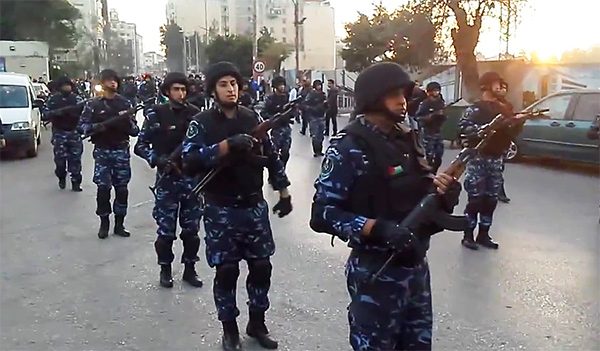
1143The Palestinian Authority police on parade, January 2015.

When three detainees die in less than a week in Palestinian detention, this should sound an alarm bell, especially among so-called pro-Palestinian groups and human rights activists in different parts of the world.

But these folks, like the UN and mainstream media, do not care about the human rights of the Palestinians if Israel cannot be held responsible. Their obsession with Israel has made them blind to the plight of Palestinians living under the Palestinian Authority and Hamas, as well as to the horrific crimes committed every day by Muslim terrorists in the Middle East and elsewhere.

The story of the three men who died in Palestinian jails is yet another example of the double standards that the international community and media employ when it comes to the Israeli-Palestinian conflict

How to insult a “progressive”

July 6, 2015

How to insult a “progressive,” Pat Condell via You Tube, July 6, 2015