Archive for the ‘Hamas’ category

Watch: Children on Hamas TV Say they Want to ‘Blow Up the Jews’

September 17, 2015

Watch: Children on Hamas TV Say they Want to ‘Blow Up the Jews,’ Elad Benari, September 17, 2015

Hamas is continuing to use its media to educate young children to carry out “jihad” against Jews.

The Middle East Media Research Institute (MEMRI) has exposed a clip from a children’s show on the Hamas-owned Al-Aqsa TV channel which shows young children, dressed in military fatigues, asked what they want to be when they grow up.

One of the children said that he wanted to be an engineer, “so that I can blow up the Jews.” Another recited a poem, “I shall liberate [Jerusalem] from the Jews by means of the Al-Qassam Brigades.”


MEMRI has in the past published several clips which show Arab youths vowing to fight “the occupation”.

A clip released by MEMRI earlier this year showed footage from a youth camp organized by Hamas’s so-called “military wing”, in which young cadets learn how to use weapons and simulate the kidnapping of an Israeli soldier.

A previous clip shows a televised graduation ceremony for a similar Hamas youth camp in Gaza. At the ceremony, suicide terror attacks against the “Zionist enemy” were glorified by Hamas officials.

Hamas has also in the past released a cartoon honoring its “military wing”.


Nuclear Jihad

September 7, 2015

Nuclear Jihad, Gatestone InstituteDenis MacEoin, September 7, 2015

    • In the year 628, Muhammad, now ruling in Medina, signed the ten-year Treaty of Hudaybiyyah with his long-time enemies, the tribal confederacy of Quraysh, who ruled Mecca. Twenty-two months later, under the pretext that a clan from a tribe allied with the Quraysh had squabbled with a tribe allied to the Muslims, Muhammad broke the treaty and attacked Mecca, conquering it. It is as certain as day follows night, that the Iranian regime will find a pretext to break the deal. Already, on September 3, the Supreme Leader Ayatollah Khamene’i made it clear that he would back out of the deal if sanctions were not completely removed at once.
    • The Iranian regime not only despises democracy; it considers all Western law, including international law, invalid.
    • The Shi’a consider themselves underdogs, who are willing to sacrifice all to establish the rights of their imams and their successors. That was what the 1979 revolution was all about, and it is what present the Iranian regime still insists on as the justification for its opposition to Western intrusion, democracy, women’s rights and all the rest, which are deemed by Iran’s leadership as part of a plot to undermine and control the expansion of the Shi’i faith on the global stage. These are not Anglican vicars.
    • The Iranian Army and the Islamic Revolutionary Guard Corps “have responsibility… for a religious mission, which is Holy War (Jihad) in the path of God and the struggle to extend the supremacy of God’s law in the world.” — Iran’s Constitution, Article “The Religious Army”.
    • A Third World War is already taking place. The Iran deal strengthens the hands of a regime that is the world’s terrorist state, a state that furthers jihad in many places because its clerical hierarchy considers itself uniquely empowered to order and promote holy war.
    • Obama’s trust in Khamene’i’s presumed fatwa of 2013, forbidding nuclear weapons, rests on the assumption that it even exists. It does not. Even if it did,fatwas are not permanent.
    • Why, then, is this deal going ahead at all? Why is one of the world’s most tyrannical regimes being rewarded for its intransigence, and especially for repeatedly violating the Non-Proliferation Treaty?

“[Some] analysts,” writes the historian and former Israeli Ambassador to the United States, Michael Oren, “claimed the president [Barack Obama] regarded Iran as an ascendant and logical power — unlike the feckless, disunited Arabs and those troublemaking Israelis — that could assist in resolving other regional conflicts. I first heard this theory at Georgetown back in 2008, in conversation with think tankers and former State Department officials. They also believed Iran’s radical Islam was merely an expression of interests and fears that the United States could with sufficient goodwill, meet and allay. … Iran, according to Obama was a pragmatic player with addressable interest. For Netanyahu, Iran was irrational, messianic, and genocidal – ‘worse,’ he said, ‘than fifty North Koreas.'”[1]

Since the signing of the deal at the UN, hot-tempered criticisms and defences have gone into overdrive in the political, journalistic, and diplomatic spheres. Acres have been written and are still being written about the deal, making it the hottest political potato of recent years. Expert analysts such as Omri Ceren and, more recently, Joel Rosenberg have cut through the deliberate obfuscation to show the extent of the dangers the deal presents to the Middle East, the United States, Israel, and the world.

The deal’s supporters insist that it will bring peace and calm to the region, while a host of denigrators — chief among them Israeli Prime Minister Binyamin Netanyahu — have exposed the enormous risks it entails. Already, a vast majority of American citizens are opposed to the deal.

Within the U.S. Congress, bipartisan opposition to the deal is high and mounting. Yet, on September 2, President Obama succeeded in winning over a 34th senator, enough that ultimate passage of the deal is a foregone conclusion. That does not, however, mean that the debate will end. In all likelihood, it will grow fiercer as time passes and true consequences become clearer to the public and politicians alike.

Recent revelations that the International Atomic Energy Agency (IAEA), which oversees nuclear developments worldwide, has agreed that only Iranians will be allowed to inspect the most controversial of Iran’s nuclear sites, have raised anxieties about proper monitoring of the deal. The military complex of Parchin, where Iran is suspected of work on nuclear weapons, will be closed to outside inspection, making it certain that, if Iran decides to cheat (something it has done before), it will be able to do so with impunity. Sanctions will not be re-imposed. And, as we shall see, cheating on the deal can be justified by the Iranians who could always refer to the practice of the prophet Muhammad with the Quraysh tribe in Mecca.

Obama, his Secretary of State John Kerry, and the entire US administration are not merely behind the deal, but almost fanatically so. Many argue that Obama is more interested in securing his “legacy” as the world’s greatest peacemaker (or war-creator, as the case may well turn out to be), the statesman par excellence who alone could bring the theocratic regime of Iran in from the cold and shower the Middle East with true balance in its troubled affairs.

To bring this about, Obama has had to diminish, if not leave totally open to obliteration, American support for Israel, the single country in the world most clearly exposed to a possible genocide should the Iran’s Islamic regime choose to exterminate it, as it has so often threatened to do.

Mahmoud Ahmadinejad’s words mellal-e Eslami bayad Esra’il-ra qal’ o qam’ kard – “the Islamic nations must exterminate Israel” — have been given renewed vigour now that it is highly likely that Iran, evading serious inspections by the IAEA, will soon possess the weapons to do just that.

Even if the treaty is a done deal, it is time to show yet another massive hole in the administration’s strategy. Already, Obama, Kerry and the tightly knit administration have shown themselves remarkably obdurate in turning a blind eye to the many concerns that surround the deal. At the end of the “sunset period,” if not sooner, Iran gets to have, legitimately, as many bombs as it likes. Other problems include breakout times; centrifuge production; centrifuge concealment; uranium enrichment by stealth; refusal to allow the IAEA to inspect military sites; the acquisition of intercontinental ballistic missiles — presumably to be used intercontinentally at guess who. It is no secret that the hardliners in Iran still speak of America as “The Great Satan” and consider it their enemy. That does not even include the implications of lifting sanctions on, and paying billions of dollars to, the world’s main sponsor of terrorism.

As Michael Oren has shown, however, the American president presumably thinks he is doing a deal with a logical and pragmatic regime. Barack Obama, an intelligent, well-read man of Muslim origin, knows almost nothing about Islam; that is the greatest flaw in the Iran deal he has fought so hard to inflict on the human race. With access to platoons of experts, to some of the greatest libraries with holdings in Islamic doctrines and history, and with the Mullahs and Iran’s public still daily promising to destroy America, Obama apparently still believes Islam is a religion of peace and that a theocratic, terror-supporting, medieval regime should have the power to make nuclear bombs. The obverse is that he might like, perhaps not wittingly, to see America, Israel and the West brought to their knees.

This author has previously exposed one aspect of Iran’s serious lack of logic, rationality, or pragmatism — namely the extent to which apocalyptic thinking, messianic prophecy, and dreams of Islamic transcendence through universal conflict pervade the clerical elite, a high percentage of the masses, and even the Islamic Revolutionary Guard Corps. One might assume that this would be especially true when they are flush with cash and nuclear weapons, and the risk to their own survival is substantially lower.

On August 17, just over a month after the signing of the nuclear deal, Iran’s Supreme Leader, ‘Ali Khamene’i, addressed a religious conference, where he expressed his undying hatred for the United States. He said, for example:

We must combat the plans of the arrogance [i.e. the West, led by the U.S.] with jihad for the sake of Allah. … jihad for the sake of God does not only mean military conflict, but also means cultural, economic, and political struggle. The clearest essence of jihad for the sake of God today is to identify the plots of the arrogance in the Islamic region, especially the sensitive and strategic West Asian region. The planning for the struggle against them should include both defense and offense.

The deal has done nothing whatever to stop military threats to Israel, an ally of the United States (though treated with disrespect by America’s president). Speaking on 2 September, the Islamic Revolutionary Guard Corp’s top commander in Tehran province, Brigadier General Mohsen Kazemayni, stated that, “… they [the US and the Zionists] should know that the Islamic Revolution will continue enhancing its preparedness until it overthrows Israel and liberates Palestine.”

There is a simple word for this: warmongering.

Why is the U.S. President insisting on a bad deal with a warmongering regime?

When a military force at its strongest fantasizes about the coming of a Messiah (the Twelfth Imam) to lead them to victory over all infidels, talk of logic, rationality and pragmatism seems acutely out of touch with reality.

Obama’s assumption that there is something solid about the Iranian regime that makes it suitable as a recipient for such largesse and the chance to enrich uranium until kingdom come seems to be based on false consciousness. The regime has been in place for almost forty years, quite a respectable time for a dictatorship. In part, that has been because it has mastered the art of suppression, giving its people a degree of freedom that is missing in several other Islamic countries, such as Saudi Arabia, Sudan, or Afghanistan. These partial freedoms, especially for young people, lull the population into risk-averseness, possibly helped along by the memory in 2009 of pleas for more freedom, which the United States ignored and the mullahs savaged.

Obama, in his ongoing attempt to portray Islam as benign — and a dictatorial regime as a sold basis for peace and understanding in the Middle East — ignores the religious element of the theocracy, as well as the sadistic repression, and in doing so misses a lot.

First of all, Shi’ite Islam is different from its Sunni big brother. It is deeply imbued with features largely absent from Sunni Islam. The most important Shi’i denomination is that of the Twelvers (Ithna’ ‘Ashariyya), who, from the beginning of Islam, have believed themselves to be not only the true version of the faith, but the group destined by God to rule in its name. Beginning with ‘Ali, the son-in-law of the Prophet and the fourth Caliph of the Sunnis, the Shi’a began as his supporters. (Please see the Appendix that follows this article: it contains material that even Barack Obama and his advisors need to know; without it, they simply will not “get” what the ayatollahs are about. It comes to an important conclusion that has considerable bearing on today’s events — and not the one you may expect.)

Beneath the smiles and banter lie the unsmiling masks and the taqiyya-flavoured lies. Beneath the wheeling and dealing and the refusals to compromise lies a sense of destiny for the regime, a belief that it stands on the brink of the realization of the centuries-old Shi’ite dream: that God will finally set his people on the pinnacle of the world and usher in the never-ending reign of the Imam Mahdi, with all injustice gone, the martyrs in paradise, the ayatollahs and mujtahids andmaraji’ in glory, and all the infidels in hell.

It is precisely because Barack Obama and his aides have never got down and dirty to take in hard information that they have remained utterly out of touch with the real springs and cogs of Iranian Shi’ite thinking.

Obama has, when all is said and done, let himself be deluded by the charm offensive of Hassan Rouhani and his henchman Javad Zarif. Obama may not believe in the mystical land of Hurqalyaor the white steed on which the Twelfth Imam will ride to the world’s last battle any more than you or I do. But the clerical elite of Iran, and those who follow them blindly — men and women brought up from birth on these tales, and who travel in the thousands every day to send a message to the Imam at the Jamkaran Mosque near Qom — believe these things with absolute devotion, and that is why this story matters, because it has political consequences.

Shi’i Muslim law enshrines jihad, holy war, as fully as does Sunni law. For Sunnis, jihad has always been possible under the authority of a Caliph, whether fought under his orders or led by kings and governors under his broad aegis.

The Shi’a, however, do not recognize the Caliphate and have often been the victims of Sunni jihads. They may feel impelled to fight a holy war, but under what authority could they do so?

The power of the clergy had waned under the anti-clerical reign of Iran’s Pahlavi dynasty (1925-1979), only to burst out more strongly than ever in the Islamic Revolution, which placed all authority in a new system of government: rule by a religious jurist, a faqih.[2] Overnight, a jihad state was brought into existence; a jihad state with vast oil reserves, modern military equipment, and, at first, the support of almost the entire Iranian population. The clerical hierarchy under Ayatollah Ruhollah Khomeini did not just intend to prepare the way for the coming of the Mahdi. They were now his earthly deputies, in whose hands lay life and death for millions.

The new Shi’ism allowed the clergy to take on powers they had never imagined. More and more economic and legal power came to be concentrated in the hands of a narrow body of scholars, and sometimes a single man could be the source of religious and legal authority for the entire Shi’i world — in Iran, Afghanistan, eastern Arabia, Bahrain, and so on. Thus were the foundations laid for the revolutionary rank of Supreme Leader, taken by the Ayatollahs Khomeini and Khamene’i.

Look for a moment at the preamble to the Constitution of the Islamic Republic of Iran.[3] You will see quickly that this does not read like any other constitution you have seen. The preamble sets the tone. Here, in an account of the circumstances leading to the revolution we read of the clergy as the ruhaniyyat-e mobarez, “the militant or fighting clergy.” These are not Anglican vicars at their prayers or rabbis studying Talmud. A mobarez is a warrior, a champion, a fighter. Not far down the preamble, one encounters a description of their struggle as “The Great Holy War,”jihad-e bozorg. We are not in Obama’s world of logical and pragmatic striving for political and diplomatic coherence. This is made even clearer in one of the constitution’s earlier articles, “The Religious Army.” Here, we read that the Iranian Army and the Islamic Revolutionary Guard Corps “have responsibility… for a religious mission, which is Holy War (Jihad) in the path of God, and the struggle to extend the supremacy of God’s law in the world.”

How do you reach a compromise and a pragmatic deal with a regime that thinks in this way? Are the U.S. administration and the P5+1 blind to something the Iranians have never even bothered to conceal? Do they really take everything in the talks at face value? Perhaps they think references to jihad and fighting clergy are nothing more than pious talk “for domestic consumption,” as they tried to explain — as real and everyday as the myths and legends of other faiths. If they do, then they have far less excuse for their blindness, for the Iranian regime is already at war and is already fighting its jihad.

In Iraq, for example, a country with a majority Twelver Shi’i population, Iranian-backed militias have been at war for many years, first against the Americans, then the Sunnis, and now the hordes of Islamic State. In June 2014, Grand Ayatollah al-Sayyid ‘Ali al-Husayni al-Sistani issued a fatwa calling on Iraqis to fight against Islamic State, justifying their fight as jihad wajib kafa’i: a Jihad that is compulsory for those who choose it, but not for the entire population. The ruling calls for a struggle against ISIS’s irhab – their “terrorism.” Jihad is a religious and legal duty, and even though ISIS may call its fighting jihad, it is here condemned as terror.

Hezbollah, created and backed by Iran, is by far the largest terrorist group in the region. Hezbollah is considered a state within a state, with forces and infrastructure inside Lebanon and Syria. It has used the name “Islamic Jihad Organization” to cover its attacks on Israeli forces in Lebanon. In its 1988 Open Letter (Risala maftuha), it describes its followers as “Combatants of the Holy War” and goes on — in terms similar to those in the Hamas Covenant — “our struggle will end only when this entity [Israel] is obliterated. We recognize no treaty with it, no cease fire, and no peace agreements, whether separate or consolidated.”

Hezbollah and its creator, the Iranian Islamic regime, have a curious link to the Palestinian terror movement, Hamas, despite Hamas being exclusively Sunni. By financing, arming, and defending Hamas, Iran is fighting a strange proxy jihad that serves its own purposes of defying the West, achieving regional hegemony, and winning praise from all Muslims in the world for its own war against Israel. It also furthers the goals of the Muslim Brotherhood (of which Hamas is the Palestinian branch) in the same struggle.

I have dragged you through the briars and mud because it is important here to see another culture through its own eyes. If we insist in pretending that Shi’i Muslims think like Sunni Muslims or, worse still, like Jews or Christians — if we brush all that history and all those doctrines under the carpet of “any deal is better than no deal ” — we will go on making the same mistakes. We will believe that a purely political and diplomatic enterprise to bring Iran in from the cold and create a new trading alliance will transform an evil regime into a land of sweetness and light.

Members of the U.S. Congress must wake up and examine, in however cursory a fashion, these views that motivate the Iranian leadership, and must stop pretending that they are as logical and pragmatic as would be convenient for the wishes of the West.

Not that Obama and Kerry have ever sounded logical or pragmatic in how they have approached this debate and this deal-making process. In an act of supreme folly, the White House has dismissed Ayatollah Khamene’i’s recent call for “Death to America;” they pretend it is just empty rhetoric for the Iranian people.

1169Left: Senior Iranian cleric Ayatollah Mohammad Ali Movahedi Kermani, speaking on July 17 in Tehran, behind a banner reading “We Will Trample Upon America” and “We defeat the United States.” Right: Iran’s Supreme Leader, Ali Khamenei, proclaims “Death to America” on March 2

We are walking with a blindfold toward sure disaster. Forget the dreams of a Messiah if you will, but do not for one moment let yourself be lulled into thinking that only ISIS is serious about waging a jihad.

Despite their oft-expressed delusion that “Islam is a religion of peace,” President Obama, Secretary John Kerry and other leaders are, like it or not, already engaged in a war against jihad. They have already fought it in Afghanistan, Iraq, Libya and elsewhere. However much Obama wants to stand off from involvement in the jihad struggles of the Middle East, he cannot: Western states are fighting jihad, sometimes abroad, increasingly at home.

A Third World War is already taking place, a war the Islamists and Islamic states understand, but which many in the West still refuse to grasp. They are not even willing to respect the true motivations of the enemies against whom they fight. The Iran deal strengthens the hands of a regime that is the world’s terrorist state, a state that furthers jihad in many places because its clerical hierarchy considers itself uniquely empowered to order and promote holy war.

Let us for the moment ignore the nuclear aspect of this deal and look instead on what it offers the world’s leading jihad state. The removal of sanctions coupled with the business deals Europeans and others are rushing to secure, the delivery of perhaps $150 billion to Tehran, and the turning of many blind eyes to both Iran’s internal repression and its jihad wars in Iraq, Syria, Yemen, Gaza, and Lebanon leave the ayatollahs poised to dominate much of the Middle East.

And that is not all. Obama’s belief in the stability of the Iranian regime seems to rest on its endurance since 1979. His trust in Khamene’i’s presumed fatwa of 2013, forbidding nuclear weapons rests on the assumption that it even exists. It does not. No one has ever seen it. Even if the fatwa did exist, fatwas are not permanent. They are always regarded as temporary rulings with Twelver Shi’ism. This is a crucial technical point that the White House seems incapable of — or ill-disposed to — grasping.

Further, Obama’s faith in Iranian President Hassan Rouhani as a reformer and moderate flies in the face of Rouhani’s devotion to the hardline clerical leadership of which he is a part. Here are a few facts:

  • ‘Ali Khamene’i is 76 years old, but his health is poor and he may not live much longer. Already, factions within the hierarchy will be jostling for the Supreme Leadership.
  • In the Usuli Twelver version of Shi’ism, once a Mujtahid dies, his fatwas are no longer valid. A new Mujtahid or, in this case, a new Supreme Leader, has to issue fatwas of his own. A new fatwa may confirm an old one or radically differ from it.
  • A new Supreme Leader is an unpredictable personality.
  • The Iranian nuclear program is already up and running.
  • The breakout time for weapons grade materials may be as short as three months.
  • Iran already has and is acquiring ballistic missiles with an intercontinental range.
  • Jihad is hard-wired into the regime’s philosophy.
  • Iran is already conducting a series of jihad wars abroad.
  • Mahmoud Ahmadinejad has expressed a hope to return to the presidency in 2017. Ahmadinejad and his clique are bent on apocalyptic outcomes and actions to bring the Hidden Imam back to this world.

We only have to get this wrong once. Chants of “Death to America” and “Death to Israel” are not narcotic iterations of slogans but sincerely felt expressions of intent.

Khamene’i last month praised the Iranian people for calling for the deaths of the USA and Israel, and said that he hoped God would answer their prayers because in at most ten years, the Iranian mullahs and their IRGC will possess the power to exterminate Israel, if they and their God so wish.

Why, then, is this deal going ahead at all?

Why are sanctions against the world’s leading exporter of jihadi terrorism being lifted, not strengthened?

Why is one of the world’s most tyrannical regimes being rewarded for its intransigence, and especially for repeatedly violating the Non-Proliferation Treaty?

Why has Israel’s Prime Minister been vilified and sidelined simply for drawing attention to the weaknesses of a deal that could lead to the death of all of his people?

Why have the P5+1 never taken seriously the Shi’ite rule that it is permitted to lie to infidels and conceal one’s own true intentions?

Why are secrets being kept — such as the contents of the two side-deals?

Why is the U.S. Congress being asked to vote without the benefit of full disclosure?

Why is the IAEA banned from spontaneously inspecting only declared Iranian nuclear sites, and why are military sites completely off-limits?

The questions are so many and so critical that we remain in the dark about where this will lead mankind. No one who has ever done a financial or political deal would ever sign on the dotted line until they had answers to all their questions. Far more hangs on this deal than perhaps any deal in history. Yet those who want to make it enforceable under international law are uninformed about the most basic contents of the deal, as well as the beliefs and historical roots of their enemy.

Such folly is almost without precedence, except possibly in the process of appeasement that endeavoured to placate the Third Reich and treat Adolf Hitler as the best friend of democracy.

The Iranian regime not only despises democracy, it considers all Western law — including international law — invalid. This view has several deep roots. For both Sunni and Shi’i Muslims, only rule under God is valid, under a Caliph or a clerical theocracy under a Supreme Ruler. Human beings have no right to interfere. Democracy leads to the making of human laws that may contradict shari’a law, and such effrontery is considered arrogant and presumptuous. The democratic elements in Iran are tightly controlled, and supremacy rests in all areas beneath clerical authority. The same principle applies to international law, UN resolutions, treaties and so forth.

Iran has openly genocidal intent, as well as a devotion to holy war that goes to the very deepest level.

Before we leave the subject of jihad, there is one other factor that everyone has overlooked. It is the Treaty of Hudaybiyyah, the most important agreement in early Islamic history. In the year 628, Muhammad, now ruling in Medina, signed the ten-year Treaty of Hudaybiyyah with his long-time enemies, the tribal confederacy of Quraysh, who ruled Mecca. Twenty-two months later, under the pretext that a clan from a tribe allied with the Quraysh had squabbled with a tribe allied to the Muslims, Muhammad broke the treaty and attacked Mecca, conquering it.

What is important about this is that Muhammad had made the treaty while he was still relatively weak. But in the months after signing it, his alliances and growing conversions meant that he now possessed superior military strength — and that was when he pounced.

In 1994, the treaty became crucial to the issue of peace between Israel and the Palestinians.[4]In September 1993, Palestinian leader Yassir Arafat signed the Oslo Accords along with Israeli Prime Minister Yitzhak Rabin, and the following year the two leaders were awarded the Nobel Peace Prize.

However, even as he awaited that prize, Arafat spoke at a mosque in Johannesburg alluded to the Treaty of Hudaybiyyah and referred to “a jihad to liberate Jerusalem”: “I see this agreement,” he said, “as being no more than the agreement signed between our Prophet Muhammad and the Quraysh in Mecca.”

Non-Muslims may well have misunderstood this as a reference to some early Muslim peace-making. But Arafat made his meaning clear: “We now accept the peace agreement, but [only in order] to continue on the road to Jerusalem.”[5]

The nuclear deal that President Obama and his supporters have imposed will strengthen Iran considerably, removing sanctions and delivering perhaps $150 billion to the country. It is as certain as day follows night, that the Iranian regime will find a pretext to break the deal. Already, on September 3, the Supreme Leader Ayatollah Khamene’i made it clear that he would back out of the deal if sanctions were not completely removed at once.

Whatever happens in the days ahead, the U.S. Congress, backed by a majority of the American public, needs to strike this madcap deal down before it wreaks a storm of tribulations on everyone.

Denis MacEoin has a PhD (Cambridge 1979) in Persian Studies and has written widely on Iran and its religious beliefs.

Appendix

‘Ali became the first in a line of twelve imams, all deemed the true leaders of Islam, but all denied their right to rule and all but one assassinated (or so it is claimed) by the Sunni Caliphs. From this comes the Shi’i sense of suffering, injustice, oppression by despots, neglect and rights — all of which played an important part in the 1979 revolution and continue to play out across society.

The Shi’a are the underdogs who are willing to sacrifice all to establish the rights of their imams and their successors. That was what the 1979 evolution was all about, and it is what present the regime still insists on as the justification for its opposition to Western intrusion, democracy, women’s rights and all the rest, which are deemed by Iran’s leadership as part of a plot to undermine and control the expansion of the Shi’i faith on the global stage.

The twelfth imam, according to Shi’ite legend, was a young boy, Muhammad al-Mahdi, the son of the murdered eleventh imam. Born in 869 in the Iraqi city of Samarra during the reign of the Sunni Abbasid Caliphate, his father, Hasan al-‘Askari, died when Muhammad was born.

It is said that young Muhammad, in order to avoid his enemies, went into something called Occultation (ghayba). Even if this originally was physical, he was never seen alive again and is supposed to have entered the celestial realm of Hurqalya, from which he will one day return as the promised Saviour, the Qa’im bi’l-Sayf, the One Who will Arise with the Sword to do battle with injustice and infidelity.

This belief is what waters modern Shi’i apocalypticism, something promoted intensely by former president Mahmoud Ahmadinejad. This expectation has considerable significance for Iran’s drive to nuclear power. But that is not why I raise the issue here. There is another, more mundane, aspect to the Imam’s disappearance and continued Occultation, and it may be even more relevant to the matters at hand.

The answer to what authority they could fight under was that only the Imam in each generation could order or lead jihad. But when the twelfth Imam vanished from human sight, was jihad to remain in abeyance until his return or could it be fought under another authority? The answer was not at first simple, but one thing started to happen: the Shi’a began to consider their religious scholars to be the intermediaries with the Imam, and this laid the basis for the possibility that they might have the right to order jihad. For some time, this was just conjectural, for the Shi’a had little worldly power.

In 1501, a new dynasty, the Safavids, came to power in Iran, forced most of the population to convert to Shi’ism, and created a line of kings under whom the clerical class became more and more powerful. The Shah could still lead jihad, but the clergy were needed to give permission. The Safavid dynasty lasted till 1722, and an interregnum was followed by the emergence of a new line of Shahs, the Qajars, who ruled from 1796 to 1925.

Under the Qajars, the Shi’i clerical hierarchy underwent deep and lasting changes, producing today’s version of Twelver Islam, the Usulis.

The newly powerful ‘ulama of the 19th century took on the mantle of deputies for the Hidden Imam and ordered jihads in 1809 and 1826 (against Russia), 1836, 1843, and 1856-7 (against the British). In 1914, when the British occupied Iraq at the start of World War I, the Shi’i clergy in the shrine centres there declared jihad to reinforce the call for Holy War by the Ottoman empire.

__________________________________

[1] Ally by Michael Oren

[2] As in Khomeini’s theory and book, Velayat-e Faqih, the Custodianship of the Jurisprudent.

[3] Here in English, here in Persian.

[4] For a detailed discussion of the treaty and its implications for making peace with Muslims, see Daniel Pipes, “Lessons from the Prophet Muhammad’s Diplomacy,” The Middle East Quarterly, September 1999, pp. 65-72.

[5] Natasha Singer, “Arafat Text Raises Ire,” Forward, May 27, 1994.

The Fiction of Political Islam

September 2, 2015

The Fiction of Political Islam, The Gatestone InstituteBassam Tawil, September 2, 2015

  • To this day, the Obama administration mourns the fall of Egypt’s Islamist President Morsi, and turns a cold shoulder to forward-looking President el-Sisi, who is (sometimes) trying to take Egypt into the 21st century and extricate Egypt from its economic and societal crisis.
  • Muslim Brotherhood terrorism against the Egyptian regime is a perfect example of how this “political movement” is in reality a terrorist movement whose objective is the violent overthrow of Egypt’s government. The White House, fully aware of the facts, continues hosting senior Muslim Brotherhood officials and shows them respect during consultations about the American Islamic community and U.S. policy in the Middle East.
  • Events in Sinai prove there is no such thing as “political Islam.” There is a radical Islamist leadership that represents itself to the gullible West as “moderate,” preaches violence from mosques, cloaks itself in ideological-religious tradition, and employs Islamist terrorists to attack civilians and Egyptian government targets.
  • It is hard not to conclude, looking at President Obama’s record (ignoring protesters of 2009 in Iran; “I’ve got a pen, and I’ve got a phone”; the dictatorial way the Iran deal is bypassing the democratic process) that in his heart-of-hearts, he is far more committed to supporting extremist Islamist regimes — whether the mullahs of Iran or the Muslim Brotherhood — than to supporting democracy, individual freedoms or human rights.
  • The Europeans are more aware of the situation but woke up too late. As hundreds of thousands of migrants from Muslim lands continue to pour over Europe’s open borders, there is little doubt that radical Islam is poised to take over the West. Islamic communities and terrorist cells continue to mushroom throughout the cities of Europe.
  • The world is beginning to understand that the catastrophes of the Middle East have nothing to do with the resolution of the Palestinian issue but are caused by the innate homicidal tendencies of the Arab rulers and the regional Islamist terrorist organizations.

Hamas is in trouble. Its relations with Egypt are going from bad to worse, and the influx of money, primarily from Qatar, Saudi Arabia and the mosques in the Western world — where charity (zakat) was collected to finance anti-Israel terrorism — has dwindled to almost nothing. So has the flow of arms and explosives from Iran, Libya, Sudan and Lebanon. The resulted is the weakening of Hamas rule in the Gaza Strip, making it ever more difficult for Hamas to continue its ongoing subversion of the Palestinian Authority (PA) in the West Bank and its non-stop attempts to overthrow President Mahmoud Abbas to take over the West Bank and establish there the sort of Islamic emirate it established in the Gaza Strip.

Hamas’s military buildup was halted when the President Mohamed Morsi’s radical Muslim Brotherhood regime in Egypt was toppled and General Abdel Fattah el-Sisi was elected President. Morsi, it will be recalled, strangely received support from President Obama until he was ousted. The Obama administration supported him despite Morsi enabling for the flow of money and arms to Hamas in Gaza to continue unhampered through the tunnels in the Sinai Peninsula. The weapons were used not only to attack Israel, but also to sabotage peace talks between Israel and the Palestinians and, indirectly, to attack the Palestinian Authority.

The Islamist terrorism festivities ended when President el-Sisi clamped down on the Islamists in Egypt, destroyed the tunnels and sealed Egypt’s border with Gaza. Since el-Sisi has been president of Egypt, Muslim Brotherhood rule has ended and the tunnels have been destroyed. It is hard to fathom why, to this day, the Obama administration mourns the fall of the Islamist Morsi administration and turns a cold shoulder to forward-looking el-Sisi, who is (sometimes) trying to take Egypt into the 21st century and extricate Egypt from its economic and societal crisis.

Since el-Sisi has been in power, money and arms no longer flow through the tunnels into the Gaza Strip; instead they began to flow in the opposite direction, from the Gaza Strip into Egypt’s Sinai Peninsula. Since the Muslim Brotherhood and its affiliated terrorist organizations, Hamas among them, have not accepted defeat, there has been an increase in terrorist attacks targeting the Egyptian regime both inside the country proper and in the Sinai Peninsula. The terrorist campaign receives ongoing support from the Izz al-Din al-Qassam Brigades, Hamas’ military-terrorist wing, and the ISIS-affiliated Ansar Bayt al-Maqdis. Both continuously attack the Egyptian police and army in the Sinai Peninsula, murder Egyptian officials and target Egyptian institutions.

The endless terrorist campaign in Egypt has proven yet again that the claim of a political Islam, separate from the terrorist organizations, is simply a lie. Muslim Brotherhood terrorism against the Egyptian regime is a perfect example of how the “political movement” tries to represent itself as dealing only with the da’wah [proselytizing], while in reality it is a terrorist movement whose objective is the violent overthrow of el-Sisi’s administration. The White House, fully aware of the facts, continues hosting senior Muslim Brotherhood officials and shows them respect during consultations about the American Islamic community and U.S. policy in the Middle East.

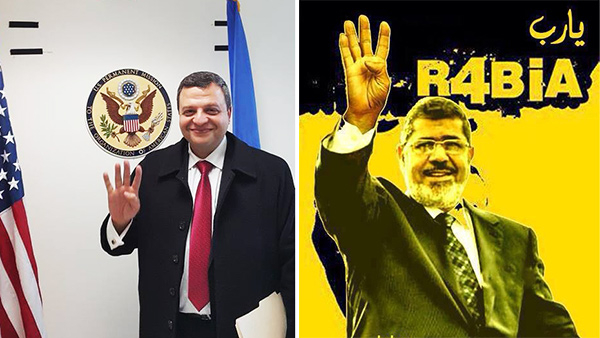
919 (1)While being hosted by the State Department on a visit to Washington in January 2015, Muslim Brotherhood judge Waleed Sharaby (left) flashed the organization’s four-finger “Rabia” sign. At right, ousted Egyptian President Mohamed Morsi (from the Muslim Brotherhood) displays the Rabia sign.

The events in the Sinai Peninsula prove there is no such thing as “political Islam.” There is a radical Islamist leadership that represents itself to the gullible West as “moderate,” preaches violence from the mosques, cloaks itself in ideological-religious tradition, and employs a hard core of Islamist terrorists to carry out attacks on civilians and Egyptian administration targets.

In the meantime, the real victims are the Egyptians. The Muslim Brotherhood’s terrorism has paralyzed Egypt’s tourist industry, as foreigners fear to visit Egypt’s antiquities. And now there are terrorist threats to the New Suez Canal, a project initiated and carried out under the leadership of General Sisi to turn both banks of the two canals into an international logistics, commercial and industrial area.

The Islamists’ plans are clear. First, they want to leverage violence, murder and countless Egyptian army casualties into establishing an autonomous terrorist enclave in the Sinai Peninsula. Then they will try to overthrow the Egyptian government and reinstate an Islamist Muslim Brotherhood regime headed by Morsi. That is exactly what their offshoot, Hamas, did in the Gaza Strip when it liquidated Palestinian Authority officials and established an Islamic emirate. The writing on the wall is still illegible as far as the U.S. government is concerned. Or else the Obama administration is still in the thrall of extremist Islam and its Muslim Brotherhood leaders. The two main ones are Turkey’s Recep Tayyip Erdogan, who has just called new elections so that he can try again to acquire enough seats in parliament to amend Turkey’s constitution to award himself a one-man Sultanate, an absolute dictatorship-for-life to go along with his new palace. The other is Mohamed Morsi, whom Obama apparently is still backing.

It is hard not to conclude, looking at the U.S. president’s record (ignoring the protesters of 2009 in Iran; “I’ve got a pen, and I’ve got a phone” and the dictatorial way the Iran deal has been short-circuited to bypass the democratic process) that in his heart-of-hearts, he is far more committed to supporting extremist Islamist regimes — whether the mullahs of Iran or the Muslim Brotherhood — than to supporting democracy, individual freedoms or human rights.

The Europeans are more aware of the situation but unfortunately woke up too late. As hundreds of thousands of migrants from Muslim lands continue to pour over Europe’s open borders, there is little doubt that radical Islam is poised to take over the West. Islamic communities and terrorist cells continue to mushroom and gather strength throughout the cities of Europe.

From the beginning of the wave of attacks in Egypt, senior Egyptian security officials threatened Hamas. Egypt warned Hamas to stop training, arming and sending its terrorists to collaborate with ISIS operatives in attacks against the Egyptian army. Hamas steadfastly denies any involvement, even as it continues collaborating with ISIS against Egypt.

As far as Hamas is concerned, destroying the Egyptian army is essential, because its continued actions along the Rafah border and in Sheikh Zuweid in the northern Sinai Peninsula prevent Hamas from acquiring money and stockpiling weapons to fight Israel, which weakens its subversion against Mahmoud Abbas and its plans to take over the West Bank.

Despite profuse denials, at the end of August 2015, four operatives from Hamas’s military-terrorist wing, the Izz al-Din al-Qassam Brigades, were taken off a bus by armed Egyptians on the way from Rafah through the Sinai Peninsula to Cairo. Hamas immediately accused Israeli intelligence of responsibility and warned the Egyptian authorities that “the abduction of its operatives will not go unpunished.”

In response, Dina Ramez, a co-host on Egypt’s official TV station, called Hamas out on its lies and denials of its terrorist activities in the Sinai Peninsula against the Egyptian regime. She asked Hamas, “If you are not involved in terrorism, what were your senior Izz al-Din al-Qassam Brigades operatives doing in Sinai?” and called them “cockroaches.”

Sources in Hamas called her a “whore,” and called Egypt a loser country defeated by Israel, using a peace treaty to sell Palestine to the enemy. Was that really the way to thank Egypt for everything it has done for the Palestinians, sacrificing its army and soldiers for us? It is a sad situation for the Palestinians and for our leadership.

What have we Palestinians gained from Hamas’s military actions against Egypt? What have we gained from our solidarity with Islamist organizations fighting against Assad in Syria, or joining organizations such as the “Palestinian Liberation Army” fighting for Assad? Why are we killing each other in the Ain al-Hilweh refugee camp? Why do we refuse everything the Israelis offer us?

Anyone who remembers history remembers the ungrateful path trodden by the Palestinians against the Kingdom of Jordan, when our leaders, headed by Arafat, tried in 1970 to overthrow King Hussein, despite the refuge Jordan offered us during the catastrophes of the Nakba in 1948 and the Naksa in 1967. Then we did the same thing in Lebanon, to where we fled from Jordan. The PLO relocated its headquarters to Beirut, and went on to turn Lebanon into a terrorist country and the lives of the Lebanese into a nightmare. If the Israelis had not invaded Lebanon in 1982, and forced the PLO to relocate to Tunisia (where its behavior was also criminal), the Palestinians definitely would have destroyed Lebanon.

The Middle East is in chaos, and Palestinian factionalism and ingratitude continue to inflame the dissolution of the Arab states and the internal Palestinian division between Hamas in Gaza and the Palestinian Authority in the West Bank.

The world is beginning to understand that the catastrophes of the Middle East have nothing to do with the resolution of the Palestinian issue, but are caused by the innate homicidal tendencies of the Arab rulers and the regional Islamist terrorist organizations.

The only person left who believes the Israeli-Palestinian nonsense is President Barack Obama, even though he is witness to the murders, rapes, beheadings and the millions of refugees, next to which the Palestinian issue is an old, irrelevant and very tired joke.

Rocket from Gaza follows IDF-Palestinian clash in West Bank town of Jenin

September 1, 2015

Rocket from Gaza follows IDF-Palestinian clash in West Bank town of Jenin, DEBKAfile, September 1, 2015

Palestinian rocket fire from the Gaza Strip put southern Israel on red alert before dawn Tuesday. Sept 1 in the wake of a major clash that erupted in the West Bank refugee camp of Jenin Sunday night. The circumstances of that episode are not entirely clear. Israel playing the Jenin encounter down, whereas the Palestinians are presenting it as “the biggest battle of the third initifada.” An Israeli soldier and five Palestinians were injured.

It began, DEBKAfile’s military sources report, when a large combined force of the IDF, Shin Bet and Police Special Operations, riding in dozens of vehicles, entered the Jenin camp Monday night to round up Islamic Jihad and Hamas terrorist suspects. In the Al-Hadaf district, they surrounded the homes of Bassam Al-Saeedi, reputed Jihad chief on the West Bank, and Majdi Abu al-Hejja, a local Hamas military arm operative.

At some point, Israeli rocket fire badly damaged Al-Saeedi’s house.

The IDF sources say it was a single small rocket, without explaining why it was fired. The IDF spokesman first reported “a heavy exchange of fire” around the building. Early Monday, the word “heavy” was dropped from the briefing to reporters and finally, there was no reference to any exchange of fire at all.

The Palestinians claim that the Jihad leader was not at home at the time of the raid and so escaped his pursuers.  But there is no word on either side about the fate of any occupants of building and whether any were killed.

Did the IDF decide to knock the building down in response to gunfire coming out of it? Or was it a warning to the Islamic Jihad and other Palestinian terrorist groups to halt their latest spate of violence or lose their homes?

Another mystery is how Bassam Al-Saeedi came to be away from home, confounding the information reaching the Shin Bet? Did he get a tip-off of the impending Israeli raid for his arrest?

If armed Palestinian groups on the West Bank have taken to posting spotters outside their areas to forewarn them of approaching Israeli forces, this would ratchet up their operational tactics to the military level observed by fellow Hamas and the Islamic Jihad groups in the Gaza Strip.

While Bassam Al-Saheedi escaped arrest, the Hamas operative Majdi Abu al-Hejja and his brother were captured and taken away for interrogation.

In weighing in heavily for a preventive detention operation against suspected terrorist leaders Sunday night, Israeli security chiefs were almost certainly acting on a decision to avert any possible terrorist action for  disrupting the opening of the school year Monday, Sept. 1. The level of Palestinian violence on and from the West Bank and Jerusalem has risen sharply in recent weeks.

Thirteen years ago, at the peak of the Palestinians’ Second intifada, Israel launched a major assault on the Jenin refugee camp. Thirteen Israeli soldiers were lost in this major battle on April 5, 2002. Since then, the refugee camp has claimed to hold the flag of armed Palestinian resistance to Israel and its army. Security forces arriving there to detain suspects routinely come under a hail of rocks and firebombs. However, the current clash of arms represented a sharp escalation in the Israeli-Palestinian confrontation on the West Bank.

Dividing the Arabs: America and Europe’s Double Game

August 29, 2015

Dividing the Arabs: America and Europe’s Double Game, The Gatestone InstituteBassam Tawil, August 29, 2015

  • Iran is on its way in a few years to having nuclear weapons capability. The breakout time, according to President Obama, would effectively be “zero.” Iran could then make as many bombs as it would like, along with intercontinental ballistic missiles to delver them to major American cities, directly from Iran, from South America, or — making identification and retaliation impossible — from submarines submerged off the U.S. coast.
  • Obama with one hand allows Iran to glide to nuclear capability and encourage the Muslim Brotherhood and similar Islamist terrorist organizations such as the Islamic State in the Sinai Peninsula — while with the other hand, he claims to support Israel.
  • Qatar’s role is duplicitous. It plays host to U.S. military bases at the same time that it funds and supports ISIS.
  • Hamas, since last year’s war, has chosen to use its scant resources to rebuild its kidnapping tunnels and war capability, instead of developing businesses and turning the Gaza Strip into a magnificent Arab Riviera, as Dubai has become. Hamas’s failure does not come from a lack of resources; it comes from a deliberate choice of how to use them.
  • The Iranians, in opposing American policy, which is a tissue of amateur plans and plots, are flexible and exploit Islam’s taqiyya [dissimulation] — religious approval to lie in the cause of Allah and to further Islam. However, they are not even bothering with that, they are telling the truth: “Death to America; Death to Israel.”

The United States is playing a double game in the Middle East: empowering Shiite Iran, while at the same time enabling Sunni ISIS to overthrow the moderate Arab regimes, as if to stop Iran.

The Americans are well aware that the Sunni Arab countries around Iran will now have to arm themselves to the teeth, thereby gutting the Nuclear Non-Proliferation Treaty (NPT).

America, despite its power and the image it projects of working against ISIS in Iraq, does not touch ISIS in its real headquarters, Syria, where ISIS actually could actually be hurt. So nothing really changes, and both Iran and ISIS continue to strengthen.

Even as the members the UN Security Council, eager do business with Iran, voted to allow Iran to build nuclear weapons, the Iranians continue to fund Hezbollah, Hamas and the Palestinian Islamic Jihad in the Gaza Strip — all Iranian proxies — in order to split the Arab ranks.

In other words, the hypocritical Obama administration, in backing the Iranians, keeps trying to sabotage the Arabs and provoke dissension.

The U.S. “divide-and-conquer” policy can also be seen in America’s ongoing support for Turkey and Qatar, both loyal to the Muslim Brotherhood. Turkey and Qatar, however, do nothing but foment incitement and support terrorist organizations. Both countries have totally abandoned the real existential interest of the Arab nation: its historic battle against Iran.

Qatar’s role is duplicitous. It plays host to U.S. military bases at the same time that it funds and supports ISIS, which is working against the West and against moderate Arab regimes.

The worst, however, is Turkey, which supports ISIS — the enemy of the West — despite Turkey being a member of NATO. Turkey also expends inordinate efforts at retaining its control of occupied Cyprus. Above all, its hypocrisy is scandalous. While it claims to care about the independence and human rights of the Palestinians, Turkey is really nothing but a radical Islamist country now denying independence and human rights to its own Kurdish citizens. At the same time, it supports Hamas and Iran in their effort to crush the unity of the Palestinian Authority (PA) and the PLO as the only legitimate representatives of the Palestinian people.

Turkey, like many other nations, including the countries that negotiated with Iran, is just waiting for the sanctions to be lifted from Iran, so that its dubious military and economic relations with the Mullahs will finally be acceptable.

Turkey and Qatar have also divided the Sunni Islamic camp and fragmented the Arab ranks. Both countries give the Palestinians political support, the deluded hope of “return,” and funding that is used for rebuilding Hamas’s military capabilities and kidnapping tunnels.

It is both folly and underhandedness for the United States to provide these countries with even a tattered umbrella of military aid.

Not only the U.S. but Europe, which supports Iran, would like to see Hamas — a terrorist offshoot of the Muslim Brotherhood — become stronger at the expense of the Palestinian people.

Europe would like to empower Hamas even further by handing it diplomatic and political support. There are rumors that the UN is planning to grant Hamas observer status in the General Assembly, as it did the Palestinian Authority.

We all know that the issue of Palestine could have been resolved long ago by establishing a demilitarized Palestinian state next to Israel, and giving the descendants of the original Palestinian refugees living in the Arab states full citizenship. But the manipulations employed by the Europeans and Americans deliberately perpetuate the Palestinian issue by using “good cop – bad cop” tactics. (Emphasis added. — DM)

Europe and the U.S. whitewash not only Hamas’s threats to Israel, but also, more importantly, its deadly subversion of Palestinian Authority. Both Europe and America totally disregard Hamas’s planned coup against PA leader Mahmoud Abbas last year, Hamas’s war crimes in the Gaza Strip, and the unspeakable treatment of its own people at home. Only one year ago, Hamas was murdering its own citizens extra-judicially, and ordering them to be cannon fodder for the benefit of international television crews.

Hamas, since then, has chosen to use its scant resources to rebuild its kidnapping tunnels and war capability, instead of to develop businesses and turn the Gaza Strip into a magnificent Arab Riviera, as Dubai has become. Hamas’s failure does not come from a lack of resources; it comes from a deliberate choice of how to use them.

Hamas and Palestinian Islamic Jihad are now operating against Egypt and Israel not only from the Gaza Strip, but from the Sinai Peninsula as well. Thus, in addition to allowing Iran to sail to nuclear weapons capability, President Obama encourages the Muslim Brotherhood and other Islamist terrorist organizations such as the Islamic State in the Sinai Peninsula with one hand, while with the other hand he claims to support Israel.

After all is said and done, if we Arabs had joined ranks — even temporarily and even with Israel — we could have long ago put a stop to Iran’s plans for expansion.

But because of our own shortsightedness, we waited too long and now the Iranians have established footholds in the Arabian Gulf and the Red Sea, and are increasing their control of Arab states such as Iraq, Syria, Lebanon and Yemen.

Iran is on its way in a few years to having nuclear weapons capability. The breakout time, according to President Obama, would effectively be “zero.” Iran could then make as many bombs as it would like, along with intercontinental ballistic missiles to delver them to the major cities of the “Great Satan,” the United States, directly from Iran, from South America, or — making identification and retaliation impossible — from submarines submerged off the U.S. coast.

The Iranians, in opposing American policy, which is a tissue of amateur plans and plots, are flexible and exploit Islam’s taqiyya [dissimulation] — religious approval to lie in the cause of Allah and to further Islam. However, they are not even bothering with that, they are telling the truth: “Death to America; Death to Israel.”

1225U.S. President Barack Obama (left). Iranian President Hassan Rouhani (right).

By this point, near the end of the process of Sunni Muslim self-destruction, a large part of the Arabs’ energy has been wasted on internal wars and the misallocation of resources to the barren, useless confrontation with Israel, even while many Arab states secretly collaborate with the Zionists.

All that will be left for the Arabs will be to continue to argue among themselves and with the Israelis about the Palestinian issue. We should instead stop the distractions and the wounds we are inflicting upon ourselves, and put the Palestinian problem behind us by granting equal rights and citizenship to Palestinians residing in Arab countries, in order to shift our focus totally, if belatedly, to the real battle: The Islamic Republic of Iran.

Egypt and the Hamas “Cockroaches”

August 26, 2015

Egypt and the Hamas “Cockroaches,” The Gatestone InstituteKhaled Abu Toameh, August 26, 2015

  • “What were your four [Hamas] men doing in Sinai? Haven’t you denied in the past the presence of any Hamas men in Sinai? So where did these men pop up from?” — Dina Ramez, Egyptian journalist.
  • The incident also proves that Hamas does not hesitate to take advantage of Cairo’s humanitarian gestures to smuggle its men out of the Gaza Strip. Obviously, the four Hamas men were not on their way to receive medical treatment. That they are members of Hamas’s armed wing, Ezaddin al-Qassam, speaks for itself.
  • The Egyptians are particularly fed up with reports about Hamas’s increased involvement in their internal affairs and links to terror groups in Sinai.
  • This practice by Hamas is something that the Egyptian authorities have come to understand, which is why they are refusing to reopen the Rafah border crossing between Gaza and Egypt. The question now is whether the international community will understand Hamas’s true intentions and plans — namely to prepare for another war against Israel.

Egypt’s President Abdel Fatah Sisi has once again proven that he and his country will not tolerate any threats from Hamas or other Palestinians.

The crisis that erupted between Sisi’s regime and Hamas after the removal from power of Muslim Brotherhood President Mohamed Morsi two years ago, reached it peak in the past few days with the kidnapping of four Hamas operatives in Sinai.

The four men were snatched from a bus shortly after crossing from the Gaza Strip into Egyptian territory on August 19. Reports said that unidentified gunmen stopped the bus and kidnapped the four Hamas men, who are wanted by Egypt for their involvement in terrorism.

1222A bus carrying Palestinians drives through the Rafah crossing, from the Gaza Strip to Egyptian Sinai, on August 23, 2015. (Image source: Aqsatv video screenshot)

Although initial reports suggested that the kidnappers belonged to a salafi-jihadi group based in Sinai, some Hamas officials have accused Egyptian security forces of being behind the abduction. The Hamas officials even issued veiled threats against Sisi and the Egyptian authorities, and said that they held them fully responsible for the safety of the Hamas men.

A statement issued by Hamas warned the Egyptian authorities against harming the four men. “These men were the victims of deception and their only fault is that they are from the Gaza Strip,” the statement said. “This incident shows that the criminals are not afraid to target our people.”

Hamas leader Musa Abu Marzouk said that his movement holds the Egyptian authorities fully responsible for any harm caused to the abductees. He said that the kidnapping raises many questions and its circumstances remain unclear.

Hamas claims that salafi-jihadi groups in Sinai have informed its representatives that they did not kidnap the four men. According to Hamas officials, the abduction took place near the border with the Gaza Strip — an area where the Egyptian army maintains a large presence.

Sources in the Gaza Strip, however, have confirmed that the four men belong to Hamas’s armed wing, Ezaddin al-Qassam. The sources said that the men were apparently on their way to Iran for military training. The sources pointed out that the four had received permission from the Egyptian authorities to leave the Gaza Strip through the Rafah border crossing. The visas, however, are supposedly for civilians, not for Hamas operatives.

Hamas’s threats against Egypt have, meanwhile, enraged the Egyptian authorities as well as some top journalists in Cairo.

Egyptian authorities responded by refusing to give permission to Hamas leader Ismail Haniyeh and some leaders of his movement to travel to Qatar and Lebanon through the Rafah border crossing. The Hamas leaders were hoping to hold talks with some of their colleagues in those two countries about the possibility of reaching a long-term truce with Israel.

The Egyptians’ refusal to allow the Hamas leaders to leave the Gaza Strip has further strained relations between the two sides. Hamas representatives in the Gaza Strip were quoted as accusing the Egyptian authorities of “conspiring” against the movement and all Palestinians.

In Cairo, Egyptian security officials denied any link to the kidnapping of the four Hamas men. However, the denials have fallen on deaf ears and no one in Hamas seems to believe the Egyptian authorities. Even worse, Hamas representatives continued over the past few days to issue warnings and threats against Egypt.

As in the past, each time tensions rise between Hamas and Egypt, the Egyptians unleash some of their senior journalists against the Islamist movement. Since President Morsi’s removal from power, the Egyptians have displayed zero tolerance when it comes to Hamas. They are particularly fed up with reports about Hamas’s increased involvement in their internal affairs and links to terror groups in Sinai.

During the last war between Israel and Hamas, several Egyptian journalists and public figures openly expressed hope that the Israelis would destroy the movement for once and for all. Other journalists in Cairo, who are openly affiliated with the Sisi regime, have even urged their government to launch attacks against Hamas bases in the Gaza Strip.

This week, and in wake of the renewed tensions between Hamas and Egypt, Egyptian journalists resumed their rhetorical attacks against the movement. The question that most of these journalists asked was: What are Hamas members doing on Egyptian soil in the first place? The journalists accused Hamas of exploiting Egypt’s humanitarian gestures to smuggle its men out of the Gaza Strip.

One of these journalists, Dina Ramez, who is known as a staunch supporter of President Sisi, launched a scathing attack on Hamas, calling its members and leaders “cockroaches.”

Referring to the Hamas threats against Egypt, Ramez said: “Has anyone ever heard of cockroaches or ants that could threaten lions? These cockroaches belong to Hamas, which is threatening Egypt following the abduction of four of its men. I want to ask the Hamas cockroaches a simple question: What were your four men doing in Sinai? Haven’t you denied in the past the presence of any Hamas men in Sinai? So where did these men pop up from? I dare you to approach the border with Egypt. We have confidence in our army and our response will be painful. It will be a strong and deterring response against any cockroach that dares to come close to our border or threaten Egypt.”

Regardless of the identity of the kidnappers, the incident shows that Sisi and the Egyptian authorities continue to view Hamas as a threat to Egypt’s national security. The incident also proves that Hamas does not hesitate to take advantage of Cairo’s humanitarian gestures to smuggle its men out of the Gaza Strip. Obviously, the four Hamas men were not on their way to receive medical treatment or pursue their studies in Egypt or any other country.

That they are members of Ezaddin al-Qassam speaks for itself. Instead of dispatching its fighters to Iran and Turkey, Hamas should have allowed medical patients and university students to leave the Gaza Strip. But Hamas does not care about the well-being of the Palestinians in the Gaza Strip. Rather, it cares about sending its men to Iran and Turkey to receive military and security training.

This practice by Hamas is something that the Egyptian authorities have come to understand, which is why they are refusing to reopen the Rafah border crossing between Gaza and Egypt. The question now is whether the international community will understand Hamas’s true intentions and plans — namely to prepare for another war against Israel.

Why the US government is on track to ‘normalizing’ ISIS

August 25, 2015

Why the US government is on track to ‘normalizing’ ISIS, NY PostAlex VanNess, August 23, 2015

(That “normalizing” the Islamic State would be lunacy is itself a good argument that Obama will do it. — DM)

Photo: AP

How long will it take the United States to recognize the Islamic State as a legitimate actor?

That may sound ridiculous. After all, ISIS is a barbaric and sociopathic band of terrorists who proudly highlight their brutality over the Internet. Unfortunately, recent history suggests this doesn’t disqualify them, as horrific as it sounds, from eventual recognition.

Since before 9/11, the Taliban laid claim to numerous terror attacks on civilian populations throughout Afghanistan. They harbored Osama bin Laden, and since the beginning of Operation Enduring Freedom, they’ve been directly responsible for the deaths of more than 2,000 American troops.

Yet in January, White House Press Secretary Josh Earnest cryptically explained that the Taliban was not a terrorist group but instead falls under a “different classification.”

Earnest’s verbal gymnastics were deployed in the service of explaining away the president’s decision to trade five members of the Taliban for the release of American soldier-captive Bowe Bergdahl.

Hamas is an openly anti-Semitic terrorist organization that has claimed responsibility for the deaths of hundreds of innocent civilians, including several Americans. Since its creation, the Gaza-based Hamas has been dedicated to the destruction of Israel and the murder of Jews. Hamas is brutally repressive toward women and gays; they have a tendency to savagely drag dead bodies through the streets.

Last year, Palestinian President Mahmoud Abbas swore in a new unity government that incorporated Hamas-appointed ministers. Instead of cutting off financial support to the new government, as required by US law, the Obama administration jumped through hoops to legitimize the new government. Officials said they would continue supporting the Palestinian government because the new ministers were “technocrats” that “don’t represent . . . hard-core Hamas leadership.”

The legitimacy granted to Hamas by this administration is a reflection of the trend held by many pro-Palestinian protestors who now brazenly chant, “we are Hamas!” through the streets of US cities such as Miami.

Cuba has a long history of human-rights abuse. The Cuban government regularly harasses and imprisons dissidents and has been a state sponsor of terrorism for decades. Cuba continues to serve as a safe haven for terrorists and maintains close ties to both North Korea and Iran.

In 2013, Cuba was caught sending weapons to North Korea. It aids terrorist groups like the Revolutionary Armed Forces of Colombia, Iranian proxy Hezbollah and the Basque Fatherland of Liberty (ETA).

Despite this behavior, the administration still decided to take Cuba off the list of State Sponsors of Terrorism and has begun the process of normalizing the relationship between the United States and Cuba.

The State Department justified this removal by stating that “Cuba has not provided any support for international terrorism during the previous six-months” and citing vague promises that they “will not support acts of international terrorism in the future.”

So to recap, within this past year we have stopped referring to the Taliban as terrorists, provided de facto recognition and funding to Hamas and have opened up to the repressive terror-sponsoring Cuban government.

Why should we assume that ISIS will be treated any differently than these groups?

As each day passes, ISIS solidifies its presence in the region. Sure, ISIS commits terrible atrocities. The group regularly — and indiscriminately — beheads innocent people; rapes women and sells them as sex slaves and employs children as executioners.

But its leaders have undeniably been working to establish the Islamic State as, well, as a functioning state. They issue identification cards, pave roads, pick up trash, operate power stations and offer social-welfare programs.

ISIS has carved out its territory by filling the Middle East’s power vacuums, and are thus, in some places, the only game in town. How long before the international community recognizes the ISIS government?

The past precedent of legitimizing various terrorist groups and repressive dictatorships make this all too real of an issue. It’s imperative that the United States stops this trajectory of providing legitimacy to these regimes and turns back the ISIS tide, or we may one day soon be debating the opening of an embassy to the Islamic State in what used to be Iraq.

Alex VanNess is the manager of public information for the Center for Security Policy.

Looking Ahead at Middle East “Peace”

August 17, 2015

Looking Ahead at Middle East “Peace” The Gatestone InstituteShoshana Bryen, August 17, 2015

  • The U.S. has provided approximately $5 billion to the Palestinians in bilateral aid since the mid-1990s and about $540 million this year. The EU added more than €500 million ($558 million), making it the largest single-year donor. Why should Palestinian Authority (PA) not have to pay the bill for its own savage behavior? And why is the U.S. so determined to protect it?
  • According to the deputy head of UNRWA, the organization needs $101 million in order to open schools on time. Why does the Hamas government not pay for its own children to go to school? And why does the Hamas government not pay for the repair of its own people’s houses? UNRWA and the U.S. government seem to believe that the PA and Hamas cannot be expected to spend their own funds — or donated funds — on the needs of their own people. Hamas can therefore use all its funds to make war.
  • As long as Hamas and the PA are permitted both to spend sponsors’ money on terrorism and warfare while escaping responsibility for the needs of their people, and as long as Iran is a key donor — with all the temptations, means and opportunity to “wipe Israel,” as it repeatedly threatens to do — the idea of a U.S.-led “peace process” is fantasy.

The Obama Administration has made it clear that it will not pursue Israeli-Palestinian “peace talks” while the Iran deal remains fluid. But as the President heads into his last year in office, the “two state solution” apparently remains an important political aspiration. The Iran deal and the “peace process” are linked by concerns over Iranian behavior on the non-nuclear front, and concerns about American willingness to remain the sort of ally Israel has found it to be in the past.

The following stories — all involving money and how it is spent — should be understood together:

  • U.S. requests lower bond for Palestinian appeal of terror case
  • Infant mortality in Gaza
  • Schools in Gaza may not open
  • Iranian assistance to Hamas

First, the U.S. Department of Justice this week asked a judge to “carefully consider” the size of the bond he requires from the Palestinian Authority (PA) as it appeals the award of damages to the victims of six terrorist attacks that killed and injured Americans in Israel. Concerned about the possible bankruptcy of the PA, Deputy Secretary of State Antony J. Blinken added a statement to the Justice Department filing, saying, “A P.A. insolvency and collapse would harm current and future U.S.-led efforts to achieve a two-state solution to the Israeli-Palestinian conflict.”

The Palestinian Authority was proven in a U.S. court to have organized and paid for terrorist attacks that killed Americans and Israelis. The U.S. has provided approximately $5 billion to the Palestinians in bilateral aid since the mid-1990s and about $540 million this year. The EU added more than €500 million ($558 million), making it the largest single-year donor. Why should PA not have to pay the bill for its own savage behavior?

And why is the U.S. so determined to protect it?

Second, UNRWA (United Nations Relief and Works Agency for Palestine Refugees in the Near East), which maintains camps for Palestinians in Gaza, Lebanon, Syria and parts of the West Bank, released a broadside last week entitled, “Infant Mortality Rises in Gaza for the First Time in 50 Years.” Subhead: “UNRWA’s Health Director says the [Israeli and Egyptian] blockade may be contributing to the trend.”

Such a rise would be a terrible thing, and Israeli culpability would be terrible also. But is it true? It takes only a few clicks of the computer keys to find out.

Palestinian infant mortality in the West Bank and Gaza has been on a straight downward slope since 1968. Using CIA Factbook figures, infant mortality was 158 per 1000 from 1950-55; 87 per 1000 in 1968 (using an Israeli government publication); 25 per 1000 in 1985-90; and is at 14 per 1000 today in Gaza. Where is the rising trend? The UNRWA release came from an article entitled “Increasing Neonatal Mortality among Palestine Refugees in the Gaza Strip,” published by PLOS ONE, an “open access” online journal.

The study itself notes, “These estimates are based on small numbers of deaths, and the confidence intervals are wide, so the infant mortality rate could in fact be stable or continuing to decline” (emphasis added). Yet its conclusion reads, “In conclusion, we have estimated that, for the first time in five decades, the mortality rate has increased among Palestine refugee newborns in Gaza, and this may reflect inadequate neo-natal care in hospitals.”

An Israeli website that evaluated the entire study caught the inherent contradiction. “They didn’t have enough data to reach the conclusion they did… Those two statements have no place in a serious scientific paper and would merit its immediate rejection.”

Third, having dispensed with scare mongering about infant mortality, let us turn to the other UNRWA broadside of the week: “Without New Cash, UNRWA Schools Won’t Open.” According to the deputy head of the organization, UNRWA needs $101 million in order to open schools on time.

Why does the Hamas government not pay for its own children to go to school?

This is similar to a story last January, in which UNRWA suspended the repair of Palestinian houses in Gaza because of a shortage of international donor money, and it raises the question: Why does the Hamas government not pay for the repair of its own peoples’ houses?

It is UNRWA’s belief — like that of the U.S. government, apparently — that Palestinian governments, including the one on the U.S. list of sponsors of terrorism, have to be protected from the consequences of their own war-making, support for terrorism, and thievery. UNRWA and the U.S. government seem to believe that the Palestinian Authority and Hamas cannot be expected to spend their own funds — or donated funds — on the needs of their own people.

Which brings us to Iran; the only country working assiduously to ensure that its client, Hamas in Gaza, gets the assistance it needs to meet its goals, and then meets those goals.

According to Israeli government sources, Iran’s most recent assistance includes “cash, military training for Hamas fighters, weaponry, and electronics equipment including for use against Israeli drones… Hamas has also been training fighters in the use of anti-tank and anti-aircraft missiles, and is training recruits to fly paragliders across the border.”

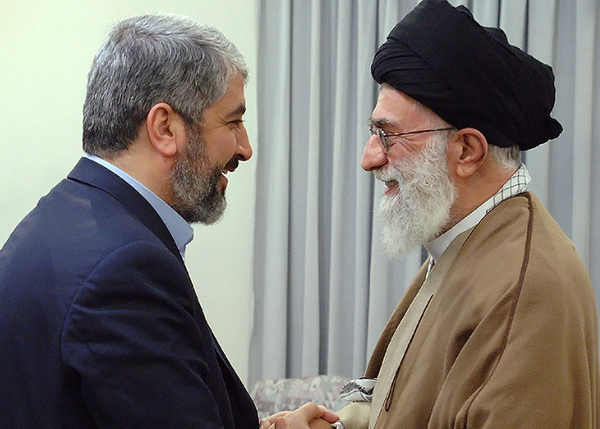
1162Bridging the Sunni-Shia divide, for the goal of genocide: Hamas leader Khaled Mashaal (left) confers with Iranian Supreme Leader Ali Khamenei, in 2010. (Image source: Office of the Supreme Leader)

UNRWA and Iran, with a supporting role played by the United States, have long made it possible for Hamas and the PA to spend other people’s money building more tunnels, arming multiplemilitias, paying “salaries” to convicted terrorists in Israeli jails, and improving the quality of their rockets and missiles. They know — and Israel knows — that between the Israeli government and the international aid agencies including, but not limited to, UNRWA, no Palestinians will starve, no one will go without medical care, no one will go homeless (except those homeless because Hamas confiscated about 20% of the cement and steel meant to restore Gaza houses damaged in last year’s war). Hamas can therefore use all its funds to make war.

As long as Hamas and the PA are permitted both to spend sponsors’ money on terrorism and warfare while escaping responsibility for the needs of their people, and as long as Iran is a key donor — with all the temptations, means and opportunity to “wipe Israel,” as it repeatedly threatens to do — the idea of a U.S.-led “peace process” is fantasy.

Our World: The anti-peace administration

August 12, 2015

Our World: The anti-peace administration, The Jerusalem PostCaroline B. Glick, August 11, 2015

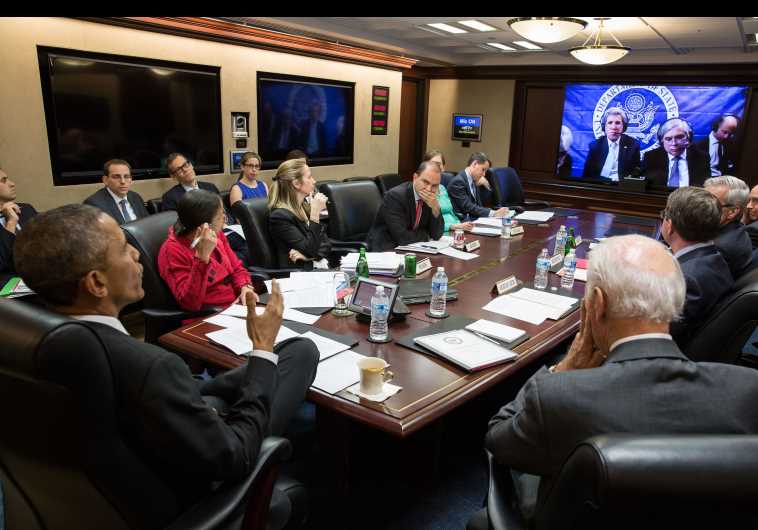
ShowImage (9)President Barack Obama, Vice President Joe Biden, and White House aides receive an update from Secretary of State John Kerry and Secretary of Energy Ernest Moniz via teleconference in Lausanne. (photo credit:WHITE HOUSE)

The US has striven to achieve peaceable relations between the states of the Middle East for nearly 70 years. Yet today, US government is disparaging the burgeoning strategic ties between the Sunni Arab states and Israel.

In a briefing to a delegation of visiting Israeli diplomatic correspondents in Washington last week, a senior Obama administration official sneered that the only noticeable shift in Israel-Arab relations in recent years is that the current Egyptian government has been coordinating security issues “more closely” with Jerusalem than the previous one did.

“But we have yet to see that change materialize in the Gulf.”

If this is how the US views the state of Israel’s relations with the Arabs, then Israel should consider canceling its intelligence cooperation with the US. Because apparently, the Americans haven’t a clue what is happening in the Middle East.

First of all, to characterize the transformation of Israeli-Egyptian relations as a mere question of “more closely” coordinating on security issues is to vastly trivialize what has happened over the past two years.

Before then Egyptian defense minister Abdel Fattah el-Sisi overthrew the US-backed Muslim Brotherhood regime headed by Muhammad Morsi in July 2013, there was a growing sense that Morsi intended to vacate Egypt’s signature to the peace deal with Israel at the first opportunity. Just a month after Morsi ascended to power in January 2013, the Muslim Brotherhood began threatening to review Egypt’s continued commitment to the peace treaty.

The main reason Morsi did not cancel the peace deal with Israel was that Egypt was bankrupt. He needed US and international monetary support to enable his government to pay for imported grain to feed Egypt’s destitute population of 90 million.

During his year in power, Morsi used Hamas as the Brotherhood’s shock troops. He embraced Iran, inviting president Mahmoud Ahmadinejad to visit Cairo in February 2013.

If Morsi were still in power today, with its $150 billion in sanctions relief Iran would have been in a position to support Egypt’s economy. So it is possible that if Morsi were still president, he would have felt he had the financial security to walk away from the peace treaty.

In happy contrast, under Sisi, Israeli-Egyptian ties are closer than they have ever been. Just last week Egyptian diplomats told Al Ahram that Israel’s support was critical for building administration support for Sisi.

Over Ramadan, Egyptian television broadcast a pro-Jewish mini-series.

Israel is closely working with the Egyptians on defeating the growing threat of Islamic State, Hamas and other Islamic terrorist groups waging a bloody insurgency against the regime in Sinai.

Last summer, it was due to the close coordination between Sisi and Israel that the US failed to force Israel to accept Hamas’s cease-fire terms, as those were represented by the Islamist regimes of Qatar and Turkey.

In part due to Israel’s critical support for Sisi’s government, and in part owing to their opposition to Iran’s rise as a regional hegemon armed with nuclear weapons, Saudi Arabia, the UAE and Jordan have all joined Egypt in viewing Israel as a strategic partner and protector.

Last year Saudi Arabia together with the UAE and Jordan supported Israel and Egypt in opposing Hamas and its American, Turkish and Qatari defenders. Had it not been for this massive Arab support, it is very likely that Israel would have been forced to accept the US’s demands and grant Hamas control over Gaza’s international borders.

In June, as negotiations between the US and the other five powers and Iran were moving toward an agreement, the Council on Foreign Relations in New York hosted a meeting between then incoming Foreign Ministry director general Dore Gold and retired Saudi General Anwar Eshki, a former advisor to the Saudi ambassador to the US. The two revealed that over the previous 18 months, they had conducted five secret meetings to discuss Iran.

Although President Barack Obama harangued Israel in his speech at American University last Wednesday, claiming that the Israeli government is the only government that has publicly opposed his nuclear deal with the Iranians, Monday US congressmen now shuttling between Egypt and Israel told Israeli reporters that Egypt opposes the nuclear deal.

As for the Gulf states, according to the US media, last week they told visiting US Secretary of State John Kerry that they support the nuclear deal.

Kerry addressed his counterparts in the Gulf Cooperation Council.

But the fact is that the only foreign minister who expressed such support was Qatari Foreign Minister Khaled al-Attiyah. To be sure, Attiyah was charged to speak for all of his counterparts because Qatar holds the GCC’s rotating chairmanship. But given that Qatar has staked out a pro-Iranian foreign policy in stark contrast to its neighbors and GCC partners, Attiyah’s statement is impossible to take seriously without the corroboration of his colleagues.

As for Qatar’s statement of support, Qatar has worked for years to cultivate good relations with Iran. It might have been expected therefore that Attiyah’s endorsement of the deal would have been enthusiastic. But it was lukewarm at best.

In Attiyah’s words, Kerry promised that the deal would place Iran’s nuclear sites under continuous inspections. “Consequently,” he explained, “the GCC countries have welcomed on this basis what has been displayed and what has been talked about by His Excellency Mr. Kerry.”

The problem of course is that Kerry wasn’t telling the truth. And the Arabs knew he was lying. The deal does not submit Iran’s nuclear sites to a rigorous inspection regime. And the GCC, including Qatar, opposes it.

In his briefing with Israeli reporters, the high-level US official rejected the importance of the détente between Israel and its Arab neighbors because he claimed the Arabs have not changed their position regarding their view of a final peace deal between Israel and the Palestinians.

But this is also nonsense. To be sure, the official position of the Saudis and the UAE is still the so-called Arab peace initiative from 2002 which stipulates that the Arabs will only normalize relations with Israel after it has ceded Jerusalem, Judea, Samaria and the Golan and allowed millions of foreign-born Arabs to freely immigrate to the shrunken Jewish state. In other words, their official position is that they will only have normal relations with Israel after Israel destroys itself.

But their official position is no longer their actual position. Their actual position is to view Israel as a strategic ally.

The senior official told the Israeli reporters that in order to show that “their primary security concern is Iran,” then as far as the Arabs are concerned, “resolving some of the other issues in the region, including the Palestinian issue should be in their interest. We would like to see them more invested in moving the process forward.”

In the real world, there is no peace process. And the Palestinian factions are fighting over who gets to have better relations with Iran. Monday we learned that PA leader Mahmoud Abbas wishes to visit Iran in the coming months in the hopes of getting the money that until recently was enjoyed by his Hamas rivals.

Hamas for its part is desperate to show Tehran that it remains a loyal client. So today, no Palestinian faction shares the joint Israeli-Saudi-Egyptian interest in preventing Iran from becoming a nuclear armed regional hegemon.

The administration showed its hand in that briefing with the Israeli reporters last week. For all their talk about Middle East peace, Obama and his advisors are not at all interested in achieving it or of noticing when it has been achieved.

Captured Hamas Operative Details Group’s Terrorist Plans

August 11, 2015

Captured Hamas Operative Details Group’s Terrorist Plans, Investigative Project on Terrorism, August 11, 2015

A Hamas operative provided a treasure trove of intelligence during Israeli interrogation concerning the terrorist group’s rebuilding efforts and future terrorist plans, Israel’s intelligence agency Shin Bet disclosed on Tuesday.

The terrorist, Ibrahim Adal Shahada Sha’ar, 21, described about Hamas’ tunnel reconstruction efforts, planned terrorist attacks against Israel, military strategy, and coordination with Iran, the Jerusalem Post reported.

He admitted working on rebuilding underground tunnels and described how some would be used in future attacks against Israel. Sha’ar disclosed the location of digging sites, tunnel entrances and underground routes, and reportedly said that a road built along the border with Israel is intended partly for terrorist attacks involving vehicles charging into Israeli territory.

He admitted that he stored several 50 kg explosive charges in his home and said that fighters kept explosives and other material in their own homes since Hamas commanders worried that the organization’s weapons depots would be targeted by Israel.

Israeli authorities arrested Sha’ar last month at the Erez Crossing after he attempted to enter Israel for “personal or humanitarian reasons.” Officers were aware of Sha’ar’s terrorist background and immediately detained him.

During last summer’s war between Israel and Hamas, Sha’ar participated in specific battlefield operations, including field logistics, transferring terrorists and weapons, and even admitted to setting up an anti-tank improvised explosion device (IED).

Sha’ar provided details of Iranian-Hamas military cooperation, including how Iran transfers funds and supplies weapons and electronics to the terrorist group. Those supplies include devices intended to jam radio frequencies to bring down Israeli drones deployed over Gaza. Furthermore, Sha’ar described how Iran trained Hamas terrorists to use hang gliders for attacks against Israel – a tactic revealed by previous Israeli interrogations of captured terrorists.

Critics of the recent Iran nuclear agreement argue that newly released funds to the Islamic Republic will bolster their regional hegemonic ambitions and global terrorist activities, including transferring more money and weaponry to its terrorist proxies.

According to Israeli intelligence, the Sha’ar detailed plans using tunnels to conduct cross-border attacks against Israeli targets, akin to Hamas’ attempts during last summer’s war. The Hamas operative confirmed that the terrorist group is diverting civilian reconstruction material for the purposes of rebuilding its terrorist infrastructure and underground tunnel network.

Sha’ar was indicted July 31 in the Beersheba District Court for being a member and engaging in activities with a banned organization, attempted murder, and forbidden military training.