Archive for the ‘Hamas’ category

UK Review of Muslim Brotherhood: Top 13 Quotes

January 7, 2016

UK Review of Muslim Brotherhood: Top 13 Quotes, Clarion ProjectRyan Mauro, January 7, 2015

(All bold face print is from the original article. — DM)

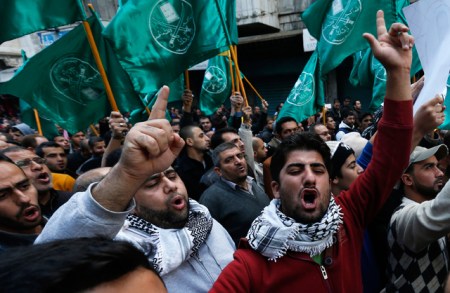
Egypt-Muslim-Brotherhood-Supporters-Flags-IPMuslim Brotherhood supporters (© Reuters)

The U.S. government rejected the conclusions of the British government’s 18-month review of its intelligence and policy towards the Muslim Brotherhood, concluding that the Islamist group is linked to terrorism and extremism. The comprehensive study welcomed outside contributors, of which the Clarion Project was one.

The British government rejected the myth that the Brotherhood is “moderate” and the patently false notion that it is “non-violent.” The Brotherhood and its ideology are now rightly seen as adversarial and measures will be taken to counter its threat. While the UK stopped just shy of banning it as a terrorist group, Prime Minister David Cameron said it will “keep under review whether the views and activities of the Muslim Brotherhood meet the legal test for proscription.”

Here are the top 13 quotes from the British government review andPrime Minister Cameron’s official statement in no particular order:

1. “The Muslim Brotherhood’s foundational texts call for the progressive moral purification of individuals and Muslim societies and their eventual political unification in a Caliphate under Sharia law. To this day the Muslim Brotherhood characterizes Western societies and liberal Muslims as decadent and immoral. It can be seen primarily as a political project.”

2.  “Aspects of Muslim Brotherhood ideology and tactics, in this country and overseas, are contrary to our values and have been contrary to our national interests and our national security.”

3.  “From its foundation the Muslim Brotherhood organized itself into a secretive ‘cell’ structure, with an elaborate induction and education program for new members…This clandestine, centralized and hierarchical structure persists to this day.”

4.  “The Hamas founding charter claims that they are the Palestinian branch of the Muslim Brotherhood and the Muslim Brotherhood treat them as such. In the past ten years support for Hamas (including in particular funding) has been an important priority for the MB in Egypt and the MB international network.”

5.  “From at least the 1950s the Egyptian Muslim Brotherhood also developed an international network, within and beyond the Islamic world. Europe became an important base for the growing Muslim Brotherhood global network.”

6.  “The wider international network of the Muslim Brotherhood now performs a range of functions. It promotes Muslim Brotherhood ideology (including through communications platforms), raises and invests funds, and provides a haven for members of the Brotherhood who have left their country of origin to continue promoting Brotherhood activity.”

7.  “[F]or the most part, the Muslim Brotherhood have preferred non violent incremental change on the grounds of expediency, often on the basis that political opposition will disappear when the process of Islamization is complete. But they are prepared to countenance violence—including, from time to time, terrorism—where gradualism is ineffective.”

8.  “Muslim Brotherhood organizations and associated in the UK have neither openly nor consistently refuted the literature of Brotherhood member Sayyid Qutb which is known to have inspired people (including in this country) to engage in terrorism.”

9.  “[The review] concluded that it was not possible to reconcile these [MB] views with the claim made by the Egyptian Muslim Brotherhood in their evidence to the review that ‘the Muslim Brotherhood has consistently adhered to peaceful means of opposition, renouncing all forms of violence throughout its existence.'”

10.  “In the 1990s the Muslim Brotherhood and their associates established public facing and apparently national organizations in the UK to promote their views. None were openly identified with the Muslim Brotherhood and membership of the Muslim Brotherhood remained (and still remains) a secret.”

11.  “[MB fronts] became politically active, notably in connection with Palestine and Iraq, and promoted candidates in national and local elections…sought and obtained a dialogue with Government….were active members in a security dialogue with the police.”

12.  “The Muslim Brotherhood have been publicly committed to political engagement in this country. Engagement with Government has at times been facilitated by what appeared to be a common agenda against al Qaida and (at least in the UK) militant Salafism. But this engagement did not take into account of Muslim Brotherhood support for a proscribed terrorist group and its views about terrorism which, in reality, are quite different from our own.”

13. “Senior Muslim Brotherhood figures and associated have justified attacks against coalition forces in Iraq and Afghanistan.”

The U.S. government, without even conducting any kind of review of its own, issued a statement to the Investigative Project on Terrorism rejecting any ban or even any “de-legitimizing” of the Brotherhood at all.

“Political repression of non-violent Islamist groups has historically contributed to the radicalization of the minority of their members who would consider violence…The de-legitimization of non-violent political groups does not promote stability and instead advances the very outcomes that such measures are intended to prevent,” the U.S. government statement claims.

In other words, the U.S. position is this: Be held hostage by the so-called “non-violent Islamist groups.” Sure, the Muslim Brotherhood has a wing named Hamas that the U.S. officially designated as a Foreign Terrorist Organization but it could be worse—at least not allo f the group’s members are engaging in violence.

Accept them as “moderates” as they wish, even at the cost of better Muslim alternatives. Don’t confront them. Don’t even “delegitimize” them for their radicalism and ideology because that might push them over the edge.

That’s not a mindset that understands what the threat is and certainly is not one that can defeat it.

Home-drone terrorism

January 7, 2016

Home-drone terrorism, The Hill, Ben Lerner, January 6, 2016

Non-state actors are already either deploying drones in the field or are drawing concern from security experts about their potential to do so.  Both Hezbollah and Hamas have sent (for now) non-weaponized, rudimentary drones of limited capability into Middle Eastern skies, including one Hezbollah drone that made it 140 miles into Israel. 

**********************

In the aftermath of the horrific terrorist attack that took the lives of fourteen victims in San Bernardino, California last month, a raft of information has been coming out regarding the identities and histories of the perpetrators, and also the arsenal they had amassed to carry out their plans.

Amidst all the reporting, it would be easy to miss a significant item that authorities found among the weaponry, as reported by Fox News:

“…Another source said investigators discovered a dozen pipe bombs in the house, as well as small explosives strapped to remote-controlled cars – a signature of terrorist groups including Al Qaeda, according to counter-terrorism experts.” [Emphasis added — DM]

Why remote-controlled cars?  Well, it turns out that as much as jihadist terrorists may value their own deaths in the course of their attacks, they also favor using any weapon that maximizes the number of casualties, and the fear that entails, whether they themselves are killed in the process or not.  Hence the high utility of and interest in improvised explosive devices (IEDs), which can be built cheaply and detonated from afar, allowing operators to evade detection and therefore minimize interdiction.  Add an ability to move the explosive to a specific location by remote, and you have a low-tech but lethal precision-guided weapon.

Those advantages of the remote IED – precision, evasion, cost-effectiveness – have prompted authorities increasingly to worry that terrorists will turn next to another device to help them carry out attacks: drones.

Drones have the potential to function essentially as the aerial version of the remote-controlled car bombs found in that San Bernardino apartment.  They could be rigged to carry small explosives and sent to a target as a precision-guided weapon, or could be deployed without an explosive and just flown, deliberately, into a jet engine.   And even if the user in question opts not to use the drone itself as a weapon, it can still operate overhead with a camera and provide what the military calls intelligence-surveillance-reconnaissance (ISR) to support an attack on the ground, for example by providing intelligence on additional targets or possible escape routes for the attackers.

Non-state actors are already either deploying drones in the field or are drawing concern from security experts about their potential to do so.  Both Hezbollah and Hamas have sent (for now) non-weaponized, rudimentary drones of limited capability into Middle Eastern skies, including one Hezbollah drone that made it 140 miles into Israel.  Drug cartels are already attempting to use drones for smuggling narcotics, and some in law enforcement have speculated that cartels will find value in drones for surveillance purposes.  The New York Police Department has been worried for some time about the potential for terrorist attacks on New York City using drones.

Given the threat posed by drones in the hands of terrorists or criminals, there is an urgent need to grapple with how to secure American skies in effective, sensible ways.  Broadly speaking, policymakers should proceed on this front bearing two things in mind:

Deploy counter-drone technologies to protect U.S. airspace.  Addressing the terrorist/criminal drone threat will require the deployment of counter-drone technology, sooner rather than later, that can be used to safely disable and bring down drones in non-military environments.  The military has been working on fielding counter-drone technologies for some time – the Navy has already made significant advances with deployment of directed energy technology to counter threats from Iranian drones and other weapons in the Persian Gulf, and recent reporting indicates that the Army’s Rapid Equipping Force (REF) and Asymmetric Warfare Group (AWG) have been collaborating extensively to identify workable counter-drone options as well.  While the homeland security side of the federal government appears to be catching upon this front, the question remains as to whether effective technology will be ready in time for use against this kind of bad-actor drone in the skies over American cities and infrastructure – particularly when, unlike their military counterparts, those responsible for homeland security are more constrained to avoid counter-drone measures that involve blowing one up in mid-air over lower Manhattan or knocking out electronic communications in downtown Washington, D.C.

Recognize the limitations of traceability and “geo-fencing.”  In recent months, there have been numerous unauthorized drone flights in U.S. airspace – near airports, near commercial aircraft, over sporting events, and in some cases, in the path of wildfire relief efforts – the preponderance of which appear to have been the result of reckless or careless drone use, rather than a malicious intent to cause harm.  These kinds of incursions have prompted the Department of Transportation to announce that it will require those who use drones to register them with the department by February of 2016.  It is thought that having operators register their drones will give law enforcement an opportunity to trace drones back to their operators in certain circumstances for deterrence and accountability purposes, though there is room to debate whether this is unnecessarily burdensome for your average law-abiding user, and whether a more effective way to create deterrence and accountability would be through tracing manufacturer serial numbers, via the retailer, back to the point of sale.

Of course, having the ability to trace a drone back to its owner only matters after a drone has already flown into restricted airspace – it won’t prevent incursions from taking place.  That reality has prompted drone companies to explore the option of manufacturer-installed “geo-fencing” technology that pre-programs a drone to render it incapable of flying into restricted airspace.

Policymakers should recognize that while traceability mechanisms and geo-fencing could be important public safety tools to better manage increasingly crowded airspace and mitigate irresponsible or reckless drone use, they will not solve the problem of malevolent drone use.  Terrorists and criminals won’t register themselves under any system, or make themselves otherwise vulnerable to having ownership traced back to them, and a determined terrorist or criminal will be all the more inclined to disable geo-fencing features, and perhaps all the more capable of doing so.

The best drones are already doing much good in American skies for law enforcement, homeland security, and a variety of industries putting them to innovative use.  As is the case with all beneficial technologies, however, bad actors will find ways to use a drone’s otherwise positive qualities to cause harm.  Dealing with that threat will entail understanding which counter-drone technologies can be usefully applied to preventing terrorist/criminal acts, and which ones are less likely to get that particular job done, other potential benefits notwithstanding.

Palestinian Leaders Promise a New Year of Violence and Death

January 4, 2016

Palestinian Leaders Promise a New Year of Violence and Death, Gatestone InstituteKhaled Abu Toameh, January 4, 2016

♦ Instead of wishing Palestinians a happy and prosperous New Year, both Fatah and Hamas are asking their people to prepare for increased violence and “resistance,” including suicide bombings, against Israelis.

♦ Fatah’s armed wing used the occasion to issue yet another threat: “We will continue in the path of the martyrs until the liberation of all of Palestine.”

♦ Masked Palestinians in Bethlehem attacked several restaurants and halls where New Year’s Eve parties were supposed to take place. The assailants, eyewitnesses reported, were affiliated with Abbas’s Fatah faction, not Hamas.

♦ Hamas banned Gazans from celebrating New Year’s Eve, saying such parties are “in violation of Islamic teachings.” Hamas does not want young Palestinians enjoying their time in restaurants and cafes. Instead, Hamas wants them to join its forces, armed and dressed in military fatigues, preparing for jihad against Israel.

After failing to offer their people any hope for the future, Fatah and Hamas are now telling Palestinians that they should expect more violence and bloodshed during in 2016.

In separate messages to the Palestinians on New Year’s Eve, the two rival Palestinian parties pledged to pursue, and even step up, “resistance” attacks against Israel. Needless to say, the messages did not make any reference to peace, coexistence or tolerance.

Instead of wishing Palestinians a happy and prosperous New Year, both Fatah and Hamas are asking their people in the Gaza Strip and West Bank to prepare for increased violence and “resistance” attacks against Israel. The two parties have nothing to offer the Palestinians besides more bloodshed and despair.

Hamas, which has been in power in the Gaza Strip for almost 10 years, is even reported to be preparing for a new wave of suicide bombings against Israelis. The last time Hamas launched suicide attacks in Israel was during the second intifada, 2000-2005, which wrought havoc and destruction to Palestinians.

Various reports have suggested that Hamas was now considering activating its West Bank “sleeper cells,” in preparation for resuming suicide bombings against Israelis. Hamas, according to the reports, is also planning to target Israeli security and political figures.

Hussam Badran, a senior Hamas official in the Gaza Strip, painted a grim picture of what awaits Palestinians during 2016. In a message to Palestinians, Badran announced that the current wave of terrorism, which he referred to as the “Al-Quds Intifada,” would escalate during the coming year. He also hinted that Hamas was indeed considering resuming suicide attacks against Israelis: “The year 2016 will witness a development and escalation of the intifada and all forms of resistance operations.”

His message, like those of many Hamas officials, did not contain any reference to the harsh living conditions of Palestinians under the rule of Hamas in the Gaza Strip. When Badran and other Hamas officials talk about waging “all forms of resistance” against Israel, they are actually referring to plans to launch suicide bombings and other terror attacks against Israelis.

The Hamas New Year’s messages do not offer Palestinians in the Gaza Strip any hope that their leaders are working towards ending their misery and state of despair. There is no promise to help solve the problem of unemployment or poverty in the Gaza Strip. Nor is there any promise to help solve the crisis with Egypt, one which has resulted in the closure of the Rafah border crossing between Gaza and Egypt for most of 2015.

As if that were not enough, Hamas last week banned Palestinians in the Gaza Strip from celebrating New Year’s Eve. Hamas security officers warned owners of restaurants and hotels against holding New Year’s Eve parties, saying that this practice is “alien to our traditions and values and in violation of Islamic teachings.” Hamas also justified the ban by arguing that Palestinians in the Gaza Strip must show solidarity with their brothers in the West Bank, who have been waging a campaign of stabbing and vehicular attacks against Israelis since early October.

By banning New Year’s Eve celebrations, Hamas is following the example of other Islamist terror groups such as the Islamic State, which have denounced such parties as “un-Islamic.” These groups consider New Year’s Eve celebrations as being part of the same Western culture they are seeking to replace with extremist Islam and Sharia law.

Hamas cannot tolerate scenes of Palestinians rejoicing and celebrating the arrival of a new year. It does not want to see young Palestinians enjoying their time in restaurants, cafes and hotels. Instead, Hamas wants young Palestinians to join its forces and prepare for jihad against Israel. Hamas prefers to see young Palestinians dressed up in military fatigues and carrying weapons. It wants the young men, instead of celebrating and rejoicing, to participate in digging more tunnels under Gaza’s borders with Israel and Egypt.

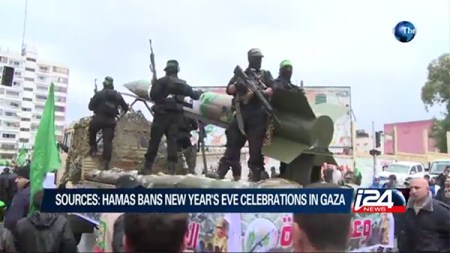
1412Armed Hamas militiamen on parade with a mock rocket in Gaza. (Image source: i24 News video screenshot)

Similarly, President Mahmoud Abbas’s ruling Fatah faction in the West Bank, which this week celebrated the 51st anniversary of its first armed attack against Israel, is hoping that 2016 will witness more violence. Several Fatah officials and groups marked the anniversary by vowing to step up “resistance” against Israelis and urging Palestinians to join the “struggle” against Israel.

Fatah’s armed wing, the al-Aqsa Martyrs Brigades, used the occasion to issue yet another threat to launch terror attacks against Israelis. “We remain committed to the option of an armed struggle,” the group rote in a leaflet distributed in the West Bank. “We will continue in the path of the martyrs until the liberation of all of Palestine.”

President Mahmoud Abbas, who is also head of Fatah, also had nothing to offer his people on New Year’s Eve, other than more messages of hate and defiance towards Israel. In a message to his people, Abbas once again justified the current wave of violence by saying it was the “result of the continuation of occupation and settlements, and the desecration of our holy sites.” He added: “Our people won’t capitulate, surrender or accept humiliation.”

As Abbas was addressing his people, masked Palestinians in Bethlehem attacked several restaurants and halls where New Year’s Eve parties were supposed to take place. Eyewitnesses said that the masked men opened fire at the restaurants, halls and vehicles, to prevent Palestinians from celebrating. The assailants, eyewitnesses reported, were affiliated with Abbas’s Fatah faction, not Hamas.

The leaders of Fatah and Hamas have once again shown they have nothing to offer the Palestinians other than violence, destruction and death. These leaders want their people to remain in a combatant mood in order to pursue the fight against Israel. As such, the year 2016 does not look very promising for Palestinians under the current leadership of Fatah and Hamas.

To Strike or Not to Strike, That is the Question

December 17, 2015

To Strike or Not to Strike, That is the Question, The Investigative Project on Terrorism, Paul Alster, December 16, 2015

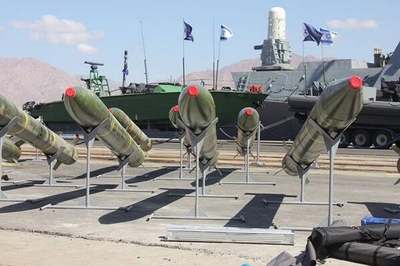
1310 (1)

[C]ould there still be a window of opportunity, unpalatable as much of the international community might find it, of Israel launching a pre-emptive strike against what is widely perceived as a massive and increasing threat to its security?

**********************

Israeli estimates of the number of missiles terrorist powerhouse Hizballah has in Lebanon increased last summer from 100,000 to 150,000. The Shi’ite army continues to gain strength, unhindered by the token presence of United Nations troops in what was supposed to be a de-militarized zone following the 2006 Second Lebanon War.

Hizballah’s promises of capturing the Galilee – that have inspired a feature-length Lebanese movie on the subject – are oft-repeated. The imminent release (as a result of the P5+1 nuclear deal) of billions of dollars to its guardian angel and guiding hand, the Islamic Republic of Iran, promise more money and materiel will be placed at the disposal of an organization that has already fought two vicious wars against the Jewish state, a state whose existence it refuses to recognize.

Hizballah’s growing strength, and its acquisition of advanced weapons, (undoubtedly aided of late by Russian air strikes in support of the Syrian army), has Israeli leaders thinking hard about how long they can allow such a build-up to go unchecked, and whether there is a growing case for something more than sporadic cross-border interventions to temporarily stem Hizballah’s growing firepower.

“We operate in Syria from time to time to prevent it turning into another front against us,” Israeli Prime Minister Benjamin Netanyahu acknowledged Dec. 1 at the Galilee Conference in Acre. “We act, of course, to prevent the transfer of deadly weaponry from Syria to Lebanon.”

His surprise comments came on the back of two reported airstrikes on Syrian weapons convoys – attributed to the IAF – apparently destined for Hizballah.

Two days later, Defense Minister Moshe Ya’alon again highlighted the increasing danger posed by Iran’s overt support of the Hizballah, telling members of the U.S. Congress, “We are very worried about Iran’s presence in Syria… This regime generates terrorism and undermines many of the regimes in the Middle East, and this is not good news for the region, not only Israel.”

Reports last week of Iran completing a second medium-range ballistic missile test in contravention of U.N. Security Council resolutions did little to ease Israeli fears. On Dec. 10, in another indication of the urgency with which it views the Iran-Hizballah threat, Israel successfully tested its Arrow 3 missile defense system, an extra layer of defense on top of the Iron Dome, David’s Sling, and the Arrow 2 system that may well prove critical in defending against the Iranian-made Shihab 3 longer ranger missiles.

In an exclusive interview with the Investigative Project on Terrorism, a senior IDF official – who for security reason must remain anonymous – spelled out the likely scenario should Hizballah live up to its promises and attack Israel from the north. He did not discuss the likelihood of an Israeli pre-emptive strike against Hizballah, but painted a sometimes grim assessment of what the Israeli public can expect.

“The next war will be different. As an Israeli citizen, father to two boys in the army, I really hope we will find a solution to peace in the area… but we have to deal with this,” the IDF official explained. “I believe that in the next war we will see that Hizballah and Hamas will both launch missiles. They have the same interest here.”

Earlier this month, subsequent to this interview taking place, Israel’s Channel 2 news reported that Shadi el-Meni, the Islamic State leader in the Sinai Peninsula, met with Hamas leaders to discuss increased weapons supplies to the Gaza-based terrorists. The ideological differences between the two sides seemingly set aside in the pursuit of preparing an enhanced assault on Israel.

The IDF officer suggested that during the 2014 Gaza War more than 70 percent of the Israeli population was covered by the Iron Dome as it intercepted missiles coming from the Hamas-controlled enclave. But with rockets raining down from Israel’s north and south, Iron Dome’s use would be limited. There will be occasions when civilians will not be protected when defending strategic installations take priority.

“We understand that Iron Dome next time will not do the same work,” he said, “because you will not always put it on populations; you will put it in strategic locations that we need to defend like chemical factories, and gas [installations], of course.”

Israel’s third largest metropolitan area, Haifa, is home to a huge Mediterranean port and a major Israeli naval base. Defending such a massive target will be “very hard” he said. “We have Iron Dome, the Arrow and the Patriot as well, but when you have 150,000 missiles from Lebanon, you cannot assume that every missile they will launch will [be intercepted]. This is what we need to explain to the Israeli population. A lot of [apartment blocks], a lot of industrial zones, a lot of factories will be targeted, and at the same time Hamas will launch from Gaza. This is our understanding.”

He suggested there will be sustained bouts of simultaneous rocket attacks in the north, although there is no doubt that Hizballah’s arsenal offers the capability to reach as far as Tel Aviv and Jerusalem.

“I think the enemy has [learned] very well. Today we see Hizballah fighting in Syria. Hizballah a few years ago said they are just defensive, now we see they are an offensive force. After the [2014] operations near Israel’s Gaza border, we understand that kibbutzim near the [Lebanese] border may be ‘evacuated and moved back.’ We think it is possible [Haifa] will be without electricity for 72 hours,” he continued. “No phones. No talking to your family. We have practiced evacuations to shelters and built civilians rescue teams in the towns and villages.”

Civilian teams have trained to help get people into shelters and in emergency response in Jewish towns and Arab villages alike. Haifa, for example, is home to a wide variety of communities, including around 30,000 Israeli Arabs, (both Muslim and Christian), Druze, and followers of the Baha’i faith.

“We assume everything Hizballah sees in Syria they can try to bring into Lebanon, so I assume that they will try to bring missiles such as Scuds and try and launch them all over Israel. In [the Haifa] district what we will see is the 122mm – they have thousands of these Katyushas that have a range of up to 45 kms – and that would take them from the [Lebanese] border to Tirat HaCarmel [on the south side of Haifa]. This is the main problem for the first days of the war.”

“Hizballah has advanced weapons. You don’t need to be in uniform to know that if they take the C-802 that they launched at Eilat in 2006 they will try launching it [again]. They have very good, advanced weapons, anti-tank missiles – a huge stockpile.”

And, under the cover of missile fire, the senior IDF officer said he has little doubt Hizballah will attempt some degree of land invasion.

“I think that there are maps of this,” he said. “We understand this when [Hizballah leader Hassan] Nasrallah says he will be in the Galilee and will take it from Israel. I don’t think that he will [achieve] it. So, they will take Metula, or Shlomi, or Hanita for a few hours and they’ll raise a flag. Okay, so they will launch thousands of rockets. It will be hard, but Israel will continue to exist. With Hizballah fighting in Syria in offensive attacks with tanks, infantry, UAV’s, you understand they are building a very powerful military with much practical experience.”

During the long and bloody fight against ISIS, Al Nusra and others in Syria, Hizballah has picked up large amounts of weaponry from the battlefield, weapons manufactured around the globe, some likely from the U.S. who have armed the Free Syrian Army. Whatever they captured could be fired on Israel when the war everyone expects finally breaks out.

With the exception of its border with Jordan, Israel faces non-state actors at all points of the compass. Hizballah in south Lebanon, Hizballah, ISIS and the Al Nusra Front in Syria, Hamas and Islamic Jihad in Gaza, and ISIS and al-Qaida in Sinai. There are also signs that the Fatah-run Palestinian Authority is increasingly vulnerable to radical Islamists from Hamas or ISIS as the stabbing terror spree against Israelis continues into a third month.

Could the awful Paris attacks in November have finally brought Europeans around to understanding the Israeli predicament in facing terror organizations on virtually all sides?

“I think that all over the world we have problems with radical Muslims. What we see… is a common enemy. These radical terror organizations have similar tactics and I hope the world will understand what Israel has [faced] in the last decades. I think maybe we don’t know how to explain our story [very well]. I hope that maybe now they will understand what a threat the world has, facing non-state actors and terrorist organizations – and we know it is Iran that gives money to Hizballah and tries to give them missiles to hit every place in Israel.”

The best opportunity for Israel to intervene might have presented itself last summer, when Hizballah appeared to be on the ropes.

“One can conclude that Israel may see an auspicious opportunity to make a preemptive attack to destroy Hezbollah’s massive ordnance in southern Lebanon, stockpiled since the 33-day Israel-Hezbollah war in 2006,” Iranian-Canadian political analyst Shair Shahidsaless wrote at the Huffington Post in June.

That was before the game-changing Russian entry into the conflict that has seen the balance of power sway back towards Assad and Hizballah. But could there still be a window of opportunity, unpalatable as much of the international community might find it, of Israel launching a pre-emptive strike against what is widely perceived as a massive and increasing threat to its security?

On Anniversary, Hamas Calls for More Stabbings and Destroying Israel

December 15, 2015

On Anniversary, Hamas Calls for More Stabbings and Destroying Israel, Investigative Project on Terrorism, December 15, 2015

Two-thirds of the Palestinians living in the West Bank and Gaza support the current wave of terrorism targeting Israelis, a survey published Monday by the Palestinian Center or Policy and Survey Research (PSR) found. An equal number of Palestinians advocate for an even more violent uprising.

**********************

Hamas reaffirmed its commitment to destroying the Jewish state, while tens of thousands of Palestinians celebrated the terrorist group’s 28th anniversary, theJerusalem Post reports.

“Hamas vows to remain faithful to the liberation of Palestine and to keep its weapon directed at the Israeli occupation only,” read a Hamas statement released on its English language website.

Hamas praised the recent wave of Palestinian terrorism plaguing Israel, calling it the “Jerusalem intifada,” and encouraging others to engage in “heroic resistance against Israeli soldiers and settlers” in order to achieve “the right of return – a sacred, nonnegotiable individual and collective right.” According to the statement, Hamas will “never compromise even one inch or grain of its soil or holy sites.”

Hamas continues to be dedicated to the erosion of Jewish sovereignty in any form and does not distinguish between Israel proper and the Palestinian territories – viewing the entire land of Israel as an “occupation.”

“Hamas will never recognize the Israeli occupation, and confirms that Palestine from the Jordan River to the Mediterranean is an Arab, Islamic country,” the statement read. This rejectionist sentiment is at the core of Hamas’ ideology, obstructing any potential for a meaningful peace settlement with the Palestinians.

Reinforcing that message, Hamas leader Khaled Meshaal glorified Palestinian terrorists involved in recent attacks against Israelis, calling for the path of “Jihad, sacrifice, and blood” as the only way Palestinians can achieve their objectives.

“The Palestinians have reached the realization that negotiations with the (Israelis) are useless…the so-called peace process is futile. There is no peace. Only the path of Jihad, sacrifice, and blood (will bear fruit),” said Meshaal in a December 10 speech in Malaysia, translated by the Middle East Media Research Institute (MEMRI) and reported by the Times of Israel.

Click here to view the MEMRI video clip.

“Weapons like Kalashnikovs or missiles are not at hand, but there are knives and cars with which to run over the enemies…By God, after the knives used by the people of the West Bank and Jerusalem, can anyone possibly have an excuse to abandon the path of jihad? Nobody can have such an excuse,” stated the Hamas leader.

Palestinian terrorists have killed 20 Israelis in the past three months, following near-daily attacks targeting Jews.

Meshaal met with government officials and politicians in Malaysia last week with a delegation of senior Hamas officials. Malaysia is a major component of Hamas’ international terrorist infrastructure, as the group actively recruits Palestinians studying at Malaysian universities to join Hamas for eventual terrorist attacks against Jews in Israel.

Two-thirds of the Palestinians living in the West Bank and Gaza support the current wave of terrorism targeting Israelis, a survey published Monday by the Palestinian Center or Policy and Survey Research (PSR) found. An equal number of Palestinians advocate for an even more violent uprising.

Palestinian terror claims 5 murders in a day as Hebron swings out of Shin Bet control

November 20, 2015

Palestinian terror claims 5 murders in a day as Hebron swings out of Shin Bet control, DEBKAfile, November 19, 2015

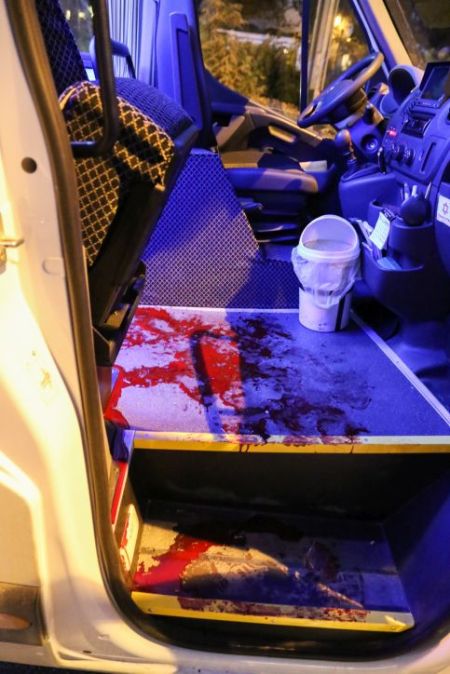
Blood inside a minibus at the scene of a drive-by shooting near the West Bank settlement of Alon Shvut, in the Etzion Bloc, on November 19, 2015. Three people were killed in the terrorist attack, and several more wounded. Photo by Gershon Elinson/FLASH90 *** Local Caption *** ????? ???? ??? ??? ????? ???? ?????? Blood inside a minibus at the scene of a drive-by shooting near the West Bank settlement of Alon Shvut, in the Etzion Bloc, on November 19, 2015. Three people were killed in the terrorist attack, and several more wounded. Photo by Gershon Elinson/FLASH90

All five murders perpetrated by Palestinian terrorists Thursday, Nov. 19, led back to the Hebron district of the southern West Bank. The writing on the wall was there in June 2014, when three Israeli teenage boys, Gil-Ad Sheer, Yakov Frankel and Eyal Yifrah were kidnapped at the Gush Etzion intersection near Hebron, and eventually found murdered.

Since the current wave of Palestinian terror erupted on Oct. 1, it has been obvious that the breeding ground was the town of Hebron and the district of Mount Hebron. This wave hit a deadly peak on Thursday. A Palestinian father of five from the village of Duma in the Hebron district, who a few days earlier received a permit to work in Tel Aviv, slashed to death two Israelis at a makeshift synagogue in southern Tel Aviv. Another terrorist from the village of Deir Samath near Hebron, slammed his car into Israeli vehicles and sprayed a traffic jam with gunfire on the highway to Hebron, killing an Israeli man, a tourist teenager and a Palestinian motorist. Seven others were injured.

The mother of one of the terrorists praised her son for bringing “pride and honor to the Palestinians and to Hebron.”

The controversy in Israeli military circles about whether the Palestinian terrorists have escalated the violence from rocks and knives to guns is hardly relevant, when the first attack of the current wave on Oct. 1 was a well-planned deadly shooting attack on an Israeli couple in a car. The 2015 violence would be more aptly dubbed “the Hebron Intifada.”

Hebron, 30 km south of Jerusalem, is the second largest West Bank city after Ramallah, the seat of the Palestinian Authority administration. Around 400,000 Palestinians, roughly a quarter of the West Bank Palestinian population, lives there and in the Mount Hebron towns of Dahariya, Halhoul, Yata, Dura. Samoa, Beit Umar, Bani Naim and Hirbat al-Aroub, as well as a far smaller Jewish population mainly in Hebron, Kiryat Arba and Gush Etzion. Just south of Mt.Hebron are the lands of small Bedouin tribes.

Periodic outbreaks of Arab pogroms against Jewish dwellers have been endemic to this region since 1929, but it was internal strife that ignited the current wave of violence which derives from four causes:

1.  The Palestinian Authority and the ruling Fatah party in Ramallah are at daggers drawn with the Hamas leadership in Gaza. The Palestinian centers of government have been too preoccupied with their quarrel to keep touch with what was going on in Hebron.

2. This void of authority opened the door for the local families and clans, which ruled the district before central authority was established in Ramallah 21 years ago, to reinstate themselves in power, with the result that Israeli and Palestinian intelligence agencies alike have found the restored authority shut tight against their penetration.

Not only are external intrusions excluded, but the clans themselves are careful to keep their business private from rival clans and families.

3. To avoid admitting to its incapacity in this new situation, Israel’s security agency, the Shin Bet, continues to harp on the “lone wolf” theory to explain why the latest round of terror is unpredictable.

But the attacks in Sharm el-Sheikh on a Russian airliner and the multiple terrorist attacks in Paris show Islamist terror to have assumed a new, impenetrable guise, to fight which anti-terror agencies will have to adapt and come up with new methods.

The Shin Beit is finding it harder than before to procure intelligence not just in Hebron but also from the Palestinian Hamas and Islamic Jihad. This difficulty is shared by Jordanian intelligence, which until not long ago maintained a broad net of highly professional agents and informers in the Palestinian community.

4.  In the current situation, Hebron is swinging out of control as athe spearhead of the current wave of Palestinian terror, and appears poised to evolve into a new Palestinian bloc to contest Ramallah for the national leadership.

5.  Israel’s failure to stem their campaign of terror has given Hebron’s clan chiefs enhanced standing in the Palestinian community at large and even in broader circles of the Arab world.

The Islamic State (ISIS) And Palestine – Rhetoric vs. Reality

November 17, 2015

The Islamic State (ISIS) And Palestine – Rhetoric vs. Reality, MEMRI, R. Green, November 17, 2015

(Please see also, ISIS THREAT’S ISRAEL IN HEBREW 22 OCTOBER 2015. — DM)

The Islamic State’s (ISIS) extensive information campaign, titled “Slaughter the Jews,”[1] that it recently launched in the wake of the recent wave of violent events in Israel and the Palestinian territories has had numerous reverberations. The campaign includes all the elements familiar from previous ISIS campaigns, including copious use of social media to encourage terror attacks, and videos featuring armed activists making threats and urging intensification and escalation of attacks. This ISIS campaign and the threats it has included have been covered extensively by media in the West and Israel, with excessive focus on threats to Israel and the Jews and on the campaign’s colorful details, such as the fact that two of the activists in the videos issued their threats in Hebrew. This campaign, and the events of the past few months in general, have again raised the question of ISIS’s view of the Palestinian issue and the war on Israel.

Despite the Slaughter the Jews campaign, which has been aimed primarily at the Palestinians, and its impact, it should be stressed that the Palestinian cause is not a major issue to ISIS. Unlike many Arab and Islamic movements and organizations for whom the liberation of Palestine, Jerusalem, Al-Aqsa mosque, and the fight against Israel head their priorities, or who at least claim this to be the case, ISIS perceives them as long term goals. ISIS’s top priority is fighting what it considers to be Islam’s internal enemies – the Shi’ites and the secular regimes. It sees conquering Baghdad, Damascus, Cairo, and Mecca as taking precedence over liberating Jerusalem.

Additionally, the idea of a Palestinian state goes completely against ISIS’s religious and ideological idea; its vision is based on the establishment of a caliphate that is not subject to the modern geopolitical limitations, and under which there is no place for separate states. It also rejects outright democratic principles and any adherence to the international community’s rules that the Palestinian movements, including the Islamic ones, have accepted.

ISIS is highly capable of quickly launching an information campaign comprising videos produced by its official media wings, videos and informational material created by its unofficial media bodies, and very extensive discourse via social media, and this is what it has done in this case as well.[2] Therefore, despite the scope of this particular campaign, it should not be viewed as indicative of a significant shift in ISIS’s focus or priorities.

To clarify: ISIS is not disregarding the Palestinian cause; it recognizes its importance for the Arab and Islamic world, and exploits it, as do other regimes, organizations, and movements, as an element in its arsenal of informational tools and as a means of recruiting supporters. Furthermore, it is riding the wave of media attention it gained with its threats of attacks against Israel in order to strike at its main rival in the Palestinian arena – that is, Hamas.

ISIS has no real organized presence among the Palestinians in either the Gaza Strip or the West Bank. Most of its manpower is directed to the Sinai, and to the combat arenas in Syria and Iraq, where training and fighting take place. The ISIS activists in the Gaza Strip are tasked with promoting ISIS’s information enterprise and helping spread its ideology among the population there.

ISIS’s Leadership Devotes No Special Attention To Palestine

A look at statements by ISIS’s leadership shows the organization’s relatively low ranking of the Palestinian cause. In their speeches, ISIS leader Abu Bakr Al-Baghdadi and its spokesman Abu Muhammad Al-‘Adnani, the only top leaders who speak for the organization, barely mention it in their speeches. In his first address as caliph, in July 2014, Al-Baghdadi included Palestine in a long list of locations where Muslims are suffering and oppressed, but made no special reference to it.[3] In his most recent speech, released in May 2015, he mentioned Palestine not as an issue per se but only as a taunt to the Saudis; the speech itself rebuked the Saudi royal family and stated that Saudi Arabia had done nothing for the Palestinians. In that speech, he refers to the “Jews” as allies of the Christian “Crusaders,” that is, the Western forces, and even as the instigators of the Western aggression against the Islamic world – a standard element of jihadi rhetoric, the most well-known example being Osama bin Laden’s 1998 declaration of “jihad against the Jews and the Crusaders.” Referring to his men in the Sinai, he takes care to praise them for threatening the “Jews,” that is, Israel.[4]

ISIS spokesman Al-‘Adnani also has not specifically referred to the Palestinians in his speeches, aside from a mention of Palestine in a long list of countries where Muslims are under attack. Furthermore, in an address released in early October 2015, following the outbreak of the current violence and the headlines about the Palestinians that it garnered, he mentioned the Palestinians not at all.[5] This omission was harshly criticized by ISIS’s Islamist opponents.[6]

25734ISIS activists in Syria: “We will only defeat the Jews by purging the country of its Arab rulers”

ISIS Leader Al-Baghdadi Is Absent From The Videos In “Slaughter The Jews” Campaign

One feature of ISIS videos is the underlining of points and honing of messages by the use of audio segments from past speeches by leaders of ISIS and its precursor groups, as well as from speeches by deceased jihadi leaders, including from Al-Qaeda, who never criticized ISIS. However, the video series of the “Slaughter the Jews” campaign includes barely any audio statements by actual ISIS leaders, and none by Al-Baghdadi himself – though statements by Osama bin Laden and Al-Qaeda commander Abu Laith Al-Libi are featured. Statements by ISIS spokesman Al-‘Adnani are included, but these are merely are non-specific calls for terror attacks in general, not for war on Israel.

Two videos in the “Slaughter the Jews” series, one produced by ISIS’s Al-Furat province (which covers the cities of Albu Kammal and Al-Qa’im) and one by its Al-Raqqa province, present audio statements from 2008 and 2009 speeches, respectively, by the head of the ISIS precursor group Islamic State of Iraq, Abu Omar Al-Baghdadi.

Another video in the series includes audio of Abu Mus’ab Al-Zarqawi, founder of the ISIS precursor Tawhid and Jihad, saying: “We fight in Iraq and our eyes are set on Bait Al-Maqdis [Jerusalem], which will be resored only by means of the guiding Koran and the victorious sword.”[7] This particular statement has become a slogan for jihadis everywhere and sums up their view, i.e., while at this time we are not fighting Israel and are not actively working to liberate Jerusalem and its holy sites, we are still focused on that goal, and will liberate it according to our faith and principles – that is, we will act in accordance with the pure Salafi Islam and by means of a jihad war.[8] Many ISIS activists appearing in the videos also reiterated this, passionately promising the Palestinians, while pointing at their eyes to indicate sincerity, that ISIS has not abandoned them.

25735ISIS fighter delivers threatening message in Hebrew and brandishes a knife in a video produced by the Damascus Province as part of the “Slaughter the Jews” campaign

The Main Thrust Of The Videos In The “Slaughter The Jews” Campaign: Anti-Hamas Rhetoric

Along with the calls and the encouragement to continue and step up the attacks, a large number, perhaps even a majority, of the videos in the “Slaughter the Jews” campaign are devoted to ISIS’s ideological dispute with Hamas, and, to a lesser extent, with the PLO; these two movements control the Gaza Strip and the Palestinian Authority, respectively, and vie with each other for support among the Palestinians. In the videos, ISIS repeatedly attacks both movements; this reflects its need to counter accusations about its inaction on the Palestinian issue and in the fight against Israel.

A video produced by the ISIS province of Al-Barakah in Syria (Al-Hasaka) featured one Abu Osama Al-Falistini directly addressing the criticism of ISIS for its noninvolvement in the Palestinian issue. He hinted that the Hamas government in the Gaza Strip, which he said is preventing attacks against Israel from being launched from there, was to blame for this: “Why don’t the caliphate soldiers come to liberate Palestine? Why are the mujahideen leaving Palestine, the land of jihad, to begin with? We say to them [i.e. the critics]: We have only left [Palestine] because of the barrier between us and jihad there, and because of the barrier between us and the Jews. Those who are in Palestine know this.”[9]

A video by ISIS’s Al-Raqqa province featured an ISIS member from Gaza, Abu Annas Al-Ghazawi, saying: “This nationalist belief that inspires some fighters in Bait Al-Maqdis [i.e. Jerusalem, that is, all of Palestine] is part of the occupation carried out by the Jews. They have conquered the people’s minds and inserted into them this failed and false belief – the nationalist belief in which loyalty is based on nationalism and on borders set by Sykes and Picot. This belief is part of the Jewish invasion of our people in Bait Al-Maqdis.

“We [declare] before Allah that we are innocent of this failed nationalist belief. We believe that these nationalist organizations, that champion nationalist loyalty, that die for the nation, and that call themselves national liberation movements, are infidel cults, and their belief is unconnected to Islam, because a Muslim’s faith is based on tawhid [the Islamic concept of monotheism]… Our men in Bait Al-Maqdis would do better to fight a jihad war based on this belief [i.e. tawhid].”[10]

ISIS member Abu Al-Bara’ Al-Shami stressed that jihad must be pure, and harshly attacked Hamas for turning to democracy and for failing to implement shari’a law: “The real thing is this religion, which can only be established by means of pure jihad for the sake of Allah, in order to make His word supreme, and to institute His laws rather than the laws of treacherous arrogant parties that have strayed from the path… Do you not see how Hamas, which speaks of nothing but liberation and resistance, ran for election on these slogans to attract your hearts and to fill the ballot boxes with your votes [for it]? Its wish came true, and then the mask came off; it attained its desire and seized power and ruled the Muslims not according to their shari’a; it hobbled them, and it fought anyone who called for implementing the shari’a [i.e. Salafi-jihadis], and called for [restoring] the glory of the caliphate [a reference to ISIS supporters].

“At the same time, [Hamas] shamelessly embraced the Zoroastrians [pejorative for Iranian Shi’ites] who invaded the land. They fought the shari’a, but welcomed the spread of the Shi’a [in the Gaza Strip], and, as is their custom, claim that this is all for the sake of the [Palestinian] cause. Their self-righteousness is like the chastity of a whore with nine bastard sons.”[11]

25736Palestinian ISIS activists in Syria with a sign reading: “Oh our men in Gaza – by Allah, there is an enemy preventing us from coming to your aid.” (Source: Twitter.com/ansar_al_shari, June 7, 2015)

ISIS In Sinai To Palestinians: “We Have Not Forgotten You”

One final note about ISIS’s Sinai Province: Situated at Israel’s border, it is one of ISIS’s most formidable extensions. In ISIS’s view, the Sinai Province is its spearhead in the war against Israel, as conveyed by Al-Baghdadi himself in his May 2015 speech: “We ask Allah the Glorified to allow us to see you in Bait Al-Maqdis [Jerusalem] very soon.”[12]

However, since July 2013, the jihadis in the Sinai are completely dedicated to their jihad against the government of Egypt,[13] to the point that in the Sinai Province’s video for the “Slaughter the Jews” campaign, its spokesman, Abu Osama Al-Masri, felt compelled to promise the Palestinians: “Oh Muslims in Bait Al-Maqdis, we in Sinai have not forgotten you… The banners of the caliphate shall reach you.” He too accused Hamas of preventing ISIS from fighting Israel: “You are standing between us and them [the Israelis]! You have dug trenches between us and them. You are protecting your allies, the Jews.”[14]

Another recent video[15] by ISIS’s Sinai Province specifically threatened the Egyptian military; the ISIS fighter appearing in it also stressed that his organization has not abandoned the fight against Israel and threatened: “As for you Jews, you people of the gharqad tree, know that the time has drawn near. Do not think for a second that our war with your apostate lackeys will keep us away from you for much longer. We shall renew our punishment operations, like the one at Umm Al-Rashrash [Eilat, in August 2011], very soon. You will regret everything that you did to the Muslims.

“We have a meeting with the rocks and the trees. The time has drawn near for them to call to us and say: ‘Oh Muslim, oh servant of Allah, there is a Jew behind me. Come and kill him.’ The [Jews] think that this day is far away, but we know that it will come soon. When the day comes, you will be surprised to see that the nation that you have tried for decades to make disappear has arisen to fight you, in order to eradicate you.”

To be sure, such threats should be taken with all seriousness. Yet the context of the threat is noteworthy: It came at the very end of a video in which ISIS lashed out at the Egyptian military and vowed revenge for its operations against it; it promises vengeance against the Egyptian military in the near future, whereas with regard to “the Jews,” the speaker invokes the hadith about Jews hiding behind trees and stones, which will take place on Judgment Day.
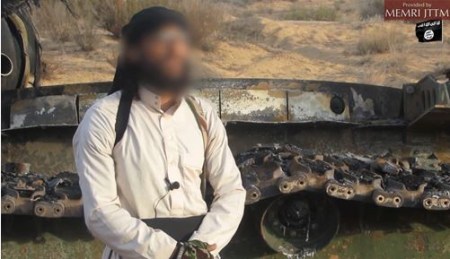
25737Abu Osama Al-Masri, prominent figure in ISIS’s Sinai Province

Endnotes:

[1] See MEMRI JTTM report ISIS Campaign: Encouraging Palestinians To Carry Out Lone Wolf Attacks, October 20, 2015.

[2] Other examples of recent coordinated campaigns by ISIS’s propaganda machine include a campaign against Muslim emigration to Europe in light of the refugee crisis, and a campaign calling on Somali jihadi members of Al-Shaba Al-Mujahideen to join ISIS.

[3] See MEMRI JTTM report In New Message Following Being Declared A ‘Caliph,’ Islamic State Leader Abu Bakr Al-Baghdadi Promises Support To Oppressed Muslims Everywhere, Tells His Soldiers: ‘You Will Conquer Rome’, July 1, 2014.

[4] See MEMRI JTTM report In New Audio Speech, Islamic State (ISIS) Leader Al-Baghdadi Issues Call To Arms To All Muslims, May 14, 2015.

[5] See MEMRI JTTM report ISIS Spokesman Reiterates Islamic State’s Steadfastness Against Coalition Campaign, Calls For Jihad Against Russia, Confirms Death Of Top ISIS Figure, October 13, 2015.

[6] See, for example, tweet by Salafi cleric Abu Muhammad Al-Maqdisi. Twitter.com/imaqdese, October 15, 2015.

[7] The comments were featured in a video posted on jihadi message boards. Al-Jazeera, April 26, 2006.

[8] The expression “the guiding Koran and the victorious sword” that Zarqawi cited is taken from the writings of 14th century Islamic thinker Ibn Taymiyyah. By quoting him in this context, Al-Zarqawi means that Jerusalem will be liberated by a jihadi organization that operates on the basis of a pure Salafi-jihadi ideology, thereby rejecting the attitude of Arab nation states, secular nationalist movements such as the PLO, and the Muslim Brotherhood and particularly its Palestinian branch Hamas.

[9] Shamikh1.info, October 19, 2015.

[10] Shamikh1.info, October 20, 2015.

[11] Shamikh1.info, October 20, 2015.

[12] For an in-depth look at how ISIS views its Sinai Province, see MEMRI Inquiry and Analysis No. 1201, ISIS In Sinai Increases Military, Propaganda Pressure On Egypt, November 8, 2015. For Al-Baghdadi’s speech, see MEMRI JTTM, In New Audio Speech, Islamic State (ISIS) Leader Al-Baghdadi Issues Call To Arms To All Muslims, May 14, 2015.

[13] See MEMRI Inquiry & Analysis No. 999, Salafi-Jihadis In Sinai Call For Jihad Against Egyptian Military,  July 24, 2013.

[14] See MEMRI JTTM ISIS Sinai Province Promises To Bring Battle To Palestine, Calls Upon Muslims Everywhere To Kill Jews, November 1, 2015.

[15] See MEMRI JTTMISIS Sinai Threatens To Punish Egyptian Military For Operation Martyr’s Right, November 11, 2015.
What France and Europe Might Learn

November 15, 2015

What France and Europe Might Learn, The Gatestone Institute, Bassam Tawil, November 15, 2015

  • By constantly endorsing pro-Palestinian and anti-Israeli policies, France has obviously been seeking to appease Islamic countries. France seems convinced that such policies will keep Muslim terrorists from targeting French nationals and interests. The French are now in grave danger of mistakenly believing that the November 13 attacks occurred because France did not appease the Muslim terrorists enough.
  • When the terrorists see that pressure works — increasing the pressure should work even more!
  • The French and Europeans would do well to understand that there is no difference between a young Palestinian who takes a knife and sets out to murder Jews, and an Islamic State terrorist who murders dozens of innocent people in Paris.
  • The reason Muslim extremists want to destroy Israel is not because of the settlements or checkpoints it is because they believe that Jews have no right to be in the Middle East whatsoever. And they want to destroy Europe because they believe that Christians — and everyone — have no right to be anything other than Muslim.
  • The terrorists attacking Jews also seek to destroy France, Germany, Britain and, of course, the United States. These countries need to be reminded that the Islamist terrorists’ ultimate goal is to force all non-Muslims to submit to Islam or face death.

Earlier this year, France was one of eight countries that supported a Palestinian resolution at the United Nations Security Council, calling for a full Israeli withdrawal to the pre-1967 lines by the end of 2017.

This vote means that France supports the establishment of an independent Palestinian state, likely to be ruled by the same type of people who on Friday carried out the most grisly terror attacks in France since World War II.

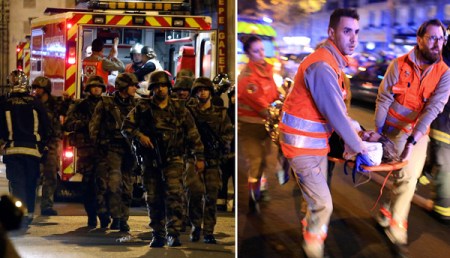
1347Scenes from Friday’s grisly terror attacks in Paris.

Today, every Palestinian child knows that in the best case, a future Palestinian state will be run by Hamas or Islamic Jihad, and in the worst case by the Islamic State and its affiliates. Has it occurred to anyone in Europe that the Palestinian people might not want to live under the rule of any of the groups, any more than Europeans would?

France and the rest of the EU countries have long been working against their own interests in the Middle East. By constantly endorsing pro-Palestinian and anti-Israeli policies, France has obviously been seeking to appease the Arab and Islamic countries. France seems convinced that such policies will keep Muslim terrorists from targeting French nationals and interests. That is probably why the French have made the catastrophic mistake of believing that the policy of appeasement toward Arabs and Muslims would persuade the Islamist terrorists to stay away from France. The French are now in grave danger of mistakenly believing that the November 13 attacks occurred because France did not appease the Muslim terrorists enough.

Sadly, the two earlier terrorist attacks that took place in Paris this year — against the Charlie Hebdo satirical newspaper and the HyperCacher Jewish supermarket — failed to convince the French that the policy of appeasement towards Arabs and Muslims is not only worthless, but also dangerous.

Instead of learning from these previous mistakes and embarking on a new policy toward the Israeli-Palestinian conflict in general and extremist Islam in particular, the French continued with their strategy of appeasement even after the Charlie Hebdo and the HyperCacher supermarket attacks.

Most recently, France voiced its backing for EU plans to label products from Israeli settlements, doubtless thinking that such a move would make the Muslim terrorists happy with the French. But, as last Friday’s terrorist attacks showed, the Islamic State and its supporters are not particularly impressed by anti-Israel moves.

Muslim terrorists do not care about the settlements. For them, that is a trivial issue compared to their chief goal and dream: truthfully, to kill all infidels and establish an Islamic empire. The Muslim terrorists who have been murdering Jews in Israel and other parts of the world also seek to kill anyone they perceive as being friends of Western values in general. These include, above all, Christians — either those unfortunate enough still to be living in the Middle East, but also those living in France and other Western countries.

The reason Muslim extremists want to destroy Israel is not because of the settlements or checkpoints. They want to destroy Israel because they believe that Jews have no right to be in the Middle East whatsoever. And they want to destroy Europe because they believe that Christians — and everyone — have no right to be anything other than Muslim. That is also why Muslims seem not particularly interested in the EU’s decision to label products from Israeli settlements. It is worth noting that the decision to label Israeli goods was not even an Arab or Islamic initiative.

The EU’s decision to boycott products from Israeli settlements has sent entirely the wrong message to the enemies of Israel and the enemies of Western values. These enemies of the West see the decision to label products as just the first step toward labeling all of Israel as an “illegal settlement.” It is no surprise that the first to celebrate the decision were Hamas and Islamic Jihad.

What France and other Western countries do not understand is that concessions and gestures are being misinterpreted by the terrorists as signs of weakness, which just invite more violence. When the terrorists see that pressure works, increasing the pressure should work even more!

The European boycotts are seen by the people here as nothing but cynical and heartless — attempts to court a thieving leadership at the expense of the people. The boycotts are seen here as nothing but keeping the Palestinian people in the grip of its corrupt leadership and prompting us to take another look at the extremists — the only choice offered up.

What the Europeans might have learned is that the assaults in Paris are what all of us here — Muslims, Christians and Jews — have been living with for decades.

During the past 22 years, all Israel’s territorial concessions and goodwill gestures have resulted only in increased terrorism against Israel, including us Arabs. Many Palestinians incorrectly saw the Israeli withdrawal from the Gaza Strip in 2005 only as a retreat and a sign of weakness. If shooting at Jews made them leave Gaza — as it appeared — keep shooting at Jews. The result was that Hamas took credit for driving the Jews out of the Gaza Strip with rockets and suicide bombings, and quickly rose to power.

In the same manner, each time Israel has released Palestinian prisoners (including dozens with blood on their hands) as a gesture to Palestinian Authority President Mahmoud Abbas or U.S Secretary of State John Kerry, the Palestinians regarded the gesture as having their demands met. So the next step is to increase the violence and demand more. The Palestinians saw Israel’s withdrawal from southern Lebanon and Gaza, and the release of Palestinian prisoners, not as a sign that Israel was interested in peace and calm, but as a reward for terrorism.

Two months ago, France took another step in appeasing the Arabs and Muslims. This time, the French voted in favor of raising a Palestinian flag at the UN headquarters. “This flag is a powerful symbol, a glimmer of hope for the Palestinians,” UN French Ambassador Francois Delattre said. Again, the French apparently thought that the vote would satisfy the Arabs and Muslims and persuade the terrorists that France was on their side in the fight against Israel.

France’s — and Europe’s — flawed policy toward the Israeli-Palestinian conflict did not start in the past year or two. Four years ago, France voted in favor of granting the Palestinians full membership of the UN’s Educational Scientific and Cultural Organization (UNESCO). Last month, the Palestinian Authority leadership unsuccessfully tried to use UNESCO to pass a resolution declaring the Western Wall a holy site for Muslims only. The resolution was changed at the last minute into one just condemning Israel, but instead of opposing the resolution, an embarrassed France chose to abstain. UNESCO, however, did vote that two ancient Jewish heritage sites symbolic of the Biblical era, Rachel’s Tomb and the Cave of the Patriarchs, would henceforth be known as Muslim heritage sites. The same week, another Biblical site, Joseph’s Tomb, was set on fire (for the second time; the first was in 2000) by people whose government, the Palestinian Authority, had agreed to protect it.

For the past few weeks, Palestinians have been waging a new wave of terrorism against Israelis. This time, the Palestinians are using rifles, knives, stones and cars to murder as many Jews as possible. But we still have not heard any real condemnation — from France, Europe or anyone — of the Palestinian terrorism.

We have also not heard France or other EU countries demand that President Mahmoud Abbas condemn the terrorist attacks against Israelis. Most French media outlets and journalists have even refused to refer to the Palestinian assailants as terrorists — despite many of the terrorists being affiliated two Palestinian groups that share the same ideology as Islamic State: Hamas and Islamic Jihad.

By failing to condemn the terrorist attacks against Israelis and name the perpetrators for what they are — ruthless murderers and terrorists — France and Western countries are once again sending the wrong message to the Islamists: that killing Jews is not an act of terrorism.

What these countries do not realize is that the terrorists who are attacking Jews also seek to destroy France, Germany, Britain and, of course, the “Big Satan” (the United States). These countries need to be reminded every day that the Islamist terrorists’ ultimate goal is to force all non-Muslims to submit to Islam or face death. Sometimes, the terrorists do not even have the patience to offer this choice to the “infidels,” and just kill them while they are watching a concert or a soccer match.

It now remains to be seen whether the French will wake up and realize that radical Islam is at war with the “unbelievers” and all those who refuse to accept the dictates of Islamic State and other Muslim extremists. This is a war that Israel has been fighting now for more than two decades, but, sadly, with little support — and most often with venomous obstruction — from countries in Europe, including France.

The French and Europeans would do well to understand that there is no difference between a young Palestinian who takes a knife and sets out to murder Jews, and an Islamic State terrorist who murders dozens of innocent people in Paris. Once the French and other Europeans understand this reality, it will be far easier for them to engage in the battle against Islamic terrorism.

Terrorist Kills Two Israelis as Palestinian Incitement Continues to Spread

November 13, 2015

Terrorist Kills Two Israelis as Palestinian Incitement Continues to Spread, Investigative Project on Terrorism, November 13, 2015

A Palestinian terrorist shot and killed a father and son, wounding another youth in the south Mount Hebron region on Friday after firing at their vehicle, the Jerusalem Post reports.

The Israeli military is searching for the gunmen.

Hamas glorified the “heroic” murders without claiming responsibility. Moreover, Palestinian sources told the Jerusalem Post that people are handing out candy in the streets in Gaza to celebrate the terrorist attack.

In the past few months, Fatah-run TV has regularly broadcast a famous Palestinian song that encourages violence against Jews, reports Palestinian Media Watch (PMW). Other popular incitement songs are being played in Ramallah’s streets, specifically calling for Palestinians to riot, throw rocks, and attack innocent Israelis with “cleavers and knives.”

“The owner of the stall selling discs on Al-Irsal Street [in Ramallah] said that the discs of national songs make up 90% of his sales at the moment because the prevailing national sentiment causes people to buy them… From another stall near the El-Bireh cultural center the song ‘I come out to you, my enemy, from every home, neighborhood and street’ is heard,” according to a Nov. 2 article in the Palestine National Authority daily Al-Hayat Al-Jadida and translated by PMW.

That song was posted on Fatah’s official Facebook page last November, shortly after terrorists killed five Israelis in a Jerusalem synagogue, using butchers’ knives and firearms. Last month, Rabbi Yehiel Rothman succumbed to wounds inflicted almost a year after the attack.

These latest examples demonstrate that Mahmoud Abbas’ Fatah party and official Palestinian Authority institutions continue to fuel violent incitement against Jews and Israelis, which in turn is promoted broadly by Palestinian society.

Since the beginning of October, Palestinians have waged a violent uprising targeting innocent Israelis and security personnel in a wave of stabbing, vehicular, rock throwing, and Molotov cocktail attacks. The violence has killed 11 Israelis and injured numerous others. Nearly 80 Palestinians also have been killed as a result – many of whom were alleged attackers killed at the scene, while others died during confrontations with Israeli soldiers.

Turkey’s Stockholm Syndrome

November 8, 2015

Turkey’s Stockholm Syndrome, The Gatestone InstituteBurak Bekdil, November 8, 2015

(Please see also, Obama’s favorite Muslim dictatorships. — DM)

  • AKP supporters celebrated their victory on November 1 with chants of “Allahu Akbar” [“Allah is the greatest”], an Islamist slogan, indicating that for them the political race in Turkey is in fact a “religious war.”
  • The Turkish “Sultan wannabe” runs an empire of fear. The November 1 vote will only help make him even more despotic.
  • A recent study found that only a quarter of Turks were NOT afraid of Erdogan. According to the research, even some of his own supporters are afraid of him.
  • “The rapidly diminishing choice of media outlets and restrictions on freedom of expression in general impacted the process and remain serious concerns.” — Ignacio Sanchez Amor, Organization for Security and Co-operation in Europe
  • The AKP’s setback in last June’s elections was because some nationalists disapproved of the AKP’s peace process with the Kurdish minority. In July, the government scrapped the peace process and ordered the military relentlessly to bomb the strongholds of militant Kurds in northern Iraq.

Once again, after a brief pause, political Islam has won in Turkey. President Recep Tayyip Erdogan’s Islamist party, the Justice and Development Party (AKP), earned nearly one out of every two votes in the renewed parliamentary elections on November 1. The AKP won more than 4.8 million new votes since the June 7 elections, in which it had lost its parliamentary majority for the first time since it came to power in 2002. The November 1 election gave the AKP a mandate to rule until 2019; by then Turkey’s Islamists will have been in power uninterruptedly for 17 years. There are happy smiles on the faces of half the Turks.

The AKP’s unexpected landslide victory can be explained in numbers. The party won by 9 percentage points more on Nov. 1 than on June 7, just five months before. How did this happen?

  1. The nationalist party, MHP, shares more or less the same voter base with the AKP. Votes often go from one to the other. In the June election, some AKP votes shifted to the MHP, which won 16.3% of the national vote. This was because some nationalists disapproved of the AKP’s peace process with the country’s restive Kurdish minority. After a new spiral of violence started in July, the government scrapped the peace process and ordered the military relentlessly to bomb the strongholds of militant Kurds in northern Iraq. With the AKP boasting its newfound nationalist spirit, the MHP lost 4.1 percentage points on Nov. 1, all of which apparently went to the AKP.
  2. The summer-long violence between the autonomy-seeking Kurdish fighters and the Turkish military, which has killed hundreds, apparently wore down Kurds with more loyalist sentiments to Turkey, and caused a shift of votes at the magnitude of 1.4 percentage points from a pro-Kurdish party to the AKP.
  3. Two splinter Islamist and nationalist parties that won 2% of the vote on June 1 disappeared from the political scene, winning just a combined 0.5% on November 1. From them the AKP earned another 1.5 percentage points.
  4. In the face of President Recep Tayyip Erdogan’s lavish, expensive palace, new private jets, extravagant spending of public funds; his assertive intervention in party politics (he must remain non-partisan, according to the Turkish constitution), and growing allegations of corruption and nepotism, some traditionally AKP voters abstained from voting on June 7. Typically, half of those who abstained in June were AKP voters. Apparently, they returned to the ballot box in November, earning the AKP another good 2 percentage points (the turnout rate was nearly 4 percentage points higher in November than in June).

All of this makes exactly 9 percentage points: the difference between what the Islamists got in June and November. That is worrying for everyone in the civilized (and shrinking) parts of Turkey — and the world. AKP fans celebrated their victory on November 1 with chants of “Allahu Akbar” [“Allah is the greatest”], an Islamist slogan, indicating that for them the political race in Turkey is in fact a “religious war.” The only non-Turkish flags at the celebrations were the Palestinian and Ottoman. It is worrying that the party that won half of the national vote celebrates with religious slogans and Palestinian and Ottoman flags.

True, even if there is not yet credible evidence of vote-rigging, the election campaign was totally unfair to the opposition. Erdogan and the AKP massively used a powerful pro-government media machine, including the state broadcaster and a semi-official news agency.

“While Turkish citizens could choose between genuine and strong political alternatives in this highly polarized election, the rapidly diminishing choice of media outlets and restrictions on freedom of expression in general impacted the process and remain serious concerns,” said Ignacio Sanchez Amor, the special coordinator and leader of the short-term observer mission of the Organization for Security and Co-operation in Europe.

The head of the delegation from the Parliamentary Assembly of the Council of Europe, Andreas Gross, said: “Unfortunately, the campaign for these elections was characterized by unfairness and, to a serious degree, fear.”

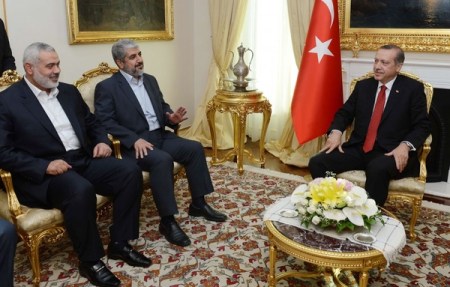
In fact, one could easily understand how democratic and fair the Turkish election campaign was from the words of Khaled Mashaal, head of Hamas’s political bureau. He called both Erdogan and his prime minister, Ahmet Davutoglu, to convey the Palestinian group’s congratulations on Turkey’s “democratic electoral environment.”

826 (1)Turkish President (then Prime Minister) Recep Tayyip Erdogan, right, meeting with Hamas leaders Khaled Mashaal (center) and Ismail Haniyeh on June 18, 2013, in Ankara, Turkey. Mashaal, last week called Erdogan to convey Hamas’s congratulations on Turkey’s “democratic electoral environment.” (Image source: Turkey Prime Minister’s Press Office)

In a way, this is Turkey’s Stockholm Syndrome. A recent study found that only a quarter of Turks were NOT afraid of President Erdogan. As many as 68.5% said they were afraid of the president. It is interesting to note that according to the findings of this research, even some of his own supporters are afraid of him: If Erdogan’s supporters make up 50% of Turkey and those who say they are afraid of him stand at 68.5%, this means a good 18.5% of his own supporters are also afraid of him.

The Turkish “Sultan wannabe” runs an empire of fear. The November 1 vote will only help make him even more despotic.