Archive for the ‘GITMO’ category

Where Have All the “Good Boys” Gone?: Effective Handling of Captured Terrorists

April 28, 2016

Where Have All the “Good Boys” Gone?: Effective Handling of Captured Terrorists, Investigative Project on Terrorism, Patrick Dunleavy, April 28, 2016
133

Captured terror suspect Salah Abdeslam now sits in an isolated cell inside a French maximum security prison. Before his extradition from Belgium this week, the individual responsible for the recent terror attacks in both Paris and Brussels that killed over 150 people was known to prison officials as a model inmate and is being called “a very good boy.”

This is not the first time a captured Islamist terrorist received this type of description. In 2013, Indiana U.S. District Court Judge Jane Magnus-Stinson lauded the prison behavior of John Walker Lindh. Lindh, also known as the “American Taliban,” is serving a 20-year sentence after he was captured by American forces in 2001 fighting alongside the jihadists in Afghanistan. He also carried an explosive device and was believed by many to be partly responsible in the death of a CIA Operations Officer named Johnny Micheal Spann. Spann was killed in 2001 when inmates in the Qali-Jangi prison at Mazar-e Sharif started a riot at the fortress in Afghanistan.

The riot occurred the same day Lindh was interviewed by Spann and another CIA officer. Some felt strongly that Lindh purposely withheld information he had regarding the pending prison revolt.

Appearing before Judge Magnus-Stinson, Lindh requested lightening some conditions of his confinement. The Bureau of Prisons opposed the changes, saying it believed Lindh remained a security risk.

The judge saw it differently, finding that although Lindh was convicted of the terrorist acts, “His scant, nonviolent disciplinary history during his incarceration has merited him a classification of low security.”

In other words becoming “jail wise” can make you less of a threat to the United States. The term has become synonymous with inmates who have learned to work the system to their advantage by outwardly appearing to be compliant to prison rules without ever changing their criminal nature.

They don’t call them “cons for nothing.

We know that Lindh did not attend any de-radicalization program specifically designed to treat radical Islamists because there is none in the United States prison system. What then of the terrorists incarcerated at Guantanamo Bay? As the administration pursues a policy of closing the prison at any cost, we find ex-detainees being sent to dubious locations.

Earlier this month, nine inmates were transferred from GITMO to Saudi Arabia. What awaits them there? The Saudis have a de-radicalization program that would be the envy of most captured jihadists.

Located at the al-Ha’ir prison outside of Riyadh, inmates can look forward to lavender walls, red carpet, queen size beds, a refrigerator, television and private showers. There is even an ATM so inmates can draw from their commissary accounts which the government replenishes every month. Married inmates are entitled to monthly conjugal visits with fresh linens, tea, and sweets provided on the nightstand.

The Wahhabi/Salafist teachings prominent in Saudi Arabia allow men to have up to four legitimate wives, so inmates can actually get a wife to visit once a week. The de-radicalization philosophy there is to see the terrorists as misguided, or simply suffering from an ideological sickness which can be easily corrected with the proper treatment. Sounds simple and extravagant.

No wonder terrorists are calling for the closing of the Guantanamo prison. They want to go to the Islamic version of Disneyland.

Yet even with all these perks, a very real threat of recidivism remains which the Saudis have had to face. Several graduates of the program have gone on to become suicide bombers right there in Saudi Arabia. Others returned to the battlefield in countries outside the kingdom.

Recent events both in Europe and the United States raise legitimate questions as to how best to handle terrorists once they are captured and incarcerated. Several terrorists in both the Brussels and Paris attacks had spent time in prison where they were radicalized by other jihadists. Authorities neglected to have an adequate post-release program in place to monitor those getting out of prison. After all, as far back as 10 years ago, French intelligence officials knew they had a serious problem with Islamic radicalization in the prison system. They also knew that the main radicalizing influence was by those already incarcerated for terrorist acts or providing material support for terrorists.

Officials in the United Kingdom have known for years that they had a problem, not only with radicalized inmates, but also with clergy who made things worse. Some Islamic prison clergy provided literature to inmates that espoused a strict Wahhabi-Salafist form of the religion. This not only led to more inmates being exposed to radical Islamist ideology, but it also created a form of extortion and intimidation, as shariah law was imposed on whole cell blocks.

Again, no effective post-release program was created so authorities could gauge whether released inmates were de-radicalized or continuing down the path of a committed jihadist.

The United States faces a similar problem with the pending release of a large number of convicted terrorists after years of incarceration. The Justice Department acknowledges we are not prepared to release them. No established de-radicalization or rehabilitation program is in place to deal with those individuals. The DOJ identifies three distinct groups of incarcerated international terrorists: those convicted of actual terrorism like 1993 World Trade Center bombers El Sayyid Nosair, Ramzi Yousef, etc.; those whose convictions included a nexus to terrorism like financing and support; and perhaps the most enigmatic, are those inmates whose conduct during their time in prison was connected to terrorism.

A recent example involves David Wright and Nicholas Rovinski, who were arrested in Boston last June and charged with providing material support for ISIS. Roviniski was still able to communicate with Wright through letters sent from the jail. Rovinski wrote to Wright last August, describing ways to continue their plans to take “down the United States government and decapitate non-believers,” prosecutors allege in a superseding indictment. This is not the first time a terrorist in prison was able to send letters out to other terrorists.

Mohammed Salameh, convicted in the 1993 World Trade Center bombing and incarcerated in the maximum security federal prison in Florence, Col. managed to smuggle letters out to Mohamed Acraf. Acraf was one of the individuals responsible for the 2004 train bombing in Madrid, Spain that killed 200 people. This glaring security leak was outlined in a report by the Inspector General’s Office which stated the Bureau of Prisons “is unable to effectively monitor the mail of terrorist and other high-risk inmates in order to detect and prevent terrorism and criminal activities.”

This would be the same IG office that also stated the BOP was unable to effectively vet Islamic clergy or religious volunteers entering the prisons.

Something has to be done to stop the leaks. Yes, terrorists go into prison, yet they are not rendered harmless. Terrorists also eventually complete their sentences and get out of prison. A study by the Centre on Religion and Geopolitics (CRG), found that 65 percent of Islamic terrorists spent time in prison during their careers.

It is therefore incumbent that there be a comprehensive strategy that deals not only with capturing radical Islamic terrorists but also effective confinement and post release monitoring. U.S. Rep. Stephen Fincher, R-Tenn., has sponsored H.R. 4285, which would tighten some of the security lapses now occurring in regard to terrorists in prison. For example, federal prison volunteers would be screened for connections to terrorism. This would be an effective first step in initiating the strategy. Legislating prison reform is nothing new.

Prison officials nationally routinely face federal mandates on how to operate. Failure to comply often leads to funding cuts. Perhaps it is time to tighten the purse strings until an effective counter-terrorism program for corrections is in place nationwide. The ultimate motivation should come from a steadfast desire to keep us safe from those committed to do us harm.
 

The GITMO Exodus

April 13, 2016

The GITMO Exodus, Front Page MagazineMatthew Vadum, April 13, 2016

gitmo_libyans_0

Despite warnings that Muslim terrorists remain a grave threat to the United States, President Obama gave two dangerous veteran jihadists at Guantanamo Bay get-out-of-jail-free cards earlier this month.

Emptying out Guantanamo is a longtime goal of Obama. Shuttering the terrorist detention facility located on U.S.-held territory in Cuba has been a goal of President Obama, going back at least to the campaign trail in 2008. He wants to close the prison camp and unleash the worst of the worst among Islamic terrorists, allowing them to wreak havoc and kill more Americans. Violent Muslim militants are merely misunderstood people from a foreign culture, in Obama’s view, and setting them free is just the right thing to do as he sees it.

Obama doesn’t give a farthing’s cuss about the prospect of these hardened terrorists returning to the glories of jihad-fighting after leaving Gitmo. Terrorists, freedom fighters — why quibble? They’re all more or less the same to the president.

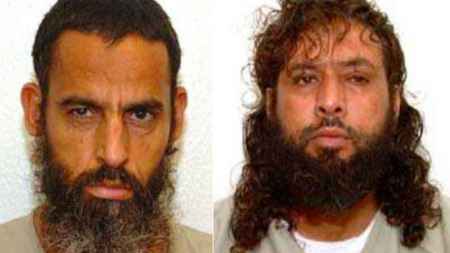
The first newly freed detainee, Salem Abdul Salem Ghereby (also known as Rafdat Muhammad Faqi Aljj Saqqaf, Falen Gherebi, and Salim Gherebi), a 55-year-old Libyan national, was transferred to Senegal on April 3.

Senegal, a French-speaking country on Africa’s western coast, also accepted Ghereby’s comrade-in-jihad, Omar Khalifa Mohammed Abu Bakr (also known as Omar Khalif Mohammed Abu Baker Mahjoub, Omar Mohammed Khalifh, and Omar Mohamad Khalifah), another Libyan national who is thought to be 43 or 44 years old.

Why Senegal? Perhaps because about 95 percent of Senegal’s up to 14 million inhabitants are Muslims.

Although Senegal “has shown no signs of jihadist terrorism” and its government has cracked down on terrorist financing and money laundering in the region, it is bordered by Islamist violence-plagued Mali and Mauritania. According to the American Foreign Policy Council, there are concerns that Senegal “presents a potential ‘backdoor’ for radical, jihadist Islam, which already exhibits a major presence in rapidly-changing North Africa.”

According to a 2008 Department of Defense report, Ghereby was a member of the Libyan Islamic Fighting Group (LIFG) also known as Al-Jama’a al-Islamiyyah al-Muqatilah bi-Libya, which is reportedly tied to al-Qaeda.

Ghereby had been an “explosives trainer and a veteran jihad fighter” who participated in hostilities against U.S. and coalition forces in Osama bin Laden’s Tora Bora Mountain complex in eastern Afghanistan. He was deemed to be only a “medium threat from a detention perspective” and of “medium intelligence value,” but was considered to be “high risk, as he is likely to pose a threat to the US, its interests, and allies[.]”

Like Ghereby, Bakr was deemed to present a “high risk” to U.S. interests but unlike Ghereby he was deemed “a high threat from a detention perspective” and is “of high intelligence value.”

“If released without rehabilitation, close supervision, and means to successfully reintegrate into his society as a law abiding citizen, it is assessed detainee would immediately seek out prior associates and reengage in hostilities and extremist support activities,” according to the DoD. Bakr mostly behaved himself in custody but he “has threatened to kill US personnel on several occasions.”

Bakr, who has “extensive explosives knowledge” according to the Pentagon, admits to being a member of LIFG and was identified as “commander of a militant training camp and acknowledged serving as trainer.” He was also identified as an “arms dealer who provided support to [Osama bin Laden] in Sudan” and was determined to have been active in a cell that planned improvised explosive device (IED) attacks against U.S. and coalition forces.

Three months ago Obama released admitted al-Qaeda member and IED maker Tariq Mahmoud Ahmed Al Sawah, a Bosnian, who was shipped off to Bosnia. “These IEDs included the limpet mine to sink US naval vessels and the prototype for the shoe bomb used in a failed attack on a civilian transatlantic flight,” the DoD reported.

Another bomb maker, Abd al-Aziz Abduh Abdallah Ali al-Suwaydi, a Yemeni, was transferred to Montenegro.

Obama, who will return to private life in nine months blithely told Yahoo! News in December that “only a handful” of Gitmo detainees had returned to the battlefield. Actually, the number was 196 as of July 2015, according to the Office of the Director of National Intelligence (ODNI). The 196 figure represents 30 percent of the 653 detainees removed from Gitmo who were confirmed or suspected of returning to the battlefield.

President Obama continues to delude himself, claiming that Gitmo’s continuing existence is the jihadist equivalent of waving a red cape at a bull.

“I am absolutely persuaded, as are my top intelligence and military advisers, that Guantanamo is used as a recruitment tool for organizations like ISIS, and if we want to fight ’em, then we can’t give ’em these kinds of excuses.”

But whose excuses is Obama talking about?

He is the one serially lying and making up excuses to justify releasing his jihadi soulmates. As the Weekly Standard notes, “Guantanamo rarely appears in jihadist propaganda, whether ISIS or al Qaeda, and reviews of recent propaganda materials from ISIS and al Qaeda – online videos and audio recordings, glossy magazines, etc. – found very few mentions of the facility.”

None of this should shock Obama-watchers. He doesn’t like letting facts get in the way of the radical left-wing narrative.

Cartoon of the day

June 17, 2015
Obama Gitmo

Pentagon spokesman portrays Guantanamo recidivism as a good thing

February 12, 2015

Pentagon spokesman portrays Guantanamo recidivism as a good thing, Long War Journal, Bill Roggio, February 11, 2015

Rear Admiral Kirby is not trying to be satirical. Or is he?– DM)

Yesterday, Pentagon Press Secretary Rear Admiral John Kirby cast a positive light on jihadists from the Taliban and al Qaeda who have been released from Guantanamo and have returned to wage jihad. The topic came up in the discussion of an airstrike that killed Mullah Abdul Rauf Khadim, a senior Taliban commander who was detained at Guantanamo from 2001 to 2007, released to Afghan custody and freed in 2009, and returned to the Taliban shortly afterward to assume the role of a senior military commander up until his defection to the Islamic State earlier this year. Below is the exchange, from the Pentagon’s transcript:

Q: Why was he released?REAR ADM. KIRBY: Joe, I don’t have the records on this guy from — from Guantanamo Bay.

Yes, he was a detainee. He was released in 2007. He was released to Kabul.

The other thing that we’ve said — and this is another great example, because we had a long, you know, discussion not too long ago about the — the recidivism and particularly the issue of this — this one individual who reengaged there in Qatar, and we said that they return to the battlefield and to the fight at their own peril. Mr. Kadim is proof of that.

Kirby’s statement that Khadim’s death should be viewed as a positive is cold comfort to the hundreds of Afghans, Americans, and Coalition personnel who were killed while Khadim commanded forces in southern Afghanistan. The jihadist was able to operate for more than six years as a top level Taliban commander and has the blood of thousands on his hands.

Khadim and Mullah Zakir, another Guantanamo alum (who is still alive; he “resigned due to ill health,” according to the Taliban) were responsible for implementing the Taliban’s counter-surge strategy. While the the jihadist group failed to halt Coalition and Afghan forces’ gains in the south from 2009 to 2011 (gains which are now melting away), at least 875 Coalition members were killed during the fighting in Kandahar (273 killed) and Helmand (602 killed) during that time period, according to iCasualties (note, data on Coalition members killed by province after 2011 is not available on the iCasualties website). The number of Afghan security personnel and civilians killed in Kandahar and Helmand by the Taliban during that timeframe is not available, but is likely in the thousands.

Despite this, Kirby doubles down and says Guantanamo should be closed, which means even more jihadists will be freed.

Q: After seeing such example, like former Guantanamo detainee who was released and went back to the — to work with the Taliban, is the Pentagon still convinced that Guantanamo should be closed?REAR ADM. KIRBY: Yes. The Pentagon’s position is that the detainee facility should be closed. Secretary Hagel has made that clear on any number of occasions. There’s no change to that.


