Archive for the ‘Germany open borders’ category

Germany Confiscating Homes to Use for Migrants

May 14, 2017

Germany Confiscating Homes to Use for Migrants, Gatestone InstituteSoeren Kern, May 14, 2017

(It’s like watching a corpse rot. Perhaps it’s time to bury it. — DM)

In an unprecedented move, Hamburg authorities confiscated six residential units in the Hamm district near the city center. A trustee appointed by the city is now renovating the properties and will rent them — against the will of the owner — to tenants chosen by the city. District spokeswoman Sorina Weiland said that all renovation costs will be billed to the owner of the properties.

Similar expropriation measures have been proposed in Berlin, the German capital, but abandoned because they were deemed unconstitutional.

Some Germans are asking what is next: Will authorities now limit the maximum amount of living space per person, and force those with large apartments to share them with strangers?

Authorities in Hamburg, the second-largest city in Germany, have begun confiscating private dwellings to ease a housing shortage — one that has been acutely exacerbated by Chancellor Angela Merkel’s decision to allow more than two million migrants into the country in recent years.

City officials have been seizing commercial properties and converting them into migrant shelters since late 2015, when Merkel opened German borders to hundreds of thousands of migrants from Africa, Asia and the Middle East. Now, however, the city is expropriating residential property units owned by private citizens.

In an unprecedented move, Hamburg authorities recently confiscated six residential units in the Hamm district near the city center. The units, which are owned by a private landlord, are in need of repair and have been vacant since 2012. A trustee appointed by the city is now renovating the properties and will rent them — against the will of the owner — to tenants chosen by the city. District spokeswoman Sorina Weiland said that all renovation costs will be billed to the owner of the properties.

The expropriation is authorized by the Hamburg Housing Protection Act (Hamburger Wohnraumschutzgesetz), a 1982 law that was updated by the city’s Socialist government in May 2013 to enable the city to seize any residential property unit that has been vacant for more than four months.

The forced lease, the first of its kind in Germany, is said to be aimed at pressuring the owners of other vacant residences in the city to make them available for rent. Of the 700,000 rental units in Hamburg, somewhere between 1,000 and 5,000 (less than one percent) are believed to be vacant, according an estimate by the Hamburg Senate.

HAMBURG, GERMANY – FEBRUARY 15: A view of the city of Hamburg with the ‘St. Michaelis Church’ on February 15, 2017 in Hamburg, Germany.  (Photo by Morris MacMatzen/Getty Images)

Socialists and Greens in Hamburg recently established a “hotline” where local residents can report vacant properties. Activists have also created a website — Leerstandsmelder (Vacancy Detector) — to identify unoccupied real estate in Hamburg and other German cities.

It remains unclear why the landlord in Hamm left his apartments vacant for more than five years. Some have posited that, given the location of the properties, the renovation costs may have been too high and probably would not have been offset by the rental income.

Others are blaming city officials for not approving more building permits to allow for the construction of new residential units. A study conducted in 2012 — well before the migrant crisis reached epic proportions — forecast that by 2017, Hamburg would have a deficit of at least 50,000 rental properties.

In 2016, however, only 2,433 new residential units came onto the market, while only 2,290 new building permits were approved, according to statistics provided by the City of Hamburg. These numbers were up slightly from 2,192 new units and 2,041 new permit approvals in 2015.

In 2012, Hamburg’s Socialist government presented a plan to build 6,000 new residential units per year. The plan never materialized, however, because prospective builders were constricted by government-imposed rental caps which would have made it impossible for them to even recover their construction costs.

Since then, the city has turned to seizing private property to resolve its self-inflicted housing crisis.

On October 1, 2015, the Hamburg Parliament (Hamburgische Bürgerschaft) approved a new law that allows the city to seize vacant commercial real estate (office buildings and land) and use it to house migrants.

City officials said the measure was necessary because, at the time, more than 400 new migrants were arriving in Hamburg each day and all the existing refugee shelters were full. They said that because the owners of vacant real estate refused to make their property available to the city on a voluntary basis, the city should be given the right to take it by force.

The measure was applauded by those on the left of the political spectrum. “We are doing everything we can to ensure that the refugees are not homeless during the coming winter,” said Senator Till Steffen of the Green Party. “For this reason, we need to use vacant commercial properties.”

Others have argued that efforts by the state to seize private property are autocratic and reek of Communism. “The proposed confiscation of private land and buildings is a massive attack on the property rights of the citizens of Hamburg,” said André Trepoll of the center-right Christian Democratic Union (CDU). “It amounts to an expropriation by the state.” He said the proposed measure is a “law of intimidation” that amounts to a “political dam-break with far-reaching implications.” He added: “The ends do not justify any and all means.”

Katja Suding, the leader of the Free Democrats (FDP) in Hamburg, said that the proposed law is an “unacceptable crossing of red lines… Such coercive measures will only fuel resentment against refugees.”

Similar expropriation measures have been proposed in Berlin, the German capital, but abandoned because they were deemed unconstitutional.

In November 2015, lawmakers in Berlin considered emergency legislation that would have allowed local authorities to seize private residences to accommodate asylum seekers. The proposal would have authorized police forcibly to enter private homes and apartments without a warrant to determine their suitability as housing for refugees and migrants.

The legislation, proposed by Berlin Mayor Michael Müller of the center-left Social Democrats (SPD), would have amended Section 36 of Berlin’s Public Order and Safety Law (Allgemeine Gesetz zum Schutz der öffentlichen Sicherheit und Ordnung, ASOG), which currently allows police to enter private residences only in extreme instances, to “avert acute threats,” that is, to fight serious crime. Müller wanted to expand the scope for warrantless inspections to include “preventing homelessness.”

The proposal was kept secret from the public until the leader of the Free Democrats (FDP) in Berlin, Sebastian Czaja, warned the measure would violate the German constitution. He said:

“The plans of the Berlin Senate to requisition residential and commercial property without the consent of the owner to accommodate refugees is an open breach of the constitution. The attempt by the Senate to undermine the constitutional right to property and the inviolability of the home must be resolutely opposed.”

Since then, both the mayor’s office and the Senate appear to have abandoned their plans.

Following an investigation, Gunnar Schupelius, a columnist with the Berlin newspaper BZ, wrote:

“A strange report made the rounds at the weekend: The Senate would authorize the police to enter private homes to house refugees, even against the will of the owner. I thought it was only satire, then a misunderstanding, because the Basic Law, Article 13, states: ‘The home is inviolable.’

“So I went on a search for the source of this strange report and found it. There is a ‘proposal’ which the Senate Chancellery (Senatskanzlei) has apparently circulated among the senators. The Senate Chancellery is another name for the mayor’s office. The permanent secretary is Björn Böhning (SPD)…

“The proposal is clear: The police can enter private property without a court order in order to search for housing for refugees when these are threatened with homelessness. You can do that ‘without the consent of the owner.’ And not only should the police be allowed to do this, but also the regulatory agencies.

“This delicate ‘proposal’ attracted little public attention. Only Berlin FDP General Secretary Sebastian Czaja spoke up and warned of an ‘open preparation for breach of the constitution.’ Internally, there should have been protests. The ‘proposal’ suddenly disappeared from the table. Is it completely gone or will it return?”

It remains unclear why no one has challenged the constitutionality of Hamburg’s expropriation law.

Meanwhile, some Germans are asking what is next: Will authorities now limit the maximum amount of living space per person, and force those with large apartments to share them with strangers?
Germany: Migrant Crime Spiked in 2016

May 2, 2017

Germany: Migrant Crime Spiked in 2016, Gatestone InstituteSoeren Kern, May 2, 2017

None of this seems to be having an impact on the German elections set for September 24, 2017. Polls show that if the election for German chancellor were held today, Angela Merkel, who is largely responsible for the migration crisis, would be re-elected with 37% of the vote. Martin Schulz, the Social Democrat candidate who has pledged to increase migration to Germany even further, would win 29% of the vote and the anti-immigration Alternative for Germany would win 8%. For now, German voters appear to believe that the alternatives to Merkel are all worse.

*****************************

Although non-Germans make up approximately 10% of the overall German population, they accounted for 30.5% of all crime suspects in the country in 2016.

Nearly 250,000 migrants entered the country illegally in 2016, up 61.4% from 154,188 in 2015. More than 225,000 migrants were found living in the country illegally (Unerlaubter Aufenthalt) in 2016.

The Berlin Senate launched an inquiry into why migrants disproportionally appear as criminals in the city-state compared to Germans.

An official annual report about crime in Germany has revealed a rapidly deteriorating security situation in the country marked by a dramatic increase in violent crime, including murder, rape and sexual assault.

The report also shows a direct link between the growing lawlessness in Germany and Chancellor Angela Merkel’s decision to allow in more than one million mostly male migrants from Africa, Asia and the Middle East.

The report — Police Crime Statistics 2016 (Polizeiliche Kriminalstatistik, PKS) — was compiled by the Federal Criminal Police Office (Bundeskriminalamt, BKA) and presented by Interior Minister Thomas de Maizière in Berlin on April 24.

The number of non-German crime suspects (nichtdeutsche Tatverdächtige) legally residing in Germany jumped to 616,230 in 2016, up from 555,820 in 2015 — an increase of 11% — according to the report. Although non-Germans make up approximately 10% of the overall German population, they accounted for 30.5% of all crime suspects in the country in 2016, up from 27.6% in 2015.

In this year’s report, the BKA created a separate subcategory called “migrants” (Zuwanderer) which encompasses a combination of refugees, pending asylum seekers, failed asylum seekers and illegal immigrants.

According to the BKA, the number of migrant crime suspects (tatverdächtiger Zuwanderer) in Germany in 2016 jumped to 174,438 from 114,238 in 2015 — up 52.7%. Although “migrants” made up less than 2% of the German population in 2016, they accounted for 8.6% of all crime suspects in the country — up from 5.7% in 2015.

In terms of non-German crime suspects residing legally in Germany, Turks were the primary offenders in 2016, with 69,918 suspects, followed by Romanians, Poles, Syrians, Serbs, Italians, Afghans, Bulgarians, Iraqis, Albanians, Kosovars, Moroccans, Iranians and Algerians.

In terms of migrant crime suspects, Syrians were the primary offenders, followed by Afghans, Iraqis, Albanians, Algerians, Moroccans, Serbs, Iranians, Kosovars and Somalis.

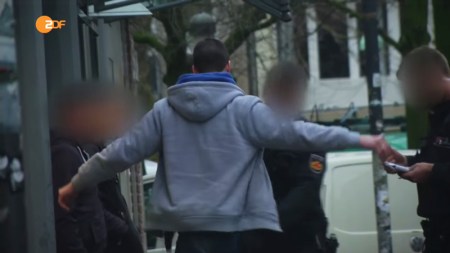
Police in Bremen, Germany frisk a North African youth who is suspected of theft. (Image source: ZDF video screenshot)

The report’s other findings include:

  • Violent crime surged in Germany in 2016. These include a 14.3% increase in murder and manslaughter, a 12.7% increase in rape and sexual assault and a 9.9% increase in aggravated assault. The BKA also recorded a 14.8% increase in weapons offenses and a 7.1% increase in drug offenses.
  • Non-German crime suspects committed 2,512 rapes and sexual assaults in Germany in 2016 — an average of seven a day. Syrians were the primary offenders, followed by Afghans, Iraqis, Pakistanis, Iranians, Algerians, Moroccans, Eritreans, Nigerians and Albanians. German authorities have repeatedly been accused of underreporting the true scale of the migrant rape problem for political reasons. For example, up to 90% of the sex crimes committed in Germany in 2014 do not appear in the official statistics, according to André Schulz, the head of the Association of Criminal Police (Bund Deutscher Kriminalbeamter, BDK).
  • Non-German crime suspects committed 11,525 robberies in Germany in 2016 — an average of 32 a day. Moroccans were the primary offenders, followed by Algerians, Syrians, Georgians, Tunisians, Albanians, Afghans, Serbs, Iraqis and Iranians.
  • Non-German crime suspects committed 56,252 aggravated assaults in 2016 — an average of 154 a day. Syrians were the primary offenders, followed by Afghans, Iraqis, Iranians, Moroccans, Algerians, Somalis, Albanians, Eritreans and Pakistanis.
  • Bavaria was the German state most affected by non-German criminality, followed by North Rhine-Westphalia, Baden-Württemberg, Hesse, Berlin, Lower Saxony, Rhineland-Palatinate, Saxony, Hamburg, Schleswig-Holstein, Saxony-Anhalt, Brandenburg, Mecklenburg-Vorpommern, Saarland, Bremen and Thüringen.
  • Berlin was the German city most affected by non-German criminality, followed by Munich, Hamburg, Frankfurt, Cologne, Düsseldorf, Hanover, Stuttgart, Dortmund, Bremen, Leipzig, Nürnberg, Essen, Duisburg, Mannheim, Karlsruhe, Dresden, Freiburg im Breisgau, Chemnitz, Aachen, Bielefeld, Wuppertal, Augsburg, Bonn, Bochum, Gelsenkirchen, Wiesbaden, Münster, Kiel, Halle, Krefeld, Braunschweig, Mainz, Lübeck, Mönchengladbach, Erfurt, Oberhausen, Magdeburg and Rostock.
  • The BKA also recorded 487,711 violations of German immigration laws (ausländerrechtliche Verstöße), up 21.1% from 402,741 violations in 2015. Nearly 250,000 migrants entered the country illegally in 2016, up 61.4% from 154,188 in 2015. More than 225,000 migrants were found living in the country illegally (Unerlaubter Aufenthalt) in 2016.

The new data contradicts claims made by the BKA in December 2016 — just four months before the current report — that migrant criminality was actually decreasing.

During a press conference in Berlin on April 24, Interior Minister Thomas de Maizière admitted:

“The proportion of foreign suspects, and migrants in particular, is higher than the average for the general population. This cannot be sugarcoated. There is an overall rise in disrespect, violence and hate. Those who commit serious offenses here forfeit their right to stay here.”

Separately, officials in Bavaria revealed that the number of crimes committed by asylum seekers and refugees there increased by 58% in 2016. They accounted for 9.6% of all crimes committed in the state, up from 3.2% in 2015 and 1.8% in 2012. Syrians were the primary offenders, followed by Afghans, Iraqis and Nigerians.

“The increase in crime in Bavaria in 2016 is mainly due to foreign suspects, especially immigrants,” said Bavarian Interior Minister Joachim Herrmann.

At the same time, officials in Baden-Württemberg noted a 95.5% increase in the number of physical assaults involving at least one migrant in 2016.

Meanwhile, the Berlin Senate launched an inquiry into why migrants disproportionally appear as criminals in the city-state compared to Germans. In 2016, 40% of all crime suspects in the German capital were non-Germans.

None of this seems to be having an impact on the German elections set for September 24, 2017. Polls show that if the election for German chancellor were held today, Angela Merkel, who is largely responsible for the migration crisis, would be re-elected with 37% of the vote. Martin Schulz, the Social Democrat candidate who has pledged to increase migration to Germany even further, would win 29% of the vote and the anti-immigration Alternative for Germany would win 8%. For now, German voters appear to believe that the alternatives to Merkel are all worse.

Dr. Jasser discusses Pres. Trump’s meeting with German Chancellor Merkel & Politico’s headline

March 18, 2017

Dr. Jasser discusses Pres. Trump’s meeting with German Chancellor Merkel & Politico’s headline, AFID and Fox News via YouTube, March 17, 2017

(Dr. Jasser contends that rather than the “leader of the free world” as referenced at Politico, Frau Merkel is the “undertaker of the free world”. Please see also, A Month of Islam and Multiculturalism in France: February 2017. — DM)

Germany’s New Propaganda Bureau

January 18, 2017

Germany’s New Propaganda Bureau, Gatestone InstituteJudith Bergman, January 18, 2017

“Considering the [upcoming] federal elections we must act very fast,” the officials urged in the memo, citing the need to combat “fake news.”

In other words, the Interior Ministry’s bureaucrats fear that Chancellor Angela Merkel will lose the elections in September 2017, and are willing to do whatever it takes to prevent that scenario, even if it means using (even more) federal authority to crack down on free speech by inventing an official state propaganda bureau. The current debate on “fake news” is a convenient excuse.

*********************

A married couple, Peter and Melanie M., were prosecuted and convicted in July 2016 of creating a Facebook group that criticized the government’s migration policy. Also, in July 2016, 60 people suspected of writing “hate speech” online had their homes raided by German police.

None of the above seems to be enough, however, for the president of the Bundestag, Norbert Lammert, from Angela Merkel’s CDU party, who believes that what Facebook is already doing against “hate speech” is not enough. According to the CDU politician, there is a need for more legislation.

The German government’s view of what constitutes “hate speech” is highly selective and appears limited to protecting the government’s own policies on immigration from legitimate criticism.

When massive antisemitism swept large German cities in the summer of 2014, for example, no such anti-racist zeal was manifest on the part of the German government. On the contrary, there were instances of authorities practically facilitating hate speech. In July 2014, Frankfurt police let mainly Muslim “protesters” use their van’s megaphone to belt out slogans of incitement in Arabic, including the repeated chanting of “Allahu Akbar” and that Jews are “child murderers”.

Firebombing a synagogue, on the other hand, is simply an “act of protest”.

Officials in Germany’s Interior Ministry are urging Interior Minister Thomas de Maizière to establish a “Defense Center against Disinformation” (Ab­wehr­zen­trum ge­gen Des­in­for­ma­ti­on) to combat what they call “political disinformation,” a euphemism for “fake news.”

“The acceptance of a post-truth age would amount to political capitulation,” the officials told Maizière in a memo, which also disclosed that the bureaucrats at the Interior Ministry are eager to see “authentic political communication” remain “defining for the 21st century.”

One wonders whether by “authentic political communication,” the officials of the Interior Ministry are referring to the way German authorities scrambled to cover up the mass sexual attacks on women on New Year’s Eve a year ago in Cologne? At the time, German police first claimed, surreally, on the morning of January 1, 2016, that the situation on New Year’s Eve had been “relaxed.” Cologne Police Chief Wolfgang Albers later dryly admitted, “This initial statement was incorrect.” Alternatively, perhaps they are referring to the decision of Germany’s public broadcaster, ZDF, not to report on the attacks until four days after they had occurred? Even a former government official, Hans-Peter Friedrich, Chancellor Angela Merkel’s Interior Minister from 2011 to 2013, accused the media at the time of imposing a “news blackout” and operating a “code of silence” over negative news about immigrants. How is that for “authentic political communication”?

2218

“Considering the [upcoming] federal elections we must act very fast,” the officials urged in the memo, citing the need to combat “fake news.”

In other words, the Interior Ministry’s bureaucrats fear that Chancellor Angela Merkel will lose the elections in September 2017, and are willing to do whatever it takes to prevent that scenario, even if it means using (even more) federal authority to crack down on free speech by inventing an official state propaganda bureau. The current debate on “fake news” is a convenient excuse.

Germany has, of course, been cracking down on free speech for quite a while now. Already in September 2015, Merkel said, “When people stir up sedition on social networks using their real name, it is not only the state that has to act, but also Facebook as a company should do something against these statements”.

Under a government program, which has enlisted the help of the German non-governmental organization, the Amadeu Antonio Foundation, led by Anetta Kahane (who has turned out, in a fine twist of irony, to be a former Stasi agent and informer) German authorities are monitoring how many supposedly “racist” posts reported by Facebook users are deleted within 24 hours. Justice Minister Heiko Maas has pledged to look at legislative measures if the results turn out to be “unsatisfactory”. The program is scheduled to run until March 2017.

A married couple, Peter and Melanie M., were prosecuted and convicted in July 2016 of creating a Facebook group that criticized the government’s migration policy. Their page stated, “The war and economic refugees are flooding our country. They bring terror, fear, sorrow. They rape our women and put our children at risk. Make this end!”

Also, in July 2016, 60 people suspected of writing “hate speech” online had their homes raided by German police.

None of the above seems to be enough, however, for the president of the Bundestag, Norbert Lammert, from Merkel’s CDU party, who believes that what Facebook is already doing against “hate speech” is not enough. According to Lammert, there is a need for more legislation. A law to bring social networks under penalty of fines if they fail to erase “hate messages” and “false news” has just been announced by Volker Kauder, leader of the parliamentary group in Merkel’s current Bundestag and CDU/CSU faction, and Thomas Oppermann, Chairman of the Social Democratic Party (SPD) parliamentary group.

European Commission President Jean-Claude Juncker has also recently called on companies such as Facebook to address “false announcements” on the Internet, saying he felt that the Europeans were increasingly becoming “sensitive to who is fluttering around them and who is telling them the truth.”

All of this, naturally, has Merkel’s strong support. She told the Bundestag in a speech on November 23:

“I support efforts by Justice Minister Heiko Maas and Interior Minister Thomas de Maizière to address hate speech, hate commentaries, devastating things that are incompatible with human dignity, and to do everything to prohibit it because it contradicts our values”.

Those “values” are clearly circumscribed: The German government’s view of what constitutes “hate speech” is highly selective, and appears limited to protecting the government’s own policies on immigration from legitimate criticism.

When massive antisemitism swept large German cities in the summer of 2014, for example, no such anti-racist zeal was manifest on the part of the German government. On the contrary, there were instances of authorities practically facilitating hate speech. In July 2014, Frankfurt police let mainly Muslim “protesters” use their van’s megaphone to belt out slogans of incitement in Arabic, including the repeated chanting of “Allahu Akbar” and that Jews are “child murderers”.

In another such instance, a German court found that the firebombing of a synagogue in Wuppertal by two German Arabs and a juvenile accomplice was not anti-Semitic, but rather “an act of protest” to “bring attention to the Gaza war.” The men were convicted of arson.

In Germany, it is criminal to bring attention to the problems that come with the government’s migration policies, or to criticize those policies, because this constitutes “hate speech.” Firebombing a synagogue, on the other hand, is simply an “act of protest.” Perhaps, once the “Defense Center against Disinformation” is set up, such “acts of protest” will be labeled, “Officially Approved Un-Fake Communication.”

Merkel: Respond to jihad massacres with love and compassion

January 2, 2017

Merkel: Respond to jihad massacres with love and compassion, Jihad Watch,

(Please see also, The Islamization of Germany in 2016. — DM)

Love and compassion to counter jihad terror? Victory is assured!

merkel-and-migrant

“‘Off her rocker’ Merkel mocked for urging Germans to beat terror with love and compassion,” by Nick Gutteridge, Express, January 1, 2017:

ANGELA Merkel was branded “mad” and “off her rocker” today after giving a bizarre New Year’s Eve speech telling Germans to fight the bombs and guns of Islamic State with love and compassion.

The embattled Chancellor, who is surrounded by armed guards around the clock and travels everywhere in a bullet-proof car, said terrified citizens should meet the ISIS terror threat with “openness”.

Her remarks come less than two weeks after a failed asylum seeker drove an articulated truck into families at a Christmas market in Berlin, killing 12 and seriously injuring dozens more.

The shocking tragedy, which followed a spate of jihadi terror attacks earlier this year, has heaped yet more pressure on Mrs Merkel’s hated open door migration policy.

But in her annual New Year’s Eve address the under-fire leader was unrepentant, insisting that ordinary Germans should continue to attend public events despite the risk to their own lives.

She said she was “so convinced” that Germany would emerge from its migrant chaos stronger, and bizarrely stated that the public mourning following the Berlin attack had filled her with confidence for the country’s future.

Speaking on national TV she said: “So what of the confidence that I spoke of at the beginning? Confidence in the midst of deep grief for the dead and injured?

“I think we could feel it here in Berlin and in many other German cities even in these difficult days – in the comfort that we were able to give or to receive.

“And in our firm determination to counter the terrorists’ hate with our humanity and our solidarity.

“By carrying on with our lives and our work, we are saying to terrorists ‘you are murderers, full of hate, but you do not determine how we live and want to live. We are free, humane, open’.”

Mrs Merkel said it was “especially bitter and disgusting” when asylum seekers carried out terror attacks, but said the shocking devastation in Aleppo vindicated her decision to fling open the country borders.

Speaking about her migration policies, she added: “All of that – it is reflected in our democracy, in our rule of law, in our values.

“They are the antithesis of the hate-filled world of terrorism, and they will be stronger than terrorism. We are stronger together. Our state is stronger.”…

Are Saudi Arabia, Qatar and Kuwait Funding German Salafism?

December 21, 2016

Are Saudi Arabia Qatar and Kuwait Funding German Salafism? Gatestone InstituteGeorge Igler, December 21, 2016

(Please see also, Saudi Arabia Funding Extremist Islamist Groups in Germany? — DM)

The Sheikh Eid Bin Mohammad al-Thani Charitable Association and the Saudi Muslim World League are coordinating a “long-running strategy to exert influence” by Gulf States in Germany, according to a report authored by Germany’s security agencies.

“This is about war, about children being indoctrinated, they are only in primary school and already fantasize about how when they grow up, they want to join the jihad, kill infidels.” — Wolfgang Trusheim, Frankfurt State Security office.

“For quite some time we’ve had indications and evidence that German Salafists are getting assistance, which is approved by the governments of Saudi Arabia, Qatar and Kuwait, in the form of money, the sending of imams and the building of Koran schools and mosques.” — Rolf Mützenich, German MP and Middle East expert.

Declining to assimilate in the West continues with the apparent, religiously mandated, preference to have the host countries become Islamic.

Salafism — from salaf, “ancestors” or “predecessors” in Arabic — urges the emulation of the first three generations of the Islamic prophet Mohammad’s companions, and Mohammad himself. It is often deemed the most fundamentalist interpretation of Islam.

Security agencies in Germany claim that 9,200 such Islamic extremists currently call the country home. Another intelligence briefing cited by Süddeutsche Zeitung, warns that “the ideology already has 10,000 followers” and growing, in the country.

“Almost all of the German nationals who have travelled to Syria to fight for Islamic State became radicalized by Salafis, who target low-income Muslim youths in German cities,” wrote the Los Angeles Times, adding that it is proving increasingly challenging for German intelligence officials, “to differentiate between those who identify intellectually with Salafism and those who espouse using violence to realize a radical version of Islam.”

1360-2

Both Germany’s Federal Office for the Protection of the Constitution (BfV) and Federal Intelligence Agency (BND) “have accused Saudi Arabia and Kuwait of funding religious groups and conversion groups, as well as financing the building of mosques and backing hardline imams,” according to the Daily Express.

Following raids of their offices throughout Germany the activist group Die Wahre Religion (“The True Religion”) has already been banned in the country.

According to the German interior minister, Thomas de Mazière, “translations of the Quran are being distributed along with messages of hatred and unconstitutional ideologies … Teenagers are being radicalised with conspiracy theories.”

A radicalized 12-year old Muslim boy was recently arrested in the country; he was accused of planting bombs aimed at targeting shoppers in Germany’s famous Christmas markets.

Police raided 190 locations nationwide, affiliated with Die Wahre Religion; authorities described the group as a “collecting pool” for jihadists, which had already sent at least 140 fighters to foreign battlefields.

850 people are thought to have journeyed, “from Germany to Syria and Iraq to join extremist groups like the Islamic State as fighters,” according to the Associated Press.

In a warehouse near the western city of Cologne, authorities seized about 21,000 German-language copies of the Quran. The ban came a week after security authorities arrested five men who allegedly aided the Islamic State group in Germany by recruiting members and providing financial and logistical help.

The German interior minister stressed that the ban does not restrict the freedom of religion in Germany or the peaceful practice of Islam in any way. However, he said the group had glorified terrorism and the fight against the German constitution in videos and meetings.

Terrorism is naturally an abiding concern in Germany, yet recent comments by Wolfgang Trusheim, of Frankfurt’s State Security office, point to where much of the Salafist influence is being focused, namely, the minds of the young:

This is about war, about children being indoctrinated, they are only in primary school and already fantasize about how when they grow up, they want to join the jihad, kill infidels. They refuse to play football with infidels, they say: “I’m not allowed to play football with you, but when I’m grown up, I will kill you, because you are an infidel.”

As cited by a recent TV report by Hessischer Rundfunk:

There were instances of radical Salafist parents, who are willing to teach their children the hatred of believers of a different creed by any means. A father who puts his children in front of the TV, they are forced to watch the most cruel decapitation videos, and will be questioned, and just as they have learned, they reply that the human who has just been burnt alive or decapitated, deserves it because he is an infidel.

Salafists, according to the New York Times, “are known for aggressive proselytizing and their sympathies for the Islamic State.” Much of the recent crackdown by German government agencies is aimed at preventing such extremists from targeting the country’s swelling “refugee” population.

Germany is already experience a boom in births as a product of its “unmanageable” population influx.

“Something must be done immediately. We cannot wait any longer,” says Michael Kiefer, an Islamic Studies specialist at the government-sponsored Institute for Islamic Theology at the University of Osnabrück, about the growth of Salafism in Germany.

Such warnings, quoted in an analysis by Gatestone Institute as far back as 2014, evidently fell on deaf ears. The following year, Germany’s Chancellor, Angela Merkel, permitted over 1.5 million Muslim migrants to swell her nation’s Islamic population still further.

According to Dr. Bernd Baumann, a representative of the populist Alternative for Germany party (AfD) from Hamburg, with Germany representing less than 1% of the world’s population, in the year 2016, the European nation had accepted more “refugee” applications than the rest of the world combined:

Public Islamist recruitment drives, however, are becoming an increasingly common sight on German streets, as Die Zeit reported on November 28.

The Daily Express reported on December 15, 2016:

“The Kuwaiti Revival of Islamic Heritage Society (RIHS), a non-governmental organization (NGO) banned by the U.S. and Russia for alleged links to terrorist group Al-Qaeda, has also been blamed for the rising support for fundamentalist Salafi groups in Germany.”

Missionary groups from the Gulf States, including the Saudi Muslim World League, and Qatar’s Sheikh Eid Bin Mohammad al-Thani Charitable Association, are allegedly involved in a “long-running strategy to exert influence” on Muslims in Germany.

RIHS and the Sheikh Eid Bin Mohammad al-Thani Charitable Association have denied the allegations. The Saudi ambassador to Germany, Awwas Alawwad, also rejected the intelligence claims, saying his country has “no connection with German Salafism.”

Despite such denials, Chancellor Angela Merkel, “has confirmed plans rapidly to expand the scope and size of Germany’s intelligence services including its domestic spy agency.”

As the German MP and Middle East expert, Rolf Mützenich, has said, “The danger is real and should not be underestimated.” He added:

“For quite some time, we have had indications and evidence that German Salafists are getting assistance, which is approved by the governments of Saudi Arabia, Qatar and Kuwait, in the form of money, the sending of imams and the building of Koran schools and mosques.

“The best way of preventing refugees from being radicalised is speedy and successful integration. To achieve that, we need professional prevention and de-radicalisation programs. That means more money and resources for specialists in schools, government administration, police, youth welfare organisations, prisons and reform schools.”

Critics might argue that that there is enormous pressure in Muslims not to assimilate. The injunction begins with the Koran:

O you who have believed, do not take the Jews and the Christians as allies. They are [in fact] allies of one another. And whoever is an ally to them among you – then indeed, he is [one] of them. Indeed, Allah guides not the wrongdoing people. (Q5:51, Sahih International translation)

And:

Let not the believers take the unbelievers for friends rather than believers; and whoever does this, he shall have nothing of (the guardianship of) Allah, but you should guard yourselves against them, guarding carefully; and Allah makes you cautious of (retribution from) Himself; and to Allah is the eventual coming. (Q3:28, Shakir translation)

Declining to assimilate in the West continues with the apparent, religiously mandated, preference to have the host countries become Islamic.

With Islamist double-agents working for German intelligence services now being arrested in the country, Germany’s security challenges clearly go far deeper.

Merkel Government Still in Denial

December 20, 2016

Merkel Government Still in Denial, Gatestone InstituteVijeta Uniyal, December 20, 2016

Islamic State took responsibility for the December 19 Berlin truck-ramming attack that killed 12 people, similar to the July 14 attack in the French city of Nice, and countless car-rammings in Israel. Now Europeans feel what Israelis live with every day.

This month, the police union in the German state of Thuringia issued an open letter to the state’s Interior Minister, describing the crumbling law-and-order situation amid the rising migrant crime: “[You] are abandoning us completely helpless to a superior force… But what changes? Nothing. One instead gets a sense of uninterest.”

Meanwhile, representatives of Arab community were reported telling the police in Ruhr, “The police will not win a war with us because we are too many.”

Chancellor Merkel, Germany’s ruling elites and the media can continue putting a happy face on uncontrolled mass-migration from Arab and Muslim lands, or suppress news reporting on rising migrant crime, but they cannot wish away the country’s deteriorating law and order situation.

It should be evident to even a casual observer that her government still does not care about the victims of its own failed “refugee” policy.


Monday’s terrorist attack on a Berlin Christmas market killed at least 12 people and injured 50 others. Islamic State took responsibility for the truck-ramming attack, as recommend by the al-Qaeda magazine, Inspire, and similar to the July 14 attack in the French city of Nice, and countless car-rammings in Israel. Now Europeans feel what Israelis live with every day.

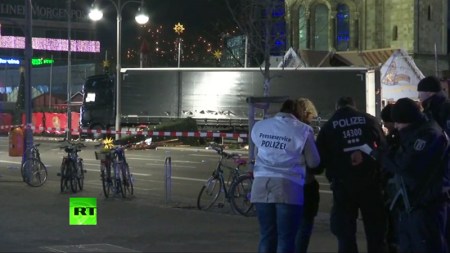
2140Police confer at the site of the December 19 car-ramming attack at a Christmas market in Berlin. (Image source: RT video screenshot)

Earlier this year, Germany was hit by a series of ISIS-inspired attacks and failed terror plots. Despite that almost all the perpetrators were recent Syrian or Afghan migrants, German Chancellor Angela Merkel, in the middle of a re-election bid, has stuck to her claim that there is “no connection” between terror attacks in the country and uncontrolled mass migration from Arab and Muslim lands.

Ahead of an election year, Merkel and her coalition partners also want to avoid another mass sexual attack — in Cologne.

Adding insult to injury, the Mayor of Cologne, Henriette Reker, is planning to put on a big show this coming New Year’s Eve in the city’s main square. After an elaborate year-long cover up, the city will be lighting up the crime scene as part of a multi-media show. “The City of Cologne has announced plans for a spectacular multi-media show in the area immediately surrounding the famous Gothic cathedral, close to the main train station,” state-run broadcaster Deutsche Welle reported.

“Cologne will send good images to the world,” says the city’s mayor. The taxpayer-funded spectacle has been named “Time Drifts Cologne.” The “light artist” running the show, Philipp Geist, considers last year’s crime scene “a fantastic place for an art installation.”

Of an estimated two thousand exclusively Muslim men who raped, assaulted and robbed more than 1200 women, almost all the attackers have managed to walk free. Ralf Jäger, Interior Minister of North Rhine-Westphalia, admitted recently that “most of the cases will remain unsolved.”

An estimated 1,800 police officers will be on duty in Cologne on New Year’s Eve, compared to just 140 last year. Barricades have been erected in the city center to check the flow of the crowd. The city’s historic cathedral and adjoining area have been placed under a crush barrier. Police will man observation posts and fly helicopters to monitor the crowd, and deploy mounted police and six armoured vehicles for riot-control. “No expense will be spared,” assured the mayor. In an important election year, the government wants to defend the city to the last taxpayer dime.

Even before it can face any real onslaught, however, Merkel’s fortification is showing some serious cracks.

Just days ahead of the News Year’s Eve, the police union in the eastern German state of Thuringia has issued an open letter describing the crumbling law-and-order situation amid the rising migrant crime. “[You] are abandoning us completely helpless to a superior force,” says the desperate note addressed to the Interior Minister of Thuringia. The union claims that politicians have been repeatedly briefed on the deteriorating conditions under which police have been working. “But what changes? Nothing. One instead gets a sense of uninterest.”

Unwilling to acknowledge the breakdown of law and order in face of the rising migrant crime wave, the German media and politicians are going after the messenger.

Their latest target is the head of German Police Union, Rainer Wendt. Wendt’s crime, after a series of rape crimes this December, was to speak the obvious truth. “The criminals are using open borders,” he said.

Ralf Stegner, deputy leader of Social Democratic Party (SPD) and a fervent supporter of Merkel’s “Refugees Welcome” policy, denounced Wendt’s statement as “politically disgusting and stupid as one can get.”

Wendt has also been attacked for questioning the customary kid-glove treatment given to violent and criminal “refugees” by German courts. Sven Rebehn, Chairman of the German Association of Judges, called Wendt, “the Donald Trump of domestic politics” — apparently the biggest insult a German liberal can come up with these days.

The Merkel government can turn the center of Cologne into an impenetrable fortress for a day or two, but the threat is not going away. The problem lies in the Ruhr region that encircles Cologne. “Have foreign clans turned Ruhr region into a No-Go-Area?” asks the leading German newspaper, Die Welt, just days ahead of News Year’s Eve.

Meanwhile, representatives of Arab community were reported telling the police in Ruhr, “The police will not win a war with us because we are too many.”

Chancellor Merkel, Germany’s ruling elites and the media can continue putting a happy face on uncontrolled mass-migration from Arab and Muslim lands, or suppress news reporting on rising migrant crime, as much as they want, but they cannot wish away the country’s deteriorating law-and-order situation.

As the desperate plea of the police union shows, the Merkel government has decided to ignore the plight of law enforcement, at least for now. It should be evident to even a casual observer that her government still does not care about the victims of its own failed “refugee” policy: Germany appears to be heading toward another rough year.

VIDEO: Merkel Says ‘Trolls’ and ‘Fake News’ Could Influence German Election

November 24, 2016

VIDEO: Merkel Says ‘Trolls’ and ‘Fake News’ Could Influence German Election, Breitbart, Liam Deacon, November 24, 2016

merkelbows

Angela Merkel has said public opinion is being “manipulated” on the internet, claiming “fake news” websites and “trolls” could influence the approaching German elections.

In her first major address since announcing her intention to seek a fourth term, the German chancellor was also heckled and labelled a “disgrace” as she claimed to be “fighting illegal immigration” in Germany.

“Something has changed. As globalization has marched on, debate is taking place in a completely new media environment. Opinions aren’t formed the way they were 25 years ago,” she said, according to AFP.

“Today we have fake sites, bots, trolls – things that regenerate themselves, reinforcing opinions with certain algorithms and we have to learn to deal with them,” she added.

The chancellor linked the rise of alternative media to populist politics in the West during the speech.

“A lot of people are concerned about the stability of our social order,” she said. “Suddenly it seems that what we considered self-evident isn’t that self-evident after all.”

She reportedly claimed that democracy itself, and even the economy, were under threat.

The chancellor also insisted that “hate speech” should be censored in Germany, because “it’s not compatible with our ideals”. Debates, she said, should be carried out in what she saw as “the spirit of respect for others”.

https://www.youtube.com/watch?v=81Yf154k034

The speech also covered the topic of migration, which saw the German leader shouted down in her own legislative chamber.

“We have passed the EU-Turkey agreement and I want to clearly state that, also looking at other areas…” she started, before a woman interrupted her, crying: “Disgrace!”

“Careful,” the Chancellor replied.

“It is your opportunity to openly express your opinions. I believe fighting illegal immigration,” she added. But the woman shouted back, “yeah, yeah”, dismissing the claim sarcastically.

Mrs. Merkel continued her speech: “Putting a stop to illegal smugglers who do vicious trade with human beings, to do something against the fact that this year 4,500 or more refugees have drowned is one of the most important requirements of political trade.”

Allies of the chancellor applauded her as she asserted: “Those who have to rely on smugglers because they can’t shape politics, they do not do their job in the sense that I envision it.”

More than a million illegal migrants walked into Germany last year. The numbers began rising sharply immediately after Mrs. Merkel promised to suspend the Dublin agreementin August, and “welcome” any migrant who could make it across Germany’s borders.

Germany Captures ISIS Infiltrator in Refugee Flow

November 3, 2016

Germany Captures ISIS Infiltrator in Refugee Flow, Counter Jihad, November 3 , 2016

How many of those who have “gone missing” did so in order to build terrorist cells, or to plan attacks?  We will likely find out only as each attack occurs, as the police resources are vastly overstretched by the scale of the refugee flows. Belgian police correctly identified some of the Brussels bombers, but had to drop its inquiry into them because it could not spare the resources for that particular case.  German police are likewise facing a crime wave that is overwhelming their available resources.  Leaked reports indicate that German police only expect this refugee crime wave to worsen, as they lack the resources to stop it — or even to track where the refugees go once admitted to the country.

********************

A young Syrian man has been captured in Germany after conducting pre-attack surveillance and recruiting at least one German to join the fight for the Islamic State (ISIS).  The Syrian, identified as Shaas Al-M., presented himself as a refugee from the conflict in Syria.  In fact, he was an ISIS fighter on a mission to conduct terrorist attacks inside Europe.

He is not alone, the British newspaper Express reports.

There were two Islamist attacks by migrants in July.

Earlier this month another bogus Syrian migrant was captured after a bomb he was building was found in his apartment in the easter city of Chemnitz.

The phrase “bogus Syrian migrant” is confusing.  This was a legitimately a migrant from Syria, and not (say) a Korean trying to pass himself off as Syrian in order to migrate to Germany.  However, this migrant was not genuinely a refugee from the violence.  Rather, he came for the express purpose of creating new Islamist violence.  His job was to conduct attacks in Europe’s heartland in order to create pressure on them not to intervene against ISIS within the physical space of its Caliphate.

Politicians in Europe and America have alike defended the idea that refugees do not represent a serious security challenge to the West.  Candidate Hillary Clinton has argued for an increase of 550 percent in the number of refugees admitted to the United States from Syria.  Former political appointees from Homeland Security for the Obama administration have likewise tried to sell the idea that “vetting” will solve whatever problems these refugees pose, although in fact there are no longer intact security services within Syria with whom we might vet them — nor any reason the Assad regime, our enemy, would tell us the truth about them if it could do so.

Meanwhile, security professionals have been giving increasingly loud warnings about the danger of terrorists in the refugee flows.  The Supreme Allied Commander, Europe, said that terrorists were appearing in refugee flows “daily.”  Head of the CIA John Brennan said that terrorists were definitely using the refugee flows to penetrate Western Europe and, from there, America.

Even Hillary Clinton herself admitted in one of her private paid-for speeches, disclosed only by an unauthorized leak, that “we can’t possibly vet all those refugees.”

It turns out that even the ones who are not terrorists still bring substantial crime and social instability.  Germany’s new police figures show a spike of well over a hundred thousand new crimes in the first half of this year, tied to refugees.

Migrants in Germany have committed 142,500 crimes in just six months, police figures have revealed

This was the equivalent of 780 crimes a day – an increase of nearly 40 percent over 2015, according to data from Germany’s Federal Criminal Police Office…  ‘Migrant crime statistics for all of 2016, when they become available, are likely to show a significant increase over the 2015 numbers. One reason for this is that thousands of migrants who entered the country as ‘asylum seekers’ or ‘refugees’ have gone missing.’

How many of those who have “gone missing” did so in order to build terrorist cells, or to plan attacks?  We will likely find out only as each attack occurs, as the police resources are vastly overstretched by the scale of the refugee flows. Belgian police correctly identified some of the Brussels bombers, but had to drop its inquiry into them because it could not spare the resources for that particular case.  German police are likewise facing a crime wave that is overwhelming their available resources.  Leaked reports indicate that German police only expect this refugee crime wave to worsen, as they lack the resources to stop it — or even to track where the refugees go once admitted to the country.

German Streets Descend into Lawlessness

October 31, 2016

German Streets Descend into Lawlessness, Gatestone Institute, Soeren Kern, October 31, 2016

During the first six months of 2016, migrants committed 142,500 crimes, according to the Federal Criminal Police Office. This is equivalent to 780 crimes committed by migrants every day, an increase of nearly 40% over 2015. The data includes only those crimes in which a suspect has been caught.

Thousands of migrants who entered the country as “asylum seekers” or “refugees” have gone missing. They are, presumably, economic migrants who entered Germany on false pretenses. Many are thought to be engaging in robbery and criminal violence.

Local police in many parts of the country admit that they are stretched to the limit and are unable to maintain law and order.

“Drug trafficking takes place right before our eyes. If we intervene, we are threatened, spat on, insulted. Sometimes someone whips out a knife. They are always the same people. They are ruthless, fearless and have no problems with robbing even the elderly.” — Private security guard.

According to Freddi Lohse of the German Police Union in Hamburg, many migrant offenders view the leniency of the German justice system as a green light to continue delinquent behavior. “They are used to tougher consequences in their home countries,” he said. “They have no respect for us.”

“It cannot be that offenders continue to fill the police files, hurt us physically, insult us, whatever, and there are no consequences. Many cases are closed or offenders are released on probation or whatever. Yes, what is happening in the courts today is a joke.” — Tania Kambouri, German police officer.


The rape of a ten-year-old girl in Leipzig, the largest city in Saxony, has drawn renewed attention to the spiraling levels of violent crime perpetrated by migrants in cities and towns across Germany — and the lengths to which German officials and the media go to censor information about the perpetrators of those crimes.

The girl was riding her bicycle to school at seven o’clock in the morning on October 27 when a man ambushed her, threw her to the ground and raped her. The suspect is described as being in his mid-thirties with short brown hair and a stubble beard.

Leipzig police have explicitly refused to say whether the suspect is a migrant, but have implicitly admitted that he is. They published a facial composite of the suspect with the politically correct warning:

“This image is to be published only in print media in the greater Leipzig area. Publishing this image on the internet, including on social media such as Facebook, is not covered by the court’s manhunt order (Beschluss zur Öffentlichkeitsfahndung) and is therefore prohibited.”

The effort to censor information about the rape, in which German officials show themselves to be more concerned about protecting the identity of the rapist than the welfare of the victim or other girls he might attack, is almost unprecedented in Germany.

To its credit, the Berlin-based newspaper, Bild, responded: “BILD is ignoring this request. We want to ensure that the suspect is arrested as quickly as possible.” Indeed, Bild has been one of the only newspapers in Germany even to publish not only the image but also report the story of this rape.

Violent crime — including rapes, sexual and physical assaults, stabbings, home invasions, robberies, burglaries and drug trafficking — has skyrocketed in Germany since Chancellor Angela Merkel welcomed into the country more than one million mostly male migrants from Africa, Asia and the Middle East. Few, if any, of the migrants were vetted before being allowed to enter Germany.

Migrants committed 208,344 crimes in 2015, according to a confidential police report leaked to Bild. This figure represents an 80% increase since 2014 and is equivalent to 570 crimes committed by migrants every day, or 23 crimes each hour, in 2015 alone.

The actual number of migrant crimes is far higher, however: the report, produced by the Federal Criminal Police Office (Bundeskriminalamt, BKA), includes only crimes that have been solved (aufgeklärten Straftaten). According to police statistics, on average only around half of all crimes committed in Germany in any given year are solved (Aufklärungsquote). This implies that the actual number of crimes committed by migrants in Germany in 2015 may have exceeded 400,000.

During the first six months of 2016, migrants committed 142,500 crimes, according to a BKA report released on September 6. This is equivalent to 780 crimes committed by migrants every day, or 32.5 crimes each hour, an increase of nearly 40% over 2015. Again, the 2016 data includes only those crimes in which a migrant suspect has been caught. Crimes similar to the rape in Leipzig would not appear in the statistics because the suspects remain at large.

Migrant crime statistics for all of 2016, when they become available, are likely to show a significant increase over the 2015 numbers. One reason for this is that thousands of migrants who entered the country as “asylum seekers” or “refugees” have gone missing. They are, presumably, economic migrants who entered Germany on false pretenses. Many are thought to be engaging in robbery and criminal violence to sustain themselves.

Most of the crimes committed by migrants are being downplayed by German authorities, apparently to avoid fueling anti-immigration sentiments. For example, the BKA report states that most of the migrant crimes involve fare evasion — using public transportation without a ticket. As for other crimes, almost invariably they are said to be isolated incidents (Einzelfälle), not part of a nationwide problem.

Gatestone Institute has reviewed hundreds of reports of migrant crime in local police reports and local or regional newspapers. The evidence points to a nationwide surge in migrant crime: cities and towns in all 16 of Germany’s federal states are affected. In fact, local police in many parts of the country admit that they are stretched to the limit and are unable to maintain law and order.

The growing sense of lawlessness is substantiated by an October 24 YouGov poll which found that 68% of Germans believe that security in the country has deteriorated during the past several years. Nearly 70% of respondents said they fear for their lives and property in German train stations and subways, while 63% feel unsafe at large public events.

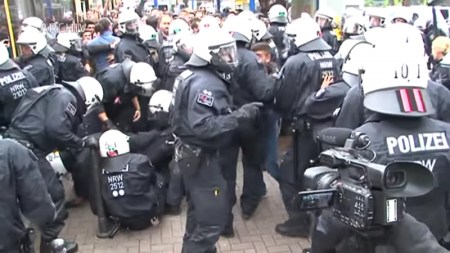
2008German police are shown deployed to break up a mass brawl between migrants (Image source: SAT1 video screenshot)

In Hamburg, statistics show that migrants committed nearly half of the 38,000 crimes reported in Hamburg during the first six months of 2016, although migrants make up only a fraction of the city’s 1.7 million inhabitants. Police say that many of the crimes were committed by “migrant gangs” (ausländischen Banden).

City police say they are helpless to confront a spike in crimes committed by young North African migrants. Hamburg is now home to more than 1,800 so-called unaccompanied minor migrants (minderjährige unbegleitete Flüchtlinge, MUFL), most of whom live on the streets and apparently engage in all manner of criminal acts, including purse snatching.

More than 20,000 purses are snatched in Hamburg every year. Most of those are stolen by males between the ages of 20 and 30 who come from the Balkans or North Africa, according to Norman Großmann, the director of the federal police inspector’s office in Hamburg. In recent months, police have carried out operations (here and here) to confront the problem, but the actions have yielded few arrests.

Local media report that gangs of migrant youth have effectively taken over parts of the Jungfernstieg, one of the most prestigious boulevards in Hamburg. Many citizens are avoiding the area, which recently underwent a multi-million euro rehabilitation, because it has become too dangerous.

More than 50 people have been physically assaulted along the Jungfernstieg since the beginning of 2016, and police are being called in almost daily to respond to complaints of aggressive begging, public drunkenness, drug dealing and sexual assault. Restaurant owners are complaining about a spike in robbery and vandalism, and taxi drivers say they are avoiding the area, where Arabic and Farsi are commonplace.

The newspaper, Die Welt, reported that unaccompanied minor migrants at a refugee shelter in the Hammerbrook district are “working” at the Jungfernstieg. Stashes of mobile phones, laptops and other stolen goods were recently found hidden in their rooms. Police also arrested a 20-year-old Egyptian named Hassan who repeatedly attacked passersby with a knife. He was filmed groping a girl’s breasts and genitals. When she resisted, he punched her in the face.

Residents of the Alsterdorf district in Northern Hamburg have asked their mayor to do something about a group of 40 highly aggressive unaccompanied minor migrants who are terrorizing the neighborhood. Residents complain about burglaries, robberies and even extortion. A 65-year-old resident said she was attacked by a ten-year-old who was trying to break into a car. A 45-year-old business owner said he is afraid to confront the youths because they might smash his windows. A 75-year-old pensioner said he no longer dares to step outside of his house after dark.

Thomas Jungfer, the deputy director of the German Police Union (DPolG) in Hamburg, warns that the city does not have enough police officers to maintain law and order. He says that private security companies are needed to fill in the gaps. “Dissatisfaction among our colleagues is growing,” he said.

In nearby Bremen, police have effectively surrendered the fight against organized crime run by clans from the Balkans and Kurdistan because of the need to pour limited personnel resources into the fight against spiraling street crime by unaccompanied migrant youths.

Rainer Wendt, head of the German Police Union (DPolG) has criticized city officials for their lack of resolve. “Bremen has capitulated to extremely dangerous clans. The state’s monopoly of the legitimate use of physical force [Gewaltmonopol des Staates] is now becoming the law of the jungle. Security continues to go down the drain.”

In Berlin, criminal migrant clans “with strong group loyalties” are operating with impunity in the districts of Neukölln, Wedding, Moabit, Kreuzberg and Charlottenburg. The newsmagazine, Focus, reported that the Kottbusser Tor area in Kreuzberg, an area with many migrants, has become a “legal vacuum” because of a reduced police presence. The place has been overrunwith drug trafficking, crime and violence, and residents and shopkeepers report crimes every hour, every day on public streets. A shopkeeper said: “In the past, children could run around here freely. Also, no one paid attention to whether the bag or backpack are secure. Today all this is no longer possible.”

According to Focus, “During the day the area is full of heroin corpses, and at night pickpockets are on the go.” A private security guard said:

“Drug trafficking takes place right before our eyes. If we intervene, we are threatened, spat on, insulted. Sometimes someone whips out his knife. They are always the same people. They are ruthless, fearless and have no problems with robbing even the elderly.”

His colleague added: “Of course, we always call the police. The last time, however, they took two hours to get here.”

In the Rhine-Ruhr region, the largest metropolitan region in Germany, police statistics show that Algerians committed more than 13,000 crimes in 2015, more than twice as many as in 2014. Moroccans committed 14,700 crimes, and Tunisians more than 2,000 crimes.

In North Rhine-Westphalia, a report by the interior ministry revealed that Moroccans committed 6,208 crimes in 2015. Algerians committed 4,995 crimes and Tunisians 1,084. These are significant increases compared to previous years.

According to the NRW Interior Ministry, “Immigrants from North African are increasingly disproportionate as offenders — mainly in large cities. The suspects are most often single young men. Their criminal specialties are robbery and assault.”

In Düsseldorf, local politicians have been accused of ignoring the growing threat posed by violent gangs of migrants from Algeria, Morocco and Tunisia. The city is home to a total of 2,244 criminal suspects from North Africa, the majority of them (1,256) from Morocco. On average, they commit an offense every 3.5 hours. A police inspector said: “The group as a whole is disrespectful and absolutely without shame.”

In Stuttgart, police are fighting a losing battle against migrant gangs from North Africa who are dedicated to pickpocketing. In the Rems-Murr district near Stuttgart, rival gangs of migrant youth from the Balkans are “stealing anything that is not nailed down.” Roma and Kosovar youth skip school to go on daily forays systematically to break into cars to steal cell phones and other valuables. They also enter doctor’s offices, residences for the elderly, kindergartens and schools to ransack handbags and jackets.

In Aalen, a 14-year-old Kosovar has a police file with more than 100 entries. A local newspaper reports: “All attempts by the police, judiciary and youth welfare office to instill in him a sense of right and wrong and to re-socialize him have so far failed. On Facebook he brags about his undertakings and his love for gangster rap.”

In Leipzig, the public transportation system has become a magnet for criminals. The number of reported cases of theft on public transport jumped 152% between 2012 and 2015. The number of physical and sexual assaults on public transportation are also up. Overall, the number of reported crimes in buses and trams jumped 111% between 2012 and 2015, and the number of reported crimes at bus stops during that period were up by 40%.

Leipzig police attribute the spike in crime to the rapid increase in the city’s population. They could not confirm the nationality of the perpetrators, however, because that would require a review of each of the crimes, a task that would “exceed the personnel-time capacity.”

In Dresden, migrants from Algeria, Morocco and Tunisia have effectively taken control over the iconic Wiener Platz, a large public square in front of the central train station. There they sell drugs and pickpocket passersby, often with impunity. Police raids on the square have become a game of “whack-a-mole,” with a never-ending number of migrants replacing those who have been arrested.

In Schwerin, roving bands of migrant youths armed with knives have made the city center increasingly dangerous day and night. City officials have drawn up an action plan to regain control of the streets. A centerpiece of the plan calls for the deployment of more social workers (Straßensozialarbeit) to promote integration.

In Bavaria, Sigrid Meierhofer, the mayor of the resort town of Garmisch-Partenkirchen complained that local police have responded to more migrant-related crimes during the past six weeks than in all of the previous 12 months combined. In a letter to the Bavarian government, she threatened to close a shelter in the town that houses 250 mostly male migrants from Africa if public safety and order cannot be restored. She has also warned female residents of the town to avoid being outside after dark.

In a bestselling book, Tania Kambouri, a German police officer, describes the deteriorating security situation in Germany due to migrants who she says have no respect for law and order. In an interview with Deutschlandfunk radio, she said:

“For weeks, months and years I have noticed that Muslims, mostly young men, do not have even a minimum level of respect for the police. When we are out patrolling the streets, we are verbally abused by young Muslims. There is the body language, and insults like ‘sh** cop’ when passing by. If we make a traffic stop, the aggression increases ever further, this is overwhelmingly the case with migrants.

“I wish these problems were recognized and clearly addressed. If necessary, laws need to be strengthened. It is also very important that the judiciary, that the judges issue effective rulings. It cannot be that offenders continue to fill the police files, hurt us physically, insult us, whatever, and there are no consequences. Many cases are closed or offenders are released on probation or whatever. Yes, what is happening in the courts today is a joke.

“The growing disrespect, the increasing violence against police…. We are losing control of the streets.”

According to Freddi Lohse, Vice Chairman of the DPolG German Police Union in Hamburg, many migrant offenders view the leniency of the German justice system as a green light to continue delinquent behavior. “They are used to tougher consequences in their home countries,” he said. “They have no respect for us.”