Archive for the ‘Foreign policy’ category

Two major Mid East escalations: Yemeni rebels fire Scuds at Saudi air base. ISIS warns Syrian rebels

June 6, 2015

Two major Mid East escalations: Yemeni rebels fire Scuds at Saudi air base. ISIS warns Syrian rebels, DEBKAfile, June 6, 2015

us_patriot_missiles_saudi_arabia_6.6.15US Patriots stationed in Saudi Arabia

Saudi military sources reported Saturday, June 6, that Patriot air defense batteries had intercepted Scud missiles fired by Yemen Houthi rebels against the kingdom’s largest air base at Khamis al-Mushait in the south west. It is from there that Saudi jets take off to strike the Yemeni rebels. DEBKAfile’s military sources report that the Patriot anti-missile systems, which were activated for the first time, were manned by American teams. This was the first direct US military intervention on the Saudi side of the Yemen conflict.

It was also the first time that Houthi rebels or their allies had fired Scud missile into the oil kingdom. Our sources add that the launch was supervised by Hizballah officers. They were transferred by Tehran to Yemen to ratchet up the conflict – although US, Saudi, Yemeni government and Houthi representatives meeting secretly in Muscat Friday agreed to attend a peace conference in Geneva this month.

Nonetheless, through Friday night and Saturday morning, Houthi forces and allied military units kept on battering at Saudi army and National Guard defense lines, in an effort to break through and seize territory in the kingdom’s southern provinces. The insurgents were evidently grabbing for strategic assets to strengthen their hand at the peace conference.

Iran’s supreme leader Ayatollah Ali Khamenei is also juggling his chips on the deteriorating Syrian warfront. In the coming hours, he is widely expected to announce the activation of the mutual defense pact signed between Iran and Syria in 2006, under which each signatory is committed to send military troops if necessary to defend its partner.

Thursday, June 4, Khamenei fired sharp verbal arrows at the Obama administration: “The United States tolerates extremist groups in Syria and Iraq and even helps them in secret,” he charged.

Our military sources add that although various Mid East publications, especially in Lebanon, are reporting that Iran has already sent units in numbers ranging from 7.000 to 15,000 troops to Syria, none have so far landed, except for the Shiite militias brought over at an earlier stage of the Syrian conflict. The expected Khamenei announcement may change this situation.

ISIS was not waiting. Saturday morning, the group issued a warning to the Syrian rebel forces fighting in the south – the Deraa sector of southern Syria near the meeting point of the Jordanian and Israeli borders and the Quneitra sector opposite the Israeli Golan. They were ordered to break off contact with the US Central Command Forward Jordan-CF-J which is located north of Amman, and the IDF operations command center in northern Israel. Any Syrian rebels remaining in contact with the two command centers would be treated as infidels and liable to the extreme penalty of beheading, the group warned.

The impression of ominous events brewing in the regime was rounded off Friday night by an unusual announcement by the Israeli army spokesman that Iron Dome anti-missile batteries had been deployed around towns and other locations in the south, although no reference was made to any fresh rocket attacks expected from the Gaza Strip. DEBKAfile adds: The first batteries were arrayed Thursday night, June 4, at vulnerable points in southern Israel – from the southernmost Port of Eilat on the Gulf of Aqaba to the western Port of Ashdod on the Mediterranean.

The Islamic State Is Here to Stay

June 5, 2015

The Islamic State Is Here to Stay, VICE NewsAhmed S. Hashim, June 6, 2015

(Please see also, The Kurd-Shia War Behind the War on ISIS. — DM)

The victories against IS in early 2015 have proven ephemeral — or have been nullified by IS gains elsewhere. On Sunday, CIA director John Brennan said on Face the Nation, “I don’t see this being resolved anytime soon.” Assad’s vaunted offensives of February 2015 have fallen short as the regime faced stiff resistance from a wide variety of opposition fighters, including elements from IS. The failure was alarming in part because the campaign was designed and aided by both Hezbollah and the Iranians, two seemingly ascendant Shia powers.

************************

Just a few months ago, analysts and policy-makers were certain that the defeat of Islamic State (IS) forces was simply a matter of time.

Coalition airstrikes would degrade the group’s capabilities and eventually allow Iraqi forces and Kurdish Peshmerga — though discredited by their poor military showing in mid-2014 — to push back the extremists. And indeed, IS fighters were ejected from Tikrit in March 2015 by the Iraqi army and thousands of motivated fighters from Shia militias. In Kobani in northern Syria, IS fighters were defeated by Syrian Kurdish fighters. Elsewhere in the country, the regime of Bashar al-Assad was going on the offensive with help from Hezbollah and advisers from the Iranian Revolutionary Guard.

The Islamic State, however, rose like a phoenix from the ashes of every setback. And today, the situation is not so rosy.

The victories against IS in early 2015 have proven ephemeral — or have been nullified by IS gains elsewhere. On Sunday, CIA director John Brennan said on Face the Nation, “I don’t see this being resolved anytime soon.” Assad’s vaunted offensives of February 2015 have fallen short as the regime faced stiff resistance from a wide variety of opposition fighters, including elements from IS. The failure was alarming in part because the campaign was designed and aided by both Hezbollah and the Iranians, two seemingly ascendant Shia powers.

The situation in Iraq is just as complicated, something that the Obama administration appears either oblivious to or reluctant to acknowledge. Much of the US strategy continues to hinge on what is increasingly a mirage: a unified, albeit federal, Iraq under the control of Baghdad. Meanwhile, the resilience of IS is greatly enhanced by the ability of its military forces to innovate and adapt faster on the ground than its lackluster opponents.

In light of the constant aerial strikes by the US and its allies, IS has dispersed and made its forces more mobile, no longer presenting dense concentrations of fighting men as it did when it seized Mosul in mid-2014. Instead, when IS seized Ramadi in May 2015, it made use of inclement weather and sent several small units from different directions simultaneously into the city aided by suicide bombers. Moreover, the fact that the group faced ill-equipped and poorly motivated Sunni fighters in and around Ramadi did not do anything for Baghdad’s standing with the country’s already alienated Sunni community, which had pleaded for arms while caught between the unfathomable brutality of IS and revengeful Shia militias.

Many Sunnis are now angling for their own “super-region,” one that would have considerable independence from Baghdad. The problem? In order to have it, the Sunnis would need to first defeat IS. Currently, they’re unable to do so because they lack the resources; despite all the talk from Baghdad and Washington about arming Sunni tribes, Baghdad is not actually keen to do so.

And besides, the Sunnis seem relatively ambivalent about defeating IS. They took an unequivocal stance between late 2006 and 2009, when they joined with the Americans and the Iraqi government to deal the Islamist militants what was then seen as a decisive blow. Now, however, despite Sunnis’ resentment and fear of IS, the Islamists’ existence is seen as a kind of insurance policy against Shia revanchism should Baghdad succeed in retaking the three Sunni provinces of Anbar, Salahuddin, and Ninevah.

(Please see video at the link. — DM

The “victory” of the Iraqi government in Tikrit was more propaganda than reality; a few hundred IS fighters managed to inflict considerable damage on the Shia militias that had been mobilized to fight alongside the Iraqi army, then withdrew because they were outnumbered and wished to avoid being surrounded. The IS forces in Tikrit simply felt that they had done enough damage; there was no need to waste further assets in an untenable situation.

Militarily, the Iraqi Shia militias are better motivated and more dedicated than the regular army. Anecdotal information out of Baghdad suggests that Iraqi Shias are wondering whether the government should invest more effort building these forces into an effective and more organized parallel army. Even that parallel army, however, might be reluctant to commit to any significant long-term offensive to reclaim provinces full of “ungrateful” Sunnis.

But the Shia are willing to die to defend what they have, and there is increased sentiment among the Shia in central Iraq and Baghdad, along with the southern part of the country, that they would be better off without the Sunnis. There also exists the belief that the Kurds have more or less opted out of the Iraqi state despite the fact that they maintain a presence within the government in Baghdad. The Shia would seemingly not be sorry to see them exit the government in a deal that would settle as best as possible divisions of resources and territory. However, whether the Kurds would take the plunge and opt for de jure rather than de facto independence is a question that is subject to regional realities — How would Ankara and Tehran react? — rather than merely a matter of a deal between Baghdad and Erbil.

The Islamic State will continue to be a profound geopolitical problem for the region and the international community, and a long battle lies ahead. Syria and Iraq are more or less shattered states; it is unlikely that they will be put back together in their previous shapes. If Assad survives 2015, it will be as head of a rump state of Alawites and other minorities protected by Hezbollah, Iran, and Alawite militias. Shia Iraq will survive, and will possibly dissociate itself from the nettlesome Sunni regions. The Kurds will go their own way step by step. The international community is currently at a loss for how to stem the flow of foreign fighters to the IS battlefields — and even more serious is the growing sympathy and admiration for the group in various parts of the world among disgruntled and alienated youth.

If the US is serious about defeating IS, it needs to take on a larger share of the fight on the ground. This means more troops embedded with regular Iraqi forces in order to bring about better command, control, and coordination. It also means advisors who can continue to train these forces so that they improve over time. If this is not done, the regular Iraqi military will continue to be nothing more than an auxiliary to the more motivated — and pro-Iranian — Shia militias. Currently, militia commanders are giving orders to the regular military; that cannot be good for morale.

This month, the Islamic State celebrates the first anniversary of its self-declared caliphate. The group has little reason to fear it will be the last.

Iran Will Walk

June 5, 2015

Iran Will Walk, The Gatestone InstituteLawrence A. Franklin, June 5, 2015

(What if the article is otherwise correct but Obama agrees to a “deal” anyway? — DM)

  • The Islamic Revolutionary Guard Corps (IRGC), the Praetorian Guard of Iran’s regime, controls most of the economy, as well as the black-market, alternative economy. The IRGC therefore actually benefits from sanctions; it is private firms, such as those involved in international commerce, that suffer. Why would IRGC operatives want to see the playing field made more level by private investment, transparency and a competitive economy?
  • Sanctions never hurt the regime’s ruling class; lifting them only helped the regime solidify its power over its people.
  • The objective of these two demands [an immediate lifting of all sanctions and no, or severely limited, inspections] is either to have them accepted, or to render it untenable for the Obama administration to offer Congress any deal that could be accepted – thereby shifting blame for the collapse of the talks to the U.S.
  • The U.S should also be on guard against the mullahs’ belief that the Obama administration is weak both politically and its aversion to using force. The mullahs might find great pleasure in humiliating Obama, as they did President Jimmy Carter, by dragging out hostage crisis negotiations by running out the clock until his term was over. They clearly believe that the Obama administration, simply to say it got “a deal,” is ready to sign anything.

From Washington to Riyadh, not to mention Jerusalem, statesmen are gritting their teeth at the possibility of a U.S.-Iran nuclear deal that seems overly generous to the theocratic-terror state of the Islamic Republic.

1008Representatives of the P5+1 countries pose with Iranian Foreign Minister Javad Zarif after nuclear negotiations in Lausanne, Switzerland on April 2, 2015. (Image source: U.S. State Department)

Most intelligence analysts and journalists assume that because Iran’s leadership endorsed the negotiations and has been the beneficiary of several key concessions by the P5+1 (the five permanent members of the UN Security Council, plus Germany), that an agreement is imminent. Forecasters have been predicting what the likely consequences of such a deal would be: negative.

But what if the Iranians walk?

Sanctions never hurt the regime’s ruling class; lifting them only helped the regime to solidify its power over its people.

A nuclear deal combined with an improvement in the commercial and business relations with the West would be inimical to IRGC interests.

The Islamic Revolutionary Guard Corps (IRGC), the Praetorian Guard of the regime, controls most of the economy as well as the black-market, alternative economy. IRGC-controlled conglomerates operate outside the law and reap huge profits through their control of the black market. The IRGC therefore actually benefits by sanctions; it is the private firms, such as those involved in international commerce, that suffer.

Furthermore, IRCG naval vessels, and private ships under their control, have been engaging in sanctions-breaking deliveries of imports across Persian Gulf waters to Dubai. The IRGC then sells the products at a profit by filtering them through the many foundations they control in Iran.

The most recent example of IRGC’s skirting of sanctions involved the illegal acquisition of aircraft through front-organizations with offices in both Europe and the Arabian Peninsula. Mahan Air, an IRGC front, was able to purchase 15 used commercial aircraft for $300 million. Another front, al-Naser Air, was about to purchase two more aircraft, this time from a U.S. owner. Israeli intelligence, however, passed details of the planned sale to the U.S. government, and on May 21, the deal was scuttled by the Office of Export Enforcement of the Department of Commerce.

Why would IRGC operatives want to see the playing field made more level by private investment, transparency and a competitive economy?

Moreover, if a nuclear deal indicated improved relations with the United States, Iranian hardliners, whether clerical revolutionaries or intelligence operatives, might fear seeing their ideological legitimacy erode. The Iranian regime’s only remaining fig leaf of legitimacy is its anti-American animus, with its accompanying pledge to “protect” Iran’s interests against the U.S.-Israel-Sunni “alliance.”

Improved relations with Washington might raise false hopes among Iran’s citizens that the regime may ultimately improve its woeful record on human rights. There remains only a thin patina of clerical control over Iranian society; if the hoped-for social and political reforms were not implemented, the result could produce a destabilizing political environment, harmful to the interests of the regime.

Another fallacy embraced by many “inside-the-beltway” analysts is that, as the Supreme Leader Ayatollah Khamenei endorsed the negotiations, a legitimate deal is now probable.

The once all-powerful Office of the Supreme Leader no longer calls all the shots. The current Iranian regime resembles a military junta or a security state as much as a theocracy. While the reach of Ayatollah Khamenei, through his network of representatives, still penetrates all dimensions of Iranian society, he does not have the final decision on key security matters. The regime’s strategic assets, for instance, such as its ballistic missile programs, are firmly under the control of the IRGC. Decisions related to Iran’s expansionist presence in the region are made by IRGC Quds Force Commander Qasem Soleimani. The role of Khamenei’s representative to the IRGC resembles more that of a handler than of an action officer.

The principal task for the regime is to find a way to back out of the negotiations while avoiding the blame. Iran’s efforts at disengagement may already have been underway for the past few weeks; the pace of decoupling from the talks seems to be accelerating. Iran has been increasing its demands apparently in the hope that they will either be accepted, or else rejected like the “poison pills” they are — such as inspectors no longer being allowed on its military sites.[1]

Another way to make the talks no longer palatable for the Obama administration was to create a hostile incident with the United States in the Persian Gulf, as it has tried to do by aggressively tailing American warships. Iranian ships affiliated with the IRGC Navy also seized a commercial ship, the Maersk Tigris, in the Strait of Hormuz, and temporarily detained both vessel and crew. Then, on May 14, IRGC boats fired several shots across the bow of a Singapore flagged vessel, but it escaped unharmed.

By this type of reckless comportment, the IRGC Navy appears intent on producing a clash with American naval vessels in the Gulf waters. Western negotiators have only to recall the presidency of Mohammad Khatami, when the IRGC and Iran’s Ministry of Intelligence and Security operated independently after they felt that the reformers had gone too far, thus threatening hard-liner control of the regime. The IRGC may have decided that Rouhani along with his American-educated Foreign Minister Zarif have reached a similar tipping point. This independent IRGC initiative is being executed even though a deal would release Iranian monetary assets that would in turn boost the sagging economy.[2]

Iran’s combative posture in Gulf waters against international shipping is also a direct challenge to international maritime law, which guarantees freedom of navigation through the world’s shipping lanes such as the Strait of Hormuz. A key principle of U.S. foreign policy is to enforce this freedom of navigation, if it is challenged by any foreign power, as one also hopes the U.S. will do in the South China Sea.

Iranian military and political spokesmen have also raised the temperature of their anti-American and anti-Israeli rhetoric of late. Leading members of the regime, including its Supreme Leader, Ali Khamenei, keep repeating, “Death to America” as well as its theological “obligation” to destroy Israel. While the Obama administration has alleged that these threats are just for “internal consumption,” an old Persian saying goes: “They spit in his eye and he calls it rain.”

Mojtaba Zolnour, Ayatollah Khamenei’s Deputy Representative to the IRGC, stated that the Islamic Republic of Iran, “has the divine permission to destroy Israel.” This media assault on Israel was designed to widen the divergence between the Obama administration and the Israeli government regarding the efficacy of the framework of a nuclear agreement negotiated so far.

Additionally, various Iranian principals have drawn “lines in the sand” designed to cause the Americans to disengage from the talks, such as the assertion that Iran will never accept inspection of its declared military sites. Another is Tehran’s repeated statement that it will not accept a gradual lifting of sanctions. Iranian leaders have insisted on immediate and irreversible lifting of all sanctions immediately after a nuclear deal is signed. The objective of these two demands is either to have them accepted, or to render it untenable for the Obama administration to offer Congress any deal that could be accepted — thereby shifting the blame for the collapse of the talks to the U.S.

Regime hard-line representatives to the majlis [Iranian Parliament] have already been mobilizing members to denounce the talks as detrimental to Iran’s national sovereignty. Eighty majlismembers signed a petition on May 12, calling upon the regime to suspend the nuclear talks until Washington halts its rhetorical threats against Iran. Hardliners in the majlis and elsewhere within the regime’s bureaucracy will likely continue to lobby against any deal.

Western analysts should be looking for the Iranian regime’s hard-line media outlets to increase domestic commentary condemning alleged U.S. deception in the negotiations as a reason to abandon the talks.

The death knell for the nuclear negotiations could come from newspapers such as Kayhan, a pro-regime newspaper run by Hossein Shariatmadari, and often characterized as a Khamenei mouthpiece.

The regime’s Friday-prayer Imams in key Iranian cities might also start opposing the talks. The themes of their noonday khutbahs [sermons] are likely to appeal to Iranian people’s patriotism, and suggest that it is more important for Iran to endure continued sanctions rather than submit to intrusive monitoring that offends Iran’s sovereignty.

Finally, hardliners who oppose any possibility of Iran’s improved relations with the U.S. may launch personal attacks on Iran’s negotiators to the nuclear talks, and, in an effort to discredit them, challenge their loyalty to the Iranian revolution. Their point of attack on Foreign Minister Mohammad Javad Zarif’s loyalty might be his alleged obsequious behavior to Secretary of State John Kerry. Zarif, on account of his many years of residency and education in the United States, can be depicted as an Americanized Iranian.

The United States should also be on guard against the mullahs’ belief that the Obama administration is weak — both politically and in its reluctance to use force. The mullahs might find great pleasure in humiliating Obama as they did President Jimmy Carter, when they dragged out hostage crisis negotiations by running out the clock until his term was over. They clearly believe that the Obama administration, simply to say it got “a deal,” is ready to sign anything.


[1]Iran’s powerful Guard rejects inspection of military sites” by Ali Akhbar Dareini, Associated Press, 19 April 2015. Deputy Chief of the IRGC General Hossein Salami is quoted and several more statements by IRGC officials since have repeated the same prohibitive statements regarding Iran’s military sites.

[2]U.S. to Award Iran $11.9 Billion Through End of Nuke Talks,” Washington Free Beacon, 21 January 2015. In the first of many subsequent denunciations, Senator Mark Clark of Illinois attacked the Obama administration’s plan to free Iran’s frozen assets if nuclear deal is reached.

Cartoon of the day

June 5, 2015

H/t Freedom is just another word

under

Who Is Blocking Palestinian Elections?

June 4, 2015

Who Is Blocking Palestinian Elections? The Gatestone InstituteKhaled Abu Toameh, June 4, 2015

  • Fatah is afraid that Hamas’s chances of winning the elections, especially in the West Bank, are very high. Hamas is not willing to relinquish control over the Gaza Strip, certainly not to Abbas and the Palestinian Authority, who were expelled from there in 2007.
  • Each party cares only about its own interests, while at the same time lying to the world that it is all Israel’s fault. Hamas continues to invest enormous resources in digging new tunnels, in preparation for a new war with Israel.
  • All this is being done with the help of anti-Israel governments around the world, and groups such as the Boycott, Divestment and Sanctions (BDS) movement, whose only goal is to delegitimize Israel and demonize Jews rather than to help the Palestinians.

One year after Palestinian Authority (PA) President Mahmoud Abbas announced the establishment of the Palestinian Fatah-Hamas “national consensus” government, the two rival parties remain as far apart as ever.

The “national consensus” government, headed by Prime Minister Rami Hamdallah, was formed after a series of “understandings” between Fatah and Hamas on the basis of previous “reconciliation” agreements between the two sides.

A year later, it has become obvious that the “national consensus” government has failed to achieve its main objectives: the reconstruction of the Gaza Strip; ending the conflict between Hamas and Fatah, and preparing for new presidential and parliamentary elections.

Fatah and Hamas can only blame each other for the failure of the latest attempt to end their dispute and do something good for their people. There is no way this time that they could lay the blame on Israel.

The two parties had a chance to cooperate on the reconstruction of the Gaza Strip in the aftermath of last year’s military confrontation between Israel and Hamas. The international community even offered to assist in the mission, but Fatah and Hamas chose to continue fighting each other at the expense of Palestinians in the Gaza Strip. Until today, the two rival Palestinian parties have not been able to reach agreement on a mechanism for the transfer of funds from international donors to the Gaza Strip.

Fatah claims that Hamas wants to steal the money, while Hamas is already accusing Fatah and the Palestinian Authority government of working to lay their hands on the funds.

Fatah and Hamas agreed back then that the Hamdallah government would remain in office for only six months — the period needed to prepare for long overdue presidential and legislative elections in the West Bank and Gaza Strip. But the “interim” government has just completed its first year in power, while the chances of holding new elections under the current circumstances are non-existent.

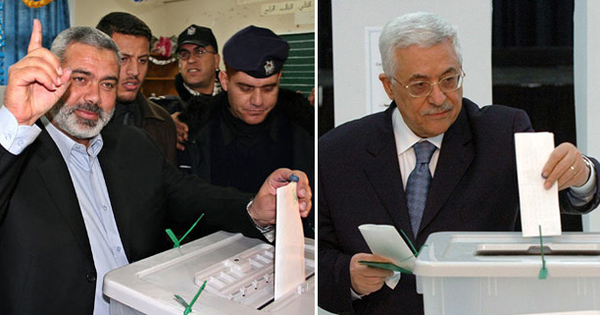
1096One man, one vote, one time? Hamas leader Ismail Haniyeh (left) and Fatah leader Mahmoud Abbas (also president of the Palestinian Authority) are pictured voting in the last election for the Palestinian Legislative Council, which took place in 2006.

Again, the two sides do not seem to be interested at all in sending Palestinians to the ballot boxes. Each side has many good reasons to avoid holding new elections in the West Bank and Gaza Strip.

First, Fatah and Hamas do not trust each other, and each side is convinced that the other would try to steal the vote. How can there be free and democratic elections while Hamas and Fatah continue to arrest and torture each other’s supporters in the Gaza Strip and West Bank?

Second, Fatah is afraid that Hamas’s chances of winning the elections, especially in the West Bank, are very high. That is because many Palestinians still do not trust Abbas and Fatah, whom they accuse of maintaining close security ties with Israel. Moreover, many Palestinians remain disillusioned with Fatah because of its failure to combat financial and administrative corruption and pave the way for the emergence of new leaders.

There is no way that Hamas and Fatah can cast the blame on Israel regarding the issue of elections. If they were really interested in holding new elections, they could do so with the help of the international community, as was the case with previous votes in 2005 and 2006. Israel even helped the Palestinian hold those elections.

When several Hamas candidates from east Jerusalem ran in the January 2006 parliamentary election, Israel did nothing to stop them. Israel even opened its post offices in the city to allow Arab voters from the city (who hold Israeli-issued ID cards) to vote in the election.

Charges made by some Palestinians and anti-Israel groups around the world, to the effect that Israel is responsible for “foiling” efforts to achieve Palestinian unity, are baseless. Although the Israeli government initially opposed the Fatah-Hamas “reconciliation” deal that was reached in 2014, it has not stopped the Palestinian prime minister and some of his cabinet members from visiting the Gaza Strip to pursue the implementation of the accord. In fact, Prime Minister Hamdallah has since visited the Gaza Strip twice, after receiving permission from Israel to go through the Erez border crossing.

Recently, ten Palestinian ministers were forced to leave the Gaza Strip, after Hamas placed them under house arrest in their hotel and banned them from meeting with locals. The ministers entered the Gaza Strip through the Erez border crossing. They came to the Gaza Strip to help solve the problem of thousands of Hamas government employees who have not received salaries for more than a year, and to discuss issues related to the reconstruction of the Gaza Strip.

So while Israel facilitated the visits by Hamdallah and his ministers to the Gaza Strip, it was Hamas that expelled them and prevented them from carrying out their duties. Had Israel expelled the ministers from the Gaza Strip or stopped them from entering the area, the country would have been condemned by the international community for “blocking” efforts to achieve Palestinian unity and rebuild the Gaza Strip.

Today, it has become unavoidably clear that Fatah and Hamas, and not Israel, are responsible for the ongoing plight of the Palestinians in the Gaza Strip. The two parties are unlikely to resolve their differences in the near future, further exacerbating the misery of their people. Each party cares only about its own interests, while at the same time lying to the world that it is all Israel’s fault. Hamas is not willing to relinquish control over the Gaza Strip, certainly not to Abbas and the Palestinian Authority, who were expelled from there in 2007. As for Abbas, he does not seem to be interested in regaining control over a problematic area such as the Gaza Strip, where most of the population lives under the poverty line and in refugee camps.

Yet instead of being honest with their people and admitting their failure to improve their people’s living conditions, Hamas and Fatah continue to wage smear campaigns against each other and, at the same time, also against Israel.

The campaigns that Hamas and Fatah are waging against Israel, particularly in the international community, are designed to divert attention from their failure to provide their people with basic services or any kind of hope.

While ignoring the plight of the Palestinians in the Gaza Strip, the Palestinian Authority leaders were prepared to invest huge efforts and resources in trying to have Israel suspended from the International Federation of Association Football (FIFA). It is as if the Palestinians had solved all their major problems and all that they needed to do now was to stop Israeli soccer players from playing in international matches.

Hamas, for its part, continues to invest enormous resources in digging new tunnels, in preparation for another war with Israel. The money that is being invested in the tunnels and the purchase and smuggling of weapons could benefit many families who lost their homes during the last war. But Hamas, like the Palestinian Authority, does not care about the misery of the Palestinians in the Gaza Strip. They want to fight Israel to the last Palestinian. And this is all being done with the help of anti-Israel governments around the world, and groups such the Boycott, Divestment and Sanctions (BDS) movement, whose only goal is to delegitimize Israel and demonize Jews rather than to help the Palestinians.

Iran’s cooperation with North Korea includes nuclear warhead technology

June 3, 2015

Iran’s cooperation with North Korea includes nuclear warhead technology, The Hill, Alireza Jafarzadeh, June 5, 2015

(The author of the article,

Jafarzadeh, the deputy director of the Washington office of the National Council of Resistance of Iran, is credited with exposing Iranian nuclear sites in Natanz and Arak in 2002, triggering International Atomic Energy Agency inspections. He is the author of “The Iran Threat” (Palgrave MacMillan: 2008).

— DM)

For years, the conventional wisdom has been that Iran and North Korea have long cooperated in missile technology, giving the perception of not so dangerous of an alliance. That was until last week. In yet another groundbreaking revelation, Iran’s main opposition movement, the Mujahedin-e Khalq (MEK) provided information that Iran and North Korea have been engaged in extensive exchange of information and visits by experts on nuclear weapons and nuclear warhead design, as recently as April 2015.

The MEK, based on information obtained by its network inside Iran, provided a detailed account of a visit to North Korea in 2013 by Tehran’s top nuclear weapons experts headed by elusive Mohsen Fakhrizadeh, who was present during the last nuclear test conducted by North Korea.

A seven-member North Korean delegation, comprised of experts in nuclear warhead design and various parts of ballistic missiles including guidance systems, spent the last week of April in Iran. This was the third such nuclear and missile team to visit Iran in 2015. The next delegation is scheduled to secretly arrive in Iran in June and will be comprised of nine experts, according to the same MEK sources.

That Tehran continues to closely engage with North Korea, a country that cheated its way into making a nuclear weapon, all the while pledging that it would not do so, should be an additional cause for alarm. It should be a red flag for the P5+1 countries as they continue their negotiations with Iran in Vienna and Geneva with only days left before the June 30 deadline to sign an agreement.

The Iran-North Korea nuclear cooperation is in sharp contrast to what the Iranian regime leaders are telling the world. It also explains why the Supreme Leader Ali Khamenei rejects IAEA inspections of military sites, snap inspection of all sites, and interviews with nuclear scientists.

Tehran has so far managed to largely push its missile program out of the nuclear agreement requirements, and with it its extensive nuclear cooperation with North Korea—something that was kept under the radar for years.

The North Korean nuclear experts who traveled to Iran in April stayed in a secret guesthouse, a cordoned-off eight-story building, near a Hemmat Industrial Group site in the Khojir area, northeast of Tehran. Named “Imam Khomeini Complex,” and also known as 2000 units, the site is controlled by the Ministry of Defense (MoD).

The Korean delegation’s needs were met by Center for Research and Design of New Aerospace Technology, one of seven sections of the Organization of Defensive Innovation and Research (SPND). Dr. Aref Bali Lashak, who personally dealt with the Korean delegation, heads this section.

The North Korean delegation dealt with this section of SPND whose responsibility is electronics area of research and manufacturing interior parts of nuclear warhead. The visit’s arrangements were made by the Directorate of Coordination of the Iranian Ministry of Defense (MoD), headed by Brigadier General Nassorllah Ezati and the Directorate of Inspections of the MoD headed by IRGC Brigadier General Alireza Tamizi.

While there were earlier reports about Fakhrizadeh’s presence during the North Korean’s 2013 nuclear test, a two-year investigation by the Iranian opposition shows that Fakhrizadeh had gone to North Korea for the nuclear test through China under the alias  “Dr. Hassan Mohseni.”

Fakhrizadeh, the head of SPND and the key figure in activities concerning the military dimensions of the regime’s nuclear program, is a Brigadier General of the IRGC, with whom the IAEA has repeatedly requested interviews, but to no avail.

The MEK first exposed the formation of SPND in July 2011 and the State Department placed it on its sanctions list in August 2014.

According to the Iranian opposition reports, during the North Korean visit, Fakhrizadeh, accompanied by two other SPND nuclear experts, stayed in Hotel Koryo in Pyongyang and spent only two hours at the Iranian regime’s embassy. To keep his visit a secret, Mansour Chavoshi, Tehran’s Ambassador to Pyongyang, personally welcomed Fakhrizadeh and facilitated his communications and exchanges with North Korean officials.

The stunning detailed information provided by the MEK is further indication that the drive to acquire nuclear weapons remains at the core of the Iranian regime’s program as nuclear negotiations continue.

North Korea’s nefarious connection once again proves that after three decades of concealment and deception, adding six or nine months to the nuclear breakout time as a result of the P5+1 negotiations will not lead to a lasting solution. Washington needs to rethink its strategy in dealing with the Iranian regime; a strategy that would eliminate, not delay, the regime’s ability to build the bomb, because Tehran consistently shows that it must not be trusted. Any nuclear agreement with Tehran, which would leave open a pathway to the nuclear bomb, must be rejected. To that end, Congress might have its biggest role to play.

Obama Is Losing Iraq Just as LBJ Lost Vietnam

June 3, 2015

Obama Is Losing Iraq Just as LBJ Lost Vietnam, Commentary Magazine, June 3, 2015

Which way will Obama go now? Will he be another Johnson or a Bush? All signs, alas, point to the former. Thus it is particularly appropriate that to show progress (what used to be known as “light at the end of the tunnel”) the administration is now resorting to the discredited body counts of Vietnam days.

**********************

The Obama White House’s mental synapses must be short-circuiting right now. If the president were a robot (rather than just being a bit robotic), he would by now be repeating over and over: “Does not compute! Does not compute!” Neither of his basic operating assumptions about the anti-ISIS campaign are coming true; in fact, both are being refuted by reality in ways that suggest a fundamental flaw in the underlying mental software.

Assumption No. 1 was that a US air campaign could degrade ISIS and allow its defeat by US allies on the ground. There is no question that the US air campaign has taken a toll. Deputy Secretary of State Tony Blinken just bragged that 10,000 ISIS fighters have been killed since the start of bombing in August. Yet this is hard to square, as Bill Roggio notes at Long War Journal, with previous CIA estimates that ISIS only had 20,000 to 30,000 fighters. If Blinken’s number is right, ISIS should have lost one-half to one-third of its fighters, yet somehow during that time it has actually gained ground in both Iraq and Syria — oh, and estimates of its overall strength have not varied.

This means that either previous CIA estimates were gross underestimates (Roggio believes ISIS had at least 50,000 fighters to begin with) or that it has managed to replenish its losses—or both. Either way, what we are seeing now is what President Lyndon Johnson and Gen. William Westmoreland discovered for themselves in Vietnam: namely that it’s impossible to win a war of attrition against a foe that has a lot more will to fight and suffer losses than you do.

Assumption No. 2 can be summed up as “the enemy of my enemy is my friend.” In both Syria and Iraq, the Obama administration calculated that Iran was the enemy of ISIS — after all, the Iranian regime is Shiite and ISIS is a Sunni organization. Thus the administration has tacitly embraced Iran’s allies — Iraqi Shiite militias and the Syrian regime of Bashar Assad — as the lesser evil in the expectation that they would do for us the dirty work of stopping ISIS. It’s a little hard to square this naïve assumption with the latest news, aptly summed up in a New York Times headline: “Assad’s Forces May Be Aiding ISIS Surge.” There are credible reports that Assad’s air force is making bombing runs in support of an ISIS offensive to capture Aleppo, a major city, from other rebel groups.

Why would Assad do this? Because he wants to reduce the battle in Syria to himself vs. ISIS on the assumption that with such an extremist foe, the rest of the world will be compelled to back him. By contrast, the more moderate rebel forces are viewed as a greater threat to his regime because they are capable of winning greater external backing. Iran is also relatively satisfied to have ISIS in control of Sunni areas in both Syria and Iraq because this gives Tehran the excuse it needs to consolidate its control over Alawite and Shiite areas — and Iran knows that it can’t rule over Sunni areas anyway.

There is nothing particularly novel about this development. There is a long history of reports suggesting deals between Assad and ISIS which range from a non-aggression pact to an agreement to cooperate in selling oil which has been captured by ISIS, while in Iraq it has long been obvious that Iranian militias are more interested in protecting Baghdad and the Shiite south than they are in pushing ISIS out of Mosul or Ramadi. The administration has just chosen to look the other way both in Syria and in Iraq rather than take on board facts that are at odds with its fundamental assumptions.

The Obama administration is now at a turning point in Iraq. It is roughly at the same place where the US was in Vietnam in 1967 and Iraq in 2006. In all those cases, the falsity of the assumptions under which we had been fighting had been revealed. The question was whether the president would execute a change of strategy. LBJ did not really do that, beyond his ineffectual bombing pauses and refusal to provide 200,000 more reinforcements to Gen. Westmoreland. It was left to Nixon and Gen. Creighton Abrams to transform the US war effort. By contrast, in Iraq in 2007 George W. Bush did execute a transformation of his strategy that rescued a floundering war effort.

Which way will Obama go now? Will he be another Johnson or a Bush? All signs, alas, point to the former. Thus it is particularly appropriate that to show progress (what used to be known as “light at the end of the tunnel”) the administration is now resorting to the discredited body counts of Vietnam days.

Iranian Rev Guards ready to intervene in Syria to save Assad. Soleimani: Expect major events in Syria

June 3, 2015

Iranian Rev Guards ready to intervene in Syria to save Assad. Soleimani: Expect major events in Syria, DEBKAfile, June 3, 2015

elite_forces_Revolutionary_GuardIranian Revolutionary Guards elite forces

Tehran is believed to be preparing to dispatch a substantial Revolutionary Guards (IRGC) special operations unit to Syria to tackle the separate rebel and ISIS advances closing in on the Assad regime, Western and Arab intelligence sources report. They say the Syrian army is already setting aside an area in northern Syria for the Iranian troops to take up position.

If this happens, DEBKAfile’s military sources note that it would be the Revolutionary Guards first direct intervention in the nearly five-year Syrian war. Up until now, Tehran has carefully avoided putting Iranian boots on the ground in both Syria and Iraq. The only place where Iranian forces are directly engaged in battle is at Iraq’s main refinery town of Baiji, where small infantry and artillery units have been trying – without success thus far – to dislodge ISIS forces from the refinery complex.

In the other Syrian and Iraqi war arenas – and elsewhere – Tehran follows the practice of using local Shiite militias as surrogates to fight its wars, providing them with training and arms. The Guards have also brought Shiite militias over from Pakistan and Afghanistan.

That Tehran is about to change course to save Bashar Assad was indicated in a surprise statement Tuesday, June 2 by Gen. Qassem Soleimani, supreme commander of Iranian forces fighting outside the country. After urgent consultations in Damascus with President Assad and his military chiefs, the Iranian general said enigmatically that “major developments” are to be expected in Syria “in the next few days.” Another source quotes him more fully as saying: “In the next few days, the world will be pleasantly surprised [by the arrangements] we [the IRGC] working with Syrian military commanders are currently preparing.”

DEBKAfile, which Sunday, May 31, exclusively disclosed Soleimani’s post-haste arrival in Damascus, now reports from its military sources that Hizballah military chiefs were summoned to Damascus to attend those consultations. On his way to the Syrian capital, those sources also reveal that the Iranian general stopped over at the Anbar warfront in western Iraq near the Syrian border.

The IRGC expeditionary force, according to Gulf sources, will have to initial objectives to recover Jisr al-Shughour in northwestern Syria and Palmyra. The first has been taken over by Syrian rebels of the Army of Conquest, a band of Sunni militias sponsored by the United States, Saudi Arabia, Turkey and Qatar; the second was captured by the Islamic State last month.

The recovery of the two cities and their return to Syrian government control would deflect the immediate threats posed by opposition and Islamist forces to the highways from Homs to Damascus and the Mediterranean port of Latakia. This, in turn, would relieve the Assad regime of much of the military pressure threatening its survival.

How Islam in America Became a Privileged Religion

June 3, 2015

How Islam in America Became a Privileged Religion, Front Page Magazine, Daniel Greenfield, June 3, 2015

(Much the same nonsense infects foreign policy and propels the notion that the Islamic State is not Islamic. — DM)

islam

What is Islam? The obvious dictionary definition answer is that it’s a religion, but legally speaking it actually enjoys all of the advantages of race, religion and culture with none of the disadvantages.

Islam is a religion when mandating that employers accommodate the hijab, but when it comes time to bring it into the schools, places that are legally hostile to religion, American students are taught about Islam, visit mosques and even wear burkas and recite Islamic prayers to learn about another culture. Criticism of Islam is denounced as racist even though the one thing that Islam clearly isn’t is a race.

Islamist organizations have figured out how lock in every advantage of race, religion and culture, while expeditiously shifting from one to the other to avoid any of the disadvantages.

The biggest form of Muslim privilege has been to racialize Islam. The racialization of Islam has locked in all the advantages of racial status for a group that has no common race, only a common ideology.

Islam is the only religion that cannot be criticized. No other religion has a term in wide use that treats criticism of it as bigotry. Islamophobia is a unique term because it equates dislike of a religion with racism. Its usage makes it impossible to criticize that religion without being accused of bigotry.

By equating religion with race, Islam is treated not as a particular set of beliefs expressed in behaviors both good and bad, but as an innate trait that like race cannot be criticized without attacking the existence of an entire people. The idea that Islamic violence stems from its beliefs is denounced as racist.

Muslims are treated as a racial collective rather than a group that shares a set of views about the world.

That has made it impossible for the left to deal with ex-Muslims like Ayaan Hirsi Ali or non-Muslims from Muslim families like Salman Rushdie. If Islam is more like skin color than an ideology, then ex-Muslims, like ex-Blacks, cannot and should not exist. Under such conditions, atheism is not a debate, but a hate crime. Challenging Islam does not question a creed; it attacks the existence of an entire people.

Muslim atheists, unlike all other atheists, are treated as race traitors both by Muslims and leftists. The left has accepted the Brotherhood’s premise that the only authentic Middle Easterner is a Muslim (not a Christian or a Jew) and that the only authentic Muslim is a Salafist (even if they don’t know the word).

The racialization of Islam has turned blasphemy prosecutions into an act of tolerance while making a cartoon of a religious figure racist even when it is drawn by ex-Muslims like Bosch Fawstin. The New York Times will run photos of Chris Ofili’s “The Holy Virgin Mary” covered in dung and pornography, but refuses to run Mohammed cartoons because it deems one anti-religious and the other racist.

The equating of Islam with Arabs and Pakistanis has made it nearly impossible for the media to discuss violence against Christians in those parts of the world. The racialization of Islam has made Arab Christians, like Bangladeshi atheists, a contradiction in terms. The ethnic cleansing of the Yazidi could only be covered by giving them a clearly defined separate identity. Middle Eastern Christians are increasingly moving to avoid being categorized as Arabs because it is the only way to break through this wall of ignorance.

While racialization is the biggest Muslim privilege, race provides no protection for many Islamic religious practices. Muslims then seek religious discrimination laws to protect these practices even if it’s often a matter of debate whether their lawsuits protect their religious practices or impose them on others.

Islam is a theocracy. When it leaves the territories conquered by Islam, it seeks to replicate that theocracy through violence and by adapting the legal codes of the host society to suit its purposes.

Islamic blasphemy laws are duplicated using hate crime laws. Employers are obligated to make religious concessions to Muslim employees because of laws protecting religious practices, but many of these practices, such as refusing to carry out jobs involving pork, liquor or Seeing Eye dogs, are really ways of theocratically forcing behaviors that Islam forbids out of public life much as Saudi Arabia or Iran do.

Accusations of bigotry are used to outlaw ideas that Islam finds blasphemous and religious protection laws are used to banish behaviors that it disapproves of. By switching from race to religion and back again, Islamists construct a virtual theocracy by exploiting laws designed to protect different types of groups.

Religions in America traded theocracy for religious freedom. They gave up being able to impose their practices on others in exchange for being able to freely practice their own religions. Islam rejects religious freedom. It exploits it to remove the freedom of belief and practice of others. When it cannot do so through religious protection laws, it does so through claims of bigotry.

Religions were not meant to be immunized from blasphemy because that is theocracy. Instead religions are protected from restrictions, rather than from criticism. Islam insists on being protected from both. It makes no concessions to the freedom of others while demanding maximum religious accommodation.

While race and religion are used to create negative spaces in which Islam cannot be challenged, the creed is promoted positively as a culture. Presenting Islam as a culture allows it easier entry into schools and cultural institutions. Islamic missionary activity uses the Western longing for oriental exotica that its political activists loudly decry to inject it into secular spaces that would ordinarily be hostile to organized religion.

Leftists prefer to see Islam as a culture rather than a religion. Their worldview is not open to Islam’s clumsy photocopy of the deity that they have already rejected in their own watered down versions of Christianity and Judaism. But they are constantly seeking an aimless and undefined spirituality in non-Western cultures that they imagine are free of the materialism and hypocrisy of Western culture.

Viewing Islam as a culture allows the left to project its own ideology on a blank slate. That is why liberals remain passionately convinced that Islam is a religion of social justice. Their Islam is a mirror that reflects back their own views and ideas at them. They pretend to respect Islam as a culture without bothering to do any more than learn a few words and names so that they can seem like world travelers.

By morphing into a culture, Islam sheds its content and becomes a style, a form of dress, a drape of cloth, a style of beard, a curvature of script and a whiff of spices. It avoids uncomfortable questions about what the Koran actually says and instead sells the religion as a meaningful lifestyle. This approach has always had a great deal of appeal for African-Americans who were cut off from their own heritage through Islamic slavery, but it also enjoys success with white upper class college students.

The parents of those students often learn too late that Islam is not just another interchangeable monotheistic religion, that its mosques are not places where earnest grad students lecture elderly congregants about social justice and that its laws are not reducible to the importance of being nice to others.

Like a magician using misdirection, these transformations from religion to race, from race to culture and from culture to religion, distract Americans from asking what Islam really believes. By combining race, religion and culture, it replicates the building blocks of its theocracy within our legal and social spaces.

Separately each of these has its advantages and disadvantages. By combining them, Islam gains the advantages of all three, and by moving from one to the other, it escapes all of the disadvantages. The task of its critics is to deracialize Islam, to reduce it to an ideology and to ask what it really believes.

Islam is a privileged religion. And there’s a word for that. Theocracy.

Egypt Says NY Times Promoting Muslim Brotherhood Agitprop

June 3, 2015

Egypt Says NY Times Promoting Muslim Brotherhood Agitprop, The Clarion ProjectRyan Mauro, June 3, 2015

(Obama has spread and relied upon much the same meme as the NY Times and Washington Post. — DM)

New-York-Times-Building-IP_1The New York Times building in New York City

If the New York Times values objective reporting, then it must mention the Brotherhood’s calls to violence in its coverage as well as the many other instances of violence that the group has been involved in.

*********************

The Egyptian ambassador to the U.S. has written a public letter toThe New York Times protesting “its unquestioning adoption of Moslem Brotherhood’s propaganda” and false characterization of the Islamist group as non-violent.

Ambassador Mohamed Tawfik’s letter was written around the same time that the Egyptian embassy released three videos of calls to violence made on Muslim Brotherhood television networks based in Turkey.

The networks’ coverage promoted explicit calls for killing Egyptian police officers and attacking foreign companies and embassies. A threat was also made to carry out regional attacks against the interests of countries who support the Egyptian government.

Egypt is infuriated at the Times as well as the Washington Post for repeatedly asserting that the Brotherhood is non-violent. In response to the Times suggestion that the Egyptian government’s prosecution of the Brotherhood is pushing it towards terrorism, the Egyptian ambassador writes:

This statement demonstrates, at best, a complete misunderstanding of the roots of radicalism. At worst, it amounts to a justification for violent extremism. Today, terrorists in Egypt are part of a network of extremists who are bound by a singular distorted ideology, and by a shared goal of taking our region back hundreds of years. They are inspired by the radical teachings of the former Moslem Brotherhood leader Sayyid Kutb [Qutb]. Terrorists in Egypt share the same evil goals as terrorists in Iraq, Syria and Libya.

Indeed, Ambassador Tawfik is correct that the New York Times separates Islamists from terrorists and extremists. The Times editorial condemns “relentless and sweeping crackdown on Islamists, under the baseless contention that they are inherently dangerous.”

The New York Times described sentencing to death of former President Morsi and 100 other Brotherhood members as “deplorable.” It describes the Brotherhood as having renounced violence in the 1970s.

However, Morsi and the defendants were sentenced for his involvement in prison breaks in 2011 that freed 20,000 inmates, including Morsi himself. The Egyptian government says the attacks were well-orchestrated and involved participation by the Muslim Brotherhood, Hamas and Hezbollah.

Tawfik chastises the Times for failing to mention that the prison break was a violent operation that resulted in the deaths of prison guards and inmates and freed members of Hamas and Hezbollah.

The Egyptian ambassador also excoriated the Washington Post in February for “toeing the Muslim Brotherhood line” and advised it to be more balance in order to “save whatever is left of your credibility in the Arab world.”

Egyptian President El-Sisi came into power after the popularly-supported military intervention in July 2013 overthrew the Muslim Brotherhood government. The move had the support of a broad spectrum of Egyptian society with public endorsements from secular-democratic activists, the Grand Sheikh of Al-Azhar University and the leader of the Coptic Orthodox Church.

The overthrow came after Morsi (whose election itself was marred bycharges of voter fraud) seized far-sweeping powers for himself, essentially negating any semblance of a democratic government.

El-Sisi is often characterized as an anti-democratic strongman; a depiction that his government is now challenging.

He argues that these strongman tactics are necessary because a democratic transition cannot be completed without stability, economic development and a confrontation with Islamism (also known as Political Islam). He asks the West to understand that there is a “civilizational gap between us and you” and it will take time to modernize.

A study commissioned by the Egyptian government criticized its heavy-handedness but concluded that banning Islamist parties is required for the country’s stability and democratic development. It recommended a program to separate politics and religion.

The Egyptian government sees the Islamic State (ISIS) as a natural outgrowth of the Muslim Brotherhood. Its website warns that the Muslim Brotherhood has a network of fronts in America that are disguised as civil society organizations.

El-Sisi called for a reformation in Islamic interpretation in January 2014 and made a dramatic call on the Islamic religious establishment to address problematic teachings this January that received widespread media coverage. He has explicitly said that Egypt should be “a civil state, not an Islamic one” and defined the ideology of the enemy as Political Islam in an interview on FOX News Channel.

El-Sisi is also confronting Islamist terrorism internationally, in addition to its fight against Islamic State in the Sinai Peninsula. His government is an enemy of Hamas and is as minimally anti-Israel as can be expected of an Arab leader.

Egypt has conducted airstrikes on ISIS in Libya and is materially supporting the Libyan government in its civil war against Islamist forces. Egypt and Libya are complaining about a lack of American backing. A new Egyptian-backed offensive is said to be in the works.

El-Sisi is assembling an Arab rapid-reaction force of 40-50,000 troops that can quickly be deployed to fight Islamic State and other terrorists. Egypt is also taking part in the Arab military intervention against the Iranian-backed Houthi rebels in Yemen.

El-Sisi also made a historic visit to a Coptic Christian church during mass on Christmas Eve. He challenged the Egyptian honor culture when he apologized to a woman who was raped in Tahrir Square.

Major American media outlets have fallen for the falsehood that the Muslim Brotherhood is non-violent. It is true that the Egyptian government is often criticized for its human rights record, but coverage of those accusations should not automatically exempt the Brotherhood and other Islamists from blame.

If the New York Times values objective reporting, then it must mention the Brotherhood’s calls to violence in its coverage as well as the many other instances of violence that the group has been involved in.