Archive for the ‘Foreign policy’ category

Terrorism in The Therapeutic Age

July 21, 2016

Terrorism in The Therapeutic Age, Front Page MagazineBruce Thornton, July 21, 2016

therapy

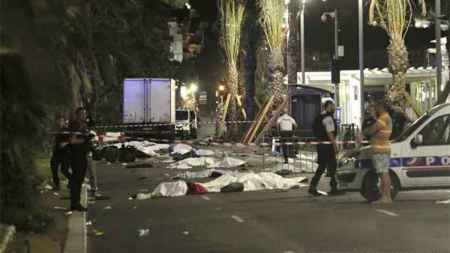
We know what is going to follow the latest terrorist murder in Nice. Shrines to the dead will instantly spring up. Conclaves of citizens will gather at sorrowful demonstrations filled with ecumenical clichés. The media will profile selected victims, wringing every ounce of pathos out of their tragedy. Twitter will be inundated with sentimental bromides and ephemeral hashtags, and politicians will give solemn and empty speeches laced with even emptier threats.

Welcome to terror in a therapeutic age.

What we will not read are passionate demands from most citizens of Western governments that mind-concentrating force be unleashed on those responsible for the latest slaughter of the innocents. Nor will we hear stirring speeches from our political leaders that forcefully make the moral case for war against the murderers and their enablers.

Obsessing over feelings and emotions is what many moderns reflexively substitute for meaningful action. Righteous anger and burning revenge of the sort that fired up Americans after the Pearl Harbor attacks are too “mean” and “hurtful,” and require a serious commitment and exorbitant risk. Displaying emotion is cheap and gratifying and offends no one. Indeed, such displays demonstrate the purveyors’ superior “we are the world” sensibilities and sensitivity. It is “conspicuous compassion,” as Alan Bloom called it, as much a status symbol as Veblen’s conspicuous consumption. It’s how people show themselves to be civilized and advanced, too sophisticated for retrograde emotions like avenging anger. That’s so Old Testament.

In the therapeutic world, conflict is to be resolved by peace, love, and understanding. Or as our Attorney General said after the Orlando jihadist massacre, “Our common humanity transcends our differences, and our most effective response to terror is compassion, it’s unity and it’s love.” Thus the institutional instruments for resolving our differences with the jihadists are diplomatic engagement, foreign aid, economic development, negotiated agreements, and careful nurturing of our enemies’ self-esteem. We must flatter them, stroke their egos, attend to their grievances, censor any unpleasant facts about their religion. Pretend, as Obama does, that Islam, the “religion of peace” and has absolutely nothing to do with Muslim terrorism, or what he prefers to call “violent extremists.” Assert, like Hillary, “Let’s be clear: Islam is not our adversary. Muslims are peaceful and tolerant people and have nothing whatsoever to do with terrorism.”

The problem is, we live in a world of people with radically different ideas about the goods they should pursue, and who don’t give a damn about “peace, love, understanding,” or the opinions of Western infidels about their religion. Whatever their potential is for possessing and recognizing a “common humanity,” in practice this possibility remains mostly unexpressed in their traditional religious tenets. Rather, Muslim jihadists––and hundreds of millions of ordinary Muslims–– limit their compassion, sympathy, and respect for humanity to fellow Muslims, and deny them to the infidel or heretic. That’s why zakat, the personal obligation for Muslims to make charitable contributions, for the most part restricts that charity to other Muslims.

The only “common humanity” pious Muslims recognize is the divine obligation for all humans to become Muslim. Their highest goods are not democracy, prosperity, leisure, and tolerance, but obedience to Allah and his laws. And millions of them view violence in the name of Allah as the divinely justified instrument for creating a world in which “all men say there is no god but Allah.”

Appeals to a “common humanity,” then, are useless as appeasing flattery for dealing with a man who, willing to die and kill in the name of Allah, drives a truck over men, women, and children, killing, mangling, and dismembering them. Flattery only confirms the jihadist’s belief that the infidel West is populated by godless hedonists eager only to enjoy life for one more day, and so are willing to sacrifice their freedom and rights for the short-term pleasures of la dolce vita. They are unworthy of compassion, for they no longer know what is worth dying and killing for. They have forgotten what Lincoln called the “awful arithmetic,” the tragic reality that some people must die today so that more people don’t die later––the gruesome calculus that the Allies followed to defeat fascism, Japanese imperialism, and Nazism.

Over forty years ago, the great Soviet dissident Alexandr Solzhenitsyn in his Nobel lecture identified this chronic weakness that permeates the West:

The spirit of Munich has by no means retreated into the past; it was not a brief episode. I even venture to say that the spirit of Munich is dominant in the twentieth century. The intimidated civilized world has found nothing to oppose the onslaught of a suddenly resurgent fang-baring barbarism, except concessions and smiles. The spirit of Munich is a disease of the will of prosperous people; it is the daily state of those who have given themselves over to a craving for prosperity in every way, to material well-being as the chief goal of life on earth. Such people––and there are many of them in the world today––choose passivity and retreat, anything if only life to which they are accustomed might go on, anything so as not to have to cross over to rough terrain today, because tomorrow, see, everything will be all right. But it never will! The reckoning for cowardice will only be more cruel. Courage and the power to overcome will be ours only when we dare to make sacrifices.

These comments about the Soviet Union and the West are just as true today about the “fang-baring barbarism” of Islamic jihad. The surreal denial of the nature of the enemy and his religious motivations; the symbolic military gestures that serve public relations and political advantage rather than a strategy for defeating the enemy; the unwillingness to accept the eternal tragic realities of war and instead create suicidal rules of engagement vetted by pettifogging lawyers; and the refusal of citizens to pay the price necessary for destroying the enemy––all reflect the disease that Solzhenitsyn identified.

The problem is one of morale, not ability. We can destroy ISIS. Even the fictional Peter Quinn, from the series Homeland, knows how: put 200,000 troops in a country indefinitely or “bomb Raqqa into a parking lot.” In the real world, Asia Times columnist “Spengler” agrees. Wage total war both against the enemy abroad and against fellow travelers and sympathizers at home.

But don’t hold your breath. The political will for such action does not exist among a significant number of Americans. They would rather feel than act. Meanwhile, they indulge lachrymose sentiment, a luxury of the pampered rich. They call for “diplomacy” and “engagement,” the tried and true camouflage for the fear to act. They prefer to spend money on more and more government provided “butter” rather than on guns, as they move on to the next episode of televised tragedy in between bouts of Pokémon Go.

Meanwhile, the reckoning for our cowardice grows ever closer and ever crueler.

Not Just the Saudis: Iran’s Huge Role in 9/11 Also Covered Up

July 19, 2016

Not Just the Saudis: Iran’s Huge Role in 9/11 Also Covered Up, PJ MediaRobert Spencer, July 19, 2016

Iran and Saudi

“Satan in Flames” was the Iranian’s elaborate plot to hijack three passenger jets, each packed full of people, and crash them into American landmarks: the World Trade Center, which jihadis took to be the center of American commerce; the Pentagon, the center of America’s military apparatus; and the White House.

*************************

The 28-page section of the 9/11 report detailing Saudi involvement in the terror attack has finally been released (although with substantial portions still redacted). We now know why one president who held hands with the Saudi King and another president who bowed to him worked so hard all these years to keep these pages secret. The 28 pages confirm that the 9/11 jihad murderers received significant help from people at the highest levels of the Saudi government.

However, Saudi involvement in 9/11 was not the only subject of a cover-up: Iran’s little-noted role in 9/11 has been covered up as well.

As I detail in my new book The Complete Infidel’s Guide to Iran, on December 22, 2011, U.S. District Judge George B. Daniels ruled in Havlish, et al. v. bin Laden, et al., that Iran and Hizballah were liable for damages to be paid to relatives of the victims of the September 11, 2001 jihad attacks in New York and Washington.

Judge Daniels found that both the Islamic Republic and its Lebanese proxy had actively aided al-Qaeda in planning and executing those attacks. He found that Iran and Hizballah had cooperated and collaborated with al-Qaeda before 9/11, and continued to do so after the attacks.

Before 9/11, Iran and Hizballah were implicated in efforts to train al-Qaeda members to blow up large buildings. This training resulted in the bombing of the Khobar Towers in Saudi Arabia in 1996, the bombing of the U.S. embassies in Kenya and Tanzania in 1998, and the attack on the USS Cole in 2000.

Shortly after the Cole attack, the 9/11 jihad plot began to come together — and Iran was involved.

Former MOIS operative Abolghasem Mesbahi, a defector from Iran, testified that during the summer of 2001 he received messages from Iranian government officials regarding a plan for unconventional warfare against the United States. The plot was entitled Shaitan dar Atash (“Satan in Flames”).

“Satan in Flames” was the Iranian’s elaborate plot to hijack three passenger jets, each packed full of people, and crash them into American landmarks: the World Trade Center, which jihadis took to be the center of American commerce; the Pentagon, the center of America’s military apparatus; and the White House.

A classified National Security Agency analysis referred to in the 9/11 Commission report reveals that eight to 10 of the 9/11 hijackers traveled to Iran repeatedly in late 2000 and early 2001.

The 9/11 Commission called for a U.S. government investigation into Iran’s role in 9/11 — but none was ever undertaken.

So Kenneth R. Timmerman of the Foundation for Democracy in Iran was, in his words, “engaged by the Havlish attorneys in 2004 to carry out the investigation the 9/11 Commission report called on the U.S. government to handle.”

Timmerman noted that during the 9/11 hijackers’ trips to Iran, they were “accompanied by ‘senior Hezbollah operatives’ who were in fact agents of the Iranian regime.” Iranian border agents did not stamp their passports so that their having been inside the Islamic Republic would not arouse suspicion when they entered the United States. The CIA, embarrassed by its failure to recognize the import of these trips, tried to suppress this revelation.

However, Timmerman contends that even the available evidence is explosive enough. In his words, he reveals that the Islamic Republic of Iran:

  • Helped design the 9/11 plot
  • Provided intelligence support to identify and train the operatives who carried it out
  • Allowed the future hijackers to evade U.S. and Pakistani surveillance on key trips to Afghanistan — where they received the final order of mission from Osama bin Laden — by escorting them through Iranian borders without passport stamps
  • Evacuated hundreds of top al-Qaeda operatives from Afghanistan to Iran after 9/11 just as U.S. forces launched their offensive
  • Provided safe haven and continued financial support to al-Qaeda cadres for years after 9/11
  • Allowed al-Qaeda to use Iran as an operational base for additional terror attacks, in particular the May 2003 bombings in Riyadh, Saudi Arabia

The Ayatollah Khamenei knew about the plot. During the summer of 2001, he instructed Iranian agents to be careful to conceal their tracks. He told them to communicate only with al-Qaeda’s second-in-command — Ayman al-Zawahiri — and Imad Mughniyah of Hizballah.

Mughniyah was Iran’s key player in the 9/11 “Satan in Flames” plot. During the Havlish trial, former CIA agents Clare M. Lopez and Bruce D. Tefft submitted an affidavit stating:

Imad Mughniyah, the most notable and notorious world terrorist of his time, an agent of Iran and a senior operative of Hizballah, facilitated the international travel of certain 9/11 hijackers to and from Iran, Lebanon, Saudi Arabia, and Afghanistan, and perhaps various other locations for the purpose of executing the events of September 11, 2001.This support enabled two vital aspects of the September 11, 2001 plot to succeed: (1) the continued training of the hijackers in Afghanistan and Iran after securing their United States visas in Saudi Arabia, and (2) entry into the United States.

The Obama-era CIA went to great pains to try to ensure that information about Iran’s role in 9/11 did not come out in the Havlish case.

In August 2010, a CIA official pressured a Havlish witness to withdraw his testimony in exchange for a new identity, new passport, and new job.

In December of that year, another CIA operative approached a different Havlish witness, showed him documents stolen from the case, and took him to a U.S. embassy where he was subjected to five hours of interrogation. He was finally offered cash if he recanted his testimony. Says Timmerman:

After I reported those attempts at witness tampering to a Congressional oversight committee, they ceased.

Judge Daniels determined that Iran, Hizballah, the Islamic Revolutionary Guard Corps, the Iranian Ministry of Intelligence and Security, and other Iranian government departments — as well as the Ayatollah Khamenei himself and former Iranian president Ali Akbar Hashemi Rafsanjani — were all directly implicated in Iranian efforts to aid al-Qaeda in its 9/11 plot.

Daniels awarded the plaintiffs in the Havlish case $394,277,884 for economic damages, $94,000,000 for pain and suffering, $874,000,000 for mental anguish and grief, $4,686,235,921 in punitive damages, and $968,000,000 in pre-judgment interest for a total of $7,016,513,805.

The Havlish plaintiffs will not receive a check for that amount from the Islamic Republic of Iran neatly signed by the Ayatollah Khamenei. Still, the judgment provided a small bit of solace for the loss of life and years of trauma these families suffered as a result of the Islamic Republic’s war against the United States.

Most importantly, the judgment stands as an acknowledgment of Iran’s role in the 9/11 attacks.

Clearly, Iran is and has been at war with the United States, Over a period of many years, Iran has conducted that war on numerous unconventional fronts while threatening conventional attacks if its agenda is thwarted in any way.

For the Islamic Republic this war is very real, a principal focus of its energy and expenditures. But it appears that only one side is fighting.

This was underscored in March 2016, when it came to light that Iranian hackers who were accused of being tied to the Islamic Republic had attempted to hack into the operating system of the Bowman Avenue Dam north of New York City, as well as into financial conglomerates Bank of America, JP Morgan Chase, Citibank, and HSBC – and the New York Stock Exchange.

Said Attorney General Loretta Lynch:

These attacks were relentless, they were systematic, and they were widespread.

Such attacks, if they had been successful, could have caused catastrophic damage to New York City and the American economy. Yet true to form, the Obama administration only indicted the accused (none of whom it had in custody). He took no measures against the Iranian government.

After 9/11, the U.S. declared war on terror and entered Afghanistan and Iraq. But if Bush had really been serious about attacking jihad terror at its root, he would have invaded Saudi Arabia and Iran instead. Under Obama, the denial and willful ignorance have only gotten exponentially worse.

Hezbollah’s Massive Arms Build-up in Lebanese Civilian Areas

July 19, 2016

Hezbollah’s Massive Arms Build-up in Lebanese Civilian Areas, Front Page MagazineJoseph Klein, July 19, 2016

hn

Every calendar quarter the United Nations Security Council holds an extensive debate on the Israeli-Palestinian “situation.” The Israeli and Palestinian UN representatives make speeches following the Secretary General’s report on the current status, which are normally predictable restatements of their respective positions. This time, however, Israel’s ambassador Danny Danon, addressing the Security Council at its July 12th meeting, presented new graphic evidence of Hezbollah’s alarming arsenal of rockets and missiles located in civilian areas of southern Lebanon.

Ten years ago, when Security Council Resolution 1701 was adopted, ending the war that had broken out between Israel and Hezbollah, the terrorist group was estimated to have had about 7000 rockets. The resolution called for Hezbollah and other armed groups not officially a part of the Lebanese government’s armed forces to relinquish their weapons. Instead, precisely the opposite has happened. Hezbollah never stopped its arms build-up, which has been funded and supplied principally from the world’s leading state sponsor of terror, Iran.

Hezbollah now has approximately 120,000 rockets and missiles aimed at Israeli civilian population centers.  By way of comparison, Ambassador Danon said that “more missiles are hidden underground in 10,000 square kilometers [of Lebanon] than the above-ground 4 million square kilometers” of the European North Atlantic Treaty Organization countries.

Referring to aerial satellite imagery, based on the latest Israeli intelligence, Ambassador Danon demonstrated to the members of the Security Council the location of rocket launchers and arms depots that Hezbollah had placed in civilian areas. “The village of Shaqra has been turned into a Hezbollah stronghold with one out of three buildings used for terror activities, including rocket launchers and arms depots,” Ambassador Danon said.  “Hezbollah has placed these positions next to schools and other public institutions putting innocent civilians in great danger.”

Hezbollah, aided and abetted by Iran, was “committing double war crimes,” the Israeli ambassador charged. “They are attacking civilians, and using Lebanese civilians as human shields,” he said. “We demand the removal of Hezbollah terrorists from southern Lebanon.”

Not surprisingly, Ambassador Danon’s presentation of irrefutable evidence of Hezbollah’s clear and present danger to Israeli and Lebanese civilians, and his demand for Security Council action, fell on deaf ears. In her own statement that followed Ambassador Danon’s remarks, U.S. Ambassador to the UN Samantha Power said not a word about what was just presented regarding Hezbollah. Instead, she stuck to her canned talking points that continue to draw a moral equivalence between acts of Palestinian terrorism and Israeli self-defense. “In recent months, there’s been a steady stream of violence on both sides of the conflict,” she said. Then Ambassador Power proceeded to criticize the building of Israeli settlements, as if again to draw a moral equivalence between housing construction and terrorism. She assailed what she called Israel’s “systematic process of land seizures, settlement expansions, and legalizations of outposts that is fundamentally undermining the prospects for a two-state solution.” All that Ambassador Power said about Lebanon was to decry the political stalemate in electing a new president and to state that “the United States is helping the Lebanese armed forces build the capabilities necessary to counter violent extremism and protect the Lebanese people.”  If the Obama administration were truly interested in countering “violent extremism” in Lebanon and protecting the Lebanese people, it would start by doing everything possible to eliminate the violent extremist threat posed by Hezbollah’s massive rearmament. That, in turn, would require the Obama administration to reverse its appeasement course towards Iran and tighten, not loosen, the financial screws on the regime.

There is no doubt where the bulk of Hezbollah’s funding and arms is coming from. Even Secretary of State John Kerry acknowledged last January Iran’s leading role in arming Hezbollah.

The terrorist organization’s chief Hasan Nasrallah boasted last month about Iran’s bankrolling its operations:

“We are open about the fact that Hezbollah’s budget, its income, its expenses, everything it eats and drinks, its weapons and rockets, are from the Islamic Republic of Iran,” Nasrallah was quoted by Hezbollah’s official Al Ahed newspaper as saying.  “As long as Iran has money we will have money. Hezbollah gets its money and arms from Iran, as long as Iran has money, so does Hezbollah. We extend gratitude to the Leader Imam, [His Eminence] Sayyed Khamenei, and to the leadership of the Islamic Republic and its government, president, scholars and people for their generous support which has never stopped.”

To add insult to injury, Nasrallah made his remarks while honoring the “martyrdom” of a top Hezbollah terrorist killed in Syria whom has been linked to the 1983 attack on the U.S. Marines barracks in Lebanon. That attack took the lives of 241 Americans. Now, Hezbollah is stronger than ever, with Iran’s “generous support.”

Iran continues to fund global terrorism, with its treasury being replenished thanks to the Obama administration’s largesse.

Brexit Disrupts Nonchalant European Union Meddling

July 13, 2016

Brexit Disrupts Nonchalant European Union Meddling, Gatestone InstituteMalcolm Lowe, July 13, 2016

♦ In respect of the Palestinian problem, the European political elites have only the means to destabilize the status quo without installing an alternative. But Israel’s leaders can take heart. Any declarations made at French President François Hollande’s conference will be unenforceable, because the EU on its own lacks the means and because its energies must now focus on stopping its own disintegration.

♦ The underlying reasons for Brexit and for EU disintegration in general have still not been widely understood. Brexit was not merely a vote of no confidence in the EU but also in the UK establishment. Similar gaps between establishment and electorate now exist in several other major European states. In some cases, however, governments are united with their electorates in detesting the EU dictatorship in Brussels.

The June 23 vote by the United Kingdom electorate to leave the European Union should be seen in the context of two other recent European events. Three days earlier, on June 20, the EU’s Foreign Ministers Council decided to solve the Palestinian problem by Christmas with its endorsement of French President François Hollande’s “peace initiative.” Three days after the vote, on June 26, the second election in Spain within a few months failed once again to produce a viable majority for any government. Worse still, the steadily rising popularity of nationalist parties in France, Germany, Austria and the Netherlands suggests that political paralysis in other EU countries is on the way.

In short, the ambitions of the ruling political cliques of Europe to solve the problems of the world are being undermined by their own neglected electorates, which are increasingly furious at the failure of those cliques to solve the problems of Europe itself. Four years ago, we wrote about Europe’s Imminent Revolution. Two years ago, about the attempt and failure of those cliques to turn the EU into a make-believe copy of the United States. Today, that revolution is creeping ahead month by month.

Before threatening Israel’s security and local supremacy, the EU foreign ministers could have recalled the results of their previous nonchalant meddling in the area. We were all rightly horrified by the threat of Muammar Gaddafi to hunt down his enemies “street by street, house by house,” as he began by shooting hundreds in his capital, in February 2011. Hollande’s predecessor, Nicolas Sarkozy, rallied European leaders — first and foremost the UK’s David Cameron — to do something about it. President Obama turned up to give a speech, something that he is good at. More importantly, Obama supplied warplanes from the NATO base in Naples. The idea was to enable victory for the Libyan rebel forces by paralyzing Gaddafi’s own air force and bombing his land forces.

Victory was achieved. But the rebels were united only in their hatred of Gaddafi. So Libya has descended into a chaos that could have been prevented only by a massive long-term presence of European land forces, which Europe — after repeated cuts in army strength — does not have. Now it is the local franchise of the Islamic State, among others, that is hunting down enemies house by house.

Europe was incapable of achieving anything in Libya without the United States, and incapable of replacing a detestable regime with a superior alternative. The lesson could have been learned from Iraq. Here, a massive American military presence accompanied a constitutional revolution and the beginnings of parliamentary rule. But the whole costly achievement collapsed when Obama decided to remove even the residual military presence needed to perpetuate it.

In respect of the Palestinian problem, too, the European political elites have only the means to destabilize the status quo without installing an alternative. But Israel’s leaders can take heart. At Hollande’s conference in December, the UK will be half in and half out, if present at all. Neither Obama nor his by then elected successor will turn up to make a speech. Any declarations made at Hollande’s conference will be unenforceable because the EU on its own lacks the means and because its energies must now focus on stopping its own disintegration.

Of the authors of the Libyan adventure, David Cameron resigned after the vote for Brexit. Obama will shortly leave after what may charitably be called a mixed record in foreign affairs. Sarkozy’s aspiration to be reelected and succeed the unpopular Hollande, whose approval rate is now just 12%, has been challenge by a recent French court decision.

Sarkozy was trying to sue Mediapart, a French investigative agency, for publishing a letter of 2007 from Gaddafi’s intelligence chief about an “agreement in principle to support the campaign for the candidate for the presidential elections, Nicolas Sarkozy, for a sum equivalent to Euro 50 million.” (The maximum individual contribution permitted in French law is 1500 euros.) The judges investigating the corruption case against Sarkozy have ruled that the letter is genuine. The suspicion, then, is that Sarkozy’s campaign to eliminate Gaddafi was at least partly motivated by the need to eliminate the supplier of a bribe.

The underlying reasons for Brexit and for EU disintegration in general have still not been widely understood. Brexit was not merely a vote of no confidence in the EU but also in the UK establishment. Out of 650 members in the House of Commons, only around 150 — nearly all Conservatives — are estimated to have voted for Brexit. Against Brexit was also a clear majority of leading figures in commerce, academia and the churches. Similar gaps between establishment and electorate now exist in several other major European states. In some cases, however, governments are united with their electorates in detesting the EU dictatorship in Brussels.

That glaring discrepancy between the UK establishment and the electorate explains the establishment’s quick acceptance of Brexit, for fear of becoming totally discredited. A contributory reason was the broad consensus on both sides of the debate that the operative style of EU institutions is deeply flawed and often detrimental to UK interests. The concessions obtained by Cameron from the EU before the vote were widely regarded as derisory. Moreover, the President of the European Parliament, Martin Schulz, had loudly proclaimed that he could obtain a vote to cancel those concessions. The real issue, therefore, was whether a Remain vote could help to reform the EU, in cooperation with other member states, or whether the EU was fundamentally unreformable. The UK electorate decided for the latter view and the establishment is committed to implementing it.
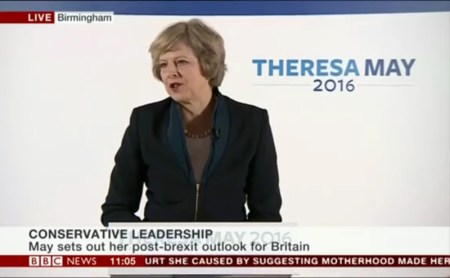
1693The glaring discrepancy between the UK establishment and the electorate explains the establishment’s quick acceptance of Brexit, for fear of becoming totally discredited. Pictured above: Theresa May launches her campaign for leader of the UK Conservative party on July 11, 2016, saying “Brexit means Brexit.”

The two earlier articles mentioned above first spotted the phenomenon of European disintegration and then explained it. Today, the intervening events have made the explanation all the simpler. Basically, the European political elites were correctly convinced, long ago, that considerable European integration was desirable, but their very successes in this area made them grossly overestimate what could and should be done further.

Up to a decade ago, it seemed that a similar pattern was becoming established in one EU country after another: the parliament was dominated by a large center-right party and a large center-left party that alternated in power from one election to another. The parallel to the United States seemed obvious, but the parallel was illusory, as we shall show.

Emboldened, the political parties concerned made the fatal mistake of trying to combine for the purpose of elections to the EU Parliament. Thus emerged a pan-European center-right pseudo-party, the “European People’s Party” (EPP), whose origins go back to a get-together of Christian Democrat parties in 1976. And a pan-European center-left pseudo-party, the “Party of European Socialists” (PES), founded in 1992 as an alliance between old-style Social Democrat parties and the former so-called Eurocommunist parties. The latter first emerged during the decline and discreditation of the Soviet Union in the 1970s and 1980s, then changed their names after its disappearance in December 1991. Thus, the core of Italy’s current Democratic Party derives from the Italian Communist Party (PCI), the major opposition party of post-war Italy.

Curiously but inevitably, the more those parties tried to unite, the more they lost support in their own countries of origin. Thus the Dutch Christian Democrats (CDA) are today a minor party of the right and the Panhellenic Socialist Movement (PASOK) barely crosses the threshold of 5% needed for entry into the Greek Parliament. (Incongruously, the last PASOK Prime Minister of Greece, George Papandreou, continues to be President of the Socialist International.) The reason for this development, however, is not far to seek.

Nationalism, it was forgotten, is an essential component of center-right sentiment. So a center-right party that prefers an international interest at the expense of the national interest of its own country loses credibility among its own core supporters; it becomes vulnerable to the rise of far-right upstart parties. Examples of this process in the EU are now so evident as not to need enumeration.

The attraction of socialism, it was forgotten, is that its core supporters expect increases in government social spending at the expense of financial stability. This becomes more difficult, the more a country is constrained by participation in a shared international framework. It becomes impossible to maintain once a country joins a common currency, since the usual remedy for socialist overspending is devaluation of the national currency. This is why PASOK has been eclipsed in Greece by the far-left SYRIZA, why the Spanish franchise of the PES (the PSOE) has lost severely to the upstart Podemos, and why support for its Dutch franchise (the PvdA) is now down to about the same as for each of two other left-wing parties.

It is also why in Britain, where the electoral system obstructs the rise of new parties, Jeremy Corbyn was voted leader by the Labour Party membership to the horror of the party establishment. Corbyn himself was a pronounced Euroskeptic until recently and only half-heartedly spoke in public for Remain, creating suspicions that he secretly voted for Leave.

A far-right party, like the Freedom Party (OFP) of Austria, has an easy sales pitch. Not so the far-left ones: after they come to power, it quickly and painfully becomes evident that they have no more ability than their derided Social Democrat predecessors to defy the constraints imposed by membership in the Eurozone.

Thus SYRIZA came to power in Greece and won a referendum to end austerity. The result was that all Greeks found that their bank accounts were virtually frozen: they were allowed to withdraw only sixty Euros a day. SYRIZA then split. The larger faction won the resulting general election and accepted the harsh conditions that the referendum had rejected. The paradoxical result in Greece is that the current government is a coalition of an upstart far-left party, SYRIZA, and an upstart nationalist party (the Independent Hellenes) that lies to the right of New Democracy (the Greek franchise of the EPP).

In other EU countries, however, the typical development has been the opposite: the erstwhile competing franchises of the EPP and the PES are in coalition against the motley upstart breakaway parties, since neither of the two gets an absolute majority in parliament any more. That is, their former raison d’être as competing alternatives has been abandoned in the need to survive in power at all. The paralysis in Spain comes from the fact that the two local franchises there are descended from the two sides in the murderous Civil War of 1936-1939. Joint government is still hardly imaginable especially for the losing socialists, who continued to suffer persecution long after the war.

Likewise, in the elections to the EU Parliament in May 2014, the EPP and the PES won only 221 and 191 seats respectively out of 751, each far short of a majority. So they clubbed together to make the top candidate of the EPP, Jean-Claude Juncker, President of the EU Commission and to retain the top candidate of the PES, Martin Schulz, as President of the Parliament. The incredible response of Juncker to Brexit has been to demand even tighter integration: he wants to force into the Eurozone the eight EU member states (other than the UK) that still have independent currencies. He also reiterated his proposal, originally made last March, to unite the armed forces of all states (with the UK gone) into a European army. For this he has the support of Schulz’s home party, the German SPD. That is, they want more and more of what the European electorates want less and less.

Especially in Eastern Europe, there are now also governments that resent the relentless centralizing urges of the EU establishment. In Hungary, for example, the government has rejected the demand of the EU Commission to absorb a quota of the immigrants currently streaming into Europe; it has scheduled a referendum on the matter for October 2. On the same day, Austria will hold a revote for the presidency, which the Freedom Party may narrowly win after narrowly losing the first time around.

These governments are among the new friends of Israel described in a recent Reuters article, titled “Diplomatic ties help Israel defang international criticism.” As it notes:

“Whereas a few years ago Israel mostly had to rely on Germany, Britain and the Czech Republic to defend its interests in the EU, now it can count Italy, Greece, Cyprus, Austria, Hungary and a handful of others among potential allies.”

These allies have no desire to penalize Israel on behalf of increasingly tedious Palestinians. On the contrary:

“Like Turkey, which last week agreed to restore diplomatic ties with Israel after a six-year hiatus, they see a future of expanding business, trade and energy ties.”

By “energy ties” is meant Israel’s recently discovered vast fields of natural gas, the phenomenon that we earlier dubbed “Israel as a Gulf State.” That is: just as governments care little for the human rights record of, say, Qatar in their eagerness to acquire its natural gas, so also the self-righteous moaning of the Palestinian Authority does not deter those governments from going for what Israel has to offer. As the Reuters article quotes a European ambassador: “There’s just no appetite to go toe-to-toe with Israel and deliver a really harsh indictment. No one sees the upside to it.”

Israel’s government is not, of course, gloating over the discontent spreading in the EU. But it surely appreciates some of the side effects.
Hillary — Lies, Benghazi, Murders and Consequences

July 7, 2016

Hillary — Lies, Benghazi, Murders and Consequences, Dan Miller’s Blog, July 7, 2016

(The views expressed in this post are mine and are not necessarily those of Warsclerotic or its other editors. — DM)

Hillary Clinton, who if elected would be President Obama Part Two, is a world-class liar. Whenever She considers truth damaging to Herself — as it usually is — She lies. Normally, She gets away with it. She lied about her State Department e-mails: guilty as hell and free as a bird. She lied about the terrorist attack in Benghazi and, thus far, has got away with it. This year, it is up to the American people to do the only thing we can to prevent Her from becoming President Obama Part Two. Our only way to do that will be to deny Her what She considers “Her turn” to continue Obama’s quest to destroy America.

Guilty as Hell and free as a bird

Guilty as Hell and free as a bird

First, a flash-back

She lied misspoke, as She often does.

On July 5th, during FBI Director Comey’s address on his recommendation that She not be indicted, She was revealed as a consummate liar. She then got adverse press, even from the lamebrain media. For her lies evidenced there alone, She should not become “our” president. She will not if we stand firm. Please see The FBI Recommendation Not to Indict Hillary Will Help Trump.

This brings us to The Benghazi Clusterdunk

The following video shows that the Obama-Clinton administration should, and could, have sent American military resources to prevent American deaths in Benghazi. For political reasons, resources were not sent: elections were comings soon, so Islamic terror needed to have been defeated and nation-building had to have been successful in Lybia. Both were lies.

The next video provides what we know about the Clinton-Obama administration refusals to send American military help. There is much that we don’t know, because of the Obama administration chose to provide lies instead of truthful answers.

Hillary lied, Obama lied. Americans died and Obama got a second term in office. Now Hillary wants Her “turn.”

https://www.youtube.com/watch?v=5xA2_LDKm8s

Knowing full well that the attack had nothing to do with a poorly made video — for which the maker was gratuitously jailed — Hillary and Obama lied. Ambassador Rice may also have lied intentionally. Either that or she was given a political spin instead of accurate information and had no reason to believe that she had been lied to.

September 25, 2011

According to the Majority Report on the Benghazi clusterdunk, as summarized by Robert Spencer,

  • Despite President Obama and Secretary of Defense Leon Panetta’s clear orders to deploy military assets, nothing was sent to Benghazi, and nothing was en route to Libya at the time the last two Americans were killed almost 8 hours after the attacks began. [pg. 141]
  • With Ambassador Stevens missing, the White House convened a roughly two-hour meeting at 7:30 PM, which resulted in action items focused on a YouTube video, and others containing the phrases “[i]f any deployment is made,” and “Libya must agree to any deployment,” and “[w]ill not deploy until order comes to go to either Tripoli or Benghazi.” [pg. 115]
  • The Vice Chairman of the Joint Chiefs of Staff typically would have participated in the White House meeting, but did not attend because he went home to host a dinner party for foreign dignitaries. [pg. 107]
  • A Fleet Antiterrorism Security Team (FAST) sat on a plane in Rota, Spain, for three hours, and changed in and out of their uniforms four times. [pg. 154] [to avoid offending the locals by wearing military attire — DM]
  • None of the relevant military forces met their required deployment timelines. [pg. 150]
  • The Libyan forces that evacuated Americans from the CIA Annex to the Benghazi airport was not affiliated with any of the militias the CIA or State Department had developed a relationship with during the prior 18 months. Instead, it was comprised of former Qadhafi loyalists who the U.S. had helped remove from power during the Libyan revolution. [pg. 144]

Part II

  • Five of the 10 action items from the 7:30 PM White House meeting referenced the video, but no direct link or solid evidence existed connecting the attacks in Benghazi and the video at the time the meeting took place. The State Department senior officials at the meeting had access to eyewitness accounts to the attack in real time. The Diplomatic Security Command Center was in direct contact with the Diplomatic Security Agents on the ground in Benghazi and sent out multiple updates about the situation, including a “Terrorism Event Notification.” The State Department Watch Center had also notified Jake Sullivan and Cheryl Mills that it had set up a direct telephone line to Tripoli. There was no mention of the video from the agents on the ground. Greg Hicks—one of the last people to talk to Chris Stevens before he died—said there was virtually no discussion about the video in Libya leading up to the attacks. [pg. 28]
  • The morning after the attacks, the National Security Council’s Deputy Spokesperson sent an email to nearly two dozen people from the White House, Defense Department, State Department, and intelligence community, stating: “Both the President and Secretary Clinton released statements this morning. … Please refer to those for any comments for the time being. To ensure we are all in sync on messaging for the rest of the day, Ben Rhodes will host a conference call for USG communicators on this chain at 9:15 ET today.” [pg. 39]
  • Minutes before the President delivered his speech in the Rose Garden, Jake Sullivan wrote in an email to Ben Rhodes and others: “There was not really much violence in Egypt. And we are not saying that the violence in Libya erupted ‘over inflammatory videos.’” [pg. 44]
  • According to Susan Rice, both Ben Rhodes and David Plouffe prepared her for her appearances on the Sunday morning talk shows following the attacks. Nobody from the FBI, Department of Defense, or CIA participated in her prep call. While Rhodes testified Plouffe would “normally” appear on the Sunday show prep calls, Rice testified she did not recall Plouffe being on prior calls and did not understand why he was on the call in this instance. [pg.98]
  • On the Sunday shows, Susan Rice stated the FBI had “already begun looking at all sorts of evidence” and “FBI has a lead in this investigation.” But on Monday, the Deputy Director, Office of Maghreb Affairs sent an email stating: “McDonough apparently told the SVTS [Secure Video Teleconference] group today that everyone was required to ‘shut their pieholes’ about the Benghazi attack in light of the FBI investigation, due to start tomorrow.” [pg. 135]
  • After Susan Rice’s Sunday show appearances, Jake Sullivan assured the Secretary of the State that Rice “wasn’t asked about whether we had any intel. But she did make clear our view that this started spontaneously and then evolved.” [pg. 128]
  • Susan Rice’s comments on the Sunday talk shows were met with shock and disbelief by State Department employees in Washington. The Senior Libya Desk Officer, Bureau of Near Eastern Affairs, State Department, wrote: “I think Rice was off the reservation on this one.” The Deputy Director, Office of Press and Public Diplomacy, Bureau of Near Eastern Affairs, State Department, responded: “Off the reservation on five networks!” The Senior Advisor for Strategic Communications, Bureau of Near East Affairs, State Department, wrote: “WH [White House] very worried about the politics. This was all their doing.” [pg. 132]
  • The CIA’s September 13, 2012, intelligence assessment was rife with errors. On the first page, there is a single mention of “the early stages of the protest” buried in one of the bullet points. The article cited to support the mention of a protest in this instance was actually from September 4. In other words, the analysts used an article from a full week before the attacks to support the premise that a protest had occurred just prior to the attack on September 11. [pg. 47]
  • A headline on the following page of the CIA’s September 13 intelligence assessment stated “Extremists Capitalized on Benghazi Protests,” but nothing in the actual text box supports that title. As it turns out, the title of the text box was supposed to be “Extremists Capitalized on Cairo Protests.” That small but vital difference—from Cairo to Benghazi—had major implications in how people in the administration were able to message the attacks. [pg. 52]

Part III

  • During deliberations within the State Department about whether and how to intervene in Libya in March 2011, Jake Sullivan listed the first goal as “avoid[ing] a failed state, particularly one in which al-Qaeda and other extremists might take safe haven.” [pg. 9]
  • The administration’s policy of no boots on the ground shaped the type of military assistance provided to State Department personnel in Libya. The Executive Secretariats for both the Defense Department and State Department exchanged communications outlining the diplomatic capacity in which the Defense Department SST security team members would serve, which included wearing civilian clothes so as not to offend the Libyans. [pg. 60]
  • When the State Department’s presence in Benghazi was extended in December 2012, senior officials from the Bureau of Diplomatic Security were excluded from the discussion. [pg. 74]
  • In February 2012, the lead Diplomatic Security Agent at Embassy Tripoli informed his counterpart in Benghazi that more DS agents would not be provided by decision makers, because “substantive reporting” was not Benghazi’s purpose. [pg. 77]
  • Emails indicate senior State Department officials, including Cheryl Mills, Jake Sullivan, and Huma Abedin were preparing for a trip by the Secretary of State to Libya in October 2012. According to testimony, Chris Stevens wanted to have a “deliverable” for the Secretary for her trip to Libya, and that “deliverable” would be making the Mission in Benghazi a permanent Consulate. [pg. 96]
  • In August 2012—roughly a month before the Benghazi attacks—security on the ground worsened significantly. Ambassador Stevens initially planned to travel to Benghazi in early August, but cancelled the trip “primarily for Ramadan/security reasons.” [pg. 99]
  • Former Secretary of Defense Leon Panetta bluntly told the committee “an intelligence failure” occurred with respect to Benghazi. Former CIA Deputy Director Michael Morell also acknowledged multiple times an intelligence failure did in fact occur prior to the Benghazi attacks. [pg. 129]

And now, two wrap-ups:

https://www.youtube.com/watch?v=1pwZvZGQfbg

Conclusions

Hillary lied, Obama lied and Islamist al-Qaeda affiliated terrorists murdered Americans because no American military resources were sent, even though available. Their deaths were not only unnecessary, they were and remain a disgrace.

There is now only one action that we can take, and that will be on November 8th. Then, we will vote either for Obama Part Two becoming Obama Part One, thereby affirming their disgraceful actions and inactions or disown them. It’s up to us to disown them both.

Why Trump Will Win in November

July 7, 2016

Why Trump Will Win in November, Front Page Magazine, David Horowitz, July 7, 2016

hj_1

Reprinted from Breitbart.com.

In elections generally – but this one in particular – things are not always what they seem. Take the apparent exculpation of Hillary by FBI director James Comey. The Democrats responded with a statement that the issue had now been “resolved” because the target had not been indicted. But not so fast. The failure to indict was not an exoneration, and what the public witnessed – the secret meeting between the head of Justice and the target’s husband, the job offer to her would-be prosecutor, and the FBI’s  dossier of her misdeeds – was in effect a second trial, and it came with a conviction. The former Secretary of State had lied to Congress and the public, and not about private matters like sexual escapades with interns. She had lied about national security matters, and was reckless in handling secrets that affect the safety of all Americans. Worse, the fact she appeared to be getting away with a serious crime was a dramatic confirmation of Trump’s campaign narrative: the system is corrupt, the fix is in, I will change all this.

The Comey episode also turned a lot of Republican heads – most notably Paul Ryan’s – that had been openly skeptical of Trump’s candidacy, and lukewarm in endorsing his campaign. Until that moment, the failure of some Republicans to rally behind the Republican nominee, indeed to refrain from seconding Democrat attacks, has been the chief weakness of Trump’s candidacy. When Trump objected to an obviously biased judge – a member of “La Raza” and opponent of securing the border – Ryan and other Republicans joined the Democrats in the ludicrous charge that Trump was a racist. (What Republican candidate in the last thirty years have the Democrats not slandered as racist?) But Ryan is not attacking Trump now. Instead he is calling on officials to remove Hillary’s security clearance – a strong signal to voters that she is not fit to be commander-in-chief, and a powerful reinforcement of Trump’s campaign theme.

At the moment, Trump is in a virtual dead heat with Hillary, which is remarkable considering the slanderous attacks on his character not only by Democrats but by the chorus of #NeverTrump Republicans who have also called him a sexist and xenophobe, and have compared him to Mussolini and Hitler. These negatives have hurt him but will ultimately fail for the same reason that the anti-Trump attacks in the primary failed. Trump is not an unknown quantity. He has been in front of the American public for thirty or forty years. Nothing in the public record would validate the charge Trump is a racist, let alone Hitler. Consequently these negatives are unlikely to over-ride the actual issues when voters make the judgments that will determine the election. At the same time, the obviousness of the slanders merely serves to confirm Trump’s narrative that corrupt elites fear him and will do anything to prevent him from upsetting their applecarts.

The reason Trump will win in November is that national security is at the top of voter concerns and Trump has been a strong advocate on this front. Beginning with his promise to build a wall, made national security issues – vetting Syrian Muslim refugees, rebuilding the military, “bombing the sh-t” out of ISIS and naming the enemy – have been centerpieces of his campaign. Of course he has also had help from the terrorists who carried out the attacks in Paris and San Bernardino and Orlando, and from a feckless Obama who refuses to recognize the Islamist threat. But so did Mitt Romney, who had Benghazi and Fort Hood and the same feckless commander-in-chief to work with. Romney, however, chose not to do so. He took the war issue off the table when he embraced Obama’s foreign policy in the third presidential debate and never tried to make it central again.

Since World War II no Republican has won the popular vote in a presidential election where national security has not been a primary issue. The one seeming exception is Bush’s victory in 2000. But Bush did not win the popular vote even though he was able to get the necessary majority in the electoral college.  In this election, Trump has instinctively seized the high ground on national security. He has put the disasters of Obama’s Middle East retreats front and center, and challenged the crippling denial of the commander-in-chief and his failure to take appropriate measures to defeat our enemies at home and abroad.

Thanks to nearly eight years of a party in power that refuses to secure our borders and is more interested in disarming law-abiding Americans than confronting the terror threat in our midst, national security is now a primary issue on the minds of all Americans. Donald Trump speaks to those concerns in a way that the damaged and compromised Hillary cannot. Her fingerprints are all over the disastrous Obama policies in the Middle East. National security is an issue that crosses party lines and also gender lines. Even more important, it is an issue that unifies the Republican coalition, whose current disunity is Trump’s greatest weakness. With the fallout from Hillary’s server fail as a backdrop, Trump should be able to bring his party together at the upcoming convention, and go on to secure a victory in November.

U.S. still gets it wrong on Islamic State

July 1, 2016

U.S. still gets it wrong on Islamic State, Japan Today, Peter Van Buren, July 1, 2016

(An interesting and rather perceptive analysis, quite contrary to Kerry’s position that the suicide attack at the Turkish airport was a sign of desperation. — DM

WASHINGTON — Tuesday’s attacks at Istanbul’s main airport, which appear at this time to be the work of Islamic State, are the latest reminder that the United States should not downplay the group’s rudimentary – yet effective – tactics.

Since the wave of Islamic State suicide bombings in May – killing 522 people inside Baghdad, and 148 people inside Syria – American officials have downplayed the strategy as defensive. Brett McGurk, the Special Presidential Envoy in the fight against Islamic State, said the group “returned to suicide bombing” as the area under its control shrank. The American strategy of focusing primarily on the “big picture” recapture of territory seems to push the suicide bombings to the side. “It’s their last card,” stated an Iraqi spokesperson in response to the attacks.

The reality is just the opposite.

A day after the June 26 liberation of Fallujah, car bombs exploded in eastern and southern Baghdad. Two other suicide bombers were killed outside the city. An improvised explosive device exploded in southwest Baghdad a day earlier.

Washington should know better than to underestimate the power of small weapons to shape large events. After Secretary of Defense Donald Rumsfeld labeled Iraqi insurgents as “dead enders” in 2003, they began taking a deadly toll of American forces via suicide bombs. It was the 2006 bombing of the Shi’ite al-Askari Golden Mosque that kicked the Iraqi civil war into high gear. It was improvised explosive devices and car bombs that kept American forces on the defensive through 2011.

To believe suicide bombings represent a weakening of Islamic State is a near-total misunderstanding of the hybrid nature of the group; Islamic State melds elements of a conventional army and an insurgency. To “win,” one must defeat both versions.

Islamic State differs from a traditional insurgency in that it seeks to hold territory. This separates it from al-Qaida, and most other radical groups, and falsely leads the United States to believe that retaking strategic cities like Fallujah from Islamic State is akin to “defeating” it, as if it is World War Two again and we are watching blue arrows move across the map toward Berlin. Envoy McGurk, following Fallujah, even held a press conference announcing Islamic State has now lost 47 percent of its territory.

However, simultaneously with holding and losing territory, Islamic State uses terror and violence to achieve political ends.

Islamic State has no aircraft and no significant long-range weapons, making it a very weak conventional army when facing down the combined forces of the United States, Iran and Iraq in set piece battles. It can, however, use suicide bombs to strike into the very heart of Shiite Baghdad (and Syria, Jordan, Yemen, and Turkey – as Tuesday’s bombing reminds us), acting as a strong transnational insurgency.

Why does such strength matter in the face of large-scale losses such as Fallujah?

Violence in the heart of Iraqi Shiite neighborhoods empowers hardliners to seek revenge. Core Sunni support for Islamic State grows out of the need for protection from a Shi’ite dominated military, which seeks to marginalize if not destroy the Sunnis. Reports of Shi’ite atrocities leaking out of the ruins of Sunni Fallujah are thus significant. Fallujah was largely destroyed in order to “save” it, generating some 85,000 displaced persons, mirroring what happened in Ramadi. Those actions remind many Sunnis of why they supported Islamic State (and al-Qaida before them) in the first place.

Suicide strikes reduce the confidence of the people in their government’s ability to protect them. In Iraq, that sends Shiite militias into the streets, and raises questions about the value of civil institutions like the Iraqi National Police. Victories such as the retaking of Ramadi and Fallujah, and a promised assault on Mosul, mean little to people living at risk inside the nation’s capital.

American commanders have already had to talk the Iraqi government out of pulling troops from the field to defend Baghdad, even as roughly half of all Iraqi security forces are already deployed there. This almost guarantees more American soldiers will be needed to take up the slack.

Anything that pulls more American troops into Iraq fits well with the anti-American Islamic State narrative. Few Iraqis are left who imagine the United States can be an honest broker in their country. A State Department report found that one-third of all Iraqis believe the Americans are actually supporting Islamic State, while 40 percent are convinced that the United States is trying to destabilize Iraq for its own purposes.

In a country like Turkey, suicide bombings play out in a more complex political environment. Turkey has effectively supported Islamic State with porous borders for transit in and out of Syria, and has facilitated the flow of oil out of Syria and Iraq that ultimately benefits the group. At the same time, however, Turkey opened its territory to American aircraft conducting bombing runs against Islamic State. Attacks in Turkey may be in response to pressure on the nation to shift its strategy more in line with Western demands. Russia (no friend of Islamic State) and Turkey have also recently improved relations; the attack in Istanbul may have been a warning shot reminding Turkey not to get too close.

The suicide bombings – in Turkey and elsewhere – are not desperate or defensive moves. They are not inconsequential, even if their actual numbers decline. They are careful strategy, the well-thought out application of violence by Islamic State. The United States downplays them at great risk.

Donald Trump vs. CNN: Score One for Donald

June 30, 2016

Donald Trump vs. CNN: Score One for Donald, Town HallEmmett Tyrrel, June 30, 2016

Trump and CNN

WASHINGTON — I see that CNN is calling upon the good offices of Mr. Potato Head to refute Donald Trump’s evisceration of Hillary Clinton in his speech last Wednesday. Mr. Potato Head is very indignant that Peter Schweizer has written a book, “Clinton Cash: The Untold Story of How and Why Foreign Governments and Businesses Helped Make Bill and Hillary Rich,” demonstrating that a pattern of corruption exists in the relationship between The Clinton Foundation and the Clinton State Department. He says that pattern of corruption does not establish the Clintons’ guilt. Well, an author can only do so much. Schweizer has written a convincing book about the Clintons’ corruption. The rest is left to the courts, which have yet to get the Clintons’ case, but my guess is they will have at the Clintons soon enough.

You might recall that Mr. Potato Head, as he was called some 20 years ago by The American Spectator, is David Gergen. Two decades ago he was employed by the Clinton White House, and he apparently still works for them at least part-time. On CNN this past week Gergen looked even more like Mr. Potato Head than he did when he worked in the White House. I remember him calling me some time in the early 1990s and complaining that we did not give him a “heads-up” on our Troopergate stories. He asked me if I would do so in the future. I generously offered to send him subscription information but offered no special rate — not even our student rate. The government of the United States could pay for its subscription to The American Spectator, as it paid for Bill Clinton’s subscriptions to “Playboy” and “Hustler.” Perhaps it could’ve paid for two subscriptions!

Mr. Potato Head was in high dudgeon last week over Schweizer’s “Clinton Cash,” claiming the book had been “discredited.” Well, it was used as a source by The New York Times and the Washington Post. They relied on it heavily for stories about the Clintons’ corruption, and it has sold quite well.

Mr. Potato Head was working with CNN’s posse comitatus to bring down Trump for his revelations about Crooked Hillary, but it is they — the so-called fact-checkers at CNN — who were brought down.

The CNN fact-checkers deemed Trump in error for claiming that the continuing bloodshed in Syria was due to Clinton’s support of regime change. But Trump never made that claim. All he charged was that her support for regime change began Syria’s descent into a bloody civil war. He did not say that she had a hand in the ongoing bloodshed. There is a significant difference. And, she actually bragged about what she did. “Yes, when I was secretary of state,” she boasted, “I did urge along with the Department of Defense and the CIA that we seek out, vet and train and arm Syrian opposition figures so that they could defend themselves against Assad.” That quote was actually broadcast during the CNN Democratic presidential debate in April. The Syrian death toll is now well over 250,000.

The CNN fact-checkers assailed Trump again for claiming the U.S. trade deficit with China soared by 40 percent while Clinton was secretary of state. This, the fact-checkers said, is “exaggerated.” Unfortunately for them we have at our disposal the U.S. Census Bureau, which in its report “Trade In Goods With China” asseverated that from 2009 to 2012 the trade deficit with China increased by almost $89 billion, or 39 percent. So Trump’s exaggeration was off by one percentage point.

Finally, CNN’s crack team of fact-checkers rated Trump in error for saying that Clinton’s State Department refused all requests for additional security in Benghazi. He said the State Department received “hundreds and hundreds of requests for security. … Hillary Clinton’s State Department refused them all.” Well, there were few security personnel on the ground when Ambassador Stevens was murdered in Benghazi. In the felicitously titled Washington Post column “Fact Checker,” Glenn Kessler claims that 581 documents have been found that deal with the security situation at Benghazi. The number is likely to climb higher if classified documents are taken into account. I have found six other open-source accounts of lax security in Benghazi, among them one from January 15, 2014 titled “Democrats Join GOP To Blame State In Benghazi.” It reported: “Ambassador Christopher Stevens and three other Americans were killed in the Sept. 11, 2012, attacks after having made requests for more security to the State Department. State has acknowledged that security was not adequate.”

After last week’s speech, it appears that Donald Trump’s charges against Hillary Clinton are absolutely copper-bottomed. CNN’s “fact-checkers” should be retired. Like all politicians, Trump may occasionally exaggerate a trivial matter. But Clinton lies repeatedly on things that matter.

Obama’s Favorite Islamic Terror Group Praises Murderer of 13-Year-Old Girl

June 30, 2016

Obama’s Favorite Islamic Terror Group Praises Murderer of 13-Year-Old Girl, Front Page Magazine, Daniel Greenfield, June 30, 2016

(Please see also, Terrorist kills 13-year-old in her bedroom in Kiryat Arba. — DM)

hillel-yafa-ariel-300x225

Obama insisted that PA terror boss Abbas had “renounced violence”. This was news to Abbas who had said on television that he was just like Hamas.

“I have to commend President Abbas. He has been somebody who has consistently renounced violence, has consistently sought a diplomatic and peaceful solution that allows for two states, side by side, in peace and security; a state that allows for the dignity and sovereignty of the Palestinian people and a state that allows for Israelis to feel secure and at peace with their neighbors,” Obama said.

Around the time that Obama visited him, Abbas gave an interview to Putin’s RT in which he claimed that he was just like Hamas.

“As far as I am concerned, there is no difference between our policies and those of Hamas. So why are they labeled as terrorists? In my opinion, [the EU] can remove Hamas [from the list], why not?”

The Palestinian Authority terrorist organization promotes and funds terrorism against Americans and Israelis. This includes the latest terror attack in which a Muslim terrorist stabbed a 13-year-old girl to death in her bedroom. The core Fatah organization quickly declared the Muslim man who was shot after murdering the young girl a martyr as Palestinian Media Watch reported.

Fatah’s official Facebook page immediately posted his picture, declaring him a Martyr – “Shahid,” the highest honor achievable in Islam according to the Palestinian Authority.

WAFA, the official PA news agency, likewise honored the terrorist, referring to him as a Martyr – “Shahid.”

According to Palestinian Authority law, the family of today’s murderer will immediately start receiving a monthly PA stipend that the PA pays to the families of all the “Martyrs.”

All of this is funded by the US and overseen by Abbas, the president who won’t run for election, who renounced violence.

More airports under ISIS threat after Istanbul

June 29, 2016

More airports under ISIS threat after Istanbul, DEBKAfile, June 29, 2016

istanbul-dead

The US, Europe and the Middle East are again refusing to connect the dots of the terrorist threat, recalling the denial that marked the peak period of Al Qaeda’s atrocities in the early 2000’s.

When the US Defense Secretary Ashton Carter trumpeted the Fallujah victory over the Islamic State on June 27, he neglected to disclose that the real victors were Iranians – not Iraqis. The next day, an ISIS suicide attack on Istanbul’s Ataturk airport overshadowed that success, killing at least 41 people including 13 foreign nationald and injuring more than 230.

As the Obama administration labored to conceal from the public in the West its strategy of using Shiite forces to hammer ISIS in Iraq and parts of Syria, the Sunni terrorists retaliated in Istanbul – and not just there.

Seven ISIS suicide bombers, some on motorcycles, exploded on Monday, June 27, in a Christian village in the Lebanon Valley near Baʿalbek. A week earlier, an ISIS suicide bomber blew himself up at the gates of a large Jordanian military base on the Syrian border.

The connection between the ISIS arenas and cause and event is there for anyone who wants to see it.

ISIS has a ready store of suicide bombers who are willing to blow themselves up, not just because they are ‘extreme fanatics’ or “thugs” as President Obama insists on defining them, but because they believe they are fighting a religious war: Sunnis against Shiites, Sunnis against Christians and Sunnis against Jews.

On this point, Obama is in denial.

Turkey’s Sunni President Tayyip Erdogan was swiftly punished for concluding a political-military-intelligence agreement with the Jewish state. That same day, three suicide bombers, probably waiting for months at a safe house near the Istanbul airport, were ordered from ISIS Syrian headquarters in Raqqa, to go into action.

Neither the dense US intelligence net in the region, nor Turkish and Israeli intelligence managed to intercept the order.

DEBKAfile intelligence sources point out that the highly secure Ataturk airport, the third largest in Europe, is not the only one on the continent at which ISIS suicide units are lurking ready to strike.

American-European intelligence input points to their presence near at least two or three other airports in Europe. The problem is that the intel is very general, pointing to intent, with no specifics on countries or airports.

The public in the West and Middle-East are not told either about the ‘small’ victories scored by ISIS on the battle field. For instance, ISIS forces managed to block the Syrian-Hizballah advance towards the highway leading from Palmyra to Raqqa, inflicting heavy losses despite Russian air cover.

In Israel, where security awareness is usually high, no one was told about the successful ISIS engagement at the Syria-Jordan-Israel border junction bordering on the Israeli Golan against US-trained and armed Syrian rebels, who fought under artillery cover from Jordan.

In other words, ISIS has established itself on the Israeli border, a few kilometers away from the Sea of Galilee and Tiberius.

The Islamic State is fully geared to respond to such losses as Fallujah by going for strategic gains on the ground and inflicting horrible retribution on its victims by remotely activating sleeper cells of suicide killers.

Rather than being degraded, as Obama claims, ISIS is fully equipped to target its victims across several continents.

On Tuesday Istanbul airport was its chosen target. Now, we must wait and see who is next.