Archive for the ‘Fatah’ category

Abbas’s Trap: The Big Bluff

October 2, 2015

Abbas’s Trap: The Big Bluff, Gatestone InstituteKhaled Abu Toameh, October 2, 2015

(Please see also, Three cheers for Terroristine — DM)

  • Those who rushed to declare the death of the Oslo Accords fell into Abbas’s trap.
  • Abbas’s threats are mainly designed to scare the international community into pressuring Israel to offer Abbas more concessions. He is hoping that inaccurate headlines concerning the purported abrogation of the Oslo Accords will cause panic in Washington and European capitals, prompting world leaders to demand that Israel give Abbas everything he asks for.
  • Abbas knows that cancelling the agreements with Israel would mean dissolving his Palestinian Authority, and the end of his political career.
  • The tens of thousands of Arab refugees now seeking asylum in Europe could not care less about the “occupation” and settlements.
  • Ironically, Abbas declared that, “We are working on spreading the culture of peace and coexistence between our people and in our region.” But his harsh words against Israel, in addition to continued anti-Israel incitement in the Palestinian media, prove that he is moving in the opposite direction. This form of incitement destroys any chance of peace.

After weeks of threatening to drop a bombshell during his speech before the UN General Assembly, Palestinian Authority (PA) President Mahmoud Abbas on September 30 proved once again that he is an expert in the art of bluffing.

In the end, the bombshell he and his aides promised to detonate at the UN turned out to be a collection of old threats to abrogate signed agreements and a smear campaign against Israel.

There was nothing dramatic or new in Abbas’s speech. During the past few years, he and some of his aides have been openly talking about the possibility of cancelling the Oslo Accords if Israel does not fulfill its obligations towards the peace process.

In his speech, Abbas repeated the same threat, although some Western political analysts and journalists misinterpreted it as an announcement that he was abrogating signed agreements with Israel.

As one of Abbas’s advisors, Mahmoud Habbash, later clarified, “President Abbas did not cancel any agreements. He only made a threat, which is not going to be carried out tomorrow.”

Now, it is obvious that the talk about a bombshell was mainly intended to create tension and suspense ahead of Abbas’s speech. This is a practice that Abbas and his aides have become accustomed to using during the past few years in order to draw as much attention as possible.

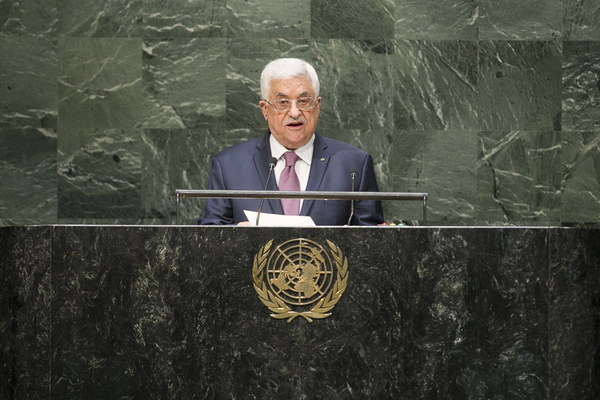
General Debate, 69th Session of the General Assembly Palestine-Bosnia-Samoa

General Debate, 69th Session of the General Assembly
Palestine-Bosnia-Samoa

The threat to cancel the Oslo Accords with Israel is not different from other threats that Abbas and his aides have made over the past few years. How many times has Abbas threatened in the past to resign from his post or suspend security coordination with Israel? In the end, he did not carry out any of these threats.

Abbas is unlikely, also this time, to carry out his latest threat to cancel the agreements with Israel. He knows that such a move would mean dissolving his Palestinian Authority and the end of his political career. But Abbas would like the world to believe that he has already cancelled the Oslo Accords. Judging from the inaccurate headlines in the international media, he seems to have achieved his goal.

Now, many in the international community are falsely convinced that Abbas has annulled all signed agreements with Israel. Those who rushed to declare the death of the Oslo Accords fell into Abbas’s trap.

Abbas’s threats are mainly designed to scare the international community into pressuring Israel to offer Abbas more concessions. He is hoping that the inaccurate headlines concerning the purported abrogation of the Oslo Accords will cause panic in Washington and European capitals, prompting world leaders to demand that Israel give Abbas everything he is asking for.

Abbas is also hoping that his recurring threats will put the Israeli-Palestinian conflict back at the world’s center stage. Abbas and the Palestinians feel that the world has lost interest in the conflict, largely due to the ongoing turmoil in the Arab world, the refugee crisis in Europe and the growing threat of the Islamic State terror group.

This concern was voiced by the PLO’s Saeb Erekat immediately after President Barack Obama’s speech at the UN General Assembly, which did not include any reference to the Israeli-Palestinian conflict.

Expressing “disappointment” over Obama’s speech, Erekat asked, “Does President Obama believe he can defeat ISIS and terrorism, or achieve security and stability in the Middle East, by ignoring the continued Israeli occupation, settlement expansion and the continued attacks on al-Aqsa Mosque?”

Of course, there is no direct link between Israeli “occupation” and settlements and the growing threat of radical Islam or the turmoil in the Arab world. The Islamic State is not beheading Muslims and non-Muslims because of the settlements or “occupation.” The Islamic State is not committing all these atrocities because it wants to “liberate Palestine.” Its main objective is to conquer the world after killing all the “infidels” in order to establish a sharia-ruled caliphate. The Islamic State would kill Erekat and Abbas — and many other Muslims — on its way to achieve its goal. In the eyes of the Islamic State, folks like Erekat and Abbas are a fifth column and traitors.

But instead of supporting the world’s war against the Islamic State and radical Islam, Abbas and Erekat want the international community to look the other way and devote all its energies and attention to the Israeli-Palestinian conflict. The tens of thousands of Arab refugees who are now seeking asylum in several European countries could not care less about the “occupation” and settlements. These people have lost everything they used to possess and their only dream is to either return to their homes and lands safely or start a new life in Europe and the US.

Abbas wanted worldwide attention in wake of the international community’s preoccupation with the refugee crisis and the radical Islam threat. For now, he appears to have achieved his goal, largely thanks to the international community’s misreading of his speech at the United Nations.

But while everyone is busy talking about Abbas’s bombshell, only a few have noticed that his speech consisted mostly of anti-Israel rhetoric that is likely to aggravate tensions between the Palestinians and Israel. Abbas used the UN General Assembly podium to make grave charges against Israel concerning “apartheid,” settlements and tensions on the Temple Mount. His fiery rhetoric, which has been partially welcomed by Hamas and other radical Palestinian groups, is likely to exacerbate tensions between Israelis and Palestinians and encourage more Palestinians to engage in violence.

It is this form of incitement that destroys any chance of peace between Israel and the Palestinians. This is the kind of rhetoric that prompts Palestinian youths to take to the streets and throw rocks and firebombs at Israeli civilians and policemen. Still, the international media, by and large, chose to ignore this destructive part of Abbas’s speech.

Ironically, Abbas declared in his speech that, “We are working on spreading the culture of peace and coexistence between our people and in our region.” But his harsh words against Israel, in addition to continued anti-Israel incitement in the Palestinian media, prove that he is moving in the opposite direction. As Abbas was addressing the UN General Assembly, some of his loyalists in Ramallah threatened and expelled Israeli Jewish journalists who came to interview Palestinians. This is certainly not a way to spread a “culture of peace and coexistence.”

Abbas: “Filthy” Jews’ Feet Not Allowed on Temple Mount

September 17, 2015

Abbas: “Filthy” Jews’ Feet Not Allowed on Temple Mount, Investigative Project on Terrorism, September 17, 2015

The International Union of Muslim Scholars is calling on Palestinians to “Rescue al-Aqsa” and rise up against Israel, according to several Twitter posts translated by the Investigative Project on Terrorism (IPT).

One of the tweets features a picture of Israeli police about to enter Jerusalem’s Al-Aqsa mosque. In reality, the Israeli authorities are pursuing Palestinian rioters who took refuge in the mosque and terrorists who were plotting to conduct attacks against Jewish worshippers. The picture – which is clearly intended to provoke Palestinians to continue stirring up trouble for Israeli citizens – includes the following quote:

“The International Union of Muslim Scholars requests the Ulema [Muslim community] and preachers of the Muslims to begin the campaign ‘Rescue al Aqsa’ and proclaim a state of general alarm among the sons of the Muslims in the world to defend al Aqsa mosque, and divulge the plans of the Zionists, and also to summon the Islamic Umma to hold protests, and to devote this Friday’s sermons to discuss Jerusalem, Al-Aqsa and Palestine.”

1232

The hashtag #RescueAlAqsa is also included in a subsequent tweet featuring a picture of flames engulfing the al-Aqsa with a sniper’s target fixated on the dome of the mosque.

“Al-Aqsa is burning Oh Umma of a billion and a half Muslims!!!,” reads the slogan on the provocative tweet.

Meanwhile, Palestinian Authority President Mahmoud Abbas glorified Palestinians fighting Israelis in Jerusalem and called for Palestinians to prevent Jews from entering Al-Aqsa with “everything in our power,” Palestinian Media Watch (PMW) reports.

“The Al-Aqsa [Mosque] is ours… and they have no right to defile it with their filthy feet. We will not allow them to, and we will do everything in our power to protect Jerusalem… We bless every drop of blood that has been spilled for Jerusalem, which is clean and pure blood, blood spilled for Allah, Allah willing. Every martyr (Shahid) will reach Paradise, and everyone wounded will be rewarded by Allah,” Abbas said in a speech, segments of which were aired on official PA TV and posted on his website.

“Today the world is divided between those trying to undermine religious coexistence and those trying to protect it,” Israel’s Foreign Ministry Director General Dore Gold said in a statement Thursday. “By saying that the ‘filthy feet’ of Jewish visitors to the Temple Mount desecrate it, Mahmoud Abbas has now clarified on which side he stands.”

Relative quiet returned to the Temple Mount on Wednesday, after three days of violent confrontations between Muslims and Israeli authorities during the Jewish New Year.

Acting Police Commissioner Bentzi Sau ordered hundreds of Israeli security personnel to Jerusalem to restore calm in light of “an upsurge” in attacks, such as firebombs and stone-throwing targeting Israeli police and civilians.

On Sunday, Palestinians throwing stones killed an Israeli civilian – 64-year-old Alexander Levlovitz – after he lost control of his car and crashed into a lamppost in Jerusalem’s East Talpiot neighborhood.

Report: Hezbollah enlisting West Bank youth to carry out terror attacks against Israel

August 30, 2015
Lebanese Hezbollah supporters march during a religious procession, to mark the burning of the tents that is part of the Ashura religious ceremony, in NabatiehLebanese Hezbollah supporters march during a religious procession in Nabatieh. (photo credit:REUTERS)

Saudi daily quotes Palestinian security source as saying PA concerned by Hezbollah attempts to make inroads with Palestinian youth.

Hezbollah has been working intensively to enlist former operatives from Fatah’s armed wing, the Al Aksa Brigades, in order to carry out terror attacks against Israeli targets in the West Bank and inside Israel, a Palestinian security source was quoted as saying on Sunday.

Saudi daily Okaz quoted the source as saying that “among those Hezbollah members involved in the operation is Kayis Ubayid, who was behind the kidnapping of Col. (res.) Elahanan Tenebaum in 2000.” Tenenbaum was released to Israel from Hezbollah captivity as part of a prisoner exchange in 2004.

The source added that Palestinian security forces believe that recent shootings and the use of explosive devices such as that thrown at an IDF position near Beit Jala, south of Jerusalem, earlier this month, are part of the Lebanese Shi’ite group’s efforts.

The Palestinian source claimed that Israel is well-aware of the Hezbollah activities. He added that some of those Palestinian operatives approached by Hezbollah reported the Shi’ite group’s efforts to Palestinian Authority officials. “We estimate that there are a number of youths who were drawn into joining Hezbollah’s ranks and are now operating in the West Bank, because of economic hardship or the deterioration in the security situation,” the source said.

“We don’t know how many people there are, but there is no doubt that the phenomenon is gaining momentum among former Al Aksa Brigade youths that have been approached by Hezbollah to work in exchange for economic support. The matter is a personal choice of these youth, who have chosen to take action against Israeli targets.”

The Palestinian security source expressed concern that, for the first time, their was a willingness among Palestinian youth to join Hezbollah. “These attempts have not gone unnoticed by us in recent years, but in recent months we feel that the phenomenon has grown, with interest expressed by the youths,” he said. “The number of youths involved can be counted on two hands, but nonetheless this is a dangerous development, which if it manages to carry out just one terror attack – it will change the situation completely. We fear that the issue will become a phenomenon, with more and more youths being seduced into getting money from Hezbollah. When they number in the dozens, handling them will become much more complicated.”

The source said that the matter was a security challenge for the Palestinian Authority, which is also currently acting against Hamas’s efforts to revive its military wing, the Kassam Brigades, in the West Bank.

The source said that in the mid-2000s, Hezbollah had tried to enlist West Bank youth, offering salaries which reached tens-of-thousands of dollars per month. “In the years 2004-2005, the Al Aksa Brigades claimed responsibility for terror attacks which were all funded by Hezbollah, whose main enlister was Kayis Ubayid.

This would not mark the first time that Palestinian security forces have warned of Hezbollah attempts to enlist fighters in the West Bank. The move could potentially be tied to Hezbollah’s patron – Iran.

In January, Iranian Defense Minister Hussein Dehghan warned that Israel “will not escape revenge” for its alleged assassination of Iranian Revolutionary Guards’ General Muhammad Allah-Dadi and of Jihad Mughniyeh in an air strike in the Syrian Golan Heights attributed in foreign reports to the IAF.

Dehghan said at the time that Iran would continue to arm the West Bank and Hezbollah. “Tehran will continue to strengthen the axis of resistance in order to deal with the Zionist entity.”

Palestinians: Why Salam Fayyad Lacks Popular Support

July 1, 2015

Palestinians: Why Salam Fayyad Lacks Popular Support, The Gatestone InstituteKhaled Abu Toameh, June 30, 2015

  • It is no secret that several senior Palestinian officials see themselves as potential successors to Abbas. Like his predecessor, Yasser Arafat, Abbas has stubbornly refused to share power with anyone. And like Arafat, he continues to run the Palestinian Authority as if it were his private fiefdom.
  • In Palestinian culture, it is more important if one graduates from an Israeli prison than from the University of Texas in Austin. A Palestinian who carries out an attack on Israel has more credentials among his people than one who studied at Harvard or Oxford universities.
  • It took Salam Fayyad too long to realize that no matter how many good things he does for his people, in the end he will be judged on the basis of his contribution to the fight against Israel, and not how much humanitarian and financial aid he provides.

In a surprise move, the Palestinian Authority (PA) has frozen the bank account of a non-profit organization headed by former Prime Minister Salam Fayyad.

The decision is seen in the context of PA President Mahmoud Abbas’s effort to undermine and discredit Fayyad. Abbas believes that Fayyad, who resigned in 2013, is seeking to replace or succeed him as president.

Following his resignation, the US-educated Fayyad established a Ramallah-based group called Future For Palestine. According to Fayyad, the group’s mission is to “enhance the resilience of Palestinian citizens in their homeland, especially in marginalized and severely impacted areas, by providing the basic development requirements.”

Abbas and the Palestinian Authority leadership did not like the idea from the beginning. Ever since Future For Palestine was established in August 2013, they have been working toward undermining the group and its founder, Fayyad.

The PA leadership is convinced that Fayyad is using the group to advance his own political goals and establish bases of power in the West Bank and Gaza Strip.

During the military confrontation between Israel and Hamas last year, Fayyad’s group launched acampaign to aid the residents of the Gaza Strip. The campaign included the purchase of tens of thousands of bottles of mineral water that were supposed to be dispatched to the Gaza Strip. The Palestinian Authority thwarted the campaign.

To justify the crackdown on Fayyad back then, the PA said that the former prime minister was part of a “conspiracy” to overthrow the Abbas regime. Some reports even suggested that Abbas had ordered his security forces to detain Fayyad for interrogation, but backtracked after threats from the US and several European governments.

Later, Abbas sent security officers to raid the offices of Future For Palestine and conduct a thorough search of its files. Some of Fayyad’s top aides were taken into custody and questioned about the sources of the group’s funding.

Last week, the campaign against Fayyad reached its peak when the Palestinian Authority announced that it has seized the assets of Future For Palestine, and accused the former prime minister of “money laundering.”

PA officials claimed that Fayyad’s group had received $10 million from the United Arab Emirates, a Gulf country that supports Abbas’s political enemy, ousted Fatah leader Mohamed Dahlan. The officials accused Dahlan and Fayyad of working together to topple the Abbas regime. Dahlan fled the West Bank several years ago after falling out with Abbas, who accused him of attempting to stage a coup against the Palestinian Authority leadership.

1135Former Palestinian Authority Prime Minister Salam Fayyad, pictured on January 25, 2013 at the World Economic Forum in Davos, Switzerland. (Image source: World Economic Forum)

Fayyad said this week that he is planning to take legal measures to cancel the decision to freeze his group’s assets. Denying the charge of “money laundering,” Fayyad added that Future For Palestine was operating within the framework of the law and did not commit any offense.

The decision to freeze the bank account of Future For Palestine came in the wake of increased talk about a behind-the-scenes power struggle to succeed the 80-year-old Abbas. The name of Fayyad has repeatedly surfaced as a potential successor to Abbas — a suggestion that has clearly enraged the Palestinian leader and his senior officials in Ramallah.

It is no secret that several senior Palestinian officials see themselves as potential successors to Abbas. These include, besides Dahlan, the chief of the PA’s General Intelligence Security Force in the West Bank, Majed Faraj, Palestinian Football Association Chairman Jibril Rajoub and Chief PLO negotiator Saeb Erekat.

Abbas believes that he has thus far succeeded in sidelining and discrediting at least two candidates: Fayyad and Dahlan. The charges made by Abbas against the two men are designed to depict them as agents of foreign countries who are plotting against him and the entire Palestinian people.

Like his predecessor, Yasser Arafat, Abbas has stubbornly refused to share power with anyone. And like Arafat, he continues to run the Palestinian Authority as if it were his private fiefdom.

Fayyad’s chances of succeeding Abbas are, anyway, very slim, if not non-existent. Fayyad is an independent figure who does not belong to Fatah, Hamas or any other political group. When he ran in the January 2006 parliamentary election at the head of the Third Way list, his group received two seats out of 132.

The reason most Palestinians did not vote for Fayyad is because he had not played any role in the “revolution” against Israel. In this culture, it is more important if one graduates from an Israeli prison than from the University of Texas in Austin. Fayyad did not participate in any armed attack on Jews and never supported the armed struggle against Israel. Nor did he send his son to throw stones or firebombs at Israelis. That is the real reason why people like Fayyad lack popular support.

If and when Abbas steps down, the only candidate who has a good chance of replacing him is one who was part of the “revolution.” A Palestinian who carries out an attack on Israel has more credentials among his people than one who studied at Harvard or Oxford universities. It took Salam Fayyad too long to realize that no matter how many good things he does for his people, in the end he will be judged on the basis of his contribution to the fight against Israel, and not how much humanitarian and financial aid he provides.

Behind the French “Peace Initiative”

June 26, 2015

Behind the French “Peace Initiative,” The Gatestone InstituteBassam Tawil, June 26, 2015

  • It is a desperate attempt by the French government to buy a few more days of quiet from its Muslim community, especially from the members of the Muslim Brotherhood and the terrorist organizations to which it gave birth — all waiting for the order to run riot through the streets of France.
  • If it succeeds, may Allah prevent it, it will lead to an ISIS and Hamas takeover of every inch of Palestinian soil from which Israel withdraws if coerced by the initiative.

  • It is evidently too frustrating and unrewarding just to sit in the U.N. and not think of some project supposedly to spread beneficence that could make your country look important to the other 190 members — even if this beneficence is lethal to its recipient.

  • When the Byzantium fell to the Ottoman Empire, the churches, including the Hagia Sophia in Constantinople, were turned into mosques; that is the dream of the Islamists today, to turn the Vatican into a mosque.

  • Currently, Qatar is currently investing millions to overthrow the Egyptian regime. It is investing millions to finance incitement among Muslims around the globe by means of its Islamist network and da’wah, the cunning preaching of the Muslim Brotherhood’s variety of Islam.

  • The Arabs always secretly believed that anyone who hated their mutual enemies, the Jews, as deeply as the Europeans did, and who actually tried to achieve their total physical destruction during the Second World War, would be their ally and help to expel them from occupied Palestine.

  • Apparently, the commonly-held hatred between the Europeans and the Arabs was not enough to halt the Jews, so now the Arabs pay huge sums to bribe the leaders of Europe to help them get rid of the Jews now.

The latest missile to split the skies over the Middle East is not a rocket; it is the French “peace” initiative.

No one in the Middle East has the slightest doubt that whatever its objective may be, it will not promote peace between Israel and the Palestinians. It is a desperate attempt by the French government to buy a few more days of quiet from its Muslim community, especially from the members of the Muslim Brotherhood and the terrorist organizations to which it gave birth — all waiting for the order to run riot through the streets of France.

We, the Palestinians, have suffered, and continue to suffer, from the creation of the Islamist terrorist organizations within the Palestinian Authority territory; it is they who keep us from reaching a peace agreement with the Jews.

One has to be deaf, dumb and blind — or genuinely desperate, which is more likely — to present a unilateral peace agreement like the French one. If it succeeds, may Allah prevent it, it will lead to an ISIS and Hamas takeover of every inch of Palestinian soil from which Israel withdraws if coerced by the initiative.

One also has to be simply ignorant not to understand that the Middle East is going up in flames and that the Arab states are disintegrating. There is no logical reason, therefore, to construct a new state, which will be both unstable and prey to local and regional subversion. It will also be subject to a quick takeover, and the first people who will suffer will be the Palestinians in the occupied territories.

The Israelis know how to look out for themselves, but we will be left to the tender mercies of Hamas and ISIS mujahedeen. Just as they have done in Iraq and Syria, they will slaughter us without thinking twice, on the grounds that as we did not all become shaheeds [“martyrs” for Islam] trying to kill the Zionists, and even tried to reach a peace agreement with them, we are not sufficiently Muslim.

The French initiative is not a benevolent gesture meant to help the Palestinians. Without a doubt, the French government and its intelligence services know full well that the secret of the Palestinian Authority’s existence today — and its ability to function as a sovereign entity, demilitarized and de facto recognizing the State of Israel — is its security collaboration with the Israelis. It serves the interests of both sides. When, therefore, a Palestinian state is declared unilaterally, as the French propose, Israel will stop collaborating with it and the state, not even fully formed, will almost instantly fall prey to Islamist extremists. That is obvious to us: even our institutions of higher learning are ruled by Hamas today, as can be seen by Hamas’s landslide victory in the recent student elections in Bir Zeit University.

The recent visit of U.S. Senator Lindsey Graham to Israel helped the Palestinians understand even more thoroughly that behind the French initiative is an attempt, as with many members of the U.N., to “be a player.” It is evidently too frustrating and unrewarding just to sit in the U.N. and not think of some project supposedly to spread beneficence that could make your country look important to the other 190 members — even if this beneficence is lethal to its recipient. One way of doing spreading such beneficence is to take over the peace process through the Security Council, force both sides into a unilateral solution, and not even to feign dismay when its first victims are the Palestinians.

Senator Graham referred to the drastic nature of the initiative and stressed that the United States supported the solution of two states for two peoples, according to the vision of Israel’s current Prime Minister, Binyamin Netanyahu. It favors a demilitarized Palestinian state that would recognize Israel as a Jewish state and make it possible for everyone, both Jews and Palestinians, to live with self-respect and independence.

Graham threatened the UN, saying that if promotes the French initiative, he would bid to halt American funding for the UN — nearly a quarter of its budget.

Today, the UN’s funds are twisted into sending peacekeepers, who have diplomatic immunity and therefore cannot be sued, out to Africa to demand sex, often from children, in exchange for food or other necessities; and to passing resolutions aimed at harming Israel, while the organization callously ignores floggings in Saudi Arabia, slavery in Mauritania; escalating executions, calls for genocide and violations of nuclear treaties in Iran, just for a start.

The situation is grotesque. They are basically accusing Israel of “terrorism” for defending itself against by rockets fired from Hamas, in a confrontation where Gazan children were hurt because Hamas used them as human shields — while ignoring the real terrorism against the children of Africa committed by the U.N.’s own peacekeepers, Boko Haram, Iran and Sudan. When they so twist logic as to accuse Israel of “terrorism,” while turning their back on the horrendous abuses by other states, they are essentially giving paedophile UN “peacekeepers,” Iran’s torturers, executioners, and nuclear weapons factories a green light.

Graham was very clear about the American point of view. He said that any country that tried to bring Israel to the International Criminal Court in The Hague would have sanctions imposed on it by the United States.

The parade of the grotesque is the direct result of the Western surrender to Islamic terrorism. Now, sadly, the Vatican has also joined France. The assumption that the Islamists can be pandered to and propitiated by harming the Jews is yet another prevalent misconception. Every gesture to the Islamists, even if it is aimed at “helping” the Palestinians, sends a message of weakness and vulnerability, and increases the Islamists’ aggression against Christians and other non-Muslim minorities.

In the Middle East, anyone who “turns the other cheek,” such as the Pope saying that the Palestinian leader, Mahmoud Abbas, could be “an angel of peace,” will find his neck under the sword. When Byzantium fell to the Ottoman Empire, its churches, including the Hagia Sophia in Constantinople, were turned into mosques; that is the dream of the Islamists today, to turn the Vatican into a mosque.

The dangerous European surrender to radical Islam is not only an attempt to hold off its threat to the free society of Europe just a little longer. It is also the result of the economic distress of the Western world, which is seeking to keep afloat by selling itself, literally, for petro-dollars. The Vatican is in desperate financial straits — there are fewer practicing Catholics and therefore fewer donating Catholics. It is hard not to feel that the anti-Israel manipulations of the Vatican administration are motivated not by a genuine desire to help the Palestinians or to save Christians in the Middle East, but by a genuine desire to extricate itself from its financial straits.

Judas sold Jesus for thirty pieces of silver; Boko Haram sells girls for the price of a pack of cigarettes, and Europe is selling itself and the Israelis to Qatar.

Europe is in the same situation as the Vatican; and so are many American universities, which are selling radical Islamist education for petro-dollars from the Persian Gulf. This enables the Islamists to rewrite history and endanger the open way of life in the gullible West.

There is already a Muslim Brotherhood lobby in the United States, a syndicate trying to force the administration to undermine the current Egyptian president, who is an enemy of the murderous Muslim Brotherhood. Their aim is to restore to power the Islamist dictator Mohamed Morsi (who is also a member of the Muslim Brotherhood), and to sabotage the measures Egypt is currently taking to rehabilitate itself.

The ease with which Qatar, the petro-dollar heavyweight, manipulates terrorist organizations in the Middle East is unnerving. The country both hosts and finances senior Muslim Brotherhood figures such as Sheikh Yusuf al-Qaradawi and others responsible for spreading the doctrine of radical Islamism and terrorism around the world.

Qatar finances a wide range of subversive Islamist terrorist organizations, among them ISIS, Al-Qaeda, Hamas, Palestinian Islamic Jihad and various other global jihad organizations operating under the aegis of the Arab-Muslim regimes. Qatar also seeks to carve out enclaves in Africa and the West, and to turn the West’s pluralistic melting pot into a seething cauldron of terrorist operatives who will, when given the signal, bludgeon Europe and America to the ground.

The petro-dollars of the Qatari feudal lords, totalitarians who dictate their whims to a population with no rights, direct a global network of propaganda and incitement, through vehicles such as Al-Jazeera TV in Arabic, light years more toxic than Al Jazeera in English. It crowns kings and topples regimes throughout the Middle East, as it did by endlessly replaying the self-immolation of the young Tunisian fruit vendor who could not get a license, until it whipped up the Tunisians and Egyptians to start the “Arab Spring.” Currently, Qatar is investing millions to overthrow the Egyptian regime. It is investing millions to finance incitement among Muslims around the globe by means of its Islamist network and da’wah, the cunning preaching of the Muslim Brotherhood’s variety of Islam.

The Arabs always felt that the Europeans had a soft spot in their hearts for them. They always secretly believed that anyone who hated their mutual enemies, the Jews, as deeply as the Europeans did, and who actually tried to achieve their total physical destruction during the Second World War, would be their ally and help to expel them from occupied Palestine. Apparently, the commonly-held hatred between the Europeans and the Arabs was not enough to halt the Jews, so now the Arabs pay huge sums to bribe the leaders of Europe to help them get rid of the Jews now.

Just look at the extensive corruption of the heads of FIFA, bought and paid-for by Qatar. All it took was $100 million, and Qatar could host the World Cup. It makes one wonder what Qatar would be willing to pay for other projects, doesn’t it?

1130Now where did that envelope of cash go…?
Joseph “Sepp” Blatter (R), then president of FIFA, is pictured patting his jacket pocket a moment after awarding the hosting of the 2022 World Cup to Qatar’s Sheikh Hamad bin Khalifa Al Thani (L), on December 2, 2010. (Image source: PBS Newshour video screenshot)


State Department Report Minimizes Palestinian Incitement to Violence

June 19, 2015

State Department Report Minimizes Palestinian Incitement to Violence, The Investigative Project on Terrorism, Jume 19, 2015

These blatant omissions from the report leave create a sense that examples of Palestinian incitement to violence and glorification of terrorists are sporadic occurrences. In reality, the Palestinian Authority institutionalizes a systematic campaign of violent incitement and continues to praise terrorists for killing Jews and Israelis, while encouraging other Palestinians to follow in their footsteps.

****************

The U.S. State Department’s Country Reports on Terrorism 2014 issued Friday minimizes official Palestinian incitement to violence against Israel and completely overlooks Palestinian glorification of terrorists.

The annual report lists major terrorist incidents worldwide and outlines each country’s counterterrorism efforts and legislation. Terrorism attacks and their resulting deaths spiked last year, the report found, an increase largely driven by attacks by the Islamic State and Nigeria’s Boko Haram terrorist groups.

With respect to the Palestinian Authority (PA), the report praises the PA for taking “significant steps to ensure that official institutions in the West Bank that fall under its control do not create content that leads to incitement to violence.” The report acknowledges that “some instances of inciting taking place via official media” still occur, listing only three examples. However, the report diminishes the fact that incitement to violence is a systematic and institutionalized PA phenomenon.

Click here for an Investigative Project on Terrorism comprehensive outline of Palestinian violent incitement focused only on incidents last fall.

The State Department assessment also ignores the direct participation of senior PA officials in praising terrorists and inciting violence against Israelis and Jews.

For example, the report does not mention PA President Mahmoud Abbas’ call last October for Palestinians to prevent Jews from going to the Temple Mount compound “in any way.” The video clip of Abbas’ Oct. 17 speech was shown 19 on PA television times in three days, implicitly calling for Palestinians to use violence against Israelis.

Instead, the report described PA efforts “to ensure” Friday sermons in more than 1,800 mosques controlled by the PA “do not endorse incitement to violence … the guidance is that no sermon can discuss political or lead to incitement to violence.”

In February, however, the PA Minister of Religious Affairs and other prominent religious officials resorted to an age-old blood libel accusing Jews of attacking Muslims sites and that Israel is trying to destroy the al-Aqsa Mosque, Palestinian Media Watch (PMW) reports. Such accusations are baseless and encourage Palestinians to conduct terrorist attacks against Israel.

The State Department report also omits any reference to official Palestinian glorification of terrorists.

For example, after the October shooting of Rabbi Yehuda Glick, Abbas sent a condolence letter to the family of terrorist Mutaz Hijazi who was killed by Israeli authorities in a firefight during a raid for his capture. In the letter, Abbas called the terrorist a “Shahid,” a martyr, who “rose to Heaven while defending our people’s rights and holy places,” PMW reported.

Moreover, a senior Fatah official claimed that Hijazi was a Fatah operative and expressed pride in his actions, a PMW translation shows.

These blatant omissions from the report leave create a sense that examples of Palestinian incitement to violence and glorification of terrorists are sporadic occurrences. In reality, the Palestinian Authority institutionalizes a systematic campaign of violent incitement and continues to praise terrorists for killing Jews and Israelis, while encouraging other Palestinians to follow in their footsteps.

Op-Ed: Core Synergies in Israel’s Strategic Planning

June 9, 2015

Op-Ed: Core Synergies in Israel’s Strategic Planning, Harvard Law School National Security Journal via Israel National News, Prof. Louis René Beres, June 9, 2016

(Rather “high brow,” but well worth considering seriously. — DM)

Significantly, the most insidious synergy of all could involve a rudimentary failure to understand that belligerent enemy intentions ultimately depend for their efficacy upon confused, partial, or inadequately thoughtful Israeli responses.

*****************

To best serve Israel, the country’s strategic studies community should favor more conceptual or “molecular” assessments of expected security perils. Going forward therefore, it will not suffice for this community to operate in ways that are roughly comparable to the purely reportorial activities of journalists and pundits, that is, of ordinary observers who focus exclusively on current personalities and events. With this timely warning in mind, the following brief essay explains and argues for a specifically enhanced Israeli consideration of enemy “synergies.”

For the most part, the concept of synergy is already familiar to capable scientists and scholars. It signifies, above all, that the usually binding axioms of geometry can sometimes be overridden by various intersecting phenomena. Applied to Israel, this concept suggests that certain identifiable threats to the Jewish State should no longer be considered as wholly separate or discrete, but instead, as more-or-less interpenetrating and mutually-reinforcing.

The most obvious and portentous example of pertinent synergy for Jerusalem is represented by Iranian nuclear weapons and Palestinian statehood.[1]

At first, any such talk of “synergy” may sound needlessly pretentious, or at least more contrived, concocted, or complicated than is really the case. In medicine, after all, it would already seem plain that the dangers of smoking cigarettes and drinking alcohol together must exceed either one behavior without the other. This is because the synergistic effect is presumptively much greater than those consequences ascertained by merely adding these two injurious activities together.

For Israeli planners, the still-widely-unrecognized synergy between Iranian nuclearization and “Palestine” should finally be treated with a more emphatic intellectual regard.[2] Notwithstanding the declared assumptions of virtually all acknowledged national strategists, Iran and Palestine,[3] as “negative force multipliers,”[4] do not represent thoroughly separate or unrelated hazards to Israel. To continue to assess each one independently of the other would be a serious conceptual error. It would be to consciously obscure what is potentially most revealing and most ominous.

Israel’s main security policies must involve carefully nuanced considerations of active defense, as well as of deterrence, preemption, and war-fighting. The country’s multilayered missile defenses are central to national survival. As long as incoming rocket aggressions from Gaza, West Bank, and/or Lebanon (Hezbollah) were to remain “only” conventional, the inevitable leakage could still be tolerable. But once these rockets were fitted with chemical and/or biological materials, such porosity could quickly prove “unacceptable.[5] This means, among other things, that the projected harms of rocket attacks upon Israel would depend not only upon the inherent dangers posed by a particular weapon system, but also upon the ways in which these individual harms would intersect.[6]

Once facing Iranian nuclear missiles, Israel’s “Arrow” ballistic missile defense system would require a fully 100% reliability of interception. To achieve any such level of reliability, however, would be impossible. Now, assuming that the prime minister has already abandoned any residual hopes for a cost-effective eleventh-hour preemption against pertinent Iranian nuclear assets , this means that Israeli defense planners must prepare instead, and longer-term, for stable deterrence.[7]

Theory is a net. Only those who cast, can catch.[8] Because of the expectedly corrosive interactive effects involving Iranian nuclear weapons and Palestinian statehood, for example, Israel will need to update and refine its existing theories of deterrence.

Looking ahead, there are various antecedent issues of theoretical concern. For one, Israel’s leaders will have to accept that certain more-or-less identifiable leaders of prospectively overlapping enemies might not necessarily satisfy the complex criteria of rational behavior in world politics. In such partially improbable but still conceivable circumstances, assorted Jihadist adversaries in Palestine, Iran, Syria, Iraq, Lebanon, or elsewhere might sometime refuse to renounce certain still-contemplated aggressions against Israel.[9]

By definition, these irrational enemies could exhibit such more-or-less plausible refusals even in anticipation of fully devastating Israeli reprisals. But, would they still remain subject to alternative threats or forms of deterrence? And might an entire state sometime exhibit such non-rational orientations, thereby becoming, in essence, a suicide terrorist writ large?

These utterly core questions can no longer be ignored. Sooner rather than later, and facing new and prospectively incalculable synergies from Iranian and Palestinian aggressions, Israel will need to take appropriate steps to assure that: (1) it does not become the object of any non-conventional attacks from these enemies; and (2) it can successfully deter all possible forms of non-conventional conflict. To meet this ambitious but indispensable goal, Jerusalem, inter alia, absolutely must retain its recognizably far-reaching conventional superiority in pertinent weapons and capable manpower, including effective tactical/operational control over the Jordan Valley.

In this connection, a Palestinian state could make Israeli military and civilian targets more opportune for Iranian rockets. It could simultaneously undermine the Jewish State’s critical early-warning systems.

Maintaining a qualitative edge in conventional war-fighting capacity could reduce Israel’s overall likelihood of ever actually having to enter into a chemical, biological, or even nuclear exchange with regional adversaries. CorrespondinglyIsrael should plan to begin to move incrementally beyond its increasingly perilous posture of “deliberate nuclear ambiguity.”[10] By preparing to shift toward prudently selective and partial kinds of “nuclear disclosure” – in other words, by getting ready to take its “bomb” out of the “basement,” but in carefully controlled phases[11] – Israel could best ensure that its relevant enemies will remain sufficiently subject to Israeli nuclear deterrence.

In matters of defense strategy, truth may emerge through paradox. Israeli planners, it follows, may soon have to acknowledge that the efficacy and credibility of their country’s nuclear deterrence posture could sometime vary inversely with enemy perceptions of Israeli nuclear destructiveness. However ironic or counter-intuitive, enemy views of a too-large or too-destructive Israeli nuclear deterrent force, or of an Israeli force that is not sufficiently invulnerable to first-strike attacks,[12] could substantially undermine this deterrence posture.

Here, too, carving “Palestine” out of the still-living body of Israel (whatamounts to the unhidden Palestinian Authority plan for a “one state solution”), could impact the Iranian nuclear threat, and vice-versa. Once again, Israel’s defense planning must account for possible and prospectively prohibitive synergies.

Also critical, of course, is that Israel’s current and future adversaries will always acknowledge the Jewish State’s nuclear retaliatory forces as “penetration capable.” This suggests forces that will seem “assuredly capable” of penetrating any Arab or Iranian aggressor’s active defenses. Naturally, a new state of Palestine would be non-nuclear itself, but it could still present a new “nuclear danger” to Israel by its probable impact upon the prevailing regional “correlation of forces.”[13] Palestine, therefore, could represent an indirect but nonetheless markedly serious nuclear threat to Israel. Here, yet again, is an example of the need for Israeli planners to think synergistically.

More remains to be done. Israel should continue to strengthen its active defenses, but Jerusalem must also do everything possible to improve each critical and interpenetrating component of its nuanced deterrence posture. In this bewilderingly complex and dialectical[14] process of strategic dissuasion, the Israeli task may require more incrementally explicit disclosures of nuclear targeting doctrine, and, accordingly, a steadily expanding role for cyber-defense and cyber-war.

Even before undertaking such delicately important refinements, Israel will need to more systematically differentiate between adversaries that are presumably rational,[15] irrational, or “mad.”[16]

Overall, the success of Israel’s national deterrence strategies will be contingent, inter alia, upon an informed prior awareness of enemy preferences, and of specific enemy hierarchies of preferences. In this connection, altogether new and open-minded attention will need to be focused on the seeming emergence of “Cold War II” between Russia and the United States. Any such emergence, of course, could have meaningful effects upon both Israeli and adversarial military postures.[17]

If, within a pattern of “Cold War II,” a newly-formalized state of Palestine does not find itself in the same ideological orbit as Iran, the net hazard to Decision-makers will then need to explore and acknowledge what amounts, paradoxically, to a geometry of chaos. Israel could still exceed the sum of relevant intersecting threats. While attempting to survive amid growing regional disorder, therefore, Israel’s leaders should learn to understand the profound strategic limits of normal “geometry”—where, quite mundanely, the whole is always expected to equal to the sum of its parts—and to augment an enhanced understanding with certain new geometric orthodoxies. In essence, these decision-makers will then need to explore and acknowledge what amounts, paradoxically, to a geometry of chaos.

Still, even this long-hidden geometry could reveal a discernible sense of symmetry and form, including the precise shape of certain critically interwoven enemy threats. Wherever the belligerent whole might add up to more than the sum of its constituent parts, Israel’s leaders could discover lethal hazards of adversarial synergies. Significantly, the most insidious synergy of all could involve a rudimentary failure to understand that belligerent enemy intentions ultimately depend for their efficacy upon confused, partial, or inadequately thoughtful Israeli responses.

When Pericles delivered his famous Funeral Oration, with its meticulously elaborate praise of Athenian civilization, his geostrategic perspective was applicable to more than the particular struggle at hand. Recorded by Thucydides, Pericles had expressed confidence in a military victory for Athens (a confidence, of course, that turned out to be misplaced), but also grave concern for any self-imposed limitations along the way: “What I fear more than the strategies of our enemies,” he had warned, “is our own mistakes.” However unforeseen, there is a vital lesson here for present-day Israel: In observing enemy preparations for war and terror, never forget that the ultimate success of these preparations will depend upon Israel’s selected responses.

There exists an overarching or determinative synergy between certain individual or intersecting enemy preparations and Israel’s own prepared policies and reactions.

In all world politics, but especially in the Middle East, we are present at the gradual unveiling of a “big picture,” but the nucleus of meaning—the essential truth of what is taking place—involves what is left out. For the foreseeable future, Israel’s enemies will continue with their ardent preparations for every form of war and terrorism. Unaffected by any civilizing expectations of international law of comity, these calculated preparations will proceed largely on their own track, culminating, if left suitably unobstructed, in new and ever more serious aggressions against Israel. The Jewish State must remain vigilant of such an emergent “big picture,” but also of every imaginable intersection or pattern of intersections between its component parts.

Always, Israel’s leaders and planners must reflect, core dangers to national security are profoundly synergistic.

Always, Israeli policy must recall, these fundamental dangers are potentially much greater than the additive sum of their  respective parts.

Always, Jerusalem must insightfully recognize, even a bewildering geometry of chaos has potentially meaningful sense and form.

Always, it must be Israel’s consuming task, to discover this synergistic truth.

Sources: 

[1] There are other still more complex synergies that need to be examined. These concern, especially, the intersecting roles of ISIS and al-Qaeda, including pertinent sub/state-state relationships with Syria, Iran, Libya, Lebanon, Yemen, and Saudi Arabia. Also worth exploring, in this connection, is the plausible escalation of “Cold War II,” a broadly transforming context of world politics that could create a “synergy of synergies.” Although all such bewildering hypotheticals may be intimidating or annoying to scholars and policy-makers, there remains no reasonable explanatory alternative to taking them into account.

[2] Rabbi Eleazar quoted Rabbi Hanina, who said: “Scholars build the structure of peace in the world.” See: The Babylonian Talmud, Order Zera’im, Tractate Berakoth, and IX.

[3] Once a Palestinian state were created, it would more likely become subject to destruction by assorted Arab forces, than by Israel. Plausibly, in this connection, ISIS forces fighting their way westward across Jordan could quickly arrive at the West Bank (Judea/Samaria), and make fast work of any now indigenous Hamas/PA national “army.” In such dire circumstances, the citizens of “Palestine” would assuredly rue the day of their recently-declared “independence.”

[4] This is a term that will likely be favored by the generals, over synergy.

[5] See, on this issue: Louis René Beres and (Major-General/IDF/Res.) Isaac Ben-Israel, “Think Anticipatory Self-Defense,” The Jerusalem Post, October 22, 2007; Professor Beres and MG Ben-Israel, “The Limits of Deterrence,” Washington Times, November 21, 2007; Professor Beres and MG Ben-Israel, “Deterring Iran,”Washington Times, June 10, 2007; Professor Beres and MG Ben-Israel, “Deterring Iranian Nuclear Attack,” Washington Times, January 27, 2009; and Professor Beres and MG Ben-Israel, “Defending Israel from Iranian Nuclear Attack,” The Jewish Press, March 13, 2013. See also: Louis René Beres and (General/USAF/ret.) John T. Chain, “Could Israel Safely Deter a Nuclear Iran?” The Atlantic, August 9, 2012; Professor Beres and General Chain, “Living With Iran,” BESA Center for Strategic Studies, Israel, May 2014; and Louis René Beres and (Lt.General/USAF/ret.) Thomas McInerney, “Obama’s Inconceivable, Undesirable, Nuclear-Free Dream,” U.S. News & World Report, August 29, 2013.

[6] Here, it warrants mention that Palestinian statehood could represent an enlarged set of risks to Israel’s Dimona nuclear reactor. Already, in 1991 and 2014, this small reactor came under missile and rocket attack from Iraqi and Hamas aggressions respectively. For authoritative assessments of these attacks and related risks, see: Bennett Ramberg, “Should Israel Close Dimona? The Radiological Consequences of a Military Strike on Israel’s Plutonium-Production Reactor,” Arms Control Today, May 2008, pp. 6-13.

[7] With particular reference to nuclear deterrence, the primary function of Israel’s nuclear forces must always be dissuasion ex ante, rather than revenge ex post.

[8] This convenient metaphor is generally attributed to Novalis, the late 18th-century German poet and scholar. See, for example, introductory citation by Karl R. Popper, in his The Logic of Scientific Discovery (1959). Ironically, perhaps, Novalis’ fellow German poet, Goethe, had declared, in his early Faust fragment (Urfaust): “All theory, dear friend, is grey. But the golden tree of life is green.” (Grau, theurer Freund, ist alle Theorie, Und grűn des Lebens goldner Baum.)

[9] See, on this point: Louis René Beres, “Religious Extremism and International Legal Norms: Perfidy, Preemption, and Irrationality,” Case Western Reserve Journal of International Law, Vol. 39, No.3., 2007-2008, pp. 709-730.

[10] See: Louis René Beres, “Like Two Scorpions in a Bottle: Could Israel and a Nuclear Iran Coexist in the Middle East,” The Israel Journal of Foreign Affairs, Vol. 8, No. 1., 2014, pp. 23-32; Louis René Beres, “Facing Myriad Enemies: Core Elements of Israeli Nuclear Deterrence,” The Brown Journal of World Affairs, Vol. XX, Issue 1., Fall/Winter 2013, pp. 17-30; Louis René Beres, “Lessons for Israel from Ancient Chinese Military Thought: Facing Iranian Nuclearization with Sun-Tzu,”Harvard National Security Journal, 2013; Louis René Beres, “Striking Hezbollah-Bound Weapons in Syria: Israel’s Actions Under International Law,” Harvard National Security Journal, 2013; Louis René Beres, “Looking Ahead: Revising Israel’s Nuclear Ambiguity in the Middle East,” Herzliya Conference presentation, 2013; March 2013; IDC, Herzliya; Louis René Beres and (General/USAF/ret) John T. Chain, “Could Israel Safely Deter a Nuclear Iran?” The Atlantic, 2012.

[11] On identifying alternative nuclear disclosure options, see: Louis René Beres, “Israel’s Strategic Doctrine: Updating Intelligence Community Responsibilities,”International Journal of Intelligence and Counterintelligence, Vol. 28, No. 1, Spring, 2015, pp. 89-104.

[12] On Israeli submarine basing measures, see: Louis René Beres and (Admiral/USN/ret.) Leon “Bud” Edney, “Israel’s Nuclear Strategy: A Larger Role for Submarine-Basing,” The Jerusalem Post, August 17, 2014; and Professor Beres and Admiral Edney, “A Sea-Based Nuclear Deterrent for Israel,” Washington Times, September 5, 2014.

[13] See: Louis René Beres, “Understanding the Correlation of Forces in the Middle East: Israel’s Urgent Strategic Imperative,” The Israel Journal of Foreign Affairs,Vol. IV, No. 1 (2010).

[14] Dialectic formally originated in the fifth century BCE, as Zeno, author of the Paradoxes, had been acknowledged by Aristotle as its inventor. In the middle dialogues of Plato, dialectic emerges as the supreme form of philosophical/analytic method. Here, Plato describes the dialectician as one who knows best how to ask and answer questions. This particular knowledge – how to ask, and to answer questions, sequentially – should now be insistently transposed to the organized study of Israeli security issues.

[15] Israelis, like Americans, are inclined to project their own dominant sense of rationality upon adversaries. Acknowledging that western philosophy has always oscillated between Plato and Nietzsche, between rationalism and irrationalism, we have all routinely cast our psychological lot with the Greek thinkers and their inheritors. Significantly, however, Israel is now up against a steadily transforming ordering of the geostrategic universe; now, Israel’s strategists might sometimes be better advised to read Dostoyevsky and Kafka, than to dwell too fixedly on Platonic rationalism.

[16] “Do you know what it means to find yourselves face to face with a madman,” inquires Luigi Pirandello, “with one who shakes the foundations of all you have built up in yourselves, your logic, and the logic of all your constructions? Madmen, lucky folk, construct without logic, or rather, with a logic that flies like a feather.”

[17] On this point, see: Louis René Beres, “Staying Strong: Enhancing Israel’s Essential Strategic Options,” Harvard National Security Journal, Harvard Law School, June 13, 2014.
 

Turkey’s View of Israel

June 9, 2015

Turkey’s View of Israel, The Gatestone InstituteUzay Bulut, June 9, 2015

  • The media’s unethical coverage of the Israel/Palestine conflict seems to be the number one reason why people in Turkey have remained so misinformed and brainwashed about the issue. It is not just anti-Semitism, but also anti-Zionism, that is racist and hateful.
  • The houses and apartments Israelis built in their historic homeland are called “illegal settlements.” But there were no “settlements” before 1967. What, then were the Israelis supposedly “occupying” between 1948 and 1967? Why was the Palestine Liberation Organization (PLO) even then trying to destroy Israel? What did it think it was “liberating”?
  • This “occupation” myth seems, instead, to have a lot to do with the “Islamization” of history and geography. Since the creation of the world, it goes, there has been only one religion: Islam. All our religious teachers have taught us that earlier historical figures were prophets — Isa [Jesus], Musa [Moses], Davut [David] and so on — were Muslims and that the original religions they brought were Islamic. These prophets, we are told, preached the teachings of Allah, but their followers, who came later, distorted their messages, changed the writings in their holy books, and fabricated these fake, untrue religions called Judaism and Christianity. Then Islam came as the last, the perfect and the only true and unchanged eternal word of Allah, which led to Muhammad to this world as a “liberator.”
  • If someone says, “there is a place related to King David and it is a Jewish place,” then a Muslim would say, “Yes, but David was also a Muslim. So this place actually belongs to Muslims.” There is never Islamic invasion; there is only Islamic liberation. If these people truly cared about Palestinian Arabs, they would do their best to stop the incitement and help to achieve a sustainable peace where both Arabs and Jews would be safe.

A large number of the citizens of Turkey, a NATO member, see Israel and the United States as enemies.

A survey conducted recently in Turkey found that nearly half the country’s citizens (42.6%) see Israel as the biggest security threat, followed by the United States (35.5%), and only then Syria (22.1%).

How do they visualize Israel, a country with which they have made several military and trade agreements, as being a security threat? Do they think Israel would ever invade Turkey? Bomb Turkey? Nuke Turkey? This view seems to be based on either religion-induced paranoia caused by Islamic anti-Semitism, or else their understanding of reality has been distorted Nazi-style by Turkish leaders and the media.

The problem is that the false myth of Israel’s being an “occupier” and “troublemaker” has been indoctrinated into the minds of most Turkish children from their early years. Almost all of us — including myself — grew up with an extreme prejudice against Israel. The media’s unethical coverage of the Israel/Palestine conflict — including both the Islamist and Kemalist (secular nationalist) media — seems to be the number one reason why people in Turkey have remained so misinformed and brainwashed about the issue.

Only the intensity of the prejudice changes according to what newspaper or TV channel you follow or what family raises you. Islamic anti-Semitism, even if we might not be aware of it, has a lot to do with this kind of upbringing.

A short scanning of Turkish newspapers and TV channels would also clearly show their continual hateful propaganda against Israel.

No other state or organization has been demonized and delegitimized by the Turkish media to this extent.

Unfortunately, even the media that calls itself “progressive” has bought and reproduced the propaganda that Israel is the “invader” and the “oppressor.” One of their most popular slogans is, “We are not anti-Semitic, but just anti-Zionist.”

Zionism defends the concept that Jews — like any other people — have human rights, and are entitled to live their original Biblical homeland. Although forced out of their land many times, as by the Babylonians or the Romans, they never entirely left it.

If the demand of Jews for equality and independence disturbs anyone, it is due to his own racism — in whatever name he is trying to dress it up — and not to anything the Jews might have allegedly done. It is not just anti-Semitism, but also anti-Zionism, that is racist and hateful.

Every person who comes up with the genius idea of “not being anti-Semitic but just being anti-Zionist” should also offer their idea of what kind of a Jewish state they would like to see or whether they would like to see a Jewish state at all. If it is the political system of Israel they oppose, then they should clarify how their own alternative system would be better than the current one, and what they would do to convince Hamas and the Palestinian Authority to achieve peaceful coexistence with Israel.

They should also clarify why they are so obsessed with Israel, which has the most democratic political system in the Middle East, while autocratic, theocratic, despotic regimes abound in the region.

They might also please explain what makes the non-existent, imaginary “democratic Palestine” preferable to already existing, thriving and democratic Israel.

Mahmoud Abbas’s Fatah is essentially no better than Hamas; just sometimes less violent. The Palestinian Authority (PA), as stated in its charter and “phased plans,” says it prefers to displace Israel diplomatically, through the dictator-controlled United Nations and European governments, and economically through boycotts and sanctions, rather than with missiles.

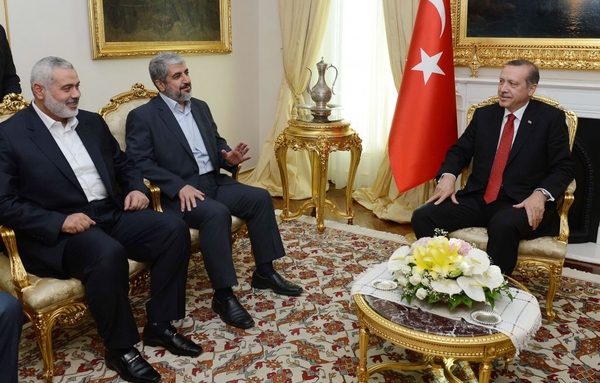
826Turkish President (then Prime Minister) Recep Tayyip Erdogan, right, meeting with Hamas leaders Khaled Mashaal (center) and Ismail Haniyeh on June 18, 2013, in Ankara, Turkey. (Image source: Turkey Prime Minister’s Press Office)

Now that so many Jews are all in one place, the progressives can pretend to themselves that it is “just Israel,” and not “the Jews,” who are the target of their hate. As the former Iranian president Akbar Hashemi Rafsanjani said, Israel, only slightly bigger than the city of Beijing, is a “one-bomb country.”

The progressive media’s representation of Israel as an “occupier” only caters to the genocidal desires of these anti-humanitarian regimes or groups. They never point to Turkey’s occupation of northern Cyprus, China’s occupation of Tibet, or Pakistan’s occupation of Kashmir — not to mention Russia’s recent flamboyant occupations.

For the past 2000 years, Jews have been exposed to unending persecution accompanied by expulsions, forced conversions, mob attacks, pogroms, property confiscations, massacres, and the 1938-45 Holocaust. Attacks against Jews in Europe continue today.

After Jews were forced from their Biblical home into the Diaspora, their lives were painful for centuries. When they were in exile in Europe, they were disposable. Now that they are back home in Israel, they are “occupiers;” again not wanted.

Under Nazi rule, Jews were “illegal,” slaughtered wholesale, tortured with fake “medical experiments” and not even considered fully human.

To end their history of 2000 years of suffering and to finally be free, Jews have returned to their home, Israel.

They have brought their light back to the land and presented gifts to the Middle Eastern peoples that no other nation there has experienced: democracy, tolerance, freedom of speech, human rights — as well as countless medical and technological innovations. This tiny country has produced some of the most brilliant minds in history, and has become the second most educated nation on earth.

What they have done is to build a truly open and productive society on sand dunes and deserts, where even the Muslim citizens, who make up 20% of Israel’s population, have the freedom to say the most horrendous things about anyone they wish, including the prime minister — and they do. In short, even the Muslims in Israel enjoy privileges that in any other country in the region would get them incarcerated.

Israel’s neighbors, however, have not shown much appreciation for these admirable traits — only more jealousy and hatred.

As thanks for the endless good the Israelis bring the region and the world, they are vilified by the anti-Semitic, anti-Zionist, Jew-hating, politically-driven blocs in the Arab countries, Turkey, Europe and the UN, which clearly want to destroy them, on one pretext or another.

The houses and apartments Israelis build in their historic homeland are called “illegal settlements.” But there were no “settlements” before 1967. What, then, were the Israelis supposedly “occupying” between 1948 and 1967? Why was the Palestine Liberation Organization (PLO) even then trying to destroy Israel? What did it think it was “liberating”?

This “occupation” myth seems, instead, to have a lot to do with the “Islamization” of history and geography.

According to Islamic ideology, all history is actually Islamic history and most of the major historical figures were actually Muslims. Islam does not recognize other religions as either genuine or original.

Since the creation of the world, it goes, there has been only one religion: Islam. Others are irrelevant, fabricated by those who came later but went astray. All our religion teachers have taught us that the earlier prophets — Issa [Jesus], Musa [Moses], Davut [David] and so on — were Muslims, and that the original religions they brought were Islamic. These prophets, we are told, preached the teachings of Allah, but their followers, who came later, distorted their messages, changed the writings in their holy books, and fabricated those fake, untrue religions called Judaism and Christianity. Then Islam came as the last, the perfect and the only true and unchanged eternal word of Allah, which led to the coming of Muhammad to this world as a “liberator.”

If someone says “there is a place related to King David and it is a Jewish place,” then a Muslim would say “Yes, but David was also a Muslim. So this place actually belongs to Muslims.”

The Islamization of history leads to the Islamization of geography. All those religious figures were Muslims, so the places in which they resided were also Muslim places. So Muslims never call their invasions “invasions.” They consider them all liberations of former Muslim places. There is never Islamic invasion; there is only Islamic liberation.

This view is the view behind the recent call of Turkey’s President, Recep Tayyip Erdogan, for “Liberating Jerusalem” from the Jews. “Conquest is Mecca,” said Erdogan in a speech in Istanbul on June 1, before millions who were celebrating the 562nd anniversary of the fall of Constantinople. “Conquest is Saladin,” he said, “It is to hoist the Islamic flag over Jerusalem again; conquest is the heritage of Mehmed II and conquest means forcing Turkey back on its feet.”

Erdogan is calling for an invasion of Jerusalem, which basically means a call for death and destruction. He was doing that just prior to the elections, because he knew that such anti-Semitic outbursts will most likely increase the votes of the AKP party.

The biggest problem is that this statement was made by the head of a NATO member.

Why would a Turk or a Muslim want to “liberate” Jerusalem? To turn it into another Muslim land where discrimination and persecution against minorities and all kinds of human rights violations run wild? Turkey does not even treat its own minorities with respect and discriminates against them daily, for instance by not giving the Kurds even the right to be educated in their native language. For what purpose, or based on what right, should Turkish authorities want to rule over Jerusalem?

Do they want to slaughter the Jews just as they slaughtered Christians in 1915, and still deny it even today? Do they want to ban the Hebrew language just as they ban the Kurdish language in Turkey? Do they want to rape Jewish women as they raped Kurdish and Greek Cypriot women during ethnic cleansing campaigns? Do they want to convert Israel’s synagogues and churches into stables as they did those in Turkey? Or do they want to turn Israel’s prisons into centers of torture just as they did in Turkey’s Kurdistan? What on earth could Turkish authorities give to Jerusalem if they could capture it?

These people need to understand and accept the fact that the Ottoman Empire is dead and that none of its former colonies wants it back.

This is not the first time that anti-Semitism is promoted by a Turkish state authority. Anti-Semitism has a very long history in Turkey. Some of the most horrible crimes committed against Turkey’s Jews happened during the 1934 pogrom, when about 15,000 Jews in Thrace were forcibly driven out of their homes. During the pogrom, Jews were boycotted and attacked, their property was looted and burned down, and Jewish women were raped.

Just prior to the outbreak of the 1934 pogrom, Ibrahim Tali Ongoren, the inspector general of Thrace (the highest state official in the region) made a four-week inspection tour of the province. According to Tali Ongoren’s report, “The Jew of Thrace is so morally corrupt and devoid of character that it strikes one immediately.” The Jew, he wrote, possessed a “fawning, deceitful character that hides its secret intentions, always applauds the powerful, worships gold and knows no love of the homeland.”

“The Jews represent a secret danger and possibly want to establish communist nuclei in our country through the workers’ club and it is therefore an indispensable necessity for Turkish life, the Turkish economy, Turkish security, the Turkish regime and the revolution in Thrace and for Turkish Thrace to be able to recover, to finally solve [the Jewish] problem in the most radical way.” [1]

According to the historian Corry Guttstadt, although the 90-page report Ongoren prepared for the government and for the ruling Republican People’s Party (CHP) contained a wide range of topics, he seemed to be, “outright obsessed with the ‘Jewish problem,’ which comes up in nearly every chapter.”

“Tali’s report” Guttstadt wrote, “is laced with the crudest of anti-Semitic stereotypes. This contradicts not only the government’s assertion that anti-Semitism in Turkey was only a fringe phenomenon [Tali was the highest ranking official of the Republic in this region] but must also be considered proof that the expulsion of the Jews from Thrace and from the Dardanelles was in keeping with the state’s objectives, just as foreign diplomats had reported.

“The rights of the non-Muslim minorities were protected by the international Treaty of Lausanne, at least on paper. To circumvent these legal obstacles, The Turkish authorities had apparently opted for the strategy of putting the Jews under such pressure with boycott activities and anonymous threats ‘from the population’ that they would leave the area ‘voluntarily’.

“The period that followed was characterized by further boycott attempts and intimidation in Edirne and even in Istanbul.”[2]

While these crimes against Jews were committed, there was no Jewish state in Israel. But Jew-hatred was clearly rampant.

The main offenders to be held responsible for anti-Semitism in Turkey are the Turkish state authorities. A state that is an EU candidate, as well as a NATO member, is supposed to be a true ally of the West. It is supposed to fight anti-Semitism and promote a peaceful, diverse and pro-Western culture. It is supposed to provide its schoolchildren with a kind of education in which the children will rid themselves off the traditional Jew-hatred and other racism, and embrace at least some humanitarian values that will help them recognize all peoples as equal and worthy of respect.

Sadly, Turkey has done none of that. It has made a record number of military and commercial deals with the state of Israel, but domestically it has systematically propagated anti-Semitism and racism, as well as Turkish-Islamic supremacy, through its institutions and media. As a result of this propaganda, a great number of Turkish people see Israel and the USA as the biggest security threats today.

In Turkey, being Westernized has been restricted to benefiting from the technical and material innovations of the West, but rejecting the social values of the West on grounds that those values would not fit into the Turkish culture. More perplexingly, being politically and socially pro-Western is almost associated with being a “traitor.”

“Israel wants peace. Period,” wrote the journalist Israel Kasnett. “The Jewish people have never held a desire to rule over others and this remains true today. Not only are we ohev shalom [‘lovers of peace’], but we are also rodef shalom [‘active pursuers of peace’].”

Is anyone listening? Are Turks listening? Many, apparently, are not.

Throughout much of the world are bloodbaths and persecution of human beings, but it is only Israel, the sole democracy in the Middle East, that is targeted and singled out for defending itself, and is accused of “occupation.”

To many of the people here in Turkey, the problem does not seem to be whether Israel wants peace, or whether Israel is a democracy, or whether Palestinian Arabs are really suffering, or why. If these people truly cared about Palestinian Arabs, they would do their best to stop the killings and incitement and to help achieve a sustainable peace where both Arabs and Jews would be safe.

But they do not really care about the Palestinians. They do not want peace. They do not want a “two-state solution.” They want to see Jews dead. And they could not care less about how many Arabs will lose their lives in the meantime.

But there is one thing they do not seem to be aware of: Their genocidal Jew-hatred can never strip Israel off its right to self-defense. It can only empower and further legitimize this right.

_______________
[1] Guttstadt, Corry (2013). Turkey, the Jews, and the Holocaust. Cambridge University Press. More slurs include: “Although (the Jews) underwent natural selection as a result of constant mixing with different blood in the last century and have almost entirely lost the physical characteristics specific to Jewry, they have completely retained the typically Jewish fawning, deceitful character that hides its secret intentions, always applauds the powerful, worships gold, and knows no love of the homeland, and have even developed these harmful traits so much further that they could inflict torment on humanity.

“In the Jewish value system, honor and dignity have no place. The Jews of Thrace owe their rise to the destructive effects of the wars on the Turkish population, that is how [the Jews] have become rich and enchanted their influence.

“The Jews of Thrace are intent on making Thrace the equivalent of Palestine. For the development of Thrace, it is of the utmost necessity that this element [the Jews], whose hands are grabbing for all the treasures of Thrace, not be allowed to continue to suck out the Turks’ blood. In the establishment of new military facilities… we must keep our administrative and military activities entirely secret from this element [the Jews].

“Above all, it is essential that this element [the Jews] be neutralized so completely that they cannot engage in spying…”

[2] Guttstadt, Corry (2013). Turkey, the Jews, and the Holocaust. Cambridge University Press.

“In the light of this, it hardly seems coincidental that Tali himself had travelled the entire region until a week before the events erupted and then remained in Ankara during the boycott activities and the threats. It seems that the operations then ‘got out of hand’ locally, with the nationalist mob putting itself in charge in some places and committing looting and acts of violence.

“After the reports of the riots reached the international public, the government was forced to condemn both the events and anti-Semitism in general. In the end, however, the episode achieved, for the most part, the intended goal and largely ‘solved’ the ‘Jewish problem’ in Thrace in the way favored by Tali.”

IDF Rehearsing for Nightmare Scenario: 4,000 Killed in Days

June 7, 2015

IDF Rehearsing for Nightmare Scenario: 4,000 Killed in Days, Israel National News, Gil Ronen, June 7, 2015

Security forces are currently rehearsing and preparing for a scenario in which Israel’s enemies launch a “carpet” missile attack that Iron Dome will be unable to counter, due to the sheer number of missiles involved, Arutz Sheva has learned from knowledgeable sources that wish to remain anonymous.

In this scenario, up to 4,000 Israelis will be killed in the first days of the attack, which could happen as early as this summer.

“Iran is seeking to cover Israel with intense fire,” Prime Minister Binyamin Netanyahu warned in a special briefing for journalists at the week’s end.

“In Lebanon, the Iranians are inserting the most advanced weapons in the world, and strengthening Hezbollah, so that it can hit any spot in Israel,” Netanyahu was quoted as saying in the daily Makor Rishon. “They are trying to build a second front in the Golan, and of course, in Gaza.”

‘Earth-shaking shock’ 

Former prime minister and defense minister Ehud Barak also sounded dire warnings last week, regarding Hezbollah’s ability to deal a heavy blow to Israel, and Israel’s unpreparedness for this.

“Our rival is serious, and we have no room for smugness on any front,” he said. “We must not be smug and take our superiority as something that is self-evident and supposedly God-given. Superiority is the result of serious work. We have not really dealt with 100,000 rockets, and we have not started to deal with the matter of their accuracy. When the rockets are accurate, it is not more of the same thing. It is something completely different.”

“The country has no choice but to reach conclusions,” Barak warned. “One cannot deal with this challenge by deploying in all of the places, from which [anti-missile] missiles can be fired. These things are very expensive: Iron Dome and Magic Wand, Arrow and Super-Arrow are expensive projects.

“One cannot exaggerate the importance of safeguarding security,” he added, “and one cannot exaggerate the earth-shaking shock that can take place when it turns out that we did not prepare and we did not understand the urgency and practicality of challenges of this sort, and the need to translate clear thought to conclusions, and we will find ourselves [in a situation where] citizens suddenly discover that one cannot walk slowly and lackadaisically to the bomb shelters, knowing that nothing can happen, as we did in during Operation Protective Edge. These things must be done now, we must not wait.”

Who Is Blocking Palestinian Elections?

June 4, 2015

Who Is Blocking Palestinian Elections? The Gatestone InstituteKhaled Abu Toameh, June 4, 2015

  • Fatah is afraid that Hamas’s chances of winning the elections, especially in the West Bank, are very high. Hamas is not willing to relinquish control over the Gaza Strip, certainly not to Abbas and the Palestinian Authority, who were expelled from there in 2007.
  • Each party cares only about its own interests, while at the same time lying to the world that it is all Israel’s fault. Hamas continues to invest enormous resources in digging new tunnels, in preparation for a new war with Israel.
  • All this is being done with the help of anti-Israel governments around the world, and groups such as the Boycott, Divestment and Sanctions (BDS) movement, whose only goal is to delegitimize Israel and demonize Jews rather than to help the Palestinians.

One year after Palestinian Authority (PA) President Mahmoud Abbas announced the establishment of the Palestinian Fatah-Hamas “national consensus” government, the two rival parties remain as far apart as ever.

The “national consensus” government, headed by Prime Minister Rami Hamdallah, was formed after a series of “understandings” between Fatah and Hamas on the basis of previous “reconciliation” agreements between the two sides.

A year later, it has become obvious that the “national consensus” government has failed to achieve its main objectives: the reconstruction of the Gaza Strip; ending the conflict between Hamas and Fatah, and preparing for new presidential and parliamentary elections.

Fatah and Hamas can only blame each other for the failure of the latest attempt to end their dispute and do something good for their people. There is no way this time that they could lay the blame on Israel.

The two parties had a chance to cooperate on the reconstruction of the Gaza Strip in the aftermath of last year’s military confrontation between Israel and Hamas. The international community even offered to assist in the mission, but Fatah and Hamas chose to continue fighting each other at the expense of Palestinians in the Gaza Strip. Until today, the two rival Palestinian parties have not been able to reach agreement on a mechanism for the transfer of funds from international donors to the Gaza Strip.

Fatah claims that Hamas wants to steal the money, while Hamas is already accusing Fatah and the Palestinian Authority government of working to lay their hands on the funds.

Fatah and Hamas agreed back then that the Hamdallah government would remain in office for only six months — the period needed to prepare for long overdue presidential and legislative elections in the West Bank and Gaza Strip. But the “interim” government has just completed its first year in power, while the chances of holding new elections under the current circumstances are non-existent.

1096One man, one vote, one time? Hamas leader Ismail Haniyeh (left) and Fatah leader Mahmoud Abbas (also president of the Palestinian Authority) are pictured voting in the last election for the Palestinian Legislative Council, which took place in 2006.

Again, the two sides do not seem to be interested at all in sending Palestinians to the ballot boxes. Each side has many good reasons to avoid holding new elections in the West Bank and Gaza Strip.

First, Fatah and Hamas do not trust each other, and each side is convinced that the other would try to steal the vote. How can there be free and democratic elections while Hamas and Fatah continue to arrest and torture each other’s supporters in the Gaza Strip and West Bank?

Second, Fatah is afraid that Hamas’s chances of winning the elections, especially in the West Bank, are very high. That is because many Palestinians still do not trust Abbas and Fatah, whom they accuse of maintaining close security ties with Israel. Moreover, many Palestinians remain disillusioned with Fatah because of its failure to combat financial and administrative corruption and pave the way for the emergence of new leaders.

There is no way that Hamas and Fatah can cast the blame on Israel regarding the issue of elections. If they were really interested in holding new elections, they could do so with the help of the international community, as was the case with previous votes in 2005 and 2006. Israel even helped the Palestinian hold those elections.

When several Hamas candidates from east Jerusalem ran in the January 2006 parliamentary election, Israel did nothing to stop them. Israel even opened its post offices in the city to allow Arab voters from the city (who hold Israeli-issued ID cards) to vote in the election.

Charges made by some Palestinians and anti-Israel groups around the world, to the effect that Israel is responsible for “foiling” efforts to achieve Palestinian unity, are baseless. Although the Israeli government initially opposed the Fatah-Hamas “reconciliation” deal that was reached in 2014, it has not stopped the Palestinian prime minister and some of his cabinet members from visiting the Gaza Strip to pursue the implementation of the accord. In fact, Prime Minister Hamdallah has since visited the Gaza Strip twice, after receiving permission from Israel to go through the Erez border crossing.

Recently, ten Palestinian ministers were forced to leave the Gaza Strip, after Hamas placed them under house arrest in their hotel and banned them from meeting with locals. The ministers entered the Gaza Strip through the Erez border crossing. They came to the Gaza Strip to help solve the problem of thousands of Hamas government employees who have not received salaries for more than a year, and to discuss issues related to the reconstruction of the Gaza Strip.

So while Israel facilitated the visits by Hamdallah and his ministers to the Gaza Strip, it was Hamas that expelled them and prevented them from carrying out their duties. Had Israel expelled the ministers from the Gaza Strip or stopped them from entering the area, the country would have been condemned by the international community for “blocking” efforts to achieve Palestinian unity and rebuild the Gaza Strip.

Today, it has become unavoidably clear that Fatah and Hamas, and not Israel, are responsible for the ongoing plight of the Palestinians in the Gaza Strip. The two parties are unlikely to resolve their differences in the near future, further exacerbating the misery of their people. Each party cares only about its own interests, while at the same time lying to the world that it is all Israel’s fault. Hamas is not willing to relinquish control over the Gaza Strip, certainly not to Abbas and the Palestinian Authority, who were expelled from there in 2007. As for Abbas, he does not seem to be interested in regaining control over a problematic area such as the Gaza Strip, where most of the population lives under the poverty line and in refugee camps.

Yet instead of being honest with their people and admitting their failure to improve their people’s living conditions, Hamas and Fatah continue to wage smear campaigns against each other and, at the same time, also against Israel.

The campaigns that Hamas and Fatah are waging against Israel, particularly in the international community, are designed to divert attention from their failure to provide their people with basic services or any kind of hope.

While ignoring the plight of the Palestinians in the Gaza Strip, the Palestinian Authority leaders were prepared to invest huge efforts and resources in trying to have Israel suspended from the International Federation of Association Football (FIFA). It is as if the Palestinians had solved all their major problems and all that they needed to do now was to stop Israeli soccer players from playing in international matches.

Hamas, for its part, continues to invest enormous resources in digging new tunnels, in preparation for another war with Israel. The money that is being invested in the tunnels and the purchase and smuggling of weapons could benefit many families who lost their homes during the last war. But Hamas, like the Palestinian Authority, does not care about the misery of the Palestinians in the Gaza Strip. They want to fight Israel to the last Palestinian. And this is all being done with the help of anti-Israel governments around the world, and groups such the Boycott, Divestment and Sanctions (BDS) movement, whose only goal is to delegitimize Israel and demonize Jews rather than to help the Palestinians.