The Invasion of Europe, Pat Condell via You Tube, September 28, 2015
Germany: Migrants In, Germans Out – The Death of Property Rights, Gatestone Institute, Soeren Kern, September 27, 2015
German authorities are applying heavy-handed tactics to find housing for the hundreds of thousands of migrants and refugees pouring into the country from Africa, Asia and the Middle East.
With existing shelters filled to capacity, federal, state and local authorities are now using legally and morally dubious measures — including the expropriation of private property and the eviction of German citizens from their homes — to make room for the newcomers.
German taxpayers are also being obliged to make colossal economic sacrifices to accommodate the influx of migrants, many of whom have no prospect of ever finding a job in the country. Sustaining the 800,000 migrants and refugees who are expected to arrive in Germany in 2015 will cost taxpayers at least at least 11 billion euros ($12 billion) a year for years to come.
As the migration crisis intensifies, and Germans are waking up to the sheer scale of the economic, financial and social costs they will [be] expected to bear in the years ahead, anger is brewing.
In Hamburg, the second-largest city in Germany, municipal officials on September 23 introduced an audacious bill in the local parliament (Hamburgische Bürgerschaft) that would allow the city to seize vacant commercial real estate (office buildings and land) and use it to house migrants.
City officials argue the measure is necessary because more than 400 new migrants are arriving in Hamburg each day and all the existing refugee shelters are full. They say that owners of vacant real estate have refused to make their property available to the city on a voluntary basis, and thus the city should be given the right to take it by force.
The measure, which will be voted upon in the Hamburg parliament within the next two weeks, is being applauded by those on the left of the political spectrum. “We are doing everything we can to ensure that the refugees are not homeless during the coming winter,” Senator Till Steffen of the Green Party said. “For this reason, we need to use vacant commercial properties.”
Others argue that efforts by the state to seize private property is autocratic and reeks of Communism. “The proposed confiscation of private land and buildings is a massive attack on the property rights of the citizens of Hamburg,” said André Trepoll of the center-right Christian Democratic Union (CDU). “It amounts to an expropriation by the state.” He said the proposed measure is a “law of intimidation” that amounts to a “political dam break with far-reaching implications.” He added: “The ends do not justify any and all means.”
The leader of the Free Democrats (FDP) in Hamburg, Katja Suding, said that the proposed law is an “unacceptable crossing of red lines… Such coercive measures will only fuel resentment against refugees.”
In Tübingen, a town in Baden-Württemberg, Mayor Boris Palmer (also of the Green Party), is making offers to rent or buy vacant properties to house migrants. But he is also threatening to confiscate the property of landlords who dare to reject his offer. In an interview with the newspaper Die Welt, Palmer said:
“In the written offers, I advise that the Police Law (Polizeigesetz) gives us the possibility, in cases of emergency, to confiscate homes for several months. The law provides for seizure in emergencies. I want to avoid this, but if there is no other way, I will make use of this law.”
When asked if he was afraid of lawsuits, Palmer said:
“No. The Police Law has clear rules. When the town is threatened with homelessness, empty homes may be confiscated. This emergency can happen when accommodations are overcrowded and we continue to receive 50 new migrants in Tübingen. If a property is confiscated, we would order immediate enforcement. That is to say, a lawsuit to determine the legality of the confiscation can only be resolved after the fact. But the accommodation would succeed in any event.”
In February 2015, officials in North Rhine-Westphalia (NRW) seized a private resort in the town of Olpe to provide housing for up to 400 migrants. The initial plan was for the town to purchase the resort from its Bavarian owners and rent it to NRW, but NRW officials decided to confiscate the property instead. According to NRW Interior Minister Ralf Jäger, properties may be seized whenever there is a “threat to public order and safety,” and the threat of mass homelessness among migrants fits the bill.
In Nieheim, another town in NRW, Mayor Rainer Vidal is using a legal maneuver called “right of repossession” (Eigenbedarf) to terminate the leases of German citizens living in state-owned apartment buildings so that migrants can move in.
On September 1, 51-year-old Bettina Halbey, who has been living in her apartment for more than 16 years, received a letter notifying her that she must vacate her apartment by May 2016 so that migrants can move in. Halbey was shell-shocked:
“I’m completely taken by surprise. I find it impossible to understand how the city can treat me like this. I cannot come to grips with this situation. I have struggled through life with grief and sorrow and now I get an eviction notice. It is a like a kick in the stomach.”
Halbey, a nurse, says that it will be difficult for her to find another place to live: “I have a dog and a cat. Many landlords will not even consider renting to me.”
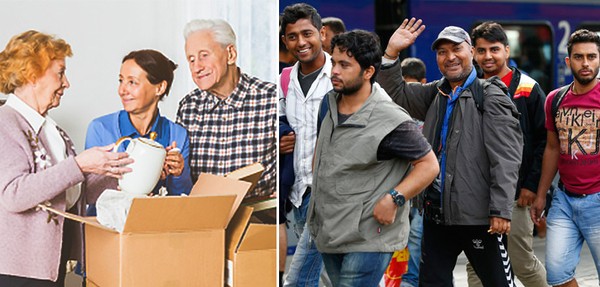 Out with the old, in with the new… German authorities are using legally and morally dubious measures — including the eviction of German citizens from their homes — in an attempt to find housing for hundreds of thousands of migrants arriving this year.
In the same building, a single mother with two children has been given until August 2016 to move out of her apartment, also to make room for migrants. Initially, she had been ordered to vacate the property by November 2015, but her eviction was delayed to allow her daughter to finish the school year without interruption.
In an interview with the newspaper Westfalen-Blatt, Vidal, an independent who does not belong to any political party, said: “I know this is an unconventional measure. But as a community, we have an obligation to provide housing for migrants.” He said he wanted to turn the entire apartment building into housing for migrants. Vidal said it would not be financially viable to house them anywhere else.
In some cases, landlords are evicting long-time residents because the government is offering them more money to house migrants than they are receiving in rent from existing tenants.
In Braunsbedra, a small town in the state of Saxony-Anhalt, a landlord evicted dozens of residents from an apartment building to make way for migrants. According to local media, the landlord, Marcus Skowronek, is being paid 552 euros ($617) for each migrant he takes in. By cramming as many migrants into his property as possible, he stands to receive payments of more than 2 million euros a year from local and regional governments.
When reporters from public broadcaster Mitteldeutscher Rundfunk visited the property to interview Skowronek, he said:
“I am asking you to leave the premises. You are banned (Hausverbot) from entering the building. Please leave the property. I am sorry. Otherwise I will have to call the police. Please go.”
In Berlin, the Institute for Urban Development, the Housing Industry and Loan Associations (Berliner Institut für Städtebau, Wohnungswirtschaft und Bausparwesen, IFS) has warned that, given the influx of so many migrants, the demand for housing will outstrip supply for many years to come. Of the 285,000 building permits approved in 2014, only 56,000 were apartments in multi-unit buildings of the kind that are suitable for migrants.
The IFS is now calling for the initiation of a process in which Germans who are currently living in inexpensive housing, but who can afford more expensive accommodations, move out of their existing homes to make way for migrants. According to the IFS:
“Considering that migrants cannot afford to rent new properties, the vast majority can only afford cheaper housing, a chain reaction of moves (Umzugsketten) must be initiated in which higher income households purchase or build more expensive accommodations for themselves in order to free up the less expensive housing for migrants.”
The IFS does not explain why Germans who are living within their means should suddenly be expected to take on debt to purchase a more expensive home.
Germans are not only being evicted from their homes to make way for migrants, they are also being removed from their schools.
In Lübbecke, another town in NRW, teachers and students were given less than 24 hours to vacate the Jahn-Realschule, a secondary school for 150 students, so that the building can be used to house 300 migrants.
The school principal, Marion Bienen, said that municipal authorities notified her at 5:30 pm on Tuesday, September 15, that last day of classes at the school would be Wednesday, September 16. Students were ordered immediately to remove all of their belongings from the premises and to take a week off until alternative classrooms could be found. Bienen said:
“My students are also human beings. You cannot treat them this way. They were given 15 minutes to remove their belongings from the classroom. Then they had to get out. The evacuation was as during wartime…. There were no discussions. No one forewarned us.”
The Center for Economic Studies, a think tank based in Munich, has published a report warning that most of the migrants arriving in Germany lack the most basic qualifications to find work in the country. This implies that they will become long-term wards of the state and thus a drag on the German economy. The report advises lowering the minimum wage as a way to prevent a surge in the unemployment rate:
“To ensure that the refugee crisis does not lead to an ongoing financial overload for the German taxpayer, refugees must find paid employment as soon as possible, so that they can contribute to their own livelihoods. It is feared that many of them will not be able to find employment at the minimum wage of 8.50 euros because their productivity simply is too low. Therefore, the minimum wage should be lowered, so that the unemployment rate does not go up.”
Meanwhile, politicians are demanding that German citizens do more to ensure that the migrants feel at home. But a first-hand account of the goings-on in a refugee shelter articulates the frustration felt by many Germans that this is a one-way street:
“For about a week now, 500 migrants and refugees are being housed in the gym in our neighborhood. So I went over there because I wanted to see the conditions there with my own eyes. There were about ten vehicles belonging to the Red Cross and volunteers.
“Older men over 60 were unloading tables and benches from the trucks, cleaning them with a bucket of water and cloth, and then carrying them into the hall….
“What made me really angry was to see the incredible lethargy of the young men. All of them in their 20s and 30s, all sitting there, smoking and looking at their cell phones, while the 60-year-old volunteers where laboring away….
“While I was watching how the Red Cross volunteers were working and no one was helping them, I saw an unbelievable situation: an elderly gentleman was trying to carry a table into the hall when a refugee returned from the city center with a shopping bag. The elderly volunteer lifted the table halfway, looked at the migrant and moved his head asking the migrant to lend a hand. The migrant paused for a moment and then just walked away. I could hardly believe what I saw.”
Mandatory Muslim immigration in the EU, Front Page Magazine, Arnold Ahlert, September 24, 2015

Third Worldism, in all its attendant dysfunction, is “breaking the door down on top of us,” even as our unconscionable leaders bemoan those who resist the cultural Armageddon it represents. Leaders whose ongoing love affair with multiculturalism is nothing more than an apology for the Western culture they disdain, even as millions of those Third Worlders are irresistibly drawn to its cornucopia of bounty and beneficence. Bounty and beneficence they will ultimately undermine with the blessings of the apologists who, despite this massive flow of humanity in only one direction, believe no culture is better than any other. It doesn’t get more ironic—or suicidal—than that.
**************************
On Tuesday, national sovereignty gave way to mandatory multiculturalism in the European Union. A plan to relocate an additional 120,000 Middle Eastern migrants was imposed by EU ministers over the objections four Eastern European countries adamantly opposed to the plan. Slovakia’s Robert Fico illuminated the resistance. “As long as I am prime minister, mandatory quotas will not be implemented on Slovak territory,” he declared in Bratislava.
Slovakia was joined by the Czech Republic, Romania and Hungary. Finland abstained from the vote. Yet despite the quartet’s disapproval, the Justice and Home Affairs Committee, led by France and Germany, pushed through the plan proposed by European Commission President Jean-Claude Juncker during his annual State of the Union address in Strasbourg earlier this month. The plan called for 160,000 migrants to be forcibly redistributed from Italy, Greece and Hungary to all other member states, save Britain, Ireland and Denmark, who remain exempt from EU treaties. In addition, Junker called for a review of the “Dublin system” that determines which EU nation is responsible for asylum claims.
In order to make the plan more politically palatable, 66,000 migrants are currently slated for relocation, joining 40,000 migrants approved for asylum in July. The remaining 54,000 had originally been allocated to Hungary where they are currently camped out. But Budapest refused to abide a plan it characterized as an invitation to economic migrants. Thus, those migrants will be reallocated in 2016, possibly among Greece, Italy, Croatia and Austria, bringing the overall total of relocated migrants to 160,000. The plan is ostensibly limited to Syrian, Iraqi and Eritrean asylum-seekers, but the details have yet to be worked out. All of those migrants are people who have purportedly crossed the Mediterranean Sea from Turkey and northern Africa, fleeing the unrelenting violence in Iraq and Syria.
Luxembourg minister and meeting chairman Jean Asselborn stated that ministers “would have preferred to have an agreement by consensus,” but nonetheless expected objectors to fall into line as required by the law. Germany has been the focus of resentment on the issue, no doubt due to German Chancellor Angela Merkel’s Sept. 7 announcement that her nation would take 800,000 refugees this year at a cost of $6.6 billion ,and 500,000 per year over the next few years. Less than a week later, German interior minister Thomas de Maizière announced Germany would be imposing border controls in the southern part of the nation for what Merkel called “urgent security reasons.” Austria and Slovakia followed Germany’s lead shortly thereafter as wishful thinking gave way to the inconvenient reality of as many as half a million migrants flooding into the EU.
The plan itself, whereby the tens of thousands of migrants landing in Italy and Greece will be involuntarily moved by their respective national police forces to other EU nations is the epitome of wishful thinking. Those police forces are already overwhelmed, and the plan to relocate migrants bore little resemblance to the reality expressed by United Nations High Commissioner for Refugees (UNHRC), which insists 120,000 people represents just six days’ worth of arrivals at the current influx rate. “A relocation programme alone, at this stage in the crisis, will not be enough to stabilise the situation,” insists UNHRC spokeswoman Melissa Fleming.
Fleming is correct. After Hungary closed it border, refugees headed west towards Croatia, and that nation allowed tens of thousands to cross into Europe. Now Croatia has blocked off part of its border with Serbia, because they can’t process migrants fast enough. It noted that 35,000 migrants crossed its border in the week following the Hungarian shutdown. In the Austrian town of Nickelsdorf, 8000 new arrivals filled the town square, as local officials insisted no accommodations were available because existing camps were full. And of the more than 4 million migrants that remain in countries near Syria, at least 270,000 Syrians have requested asylum in Europe.
Hungarian Prime Minister Viktor Orban expressed the sense of frustration felt by many in the EU. “They are overrunning us,” he told his nation’s Parliament. “They’re not just banging on the door, they’re breaking the door down on top of us. Our borders are in danger, our way of life built on respect for the law, Hungary and the whole of Europe is in danger. Europe hasn’t just left its door open but has sent open invitation… Europe is rich but weak, this is the worst combination, Europe needs to be stronger to defend its borders.” Hungary has passed a law allowing the army to use rubber bullets, tear gas and net guns to maintain control over migrants on its border.
Unsurprisingly Orban was criticized by European colleagues, such as Czech Foreign Minister Lubomir Zaoralek, who, prior to Tuesday’s meeting, declared Eastern European foreign ministers were “absolutely dedicated” to finding a solution with their EU partners. Since the Czech Republic was one of four nations utterly opposed to the agreement, such optimism was short-lived. “Soon we will find out that the emperor has no clothes,” he tweeted after the plan was announced. “Reason lost today.”
One suspects reason was never in play. As The Telegraph’s Janet Daley warned earlier this month, European elitists have used the now famous image of a dead child washed up on a Turkish beach “to support the notion of Western guilt,” even as Bashar Assad’s murderous regime gets a pass. “For some reason, the appalling photographs of the bodies of children who had been deliberately gassed by the Assad regime, laid out on a concrete floor in Syria two years ago, were not sufficiently moving to compel the world to take action,” she writes. “Are dead children only a moral outrage when they are on the beaches of Europe?”
Elitist outrage is more like it, as Daley notes Germany’s magnanimity, which they and other economically advanced EU nations can afford, stands in stark contrast to the economically struggling eastern bloc nations that must initially accommodate that high-mindedness. “Imagine if you were a poor householder, just managing to keep your financial head above water while you attempted to turn your circumstances around, and a very wealthy neighbour decided to throw open his doors to the needy – and one obvious way that those in need could reach that welcoming haven was by tramping through your house,” Daley explains. “Might you find yourself inclined to be unhelpful in the hopes of discouraging others from taking the same path?”
Millions of ordinary Americans are undoubtedly pondering the same question. In addition to the hordes of illegals embraced by our own ruling class, the Obama administration intends to “significantly increase” the number of “worldwide migrants” this nation takes in over the next two years, reaching a total of 100,000 by 2017. Apparently the reality that the legal and illegal immigrant population in the United States has reached a record-breaking 42.6 million, or about one-out-of-eight residents in the U.S.—more than double what it was in 1980—remains insufficient with regard to the “fundamental transformation of the United States” the American left desires. And while the similar elitist-driven multicultural force-feeding devolving the Europe ethos is much more immediate, make no mistake: both are equally inexorable should current trends on both sides of the Atlantic continue.
In Europe, the bill is coming due for a continent that largely relied on America to do the heavily lifting in response to Islamic terrorism, even as it remained largely contemptuous of the “vulgarities” associated with a military response to the problem. America is facing the twin deficits of a ruling class determined to shove illegal immigration down the throats of a recalcitrant public, and a feckless Obama administration whose foreign policy of phony red lines in Syria, leading from behind in Libya, untimely troop withdrawal in Iraq, and the apparent determination to manipulate intelligence regarding ISIS in the administration’s favor, has precipitated the largest refugee crisis since WWII.
It is a refugee crisis tailor made for ISIS and other Islamic terror groups to exploit with impunity. On both continents, Third Worldism, in all its attendant dysfunction, is “breaking the door down on top of us,” even as our unconscionable leaders bemoan those who resist the cultural Armageddon it represents. Leaders whose ongoing love affair with multiculturalism is nothing more than an apology for the Western culture they disdain, even as millions of those Third Worlders are irresistibly drawn to its cornucopia of bounty and beneficence. Bounty and beneficence they will ultimately undermine with the blessings of the apologists who, despite this massive flow of humanity in only one direction, believe no culture is better than any other. It doesn’t get more ironic—or suicidal—than that.
Migration Crisis: Germany Wants to Be “Miss Congeniality,” Gatestone Institute, Vijeta Uniyal, September 20, 2015
(Please see also, U.S. to Increase Admission of Refugees to 100,000 in 2017, Kerry Says. — DM)
Overwhelmed by the unprecedented influx of migrants, Germany has imposed temporary border controls. This temporary halt in new arrivals is “intended to give Germany a chance to catch its breath while at the same time ratcheting up the pressure on other European Union member states to accept a quota system for the distribution of asylum recipients across the bloc,”according to Interior Minister Joachim Herrmann of the German state of Bavaria on public radio. Germany’s move to tighten its border controls, however, is not going to halt millions of migrants already mobilized by Berlin’s suspension of existing asylum rules and its open border policy in the first place.
Horst Seehofer, the leader of Christian Social Union (CSU), the Bavaria-based sister party to Chancellor Angela Merkel’s Christian Democrats (CDU), painted a grim picture, saying that Merkel’s open border policy “was a mistake that will occupy us for a long time yet. I see no possibility of putting the stopper back into the bottle.”
German media is in lockstep with the government, giving happy-talk and a positive spin on migrant crisis of gigantic proportions hitting Europe.
German newspapers and media outlets have suppressed the stories of rampant rape and child abuse among the migrants housed in government-run accommodations. In a recent letter addressed to the Minister of Integration and Social Affairs in the state of Hesse, prominent women’s organizations have described the culture of rape and violence perpetuated by male migrants — right under the nose of German authorities. The letter states:
“It is a fact that women and children [at HEAE accommodation facility, under the supervision of Administrative District of Giessen] are unprotected. This situation is opportune to those men who already regard women as their inferior and treat unaccompanied women as ‘fair game.’ As a consequence, there are reports of numerous rapes, sexual assaults and increasingly of forced prostitution. … These are not isolated incidents.”
According to the letter, women were terrified to walk in the camp even during the day.
The letter, signed by leading officials organizing the settlement of the migrants in the state of Hesse, went virtually unreported in the German media.
For now, the German media can afford to ignore these crimes, committed in makeshift transit centers — away from the public eye. How do the media plan to suppress this reality once some of these criminals are released into communities? Here is a foretaste of the things to come:
Recently the Germany’s top public broadcaster ZDF refused to run a segment about a rape case on its prime time crime show, “Aktenzeichen XY,” which helps law enforcement to gather leads from the general public, on the grounds that the alleged fugitive was of a “darker skin” and might fit the profile of a migrant. The editor-in-chief, Ina-Maria Reize-Wildemann, defended her decision: “We don’t want to inflame the situation and spread the bad mood. [The migrants] don’t deserve it.” That the poor rape victim deserved justice was apparently of no concern to the broadcaster.
Mainstream media in Germany are not merely willing executioners of Merkel’s open border policy, they are ideological players committed to breaking any opposition to the plan.
 Commenting on Germany’s acceptance of hundreds of thousands of migrants, the popular mainstream newsmagazine Der Spiegel last week portrayed Chancellor Merkel as a Mother Theresa-like figure (left). Pictured at right, a German policeman leads a group of newly arrived migrants.
Germany wants to dictate its stand on migration to other EU member states. First Germany wrecked the existing legal framework by unilaterally suspending the Dublin Protocol, and now it wants Europe to shoulder a “fair share” of migrants who are stampeding into Europe — encouraged by Berlin’s irresponsible stance to begin with.
Chancellor Merkel today seems to be promising nothing less than absolution for Germany’s sins of the Holocaust. “The world sees Germany as a land of hope and opportunities,” she says. “That hasn’t always been the case.” The problem is, of course, that Muslims are quite different from Jews.
German politicians and EU Commissars, however, seem hell bent on imposing quotas on member states – harkening back to the heyday of Soviets jackboots running the Eastern bloc. It may only be a matter of time until some of the reluctant East European states start complying, possibly forced by economic threats and sanctions from Brussels and Berlin.
Germany under Chancellor Merkel wants to play “Miss Congeniality” at the global scale and wants Europe to pick up the tab.
Germany: Migrants’ Rape Epidemic, Gatestone Institute, Soeren Kern, September 18, 2015
A growing number of women and young girls housed in refugee shelters in Germany are being raped, sexually assaulted and even forced into prostitution by male asylum seekers, according to German social work organizations with first-hand knowledge of the situation.
Many of the rapes are occurring in mixed-gender shelters, where, due to a lack of space, German authorities are forcing thousands of male and female migrants to share the same sleeping areas and restroom facilities.
Conditions for women and girls at some shelters are so perilous that females are being described as “wild game” fighting off Muslim male predators. But many victims, fearing reprisals, are keeping silent, social workers say.
At the same time, growing numbers of German women in towns and cities across the country are being raped by asylum seekers from Africa, Asia and the Middle East. Many of the crimes are being downplayed by German authorities and the national media, apparently to avoid fueling anti-immigration sentiments.
On August 18, a coalition of four social work organizations and women’s rights groups sent a two-page letter to the leaders of the political parties in the regional parliament in Hesse, a state in west-central Germany, warning them of the worsening situation for women and children in the refugee shelters. The letter said:
“The ever-increasing influx of refugees has complicated the situation for women and girls at the receiving center in Giessen (HEAE) and its subsidiaries.
“The practice of providing accommodations in large tents, the lack of gender-separate sanitary facilities, premises that cannot be locked, the lack of safe havens for women and girls — to name just a few spatial factors — increases the vulnerability of women and children within the HEAE. This situation plays into the hands of those men who assign women a subordinate role and treat women traveling alone as ‘wild game’.
“The consequences are numerous rapes and sexual assaults. We are also receiving an increasing number of reports of forced prostitution. It must be stressed: these are not isolated cases.
“Women report that they, as well as children, have been raped or subjected to sexual assault. As a result, many women sleep in their street clothes. Women regularly report that they do not use the toilet at night because of the danger of rape and robbery on the way to the sanitary facilities. Even during daylight, passing through the camp is a frightful situation for many women.
“Many women — in addition to fleeing wars or civil wars — are also on the run for gender-related reasons, including the threat of forced marriage or genital mutilation. These women who face special risks, especially when they are on the run alone or with their children. Even if they are accompanied by male relatives or acquaintances, this does not always ensure protection against violence because it can also lead to specific dependencies and sexual exploitation.
“Most female refugees have experienced a variety of traumatizing experiences in their country of origin and while on the run. They are victims of violence, kidnappings, torture, rape and extortion — sometimes over periods of several years.
“The feeling to have arrived here — in safety — and to be able to move without fear, is a gift for many women…. We therefore ask you…to join our call for the immediate establishment of protected premises (locked apartments or houses) for women and children who are travelling alone….
“These facilities must be equipped so that men do not have access to the premises of the women, with the exception of emergency workers and security personnel. In addition bedrooms, lounges, kitchens and sanitary facilities must be interconnected so that they form a self-contained unit — and thus can only be reached via lockable and monitored access to the house or the apartment.”
After several blogs (here, here and here) drew attention to the letter, the LandesFrauenRat (LFR) Hessen, a women’s lobbying group that originally uploaded the politically incorrect document to its website, abruptly removed it on September 14, without explanation.
The problem of rapes and sexual assaults in German refugee shelters is a nationwide problem.
In Bavaria, women and girls housed at a refugee shelter in Bayernkaserne, a former military base in Munich, are subject to rape and forced prostitution on a daily basis, according to women’s rights groups. Although the facility has separate dorm rooms for women, the doors cannot be locked and men control access to the sanitary facilities.
Approximately 80% of the refugees/migrants at the shelter are male, according to Bavarian Broadcasting (Bayerischer Rundfunk), which reports that the price for sex with female asylum seekers is ten euros. A social worker described the facility this way: “We are the biggest brothel in Munich.”
Police insist they have no proof that the rapes are taking place, although a police raid on the facility found that guards hired to provide security at the site were trafficking drugs and weapons and were turning a blind eye to the prostitution.
On August 28, a 22-year-old Eritrean asylum seeker was sentenced to one year and eight months in prison for attempting to rape a 30-year-old Iraqi-Kurdish woman at a refugee shelter in the Bavarian town of Höchstädt. The reduced sentence was thanks to the efforts of the defense attorney, who persuaded the judge that the defendant’s situation at the shelter was hopeless: “For a year now he sits around and thinks about — about nothingness.”
On August 26, a 34-year-old asylum seeker attempted to rape a 34-year-old woman in the laundry room of a refugee facility in Stralsund, a city near the Baltic Sea.
On August 6, police revealed that a 13-year-old Muslim girl was raped by another asylum seeker at a refugee facility in Detmold, a city in west-central Germany. The girl and her mother reportedly fled their homeland to escape a culture of sexual violence; as it turns out, the man who raped the girl is from their country.
Although the rape took place in June, police kept silent about it for nearly three months, until local media published a story about the crime. According to an editorial comment in the newspaperWestfalen-Blatt, police are refusing to go public about crimes involving refugees and migrants because they do not want to give legitimacy to critics of mass migration.
Police chief Bernd Flake countered that the silence was aimed at protecting the victim. “We will continue with this policy [of not informing the public] whenever crimes are committed in refugee facilities,” he said.
Over the weekend of June 12-14, a 15-year-old girl housed at a refugee shelter in Habenhausen, a district in the northern city of Bremen, was repeatedly raped by two other asylum seekers. The facility has been has been described as a “house of horrors” due to the spiraling violence perpetrated by rival gangs of youth from Africa and Kosovo. A total of 247 asylum seekers are staying at the shelter, which has a capacity for 180 and a cafeteria with seating for 53.
Meanwhile, the raping of German women by asylum seekers is becoming commonplace. Following are a few select cases just from 2015:
On September 11, a 16-year-old girl was raped by an unidentified “dark-skinned man speaking broken German” close to a refugee shelter in the Bavarian town of Mering. The attack occurred while the girl was walking home from the train station.
On August 13, police arrested two Iraqi asylum seekers, aged 23 and 19, for raping an 18-year-old German woman behind a schoolyard in Hamm, a city in North Rhine-Westphalia.
On July 26, a 14-year-old boy was sexually assaulted inside the bathroom of a regional train inHeilbronn, a city in southwestern Germany. Police are looking for a “dark skinned” man between the ages of 30 and 40 who has an “Arab appearance.” Also on July 26, a 21-year-old Tunisian asylum seeker raped a 20-year-old woman in the Dornwaldsiedlung district of Karlsruhe. Police kept the crime secret until August 14, when a local paper went public with the story.
On June 9, two Somali asylum seekers, aged 20 and 18, were sentenced to seven-and-a-half years in prison for raping a 21-year-old German woman in Bad Kreuznach, a town in Rhineland-Palatinate, on December 13, 2014.
On June 5, a 30-year-old Somali asylum seeker called “Ali S” was sentenced to four years and nine months in prison for attempting to rape a 20-year-old woman in Munich. Ali had previously served a seven-year sentence for rape, and had been out of prison for only five months before he attacked again. In an effort to protect the identity of Ali S, a Munich newspaper referred to him by the more politically correct “Joseph T.”
On May 22, a 30-year-old Moroccan man was sentenced to four years and nine months in prison for attempting to rape a 55-year-old woman in Dresden. On May 20, a 25-year-old Senegalese asylum seeker was arrested after he attempted to rape a 21-year-old German woman at the Stachus, a large square in central Munich.
On April 16, a 21-year-old asylum seeker from Iraq was sentenced to three years and ten months in prison for raping a 17-year-old girl at festival in the Bavarian town of Straubing in August 2014. On April 7, a 29-year-old asylum seeker was arrested for the attempted rape of a 14-year-old girl in the town of Alzenau.
On March 17, two Afghan asylum seekers aged 19 and 20 were sentenced to five years in prison for the “particularly abhorrent” rape of a 21-year-old German woman in Kirchheim, a town near Stuttgart, on August 17, 2014.
On February 11, a 28-year-old asylum seeker from Eritrea was sentenced to four years in prison for raping a 25-year-old German woman in Stralsund, along the Baltic Sea, in October 2014.
On February 1, a 27-year-old asylum seeker from Somalia was arrested after attempting to rape women in the Bavarian town of Reisbach.
On January 16, a 24-year-old Moroccan immigrant raped a 29-year-old woman in Dresden.
Dozens of other cases of rape and attempted rape — cases in which police are specifically looking for foreign perpetrators (German police often refer to them as Südländer, or “southerners”) — remain unresolved. Following is a partial list just for August 2015:
On August 23, a “dark skinned” man attempted to rape a 35-year-old woman in Dortmund. On August 17, three male “southerners” attempted to rape a 42-year-old woman in Ansbach. On August 16, a male “southerner” raped a woman in Hanau.
On August 12, a male “southerner” attempted to rape a 17-year-old woman in Hannover. Also on August 12, a male “southerner” exposed himself to a 31-year-old woman in Kassel. Police say a similar incident occurred in the same area on August 11.
On August 10, five men of “Turkish origin” attempted to rape a girl in Mönchengladbach. Also on August 10, a male “southerner” raped a 15-year-old girl in Rinteln. On August 8, a male “southerner” attempted to rape a 20-year-old woman in Siegen.
On August 3, a “North African” raped a seven-year-old girl in broad daylight in a park in Chemnitz, a city in eastern Germany. On August 1, a male “southerner” attempted to rape a 27-year-old woman in downtown Stuttgart.
Meanwhile, parents are being warned to look after their daughters. Police in the Bavarian town of Mering, where a 16-year-old-girl was raped on September 11, have issued a warning to parents not to allow their children to go outside unaccompanied. They have also advised women not to walk to or from the train station alone because of its proximity to a refugee shelter.
In the Bavarian town of Pocking, administrators of the Wilhelm-Diess-Gymnasium have warned parents not to let their daughters wear revealing clothing in order to avoid “misunderstandings” with the 200 Muslim refugees housed in emergency accommodations in a building next to the school. The letter said:
“The Syrian citizens are mainly Muslim and speak Arabic. The refugees have their own culture. Because our school is directly next to where they are staying, modest clothing should be worn in order to avoid disagreements. Revealing tops or blouses, short shorts or miniskirts could lead to misunderstandings.”
A local politician quoted by Die Welt newspaper said:
“When Muslim teenage boys go to open air swimming pools, they are overwhelmed when they see girls in bikinis. These boys, who come from a culture where for women it is frowned upon to show naked skin, will follow girls and bother them without their realizing it. Naturally, this generates fear.”
The increase in sex crimes in Germany is being fueled by the preponderance of Muslim males among the mix of refugees/migrants entering the country.
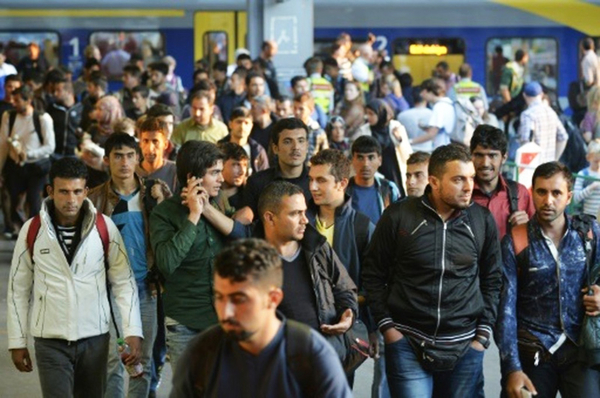 Where are the women?
A record 104,460 asylum seekers arrived in Germany in August, bringing the cumulative total for the first eight months of 2015 to 413,535. Germany expects to receive a total of 800,000 refugees and migrants this year, a four-fold increase over 2014.
At least 80% of the incoming refugees/migrants are Muslim, according to a recent estimate by the Central Council of Muslims in Germany (Zentralrat der Muslime in Deutschland, ZMD), a Muslim umbrella group based in Cologne.
The asylum seekers are also overwhelmingly male. Of the 411,567 refugees/migrants who have entered the European Union by sea so far this year, 72% have been male, 13% women and 15% children, according to calculations by the United Nations Refugee Agency. Information about the gender of those arriving by land remains unavailable.
Of the asylum seekers arriving in Germany in 2014, 71.5% of those between ages 16 and 18 were male; 77.5% in the 18-25 age group were male; as were 73.5% of those between 25 and 30, according to German migration statistics. Data for 2015 is not yet available.
To bring America back we need to break some stuff, Dan Miller’s Blog, September 14, 2015
(The article is not immediately pertinent to Israel because the current President will continue to be Obama and his tame Congress will continue to go along to get along. However, the 2016 U.S. presidential elections are very pertinent to Israel’s future, so I am taking the liberty of posting it here. For those not familiar with the acronym “RINO,” it is a term of disparagement referring to Republicans who would probably be happier if they were Democrats. Needless to say, the views expressed in the article are mine and do not necessarily reflect those of Warsclerotic or its other editors. — DM)
In December of 2011, I wrote an article titled The U.S. Constitution and Civil War. A remark by Cokie Roberts — that we need to ignore parts of the Constitution to save the rest — inspired my article. To bring America back, we don’t need to, nor should we, ignore or otherwise break the Constitution; it is America’s foundation. We do need to destroy and rebuild much of the mess that has been wrongly erected atop that foundation.

Who should be our next President?
Daniel Greenfield, in an article titled This is the America We Live in Now, wrote,
We are not this culture. We are not our media. We are not our politicians. We are better than that.
We must win, but we must also remember what it is we hope to win. If we forget that, we lose. If we forget that, we will embrace dead end policies that cannot restore hope or bring victory.
What we have now is not a movement because we have not defined what it is we hope to win. We have built reactive movements to stave off despair. We must do better than that. We must not settle for striving to restore some idealized lost world. Instead we must dream big. We must think of the nation we want and of the civilization we want to live in and what it will take to build it. [Emphasis added.]
Our enemies have set out big goals. We must set out bigger ones. We must become more than conservatives. If we remain conservatives, then all we will have is the America we live in now. And even if our children and grandchildren become conservatives, that is the culture and nation they will fight to conserve. We must become revolutionaries. [Emphasis added.]
If we don’t, perhaps we should surrender and petition to join the European Union. Our unelected and unaccountable bureaucracy could merge with that of the EU and our Congress could merge with the impotent EU Parliament.
Joining the EU would not fit well with the U.S. Constitution, but so what? Obama and “pragmatic” judges have twisted and distorted it. They pay but scant attention to its clear language or that of the statutes they misconstrue. Most in the current crop of Republicans in the Congress have been willing to surrender whenever Obama blows His dog whistle and run to Him with hopes that He may offer them small bones.
Our once great nation is itself broken, but not necessarily beyond repair. It needs to be fixed before it gets to the point where it can’t be, and we are rapidly approaching that point. Our Constitution must be revived, and as revived survive, if America herself is to survive. America can’t be fixed with fresh paint and new floral arrangements featuring a “new” Bush.
When Ronald Reagan was first mentioned as a possible Republican presidential candidate, my first thought was that we don’t need a washed-up grade B movie actor/former Democrat leftist as President. I was wrong. He became the best President America has seen in my thus far seventy-four years on Earth. We need another Reagan, but who should it be? There are only a few good candidates and the Republican establishment opposes, with such insipid vigor as it can muster, all of them. It wants Jeb Bush, or in any event a Bush clone, to march stolidly toward a new Amerika.
Donald Trump
The mainstream media cannot understand why Trump continues to lead in the polls. Neither can the RINOs. Trump can’t possibly continue to lead; why, he is not even a politician! On September 12th, Sharyl Attkisson posted an article titled Donald’s Duck: 7 Reasons Why Nothing Sticks to Teflon Trump. In it, she explored seven of the reasons why it is claimed that Trump “can’t win.”
1. Trump doesn’t know the names of terror leaders.
2. Trump doesn’t have a plan.
3. Trump isn’t conservative enough.
4. Trump has flip-flopped.
5. Trump personally insults people.
6. Trump is against immigrants.
7. Trump won’t apologize.
Please read her analysis pointing out the fallacies behind these talking points as seen by Trump supporters; I think they are correct.
On September 13th Sundance, writing at The Last Refuge, posted an article titled The GOPe Roadmap, Status Update and The Event Horizon… There, he pointed out the RINOs’ multifaceted plan to defeat Trump and to install Jeb Bush as “our” next President. Jeb wants to lead us to more of the same namby-pamby nonsense that gave us Obama, the “great healer.” I don’t want to go there and want to stay as far away from there as possible. Please read Sundance’s article in its entirety. It’s excellent and so is this sequel about the upcoming CNN debate and the night of the long knives.
What will Trump do if elected?
I don’t know what Trump will do if elected President. He probably can’t make things worse, will try very hard to make them better and may well succeed. Please watch “lunatic” Trump respond to questions during this interview.
The only thing I am confident that the RINO candidates would do is to continue America’s collective swirl down the toilet. I very much like Ted Cruz (he would also be an excellent Secretary of State) and Ben Carson (Secretary of Health and Human Services?). Carina Fiorina? I like her thus far but need to learn more.
Trump has captured the public attention and, in many cases, its admiration and trust. Apparently many of his supporters feel as I do and are “mad as hell and don’t want to take it anymore.”
Please compare and contrast these Obama and Hillary campaign videos:
Obama won His last two elections by campaigning for change “we” can believe in. Trump has thus far campaigned for change those who think America was great before Obama got to mucking around with her do believe in and want to have implemented.
Much is yet unknown about where and how Trump will lead the nation as her President. One thing seems clear, at least to me: he will discard that which is broken and replace it with what we need. So long as he does not muck around with the Constitution (as Obama has done with abandon), I think we should give him an opportunity to try.


Is Europe Losing Control Over Its Destiny? Gatestone Institute, Soeren Kern, September 13, 2015
The European Commission, the powerful administrative arm of the European Union, has unveiled a controversial plan that would compel EU member countries to accept 160,000 migrants and refugees from the Middle East and North Africa.
The move by unelected bureaucrats in Brussels to force European countries to throw open their borders — and to require them to provide migrants with free clothing, food, housing and healthcare for an indefinite period of time — not only represents an audacious usurpation of national sovereignty, it is also certain to encourage millions of additional migrants from the Muslim world to begin making their way to Europe.
The migration proposal, announced on September 9, would “share” 120,000 migrants currently holed up in Greece, Hungary and Italy with other countries in the European Union. This number is in addition to previous demands by the European Commission that 40,000 Syrian and Eritrean migrants be relocated from Greece and Italy.
German Chancellor Angela Merkel, whose open-door immigration policy is partly responsible for fueling the rush of migrants to Europe, has already warned that the European Commission’s plan is “merely a first step” and that Europe may have to accept even bigger numbers. German Vice Chancellor Sigmar Gabriel said that Germany could take 500,000 migrants annually for “several more years.”
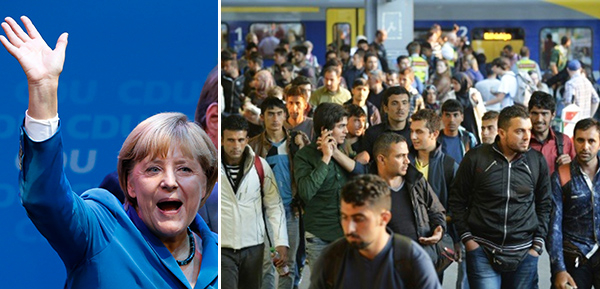 Welcome to Germany! At left, German Chancellor Angela Merkel. At right, some of the hundreds of migrants who arrived in Munich on September 12, 2015.
It remains unclear just how many of the migrants arriving in Europe are refugees fleeing warzones, and how many are economic migrants seeking a better life in the West. Statistics show that of the 625,920 people who applied for asylum in the European Union in 2014, only 29.5% were from Syria, Afghanistan and Iraq.
German officials have admitted that 40% of the migrants arriving in the country in 2015 are from the Balkans, including Albania, Kosovo and Serbia, which implies that at least half of those arriving in Germany this year are economic migrants fleeing poverty not war.
Critical observers are describing the migration chaos engulfing Europe in apocalyptic terms: an “unstoppable demographic revolution,” a “total Armageddon scenario,” and an “exodus of biblical proportions.”
What follows is a selection of quotes and commentary from a variety of political leaders and opinion-shapers in Europe and elsewhere about the consequences of untrammeled immigration from the Muslim world.
In Britain, Nigel Farage, the leader of the Eurosceptic UK Independence Party (UKIP), spoke to the BBC Radio 4’s Today program. He said:
“The problem we’ve got is we’ve opened the door to an exodus of biblical proportions meaning millions and millions of refugees. We’ve lost sight of what it is to be a refugee. How many millions does Europe want to take? That is the question.
“Genuine refugees have tended to be groups of people, ethnic groups or religious groups who were directly under persecution and were fleeing in fear of their lives. The problem we’ve got now if you look at the definition of the EU’s common asylum policy, it includes anyone fleeing from a war-torn country, and it even includes people fleeing extreme poverty.”
British MEP Janice Atkinson, said:
“Nobody voted for illegal immigration. Plenty of people voted to put us here to oppose it. The hundreds of thousands of illegal immigrants overwhelming our borders and our capacities to cope are exactly that — illegal.
“Let’s be clear about another thing: despite what the human rights industry and the massed ranks of taxpayer-funded charities and lobby-groups repeat, this is not a refugee crisis but a massive crisis of illegal immigration which must be resisted for what it is.”
English author and journalist Peter Hitchens, in an essay titled, “We won’t save refugees by destroying our own country,” wrote:
“Actually we can’t do what we like with this country. We inherited it from our parents and grandparents and we have a duty to hand it on to our children and grandchildren, preferably improved and certainly undamaged. It is one of the heaviest responsibilities we will ever have. We cannot just give it away to complete strangers on an impulse because it makes us feel good about ourselves….
“Thanks to a thousand years of uninvaded peace, we have developed astonishing levels of trust, safety and freedom…. I am amazed at how relaxed we are about giving this away.
“Our advantages depend very much on our shared past, our inherited traditions, habits and memories. Newcomers can learn them, but only if they come in small enough numbers. Mass immigration means we adapt to them, when they should be adapting to us….
“So now, on the basis of an emotional spasm, dressed up as civilization and generosity, are we going to say that we abandon this legacy and decline our obligation to pass it on, like the enfeebled, wastrel heirs of an ancient inheritance letting the great house and the estate go to ruin?
“I can see neither sense nor justice in allowing these things to become a pretext for an unstoppable demographic revolution in which Europe (including, alas, our islands) merges its culture and its economy with North Africa and the Middle East. If we let this happen, Europe would lose almost all the things that make others want to live there.”
British MEP Daniel Hannon warned that Germany’s open-door immigration policy was drawing ever more migrants to Europe. He wrote:
“The belief that Germany is relaxing its policy is bound to lead to a level of migration that surpasses anything seen so far. Refugees and economic migrants will be thrown together in a rush. Some will be trampled, and some boats will be overturned. But many more will reach Italy and Greece. Eventually, the front-line EU states will stop trying to enforce the rules, and will simply wave new arrivals across their territory, tempting even more into attempting the crossing.”
The London-based Financial Times lamented the lack of a unified European response to the migration crisis:
“This has been a miserable summer for European ideals. From a bloc founded in the pursuit of peace have emerged frightful images of refugees suffocating on motorway lay-bys, squalid makeshift camps, lifeless toddlers washed ashore, burning asylum centers, serial numbers penned on forearms, the sight of black-clad police pepper spraying families fleeing war. Inundated with asylum seekers, yet lacking the central functions to cope, Europe is divided over what to do. Higher walls? Welcome mats? Is this a national problem or should the burden be shared?
British political scientist Anthony Glees accused the German government of rank hypocrisy for demanding that Greece comply with the strict letter of EU law to obtain a financial bailout, but that same German government unilaterally dispensed with EU law to open Europe’s borders wide open to hundreds of thousands of migrants from the Muslim world. He said:
“Europe’s tectonic plates will move if Germany behaves as a hippie state, guided only by feelings. Prime Minister David Cameron said, quite rightly, in my opinion, that the United Kingdom must act not only with the heart, but also with the head. And the question in the UK is that if Frau Merkel now pursues this policy, a very different policy which it pursued vis-à-vis Greece, where will this end? The UK already intervenes militarily in the fight against the so-called Islamic State. Germany, however, has kept its distance from these things. But then at the same time to say to desperate people in Syria and Iraq, please come to the Federal Republic of Germany, many Britons view this as nonsensical. This will have no end!
“I think it may be that Germany still has historical feelings that are completely absent in Britain. It may be that in 2015, there are still memories of what happened with refugees before the Second World War (1938/1939). But in Britain, where we are currently not only fighting terrorism, not only coping with the problem of economic migrants, but also coping with the humanitarian problem, the German approach seems sloppy and not properly thought through, especially when it comes to Europe when the Germans do not abide by the rules. One may think whatever they might about the Hungarian government, but the rules are there, and if Germany does not comply with the rules, the entire Union is in danger of falling apart.
In Brussels, the self-proclaimed capital of Europe, the president of the European Commission, Jean-Claude Juncker, insisted that immigration from Muslim countries would be a solution to Europe’s demographic decline. He said:
“Let us not forget, we are an ageing continent in demographic decline. We will be needing talent. Over time, migration must change from a problem to be tackled to a well-managed resource. To this end, the Commission will come forward with a well-designed legal migration package in early 2016.”
During the so-called State of the European Union address on September 9, Juncker said that there was no difference between Christian, Jewish and Muslim migrants. He said:
“Europe has made the mistake in the past of distinguishing between Jews, Christians and Muslims. There is no religion, no belief and no philosophy when it comes to refugees.”
Although unemployment is rampant within the European Union, especially among young Europeans, Juncker said:
“I am strongly in favor of allowing asylum seekers to work and earn their own money whilst their applications are being processed. Labor, work, being in a job is a matter of dignity…so we should do everything to change our national legislation in order to allow refugees, migrants, to work since day one of their arrival in Europe.”
In the Czech Republic, President Milos Zeman said that no one had invited migrants to his country, but once they arrive, they should respect the rules of his country or leave. He said:
“If you do not like it, just go away. Someone may consider it appealing to the worst instincts, but this is the same stance that Hungarians share when they are building a fence against Serbia, and Americans who have built a fence on its border with Mexico.”
In Denmark, Andreas Kamm, the secretary general of the Danish Refugee Council (Dansk Flygtningehjælp), warned that the current refugee crisis could lead to total collapse of European society. In an interview with the newspaper Jyllands-Posten, Kamm said he believes that Europe is facing “a total Armageddon scenario.” He added:
“We are experiencing a historical imbalance between the very high numbers of refugees and migrants and the global capacity to provide them with protection and assistance. We are running the risk that conflicts between the migrants and local populations will go awry and escalate. The answer cannot be that Europe imports surplus populations. We cannot be required to destroy our own society.”
Danish Finance Minister Claus Hjort Frederiksen said: “I’m most indignant over the Arab countries who are rolling in money and who only take very few refugees. Countries like Saudi Arabia. It’s completely scandalous.”
In Germany, Interior Minister Thomas de Maizière, in an interview with Die Zeit, said:
“The migration crisis presents a formidable challenge. It is bigger than any of us have previously thought — socially, politically, economically, culturally…. Now we will get hundreds of thousands of Muslims with an Arab background. According to what I am told by my French colleague, this is a significant difference as far as integration is concerned…. I am being told that between 15% and 20% of the adult migrants are illiterate.
“We must get used to the idea that our country is changing. School, police, housing, courts, health care, everywhere! We also need an amendment to the constitution. And all this has to happen very quickly, within weeks! This will require a huge change in our established way of thinking.”
In an interview with Politico, Josef Joffe, a normally astute Jewish-German intellectual who is the publisher of the newspaper Die Zeit, seemed completely oblivious to the long-term consequences of importing hundreds of thousands of Muslims to Germany, when he said:
“It is a true miracle. Our poster-boy refugee is now the Syrian doctor who combines educational achievement with moral obligation, given the unspeakable cruelty against civilians in the Syrian war. Germany, like the countries of English settlement, is turning into an Einwanderungsland, a country of immigration, accepting different colors, faiths and origins. So Germany is evolving into a kind of America, where you need not be born as American, but can become one. It is a mental and emotional revolution.”
In Hungary, Prime Minister Viktor Orbán warned of the “explosive consequences” of culture clash between Europe and migrants from the Muslim world. In a September 3 essay published by the Frankfurter Allgemeine Zeitung, Orbán wrote:
“To understand what we must do, we need to grasp the true nature of the situation we are facing. Europe is not in the grip of a ‘refugee problem’ or a ‘refugee situation,’ but the European continent is threatened by an ever mounting wave of modern-era migration. Movement of people is taking place on an immense scale, and from a European perspective the number of potential future immigrants seems limitless.
“With each passing day we see that hundreds of thousands have been turning up and clamoring at our borders, and there are millions more intending to set out for Europe, driven by economic motives….
“We must acknowledge that the European Union’s misguided immigration policy is responsible for this situation. Irresponsibility is the mark of every European politician who holds out the promise of a better life to immigrants and encourages them to leave everything behind and risk their lives in setting out for Europe. If Europe does not return to the path of common sense, it will find itself laid low in a battle for its fate….
“Let us not forget that those arriving have been raised in another religion, and represent a radically different culture. Most of them are not Christians, but Muslims. This is an important question, because Europe and European identity is rooted in Christianity. Is it not worrying in itself that European Christianity is now barely able to keep Europe Christian? If we lose sight of this, the idea of Europe could become a minority interest in its own continent.”
Referring to Hungary’s occupation by the Ottoman Empire from 1541 to 1699, Orbán said:
“I think we have a right to decide that we do not want a large number of Muslim people in our country. We do not like the consequences of having a large number of Muslim communities that we see in other countries and I do not see any reason for anyone else to force us to create ways of living together in Hungary that we do not want to see. That is a historical experience for us.”
According to Zoltán Kovács, a spokesman for Hungary’s center-right government, the EU’s response to the crisis has been a complete failure. He said:
“The EU does not differentiate between those who are in real need of help. Genuine refugees are pushed together with economic migrants. We are not facing a refugee crisis, we are facing a migration crisis. People are coming here from a hundred countries around the world. It is completely unacceptable that illegal means of movement are now institutionalized.”
In Slovakia, Prime Minister Robert Fico said that 95% of so-called refugees were actually economic migrants:
“We won’t assist in this folly with arms opened wide with the notion that we’ll accept them all regardless of whether they’re economic migrants or not. If we do not start telling the truth about migration, we will never move from this spot.”
Fico also warned of the consequences of untrammeled Muslim immigration. He said:
“Since Slovakia is a Christian country, we cannot tolerate an influx of 300,000-400,000 Muslim immigrants who would like to start building mosques all over our land and trying to change the nature, culture and values of the state.”
In the United States, Ambassador John Bolton warned that Europe’s migration crisis is America’s problem too. He wrote:
“While Americans may believe that Europe, long disdainful of our own intense debate over border-security problems, is getting what it deserves, we should nonetheless focus on both the potential threats and lessons applicable to us.
“One critical cause of Europe’s illegal-immigration spike is the growing chaos across the greater Middle East. This spreading anarchy derives, in substantial part, from Barack Obama’s deliberate policy of ‘leading from behind’ by reducing U.S. attention to and involvement in the region. When America’s presence diminishes anywhere in the world, whatever minimal order and stability existed there can rapidly evaporate….
“For years, the central cause of population movements into Europe was economic: North Africans crossed the narrow Strait of Gibraltar or headed to France or Italy. Turks and Arabs entered through Greece and Eastern Europe. Once into the European Union, thanks to the Schengen Agreement, travel barriers are now almost nonexistent, and, as in the United States, illegal aliens can essentially travel freely….
“Spreading terrorism, armed conflict and collapsing political authority in the Middle East are now powerful causal factors equaling or exceeding continuing economic disparities. Europe fears being overwhelmed by the sheer numbers of people on the move, thereby losing control over decisions on who to admit and who to turn away. These concerns are legitimate, but there are deeper risks as well. Mirroring worries in Washington, there is a serious and rising Islamicist terrorist threat hidden within the tides of people seeking refuge.
“The lesson for the United States is that reducing our global influence does not increase international peace and security. Quite the opposite. Obama’s retreat from the Middle East, whether in the aftermath of Libya, his disinterest in the Islamic State’s continuing rise, or his surrender to Iran’s nuclear-weapons program, are all part of the larger pattern. Europe’s illegal immigration problem is our problem as well.”
Writing for the New York Observer, Arthur Chrenkoff wrote:
“As an unseasonably hot European summer gives way to autumn, the continent is experiencing a mass movement of people not seen since the aftermath of the Second World War. Unlike the end of the war, however, none of the masses currently on the move is European. As hundreds of thousands of people continue to arrive on Europe’s doorsteps and throng her roads and railway lines, many conservative commentators see a more apt, and more ominous, historical parallel in the Völkerwanderung or ‘wanderings of the peoples’ that foreshadowed the fall of the Roman Empire some sixteen centuries ago. Europeans have long historical memories….
“As we reflect on the vivid media images of boats and trains overflowing with desperate humanity, it is important to keep in mind two points: 1) The majority of the 350,000-400,000 immigrants who have arrived in Europe so far this year (these are the known numbers; no one knows how many enter undetected) are not Syrians. In fact, less than a third are, with the rest originating in a miscellany of African, Middle Eastern and South Asian countries. 2) The majority seem to be single, healthy-looking young men, which traditionally suggests economic motives for migration, rather than the fear of death or persecution.
“What is happening in Europe at the moment is not so much, or at least not predominantly, a refugee crisis but a crisis of European immigration policies.
Chrenkoff summed it up this way:
“The control over one’s own borders is one of the most important characteristics — and responsibilities — of a modern state. Countries lose control over their destinies and even cease to exist when they lose control over who gets in.”
An Illegal Immigrant Catastrophe… In Europe? ISIS Refugees! PJ Media via You Tube, September 9, 2015
(Perhaps the European Union should impose multiple two state solutions: each country facing an Islamic invasion would be split, part for Islamists and part for everyone else. Why not? If that’s fine for Israel, it should work as well there. — DM)
Europe’s Migration Crisis, Gatestone Institute, Soeren Kern, September 9, 2015
Half a million migrants and refugees are known to have entered the European Union during the first eight months of 2015; that number may increase to more than one million before the year is through. This figure does not include individuals who got into the EU undetected.
A total of 364,183 migrants entered the European Union by sea between January and August, compared to 280,000 for the whole of 2014, according to updated statistics published by the International Organization for Migration (IOM) on September 3, 2015.
Of the total maritime arrivals, 245,274 arrived in Greece, 116,649 in Italy, and 2,166 arrived in Spain. The top countries of origin are: Syria, followed by Afghanistan, Eritrea, Nigeria, Albania, Pakistan, Somalia, Sudan and Iraq.
In addition, 132,240 migrants are known to have arrived in the European Union during the first seven months of 2015 by land, crossing from Turkey into Greece and Bulgaria, according to Frontex, the EU’s border management agency. The top three countries of origin are: Syria, Afghanistan and Pakistan.
Germany and Sweden are the final destinations of choice for most migrants, lured by the generous benefits they can claim and the governments’ message that refugees are welcome in unlimited numbers.
If sustained indefinitely, the open-door immigration policies could draw potentially millions of Muslims into Europe from the Middle East and North Africa.
Every European country is being affected by the migration crisis in one way or another. What follows is a brief survey of developments in selected countries.
In Austria, Chancellor Werner Faymann said he would end an emergency measure that allowed more than 10,000 migrants and refugees in Hungary to enter the country unhindered. “We have always said this is an emergency situation in which we must act quickly and humanely,” he said. “We have helped more than 12,000 people in an acute situation. Now we have to move step-by-step away from emergency measures towards normality.”
Only 20 of the 12,000 people who crossed the border during the weekend of September 5-6 applied for asylum in Austria. The rest have already moved on to the more generous Germany. In addition to receiving free clothing, food, housing and healthcare, migrants in Germany also get a monthly cash payment of €143 ($160), compared to only €40 ($45) per month in Austria.
Meanwhile, six people — five Bulgarians and an Afghan with Hungarian residency — have been arrested in connection with the deaths of 71 migrants whose decomposing bodies were found in the back of an abandoned truck on August 27. Police believe the truck, which was left on the side of an Austrian highway, entered into Austria from Hungary. The truck owner is a Bulgarian citizen of Lebanese origin.
In Britain, Prime Minister David Cameron on September 7 announced plans to accept 20,000 Syrian refugees during the next five years. Just days earlier, he said the UK had already taken in enough refugees. Cameron’s position is said to have changed after British newspapers published photographs of the body of a Syrian child washed up on a Turkish beach.
Since then, a petition calling on the government to accept more refugees has garnered more than 400,000 signatures, well above the 100,000 threshold needed to allow for a debate in Parliament.
The petition states: “There is a global refugee crisis. The UK is not offering proportional asylum in comparison with European counterparts. We can’t allow refugees who have risked their lives to escape horrendous conflict and violence to be left living in dire, unsafe and inhumane conditions in Europe. We must help.”
Thousands of economic migrants have attempted to enter the UK illegally through the Channel Tunnel, a 50 kilometer (31 mile) rail tunnel between France to Britain.
In Bulgaria, five jihadists posing as refugees were arrested on August 28 while trying to cross the border at Gyueshevo, one of three checkpoints along the Bulgarian-Macedonian border. Police became suspicious after the five men, Albanians aged between 20 and 24, attempted to bribe the border guards with 175 euros ($195) each. A subsequent search found that the men were carrying Islamic State propaganda, including videos of decapitations.
In the Czech Republic, authorities assigned migrants with numbers, which they wrote on the migrants’ arms and hands with a felt-tip pen. The government said many migrants had no documents and did not speak English, and that this method was the best way to track them. The move was widely criticized because of its connotations with the Jewish Holocaust, when the Nazis tattooed numbers on everyone they sent to concentration camps.
In Denmark, Andreas Kamm, the secretary general of the Danish Refugee Council (Dansk Flygtningehjælp), warned that the current refugee crisis could lead to total collapse of European society. In an interview with the newspaper Jyllands-Posten, Kamm said he believes that Europe is facing “a total Armageddon scenario.” He added:
“We are experiencing a historical imbalance between the very high numbers of refugees and migrants and the global capacity to provide them with protection and assistance. We are running the risk that conflicts between the migrants and local populations will go awry and escalate. The answer cannot be that Europe imports surplus populations. We cannot be required to destroy our own society.”
Danish Finance Minister Claus Hjort Frederiksen said: “I’m most indignant over the Arab countries who are rolling in money and who only take very few refugees. Countries like Saudi Arabia. It’s completely scandalous.”
The Danish government has placed ads in Lebanese newspapers aimed at deterring potential migrants. “Denmark has decided to tighten the regulations concerning refugees in a number of areas,” say the ads, which warn that Denmark recently passed legislation, cutting benefits by up to 50% for newly arrived refugees.
On September 6, Danish police stopped 150 refugees who began marching towards the border with Sweden, known for its more generous asylum policies. The group was among 300 refugees who arrived in Rødby, a busy ferry crossing between southern Denmark and Germany. Scuffles broke out with police when some ran off to avoid having their fingerprints taken, in fear they would be registered as seeking refuge in Denmark and unable to go on to Sweden.
On September 8, Danish police sent back a group of economic migrants who had arrived from Germany. “These are people who do not want to seek asylum and are therefore here illegally. They have been deported and barred from re-entering the country for two years,” police in southern Denmark said in a statement. “This first group was a score of people. More will follow after their cases are processed,” the statement said, adding that they were sent back by bus.
In Finland, Prime Minister Juha Sipila offered to do his part to alleviate Europe’s migration crisis by announcing that Muslim refugees could stay at his unused summer cottage in Kempele, a small town just 184 kilometers (114 miles) south of the Arctic Circle. Average temperatures in Kempele are below the freezing point six months out of the year and the town does not (yet) have a mosque. “I hope this becomes some kind of people’s movement that will inspire many others to shoulder part of the burden in this refugee housing crisis,” Sipila said on state television.
Sipila made his offer one day after his government doubled its estimate for the number of asylum seekers in Finland in 2015 to 30,000. Just two weeks earlier, his government had lifted the estimate to 15,000, which was 10,000 higher than previous estimates. The figures compare to 3,600 asylum seekers in 2014.
During the first five months of 2015, the majority of asylum seekers in Finland — which is stuck in a three-year recession — were economic migrants, not refugees fleeing war zones. According to the Finnish Immigration Service, the top ten countries origin countries for migrants to Finland were: Iraq, Somalia, Kosovo, Afghanistan, Russia, Albania, Nigeria, Syria, Morocco and Algeria.
Meanwhile, some 200 Finns in Salo, home of the once-dominant Nokia cell phone maker, protested against the opening of a reception center for refugees in the town. Demonstrators in the central square shouted slogans such as, “Close the borders” and “Islam will destroy us.” One protestor said: “Finns need to be helped first. Everything has been taken from the unemployed, the poor and the sick. But the coffers are empty. If these centers open, our taxes will go up.”
In France, President François Hollande agreed to take in 24,000 migrants during the next two years. A September 5 poll published by Le Parisien showed that 55% of French voters are opposed to an easing of rules for migrants asking for refugee status, including Syrians fleeing civil war.
The vice president of the anti-immigration National Front party, Florian Philippot, accusedGerman Chancellor Angela Merkel of encouraging migration to Europe so that German industry would be supplied with “slaves.”
“Germany needs cheap slaves to supply its industry,” Philippot said during a speech at a gathering of the National Front in Marseille. “Her proposals to impose migrant quotes are only logical: to serve the cynical interests of German capitalism. The only objective is to bridge the demographic deficit as cheaply as possible.”
In Germany, the number of asylum seekers entering the country in a single month surpassed the 100,000 mark for the first time ever. A record 104,460 asylum seekers arrived in August 2015, bringing the cumulative total for the first eight months of 2015 to 413,535. Germany expects to receive a total of 800,000 refugees and migrants this year, a four-fold increase over 2014.
German officials say that 20,000 migrants and refugees arrived in the country during the weekend of September 5-6. Another wave is expected to arrive within the next few days.
The German government will spend €6 billion ($6.7 billion) to cope with the influx of refugees. State and local governments will receive €3 billion for housing the refugees, and the central government will allocate another €3 billion for benefits for the new arrivals.
Hundreds of Muslim refugees are converting to Christianity, apparently in an effort to improve their chances of having their asylum applications approved. Under Islam, Muslims who convert to Christianity are guilty of apostasy, a crime punishable by death. The “converts” apparently believe that German immigration officials will allow them to stay in Germany if they can be persuaded that they will be killed if they are sent back to their countries of origin.
Muslim migrants have clashed among themselves upon arrival in Germany. On August 19, at least 20 Syrian migrants staying at an overcrowded refugee shelter in the eastern German town of Suhl tried to lynch an Afghan migrant after he tore pages from a Koran and threw them in a toilet.
More than 100 police officers were called in to restore order, but when they arrived they were attacked with stones and concrete blocks. Seventeen people were injured in the melee, including 11 refugees and 6 police officers. The Afghan is now under police protection. The president of the German state of Thuringia, Bodo Ramelow, said that Muslims of different nationalities should be housed separately to avoid similar violence in the future.
In Greece, troops were deployed to the Aegean island of Lesbos, following clashes between migrants and police. More than 15,000 migrants and refugees have arrived on the island, an entry point into the European Union. Migrants are upset over delays in the registration process that has left them stranded on the island, unable to continue their journey to other countries in northern Europe. Scuffles have also broken out between Syrians, who are granted priority in the vetting process, and Afghans, who are forced to wait much longer.
In Hungary, Prime Minister Viktor Orbán proposed sending in the military to seal the country’s southern border with Serbia. He said:
“We’ll bring the border under control step-by-step. We’ll send in the police, then, if we get approval from parliament, we’ll deploy the military. It’s not 150,000 migrants coming that some want to divide according to quotas, it’s not 500,000, a figure that I heard in Brussels, it’s millions, then tens of millions, because the supply of immigrants is endless.”
A spokesman for Hungary’s center-right government, Zoltán Kovács, said the EU’s response to the migration crisis has been a total failure. He said:
“It [the EU] does not differentiate between those who are in real need of help. Genuine refugees are pushed together with economic migrants. We are not facing a refugee crisis, we are facing a migration crisis. People are coming here from a hundred countries around the world. It is completely unacceptable that illegal means of movement are now institutionalized.”
Hundreds of migrants, eager to leave Hungary for the promised land of Germany, were filmed confronting police and refusing food and water. One migrant was asked why he doesn’t want to stay in Hungary. He replied: “[Hungary is] not giving us like in Germany… a house, money…”
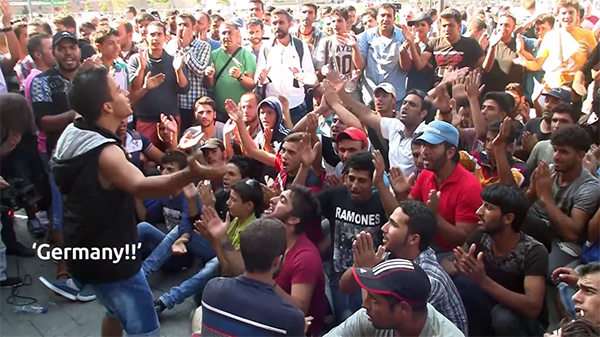 Dozens of migrants camped in front of central train station in Budapest, Hungary clap and chant “Germany!”
In Iceland, population 330,000, more than 12,000 families offered to open their homes to migrants in a bid to raise the government’s cap of just 50 asylum seekers per year. They responded to a call by Bryndís Björgvinsdóttir, an activist who set up a Facebook page calling on the government to allow ordinary Icelanders to help.
Referring to the refugees, Björgvinsdóttir wrote:
“They are our future spouses, best friends, the next soul mate, a drummer for our children’s band, the next colleague, Miss Iceland in 2022, the carpenter who finally finishes the bathroom, the cook in the cafeteria, a fireman and television host. People of whom we’ll never be able to say in the future: ‘Your life is worth less than my life.'”
In Italy, an 18-year-old asylum-seeker from the Ivory Coast named Mamadou Kamara was accused of murdering an elderly couple in Sicily. Kamara, who was rescued in the Mediterranean Sea on June 8 and brought with other migrants to the port of Catania in Sicily, allegedly broke into a home in the nearby village of Palagonia and slit the throat of Vincenzo Solano, 68, during a robbery that turned violent. His Spanish-born wife, Mercedes Ibañez, 70, fell to her death from a second-floor balcony. Police say Kamara stole a laptop computer, a video camera and a mobile telephone from the couple’s home.
Center-right politician Giorgia Meloni said: “The instigator of the murder of these two innocents is the Italian state, which is responsible for having kept open a migrant facility… which we said should be closed down.”
In Macedonia, police scuffled with thousands of migrants trying to cross into the country from Greece. Foreign Minister Nikola Poposki said:
“In the last several days there has been a dramatic increase of inflow of migrants and we have reached numbers of 3,000 to 3,500 per day which obviously is not something a country of two million people and our resources can handle on a daily basis. We had to reinforce the control of illegal entry of Macedonian territory.”
Hundreds of Muslim migrants shouting “Allahu Akbar” (“Allah is Greater”) rejected Red Cross meals distributed by Macedonian troops because the food is not halal, or legally permissible according to Islamic Sharia law.
In the Netherlands, the government announced new rules that would cut off food and shelter for migrants who fail to qualify as refugees. Failed asylum seekers would be limited to “a few weeks” shelter after being turned down. If they do not agree to return home, they would be deported.
The UN’s Committee on the Elimination of Racial Discrimination criticized the Dutch policy. It said that the basic needs of migrants should be provided unconditionally. Prime Minister Mark Rutte responded by saying that it would be “crazy” to offer permanent shelter to people who refused to leave. “We are talking about the group that can go back,” he said, “whose governments would take them back, but they do not want to go back.”
In Norway, dozens of migrants are arriving via the Arctic Circle. Up to 20 migrants a month are trekking to the far north of Russia and then crossing into the tiny Norwegian town of Kirkenes, which lies around 4,000 kilometers (2,500 miles) north of Damascus.
According to border agreements, it is illegal either to cross the border on foot or to give a lift to someone without papers — a problem Syrian refugees have sidestepped by using bicycles.
“There is no reason to believe that this will stop,” Hans Møllebakken, chief of police in Kirkenes, told Norway’s VG newspaper. “The fact is, if you have money, you can get from Damascus to Storskog in under 48 hours: This is the fast track to Schengen.”
In Slovakia, a spokesman for the Interior Ministry, Ivan Netik, said that his country will only accept Christians when it takes in Syrian refugees under an EU relocation scheme. Speaking to the BBC, Netik said:
“We want to really help Europe with this migration wave but we are only a transit country and the people don’t want to stay in Slovakia. We could take 800 Muslims but we don’t have any mosques in Slovakia so how can Muslims be integrated if they are not going to like it here?”
In Spain, the newspaper El País reported that most asylum seekers see Spain as nothing more than a “stop on the road” to Germany. Many move north after their six months of free financial assistance runs out. “Many of those who reach Spain leave as soon as they can for countries with more generous aid,” the paper reported. “They know there are no jobs here, and that the existing structure cannot cover everyone’s needs.”
The central government in Madrid has placed limits on the amount of aid available, but more than 50 provincial and municipal governments in Spain are now providing migrants with housing and free health care.
Police on September 7 fired rubber bullets at migrants in a detention center in Valencia after more than 50 of them tried to escape. On August 16, at least 35 migrants escaped from a holding facility in Algeciras. On August 15, eight migrants escaped from a detention center in Murcia.
In Sweden, Prime Minister Stefan Löfven on September 6 addressed a pro-refugee rally in Stockholm in which he urged Swedes and other Europeans to do more for migrants. He said: “We need to decide right now what kind of Europe we are going to be. My Europe takes in refugees. My Europe doesn’t build walls.”
An Schibsted/Inizios opinion poll produced for the newspaper Aftonbladet found that 66% of Swedes were prepared to help refugees, but 48% said they have little or no confidence in the government’s approach to the crisis.
At the Vatican, Pope Francis on September 6 called on all Catholic parishes and monasteries in Europe each to house one refugee family. He said the Vatican’s two parishes would lead by example. According to one calculation, “There are about 122,000 Catholic parishes in Europe, according to a study conducted by Georgetown University and published in June. If each of them housed one refugee family consisting of three to four people, about 360,000 to 500,000 refugees could be accommodated in the coming months.”




 anneinpt
 artaxes
 danmillerinpanama
 davidking1530
 Peter Hofman
 Joseph Wouk
 Peter
Peter Louisiana Steve
 WarSclerotic
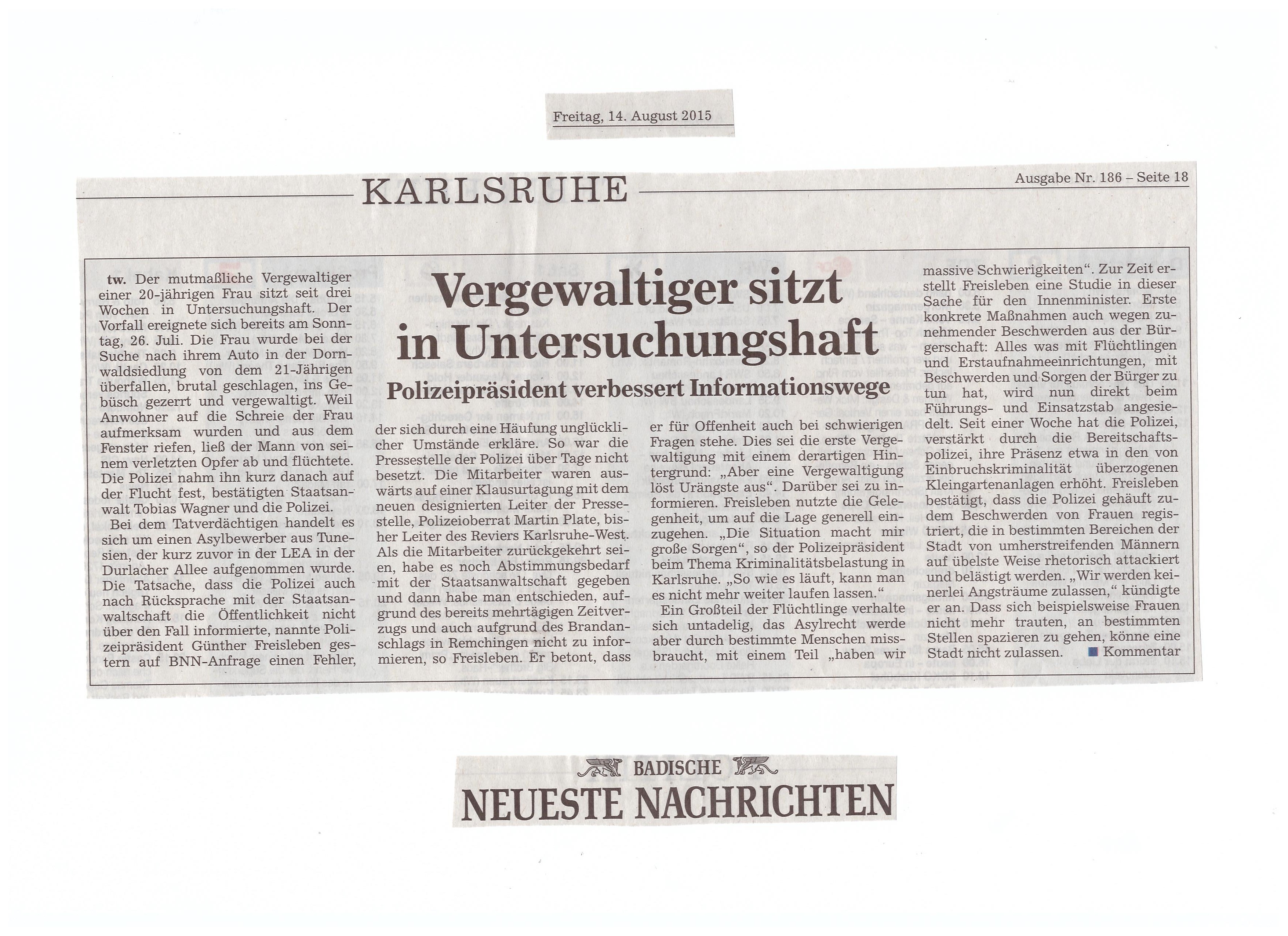
_asylum_seekers_in_the_EU-28_Member_States,_2013_and_2014_YB15_III.png)
Recent Comments