Archive for the ‘Erdogan’ category

Turkey: Good News, Bad News

July 28, 2016

Turkey: Good News, Bad News, Gatestone InstituteBurak Bekdil, July 28, 2016

♦ Turkish prosecutors are investigating people who allege on social media that the coup attempt was in fact a hoax.

♦ In a massive purge, the government sacked more than 60,000 civil servants from the military, judiciary, police, schools and academia, including 1,577 faculty deans who were suspended. More than 10,000 people have been arrested and there are serious allegations of torture.

♦ Witnesses told Amnesty International that captured military officers were raped by police, hundreds of soldiers were beaten, some detainees were denied food and water and access to lawyers for days. Turkish authorities also arrested 62 children and accused them of treason.

♦ The good news is that the coup attempt failed and Turkey is not a third world dictatorship run by an unpredictable military general who loves to crush dissent. The bad news is that Turkey is run by an unpredictable, elected president who loves to crush dissent.

In 1853, John Russell quoted Tsar Nicholas I of Russia as saying that the Ottoman Empire was “a sick man — a very sick man,” in reference to the ailing empire’s fall into a state of decrepitude. Some 163 years after that, the modern Turkish state follows in the Ottoman steps.

Turkey, under President Recep Tayyip Erdogan’s rule, was staggering between a hybrid democracy and bitter authoritarianism. After the failed putsch of July 15, it is being dragged into worse darkness. The silly attempt gives Erdogan what he wanted: a pretext to go after every dissident Turk. A witch-hunt is badly shattering the democratic foundations of the country.

Taking advantage of the putsch attempt, the Turkish government declared a state of emergency that will run for a period of three months, with an option to extend it for another quarter of a year. Erdogan, declaring the state of emergency, promised to “clean out the cancer viruses like metastasis” in the body called Turkey. With the move for a state of emergency, Turkey also suspended the European Convention on Human Rights, citing Article 15 of the Convention, which stipulates:

“In time of war or other public emergencies threatening the life of the nation, any High Contracting Party may take measures derogating from its obligations under this Convention to the extent strictly required by the exigencies of the situation, provided that such measures are not inconsistent with its other obligations under international law.”

Before July 15, civil liberties in Turkey were de facto in the deep freeze. Now they are de jure in the deep freeze.

On July 27, the Turkish military purged 1,684 officers, including 149 generals, on suspicion that they had links with Fethullah Gulen, a U.S.-based Muslim cleric who once was Erdogan’s staunchest political ally but is now his biggest nemesis and the suspected mastermind of the coup attempt. On the same day, the government closed down three news agencies, 16 television stations, 23 radio stations, 45 newspapers, 15 magazines and 29 publishers on the same charges. Two days before those actions, warrants were issued for 42 journalists, as a part of an investigation against members of the “Fethullah [Gulen] terrorist organization.”

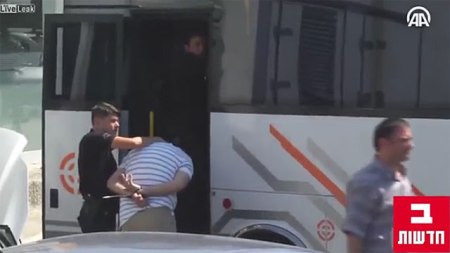
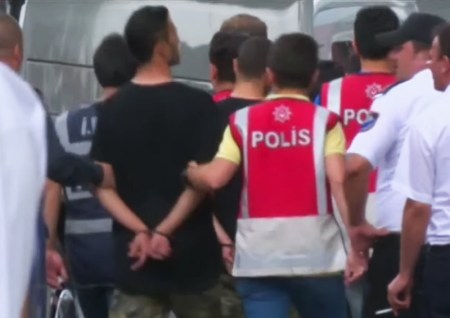
1726Turkish police escort dozens of handcuffed soldiers, who are accused of participating in the failed July 15 coup d’état. (Image source: Reuters video screenshot)

Under the state of emergency, it is dangerous in Turkey even to question whether July 15 was a fake coup orchestrated or tolerated by Erdogan for longer-term political gains. Turkish prosecutors are investigating people who allege on social media that the coup attempt was in fact a hoax. Justice Minister Bekir Bozdag said that: “Anyone who suggests the coup attempt was staged ‘likely had a role’ in the insurrection.” But there is more.

In a massive purge, the government sacked more than 60,000 civil servants from the military, judiciary, police, schools and academia, including 1,577 faculty deans who were suspended. More than 10,000 people have been arrested, and there are serious allegations of torture. Witnesses told Amnesty International that captured military officers were raped by police, hundreds of soldiers were beaten, and some detainees were denied food, water and access to lawyers for days. Turkish authorities also arrested 62 children and accused them of treason. The youngsters, aged 14 to 17, were from Kuleli Military School in Istanbul. The students have reportedly been thrown in jail and are not allowed to speak to their parents.

The witch-hunt is not in the governmental sector only. Several Turkish companies have fired hundreds of personnel suspected of having links with Gulen. Turkish Airlines, Turkey’s national airline, fired 211 employees, including a vice-general manager and a number of cabin crew members.

Sadly, Turks had to choose between two unpleasant options: military dictatorship and elected dictatorship. The good news is that the coup attempt failed and Turkey is not a third-world dictatorship run by an unpredictable military general who loves to crush dissent. The bad news is that Turkey is run by an unpredictable, elected president who loves to crush dissent.

Turkey: Systematic Torture, Rape of Political Prisoners

July 24, 2016

Turkey: Systematic Torture, Rape of Political Prisoners, Clarion Project, William Reed, July 24, 2016

torture

Will the diplomats in Brussels who advocate and push for the membership of Turkey in the EU please speak out in defense of political prisoners raped and tortured in Turkish police stations and jails?

Will the United States, which supports and finances Turkey, also turn a blind eye to these abuses?

**********************

Following the failed July 15th coup d’état in Turkey, the world witnessed how thousands of Turks dealt with their own Turkish soldiers who put down their arms and surrendered. Pro-government Turks beat, tortured and lynched their own soldiers in the streets – before the eyes of the entire world.

But torturing is nothing new in Turkey. It is an old political tradition. Kurdish political prisoners have for decades been exposed to appalling sexual and physical torture in Turkish jails and police stations.

The day before the coup, human rights organizations in Turkey announced in a press conference that many Kurds who have been recently arrested and jailed in the city of Sanliurfa, or Urfa, have been tortured and raped while in detention. [i]

Atilla Yazar, the head of the Urfa branch of the Human Rights Association (IHD), said that they have received complaints of torture from Urfa since 2015. “The detainees are first taken to the anti-terror branch (TEM) of the Urfa police directorate,” said Yazar. “Then they are taken to a cave. They say that they have been tortured heavily. Five of them are women. And they are still in prison now.”

Eren Keskin, the vice-president of the Human Rights Association (IHD), said, “A long time ago, Tayyip Erdogan, who was then prime minister, said that ‘There would be zero tolerance to torture.’ But I think there is boundless tolerance to torture.”

“The stories we heard from the detainees were horrible,” Keskin continued.

“I have been working in the field of torture for the last 20 years. But I did not hear some of those torture methods even in the 1990s, when torture and rapes were very commonplace.

“We see that torture is a state policy and it is systematic. It is not just Turkish soldiers or police officers who are involved, [but also] the prosecutors who do not question them, the doctors who do no not give them medical reports about torture, and the forensic medicine institute all carry this [torture] out together.”

Keskin explained, “Most of the people we talked to were civilian politicians who are members of the legal Democratic Peoples’ Party (DBP).  A detainee called Mazlum Dagtekin said that there is a cave of torture filled with tools of torture in the town of Ceylanpinar. He said that they [the police] torture people under the control and supervision of the prosecutor. First, they blindfold them. Then they put a sack on their heads. And they blindfold them again on those sacks. Stripping detainees naked is one of their primary methods.

“Mazlum also said: ‘They put my head in a well. They raped me. They stripped me naked. They inserted a nightstick in my anus. They made me sit on an armchair. They tied my feet with construction wires. They shackled my hands to the armchair. They hit my stomach and chest cavity with nightsticks and punches. Later they tied my hands with a wire and made me swing into a well. They urinated on me. One of the police officers took out his penis and told me to lick it. While all of these things were done to me, the prosecutor was there.’

“At night, they took Mazlum outside. They tied his feet and put a gun to his head. Then they gave him the gun and told him to kill himself. Mazlum told us that at that moment he wanted to die so much that he pulled the trigger without thinking about it at all, but the gun was empty. To bring a person to a point where he wants nothing else but to die is the worst of all tortures.

“Five women that we spoke to were exposed to heavy sexual torture,” added Keskin. “All of them were frisked bare-naked. They touched their bodies. They applied methods of torture that I cannot verbalize here. The women do not want us to express these things. For women who are exposed to sexual torture express what they have experienced with much difficulty. Due to the certain understanding of honor that is exposed on us, they are ashamed, scared and timid. We understand them. But we will write what they have told us in our report and present it to the United Nations.

“This is what all the detainees were told. ‘We are a special team. We came here from Ankara for you. We will commit all kinds of torture to make you speak.’”

Keskin also said that they were planning to file a complaint to the Turkish medical association about the doctors involved in rights violations. “When prisoners are brought to the hospital by the Turkish police, the doctors stick their heads in the vehicle and ask ‘Is there anybody hurt in here?’ The police say, ‘No,’ Then the doctors sign a report which states that there was nobody hurt in the vehicle. This is a clear violation.

“The doctors turn a blind eye to torture or they are forced to. For example, Inci Korkmaz, one of the victims we spoke to, had felt faint. They suspected that she was having a heart attack and took her to hospital. The doctor first told the police ‘not to take her back like that.’ But when the police insisted, the doctor gave her an injection and [let the police take] her back. This is against the Hippocratic Oath.

“The Urfa anti-terror branch is a place where people are openly exposed to sexual torture. We need to make a call to the states that Turkey has signed international treaties with since Turkey is openly violating these treaties,” Keskin said.

Currently in Turkey, the minister of justice has given an order forbidding political prisoners from talking to their lawyers. In addition to the numerous Kurdish political prisoners being tortured and grossly abused by the Turkish authorities, there are now thousands who have been arrested in the wake of the failed coup.

They now have nobody to speak for them.

Will the diplomats in Brussels who advocate and push for the membership of Turkey in the EU please speak out in defense of political prisoners raped and tortured in Turkish police stations and jails?

Will the United States, which supports and finances Turkey, also turn a blind eye to these abuses?

Obama administration mum as Turkey’s post-coup crackdown expands

July 23, 2016

Obama administration mum as Turkey’s post-coup crackdown expands, Fox News, Christiana Licata, July 23, 2016

Turkey festersVan Hipp: Turkey had been festering, but Obama admin asleep

The Obama administration’s relative silence on Turkey’s alarming crackdown following last week’s failed coup attempt is tantamount to a green light for President Recep Tayyip Erdogan to continue his assault on democracy in the NATO nation, experts said.

Questioned about Erdogan’s ongoing roundup of some 50,000 academics, judges, teachers, soldiers and civil servants, and the declaration Wednesday of a state of emergency, a State Department official earlier this week meekly warned against “overreach.”

“I cannot overstate the sense of the Turkish government and the Turkish people right now that they truly felt and truly feel under threat,” State Department spokesman Mark Toner told an Associated Press reporter at a department briefing. “We support completely the efforts to bring the perpetrators of the coup to justice. We just also caution against any kind of overreach that goes beyond that.”

But when pressed, Toner declined to characterize the arrest, firing or suspension of the tens of thousands of Turkish government workers as “overreach.”

Erdogan’s government, which blames U.S.-based cleric Fethullah Gulen for inciting the coup attempt, in which more than 200 people were killed and members of the military briefly commandeered tanks, aircraft and communications channels, has reacted with a vengeance.

The state of emergency gives Erdogan and his cabinet new powers to implement laws without parliamentary approval. It also allows Ankara to censor media broadcasts, search citizens, impose curfews and restrict gatherings both public and private.

Erdogan has simultaneously demanded the U.S. hand over Gulen, a onetime Erdogan ally who lives in a Pennsylvania mountain compound and runs a profitable chain of Islamic charter schools. Secretary of State John Kerry has said the department is considering the request, but it remains unclear what evidence Erdogan’s administration has provided.

Former U.S. Ambassador to the United Nations John Bolton said the crackdown shows Erdogan is taking advantage of the failed coup to further strengthen his grip on power. The strongman, who has ruled Turkey as either president or prime minister since 2001, has been steadily stripping the long proudly secular nation of its constitutional freedoms and increasingly adopted Islamist rhetoric.

“When he was mayor of Istanbul 20 years ago, he said democracy is like a street car — you ride it to the stop you want and then you get off,” Bolton said of Erdogan. “This will enable him to pursue his objective of Islamisizing the Turkish government and overturning the secular constitution. That’s what’s underway. I don’t think there’s much question about it.”

Bolton said that the Obama administration appears to have done “very little” to pressure Turkey to ease up on its people, either publicly or behind the scenes. That gives Erdogan all the encouragement he needs, Bolton said.

“The situation will continue to deteriorate as Erdogan arrests more people and puts them in jail,” he said.

The European Union has more aggressively sought to rein in the crackdown, with two EU officials warning Thursday that Turkey’s declaration of a state of emergency had led to “unacceptable decisions on the education system, judiciary and the media.”

“We call on Turkish authorities to respect under any circumstances the rule of law, human rights and fundamental freedoms, including the right of all individuals concerned to a fair trial,” EU high representative Federica Mogherini and commissioner Johannes Hahn said in a statement.

Ahmet Yayla, who was chairman of the sociology department at Harran University and a former police chief in Turkey, said many of those being rounded up in Turkey include the Muslim nation’s bulwark against terrorism.  Police, soldiers and judges deemed disloyal to Erdogan have been detained, leaving a diminished human infrastructure to deal with security threats, he said.

“Those are the people who were fighting against terrorism in Turkey,” said Yayla, who fled to the U.S.  eight months ago when ISIS threatened his life for interrogating terrorist defectors.

Yayla said Erdogan’s dangerous dance with ISIS – tacitly supporting the terror group and allowing foreign fighters to pass through Turkey on their way to the terrorist army’s caliphate – could combine with the post-coup unrest to threaten the nation’s stability.

“In the near future, Turkey will face a lot of danger coming from terrorism because the newly appointed officers in the military and police are not going to be able to fight or deal with terrorism threats that exist in the country, especially by Erdogan’s allowing the terrorists inside the country,” he said.


After 10,000 Arrested, it’s Time for the US to End Backing for Islamist Regime

July 23, 2016

After 10,000 Arrested, it’s Time for the US to End Backing for Islamist Regime, Front Page Magazine, Daniel Greenfield, July 22, 2016

Erdogan Hitler

It’s funny how the media was far more outraged by the supposed attempt by the Turkish military to restore the republic than by the Islamist tyrant’s escalating crackdown which has now seen 10,000 arrested. That’s war crime level detentions. If the Turkish military had done this, they would be screaming their heads off. Yet 10,000 arrests by Islamists, just like the Muslim Brotherhood’s torture and abuses in Egypt, get a pass.

And that has to change.

Turkey is swiftly turning into an actual totalitarian regime with no holds barred.

Turkey entered its second day under a state of emergency as President Recep Tayyip Erdogan signaled that the three-month period approved by parliament may not be enough to complete a purge of those responsible for last week’s failed coup.

Erdogan told Reuters that there’s no obstacle to extending emergency rule, which took effect at 1 a.m. on Thursday and was later endorsed by parliament. It allows the government to issue decrees with the force of law, and detain suspects for longer periods without trial.

And then the emergency rule will just be made permanent and Erdogan will declare himself a sultan. All of this is happening with the complicity of the US and the EU. And I don’t just mean the radical left.

Too few, even Republicans, were willing to come out against the Arab Spring or to back the Egyptian military’s restoration of the government. That’s why Trump’s mention of it in his acceptance speech was important. We should have backed the Turkish military to the hilt. And by “us” I don’t mean Obama, who has never met an Islamist Jihadist he didn’t love, but Republicans and conservatives.

Turkey – Roger Out

July 22, 2016

Turkey – Roger Out, Front Page MagazineCaroline Glick, July 22, 2016

turkey roger out

Originally published by the Jerusalem Post

On Wednesday, NATO Secretary-General Jens Stoltenberg insisted that the purge of thousands in the Turkish military – including a third of the serving generals – did not weaken the military.

Stoltenberg told Reuters, “Turkey has a large armed force, professional armed forces and… I am certain they will continue as a committed and strong NATO ally.”

It would be interesting to know whether the 1,500 US soldiers who have been locked down at Incirlik Air Base along with several hundred soldiers from other NATO countries since the failed coup Friday night would agree with him.

Following the failed coup, the Erdogan regime cut off the base’s external electricity supply and temporarily suspended all flights from the base.

The base commander Gen. Bekir Ercan Van and 11 other service members from the base and a police officer were placed under arrest.

Incirlik is the center of NATO air operations against Islamic State in Syria. It also reportedly houses 50 nuclear warheads. The atomic bombs belong to the US. They deployed to Turkey – under US control – as a relic of the Cold War.

It took US President Barack Obama two years of pleading to convince Turkish President Recep Erdogan to allow NATO forces to use the base at Incirlik. It was only after the Kurdish political party secured unprecedented gains in Turkey’s parliamentary elections last year, and Tayyip Erdogan decided to expand his operations against the Kurds of Iraq and Syria to dampen domestic support for the Kurds, that he agreed to allow NATO forces to use the base.

His condition was that the US support his war against the Kurds – the most effective ground force in the war against Islamic State.

Stoltenberg’s statement of support for Turkey is particularly troubling because Erdogan’s post-coup behavior makes it impossible to continue to sweep his hostility under the rug.

For nearly 14 years, since his AK Party first won the national elections in late 2002, Erdogan and his followers have made clear that they are ideologically – and therefore permanently – hostile to the West. And for nearly 14 years, Western leaders have pretended this reality under the rug.

Just weeks after AKP’s first electoral triumph, the Turkish parliament shocked Washington when it voted to reject the US’s request to deploy Iraq invasion forces along the Turkish border with Iraq. Turkey’s refusal to permit US operations from its territory are a big reason the Sunni insurgency in Iraq was able to organize.

It took the US some two months to take over northern Iraq. By that time, the Ba’athists had organized the paramilitary militias that later morphed into al-Qaida in Iraq and then, following the US withdrawal from Iraq in 2011, Islamic State.

Ever since then, Erdogan has paid lip service, and even assisted NATO and the EU from time to time, when it served his momentary interests to do so. But the consistent trend of his behavior has been negative.

Since taking power, Erdogan has galvanized the organs of state propaganda – from the media to the entertainment industry to the book world – to indoctrinate the citizens of Turkey to hate Jews and Americans and to view terrorists supportively.

This induced hatred has been expressed as well in his foreign policy. Erdogan was the first major leader to embrace Hamas after its electoral victory in the 2006 Palestinian Authority elections. He treated Hamas terror chief Ismail Haniyeh like a visiting monarch when he hosted him shortly after those elections.

During Hezbollah’s 2006 war against Israel, Turkey was caught red-handed as it allowed Iran to move weapons systems to Hezbollah through Turkish territory.

Erdogan has turned a blind eye to al-Qaida. And he has permitted ISIS to use Turkey as its logistical base, economic headquarters and recruitment center. Earlier this year the State Department claimed that all of the 25,000 foreign recruits to ISIS have entered Syria through Turkey.

As for Iran, until Obama engineered the lifting of UN sanctions against Iran through his nuclear deal with the ayatollahs, Turkey was Iran’s conduit to the international market. Turkey was Iran’s partner in evading sanctions and so ensuring the economic viability of the regime. According to a series of investigative reports by Turkish and foreign reporters, Erdogan’s family was directly involved in this illicit trade.

Then there is Europe. For ISIS, Turkey has been a two-way street. Fighters have entered Syria through Turkey, and returned to Europe through Turkey. Turkey is behind the massive inflow of Syrian refugees to Europe.

German Chancellor Angela Merkel tried to cut a deal with Erdogan that would stem the flow. Erdogan pocketed her economic concessions and did nothing to stop the hemorrhage of refugees to Europe.

As for the US, the years of anti-American incitement and indoctrination of Turkish society are now coming into full flower in the aftermath of the coup. Even before the dust had settled, Erdogan was pointing an accusatory finger at Washington.

Insisting that the failed coup was the brainchild of exiled Islamic cleric – and erstwhile ally of Erdogan – Fetullah Gulen, who took up residence in Pennsylvania’s Poconos Mountains 16 years ago – Erdogan demanded that the US immediately put Gulen on an airplane with a one-stop ticket to Turkey.

In the days that followed, the Erdogan regime’s accusations against the US became more and more unhinged. Prime Minister Binali Yildirim said that failure to comply with Erdogan’s extradition demand would be viewed as a hostile act by the US.

And Turkish Labor Minister Suleyman Soylu flat out said that “America is behind the coup,” in a media interview.

In other words, after arresting the base commander and other forces at Incirlik, and while effectively holding US-led NATO forces and 50 nuclear warheads prisoner for the past six days, Turkey is accusing the US of engineering the coup attempt.

But apparently, NATO has decided to try to again sweep reality under the rug, once more. Hence, Stoltenberg’s soothing insistence that there is no cause for worry. Turkey remains a trusted member of the alliance.

This isn’t merely irresponsible. It is dangerous, for several reasons.

First of all, Stoltenberg’s claim that the Turkish military is as strong as ever is simply ridiculous.

A third of the serving generals are behind bars along with thousands of commanders and soldiers, educators, police officers, jurists and judges.

Who exactly can be willing to take the initiative in this climate? Amid at best mixed messages from the regime regarding the war against ISIS, and with the generals who coordinated the campaign with NATO now behind bars, who will maintain the alliance with NATO ? No one will.

The implications of this passivity will be felt on the ground in Turkey as well as in Syria and Iraq.

Thanks to Erdogan’s passive support, ISIS has operatives seeded throughout Turkey. Who can guarantee that they will leave the nuclear weapons at Incirlik alone? Is the US really planning to leave those bombs in Turkey when its own forces are effective prisoners of the regime? And what are the implications of removing them? How can such a necessary move be made at the same time that NATO pretends that all is well with Turkey? Then there is the problem of chemical weapons.

In recent months, ISIS has used chemical weapons in Syria and Iraq. In February, James Clapper, the director of US national intelligence, warned that ISIS is developing a chemical arsenal and intends to use chemical weapons against the US and Europe.

In May it was reported that ISIS is conducting experiments with chemical weapons on dogs and prisoners in labs located in residential neighborhoods in Mosul.

Turkey is a NATO member with open borders to Europe, and the only thing that has prevented ISIS terrorists from bringing chemical weapons to Europe has been the Turkish military and police force. They are now being purged.

Moreover, as Soner Cagaptay reported in The Wall Street Journal this week, Erdogan used out and out jihadists to put down the coup on Friday night and Saturday. He has continued to embrace them in the days that have passed since then.

In so doing, Erdogan signaled that he may well use the post-coup state of emergency to dismantle what is left of Turkey’s secular state apparatus and transform the NATO member into an Islamist state, along the lines of the short-lived Muslim Brotherhood regime in Egypt, which Erdogan enthusiastically supported.

In this climate, it is difficult, if not as a practical matter impossible, to imagine that the military and police will work particularly hard to prevent ISIS terrorists from transporting weapons of mass destruction from Syria to Europe through Turkey.

The Obama administration is partly responsible for the current crisis. Secretary of State John Kerry just agreed to subordinate the US-led anti-ISIS campaign to Russia. In so doing, he made clear that the US will not protect Turkey from Russia. This gives Erdogan little choice other than to strike out a new, far more radical course.

To Erdogan’s own Islamist convictions and US incompetence must be added a third reason to assume the situation in Turkey will only get worse.

As David Goldman has reported in the Asia Times, Turkey is on the brink of economic collapse. Its currency has been devalued by 7 percent just since the failed coup. “With about $300 billion in foreign currency liabilities, Turkish corporations’ debt service costs rise as the currency falls. Stocks have lost more than half their value in dollar terms since 2013,” Goldman warned.

In the current climate, it is hard to imagine Erdogan instituting austerity measures to pay down the debt. So he needs a scapegoat for his failure. The chosen scapegoat is clearly the US.

To make a long story short then, the Turkish military is no longer capable of cooperating in any meaningful way with the US or NATO . Erdogan, never a reliable ally, is now openly hostile.

He is in the midst of committing aggression against NATO forces at Incirlik. And he is embracing Turkish jihadists who are ideologically indistinguishable from ISIS.

The US surrender to Russia means that America cannot protect Turkey from Russia. And Erdogan has chosen to blame American for Turkey’s fast approaching economic doomsday.

Under the circumstances, if NATO takes its job of protecting the free world seriously, it has no choice but to quit with the business as usual routine and kick Turkey out of the alliance, withdraw its personnel and either remove or disable the nuclear weapons it fields in the country.

As for anti-ISIS operations, the US will have to move its bases to Iraqi Kurdistan and embrace the Kurds as the strategic allies they have clearly become.

In the aftermath of the failed coup, Turkey is a time bomb. It cannot be defused. It will go off. The only way to protect the free world from the aftershocks is by closing the border and battening down the hatches.
Did Erdogan Stage the Coup?

July 20, 2016

Did Erdogan Stage the Coup?, Clarion Project, Meira Svirsky and William Reed, July 20, 2016

turkey coup busA leader of the ‘coup’ is arrested by Erdogan’s intelligence agency. (Photo: Video screenshot)

The European Union commissioner in charge of Turkey’s bid, Johannes Hahn, to join the EU echoed these sentiments, saying, “It looks at least as if something has been prepared. The lists are available, which indicates it was prepared and to be used at a certain stage,” Hahn said. “I’m very concerned. It is exactly what we feared.”

[M]ost Syrian asylum seekers in Turkey of which there are 2.7 million, are sympathizers of ISIS. “As opposed to what is thought,” Gezici said, “60 percent of the Syrian asylum seekers in Turkey have come to Turkey fleeing Syrian head of state Bashar al-Assad. And a large majority of this group sees ISIS as a savior; they have sympathy for it.”

*********************

In the aftermath of the attempted coup in Turkey Friday night, thousands of teachers as well as police, military personnel, judges, governors and more have been dismissed.  The list includes:

  • 21,000 private teachers have licenses removed
  • 15,000 suspended from education ministry
  • 8,000 police officers detained or suspended
  • 6,000 soldiers detained
  • 1,500 staff at Ministry of Finance dismissed
  • 2,745 judges dismissed
  • 1,577 deans – Education board demands resignation
  • 492 sacked from Religious Affairs Directorate
  • 399 from Ministry of Family and Social Policies stripped of responsibilities
  • 257 fired from the prime minister’s office
  • 100 intelligence officials sacked
  • 47 district governors dismissed
  • 30 provincial governors dismissed
  • 20 news websites blocked

In addition, public sector employees have reportedly been forbidden from leaving the country.

The alacrity with which the above thousands  were either arrested or purged from their position, has led many to assume that Turkish President Recip Tayyip Erdogan had prepared the lists before the coup.

The European Union commissioner in charge of Turkey’s bid, Johannes Hahn, to join the EU echoed these sentiments, saying, “It looks at least as if something has been prepared. The lists are available, which indicates it was prepared and to be used at a certain stage,” Hahn said. “I’m very concerned. It is exactly what we feared.”

Moreover, many dubious circumstances surrounding the coup have led others to question whether the coup was, in fact staged, to allow Erdogan to execute these purges and declare a state of emergency where authoritarian rule will be imposed on the country.

These circumstances include the fact that the coup’s plotters:

Failed to seize power

  • Neither Erdogan nor any members of the cabinet or high-ranking officials of Erdogan’s Islamist AK party were detained or killed.
  • Sent commandos to the hotel where Erdogan was staying after he had already left.
  • Erdogan’s $600 million presidential palace was not attacked or occupied.
  • Erdogan’s plane was not intercepted or shot down as he flew back to Istanbul, despite the fact that top generals in the Air Force were involved in the plot.
  • Coup plotters occupied Ataturk International Airport but left before Erdogan’s plane landed.
  • Attacked the parliament building, which was all but empty at the time.

Failed to seize control of media

  • After initially taking control of the state’s TRT station and CNN Turk, the plotters immediately relinquished control of these news outlets back to the government, which allowed Erdogan to leverage appeal to his followers to take to the streets in support of the government.

Whether the coup was staged or Erdogan received a tip-off about it, as other have suggested, he was able to bring the Islamist “street” out in force to support him. The fact that the Turkish public seems to be becoming increasingly radicalized is borne out by a recent poll taken in Turkey in May of this year.

According to a May poll of the Gezici Research Company, close to 1 in 5 people in Turkey (19.7 percent) support the Islamic State and over 23 percent have sympathy for it.

The poll, which was conducted face-to-face with 2,455 Turkish citizens in 24 cities,  also indicates that Turkish support for ISIS has increased 100 % in the last 2 years.

The owner of the research company that conducted the poll, Murat Gezici, explained the surprising results. “95 percent of Turkey’s population is Muslim. And a large majority of them are pious and conservative,” Gezici said.

“At the Sultanahmet Square in Istanbul, a German tourist group was targeted. In Suruc, leftists were targeted. The attack at the Istanbul Ataturk Airport took place at its international terminal,” he added. “The conservatives in Turkey see that Muslims are not targeted in the attacks that are told by official sources to have been carried out by ISIS.”

Gezici also said that most Syrian asylum seekers in Turkey of which there are 2.7 million, are sympathizers of ISIS. “As opposed to what is thought,” Gezici said, “60 percent of the Syrian asylum seekers in Turkey have come to Turkey fleeing Syrian head of state Bashar al-Assad. And a large majority of this group sees ISIS as a savior; they have sympathy for it.”

In 2015, the Gezici Research Company was raided by government inspectors after releasing an opinion poll and its pollsters were detained after releasing results of an opinion poll showing that Turkey’s ruling party would losing votes in an upcoming election.

“Police told our surveyors that they were not authorized for the field study. In reality, we have had all licenses for political, economic and market studies since 2011,” said Gezici at the time.

Meanwhile, jihadi propaganda is becoming more and more common in the Turkish Islamist media. In just one example, Misvak, an Islamist “humor” magazine known to be close to the ruling AKP (Justice and Development Party), recently published a cartoon praising the Islamic State.

These current statistics as well as recent events challenge the myth that Turkey is a secular, democratic state worthy of Western support, NATO membership and an appropriate candidate for EU membership.

In truth, the history of Turkey is not foreign to Islamic State-like atrocities  and has witnessed tremendous persecution of religious minorities – including the Yazidis, Christians, Alevis, Jews and others.

From the 1915 Armenian genocide, to the 1937 Dersim Alevi massacres, the 1955 anti-Greek pogroms in Istanbul, the 1978 massacre of Alevis in Maras and the 1980 massacre of Alevis in Corum, among others, many Turkish governments and a considerable part of the Turkish society have carried out brutal crimes against their minority citizens.

Religious violence is largely endemic to political Islam. Doubtlessly, the Islamic State is a huge threat to human rights and liberties worldwide, but Islamist crimes should not be restricted to this terror group only.

Analyzing the history of Islamist crimes against non-Muslims – both in Turkey and the rest of the Muslim world – as well as the Islamic doctrine of jihad would give us a better insight into why many Muslims can so easily feel sympathy for a horrific group like ISIS and why many pious Muslims can even see ISIS as a source of humor.

Winner Takes All: Erdogan Overcomes Coup Attempt

July 17, 2016

Winner Takes All: Erdogan Overcomes Coup Attempt, Clarion Project, July 16, 2016

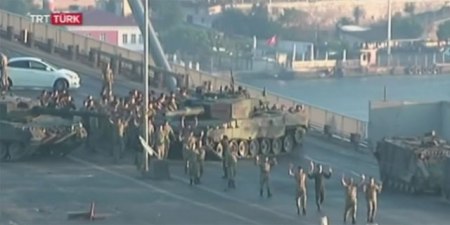
Turkish coup soldiersTurkish soldiers who had attempted a coup surrender on Bosphorus bridge (Photo: Video screenshot)

With U.S. President Obama and NATO leaders praising Erdogan and needing to maintain Turkey’s alliance in the region, the statements made by the leaders of the coup served as futile attempts to bring actual democracies to their side.

Most likely, [Edrogan] will introduce “emergency” measures to prevent any further attempts, which in reality will give his party uninterrupted reign for years to come.

************************

Turkey has just witnessed one of the fastest and strangest attempted coup d’etats in history. And it has failed.

Nearly 3,000 soldiers, including two high-level generals, have been arrested and 2,700 judges fired, as the government begins to clamp down on those it suspects of having links to the attempted coup, which officials say left 265 people dead (161 civilians and 104 accused of plotting the coup).

Of all the details that we may never know about what actually happened last Friday night, only one thing is certain: Turkish President Recep Tayyip Erdogan  — Turkey’s top leader and head of the ruling Islamist AK Party, a known extremist, suppressor of free speech and human rights, and grand supporter of the Muslim Brotherhood and Hamas — has emerged as the ultimate winner.

The attempted coup began Friday night when factions of the military set up blockades of bridges in Istanbul and began a takeover of the Parliament building in Ankara as well as the government’s main news station.

The military faction behind the coup stated that “the Turkish people want their democracy back.” Opposition groups throughout Turkey have consistently been critical of Erdogan’s increasingly authoritarian government which has stripped the country of many democratic and secular freedoms, including free speech, free press and religious tolerance.

Those behind the coup cited increasing human rights violations by Erdogan and his ruling AK Party as justification for the attempted takeover and pledged that “all existing foreign relations will continue.”

Initial reports about the coup showed a peaceful military transition and takeover with few casualties.  Understanding the sitting government’s influence over media in the country, coup leaders took control of the state-run news station to ensure the truth about the takeover was reported rather than government propaganda.

Speaking to RT, Sreeram Chaullia from the Jindal School of International Affairs, also cited the deteriorating security situation as an impetus for the coup. “A series of terrorist attacks signal the inability of the Turkish government to stop these attacks. It has angered some sections of the security establishment that believe that they can do a better job because Erdogan is just playing politics with everything,” he said.

Chaullia sited Erdogan’s mishandling of the war in Syria and Iraq and its impact on Turkey as well as his vicious on-going attacks on the Kurds. In addition, Erdogan has managed to antagonize both Russia and Iran.

Shocking reports have also surfaced proving Erdogan’s support of the Islamic State.

Erdogan made two crucial moves in the first hours of the coup: First, he cut off civilian access to all social media sites, and second, even before rescuing his officials in the parliament building, he immediately sent an F-16 to take out the coup forces at his government news station.

After Erdogan regained control of the media, the news quickly shifted to the story that “the people love their leaders and Erdogan,” “they reject the coup” and the coup was perpetrated by “a small terrorist cell within the military that will be crushed.”

Of course, we will never know the true story of what occurred in Turkey on July 15, 2016. The coup was doomed to failure, however, even if it had a large support of the people whose voices have been stifled in Turkey under Erdogan’s regime. With U.S. President Obama and NATO leaders praising Erdogan and needing to maintain Turkey’s alliance in the region, the statements made by the leaders of the coup served as futile attempts to bring actual democracies to their side.

It is no surprise that those who may have cheered at a successful takeover now claim to have be in support of the government, as it is clear that any dissident voices in Turkey will be violently silenced.

Although Turkish cleric and Erdogan-rival Fethullah Gulen is being blamed for the coup, he claims to have had no part in it.  He also says that the coup could have been a government “show” to further a political strong-arm of the U.S.

Gulen’s movement, Hizmet, began creating a parallel state inside Turkey in the 1970s through a network of schools, media outlets and businesses and recruitment of supporters in the security services and government.  His movement is widely credited with paving the way for the Islamist Justice and Development Party to take power electorally in 2002. However, Gulen and the AK Party had a falling out afterwards.

Gulen fled to the U.S. in 1999 when the Turkish government planned to prosecute him for allegedly trying to undermine the secular nature of the state. The Islamist government of Turkey acquitted him of those charges in 2008.

Erdogan has used the “Gulen excuse” in the past to purge the military and justice system of his supporters who were many.

Whoever was behind the coup, Erdogan will benefit enormously from this attempt takeover while a small number of his military will pay for it. In fact, it serves Erdogan very well. He gets rid of rebels within, consolidates his power and eliminates any and all opposition in the parliament.

The attempted coup will give Erdogan all the power he has been trying to wrench for himself over the past number of years. He can now complete his purge of the army, police and justice system and replace all those he doesn’t trust with loyalists.

Most likely, he will introduce “emergency” measures to prevent any further attempts, which in reality will give his party uninterrupted reign for years to come.

Erdogan will be more in control than ever. Who, after all, will oppose him after he demonstrated his strength (helped by his Islamist backers who took to the streets to lynch opposition soldiers)?

One could say he is now invincible.

Desperate people do desperate things.  For a country whose jails are filled with citizens who disagree with their president’s leadership, one must wonder if a military coup – however feeble — was the only thing they could do to show the world they are not OK with oppressive, Islamist rule.

Turkey: Coup Has Failed, Erdogan More Powerful Than Ever

July 16, 2016

Turkey: Coup Has Failed, Erdogan More Powerful Than Ever, PJ MediaMichael Van Der Galien, July 16, 2016

(But please see also, Analyzing Turkey and the threat of lone wolf attacks. — DM)

Turkey coupTurkish soldiers secure the area as supporters of Turkey’s President Recep Tayyip Erdogan protest in Istanbul’s Taksim square, early Saturday, July 16, 2016. (AP Photo/Emrah Gurel)

Izmir, Turkey — It’s a done deal: the military coup has failed. President Recep Tayyip Erdogan and his AK Parti remain in power and vow to take revenge against those behind the coup.

Or, perhaps better said: against those they say are behind it.

Now that the coup has clearly failed, we can conclude that this must have been the most incompetent attempted takeover in Turkey’s troubled history. When part of the military launched their offensive last night (Turkish time), I immediately checked news channels supporting President Erdogan. Surprisingly, none of them was taken over. The only broadcaster who was taken over was TRT Haber, the state news channel. But NTV and other channels supporting Erdogan were left alone.

That was remarkable, but what struck me even more was the fact that these channels — especially NTV — were able to talk to the president and the prime minister. That’s strange, to put it mildly. Normally, when the military stages a coup, the civilian rulers are among the first to be arrested. After all, as long as the country’s civilian leadership are free, they can tell forces supportive of them what to do… and they can even tell the people to rise up against the coup.

And that’s exactly what happened. Both Prime Minister Binali Yildirim and President Recep Tayyip Erdogan called into news programs and told their supporters to go out on the streets and fight back against the soldiers. A short while later, streets in the big cities (Ankara and Izmir) were flooded with Erdogan-supporters, who even climbed on top of tanks. Fast forward a few hours and it was officially announced that the coup had failed, and that Erdogan and his AK Party remained in power. About 1500 soldiers were arrested.

As I wrote on Twitter yesterday, there were three options:

  1. The coup was staged by a small group within the military, which would severely limit their ability to strike.
  2. The coup was staged by the entire military, which meant Erdogan’s chances of surviving politically were extremely small.
  3. The coup was a set-up. Think the Reichstag fire.

The main argument against option number three is that there was some very serious fighting taking place, including massive explosions. Dozens of people have been killed. If this was a fake coup, it probably was the bloodiest one ever. That’s why many people are skeptical about this option, and believe it was just an incompetent attempt at a military takeover.

The general feeling in Izmir — a city with 3 million inhabitants who are generally not pro-Erdogan at all — is that it was a real coup attempt, but that the officers behind it were incredibly amateurish. Friends on the streets and cafés are literally telling me:

It was a real attempt, but they were stupid.

Shortly after the attempted coup, Erdogan and Yildirim immediately blamed a disgraced Islamic scholar, Fethullah Gulen, who now lives in Pennsylvania. Gulen and Erdogan were longtime allies, who shared a dream of Islamizing Turkey, but had a falling out several years ago. Ever since, Erdogan has blamed Gulen for pretty much every problem in Turkey, including a major controversy about cabinet members (including Erdogan, and his family) possibly stealing millions of dollars. In the years after, Gulen became Erdogan’s enemy number one, which is undoubtedly why he’s blamed for yesterday’s coup.

Proof that Gulen is indeed behind it hasn’t been presented, however. In fact, the Gulen group denies any involvement. You could imagine that, if they did support it, they’d call on their followers to support the takeover. They did no such thing.

The same goes for the leaders of Turkey’s official opposition parties. The secular CHP and the nationalist MHP aligned with the AKP to condemn the coup. Some in the West have expressed shock at that: if they’re opposed to Erdogan, why didn’t they support the coup? The answer is, of course, that Turkey has had two military takeovers in the recent past (1960s and 1980s): both were very bloody and absolutely horrendous, not just for the ousted governments, but also for the average Turk. People weren’t allowed to leave their homes, not even to buy food and drinks, and many innocent civilians were rounded up by the military. Once in prison, many of them either died or were severely tortured.

It’s not very strange that even the country’s opposition parties don’t wish a repeat of that. No person in his right mind would.

When the coup was still going on, one Twitter user tweeted this:

This coup attempt, whether it succeeded or failed, ensured Turkey would be more autocratic moving forward.

I’m afraid that Yousef was, and is, right. If the military would’ve succeeded, Turkey would now have been a military dictatorship. Regardless of where you stand on Erdogan, that would’ve meant major changes for the Turkish people. A lockdown would’ve been put in place, people would’ve been imprisoned in their own homes. In fact, I went out at 2 a.m. to a local market to buy as much food, milk, eggs, and so on as I could. I did this because, in past coups, people had to stay indoors for many days. Some people, who couldn’t take care of themselves, actually died from hunger, or so I’ve been told by Turks. After that first phase, the military always rounded up all those they thought were loyal to the former government. Mass imprisonments, torture and killings were everyday events.

In other words, even if you oppose Erdogan, it’s difficult if not impossible to celebrate a military coup.

Of course we now have to see what Erdogan’s government will do. More than 100 soldiers involved in the coup have been killed, military commanders were taken hostage, and Erdogan has vowed revenge. As anyone with even a bit of knowledge of history knows, the crackdowns after a failed coup can be as bad as the crackdown after a successful military takeover. Erdogan already wanted to change Turkey’s constitution and change the system into a so-called presidential system, meaning most if not all power would reside in his office. Nobody doubts that this is exactly what’ll happen now: he’ll draw all power to himself and ignite a major cleansing, possibly not only of the military and police forces, but also in politics itself.

The only possibly conclusion, then, is: no matter what, democracy will suffer a major setback in Turkey. We can only hope and pray that the consequences will be less severe than I fear.

Anger, Honor and Freedom: What European Muslims’ Attack On Speech Is Really About

June 30, 2016

Anger, Honor and Freedom: What European Muslims’ Attack On Speech Is Really About, Investigative Project on Terrorism, Abigail R. Esman, June 30, 2016

1052

Indeed, much of the Muslim violence in Europe is about exactly this: intimidating non-Muslims into a fearful capitulation, where words like “I hate Muslims” and drawings of Mohammed become extinct because the Muslim communities insist that it be so. It is about forcing Westerners to rearrange their lives, their culture, to accommodate the needs and values and culture of Islam. It is about control, and the power over freedom. And it is about creating a culture in which honor is injured by words and restored through violence and terror.

**********************

“Clash of civilizations,” some say. Others call it the “failure of multiculturalism.” Either way, the cultural conflicts between some Muslims and non-Muslims worldwide continue to play out as Western countries struggle to reconcile their own cultures with the demands of a growing Muslim population.

But herein lies the problem: in many ways, the two cultures are ultimately irreconcilable. There is no middle ground. And hence, the conflicts and the tugs-of-war continue.

Over the past two months, the events surrounding controversial Dutch columnist Ebru Umar have encapsulated that “clash” at its core, a salient metaphor for the tensions, particularly in Europe, between the West’s Muslim populations and its own. More, they illuminate the enormity of the problems we still face.

Umar is no stranger to the spotlight, or to the wrath of Dutch Muslims who read her many columns, most of them published in the free newspaper, Metro. For years, the Dutch-born daughter of secular Turkish immigrants has raged against the failure of other Dutch-born children of immigrants, mostly Moroccan, to assimilate into the culture of their birth. She loudly condemns Dutch-Moroccan families for the shockingly high rates of criminality and violence among Dutch-Moroccan boys – as much as 22 times the rate of Dutch native youth – a phenomenon she ascribes to their Islamic upbringing and their parents’ refusal to allow their children to mingle among the Dutch.

But her critiques have earned her no converts. Instead, Dutch-Moroccan youth, whom she calls “Mocros,” have regularly taunted her, both online and in the street.

This past April, however, Umar added a new team of enemies to her portfolio: when, in response to Turkish president Recep Tayyip Erodogan’s demand that a German satirist be prosecuted for insulting him on TV, Umar tweeted “f***erdogan,” Dutch Turks turned on her in fury. “How dare you insult our president!” cried these Dutch-born subjects of Holland’s King Willem-Alexander. And while Umar took a brief holiday on the Turkish coast, one such Dutch-Turk turned her in to the police. She was arrested at her vacation home in Kusadasi, and though released the following day, was forbidden to leave the country. The charge: Insulting the Turkish president. It took 17 days before discussions between Holland’s prime minister and Turkish authorities enabled her to return to the Netherlands.

But she could not return home. In her absence, Umar’s home had been burgled and vandalized, the word “whore” scrawled on a stairway wall. Death threats followed her both in Turkey and on her return. When it became clear she could not ever return to the apartment she had lived in for nearly 20 years, she announced on Twitter (Ebru Umar posts constantly on Twitter) that she would be moving out.

Meantime, in Metro and elsewhere, she continued her criticism of Moroccans and, as she herself notes, of Islam overall.

And so it was that on the day Ebru Umar moved out of her apartment in Amsterdam, a group of Dutch-Moroccans in their twenties came to see her off, taunting her with chants: Ebru has to mo-o-ve, nyah nyah.” Though furious, she ignored them – until one of them began to film her loading her belongings into her car. For Umar, being taunted by the very people whose threats had forced her from her home in the first place was bad enough: but this violation of what little privacy remained for her was more than she could take. She grabbed her iPhone and began filming them right back. “Go ahead,” she challenged. “Say it for the camera.”

Scuffles ensued, and soon one of the Moroccans had her iPhone in his hand. The others laughed. Then they ran away. Umar filed a police report and, still smarting, took to Twitter once again: “C**t Moroccans, I hate you,” she posted. “I hate you, I hate you, I hate you, I hate you and I hate your Muslim brothers and sisters, too. F**k you all.” (It is important to note that, however offensive, the expression “c**t Moroccans” is a common epithet in the Netherlands.)

But, hey – she was angry. Her phone had been snatched from her hand in a brutal, aggressive gesture that left her feeling violated and, vulnerable. She had just been forced to leave her home. She had endured prison, a criminal inquiry, and death threats, all at the hands of the same group on whom she now spewed her fury.

Her words may have been harsh or inappropriate, but they were words. She had not struck her tormenters as they filmed her. She did not call for their demise, or strap a bomb around her waist and visit the local mosques.

She took to Twitter and said: I hate you.

“But hate,” she tells me later in an e-mail, “is just an emotion.” And in a column penned more than two years ago, she observed, “Hate me till you’re purple, but keep your claws off me.”

Here is where Ebru Umar’s story becomes the story of the Western world. In response to her words (“I hate you. F*** you”), several Muslims – Moroccans and others – filed charges against her for hate speech. (Though ironically, “I hate you” does not legally qualify as “hate speech.”) Such words are an attack upon their honor, a humiliation: and if there is one thing experts on Arab and Muslim culture will agree on, it is the significance of humiliation and honor in governing their lives. For this, Dutch Moroccan youth threaten Umar on the streets, and have done so, she says, for years: after all, she insults them.

1664

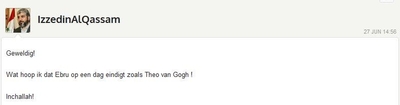
But in truth, it isn’t just the youth. The broader Muslim community stands by, silent: they do not condemn the youth who taunt her, who rip her telephone from her hands, or post things on the Internet like “We hate you, too – can you please kill yourself?” or “Oh, how I hope she ends up like Theo van Gogh.”

Theo van Gogh, also a controversial columnist, was shot and stabbed to death in 2014 by a radical Dutch-Moroccan Muslim.The commenter wishing her the same fate used the name “IzzedinAlQassam,” the founder of modern Palestinian jihad, and an icon of Hamas leader Khaled Meshaal.

For people like this, it doesn’t matter that Umar – or van Gogh – inflicted no violence, any more than it mattered that the editors of Charlie Hebdo were not violent. It was the insult, the humiliation – to them, to Islam, to Mohammed – that mattered: and an insult, a humiliation, deserves a violent response.

Indeed, much of the Muslim violence in Europe is about exactly this: intimidating non-Muslims into a fearful capitulation, where words like “I hate Muslims” and drawings of Mohammed become extinct because the Muslim communities insist that it be so. It is about forcing Westerners to rearrange their lives, their culture, to accommodate the needs and values and culture of Islam. It is about control, and the power over freedom. And it is about creating a culture in which honor is injured by words and restored through violence and terror.

When Umar says “I hate you,” what she hates, really, isn’t the Moroccans who attacked her or their “Muslim brothers and sisters.” What she hates is this – this effort, this battle over honor and speech and freedom, and this clash between violence and expression, guns and conversation.

“I don’t want Muslims to leave,” she tells me, again by e-mail. “I want them to embrace the Enlightenment, Western society, the Netherlands.” And in turn, she calls on the Dutch to “set rules: no violence in any sense. And stop using culture or religion as an excuse for behavior.”

Ebru Umar’s words. More of us should listen.

Israeli-Turkish accord: core of new lineup vs Iran

June 28, 2016

Israeli-Turkish accord: core of new lineup vs Iran, DEBKAfile, June 27, 2016

(Please see also, Israel and Turkey restore relations – peace in our time? — DM)

Turkey_Israel480

The reconciliation agreement announced Monday, June 27 for restoring full normalization between Israel and Turkey after six years of animosity will restart intelligence and security cooperation between the two countries and entail joint military exercises, and investments in energy and defense.

DEBKAfile’s security experts evaluate the deal as offering a valuable and timely increment for Israeli’s national interests on eight scores:

1. It fits neatly into the current joint Saudi-Egyptian bid for Israel to bolster their emerging alliance with Turkey that is designed for drawing a Sunni line against Iran’s expansionist moves in the Horn of Africa, the Red Sea, the Straits of Aqaba and in uncomfortable proximity to the Mediterranean shores of Israel and Egypt.

2. It is designed as the forerunner of a series of interlocking deals. DEBKAfile can disclose that the next bilateral accord expected to be concluded is a reconciliation agreement between Turkey and Egypt for Presidents Recep Tayyip Erdogan and Abdel-Fatteh El-Sisi to bury the hatchet. In at least one respect, this ont will be modeled on the Turkish deal with Israel: Turkey is committed not to let Hamas act against Israel from its soil and, by the same token, not to permit Hamas’s parent and El-Sisi’s archenemy, the Muslim Brotherhood, operate from Turkey.

3. In this regard, Egypt and Turkey will maintain intelligence cooperation.

4. The bilateral intelligence mechanisms to be set up between Turkey and Israel and Turkey and Egypt will pool their input on Iran.

5.  This key aspect of the renewed cooperation between Ankara and Jerusalem lends it a military-intelligence dimension rather than that of a diplomatic protocol. This dimension finds expression in the decision to devolve its implementation not on the holders of political office but the heads of the military-intelligence services of the two countries.

IDF Chief of Staff Lt. Gen. Gady Eisenkot, to whom the head of military intelligence defers, will in fact be in charge of these exchanges, as well as the joint military exercises which are in the active planning stage.

Realizing he had been passed over for this important facet of cooperation with Turkey, Israel’s new defense minister Avigdor Lieberman announced he was opposed to the deal. This was treated as no more than a token protest that will not impede it.

6.  Jordan has been slated as another member of the new alliance. King Abdullah is currently in the process of quietly dismantling the Muslim Brotherhood networks in his kingdom. Many of is members belong to the Palestinian Hamas.

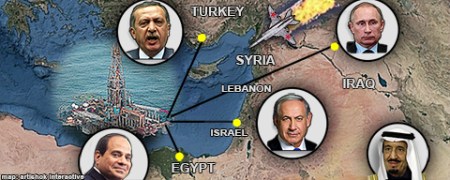
7.  Under the agreement, Israel and Turkey will begin formal talks to build a gas pipeline between the two countries, through which Israel might sell its natural gas, with Turkish assistance, to Europe.

DEBKAfile rates this provision as fundamental to the entire process and of cardinal importance to both their interests. Israel is in need of a major client to boost the development of its offshore gas fields, whereas Turkey wants to be that client and, at the same time, Russia is after a piece of the energy bonanza and most of all a contract to build the pipeline to Europe.

Up until recently, Israel put up a keep out sign for Moscow, mainly under pressure from Washington. But in recent months the conversations between Binyamin Netanyahu and Vladimir Putin have progressed into an inclusive strategic dialogue on Middle East issues, especially on Syria. This opened the door to a Russian role being broached in the export of Israeli gas.

8. This role took another step forward Monday. On the table now is Israeli-Turkish-Russian military and intelligence collaboration for securing the Israeli offshore gas in the Mediterranean – a prospect that brought the Turkish president to finally apologize for his air force downing a Russian Su-24M bomber over the Syrian-Turkish border on Nov. 24, 2015.

For the sake of these promising relations, Turkey was ready to offer compensation in the case of the dead pilot, just as Israel agreed to pay compensation for the nine Turks killed in a clash with Israeli troops during an illicit attempt too breach Israel’s blockade of the Gaza Strip.

Israeli-Turkish-Russian cooperation and goodwill for their mutual benefit on the gas issue may also generate joint efforts in other spheres too.