Archive for the ‘Egypt’ category

Islamic State ‘province’ bombs hotel in the Sinai

November 24, 2015

Islamic State ‘province’ bombs hotel in the Sinai, Long War Journal, November 24, 2015

Earlier today, the Islamic State’s so-called Sinai “province” attacked a hotel where a number of judges were staying as they oversaw elections. According to initial casualty reports, four people were killed.

Two “martyrdom” operatives were responsible for the assault. One of the two drove a vehicle laden with explosives into the security forces protecting the hotel. The second, armed with an assault weapon and a suicide belt, then followed.

15-11-24-Sinai-province-claims-bombing-at-hote-housing-judges-300x250The Islamic State’s Sinai “province,” which officially joined the “caliphate” in November 2014, quickly posted a statement on social media claiming responsibility. The message, seen on the right, is formatted in the same fashion as most other claims of responsibility issued by the Islamic State’s “provinces,” with white text, a blue body, and a red header. A watermark in the upper right hand corner makes it clear that the statement is on behalf of Abu Bakr al Baghdadi’s global organization.

The statement was translated by the SITE Intelligence Group.

Interestingly, the group attempts to justify the attack using the same rationale as pro-al Qaeda jihadist groups in Egypt. “This operation comes as a response to the arrest by the apostate Egyptian army of the Muslim women and the insulting of them at the checkpoints of the apostate army,” the claim of responsibility reads, according to SITE’s translation.

This is essentially the same rationale offered by Ajnad Misr (“Soldiers of Egypt”) for some of its terrorist attacks in Cairo and elsewhere. In November 2014, for instance, Ajnad Misr said that it bombed policemen near a university in Cairo after supposedly witnessing female students being harassed and dragged off by security forces.

Ajnad Misr was once part of Ansar Bayt al Maqdis (ABM), which evolved into the Islamic State’s Sinai “province.” But Ajnad Misr did not go along with ABM’s defection to Abu Bakr al Baghdadi’s camp and refused to swear allegiance to the Islamic State. Ajnad Misr has claimed only a few operations inside Egypt this year.

The Islamic State’s Sinai “province” remains a prolific jihadist force. And its operations further illustrate that there is no firm dividing line between the jihadists’ insurgencies and their ability to carry out high-profile terrorist attacks.

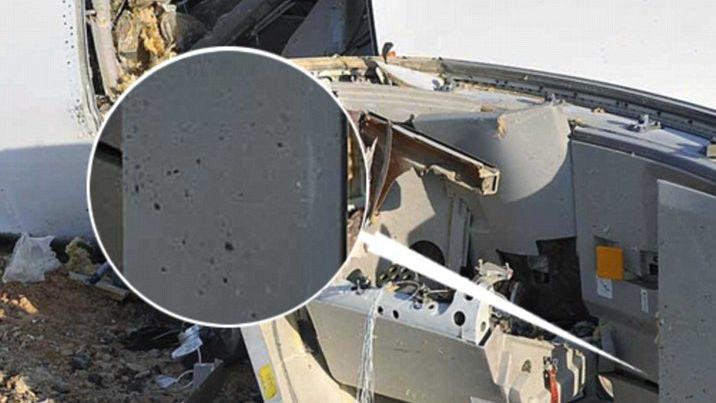
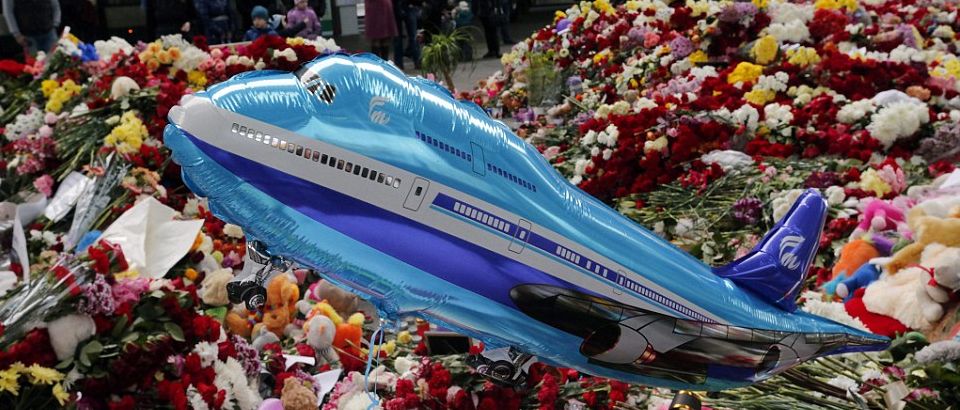
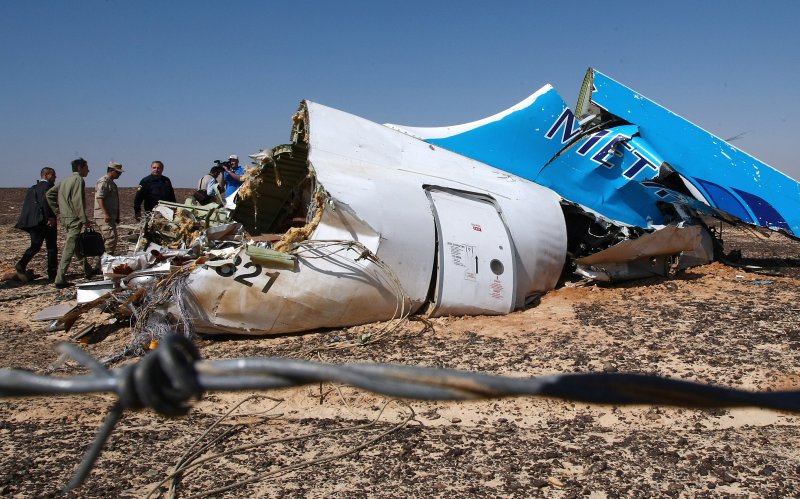
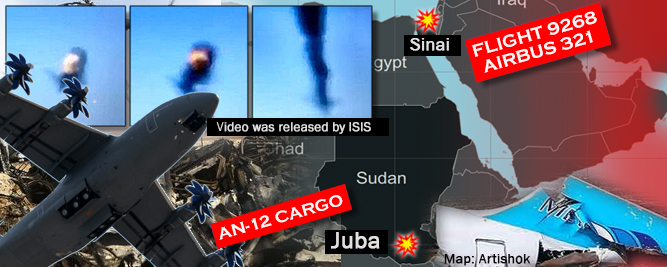
The Islamic State’s branch has repeatedly claimed responsibility for the downing of a Russian airliner on October 31. The first claim of responsibility was issued just hours after the airplane crashed, killing all 224 passengers and crew on board. On several occasions since then, both the Sinai “province” and other parts of the Islamic State’s international network have issued statements and videos saying the “caliphate’s” soldiers were responsible. The latest issue of the English-language Dabiq magazine includes a photo of the bomb that allegedly ripped the plane’s fuselage apart midair.

On November 19, the Sinai “province” released a video tallying the results of its insurgency operations against the Egyptian government. The video was also translated by SITE. The group claimed to have destroyed more than 25 Egyptian military and security vehicles, killed more than 100 members of Egypt’s security forces and taken various spoils between October 14 and November 13. These operations were in addition to the bombing of the Russian airliner.

The figures cited could not be independently verified. Even if the jihadists are exaggerating, however, there is no doubt that the Sinai “province” continues to wage a systematic campaign against Egyptian forces. Dozens of jihadists representing the “caliphate” launched a coordinated assault across the Sinai in early July. The Islamic State arm has launched rockets at Israel, struck an Egyptian naval vessel off of the coast of the Sinai, and hit targets inside Cairo as well.

Islam — Radical, Extremist and Mainstream

November 21, 2015

Islam — Radical, Extremist and Mainstream, Dan Miller’s Blog, November 21, 2015

(The views expressed in this article are mine and do not necessarily reflect those of Warsclerotic or its other editors. — DM

In largely secular western societies, Islam and its history are viewed by many non-Muslims as substantially irrelevant to how devout Muslims behave. Perhaps the view that religion is of little importance to devout Muslims is based on the role, minor if any, that religion and religious history play in their own secular lives. However, both Islamic teachings and history give devout Muslims their grounding in Islam and teach them that Islam is the religion of war, not peace: Islam must become the world’s only religion by extirpating all others.

Islam was founded by Mohamed ( c. 570 CE – 8 June 632 CE) in the sixth century. Mohamed

is considered, almost universally,[n 2] by Muslims to have been the last prophet sent by God to mankind[3][n 3] to restore Islam, which they believe to be the unaltered original monotheistic faith of Adam, Abraham, Moses, Jesus, and other prophets.[4][5][6][7] [Emphasis added.]

Islam considers the words of Mohamed, as transcribed in the “Holy” Quran and Hadith, to be the words of Allah. “Restoring” other monotheistic religions means changing them to comport with Islam as dictated to Mohamed by Allah; unaltered, those other religions cannot continue to exist; it is the duty of Muslims to force them to change or to exterminate them.

Islam provides the basis for Sunni and Shiite (principal branches of Islam) efforts to govern world civilization according to Islamic principles as voiced by Allah through his prophet, Mohamed. Since Islamic principles tolerate no religious or political freedoms (let alone contemporary gender equality or homosexuality notions), such western ideas must be extirpated — as they have been in Saudi Arabia (now the head of the UN Human Rights Council) and Iran. Islamic principles are also manifested by the hopes and efforts of the Islamic State (Sunni, like Saudi Arabia) and the Islamic Republic of Iran (Shiite) to achieve their own caliphates.

Sheikh Muhammad Abdullah Nasr is a scholar of Islamic law and a graduate of Egypt’s Al Azhar University — regularly touted as the world’s most prestigious Islamic university. Al Azhar University co-hosted Obama’s 2009 “New Beginnings” address in Cairo, to which Obama insisted that at least ten members of the Muslim Brotherhood be invited. According to an article at Jihad Watch,

After being asked why Al Azhar, which is in the habit of denouncing secular thinkers as un-Islamic, refuses to denounce the Islamic State as un-Islamic, Sheikh Nasr said:

It can’t [condemn the Islamic State as un-Islamic].  The Islamic State is a byproduct of Al Azhar’s programs.  So can Al Azhar denounce itself as un-Islamic?  Al Azhar says there must be a caliphate and that it is an obligation for the Muslim world [to establish it].  Al Azhar teaches the law of apostasy and killing the apostate.  Al Azhar is hostile towards religious minorities, and teaches things like not building churches, etc.  Al Azhar upholds the institution of jizya [extracting tribute from religious minorities].  Al Azhar teaches stoning people.  So can Al Azhar denounce itself as un-Islamic? [Emphasis added.]

Nasr joins a growing chorus of critics of Al Azhar.  Last September, while discussing how the Islamic State burns some of its victims alive—most notoriously, a Jordanian pilot—Egyptian journalist Yusuf al-Husayni remarked on his satellite program that “The Islamic State is only doing what Al Azhar teaches… and the simplest example is Ibn Kathir’s Beginning and End.”

Since the world’s preeminent Islamic university teaches Islam as proclaimed by the Islamic State, how can non-Muslims claim that the Islamic State is not Islamic? Why do many, even conservatives, refer to the Islamic State and its allied Islamic terror groups as “radical” or “extremist?”

Martin Luther was “radical” and “extreme” because he tried to reform aspects of Roman Catholicism which he deemed malign.

He strongly disputed the claim that freedom from God’s punishment for sin could be purchased with money. He confronted indulgence salesman Johann Tetzel, a Dominican friar, with his Ninety-Five Theses in 1517. His refusal to retract all of his writings at the demand of Pope Leo X in 1520 and the Holy Roman Emperor Charles V at the Diet of Worms in 1521 resulted in his excommunication by the Pope and condemnation as an outlaw by the Emperor.

Unlike Martin Luther’s eventually successful efforts to reform aspects of Roman Catholicism, the efforts of Egyptian President Sisi and other moderate Muslims to reform Islam have thus far gained little traction. Obama appears to support President Sisi’s principal opponent in Egypt, the Muslim Brotherhood and its affiliate, the Council on American-Islamic Relations (CAIR). Sisi and other moderates — rather than the Islamic State and Islamic nations such as Iran and Saudi Arabia — should be characterized as “radical” or “extreme” because they dispute the teachings of Allah as relayed through his prophet, Mohamed. The proponents of Islam as it now exists are “mainstream,” and therefore neither “radical” nor “extreme.” We should support “radicals” like President Sisi.

As noted in an article titled Beware of Islamic Terrorism,

All Islamic terrorists — not only the Islamic State group and al-Qaida — systematically and deliberately target civilians, stabbing their Muslim and “infidel” host countries in the back, abusing their hospitality to advance 14 centuries of megalomaniac aspirations to rule the globe in general, and to reclaim the “waqf” (Allah-ordained) regions of Europe in particular.

Emboldened by Western indifference, these destabilizing and terror-intensifying aspirations have been bolstered by the Islamic educational systems in Europe, the U.S. and other Western countries. These proclaim a supposedly irrevocable Islamic title over the eighth-century Islamic conquests of Lyon, Nice and much of France, as well as all of Spain; the ninth-century subjugation of parts of Italy; and the ninth- and 10th-century occupations of western Switzerland, including Geneva. [Emphasis added.]

Europe has underestimated the critical significance of this long anti-Western history in shaping contemporary Islamic education, culture, politics, peace, war, and the overall Islamic attitude toward Europe, North America, Australia, and other “arrogant infidels.” “Infidel” France has been the prime European target for Islamic terrorists, with 11 reported attacks in 2015, despite France’s systematic criticism of Israel and support for the Palestinian Authority — dispelling conventional “wisdom” that Islamic terrorism is Israeli or Palestinian-driven.

Europe has ignored the significant impact the crucial milestones in the life of the Prophet Muhammad have had on contemporary Islamic geostrategy, such as his seventh-century Hijrah, when Muhammad, along with his loyalists, emigrated or fled from Mecca to Yathrib (Medina), not to be integrated and blend into Medina’s social, economic or political environment, but to advance and spread Islam through conversion, subversion and terrorism, if necessary. Asserting himself over his hosts and rivals in Medina, Muhammad gathered a critical mass of military might to conquer Mecca and launch Islam’s drive to dominate the world. [Emphasis added.]

According to a moderate Muslim, Maajid Nawaz, writing in an article at the Daily Beast titled ISIS Is Just One of a Full-Blown Global Jihadist Insurgency,

Our political leaders have been restricting the definition of this problem to whichever jihadist group is causing them the biggest headache at the present time, while ignoring the fact that they are all borne of the same Islamist ideology. Before ISIS emerged, the U.S. State Department strangely took to naming the problem “al Qaeda-inspired extremism,” even though it was not al Qaeda that inspired the radicalism. Rather, Islamist extremism inspired al Qaeda. And in turn, ISIS did not radicalize those 6,000 European Muslims who have traveled to join them, nor the thousands of supporters the French now say they are monitoring. [Emphasis added.]

This did not happened overnight and could not have emerged from a vacuum. ISIS propaganda is good, but not that good. No, decades of Islamist propaganda in communities had already primed these young Muslims to yearn for a theocratic caliphate. When surveyed, 33 percent of British Muslims expressed a desire to resurrect a caliphate. ISIS simply plucked the low-hanging fruit, which had been seeded long ago by various Islamist groups, and it will now require decades of community resilience to push back. But we cannot even begin to do so until we recognize the problem for what it is. Welcome to the full-blown global jihadist insurgency. [Emphasis added.]

The author of that article claims that Islamism (often referred to as “political Islam“) is not Islam:

I speak as a former Liberal Democrat candidate in the U.K.’s last general election and as someone who became a political prisoner in Egypt due to my former belief in Islamism. I speak, therefore, from a place of concern and familiarity, not enmity and hostility to Islam and Muslims. In a televised discussion with CNN’s Fareed Zakaria on the issue, I have argued that of course ISIS is not Islam. Nor am I. Nor is anyone, really. Because Islam is what Muslims make it. But it is as disingenuous to argue that ISIS has “nothing to do with Islam” as it is to argue that “they are Islam.” ISIS has something to do with Islam. Not nothing, not everything, but something. . . . [Emphasis added.]

It is important to define here what I mean by Islamism: Islam is a religion, and like any other it is internally diverse. But Islamism is the desire to impose a very particular version of Islam on society. Hence, Islamism is Muslim theocracy. [Emphasis added.]

In another article, Mr. Nawaz acknowledges,

Islamism has been rising in the UK for decades. Over the years, in survey after survey, attitudes have reflected a worrying trend. A quarter of British Muslims sympathised with the Charlie Hebdo shootings. 0% have expressed tolerance for homosexuality. A third have claimed that killing for religion can be justified, while 36% have thought apostates should be killed. 40% have wanted the introduction of sharia as law in the UK and 33% have expressed a desire to see the return of a worldwide theocratic Caliphate. Is it any wonder then, that from this milieu up to 1,000 British Muslims have joined ISIS, which is more than joined the Army reserves.

I wish Mr. Nawaz well and hope that his efforts to change Islam succeed. However, in drawing distinctions between Islam and Islamism, he seems to have forgotten, or perhaps to have chosen to ignore, the teachings of Allah as relayed by his messenger and Islam’s founder, Mohamed, referenced at the beginning of this article. Mohamed (and presumably Allah himself) would be surprised by and even horrified at such notions as “Islam is what Muslims make itand that Islam does not contemplate a Muslim theocracy. So, in all probability, would be many of the clerics at Egypt’s Al Azhar University.

Here are a few videos of Islamic clerics spreading their messages of Islamic peace, love and tolerance. The last of the bunch is about one of Obama’s favorite Muslims.

To close on a somewhat lighter note, here are a few observations by Jonah Goldberg taken from his Goldberg file (November 20, 2015 e-mail),

If you Google “Christian terrorism,” you’re probably a jackass to begin with. But if you do — bidden not by your own drive to jackassery but by the natural curiosity inspired by this “news” letter — you’ll find lots of left-wingtrollery about how the worst terrorist attacks on American soil have been committed by Christians. Much of it is tendentious, question-begging twaddle. But I really don’t want to waste a lot of time on whether Tim McVeigh was a Christian or not (he really wasn’t).

What I find interesting is that many of the same people who clutch their pearls at the mere suggestion that Islamic terrorism has anything to do with — oh, what’s the word again? — oh right: Islam, seem to have no problem making the case that “Christian terrorism” is like a real thing. Remember how so many liberals loved — loved — Obama’s sophomoric and insidious tirade about not getting on our “high horses” about ISIS’s atrocities in the here and now because medieval Christians did bad things a thousand years ago? They never seem to think that argument through. Leaving out the ass-aching stupidity of the comparison, it actually concedes the very point Obama never wants to concede. By laying the barbaric sins of Christians a thousand years ago at the feet of Christians today, he implicitly tags Muslims with the barbarism committed in their name today. [Emphasis added.]

Now, I see no need to wade too deeply into the theology here, but I think I am on very solid ground when I say that Islamic terrorism draws more easily and deeply from the Koran than Tim McVeigh drew from the Christian Bible. Of course, you’re free to disagree. In a free society, everybody has the right to be wrong in their opinions. (But don’t tell anyone at Yale that.)

. . . .

But it is simply a lie — an obvious, glaring, indisputable, trout-in-the-milk lie — that Muslims have nothing whatsoever to do with terrorism.

Simply put, this is nonsense. . . .  The jihadists say they are motivated by Islam. They shout “Allahu akbar!” whenever they kill people. “Moderate Muslims” in Saudi Arabia and elsewhere have been funding Islamic radicals around the world for nearly a century. This morning in Mali, terrorist gunmen reportedly released those hostages who could quote the Koran. The leader of ISIS has a Ph.D. in Islamic Studies and openly talks about restoring the Caliphate. [Emphasis added.]

Despite all of this, don’t be distracted from the greatest threat to our security; or perhaps we should be:

theo3

Muslim cleric: “The Islamic State is a byproduct of Al Azhar’s programs”

November 21, 2015

Muslim cleric: “The Islamic State is a byproduct of Al Azhar’s programs” Jihad Watch

[T]he phenomenon known as “ISIS” is not a temporal aberration within Islam but rather a byproduct of what is considered normative thinking for Al Azhar—the Islamic world’s most authoritative university.

*************************

Sheikh Muhammad Abdullah Nasr, a scholar of Islamic law and graduate of Egypt’s Al Azhar University—regularly touted as the world’s most prestigious Islamic university—recently exposed his alma mater in a televised interview.

Muhammad-Abdullah-Nasr

After being asked why Al Azhar, which is in the habit of denouncing secular thinkers as un-Islamic, refuses to denounce the Islamic State as un-Islamic, Sheikh Nasr said:

It can’t [condemn the Islamic State as un-Islamic].  The Islamic State is a byproduct of Al Azhar’s programs.  So can Al Azhar denounce itself as un-Islamic?  Al Azhar says there must be a caliphate and that it is an obligation for the Muslim world [to establish it].  Al Azhar teaches the law of apostasy and killing the apostate.  Al Azhar is hostile towards religious minorities, and teaches things like not building churches, etc.  Al Azhar upholds the institution of jizya [extracting tribute from religious minorities].  Al Azhar teaches stoning people.  So can Al Azhar denounce itself as un-Islamic?

Nasr joins a growing chorus of critics of Al Azhar.  Last September, while discussing how the Islamic State burns some of its victims alive—most notoriously, a Jordanian pilot—Egyptian journalist Yusuf al-Husayni remarked on his satellite program that “The Islamic State is only doing what Al Azhar teaches… and the simplest example is Ibn Kathir’s Beginning and End.”

Ibn Kathir is one of Sunni Islam’s most renowned scholars; his Beginning and End is a magisterial history of Islam and a staple at Al Azhar.  It is also full of Muslims, beginning with Muhammad, committing the sorts of atrocities that the Islamic State and other Islamic organizations and persons commit.

In February, Egyptian political writer Dr. Khalid al-Montaser revealed that Al Azhar was encouraging enmity for non-Muslims, specifically Coptic Christians, and even inciting for their murder.  Marveled Montaser:

Is it possible at this sensitive time — when murderous terrorists rest on texts and understandings of takfir [accusing Muslims of apostasy], murder, slaughter, and beheading — that Al Azhar magazine is offering free of charge a book whose latter half and every page — indeed every few lines — ends with “whoever disbelieves [non-Muslims] strike off his head”?

The prestigious Islamic university—which co-hosted U.S. President Obama’s 2009 “A New Beginning” speech—has even issued a free booklet dedicated to proving that Christianity is a “failed religion.”

In short, the phenomenon known as “ISIS” is not a temporal aberration within Islam but rather a byproduct of what is considered normative thinking for Al Azhar—the Islamic world’s most authoritative university.

ISIS launches its winter terror offensive with first 274 deaths

November 13, 2015

ISIS launches its winter terror offensive with first 274 deaths, DEBKAfile, November 13, 2015

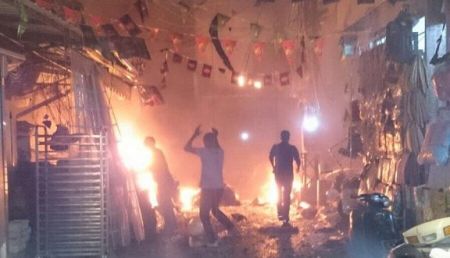
Borj_al-Barajneh12.11.15Suicide bombers strike Hizballah in Beirut
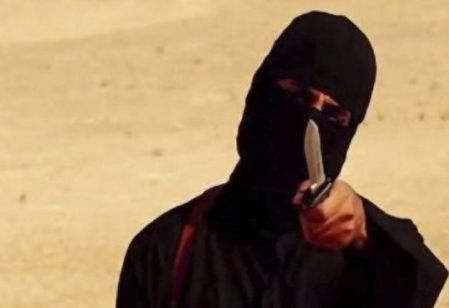
Execution of Steven Sotloff (1983 – 2014) by Jihadi John of ISIS. In August 2013, Sotloff was kidnapped in Aleppo, Syria, and held captive by militants from the Islamic State of Iraq and the Levant. Jihadi John (Mohammed Emwazi, born August 1988) a British man who is thought to be the person seen in several videos produced by the Islamic extremist group ISIL showing the beheadings of a number of captives in 2014 and 2015. (Photo by Universal History Archive/UIG via Getty Images)

Execution of Steven Sotloff (1983 – 2014) by Jihadi John of ISIS. In August 2013, Sotloff was kidnapped in Aleppo, Syria, and held captive by militants from the Islamic State of Iraq and the Levant. Jihadi John (Mohammed Emwazi, born August 1988) a British man who is thought to be the person seen in several videos produced by the Islamic extremist group ISIL showing the beheadings of a number of captives in 2014 and 2015. (Photo by Universal History Archive/UIG via Getty Images)

The US drone strike Thursday night, Nov. 11, targeting the Islamic State’s infamous executioner known as “Jihad John” in the northern Syrian town of Raqqa may or may not have hit the mark – the Pentagon says it is too soon to say. The hooded, masked terrorist with the British accent has been identified as a British Muslim born in Kuwait called Mohamed Emwazi. He appeared on videos worldwide showing the cold-blooded murders of US, British, Japanese and other hostages.

The drone attack occurred shortly after the latest ISIS atrocity: Thursday night, two or three suicide bombers blew themselves up, killing 43 people and injuring at least 240 in the Hizballah stronghold of southern Beirut opposite Burj Barajneh.

Ten days earlier, the Islamic State brought down the Russian Metrojet airliner over Sinai killing all 224 people aboard. This spectacular act of terror was apparently the first strike of the jihadist group’s winter offensive. It achieved its objectives of multiple murder; mortal damage to Egypt’s tourism industry and a blow to the prestige of its president Abdel-Fatteh El-Sisi.

The attack also punished President Vladimir Putin for bringing the Russian military into the center of the Syrian conflict.

The next Islamic State assault was aimed to undermine the credibility of Jordan’s King Abdullah and his security services: On Nov. 8,  a Jordanian police captain opened fire at a high-security US training facility outside Amman, killing two American trainers, a South African and two Jordanians. The number of US personnel injured in the attack was not released. This attack was timed to coincide with the 10thanniversary of the massive al Qaeda assault on Amman’s leading hotels, all American owned, which left 61 dead.

In northern Sinai, the murder of a family of 9 Egyptians at El Arish Thursday morning raised the total of ISIS murders in less than a month to 274.

DEBKAfile’s counterterrorism sources discern three objectives in the attack Thursday night in Beirut

1. A lesson for Tehran and Hizballah’s leader Hassan Nasrallah to show them that the Islamic State is able to reach them on their home ground, no matter how many troops they deploy to fight the jihadis in Syria (Iran and Hizballah together field an estimated 13,000 soldiers in Syria). ISIS was capable of inflicting terrible casualties both on the battlefield and in their homeland, first in Beirut and eventually in Tehran.

2.  The day before, Wednesday, Nov. 11, in a speech marking the “Day of the Shahid,” Nasrallah gloated over Hizballah’s triumph in a battle outside Aleppo. He also boasted that his domestic security shield in Lebanon presented an impenetrable barrier against ISIS or Nusra Front terrorist intrusions.

The Islamic State’s tacticians determined to blow up both claims in Nasrallah’s face. He and Iran were to be shown that they could not stop ISIS or prevent the Syrian war’s spillover into Lebanon.

3.  By blowing up the Russian airliner over Sinai, the Islamists sought to underscore this point for Moscow too. Russia might send a powerful military force to Syria, but the Islamists would hit Putin from the rear at a location of its choosing anywhere in the Middle East. Moscow may have opted to defend Bashar Assad, but what can it do to protect Hizballah and its other allies?.

DEBKAfile’s counterterrorism sources note that US and Russia have taken lead roles in the broad military effort to defeat ISIS – often by means of pinpointed operations. At the same time, under their noses, the Islamist terrorists have launched their winter campaign, striking with extreme ferocity and agility in unexpected places that are outside the regular battle fronts in which the big powers are engaged.

Egypt-Saudi Arabia Relations

November 11, 2015

Egypt-Saudi Arabia Relations: Substantial Rifts Despite Shared Basic Interests, MEMRI, Y. Graff*, November 9, 2015

Introduction

Since the ouster of Muhammad Mursi in July 2013, Saudi-Egyptian relations have been close and marked by common interests. Saudi Arabia backed the Egyptian military’s ousting of Mursi and supported its claim that the ouster expressed the will of the people, in the face of international claims that it was a military coup. Alongside political support for the new regime, Saudi Arabia also donated billions of dollars to restore Egypt’s economy. However, despite the friendly relations, Arab press has reported that, since the death of Saudi King ‘Abdallah in January 2014 and the ascension of King Salman, relations between the countries have chilled. Outwardly, the leaders of the two countries strive to demonstrate unity and friendship, yet reports in the Arab media point at a growing tension between Egypt and Saudi Arabia, mainly due to fundamental disagreements on various political issues.

It should be mentioned that, contra to Saudi expectations and despite this country’s generous financial assistance, Al-Sisi’s Egypt does not regard itself bound by Saudi policies. In fact, it has employed an independent policy in the hopes of forging bonds of friendship and alliances on several concurrent fronts – in a manner that has sometimes contravened and even thwarted Saudi foreign policy. This has led to disagreements with Saudi Arabia on several fronts:

The Saudi openness towards the Muslim Brotherhood (MB), to Egypt’s dismay: Saudi fears regarding Iran – which substantially increased after Iran’s Houthi allies took control of the Yemeni capital of Sana’a in September 2014, and later of all of southern Yemen, including Aden, and parts of the north up to the Saudi border, and after Iran signed the JCPOA with the P5+1 Group – have caused a tactical Saudi shift towards the MB after years of animosity towards it and towards its sponsors, Qatar and Turkey. This, in an attempt to form a unified Sunni front to confront the Iranian threat in the region. Saudi Arabia’s openness towards the MB, which Egypt sees as an enemy of the regime and a terrorist organization, is expressed in the Saudi view of the MB as future partners in ruling Yemen and Syria. Further expressions were a visit by Hamas Political Bureau Chief Khaled Mash’al to Saudi Arabia in July 2015, where he met with King Salman, as well as Saudi Arabia’s siding with Qatar in February 2015 when the latter opposed Egypt’s attack in Libya.

This Saudi rapprochement with the MB, Qatar and Turkey displeases the Egyptian regime, which regards them as its bitter enemies and rejects any cooperation with them, even at the cost of thwarting the cause of forming a united Sunni front against Iran.

An Egyptian openness towards Iran, to the chagrin of Saudi Arabia: Saudi Arabia sees Iran as a strategic threat to its security and the security of the entire Sunni world. Conversely, many elements in Egypt do not regard Iran as an existential threat and are reluctant to enter the Sunni-Shi’ite struggle. Al-Sisi’s Egypt is seeking economic investments and alliances to fill its dwindling coffers, and some there see the lifting of sanctions from Iran as an opportunity to renew business relations with it, even if this goes against Saudi Arabia and despite the fact that Egypt and Iran have had historically tense relations and do not maintain full diplomatic relations to this day.

Egypt’s openness towards the Syrian regime: Saudi Arabia demands the ouster of Assad, whether by political or by military means, and even supports the armed opposition to that end. Conversely, Egypt opposes a military solution and advocates dialogue with the Assad regime to achieve a solution that would preserve Syria’s state institutions and its unity. Moreover, Egypt refrains from addressing the issue of Assad’s personal fate.

Saudi disappointment at absence of sufficient support for its military operation in Yemen: Saudi Arabia, which is leading a large-scale military operation in Yemen against the Houthis and supporters of ousted president ‘Ali ‘Abdallah Saleh, is disappointed at Egypt’s refusal to participate more fully in this operation. Moreover, there are reports on disagreements between the two countries regarding the attitude towards the Yemeni MB, as well as reports that Egypt is in contact with Saudi Arabia’s rivals in Yemen in the hopes of finding a political solution to the crisis there.

This report will review the points of contention between Saudi Arabia and Egypt on various topics, as was reported in Arab media.
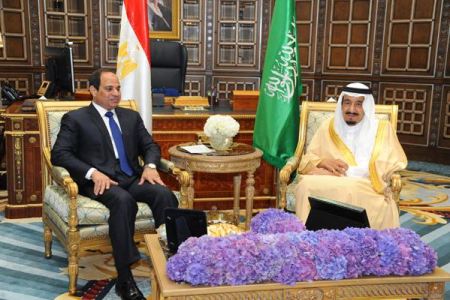
25685Egyptian President Al-Sisi with Saudi King Salman (image: elpah.com)

Egypt Furious Over Saudi Arabia Growing Close To Qatar, Turkey, MB

Since his ascension to the Saudi throne, King Salman continued efforts by his predecessor, King ‘Abdallah, to connect the traditional Sunni axis, led by Saudi Arabia and Egypt – which includes countries such as Jordan, the UAE, and Bahrain – with the MB axis – which includes Turkey, Qatar, and the various MB organizations and parties in the region such as Hamas, Al-Islah in Yemen, and the Syrian MB. The Saudis support the idea that both these axes should come together to confront Iran and its regional allies. In the opinion of Saudi Arabia and other Gulf states, Iran has become an increasing threat in the past decade after gaining crucial influence in three Arab capitals: Beirut, Baghdad, and Damascus. In the past year, Iran has also added the Yemeni capital of Sana’a to the list,[1] after the Shi’ite Houthi movement took control of it, as well as of South Yemen and Aden together with forces supporting ousted president ‘Ali ‘Abdallah Saleh. This takeover created a strategic threat to Saudi Arabia after the Houthis took control of the Strait of Bab Al-Mandeb, prompting the kingdom to launch Operation Decisive Storm in order to restore the rule of its ally President Hadi.

Up until the Houthi takeover of Sana’a, Saudi Arabia, much like Egypt, saw the MB axis as an equal threat to the one posed by Iran. It defined the MB as a terrorist organization, and conducted a public conflict with Qatar over this issue, which triggered a recall of its ambassador in March 2014.[2] However, the deterioration of the situation in Yemen, as well as the constant motion towards a nuclear agreement between Iran and the U.S. (which was eventually achieved in July 2015), caused Saudi Arabia to shift towards Iran as the central threat to its national security and the safety of Arabs in general. As part of this view, Saudi Arabia decided to grow close to its MB axis rivals and undertake the compromises necessary to achieve this.

Accordingly, Saudi Arabia began normalizing its relations with Qatar, even backing it in February 2015 during a harsh disagreement with Egypt.[3] Saudi Arabia’s openness towards Qatar and towards its ally, the MB, was also expressed by releasing many Egyptian MB prisoners, including high ranking activists who were imprisoned in Saudi Arabia during the reign of King ‘Abdallah, as well as by ending Saudi pressure on Britain to define the MB as a terrorist organization.[4]

Arab press also began reporting on contacts between MB officials and Saudi leadership. For example, Saudi officials met with Europe-based billionaire Youssef Nada, who is a noted MB donor;[5] Jordanian MB General Guide Himam Sa’id visited Saudi Arabia in June 2015 and met with the Saudi minister of religious endowments, and a delegation of Hamas officials led by Political Bureau Chief Khaled Mash’al held a meeting with King Salman in Mecca in July 2015, which led to a release of Hamas activists imprisoned in the kingdom.

In order to bring Egypt closer to the MB axis as well, Saudi Arabia attempted to reconcile between it and Qatar, and Egyptian and Gulf sources even claimed that it explored the possibility of promoting inter-Egyptian reconciliation between the regime and the MB.[6] In recent months, the Saudi press featured articles criticizing Egypt’s rigid policy towards the MB. Senior Saudi political analyst Khaled Al-Dakhil, writing in the London-based Saudi daily Al-Hayat on June 21, 2015, called it “a phobia” and “McCarthyism,” hinting that the Egyptian regime, which warns of a totalitarian MB rule, does not behave much differently itself. According to him, “this McCarthyist [attitude] towards the MB cannot be sustained for long… We need an alternative [to persecuting the MB], which has thus far not materialized.”[7] Saudi columnist Daoud Al-Shiryan made explicit calls for reconciliation with the MB in his June 17 column in the same daily: “The [Egyptian] enthusiasm for [meting out] the death penalty [to MB leaders], and the view that regards this as a tool for deterring and restraining them, and for imposing the country’s authority [over them], is an erroneous policy, since Egypt’s interest today demands to close the book on this topic and open a new horizon for political reconciliation [with the MB] while looking to the future.”[8]

Reports that Saudi Arabia was growing closer to the MB were of great concern to Egypt, but it seems that Mash’al’s visit to the kingdom and his meeting with King Salman were the straw that broke the camel’s back. Following the visit, several Egyptian columnists published articles featuring harsher tones than had been acceptable in Egypt up to that point. For example, ‘Abd Al-Rahim ‘Ali, editor of the Egyptian news portal Albawabhnews.com, who is close to Egyptian security forces, claimed in an article on Saudi-Egyptian tensions that Saudi Arabia was trying to “thaw the ice” with Hamas and grow close to this organization so it would join the anti-Iranian Sunni axis that Saudi Arabia heads and mediate between the kingdom and the Yemeni Al-Islah party. According to him, Egypt responded to these attempts by conveying that it refuses to be party to any plan in which the MB is involved. He claimed further that Egypt had conveyed a message to Saudi Arabia that “its alliance with this organization poses a threat to the Arab’s national security and especially to Egypt’s national security.” [9]

Even more critical of the Saudi openness towards the MB was editor-in-chief of the official daily Al-Ahram, ‘Abd Al-Hadi ‘Allam, who did not mention Saudi Arabia by name but alluded to it in a highly resentful tone. He wrote: “Forming an alliance with political Islam organizations [such as the MB] will never benefit the region and the Arab forces [such as Saudi Arabia] that aspire to forge a new alliance against Tehran… as though those organizations were not party to the regional chaos and bloodshed.” He added: “The thought that we can combat the pox of terrorism and extremist organization [referring to Shi’ite militias such as the Houthis and Hizbullah] by supporting equally radical organizations [such as Hamas and the various arms of the MB] constitutes ignorance, near-sightedness, and politically folly.”[10]

Different Attitudes Towards Iran As Strategic Threat To The Region

Egypt’s objections to Saudi Arabia growing close to the MB also touch on their differing views on Iran as a strategic threat. Egypt disagrees with the Saudi position that Iran constitutes such a threat to Arab national security as to justify allying with the MB. Egypt sees the MB as a no lesser threat to Arab national security, and some elements there even argue that Iran does not constitute a significant threat at all.

Egyptian Foreign Minister Sameh Shoukry said after the signing of the JCPOA that Egypt’s relations with Iran “are unrelated to the attitude of the Gulf states towards it.” He added: “Nobody is tying our hands. We are forging ties with [Iran] based on many considerations, including the regional one, not based on formal matters like the name of a street.”[11] Also, in late September, Shoukry met with his Iranian counterpart, Javad Zarif, on the periphery of the UN General Assembly, and conveyed to him that Egypt expects Iran to support regional stability and Arab national security. The two also discussed a political solution in Syria and the implications of the JCPOA.[12] Then Egyptian Oil Minister Sherif Ismail, who is now prime minister, even expressed hope that Egypt could begin importing oil from Iran, thus easing its severe energy crisis.[13]

Several Egyptian columnists strengthened this position and called Egypt to see the JCPOA as a chance to economically develop Egypt and foster ties with Iran after many years of disconnect. Al-Ahram columnist Ibrahim Sengab argued that “naming a street in Tehran for the murderer of President Sadat [Khalid Al-Islambouli] cannot be grounds for severing ties between the countries.[14] Al-Ahram columnist Muhammad Idris wrote that in light of the rise of Iranian might in the region, Egypt is faced with two options. One is to create “strategic integration with Saudi Arabia” and lead a joint Arab force that would constitute a counterbalance to Iran, and the other is to normalize relations with Iran. According to him, the schism between Saudi Arabia and Egypt, and Saudi attempts to compete with Egypt rather than cooperate with it, indicate that normalizing relations with Iran is the better option.[15] However, it should be mentioned that many Egyptian articles sided with the Saudi position that sees the JCPOA as dangerous.

Another Iran-related disagreement between Egypt and Saudi Arabia revolves around the Egyptian regime’s estimate that Saudi Arabia is turning its conflict with Iran into a Sunni-Shi’ite sectarian conflict, which Egypt has no interest in. Egyptian journalist Mai ‘Azzam harshly attacked Saudi Arabia’s conduct vis-à-vis Iran on this account, claiming that “Saudi Arabia is spearheading the transforming of the regional conflict into a sectarian one. It is the one that dragged the region into civil wars… [in which] members of the same nationality fight under sectarian banners, and it seems that this is a war between Shi’ites and Sunnis rather than a war of interests between Saudi Arabia and Iran.” She explained that “the clash between the interests of Saudi Arabia and Egypt is crystal clear.”[16] The editor of Al-Ahram, ‘Abd Al-Hadi ‘Allam, also addressed this point and stated in his aforementioned article that Egypt “would never lead a sectarian war against Iran.”[17]

Saudi-Egyptian Disagreements Regarding Resolution Of Syrian Crisis

Saudi and Egyptian officials have been stressing that there is no disagreement between the countries with regards to the Syrian crisis. Saudi Ambassador to Egypt Ahmad Qattan argued in an August 4 press conference that the two countries no longer disagree on the means to resolve the crisis, and that the two had always agreed on the goal: a political solution that preserves state institutions, while distancing Assad himself from a position of influence.[18] Egypt’s foreign minister also stressed, in a joint press conference with his Saudi counterpart, that the two countries had never disagreed and do not disagree today on the solution to the Syria crisis.[19]However, these statements do not seem to reflect reality, which points to major differences of opinion between the countries regarding the fate of Bashar Al-Assad and the ways to deal with the crisis. Egypt’s position on these matters appears closer to that of Russia, the strategic ally of the Assad regime along with Iran, than to that of Saudi Arabia.

The Saudi-Egypt disagreements on the Syrian issue can be divided into several topics:

Ways To Deal With The Syrian Crisis And The Fate Of President Assad

While Saudi Arabia sees Assad as the root cause of the problem, and sees his ouster as a condition to solving the crisis, Egypt believes that removing Assad would only exacerbate the crisis and lead to chaos, as happened with the ouster of Saddam Hussein in Iraq and of Mu’ammar Al-Qadhafi in Libya. While Egypt does not openly state that it supports Assad remaining in power, it does routinely warn of the implications of his ouster. In its view, removing Assad is not a condition to solving the crisis, and Assad’s fate is in the hands of Syrians – a position similar to that of Russia, Iran, and the Syrian regime itself. This was expressed in statements made by Egyptian President Al-Sisi, who called for a political solution in Syria, “not in order to support one side over the other, but rather to preserve the Syrian state and its institutions, and to solve [the crisis] without collapsing them.”[20]Egyptian Foreign Minister Shoukry also said that Assad’s fate should only be determined by the Syrian people, “who have a right to decide [their leadership] by [establishing] a transitional government and later in free elections held under international oversight and as part of the implementation of the Geneva 1 agreement.”[21]

Egypt does not view the “military option” as an alternative if a political solution cannot be reached, as Saudi Arabia has threatened.[22] Moreover, official elements in Egypt stress that a military solution in Syria is impossible, and that military action to topple the regime will only exacerbate the civil war in the country.

In Egypt’s opinion, only a political solution that ensures that the Syrian army and state institutions not be harmed can guarantee the stability of Syria and of the region. This Egyptian position was expressed in a document constituting a kind of roadmap to solving the Syrian crisis, which was presented by the Egyptian foreign ministry to several Syrian opposition parties and was published on the liberal Saudi website elaph.com on December 25, 2014.[23] The Egyptian document does not touch on the fate of Bashar Al-Assad, but stresses that the Syrian army cannot be dismantled since it is “the national institution defending the state and ensuring its independence and sovereignty, and [since it] will preserve national security and not interfere in politics.”[24]

The Root Causes Of The Crisis And The Priorities In Dealing With It

The two countries both see the spread of ISIS in Syria as a threat to the existence of the state and to regional stability, but differ on how to deal with it and the priorities in doing so. Saudi Arabia believes that the root of the problem is the Assad regime itself, since it is the cause of the uprising and the emergence of ISIS and other extremist Islamic groups, and therefore ousting it will end the uprising and weaken these groups.

Egypt, on the other hand, shares Russia’s, Iran’s, and the Syrian regime’s view that the essence of the crisis is the extremist Islamic terrorist organizations such as ISIS and Jabhat Al-Nusra, and therefore the top priority is eliminating them. Moreover, Egypt sees the Syrian army as the spearhead of the fight against ISIS. It supports the Russian initiative that calls to establish a regional alliance against ISIS together with the Assad regime. Egypt even expressed support for Russian airstrikes in Syria, in contrast to Saudi Arabia, which opposes them. Egyptian Foreign Minister Sameh Shoukry even supported the Russian involvement in Syria in an interview with the Saudi Al-Arabiya TV, saying that “the info given us in our direct contacts with the Russian side indicates that Russia is interested in combating terrorism and working to reduce the spread of terrorism in Syria.” He added that the Russian involvement would help eliminate terrorism in the country.[25]

Attitude Towards Syrian Opposition

Egypt and Saudi Arabia’s disagreement regarding the status of Assad is also reflected in their support for different opposition elements. Saudi Arabia supports armed opposition groups such as the Free Syrian Army and moderate Islamic militias with equipment, weapons, and money. The Saudis, in a joint move with Turkey and Qatar, which also support militias combatting Assad, recently established Jaish Al-Fath – an umbrella organization for several armed factions, including Islamist ones, which has made impressive achievements against the regime. Additionally, Saudi Arabia supports the National Coalition for Syrian Revolutionary and Opposition Forces, an unarmed political opposition to the regime, in which the Muslim Brotherhood (MB) has considerable weight, and which also calls for the ouster of Bashar Al-Assad.

Egypt, on its part, while not boycotting the National Coalition, supports opposition elements willing to conduct dialogue with the Syrian regime, such as the National Coordination Committee for the Forces of Democratic Change (NCC), which is based in Syria and receives Russia’s support. Additionally, Egypt does not recognize MB elements that are members of the National Coalition. Thus, in June 2015, Egypt organized a summit for Syrian oppositionists in Cairo, but did not invite any MB representatives. In response, the National Coalition boycotted the summit.

Furthermore, unlike the Saudis, Egypt rejects a military solution in Syria, and opposes armed opposition. In this context, it is worth mentioning an article penned by Ahmed Sayyid Al-Naggar, head of the board of directors ofAl-Ahram, who harshly criticized the Free Syrian Army and Saudi Arabia’s support for armed opposition in Syria. He wrote: “Egypt should not permit the rending of Syria and the destruction of the unity of the Syrian state, as is being attempted today by the terrorist gangs of Jabhat Al-Nusra, ISIS, and the ‘Free Collaborator Army’ [pejorative term for the FSA] with the support of several regional countries…”[26]

Saudi Arabia’s dissatisfaction with Egypt’s policy on solving the Syrian crisis is embodied by criticism levelled by the former editor of the London-based Saudi daily Al-Sharq Al-Awsat, Tariq Alhomayed, at Egyptian Foreign Minister Shoukry due to his statements in support of Russian involvement in Syria. According to Alhomayed, these statements by Shoukry indicate that he is “taking the criminal Assad lightly, and even showing sympathy for him, and [his statements] do not acknowledge that [Assad’s] crimes are the reason that Syria is in its current state, or that Assad is the official sponsor of terrorism and the reason for the appearance of ISIS there [in Syria]… It is a duty to say, even with a substantial delay, that there is a severe lack of understanding of the Syrian crisis in Egypt… What some people in Egypt do not understand is that the Assad army is sectarian and [moreover] has [now] been replaced by Shi’ite and Iranian militias and by Russian forces, and is no longer the same as the Egyptian army.”[27]

Reports On Warming In Egyptian-Syria Relations

In fact, since Al-Sisi’s rise to power in Egypt, and to Saudi Arabia’s dismay, there has been a noticeable warming of relations between Egypt and the Assad regime, embodied by Egypt’s uncompromising support for the survival of this regime and its army. This Egyptian position can be explained by the fact that the Syrian and Egyptian regimes both represent the Middle East’s old guard (authoritarian regimes leaning mainly on the army); by the strong ties between their militaries; by their similar view of the MB, ISIS and Al-Qaeda as threats to their security; and by their shared hostility for Turkey and Qatar, who sponsor the MB. It seems that similar interests and the similarity in the structure of both regimes lead Egypt to fear that the ouster of the Assad regime and its army, as well as the division of Syria, would open the door to a similar scenario in Egypt. Additionally, Egypt’s tightening relations with Russia – a strategic ally of the Syrian regime along with Iran – have contributed to its positive relations with the Assad regime. Furthermore, unlike its Gulf allies, Egypt did not participate in the international coalition attacks on ISIS in Syria, which the Assad regime called “illegitimate.”[28]

Over the past year, the Assad regime has recognized these disagreements between Saudi Arabia and Egypt and has attempted to exploit them to grow close to Egypt, including with positive statements on Egypt made by Syrian officials, and the dispatching of envoys to the country. For example, in a speech to Ba’th Party members in November 2014, President Assad showered Egypt with praise, saying: “We can describe the Egyptian role as positive. Our relations with the Egyptian security mechanisms, even during the days of [previous president Muhammad] Mursi, were good, and now they have developed; first, thanks to the rise of President ‘Abd Al-Fattah Al-Sisi, and second, due to the blows dealt to the MB in Egypt. This led to a major warming [between the countries].”[29] In an interview with Hizbullah’s Al-Manar TV in August 2015, Assad stressed the importance of relations with Egypt: “Even when Mursi, of the MB, was Egyptian president and despite his offenses towards Syria, we never tried to harm Egypt; first, due to the importance of our relations, and second, because contacts between Syria and Egypt were not severed even during the reign of Mursi.” Assad hinted at the pressure Saudi Arabia is applying to Egypt to avoid forging stronger ties with Syria, saying: “We want Egypt to play the role of an important… and influential country, [one] that assists the other Arab countries on the basis of its ancient history, not on the basis of a handful of petrodollars and recent history.” According to Assad, “rival countries are pressing Egypt in attempt to keep it from playing the part we wish it to play.” He also said that Syria-Egypt relations help attain balance in the Arab arena and that “Syria believes that it is in the same trench as the Egyptian army and people in dealing with terrorists…”[30]

Syrian Foreign Minister Walid Al-Mu’allem told the Egyptian daily Al-Ahram that “Egypt does not play a part [in Syria] for obvious reasons,” alluding to its alliance with Saudi Arabia, and added: “The Mursi regime, which decided to downgrade diplomatic relations [with Syria], is gone, and we hope that they will now return [to the previous level].”[31] In an interview with the Egyptian daily Al-Akhbar, Al-Mu’allem said that there is security coordination between Syria and Egypt and that it was an advanced step towards normalizing relations between the countries.[32] The Lebanese daily Al-Safir, which is close to the Syrian regime, even reported in February 2015 that Al-Sisi had renewed security coordination with Syria “to a small degree.”[33] Additionally, the website Alahednews.com, which is owned by Hizbullah, reported that Egypt was arming the Assad military.[34]

25686Al-Mu’allem (center) posing with members of the Egyptian media (Image: Al-Ahram, Egypt, August 20, 2015)

Alongside these messages, the Syrian regime dispatched several envoys to Egypt. In December 2014, a delegation headed by ‘Imad Al-Assad, the cousin of President Bashar Al-Assad, visited Egypt.[35] One month later, in January 2015, an unnamed Syrian regime envoy met with Egyptian officials in Cairo. According to reports on a Syrian opposition website, the visit was meant to bolster Egyptian efforts to unite the Syrian opposition and promote indirect talks between the regime and opposition as a preamble to direct talks with Egyptian or international presence.[36]

Though Egyptian officials make sure to avoid explicit expressions of support for the Assad regime, the administration’s mouthpieces do express such support, unreservedly. Official Egyptian press featured numerous articles calling for Assad to remain in power and backing him in his struggle against terrorism. They also featured articles praising the tight relations between the two countries and peoples, articles which presented the events in Syria from the Egyptian regime’s standpoint, and discussed the common enemies of the two countries and the need for the Egyptian army to assist its Syrian counterpart.[37]

Thus, chief editor of Al-Ahram, ‘Abd Al-Hadi ‘Allam, wrote in April 2015 that “distancing Bashar Al-Assad from any solution to the crisis is a akin to imposing guardianship upon the Syrian people and its choices, and [constitutes] interference in its affairs, and marginalization of parts of the Syrian people who see him as a component in a solution.” ‘Allam also claimed that, had the MB regime remained in power in Egypt and had the Assad regime been ousted, tens of thousands of ISIS fighters would have entered Egypt, and therefore “the mighty stand of the Syrian regime and army in the face of terrorism constitutes defense of Egypt and its national security…”[38]

Similarly, Morsi ‘Atallah, former head of Al-Ahram‘s board of directors, wrote in June 2015 that, contrary to statements by Saudi Foreign Minster Al-Jubeir that Egypt and Saudi Arabia agreed that Assad must be removed and that Egypt would press Russia to abandon him, “this trend does not match the principles of Egyptian policy… which is far from sticking its nose into the internal affairs of its Arab sisters… regardless of circumstances and excuses.”[39] In a February 2015 article, Al-Ahram columnist Makram Muhammad Ahmad stated that Bashar Al-Assad would “necessarily be part of a peaceful solution to the Syrian crisis” because he still controls a large portion of the country, because the army will remain loyal to him, as well many minorities; and especially in light of estimates that the only alternative to his rule is ISIS.[40] In another article on September 8, 2015, written on the backdrop of the wave of Syrian refugees fleeing to Europe, Ahmad wrote that Syria “is being worn away by ISIS and Al-Qaeda due to the insistence on getting rid of Assad as a precondition to a nonviolent solution,” adding that “the crimes Assad has committed against his people are of limited [scope] compared to the crimes of Arabs who stand silent and helpless in the face of the great disaster of the Syrian people.”[41]

The Yemen Crisis: Saudi Arabia Disappointed At Insufficient Egyptian Aid; Egypt Fears MB Inclusion In Future Arrangement

It initially appeared that there was solidarity and cooperation between Egypt and Saudi Arabia on the Yemeni situation, since Egypt dispatched aerial and naval forces to join the Saudi-led coalition that launched Operation Decisive Storm in March against the Houthis and the supporters of ousted president ‘Ali ‘Abdallah Saleh. However, as time wore on, the rift between the countries became apparent, embodied by Egypt’s reluctance to dispatch ground troops to Yemen, while other coalition members such as the UAE, Sudan, and Mauritania have already done so.[42]

Egypt sees the Strait of Bab Al-Mandeb, which is the gateway to the Red Sea, as a strategic area, and Egyptian officials have repeatedly stressed that their country would prevent the Houthis from taking control of it. Moreover, in April 2015, President Al-Sisi said that Bab Al-Mandeb and the security of the Gulf States were matters of Egyptian national security, and that the Egyptian army would be mobilized to deal with them if necessary.[43]Nevertheless, it appears that Egypt is avoiding taking a more active role in this operation, possibly due to several reasons: The Egyptian army’s preoccupation with combating ISIS terrorism in Sinai; bitter memories of Egypt’s failed war in Yemen 50 years ago, which claimed the lives of thousands of Egyptian soldiers; and Egypt’s aversion to Saudi Arabia’s pact with the Yemeni MB against the Houthis and Saleh.

Since the onset of the Arab Spring in 2011, Saudi Arabia has opposed the MB-affiliated Al-Islah Party in Yemen, but since the ascension to the throne of King Salman, the Saudis seem to have been seeking to improve their relations with it.[44] The Al-Islah Party welcomes the anti-Houthi Saudi operation in Yemen, and Saudi reports even indicate that it has taken an active part in it. The independent Egyptian daily Al-Shorouq reported that Saudi Arabia has even insisted that Al-Islah be given a substantial role in the Yemeni regime. Egypt, on the other hand, is apparently still avoiding cooperating with the MB in Yemen or bolstering its political power. Al-Shorouqcited Egyptian sources as saying that, despite understanding Saudi fears of an Iranian takeover, they do not want to replace one religious force in Yemen (meaning the Houthis) with another (meaning the MB).[45] According to the Lebanese daily Al-Akhbar, Egypt in fact told Saudi Arabia that its participation in Operation Decisive Storm was conditional upon the Al-Islah Party not becoming part of the future regime in the country, and the Saudis were forced to make assurances along these lines, while simultaneously trying to preserve their alliance with the party.[46]

Two additional events in Egypt demonstrate this country’s opposition to Saudi policy in Yemen: In April 2015, a protest against Operation Decisive Storm was held outside the Saudi embassy in Cairo, which featured offensive slogans aimed at the Saudi king. A report in the Egyptian daily Al-Yawm Al-Sabi’ claimed that this was “a plot of the Egyptian MB to drive a wedge between Saudi Arabia and Egypt.”[47] However, the fact that such a protest even took place in Egypt, which strictly regulates protest activity,[48] raised many questions. Thus, following the protest, the independent e-daily Rai Al-Yawm wondered whether it had received the implicit blessing of the Egyptian regime, which does not air out its differences with Arab countries, choosing instead to express them in indirect ways and via messages in the media. The daily asked: “Is it possible that Egyptian authorities used this means to express their differences with Saudi Arabia [on Yemen]?”[49]

25687Egyptians protesting Saudi Operation in Yemen. Right: “Stop barbaric aggression against Yemen.” Left: “Salman, you coward, you agent of the Americans” (Images: Watan.com, Arabic.cnn.com, April 6, 2015)

The second event took place in July 2015. The London-based Saudi daily Al-Hayat reported that the El-Sawy Culture Wheel[50] in Cairo, which is considered one of Egypt’s largest and most important cultural centers, was holding an exhibition depicting “Saudi aggression in Yemen,” adopting the Houthi narrative of events.[51] Saudi journalist Jasser Al-Jasser attacked the El-Sawy Culture Wheel in a July 16 article, calling it the abode of “political mercenaries” – a reference to Egypt’s political elites. According to him, the exhibition falsified reality and facts and constituted “a hostile act against all Saudis” and an offense to Saudi martyrs.[52] It should be mentioned that, according to a report in Al-Hayat, the Culture Wheel denied holding such an exhibition, likely after it caused diplomatic embarrassment to Egypt, which quickly issued a statement via the foreign ministry spokesman denying that there were any disagreements between it and Saudi Arabia on Yemen.
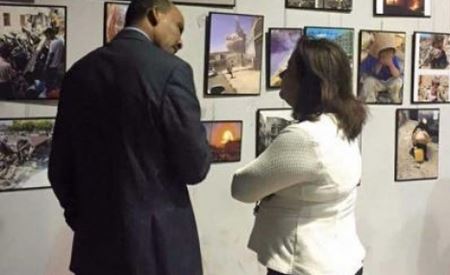
25688The exhibition at the El-Sawy Culture Wheel (Image: Al-Misryyoun, Egypt, July 9, 2015)

However, Arab media featured reports on meetings held in Cairo between Egyptian officials and Abu Bakr Al-Qirbi, an emissary for ousted president Saleh, to formulate a solution to the Yemeni crisis that would not include the Al-Islah party. Sources said that Saudi Arabia had told Egypt it was displeased by this move.[53]   Conversely, the Lebanese daily Al-Akhbar reported on July 24 that the Egyptian officials’ meetings with Saleh’s and Houthi representatives had been held with Saudi Arabia’s knowledge.[54]

Saudi Arabia Thwarts Egyptian Initiative To Establish “Joint Arab Force”

Another clear expression of the many disagreements between Egypt and Saudi Arabia can be seen in the fact that in recent months, Saudi Arabia has repeatedly delayed an initiative presented by President Al-Sisi to establish a joint Arab force empowered by the Arab League to carry out missions to defend Arab countries. Al-Sisi intends for this new force to be sent by the Arab League to Libya, to remove the increasing threat to Egypt from terrorist elements operating there, including ISIS.

Al-Sisi presented this initiative to Arab leaders at the Arab League summit in March 2015, shortly after ISIS in Libya executed 21 Egyptian Copts living in the country. The initiative received the support of Arab leaders at the summit, and it was decided to hold deliberations and formulate a protocol to establish it. However, the Arab defense and foreign ministers summit that is set to convene to approve the formulated protocol has already been postponed twice – once on July 26,[55] and again on August 26.[56]

The London-based Qatari daily Al-Quds Al-Arabi claimed on September 2, 2015 that Saudi Arabia was behind the postponements. The report stated that Saudi Arabia had thwarted the Egyptian initiative due to the severe disagreements between the two countries on various topics, chiefly Syria and Yemen, and added that “the fact that a [new] date has not been set for the summit indicates that the disagreements run deep.” According to sources cited in the report, one of the main reasons for Saudi Arabia blocking the Egyptian move is the strong ties between the Al-Sisi and Al-Assad regimes, and Egypt’s efforts to achieve a political solution to the Syrian crisis that ensures Assad remains in power, which is contrary to the Saudi position. The report also states that initially, Saudi Arabia supported the establishment of the Joint Arab Force in an attempt to entice Egypt do join its coalition for Operation Decisive Storm in Yemen, but after Egypt did not commit to the coalition sufficiently, Saudi Arabia decided to reign in the Egyptian initiative. The report also cited analysts and associates of the Saudi regime who estimated that Al-Sisi’s aim in establishing the Joint Arab Force was not to combat terrorist organizations in Libya, but rather to suppress pro-MB Libyan rebels and establish a government under his sponsorship, allowing him to take control of the oil in eastern Libya. They said that Saudi Arabia was disinclined to take sides in the Libyan crisis and preferred to reach an UN-brokered solution geared at establishing a national consent government that includes the MB.[57]

Saudi Arabia Fails To Block Egyptian Media Assault; Tense Relations Persist

On July 30, 2015, Saudi Crown Prince Muhammad bin Salman arrived in Cairo for an official visit, meeting with President Al-Sisi and attending a graduation ceremony at the military college, during which Al-Sisi stressed that the prince’s visit to Egypt sent the message that Saudi Arabia and Egypt were “together.” The visit ended with the “Cairo Declaration,” which states that both countries will work to strengthen their military and economic ties and will cooperate on the strategic level.[58] The visit alleviated the concerns of many in the Egyptian media for a time, and the Cairo Declaration assured that the future of cooperation between the countries was secure. And indeed, immediately after the visit, Egypt approved an extension of its forces’ activity in Yemen until the end of the operation, even committing to dispatch ground forces to protect the ports of ‘Aden after they were liberated by forces loyal to Yemeni President Hadi. Furthermore, during and after the visit, the Egyptian press featured several articles praising the close relations between the countries. An article by journalist Mohammed Mujahid Al-Zayyat, published in Al-Ahram on August 3, even directly rejected the anti-Saudi allegations published in the Egyptian press mere weeks earlier. He claimed that Saudi Arabia did not really belong to the Turkey-Qatar-MB axis and that the visit to Saudi Arabia by Hamas Political Bureau Chief Khaled Mash’al had not been meant to show Saudi support for Hamas, which is in conflict with Egypt, or to circumvent Egypt as mediator in the intra-Palestinian reconciliation.[59]

25689Saudi Crown Prince Muhammad Bin Salman and Egyptian President Al-Sisi during the former’s visit to Cairo (Image: Al-Quds Al-Arabi, London, July 30, 2015)

However, Al-Misryyoun editor Gamal Sultan, who is known for criticizing the regime, stressed that anti-Saudi articles had appeared in official dailies, indicating that the tensions were real.[60] Moreover, even though there are occasional high-level meetings between Egypt and Saudi Arabia where the strong cooperation between the countries is emphasized and reports on their disagreements are denied, Arab press continues to feature numerous reports on the ongoing tensions between them. Thus, for example, Al-Quds Al-Arabi reported that King Salman had been scheduled to visit Egypt in early September after visiting the U.S., but eventually did not come. The daily claimed that the king’s change of plans reflected ongoing Saudi-Egyptian tensions.[61] On the other hand, Egyptian Foreign Minister Sameh Shoukry said in an interview on September 10 that the countries were preparing for a visit to Egypt by King Salman, even though a date had not been set yet, and reiterated that there were no disagreements between the countries, but rather that each country “has its own role and its own attitude…”[62]

On October 13, Al-Quds Al-Arabi reported that, following a proposal by Saudi ambassador to Egypt Ahmad Qattan, Saudi Arabia had paid to fly 50 Egyptian media figures to participate in the annual pilgrimage to Mecca and Medina. The daily stated that each year, Saudi Arabia funds the pilgrimage of media figures from countries friendly to Saudi Arabia, and that this year the largest group had been from Egypt. According to the report, Saudi Arabia hoped this move would help bridge its gaps with the Egyptian media, but this goal was not achieved. When the journalists returned to their country, they once again attacked Saudi policy, mainly on Syria.[63] This may have angered the Saudi ambassador, who reportedly had a harsh argument several days later with Sayyid Ahmed Al-Naggar, head of Al-Ahram‘s board of directors, during a festive dinner at the home of the Algerian ambassador to Egypt. Following the argument, news sites reported that the Saudi ambassador had left Cairo in a rage. Qattan quickly denied these reports, and speaking to the Egyptian daily Al-Watan he said: “Would I leave Egypt because of Ahmed Al-Naggar? That makes no sense.”[64] Official elements in both countries also issued swift denials that the ambassador had left Egypt, but the e-daily Rai Al-Yawm remained unconvinced, and claimed, in an October 19 editorial, that alongside the cancellation of King Salman’s visit to Egypt, this was another expression of the deteriorating relations between the countries.[65]


* Y. Graff is a research fellow at MEMRI.


Endnotes:


[1] See MEMRI Inquiry & Analysis Series Report No. 1155, Iran’s Support For The Houthi Rebellion In Yemen: ‘Without Iran There Would Be No War In Syria And Ansar Allah Would Have Never Emerged’, April 21, 2015.

[2] See MEMRI Inquiry & Analysis Series Report No. 1075, Unprecedented Tension Between Qatar And Saudi Arabia/UAE/Bahrain Threatens To Break Up Gulf Cooperation Council, March 14, 2014.

[3] After ISIS executed 21 Egyptian Copts living in Libya, Egypt retaliated by attacking ISIS targets in the country, an attack backed by the Arab League, aside for Qatar, which expressed reservations about the move. Egypt’s representative to the Arab League claimed that Qatar’s position “reveals its support for terrorism,” leading Qatar to recall its ambassador from Egypt. The Gulf Cooperation Council (GCC), in which Saudi Arabia is a central member, condemned the Egyptian Arab League representative’s statements against Qatar and the London-based Saudi dailies Al-Sharq Al-Awsat and Al-Hayat published articles expressing reservations about the military attack in Libya (see for example a February 18, 2015 article by Tariq Alhomayed in Al-Sharq Al-Awsatand a February 18, 2015  article by Randa Takieddine  in Al-Hayat).

[4] Al-Arabi Al-Jadid (London), March 15, 2015.

[5] Al-Shorouq (Egypt), July 24, 2015.

[6] Al-Akhbar (Lebanon), April 18, 2015.

[7] Al-Hayat (London), June 21, 2015.

[8] Al-Hayat (London), June 17, 2015.

[9] Albawabhnews.com, July 18, 2015.

[10] Al-Ahram (Egypt), July 24, 2015.

[11] Al-Shorouq (Egypt), July 13, 2015. The reference is to a street in Tehran which the Iranian regime named after Khalid Al-Islambouli, who assassinated Egyptian president Sadat in 1981. Officially, Iran has had no diplomatic relations with Egypt since 1980, when Khomeini severed them in protest of the Israel-Egypt peace treaty and of Egypt’s hosting of the deposed Iranian Shah. The name of the street in Tehran has long been emblematic of the difficulties facing a reconciliation between Egypt and Iran.

[12] Alarabiya.com, September 24, 2015.

[13] Al-Ahram (Egypt), July 29, 2015.

[14] Al-Ahram (Egypt), July 22, 2015.

[15] Al-Ahram (Egypt), September 8, 2015.

[16] Al-Masri Al-Yawm (Egypt), July 23, 2015.

[17] Al-Ahram (Egypt), July 24, 2015.

[18] Al-Masri Al-Yawm (Egypt), August 5, 2015.

[19] Al-Riyadh (Saudi Arabia), October 26, 2015.

[20] Al-Ahram (Egypt), September 10, 2015.

[21] Al-Sharq Al-Awsat (London), September 9, 2015.

[22] While Saudi Arabia states that it supports a political solution for the crisis, it seems to believe that the Assad regime should be pressured militarily in order to bring him to the negotiating table and force far-reaching concessions from him. Following a meeting of the Gulf Cooperation Council (GCC) foreign ministers on September 16, Saudi Foreign Minister ‘Adel Al-Jubeir said that if a political solution cannot be reached, then “the military option is still on the table,” and that the Syrian opposition has been dealing with Assad with increasing effectiveness. Al-Watan (Saudi Arabia), September 16, 2015. Al-Jubeir reiterated these statements in a press conference during the UN General Assembly on September 30. Al-Watan (Egypt), September 30, 2015.

[23] After elaph.com published the document, Egypt issued an official denial that it had formulated an initiative to solve the Syrian crisis. Elaph.com, December 25, 2014. The document published by the website proposed that opposition and regime delegations conduct direct talks sponsored by the UN based on the Geneva 1 declaration, Security Council resolutions on Syria, and the six point peace plan proposed by Kofi Annan, who served as the UN and Arab League’s joint special envoy to Syria, which he presented to the Security Council on March 16, 2012. Annan’s plan included: calling on the Assad regime to commit to a political process that meets the aspirations of the Syrian people; ending fighting and withdrawing troops from population areas; enabling the transfer of humanitarian aid; releasing political prisoners; and enabling journalist’s freedom of movement as well as freedom of expression and protest. See Aljazeera.com, March 27, 2012.

[24] In his speech at the 70th UN General Assembly on September 28, 2015, Al-Sisi called on Syrian opposition and regime elements to come to Cairo to negotiate “in order to formulate a clear vision for a transitional phase in accordance with the Geneva document, which will provide a common ground for all Syrians to build a democratic Syria that is sovereign over all its territory, and which preserves the state’s essence and institutions, respects the variety of elements in its population, and strengthens their national affinity.” He stressed that “these Syrian national elements are invited today to participate and invest every effort in negotiations to find a political solution to the crisis that realizes the ambitions of the Syrian people. ” Al-Quds Al-Arabi (London), September 30, 2015. In this statement, Al-Sisi expressed the main principles of Egypt’s policy on the Syrian crisis: Finding a political solution through dialogue with the regime, and preserving existing state institutions.

[25] Al-Ahram (Egypt), October 5, 2015.

[26] Al-Ahram (Egypt), September 7, 2015.

[27] Al-Sharq Al-Awsat (London), October 4, 2015.

[28] See MEMRI Inquiry & Analysis Series Report No. 1125, Egypt’s Position On International Anti-ISIS Coalition: Reserved Support Alongside Refusal To Commit To Military Participation, October 22, 2014.

[29] Al-Akhbar (Lebanon), January 3, 2015.

[30] Presidentassad.net, August 25, 2015.

[31] Al-Ahram (Egypt), August 20, 2015.

[32] Al-Akhbar (Egypt), August 19, 2015.

[33] Al-Safir (Lebanon), February 11, 2015.

[34] Alahednews.com, September 22, 2015.

[35] Al-Hayat (London), December 18, 2014.

[36] Aksalser.com, January 26, 2015.

[37] See for example, Riyadh Sanih, Al-Ahram (Egypt), August 9, 2015; ‘Asim Bakri, Al-Masri Al-Yawm (Egypt), August 19, 2015; Gamil ‘Afifi, Al-Ahram (Egypt), September 8, 2015; and Muhammad Hussein Abu Al-Hassan,Al-Ahram (Egypt), September 9, 2015.

[38] Al-Ahram (Egypt), April 17, 2015.

[39] Al-Ahram (Egypt), June 9, 2015.

[40] Al-Ahram (Egypt), February 17, 2015.

[41] Al-Ahram (Egypt), September 8, 2015.

[42] Al-Shorouq (Egypt), May 31, 2015.

[43] Al-Yawm Al-Sabi’ (Egypt), April 4, 2015.

[44] Al-Akhbar (Lebanon), April 17, 2015.

[45] Al-Shorouq (Egypt), May 31, 2015.

[46] Al-Akhbar (Lebanon), August 21, 2015.

[47] Al-Yawm Al-Sabi’ (Egypt), April 6, 2015.

[48] See MEMRI Inquiry & Analysis Series Report No. 1061, Egyptians Deeply Divided Over Law Restricting Public Protests, January 28, 2014.

[49] Raialyoum.com, April 9, 2015. The article mentioned a tweet by Saudi journalist Jamal Khashoggi, who also implied that Egyptian authorities might have quietly approved of the protest or even organized it, since “the operating principle of the Egyptian police is: If you protest without authorization – you will be killed.”

[50] Named for Abdel Moneim El-Sawy (died 1984), who founded the Egyptian news agency and served as culture minister under President Sadat.

[51] Al-Hayat (London), July 13, 2015.

[52] Al-Jazirah (Saudi Arabia), July 16, 2015.

[53] Al-Arabi Al-Jadid (London), June 6, 2015; Albawabhnews.com, July 18, 2015.

[54] Al-Akhbar (Lebanon), July 24, 2015.

[55] Al-Sharq Al-Awsat (London), July 27, 2015.

[56] Alarabiya.com, August 26, 2015.

[57] Al-Quds Al-Arabi (London), September 2, 2015.

[58] Al-Hayat (London), August 3, 2015.  At the last Summit of South American-Arab Countries, held in Riyadh on November 10-11, 2015, Al-Sisi met with the Saudi king in another show of unity. Following this meeting the two countries’ FMs signed a protocol for establishing an “Egyptian-Saudi Corrdination Council” to implement the resolutions of the Cairo Declaration. Elaph.com, November 11, 2015.

[59] Al-Ahram (Egypt), August 3, 2015.

[60] Al-Misryyoun (Egypt), August 2, 2015.

[61] Al-Quds Al-Arabi (London), September 8, 2015.

[62] Al-Sharq Al-Awsat (London), September 9, 2015.

[63] Al-Quds Al-Arabi (London), October 13, 2015.

[64] Al-Watan (Egypt), October 17, 2015.

[65] Raialyoum.com, October 19, 2015.

No good news in the Mid East for Obama or Netanyahu when they meet Monday

November 8, 2015

No good news in the Mid East for Obama or Netanyahu when they meet Monday, DEBKAfile, November 8, 2015

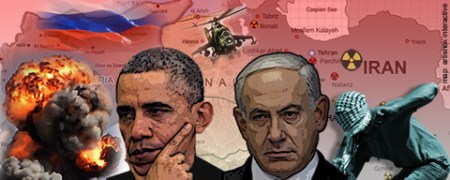
Obama_Bibi2480

After more than a year, Israeli Prime Minister Benyamin Netanyahu meets President Barack Obama at the White House on Monday, Nov. 9, with the deck heavily stacked against him – and not just because of the Islamic State, which is a universal bane, or Obama’s Iran policy – or even the evaporation of the peace process with the Palestinians. This time, Netanyahu is not getting a dressing-down over the disappearance of the two-state solution, because even the US president has decided to shelve it for the remainder of his presidency which ends in January 2017.

This is not because the Netanyahu government has missed any chances for talks with the Palestinians, as the Israeli opposition loudly claims, but because it is unrealistic.

Palestinian Authority Chairman Abu Mazen (Mahmud Abbas), who lost all credibility on the Palestinian street long ago, has been quietly but continuously encouraging the continuous Palestinian wave of terror by knives, guns and cars.

The Israeli prime minister had his most promising card snatched from him just ten days before he traveled to Washington. He had intended presenting the US president with the quiet alliance he had formed with key moderate Arab governments as a viable alternative for the deadlocked Palestinian peace process, with the promise of a measure of stability for its members in the turbulence around them.

However, the linchpin Egyptian President Abdel-Fatteh El-Sisi’s position was suddenly shaken up badly by the downing of the Russian passenger plane over Sinai on Oct. 31, presenting him with his most dangerous crisis since he took power in 2013.

In addition, the security situation in Syria, including along Israel’s northern border, especially the Golan, has gone from bad to worse – especially since Russia built up its military presence in Syria.

Israel has been forced to forego most of its red lines for defending its security as no longer relevant. Although no Israeli official says so openly, Israel’s military options in Syria have shrunk, and even the overflights by its air force flights for keeping threats at bay are seriously restricted..

Iran and Hizballah, under Russian air cover, have been slowly but surely making gains in their attempt to retake southern Syria from the rebels and hand it over to the army of Syrian President Assad.

Israel is still insisting that it will not allow the deployment of Iranian or Hizballah forces on the Syrian side of the Golan, but these statements are losing their impact. If the coalition of Russia, Iran, Syria and Hizballah defeats the rebels in southern Syria and moves in up to its border, Israel will find it extremely difficult to prevent this happening.

It would also mark the end of more than three years of investment and building of ties with various elements in southern Syria as part of a strategic decision to transform those groups into a buffer between Israel and Iran in the Golan area.

Netanyahu’s struggle against the nuclear deal with Iran was not just aimed at Washington’s recognition of Iran’s nuclear program, but ever more at Obama’s acknowledgement of Iran as America’s strategic partner and leading Middle East power. But in this respect, the US president is most likely chafing over the setbacks to his own cherished plan, as a result of four developments:

1. Iran has plunged more deeply than ever predicted into the Syrian conflict. For the first time since the 19th century, Iran has not only sent its military to fight beyond its borders, but it is coordinating its moves with Moscow, not Washington.

Even if Israel needed to turn to the US administration for a helping hand against Iran, it would have no address because Washington too has been displaced as a power with any say in the Syrian picture.

2. Although the alliance by Israel and moderate Arab countries was designed by Netanyahu to serve as a counterweight to the US-Iranian partnership,  that alliance too is far from united on Syria:  Egyptian President El-Sisi, for example, supports President Bashar Assad, and is in favor of keeping him in power in Damascus.

3. The Islamic State continues to go from strength to strength in Syria and the Sinai Peninsula which share borders with Israel as well as in Iraq.

4. Israel’s political, defense and intelligence elite have badly misread or missed altogether four major events in the region:

  • Assad’s persistent grip on power
  • The deep Russian and Iranian military intervention in Syria
  • The strengthening of ISIS
  • The eruption of a new, deadly Palestinian campaign of terror which strikes unexpectedly in every town, highway and street.

These errors are taking their toll on Israel’s security, wellbeing and prestige.

Even if Israeli Prime Minister Netanyahu and US President Obama, like Defense Minister Moshe Yaalon and Secretary of Defense Ashton Carter, do reach an agreement on Israel’s security needs for the coming years and US military assistance, such an agreement may not withstand the test of Middle East volatility. The rapidly changing conditions are for now all to the detriment of the US and Israel.

Amplifying Details on the Sinai Plane Bombing and the Egypt-Libya Nexus

November 7, 2015

Amplifying Details on the Sinai Plane Bombing and the Egypt-Libya Nexus, Independent Strategy and Intelligence Study Group, November 7, 2015

The last few days have been filled with a flurry of information regarding the downing of Flight 7K9268. Within the last 18 hrs we’ve received amplifying information from our sources in the country. Our sources within the Egyptian Directorate of Military Intelligence (DMI) confirmed that Russian investigators found the remnants of the explosive device we were talking about in our 03 NOV “Sinai Plane Crash Update.” Furthermore, the running theory of those investigators is that depressurization caused by an internal explosion tore off the tail section, causing the plane to flip over and send it to the ground. When we asked one of our sources if 500 grams of C4 could cause that, he answered back that it wouldn’t take much to bring a plane down, especially if the device was placed near the fuel line – which is what DMI assesses to be the case. Another source working with Russia’s Health Ministry Center for Forensic Medical Expertise confirmed that parts of an explosive device was uncovered.

sinai-crash-300x168Source: Associated Free Press/Getty Images (Maxim Grigoryev)

As for the operative who emplaced the device on the plane, we’ve confirmed that the individual did not receive any assistance from a member of the security forces – because he’s a member of the security forces himself. The individual in question used his position to circumvent the 8 explosive detection systems and security checkpoints located at the airport in order to get to his target. DMI knew how this went down fairly quickly, although our sources couldn’t answer how this fell through the cracks, although they did imply that the security forces are plagued with serious internal issues due to the rising insider threat. However, Sharm al-Sheik Airport Chief Abdel-Wahab Ali was removed from his position due to these major security lapses. The fact that the British government aired these very same concerns LAST YEAR made the decision to remove him much easier.

The Latest: Sharm El-Sheikh Airport Chief Has Been Replaced
http://www.nytimes.com/aponline/2015/11/04/world/middleeast/ap-egypt-russian-plane-crash-the-latest.html?_r=0

UK had concerns about Sharm el-Sheikh airport security almost a year ago
http://www.theguardian.com/politics/2015/nov/05/uk-had-concerns-sharm-el-sheikh-airport-security-year-ago-egyptian-beach-resort

Sinai Plane Crash Update
http://isisstudygroup.com/?p=9184

IS-Sinai-300x135Islamic State-Sinai (IS-Sinai) aka “Wilayat Sinai (WS)”: Just entered the next stage of Operations. Source: The ISIS Study Group

Adding further weight to what we’ve been saying is that the Black Box reveals that the crash was not an accident. More importantly, the media (and some Western governments) are saying what we first mentioned in our “Sinai Plane Crash Update.” Excerpt:

European investigators who analyzed the two flight recorders from the Metrojet plane that went down last weekend in Egypt are categorically saying the crash is not an accident, CNN affiliate France 2 reported Friday.

The investigators said the cockpit voice recorder of Metrojet Flight 9268 shows an explosion and the flight data recorder confirms the explosion is not accidental — there is no sign of mechanical malfunction during the initial part of the flight, France 2 reported.

Everything is fine during the first 24 minutes, then in a fraction of a second there is a blackout and no more cockpit conversation, convincing investigators there was a bomb on board, according to France 2.

CNN Aviation Analyst Richard Quest said there would have been different data on the black boxes if there was a catastrophic failure than if there was an explosion. The key is what happened just before the data suddenly stops, he said.

“It’s this split second, and it’s a millisecond, where you hear an explosion of some description,” he said. “And you see all the parameters (on the recorders) go haywire before the power is completely lost. If this report is accurate, (investigators) have now analyzed that … heard it and they can identify it.”

If the plane had broken apart due to structural failure, there would have been more noise — and for a longer time, he said.

France’s air accident investigation agency, the BEA, told CNN that Egyptian officials will make an announcement about the crash investigation within the next 24 hours.

Report: Black boxes show bomb brought down Russian jet
http://www.cnn.com/2015/11/06/middleeast/russian-plane-crash-egypt-sinai/

Screen-Shot-2015-11-06-at-6.50.48-PM-300x167

Media now talking about the bomb being placed in the cargo hold among the luggage near the fuel line
Source: CNN

This wasn’t the first time WS gained access to an Egyptian airport either. Last year they recruited an employee at Cairo International Airport who provided Team Baghdadi with schematics of the facility, locations of guard postings and security procedures. Fortunately, DMI found out and arrested him before the attack plan was set into motion – which was the same plan carried out in Sharm al-Sheik. This was one of a long list of incidents – many of which were never reported by the country’s media outlets – that led to GEN Sisi authorizing the DMI to lead the crackdown on the insider threat within the security forces. From MAY 15 – JUL 15 several junior and mid-level officers within the Army were detained for either being sympathizers or full-fledged members of WS. There’s also been an increase in military personnel refusing to carry out missions against WS – not because they’re “scared” – because they “didn’t want to kill their Muslim Brothers” (which is a red flag since most Muslims would never consider IS as their “Muslim Brothers”). For the most part the military has been the main advocate for moderate Islam and secularism. Unfortunately, that all changed when the Muslim Brotherhood’s Muhammad Morsi rose to power, where he quickly began to sack “problematic” (read-those of moderate Islam or secular leanings) officers. Then he began to fill the ranks with those he reflected his values – in other words, guys with extremist views. The result was a new breed of officers in the junior and mid-level ranks who were very sympathetic to the ideologies of al-Qaida (of which the MB is closely-aligned) and IS. WS’ increase in capability is a good indicator of the success they’ve had in recruiting personnel with formal military experience (Check out “ISIS-Sinai Beheads Croatian Hostage – Just the Beginning” for additional info).

ISIS-Sinai Beheads Croatian Hostage – Just the Beginning
http://isisstudygroup.com/?p=8195

mohamed-morsi-300x225Egypt’s insider threat: Morsi’s legacy. Source: Sharif Abdel Minoem (Associated Press)

The bombing of that Russian airliner is the beginning of WS and IS’ Libya affiliate entering into a new phase of Team Baghdadi’s overall global campaign of conducting high-profile attacks outside of Syria and Iraq. WS followed up the plane bombing with another attack targeting an officer’s club that killed three policemen. But that’s just the start – WS fully intends to expand their operations to targeting Russians and Western tourists to both cripple Egypt’s tourism industry (which would result in significant economic damage) and retaliating for Russia’s Syria intervention. The indicators were all there with the sharp increase in the frequency and scale of attacks carried out by WS in Sinai throughout the year and this past summer in particular (Reference – “Sinai Under Siege Rising capabilities of Wilayat Sinai”). That said, the first real indicators of WS’ increased capabilities was seen as early as JAN 14 when they shot down an Egyptian military helicopter in the Sinai with a MANPAD that was traced back to one of the Qaddafi regime weapons depots that was raided by so-called “moderates” during the early days of the “Arab Spring.” In AUG 15 another attempt was made by WS to bring down an aircraft – this time a Thomson Airways airliner – as it was heading to Sharm al-Sheik Airport. Fortunately the pilot was able to perform evasive maneuvers and avoid being brought down (See the Guardian’s article titled, “Sharm el-Sheikh flight from Stansted dodged missile in August” and our initial piece on the Sinai crash, “Islamic State Claims to Have Shot-Down Russian Plane in Sinai – But Did They?”).

Egypt: 3 police officers killed in North Sinai bombing
http://www.cnn.com/2015/11/04/africa/egypt-north-sinai-bombing/

Militants Down Egyptian Helicopter, Killing 5 Soldiers

Sharm el-Sheikh flight from Stansted dodged missile in August
http://www.theguardian.com/uk-news/2015/nov/06/missed-by-a-1000-feet-how-british-holidaymakers-came-close-to-being-hit-by-a-missile-in-august?CMP=twt_gu

Sinai Under Siege Rising capabilities of Wilayat Sinai (WS)
http://isisstudygroup.com/?p=7587

Islamic State Claims to Have Shot-Down Russian Plane in Sinai – But Did They?
http://isisstudygroup.com/?p=9157

WS-July-2015-attack-Sinai-300x169

This is just a quick snapshot of attacks that occurred in JUL 15
Source: The ISIS Study Group

WS also wanted to show Baghdadi that they’re an effective force capable of achieving the objectives of his external operations campaign, but also to justify that their request for additional funding. This was also a bid for obtaining heavier weaponry from IS’ Libya affiliate, who sends weapons and supplies to Syria – some of which goes through Sinai (Check out “The Strategic Importance of Egypt to ISIS,” “2015: The Year of ISIS Expansion From Gaza to North Africa” and “The ISIS Expansion Into North Africa” for more details). We don’t think Libyan IS Emir Abu Nail will satisfy that request until after he seizes Darnah – which IS was driven out of back in JUN 15. As of this writing, IS-Libya has been busy consolidating its forces in the al-Fatayeh-area located Southeast of the city. That area is the likely staging-area from which the offensive to retake the town will be launched. The Libyan affiliate is facing a tough fight as they’re forced to take on several other opposition groups of varying jihadist flavors as well as the forces of the Egypt-back Libyan GEN Khalifa Haftar.

For the third time, Haftar’s forces fail to control Derna
https://www.middleeastmonitor.com/news/africa/20744-for-the-third-time-haftars-forces-fail-to-control-derna

Isis in Libya: Islamic State driven out of Derna stronghold by al-Qaeda-linked militia
http://www.ibtimes.co.uk/isis-libya-islamic-state-driven-out-derna-stronghold-by-al-qaeda-linked-militia-1506241

ISIS responsible for most Libya killings: ICC prosecutor
https://www.dailystar.com.lb/News/Middle-East/2015/Nov-06/321833-isis-responsible-for-most-libya-killings-icc-prosecutor.ashx

ISIS In Libya? Gadhafi Sirte Residence Searched By Islamic State For Hidden Money: Report
http://www.ibtimes.com/isis-libya-gadhafi-sirte-residence-searched-islamic-state-hidden-money-report-2139456

Warplanes bomb Libya’s Sirte, target Islamic State: witness
http://www.reuters.com/article/2015/10/29/us-libya-security-idUSKCN0SN2JM20151029

The Strategic Importance of Egypt to ISIS
http://isisstudygroup.com/?p=1392

2015: The Year of ISIS Expansion From Gaza to North Africa
http://isisstudygroup.com/?p=5248

The ISIS Expansion Into North Africa…
http://isisstudygroup.com/?p=3257

IS’ Libya affiliate is the terror organization’s most-developed branch and has become a critical part of Baghdadi’s vision of being able to project power outside of Syria/Iraq. Its worth noting that the Libya affiliate has been tasked with providing material support to other affiliates in North Africa in addition to WS and the main effort in Syria. WS actually receives a great deal of their financial support from the Libya affiliate. In fact so much influence has been placed on bolstering the Libya affiliate that some foreign fighters have actually been diverted there. Our sources report the presence of fighters from France, Germany, Egypt, Algeria, Sudan, Saudi Arabia, Canada and one unconfirmed report of Americans serving among the ranks. Recent reporting also suggests that a group of Indonesian jihadists are projected to be entering the country for this same purpose – other sources imply that they may have already arrived. Not only is Libya an alternative for foreign fighters who aspire to wage jihad but can’t make the trip to Syria, its a training ground for select personnel who get sent back to their countries of origin to establish their own attack networks and conduct the cell-based external operations that the IS leadership has been transitioning to over the last few months (For more info on this transition to cell-based external OPs, check out “Neil Prakash and Friends – an Update” and “Nail in the Coffin: ISIS’ Anwar al-Awlaqi BN Sends Fighters to Europe”). Think of it as IS’ way of “diversifying their terror portfolio” for their goal of launching such attacks in the West.

Neil Prakash and Friends – an Update
http://isisstudygroup.com/?p=8862

The Loss of Key ISIS External OPs Figures and the Anwar al-Awlaqi Battalion
http://isisstudygroup.com/?p=8467

Nail in the Coffin: ISIS’ Anwar al-Awlaqi BN Sends Fighters to Europe
http://isisstudygroup.com/?p=8562

With all this happening, what’s next for Vlad? Make no mistake, he’s going to respond – and when he does, people are either going to die or “disappear.” The big mistake the IS mothership in Syria and the Sinai affiliate made is thinking that Vlad is as soft and flaccid as President Obama. They’re going to find out real quick just how big of a mistake they made once he expands his intervention in Syria (although there will be challenges-more on that in another article) followed by enhanced collaboration with the Sisi regime – which has been steadily moving away from America and getting closer to Russia for well over a year (Check out “Egypt Atmospherics” for more details). On the flip side we assess that IS’ Caucasus affiliate (made up mostly of remnants of Imarat Kavkaz or “IK”) are going to become very active in launching attacks inside Russia itself. Although the media seized on the fact that Syria is one of Vlad’s client states, what didn’t get any real coverage are the 2,500-3,000 Russian nationals currently fighting under the IS banner in Syria – many of which are of Chechen/Dagestani/Tajik ethnicity (Reference the following for additional info – “Russia Poised to Increase Military Presence in Middle East in Response to Islamic State’s Strength,” “Islamic State’s Expansion into the Caucasus Region,” “Gulmurod Khalimov Update – His Militant Views May Not Be a Recent Development” and “Introducing Tajik Special Police COL Gulmurod Khalimov: Islamic State Defector”). At some point those foreign fighters are going to return to Mother Russia. A few already have. So if you thought this high-profile attack was an “isolated incident” that only affects Egypt, you thought wrong.

Egypt Atmospherics…
http://isisstudygroup.com/?p=614

Russia Poised to Increase Military Presence in Middle East in Response to Islamic State’s Strength
http://isisstudygroup.com/?p=8416

Islamic State’s Expansion into the Caucasus Region
http://isisstudygroup.com/?p=6880

Gulmurod Khalimov Update – His Militant Views May Not Be a Recent Development
http://isisstudygroup.com/?p=7760

Introducing Tajik Special Police COL Gulmurod Khalimov: Islamic State Defector
http://isisstudygroup.com/?p=7027

vlad2-300x219

Egyptian locals are increasingly “Pro-Vlad” – but aren’t big fans of President Obama
Source: The ISIS Study Group

Other Related Articles:

Haftar-Sisi Alliance: The Roadblock to ISIS Bridge Into the Maghreb
http://isisstudygroup.com/?p=5033

Egypt Strikes ISIS Positions in Libya: Moderate Muslims Rise Up Against Terror
http://isisstudygroup.com/?p=4889

Egypt and UAE Launch Airstrikes in Libya – US Kept in the Dark
http://isisstudygroup.com/?p=1302

Is Egypt Planning Military Intervention in Libya?
http://isisstudygroup.com/?p=584

Jordan Steps Up Airstrikes Against ISIS, Egypt Launches New Sinai Offensive
http://isisstudygroup.com/?p=4669

Egyptian Army and IDF Take On ISIS Supporters in Sinai
http://isisstudygroup.com/?p=1500

Egyptian Army Hits Back At ISIS In Sinai
http://isisstudygroup.com/?p=2410

ISIS Plots to Bring the “Flames of War” to US, UK and Australia
http://isisstudygroup.com/?p=6431&

Putin halts flights to Egypt until “true causes” known for Metrojet crash

November 6, 2015

Putin halts flights to Egypt until “true causes” known for Metrojet crash, DEBKAfile, November 6, 2015

(Please see also, Russia to suspend flights to Egypt until causes of Sinai crash are clear. — DM)

Bomb_evidence_B_5.11.15

They discovered holes made by iron balls planted inside a bomb and scattered through all parts of the plane (see attached photos), as well as large tears in the outer walls that were caused by a powerful explosion.

****************************

President Vladi­mir Putin halted all Russian flights to Egypt Friday, Nov. 6, “until we know the true causes of the incident” .i.e. the cause of the Russian Metrojet flight crash over Sinai Saturday which killed all 224 people aboard. Several European and Gulf Arab governments suspended flights to Sharm el-Sheikh, but Russia was the first to halt all outbound flights to Egypt. Kremlin spokesman Dmitry Peskov said that Putin acted on the recommendation of the Russian security service chief Alexander Bortnikov.

The language of the statement – “true causes of the incident” – indicates that the Russians have lost patience with President Abdel-Fatteh El-Sisi and don’t trust the Egyptian investigation into the causes of the disaster. For most of the week, the Russians played along with Egypt’s obstinate resistance to any suggestion of terrorism and insisted on waiting for the official investigations before making any determinations. Thursday, Moscow sharply criticized British prime minister for presuming on the strength of intelligence that the plane was most likely downed by a bomb.

Putin abruptly changed course Friday following four developments:

1. Russian investigators collecting samples at the crash scene in Sinai found residue and other evidence of an explosion emanating from inside the plane or externally from a missile. They discovered holes made by iron balls planted inside a bomb and scattered through all parts of the plane (see attached photos), as well as large tears in the outer walls that were caused by a powerful explosion. Samples from the airplane’s wreckage were collected and presented to a meeting of the National Anti-Terrorist Committee Thursday.

Mourners_memory_5.11.15

2.  Forensic examination of victims’ remains left no doubt that they died as a result of an explosive blast.

These findings spread like wildfire in Moscow and in St. Petersburg among the grieving families. The Russian leader saw he could no longer afford to line up with Cairo’s playdown of the terrorist factor.

3. Moscow received intelligence that the Islamic State plans to follow up on its first “success” with further terrorist attacks on Russian and European passenger jets.

By downing the Russian airliner over Sinai, the Islamist terror group delivered a huge blow to Egypt’s tourism industry. Russia tops Egypt’s tourist market. Last year, 3.1 million Russians visited Egypt, yielding $2.5bn out of the total national tourism income of $7.3bn in 2014.

Sharm el-Sheikh was the scene of havoc Friday, as Russian and British tourists mobbed the airport in an attempt to fly home after the Egyptian authorities limited the number of outbound flights.

Anti-air missiles in ISIS hands also imperil Saudi, Jordanian and Israeli skies

November 5, 2015

Anti-air missiles in ISIS hands also imperil Saudi, Jordanian and Israeli skies, DEBKAfile, November 5, 2015

Shut_up

The Ansar al Sharia terrorist organization in Libya, which attacked the US consulate in Benghazi and murdered the American ambassador in 2012, has the very missiles capable of shooting down large airliners flying at high altitudes: Russian-made ground-to-air Buk missiles, which have a range of between three and 42 kilometers. This ultra-violent Islamist terror group has very close operational ties with ISIS-Sinai, and very possibly smuggled the missile system into Sinai from Libya.

****************************

The British Cobra (emergency cabinet) decision of Wednesday, Nov. 4, not to send airliners to or from Sharm El-Sheikh, where 20,000 British tourists are stranded, further strengthens the assumption that the Russian Metrojet Flight 9268 was downed over Sinai Saturday by a terrorist missile. It confirms that air traffic over Sinai and landings at Sharm are under threat from the ground – else why leave a large group of Britons under virtual siege in the Egyptian Red Sea resort? London said that the suspension of flights to Sharm was “indefinite.”

Moscow early Thursday accused London of being moved to this action out of hostility to Russia rather than security concerns.

Downing Street released a statement Wednesday saying: “As more information has come to light, we have become concerned that the plane may well have been brought down by an explosive device.” This statement was criticized by Egypt as “premature” – not a good omen for the conversation Prime Minister David Cameron is due to hold with his visitor, Egyptian president Abdel-Fatteh El-Sisi, later Thursday.

The British government has therefore stubbed toes in Moscow and Cairo without coming up with an emergency plan for evacuating its citizens from Egypt, whether overland to Cairo by bus or by sea aboard ships picking them up at the Red Sea resort and sailing through the Suez Canal.

This lack of initiative is a sign of confusion and uncertainty.

So far, the drawn-out deliberations and prevarications by officials in several countries regarding the crash of the Russian plane are meant for one purpose: to gain time for doing nothing about ISIS in Sinai. Neither the US, Russia or Britain is ready to send forces to the peninsula to confront the terrorists head-on.

The Ansar al Sharia terrorist organization in Libya, which attacked the US consulate in Benghazi and murdered the American ambassador in 2012, has the very missiles capable of shooting down large airliners flying at high altitudes: Russian-made ground-to-air Buk missiles, which have a range of between three and 42 kilometers. This ultra-violent Islamist terror group has very close operational ties with ISIS-Sinai, and very possibly smuggled the missile system into Sinai from Libya.

A number of intelligence agencies are aware of this and so a flock of leading European and Persian Gulf airlines lost no time in rerouting their flights to avoid Sinai straight after the Russian air disaster.

By causing this disaster, the Islamist terrorists coolly aimed for four goals:

1.  Retaliation for Russian intervention in Syria

2.  An attempt to destabilize the regime of Egyptian President Fattah Al-Sisi

3.  To show up the inadequacies of the 63-member coalition that the US formed in its effort to fight ISIS

4. To parade before the world the Islamic State’s operational prowess, its ability to shoot down the large passenger planes of the world’s biggest powers.

For five days, intelligence and flight safety experts dismissed the claim of responsibility that ISIS issued on the evening of October 31, maintaining that it was not to be taken seriously because no proof had been provided to support the claim – as if the charred fragments of the plane spread across tens of kilometers of desert were deniable.

In the second of its three messages, ISIS repeated its claim Wednesday, Nov. 4, promising details of how it downed the plane at a later date.

While more and more Western governments are coming around to accepting that the Russian airliner’s crash was caused by an explosive device, DEBKAfile’s counterterrorism sources repeat that they cannot rule out the possibility of a missile. The argument made on Wednesday in Washington and London that terrorist organizations do not have missiles capable of downing such planes is are simply incorrect.

ISIS-Sinai’s possession of an advanced ground-air missile system does not only endanger planes in the peninsula’s airspace, but also those aircraft flying over the Suez Canal as well as parts of Saudi Arabia, Jordan and Israel. One of the Egyptian president’s main purposes in his London visit was to try and persuade Prime Minister Cameron to join an Egyptian military operation against Ansar al Sharia in Libya and so eliminate a major prop and arms supplier for ISIS-Sinai. He does not hold out much hope of success.

Russian-made cargo plane crash in S. Sudan kills dozens. Second Mid East air disaster

November 4, 2015

Russian-made cargo plane crash in S. Sudan kills dozens. Second Mid East air disaster, DEBKAfile, November 4, 2015

RussianPlaneSinai_Sudan2nd Russian-linked air crash kills dozens in Sudan. The missile or bomb which blew up the Russian airliner over Sinai Saturday is reported by DEBKAfile’s sources to have been likely smuggled in from Libya. Nov 4, 2015, 12:29 PM (IDT)

While neither the Egyptians or the Russians are willing to admit this, it is highly likely that the missile or explosives which brought down the Russian airliner Saturday came from Libya.

*********************

No cause has yet been established for the Russian-made Antonov Ant-12’s crash-landing on the east bank of the Nile River 800 m short of Juba international airport in South Sudan Wednesday, Nov. 4. Its five-man crew were Russians. According to first reports some 40 people were killed both on board and on the ground, although there appear to be two survivors.

But none of the 224 passengers and crew aboard the Metrojet Flight 9268 Airbus 321 survived the airliner’s crash in central Sinai Saturday, Oct. 31, en route from their holiday in Sharm El Sheikh to St. Petersburg.

Russian sources following the forensic examination of the bodies and partial remains of the victims flown to St. Petersburg report that they show evidence of an explosion in the plane before it plummeted to the ground. Further testing is required to establish the cause of the explosion.

A US infrared satellite detected a heat flash at the same time and same vicinity over Sinai where the Russian plane went down. A US defense official added that the same satellite would have been able to track the tell-tale heat trail of a missile from the ground.  “The speculation that this plane was brought down by a missile is off the table,” the official said.

Another official said, “the plane disintegrated at a very high altitude.”

The general consensus ahead of the Egyptian and Russian probes is that a sudden, catastrophic explosion caused the crash – whether from a bomb inside, “external impact” – as the Metrjet company claims – or from faulty fuel. Russian fuel experts found nothing wrong with the fuel.

An Egyptian physician who inspected the scene of the disaster found that one out of every five bodies he saw had been incinerated to death from a fire that may have started in the passenger’s cabin and spread to the rest of the plane.

Egyptian experts reported that “the large number of separate body fragments” could indicate that a strong explosion occurred onboard before the aircraft hit the ground. They were scattered across a radius of 8-10 square kilometers from the wreckage.

Russian and Egyptian sources tracking the examination of the two black boxes found evidence that the calamity occurred too rapidly for the pilots or crew to send an SOS or even say a few words.

As the probe of the air catastrophe began Tuesday and Wednesday, Moscow and Cairo were increasingly at odds on their findings. The Russians asserted that the plane must have broken up into two parts as a result of a strong explosion, whereas Egyptian officials remained intent on playing down the claim of responsibility for the crash published Saturday by the Sinai wing of the Islamic State. They criticize the Russians as rushing to conclusions ahead of the probe.

Egyptian President Abdel-Fatteh El-Sisi arrived in London Wednesday for talks with British Prime Minister David Cameron. In interviews prior to his arrival, the Egyptian president said that he will demand that David Cameron “complete his mission in Libya to prevent the country being dominated by Islamists.”

By “mission,” El-Sisi was referring to the UK’s role in the coalition which toppled Muammar Qaddafi in 2011.

DEBKAfile’s counterterrorism sources report that Egypt faces an acute problem from Libya’s transformation in the last two years into the main supply source of smuggled arms and fighters for the Islamist terrorists operating in Egypt and Sinai.

While neither the Egyptians or the Russians are willing to admit this, it is highly likely that the missile or explosives which brought down the Russian airliner Saturday came from Libya.