Ben Carson Endorses Donald Trump FULL Press Conference (3-11-16) via You Tube, March 11, 2016
Op-Ed: Why Trump and only Trump can beat Hillary, Israel National News, Jack Engelhard, March 10, 2016
The crux of it is that Hillary Clinton is the most famous woman in America. To beat her in the general election you will need someone equally famous.
Does the name Kasich come to mind? Rubio? Cruz?
Americans don’t know these people. They’re good guys, as good as anyone, I suppose, but they are strangers and have no shot.
You and me – we watch Fox News, occasionally CNN and MSNBC for the laughs, but our neighbors are watching “Dancing with the Stars.”
So it’s Trump and only Trump and only Trump is as well-known as Hillary the crook.
It should not be that way, I know. It should be about issues and sometimes it is, but mostly it isn’t. It’s about fame.
Americans – we gravitate to fame. Maybe it’s the same all over, but in this country it’s like King Solomon said; a good name is more precious than silver and gold.
Don’t look to me for an endorsement. So this is not a pitch to Vote Trump. This is a pitch to vote for anybody except Hillary.
Anybody will do so long as that yenta doesn’t get it in. Imagine getting up in the morning to that scold! Four years of that? Eight years?
Republicans who say they are staying home if Trump gets the nomination, your peeve, your snit may well come crashing upon all our heads.
How stupid! How selfish!
So happens that I do like Trump; liked him from the start. He’s too brash, too unscripted? That’s what I like. No teleprompter for him.
We’ve already got the perfect politician sitting in the White House – how’s that working out?
Ditto Hillary the opportunist. She’ll say anything to make a sale. Even people who vote for her do not like her. Nobody likes her. Bill doesn’t like her and what a disgrace to find a former President of the United States, instead of sitting grandly retired, there he is, from coast to coast, reduced to pimping for votes.
No wonder. She needs all the help she can get, so in this age where everybody gets a gold star, she calls it a triumph even when she loses.
The other day she lost Michigan to Bernie Sanders, the Communist Senator from Vermont. Did she give a concession speech?
No, she gave a victory speech.
The Republicans do likewise. Kasich, Cruz and Rubio keep losing and keep explaining how it is they really won.
They give victory speeches for coming in second, third and fourth.
No guys, you lost. Trump won.
To keep him going and to save us from Hillary or any Democrat in the next White House – think Hollywood.
When the studios spend millions to bring out a picture they need a big name, a star, to “open.”
To “open” means to attract moviegoers with a familiar name, like say Tom Hanks, and thus guarantee automatic box office.
Yes, Tom Hanks can open for the movies.
Donald Trump and only Donald Trump can open for the White House.
Via Townhall

Donald Trump’s message to Lower Slobbovia, Washington Times,
(Hey! Wait a minute! Trump might change things. We can’t have that! — DM)
 Republican presidential candidate Donald Trump speaks during a campaign rally Monday, March 7, 2016, in Madison, Miss. (AP Photo/Brynn Anderson)
Ringling Brothers, ever on the hunt for the latest wild man from Borneo with two heads and three feet, should move the greatest show on earth into the Big Top and charge admission. Everybody wants to watch, even if the faint of heart complain that the sight of it all makes them leave the tent with wet pants.
Reuters, the British news service, reports that foreign diplomats are alarmed by the Donald’s “inflammatory and insulting public statements.” The folks in Foggy Bottom, who are trained to view with alarm and never have to learn to point with pride, are stumped for what to tell them. “As the Trump rhetoric has continued,” one of the officials tells Reuters, “and in some cases ‘amped’ up, so too have concerns by certain leaders around the world.” Three officials who were willing to talk about the shortage of fainting couches in the frightened precincts of the world, declined to say exactly where these precincts are, but conceded that some of them were in India, South Korea, Japan and Mexico.
But leaders in Britain, France and Canada have indeed gone public with their not-so-private fears. The economics minister of Germany, who you might think would be devoting full attention to the swarms of migrants from the Islamic world threatening to make Muslims of Germans, says the Donald threatens peace and prosperity.
A spokesman for the Mexican embassy wouldn’t confirm that any Mexican diplomat had complained to anyone in Washington about Trump fatigue, but observed that its top diplomat, Claudia Ruiz Massieu, had called Mr. Trump “ignorant” and, of course, “racist,” and his plan to build a wall to keep Mexicans at home was “absurd.” The fear of such a wall is that it might actually work, as such a wall has worked in Israel, and hamper the dumping of an excess of Mexicans.
Foreign governments in the past have always kept their criticisms of American elections muted. There’s something of an agreement among the gentlemen (and ladies) in striped pants. If the prime minister of Lower Slobbovia, for example, won’t say anything in public about a scary candidate in America, maybe an American president won’t say anything about the mayhem and abuse in Lower Slobbovian elections.
Foreign criticism is thus mostly hyperventilation; diplomats must have someone to complain to, and to report that he said something in what used to be called “cables” to the Home Office. Now everything is sent via email, secure or, in the case of a famous former American secretary of State, not so secure. However, diplomats from countries where everyone must mind his tongue lest it be removed with a rusty knife, never quite learn how America works, and think the U.S. government can control what a candidate, like everyone else, is allowed to say.
Donald Trump scares these foreign diplomats because they think he might mean what he says about forcing the rest of the world to do their share of the heavy lifting required to keep the free world more or less free. In fits of candor, some diplomats concede concerns that the United States might become “more insular” under President Trump, who has threatened to repeal or revise trade agreements and push allies to take a larger role in facing up to the radical Islamic threat in the Middle East.
“European diplomats are constantly asking about Trump’s rise with disbelief and now with growing panic,” a senior NATO official tells Reuters. “With the European Union facing a [serious] crisis, there’s more than the usual anxiety about the United States turning inward when Europe needs American support more than ever.”
Gen. Philip Breedlover, the senior U.S. commander in Europe, says he’s getting more questions than usual about how American elections work. “And I think they see a very different sort of public discussion than they have in the past.”
Indeed they do, and if these foreign diplomats in Washington had been paying closer attention to what’s going on in the United States, particularly in the flyover country that is as foreign to American elites as it is to the rest of the world, they would have seen the phenomenon of 2016 coming. Donald Trump did not come out of nowhere, like a summer squall that ruins the picnic.
The great Republican unwashed feel betrayed. So do many Democrats, as Bernie Sanders could tell you. The wheel that goes around comes around, and it may be about to crush anyone who doesn’t get out of the way. That’s the message to be sent to Lower Slobbovia.
Romney’s Attack on Trump Backfires: 31% ‘More Likely’ to Support GOP Frontrunner Now, Truth Revolt, Tiffany Gabbay, March 8, 2016
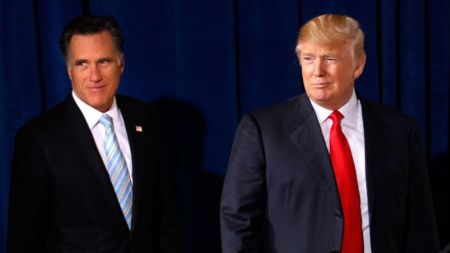
Echoing the sentiments of David Horowitz, I too had always considered Mitt Romney to be a decent man — perhaps not the strongest nor most conservative of the GOP leaders, but a class act in his own right. That notion was stretched to its limits, however, last week when the former Republican presidential candidate played party-attack dog in an effort to detail current frontrunner Donald Trump.
Perhaps the most galling aspect of Romney’s attack last week was its hypocrisy. Not four years prior, Romney was all too happy to take Donald Trump’s endorsement and hefty financial contribution while praising the real estate mogul’s business savvy and success.
What, then, could justify Romney’s complete about face without painting the failed Republican candidate as a complete user and hypocrite?
Apparently, nothing, as polls reveal.
In fact, Romney’s attack-plan backfired and in no small way.
A new Morning Consult survey taken between Friday and Sunday reveals that 31 percent of GOP voters say they are “more likely” to support Trump now, as a result of Romney’s Thursday attack.
Only 21 percent said they are “less likely” to back Trump following Romney’s speech.
With fewer candidates and a tough debate showing last week, Trump still remains in the lead. The NY Post cites a recent poll placing Trump at support levels of 34 compared to Ted Cruz at 25 percent, Marco Rubio with 18 percent and John Kasich at 13 percent.
Indeed, while the overall race is tightening, it seems the GOP’s concerted effort to derail Trump has turned the frontrunner, ironically, into the underdog.
Can the establishment trump Trump? Israel Hayom, Boaz Bismuth, March 6, 2016
Some in the Republican establishment are playing with fire. It is plain obvious that they would like to deny Donald Trump the party’s nomination, and they have every right to try to do so.
But this onslaught on Trump — led by GOP big guns, along with its two most recent presidential nominees, Mitt Romney and John McCain — could backfire and turn the real estate mogul into a political martyr. They face an excruciating dilemma: how to drive home the notion that Trump is unfit to be president even as the public rallies behind him?
Some in the GOP establishment failed to pick up the political undercurrents among rank-and-filed Republicans during the first few months of the campaign. This helped Trump’s ascent. But the establishment may still be oblivious to what GOP voters want. As a result of this disconnect, they may actually help him seal the deal. Saturday’s votes in Kansas, Kentucky, Louisiana and Maine could provide insight on the way forward. Remember, so far every attack on Trump has helped him.
Unlike the Democratic front-runner, Hillary Clinton, Trump has yet to run away with the delegates, despite having momentum on his side and winning 10 of the 15 states that held primaries (not including Saturday’s votes).
Before there was Trump, it was Texas Sen. Ted Cruz who was hated by the party’s big wigs. In fact, Cruz has yet to be endorsed by any of his colleagues in the Senate because of the bad rapport he has with the people in Washington. Nevertheless, in states where primaries have been closed (meaning, only registered Republicans can vote, like those on Saturday), Cruz has fared well.
At first, the establishment couldn’t decide between Florida Sen. Marco Rubio and former Florida Governor Jeb Bush; then it came out against Cruz; and all the while, it ignored Trump. Now the establishment has a conundrum on its hands: How do you attack two unwanted front-runners (the first of the two is the most pressing problem)? Former Arkansas Governor Mike Huckabee, an also-ran in this cycle and in 2008, has warned the establishment not to meddle with the process. “Let’s remember, we have an election process and not a selection process,” he said recently.
Republican voters have viewed the GOP establishment’s efforts with scorn and may very well set the house ablaze. In fact, 78% of Trump supporters say they would continue to back him no matter what he does. On Super Tuesday, Trump garnered almost 70% of the vote among those who said they wanted an outsider as their next president.
Rubio is not an outsider; neither is Cruz. The outsider is Trump. Trump has bested his opponents in virtually every possible measure. This only adds to his success and exacerbates the party’s headache.
The establishment’s efforts may very well be a case too much, too late. Perhaps the Republican voters truly are fed up with Washington; perhaps they truly are disappointed by the economy and view the billionaire as their savior (or at the very least, someone who can punish Washington). The establishment enlisted the help of Romney, who has become the face of the anti-Trump campaign. But Romney, lest you forget, lost to President Barack Obama in 2012 and to McCain in 2008.
These elections are about being a winner. They are about making America win again. Romney is not quite the right person. Perhaps the establishment has no choice but to attack. It is now or never. We are likely to see more surprises in this race, but for the time being, the campaign to stop Trump is the biggest story.
Let’s hope the Republican leaders don’t forget who their real adversary is. Judging from how they have conducted themselves, they could very well start viewing Hillary Clinton as their big savior. By doing so, they will have severed their ties with the GOP rank and file for good.
Deserve Hillary? Then vote for her, Dan Miller’s Blog, March 3, 2016
(The views expressed in this post are mine and do not necessarily reflect those of Warsclerotic or its other editors. — DM)
Democrats have done a bang up job for their people for the last fifty years. Want more of the same? Vote for Hillary.
How about Mit Romney? Surely, he must be right. After all, the proud godfather of ObamaCare did so well in 2012. His part of the video starts at 23:00.
So, all of you RINOs who prefer Hillary to Trump, have at it. Heck, with the RINOs and the Dems in charge, the country will stay in the very best of hands.
The G.O.P.’s Last-Ditch, Frantic Effort to Stop Trump, New York Times, Alexander Burns, Maggie Haberman and Jonathan Martin, February 27, 2016
(Please see also, Off Topic: Trump and the Rise of the Unprotected – WSJ. — DM)
The scenario Karl Rove outlined was bleak.
Addressing a luncheon of Republican governors and donors in Washington on Feb. 19, he warned that Donald J. Trump’s increasingly likely nomination would be catastrophic, dooming the party in November. But Mr. Rove, the master strategist of George W. Bush’s campaigns, insisted it was not too late for them to stop Mr. Trump, according to three people present.
At a meeting of Republican governors the next morning, Paul R. LePage of Maine called for action. Seated at a long boardroom table at the Willard Hotel, he erupted in frustration over the state of the 2016 race, saying Mr. Trump’s nomination would deeply wound theRepublican Party. Mr. LePage urged the governors to draft an open letter “to the people,” disavowing Mr. Trump and his divisive brand of politics.
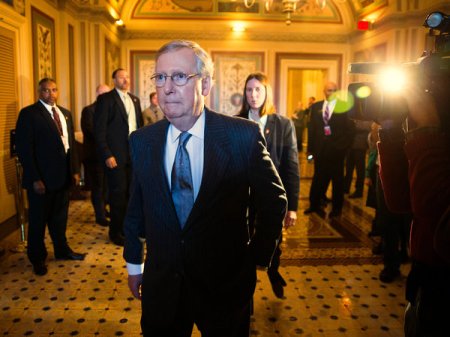 The Senate majority leader, Mitch McConnell, has laid out a plan that would have lawmakers break with Mr. Trump in a general election. Credit Doug Mills/The New York Times
In public, there were calls for the party to unite behind a single candidate. In dozens of interviews, elected officials, political strategists and donors described a frantic, last-ditch campaign to block Mr. Trump — and the agonizing reasons that many of them have become convinced it will fail. Behind the scenes, a desperate mission to save the party sputtered and stalled at every turn.
Efforts to unite warring candidates behind one failed spectacularly: An overture from Senator Marco Rubio to Mr. Christie angered and insulted the governor. An unsubtle appeal from Mitt Romney to John Kasich, about the party’s need to consolidate behind one rival to Mr. Trump, fell on deaf ears. At least two campaigns have drafted plans to overtake Mr. Trump in a brokered convention, and the Senate majority leader, Mitch McConnell of Kentucky, has laid out a plan that would have lawmakers break with Mr. Trump explicitly in a general election.
Despite all the forces arrayed against Mr. Trump, the interviews show, the party has been gripped by a nearly incapacitating leadership vacuum and a paralytic sense of indecision and despair, as he has won smashing victories in South Carolina and Nevada. Donors have dreaded the consequences of clashing with Mr. Trump directly. Elected officials have balked at attacking him out of concern that they might unintentionally fuel his populist revolt. And Republicans have lacked someone from outside the presidential race who could help set the terms of debate from afar.
The endorsement by Mr. Christie, a not unblemished but still highly regarded figure within the party’s elite — he is a former chairman of the Republican Governors Association — landed Friday with crippling force. It was by far the most important defection to Mr. Trump’s insurgency: Mr. Christie may give cover to other Republicans tempted to join Mr. Trump rather than trying to beat him. Not just the Stop Trump forces seemed in peril, but also the traditional party establishment itself.
Should Mr. Trump clinch the presidential nomination, it would represent a rout of historic proportions for the institutional Republican Party, and could set off an internal rift unseen in either party for a half-century, since white Southerners abandoned the Democratic Party en masse during the civil rights movement.
Former Gov. Michael O. Leavitt of Utah, a top adviser to Mr. Romney’s 2012 presidential campaign, said the party was unable to come up with a united front to quash Mr. Trump’s campaign.
“There is no mechanism,” Mr. Leavitt said. “There is no smoke-filled room. If there is, I’ve never seen it, nor do I know anyone who has. This is going to play out in the way that it will.”
Republicans have ruefully acknowledged that they came to this dire pass in no small part because of their own passivity. There were ample opportunities to battle Mr. Trump earlier; more than one plan was drawn up only to be rejected. Rivals who attacked him early, like Rick Perry and Bobby Jindal, the former governors of Texas and Louisiana, received little backup and quickly faded.
Late last fall, the strategists Alex Castellanos and Gail Gitcho, both presidential campaign veterans, reached out to dozens of the party’s leading donors, including the casino magnate Sheldon Adelson and the hedge-fund manager Paul Singer, with a plan to create a “super PAC” that would take down Mr. Trump. In a confidential memo, the strategists laid out the mission of a group they called “ProtectUS.”
“We want voters to imagine Donald Trump in the Big Chair in the Oval Office, with responsibilities for worldwide confrontation at his fingertips,” they wrote in the previously unreported memo. Mr. Castellanos even produced ads portraying Mr. Trump as unfit for the Oval Office, according to people who saw them and who, along with many of those interviewed, insisted on anonymity to discuss private conversations.
The two strategists, who declined to comment, proposed to attack Mr. Trump in New Hampshire over his business failures and past liberal positions, and emphasized the extreme urgency of their project. A Trump nomination would not only cause Republicans to lose the presidency, they wrote, “but we also lose the Senate, competitive gubernatorial elections and moderate House Republicans.”
No major donors committed to the project, and it was abandoned. No other sustained Stop Trump effort sprang up in its place.
Resistance to Mr. Trump still runs deep. The party’s biggest benefactors remain totally opposed to him. At a recent presentation hosted by the billionaires Charles G. and David H. Koch, the country’s most prolific conservative donors, their political advisers characterized Mr. Trump’s record as utterly unacceptable, and highlighted his support for government-funded business subsidies and government-backed health care, according to people who attended.
But the Kochs, like Mr. Adelson, have shown no appetite to intervene directly in the primary with decisive force.
The American Future Fund, a conservative group that does not disclose its donors, announced plans on Friday to run ads blasting Mr. Trump for his role in an educational company that is alleged to have defrauded students. But there is only limited time for the commercials to sink in before some of the country’s biggest states award their delegates in early March.
Instead, Mr. Trump’s challengers are staking their hopes on a set of guerrilla tactics and long-shot possibilities, racing to line up mainstream voters and interest groups against his increasingly formidable campaign. Donors and elected leaders have begun to rouse themselves for the fight, but perhaps too late.
 Mitt Romney at an event in Mississippi last year. He has tried various ways to slow the progress of Mr. Trump, without success. Credit Rogelio V. Solis/Associated Press
Two of Mr. Trump’s opponents have openly acknowledged that they may have to wrest the Republican nomination from him in a deadlocked convention.
Speaking to political donors in Manhattan on Wednesday evening, Mr. Rubio’s campaign manager, Terry Sullivan, noted that most delegates are bound to a candidate only on the first ballot. Many of them, moreover, are likely to be party regulars who may not support Mr. Trump over multiple rounds of balloting, he added, according to a person present for Mr. Sullivan’s presentation, which was first reported by CNN.
Advisers to Mr. Kasich, the Ohio governor, have told potential supporters that his strategy boils down to a convention battle. Judd Gregg, a former New Hampshire senator who had endorsed Jeb Bush, said Mr. Kasich’s emissaries had sketched an outcome in which Mr. Kasich “probably ends up with the second-highest delegate count going into the convention” and digs in there to compete with Mr. Trump.
Several senior Republicans, including Mr. Romney, have made direct appeals to Mr. Kasich to gauge his willingness to stand down and allow the party to unify behind another candidate. But Mr. Kasich has told at least one person that his plan is to win the Ohio primary on March 15 and gather the party behind his campaign if Mr. Rubio loses in Florida, his home state, on the same day.
In Washington, Mr. Kasich’s persistence in the race has become a source of frustration. At Senate luncheons on Wednesday and Thursday, Republican lawmakers vented about Mr. Kasich’s intransigence, calling it selfishness.
One senior Republican senator, noting that Mr. Kasich has truly contested only one of the first four states, complained: “He’s just flailing his arms around and having a wonderful time going around the country, and it just drives me up the wall.”
Mr. McConnell was especially vocal, describing Mr. Kasich’s persistence as irrational because he has no plausible path to the nomination, several senators said.
While still hopeful that Mr. Rubio might prevail, Mr. McConnell has begun preparing senators for the prospect of a Trump nomination, assuring them that, if it threatened to harm them in the general election, they could run negative ads about Mr. Trump to create space between him and Republican senators seeking re-election. Mr. McConnell has raised the possibility of treating Mr. Trump’s loss as a given and describing a Republican Senate to voters as a necessary check on a President Hillary Clinton, according to senators at the lunches.
(video of Christie endorsing Trump at the link.- – DM)
He has reminded colleagues of his own 1996 re-election campaign, when he won comfortably amid President Bill Clinton’s easy re-election. Of Mr. Trump, Mr. McConnell has said, “We’ll drop him like a hot rock,” according to his colleagues.
There is still hope that Mr. Rubio might be able to unite much of the party and slow Mr. Trump’s advance in a series of big-state primaries in March, and a host of top elected officials endorsed him over the last week. But Mr. Rubio has struggled to sideline Mr. Kasich and Senator Ted Cruz of Texas, who is running a dogged campaign on the right. He has also been unable to win over several of his former rivals who might help consolidate the Republican establishment more squarely behind him.
Mr. Rubio showed a lack of finesse in dealing with his fallen rivals’ injured egos.
Mr. Christie had attacked Mr. Rubio contemptuously in New Hampshire, calling him shallow and scripted, and humiliating him in a debate. Nevertheless, Mr. Rubio made a tentative overture to Mr. Christie after his withdrawal from the presidential race. He left the governor a voice mail message, assuring Mr. Christie that he had a bright future in public service, according to people who have heard Mr. Christie’s characterization of the message.
Mr. Christie, 53, took the message as deeply disrespectful and patronizing, questioning why “a 44-year-old” was telling him about his future, said people who described his reaction on the condition of anonymity. Further efforts to connect the two never yielded a direct conversation.
Mr. Trump, by contrast, made frequent calls to Mr. Christie once he dropped out, a person close to the governor said. After the two met at Trump Tower on Thursday with their wives, Mr. Christie flew to Texas and emerged on Friday to back Mr. Trump and mock Mr. Rubio as a desperate candidate near the end of a losing campaign.
Efforts to reconcile Mr. Rubio and Mr. Bush, a former governor of Florida, have been scarcely more successful, dating to before the South Carolina primary, when Mr. Rove reached out to their aides to broker a cease-fire, according to Republicans familiar briefed on the conversations. It did not last.
Mr. Bush has been nearly silent since quitting the race Feb. 20, playing golf with his son Jeb Jr. in Miami and turning to the task of thank-you notes. In a Wednesday conference call with supporters, he did not express a preference among the remaining contenders. When Mr. Rubio called him, their conversation did not last long, two people briefed on it said, and Mr. Rubio did not ask for his endorsement.
“There’s this desire, verging on panic, to consolidate the field,” said Senator Lindsey Graham of South Carolina, a former supporter of Mr. Bush. “But I don’t see any movement at all.”
Mr. Rubio’s advisers were also thwarted in their efforts to secure an endorsement from Mr. Romney, whom they lobbied strenuously after the Feb. 20 South Carolina primary.
Mr. Romney had been eager to tilt the race, and even called Mr. Christie after he ended his campaign to vent about Mr. Trump and suggest that Mr. Christie help consolidate the field. On the night of the primary, Mr. Romney was close to endorsing Mr. Rubio himself, people familiar with his deliberations said.
Yet Mr. Romney pulled back, instead telling advisers that he would take on Mr. Trump directly.
After a Tuesday night dinner with former campaign aides, during which he expressed a sense of horror at the Republican race, Mr. Romney made a blunt demand Wednesday on Fox News: Mr. Trump must release his tax returns to prove he was not concealing a “bombshell” political vulnerability.
Mr. Trump responded only with casual derision, dismissing Mr. Romney on Twitter as “one of the dumbest and worst candidates in the history of Republican politics.”
Mr. Romney is expected to withhold his support before the voting this week on the so-called Super Tuesday, but some of his allies have urged him to endorse Mr. Rubio before Michigan and Idaho vote March 8. Mr. Romney grew up in Michigan, and many Idahoans are fellow Mormons.
But already, a handful of senior party leaders have struck a conciliatory tone toward Mr. Trump. Representative Kevin McCarthy of California, the House majority leader, said on television that he believed he could work with him as president. Many in the party acknowledged a growing mood of resignation.
Fred Malek, the finance chairman of the Republican Governors Association, said the party’s mainstream had simply run up against the limits of its influence.
“There’s no single leader and no single institution that can bring a diverse group called the Republican Party together, behind a single candidate,” Mr. Malek said. “It just doesn’t exist.”
On Friday, a few hours after Mr. Christie endorsed him, Mr. Trump collected support from a second governor, who in a radio interview said Mr. Trump could be “one of the greatest presidents.”
That governor was Paul LePage.




 anneinpt
 artaxes
 danmillerinpanama
 davidking1530
 Peter Hofman
 Joseph Wouk
 Peter
Peter Louisiana Steve

 WarSclerotic
Recent Comments