H/t Power Line

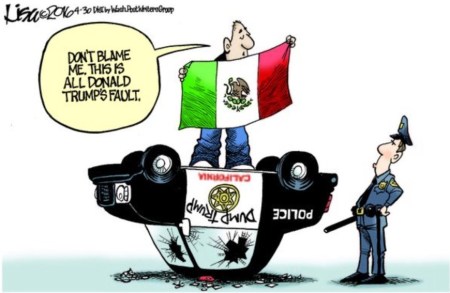
Can Trump Save Mexico? PJ Media, Roger L Simon, May 13, 2016
(Mexico, along with nearly all of Latin America, is endemically corrupt. The United States already has more than enough corruption and we do not need to import more. — DM)

I love Mexico. I have been there dozens of times from the border to the Chiapas jungle. I love almost everything about it.
But like so many, I detest their government. It has been a disaster longer than I have been alive. And glorious as the art and architecture may be, there’s that other more depressing Mexico – the land of El Chapo, mordidas and murder – the desperate barrios you see from the cab if you accidentally stray from the Zona Rosa or Polanco or one of the other tony neighborhoods of the Distrito Federal. This is the world’s capital of income inequality.
Mexico, wonderful as it is to visit, is intolerably corrupt. Corruption in Mexico even merits its own Wikipedia entry. Most of us who have been there on multiple occasions have experienced it. I have paid a mordida to their cops myself more than once for traffic infractions I didn’t commit to avoid being hauled off to jail. It’s just the price you pay for enjoying yourself down there, sort of like meeting the troll at the bridge.
The corruption never seems to change, no matter who is in power, with a large percentage of their population living in unspeakable poverty. The misery of these people is so extreme you avert your eyes when confronted by it and try to pretend it’s not there, so it doesn’t affect you too much. But you can’t.
The USA has for generations been the stopgap for this poverty, providing work for the Central American jobless, the millions of illegal aliens in our midst, who send remittances home from the storefronts we see across Los Angeles and other cities of our country. It’s always been like that, with America, inadvertently or not, enabling this corrupt Mexican system, often for the advantage of America’s corporations but not her people. I never thought it would be different.
And then along comes Donald Trump wanting to build that wall and make Mexico (gasp!) pay for it. Needless to say, Mexican officiales went ballistic, notably former president Vincente Fox who accused Trump of bringing back the era of the “Ugly American” and went so far as to say that Trump’s election could lead to “war” between Mexico and the United States. Other officials are taking a more modern approach, initiating a public relations campaign this June to counter the view of Mexico being promulgated by the man they call “The Clown.”
But public relations is the last thing Mexico needs. It needs change. Public relations, in this instance no more than spin on a grand scale, is the enemy of that. It simply papers over a bad situation and prevents it from improving.
Ironically, Donald Trump is Mexico’s best friend right now – not of the officials, of course, or their extraordinarily large billionaire class – but of the Mexican people themselves. By actually bottling up the border and reducing the flow to legal immigration, something that has not been done for decades, if ever, Trump and his allies are forcing the Mexican government to deal with their own problems. That’s not going to happen as long as El Norte is here to solve everything for them. It never happened while the border was open and will never happen until it’s closed.
Mexican officials and our liberal-progressives think Trump is acting like a racist, or is one, for proposing this action. But actually, whether he realizes it or not, Donald is giving Mexico a little amor duro (tough love, in Spanish) that it sorely needs, has needed for one helluva long time. Whether Mexico will be able to accept it is another matter. But that’s always the question with “tough love,” isn’t it?
[M]ight we make Trump the precedent-shattering break from historical practice? We very well might, for the simple reason that only someone who is genuinely an outsider—a way outsider in every way—like Trump stands a chance of restoring some semblance of sensible government. One can imagine a President Trump governing like “President Dave” in the movie from the mid-1990s, and saying “Why do we have 55 federal job training programs? How about eliminating at least two-thirds of them?” Rinse and repeat. In other words, what is required is a disposition much different than Ross Perot’s risible slogan of “getting under the hood and fixin’ it.”
************************
I recant none of my previous criticisms of Trump’s unsuitability to be president, but the case that he—and he alone—has an unprecedented opportunity to disrupt (in the right ways) the crisis of American government today deserves to be understood. The most sophisticated, though perhaps sophistical, case comes from our friends at the Journal of American Greatness, though even they admit that they may be reading more into Trump than is there. (And c’mon Decius, no one who uses the term “noetic heterogeneity” is going to get a job in the Trump Administration.)
I have a simpler case, and, unusual for me, it doesn’t require any classical metaphysics. I keep coming back to the curious fact that so many Bernie Sanders voters (almost half in West Virginia) say they will vote for Trump if Bernie doesn’t get the nomination. This can’t be because they think Trump is a socialist. And I doubt the dislike of Hillary sufficiently explains it either.
I think the explanation lies in this chart:
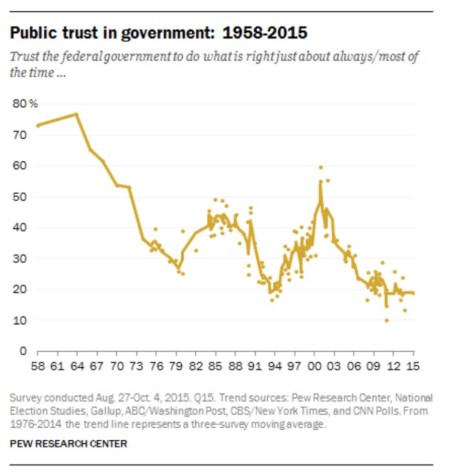
This trend is well-known among public opinion survey monkeys, and it is worth observing several things. First, the overall decline in public confidence in the competence of the federal government. Second, notice the two places where the trend reverses—during the Reagan years, and right after 9/11, when President Bush and the national government was wholly focused on its chief responsibility: defending the nation. Third, it is conspicuous that there has been no upturn at all under Obama. You’d think he could expect some bump even from a weak economy. If you break down this data by party (see next chart) you can see that Obama doesn’t even get much of a bump up from Democrats.
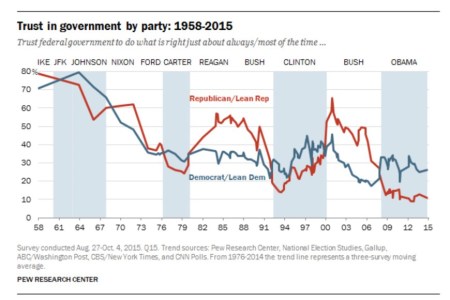
Finally, look at public opinion about the government from this point of view, which finds that 79 percent of Americans—four out of five—are frustrated or angry with the federal government.

Some observations. First, you’ll note in the first chart that back in the early 1960s, public confidence in the federal government was fairly high, even though liberals told us that the Eisenhower years were dreadful, etc. As James Q. Wilson once pointed out, in 1960 what most people had in front of them was a government that had successfully accomplished some large things: it had won a World War in short order; it had educated millions of troops who came home from that war through the G.I. Bill; it has begun the interstate highway system, an eminently practical undertaking. California built a huge water project (for people back then—imagine that) and other things.
In those days, the government wasn’t trying to solve poverty, promote self-esteem, heal our souls, etc. It[s pretty easy to see that public confidence in the federal government began its long term decline exactly when the government became incompetent at foreign and domestic policy simultaneously. Liberalism has never recovered from this. But neither has the Republican Party ever achieved much serious reform. And the quagmire of the Iraq War under Bush deprived Republicans of an example of the one thing they were supposed to be able to do better than Democrats. (Yes, the surge worked, and we prevailed before Obama threw it away. But it cost too much and came too late to stave off the political damage to Republicans.)
Meanwhile, what do liberals want to build today? No new dams or highways, but high speed rail that no one will ride and urban transit systems (like DC’s Metro) that they can’t maintain. A health care system that remains hated by a majority of Americans. An airport security system that everyone knows is a costly joke. Need I go on? Liberals and the media would like everyone to think that people are disgusted with “gridlock” in Washington (which is only liberal code for saying conservatives should unilaterally disarm so government can do even more things). I don’t think that’s it at all. I think a majority are disgusted with an incompetent government. The mode of public conversation about the federal government is contempt, not frustration that it isn’t doing even more.
Most of the leading candidates of both parties talk about “reform,” but mostly offer mere tinkering. Republicans offer tax cuts; Democrats offer more free stuff. Neither is credible any more. Which brings us to Trump. His difference from the political class is obvious, and has been widely remarked upon, so I won’t repeat that part of the story. Bottom line: we reached a point of such bipartisan disgust with the government that someone like Trump looks like the only kind of person who could conceivably take it on.
One more key political fact, though: We have never elected someone with no prior experience in public office at all to the presidency. (I count being supreme commander of Allied armies in WWII—Eisenhower—as experience in public office. Ditto Grant, etc.) Only once has a major party ever nominated someone from the business world with no experience in public office: Wendell Willkie in 1940. He was a very credible figure, and might have won in the absence of the growing shadow of war.
So might we make Trump the precedent-shattering break from historical practice? We very well might, for the simple reason that only someone who is genuinely an outsider—a way outsider in every way—like Trump stands a chance of restoring some semblance of sensible government. One can imagine a President Trump governing like “President Dave” in the movie from the mid-1990s, and saying “Why do we have 55 federal job training programs? How about eliminating at least two-thirds of them?” Rinse and repeat. In other words, what is required is a disposition much different than Ross Perot’s risible slogan of “getting under the hood and fixin’ it.”
Does Trump understand the nature and magnitude of the problem, and thereby his extraordinary opportunity? I’m doubtful, but he just might kindof, sortof grasp it in his instinctual, elemental way. And his very brashness might be just the kind of approach to accomplishing a few things.
You can find the extensive background to the three charts shown here from the Pew Research Center.
Trump taps climate change skeptic, fracking advocate as key energy advisor, Reuters, Valerie Volcovice, May 13, 2016

U.S. Representative Kevin Cramer (R-ND) speaks at the National Press Club in Washington, DC, United States on January 8, 2015. REUTERS/Larry Downing/File Photo
Republican presidential contender Donald Trump has asked one of America’s most ardent drilling advocates and climate change skeptics to help him draft his energy policy.
U.S. Republican Congressman Kevin Cramer of North Dakota – a major oil drilling state – is writing a white paper on energy policy for the New York billionaire, Cramer and sources familiar with the matter told Reuters.
Cramer was also among a group of Trump advisers who recently met with lawmakers from western energy states, who hope Trump will open more federal land for drilling, a lawmaker who took part in the meeting said.
Cramer said in an interview his paper would emphasize the dangers of foreign ownership of U.S. energy assets, burdensome taxes, and over-regulation. Trump will have an opportunity to float some of the ideas at an energy summit in Bismarck, North Dakota on May 26, Cramer said.
A spokeswoman for Trump’s campaign did not comment.
While the ultimate size and makeup of Trump’s energy advisory team is unclear, Cramer’s inclusion suggests the presumptive Republican presidential nominee’s oil policy could emphasize more drilling, less regulation and taxes, and curbs on efforts to combat climate change.
Cramer has said he believes the Earth is cooling, not warming, and he has opposed efforts by the Obama administration to regulate greenhouse gas emissions.
Trump has been light on details of his energy policy so far, though he recently told supporters in West Virginia that the coal industry would thrive if he were in the White House. He has also claimed global warming is a concept “created by and for the Chinese” to hurt U.S. business.
Trump only recently started building up teams of advisors on the economy, foreign policy and other issues to flesh out his platform for the Nov. 8 presidential election.
Cramer, North Dakota’s only congressman and an early Congressional Trump supporter, encountered Trump when they were guests on a radio show last month and Trump spoke about relaxing regulation and expanding drilling. Trump’s political team later asked Cramer to write the energy policy paper, the lawmaker said.
“The real opportunity for prosperity in this country has been to produce more because you have access to more markets,” Cramer said, referring to the recent lifting of a decades-old ban on oil exports. “The last thing we need is more rules.”
On foreign ownership of U.S. oil assets, Cramer said: “One-third of refining capacity is owned by OPEC countries. How does this fit into his (Trump’s) America first policy?”
OPEC members Saudi Arabia and Venezuela both have large stakes in U.S. refining capacity.
Cramer said he expected energy policy to be a vulnerability for Hillary Clinton, the frontrunner for the Democratic presidential nomination, in an election year where energy companies are going broke.
Clinton has advocated shifting the country to 50 percent clean energy by 2030, promised heavy regulation of fracking, and said her prospective administration would put coal companies “out of business.”
Op-Ed: Trump versus the Muslim mayor of London, Israel National News, Jack Engelhard, May 13, 2016
First the good news about Sadiq Khan. In his first act as London’s newly elected Muslim mayor he attended a Holocaust memorial service.
Terrific.
Next we hear that he plans a trip to Israel. This is still good. But after that, and even before that, the news is not so good.
He says that if Trump is elected he won’t come to the United States. (Ain’t that a shame.)
Then he says that if Muslims will be prevented, or limited, from entering the United States there will be consequences. Expect Islamic violence.
If other words, we’re asking for it if we don’t elect someone entirely favorable to the Muslim world. This, of course, excludes Trump and favors Hillary.
But this…
We get Muslim violence regardless who is president, don’t we? We got 9/11 while George W. Bush was in office. Trump was nowhere in sight.
We got Fort Hood, the Boston Marathon, San Bernardino and other acts of Muslim violence while Obama was in office and no one’s been more favorable to the Muslim cause than Obama – except maybe LBJ. Back in 1965, LBJ signed into law the (Hart-Celler) Immigration and Naturalization Act that opened America’s doors wide open for Muslims.
Trump was nowhere to be seen when a Muslim Palestinian Arab, Sirhan Sirhan murdered Robert Kennedy in 1968.
LBJ was president and we already know that LBJ’s heart was in the right place for Islam.
So why Trump, when it’s Mayor Khan who should be in the hot seat. The day after he was declared the winner, buses in London were driving along with signs declaring “Glory to Allah” and we imagine that Hamas were handing out candy in Gaza and likewise the PA in Ramallah.
Where – Trump might ask Mayor Khan – yes where is the Jewish mayor of Islamabad?
Or where is the Christian mayor anywhere in Pakistan, Mayor Khan’s ancestral home?
Let me answer – that’ll be the day.
So while the West celebrates itself for being so elaborately diverse, don’t even dream about diversity anywhere along the world’s 57 Islamic states.
Don’t plan on “Glory to Tolerance” buses running through the Maelbeek neighborhood of Brussels.
Only Western Democracies, like Britain, like the United States, like Israel, are expected to extend hospitality and equality – and we do.
In Israel, the Muslim population numbers more than one and a half million and these Palestinian Arab citizens enjoy full and equal rights.
The number for London alone is about 600,000 – “Glory to Allah.” Except that here’s another question from Trump to Khan.
What about the rape epidemic that’s been sweeping parts of London throughout the years?
Khan needs to answer for his Pakistani countrymen who are alleged to be the dominant assailants against thousands of British women and girls.
No wonder, then, that Trump keeps calling for a pause on migrating Syrian refugees.
Altogether, Trump says, we need to think twice about a Muslim influx. He’s appointing Mayor Rudy Giuliani to study the situation.
Mayor Khan may turn out to be an okay guy.
But he’s no Mayor Rudy, who can still smell the burning flesh from what they came and did to us on 9/11.
Trump Derangement Syndrome, Front Page Magazine, David Horowitz, May 12, 2016

I don’t think I speak for myself alone when I confess utter bewilderment at the number of conservatives – among whom I count long-term friends – who seem to have lost their marbles when assessing the presidential candidacy of Donald Trump.The Wall Street Journal’s Bret Stephens, to take one example that can stand for many, is an astute analyst – in my view one of the best political commentators writing today. Yet he is the author of this opening paragraph in Monday’s paper, which leaves me scratching my head, and embarrassed for my friend: “The best hope for what’s left of a serious conservative movement in America is the election in November of a Democratic president, held in check by a Republican Congress. Conservatives can survive liberal administrations, especially those whose predictable failures lead to healthy restorations—think Carter, then Reagan.”[1]
I can’t think of anything that is right about these sentences. The president’s first business is the nation’s security. Did Reagan really repair the damage that Carter did? It is true that he pulled the nation back from Carter’s policies of appeasing our enemies and disarming our military. But he failed to retrieve Carter’s greatest foreign policy disaster. It was Carter who brought down America’s ally, the Shah of Iran, and brought the Ayatollah Khomeini back from exile, thereby transforming Iran into the first jihadist state, and America’s deadliest enemy. Neither Ronald Reagan nor both George Bushes could undo that.
Could a Republican Congress – assuming that there would be a Republican Congress if Trump lost – hold a Democratic president like Hillary Clinton “in check”? How did that work out during the destructive reign of Barack Obama? With Republican majorities in the House and Senate Obama had no real problem in becoming the first American president to build his legacy around a policy that can fairly be described as treasonous – providing a path to nuclear power and ballistic missile capability to an Iranian regime that is our nation’s mortal enemy, has already murdered thousands of Americans, and is ruled by religious fanatics who have made no secret of their determination to destroy us.
Bret Stephens and an all-too-prominent cohort of inside-the-beltway conservatives want to turn the presidency over to Hillary Clinton “to save conservatism.” What can this mean? Have they forgotten who Hillary Clinton is? As Secretary of State she was the foreign policy captain in an administration that abandoned Iraq, thereby betraying every American and Iraqi who gave his or her life to keep that benighted country out of the hands of the terrorists and Iran (not that any Republican had the temerity to say so). ISIS is as much her godchild as Barack Obama’s. In creating the vacuum that ISIS filled Hillary was only carrying on the Democratic foreign policy tradition that Jimmy Carter inaugurated of sacrificing America’s security to pie-eyed internationalist delusions. As Secretary of State Hillary Clinton supported the overthrow of an American ally in Egypt and its replacement by the Muslim Brotherhood, the fountainhead of al-Qaeda and ISIS. She colluded in the overthrow of an American ally in Libya – a country posing no threat to the United States – thereby turning it into a base for ISIS and al-Qaeda. It was Hillary who was behind the gunrunning scheme to al-Qaeda rebels in Syria that led to the Benghazi disaster. She denied Ambassador Stephens – her American pawn in Benghazi – the security he requested in order to cover Obama’s retreat in the war on terror (it was election time), and then lied about his murder and that of three American heroes to the American people, to the mothers and fathers of the dead heroes, and to the world at large. According to the official version she approved insulting the prophet Mohammed was the problem not the terrorist onslaught that she and Obama had helped to unleash. Now we have learned that she willfully violated America’s Espionage Act, resulting in tens of thousands of her emails, classified and unclassified falling into the hands of the Russians and other adversary powers, and leading to how many future American casualties we can only guess.
This is the president that Bret Stephens and Bill Kristol and George Will think would be better for conservative values and conservative concerns than Donald Trump, a man who has raised an admirable family (a character-reflecting feat his detractors always overlook) and whose patriotism in the course of a long public life has never been in question. Nonetheless, it is Hillary Clinton – this serial liar, this traducer of the nation’s trust, this corrupt taker of $600,000 speaking fees and multi-million dollar gifts from foreign governments while acting as Secretary of State –this wretched individual who in their eyes is “survivable” should she become president.
And what isn’t survivable? “What isn’t survivable is … a serial fabulist, an incorrigible self-mythologizer, a brash vulgarian, and, when it comes to his tax returns, a determined obfuscator.” I blush for my friend making these charges, first because they are sins common to most politicians (with admittedly less flair than Donald Trump) and second because of the reason he gives for why they should matter: “Endorsing Mr. Trump means permanently laying to rest any claim conservatives might ever again make on the character issue.”
The character issue! Oh yes, that vital conservative weapon. And how did the use of it actually work out when it was put before the entire nation? Approaching the end of Clinton’s second term, Republicans made a political season out of his bad character and actually managed to impeach him for abusing women and lying to a grand jury. But when it was over, there wasn’t a pundit or pollster around who didn’t think that Bill Clinton would have an odds on chance of being elected to a third term in 2000 if the 22nd Amendment had allowed him to run.
This is not serious stuff, yet it is being peddled by first-rate conservative intellects and the fate of our nation may yet hang on it. The greatest obstacle to a Republican victory in November is the fratricidal war now being waged by the “Never Trump” crowd against the only person who might prevent the disaster awaiting us if the party of Obama and Kerry and Hillary and Sharpton prevails in November.
Their Trump hysteria notwithstanding, I still have the highest regard for the intellects of Bret Stephens and George Will and their comrades-in-arms. But I am hoping against hope that they come to their senses before it is too late.
Donald Trump, Bill Whittle and Republican Principles, Dan Miller’s Blog, May 11, 2016
(The views expressed in this post are mine and do not necessarily reflect those of Warsclerotic or its other editors. — DM)
In 2012, after Mitt Romney lost the presidential election, Bill Whittle delivered an address on Republican principles. The Timid Republican Party has substantially ignored those principles and is not guided by them. Party candidates nevertheless continue to mouth them at election time. Perhaps they understand what the voters want and recite their fealty to get their votes. Once safely in office, they revert to ignoring those same principles.
During the current Republican nomination process, the Establishment has chastised Donald Trump for not being a “real” Republican and not adhering to Republican principles — the principles which they themselves ignore, by which he abides and by which as our President he will continue to abide. As they cringe at his refusal to mince words and to be politically correct, they seem uncomfortable with his wealth and his decision to finance his own primary campaign. Trump is very comfortable with being rich and is rightfully proud of what he has been able to do because of it — including not being subservient to wealthy donors and donor collectives to which Establishment members are themselves subservient.
While watching the video, please ponder what Trump would say — and do — as our candidate and then as our President.
It strikes me that Trump and Whittle care more about “Republican principles” than do members of the Republican Establishment. Trump is substantially more likely to support and adhere to those principles than the Party Establishment has, and than any candidate it would prefer has or would. In recent months, the “unwashed vulgarian” Republican masses have shown that they do as well. They are right.
Clueless Republicans Don’t Realize It’s the Democrats Who Have the Problem, PJ Media, Roger L. Simon, May 10, 2016

I’m a bit perplexed with the continued resistance of so many of my right-wing brothers and sisters to Donald Trump. If it’s just his brash style and vulgar taste, his preference for glittery gold over brushed nickel or flat black for his bathroom fixtures, I could understand it. I’m a flat black guy myself. But it’s so much more than that.
The latest “betrayal” is that Trump admitted his tax plan was negotiable Imagine that—a tax plan being negotiated between the administration and Congress! Never heard of that before…. oh, wait.
Never mind that the Trump plan, even negotiated, would be considerably lower than just about any on offer and well within the parameters of conventional GOP proposals. (Now be honest—who would you rather have negotiating for you, Donald Trump or Paul Ryan? Who do you think would get a better result?) Nevertheless The Donald, in the opinion of the cognoscenti, once more has shown himself to be a feckless character not worthy of support—and the Republican gulf widens.
Or so we’re supposed to believe, even though he has the nomination completely nailed down, signed, sealed and delivered, everything but set in bronze.
Meanwhile, to almost everyone’s surprise, the Democrats are still fighting, their internal enmity growing as Comrade Bernie wins primary after primary, sometimes by large majorities, and Lady Hillary clings to her super delegates like a three-year-old to a blanket. What happens if she loses California? According to West Virginia exit polls, a full third of Democratic primary voters are ready to defect to Trump. In the latest poll of swing states, Donald is already ahead of Clinton in Ohio and neck-and-neck in Florida and Pennsylvania. And the big show is just getting started.
It is the Democrats, not the Republicans, that have the problem, but you wouldn’t know it if you watched, say, The Kelly File or had your Internet perpetually wired to National Review or The Weekly Standard, where the writing is as elegant as the thinking, these days, is often fuzzy. The Democrats are fighting a real war of ideas, disreputable though those ideas may be, while the Republicans fight a status war among themselves, a battle over control, not, except in the margins, over ideology.
Am I wrong? Remind me again where Trump, at least currently, is not a conservative? Taxes, check. Deficit, check. Immigration, check. Sanctuary cities, check. Strong defense, check. Supreme Court, check. Veterans, check. Common core, check. Iran deal, check. Israel, check. Healthcare, check. Pro-life, check…. Oh, yes, Planned Parenthood. He thinks the part of that operation that treats cervical cancer is okay. What a sin.
But…but…but… he has those whacky ideas on NATO and nuclear weapons and trade.
Are they so whacky? Other nations maybe should pay the part of NATO they contracted to. And the Japanese and South Koreans themselves have been talking about building nukes. Wouldn’t you after eight years of Obama? And then trade, who would doubt it could have been negotiated better, considering how our foreign policy deals have been negotiated?
And of course there’s the matter of Muslim immigration. He wants that restricted for now. So do most Americans, according to polls. Again, this is the opening point of a negotiation. Who knows where it will end? But no one, other than the extreme left, would like to see the Syrian refugees pouring in. Trump will have the public on his side in preventing it.
As I said, the real problem is with the Democrats. They are the ones in true disarray and are likely to remain so through their convention. This is a huge gift to the Republicans if they can only suck it up, shelve their egos, get together and take advantage of it. It doesn’t matter whether you are a neocon, a social con, a libertarian, a financial con or just a plain con. Ideology is so last year. (Well not completely, but it doesn’t have to be on the front burner all the time, does it?) Just do it.
Trump: Unexpected and Unconventional but Suited for Our Times, American Thinker, Scott S. Powell, May 11, 2016
One of the most extraordinary things about Donald Trump’s primary victory in the Republican Party is that he received more votes from people identifying as Christian than his closest competitor Ted Cruz — the son of an evangelical pastor and one who profusely displayed his Christian identity in speech and temperament. In contrast, by standards that many believe to be the essence of Christian character as expressed in the Sermon on the Mount, Donald Trump has been anything but meek, merciful, or peacemaking in his political rise. Some have likened him to a one-man wrecking ball. So what’s going on?
No one doubts that these are unusual times, with more forces pulling the United States down than at any other time in history. There is plenty of blame to go around for America’s spiraling state of decline, but at the top of the list are two things: First, we have had a culture captured and constrained by secular progressive political correctness. Second, we have an overbearing federal government that has corrupted both parties, the bureaucracies, and even the supposedly independent Federal Reserve.
At the grassroots, Republicans have tried to bring about a corrective, and they did succeed in getting many conservative reform candidates elected to congress in the last six years. Yet the stranglehold of political correctness and the corruption of Washington from special interests and lobbyists have proven insurmountable. Washington, DC — a metropolis producing very little with limited industry and almost no manufacturing — has become the richest city in the country, while driving the nation to the edge of financial ruin, as manifest in a national debt exceeding $19 trillion, 47 million people on food stamps, and a true unemployment rate that may be three times higher than the manipulated official rate released by the federal government.
Even as white Christians have diminished in their overall percentage of the population at large, according to the Pew Research Center, they still account for nearly seven in ten Americans who identify with, or lean toward, the Republican Party — about the same percentage as in the 1980s during the Reagan years. The problem is the GOP — despite its success in gaining majorities in both houses of Congress and controlling the power of the purse — has been ineffective as an opposition party during the Obama years.
The tipping point for many Christians came with a realization that the Republican Party was as incapable of protecting their rights and values at home as it was feckless in stopping an errant foreign policy that undermined trust with allies and emboldened enemies.
Two unnerving breaches of protection prompted many to recognize compelling qualities in Donald Trump over other candidates. First, he exuded an unapologetic toughness about building a wall and stopping the wave of illegal immigrants flooding over the Mexican border. Second, he was unequivocal about obliterating ISIS quickly and decisively — ending its wanton slaughter of Christians and other ethnic groups. And bridging both of these issues, in the aftermath of ISIS-inspired attacks in San Bernardino and Brussels, Trump unhesitatingly opposed Obama’s wish to take in undocumented Syrian refugees, “until we figure out what the hell is going on.” In that alone in the eyes of the majority, Trump demonstrated he was presidential, putting the protection of Americans as the top priority.
Political correctness and intolerance, which debilitates critical thinking, discourse and debate, has been shaping American culture for more than a generation. Throughout the seven plus years of the Obama administration, political correctness has driven domestic and foreign policy — with disastrous results. Obama has gone beyond anyone in recent memory in assaulting the First Amendment, undermining both speech and the exercise of Christian religion. We now see among liberals and secular progressives operating in the Democrat Party an Orwellian power structure that seeks to advance a statist, socialist and globalist transformation of the U.S. by silencing opposing views through the courts, misinformation, and distortion of the truth. Call it “newspeak” as Orwell did or the successor term “doublespeak,” its purpose is the same: to shape the masses thinking and obfuscate what is really going down.
Political correctness has not only prevented development of an effective strategy to deal with Islamist terrorism. It has turned U.S. relations in the Middle East upside down. The Obama administration celebrated the ouster and replacement of Egypt’s president Hosni Mubarak, a long-standing U.S. ally, with Muslim Brotherhood’s Mohamed Morsi. A similar glee was initially expressed by Secretary of State Hillary Clinton on the news of Muammar Gaddafi being hunted down and killed, only to be followed by increased mayhem in Libya, leading to the tragedy and humiliation of the U.S. at the hands of terrorists in Benghazi.
But for many Christians, the bridge too far was Obama’s rebuke of Israel and his end run around the U.S. Congress, in forcing through a fundamentally flawed nuclear deal with Iran. Iran is both the top exporter of hate and the world’s largest state sponsor of terrorism whose longstanding primary targets are the United States (often referred to as the “big Satan”), and Israel (the “little Satan”).
Everyone recognizes that Donald Trump is a flawed candidate. His Christian supporters certainly know this as well or better than his critics. But they also recognize that sinners are all that there are to choose from and that America’s precarious position at home and abroad requires an unconventional leader with unusual characteristics — some of which may not be aligned with a stereotypical Christian temperament.
One thing few could disagree with is that Trump deserves credit more than any conservative for fracturing the foundation of political correctness, upon which rests the entire liberal superstructure.
In fact, conventional conservatives may have reached a limit in expanding their audience. In contrast, it appears to be harvest time for Trump. His style of common sense plain talk has the potential to make huge inroads into both independent and liberal constituencies who are just now waking up to the absurdities of political correctness. While many still can’t see clearly, the fog is lifting, and the soul, spontaneity and humor of America is making an incipient revival, even in the midst of rancor.
If one can get past the braggadocio, narcissism and other negatives of Trump’s character, on the positive side he exudes confidence, ambition and a keenness to make good deals, get results and win. He is bold, direct and doesn’t shy away from confrontation. Mr. Trump is quite social and clearly likes to entertain, but he is also tough as nails, unrelenting and unpredictable with adversaries. He is unquestionably and refreshingly patriotic.
It turns out that some of these qualities are among those most vital to rebuilding relations with America’s allies and restoring respect — even fear — from adversaries. Mr. Trump’s irectness also suggests he is the best-suited presidential candidate to take on America’s greatest threat — insolvency. He could break the cycle of denial that completely engulfs the Democrat Party, and has hitherto prevented predecessors from doing much of anything regarding the nation’s out-of-control spending, deficits and unsustainable debt. Additionally, Trump’s toughness may be the key virtue needed to rule in a divided country and to successfully downsize and restructure federal agencies and get Washington out of the way of the American economy and its people.
Although the GOP believes it has a big tent, understandably many party members with well-established positions and values have great difficulty in accepting for the highest office in the land a newcomer candidate as fundamentally different as Donald Trump. To them I would say, unusual times with threats on every front at home and abroad call for an unconventional candidate. And it’s not so hard after all to recognize qualities in Donald Trump that make him in certain ways uniquely well-suited for our times.




 anneinpt
 artaxes
 danmillerinpanama
 davidking1530
 Peter Hofman
 Joseph Wouk
 Peter
Peter Louisiana Steve
 WarSclerotic
Recent Comments