Archive for the ‘Diplomacy’ category

A “preliminary deal” is announced in Lausanne. Zarif: There is no agreement, no commitments

April 2, 2015

A “preliminary deal” is announced in Lausanne. Zarif: There is no agreement, no commitments, DEBKAfile, April 2, 2015

Obama nuke dealBarack Obama hails nuclear “agreement”

Iranian Foreign Minister Mohammed Javad Zarif and EU Foreign Policy Executive Federica Mogherini announced Thursday, April 2 that “a general agreement for a peaceful nuclear program and a lifting of sanctions against Iran” had been reached in Lausanne. “We have reached solutions on key parameters of a join comprehensive plan of action,” the details to be negotiated between now and June 30,” she said.

Speaking after the EU official, Zarif delivered a long statement ending with the declaration: “There is no agreement; and so no commitments” before June 30.

But President Barack Obama, commenting on the event at the White House, hailed the agreement as a historic event that will change the face of the world and make it a safer place.  “It is a deal that meets our core objectives.” There is no way Iran can get round it to build a bomb, or produce plutonium at its Arak plant. Obama stressed that the verification mechanisms built into the agreed framework would ensure that “if Iran cheats, the world with know it.”

This is a long-term agreement which promises that Iran’s nuclear program will be closely monitoried for the next 20 years. There is much work to be done to hammer out the details before June 30, Obama said, and voiced the hope that the Iranians would not back out of the principles they had accepted in Lausanne.

In the his view, there were just three options for dealing with the Iranian nuclear program: Military force that would hold the program back for no more than two years; more sanctions, when the first round had proved to have little impact; or diplomacy, which he had chosen.

Obama said hoped the US Congress would not heap obstacles in the path of an accord, because the majority of the American popular approved of the course he led.

Before the end of the day, the president said he would talk to Israeli Prime Minister Binyamin Netanyahu and Saudi King Salman, the two leading opponents of the nuclear deal.

The parameters outlined by Mogherini agreed for future negotiation:

• Iran’s enrichment capacity and stockpile would be limited, and Iran’s sole enrichment facility would be at the Natanz nuclear facility. Other nuclear facilities would be converted to other uses.

• The nuclear facility at Fordo would be converted to a nuclear physics and technology center and the facility at Arak would be redesigned as a heavy-water research reactor that will not produce weapons-grade plutonium.

• The European Union would terminate all nuclear-related economic and financial sanctions against Iran, and the United States would do the same once Iran’s implementation of the agreement is confirmed.

• The United Nations would terminate all previous resolutions sanctioning Iran, and would incorporate other restrictions for an agreed-upon period.

The Tricks Obama Is Trying to Play with the Iran Announcement

April 2, 2015

The Tricks Obama Is Trying to Play with the Iran Announcement, Commentary Magazine, April 2, 2015

(When will Iran say what and to whom about Obama’s new “framework?” Will Iran cloud the results of the negotiations as cleverly as did Obama? — DM)

If you look at what happened today between the U.S. and Iran through the lens of domestic American politics, Barack Obama has made a very clever play here—because what might be called “the agreement of the framework of the possibility of a potential deal” gives him new leverage in his ongoing battle with the Senate to limit its ability to play a role in the most critical foreign-policy matter of the decade.

The “framework” codifies the Obama administration’s cave-ins but casts them as thrilling reductions in Iran’s capacities rather than what they are—a pie-in-the-sky effort to use inspections as the means by which the West can “manage” the speed with which Iran becomes a nuclear power.

Obama’s tone of triumph this afternoon was mixed with sharp reminders that the deal is actually not yet done—and that is entirely the point of this exercise from a domestic standpoint. the triumph signals his troops and apologists that the time has come for them to stand with him, praise the deal sheet and pretend it’s a deal, declare it historic, and generally act as though the world has been delivered from a dreadful confrontation by Obama and Kerry.

But since the deal is not yet done, it could still be derailed. And that is where Obama’s truly Machiavellian play here comes in: He may have found a way to put the Senate in a box and keep Democrats from melting away from him on Iran and voting not only for legislation he doesn’t want but also to override the veto he has promised.

The Senate has two provisions at the ready with which it could go ahead any time. One, called Kirk-Menendez, imposes new sanctions on Iran. Obama promised a veto of this bill should it pass, and after today, one ought to presume that it’s dead.

The other, Corker-Menendez, requires the administration to submit any deal to the Senate within 60 days of its signing. This is a key provision because, of course, what the Iranians want—and what they said today they got—was the lifting of all sanctions. The president, in his statement, vowed to lift the “nuclear” sanctions (there are others involving human rights) if the Iranians comply by the terms of the deal.

Existing sanctions legislation features waivers the president can arguably use to do that. But those sanctions were put into place specifically to make it incredibly painful for Iran to retain any nuclear-weapons capability—not as a means of acceding to Iran’s retention of a nuclear capability.

For this reason, and for the reason that the president is essentially negotiating an arms-control treaty with Iran, the Senate should approve any final deal. Obama disagrees and claims this is merely a nuclear-agreement, not a treaty, and therefore Congress has no role.

That’s a very nervy argument. It is not only disrespectful of the Senate but it misrepresents the nature of what’s being negotiated. And that’s why it’s an argument it appeared the president would lose—that senators would not only vote for Corker-Menendez but would override his veto of it.

Which is why the deal-that’s-not-yet-a-deal works in his favor. Talks are now to continue until the end of June. Obama can and will argue to Democrats that they owe it to him, to their base, and to their governing ideology to give him all the room he needs to get to June 30.

Of course, if the legislation does not pass by June 30 and Obama signs a final deal, the game is up; the Senate can’t retroactively insist in July he bring it to them for a vote.

Will there be a deal by June 30? Maybe, maybe not; maybe they’ll finish, maybe they won’t; maybe the Iranians will say they didn’t agree to this or that and blow up the whole thing; who knows. Probably the total collapse, after all this, would bring the Kirk-Menendez sanctions back to life. Which is why there will never be a total collapse—because these talks can simply go on….

Iran, U.S. allies strike agreement on nuclear deal

April 2, 2015

Iran, U.S. allies strike agreement on nuclear deal, Associated Press via Washington Times, April 2, 2015

(??????????????? — DM)

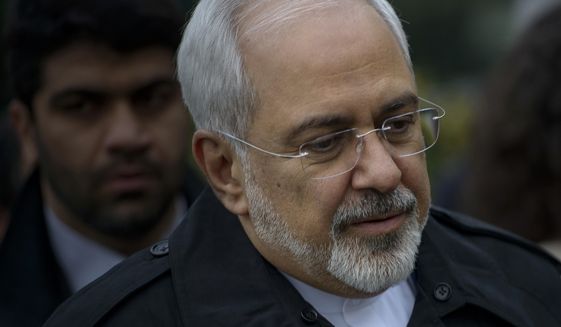
2e738e88a8f2710e720f6a7067008cce_c0-196-4500-2818_s561x327Iranian Foreign Minister Javad Zarif, walks through a courtyard at the Beau Rivage Palace Hotel during an extended round of talks, Wednesday, April 1, 2015 in Lausanne, Switzerland. Negotiations over Iran’s nuclear program appeared headed for double overtime on Wednesday.

LAUSANNE, Switzerland (AP) — Iran and and six world powers have agreed on the outlines of an understanding that would open the path to a final phase of nuclear negotiations but are in a dispute over how much to make public, officials told The Associated Press Thursday.

The officials spoke outside week-long talks that have busted through a March 31 deadline in an effort to formulate a general statement of what has been accomplished and documents setting down what the sides need to do by the end of June deadline for a deal.

Swiss officials facilitating the negotiations set a news conference for later in the day that was expected to announce the results of the talks

In the search for a comprehensive deal, the U.S. and five other countries hope to curb Iran’s nuclear technologies that it could use to make weapons. Tehran denies such ambitions but is negotiating because it wants a lifting of sanctions imposed over its nuclear program.


The Shadow of Munich Haunts the Iran Negotiations

April 2, 2015

The Shadow of Munich Haunts the Iran Negotiations, National Review Online, Victor Davis Hanson, April 2, 2015

(Hitler did tell the truth occasionally, in Mein Kampf for example. It was generally ignored until too late. “Death to America and Israel” are spouted by the Iranian Supreme Leader at every opportunity. Obama, et al, ignore it. Will Israel be Obama’s Czechoslovakia? And then what?– DM)

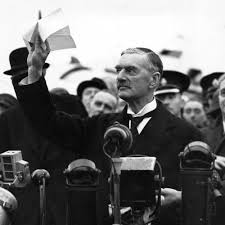
Neville Chamberlain

Our dishonor in Lausanne, as with Munich, may avoid a confrontation in the present, but our shame will guarantee a war in the near future.

*********************

Once again our leaders are needlessly appeasing a hostile state that shows them nothing but contempt.

The Western capitulation to Adolf Hitler in the 1938 Munich Agreement is cited as classic appeasement that destroyed Czechoslovakia, backfired on France and Britain, and led to World War II. All of that is true.

But there was much more that caused the Munich debacle than simple Western naiveté. The full tragedy of that ill-fated agreement should warn us on the eve of the Obama’s administration’s gullible agreement with Iran on nuclear proliferation. Fable one is the idea that most people saw right through the Munich folly. True, Europeans knew that Hitler had never once told the truth and was already murdering German citizens who were Jews, Communists, or homosexuals. But Europeans did not care all that much.

Instead, the Western world was ecstatic over the agreement. After the carnage of World War I, Europeans would do anything to avoid even a small confrontation — even if such appeasement all but ensured a far greater bloodbath than the one that began in 1914.

Another myth was that Hitler’s Wehrmacht was strong and the democracies were weak. In fact, the combined French and British militaries were far larger than Hitler’s. French Char tanks and British Spitfire fighters were as good as, or superior to, their German counterparts.

Czechoslovakia had formidable defenses and an impressive arms industry. Poland and perhaps even the Soviet Union were ready to join a coalition to stop Hitler from dissolving the Czech state.

It is also untrue that the Third Reich was united. Many of Hitler’s top generals did not want war. Yet each time Hitler successfully called the Allies’ bluff — in the Rhineland or with the annexation of Austria — the credibility of his doubters sank while his own reckless risk-taking became even more popular.

Munich was hardly a compassionate agreement. In callous fashion it immediately doomed millions of Czechs and put Poland on the target list of the Third Reich.

Munich was directly tied to the vanity of Neville Chamberlain. In the first few weeks after Munich, Chamberlain basked in adulation, posing as the humane savior of Western civilization. In contrast, loud skeptic Winston Churchill was dismissed by the media and public as an old warmonger.

Hitler failed to appreciate the magnanimity and concessions of the French and British. He later called his Munich diplomatic partners “worms.” Hitler said of the obsequious Chamberlain, “I’ll kick him downstairs and jump on his stomach in front of the photographers.”

The current negotiations with the Iranians in Lausanne, Switzerland, have all the hallmarks of the Munich negotiations.

Most Westerners accept that the Iranian government funds terrorist groups such as Hezbollah and Hamas. It has all but taken over Iraq, Lebanon, Syria, and Yemen. Yet the idea of stronger sanctions, blockades, or even force to stop Iranian efforts to get a bomb are considered scarier than Iran getting a bomb that it just possibly might not threaten to use.

The U.S. and its NATO partners are far stronger than Iran in every imaginable measure of military and economic strength. The Iranian economy is struggling, its government is corrupt, and its conventional military is obsolete. Iran’s only chance of gaining strength is to show both its own population and the world at large that stronger Western powers backed down in fear of its threats and recklessness.

Iran is not united. It is a mishmash nation in which over a third of the population is not Persian. Millions of protestors hit the streets in 2009. An Iranian journalist covering the talks defected in Switzerland — and said that U.S. officials at the talks are there mainly to speak on behalf of Iran.

By reaching an agreement with Iran, John Kerry and Barack Obama hope to salvage some sort of legacy — in the vain fashion of Chamberlain — out of a heretofore failed foreign policy.

There are more Munich parallels. The Iranian agreement will force rich Sunni nations to get their own bombs to ensure a nuclear Middle East standoff. A deal with Iran shows callous disagreed for our close ally Israel, which is serially threatened by Iran’s mullahs. The United States is distant from Iran. But our allies in the Middle East and Europe are within its missile range.

Supporters of the Obama administration deride skeptics such as Democratic senator Robert Menendez and Israeli prime minister Benjamin Netanyahu as if they were doubting old Churchills.

Finally, the Iranians, like Hitler, have only contempt for the administration that has treated them so fawningly. During the negotiations in Switzerland, the Iranians blew up a mock U.S. aircraft carrier. Their supreme leader, Ayatollah Khamenei, did his usual “death to America” shtick before adoring crowds. Our dishonor in Lausanne, as with Munich, may avoid a confrontation in the present, but our shame will guarantee a war in the near future.

Khameni to Zarif: Don’t sign! Obama to Kerry: Make them sign! Gridlock

April 2, 2015

Khameni to Zarif: Don’t sign! Obama to Kerry: Make them sign! Gridlock, DEBKAfile, April 2, 2015

Kerry_hotel_nuclear_talks_C_1.4.15John Kerry takes a break from the Lausanne talks

Tehran is not averse to negotiating ad infinitum – so long as the talks go their way. 

So the real gridlock centered on finding a procedure that fitted the US delegation’s instructions to get some sort of a deal signed, and the Iranian group’s directive to sign nothing that could be seen as an accord. So who will give ground first?

***************

It is hard to make out exactly what the seven exhausted foreign ministers of the world powers and Iran were actually talking about in Lausanne this week – especially in the last two days, when the negotiations overran their March 31 deadline for a framework nuclear accord.

The highly-colored reports from the Swiss hotel up until Thursday, April 2, bespoke a mighty battle between the American negotiators led by Secretary of State John Kerry and Energy Secretary Ernest Moniz, and the Iranian group, headed by Foreign Minister Mohammed Javad Zarif, over four key points still at issue between them: the pace of sanctions relief, research and development projects, international inspections – including snap visits to any nuclear facilities they demanded, and, finally, the quantity of low-enriched uranium Iran may retain after the bulk of its stockpile is shipped overseas.

The drama was heightened by the sight of the American delegation marching into a tent set up in the hotel yard “to defeat eavesdropping” for a video conference with President Barack Obama in the White House. Kerry wanted to know whether to carry on the never-ending negotiations, which were looking more and more farcical as the hours ticked by without closure, or quit. This would be tantamount to the failure of the entire structure of nuclear diplomacy.

Obama directed the delegation to carry on talking with the Iranians and disregard the missed deadline as though nothing had changed.

The Secretary of State earlier appeared in an upper hotel window gazing out in the distance. Was he seeing a solution of the impasse visible to no one else?

The French Foreign Minister, Lauren Fabius, fed up with the game playing out between the Americans and the Iranians, left more than once for home. He returned Thursday saying: “We are a few meters from the finishing line, but it’s always the last meters that are the most difficult. We will try and cross them. It’s not done yet.”

Zarif told reporters: “Our friends need to decide whether they want to be with Iran based on respect or whether they want to continue based on pressure. They have tested the other one; it is high time to test this one.”

Those words carried two messages: One that the Iranians were serious when they reiterated in the past weeks that a framework accord for ending the current phase of negotiations was unacceptable, and insisted on the talks carrying straight through to a comprehensive deal by June 30.

The Iranian foreign minister’s second message was a negation of “pressure” – i.e., sanctions, in obedience to supreme leader Ayatollah Ali Khamenei’s directive to the delegation to reject the incremental easing of international sanctions and press Tehran’s demand for immediate relief.

That directive was laid down by the ayatollah on February 18, when he determined that “an agreement would be arrived at not in two stages but in one stage to be completed by the end of June 2015 and the agreement would include the removal of all sanctions on Iran.”

The writing was on the wall for all the parties to see. The current deadline crisis could have been avoided by understanding that there was no way the Iranian delegation would ever disobey the supreme leader’s dictates.

Tehran is not averse to negotiating ad infinitum – so long as the talks go their way.

So the real gridlock centered on finding a procedure that fitted the US delegation’s instructions to get some sort of a deal signed, and the Iranian group’s directive to sign nothing that could be seen as an accord. So who will give ground first?

Humor? Obama abducted by aliens

April 1, 2015

Obama abducted by aliens, Dan Miller’s Blog, April 1, 2015

(The views expressed in this article are not necessarily mine or those of Warsclerotic or its other editors. — DM)

Today, April fool’s day first, Obama was abducted by aliens from Venus who were concerned about His warlike stance toward the peaceful Islamic Republic of Iran.

Venus

Organizing for Action logo 1

Mars is the god of war, Venus is the goddess of peace. Aliens from Mars had been slightly disturbed that Obama’s efforts to give Iran nuclear weapons might fail, but had seen that her status as a nuclear power was inevitable and hence did nothing. Aliens from Venus were equally pleased with the prospects of Iranian nuclear weapons but were very concerned that Obama, by failing adequately to praise Iranian attempts to extend its hegemony over the entire Middle East and beyond, had retarded those praiseworthy efforts on behalf of true Islamic peace. Hence, they secretly abducted Him this morning as He deplaned from Air Force One following an off-the-books trip to His spiritual birth place in Manchuria.

Since Obama’s abduction and remedial training required only a few minutes He was not missed, even by His dear soul mate, Valerie Jarrett. Ms. Jarrett was, therefore, pleasantly surprised when Obama called a press conference in the Rose Garden to make an announcement, following a splendid rendition of Hail to the Chief:


Fellow world citizens, I have finally awakened from my slumbers to realize that Iran is the only country in the world capable of bringing true peace through submission in accord with the word of Allah, may His Holy name be forever praised by all. Israel claims to desire peace, but only through war. Saudi Arabia, Egypt, Jordan and other misbegotten specs of excrement on the face of our dear planet — now in peril of imminent death due to climate change to which their vile oil has contributed massively — have dared even to challenge Iran’s peaceful pursuits of peace throughout the Middle East in Iraq, Syria, Yemen and elsewhere.

Henceforth, it will be My supreme duty as your Commander in Chief to promote and otherwise to assist Iran in her glorious efforts for peace. I know in my heart that that’s the principal reason that you, My people, elected Me as your very own Supreme Leader. Accordingly, I pledge that My efforts will be unstintingly directed to the end that you desire.

May Allah bless Iran, Damn America, Israel and all other enemies of true peace, and give a blessed day to you all, inshallah.

Iran’s leaders, due to their extensive relations with the aliens who had abducted Obama, were not at all surprised but pretended that they were. Supreme Leader Khamenei personally accepted Supreme Leader Obama’s gracious words by saying that Obama had finally managed to tame the Great Satan and promised to do everything within his power to help, inshallah. He also commented favorably on Secretary Kerry’s use of “inshallah” in rebutting suggestions by defeatists that the P5+1 negotiations would collapse without giving Iran nuclear weapons.

Kerry34

Even those who had previously viewed Obama as weak and indecisive will now be forced to see Him as He truly is, a towering beacon of strength and light to a world beset with tribulation, turmoil and darkness.  His legacy as the Greatest Peace Maker, Ever, is assured, inshallah.

Smoking pot is lots better than making war!

Smoke ganja. War is for sissies!

Let’s hope it’s just April Fool’s Day nonsense.

Critics Say Obama Gave Up Leverage Early On In Nuke Negotiations W/Iran – America’s Newsroom

March 31, 2015

Critics Say Obama Gave Up Leverage Early On In Nuke Negotiations W/Iran – America’s Newsroom via You Tube, March 31, 2015

(It’s like awaiting with trepidation the birth of a horribly mutated and probably stillborn baby, as the attending physicians proclaim their skill, patience and good intentions. — DM)


Pakistani defense chief due in Riyadh, airlifts troops for Saudi Yemen war. Aden landings imminent

March 30, 2015

Pakistani defense chief due in Riyadh, airlifts troops for Saudi Yemen war. Aden landings imminent, DEBKAfile, March 30, 2015

pakistani_special_forces_30.3.15Pakistani Special Forces fighter

The US-led world powers and Iran Monday, March 30, entered the last tense hours for a nuclear deal as though Lausanne was on a different planet from the Middle East, where the Yemen war, in which Iran is deeply involved, abruptly scooped up a power outside the region, Pakistan.

A high-level meeting chaired by Prime Minister Nawaz Sharif in Islamabad on Monday reaffirmed Pakistan’s “firm commitment to supporting the sovereignty and territorial integrity of Saudi Arabia.” Among those attending were Chief of Army Staff (COAS) General Raheel Sharif, Advisor on National Security and Foreign Affairs Sartaj Aziz and Defense Minister Khawaja Asif. The Defense minister leads a Pakistani military delegation arriving in Riyadh Tuesday.

The Islamabad communiqués did not specify the types of military support Pakistan has pledged to its Saudi ally.

DEBKAfile’s Intelligence sources report that the Pakistani army is preparing to airlift a large force of several brigades up to a complete division to Saudi Arabia.

Our military sources note that Pakistan’s decision to intervene in the war against “Shiite Muslim Houthi rebels” presages the Yemen conflict’s expansion to ground and sea operations after four days of heavy Saudi air raids.

The Pakistani brigades would relieve the substantial Saudi ground forces strung out along the kingdom’s 1,000-kilometer-long southern border with Yemen, and free them up for action against the Houthis.  Pakistani troops would also be available for ensuring security at Saudi oil fields and terminal, as they have in the past.

Riyadh fears that bands of terrorists trained by Iran, some of them Houthis, might infiltrate the kingdom and target its oil infrastructure.

DEBKAfile sources report that, after the Saudi air bombardment broke the back of the Houthi-controlled Yemeni Air Force aircraft and its missile resources Sunday, a task completed Sunday,the fourth day of its intervention, Saudi and allied Gulf and Egyptian forces are preparing to land marines in the big Yemeni Red Sea port of Aden. They aim to stabilize the battle lines and prevent the town’s fall to the rebels.

But despite the gains made by the Saudi Air Force, Houthi forces are still advancing on Aden, and have come as far as artillery range from the city and its airport.  Egypt forces intervened Monday to check the advance, Its offshore warships and incoming jets blasted the Houthi columns as they closed in on the city.

Once Aden is secured, the Yemeni president Abd-Rabbu Mansour Hadi, who fled the city on the eve of the Saudi operation, can return and start re-assembling his tattered regime. A restored and functioning legitimate government is essential for the conduct of the coming stages of the war to crush the revolt, but also envisages an exit line:  negotiations for the conflict’s termination.

What If There’s No Iran Deal?

March 30, 2015

What If There’s No Iran Deal? Commentary Magazine, March 30, 2015

(If there is no deal, Iran will still have won. U.S. sanctions, difficult to enforce in the best of times, will continue, and be ignored by other nations eager for more trade with Iran. Iran will continue to do as it pleases. The situation will be worse than had no P5+1 deal been sought. — DM)

[T]he grand realignment Obama has been seeking with Iran can’t and won’t be undone. That’s happening whether a deal is signed or not. And while Obama will have spent much of his own political capital, the president’s wasted time will pale in comparison to the smoldering ruins of American influence he leaves behind.

*********************

Each week seems to bring a new damning portrait of President Obama’s foreign policy from a different major news outlet. They say essentially the same thing but, like fingerprints, aren’t exactly the same. And Politico’s piece on Thursday by Michael Crowley stood out for providing a quote from the Obama administration that may rise above even the infamous “leading from behind” slogan the White House has rued since the words were spoken. What it lacks in bumper-sticker brevity it more than makes up for in stunning honesty.

Here’s how the Politico article closes, with a quote from an administration official:

“The truth is, you can dwell on Yemen, or you can recognize that we’re one agreement away from a game-changing, legacy-setting nuclear accord on Iran that tackles what every one agrees is the biggest threat to the region,” the official said.

The Obama administration’s official perspective on the Middle East currently engulfed in brutal sectarian conflict, civil war, and the collapse of state authority is: Let it burn. Nothing matters but a piece of paper affirming a partnership with the region’s key source of instability and terror in the name of a presidential legacy.

But there’s another question that’s easy to miss in the frenetic, desperate attempt to reach a deal with Iran: What if there’s no deal?

Obviously the president wants a deal, and he’s willing to do just about anything for it. The Obama administration long ago abandoned the idea that a bad deal is worse than no deal, and only recently began hinting at this shift in public. Officials have no interest in even talking about Yemen while they’re negotiating the Iran deal. It’s a singleminded pursuit; obsessive, irrational, ideologically extreme. But it’s possible the pursuit will fail: witness today’s New York Times story demonstrating that the Iranians are still playing hardball. (Why wouldn’t they? Their demands keep getting met.)

Surely it’s appalling for the administration to be so dismissive of the failure of a state, such as Yemen, in which we’ve invested our counterterrorism efforts. But it also shifts the power structure in the region. Take this piece in the Wall Street Journal: “Uncertain of Obama, Arab States Gear Up for War.” In it, David Schenker and Gilad Wenig explain that “The willingness of Arab states to finally sacrifice blood and treasure to defend the region from terrorism and Iranian encroachment is a positive development. But it also represents a growing desperation in the shadow of Washington’s shrinking security role in the Middle East.”

They also note the Arab League’s record isn’t exactly a monument to competent organization, so it’s not a great stand-in for an American government looking to unburden itself as a security guarantor for nervous Sunni allies. And it adds yet another note of instability.

Yemen’s only the latest example of the realignment, of course. The death toll in Syria’s civil war long ago hit triple digits, and it’s still raging. Bashar al-Assad, thanks to his patron Iran and Tehran’s complacent hopeful partner in Washington, appears to have turned a corner and is headed to eventual, bloody victory.

The Saudis are toying with joining the nuclear arms race furthered by the Obama administration’s paving the Iranian road to a bomb. In Iraq, as Michael Weiss and Michael Pregent report, our decision to serve as Iran’s air force against ISIS has grotesque consequences, including that our military is now “providing air cover for ethnic cleansing.” Iran’s proxies, such as those in Lebanon and on Israel’s borders, will only be further emboldened.

And the lengths the administration has gone to elbow Israel out of the way–fromleaking Israel’s nuclear secrets to intervening in its elections to try to oust those critical of Obama’s nuclear diplomacy–only cement the impression that to this president, there is room for every erstwhile ally under the bus, if that’s what it takes to get right with Iran. The view from France, meanwhile, “is of a Washington that seems to lack empathy and trust for its long-time friends and partners — more interested in making nice with Iran than looking out for its old allies.”

The ramifications to domestic politics are becoming clear as well. The point of Obama portraying foreign-government critics as Republicans abroad is that he sees everything in binary, hyperpartisan fashion. The latest dispatch from the Wall Street Journal on the issue includes this sentence:

In recent days, officials have tried to neutralize skeptical Democrats by arguing that opposing President Barack Obama would empower the new Republican majority, according to people familiar with the discussions.

Taking a tough line on Iranian nukes is bad, according to Obama, because it could help Republicans. It’s a rather amazing bit of myopia and partisan mania from the president.

And yet all this damage Obama is doing is for an Iran deal that might, in the end, not happen. And what if that’s the case? We can’t stitch Yemen, Syria, and Iraq back together. The failure of the negotiations won’t make the Saudis or the Israelis or the French trust Obama any more.

Obama’s clout on the Hill will plummet. And his legacy will be in ruins. After all, though he has been on pace to sign a bad Iran deal, it would at least buy him time for his devotees to spin the deal before its worst consequences happen (which would be after Obama leaves office, as designed). In other words, signing a bad deal for Obama allows him to say that at least from a narrow antiwar standpoint, all the costs we and our allies have incurred were for a purpose.

Of course, the grand realignment Obama has been seeking with Iran can’t and won’t be undone. That’s happening whether a deal is signed or not. And while Obama will have spent much of his own political capital, the president’s wasted time will pale in comparison to the smoldering ruins of American influence he leaves behind.

Iran, North Korea, nukes and Obama

March 30, 2015

Iran, North Korea, nukes and Obama, Dan Miller’s Blog, March 30, 2015

(The views expressed in this article are mine and do not necessarily reflect those of Warsclerotic or its other editors. — DM)

North Korea has ample nukes and wants money. Iran wants (and may already have) nukes, has money and will have more as sanctions are ended. The two rogue nations have long had a symbiotic relationship and it has not diminished. Yet “our” P5+1 negotiators, under the leadership of Obama’s minions, ignore that inconvenient problem as well as Iran’s missile development, “possible” nuclear weaponization and increasing regional hegemony.

I wrote about the Iran – North Korea connection back in 2013 in articles titled China, Iran and North Korea — a radioactive stew,  Iran, North Korea and Nuke Negotiations and elsewhere. As I noted in the radioactive stew article,

The main thing that puzzles me is why we continue to focus on Iran’s uranium enrichment. Is Iran (again) playing us for suckers? North Korea is fully capable of enriching uranium for Iran (or for anyone else) and would doubtless be happy to enrich as much as may be desired in exchange for the hard currency freely available to Iran if it were only to cease its own enrichment. North Korea needs the money and is not likely very particular about its sources. Just as our sanctions have not impacted Iran’s enrichment capabilities significantly, neither have they impacted those of North Korea. Perhaps we may awaken before it’s too late and notice Iran playing its Korean hole card in our high-stakes poker game.

We have not awakened and the problem has worsened since 2013.

Soure: American in North Korea

Soure: American in North Korea

In 2014, I summarized several earlier articles in one titled The Iran scam continues. There, I pointed out that the English language version of the interim P5+1 deal and the White House summary generally ignore “undisclosed” — but known — Iranian sites for missile and warhead development and the work done there– despite warnings from the International Atomic Energy Agency. I also noted the Iran – North Korea nexus. Again, the situation has become worse since then. As the magic date of March  31, 2015 arrives, Iran is still demanding – and likely will get — more and more concessions.

“The Iranians are again outplaying the Americans,” said one source in Europe familiar with the negotiations. “They know they’ll have to give up certain things eventually. So they’re digging in their heels on issues that mean everything and preparing to give ground on relatively minor issues—but not yet, and not until they see how much more the Americans are willing to give.” [Emphasis added.]

. . . .

“Iran has successfully dragged the administration toward their positions to attain massive concessions, and, sensing that kind of weakness, they are seeking to press their advantage to gain further ground on critical points,” according to the source, who added that on the sanctions relief front, Iran is seeking a rollback “without dismantling anything.” [Emphasis added.]

a1  Obama and Kahameni -building a toaster

What might Iran be willing to give up in order to get additional important concessions? How about stuff that North Korea will be pleased to do in exchange for a share of the extra funds Iran will have as sanctions are eliminated?

Occasionally but not often, news media raise the Iran – North Korea connection. For example, a March 29th article at the Washington Post by Ali Alfoneh and Reuel Marc Gerecht is titled What else is Iran hiding? Another article at the Daily Beast by Gordon G. Chang is titled Does Iran Have Secret Nukes in North Korea?

As noted in the Washington Post article,

The unfinished North Korean-designed reactor that was destroyed by Israeli planes on Sept. 6, 2007, at Deir al-Zour in Syria was in all likelihood an Iranian project, perhaps one meant to serve as a backup site for Iran’s own nuclear plants. We draw this conclusion because of the timing and the close connection between the two regimes: Deir al-Zour was started around the time Iran’s nuclear facilities were disclosed by an Iranian opposition group in 2002, and the relationship between Shiite-ruled Syria and Shiite Iran has been exceptionally tight since Bashar al-Assad came to power in 2000. We also know — because Ali Akbar Hashemi Rafsanjani, the former Iranian president and majordomo of the political clergy, proudly tells us in his multivolume autobiography — that sensitive Iranian-North Korean military cooperation began in 1989. Rafsanjani’s commentary leaves little doubt that the Iranian-North Korean nexus revolved around two items: ballistic missiles and nuclear-weapons technology. [Emphasis added.]

. . . .

The Iranian-North Korean contacts intensify in 1992, the year that Rafsanjani, with Rouhani at his side, launches a policy of commercial engagement with the Europeans. On Jan. 30, Rafsanjani receives intelligence minister Ali Fallahian and Mostafa Pourmohammadi, the ministry’s director of foreign espionage, to discuss “procurement channels for sensitive commodities.” On Feb. 8, Rafsanjani writes, “The North Koreans want oil, but have nothing to give in return but the special commodity. We, too, are inclined to solve their problem.” Rafsanjani orders defense minister Akbar Torkan to organize a task force to analyze the risks and benefits of receiving the “special commodity.” This task force recommends that the president accept the “risk of procuring the commodities in question.” Rafsanjani adds that “I discussed [this] with the Leader [Ayatollah Ali Khamenei] in more general terms and it was decided to take action based on the [task force’s] review.” [Emphasis added.]

It’s most unlikely that the “special commodity” and the technical know-how surrounding it have anything to do with ballistic missiles; Rafsanjani expresses anxiety that the “special commodity” could be intercepted by the United States, but doesn’t share this worry about missile procurement. In a March 9, 1992, journal entry, the cleric gloats about the U.S. Navy having tracked a North Korean ship bound for Syria but not two ships destined for Iran. Two days later, when the “special commodity” is unloaded, he writes: “The Americans were really embarrassed.” [Emphasis added.]

. . . .

Odds are good that North Korea helped to jump-start Iran’s nuclear-weapons program. If so, how long did this nefarious partnership continue?

Rouhani was Rafsanjani’s alter ego. He’s undoubtedly the right man to answer all of the PMD questions that the IAEA keeps asking and the Obama administration keeps avoiding. [Emphasis added.]

As noted at the Daily Beast article,

In October 2012, Iran began stationing personnel at a military base in North Korea, in a mountainous area close to the Chinese border. The Iranians, from the Ministry of Defense and associated firms, reportedly are working on both missiles and nuclear weapons. Ahmed Vahidi, Tehran’s minister of defense at the time, denied sending people to the North, but the unconfirmed dispatches make sense in light of the two states announcing a technical cooperation pact the preceding month.

. . . .

[N]o inspections of Iranian sites will solve a fundamental issue: As can be seen from the North Korean base housing Tehran’s weapons specialists, Iran is only one part of a nuclear weapons effort spanning the Asian continent. North Korea, now the world’s proliferation superstar, is a participant. China, once the mastermind, may still be a co-conspirator. Inspections inside the borders of Iran, therefore, will not give the international community the assurance it needs.

The cross-border nuclear trade is substantial enough to be called a “program.” Larry Niksch of the Center for Strategic and International Studies in Washington, D.C., estimates that the North’s proceeds from this trade with Iran are “between $1.5 billion and $2.0 billion annually.” A portion of this amount is related to missiles and miscellaneous items, the rest derived from building Tehran’s nuclear capabilities. [Emphasis added.]

Iran has bought a lot with its money. Mohsen Fakhrizadeh, thought to be Tehran’s chief nuclear scientist, was almost certainly in North Korea at Punggye-ri in February 2013 to witness Pyongyang’s third atomic test. Reports put Iranian technicians on hand at the site for the first two detonations as well.

The North Koreans have also sold Iran material for bomb cores, perhaps even weapons-grade uranium. The Telegraph reported that in 2002 a barrel of North Korean uranium cracked open and contaminated the tarmac of the new Tehran airport.

. . . .

Even if Iran today were to agree to adhere to the Additional Protocol, it could still continue developing its bomb in North Korea, conducting research there or buying North Korean technology and plans. And as North Korean centrifuges spin in both known and hidden locations, the Kim regime will have a bigger stock of uranium to sell to the Iranians for their warheads. With the removal of sanctions, as the P5+1 is contemplating, Iran will have the cash to accelerate the building of its nuclear arsenal.

So while the international community inspects Iranian facilities pursuant to a framework deal, the Iranians could be busy assembling the components for a bomb elsewhere. In other words, they will be one day away from a bomb—the flight time from Pyongyang to Tehran—not one year as American and other policymakers hope. [Emphasis added.]

Why does the Obama administration persistently avoid raising the Iran – North Korea nexus? Perhaps doing so would scuttle the “negotiations” and thereby Obama’s dreams about His legacy. Perhaps Obama is keen for Iran to have, and be in a position to use, nukes to enhance its hegemony over the Middle East and to displace Israel as well as regional Arab allies in the Gulf states. Since Israel is unwilling to commit suicide in present circumstances by agreeing to a two state solution with Palestinians — intent upon and capable of causing her destruction — that may well be His only way to bring to fruition His desire for Middle east “peace” through submission and “social justice.”

to follow the Constitution.  It's to old and too slow.

to transform the Middle East with social justice

Conclusions

The Iran – North Korea nexus, regardless of its importance, was not considered (or was considered but deemed too intractable to approach) when the framework for the P5+1 negotiations was decided and it will not be considered now. That’s bad and dangerous. If a deal with Iran evolves from the current mess, Obama will gloat about His legacy and the Mad Mullahs will gloat about having put one over on the weak and declining free world. That’s frustrating but otherwise of little consequence.

Because of the Iran – North Korea nexus, Iran would need little time to repair any damage Israel and/or her Arab allies might do to Iran’s existing or future nuclear infrastructure. What can and should be done? I wish I knew. Perhaps Iran’s borders could be sealed adequately to keep North Korean stuff out, but that would require an expensive long term commitment. Perhaps others will think of something better. I hope so.