U.S. Warships On Watch – Leading From Behind – Lt Col Ralph Peters – Willis Report, Fox News via You Tube, April 21, 2015
(It’s from yesterday and the situation remains fluid. Still, it’s worth watching. — DM)
U.S. Warships On Watch – Leading From Behind – Lt Col Ralph Peters – Willis Report, Fox News via You Tube, April 21, 2015
(It’s from yesterday and the situation remains fluid. Still, it’s worth watching. — DM)
US Yemen ceasefire bid founders as Saudis resume air strikes, Iranian warships on course for Gulf of Aden, DEBKAfile, April 22, 2015
The tone coming from the White House towards the end of the day was that the US naval buildup opposite Yemen was intended to give diplomacy a military boost, rather than confront the Iranian fleet.
******************
Just hours after halting military operations in Yemen, Saudi Arabia Wednesday, April 22 resumed its air strikes, bombing pro-Iranian Houthi rebel positions southwest of Taiz, after they seized a brigade base from forces loyal to fugitive President Abdu-Rabbu Mansour Hadi. DEBKAfile’s military sources report that the Saudi-led coalition went back on a promise published Tuesday to shift its focus from military action to peace talks after Houthi rebels opted out of the ceasefire the Obama administration was trying to broker between Riyadh and Tehran. Tehran further refrained from ordering its warships to turn around and told them to stay on course for the Gulf of Aden opposite Yemen.
DEBKAfile reported earlier Wednesday:
Wide overnight predictions of a Yemen ceasefire coming out of US mediation between Iran and Saudi Arabia were unfulfilled by Wednesday, April 22. All that happened was Saudi Arabia’s termination of its air strikes against the Iran-backed Houthi rebels – but not its sea and air blockade of the country. The rebels made it clear that for them, the war goes on. From Washington, US President Barack Obama warned Tehran against delivering weapons to Yemen that could be used to threaten shipping traffic in the region. Speaking in a televised interview on MSNBC’s “Hardball,” the president said: “What we’ve said to them is that ‘if there are weapons delivered to factions within Yemen that could threaten navigation, that’s a problem.’”
He was referring to the Iranian buildup of nine vessels, some carrying weapons, and warning that US warships were deploying to defend international navigation in the Gulf of Aden and the strategic Strait of Bab el-Mandeb off the shores of Yemen.
DEBKAfile reported earlier::
Iran’s Deputy Foreign Minister Hossein Amir Abdolllahian said Tuesday night, April 21, that Tehran is optimistic that ‘in the coming hours we shall see a halt to military attacks in Yemen.”
He did not say whether the Saudi Arabia had accepted a ceasefire after three weeks of air strikes, or its targets, the Houthi rebels and their Yemeni army allies – or both. Their acceptance would terminate the Yemen civil war.
Earlier Tuesday, White House spokesman Josh Earnest tried to play down the danger of a collision between a US naval strike force led by the USS Theodore Rooseveltaircraft carrier and an Iranian naval convoy believed to be carrying arms for the Houthis. Both were due to arrive in the Gulf of Aden opposite the Yemeni shore. Earnest said the US fleet’s mission was “to ensure the free flow of commerce” i.e. the freedom of navigation through the Gulf of Aden and Strait of Bab El-Mandeb.
He did not repeat an earlier statement by US defense officials that The Roosevelt carrier, the guided-missile cruiser USS Normandy and other accompanying warships had been sent to pre-empt any attempt by the Iranian vessels to unload weapons for the Houthis – in violation of a UN Security Council resolution.
Pentagon officials said an Iranian convoy of nine cargo ships had reached international waters in the Gulf of Aden, but that to their knowledge, the US and Iranian ships had not yet seen each other or made any contact.
The tone coming from the White House towards the end of the day was that the US naval buildup opposite Yemen was intended to give diplomacy a military boost, rather than confront the Iranian fleet.
Reports from Riyadh likewise pointed to active diplomacy afoot for ending the violence in Yemen.
A statement read out on Saudi-owned Arabiya TV announced the end of the kingdom’s military operation against the Iran-allied Houthi rebels in Yemen. “The alliance had achieved its goals in Yemen through the “Storm of Resolve” campaign and would now begin a new operation called “Restoring Hope.”
This operation, the statement said, would focus on security at home and counter-terrorism, aid and a political solution in Yemen.
At the same time, DEBKAfile’s Gulf sources report the same TV channel carried the opposite message from Riyadh:
Saudi Arabia’s King Salman Abdulaziz has ordered the Kingdom’s National Guard to join the military campaign in Yemen, said another communique. Minister of the Saudi National Guard Prince Mutaib bin Abdullah said his forces are on high alert and are ready to take part in Operation Storm of Resolve, a Saudi-led coalition of 10 states battling the advance of the Iran-backed rebels.
The Saudi National Guard is a strong armed force, superior to and better equipped than the Saudi national army. It would provide a solid increment for the Saudi air strikes in Yemen.
Behind this cloud of apparent contradictions hovering over the Yemen conflict Tuesday, is an Obama administration bid to broker the contest between Saudi Arabia and Yemen and bring about a ceasefire. The various parties are meanwhile jockeying for advantageous positions without surrendering their options. If the bid is successful, a truce may be announced in the Yemen war in the coming hours, but it is still hanging fire.
A Senate staff member told me yesterday there is a classified version of the nuclear framework with Iran that members of the Senate are having difficulty assessing because it has been classified secret and is locked up in the Senate security office. I was told that few Senate staffers are being allowed to read this classified version of the framework.
This revelation raises several serious questions about President Obama’s desperate effort to get a nuclear deal with Iran.
First, this classified version of the framework agreement must be different from the fact sheet on the framework released by the State Department on April 2. We already know, based on a revelation by the French, that the Obama administration withheld from the fact sheet a controversial provision of the framework on advanced centrifuges. Were other controversial provisions withheld? Did Obama officials selectively release parts of the framework to block congressional action against a nuclear deal?
Second, since Iranian officials have denounced the fact sheet as a lie, does the classified version show what was actually agreed to? Does it show major differences in areas where Obama officials are claiming the United States and Iran are in agreement?
Third, the U.S. government classifies information to prevent disclosure to our adversaries. Who is the adversary here? Not Iran, since the classified framework document reflects discussions and agreements with Iranian diplomats. It is pretty clear that the framework documents have been classified to keep them from the American people, not hostile foreign governments, and to make it as difficult as possible for members of Congress and their staffs to access them.
With Iran rejecting U.S. claims that a final nuclear deal will have strong provisions on verification and lifting sanctions, and a new report that President Obama has offered Iran a $50 billion “signing bonus” for agreeing to a nuclear deal, opposition to the president’s dangerous nuclear diplomacy with Iran is growing on Capitol Hill. Every member of Congress must review the classified documents on the framework with their staffs to determine the full extent of the Obama administration’s concessions to Iran in the nuclear talks and how to respond if important U.S. concessions have been kept from the American people.
Pentagon: US Warship Repositioning, Not Intercepting Iranian Ships Off Yemen, Voice if America, April 20, 2015
(Who is the U.S. Navy about to protect from whom? Does it have anything to do with the P5+1 nuke “negotiations?”– DM)
The Pentagon says the American warship USS Theodore Roosevelt is “repositioning” as part of a security operation at sea, and not to intercept Iranian vessels off the coast of Yemen.
Citing unnamed officials, the Associated Press reported earlier in the day that the aircraft carrier would join other U.S. ships in the area to confront Iranian vessels, which are said to be carrying weapons to resupply Houthi rebels that have overrun parts of the country.
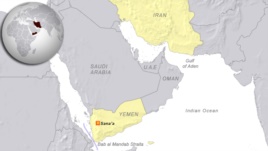 Yemen and Iran
But Pentagon spokesman Col. Steve Warren dismissed the report, saying the Roosevelt is ”repositioning to conduct maritime security operations.”
The guided-missile cruiser USS Normandy escorted the ship en route from the Arabian Gulf to the Arabian Sea, where they joined other U.S. military vessels “to ensure the vital shipping lanes in the region remain open and safe,” according to a statement from the U.S. Navy.
U.S. officials told media late last week that Iran has deployed at least seven ships, some carrying weapons, to Yemen in a bid to shore up Houthi arms supplies through the port city of Aden.
Houthi insurgents face daily air raids from a Saudi Arabian-led coalition and ongoing clashes with local forces.
White House spokesman Josh Earnest told reporters Monday there is “evidence that Iranians are supplying weapons and other forms of support to Houthis.”
“That’s the kind of support that will only contribute to greater violence in Yemen,” he said.
On Saturday, Iranian President Hassan Rouhani said the presence of Iranian naval ships “in the Persian Gulf and the Gulf of Aden is intended to ensure the security of neighboring countries and maritime traffic.”
The Saudi coalition has Aden under a naval blockade.
An EMP attack on America seems likely, Dan Miller’s Blog, April 19, 2015
(The views expressed in this article are mine and do not necessarily reflect those of Warsclerotic or any of its other editors. — DM)
Some consider North Korea to be the rogue nation most likely to use an electromagnetic pulse (EMP) to attack America; Iran is also seen as quite likely to do it. It matters little which succeeds.
Here is a lengthy 2013 video about an EMP attack, what would happen and why:
The possibilities and consequences of an EMP attack on America are too horrific to contemplate; the “legitimate news media” generally ignore them. We therefore tend to relegate them to the realm of remote “tin foil hat conspiracy theories” and to focus instead on more congenial stuff — the latest sex scandal, Hillary Clinton’s campaign van parking in a disabled-only space and other matters unlikely to impact America to an extent even approaching that of an EMP attack. Meanwhile, most of “our” Congress Critters, who should know better, focus on opinion polls, filling their campaign coffers and getting richer personally while neglecting our atrophying missile defense systems and other potential means of avoiding or recovering from an EMP attack.
Here is a 2013 video about the likelihood of an Iranian EMP attack on America that would paralyze the country for a very long time.
North Korea and the Islamic Republic of Iran have long cooperated in the development of nukes and means to deliver them. I wrote about their cooperation here, here, here and elsewhere. It now appears that Iran intends to use them for an EMP attack on America.
The issue of a nuclear EMP attack was raised in the final hours of this week’s elections in Israel when U.S. authority Peter Vincent Pry penned a column for Arutz Sheva warning of Iran’s threat to free nations.
“Iranian military documents describe such a scenario — including a recently translated Iranian military textbook that endorses nuclear EMP attack against the United States,” he wrote. [Emphasis added.]
Here is a March 7, 2015 video about the impact of the P5+1 “negotiations” on Iran getting (or keeping) nukes and the likelihood of an Iranian EMP attack on America:
In April of this year, John Bolton had this to say about the Iran – North Korea connection, how much we don’t know and the ongoing P5+1 “negotiations.”
Perhaps Israel can take out Iran’s nuke capabilities.
Here is a February 2015 video about what’s (not) being done to harden our domestic power grid:
As of February of this year, Govtrack US opined that the chances of passage of the SHIELD act were zero percent. Be that as it may, simply hardening the power grid would not solve communications or transport problems — most modern communications devices, as well as vehicles built after 1987, depend on computer chips and, when the chips are fried, will not function. Even if food and water could be processed, getting them to consumers in sufficient quantities to keep them alive would be an enormous if not impossible task.
Problems of a human nature would also arise and remaining alive would be difficult. If one’s family were about to starve, how many would try to steal food and water from those who still have even enough for a few days? How many roving gangs of armed criminals, quite willing to kill, would do the same? The police would likely have no communications ability and might well be otherwise occupied, tending to their own families. Military forces not confined to base would likely have the same problems and be doing the same.
That suggests another problem in restoring infrastructure seriously damaged or destroyed by the EMP attack. It would not only require the availability of transport, communications and undamaged equipment. It would also require the availability of personnel, not otherwise occupied in scrounging for food, water, medical supplies and other resources to care for their own families, while protecting them from those lacking such resources, as well as from armed gangs.
Now, the U.S. military is taking steps to protect itself by reopening a cold war bunker at Cheyenne Mountain, abandoned in 2006.

Cheyene Mt. Complex
The Pentagon last week [early April 2015] announced a $700 million contract with Raytheon Corporation to oversee the work for North American Aerospace Command (NORAD) and US Northern Command.
Admiral William Gortney, head of NORAD and Northern Command, said that ‘because of the very nature of the way that Cheyenne Mountain’s built, it’s EMP-hardened.’
. . . .
‘And so, there’s a lot of movement to put capability into Cheyenne Mountain and to be able to communicate in there,’ Gortney told reporters.
‘My primary concern was… are we going to have the space inside the mountain for everybody who wants to move in there, and I’m not at liberty to discuss who’s moving in there,‘ he said. [Emphasis added.]
The Cheyenne mountain bunker is a half-acre cavern carved into a mountain in the 1960s that was designed to withstand a Soviet nuclear attack. From inside the massive complex, airmen were poised to send warnings that could trigger the launch of nuclear missiles.
But in 2006, officials decided to move the headquarters of NORAD and US Northern Command from Cheyenne to Petersen Air Force base in Colorado Springs. The Cheyenne bunker was designated as an alternative command center if needed.
Now the Pentagon is looking at shifting communications gear to the Cheyenne bunker, officials said.
‘A lot of the back office communications is being moved there,’ said one defense official.
Officials said the military’s dependence on computer networks and digital communications makes it much more vulnerable to an electromagnetic pulse, which can occur naturally or result from a high-altitude nuclear explosion.
Under the 10-year contract, Raytheon is supposed to deliver ‘sustainment’ services to help the military perform ‘accurate, timely and unambiguous warning and attack assessment of air, missile and space threats’ at the Cheyenne and Petersen bases.
Raytheon’s contract also involves unspecified work at Vandenberg Air Force Base in California and Offutt Air Force Base in Nebraska.
When will the site be fully operational, for what and who will be allowed to go there?
Some other military bases are probably being hardened, at least to an extent that might (or might not) preserve their electrical grids. If it works, they may serve as refugee centers for adjacent civilian populations. However, the military installations would likely run out of food and potable water before very long and, with food and water processing centers no longer operational, there would be substantial difficulties in getting — as well as transporting — large quantities of food and water. Were the processing centers to become operational, transportaion difficulties would remain. Communications between the military installations and the outside world? Likely zilch, at least initially, because radios, telephones and other modern communications devices (as most now are) depend on computer chips and would be fried by an EMP attack. Some might eventually be restored at some military bases, but that is not likely to be the case with those not on those bases.
Conclusions
What would you do in the event of an EMP attack? In a major metropolitan area, you would probably be SOL very quickly. In a small town? Marginally but not much better off. An isolated small farm, close to a mountain spring and adequately stocked with food, medical supplies, firearms and ammunition, could provide reason to hope that you might eventually be able to grow or slaughter sufficient food and have access to enough potable water to survive; at least until roving armed gangs arrive and overpower you.
This video is about a massive world-wide pandemic. In the event of a pandemic, electricity, automobiles and communications would still function, at least for a while. Following an EMP attack, the consequences would likely be substantially worse and last far longer.
Here is a link to a novel about one family in a small city and its efforts to survive an EMP attack on America. It does a reasonable job of summarizing the potential consequences.
Obama says US open to talks with Iran on immediately lifting sanctions, Times of Israel, April 17, 2015
 President Barack Obama listened as Italian Prime Minister Matteo Renzi speaks during their news conference in the East Room of the White House in Washington, Friday, April 17, 2015. (Photo credit: AP Photo/Susan Walsh)
Obama also said Friday that a bill introduced by Congress seeking a review and approval of a nuclear deal with Iran would not derail negotiations with Tehran, set to resume next week, and that the proposed legislation was a “reasonable compromise” he planned to sign off on.
The legislation would block Obama from waiving congressional sanctions against Iran for at least 30 days after any final agreement, which would give lawmakers time to weigh in. Obama said he still has concerns that some lawmakers are treading on his unilateral power as president to enter into a political agreement with another country, but the bill has language that makes it clear that lawmakers’ review will be limited to the sanctions imposed by Congress.
***********************
U.S. President Barack Obama on Friday left open the door to “creative negotiations” in response to Iran’s demand that punishing sanctions be immediately lifted as part of a nuclear deal, even though the initial agreement calls for the penalties to be removed over time.
Asked whether he would definitively rule out lifting sanctions at once as part of a final deal aimed at keeping Iran from developing a nuclear weapon, Obama said he didn’t want to get ahead of negotiators in how to work through the potential sticking point. He said his main concern is making sure that if Iran violates an agreement, sanctions can quickly be reinstated — the so-called “snap back” provision.
“How sanctions are lessened, how we snap back sanctions if there’s a violation, there are a lot of different mechanisms and ways to do that,” Obama said. He said part of the job for Secretary of State John Kerry and the representatives of five other nations working to reach a final deal with Iran by June 30 “is to sometimes find formulas that get to our main concerns while allowing the other side to make a presentation to their body politic that is more acceptable.”
Iran’s Supreme Leader Ayatollah Ali Khamenei and President Hassan Rouhani insisted last week that they would not sign a deal unless all sanctions are lifted right after an agreement is signed. Obama initially portrayed their comments as a reflection of internal political pressure, while pointing out that the initial framework agreement reached earlier this month allows for sanctions to be phased out once international monitors verify that Tehran is abiding by the limitations.
Obama also said Friday that a bill introduced by Congress seeking a review and approval of a nuclear deal with Iran would not derail negotiations with Tehran, set to resume next week, and that the proposed legislation was a “reasonable compromise” he planned to sign off on.
The legislation would block Obama from waiving congressional sanctions against Iran for at least 30 days after any final agreement, which would give lawmakers time to weigh in. Obama said he still has concerns that some lawmakers are treading on his unilateral power as president to enter into a political agreement with another country, but the bill has language that makes it clear that lawmakers’ review will be limited to the sanctions imposed by Congress.
“That I think at least allows me to interpret the legislation in such a way that it is not sending a signal to future presidents that each and every time they’re negotiating a political agreement, that they have to get a congressional authorization,” Obama said. He said he takes lawmakers who have drafted the legislation at their word that they will not try to derail negotiations.
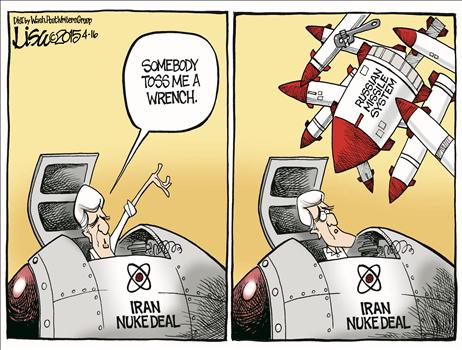
The president also weighed in on Russia’s announcement earlier this week that it would lift a five-year ban on delivery of anti-aircraft missiles, giving the Islamic republic’s military a strong deterrent against any air attack. The White House initially objected, but Obama said, “I’m frankly surprised that it held this long.”
Russia signed the $800 million contract to sell Iran the S-300 missile system in 2007, but suspended their delivery three years later because of strong objections from the United States and Israel. “Their economy is under strain and this was a substantial sale,” Obama said.
Russia, which also is party to the talks along with China, France, Britain and Germany, said the preliminary nuclear agreement made its 2010 ban on sending missiles to Iran no longer necessary.
PART II: Michael Rubin on Obama: ‘He is Constructing an Imaginary Iran’ Breitbart, Adelle Nazarian, April 17, 2015

Obama doesn’t understand that the Middle East isn’t a neighborhood to organize. He doesn’t understand that he’s the leader of the free world and not a zoning commissioner. In effect, the bad guys are running all over him. And the problem is, he’s too naive or too arrogant to care.
****************************
Breitbart’s Adelle Nazarian had the opportunity to speak with renowned Middle East expert and resident scholar at the American Enterprise Institute (AEI) Dr. Michael Rubin recently. Dr. Rubin provided his analysis on U.S.-Iran relations under the Obama Administration and provided a look into the future through the periscope of the past.
This is Part II of a two-part series. For the first installment, click here.
BREITBART: Why didn’t the Obama administration look back at Khomeini’s letter from 1988 calling for nuclear weapons and compare it to Khamenei’s supposed nuclear fatwa today when approaching the nuclear talks?
RUBIN: You’ve got a situation where the Obama Administration is cherry picking dishonestly. And frankly, if Obama acted this way as a university professor, he would be dismissed. He is constructing an imaginary Iran. Take the case of the fatwa.
Does the fatwa actually exist? According to open source center there was something delivered in 2014 that purports to be the text of the fatwa to the United Nations. But in that text — according to the open source center of the United States — it doesn’t use the word “never.”
Here’s another problem. It’s Diplomacy 101 to know that you don’t rely on anything that’s not written down. Even with North Korea, we got the North Koreans and the Americans to agree on a piece of paper.
I’m not sure John Kerry is even competent to negotiate with a 5-year-old over chocolate or vanilla ice cream. I mean how could you not get something in writing? It’s the same thing with Obama and the fatwa. Get it in writing. How come Obama can’t put this up on the White House website? He puts up everything else.
BREITBART: Is it true that a fatwa, either verbalized or written, can be changed at any time?
RUBIN: Yes. It can. And Obama is operating in a vacuum.
It’s like Groundhog Day. In 2003, Mohammaed Javad Zarif negotiated with the Americans with regard to non-interference in Iraq. According to the Iranian press, the Iranians proceeded to break that agreement and inserted 2,000 Revolutionary Guardsmen into Iraq.
Now the question is, did Zarif lie? Or was he sincere but he didn’t have the power to ensure that all aspects of the Iranian government would abide by the agreement? And why is it that, 12 years later, we’re having the same discussion about the same man? Either Zarif is a liar, in which case we never should have sat down with him again. Or he’s powerless and a conman, in which case we should have never sat down with him again.
There is a major misconception under the current administration– with Obama and Kerry– that it was due to a lack of diplomacy under the Bush Administration that the number of centrifuges skyrocketed in Iran.
#1: Between 2000-2005, the European Union almost tripled its trade with Iran and sat down with them regularly. That directly corresponds to the rapid increase in Iranian centrifuges. It was because of diplomacy, not because of coercion.
#2. During that same period, the price of oil almost quintupled and the bulk of hard-currency windfall went into Iran’s nuclear and ballistic missile programs. That was under the so-called “reformists,” and this is why the so-called reformists like to claim that they are responsible for the success of the nuclear program. But this raises questions about why Obama would again repeat the same issue.
The Iranian economy, according to Iran’s Central Bank, had declined 5.4% in the year before we sat down to negotiate the joint plan of action. Now, Iran’s economy is in the black because we’ve given them an infusion of cash. But if we hadn’t given them that infusion of cash in conjunction with the halving of the price of oil, then we could literally force Iran to drink from the chalice of poison.
Those were the words that Khomeini said when he ended the Iran-Iraq War after swearing he would never do it until Jerusalem was liberated.
Giving someone $12 billion is not forcing them to drink from a chalice of poison. What Obama did was the equivalent to giving a five-year-old dessert first and then asking him to eat his spinach.
BREITBART: What has to be done strategically to stop Iran from expansion?
RUBIN: It’s the same thing with Putin and any other expansionist dictators. The more you appease, the more you show that your red lines are drawn in pink crayon and the more they are going to test you. What we forget is when Iran tested the U.S. under Reagan, Reagan responded with Operation Praying Mantis. He sank the Iranian Navy which gave way to a joke from that time. “Why does the Iranian Navy have glass bottomed-boats? So they can see their air force as well.”
Operation Praying Mantis was the largest surface naval engagement since WWII and it taught the Iranians that you don’t mess with the United States. Obama doesn’t understand that the Middle East isn’t a neighborhood to organize. He doesn’t understand that he’s the leader of the free world and not a zoning commissioner. In effect, the bad guys are running all over him. And the problem is, he’s too naive or too arrogant to care.
BREITBART: Should the next President of the United States of America be an expert on Iranian issues?
RUBIN: What you need in a presidential candidate is not someone that knows the Iran issue inside and out. What you need is someone that is true to their values, can provide moral leadership, is not afraid of moral clarity and understands the following:
#1. The importance of individual liberty, because individual liberty is a character which no dictatorship can withstand. You need someone who isn’t afraid of understanding that we should not live in a morally and culturally equivalent world.
#2. The United States is not the equal to countries like Iran or Russia. We are their moral superiors and as such it is important that we win and our adversaries lose. It’s important that freedom and liberty triumph.
You don’t need to be an expert in Iran to understand that. But you need to be someone who is not going to calibrate their foreign policy to the latest poll. Principles have to trump polls and I think that’s where Bush and Clinton are going to be disasters.
EXCLUSIVE: Iranian Parliament Releases “Factsheet” for Revision of Lausanne Statement, FARS News Agency (Iranian), April 15, 2015
(Note: all bold print and italics are in the original. Iran now insists on a five year term for an agreement and the immediate lifting of all sanctions, among other things. — DM)
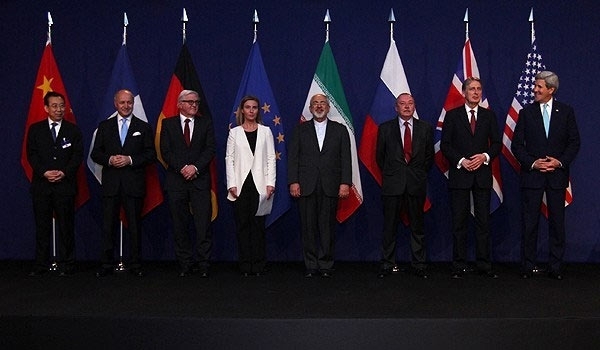
The factsheet which was presented by Head of the Nuclear Committee Ebrahim Karkhaneyee on Wednesday stresses the necessity for respecting the redlines and guidelines specified by Supreme Leader of the Islamic Revolution Ayatollah Seyed Ali Khamenei, making Iran’s decisions and undertakings reversible to enable the country to resume its nuclear operations in case of the other side’s non-commitment to its undertakings, and immediate termination of all sanctions in a single step and on the first day of the implementation of the final agreement.
The factsheet also necessitates commitment of both sides to their undertakings based on the Geneva agreement, a fair and reasonable balance between the gives and takes, taking good care not to impair the country’s security and military boundaries and national interests, providing 190,000 SWUs (Separative Work Units) of nuclear fuel enrichment capability needed by Iran to produce fuel for the Bushehr nuclear power plant immediately after the end of contract with Russia, safeguarding the nuclear achievements, actual operation of all nuclear facilities of Iran not in words, but in action, continued Research and Development (R&D) works and scientific and technological progress in Iran and immediate application of R&D findings in the country’s industrial-scale uranium enrichment cycle.
The factsheet urges operation of 10,000 centrifuge machines at Natanz and Fordo, a maximum 5-year-long duration for the deal and for Iran’s nuclear limitations, replacement of the current centrifuges with the latest generation of home-made centrifuge machines at the end of the five-year period.
Enrichment Program:
The period for the Join Comprehensive Plan of Action (JCPOA) should be limited to five years, in which about 10,000 active centrifuges operating at Natanz and Fordo now will continue nuclear fuel production by enriching uranium below the 5% grade.
The UF6 enriched reserves which are under the supervision of the International Atomic Energy Agency (IAEA) should be kept at Fordo nuclear plant and will be turned into nuclear fuel complex based on the existing capabilities.
During the five-year period, the Islamic Republic of Iran will continue to keep the excess centrifuges installed at Natanz and Fordo or will gradually dismantle them, and at the end of the 5-year period, it will replace all the existing centrifuges, including the active or inactive ones, with the new generation of (IR-N) centrifuge machines with the help of the new spaces and infrastructures which will have been already prepared and will use them without any limitation.
Justification:
Based on the Geneva agreement, the period for the final step should merely include a single period which has been considered as to be five years in the present factsheet. But in the Lausanne statement, different periods of 10, 20, 25 years and higher have been considered.
Given the Geneva agreement, the amount of enrichment should be specified based on the country’s practical needs and the number of 10,000 centrifuges has also been specified on this basis.
The 5-year period in this factsheet has been has been specified with respect to the date when Iran’s nuclear fuel contract with Russia for the Bushehr nuclear power plant will end; hence, the rules and limitations for the components of the enrichment cycle should be set in such a way that the Islamic Republic of Iran will be able to supply the fuel needed for the power plant after the end of the contract with Russia.
Operation of 10,000 centrifuges and developing and having a 10-ton enriched uranium stockpile will enable the Islamic Republic of Iran to supply the fuel needed for the Bushehr power plant in the year when the fuel supply contract with Russia (28-30 tons) ends.
Fordo installations:
Fordo nuclear facility will remain an enrichment and nuclear Research and Development (R&D) center. 4 enrichment cascades with 656 centrifuges will continue operation and production of fuel for purity levels lower than 5% by maintaining the current chain arrangements.
If the country would need 20%-degree (enriched) uranium, the nuclear fuel production line for purity levels lower than 5% will be altered to enrich uranium to the 20%-grade after connecting the centrifuge cascades to each other again.
Justification:
Based on the above, Fordo will remain an actual and active center, and the Islamic Republic of Iran will maintain its capability to reverse its decision and restore the 20%-grade enrichment.
Research and Development (R&D):
In a bid to use R&D findings in the country’s industrial-scale enrichment chain, R&D should be planned in a way that the necessary possibilities and infrastructures will be provided for replacing the first generation of centrifuges with the latest generation of centrifuge machines (IR-N) when the Joint Comprehensive Plan of Action comes to an end after 5 years.
The R&D program should undergo no limitation before it comes into use for industrial-scale operation.
Justification:
Accordingly, the advanced centrifuges will enter the chain of nuclear fuel production without any restriction at the end of the 5-year deal.
Arak Heavy Water Reactor:
Given the Group 5+1 countries’ mere concern about the plutonium existing in the spent nuclear fuel (SNF) of the Arak 40-MW heavy water reactor, the fuel used by the reactor will be sent abroad.
The G5+1 states will be committed to cooperate and take the necessary measures for relevant international licensing and permissions.
Justification:
Given the SNF export abroad, the insistence of the G5+1, specially the US, on redesigning the said reactor is merely a pretext and doesn’t have any scientific rationale.
What is more important than the heavy water nature of Arak reactor is the core of the reactor which is due to be taken out and then be redesigned and renovated. Such a move is irreversible in nature, and thus means crossing the specified redlines.
Supervision and Inspection:
Supervision and inspections of the Islamic Republic of Iran’s nuclear program should be carried out within the framework of the the Non-Proliferation Treaty (NPT) safeguards agreements.
Justification:
Once done, the principle stated by the Supreme Leader of the Islamic Revolution – that security and military sanctities and boundaries shouldn’t be violated and that the inspections should be carried out at conventional levels similar to all other countries – will be respected and materialized. Given the Islamic Republic of Iran’s opposition to the world arrogance, endorsing and implementing the Additional Protocol will provide the world arrogance (a term normally used for the US and its western allies) with legal grounds to stage their preplanned plots against the Islamic Republic of Iran.
Sanctions:
Concurrently with the start of the JCPOA, all the US and EU sanctions will be terminated and Iran will start fulfilling its undertakings based on the verification of the IAEA.
The UN Security Council sanctions resolution against Iran will be annulled and all nuclear-related sanctions will be terminated and the Islamic Republic of Iran’s case will be normalized.
The G5+1 countries, the EU and the UNSC will avoid imposition of new nuclear-related sanctions against Iran.
Justification:
By terminating all sanctions in a single step right at the start of the implementation of the final comprehensive agreement, the Supreme Leader’s statement that termination of sanctions is part of the agreement and not its result will be materialized.
Based on the Geneva agreement, after the implementation of the JCPOA, all UNSC, US and EU sanctions should be terminated and no new (UNSC) resolution would be needed in this regard; Hence, terminating the UNSC sanctions will close the case and no new resolution which would pave the ground for new plots will be issued.
International cooperation:
The Islamic Republic of Iran’s nuclear cooperation with the world states, including the G5+1 members, in areas of building nuclear power plants, research reactors, nuclear fuel production, nuclear safety medicine and nuclear agriculture, etc. will be possible and will improve. Based on the JCPOA, Iran will be provided with access to the global market, trade and finance and technical know-how and energy.
Reversibility:
In case of the two sides’ non-commitment to their undertakings, there will be a possibility for reversing all measures.
Justification:
Based on the aforementioned proposal, the Islamic Republic of Iran will be provided with reversible measures at the lowest level of damage and, therefore, the G5+1’s commitment to its undertakings will be in fair balance (with those of Iran).
Duration of the JCPOA:
After the end of the five-year period and the JCPOA exercise, all restrictions will be lifted and based on the Geneva agreement, the case with the Islamic Republic of Iran’s nuclear program will be similar to that of the other NPT member states.
The Iranian Parliament factsheet for a revision to the Lausanne agreement came after the US released a factsheet different from the joint statement issued by Iran’s Foreign Minister Mohammad Javad Zarif and Federica Mogherini, the High Representative of the European Union for Foreign Affairs and head of the G5+1 in nuclear talks with Iran, at the end of the latest round of Iran-world powers nuclear talks in Switzerland on April 2, known as the Lausanne statement.
The US factsheet that was released only a few hours after the Lausanne framework understanding caused fury in Iran, encouraging many to raise deep doubt about the results of the talks and US accountability and trustworthiness.
In only a few weeks, a bipartisan bill was also presented to the Congress for vote that would give the US legislature oversight of a final deal, a move seen by many across the globe, including both Iran and the US, as furthering impediments to the endorsement of a final deal between Iran and the sextet.
Senate Foreign Relations Committee Chairman Senator Bob Corker, who wrote the bill, said the White House had agreed to go along with the bill only after it was clear there was strong Democratic support. The legislation was passed unanimously by the committee and is expected to pass the full Senate and then the House of Representatives.
“That change occurred only when they saw how many senators were going to vote for this,” Corker said.
Bipartisan support for the bill had grown in recent weeks to near the 67 votes needed to override any presidential veto. But senators from Obama’s Democratic Party did succeed in adding amendments to water down the bill, making it more palatable to the White House.
A Reckless Act in the Senate on Iran, New York Times, The Editorial Board, April 14, 2015
(Consider the source. — DM)
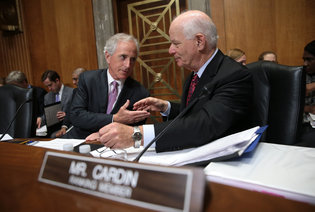 Senators Bob Corker, left, and Ben Cardin, the leaders of the Senate Foreign Relations Committee. Credit Win McNamee/Getty Images
Congress has formally muscled its way into President Obama’s negotiations with Iran, creating new and potentially dangerous uncertainties for an agreement that offers the best chance of restraining that country’s nuclear program.
With a unanimous vote on Tuesday, the Senate Foreign Relations Committee approved a bill that would require Congress to review, and then vote on, the final text of a nuclear deal. It would also prohibit Mr. Obama from waiving economic sanctions on Iran — the crucial element of any agreement under which Iran rolls back its nuclear program — for at least 30 days, and up to 52 days, after signing an agreement so Congress has time to weigh in.
The full Senate and the House will have to approve the bill. But the committee’s action gives momentum to those who have bitterly criticized Mr. Obama for negotiating with Iran, though they offer no credible alternative to the preliminary deal on the table. Republicans who control Congress have largely been the driving force behind the legislation, but this bill was passed overwhelmingly by the Senate committee thanks to Democratic support.
Mr. Obama initially threatened to veto the legislation, but he backed off rather than face a bipartisan override of his veto. The administration did get some compromises. The review period was shortened, and language making the lifting of sanctions dependent on Iran ending support for terrorism was softened.
Mr. Obama’s acquiescence might be a tactical move. He could veto the congressional vote on the final agreement, which is supposed to be concluded by the June 30 deadline, rather than expending political capital in vetoing this measure if it were to pass both chambers of Congress. But the Senate committee’s action puts him in an weakened position as the only leader involved in the negotiations who may not be permitted to fully honor commitments that were made.
The nuclear deal is the product of a multinational negotiation with Iran conducted by the United States, France, Britain, China, Germany and Russia. In no other country has a legislative body demanded the right to block the agreement. Even if Congress barred Mr. Obama from waiving American sanctions, the European Union and the United Nations Security Council could lift the sanctions they imposed, thus undercutting the American decision.




 anneinpt
 artaxes
 danmillerinpanama
 davidking1530
 Peter Hofman
 Joseph Wouk
 Peter
Peter Louisiana Steve
 WarSclerotic
Recent Comments