CNN: Original Obama administration standards for nuclear deal not met, Washington Free Beacon via You Tube, July 15, 2015
Full text of Obama on Iran deal: ‘Every pathway to a nuclear weapon is cut off,’ The Times of Israel, July 14, 2015
(Obama distorts and obfuscates the “deal.” Please see Joint comprehensive plan of action — text. — DM)
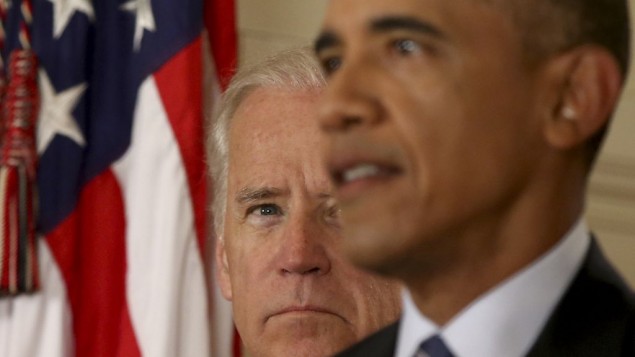 Vice President Joe Biden listens as President Barack Obama delivers remarks in the East Room of the White House in Washington, Tuesday, July 14, 2015, after an Iran nuclear deal is reached. (AP Photo/Andrew Harnik, Pool)
Because of this deal we will for the first time be in a position to verify all of these commitments. That means this deal is not built on trust. It is built on verification. Inspectors will have 24/7 access to Iran’s nuclear facilities. Iran will have access to Iran’s entire nuclear supply chain, its uranium mines and mills, its conversion facility and its centrifuge manufacturing and storage facilities.
Because of this deal, inspectors will also be able to access any suspicious location — put simply, the organization responsible for the inspections, the IAEA, will have access where necessary, when necessary. That arrangement is permanent. And the IAEA has also reached an agreement with Iran to get access that it needs to complete its investigation into the possible military dimensions of Iran’s past nuclear research.
********************
After two years of negotiations, the United States, together with our international partners, has achieved something that decades of animosity has not: a comprehensive long-term deal with Iran that will prevent it from obtaining a nuclear weapon.
This deal demonstrates that American diplomacy can bring about real and meaningful change, change that makes our country and the world safer and more secure.
This deal is also in line with a tradition of American leadership. It’s now more than 50 years since President Kennedy stood before the American people and said, “Let us never negotiate out of fear, but let us never fear to negotiate.” He was speaking then about the need for discussions between the United States and the Soviet Union, which led to efforts to restrict the spread of nuclear weapons.
In those days, the risk was a catastrophic nuclear war between two superpowers. In our time, the risk is that nuclear weapons will spread to more and more countries, particularly in the Middle East, the most volatile region in our world.
Today, because America negotiated from a position of strength and principle, we have stopped the spread of nuclear weapons in this region. Because of this deal, the international community will be able to verify that the Islamic Republic of Iran will not develop a nuclear weapon.
This deal meets every single one of the bottom lines that we established when we achieved a framework this spring. Every pathway to a nuclear weapon is cut off, and the inspection and transparency regime necessary to verify that objective will be put in place. Because of this deal, Iran will not produce the highly enriched uranium and weapons-grade plutonium that form the raw materials necessary for a nuclear bomb.
Because of this deal, Iran will remove two thirds of its installed centrifuges, the machines necessary to produce highly enriched uranium for a bomb and store them under constant international supervision. Iran will not use its advanced centrifuges to produce enriched uranium for the next decade. Iran will also get rid of 98 percent of its stockpile of enriched uranium.
To put that in perspective, Iran currently has a stockpile that could produce up to 10 nuclear weapons. Because of this deal that stockpile will be reduced to a fraction of what would be required for a single weapon. This stockpile limitation will last for 15 years.
Because of this deal, Iran will modify the core of its reactor in Arak so that it will not produce weapons grade plutonium and it has agreed to ship the spent fuel from the reactor out of the country for the lifetime of the reactor. For at least the next 15 years Iran will not build any new heavy water reactors.
Because of this deal we will for the first time be in a position to verify all of these commitments. That means this deal is not built on trust. It is built on verification. Inspectors will have 24/7 access to Iran’s nuclear facilities. Iran will have access to Iran’s entire nuclear supply chain, its uranium mines and mills, its conversion facility and its centrifuge manufacturing and storage facilities.
This ensures that Iran will not be able to divert materials from known facilities to covert ones. Some of these transparency measures will be in place for 25 years.
Because of this deal, inspectors will also be able to access any suspicious location — put simply, the organization responsible for the inspections, the IAEA, will have access where necessary, when necessary. That arrangement is permanent. And the IAEA has also reached an agreement with Iran to get access that it needs to complete its investigation into the possible military dimensions of Iran’s past nuclear research.
Finally Iran is permanently prohibited from pursuing a nuclear weapon under the Nuclear Nonproliferation Treaty, which provided the basis for the international community’s efforts to apply pressure on Iran.
As Iran takes steps to implement this deal, it will receive relief from the sanctions that we put in place because of Iran’s nuclear program, both America’s own sanctions and sanctions imposed by the United Nations Security Council.
This relief will be phased in. Iran must complete key nuclear steps before it begins to receive sanctions relief.
And over the course of the next decade, Iran must abide by the deal before additional sanctions are lifted, including five years for restrictions related to arms and eight years for restrictions related to ballistic missiles.
All of this will be memorialized and endorsed in a new United Nations Security Council resolution. And if Iran violates the deal, all of these sanctions will snap back into place. So there is a very clear incentive for Iran to follow through and there are very real consequences for a violation.
That’s the deal. It has the full backing of the international community. Congress will now have an opportunity to review the details and my administration stands ready to provide extensive briefings on how this will move forward.
As the American people and Congress review the deal it will be important to consider the alternative. Consider what happens in a world without this deal. Without this deal, there is no scenario where the world joins us in sanctioning Iran until it completely dismantles its nuclear program. Nothing we know about the Iranian government suggests that it would simply capitulate under that kind of pressure and the world would not support an effort to permanently sanction Iran into submission.
We put sanctions in place to get a diplomatic resolution and that is what we have done. Without this deal there would be no agreed-upon limitations for the Iranian nuclear program. Iran could produce, operate and test more and more centrifuges. Iran could fuel a reactor capable of producing plutonium for a bomb and we would not have any of the inspections that would allow us to detect a covert nuclear weapons program.
In other words, no deal means no lasting constraints on Iran’s nuclear program. Such a scenario would make it more likely that other countries in the region would feel compelled to pursue their own nuclear programs, threatening a nuclear arms race in the most volatile region of the world.
It would also present the United States with fewer and less effective options to prevent Iran from obtaining a nuclear weapon.
I have been president and commander in chief for over six years now. Time and again I have faced decisions about whether or not to use military force. It’s the greatest decision that any president has to make.
Many times, in multiple countries, I have decided to use force. And I will never hesitate to do so when it is in our national security interest. I strongly believe that our national security interest now depends upon preventing Iran from obtaining a nuclear weapon, which means that, without a diplomatic resolution, neither I nor a future U.S. president would face a decision about whether or not to allow Iran to obtain a nuclear weapon or whether to use our military to stop it.
Put simply, no deal means a greater chance of more war in the Middle East. Moreover, we give nothing up by testing whether or not this problem can be solved peacefully. If, in a worst-case scenario, Iran violates the deal, the same options that are available to me today will be available to any U.S. president in the future.
And I have no doubt that 10 or 15 years from now, the person who holds this office will be in a far stronger position with Iran further away from a weapon and with the inspections and transparency that allow us to monitor the Iranian program.
For this reason, I believe it would be irresponsible to walk away from this deal. But on such a tough issue, it is important that the American people and the representatives in Congress get a full opportunity to review the deal.
After all, the details matter. And we’ve had some of the finest nuclear scientists in the world working through those details. And we’re dealing with a country — Iran — that has been a sworn adversary of the United States for over 35 years.
So I welcome a robust debate in Congress on this issue and I welcome scrutiny of the details of this agreement. But I will remind Congress that you don’t make deals like this with your friends. We negotiated arms control agreements with the Soviet Union when that nation was committed to our destruction and those agreements ultimately made us safer.
I am confident that this deal will meet the national security interests of the United States and our allies. So I will veto any legislation that prevents the successful implementation of this deal. We do not have to accept an inevitable spiral into conflict. And we certainly shouldn’t seek it. And precisely because the stakes are so high this is not the time for politics or posturing. Tough talk from Washington does not solve problems. Hard-nosed diplomacy, leadership that has united the world’s major powers offers a more effective way to verify that Iran is not pursuing a nuclear weapon.
Now that doesn’t mean that this deal will resolve all of our differences with Iran. We share the concerns expressed by many of our friends in the Middle East, including Israel and the Gulf states, about Iran’s support for terrorism and its use of proxies to destabilize the region.
But that is precisely why we are taking this step, because an Iran armed with a nuclear weapon would be far more destabilizing and far more dangerous to our friends and to the world.
Meanwhile we will maintain our own sanctions related to Iran’s support for terrorism, its ballistic missile program and its human rights violations. We will continue our unprecedented efforts to strengthen Israel’s security, efforts that go beyond what any American administration has done before.
And we will continue the work we began at Camp David, to elevate our partnership with the Gulf States to strengthen their capabilities to counter threats from Iran or terrorist groups like ISIL.
However, I believe that we must continue to test whether or not this region, which has known so much suffering, so much bloodshed, can move in a different direction.
Time and again I have made clear to the Iranian people that we will always be open to engagement on the basis of mutual interests and mutual respect. Our differences are real and the difficult history between our nations cannot be ignored. But it is possible to change.
The path of violence and rigid ideology, a foreign policy based on threats to attack your neighbors or eradicate Israel, that’s a dead end. A different path, one of tolerance and peaceful resolution of conflict, leads to more integration into the global economy, more engagement with the international community and the ability of the Iranian people to prosper and thrive. This deal offers an opportunity to move in a new direction. We should seize it.
We have come a long way to reach this point: decades of an Iranian nuclear program, many years of sanctions, and many months of intense negotiation.
Today, I want to thank the members of Congress, from both parties, who helped us put in place the sanctions that have proven so effective as well as the other countries who joined us in that effort. I want to thank our negotiating partners — the United Kingdom, France, Germany, Russia, China, as well as the European Union — for our unity in this effort, which showed that the world can do remarkable things when we share a vision of peacefully addressing conflict. We showed what we can do when we do not split apart.
And finally, I want to thank the American negotiating team. We had a team of experts working for several weeks straight on this, including our secretary of energy, Ernie Moniz. And I want to particularly thank John Kerry, our secretary of state, who began his service to this country more than four decades ago when he put on our uniform and went off to war. He is now making this country safer through his commitment to strong, principled American diplomacy.
History shows that America must lead, not just with our might, but with our principles. It shows we are stronger, not when we are alone, but when we bring the world together. Today’s announcement marks one more chapter in this pursuit of a safer and more helpful, more hopeful world.
Thank you. God bless you and God bless the United States of America.
Nowhere, no-time supervision, Israel Hayom, David M. Weinberg, July 14, 2015
(The article was written prior to release of the “Joint comprehensive plan of action.” A link to the text of the plan, with quotes from the part about IAEA inspections, is available here. — DM)
Under the terms of the accord, it seems that IAEA inspectors will have to “coordinate” their visits to suspect Iranian sites, “in consultation between Iran and the world powers.” Worse still, Iran will have the right to deny and challenge U.N. requests to send inspectors to suspicious sites. In these cases, an arbitration board composed of Iran and the powers would decide on the issue.
They call this “managed access,” which is a euphemism for nowhere, no-time inspections.
******************
Ahead of the accord reached between the P5+1 and Iran Tuesday, The New York Times reported that it was expected to be a “political agreement,” not a “legally binding treaty.”
Furthermore, Israeli sources said the two sides would “announce understandings” and present a 100-page document, but not “sign” anything. It will take months of additional negotiations to develop the relevant implementation documents.
All of which is meant to obfuscate the details, Israeli officials fear, and cloud the matter enough to confuse or bamboozle Congress. It will also allow the Iranians to (correctly) claim that they never truly “signed away” their nuclear capacities. In the meantime, U.N. and other international mechanisms to lift sanctions on Iran will go into high gear.
However, the root corruption of the agreement is that Iran gets to keep its nuclear facilities, and there will be no truly intrusive international supervision of what goes on deep inside them.
The accord leaves Iran with all its nuclear development facilities intact, including the Fordo underground center, instead of dismantling them. This allows the Iranians to continue refining their nuclear skills. Even at low levels of enrichment (3.5% and 5%, which are not useful for a bomb) this provides a framework with which Tehran can bypass Western restrictions and hoodwink Western inspectors.
After all, Iran has clandestinely crossed every “red line” set by the West over the past 20 years — putting nuclear plants online, building heavy-water facilities, refining uranium, working on explosive triggers and warheads, and generally breaching all of its obligations under the Nuclear Nonproliferation Treaty — and has gotten away with it. It has lied, formally and repeatedly, to the international community about its nuclear efforts.
So any deal that scales back sanctions and allows Iran to keep operating its advanced nuclear development facilities even at a low level is a fatal bargain. So warned Simon Henderson of the Washington Institute and Olli Heinonen, a former deputy director general of the International Atomic Energy Agency, as long as two years ago.
U.S. President Obama’s response to this was to promise that he would accept nothing less than a Western right to conduct “anywhere, anytime” international inspections of Iran’s most secret nuclear and military facilities.
Indeed, veteran investigators have testified in front of Congress literally dozens of times that anywhere-anytime access is a minimum prerequisite to a verifiable deal.
Alas, Obama has now backed down from that. It’s an American collapse.
Under the terms of the accord, it seems that IAEA inspectors will have to “coordinate” their visits to suspect Iranian sites, “in consultation between Iran and the world powers.” Worse still, Iran will have the right to deny and challenge U.N. requests to send inspectors to suspicious sites. In these cases, an arbitration board composed of Iran and the powers would decide on the issue.
They call this “managed access,” which is a euphemism for nowhere, no-time inspections.
This means that Iran will continue to play the negotiation game over every Western inspection request. With lawyers and more lawyers, diplomats and more diplomats. Lots of hotels and endless discussions.
In other words, Iran will be able to delay and delay access to true military or nuclear sites, just as it has done with the Parchin military base, where it is suspected to have experimented with nuclear weapons production.
Only now, under the accord and after at least three years of requests (and after a major Iranian cleanup effort, documented by Western satellite photos) will Iran finally ”grant” access to Parchin. Sometime soon.
Yay. What a great victory for Obama and nuclear containment of Iran.
Joint comprehensive plan of action [PDF], July 14, 2015
(It’s about 150 pages in length, with frequent references to Annex I, dealing with IAEA inspections, which begins at page 21. The part of the annex dealing with IAEA inspections concerning “M. PAST AND PRESENT ISSUES OF CONCERN” starts at page 38; access begins at page 42. It’s complicated and dramatically delays and limits the nature and scope of the inspections, giving Iran ample time to hide its activities. Among other provisions, it includes:
In line with normal international safeguards practice, such requests will not be aimed at interfering with Iranian military or other national security activities, but will be exclusively for resolving concerns regarding fulfilment of the JCPOA commitments and Iran’s other non-proliferation and safeguards obligations.
. . . .
If the absence of undeclared nuclear materials and activities or activities inconsistent with the JCPOA cannot be verified after the implementation of the alternative arrangements agreed by Iran and the IAEA, or if the two sides are unable to reach satisfactory arrangements to verify the absence of undeclared nuclear materials and activities or activities inconsistent with the JCPOA at the specified locations within 14 days of the IAEA’s original request for access, Iran, in consultation with the members of the Joint Commission, would resolve the IAEA’s concerns through necessary means agreed between Iran and the IAEA. In the absence of an agreement, the members of the Joint Commission, by consensus or by a vote of 5 or more of its 8 members, would advise on the necessary means to resolve the IAEA’s concerns. The process of consultation with, and any action by, the members of the Joint Commission would not exceed 7 days, and Iran would implement the necessary means within 3 additional days.
— DM
Goodnight Vienna (11), Power Line,
Omri Ceren continues his series of reports by email from Vienna:
Good Monday from Vienna, where we’re now into day 17 of the current round of negotiations and yet summer continues to surprise us.
The JPOA is again set to expire at midnight after having been extended a few days ago. Just about everyone is saying that another short-term extension is not being considered. Of course the parties always say that, until they don’t, but this time the comments feel a little bit different. The Europeans could not be more frustrated – they don’t understand why the Americans and the Iranians can’t get their nonsense together – and the Russians and Chinese actually have things they need to take care of. Rouhani was even scheduled to speak on TV today, though the Iranians are now saying he’ll wait until there’s a formal announcement.
The conventional wisdom is that negotiations will wrap up today and a ceremony will be held tomorrow.
As for what the parties are still talking about: Reuters has been saying all week that sanctions remain unresolved, and today the wire piled on with “among the biggest sticking points in the past week has been Iran’s insistence that a United Nations Security Council arms embargo and ban on its ballistic missile program dating from 2006 be lifted immediately… Other problematic issues are access for inspectors to military sites in Iran” [1]. The Associated Press report from this morning also identified those two areas as key disagreements, and added that there are complications due to a new Iranian demand “that any U.N. Security Council resolution approving the nuclear deal be written in a way that stops describing Iran’s nuclear activities as illegal” [2].
As far as the UNSCR gambit goes, it seems like a not-very-sophisticated attempt to craft language that would later be used to undermine the IAEA’s authority to inspect Iranian facilities. The Iranians have successfully pulled off similar tricks throughout the talks: they inserted vague language into Geneva that they interpreted as a right to enrich, and they did the same thing at Lausanne so they could later claim that the arms embargo has to be lifted. U.S. negotiators have proven less than adept in detecting how and when the Iranians are laying traps for them.
As far as the arms embargo goes, there are multiple Iranian motives. The most obvious is that the Iranians are engaged in four hot wars across the region against traditional American allies, and they’re eager to purchase Russian weapons to fight in those wars. David Ignatius to MSNBC this morning: “Israel will see that as a direct threat, as it will arm the people Israel is fighting. The Sunni Arabs, as you said, will see this as a major capitulation by the U.S.” The more subtle reason has to do with how the Iranians conduct their illicit nuclear trade. The Iranians have an interest in weakening international restrictions against arms transfers in in general, because they then use newly-legitimized procurement channels to violate whatever restrictions remain. I’m [linking] below an article published yesterday by Benjamin Weinthal – a Berlin-based fellow for Foundation for Defense of Democracies (FDD) – on how Iran has been violating UNSC nuclear sanctions over the last few months:
While U.S.-led world powers hold talks with Iran in Vienna to curb Tehran’s illicit nuclear weapons program, the Islamic Republic’s spies have been seeking atomic and missile technology in neighboring Germany as recently as last month, according to German intelligence sources… Iran has a long history of illegally obtaining nuclear technology from within Germany and transporting it in ways that circumvent international sanctions. German companies have shown an eagerness to legally tap the Iranian market, though none are accused of abetting illegality in the latest efforts by Iran.
Of course there’s also what ought to be the major diplomatic scandal of the Iranians cheating on nuclear sanctions even as nuclear negotiations continue [reported by Benjamin Weinthal in the linked story]. But the Iranians have been caught cheating throughout the talks: they’ve violated UNSC resolutions in exactly this way and they’ve violated the JPOA by busting through oil caps, testing advanced centrifuges, and failing to convert excess enriched gas into dioxide. In literally every case the Obama administration has found a reason to publicly play Iran’s lawyer by spinning away those violations.
_________________
[1] http://www.reuters.com/article/2015/07/13/us-iran-nuclear-idUSKCN0PM0CE20150713
[2] http://bigstory.ap.org/article/1bfd89dfd94b47b19706949ae2255c02/iran-talks-hit-final-stage-announcement-expected
The Islamist state of Iran scoring victories, Front Page Magazine, Dr. Majid Rafizadeh, July 13, 2015

Why negotiations are shaping up to be a win-win for the Mullahs
The mainstream media have ignored and overlooked the Islamic Republic’s recent moves, which threatened regional security. The Islamic Republic’s search for regional hegemony has also been overshadowed by President Obama’s prioritization of signing a nuclear deal.
Iranian leaders and media outlets have given an estimate of how much they have so far gained from the nuclear talks. The Iranian leaders and state-owned media have recently boasted about receiving approximately $12 billion in assets over the period of the nuclear talks by July 7th.
The ruling clerics in the Islamic Republic and Iran’s Revolutionary Guard Corps have also unveiled and are celebrating the deployment of a new and second long-range Ghadir radar. According to an Iranian state-owned outlet, Brigadier General Farzad Esmaili, commander of the Islamic Revolutionary Guards Corps’ (IRGC) air defense force, who unveiled the Ghadir phased-array radar, pointed out that “Discovering and tracking micro aerial vehicles (MAV)… is one of the special qualities of the Ghadir radar system.”
This is part of long-range and air defense system. The Islamic Republic is attempting to completely shield its nuclear facilities when it is close to obtaining nuclear weapons. Russia has also made a deal with the Islamic Republic to ship the S-300 advanced missile system to Iran.
The Islamic Republic also continues to receive billions of dollars due to the nuclear talks. One recent example includes a side deal that the Islamic Republic worked out at the nuclear talks with the Obama administration, which would give Tehran 13 tons of gold worth about $700 million.
The winners of these nuclear talks are primarily President Obama, the Iranian government, Shiite proxies in the region, Iran’s Revolutionary Guard Corps, President Rouhani, the Syrian government and Bashar Al Assad, and Western corporations and companies.
President Obama desires to seal and achieve his final legacy. President Obama and his administration are creating the narrative that the deal is a historic and good one.
On the other hand, the easing of sanctions creates a whole array of other winners in the Islamic Republic including the IRGC, office of the Supreme Leader, and the Quds force (elite branch of IRGC which operates in extraterritorial landscapes).
As the economic power of the IRGC and the Quds force increases, Iran’s Shiite proxies in the region will benefit from the trickling down of these funds. Al Assad can also be more assured and confident that the Islamic Republic will continue supporting his government financially, economically, militarily, and through intelligence and advisory roles.
Entities or governments which will not benefit from these nuclear talks or latest developments are countries which are threatened by extremist militia groups in the region and are concerned with Iran’s hegemonic ambitions, it’s search for regional preeminence and supremacy, Iran’s attempts to tip the balance of power in its favor.
The Islamic Republic fuels extremism in the region, gives birth to militias and is the major root of atrocities, terrorism, human rights abuses and the vicious cycle we are witnessing in the Middle East and beyond. In fact, there is a powerful correlation between the Islamic Republic’s rising military buildup and the rising power of extremism and terrorism in the region.
As Israeli Prime minister Benjamin Netanyahu stated, the Islamic State (IS) threat is nothing in comparison to the Islamic Republic’s threat.
The Iranian government is also scoring further victories with regard to the nuclear talks. When we comprehensively and meticulously look at the deal, the agreement will not only maintain Iran’s nuclear ambitions, but it will create whole new security and geopolitical concerns in the region. The agreement is not final but temporary, broadly speaking. After 10 years, economic sanctions will have lifted, Iran’s breakout capacity will be nearly complete, and Iran can reinitiate its program with full speed.
As a result, Iranian leaders will have it both ways.
President Obama is treating the Islamic Republic completely differently from groups such as the Islamic State. He calls Iran a successful regional player.
Obama fails to recognize the fact that any victory or military capability that the Islamic Republic gains is a step towards more militarization, terrorism, violence and regional insecurity. As Israeli PM Benjamin Netanyahu stated, “Obviously no one thinking with a clear mind would consider giving Islamic State nuclear weapons,” and he adds, “But in the negotiations taking place now with Iran, this extreme state that spreads terrorism around the world is being given the ability to develop a nuclear weapons arsenal with many nuclear bombs, together with the means to deliver them… We should not strengthen one at the expense of the other…We need to weaken both and prevent the aggression and military buildup of both of them.”
It is the time to pay closer attention to the Islamic Republic’s covert military buildup and treat it the same way the international community treats the Islamic State, not as a successful regional player.
Addicted to self-deception, Israel Hayom, Dr. Reuven Berko, July 13, 2015
There is an Arab proverb that says, “What is written on the brow will inevitably be seen by the eye,” meaning that one will inevitably meet one’s destiny.
But the eyes of the West do not see the writing. The negotiators responsible for the talks between Iran and the world powers see the sights and hear the voices, but ignore reality and engage in the wishful thinking of those who sent them to Vienna.
Like failed psychologists, U.S. Secretary of State John Kerry and his team are managing the negotiations with the unquestionably stubborn Iranians as if they were therapy sessions. The Iranians, following the directives of a cynical ayatollah whispering to them from the wings, are deliberately displaying manic personality shifts, up and down, playing the West like a marionette between hope and despair.
The West watches eagerly as Iran continues to develop its missiles and its nuclear program, as the centrifuges constantly whirl throughout this period of intentional procrastination. World leaders hear the threats of Ayatollah Ali Khamenei and his band of clerics, who shun the deal and preach the destruction of Israel, while declaring that the Iranian nation’s struggle against the “boastful” United States will continue and that there will be no access to the sites where the bomb is being developed. If that is what the leader thinks, then the masses will follow. And indeed, the Iranian media, defense establishment, and the crowds in the streets of Tehran parade their zealous hatred and their anti-Western incitement as they demand that sanctions be lifted while American and Israeli flags go up in flames.
It appears the leaders in the talks are using “denial” and “repression” as psychological tricks to delude themselves, and not, God forbid, as negotiation tactics to achieve the desired deal from the enemy. These masters of self-deception respond to threatening declarations from Iran’s supreme leader that his country will never giver up its nuclear achievements by saying that it is his way of preparing the masses in Iran for the concessions to come. This is like saying that the harsh and radical comments repeatedly made are simply a way to “vent” the feelings of rage in the Iranian public and are a sign “from above” of the concession of the nuclear project.
Those who have eyes in their heads understand that things are not going well. Lifting the sanctions will swell Iran’s purse, which funds global terrorism, particularly in Syria, Yemen, Jordan, Lebanon and Iraq, and seeks urgently to import Chinese and Russian weapons. Can the leaders of the negotiations admit that they were mistaken and were led astray by the masters of Iranian diplomacy? Will they be able to take a step back and admit that Prime Minister Benjamin Netanyahu was right to call the deal a disaster? Since we are dealing with deception, it appears that Kerry and his staff are trapped in cognitive dissonance of the same sort as a person who buys a beautiful car and then discovers that he has been deceived and the engine is burned out, yet still takes comfort in the fact that the horn works just fine.
From a psychological perspective, this is the line between the impulse for a collective Shiite suicide mission in the name of Allah and the megalomaniacal desire to control the world at the cost of the lives of everyone who opposes. However, in a Persian bazaar, what you see is what you buy. Iran is declaring, planning and working toward destroying every country in the Middle East — especially Israel — with its nuclear program, and no deal with Kerry will change that. Instead of the simple solution — the complete dismantling of the Iranian nuclear program — the West has become addicted to the process of self-deception and procrastination. At least therapy is discreet.




 anneinpt
 artaxes
 danmillerinpanama
 davidking1530
 Peter Hofman
 Joseph Wouk
 Peter
Peter Louisiana Steve
 WarSclerotic
Recent Comments