Archive for the ‘Diplomacy’ category

A New Age of Theory

August 6, 2015

http://www.jewishmediaresources.com/1768/a-new-age-of-theoryAugust 7, 2015

The recently signed p5+1 nuclear deal with Iran is based on another beautiful theory: The nicer the United States is to the Iranian mullahs, the more she caves into their demands and acknowledges their valid reasons for hating America, the more they will seek to be like us and want to be good citizens of the world. President Obama has literally bet the fate of the world on that conjecture.

The theory that the Iranian theocracy will be transformed by kindness betrays another failure of progressive theorists from the French Revolution to the present: They view religion as “irrational,” and cannot fathom that anyone else takes its claims seriously. That Iran’s Islamic Revolution really seeks world conquest for Islam is too absurd to countenance as an explanation of regime behavior.

**********************

Alexis de Tocqueville’s explanation of the descent of the French Revolution into the Terror, in The Old Regime and the Revolution, emphasized the outsized role that men of letters played in French political discourse prior to the Revolution. These writers, as described by de Tocqueville, had a decided preference for “general and abstract theories of government” and a tendency “to trust in them blindly.” Since they dwelt at “an almost infinite distance from practice . . . no experience tempered the ardors of their natures; nothing warned them of the obstacles that existing facts might place before them.”

With the passage of time, “they . . . became much bolder in their innovations, fonder of general ideas and systems, more contemptuous of old wisdom, and still more confident of their individual reason. . . ,” writes de Tocqueville.

We live in another such age of theory, writes Alain Finkelkraut. Take for example the lunatic claim that Jews are committing genocide against the Palestinians. Under Israeli rule of the West Bank from 1967 to 1992, life expectancy leaped by 50% — from 48 to 72; infant mortality dropped by 75%; seven universities were built where none had existed, and Palestinian illiteracy was reduced to a fraction of that in neighboring Egypt and Syria; and the West Bank, as of 1992, had the fourth fastest growing economy in the world. If that be genocide, it was genocide of a decidedly peculiar sort.

But, explains Finkelkraut, Europeans have theory according to which Jews are uniquely capable of genocide today. And in an age of theory, a beautiful theory trumps a thousand unruly facts. What’s the theory? Because Jews were the victims of the Holocaust, not its perpetrators, they never learned of the danger of turning one’s fellow human beings into the dehumanized “Other.” From which it follows that Jews dehumanize Palestinians and are committing genocide against them. Never mind the facts.

The recently signed p5+1 nuclear deal with Iran is based on another beautiful theory: The nicer the United States is to the Iranian mullahs, the more she caves into their demands and acknowledges their valid reasons for hating America, the more they will seek to be like us and want to be good citizens of the world. President Obama has literally bet the fate of the world on that conjecture.

Neither tens of thousands chanting “Death to America” nor Supreme Leader Khameini’s insistence that Iran will continue to fight American arrogance even after the deal because hatred of America is the very raison d’etre of the regime register with supporters of the theory.

The theory that the Iranian theocracy will be transformed by kindness betrays another failure of progressive theorists from the French Revolution to the present: They view religion as “irrational,” and cannot fathom that anyone else takes its claims seriously. That Iran’s Islamic Revolution really seeks world conquest for Islam is too absurd to countenance as an explanation of regime behavior.

Another Obama theory holds that even rabid anti-Semites, like the Iranian mullahs, will not act upon their hatreds to the harm of their “rational” interests. But history proves the opposite: The Nazis diverted vital war material in an effort to wipe out Hungarian Jewry in Auschwitz.

The attachment to theory over empirical evidence is evidenced in the way that Left policy prescriptions remain constant despite their repeated failures. What Walter Russell Mead calls the Blue Model of governance – high taxes, high regulation, and generous public union pensions – is failing everywhere. From mid-size California cities to Detroit, Chicago, and most recently, Puerto Rico, it has led to literal bankruptcy.

A vicious cycle sets in of higher taxes to pay pensions based on fantastical assumptions followed by the flight of business and jobs to lower tax states followed by yet higher taxes on those remaining to compensate for the lost business and jobs. Eventually, Blue Model cities and states experience the highest income inequality, as the population divides between extremely high earners, on the one hand, and the menial workers who serve them and welfare recipients, on the other.

The Obama administration has now set out to increase Muslim immigration, despite Europe’s dystopian experience, which has left it poised to become an extension of the Maghreb by the end the century, with an increasingly radicalized and unassimilated Muslim population taking over.

The theories of the Left are unmoored from reality because they have less to do with seeking to make life better than with the emotional reaffirmation they offer their proponents. Every Democratic candidate, for instance, will call for universal pre-school education, despite 50 years of evidence that Head Start early intervention has no lasting impact.

Similarly, every Democratic candidate will advocate heavy government investment in abundant, renewable “green” energy – such as ethanol, the production of which actually creates more pollution than it saves – even though “green energy” consistently proves to be economically unviable and a drag on economic productivity in the form of higher energy costs. Billions of dollars of taxpayer money, however, will inevitably find their way into the pockets of “green energy” crony capitalists.

The attraction of “renewables” is primarily the feeling of moral virtue they confer on proponents. And the same is true of Head Start and calls for a $15/and hour minimum wage, which would only ensure that orders at McDonald’s will be taken by a machine and not by some striving high-school kid eager to earn money for college or a poor, single-mother with no marketable skills. Estimates of the American jobs likely lost if the minimum wage were to rise to $15/hour range from 3,000,000 to 6,000,000, most of them to low-wage earners. But how deliciously virtuous must legislators feel enacting minimum wage laws.

THOSE WHO PREFER THEORY over history and facts do not just produce bad policy: They are subject to a profoundly illiberal, even totalitarian, temptation. That was De Tocqueville’s subject. Their theory of government is that “smart” people – i.e., theoreticians like themselves — ought to run the show. A corollary is that all smart people will reach similar “rational” conclusions, and that those who don’t are either fools or evil. Not surprisingly, when human beings and reality fail to conform to their theories, they turn ornery. Think Pol Pot.

Hostility to free markets and a profound ambivalence towards representative democracy are part and parcel of the preference for abstractions. The former are too irrational and chaotic. Markets give equal value to the desires of the not-so-bright. Central planning, by contrast, is much more rational, or so it seems, until one considers its unbroken record of failure. Just think of resource rich Venezuela, where years of socialist rule have made both food and toilet paper scarce.

Similarly the flaw of representative democracy is that fools and geniuses alike have one vote. The preferred form of municipal government for early American Progressives was unelected city managers, above the fray of partisan politics. And those same early Progressives created the modern administrative state, whose rule-making by unelected bureaucratic “experts,” has become virtually indistinguishable from the law-making power conferred exclusively upon Congress by the Constitution.

Self-styled progressive Barack Obama is perfectly comfortable ruling by executive decree and through administrative agencies, like the Environmental Protection Agency, which seeks to impose by rule-making what could never pass in Congress.

Obama’s progressive ancestor, President Woodrow Wilson, famously declared the U.S. Constitution, with its federal system and checks and balances between the three branches, to be an outmoded document for the modern age, and called for a much more powerful unitary executive.

Progressive thinkers have little patience for the rules of procedure of representative democracy or its allocation of decision-making authority. Only results matter and that the smart people make the decisions – be they judges, agency bureaucrats, or the president himself. Neither Court President Aharon Barak in his heyday nor Justice Anthony Kennedy more recently showed the slightest concern over whom appointed them philosopher-king to determine the nature of human dignity.

The assumption that those who disagree are either stupid or evil undercuts the fundamental democratic value of tolerance. On issues like anthropogenic climate change, modern progressive are ever eager to declare the debate over, and even advocate criminal penalties for global warming deniers. (This at a time when many climate scientists are forecasting a mini-Ice Age based on lower solar activity.)

Anyone who follows nutrition and health reports knows how wildly fluctuating the best scientific advice is. How much more unlikely is the discussion to be over in the vastly more complex area of climate, involving up to twenty different scientific disciplines and in which controlled experiments are impossible.

Not by accident are the most progressive institutions in American society – the universities – those with the most restrictive speech codes designed to regulate various and sundry “micro-aggressions” in speech.

The Orwellian argument of the late Brandeis philosopher Herbert Marcuse that “new and rigid restrictions” on certain teachings that protect the oppressive status quo are required for true freedom of thought to flourish only represents the outer limit of where the preference for abstractions over human reality can lead.

Iran Already Sanitizing Nuclear Site, Intel Warns

August 5, 2015

Iran Already Sanitizing Nuclear Site, Intel Warns, Bloomberg View&  August 5, 2015

The U.S. intelligence community has informed Congress of evidence that Iran was sanitizing its suspected nuclear military site at Parchin, in broad daylight, days after agreeing to a nuclear deal with world powers.

For senior lawmakers in both parties, the evidence calls into question Iran’s intention to fully account for the possible military dimensions of its current and past nuclear development. The International Atomic Energy Agency and Iran have a side agreement meant to resolve past suspicions about the Parchin site, and lawmakers’ concerns about it has already become a flashpoint because they do not have access to its text.

Intelligence officials and lawmakers who have seen the new evidence, which is still classified, told us that satellite imagery picked up by U.S. government assets in mid- and late July showed that Iran had moved bulldozers and other heavy machinery to the Parchin site and that the U.S. intelligence community concluded with high confidence that the Iranian government was working to clean up the site ahead of planned inspections by the IAEA.

The intelligence community shared its findings with lawmakers and some Congressional staff late last week, four people who have seen the evidence told us. The Office of the Director of National Intelligence briefed lawmakers about the evidence Monday, three U.S. senators said.

“I am familiar with it,” Senate Intelligence Committee Chairman Richard Burr told us Tuesday. “I think it’s up to the administration to draw their conclusions. Hopefully this is something they will speak on, since it is in many ways verified by commercial imagery. And their actions seem to be against the grain of the agreement.”

Burr said Iran’s activities at Parchin complicate the work of the IAEA inspectors who are set to examine the site in the coming months. IAEA’s director general, Yukiya Amano, was in Washington on Wednesday to brief lawmakers behind closed doors about the side agreements.

“They are certainly not going to see the site that existed. Whether that’s a site that can be determined what it did, only the technical experts can do that,” Burr said. “I think it’s a huge concern.”

A senior intelligence official, when asked about the satellite imagery, told us the IAEA was also familiar with what he called “sanitization efforts” since the deal was reached in Vienna, but that the U.S. government and its allies had confidence that the IAEA had the technical means to detect past nuclear work anyway.

Another administration official explained that this was in part because any trace amounts of enriched uranium could not be fully removed between now and Oct. 15, the deadline for Iran to grant access and answer remaining questions from the IAEA about Parchin.

Senate Foreign Relations Committee Chairman Bob Corker told us Tuesday that while Iran’s activity at Parchin last month isn’t technically a violation of the agreement it signed with the U.S. and other powers, it does call into question Iran’s intention to be forthright about the possible military dimensions of its nuclear program.

“The intel briefing was troubling to me … some of the things that are happening, especially happening in such a blatant way,” he said. “Iran is going to know that we know.” He added the new information gave him “a lot of concerns” about Iran coming clean on military dimensions of its nuclear work.

According to the overall nuclear agreement, sanctions relief for Iran can come only after the IAEA and Iran resolve their outstanding concerns about possible military dimensions of past and current work. But the agreement does not specify how the issue must be resolved, only that it be resolved to the IAEA’s satisfaction.

Several senior lawmakers, including Democrats, are concerned that Iran will be able to collect its own soil samples at Parchin with only limited supervision, a practice several lawmakers have compared to giving suspected drug users the benefit of the doubt to submit specimens unsupervised. Iran’s sanitization of the site further complicates that verification.

Democratic Senator Chris Coons, a member of the Foreign Relations Committee, told us Tuesday that this area is part of why he is undecided on supporting the Iran deal.

“I have concerns about the vigorous efforts by Iran to sanitize Parchin,” he said. “I’ve gotten some reassurance about how difficult it is for them to effectively conceal what we know to have been their illicit nuclear weapons developments there.”

Coons said he was most concerned about the integrity of the IAEA inspection process going forward and not as concerned about figuring out what happened in the site in the past: “We know what the Iranians did at Parchin.”

David Albright, the president of the Institute for Science and International Security, obtained a commercially available image of the Parchin site taken by satellites on July 26 that shows renewed activity at the Parchin site. He told us there are two new large vehicles, alterations ongoing to roofs of two of the buildings and new structures near two of the buildings.

“You have to worry that this could be an attempt by Iran to defeat the sampling, that it’s Iran’s last-ditch effort to eradicate evidence there,” he said. “The day is coming when they are going to have to let the IAEA into Parchin, so they may be desperate to finish sanitizing the site.”

The facility, outside of Tehran, first came to the attention of the international community in 2004 when news reports surfaced that it was being used to test explosives for a nuclear warhead.

A 2007 U.S. National Intelligence Assessment concluded that Iran halted this kind of work in 2003. Between 2005 and today, Iran has allowed IAEA inspectors access to Parchin — a vast complex with dozens of buildings — on only five occasions. In 2012, Abright’s group reported on satellite imagery that it said showed efforts to clean up evidence of an explosives testing chamber there.

Representative Ed Royce, the Republican chairman of the House Foreign Affairs Committee, said that Amano had told him in recent conversations that the IAEA had “thousands of pages of documentations on tests to weaponize a nuclear device.” Royce added, “For a long time, they have been altering sites.”

The IAEA has documented this as well. The agency’s report from May 29 this year said there was  satellite imagery of vehicles, equipment and “probable construction materials” at Parchin. The report said, “The activities that have taken place at this location since February 2012 are likely to have undermined the Agency’s ability to conduct effective verification.”

Secretary of State John Kerry has said that the U.S. government has “absolute knowledge” about what Iran has done in the past. Ahead of the vote on the agreement next month, many lawmakers don’t share Kerry’s confidence. Iran would seem to have its doubts as well, since it’s still trying to cover its tracks.

Obama negotiator says she didn’t see final Iran ‘side deals’

August 5, 2015

Obama negotiator says she didn’t see final Iran ‘side deals,’ The Hill, Kristina Wong, August 5, 2015

(Were the secret agreements on which Kerry, et al, were “fully briefed” and hence know “exactly” what they say also “rough drafts?” Unlike Ms. Sherman, Kerry testified that he had not seen the secret agreement(s).– DM)

shermanwendy_052715gettyGetty Images

[L]ater in the hearing, she walked back her comments about not seeing the final arrangements. 

“I was shown documents that I believed to be the final documents, but whether there were any further discussions…” she added before being cut off by another question by Sen. Pat Toomey (R-Pa.). Later, she said responded, “I have” when asked whether she saw the final versions of the deals.

****************

The only Obama administration official to view confidential “side deals” between Iran and the International Atomic Energy Agency (IAEA) admitted Wednesday she and her team have only seen rough drafts.

“I didn’t see the final documents. I saw the provisional documents, as did my experts,” said Wendy Sherman, a lead U.S. negotiator for the deal, at a Senate Banking Committee hearing.  

Sherman, undersecretary of State for political affairs, said she was only allowed to see the confidential deals “in the middle of the negotiation” when the IAEA “wanted to go over with some of our experts the technical details.” 

She maintained the deals — which focus on with Iran’s prior work on a bomb and access to Iran’s Parchin military site — are still confidential and can’t be submitted to Congress.

Sherman said the U.S. did not protest to the confidentiality of the agreements, despite the Iran Nuclear Agreement Review Act demanding all related agreements, because the administration wanted the IAEA to respect the confidentiality of their agreements with the U.S.

“We want to protect U.S. confidentiality … this is a safeguards protocol. The IAEA protects our confidential understandings … between the United States and the IAEA,” she said.

However, later in the hearing, she walked back her comments about not seeing the final arrangements.

“I was shown documents that I believed to be the final documents, but whether there were any further discussions…” she added before being cut off by another question by Sen. Pat Toomey (R-Pa.). Later, she said responded, “I have” when asked whether she saw the final versions of the deals.

She also argued they could not be submitted to Congress because the administration does not have the deals, and that the Senate had “every single document” the administration has.

Sherman emphasized she would brief Senators later Wednesday afternoon in a classified session on everything she knows about the deal.

A similar briefing for House lawmakers last week did not assuage concerns for Rep. Ed Royce (R-Calif.), chairman of the House Foreign Affairs Committee, who sent a letter to Secretary of State John Kerry on Monday calling on the administration to submit the deals.

She also noted that IAEA Director General Yukiya Amano was meeting with the Senate Foreign Relations Committee later in the afternoon.

Although she said the U.S. did not ask or pressure Amano to conduct the briefing, she suggested it was a gesture beyond what the IAEA is obligated to do.

Todd: No One Will Say The Iran Agreement Is A Great Deal

August 5, 2015

Todd: No One Will Say The Iran Agreement Is A Great Deal, Washington Free Beacon, August 5, 2015

NBC’s Chuck Todd said Wednesday that American sentiment about the Iran nuclear agreement is tepid because, while Americans want to engage in diplomacy, they do not trust Iran or the Ayatollah to keep his word.

“You haven’t hear anybody say this is a great deal,” Todd said on Morning Joe. “’This is a workable deal’ is about the best argument you hear for it.”

As the public opinion of the Iran deal suffers, President Obama has maintained that his deal is the only option to prevent war with the largest state sponsor of terrorism. Americans oppose the Iran agreement by a 2-1 margin.

“There is nobody excited about this deal,” Todd said.

Critics of the Iran deal point to Iran’s actions causing chaos in the Middle East as an indicator of why the deal is misguided. If Iran complies with the terms of the agreement, sanctions will be lifted giving the regime well over $100 billion of its own money that was previously frozen. Side deals between the International Atomic Energy Agency (IAEA) and Iran have also raised alarms, especially about the ability to inspect Iran’s nuclear facilities.

“I feel the president should be acknowledging that this isn’t a perfect deal more often,” Todd said. “I feel like they oversell the deal sometimes.”


Kerry says sinking of Iran deal would be ‘ultimate screwing of ayatollah’

August 5, 2015

Kerry says sinking of Iran deal would be ‘ultimate screwing of ayatollah,’ Jerusalem Post, August 5, 2015

(It’s as pro-Israel as the Obama administration gets. Please see also, Daniel Greenfield’s comments here. — DM)

ShowImage (6)
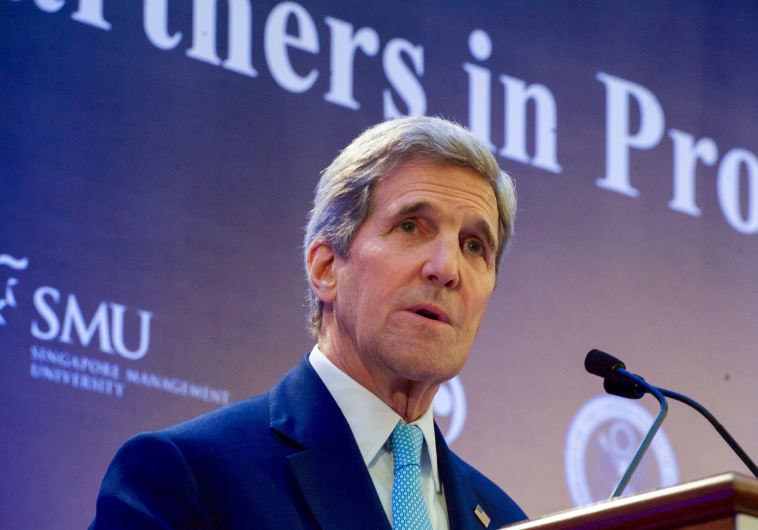
US Secretary of State John Kerry speaks in Singapore. (photo credit:STATE DEPARTMENT)

The secretary rejected Israel’s criticism of the nuclear agreement, saying that the deal “is as pro-Israel” as it gets.

******************

U.S. Secretary of State John Kerry told The Atlantic on Wednesday that if Congress were to shoot down the Iran nuclear agreement, it would be “the ultimate screwing” of Supreme Leader Ayatollah Ali Khamenei.

Kerry made the remarks in an interview with The Atlantic‘s Jeffrey Goldberg.

The secretary rejected Israel’s criticism of the nuclear agreement, saying that the deal “is as pro-Israel” as it gets.

Reneging on the nuclear agreement, which has the support of the major world powers, would constitute a setback for Washington and justify anti-American animus in Iran.

“The ayatollah constantly believed that we are untrustworthy, that you can’t negotiate with us, that we will screw them,” Kerry said. “[Having Congress vote down the nuclear pact] will be the ultimate screwing.”

“The United States Congress will prove the ayatollah’s suspicion, and there’s no way he’s ever coming back. He will not come back to negotiate. Out of dignity, out of a suspicion that you can’t trust America. America is not going to negotiate in good faith. It didn’t negotiate in good faith now, would be his point.”

Kerry also commented on the vociferous opposition to the deal expressed by Israel, which the secretary referred to as “visceral” and “emotional.” He was adamant that the agreement was positive for Israel’s geopolitical standing.

“I’ve gone through this backwards and forwards a hundred times and I’m telling you, this deal is as pro-Israel, as pro-Israel’s security, as it gets,” Kerry said. “And I believe that just saying no to this is, in fact, reckless.”

Kerry said that he was “sensitive” to Israeli concerns over Iran’s long-term aims, but he rejected arguments made by Jerusalem that the Islamic Republic was planning its annihilation.

“I haven’t seen anything that says to me [that Iran will implement its vow of wiping Israel off the map],” the secretary said. “They’ve got 80,000 rockets in Hezbollah pointed at Israel, and any number of choices could have been made. They didn’t make the bomb when they had enough material for 10 to 12. They’ve signed on to an agreement where they say they’ll never try and make one and we have a mechanism in place where we can prove that. So I don’t want to get locked into that debate. I think it’s a waste of time here.”

“I operate on the presumption that Iran is a fundamental danger, that they are engaged in negative activities throughout the region, that they’re destabilizing places, and that they consider Israel a fundamental enemy at this moment in time,” Kerry said. “Everything we have done here [with the nuclear agreement] is not to overlook anything or to diminish any of that; it is to build a bulwark, build an antidote.”

The secretary said that the nuclear deal is even more imperative if Israel’s fears that Iran is plotting its destruction are true, since the agreement neutralizes Tehran’s nuclear program.

Contentions | Has Obama Read the Khamenei Palestine Book?

August 4, 2015

Contentions | Has Obama Read the Khamenei Palestine Book? Commentary Magazine, August 4, 2015

(Another interesting question would be, does Obama agree with any of Khamenei’s statements and, if so, which? — DM)

The Khamenei Palestine book is important not in and of itself but because the regime’s obsession with Israel is a key to its foreign policy. . . . But as much as Iran is focused on regional hegemony in which Sunni states would be brought to heel, as Khamenei’s Palestine illustrates, it is the fixation on Israel and Zionism that really animates their expansionism and aid for terror groups.

******************

It turns out President Obama isn’t the only world leader who writes books. His counterpart in Iran – Supreme Leader Grand Ayatollah Ali Khamenei — has also just published a new book. But while it may not be as introspective as Obama’s Dreams From My Father, it does tell us at least as much about the vision of the person in charge in Tehran (as opposed to Hassan Rouhani, the faux moderate who serves as its president) as the president’s best-selling memoir. As Amir Taheri reports in the New York Post, Palestine is a 416-page diatribe against the existence of the state of Israel and a call to arms for it to be destroyed. Supporters of the nuclear deal the president has struck with Khamenei’s regime may dismiss this book as merely one more example of the Supreme Leader’s unfortunate ideology that must be overlooked. But as the New York Times noted last week, the administration’s real goal here isn’t so much in delaying Iran’s march to a nuclear weapon (which is the most that can be claimed for the agreement) as it is fostering détente with it. Seen in that light, the latest evidence of the malevolence of the Islamist regime should be regarded as yet another inarguable reason for Congress to vote the deal down.

In his interview with The Atlantic’s Jeffrey Goldberg on May 21, President Obama was asked directly about the significance of Iran’s anti-Semitism and its commitment to destroying Israel. The president said the anti-Semitism of the Iranian leadership did not mean they weren’t also “interested in survival” or being “rational.” As far as he was concerned, the ideology of the regime was not something that would influence its decisions.

But everything Khamenei says and, even more importantly, everything the regime does, by funding terrorist groups at war with Israel such as Hamas and Hezbollah or by embarking on a ruinously expensive nuclear project that placed it in conflict with the West, speaks to its commitment to policies that Obama may think are irrational but which are completely in synch with what he called its “organizing principle.” Why would a nation so rich in oil need to risk international isolation or war seek nuclear power if not to help Khamenei fulfill his pledge to “liberate” what is now Israel for Muslims?

The president told Goldberg that the American military option would be a sufficient deterrent to ensure that Iran didn’t violate the nuclear pact or behave in an irrational manner. But since the president has ruled out the use of force in a categorical manner, it’s hard to see why the Iranians would fear it once the U.S. and Europe are doing business with them. Even if it was a matter of snapping back sanctions, assuming that such a concept is even possible? Once the restrictions are unraveled, it’s fair to ask why would they work then when the president repeatedly tells us additional sanctions won’t work now and require us to accept the current deal that doesn’t achieve the objectives that the administration set for the negotiations when they began.

The Khamenei Palestine book is important not in and of itself but because the regime’s obsession with Israel is a key to its foreign policy. Iran constitutes a grave threat to Neighboring Arab countries that are at least as angry about the president’s embrace of Tehran as the Israelis since their nuclear status would undermine their security. But as much as Iran is focused on regional hegemony in which Sunni states would be brought to heel, as Khamenei’s Palestine illustrates, it is the fixation on Israel and Zionism that really animates their expansionism and aid for terror groups.

As Taheri notes in his article on the book, Khamenei distinguishes his idée fixe about destroying Israel from European anti-Semitism. Rather, he insists, that his policy derives from “well established Islamic principles.” Chief among them is the idea that any land that was once ruled by Muslims cannot be conceded to non-believers no matter who lives there now. While the Muslim world seems to understand that they’re not getting Spain back, the territory that constitutes the state of Israel is something else. Its central location in the middle of the Muslim and Arab worlds and the fact that Jews, a despised minority people, now rule it makes its existence particularly objectionable to Islamists like Khamenei.

Khamenei’s book shows that not only is he serious about wanting to destroy Israel and uproot its Jewish population, he regards this project as a practical rather than a theoretical idea. The administration ignores this because it wants to believe that Iran is a nation that wants to, as the president put it, “get right with the world.” But what it wants is to do business with the world while pursuing its ideological goals. The nuclear deal is a means to an end for the regime and that end does not involve good relations with the West or cooperation with other states in the region, let alone coexisting peacefully with Israel.

What is curious is that this is the same administration that regarded the announcement of a housing project in Jerusalem by low-level Israeli officials as an “insult” to Vice President Biden. But it chooses to regard the “death to America” chants led by regime functionaries in Iran as well as a book by the country’s leader indicating that Obama’s ideas about its character are fallacious as non-events. The only explanation for this remarkable lack of interest in Iranian behavior is an ideological fixation on détente with Tehran that is every bit as hardcore as any utterances that emanate from the mouth or the pen of the Supreme Leader.

Taken out of the context of a vision of friendship with the Iranian regime, the nuclear deal makes no sense. Yet squaring that vision with Khamenei’s literary effort is impossible. Members of the House and Senate must take note of this conundrum and vote accordingly.

Israeli Preemptive Action, Western Reaction

August 4, 2015

Israeli Preemptive Action, Western Reaction, National Review, Victor Davis Hanson, August 4, 2015

[W]e should conclude that any deal that leads, now or in the near future, to an Iranian bomb is unacceptable to Israel — a nation that will likely soon have no choice but to consider the unthinkable in order to prevent the unimaginable.

*********************

Will Israel do the unthinkable to stop the unimaginable?

The Obama administration seems peeved that almost everyone in Israel, left and right, has no use for the present Iranian–American deal to thwart Iran’s efforts to get the bomb. Indeed, at times John Kerry has hinted darkly that Israel’s opposition to the pact might incur American wrath should the deal be tabled — even though Kerry knows that the polls show a clear majority of Americans being against the proposed agreement while remaining quite supportive of the Jewish state. President Obama, from time to time, suggests that his agreement is being sabotaged by nefarious lobbying groups, big-time check writers, and neoconservative supporters of the Iraq war — all shorthand, apparently, for pushy Jewish groups.

Obama and his negotiators seem surprised that Israelis take quite seriously Iranian leaders’ taunts over the past 35 years that they would like to liquidate the Jewish state and everyone in it. The Israelis, for some reason, remember that well before Hitler came to power, he had bragged about the idea of killing Jews en masse in his sloppily composed autobiographical Mein Kampf. Few in Germany or abroad had taken the raving young Hitler too seriously. Even in the late 1930s, when German Jews were being rounded up and haphazardly killed on German streets by state-sanctioned thugs, most observers considered such activities merely periodic excesses or outbursts from non-governmental Black- and Brownshirts.

The Obama administration, with vast oceans between Tehran and the United States, tsk-tsks over Iranian threats as revolutionary hyperbole served up for domestic consumption. The Israelis, with less than a thousand miles between themselves and Tehran, do not — and cannot. Given the 20th century’s history, Israel has good reason not to trust either the United States or Europe to ensure the security of the Jewish state. Israel has learned from the despicable anti-Semitism now prevalent at the U.N. and from the increasing thuggery directed at Jews in Europe that the world at large would shed crocodile tears over the passing of Israel on the day of its destruction, but, the next day, sigh and get right back to business in a “that was then, this is now” style.

In 1981 the Israelis took out the Iraqi nuclear reactor — sold to Saddam Hussein by France. They were ritually blasted as state terrorists and worse by major U.S. newspapers and at the United Nations — though not by Khomeini’s Iran, which earlier had failed in a preemptive bombing strike to do much damage to the Osirak reactor. Today, in retrospect, most nations are privately glad that the Israelis removed the reactor from a country that had hundreds of years’ worth of natural-gas and oil supplies and no need for nuclear power — and that is now under assault from ISIS.

In 2007, when the Israelis preempted once more, and destroyed the al-Kibar nuclear facility that was under construction in Syria, the world, after initial silence, again in Pavlovian fashion became outraged at such preemptive bombing. The global chorus claimed that there was no intelligence confirming that the North Koreans had helped to launch a Syrian uranium-enrichment plant.

Yet eight years later, most observers abroad once again privately shrug that Bashar Assad most certainly had hired the Koreans to build a nuclear processing plant — and are quietly satisfied that the Israelis took care of it. Note that the al-Kibar site lies in territory now controlled by ISIS. One can imagine a variety of terrifying contemporary scenarios had the Israelis not preempted. Most of those who condemned Israel’s attack would now be worrying about an ISIS improvised explosive device, packed with dirty uranium, that might go off in a major Western city.

In all these cases, the Israelis assumed that Western intelligence about nuclear proliferation in the Middle East was unreliable. They took for granted that Westerners automatically would blame Israelis for any preemptive attack against an Islamic nuclear site. And they likewise concluded that, privately and belatedly, Westerners would eventually be happy that the Israelis had belled the would-be nuclear cat.

But in a larger sense, the Israelis also recall the sad story of the West and the Holocaust less than 75 years ago — a horror central to the birthing of a “never again” Jewish state. By 1943, the outlines of the Nazis’ Final Solution were well known in both Washington and London; Jews were already being gassed at German death camps in Poland in an effort to kill every Jew from the Atlantic Ocean to the Volga River.

It was also a matter of record that the major Western democracies — America, Britain, and prewar France — had refused sanctuary to millions of Jewish refugees who had been stripped of their property by the Third Reich and told to leave Germany and its occupied territories. In some notorious cases, shiploads of Jews were turned away after docking in Western ports and were sent back to Nazi-occupied Europe, where the passengers were disembarked and soon afterward gassed. Moreover, Israelis understand that Hitler’s Final Solution would have been far more difficult to implement without the active participation of sympathetic anti-Semites in occupied European nations, who volunteered to round up their own Jews and send them on German trains eastward to the death camps.

In the case of the United States, anti-Semitic or indifferent officials high up in the State Department and elsewhere within the Roosevelt administration went out of their way to hide data about the plight of Jewish refugees, and circumvented protocol in order to refuse entry into the United States to the vast majority of Jews fleeing the Holocaust. The British were nearly as exclusionary, and also did their best to stop Jewish refugees from fleeing to Palestine to escape the death camps.

As it happens, Fascist and Nazi-allied Japan was sometimes more sympathetic to Jews desperate to leave Europe than were the Allies. Indeed, Hitler and his Nazi top echelon constantly bragged about the fact that neither the Allied powers nor occupied European nations wanted to take Jews off Berlin’s hands — proof, in Nazi eyes, of a supportive wink-and-nod attitude to the Holocaust. Each time the Allies published a threat to the Nazi leadership that there would be an accounting and war-crime trials after the war, Hitler, Goebbels, and Himmler remembered that none of these outraged governments wanted to accept Jews themselves, and thus they must secretly still have remained indifferent to their fate. Thus the threats rang hollow to the Nazis, and the crematoria burned on.

By mid-1943 at the latest, American authorities had comprehensive knowledge — from firsthand reports by camp escapees, from photo reconnaissance, and from brave Germans who passed on detailed inside information through the neutral Swiss — of the vast scope of the Holocaust. They were constantly beseeched by international Jewish advocates to at least bomb the crematoria and gas chambers at Auschwitz, which were within range of the Allies’ four-engine heavy bombers. Indeed, an Allied bombing mission would on occasion hit one of the key German factories that surrounded Auschwitz itself — to the delight of the doomed inmates of the death camps.

Given that eventually over 10,000 Jews per day were being gassed and cremated at Auschwitz, almost every Jewish leader advocated bombing the camps to destroy the rail links, the intricate camp machinery, and the SS guards so essential to the perpetration of the Holocaust. Again, such pleas were met with both indifference and lies, once more offered up by heralded American statesmen like U.S. Assistant Secretary of State Breckinridge Long and well-connected consigliere and future “wise man” John McCloy of the War Department. The latter falsely argued at times that the camps were not really in reach of Allied bombers, or that the numbers of Jews being slaughtered were exaggerated, or that the diversion of even one or two missions from the strategic bombing of Germany would hamper the entire Allied war effort.

After the war, with rising Cold War tensions and a need to ensure that the West German public remained firmly in the new NATO alliance, many Nazi war criminals either were let out of prison early, had their sentences commuted, or were never charged at all. For all the Western empathy about the horrific Final Solution, Jews remembered (1) that it would once have been possible to save many fleeing Jews, if only the democracies had just allowed in political refugees; (2) that many of the death camps could have been leveled by Allied bombers in their last year or two of full-bore operation, saving perhaps 2 to 3 million of the doomed; and (3) that the political expediency of the postwar Western alliance had trumped bringing Nazi war criminals to a full accounting for their horrendous acts.

The Israelis have taken to heart lots of lessons over the last 70 years. They have concluded that often the world quietly wants Israel to deal with existential threats emanating from the Middle East while loudly damning it when it does. They have learned from the experience of the Holocaust that, for good or evil, Jews are on their own and can never again trust in the world’s professed humanity to prevent another Holocaust. And they are convinced that they can also never again err on the side of the probability that national leaders, with deadly weapons in their grasp, do not really mean all the unhinged things they shout and scream about killing Jews.

Given all that, we should conclude that any deal that leads, now or in the near future, to an Iranian bomb is unacceptable to Israel — a nation that will likely soon have no choice but to consider the unthinkable in order to prevent the unimaginable.

More bad news for Obama from Iran about the secret deals

August 4, 2015

More bad news for Obama from Iran about the secret deals, Dan Miller’s Blog, August 4, 2015

(The views expressed in this article are mine and do not necessarily reflect those of Warsclerotic or its other editors. — DM)

An Iranian official recently stated that no International Atomic Energy Agency (IAEA) personnel will be permitted to enter military or missile sites. Another stated that “no country is permitted to know the details of future inspections conducted by the IAEA.” Their statements are probably consistent. There may well be other secret deals we don’t know about and perhaps never will. Meanwhile, Iran is preparing to test long range ballistic missiles “to prove that the missile ban was invalid.”

It's not MY fault.

It’s not MY fault.

I. No IAEA inspections of the sites that matter most

Entry-into-Iran-military-sites-forbidden (1)

In an interview on Al Jazeera TV last week Ali Akbar Velayati, Security Adviser to Iran’s Supreme Leader, stated that

United Nations nuclear inspectors from the International Atomic Energy Agency would not be given access to Tehran’s sensitive military nuclear sites.

. . . .

“First, allow me to emphasize that the issue of the missiles and of Iran’s defensive capabilities were not part of the negotiations to begin with,” Velayati said. [Emphasis added.]

“No matter what pressure is exerted, Iran never has negotiated and never will negotiate with others – America, Europe, or any other country – about the nature and quality of missiles it should manufacture or possess, or about the defensive military equipment that it needs. This is out of the question.” [Emphasis added.]

A video of Mr. Velayati remarks, with translations by the Middle East Media Research Institute (MEMRI), is available here. Since I have been unable to find it on You Tube I have no way to embed it.

Unfortunately, Mr. Velayati is essentially correct. The November 2013 Joint Plan of Action focused almost exclusively on Uranium enrichment, to the exclusion of the “possible military dimensions” of Iran’s military nuclear activities including missile research, development and testing.

II. Details of IAEA inspections will not be disclosed

Reza Najafi, Iran’s ambassador and permanent envoy to the IAEA, stated over the weekend that “no country is permitted to know the details of future inspections conducted by the IAEA.”

Najafi’s statement could mean (a) that no details about inspection methodology will be disclosed, (b) that no details about inspection results will be disclosed or (c) both. If inspection methodologies — who did the inspections as well as when, where and how, are not disclosed, what useful purpose will they serve, other than for Iran? If details of the results of inspections are not disclosed, that will also be the case. How, in either or both cases, will the members of the P5+1 negotiating teams have sufficient information to decide whether to “snap back” sanctions — if doing so is now even possible — or anything else?

III. Even details about inspections of non-military sites will be hidden

Considering Parts I and II together, and assuming that the statements of Iranian officials are reasonably consistent and not mere gaffes, IAEA personnel will be permitted to inspect non-military sites only and hence only to keep tabs on Uranium enrichment; even the details of those inspections will not be disclosed. Is that what Kerry and the other P5+1 negotiators had (pardon the expression) in mind?

IV. Iran says, Ballistic missile testing and development are OK

games

As reported by DEBKAfile,

Shortly before US Secretary of State John Kerry was due in Qatar Monday, Aug. 3, Iran’s highest authorities led by supreme leader Ayatollah Ali Khamenei Sunday launched a public campaign to support Tehran’s noncompliance with the Vienna nuclear accord and UN Security Council Resolution 2231 of July 20, on its ballistic missile program. The campaign was designed by a team from Khamenei’s office, high-ranking ayatollahs and the top echelons of the Revolutionary Guards, including its chief, Gen. Ali Jafari. [Emphasis added.]

It was kicked off with a batch of petitions fired off by the students of nine Tehran universities and Qom religious seminaries to Iran’s chief of staff Maj Gen. Hassan Firouzabadi, demanding immediate tests of long-range ballistic missiles to prove that the missile ban was invalid. [Emphasis added.]

. . . .

The Security Council Resolution, which unanimously endorsed the Joint Comprehensive Plan of Action (Vienna nuclear accord) signed by Iran’s Foreign Minister Mohammed Javad Zarif, called on Iran “not to undertake any activity related to ballistic missiles designed to be capable of delivering nuclear weapons, including launches using such ballistic technology until the date eight years after the JCPOA Adoption Day.” [Emphasis added.]

Tehran retorted that none of its ballistic missiles were designed to deliver nuclear weapons, and so this provision was void. Shortly after its passage, the foreign ministry in Tehran issued an assurance that “…the country’s ballistic missile program and capability is untouched and unrestricted by Resolution 2231.” [Emphasis added.]

This appears to confirm that all of Iran’s ballistic missile sites are off-limits to inspectors.

V. What does Kerry know?

When questioned by members of Congress on the secret deals, Secretary Kerry testified that he had neither seen nor read them but that he had been fully briefed and knew “exactly” what they say. Put charitably, it seems unlikely that he knew that much.

Less charitably, Kerry knew far more than he said and declined to be forthcoming. Now that two Iranian officials have provided highly important information, thus far probably unknown to Congress, will Kerry have additional comments? Not if he can help it.

VI. Conclusions

I wrote early and often about the miserable “deal” about to be entered into by P5+1 under Obama’s dubious leadership. As Iranian officials provide additional information it should be clear — even to the most enthusiastic “deal” supporters — that the “deal” is far worse than earlier thought possible and that the U.S. Congress is obligated to disapprove it and to override any Obama veto, partisan politics notwithstanding.

Funding the Mullahs’ exeution spree

August 4, 2015

Funding the Mullahs’ exeution spree, Front Page MagazineDr. Majid Rafizadeh, August 4, 2015

(Yet “progressive” supporters of the “deal” seem not to be bothered — unless an African lion is killed. — DM)

hangings_in_iran_wikimedia_groundreport.com_640_0

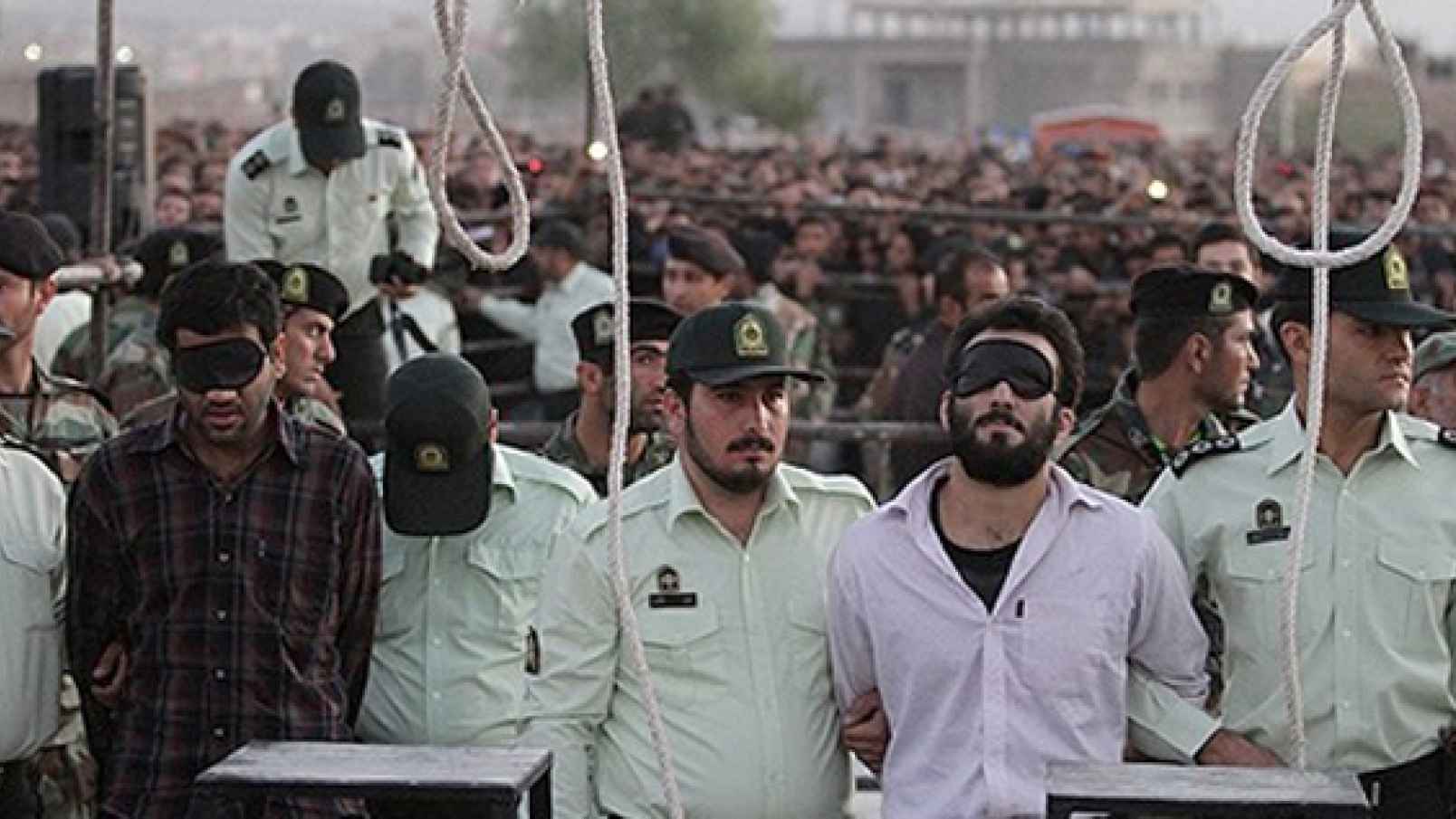
Unfortunately, although President Obama is very vocal about defending the nuclear deal, the lifting of economic sanctions on the Ayatollah, the release of over a hundred of billion dollars to the ruling clerics of Iran, he has not issued any serious criticism against the leaders of the Islamic Republic with regards to the execution spree.

***********************

How the Obama administration is facilitating Iran’s unprecedented killing binge.

President Obama is determined to defend the Islamic Republic as a legitimate government that should receive sanctions relief. He has even overstepped his constitutional authority by signing the nuclear deal (a treaty) in the United Nations Security Council without getting the two-third vote of the Senate. He did not give Congress time to review the nuclear deal as he previously promised.

The Obama administration is advocating for a regime that has been on an execution spree on an unprecedented level, according to Amnesty International’s latest report. Since the beginning of this year, the Islamic Republic has executed approximately 700 people.

People being executed are usually not told about their death sentence until the noose is put around their neck and until they reach the gallows. Family members of the victims often do not know about the execution until weeks after.

As Said Boumedouha, deputy director of Amnesty’s Middle East and North Africa program said, “Iran’s staggering execution toll for the first half of this year paints a sinister picture of the machinery of the state carrying out premeditated, judicially-sanctioned killings on a mass scale.” He added, “The use of the death penalty is always abhorrent, but it raises additional concerns in a country like Iran where trials are blatantly unfair.”

I regularly speak with Iranian people living in various cities in Iran including Esfahan, Tehran, Tabriz, and Khorasan in order to obtain a better understanding on the ground. My family lives there too. The words of every one of them (about the current situation in Iran after the nuclear deal was reached) echoes what Zahra, an English teacher in the province of Esfahan, told me. She said, “Any cash given to the these Sheikhs in the government (the clerics) by the powers because of the nuclear deal, will not be distributed to the people. The money will not be used to improve people’s economic standards. The people on top will steal the money, saving it in their bank accounts, or send it to their Arab allies, Bashar Al Assad, Hezbollah, and the Iraqi government. They [Iranian leaders] are also going to increase domestic suppression if they begin seeing the flow of cash.”

If we look at the history of the Islamic Republic closely, we see that when a “reformist” president (Mohammad Khatami) was in power in Iran, the nation witnessed the same increase in executions and suppression. It was one of the worst periods of oppression and crackdowns on civil liberties. In addition, the number of executions normally rises under the so-called “moderates” and “reformists” rules.

When Iranian people feel that they might finally have a better relationships with the West, the ruling establishments ratchets up their imprisonment, torture, suppression and killings in order to show the people who is in charge and in order to impose fear. By using these tactics, they send a clear message that the Islamists are in charge, not the youth.

This staggering number of executions suggests that, as the ruling clerics of the Islamic Republic were gaining global legitimacy due to the nuclear negotiations and “normalizing” relationships with the Obama administration, they have also increased their mass scale killings of their own citizens. At the same time, several American citizens are still spending time in Iran’s prison.

Unfortunately, although President Obama is very vocal about defending the nuclear deal, the lifting of economic sanctions on the Ayatollah, the release of over a hundred of billion dollars to the ruling clerics of Iran, he has not issued any serious criticism against the leaders of the Islamic Republic with regards to the execution spree.

In the Islamic Republic, one can be executed for actions which might not even be a crime or it might be a misdemeanor in other democratic countries. For example, one can be executed for “enmity against Allah” or “corruption on earth.” In addition, a non-Muslim man can be executed for having sex with a Muslim women, but not vice versa. One can be executed or stoned if he/she is married and has sex with an unmarried person. One can also be executed for cursing or using bad words against the prophet.

As the report by Amnesty International described, “They [death sentences] are imposed either for vaguely worded or overly broad offenses, or acts that should not be criminalized at all, let alone attract the death penalty… Trials in Iran are deeply flawed, detainees are often denied access to lawyers, and there are inadequate procedures for appeal, pardon and commutation.”

Boumedouha observed, “For years, Iranian authorities have used the death penalty to spread a climate of fear in a misguided effort to combat drug trafficking, yet there is not a shred of evidence to show that this is an effective method of tackling crime…”

The more the Iranian leaders are empowered and emboldened financially, economically and politically, the more they tighten the noose on all freedoms (including speech, assembly, press, etc.), as well as basic inalienable human rights.

There are currently thousands of innocent people on death row waiting to be unfairly executed in the Islamic Republic. While President Obama finds it urgent to overstep his constitutional authority to quickly sign the nuclear deal with Iran and push for sanctions relief against the ruling clerics, he needs to pay close attention to how the empowerment of the ruling Islamists in Iran is adversely affecting the lives of millions of innocent people.

Contentions| The Real Goal of the Nuclear Deal: Iran Détente

August 3, 2015

Contentions | The Real Goal of the Nuclear Deal: Iran Détente, Commentary Magazine, August 3, 2015

To listen to President Obama and Secretary of State John Kerry defend their nuclear deal in recent weeks, you’d think the issue at stake is a narrow one that solely concerned whether or not the agreement retards Tehran’s quest for a bomb. The assumption from the administration and its apologists that the deal does this even minimally is a dubious one. But one of the subtexts of the misleading way they have been conducting their end of this debate is their effort to distract both Congress and the public from the broader goals of the pact. While critics of the deal have highlighted Obama’s refusal to make the sanctions relief dependent on an end to support for terrorism, ballistic missile production or the nature of Iranian government, the answers from the administration have been consistent. They want to restrict the discussion to purely technical nuclear issues that can be obfuscated by deceptive claims or to the false choice between the agreement and war. But, to its credit, one of the president’s chief media cheerleaders did highlight the real goals of the administration in an article published on Friday. The New York Times feature titled “Deeper Aspirations Seen in Nuclear Deal With Iran” ought to be required reading for all members of the House and Senate. The choice here isn’t one between a flawed nuclear deal and war, but between Iran détente with a tyrannical, anti-Semitic, aggressive Islamist regime and a reboot of the diplomatic process that has been hijacked by appeasers.

As the Times points out, prior to the announcement of the final, lenient terms of the deal that expires in ten years the administration wasn’t so coy about its real objective:

Before his fight for the deal in Congress, Mr. Obama was far more open about his ultimate goals. In an interview in The Atlantic in March 2014, he said that a nuclear agreement with Iran was a good idea, even if the regime remained unchanged. But an agreement could do far more than that, he said:

“If, on the other hand, they are capable of changing; if, in fact, as a consequence of a deal on their nuclear program those voices and trends inside of Iran are strengthened, and their economy becomes more integrated into the international community, and there’s more travel and greater openness, even if that takes a decade or 15 years or 20 years, then that’s very much an outcome we should desire,” he said. …

And in an interview in December, Mr. Obama even seemed to welcome the rise of a powerful Iran. “They have a path to break through that isolation and they should seize it,” he said. “Because if they do, there’s incredible talent and resources and sophistication inside of — inside of Iran, and it would be a very successful regional power.”

The importance of this context for the discussion of the deal cannot be overemphasized.

The deal ought to be defeated on its own merits because it fails to achieve the administration’s stated objectives about stopping Iran’s nuclear ambitions. All it accomplishes, if it can even be said to do that much, is to delay Iran’s march to a bomb for the period of the agreement while permitting to continue research with a large nuclear infrastructure under a loose inspections regime that makes a mockery of its past promises on all these issues.

But the point on which the administration has been most reluctant to comment is the more than $100 billion in frozen assets that will be released to Tehran. Critics rightly believe this money will, one way or another, help subsidize Iran’s terrorist allies and push for regional hegemony that worries neighboring Arab states as well as Israel, whose existence is threatened by Iran becoming a threshold nuclear state with Western approval.

No rational argument can be mustered against this assertion since the money will be Iran’s to use as it likes and any prohibitions on Iranian adventurism are likely to be even less effective in a post-deal environment than they were prior to it. But if, like President Obama, you believe that Iran is in the process of transforming from a revolutionary threat whose goals are mandated by the extreme religious beliefs and Islamist ideology of its rulers into one eager to be friends with the world, the prospect of a stronger Iran doesn’t trouble you.

That’s why President Obama did not predicate these negotiations on any pledges, even ones that were transparently false, of good behavior from Iran. He claims that insisting on an end to Iranian state sponsorship of terror or forcing it to renounce its goal of eliminating Israel would have prevented him from getting a deal on the nuclear question. But that formulation has it backward. The point of the negotiations was never about the nuclear details, something that was made clear by the astonishing series of concessions that the administration made throughout the talks. In October 2012, during his foreign policy debate with Mitt Romney, Obama pledged that any deal would eliminate Iran’s nuclear program. Now he is advocating for one that leaves it in place under Western sponsorship while rewarding Tehran with the lifting of sanctions.

What Obama always wanted was a deal at any price because he thought it was the pathway to a new entente with Iran that would end the conflict with its Islamist leaders. But while a future in which Iran would no longer be a terror sponsor bent on destroying Israel and dominating the Middle East would be a good thing there is no rational reason to imagine this will happen. Indeed, by strengthening its government the president is ensuring that they will never have to choose between their aggressive goals and economic prosperity.

That’s why rather than being sidetracked into debates about the nuclear details, opponents need to focus on the real goal of the deal: détente with a regime that threatens the U.S. and its allies. The deal fails as a nuclear pact. But it is perhaps an even greater disaster when one realizes that its premise is a naive belief that Islamist tyrants are so enraptured with Obama that they are about to abandon their deeply held beliefs and evil intentions.