Archive for the ‘BREXIT’ category

Brexit Vote Has Huge Ramifications for U.S. Politics

June 24, 2016

Brexit Vote Has Huge Ramifications for U.S. Politics, PJ MediaRoger L Simon, June 23, 2016

(Amen! — DM)

roger_brexit_article_banner_6-17-16-1.sized-770x415xc (1)

A bubble has broken, but it isn’t a stock bubble. It’s a human bubble consisting of elites who seek to govern in a manner not all that distant from Comrade Lenin, just hiding under a phony mask of bureaucratic democracy. They’ve taken a big body blow from the citizens of England. Churchill would be proud.  Time for America to follow suit.

***********************

News flash: The revolt against elites is real in the UK and America and it’s only getting started. Maybe there will always be an England.

In a surprise, Leave won the Brexit referendum on whether to stay in the European Union by an equally surprising amount. British sovereignty won. David Cameron lost. Jeremy Corbyn lost. The EU lost. Bureaucrats lost. Angela Merkel lost. Barack Obama lost. Globalism lost. Authority figures almost everywhere lost. And, most of all, unlimited immigration lost.

So what happened to the vaunted British betting market that is almost invariably correct and was predicting by 80 percent a Remain victory? Or all those recent polls that were tilting Remain?

Answer: Those same elites had convinced each other they would win and therefore convinced the usual suspects—media, pollsters and, sadly, financial markets—that they were right. They were wrong. Watching them now on the BBC they still cannot comprehend  what has happened. The peasants have revolted—oh no, oh no. There must be some mistake. Didn’t they get the memo? The sky would fall if they left the EU.

Earth to elites: Citizens of truly democratic countries don’t want unlimited immigration into their countries by people who couldn’t be less interested in democracy. They also don’t want to be governed by the rules and regulations of faceless bureaucrats whose not-so-hidden goals are power and riches for themselves and their friends. Simple, isn’t it?

This vote is of immense help to Donald Trump if he is smart enough to seize it properly and doesn’t bobble the ball. Many, probably most, Americans feel exactly the same as their brothers and sisters across the pond. They despise the same elites and want to save their country. Trump, now fortuitously in Scotland (I know—they voted Remain, but not in the numbers they were supposed to), should show his support. The  UK is America’s closest ally.  We should be the first to extend a hand, negotiate free trade, etc., and get her rolling again.

That most elite of presidents, Barack Obama, who opened his morally narcissistic mouth supporting the Remain side and warning the British people, as he is wont to do, that there would be “consequences” if they voted to leave the EU, is in no position to do anything, even if he wanted to.  And he doesn’t.

Hillary Clinton is so elitist she practically defines the term. She was probably up all night figuring out what to do about the situation. I have a suggestion—move to Brussels.

Meanwhile, Trump should take up the gauntlet for the U.S. and the UK now. Why wait? Act like the president—we could use one.  Donald has a natural ally in the leading Leave spokesperson conservative Boris Johnson. The two men are said to be similar and in many ways they are.

Long live the Anglosphere. Remember the Magna Carta and all that. This is a day truly to celebrate, even if stock markets are crashing around the world. They’ll come back. Look on it as a buying opportunity. A bubble has broken, but it isn’t a stock bubble. It’s a human bubble consisting of elites who seek to govern in a manner not all that distant from Comrade Lenin, just hiding under a phony mask of bureaucratic democracy. They’ve taken a big body blow from the citizens of England. Churchill would be proud.  Time for America to follow suit.

But don’t get cocky.  This is only one small victory—a non-blinding referendum—but make no mistake about it, still a victory after all.  Just follow the instructions of Sir Winston and “never, never give up.”  Yes, I know the quote is falsely attributed, but it’s good advice nevertheless.

ainston

EU Debate – Oxford Union. Daniel Hannan MEP

June 22, 2016

EU Debate – Oxford Union. Daniel Hannan MEP via YouTube June 20, 2016

(An excellent presentation. — DM)

Brexit: Welcome, Britain, To Our Revolution

June 21, 2016

Brexit: Welcome, Britain, To Our Revolution, The Federalist, June 20, 2016

(America will have her own “Brexit” to vote on this November. Many of the same issues are involved in both. — DM)

As an American, the Brexit — Britain’s upcoming referendum on whether to exit the European Union — does not directly affect me, nor do I have a vote on it. But from the perspective of American history, I think I can offer some relevant context and advice.

The Brexit is a good opportunity to welcome the mother country to our revolution, because the fundamental issue in the Brexit is exactly the same as the one that impelled us to separate from Britain more than two centuries ago.

I recently took the kids to Colonial Williamsburg, a reconstruction of Virginia’s colonial capital that has been turned into a kind of living museum of revolutionary era America, where you can see re-enactors take the stage in the personae of Patrick Henry, George Washington, Thomas Jefferson, James Madison, and the rest of that crowd, and debate the big political issues relating to the Amerexit.

Oh yes, and we also got together in a mob outside Raleigh Tavern and hanged Lord North in effigy. See the photo at the top of this article. Most of you, I suspect, will not know who Lord North was or why we were (symbolically) hanging him. But it’s entirely relevant today.

Lord North was His Majesty’s Prime Minister during the crucial years of the American Revolution, from 1770 to 1782. The specific infractions for which he was subjected to mock trial and hanging in effigy were the Intolerable Acts, a series of punitive measures against Boston that were widely interpreted as a declaration of war against colonial America.

Today, we tend to think of the American Revolution as a war against King George III. But it was just as much a war against the British Parliament and its leadership, which was increasingly regarded by Americans as a “foreign” body that did not represent them. We already had our own, long-established legislatures (Virginia’s General Assembly, for example, will soon celebrate its 400th anniversary and is one of the oldest in the world), and we considered them to be our proper representatives, solely authorized to approve legislation on our behalf.

That was the key issue of the American Revolution: the consent of the governed. The question was whether we were to be subject to laws passed by representatives elected by and accountable to us or whether we were to be subject to the decisions of an institution that was not answerable to the people it governed. So it’s not just about rejecting the sovereignty of a hereditary monarch. It’s also about rejecting control by a distant and unaccountable bureaucracy.

Which, in an interesting historical irony, is precisely the issue Britain faces in its relationship with the European Union.

The Telegraph‘s Ambrose Evans-Pritchard puts the issue succinctly and in terms that are totally recognizable to a student of American history

Stripped of distractions, it comes down to an elemental choice: whether to restore the full self-government of this nation, or to continue living under a higher supranational regime, ruled by a European Council that we do not elect in any meaningful sense, and that the British people can never remove, even when it persists in error.

The effect of the European Union, as currently organized, is to send the mother of parliaments to a rest home. As Evans-Pritchard has recently pointed out, Britain’s judicial system has already been put into an impossible position, forced to issue a warning to the European Court that it will resist its mandates if they conflict with such ancient guarantees as the Magna Carta and the English Bill of Rights.

The key issue — the breaking point — is the European Union’s practice of seeking to validate its authority through popular referendums then ignoring them when they don’t get the result they wanted.

The EU crossed a fatal line when it smuggled through the Treaty of Lisbon, by executive cabal, after the text had already been rejected by French and Dutch voters in its earlier guise. It is one thing to advance the Project by stealth and the Monnet method, it is another to call a plebiscite and then to override the outcome.
He is referring to the 2005 attempt to push through the European Constitution, which was resoundingly rejected by France and the Netherlands, only to be substantially resurrected as the Lisbon Treaty in 2008.

The whole premise of the EU has become the idea of a bureaucratic clerisy holding power beyond the reach of the people. It’s the great dream of the party of big government here, too. They want to impose their policies on every issue — global warming, immigration, gun control, transgender bathrooms, and on and on — by way of regulatory rulings by an entrenched civil service, without ever having to put anything up for an actual vote by the people’s representatives. The European Union takes that idea farther, placing the bureaucratic aristocracy at an even greater remove from its subjects.

The pro-EU side of Britain’s debate makes it sound as if the Brexit would be an act of destructioncarried out in a fit of irrational anger. But this is not about destroying institutions. It’s about preserving them.

It was no different for America. After I recently defended the idea of the right to depose tyrants, a friend of mine who is an historian sent me an interesting, minor correction. The Founding Fathers, he told me, described the creation of America as a “revolution,” not a “rebellion.” It’s a distinction that has largely been lost today, but they viewed a rebellion as an insurrection against legitimate authority, while a revolution was a legitimate exercise of the people’s right to change their government and its leadership, in this case by firing their “chief magistrate,” the king. But they viewed this as a way of re-establishing and reforming the legitimate authority of their own, long-established colonial legislatures.

And when you think of it, we were just following the British example. Britain had faced its own conflicts between the authority of Parliament and the overreaching ambitions of its kings, and they had already set the example of removing the king to preserve the power of Parliament. Before we did it in the 18th century, they did it in the 17th century — twice. Britain itself had established the precedents of the rule of law and the consent of the governed. I don’t know why they would want to throw that away now.

British citizens shouldn’t fear that leaving the EU will cause Britain to be “isolated.” The American example is instructive. After a little more unpleasantness (let’s not mention that unfortunate incident with the White House in 1814), Britain and America eventually settled down into our “special relationship.” Our common bonds of commerce and culture were too strong and deep to be disrupted permanently. The same will be true of Britain and Europe, only more so, since its departure will be on friendlier terms. There is no reason Britain cannot do as other European nations have done and remain part of a common market without submitting to the authority of the European Union.

That’s the choice Britain faces: to maintain the legitimate authority of its own government or to turn the country into a mere colony of Brussels. If the British want to preserve their ability to govern themselves, they will vote to leave the European Union.

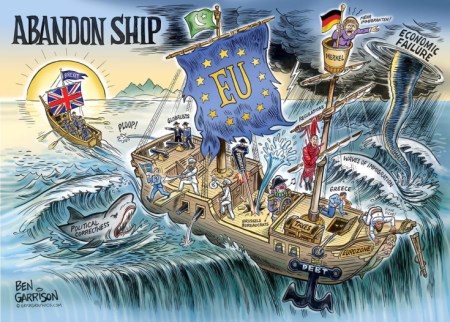
Cartoons of the Day

June 20, 2016

H/t Joopklepzeiker

eunboarding1068-2


Leaders

Why This American Supports ‘Brexit

June 18, 2016

Why This American Supports ‘Brexit, PJ MediaRoger L Simon, June 17, 2016

roger_brexit_article_banner_6-17-16-1.sized-770x415xc

But what this is really about, what Britain and we really need from this vote, is a firewall against Islamization. Economic niceties aside, that is finally how “Brexit” will be judged—here and in Europe. The Brits have to suck it up, brave the inevitable accusations of Islamophobia and put poor old Hannan out of a job.

****************************

For those of us of a “certain age,” Europe was the height of old world cool and sophistication—Anouk Aimée and Jean-Louis Trintignant, the glorious Julie Christie. We wanted to be like them. That was a long time ago. No more Nouvelle Vague. No more Beatles. Now it’s a continent on the verge of imploding with moribund or worse economies, intermittent (and, in the case of France, persistent) violence, and a growing Islamization that is turning countries once among the most free on Earth into Sharia-laced nightmares.

The European Union—consciously or unconsciously—has been complicit in all that, an ever-growing bureaucratic miasma that seems more distant from the needs of its constituents than even our own government.

Americans—concerned ones anyway—watch from afar as right-wing separatist parties have sprung up across the continent, gaining popularity from Austria to the UK. Are they avatars of the World War II-era fascist parties the liberal-left (our guardians at The Guardian) would have us believe or are they natural responses to this monolithic EU and its fruits and therefore the true protectors of the Enlightenment?

It’s hard to say at this point. A welter of conflicting forces are at play. The only thing that is clear is that things are bad.

Those of us who travel often to Europe have seen it, ever-expanding Islamic enclaves in and around many of the major cities that are now larger, quite literally, than any since the days of Muslim-ruled Spain. The “Reconquista” is in progress via what Robert Spencer calls “the stealth jihad.” (Sometimes, as we know, it’s not so stealthy.) Putting up barely a fight, Europe appears to be relinquishing the values they have fought for since the Magna Carta. Who cares about misogyny, homophobia or that outdated separation of church and state when you don’t have any religion of your own to separate? We’re multicultural!  We’re diverse! We’re…. dead?  Well, not quite but wait.

Meanwhile, here in the US of A, the same process has been revving up. Under the Obama administration we’re on track to admit a million new Muslim immigrants—and that doesn’t include those overstaying their visas, etc. Our politically correct, morally narcissistic president has decreed that these people are culturally our equal and deserving of citizenship even though roughly half (probably more if we really knew) of those already here, and therefore supposedly assimilated,  believe in that oppressive religious legal system straight out of the Dark Ages—Sharia law.

Is that what we want? Call me a bigot, but I don’t think so. There are lots of places believers in Sharia can live, thank you, and I have long passed my tolerance for wife beatings, adultery stonings, and repellent women-hating rape laws—even, maybe especially,  if they’re only practiced in secret—not to mention mass shootings in Florida gay bars and at California Christmas parties in the name of somebody’s twisted vision of God, events that are from from secret.

Which leads me to “Brexit” (Britain-exit) and the coming June 23 vote on whether the United Kingdom will remain in the European Union.  Enough ink has been spilled to fill every issue of theTimes Literary Supplement back to its 1902 founding with a few Virginia Woolf novels thrown in about the economic ins and outs of the UK leaving the EU. I am not knowledgeable enough to have an opinion about that, but suspect the witty Daniel Hannan, a 17-year Member of the European Parliament who asked to be “sacked” by his readers in his recent book on Brexit, is a more than reliable source. Hannan makes the case that Brussels has become ground zero for crony capitalism—hardly a surprise, alas.

But what this is really about, what Britain and we really need from this vote, is a firewall against Islamization. Economic niceties aside, that is finally how “Brexit” will be judged—here and in Europe. The Brits have to suck it up, brave the inevitable accusations of Islamophobia and put poor old Hannan out of a job.

There may not “always be an England,” but let’s give her a chance, even if her neighbors have given up (some of them, anyway). The arrogant moral narcissism of Angela Merkel and her ilk has caused enough problems. It was truly tragic and horrible that that Labor MP was murdered by a psychotic the other day —this time a right-wing one—but I sincerely hope it won’t overly affect the vote.  I can’t cast one myself, but were I a Brit, I’d be voting “LEAVE” wholeheartedly.

Cartoons of the Day

June 12, 2016

H/t Joopklepzeiker

EU over the falls


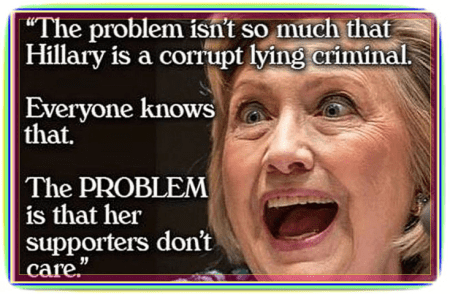
Hillary keeps lying

Public Support for the European Union Plunges

June 9, 2016

Public Support for the European Union Plunges, Gatestone InstituteSoeren Kern, June 9, 2016

♦ Public anger is also being fueled by the growing number of diktats issued by the unelected officials running the Brussels-based European Commission, the powerful administrative arm of the bloc, which has been relentless in its usurpation of sovereignty from the 28 nation states that comprise the European Union.

♦ Although the survey does not explicitly say so, the findings almost certainly reflect growing anger at the anti-democratic nature of the EU and its never-ending power grabs.

♦ On May 31, the EU, in partnership with Facebook, Twitter, YouTube and Microsoft, unveiled a “code of conduct” to combat the spread of “illegal hate speech” online. Critics say the EU’s definition of “hate speech” is so vague that it could include virtually anything deemed politically incorrect by European authorities, including criticism of mass migration, Islam or  even the EU itself.

♦ On April 20, the European Political Strategy Centre, an in-house EU think tank that reports directly to Juncker, proposed that the European Union establish its own central intelligence agency, which would answer only to unelected bureaucrats.

Public opposition to the European Union is growing in all key member states, according to a new survey of voters in ten EU countries.

Public disaffection with the EU is being fueled by the bloc’s mishandling of the refugee and debt crises, according to the survey, which interviewed voters in Britain, France, Germany, Greece, Hungary, Italy, the Netherlands, Poland, Spain and Sweden.

Public anger is also being fueled by the growing number of diktats issued by the unelected officials running the Brussels-based European Commission, the powerful administrative arm of the bloc, which has been relentless in its usurpation of sovereignty from the 28 nation states that comprise the European Union.

The 17-page report, “Euroskepticism Beyond Brexit,” was published by the Pew Research Center on June 7, just two weeks before the June 23 referendum on whether Britain will become the first country to leave the European Union (Brexit blends the words Britain and exit).

The following are excerpts:

  • Much of the disaffection with the EU among Europeans can be attributed to Brussels’ handling of the refugee issue. In every country surveyed, overwhelming majorities disapprove of how Brussels has dealt with the crisis. This includes 94% of Greeks, 88% of Swedes and 77% of Italians. In Hungary and Poland, disapproval of how the refugee crisis has been managed stands at 72% and 71%, respectively. In France, 70% disapprove; in Germany the figure is 67%. The strongest approval of EU management of the refugee crisis is in the Netherlands, but that backing is a tepid 31%.
  • The EU’s handling of economic issues is another huge source of disaffection with Brussels. About nine-in-ten Greeks (92%) disapprove of how the EU has dealt with the ongoing economic crisis. Roughly two-thirds of the Italians (68%), French (66%) and Spanish (65%) similarly disapprove. (France and Spain are the two nations where the favorability of the EU has recently experienced the largest decline.) Majorities in Sweden (59%) and the UK (55%) also disapprove of the EU’s job in dealing with economic challenges. The strongest approval of Brussels’ economic efforts is in Poland and Germany (both 47%).
  • Nearly two-thirds (65%) of Britons say they want the EU to return certain powers to national governments. This Euroskepticism is not limited to Britain. In Greece, 68% of those surveyed want some EU powers devolved to the national government, followed by Sweden (47%); the Netherlands (44%) and Germany (43%).
  • A median of 42% of Europeans across the ten countries surveyed say they want to reclaim some powers from Brussels, while just 19% favor greater centralization (27% prefer the status quo).
  • Conversely, there is little enthusiasm for transferring more power to Brussels. Only 6% of Britons, 8% of Greeks and 13% of Swedes favor more power for the EU. The strongest backing for an ever closer Europe is only 34%, in France. In most countries, a quarter or more of the public prefers to keep the current division of power.
  • Three-quarters of Britons who disapprove of the EU’s handling of economic problems and 71% of those who have an unfavorable view of the bloc’s handling of the refugee crisis believe that Brussels should return powers to national governments.
  • The strongest backers of the EU are the Poles (72%) and the Hungarians (61%). In many other nations, support is tepid. Just 27% of the Greeks, 38% of the French (down from 69% in 2004) and 47% of the Spanish (down from 80% in 2007) have a favorable opinion of the EU. Notably, 44% of the British view the EU favorably, including 53% of the Scottish.
  • EU favorability is down in five of the six nations surveyed in both 2015 and 2016. There has been a double-digit drop in France (down 17 percentage points) and Spain (16 points), and single-digit declines in Germany (8 points), the United Kingdom (7 points) and Italy (6 points).
  • Young people — those ages 18 to 34 — are more favorable toward the European Union than people 50 and older in six of the 10 nations surveyed. The generation gap is most pronounced in France — 25 percentage points — with 56% of young people but only 31% of older people having a positive opinion of the EU. There are similar generation gaps of 19 points in the UK, 16 points in the Netherlands, 14 points in Poland and Germany, and 13 points in Greece. It remains unclear why young Europeans are so favorable to the EU, where youth unemployment is near 50% in some EU countries.
  • There is overwhelming sentiment across Europe that Brexit would be a bad thing for the European Union: 89% in Sweden, 75% in the Netherlands and 74% in Germany say the British leaving would not be good for the EU. France is the only country where more than a quarter (32%) of the public says it would be positive for the EU if the UK departed.

Although the survey does not explicitly say so, the findings almost certainly reflect growing anger at the anti-democratic nature of the EU and its never-ending power grabs.

On May 31, the European Union, in partnership with Facebook, Twitter, YouTube and Microsoft,unveiled a “code of conduct” to combat the spread of “illegal hate speech” online in Europe. Critics say the initiative amounts to an assault on free speech in Europe because the EU’s definition of “hate speech” and “incitement to violence” is so vague that it could include virtually anything deemed politically incorrect by European authorities, including criticism of mass migration, Islam or even the European Union itself.

On May 24, the unelected president of the European Commission, Jean-Claude Juncker, vowed to use sanctions to isolate far-right or populist governments that are swept into office on the wave of popular anger against migration. Under powers granted to the European Commission in 2014, Juncker can trigger a “rule of law alert” for countries that depart from “the common constitutional traditions of all member states.” Rather than accepting the will of the people at the voting booth, Juncker can impose sanctions to address “systemic deficiencies” in EU member states.

On May 4, Juncker warned that EU countries that failed to “show solidarity” by refusing take in migrants would face a fine of €250,000 ($285,000) per migrant.

On April 20, the European Political Strategy Centre, an in-house EU think tank that reports directly to Juncker, proposed that the European Union establish its own central intelligence agency, which would answer only to unelected bureaucrats. According to the plan, the 28 EU member states would have a “legally binding duty to share information.”

The British Minister of State for the Armed Forces, Penny Mordaunt, responded:

“These matters are supposed to be, and must be the competence of member states. Intelligence sharing can only be done on a bilateral basis. This latest EU integration project not only shows how little the EU cares for the sovereignty of nation states, but also how little it understands the business of counter-terrorism.”

On December 15, 2015, the European Commission unveiled plans for a new European Border and Coast Guard force that can intervene anywhere in the EU, even without the host country’s consent.

On March 8, 2015, Juncker said that the EU needed its own military in order to restore the bloc’s standing around the world: “Europe’s image has suffered dramatically and also in terms of foreign policy, we don’t seem to be taken entirely seriously.”

1642Jean-Claude Juncker, the unelected president of the European Commission, recently vowed to use sanctions to isolate far-right or populist governments that are swept into office on the wave of popular anger against migration. In December 2015, the Commission unveiled plans for a new European Border and Coast Guard force that can intervene anywhere in the EU, even without the host country’s consent. (Image source: © European Union 2015 – European Parliament)

In a recent interview with Le Monde, Juncker said that if Britons voted to leave the EU, they would be treated as “deserters”:

“I am sure the deserters will not be welcomed with open arms. If the British should say ‘No’ — which I hope they do not — then life in the EU will not go on as before. The United Kingdom will be regarded as a third country and will have its fur stroked the wrong way (caresser dans le sens du poil). If the British leave Europe, people will have to face the consequences. It is not a threat but our relations will no longer be what they are today.”

In an interview with the Telegraph, Giles Merritt, director of the Friends of Europe think tank in Brussels, summed it up this way:

“The EU policy elites are in panic. If the British vote to leave the shock will be so ghastly that they will finally wake up and realize that they can no longer ignore demands for democratic reform. They may have to dissolve the EU as it is and try to reinvent it, both in order to bring the Brits back and because they fear that the whole political order will be swept away unless they do.”

Brexit is the Only Way to Secure Great Britain

June 4, 2016

Brexit is the Only Way to Secure Great Britain, Breitbart, Christopher Carter, June 4, 2016

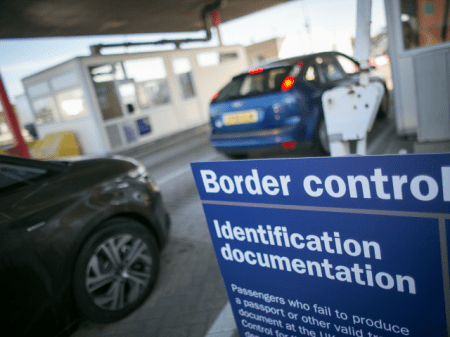
Border control

A few weeks ago David Cameron made contemptible warnings over Brexit and its implications for UK security. He even went so far as to suggest the Islamic State leader Abu Bakr al-Baghdadi “might be happy” if the country votes to Leave the EU.

It is rather telling that since this intervention the PM has chosen to focus on prophesizing economic collapse and hardship rather than discussing this vital issue of Britain’s national security. It is not surprising – considering the recent interventions and revelations concerning how the UK’s membership of the EU impacts on our security.

A report by the EU itself has revealed how there will be a greater risk of terrorist attacks as a result of the Turkey visa-waiver scheme. This has been supported by the ex-head of MI6, Sir Richard Dearlove, who strongly criticised the EU’s attempt to solve the migrant crisis by offering visa-free access to millions of Turks, saying it was “like storing gasoline next to the fire one is trying to extinguish”.

Added to the short-term security threat posed by 77 million Turks having access to all the countries within the EU, there are the long-term political ramifications of the deal, which has the potential to accelerate the resurgence of the far-Right across Europe.

The fact President Erdogan is willing to simply pocket the €3 billion he has demanded the EU send Turkey in aid is hardly going to improve the mood of governments currently forcing through major austerity measures.

He is even threatening to renege on the deal he made over the Greek borders if he doesn’t get his way. His recent warning to the German Parliament not to pass a resolution declaring the mass killings of Armenians in 1915 as genocide are typical of his despotic interventions.

It is clear the EU’s deal with Turkey will have lasting consequences for the whole of the EU, and only by Leaving can we protect the UK.

Of huge concern are the rulings of the European Court of Justice (ECJ), the official court of the EU. Not content with simply supporting the European Commission in its drive to create a federal superstate, its interventions are now putting UK citizens at risk.

Particularly worrying is the recent ruling by the ECJ on freedom of movement. The ECJ is now insisting if a Member State wants to restrict a citizen’s right to ‘free movement’ if they suspect the person has been involved in terrorist activities for example, it must explain exactly why – even though this would endanger national security.

This raises the prospect of British Intelligence officials being forced to hand over highly sensitive documents to people they suspect of terrorism. The UK’s own Court of Appeal has since ruled the rights enshrined in the Charter of Fundamental Rights of the European Union “cannot yield to the demands of national security”.

Yesterday the Justice Secretary, Michael Gove spoke of his frustration at the inability of the UK Government to refuse entry to EU citizens who are suspected of terrorist links. It is clear the European elite are perfectly happy to put the lives of the people of Europe at risk in order to protect the deeply flawed principle of ‘free movement’.

These revelations completely undermine the claims of the Remain campaign that we are safer inside the EU. It is not at all surprising the Prime Minister has now backtracked, choosing to orchestrate a smear campaign against his Leave opponents, rather than addressing the important issue of our national security.

Whilst David Cameron is happy making ludicrous claims about Brexit causing a World War 3, he is clearly uncomfortable addressing the very real threats we will face if we vote to Remain inside the EU.

There is only one way to regain control of our borders and our security and this is to Vote to Leave, to Get Britain Out of the EU.

The Moment of Truth

May 31, 2016

The Moment of Truth, Pat Condell via YouTube, May 31, 2016

(Brexit the Movie is available at Warsclerotic, here. — DM)


The blurb beneath the video states,

Do we want to live in a sovereign democracy or a federal dictatorship?

Please watch ‘Brexit The Movie’ before the referendum, not after. This is the most important political decision we will ever make.
https://www.brexitthemovie.com

Cartoon of the Day

May 30, 2016

H/t Joopklepzeiker

Europe