Right Angle Special Edition: The Brexit via YouTube, June 28, 2016
(Bill Whittle tried to turn the conversation to the U.S. 2016 elections, briefly and without much success.)
Right Angle Special Edition: The Brexit via YouTube, June 28, 2016
(Bill Whittle tried to turn the conversation to the U.S. 2016 elections, briefly and without much success.)
From Brexit to Visions of a UN Exit? PJ Media, Claudia Rosett, June 28, 2016
(The UN is a disgrace. The best, if not only, reason I have thought of not to leave it is that, as a permanent member of the Security Council, America has a veto over all of its resolutions. Absent that veto, much could be done to harm us and our allies.– DM)

Britain’s vote last week to leave the European Union — the Brexit — was a vote for freedom, a revolt against an unaccountable bureaucracy in Brussels. Amid the excitement, Fox News briefly reported the story as even bigger than it was, with a TV screen banner proclaiming not that the U.K. was leaving the EU, but “UK VOTES TO LEAVE UN.”
Yes, some things are too good to be true, and this was one.
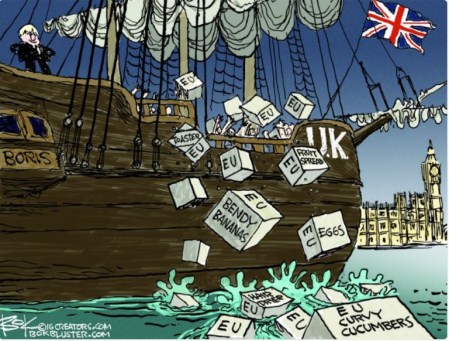
As parody, it would have been genius. As a piece of news reporting, the Fox mixup of the EU and UN inspired plenty of derision — a bit of comic relief, gleefully seized upon by the stricken members of a pro-EU global elite and commentariat. They cannot fathom why a majority of British voters would choose to reclaim from the commissars of the EU the full freedom to control Britain’s own borders, bananas and vacuum cleaners. In that context, Fox’s botching of a news banner helps feed the narrative that the Brexit vote was some boorish mistake cooked up by a know-nothing mob.
Except that’s false, in ways far more profound than the mistake in the Fox chyron. For an eloquent defense of Brexit, see Roger Kimball’s “Focused on Disaster Narrative, Media Ignores Obvious Benefits of Brexit.” To this I’d add that even in Fox’s erroneous UN-exit caption there was, along with the comedy, some grist for serious thought.
I’m not defending Fox’s proofreaders. Accuracy matters, even on TV. But it’s not completely daft that a copywriter in a hurry would read “EU” and write “UN.” There are some pernicious similarities between the two. Both belong to the clan of multilateral institutions set up with the mission of promoting peace and prosperity, post-World War II. Both have proved better at promoting themselves and their own backroom deals. They are clubs of governments, breeding big, intrusive and unelected bureaucracies; largely self-serving, unaccountable and in various ways damaging to and divorced from the real interests of the populations they claim to serve. As Ambassador John Bolton writes in a piece on “How America Should Answer the Brexit Vote,” peace in Europe since 1945 is a product not of the EU, but of the U.S.-led military alliance of NATO.
Both the EU and the UN have a distinct tilt toward central planning, with all the warped incentives, waste and disregard for free choice that this entails. In the EU, this takes the form of regulation. At the UN, it is packaged as an endless array of UN-orchestrated development goals, capacity-building programs and bureaucratically-directed spending of other people’s money, much of it funneled through despotic governments whose oppressive misrule is the main reason for the poverty and perils the UN proposes to alleviate.
We’ve all read plenty in recent times about the troubles within the EU. Let’s take a moment to reprise just a few of the problems with the UN. A good place to start would be a June 17th article by a former Swedish diplomat and UN whistleblower, Anders Kompass, who recently resigned from the UN Office of the High Commissioner for Human Rights. In this article, headlined “The ethical failure — Why I resigned from the UN,” Kompass writes:
Cholera in Haiti, corruption in Kosovo, murder in Rwanda, cover-up of war crimes in Darfur: on too many occasions the UN is failing to uphold the principles set out in its Charter, rules and regulations. Sadly, we seem to be witnessing more and more UN staff less concerned with abiding by ethical standards of the international civil service than with doing whatever is most convenient — or least likely to cause problems — for themselves or for member states.
Kompass ran afoul of his UN bosses in 2014, when he reported to French authorities that French UN peacekeepers were sexually abusing children in the Central African Republic. The UN accused Kompass of sharing confidential information, suspended him from his job and asked him to resign. Many months later, he was exonerated, but he writes that the UN has done nothing to address the “systemic issues of internal accountability” raised by his case.
But now, he despairs of the UN generally:
I still believe in the defence of human rights. I still believe that a universal organization is needed to improve the chances of world peace and progress. But I also believe that without great changes aimed at resurrecting ethical behavior within the UN, the organisation will not be able to successfully address the challenges of today and of tomorrow.
It would be nice to think that Kompass’s case is unusual. It is nothing of the kind. He joins a long line of disenchanted and mistreated UN whistleblowers, at UN agencies including — to name just a few — the World Meteorological Organization, the World Intellectual Property Organization and the UN’s flagship agency, the UN Development Program — which was exposed in 2007, in the Cash-for-Kim scandal, funneling cash and dual-use goods to North Korea.
That’s just a small sampling of the staggering roster of UN scandals, abuses, cover-ups and failures. Along with the apparently chronic problem of peacekeeper rape (despite a policy of “zero tolerance”), and a bigoted fixation on condemning first and foremost the democratic state of Israel, the UN has gone from the globally corrupt 1996-2003 Oil-for-Food relief program for Iraq, to massive bribery and kickback scandals in its procurement department, to narcotics in the mailroom, to the current drama surrounding a former head of the UN General Assembly, the late John Ashe. Ashe was facing criminal charges in a million-dollar-plus bribery case, accused by U.S. prosecutors of having turned his UN post into a “platform for profit,” when — having pleaded not guilty — he was found dead just last week in his Dobbs Ferry, N.Y. home. According to the medical examiner, he was killed in an accident in which a barbell fell on his neck.
If all this sounds like the saga of a global mafia that happens to have acquired diplomatic immunity, plus an annual multi-billion-dollar entitlement from U.S. taxpayers, plus a luxurious headquarters complex in midtown Manhattan, plus a neo-colonial globe-girdling empire of offices, programs, staff, “public-private partnerships,” trust funds and influence, you’ve got the idea.
Meantime, the UN in its role as promoter of world peace has done nothing to effectively deter turf grabs by Russia and China; has given its eager approval to President Obama’s rotten Iran nuclear deal; has failed despite umpteen Security Council resolutions, sanctions and statements to stop North Korea’s nuclear missile program — or for that matter, North Korea’s hideous human rights abuses. In the UN General Assembly, the second-largest voting bloc, the 120-member Non-Aligned Movement, has been chaired since 2012 by the world’s leading state sponsor of terrorism, Iran.
The UN, for all its trappings of democratic process, is a collective of 193 member states, of which the majority are not free. Their governments do not actually account to the people they pretend to represent. The UN’s system and priorities are such that there is no place for the government of the genuinely democratic Republic of China on Taiwan, but there is a seat, with accompanying privileges, for the totalitarian Kim dynasty of North Korea.
As a rule, the only member state that every so often tries to reform the UN is its chief sugar-daddy, the U.S., with some help from the British and (during the recent tenure of Prime Minister Stephen Harper) the Canadians. As another rule, the UN — with its immunities, opacity and spigots of money flowing as an entitlement from the world’s developed democracies — is pretty much impervious to reform. It’s been tried, over and over. The chief result is a UN that keeps getting bigger, not better.
What is to be done?
Calling for the U.S. to leave the UN sounds unserious. It would be complicated. A leap into the unknown. Any move by a major power, especially the U.S, to massively defund or even exit the UN — mothership of post-World War II multilateral collectives — would meet huge resistance from the same global elite now professing shock and horror over the Brexit. The standard defense of the UN is that it may be imperfect, but it’s all we’ve got.
The real question is, just how imperfect can we afford to let it get, before we start looking quite seriously for a better way? Or, as British voters apparently asked themselves, what are the opportunity costs of sticking with the devil we know? In politics, as in love, getting out of a bad relationship may not be cheap or easy, but in the long-run it can prove a brilliant move. (I’ve been wondering what immediate effect the July 4, 1776 Declaration of Independence had on markets, as they then were).
As the immediate panic over Brexit subsides, it is time for a serious debate not only about the future of the EU, but the UN, and what might replace these corrosive institutions with arrangements more beneficial to the modern world.
Leaked document: Germany and France to replace Brussels in charge of EU? RT via YouTube, June 26, 2016
According to the blurb beneath the video,
Document leaked by Polish media indicates Germanу and France could be taking matters in their own hands without bothering to consult Brussels or any other EU countries. Document claimed to be presented to Poland, Czech Republic, Hungary and Slovakia at the meeting in Prague. It reportedly discloses intention to create ‘superstate’ within EU with center of power split between Paris and Berlin.
The EU-Progressive Paradigm is Falling Apart, Front Page Magazine, Bruce Thornton, June 27, 2016
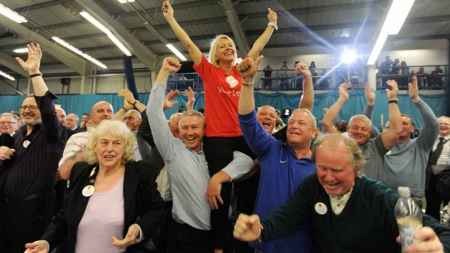
In short, millions of ordinary people in America, England, France, and many other Western nations know that the paradigm of transnational hegemony and technocratic rule created not a utopia, but an arrogant privileged class that believes it is superior and thus entitled to boss other people around and lecture them about backward superstitions and bigotry. And it looks like these average citizens have had enough.
******************************
Long-developing cracks in the Western political establishment’s century-old paradigm suddenly widened this year. In the US Donald Trump, a reality television star and real estate developer, improbably became the Republican Party’s nominee for president. Bernie Sanders, a socialist and long-time Senate crank, challenged the Democrats’ pre-anointed nominee Hillary Clinton, who prevailed only by dint of money and un-democratic “super-delegates.” Meanwhile in Europe, the UK voted to leave the European Union, perhaps opening the flood-gates to more defections.
These three events share a common theme: populist and patriotic passions roused by arrogant elites have fueled a rejection of Western establishments and their un-democratic, autocratic, corrupt paradigm.
That political model can be simply defined as technocratic and transnational. Starting in the 19th century, the success of science and the shrinking of the world through technology and trade created the illusion that human nature, society, and politics could be similarly understood, managed, and improved by those trained and practiced in the new “human sciences.” This new “knowledge” said people are the same everywhere, and so all humans want the same things: peace with their neighbors, prosperity, and freedom. The absence of these boons, not a permanently flawed human nature, explains the history of war and conflict. National identities, along with religion and tradition, are impediments to institutionalizing this “harmony of interests.” International organizations and covenants can be created to enforce this harmony, shepherd the people towards the transnational utopia, and leave behind the misery and wars sparked by religious, ethnic, and nationalist passions.
Technocracy, however, is by definition anti-democratic. So how can the foundational belief of Western governments – the sovereignty of free people and their right to be ruled by their own consent–– coexist with an administrative state staffed by “experts” and armed with the coercive power of the state? Quite simply, it can’t. As for the transnational ideal of a “harmony of interests,” it was repudiated by the carnage of World War I, when the Entente and Central Powers sent their young to die under the flags of their nations on behalf of their particular national interests. Yet the West still codified that transnational ideal in the League of Nations, even as it enshrined the contrary ideal of national self-determination, the right of people to rule themselves free of imperial or colonial overlords.
This gruesome war demonstrated that people are still defined by a particular language, culture, mores, folkways, religions, and landscapes, and that nations have interests that necessarily conflict with those of other nations. That’s why the League failed miserably to stop the aggression of its member states Japan, Italy, and Germany, and could not prevent an apocalyptic second world war that took at least 50 million lives. Yet the Western elites continued to pursue the transnational dream of technocratic rule after World War II, creating the UN as yet another attempt to trump the reality of national differences with some imagined harmony of interests. In reality, the UN has been an instrument used by states to pursue those interests at the expense of other nations.
Still not learning their lesson, the transnationalists created yet another institution that would subordinate the nations of Europe to its control, on the debatable assumption that the carnage of two world wars was wrought by national particularism. They confused genuine patriotism and love of one’s own way of living, with the grotesque political religions of fascism and Nazism, both as much avatars of illiberal tribalism as nationalism grown toxic. Thus was born the supranational EU, which began modestly in 1958 with the European Economic Community, and then relentlessly expanded over the years into today’s intrusive, unaccountable bureaucracy of anonymous technocrats that has concentrated power in Brussels at the expense of national sovereignty.
Similarly, in the US the progressives of the early 20th century began transforming the American Republic based on similar assumptions. They believe that economic, social, and technological progress rendered the Constitution––particularly its separation of powers, checks and balances, and federalist protections of the sovereignty of the states––an anachronism. “The age of enlightened administration had come,” F.D.R. proclaimed, and he set about creating the federal bureaus and agencies that have over the years expanded in scope and power, and increasingly encroached on the rights and autonomy of the states, civil society, and individuals.
But the Eurocrats and progressives forgot one of the most ancient beliefs of the West, and a fundamental assumption behind the structure of the Constitution––that a flawed human nature, vulnerable to corruption by power, is constant across time and space. As Benjamin Franklin wrote during the Constitutional convention, “There are two passions which have a powerful influence on the affairs of men. These are ambition and avarice: the love of power and the love of money,” which when combined have “the most violent of effects.” As much as the democratic mob, any elite, whether of birth, wealth, or education, is subject to power’s corruption and abuse. That’s why our Constitution checked and balanced power: to limit the scope of any part of the government, and thus safeguard the freedom of all citizens no matter their wealth, birth, or education.
In contrast, the conceit of progressives and EU functionaries is that they are somehow immune to the seductions of power. They think their presumed superior knowledge and powers of reason make them more capable and trustworthy than the fickle, ignorant masses and the elected officials accountable to them. History, however, shows that technocrats are as vulnerable to the corruption of power as elites of birth or wealth, and that power is, as the Founders were fond of saying, “of an encroaching nature” and must “ever to be watched and checked.” The expansion of the EU’s tyrannical regulatory and lawmaking power at the expense of national sovereignty is the proof of this ancient wisdom. So too are America’s bloated federal executive agencies aggrandizing and abusing their powers at the expense of the people and the states.
Thus the dominant paradigm that has long organized politics and social life in the West is now under assault, for history has presented this model with challenges it has failed to meet. The resurgence of Islamic jihadism and terror has been met with sermons on Islamophobia and therapeutic multiculturalism. A newly assertive Russia has pursued its national interest with state violence, only to be scolded by our Secretary of State for “behaving in a 19th century fashion.” The financial crisis of 2008 was caused in part by government political and regulatory interference in the market, the same policies that have kept economic growth sluggish for over seven years. Feckless immigration policies have been worsened by a failure to monitor those who get in, and to assimilate those that do. And most important, the redistributionist entitlement regime has weakened the citizens’ character, fostered selfish hedonism, and is on track to bankrupt this country and many in Europe. All these crises have in the main been the offspring of progressives and Eurocrats, whose only solution is to cling to the policies that empower and enrich them, but degrade their own cultures and endanger their own peoples.
Millions of citizens both in the US and in Europe have been watching these developments and living with the baleful consequences that the hypocritical, smug progressive and EU elites seldom encounter in their daily lives. This long-festering anger and resentment of those who smear them as stupid racists, neurotic xenophobes, and fearful “haters,” has now burst to the surface of political life. People can see that the “we are the world,” “global village” cosmopolitanism enriches and empowers the political, cultural, and business elites, but passes on to the people the risks of careless and often deadly immigration policies, and the economic dislocations of a globalized economy. They see that coastal fat cats, who can afford the higher taxes and the costs of environmental regulations, care nothing for the flyover-country working and middle classes pinched by higher electric and gasoline bills. People who live in tony enclaves of white professionals and hipsters support unfettered immigration, while others have to live with the crime and disorder that comes from thrusting into their midst people from very different cultures and mores, including some who have a divine sanction to kill the same people who have welcomed them in.
In short, millions of ordinary people in America, England, France, and many other Western nations know that the paradigm of transnational hegemony and technocratic rule created not a utopia, but an arrogant privileged class that believes it is superior and thus entitled to boss other people around and lecture them about backward superstitions and bigotry. And it looks like these average citizens have had enough.
England has spoken in favor of popular sovereignty and self-government. Soon it will be America’s turn. Our British cousins made the right choice. Let’s hope we do too.
Why Brexit Is More Entrance Than Exit, PJ Media, Roger Kimball, June 26, 2016
(The petition for a new referendum poll was apparently a scam.
The BBC, The Mirror, France 24, The Telegraph, Manchester Evening News, The Guardian… all reported on the bogus petition.
But they got punked. The poll was manufactured by 4Chan and Anonymous hackers who loaded up the signatures with fake names from The Vatican, Ghana, North Korea and elsewhere. [Emphasis in original — DM]
The petition fit the meme, so it deserved and got no fact-checking — DM)
Pop psychologists tell us that grief proceeds through five stages: denial, anger, bargaining, depression, and acceptance. Have been blindsided by the stunning victory of Brexit on Thursday, members of the camp of the Remainders are now vibrating somewhere between anger and bargaining. This followed hard on a brief period of stunned denial that often expressed itself as gulping incredulity. As the psychiatrist Theodore Dalrymple observed in City Journal,
For a long time, Britons who wanted their country to leave the European Union were regarded almost as mentally ill by those who wanted it to stay. The leavers didn’t have an opinion; they had a pathology. Since one doesn’t argue with pathology, it wasn’t necessary for the remainers to answer the leavers with more than sneers and derision.Even after the vote, the attitude persists. Those who voted to leave are described as,ipso facto, small-minded, xenophobic, and fearful of the future. Those who voted to stay are described as, ipso facto, open-minded, cosmopolitan, and forward-looking.
At this point it is not clear exactly when the Brits will formally invoke Article 50 of the Treaty on European Union and officially begin the withdrawal negotiations. But Thursday’s vote made Britain’s congé in the most stinging and public manner.
As of this writing, early Sunday morning, the Remainders have yet to take that rebuke on board. They have, however, moved firmly from denial to white hot anger, as the movement to invalidate the referendum by holding a second referendum attests. As of last night, a petition demanding that Parliament force a new referendum had attracted some 2 million signatures.
The fatuousness of that effort is as patent as it is contemptible. Back in 2009, Barack Obama smugly observed that “elections have consequences.” Thursday’s vote was a non-binding referendum, not an election, but it most assuredly has consequences, as (for example) the immediate announcement by David Cameron, the prime minister, that he would soon be resigning demonstrates.
I expect that the Remainders will soon abandon the petition and move on to more circuitous, backroom maneuvers to subvert or nullify the will of the people. It is at that point, when the delayers and dispensers of red tape arrive with their megaphones, that we’ll know that the bargaining stage has been definitively reached. (I am no psychologist, but my observation is that most people, even if they do progress through the five stages described, do not entirely leave behind the earlier stages. There generally persists, I believe, a bit of denial and more than a bit of anger.)
Fraser Nelson, editor of The Spectator, put his finger on one of the most extraordinary features of the Brexit phenomenon: that the vote turned out the way it did despite the Establishment’s mobilization of every resource at its command against it. “Never,” he wrote in an article for The Wall Street Journal, “has there been a greater coalition of the establishment than that assembled by Prime Minister David Cameron for his referendum campaign to keep the U.K. in the European Union.”
There was almost every Westminster party leader, most of their troops and almost every trade union and employers’ federation. There were retired spy chiefs, historians, football clubs, national treasures like Stephen Hawking and divinities like Keira Knightley. And some global glamour too: President Barack Obama flew to London to do his bit, and Goldman Sachs opened its checkbook.And none of it worked. The opinion polls barely moved over the course of the campaign, and 52% of Britons voted to leave the EU. That slender majority was probably the biggest slap in the face ever delivered to the British establishment in the history of universal suffrage.
I’d say that 52% is closer to “decisive” than “slender,” but Nelson’s point is well taken. The Remainders threw everything they had into this campaign, but it availed them nothing. The British people don’t like what the commissars in Brussels have been doing to their country. What is euphemistically called “immigration” — really, it is a sort of invasion – was part of the story, but only a part. Remainders seized on immigration as the motivating issue because it was easy to weaponize and use it to castigate those who favored Brexit as troglodytic nativists and reactionaries.
As I noted yesterday, the Brexit vote was less an “anti-Europe” vote than a positive assertion of freedom. Indeed, it was by accentuating the positive, by underscoring Brtain’s native strengths and potential, that Brexiteers like Boris Johnson were able to give affirmative voice to the people’s disenchantment. The unease that many Brits felt under the regulatory yoke of the EU is felt by many other people, including many Americans.
As has been often pointed out, that unease helps to explain the success of Donald Trump. Would that Trump had a scintilla of the insight and affirmative spirit of Brexiteers like Boris Johnson, Dan Hannan,Michael Gove, and Nigel Farage. Despite desperate howls to the contrary, the campaign these men waged triumphed not because of what they were repudiating but what they were saying Yes to. Sure, the campaign involved a No to officious interference by corrupt and unaccountable officials across the channel. But the main course was Yes: Yes to freedom, Yes to individual responsible, Yes to deciding for ourselves how we will govern ourselves.
There’s a moral here for politicians, and for political pundits. It’s unclear, however, whether many people are bothering to read the script.
Op-Ed: The American Gulag, Israel National News, Phyllis Chester, June 26, 2016
For years, beginning in 2003, I have personally faced both censorship and demonization. When I began publishing pieces about anti-Semitism, anti-Zionism, and Islamic gender and religious apartheid at conservative sites, I was seen as having “gone over to the dark side,” as having joined the legion of enemies against all that was right and good.
My former easy and frequent access to left-liberal venues was over. I learned, early on, about the soft censorship of the Left, the American version of the Soviet Gulag. One could think, write, and even publish but it would be as if one had not spoken–although one would still be constantly attacked for where one published as much as for what one published.
Since then, Left censorship has only gotten worse. (There is also censorship on the Right–but not quite as much.)
A week ago, a colleague of mine was thrilled that a mainstream newspaper had reached out to him for a piece about the violent customs of many male Muslim immigrants to Europe. He discovered, to his shock, that his piece had been edited in a way that turned his argument upside down and ended up sounding like American Attorney General Loretta Lynch’s view, namely, that home-grown terrorists need “love and compassion,” not profiling or detention.
I told him: One more left-liberal newspaper has just bitten the Orwellian dust. He could expose this use of his reasoned view for propaganda purposes–or wear out his welcome at this distinguished venue.
“But,” I said, “on the other hand, what kind of welcome is it if they change your words and the main thrust of your argument?”
That same week, right after the Jihad massacre in Orlando, another colleague, long used to being published–and published frequently at gay websites–wrote about the male Muslim immigrant/refugee physical and sexual violence against girls and women (their own and infidel women); against homosexuals–and paradoxically, also against young boys. He counseled gays to understand that the issues of gun control and “hate,” while important, were also quite beside the point, that “homosexuality is a capital crime in Islam.”
His piece was rejected by every gay site he approached. One venue threatened him: If he published his piece “anywhere,” that his work would no longer be welcome in their pages.
I welcomed him to the American Gulag.
He told me that he finally “had” to publish the piece at a conservative site.
Gently, I told him that what he wrote was the kind of piece that was long familiar only at conservative sites and that he should expect considerable flack for where he’s published as well as for what he’s published.
Another gay right activist told me that when he described Orlando as a Jihad attack, he was castigated as a “right-wing hater.” He, too, had to publish what he wanted to say at a conservative site.
I published two pieces about Orlando. I said similar kinds of things and I privately emailed both articles to about 30 gay activists whom I know.
The silence thereafter was, as they say, deafening. I was not attacked but I was given the Silent Treatment.
For a moment, I felt like gay activist Larry Kramer might have felt when, in the 1980s, he tried to persuade gay men to stop going to the baths and engaging in promiscuous sex, that their lust was literally killing them. Kramer was attacked as a spoilsport and as the homophobic enemy of the gay lifestyle. Alas, Kramer had been right and many gay male lives were lost to AIDS.
Thus, gay activists see their collective interests as best served by marching, lock-step, with politically correct politicians who view “mental illness,” “gun control,” and “American right-wing hatred of gays”–not Jihad–as the major problems. Such gay activists also prefer “Palestine” to Israel. It makes absolutely no difference that Israel does not murder its homosexual citizens and that in fact, Israel grants asylum to Muslim Arab men in flight from being torture-murdered by other Muslim Arab men.
A number of European activists have recently visited me. They described what has been happening to women who undertake the journey from Iraq, Syria, Afghanistan, Turkey; along the way, the girls and women are continually groped and sexually assaulted, even penetrated in every possible orifice, by gangs of male Muslim immigrants. If they want to live, their husbands and fathers can do nothing.
So much for Muslim immigrant women on the move.
And now, European women are being told to “dye their hair black,” stay home “after 8pm,” “always have a male escort at night;” a group of German nudists, whose tradition goes back 100 years, have just been told to “cover up” because refugees are being moved into the rural lake community.
Where will this all end? In Europe becoming a Muslim Caliphate dominated by Sharia law and by all its myriad misogynist interpretations? In Muslim immigrants assimilating to Western ways? In Europeans voluntarily converting to Arab and Muslim ways? In non-violent but parallel Muslim lives?
Bravo to England which has just taken its first, high risk steps to control its borders and its immigrant population.
A victory for patriotism, Israel Hayom, Dror Eydar, June 26, 2016
(“Patriotism” — what a silly, old-fashioned concept. Thus spake the left. — DM)
1.
Nationalism won in Britain — not “fascism,” not “xenophobia” and not any of the other pejoratives pseudo-liberals love to apply to anything that counters their beliefs. Yes, pure and simple patriotism is what drove Brexit supporters, the kind of nationalism that leftist-liberal elites in the West in general, and Britain in particular, do not identify with.
British nationalism preceded Europe. The late historian Adrian Hastings placed the emergence of the buds of this nationalism in the eighth century and the formation of a true English national entity between the ninth and 11th centuries, at the end of the Anglo-Saxon period. So the claims that the pro-Brexit movement was fueled by of “populism” and “empty rhetoric” indicates the critics’ own worldview.
2.
Fear of foreign migrants was not the main motive behind Brexit, but the unchecked flow of such migrants did serve as a wake-up call. Many of the migrants flooding into Britain refuse to integrate into British society. They do not adopt the culture of their hosts and do not see themselves as committed to the long-standing British ethos. This cultural (and perhaps national) autonomy migrants have created for themselves within Britain has served as a catalyst for the reawakening of natural feelings of patriotism among native Britons — feelings that elites have been trying to kill in the name of universal ideas.
3.
Not surprisingly, and quite entertainingly in fact, much of the Israeli media showed sympathy for the “Remain” camp. Why, you ask, does this have anything to do with us? Let’s look at the similarities between the Brexit vote and the last Knesset elections in March 2015. One can see the same media denial of the will of the people, belittlement of patriotic and religious sentiments and adherence to leftist totalitarian thinking (even at the cost of detachment from reality and the people). For Israeli media figures, the aftermath of the Brexit vote was a mini-replay of the dejection they felt after the last Knesset elections.
4.
Just a few months ago, U.S. President Barack Obama called on Brits to vote to remain in the European Union. The results of Thursday’s referendum showed Obama’s complete lack of influence. Obama is a symbol of both the radicalization of Western elites, who since the end of World War II have been trying to dissolve the idea of the sovereign nation-state, and the attempt by these elites to impose ideology (euphemistically called “values”) on the reality they see, instead of engaging in a thorough examination of reality and the lessons of history. The drama in the U.K. will have implications on these subjects, too.
5.
When it comes to Israel, it is still not clear whether Britain’s departure from the EU will be good or bad. Anti-Israel activists on the European continent and inside Britain, who, seeking via a variety of methods (some sophisticated and some less so) to thwart the Jewish people’s return to Zion, will not disappear, and will perhaps even get stronger. However, seeing the hostile EU be weakened is not a bad thing. We will wait and see how things develop.




 anneinpt
 artaxes
 danmillerinpanama
 davidking1530
 Peter Hofman
 Joseph Wouk
 Peter
Peter Louisiana Steve

 WarSclerotic
Recent Comments