Author Archive

The Ayatollah Empire Is Rotting Away

January 7, 2018

The Ayatollah Empire Is Rotting Away, TabletEdward N. Luttwak, January 7, 2018


There is no need to laboriously negotiate a new set of sanctions against Iran—strict, swift, and public enforcement of the restrictions that are already on the books is enough. Every time a South Korean regime-related deal is detected, the offenders need a quick reminder they will be excluded from the United States if they persist. In this, as in everything else, it is just a matter of getting serious in our focus on Iran.

Obama was serious in his courtship of the ayatollahs’ regime. Trump should do the same to bring the regime to an end, faster

*************************************

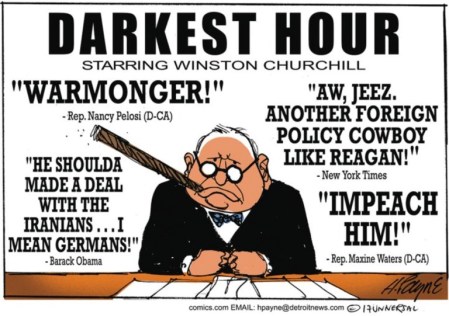
Ronald Reagan, who outraged the Washington elite and frightened European leaders by flatly refusing coexistence with the Soviet Union, lived to see its sudden decline and fall. There is a fair chance that Donald Trump, who contradicts Barack Obama and Europe’s leaders by refusing coexistence with Iran’s ayatollah empire, will also have the satisfaction of seeing the dissolution of a regime that Obama among many others preferred to accommodate.

Whether or not this past weekend’s mass demonstrations in Iran will spread, whether a second revolution is imminent or not, the numbers for the ayatollah empire just don’t add up. A breakdown is materially inevitable.

With some 80 million people, and with oil accounting for 80 percent of its exports, Iran would need to export some 25 million barrels a day to make a go of it, but it can barely export 2.5 million. That would be luxuriously ample for the likes of Abu Dhabi with fewer than 800,000 citizens, but it is a miserable pittance for Iran, with a population more than 100 times as large.

Iran cannot even match the $6,000 income per capita of Botswana. That most fashionable of safari destinations is a fine and well-governed country to be sure, and far from poor by African standards—but then its citizens are not required to pay for extensive nuclear installations, which are very costly to maintain even in their current semi-frozen state, or for the manufacture of a very broad range of weapons—from small arms to ballistic missiles—for which much expensive tooling is imported daily from the likes of our own dear ally South Korea. Neither is Botswana mounting large-scale military expeditions in support of a foreign dictator at war with 80 percent of his own population or providing generous funding for the world’s largest terrorist organization, Hezbollah, whose cocaine-smuggling networks and local extortion rackets cannot possibly cover tens of thousands of salaries. The ayatollah empire is doing all those things, which means that average Iranians are actually much poorer than their Botswanian counterparts.

You would never know it looking at photographs of Tehran, one more bombastic capital city fattened on intercepted oil revenues and graft, but Iran is dirt poor. I recently saw Iran’s general poverty at first-hand driving through one of Iran’s supposedly more prosperous rural districts. In an improvised small market next to a truck stop, several grown men were selling livestock side by side, namely ducks. Each had a stock of three or four ducks, which looked like their total inventory for the day.

That is what happens in an economy whose gross domestic product computes at under $6,000 per capita: very low productivity, very low incomes. The 500,000 or so Iranians employed in the country’s supposedly modern automobile industry are not productive enough to make exportable cars: Pistachio nuts are the country’s leading export, after oil and petroleum products.

The pistachios bring us directly to Iran’s second problem after not-enough-oil, namely too much thieving by the powerful, including pistachio-orchard-grabbing Akbar Hashemi “Rafsanjani,” former president and a top regime figure for decades.

Akbar Hashemi was not being immodest when he claimed the name of his native Rafsanjan province for himself. He became the owner of much of it as huge tracts of pistachio-growing orchards came into his possession.

His son Mehdi Hashemi is very prominent among the aghazadeh (“noble born”), the sons and daughters of the rulers. He preferred industrial wealth to pistachios, and his name kept coming up in other people’s corruption trials (one in France), until he finally had his own trial, for a mere $100 million or so. But the Rafsanjani clan as a whole took a couple of billion dollars at least.

The Supreme Leader Khamenei himself is not known to have personally stolen anything—he has his official palaces, after all. But his second son, Mojtaba, may have taken as much as $2 billion from the till, while his third son, Massoud, is making do with a mere 400- or 500-hundred million. His youngest son, Maitham, is not living in poverty either, with a couple of hundred million. The ayatollah’s two daughters, Bushra and Huda, each received de-facto dowries in the $100 million range.

This shows that the regime is headed by devoted family men who lovingly look after their many children, for whom only the best will do. It also cuts into the theoretical $6,000 income per Iranian head, because some “heads” are taking a thousand times as much and more.

That is one motive for today’s riots—bitter anger provoked by the regime’s impoverishing and very visible corruption, which extends far, far beyond the children of the top rulers: thousands of clerics are very affluent, starting with their flapping Loro Piana “Tasmania” robes—that’s 3,000 euros of fancy cloth right there.

Much of the economy is owned by bonyads, Islamic foundations that pay modest pensions to war widows and such, and very large amounts to those who run them, mostly clerics and their kin. The largest, the Mostazafan Bonyad, with more than 200,000 employees in some 350 separate companies in everything from farming to tourism, is a very generous employer for its crowds of clerical managers.

That is why the crowds have been shouting insults at the clerics—not all are corrupt, but high-living clerics are common enough to take a big bite out of that theoretical $6,000 per capita.

But the largest cause of popular anger is undoubtedly the pasdaran, a.k.a the Islamic Revolutionary Guards (IRGC), an altogether more costly lot than the several hundred aghazadeh or tens of thousands of high-living clerics. The IRGC’s tab starts with the trillion dollars or more that the pasdaran-provoked nuclear sanctions cost before the Obama team agreed to lift them and continues with the billions that Iran still loses annually because of the ballistic-missile sanctions that Trump will never lift. Then there are the variable costs of the pasdaran’s imperial adventures, as well as the fixed cost of pasdaran military industries that spend plenty on common weapons as well as on “stealth” fighters and supposedly advanced submarines that exist only in the fantasies of regime propagandists. Pasdaran militarism and imperial adventures are unaffordable luxuries that the demonstrators very clearly want to do without—hence their shouts of “no-Gaza, no-Syria.”

Whatever happens next—and at least this time the White House will not be complicit if it ends in brutal repression—the ayatollah empire cannot last. Even despite Obama’s generous courtship gifts, the Iranian regime cannot just keep going, any more than the USSR could keep going by living off its oil.

So what can be done to accelerate the collapse? Broad economic sanctions are out of the question because they would allow the rulers to blame the Americans for the hardships inflicted by their own imperial adventures. But there is plenty of room for targeted measures against regime figures and their associates—the State Department list of sanctioned individuals is far from long enough, with many more names deserving of the honor. (Iran is not North Korea; it is not hard to find names and assets and to make them public.)

Above all, very much more could be done to impede the pasdaran and their military industries. Many European and Japanese big-name companies are staying away from Iran because the missile and terrorism sanctions persist—and to avoid displeasing the United States. They should. But the South Koreans whom we defend with our own troops totally ignore U.S. interests in regard to Iran and have therefore emerged as the lead suppliers of machinery and tooling for the pasdaran weapon factories. Nor do they hesitate to sell equipment that can be adapted to military use in a minute or less, as in the case of the airfield instrument landing system and portable ILS/VOR signal analyzer that the Korea Airports Corp. has just agreed to supply to Iran’s Tolid Malzomat Bargh.

There is no need to laboriously negotiate a new set of sanctions against Iran—strict, swift, and public enforcement of the restrictions that are already on the books is enough. Every time a South Korean regime-related deal is detected, the offenders need a quick reminder they will be excluded from the United States if they persist. In this, as in everything else, it is just a matter of getting serious in our focus on Iran.

Obama was serious in his courtship of the ayatollahs’ regime. Trump should do the same to bring the regime to an end, faster.
Egypt quietly urges Palestinians to accept Ramallah as capital

January 7, 2018

Egypt quietly urges Palestinians to accept Ramallah as capital, DEBKAfile, January 7, 2018

Cairo has tacitly accepted Jerusalem as Israel’s capital. An Egyptian intelligence officer Capt. Ashraf al-Kholi is recorded in four audios of telephone calls to Arab media as asking: “How is Jerusalem different from Ramallah, really?”  Palestinians should content themselves with Ramallah, he said. “Like all our Arab brothers, Egypt would denounce in public” President Donald Trump’s decision to recognize Jerusalem as Israel’s capital, but strife with Israel is not in Egypt’s interest and the Arabs must accept it.

Brett Decker: ‘Trump in One Year Is Already Better Than 16 Years’ of Bush, Obama ‘Put Together’

January 7, 2018

Brett Decker: ‘Trump in One Year Is Already Better Than 16 Years’ of Bush, Obama ‘Put Together’, BreitbartRobert Kraychik, January 6, 2018

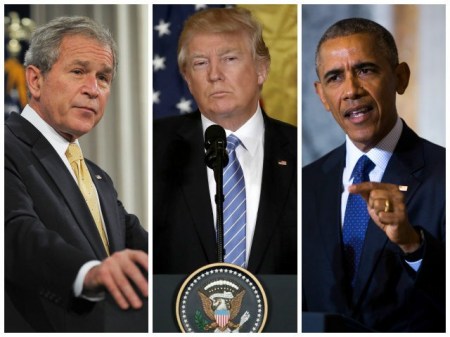
MANDEL NGAN, Win McNamee, Jim Lo Scalzo-Pool/Getty Images by ROBERT KRAYCHIK6 Jan 201813

“Trump in one year is already better than sixteen years of [George W. Bush and Barack Obama] put together,” said former Wall Street Journal editor Brett M. Decker, pointing to a current 17-year high in consumer confidence.

Decker, an expert on Asia and the bestselling author of Bowing to Beijing: How Barack Obama Is Hastening America’s Decline and Ushering a Century of Chinese Domination, joined Friday’s edition of SiriusXM’s Breitbart News Tonight with Breitbart News’s Executive Chairman Stephen K. Bannon and Senior Editor-at-Large Rebecca Mansour.

“The leading indicator, when you dig into the data on why consumer confidence is high, is because people are anticipating higher wages,” said Decker. “The economy and consumer, they work logically. … What you’re seeing [are] the consequences of positive policy.”

President Donald Trump’s economic policies incentivize economic investment in America, said Decker, noting the mobility of capital in the modern era. “Businesses and consumers are [responding] logically” to the Trump administration’s economic policies, he added.

Decker rejected narratives crediting former President Barack Obama’s economic policies with recently developing economic figures during Trump’s presidential tenure, framing such assertions as “absolutely crazy”: “You look at the unemployment numbers, and it’s 4.1 percent. I look at Obama and Bush kind of combined, when I look at their block of sixteen years. Anyone that says this is inheriting some kind of Obama economy, he had eight years, and in 2010, the unemployment rate was 9.6 percent, absolutely crazy. … This idea that it has anything to do with Obama is absolutely crazy.”

Dropping unemployment rates, said Decker, will not be welcomed by all persons or interests. “Big business” interests, he said, prefer higher rates of unemployment given their depressive effects on wages. He also praised Trump’s emphasis on expanding domestic manufacturing. “When there are fewer people looking for jobs, you have to pay those few people more to take those jobs. What scares me about this is big business … seeing the unemployment numbers go down, and they’re like, ‘Oh, no. We’re going to have to pay these people more. We better call Paul Ryan and get him to flood us with cheap immigrant labor.’ So not everybody who looks at these numbers gets excited. There are different kinds of reactions.”

Decker went on to say that “one of [his] favorite things that Trump has done [was when] he was with some of the automakers, and he pointed to the head of Toyota of America, he said, ‘You have to build plants here.’ Within a short period of time, Toyota canceled a factory they were building in Mexico and said they were going to put it in the U.S., instead. What is that, a few thousand extra manufacturing jobs?”

Decker added, “Trade policy, I think, is one of the clearest areas where, if you look at the deindustrialization of America, how much government policy matters. The period between 1994, when NAFTA was passed, and 2014, a 20-year period … our trade deficit with [Canada and Mexico] went up 430 percent. … We get zero benefit out of these trade deals.”

America’s hemorrhaging of manufacturing jobs to other countries, said Decker, was economically disadvantageous: “Fundamentally, I think most people know in their heart of hearts, you can’t just be a consumer economy. If you want to consume anything, you have to make something. We’ve had decades of policy where we just decided we didn’t have to make anything anymore.”

Neo-conservative predictions of China’s political liberalization resulting from its deeper integration into the global economy had not borne out, said Bannon and Decker, with the former describing it as “one of biggest strategic mistakes” of modern Western political leadership.

Decker said, “This idea that you see among the neo-con right is, if you make [China] richer, eventually they’re gonna get more economic freedom. People are gonna demand more political freedom.” Bannon responded, “Oops. That was a miss,” and Decker agreed. “That was one of the biggest strategic mistakes,” said Bannon, adding, “When they look back at the history of this thing a hundred years from now, the Clinton and Bush administrations, the strategic miscalculation about China will go down in history as one of the greatest failures of the elites and the leadership of this country – the mid-nineties to up until, really, President Trump came on the scene, the whole ‘China’s gonna change.’”

Canada: PM Trudeau meeting with former Taliban captive raising questions

January 6, 2018

Canada: PM Trudeau meeting with former Taliban captive raising questions, Jihad Watch

Canadian Prime Minister Trudeau’s “meeting with returned captive Joshua Boyle and his family was questionable when first revealed last month.”

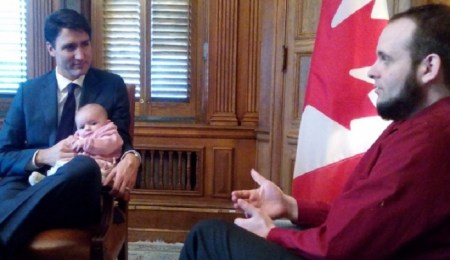
Every day like clockwork, even when he’s on vacation, the Prime Minister’s Office kicks out Justin Trudeau’s itinerary.” December 18th was no different. The “itinerary listed Trudeau’s attendance at the new chief justice’s swearing-in ceremony and a chat with Quebec civic politicians,” but Trudeau did a little more than that. He went for a meeting with freed hostage Joshua Boyle and his family. Boyle and his wife were kidnapped by a Taliban-linked group and held captive in Afghanistan for years. Their children were born in captivity.

Boyle is said to have requested a meeting with Trudeau, and enough information was on the table for Trudeau to decline such a meeting. He at least knew that Boyle was:

A guy roaming dangerous territory [Taliban] with pregnant wife in tow; a guy once married to the jihad-supporting sister of Omar Khadr; a father who named his deceased daughter Martyr

None of this stopped Trudeau, but why would it, considering his record? Trudeau visited a gender-segregated mosque with terror connections; he paid out 10.5 million dollars of taxpayer money to jihadist Omar Khadr for being too roughly treated at Gitmo; and Islamic State jihadists are welcomed into Canada by Trudeau. He bumbled out a whimsical justification to this welcome in Parliament under pressing questions by Opposition leader Andrew Scheer:

“But we also have methods of de-emphasizing or de-programming people who want to harm our society, and those are some things we have to move forward on.”

Yet the Trudeau government has not even been “tracking interventions” with returning Islamic State fighters.

Trudeau was also recently found to have violated four sections of Canada’s Conflict of Interest Act over visits to the Aga Khan’s residence. It was uncovered in the Ethics Commissioner’s report:

Not only did Mr. Trudeau and his family vacation at the Aga Khan’s residence last Christmas, the Trudeaus travelled to the private island for another Christmas holiday in 2014. It also said Mr. Trudeau’s wife, Sophie Grégoire Trudeau, took a separate vacation there in March, 2016.

Back to the Trudeau meeting with Boyle: it is being described by many, including in the headline below, as “lousy judgement,” which seems to be a pattern with Canada’s Prime Minister — as well as dubious ethics — but along with this, he has a pattern of eyebrow-raising sympathies toward jihadists.

It looks much worse now, as Boyle faces 15 charges, include eight counts of assault, two counts of unlawful confinement and one count of misleading police for alleged crimes that occurred almost immediately upon his return to Canada in October.


“EDITORIAL: Trudeau’s Boyle meeting showed lousy judgment,” by Lyle Aspinall, Toronto Sun, January 3, 2018:

Prime Minister Justin Trudeau’s Dec. 19 meeting with returned captive Joshua Boyle and his family was questionable when first revealed last month.

Boyle’s past associations, pronouncements and his stated reasons for taking his pregnant wife to a Taliban-controlled war zone in Afghanistan – on a backpacking trip – should have raised concern.

It looks much worse now, as Boyle faces 15 charges, include eight counts of assault, two counts of unlawful confinement and one count of misleading police for alleged crimes that occurred almost immediately upon his return to Canada in October, though none have been proven in court.

While the Liberal government is usually eager to promote their celebrity PM, news of the Boyle meeting came via the family’s Twitter  account. The Prime Minister’s Office confirmed it happened, but refused comment citing privacy reasons…..

The added fact he’s the ex-husband of Omar Khadr’s sister Zaynab, part of Canada’s most notorious terror family, also disturbed Canadians.

Given such reasonable apprehensions, was this really someone who should have been granted a private audience with the PM? Of course not. It displayed astonishingly lousy judgment.

Making matters worse, Trudeau’s meeting with Boyle likely took place while his police investigation was underway.

Did the PMO know this? They won’t say and declined comment because of the ongoing criminal trial.

But as Senator Vern White, a former Ottawa Police Chief, told the Sun, there is only one system where names under investigation are logged so if Trudeau’s security detail ran his name it should have come up.

This seems to suggest they either didn’t run a check on a man for whom many questions still linger or they did run it and the PM met with him anyway.

It’s hard to say which is worse.

What can be said without any doubt is the Boyle family meeting was just the latest in a series of decisions by our PM that profoundly call his judgment into question.

Cartoons and Video of the Day

January 6, 2018

Via LatmaTV


H/t Power Line


Justice Dept. Re-Opens Clinton “Crime Cartel” Investigation | John Cardillo

January 6, 2018

Justice Dept. Re-Opens Clinton “Crime Cartel” Investigation | John Cardillo, Rebel Media via YouTube, January 6, 2018

(Please see also, Byron York: What the Trump dossier criminal referral means. — DM)

Byron York: What the Trump dossier criminal referral means

January 6, 2018

Byron York: What the Trump dossier criminal referral means, Washington ExaminerByron York, January 6, 2018

[T]here has been much speculation that the FBI used information from the uncorroborated dossier to seek court permission to spy on Americans in the Trump-Russia investigation. That would be a big deal, and it is an issue House and Senate Republicans are determined to sort out.

“I don’t take lightly making a referral for criminal investigation,” Grassley said in a statement Friday. “But, as I would with any credible evidence of a crime unearthed in the course of our investigations, I feel obliged to pass that information along to the Justice Department for appropriate review. Everyone needs to follow the law and be truthful in their interactions with the FBI.”

“Maybe there is some innocent explanation for the inconsistencies we have seen,” Grassley continued, “but it seems unlikely.”

*****************************

There’s been a lot of confusion about the decision by Senate Judiciary Committee chairman Chuck Grassley and crime subcommittee chairman Lindsey Graham to refer Christopher Steele, author of the Trump dossier, to the Justice Department for a possible criminal investigation.

The two senators sent a brief letter Thursday to deputy attorney general Rod Rosenstein and FBI director Christopher Wray. The letter, which was unclassified and released to the public Friday, was a cover letter for what Grassley and Graham called a “classified memorandum related to certain communications between Christopher Steele and multiple U.S. news outlets regarding the so-called ‘Trump dossier’ that Mr. Steele compiled on behalf of Fusion GPS for the Clinton campaign and the Democratic National Committee and also provided to the FBI.”

Grassley and Graham said that, on the basis of the classified information laid out in the memo, “we are respectfully referring Mr. Steele to you for investigation of 18 U.S.C. 1001, for statements the committee has reason to believe Mr. Steele made regarding his distribution of information contained in the dossier.” (18 U.S.C. 1001 is the same federal false statements law that special counsel Robert Mueller has used to charge Michael Flynn and George Papadopoulos in the Trump-Russia investigation.)

That’s all Grassley and Graham said, or at least all they said that was released to the public. The classified memo, of course, was not released at all.

It was all very confusing. What did the letter mean? Were Grassley and Graham alleging that Steele lied to the Senate Judiciary Committee? To some other congressional committee? To other investigators? If so, to whom?

The move met with skepticism in a number of circles. Sen. Dianne Feinstein, ranking Democrat on the Judiciary Committee, called it an “effort to deflect attention” from the Trump-Russia probe. A former prosecutor called it “nonsense” in an interview with the Washington Post. A law professor speculated that it was “baseless.”

At the same time, few outside the committee seemed to understand what the letter meant. So, here is what appears to be going on:

Steele has not talked to any of the three congressional committees investigating the Trump-Russia affair – the Senate Judiciary Committee, the Senate Intelligence Committee, or the House Intelligence Committee. Steele did not make false statements to them because he has not made any statements to them.

Steele has, reportedly, talked to Mueller’s prosecutors, but it seems highly unlikely Grassley and Graham are suggesting Steele lied to Mueller because it is highly unlikely – actually, beyond highly unlikely – that the Mueller office would have shared any of Steele’s answers with the Senate Judiciary Committee. So, what were Grassley and Graham referring to in their letter? What are the “statements the committee has reason to believe Mr. Steele made” that Grassley and Graham believe might be false?

The answer is that Steele talked – and talked a lot – to the FBI. Remember that when he began to compile the dossier in the summer of 2016, Steele reportedly concluded the sensational information he had picked up – allegations of election collusion and Trump sexual escapades in Russia – was so important that he had to take it to the FBI. Steele told the left-leaning magazine Mother Jones that he first took the material to the FBI “near the start of July.”

That began a series of communications between Steele and the bureau in which Steele made certain representations to the FBI about his work. It is a crime to make false statements to the FBI – doesn’t have to be under oath, doesn’t have to be in a formal interview or interrogation setting, it’s simply a criminal act to knowingly make a false statement to the FBI.

As a result of their talks, Steele and the FBI reached a tentative agreement whereby the FBI would pay Steele to continue the anti-Trump work.

All the while, Steele was also working for the opposition research firm Fusion GPS – his dossier was the result of a Fusion anti-Trump project funded by the Clinton campaign. As part of that, Steele briefed reporters on what he had found. In a London court case, Steele’s lawyers said that in September 2016, Fusion GPS directed Steele to brief reporters from the New York Times, the Washington Post, CNN, the New Yorker, Yahoo News, and, later, Mother Jones. Steele did each briefing individually.

One serious question is whether Steele told the FBI that he was telling reporters the same information – those explosive allegations about Trump and Trump associates – that he was bringing to bureau investigators. If the FBI knew that, would they have agreed to an arrangement to make Steele a paid FBI operative investigating the Trump-Russia affair? That would have been a most unorthodox arrangement, with Steele disseminating his allegations to the FBI and the press simultaneously.

That is not exactly how the FBI operates. So now the question is: When Steele was discussing working for the FBI, did he fully inform the FBI of what his work for the Clinton campaign involved, in particular his briefing the press on the findings he would be reporting to the FBI? To use Grassley’s and Graham’s words, were the “statements the committee has reason to believe Mr. Steele made regarding his distribution of information contained in the dossier” accurate?

One way to find that out is to compare what Steele told the London court with what Steele told the FBI. Some of the London court testimony is public. As for what Steele told the FBI, the Senate Judiciary Committee has examined a lot of dossier-related material from the FBI under an agreement that allows the committee to view materials the bureau has originally produced to the House Intelligence Committee.

It appears that Grassley and Graham are pursuing inconsistencies between what Steele told the FBI and what Steele told the London court. If they conflict, which is true? If what Steele told the FBI was untrue, that’s a problem.

Ultimately, the Steele-FBI deal fell through, for reasons that have never been publicly disclosed.

But there has been much speculation that the FBI used information from the uncorroborated dossier to seek court permission to spy on Americans in the Trump-Russia investigation. That would be a big deal, and it is an issue House and Senate Republicans are determined to sort out.

“I don’t take lightly making a referral for criminal investigation,” Grassley said in a statement Friday. “But, as I would with any credible evidence of a crime unearthed in the course of our investigations, I feel obliged to pass that information along to the Justice Department for appropriate review. Everyone needs to follow the law and be truthful in their interactions with the FBI.”

“Maybe there is some innocent explanation for the inconsistencies we have seen,” Grassley continued, “but it seems unlikely.”

If You Hate America, Why Not Go Back to Your Country?

January 6, 2018

If You Hate America, Why Not Go Back to Your Country?, Gatestone InstituteMajid Rafizadeh, January 6, 2018

No matter what the Islamists’ current status or situation, they would lash out at the US, the West and Americans. Meanwhile, American taxpayers were providing hundreds of thousands of dollars to them in scholarships, free accommodation, and often even a monthly stipend. By comparison, many American students struggle to pay their own tuition and housing; many graduate with debt.

Some believed that the US was simply supposed to do these favors for them for free of charge. Others argued that this was an opportunity to take advantage of America, and should be done for the sake of furthering Islamic political and religious views.

The US has been funding the lives of these extremists as they endanger our country and the lives of all Americans, and spread hatred towards America, Christianity, Judaism and the West. Is this how American taxpayers want their hard-earned contributions to be used?

When I first arrived in America, I would ask every extremist and fundamentalist Muslim I met: “How has your life been since you came to the United States?”

It was clear that their living standards were much better than back home. I knew well the lands they had come from, their economic standards and restrictions, their lifestyle, the social, and the religious, economic and political landscapes of the region.

They were surely about to say how much their lives had improved, and how grateful they were to be in a new, less restricted environment. Instead, they expressed anger and even hatred of their new country and its culture. What they could not put into words, was clearly written across their faces: revulsion and disgust.

It seemed they were comfortable disclosing their true feelings in Farsi or Arabic about the US, Americans, the West, Christians, and Jews. As we had all come from, grown up in, and worked in the same region, many of them mistakenly assumed that we both shared the same hate-filled views. Once they discovered that was not the situation, some even tried to reshape my views: as I was new to the country, I probably did not yet understand.

Everything in this country, they patiently explained, was kufr: blasphemy, filthy, infidel. They went on harshly to criticize American culture and the Western lifestyle. Their list of complaints was unending: how men and women dress, how people interact, how people work and celebrate life, go to parties, date, marry, dance, drink — there did not seem one aspect of American life that did not enrage them.

A wealthy Islamist imam, who explained that he was poor in his prior country and had accumulated all of his wealth after coming to the US by expanding existing mosques and attracting people and donations, ironically bashed the US for not allowing Islamist imams to grow financially. He could not explain why. It was just another hypocritical tool, used as an excuse to hate America and brainwash followers to hate America. Despite the fact that he had gone from poverty to riches beyond anything he could have dreamed, he was quite angry at his new country.

More intriguingly, this attitude was apparent among both academics and non-academics. No matter what the Islamists’ current status or situation, they would lash out at the US, the West and Americans. Meanwhile, American taxpayers were providing hundreds of thousands of dollars to them in scholarships, free accommodation, and often even a monthly stipend. By comparison, many American students struggle to pay their own tuition and housing; many graduate with debt.

When asked what they thought of the free education that they were receiving at the best universities in the world, which ensured their success in life, a sense of entitlement would appear. Some believed that the US was simply supposed to do these favors for them for free of charge. Others argued that this was an opportunity to take advantage of America, and should be done for the sake of furthering Islamic political and religious views.

When asked for details about their home country from where they immigrated or fled, surprisingly, they had nothing bad to say. Everything in their home country was heaven-like. They beautified and worshiped their authoritarian and Islamist regimes.

Finally, I asked the question that burned in my mind: Why, if they hated the US so much, did they not they go back to their beloved home country? What if all their expenses were covered, such as plane tickets to their native land?

Instead of the earlier lengthy explanations, the general response was evasive. Some even remained perfectly silent or refused to answer.

The question itself had unmasked me. In their eyes, just by asking this question, I had revealed myself as an outsider. In that moment, I joined the crowd of multitudes of human beings that they hate and refuse to tolerate.

Even if one puts their Islamist agenda aside, their extreme ungratefulness seemed jolting. The United States had given them a home, a green card, citizenship, free scholarships, salaries, unlimited opportunities, and freedoms they had never known: freedom of speech, of the press, and of assembly.

Here they were enjoying equality under the law, security, and so many other benefits that would be considered extreme luxuries or unheard of in their previous homelands — everything they had been deprived of in their earlier home. No other country would have provided them with half of this. So why did they demonstrate and ratchet up anti-American, anti-Western, anti-Christian, anti-Semitic sentiments, while at the same time rejecting the idea of returning to their original country? How could they enjoy all of these benefits America offered them, and yet, at the same time, yearn for its destruction? There do not seem to be such anti-American sentiments expressed by other immigrants from non-Islamist countries, or from Christians or Jews who fled from Islamist states in the same region.

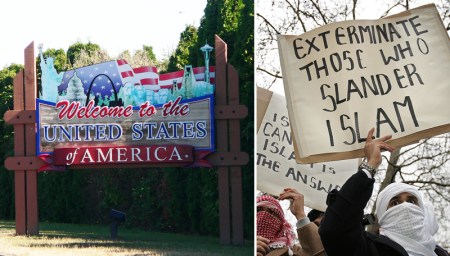
(Image sources: Welcome to USA sign – Craig Nagy/Wikimedia Commons; Islamist protester – Peter Macdiarmid/Getty Images)

It is now time to reconsider whom we are freely providing money and resources to — including those Islamists who have already been in the United States for generations. It is the time to reconsider whom we are allowing to enter this country, and providing with free shelter, scholarships, cash, freedom of speech, and all the rights that come with the constitution. The US has been funding the lives of these extremists as they endanger our country and the lives of all Americans, and spread hatred towards America, Christianity, Judaism and the West.

Is this how American taxpayers want their hard-earned contributions to be used?

Dr. Majid Rafizadeh, is a business strategist and advisor, Harvard-educated scholar, political scientist, board member of Harvard International Review, and president of the International American Council on the Middle East. He is the author of “Peaceful Reformation in Iran’s Islam“. 

Act 2 of Trump clampdown on Iran: Re-imposing sanctions lifted under nuclear accord

January 6, 2018

Act 2 of Trump clampdown on Iran: Re-imposing sanctions lifted under nuclear accord, DEBKAfile, January 6, 2018

On the heels of the first protests to hit the Iranian regime, Washington will turn the screw by negating financial benefits afforded by the nuclear deal.  To this end, President Donald Trump will use the deadlines he faces as of next week for certifying the Iranian nuclear deal and approving sanctions waivers. This intent was indicated by Secretary of State Rex Tillerson in an AP interview Friday, Jan. 5.

Since the president had demanded that the 2015 nuclear accord with Iran be either “fixed or cancelled,” Tillerson said the administration was working with lawmakers on legislation for making it more acceptable to the president. Last October, Trump reluctantly waived sanctions for another three months. However, since sanctions relief was not incorporated in the nuclear deal, which Iran signed with six world nations three years ago, the US may set them aside without being accused of non-compliance. The US may therefore certify the framework while emptying it of the economic benefits the Obama administration granted, which funneled hundreds of billions of dollars to the Iranian treasury.

This is what Tillerson meant by “fixing” rather than “cancelling” the nuclear accord. He is charged with reformulating the deal, while upholding the Trump policy for countering Iran’s regional aggression and continuing support for anti-regime protests. These steps are components of the drawn-out, staged war of attrition the Trump administration has begun orchestrating against the revolutionary Shiite regime in Tehran for the year of 2018.

The following steps are already in the pipeline, DEBKAfile reports:

  1. President Trump may refrain this time from signing on to the sanction waivers, but may re-certify Iran’s compliance with the accord.
  2. The US Treasury Department has meanwhile announced new sanctions targeting banks, financial entities and officials – whether involved in Iran’s missile program or propping up the Revolutionary Guard Corps and its actions to suppress popular dissent.
  3. Washington will likewise target entities in the Middle East and beyond that serve Tehran and receive Iranian financial assistance and weapons. Examples are Lebanon, Hizballah, the Iraqi Shiite militias under Iranian command, Hamas, the Palestinian Islamic Jihad and others.
  4. A broad US strategy is now in place for halting or slashing American aid programs to entities and governments which refuse to cooperate with the administration’s policy objectives.
  5. Donald Trump’s original plan was to work closely with the Europeans on his drive against Iran. Since the European governments have not only opted out of cooperation but are flatly opposed to US support for the Iranian protesters, Washington is forging ahead on its own, without reference to any European capital.
    Trump has thus scrapped one of the basic principles which gave birth to the nuclear accord, close cooperation between the US, Russia and the leading European powers.
  6. The breakup of this transatlantic partnership confronts Russia’s Vladimir Putin with a dilemma. Lining up with Europe on Iran would place Moscow on a collision course with the Trump administration. That Moscow knows exactly what is at stake was evident in the remarks made by Russia’s Deputy Foreign Minister Sergei Ryabkov on Jan. 4, in response to Washington’s call for a UN Security Council to discuss repression in Iran: “We warn the US against attempts to interfere in the internal affairs of the Islamic Republic of Iran.” He also cautioned Washington against being “tempted to use the moment to raise new issues with regard to the JCPOA (the 2015 nuclear accord.)

Turkish President Erdogan Rails Against US ‘Chain of Plots,’ Israeli ‘Interference’ in Iran Protests

January 6, 2018

Turkish President Erdogan Rails Against US ‘Chain of Plots,’ Israeli ‘Interference’ in Iran Protests, AlgemeinerBen Cohen and Agencies, January 5, 2017

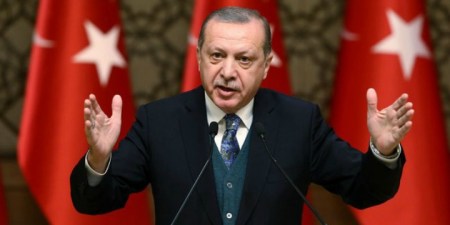
Turkish President Erdogan speaks at the presidential palace in Ankara. Photo: Reuters / Kayhan Ozer.

Turkey and Iran are presently enjoying a warm phase in their relations, with Erdogan giving full support to the Tehran regime as it faced a week of anti-government protests in more than thirty cities.

******************************

Turkish President Recep Tayyip Erdogan launched fresh verbal onslaught against the US and Israel on Friday, as he responded to the sentencing of Turkish banker by an American court for breaking sanctions on Iran, as well as the previous week of protests against the Tehran regime.

Erdogan, currently in Paris for an official visit with French President Emmanuel Macron, accused the US of carrying out “a chain of plots,” following the sentencing on Wednesday of Mehmet Hakan Atilla, an executive with Halkbank, a Turkish bank.

“These are not just legal but also economic plots,” Erdogan asserted.

Atilla was convicted on five of six counts, including bank fraud and conspiracy to violate US sanctions law. The case against him was based on the testimony of a wealthy Turkish-Iranian gold trader, Reza Zarrab, who cooperated with prosecutors and pleaded guilty to charges of leading a scheme to evade American sanctions against Iran.

In his testimony, Zarrab implicated top Turkish politicians, including Erdogan. Zarrab said Erdogan, who was Turkey’s prime minister at the time, had personally authorized two Turkish banks to join the scheme.

Turkey says the case was based on fabricated evidence and has accused US court officials of ties to Fethullah Gulen — the US-based Muslim cleric blamed by Erdogan for the murky coup attempt against his regime in July 2016.

In a separate set of remarks on Friday, Erdogan told Turkish journalists,  “We cannot accept that some countries — foremost the US, Israel — to interfere in the internal affairs of Iran and Pakistan.”

He continued: “It is turning the people against each other in these countries. It’s a shame that we have seen this done in many nations. We saw this in Iraq.”

Erdogan did not expand on the nature of the alleged meddling in Pakistan. On Thursday, the US announced a freeze in deliveries of military equipment and security funding until Pakistan cracks down on jihadi terrorist organizations in the country.

The Turkish president then referred to problems in “Syria, Palestine, Egypt, Libya and Tunisia” and in African countries including Sudan and Chad.

He claimed a “game was being played” against Muslim-majority nations.

“They are taking steps towards making the plentiful underground riches in all these countries their own resources,” he said.

“Sorry, these realities should be known by our people and all people,” he said.

Turkey and Iran are presently enjoying a warm phase in their relations, with Erdogan giving full support to the Tehran regime as it faced a week of anti-government protests in more than thirty cities.