Archive for January 2018

Turkish planes bomb Syrian Kurdish targets as Ankara-backed rebels enter Afrin

January 20, 2018
https://www.rt.com/news/416498-turkey-bombs-kurds-afrin-fsa/
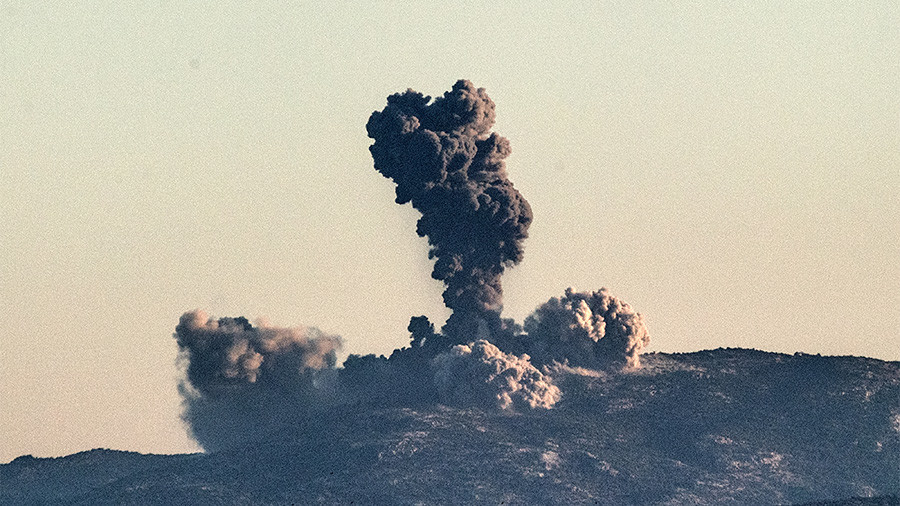
Turkish aircraft have bombed Kurdish targets in Syria’s Afrin, according to the Turkish prime minister. Turkish-backed Syrian opposition fighters have also entered the Kurdish enclave, state media reported.

“TSK (Turkish Armed Forces) has started airborne operations,” Prime Minister Binali Yildirim said at a party congress on Saturday, as quoted by Hurriyet. Yildirim said eight F-16 aircraft were involved in the aerial sortie.

READ MORE: Turkish field op against Afrin Kurds ‘de facto underway’ – Erdogan

“As of this moment our brave Armed Forces have started the aerial offensive to eliminate the PYD and PKK and [Islamic State] elements in Afrin,” Yildirim said.

Turkey’s General Staff has officially declared the start of the operation, dubbing it ‘Operation Olive Branch,’ according to a statement cited by Turkish newspaper Sol.

AP journalists at the Turkish border reported seeing at least five jets heading toward Afrin. Also sighted was a convoy of buses, believed to be carrying Syrian opposition fighters, and trucks mounted with machine guns.

The US-backed Syrian Democratic Forces (SDF) have meanwhile accused Turkey of using cross-border shelling as a false pretext to launch an offensive into Syria, according to Reuters. The SDF, an alliance of Kurdish and Arab militias fighting Islamic State (IS, formerly ISIS), said it will have no choice but to defend itself if attacked. The alliance controls areas in Syria’s east and north.

Russia’s Foreign Ministry said Moscow is closely following the situation, citing concerns over recent developments in the area. The ministry’s statement called on all sides in the conflict to exercise restraint.

It comes after Turkish President Recep Tayyip Erdogan said earlier on Saturday that Ankara had “de facto” begun its operation against Kurdish forces in Afrin. He said the operation would be “followed by Manbij,” referring to the Kurdish-controlled town in northern Syria.

Pence kicks off Middle East tour in Egypt amid Arab anger over Jerusalem

January 20, 2018

By Maram Mazen and Dave Clark January 20, 2018 5:11 pm The Times of Israel

Source: Pence kicks off Middle East tour in Egypt amid Arab anger over Jerusalem

{When have the ‘Arabs’ not been angry? – LS}

US vice president to meet with Sissi in Cairo before heading to Jordan, Israel; no talks with Palestinians who are boycotting the US vice president.

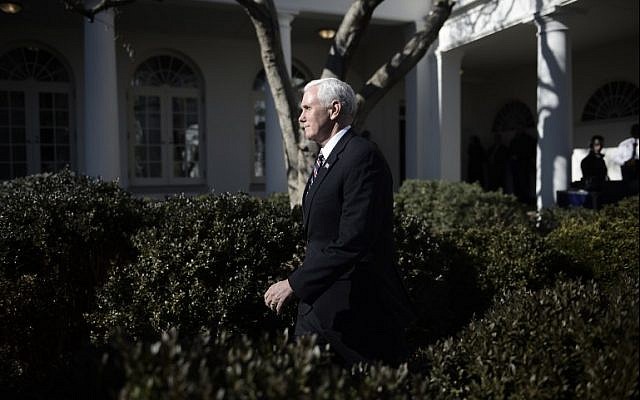
CAIRO (AFP) — US Vice President Mike Pence arrived in Egypt Saturday to begin a delayed Middle East tour overshadowed by anger in the Arab world over Washington’s recognition of Jerusalem as Israel’s capital.

Controversy over US President Donald Trump’s decision to move the American embassy in Israel to Jerusalem had led to the cancellation of a number of planned meetings ahead of the trip originally scheduled for December.

While the deadly protests that erupted in the West Bank and Gaza Strip at the time have subsided, concerns are mounting over the future of the UN aid agency for Palestinian refugees, known as UNRWA.

Washington has frozen tens of millions of dollars of funding for the cash-strapped body, putting at risk operations to feed, teach, and treat hundreds of thousands of Palestinians.

The Palestinian Authority, already furious over the Jerusalem decision, has denounced the US administration and had already refused to meet Pence in December.

But the vice president’s press secretary, Alyssa Farah, said he would still meet the leaders of Egypt, Jordan, and Israel on the high-stakes four-day tour.

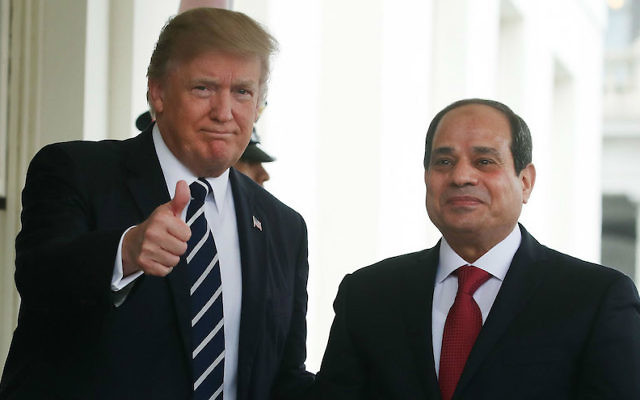
Pence is scheduled to hold talks with Egyptian President Abdel Fattah el-Sissi on Saturday before traveling to Amman for a one-on-one meeting with King Abdullah II on Sunday.

The trip had been pushed back in December as a crunch tax vote loomed on Capitol Hill.

Key security partners

The leaders of both countries, the only Arab states that have peace treaties with Israel, would be key players if US mediators ever manage to get a revived Israeli-Palestinian peace process off the ground, as Trump says he wants.

They are also key intelligence-sharing and security partners in America’s various covert and overt battles against Islamist extremism in the region, and Egypt is a major recipient of aid to help it buy advanced US military hardware.

Sissi, one of Trump’s closest allies in the region, had urged the US president before his Jerusalem declaration “not to complicate the situation in the region by taking measures that jeopardize the chances of peace in the Middle East.”

Ahmed al-Tayeb, the grand Imam of Al-Azhar, Egypt’s highest institution of Sunni Islam, cancelled a meeting with Pence in protest at the Jerusalem decision.

The head of Egypt’s Coptic Church, Pope Tawadros II, did the same, saying Trump’s move “did not take into account the feelings of millions of Arab people.”

After Jordan — the custodian of Christian and Muslim holy sites in Jerusalem’s Old City — Pence will head to Israel for talks with Prime Minister Benjamin Netanyahu on Monday.

He will also deliver a speech to the Knesset and meet President Reuven Rivlin during the two-day visit.

Pence can expect a warm welcome after Trump’s decision on Jerusalem, which was welcomed by Israeli but denounced by the Palestinians.

Israel captured the West Bank and East Jerusalem from Jordan in the 1967 Six Day War. It later extended Israeli sovereignty to East Jerusalem in a move never recognized by the international community.

Israel claims all of Jerusalem as its united capital, while the Palestinians see East Jerusalem as the capital of their future state.

The international community considers East Jerusalem illegally occupied by Israel, and currently all countries have their embassies in the commercial capital Tel Aviv.

‘Matter of years’

The State Department has begun to plan the sensitive move of the US embassy to Jerusalem, a process that US diplomats say may take years to complete.

This week reports surfaced that Washington may temporarily designate the US consulate general in Jerusalem as the embassy while the search for a secure and practical site for a long-term mission continues.

A senior State Department official, speaking on condition of anonymity, told reporters that Secretary of State Rex Tillerson has yet to make a decision on either a permanent or interim location for the mission.

“That is a process that takes, anywhere in the world, time. Time for appropriate design, time for execution. It is a matter of years and not weeks or months,” he said.

Pence — himself a devout Christian — will visit the Western Wall, one of the holiest sites of Judaism in Jerusalem’s Old City, and pay his respects at the Yad Vashem Holocaust memorial.

Former FBI Director James Comey to teach ethical leadership class

January 20, 2018

Former FBI Director James Comey to teach ethical leadership class, CNN Politics, Tammy Kupperman and Veronica Stracqualursi, January 19, 2018

(There are unsubstantiated rumors that William and Mary will hire a cannibal to teach dining etiquette. — DM)

“Ethical leaders lead by seeing above the short term, above the urgent or the partisan, and with a higher loyalty to lasting values, most importantly the truth,” Comey says in the article. “Building and maintaining that kind of leadership, in both the private sector and government, is the challenge of our time.”

****************************************

(Video at the link — DM)

Former FBI Director James Comey will teach a course on ethical leadership at William and Mary beginning in the fall, according to an article on the Virginia college’s website.<

The course will meet primarily at the college’s Washington, DC, center and once at the campus in Williamsburg, Virginia. Comey will co-teach the course with Drew Stelljes, executive assistant professor of education and assistant vice president for student leadership, in fall 2018 and spring and summer 2019.

Comey, who graduated from the college in 1982, told the school he is “thrilled” at the chance to teach this course.

“Ethical leaders lead by seeing above the short term, above the urgent or the partisan, and with a higher loyalty to lasting values, most importantly the truth,” Comey says in the article. “Building and maintaining that kind of leadership, in both the private sector and government, is the challenge of our time.”

William and Mary’s president, Taylor Reveley, said in a statement quoted in the article that Comey has been “deeply committed” to the college over the years.

“He understands to the core of his being that our leaders must have an abiding commitment to ethical behavior and sacrificial service if we are to have good government.”

Comey led the FBI from 2013 until last year, when he was fired by President Donald Trump. Comey, as director, oversaw the investigation into whether Trump campaign members colluded with Russians who hacked the 2016 election.

James Clapper’s perjury, and why DC made men don’t get charged for lying to Congress

January 20, 2018

James Clapper’s perjury, and why DC made men don’t get charged for lying to Congress, USA Today, Jonathan Turley, January 19, 2018

The problem is not that the perjury statute is never enforced. Rather it is enforced against people without allies in government. Thus, Roger Clemens was prosecuted for untrue statements before Congress. He was not given the option of giving the “least untruthful” answer.

Later, Clapper said that his testimony was “the least untruthful” statement he could make. That would still make it a lie of course but Clapper is a made guy. While feigned shock and disgust, most Democratic leaders notably did not call for his prosecution. Soon Clapper was back testifying and former president Obama even put Clapper on a federal panel to review the very programs that he lied about in Congress. Clapper is now regularly appearing on cable shows which, for example, used Clapper’s word as proof that Trump was lying in saying that there was surveillance of Trump Tower carried out by President Barack Obama. CNN and other networks used Clapper’s assurance without ever mentioning that he previously lied about surveillance programs.

*******************************************

In DC, perjury is not simply tolerated, it is rewarded. In a city of made men and women, nothing says loyalty quite as much as lying under oath.

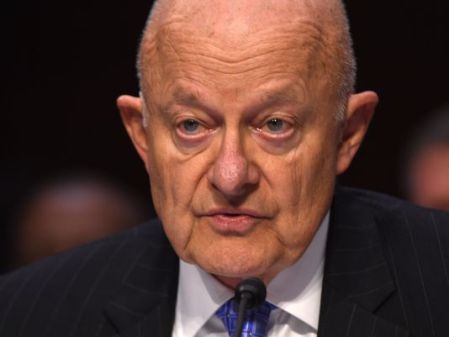
Former National Intelligence Director James Clapper is about celebrate one of the most important anniversaries of his life. March 13th will be the fifth anniversary of his commission of open perjury before the Senate Intelligence Committee. More importantly, it also happens to be when the statute of limitations runs out — closing any possibility of prosecution for Clapper. As the clock runs out on the Clapper prosecution, Democrats like Sen. Cory Booker (D-N.J.) have charged that Homeland Security Secretary Kirstjen Nielsen committed perjury when she insisted that she could not recall if President Donald Trump called Haiti and African countries a vulgar term. The fact is that perjury is not simply tolerated, it is rewarded, in Washington. In a city of made men and women, nothing says loyalty quite as much as lying under oath.

Even in a city with a notoriously fluid notion of truth, Clapper’s false testimony was a standout. Clapper appeared before the Senate to discuss surveillance programs in the midst of a controversy over warrantless surveillance of the American public. He was asked directly, “Does the NSA collect any type of data at all on millions, or hundreds of millions of Americans?” There was no ambiguity or confusion and Clapper responded, “No, sir. … Not wittingly.” That was a lie and Clapper knew it when he said it.

Later, Clapper said that his testimony was “the least untruthful” statement he could make. That would still make it a lie of course but Clapper is a made guy. While feigned shock and disgust, most Democratic leaders notably did not call for his prosecution. Soon Clapper was back testifying and former president Obama even put Clapper on a federal panel to review the very programs that he lied about in Congress. Clapper is now regularly appearing on cable shows which, for example, used Clapper’s word as proof that Trump was lying in saying that there was surveillance of Trump Tower carried out by President Barack Obama. CNN and other networks used Clapper’s assurance without ever mentioning that he previously lied about surveillance programs.

The problem is not that the perjury statute is never enforced. Rather it is enforced against people without allies in government. Thus, Roger Clemens was prosecuted for untrue statements before Congress. He was not given the option of giving the “least untruthful” answer.

Another reason for the lack of prosecutions is that the perjury process is effectively rigged to protect officials accused of perjury or contempt before Congress. When an official like Clapper or Nielsen is accused of lying to Congress, Congress first has to refer a case to federal prosecutors and then the administration makes the decision whether to prosecute its own officials for contempt or perjury. The result has almost uniformly been “declinations” to even submit such cases to a grand jury. Thus, when both Republicans and Democrats accused CIA officials of lying to Congress about the torture program implemented under former president George W. Bush, not a single indictment was issued.

For Clapper, the attempt to justify his immunity from prosecution has tied officials into knots. After Clapper lied before Congress and there was a public outcry, Clapper gave his “least untruthful answer” justification. When many continued to demand a prosecution, National Intelligence general counsel Robert Litt insisted that Clapper misunderstood the question. Still later, Litt offered a third rationalization: that Clapper merely forgot about the massive surveillance system. That’s right. Clapper forgot one of the largest surveillance (and unconstitutional) programs in the history of this country. Litt did not explain why Clapper himself said that he knowingly chose the “least untruthful answer.” Litt added, “It was perfectly clear that he had absolutely forgotten the existence of the … program … We all make mistakes.” Of course, this “mistake” was an alleged felony offense.

Clapper will establish a standard that will be hard to overcome in the future. He lied about a massive, unconstitutional surveillance program and then admitted that he made an “untruthful” statement. That would seem to satisfy the most particular prosecutor in submitting a case to a grand jury, but this is Washington.

Jonathan Turley is the Shapiro Professor of Public Interest Law at George Washington University and a member of USA TODAY’s board of contributors.

Turkish field op against Afrin Kurds ‘de facto underway’ – Erdogan

January 20, 2018
https://www.rt.com/news/416492-erdogan-syria-afrin-operation/
Ankara has “de facto” begun its operation against Kurdish forces in Syria’s Afrin, Turkish President Recep Tayyip Erdogan said after the army called the military strike “legitimate self-defense.”

“The Afrin operation has de facto been started on the ground,” Erdogan said in a televised speech in the city of Kutahya, as cited by AFP.

Read more

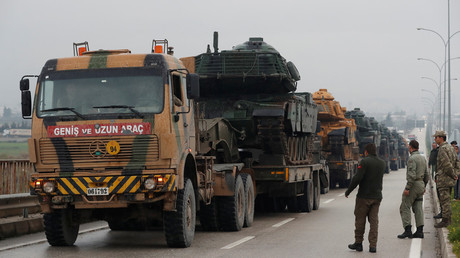
A Turkish military convoy arrives at an army base in the border town of Reyhanli near the Turkish-Syrian border in Hatay province, Turkey January 17, 2018 © Osman Orsal

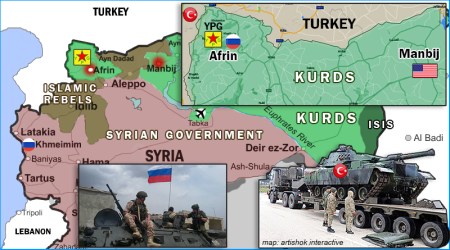
“This will be followed by Manbij,” he added, referring to a Kurdish-controlled town in northern Syria, about 30 kilometers west of the Euphrates.

Both Afrin and Manbij are controlled by the YPG Syrian Kurdish militia.

“The promises made to us over Manbij were not kept. So nobody can object if we do what is necessary,” Erdogan said, referring to previous US assurances that the YPG would move out of Afrin.

“Later we will step-by-step clear our country up to the Iraqi border from this terror filth that is trying to besiege our country,” he concluded.

The army said it shelled Kurdish positions in Syria’s Afrin region on Friday and Saturday, destroying shelters and hideouts used by militants from the Kurdistan Workers’ Party (PKK), Syria’s Democratic Union Party (PYD) and the Kurdish People’s Protection Units (YPG).

In a written statement, the Turkish General Staff said the army hit the terrorist organization’s shelters “within the scope of legitimate self-defense,” as cited by Turkish news agency Anadolu.

According to Ankara, Syria’s Democratic Union Party (PYD) and its affiliate People’s Protection Units (YPG) are allegedly linked to the Kurdistan Workers’ Party (PKK), which is considered a terrorist organization by Turkey.

Read more

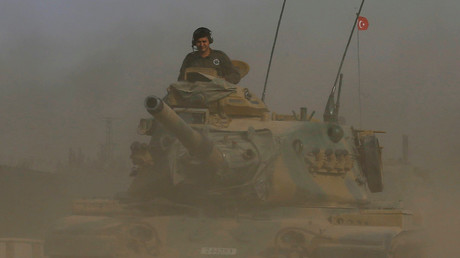
A Turkish army tank drives towards the Turkey-Syria border, August 25, 2016 / Umit Bektas

Turkey’s Defense Minister said on Friday that Ankara has no option but to carry out a military operation in the north-western Syrian enclave of Afrin (a Kurdish-held area of Syria.) The minister added that the operation has actually ‘de facto started’ with cross-border shelling.

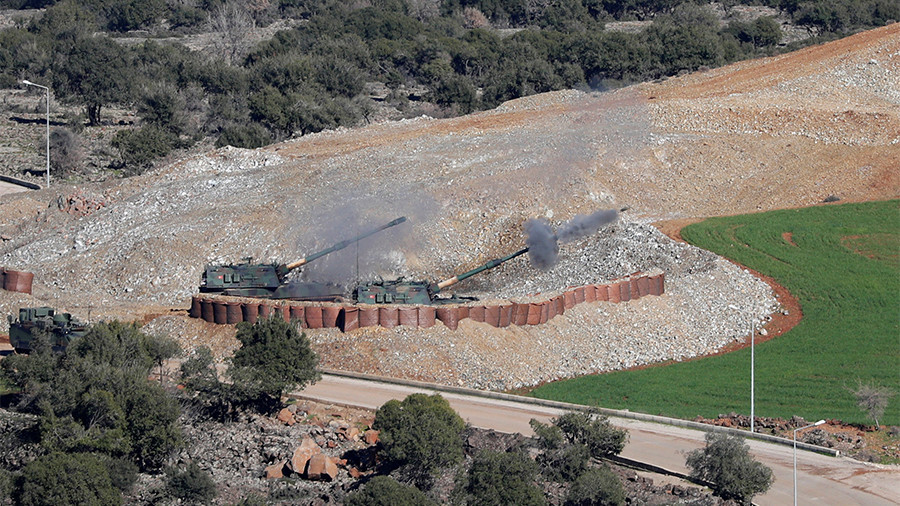
According to Anadolu, at least ten howitzer shells were fired on targets in Syria by Turkish artillery deployed in the Kirikhan and Hassa districts of Hatay province. The Turkish military said they are preventing the creation of a “terror corridor” connecting Syrian Kurdish enclaves along the border.

RIA Novosti cited an YPG source as saying on Friday that “more than 70 artillery rockets” coming from the Turkish side had landed in the Afrin area.

Turkish President Recep Tayyip Erdogan stated on Monday that “the operation [in Afrin] may start at any time” adding that “operations into other regions will come after.”

Turkey’s allies should think twice before they consider helping what he called terrorists in Syria, Erdogan said.

“We won’t be responsible for the consequences,” the Turkish leader warned.

On Friday, the main opposition Republican People’s Party (CHP) leader, Kemal Kilicdaroglu, called on the ruling Justice and Development Party (AKP) to put their faith in diplomacy before launching any military operation into Afrin.

“If diplomacy is used, an agreement is reached, and aerial support is also provided, the problem can be solved. Otherwise, the problem would grow bigger and its cost for Turkey would be hefty,” the lawmaker warned, as cited by Hurriyet newspaper.

On Thursday, Damascus warned Turkey against launching a military operation in Afrin, noting that Syrian air defenses are ready to defend against any “acts of aggression.”

“We warn the Turkish leadership that if they initiate combat operations in the Afrin area, that will be considered an act of aggression by the Turkish army,” Deputy Foreign Minister Faisal Meqdad said in a statement, as cited by Reuters.

“The Syrian air defenses have restored their full force and they are ready to destroy Turkish aviation targets in Syrian Arab Republic skies,” he added.

Over the past week, tanks and self-propelled howitzers have been arriving in the border areas inside Turkey, local media reported. Notably, the army has deployed signal jammers, indicating that the intervention might also include electronic warfare.

The looming military op in Afrin is a follow-up to Turkey’s seven-month Euphrates Shield Operation that was meant to target Islamic State (IS, formerly ISIS) and drive Kurdish forces out of their enclaves in northern Syria.

Time to Kick Turkey Out of NATO?

January 19, 2018

Michael J. Totten January 19, 2018 World Affairs

Source: Time to Kick Turkey Out of NATO?

{That would be like a huge multi-national corporation kicking out a major subsidiary. Not going to happen. – LS}

The case for evicting Turkey from NATO got stronger this week.

First, the United States announced the backing of a Kurdish security force—the People’s Protection Units, or YPG—in Rojava, the quasi-independent Kurdish region in northeastern Syria along the Turkish border. Then Turkey’s President Recep Tayyip Erdogan says he will “strangle” that American-backed force “before it’s even born.” Russia, Iran and Syria’s Assad regime are standing with Erdogan.

The YPG, along with the multiethnic Syrian Democratic Forces which the YPG dominates, are the only armed groups indigenous to Syria that are willing and able to take on ISIS and win, and they’re the only significant armed faction in Syria’s dizzying civil war that isn’t ideologically hostile to the West. In October of last year, they finally liberated Raqqa, the “capital” of the ISIS “caliphate,” while the Russian and Syrian militaries were busy pounding rebels instead in the west.

The Turks would rather have the Assad regime—and by extension Russia, Iran and Hezbollah—rule over the Syrian Kurds whom they consider terrorists. The United States is “building an army of terror” along the southern border, Erdogan says. “Either you take off your flags on those terrorist organisations, or we will have to hand those flags over to you, Don’t force us to bury in the ground those who are with terrorists…Our operations will continue until not a single terrorist remains along our borders, let alone 30,000 of them.”

This is not how a NATO ally behaves. It’s how an enemy state behaves. There is truly no getting around this. We can argue all we want—and I have—that keeping Turkey in NATO is better than kicking Turkey out of NATO because it’s better to deal with a troublesome country inside an ostensibly friendly framework than outside one.

There are limits, though, even if those limits aren’t clearly defined. A direct Turkish attack against the United States would clearly be over the line whether a line is defined or not, as would a direct attack against another NATO member state. Attacking a non-NATO ally is more ambiguous, especially when the non-NATO ally in question isn’t even a state. (It’s not like Turkey is threatening to attack Israel, Japan or Morocco.)

None of this could have been foreseen when NATO was founded in 1949 or when Turkey was admitted in 1952. NATO was founded as a united Western front against the Soviet Union, which occupied or indirectly controlled half of Europe, including a third of Germany. Iran’s Islamic Republic, the Syrian Baath Party regime, armed Kurdish separatist movements, ISIS—none of these even existed then, and only the Kurdish movements could even have been imagined.

The world has dramatically changed, as has NATO. In 1952, Turkey was a crucial member in good standing while Estonia was part of the Soviet Union. In 2018, Estonia is a member in good standing while Turkey is behaving as a belligerent. No one should be surprised that alliances have shifted after seven decades. Alliances always shift over time. Enemies become friends and vice versa. Not even Britain has been a constant friend of the United States, and not even Russia has been a constant enemy.

Changes like these happen slowly, and the West is having a hard time processing the fact that Turkey is increasingly hostile, though it has been for some time now. It started when Ankara denied the use of its territory, including Incirlik Air Base, during the war against Saddam Hussein, mostly because Turkey didn’t want Iraqi Kurdistan to become an economic and military powerhouse. Later, Erdogan helped Iran transfer weapons to Hezbollah in Lebanon and implicitly sided with ISIS in Syria because he didn’t want an independent Kurdish region to rise up in Syria as it had in Iraq. More recently, he has taken American citizens hostage and purchased a missile system from the Kremlin. And how he’s threatening to destroy the only competent Western-friendly militia in all of Syria.

Last August, as Erdogan visited his “dear friend” Vladimir Putin in Moscow, NATO issued a telling statement. “Turkey is a valued ally, making substantial contributions to NATO’s joint efforts… Turkey’s NATO membership is not in question.”

Stop right there. Of course Turkey’s NATO membership is in question. Otherwise, why bother denying it? NATO isn’t denying that the United Kingdom or Canada doesn’t belong in NATO any longer. NATO is only denying that Turkey’s membership is in question, which is another way of saying it is. Anyway, you can type “Turkey out of NATO” into Google and spend a year wading through the results.

The statement continues: “Our Alliance is committed to collective defence and founded on the principles of democracy, individual liberty, human rights and the rule of law.” Indeed, the alliance was founded on all of those principles, none of which increasingly authoritarian Turkey adheres to any longer.

If Turkey were not in NATO, it would not be admitted. It’s grandfathered in at this point.

It’s much easier to say no to an aspiring member that doesn’t belong than to evict a longstanding member who no longer belongs, especially when there’s no clear criteria for banishment. It’s about time, then, for NATO to have a serious discussion about what the criteria for banishment is. That alone might improve Turkey’s behavior. If it doesn’t, we’ll have other options.

Turkey declares de facto war on Syrian Kurds. Russian troops move out of Afrin

January 19, 2018

Turkey declares de facto war on Syrian Kurds. Russian troops move out of Afrin, DEBKAfile, January 19, 2018

ISIS and Syrian rebel groups may well take advantage of a major Turkish-Kurdish clash to recover territory which they lost to Kurdish fighters in northern and eastern Syria. It is hard to see the United States letting that happen.

**********************************

Turkish artillery shelling Friday, Jan. 19 kicked off a major offensive against the Kurdish Afrin enclave of N. Syria, shortly after Turkish C-of-S and intelligence chief left Moscow. No statement followed the visit as to whether Gen. Hulusi Akar had succeeded in his mission of winning Moscow’s cooperation. What happened next was word that the Russian troops positioned in Afrin were to be moved out of the targeted region for safety.

Three days earlier, on Jan. 16, Gen. Akar, who leads one of NATO’s largest armies, visited Brussels and asked the Chairman of the US Joint Chiefs Gen. Joseph Dunford, not to counter the planned Turkish invasion for “clearing YPG [Kurdish militia] fighters from Afrin.” But he was cautioned by the American general against going forward with this offensive. In Ankara, President Tayyip Erdogan shot back by informing parliament in Ankara that the Turkish military operation against the Kurds of Afrin was “imminent.” For Erdogan, relations with Washington, which supports the Syrian Kurds, had reached breaking point.

Moscow’s decision to move the Russian contingent at the airport of Afrin out of the way of crossfire, 10 months after its deployment there, was a sign that the Kremlin is taking seriously Erdogan’s threat to crush the Kurds of Afrin. The Turkish ruler has stepped up his anti-Kurd rhetoric even more since US plans were revealed for creating a 30,000-strong border army, predominantly made up of Kurdish militias, in northern Syria. The Kurdish YPG has meanwhile warned the Turks and the Syrian rebel force they support: “If they dare to attack, we are ready to bury them one by one in Afrin.”

But Turkish Defense Minister Nurettin Canikli left no room for doubt that the die has been cast, when he said Friday in Ankara: “The assault has begun, the operation has actually started de facto with cross-border shelling. I don’t want it to be misunderstood. All terror networks and elements in northern Syria will be eliminated.”

DEBKAfile’s military sources note that the Turkish army must overcome four obstacles before its tanks and troops can roll across the border into Afrin.

  1. The US forces based in northern Syria. The Trump administration did not immediately respond to the Turkish shelling and threats, but the American outpost in Manbij is no more than 120km from Afrin. Erdogan has included Manbij in his threat to capture Afrin. On Jan. 16, our sources reported that the US had supplied the YPG for the first time with portable anti-air missiles to defend themselves in the event of potential Turkish air strikes. But at this early stage, the Kurds are believed capable of standing up to the Turkish offensive.
  2. Syria has warned Turkey against an incursion of its territory would be deemed an act of aggression and threatened its air defenses would shoot down Turkish jets overflying Syria. Our military sources note that, in any case, Russia controls the airspace over Afrin, a fact that may well deter Ankara from using its air force.
  3. An ingathering of all the Kurdish forces from their northern Syrian bastions in the defense of the YPG, would confront the Turkish army with between 20,000 and 30,000 trained Kurdish fighters well-armed with American weapons, whose motivation for defending their land would be more powerful than any invading force. In past engagements with the Islamic State, the Turkish army’s performance was middling.
  4. ISIS and Syrian rebel groups may well take advantage of a major Turkish-Kurdish clash to recover territory which they lost to Kurdish fighters in northern and eastern Syria. It is hard to see the United States letting that happen.

Inside Judicial Watch: The Truth Behind Fusion GPS & The Trump Dossier

January 19, 2018

Inside Judicial Watch: The Truth Behind Fusion GPS & The Trump Dossier via YouTube,  January 18, 2018

According to the blurb beneath the video,

In this compelling episode of “Inside Judicial Watch,” host Jerry Dunleavy joins JW Senior Investigator Bill Marshall to discuss Fusion GPS, how the infamous Trump dossier was produced, who paid for it, and how it may have led to the surveillance of then-presidential candidate Donald Trump and his inner-circle. Prior to joining Judicial Watch, Bill Marshall worked in the private sector conducting corporate investigations and opposition research for various entities, similar to the kind of work carried out by Glenn Simpson, the founder of Fusion GPS. You WON’T want to miss out on Bill’s compelling insight into the world of opposition research, Fusion GPS, and the Trump dossier.

DOJ Backs Christian Students in School Choice Case

January 19, 2018

DOJ Backs Christian Students in School Choice Case, Washington Free Beacon, January 19, 2018

(Please see also, New HHS civil rights division charged with protecting health-care workers with moral objections. It appears that the Trump administration values religious freedom to a substantially greater degree than did its predecessor.– DM)

Getty Images

“The Constitution prohibits states from discriminating based on religion,” said Associate Attorney General Rachel Brand. “Today’s amicus brief is further proof that this administration will lead by example on religious liberty.”

The Department’s brief is an extension of Attorney General Jeff Sessions’s religious liberty priorities, specifically guidance extended by the Department in October on federal religious liberty protections. That guidance  stipulated that state governments may not “deny religious schools—including schools whose curricula and activities include religious elements—the right to participate in a voucher program, so long as the aid reaches the schools through independent decisions of parents.”

*******************************

The Department of Justice filed an amicus brief Thursday in support of students claiming they were discriminated against after the state of Montana denied them placement in a tax credit scholarship program because the school they attended was a Christian one.

The case, Espinoza v. Montana Department of Revenue, concerns a the Montana Tax Credit Scholarship Program, which allows Montanans to deduct up to $150 of their contribution to a privately run scholarship program. The state department of revenue prompted the suit when it added a rule prohibiting tax credits for contributions to schools owned or operated by “a church, religious sect, or denomination.”

A group of parents brought suit on behalf of their children in December 2015 after they were denied participation in the scholarship program because their children attended a Christian-run school. The suit made it to a state trial court, which sided with the parents; the state then appealed to the Supreme Court of Montana, where DOJ lodged its Thursday amicus.

The Department’s brief argues that the state violated the First Amendment’s prohibition on government interference in the free exercise of religion by denying the religious students access to the scholarship fund.

“By targeting religious conduct for distinctive, and disadvantageous, treatment, Defendants violate the Free Exercise Clause unless they can show that the discriminatory treatment is supported by interests ‘of the highest order’ and narrowly tailored to achieve those interests. Defendants have made no such showing here,” the brief reads.

The DOJ contends in its brief that simply extending the scholarship fund to all students, including religious ones, would not run afoul of the Constitution, a position Montana had not explicitly disagreed with. The Department then applies the Supreme Court of the United States’ reasoning in last year’s Trinity Lutheran Church of Columbia v. Comer, in which the Court found that denying a church daycare access to state grant money was “odious to our Constitution.”

“The Constitution prohibits states from discriminating based on religion,” said Associate Attorney General Rachel Brand. “Today’s amicus brief is further proof that this administration will lead by example on religious liberty.”

The Department’s brief is an extension of Attorney General Jeff Sessions’s religious liberty priorities, specifically guidance extended by the Department in October on federal religious liberty protections. That guidance  stipulated that state governments may not “deny religious schools—including schools whose curricula and activities include religious elements—the right to participate in a voucher program, so long as the aid reaches the schools through independent decisions of parents.”

European leaders, facing growing public unease, toughen up on immigration

January 19, 2018

European leaders, facing growing public unease, toughen up on immigration, Fox News,  Adam Shaw, January 17, 2018

(A good overview of rising anti-migrant views in Europe. — DM)

Thousands of migrants packed into Greek island

Looking for answers as to why the once welcoming E.U. is keeping migrants in horrific conditions, activists on the ground told the Post that they believe it’s part of the new change in tone, with European leaders sending a message to potential migrants.

************************************

As politicians in America and across the globe lined up last week to condemn President Trump’s reported remarks calling certain African nations “s—hole countries,” there was a somewhat muted response in Europe — a sign of how the political winds of immigration are blowing.

Europe is a continent filled with leaders happy to speak out in condemnation of the U.S. president, but the silence last week was noticeable — with the New York Times describing a “ringing silence across broad parts of the European Union, especially in the east, and certainly no chorus of condemnation.”

But a continent spooked by a populist revolt still bubbling in its parliaments and roaring on its streets, many of Europe’s politicians are still struggling with an influx from developing countries, or fighting for their political lives as they fend off challengers running on doing just that.

Europe has been wracked by a continent-wide migration crisis since 2015, when German Chancellor Angela Merkel threw open Germany’s borders to a wave a Syrian refugees — telling Germans: “Wir schaffen das!” [We can do this]

Germany

While Merkel was applauded worldwide – and immediately given Time’s Person of the Year – refugees and economic migrants from other countries, along with a wave of terror attacks and other crimes and social problems, flooded into the continent. Merkel’s poll numbers caved, and she was forced to shift right to appease the anti-migrant sentiments.

In December 2016, she pushed for a so-called “burqa ban” and promised that the 2015 migration surge “cannot, should not and must not be repeated.”

Her Christian Democrats (CDU) nonetheless took a hit in September’s national elections, while the anti-migration Alternative for Germany (AfD) surged, and the woman described just a few years ago as the “chancellor of the Free World” was left fighting for her political life. Her party now looks to convince reluctant former coalition partners, the left-wing Social Democrats (SDU), to form another coalition and keep her in power.

An initial draft of a potential coalition deal includes a hard cap of approximately 200,000 refugees a year — a significant decrease from the more than a million refugees that flooded into the country in 2015 — a sign that migration will be a decisive factor in whether Merkel survives.

Eastern Europe

Other countries, particularly in Eastern Europe, have been taking a strong line of migration for years. Poland, the Czech Republic and Hungary have been particularly muscular in asserting their own sovereignty in dealing with immigration issues — despite opposition from E.U. officials.

Hungary has erected a border fence amid a host of border security measures — and even had the Trumpian chutzpah to ask the E.U. to pay for half of it. For pro-open borders left, outspoken Hungarian Prime Minister Viktor Orban has become their bogeyman, using language that makes Trump’s appear almost timid.

In an interview with Germany’s Bild, this month, Orban referred to some migrants “Muslim invaders,” and called multiculturalism “an illusion.”
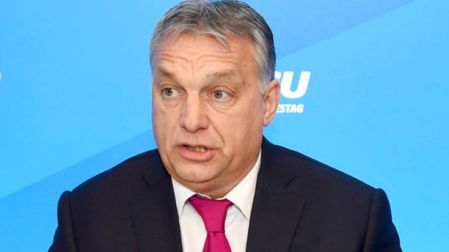
Hungarian Prime Minister Viktor Orban has built a border fence and asked the E.U. to pay for half of it. (AP)

“If you take masses of non-registered immigrants from the Middle East into your country, you are importing terrorism, crime, anti-Semitism, and homophobia,” he said in a follow up interview this week.

Orban also made reference to the mass sexual assaults on New Years’ Eve 2015 in Cologne, Germany, as well as other problems attributed to the wave of migration from Africa and the Middle East.

“[In Hungary] there are no ghettos and no no-go areas, no scenes like New Year’s Eve in Cologne. The images from Cologne have deeply moved us Hungarians,” he said. “I have four daughters. I can not help my children grow up in a world where something like Cologne can happen.”

While Orban is perhaps the most outspoken of Europe’s political leaders, other more moderate leaders are tilting in Orban and Trump’s direction.

France, United Kingdom

Europe’s establishment breathed a sigh of relief in May, when French centrist Emmanuel Macron comfortably beat right-wing and anti-migration Marine Le Pen in France’s presidential election. Macron’s comfortable win was seen by many analysts as a sign that the seemingly unstoppable 2016 populist wave, which gave the world Brexit and President Trump, was finally crashing upon the rocks.

But Macron has rejected an open-arms approach to migration, attempting to find himself a middle ground between Merkelism and Orbanism. In a New Year’s Eve speech, he admitted: “We can’t welcome everyone, and we can’t work without rules.”

French President Emmanuel Macron has come under fire for taking a tougher stance on economic migrants. (AP)

His government has also taken a tougher line on economic migrants, opening himself up to criticism from his own party, who have accused him of being too tough and catering to the right-wing. According to Reuters, opponents point to a new bill that would increase detention times and lead to the deportation of anyone not classified as a refugee from a warzone.

But Macron followed this up Tuesday with a visit to the former “Jungle camp” at Calais — a sprawling refugee camp at the port to the United Kingdom that was deconstructed in 2016.

In a speech at the site of the former camp on Tuesday, he promised to be sure it did not return. In a meeting on Thursday with British Prime Minister Theresa May, he is expected to demand a renegotiation of the border arrangement with the U.K., including more money from the British and for them to take on more refugees.

That push is unlikely to be well-received in the U.K., where the decision to leave the European Union was largely motivated by migration-related issues and a need to take control of borders.

In 2016, Britain allowed in child asylum seekers from Calais who had family members in the U.K. But outrage and mockery followed when pictures appeared in British newspapers showing what one Conservative MP described as “hulking young men” presenting themselves as children.

Former U.K. Independence Party leader Nigel Farage said this week that France’s migration problems are France’s to solve and that Macron should stop playing hot potato.

“If they are illegal immigrants, France should get rid of them, if they are people claiming refugee status, France should process them,” Farage said in an interview with the BBC. “It’s actually desperately simple but the French don’t want to do that and the truth of it for the last 10, 15, 20 years the French have been quite happy for camps to develop and for people to climb on the back of lorries to go to England, and then it’s our problem.”

Austria

A key motivator for many Western European politicians are impending elections. While Merkel is scrambling for survival in Germany, across the border in Austria, a right-wing government was formed in December led by the 31-year-old Sebastian Kurz — whose center right People’s Party (OVP) campaigned primarily on a tough stance on migration, and formed a coalition with the far-right Freedom Party (FPO).

Austria will take over the presidency of the E.U. Council in the summer, and Kurz said in an interview published Wednesday one of his top priorities will be “border control to stop illegal migration to Europe.”

But far from looking for conflict, Kurz told German newspaper FAZ that the continent’s view on migration is now much closer to his own.
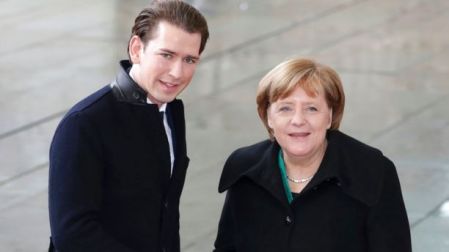
Austrian Chancellor Sebastian Kurz met with his German counterpart Angela Merkel this week. (AP)

“There has been a lot of movement in recent years. For example, the German position is now much closer to ours than it was two years ago,” Kurz said. “Many states have moved in the right direction. Now we need a focus on proper protection of the external borders of the EU and not just the constant debate about the distribution of refugees within the European Union by quotas.”

As Austria turns rightward, and Germany struggles to form a government, all eyes will soon move to Italy, where voters will go to the polls in March in an election dominated by discussions about the E.U. and migration.

Italy

There, the populist Five Star Movement leads the polls, although its reluctance to form a coalition (and with it polling at approximately 27-30 percent) the most likely outcome appears to be a right-wing coalition led by former prime minister Silvio Berlusconi’s Forza Italia party. While Forza is a relatively moderate right-wing party, its path to government lies in a coalition with further right parties, including the Northern League — which has campaigned strongly for control of migration flows into the country.

Yet even current left-wing Prime Minister Paolo Gentiloni’s government is far from an open borders free-for-all. Gentiloni’s cabinet includes Interior Minister Marco Minniti who has been credited with overseeing a massive drop in migrants into Italy from Libya by striking controversial deals with the Libyan government to strengthen security and the Coast Guard in the Mediterranean.

Former Prime Minister Silvio Berlusconi’s Forza Italia look likely to form a coalition after Italian elections in March. (AP)

Humanitarian groups are seeing these debates play out on the ground too. The Washington Post offered a glimpse into a refugee camp on the Greek island of Lesbos, where migrants wait in limbo to be shipped back via a deal signed between the E.U. and Turkey in 2016.

“The first thing you notice is the smell: the stench from open-pit latrines mingling with the odor of thousands of unwashed bodies and the acrid tang of olive trees being burned for warmth.

Then there are the sounds: Children hacking like old men. Angry shouts as people joust for food,” the Post reports.

Humanitarian groups have expressed concern for squalid conditions at refugee camps on Greek islands. (Reuters)

Looking for answers as to why the once welcoming E.U. is keeping migrants in horrific conditions, activists on the ground told the Post that they believe it’s part of the new change in tone, with European leaders sending a message to potential migrants.

Eva Cossé, a researcher for Human Rights Watch, told the Post that the message was simple: “‘Don’t come here, or you’ll be stuck on this horrible island for the next two years.’”