Archive for November 4, 2017

Refugee Admissions Plummet to 1,242 in First Month of FY 2018

November 4, 2017

Refugee Admissions Plummet to 1,242 in First Month of FY 2018, BreitbartMichael Patrick Leahy, November 3, 2017

Joshua Lott / AFP / Getty

The number of refugees admitted into the country during the first month of FY 2018 by the Trump administration plummeted to 1,242 – an 87 percent decline from the 9,945 admitted during the first month of FY 2017 by the Obama administration.

The percentage of refugees admitted who are Muslim declined dramatically as well, from 45 percent in October 2016 to 23 percent in October 2017, according to the State Department interactive website.

Of particular note is the precipitous drop in the number of refugees admitted from the seven countries whose citizens were temporarily banned from traveling to the United States under the first travel ban, Executive Order 13679, issued by President Trump on January 27, 2017.

In October 2017, the first month of FY 2018, only 275 refugees from these seven countries — Iran, Iraq, Libya, Somalia, Sudian, Syria, and Yemen — were admitted to the United States under the Refugee Admissions Program.

In contrast, in October 2016, the first month of FY 2017, a total of 4,581 refugees from these seven countries were admitted into the United States under the Refugee Admissions Program (1,352 from Somalia, 1,323 from Iraq, 1,297 from Syria, 414 from Iran, and none from either Libya or Yemen.)

Should refugee admissions continue at this same pace for the remaining eleven months of FY 2018, the total number of refugees admitted for the entire fiscal year would be less than 15,000, which is 30,000 below the 45,000 cap for refugees set forward in the Trump administration’s presidential determination announced in September.

While such a dramatic dropoff seems unlikely, it is not outside the range of the possible.

The Refugee Act of 1980 requires the announcement of a presidential determination for the ceiling number of new refugee arrivals in the next fiscal year before the end of the previous fiscal year, but that number simply states the top cap for potential refugee arrivals.

The funding for the number of new refugee arrivals below that cap is determined by Congress, in consultation with the administration, during the budgeting process for the fiscal year. The announcement of a ceiling number of potential refugees in the presidential determination does not mean that that the ceiling number will be reached during that fiscal year, though historically the number of refugees admitted usually approaches or reaches the ceiling number.

FY 2018 is likely to be different than any preceding year in the three-decades-plus history of the federal refugee resettlement program, as a series of more stringent vetting procedures for potential refugees developed by the Trump administration’s Department of Homeland Security are currently in the process of being implemented.

Those vetting procedures may serve as an effective bottleneck to slow the flow of refugees into the United States at a level significantly below the announced refugee ceiling of 45,000 for FY 2018.

Refugee Council USA, the “trade organization” of the refugee resettlement industry, issued a statement last week that it “is appalled by the Administration’s proposed changes to refugee processing. These changes enact another ban on refugee admissions and are driven by ideology rather than necessity.”

The Trump administration, however, is continuing with its improved refugee vetting processes.

The refugee resettlement industry — which receives almost all of its estimated $1 billion annual funding from the federal government — is already feeling the budget pinch resulting from the diminished number of new arrivals.

“Refugee advocates called attention to the low monthly numbers in an online campaign Monday,” Voice of America reported, linking to this tweet from the Refugee Council USA:

FACT: 3,750 refugees must be admitted per month to meet to meet @POTUS‘s low 45k goal. Only 1,241 were admitted in Oct. 

The harsh political reality now facing the refugee resettlement industry is that neither the Trump administration nor Congress have much inclination to meet that 45,000 annual refugee ceiling.

This is especially the case in light of the recent revelation, reported by Breitbart News, that the Refugee Council USA spent $100,000 this year to hire the Podesta Group to lobby Congress and provide pro-Amnesty Republican legislators with “talking points” that can provide them “cover” when talking about refugee resettlement issues with the media and other Republicans.

Dawa: Sowing the Seeds of Hate

November 4, 2017

Dawa: Sowing the Seeds of Hate, Gatestone InstituteJudith Bergman, November 4, 2017

“In Western countries, dawa aims both to convert non-Muslims to political Islam and to bring about more extreme views among existing Muslims. The ultimate goal of dawa is to destroy the political institutions of a free society and replace them with strict sharia.” — Ayaan Hirsi Ali in her book, The Challenge of Dawa: Political Islam as Ideology and Movement and How to Counter It.

The ultimate goal of establishing an Islamic state in the United States could hardly be much clearer. The pretense of caring for “diversity” and “inclusion” that ICNA displays on its public website cannot be characterized as anything other than an attempt at dissimulation, as is the stated goal of “establishing a place for Islam in America.”

If Western leadership is unable to fathom the danger posed by organizations such as Tablighi Jamaat, iERA and ICNA, and, according to critics, others such as CAIR and ISNA — let alone do something about it, instead of endlessly obsessing over “Islamophobia” — Qaradawi could be proven right.

While the West is preoccupied with fighting “hate speech”, “Islamophobia” and white supremacist groups, it appears more than willing to ignore the cultivation of Muslim hate speech and supremacist attitudes towards non-Muslims.

It is a cultivation that occurs especially in the process of dawa, the Muslim practice of Islamic outreach or proselytizing, the results of which seem to have been on show this week in a downtown New York terror attack. The terrorist, Sayfullo Saipov, originally from Uzbekistan, was apparently only radicalized after he moved to the United States. The mosque he attended in New Jersey had been under surveillance by the NYPD since 2005. A 2016 U.S.-commissioned report said Uzbek nationals were “most likely to radicalize while working as migrants abroad,” according to the U.S. State Department.

On the surface, dawa, or outreach — in person or online — appears to be a benign missionary activity, about converting non-Muslims. Legal in Western societies, it is allowed to proceed undisturbed by the media or government. Dawa generally attracts little attention, except when members of an outreach organization suddenly turn up in the headlines as full-fledged jihadists.

Politicians and the media in the West seem to prefer viewing Islam solely as a religion and not as a political system that, according to critics, seeks to impose its own laws and regulations, sharia, on the world.

According to the Somali-born Muslim dissident and author, Ayaan Hirsi Ali, however, in her recent bookThe Challenge of Dawa: Political Islam as Ideology and Movement and How to Counter It:

“The term ‘dawa’ refers to activities carried out by Islamists to win adherents and enlist them in a campaign to impose sharia law on all societies. Dawa is not the Islamic equivalent of religious proselytizing, although it is often disguised as such… [It] includes proselytization, but extends beyond that. In Western countries, dawa aims both to convert non-Muslims to political Islam and to bring about more extreme views among existing Muslims. The ultimate goal of dawa is to destroy the political institutions of a free society and replace them with strict sharia.”
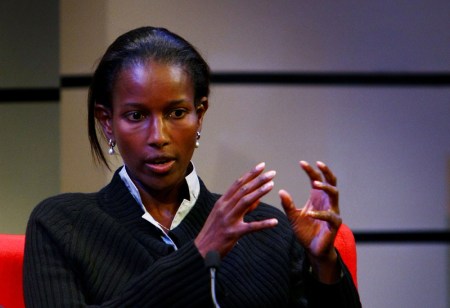
Somali-born Muslim dissident and author, Ayaan Hirsi Ali, wrote in her recent book that in the West, the ultimate goal of dawa (the Muslim practice of Islamic outreach or proselytizing) “is to destroy the political institutions of a free society and replace them with strict sharia.” (Photo by Ian Waldie/Getty Images)

Presumably, the last thing a society would want are groups that cloak political activity in religious practices, protected under the precepts of freedom of religion.

In the Philippines, recently, members of the dawa organization known as Tablighi Jamaat (“Group that Propagates the Faith”) entered the country under the guise of missionary activity — that they were going to participate in the Tablighi Jamaat’s annual gathering there. It turned out, however, that they had come to wage jihad together with Isnilon Hapilon, the late “emir” of Islamic State in Southeast Asia.

The Tablighi Jamaat has been described by the expert on Islam and journalist, Innes Bowen, in her 2014 book, Medina in Birmingham, Najaf in Trent, as “a Deobandi missionary movement and one of the largest Islamic groups in the UK… it has quietly grown into one of Britain’s most successful Islamic movements. Vast numbers of British Muslims have spent time in its ranks”[1]. However, the Tablighi Jamaat was largely unknown in the UK, until it emerged that several British Muslims charged with terror offences had all spent time[2] in the organization. Among these terrorists were Richard Reid, the “shoe-bomber,” and three of the four perpetrators of the London 7/7 terrorist attacks. The American enemy combatant, John Walker Lindh, who aided the Taliban, was associated with the Tablighi Jamaat; and the San Bernardino terrorist Syed Farook prayed in San Bernardino at the Dar al Uloom al Islamiyyah mosque, described as a “haven for Tablighi Jamaat activists.”

The movement, according another expert on Islam, Yoginder Sikand, in his 1998 study of the Tablighi Jamaat , sought “to promote a sense of paranoia and even disgust of non-Muslim society”[3]. He quoted a prominent British promoter of the Tablighi Jamaat as saying:

“a major aim of tabligh is to rescue the ummah [Muslim community] from the culture and civilization of the Jews, Christians and (other) enemies of Islam to create such hatred for their ways as human beings have for urine… and excreta…”.

The Tablighi Jamaat has been described in the Middle East Quarterly, in an article called “Tablighi Jamaat: Jihad’s Stealthy Legions“, as a wolf in sheep’s clothing:

“Tablighi Jamaat is not a monolith: one subsection believes they should pursue jihad through conscience…while a more radical wing advocates jihad through the sword … in practice, all Tablighis preach a creed that is hardly distinguishable from the radical Wahhabi-Salafi jihadist ideology that so many terrorists share”.

Nevertheless, Tablighi Jamaat remains a legal, active organization, which yields a considerable influence over Muslims in Europe, especially the UK and the United States. Already in 2003, the deputy chief of the FBI’s international terrorism section, Michael J. Heimbach, said, “We have a significant presence of Tablighi Jamaat in the United States and we have found that Al-Qaeda used them for recruiting now and in the past.” One 2011 undercover video segment from the Darul Ulum Islamic High School in Birmingham, England, associated with the Tablighi Jamaat, showed that Muslim children were taught Muslim supremacy. Eleven year olds were taught that Hindus “have no intellect” and “drink cow piss”. The teacher also said, “You are not like the non-Muslims out there… All that evil that you see in the streets… people not wearing Hijab properly, people smoking… you should hate it…” The children were also told:

“You need to free yourself from the influence of the Shaitan [Satan] and of society… The Kuffar [derogatory term for non-Muslims] have brought so many new things out there…They are controlling your minds… Are you part of those who prefer their way of life: The way of the Kuffar over the way of the Prophet?”

Both US and Dutch intelligence once seemed aware of the imminent danger of dawa organizations. In 2004, a Dutch government report identified threats to Dutch society from the practice of dawa and concluded that an “interaction or even interwovenness of Dawa and Jihad demonstrate the relationship between the various forms of radical Islam and the phenomenon of radical-Islamic terrorism.”

The study also distinguished various kinds of dawa, both overt and covert, and the threats emanating from it:

“Dawa may be aimed at trying to convince Muslim communities that non-Muslim communities are hostile towards Islam and wish to oppress or even destroy it. Dawa may also serve to convince Muslim communities that the values and standards of non-Muslims are incompatible with those of Islam and should therefore be considered as depraved. In such a form of Dawa, Muslim communities are often encouraged to emphasise (in a provocative way) the differences with other groups and sometimes also to express their contempt and hatred towards standards and values and the culture of non-Muslims”.

It would appear that Western governments have largely unlearned — at least officially — these insights into dawa as a tool for fostering feelings of Muslim supremacy and hatred of non-Muslims. Instead, they engage in endless, misguided obsessions over “Islamophobia.” Their unlearning should be a cause for concern.

Other dawa organizations also operate in the West. One is the Islamic Education and Research Academy (iERA), led by two converts, Abdur Raheem Green and Hamza Andreas Tzortis, that works globally to spread Islam. Unlike the Tablighi Jamaat, it focuses its missionary efforts on non-Muslims. Its leaders have made racist, supremacist and anti-democratic statements such as, again, calling non-Muslims, “kuffars.” Green has said that, “The purpose of the jizya [protection money, or “tax”, paid by non-Muslims to Muslims] is to make the Jew and the Christian know that they are inferior and subjugated to Islam,” and “If a Jew or Christian is found walking down the street, a Muslim should push them to the side”. He has also said that the “immediate problem” for Muslims in Britain is being surrounded by “kuffar” and that one of the only justifications for Muslims to remain in the UK is to “call the kuffar to Islam.”

Tzortis has said that apostates who “fight against the community[…] should be killed” and that, “we as Muslims reject the idea of freedom of speech, and even the idea of freedom.” He has also spoken in favor of child marriage. He admits that he used to be a member of Hizb ut-Tahrir, a radical Islamic organization, but that he left the organization for “scholastic and philosophical reasons.” In a statement on the iERA website, Tzortis and Green try to distance themselves from some (unspecified) past statements by writing, “some of the anachronous statements attributed to iERA personnel have been either clarified or publicly retracted, and were never made at university campuses.”

The iERA evidently enjoys a large platform on UK campuses. According to a report on extremist events on UK campuses in the academic year 2016/17, iERA was behind 34 out of the total 112 events that took place that year. Unlike the far-right fringe groups recently banned by British Home Secretary Amber Rudd — the mere support of such groups is punishable by up to 10 years in prison — the iERA is free to carry on its dawa activity undisturbed[4] and does so at an incredible pace. According to the organization’s Facebook page, in October 2017 alone iERA or its representatives were active doing dawa in Canada, Hong Kong, the Netherlands, and in the United States. The iERA also trained 15 dawa leaders from all over the world — from Iceland and Poland to Honduras and Finland — in a recent online dawa training program.

In the United States, the iERA works with the Muslim American Society (MAS) and Islamic Circle of North America (ICNA), according to the iERA website. ICNA, a leading Muslim organization in the US, is actively involved in dawa, and in 2015 ran “Global Dawa day,” which referred to Tzortis’s training course.

According to ICNA’s 2013 Members Handbook (for its female members), the organization considers itself an Islamic movement which is an

“organized and collective effort waged to establish Al-Islam in its complete form in all aspects of life. Its ultimate objective is to achieve the pleasure of our Creator Allah and success in the hereafter through struggle for Iqamat-ad-Deen [the establishment of Islam in its totality]. Islamic movements are active in various parts of the world to achieve the same objectives”.

The ultimate goal of establishing an Islamic state in the United States could hardly be much clearer. The pretense of caring for “diversity” and “inclusion” that ICNA displays on its public website cannot be characterized as anything other than an attempt at dissimulation, as is the stated goal of “establishing a place for Islam in America.” ICNA already has a place for Islam in America — it presumably wants to expand that place until nothing else is left.

The 2013 Members Handbook describes that ICNA’s work proceeds in “stages.” One of the stages is dawa, or “effective outreach.”

“Those who accept the truth of Islam are provided with appropriate Islamic literature and given the opportunity to become a Muslim. They are made part of the Islamic Ummah as brothers and sisters.”

The Members Handbook goes on to describe how already in the 1970s:

“ICNA established its own forums for dawah work at the local, regional, and national level. It established vital institutions at the national level for support of its dawah activities… Recognizing other movement oriented groups in this land, ICNA continues to coordinate and combine its efforts with them”.

In fact, ICNA has a separate project called the “Why Islam Dawah Project,” which

“aims to organize the dawah work in North America in a professional and effective manner. Highlights of the project are Toll-Free number for non-Muslims; Distribution of Islamic literature… Dawah through Media; Dawah in Prisons; Campus Dawah Support; Dawah Flyers Online; Dawah through Email”.

ICNA is considered by experts such as Steven Emerson, Founder and Executive Director of The Investigative Project on Terrorism, to be linked to the Muslim Brotherhood. Its spiritual leader, Yusuf al Qaradawi, has preached that the West will be conquered by Islam — not through the sword, but through dawa.

If Western leaders are unable to fathom the danger posed by organizations such as Tablighi Jamaat, iERA and ICNA, and, according to critics, others such as CAIR and ISNA — let alone do something about it, instead of endlessly obsessing over “Islamophobia” — Qaradawi could be proven right.

Judith Bergman is a columnist, lawyer and political analyst.
DOJ Sources: Sessions Has Not Recused Himself from Potential Uranium One Probe

November 4, 2017

DOJ Sources: Sessions Has Not Recused Himself from Potential Uranium One Probe, Washington Free Beacon, November 3, 2017

Attorney General Jeff Sessions / Getty Images

Department of Justice (DOJ) sources disputed reports late Friday that Attorney General Jeff Sessions has recused himself from decisions involving potential investigations into alleged corruption surrounding a deal that gave Russia control of a large portion of U.S. uranium-mining capacity.

DOJ officials told the Free Beacon that Sessions has not recused himself from deciding how the Justice Department should respond to recent reports raising questions about the Obama administration’s approval of a 2010 purchase of Uranium One, which controlled 20 percent of U.S. uranium, by Russian energy company Rosatam.

Sessions, in his role as attorney general, could recommend an internal DOJ investigation into the matter or appoint an outside special counsel to handle it.

For months, President Donald Trump has blasted Sessions for recusing himself from the probe into Russian meddling in the election and Moscow’s alleged ties to the Trump campaign. Sessions’ recusal led to the appointment of former Robert Mueller as special counsel in charge of the Russia probe.

Following Mueller’s first round of indictments in the Russia probe this week, Trump expressed frustration over his inability to get involved in Justice Department decisions and what investigations it launches.

On Friday morning he tweeted: “Everybody is asking why the Justice Department (and FBI) isn’t looking into all of the dishonesty going on with Crooked Hillary & the Dems…”

By week’s end, conservatives who support Sessions became increasingly concerned that Trump would decide to fire Sessions if the attorney general did not provide clarity about his recusal and whether he would be involved in decisions regarding former Secretary of State Hillary Clinton and any improper role she might have played in the Uranium One deal.

Sessions’ defenders point to his decision last week to lift a gag order on an FBI informant with detailed knowledge of a Russian bribery scheme linked to the Uranium One deal as evidence that is has not recused himself from the issue. The Obama-era DOJ had imposed the non-disclosure agreement and reportedly threatened the informant with litigation if he broke it.

Rick Manning, the president of Americans for Limited Government, a conservative nonprofit, on Friday issued a statement, saying that Sessions “is in the game” on Uranium One and knocking down reports claiming otherwise.

Manning, citing what he called an “unimpeachable source,” said Sessions is on the Uranium One case.

“The fact that the attorney general ended the non-disclosure agreement for the Uranium One whistleblower provides the proof that Sessions is actively involved in the Uranium One case,” he said. “Unfortunately, the attorney general cannot conduct any investigations through press releases and sound bites allowing the rest of us to receive a blow-by-blow description of every action that might be under way.”

GOP lawmakers have launched their own investigations into the matter after the Hill and Circa News reported new details of an extensive Russian bribery scheme aimed at expanding Moscow’s control of U.S. nuclear energy supplies. Three congressional committees are now looking into the bribery scheme and whether it influenced then-Secretary of State Hillary Clinton’s decision to sign off on the acquisition.

Sen. Chuck Grassley (R., Iowa), who chairs the Senate Judiciary Committee, was the first lawmaker to press the Justice Department and other federal agencies for information about the Uranium One deal, asking Sessions during an Oct. 19 hearing whether the agency was investigating the deal and the surrounding Russian bribes.

At the time, Sessions responded that it would be inappropriate to disclose whether Justice is looking into to the matter but tried to assure Grassley that his concerns would be addressed.

He also said he doubted Deputy Attorney General Rod Rosenstein would be the right person to look into the matter because he had handled the prosecution of those implicated in the Russian bribery scheme while he was serving as a U.S. attorney in Maryland before he became a top DOJ official.

Last week, Grassley appeared exasperated by the lack of clarity about whether Sessions could launch an investigation into Uranium One.

“Whoever in DOJ is capable w authority to appoint a special counsel shld do so to investigate Uranium One ‘whoever’ means if u aren’t recused,” he tweeted.

Rep. Matt Gaetz (R., Fla.) said earlier this week that Sessions met with House Judiciary Committee Republicans in late September and told them that his recusal prevented any involvement in potential investigations into Uranium One or anything that involved the 2016 campaign, the candidates, or Russia.

According to a Breitbart report, when Gaetz asked Sessions to appoint a special counsel to look into the Uranium One deal, the attorney general abruptly stood up and said he couldn’t discuss the matter because of the recusal and left the room.

That left the House Judiciary Republicans with a group of aides to Deputy Attorney General Rod Rosenstein who Gaetz said showed “no interest” in discussing a potential Uranium One Justice Department investigation.

Gaetz said Sessions’ “broad” interpretation of the recusal puts Rosenstein in charge, which he called “troubling.”

Rep. Bob Goodlatte (R., Va.), who chairs the House Judiciary Committee, as well as Reps. Ron DeSantis, (R., Fla.), Louis Gohmert, (R., Texas), and Jim Jordan, (R., Ohio), all members of the panel, also were at the late September meeting with Sessions.

Justice Department spokeswoman Sarah Isgur Flores earlier this week said she did not believe that others remembered Sessions making the statements about his recusal that Gaetz claimed but would not comment directly or not about whether Sessions was recused from the Uranium One issue.

Sessions, an early Trump supporter and frequent campaign surrogate, in early March recused himself from any Department of Justice investigations into President Trump’s campaign and any alleged ties to Russia. It is unclear, however, how far the recusal extended.

The recusal came after a storm of criticism over Sessions’ failure to disclose two instances in which he met Russian ambassador, Sergey Kislyak, during his Senate confirmation hearings.

Trump and other Republicans pushed back, pointing to numerous contacts Kislyak had with high-profile Democrats, including Minority Leader Nancy Pelosi and several Democratic senators.

The Hill newspaper and Circa News reported new details of a sweeping multimillion dollar racketeering scheme by Russian nuclear officials on U.S. soil that involved “bribery, kickbacks, money laundering and extortion.”

The report indicated that an FBI informant had information that FBI agents suggested that political pressure was exerted during the Justice Department probe of the bribery scheme and that there was specific evidence that could have scuttled approval of the Uranium One deal.

The Committee on Foreign Investment in the United States (CFIUS) approved the controversial Uranium One deal in 2010. Then-Secretary of State Hillary Clinton and then-Attorney General Eric Holder served on CFIUS at the time the agency approved the deal. She has said she knew nothing about the Russian racketeering.

Grassley and other GOP lawmakers have questioned the propriety of millions of dollars the Clinton Foundation received from “interested parties” in the uranium deal and have highlighted a $500,000 payment Bill Clinton received for a speech in Moscow before a Russian-government aligned bank. That speech took place the same month the Russians began the process of acquiring Uranium One.

New US Policy Confronts Iranian Regime, Opening up New Opportunities for Change

November 4, 2017

New US Policy Confronts Iranian Regime, Opening up New Opportunities for Change, Iran News Update, November 4, 2017

It appears that the only options left with Iranian authorities are confronting, retreating, or buying time until the end of the Trump presidency. Still, the regime must face the other factors at work against it, like the social disaffection within Iran towards the regime, and the recognition of the main opposition movements — the National Council of Resistance of Iran (NCRI) and People’s Mujahideen of Iran (PMOI) — by US and its allies in the region.

There is now an opportunity, with the current international situation, for the Iranian people and its main opposition movement (NCRI and PMOI), as well as for the people of Middle East and the whole world, for these factors that can lead to regime change and put an end to Iran’s destabilization activities in the Middle East.

***************************

INU – Saudi Arabia and Egypt, important countries in the region, concerned about the destabilizing activities of the Iranian regime in the Arab world, have strongly welcomed the October 13th announcement by US President Trump his regarding his new policy against the destabilizing behavior of Iran in the Middle East, particularly its missile activities. The new policy emphasized making the Middl#$e East a region without weapons of mass destruction.

The Iranian opposition movement and its President-elect, Maryam Rajavi, is leading a campaign to isolate the regime in Tehran. It welcomes the new White House strategy that delegitimizes the Iranian regime. Rajavi called on Trump and the international community to work toward “the ultimate solution”, regime overthrow and the establishment of freedom and democracy in Iran.

By refusing to give approval to the nuclear deal, and designating the Iranian Revolutionary Guard Corps (IRGC) on the list of terrorist organizations, the new US policy is targeting at the heart of the Iranian regime. According to the Washington Post the strategy marks an important change in US policy on the Middle East: a shift from focusing on war against ISIS and towards the end of Iran’s expansionism in the region.

The steps taken by the White House to carry out this policy include the visit by US Secretary of State to Saudi Arabia and other countries in the region, imposition of sanctions on Hezbollah for being the military wing of IRGC in Lebanon, and sanctions on companies, financial institutions and individuals related to the regime’s ballistic missiles programs.

According to F. Mahmoudi, Kurdish-Iranian political and human rights activist, in his Al Arabiya article, “Therefore, there is no reason for any objection by European countries to the new White House policy. European states are only thinking of securing their financial and economic interests with Iran, as not only the political and military power of the Iranian regime but also economic control lie in the hands of the IRGC.”

Sanctions against the Iranian regime, IRGC and Hezbollah will put European companies and banks in serious danger if they deal with this regime and its affiliates.

Additionally, the sanctions and the terrorist designation of IRGC have put Hasan Rouhani, who earlier presented himself to the West as a moderate, in a position of fully supporting the IRGC.

Supreme Leader, Ali Khamenei, reacting to the new US strategy, defended the IRGC’s presence in Iraq, Syria and Yemen and asked Europeans to stand strongly against Trump’s policy. However, it is believed that Europe will eventually choose the US instead of Iran and it will not sacrifice billion of dollars in trade benefits with the US. Additionally, Europe cannot accept the risk of Trump’s threat of leaving NATO.

It appears that the only options left with Iranian authorities are confronting, retreating, or buying time until the end of the Trump presidency. Still, the regime must face the other factors at work against it, like the social disaffection within Iran towards the regime, and the recognition of the main opposition movements — the National Council of Resistance of Iran (NCRI) and People’s Mujahideen of Iran (PMOI) — by US and its allies in the region.

There is now an opportunity, with the current international situation, for the Iranian people and its main opposition movement (NCRI and PMOI), as well as for the people of Middle East and the whole world, for these factors that can lead to regime change and put an end to Iran’s destabilization activities in the Middle East.

Al-Qaeda Terrorism and Shakespeare

November 4, 2017

Al-Qaeda Terrorism and Shakespeare, American ThinkerMichael Curtis, November 4, 2017

(Please see also, Can Bin Laden Heir Salvage Jihad in Syria? — DM)

Particularly important is Osama’s account of relations between al-Qaeda and Iran.

They were and are complex, fluctuating relations and loose ties between Sunni Osama and Shiite Iran.  What brought them together was the common hostility to the U.S. and to Saudi Arabia.  Iran supported al-Qaeda’s war against those countries.  Iran offered al-Qaeda “everything they needed,” funds and arms, and the opportunity to train in Hezb’allah camps in Lebanon in exchange for striking U.S. interests.  Iran sheltered al-Qaeda people.  Al-Qaeda opposed Saudi Arabia because it was hosting U.S. troops during the Gulf war.  Osama sent a group, the al-Qaeda management committee, to Iran while Iran enabled al-Qaeda to move funds and fighters to south Asia and Syria.

*******************************

Cole Porter would have been perplexed by the petition in October 2017 to the English Department at Cambridge University to “decolonize the curriculum,” but he had the foresight to call on people to brush up on your Shakespeare, start quoting him now.  Evidently Osama bin Laden, the epitome of decolonization, who had no use for Broadway anyway, had no quarter for Porter.  The terrorist leader who founded al-Qaeda in 1988, not one of those attired in wonder that know not what to say, implicitly told the world this in his personal diary of 228 pages with his private reflections that have just been made public.

This information is important at a time when the United States and the Western world have been preoccupied with the activities of ISIS, both the caliphate and its adherents, with attacks in New York City and around the world that have overshadowed the once more well known terrorist group al-Qaeda and its leader Osama.

On November 1, 2017, Mike Pompeo, director of the CIA, ordered the release of 470,000 documents captured in the Navy SEALs’ raid on May 2, 2011 on the compound of Osama in Abbottabad, Pakistan, close to the Pakistan Military Academy.  President Barack Obama had held that no more data taken from the compound should be released to the public .

However, Pompeo believes that it is important for reasons of national security to make most of the unclassified documents public, except those that might harm national security or are pornographic or copyrighted.  This is made more important because the U.S. forces in the raid were not able to take everything in the compound, and no doubt Pakistani officials have useful information not available to the U.S.  It is certain that American analysts can gain important insights into the plans and workings of al-Qaeda and other terrorist organizations from the revealed material.

No doubt the documents will prove a treasure trove with their astonishing array of material.  Some of them, if tantalizing, have little to do with Islamic terrorism or with U.S. security, especially those that are probably for the amusement of younger and other members of the Osama family that contained several of his wives and 23 children and his grandchildren.  In this part of the treasure trove are animated films; episodes of Tom and Jerry; film classics; a video of “Charlie Bit my Finger”; commercials from an Oregon car dealer; home videos with a barn and animals; videos such asThe Three Musketeers; National Geographic films on Peru, the Kremlin, and India; and material on conspiracy theories, the occult, the Illuminati, and even 9/11, for which adherents of al-Qaeda were responsible.

Among the 80,000 audio and image files and the 10,000 video files are statements by Osama, his 228-page personal journal, and jihadist propaganda.  Interestingly, Osama seemed to have liked watching three documentaries on himself and programs on how the West saw him.  One of them was an interview in 2005 of former CIA director James Woolsey of the Iraq war.  The collection includes videos of jihadist beheadings and a video of Abu Musab al-Zarqawi, the Iraqi al-Qaeda leader, who was killed in a 2006 U.S. air strike.

It has long been assumed that Osama was radicalized after he joined the Mujahideen in Afghanistan in 1979 fighting the forces of the Soviet Union.  But the personal diary reveals a different picture.  Osama tells of his visit to the U.K. for unstated “treatment” for ten weeks while he was in the 6th grade, aged 13.  He reports that he went every Sunday to visit Shakespeare’s 16th-century house in Stratford-upon-Avon.  He was not impressed, and he realized that British society was very different from his own and was a “morally loose society.”  It was at Stratford, not Afghanistan, that he first concluded that the West is “decadent.”  It is unlikely that he actually saw any one of Shakespeare’s plays, but even if not influenced by Hamlet, he acted as “if from this time forth, my thoughts be bloody or be nothing worth.”

Though his exact schedule is unknown, Osama experienced further decadence in Britain.  He had the misfortune to take an English language course at Oxford – at least it saved him from the “colonialism” at Cambridge – and is believed to have attended a soccer game at the home of Arsenal, the brutal Great Gunners, at Highbury in north London.

The materials reveal that American administration perceptions of Osama’s supposed unimportance in his last decade were inaccurate.  Osama and his network remained active and conspiratorial, and he was still the central factor in al-Qaeda, remaining in operations communication with his followers around the world.  His cohesive network included al-Qaeda in the Arabian Peninsula (AQAP), al-Qaeda in the Islamic Maghreb (AQIM), Al Shabaab in Somalia, and even the Taliban.

Some of his revelations are relevant to current affairs and U.S. policy.  He discusses the differences between al-Qaeda and ISIS and the factions with strategic, doctrinal, and religious differences within al-Qaeda.  The documents include the videos of Hamza, Osama’s favorite son and potential successor, with footage of his wedding, which apparently took place in Iran.  This son is slated to be the head of al-Qaeda and is a bitter enemy of the U.S.  Indeed, early in 2017, Hamza in a message called on al-Qaeda to attack Jews, Americans, Westerners, and Russians, using whatever weapons they have.  The U.S. has now placed Hamza on its Global Terrorist List.

For U.S. policymakers, it is useful to examine Osama’s thoughts on a variety of issues: the use of Libya after the death of Moammar Gaddafi; the path then and still for jihadists to enter Europe; the turmoil in the Middle East; Yemen, where Osama was plotting to kill the ruler Ali Abdullah Saleh; Bahrain; the protest by schoolchildren in Syria in 2011; the exploitation of the Arab Spring and other uprisings; and what al-Qaeda should do to make use of chaos.

Particularly important is Osama’s account of relations between al-Qaeda and Iran.

They were and are complex, fluctuating relations and loose ties between Sunni Osama and Shiite Iran.  What brought them together was the common hostility to the U.S. and to Saudi Arabia.  Iran supported al-Qaeda’s war against those countries.  Iran offered al-Qaeda “everything they needed,” funds and arms, and the opportunity to train in Hezb’allah camps in Lebanon in exchange for striking U.S. interests.  Iran sheltered al-Qaeda people.  Al-Qaeda opposed Saudi Arabia because it was hosting U.S. troops during the Gulf war.  Osama sent a group, the al-Qaeda management committee, to Iran while Iran enabled al-Qaeda to move funds and fighters to south Asia and Syria.

Lastly, Osama’s relations with Pakistan.  It is now clear that Pakistani authorities helped to hide him from the CIA for almost a decade.  This is clear from the fact that Osama used cell phones and computer hard drives, among other implements.

There is obviously a great deal of detail to analyze in the 470,000 documents.  What is important in all this for the U.S. and the Western world and Russia is reaffirmation of the need for cooperation to overcome Islamic terrorism.

Israel vows to protect embattled Syrian village from rebels

November 4, 2017

IDF pledges to intervene in Syrian civil war to ‘prevent capture, occupation’ of Druze town by rebel forces after suicide bomber kills 9.

David Rosenberg, 03/11/17 14:09

Source: Israel vows to protect embattled Syrian village from rebels

Fighting near Druze town of Hader in Golan       FLASH90

Israel has offered to intervene on behalf of a Syrian village near the Israeli border, one of the few times the Jewish state has expressed a willingness to wade into Syrian civil war raging for the past six years on Israel’s northern border.

The Israeli army said Friday that fighting has escalated in and around the town of Hader on the Syrian side of the Golan Heights.

Hader, a Druze town, has backed President Assad’s regime, making it a target for rebel forces, including the radical Al Nusra Islamist movement, which is seeking to gain a foothold in the Syrian Golan.

A suicide car bomber killed at least 9 people in Hader Friday, AFP reported, with another 23 injured. The Syrian SANA media outlet blamed the Al Nusra movement for the bombing.

Senior IDF officials pledged Thursday afternoon to intervene on Hader’s behalf and to protect its inhabitants from rebel forces.

Israel, said Brigadier General Ronen Manelis, is prepared to act “to prevent Hader from being harmed or occupied as part of our commitment to the Druze population.”

Manelis also denied “claims of Israeli involvement or help to global Jihadi elements in the fighting.”

The Druze, a small stateless ethno-religious community spread across Syria, Lebanon, and northern Israel, have often suffered persecution at the hands of despots and radical Islamists in the region. The 145,000 Druze citizens of Israel are by and large loyal to the state, with most Druze men enlisting in the IDF and even serving in high IDF positions. Not a few have given their lives for the state..

Druze tradition calls for being loyal to whoever rules the area in which they reside and Druze in the past even spawned terrorists such as Lebanese Druze Samir Kuntar who carried out the barbaric terror attack against the Haran family in Nahariya. However, the family ties between Israeli and Syrian Druze are many and trump those factors.

One Druze resident of Israel was wounded Friday morning by stray gunfire from the Syrian side of the border.

The victim, a resident of Majdal Shams in the Israeli Golan Heights, was lightly wounded in the incident and was treated at the scene.