Archive for July 2017

Former CIA Director Calls For A Coup If Trump Fires Mueller

July 25, 2017

Source: Former CIA Director Calls For A Coup If Trump Fires Mueller | Zero Hedge

Hurry up, we have to save the democracy in Venezuela !

In the most vocal opposition to president Donald Trump yet, former CIA Director John Brennan said that if the White House tries to fire special counsel Robert Mueller, government officials should refuse to follow the president orders, as they would be – in his view – “inconsistent” with the duties of the executive branch.

“I think it’s the obligation of some executive branch officials to refuse to carry that out. I would just hope that this is not going to be a partisan issue. That Republicans, Democrats are going to see that the future of this government is at stake and something needs to be done for the good of the future,” Brennan told CNN’s Wolf Blitzer at the Aspen Security Forum, effectively calling for a coup against the president should Trump give the order to fire Mueller.

The exchange is 43 minutes into the clip below:

(Full transcript here)

Brennan appeared alongside his former colleague, Director of National Intelligence James Clapper, and both men who served in the Obama administration, told Blitzer they have total confidence in Mueller. “Absolutely. It was an inspired choice- they don’t come any better, ” Brennan said adding that “If Mueller is fired, I hope our elected reps will stand up and say enough is enough.” Some have responded with questions where Brennan’s devotion to the Constitution was in the aftermath of the events in Benghazi.

Falling back on his neocon roots, James Clapper, who has waged a long-running vendetta with Trump, once again warned about Russian interference in US affairs. When asked about the June 2016 meeting between Donald Trump Jr., Jared Kushner and Paul Manafort with a Russian lawyer and others, he responded: “I’m an old school, Cold War warrior and all that – so I have, there’s truth in advertising, great suspicions about the Russians and what they do. A lot of this to me had kind of the standard textbook tradecraft long deployed by Russians. It would have been a really good idea maybe to have vetted whoever they were meeting with.”

Clapper was also asked about Trump’s comparison of the intelligence community to Nazi Germany. Clapper said he called the President-elect nine days before he left the Obama administration saying he “couldn’t let that reference pass” and it was an insult to him, CIA Director John Brennan and the workforce. “That was a terrible, insulting affront, not just to me or John, we get paid the big bucks, but I’m talking about the rank and file, men and women, patriots and intelligence community — that was completely inappropriate and over the top – I had to do something about it.”

And so he did: on the call Clapper said Trump asked him to “to put out a statement rebutting the contents of the dossier which I couldn’t and wouldn’t do. It was kind of transactional” referring to a dossier that alleged ties between President Donald Trump’s campaign and Russia. It was not clear if he wouldn’t and couldn’t do it because the contents were legitimate, in his view, or because the dossier is what started the whole “Russian collusion” narrative in the first place. Curiously, Clapper saw it as a favor to Trump not to issue a statement: Clapper was asked by Blitzer why he didn’t put out a statement replying: “The whole point of the dossier by the way was we felt an obligation to warn him to alert him to the fact it was out there. That was the whole point.”

It was not clear if James Comey, whose subsequent leak to the NYT led to the appointment of Mueller, would have applied the same reasoning when asked by Trump to rebut the dossier’s contents.


Secretary of State Shills for Muslim Brotherhood, Qatar

July 25, 2017

Secretary of State Shills for Muslim Brotherhood, Qatar, Clarion ProjectRyan Mauro and Martin Mawyer, July 25, 2017

(Please see also, State Department Lawyers Removing References to ISIS ‘Genocide’ Against Christians, Other Religious Minorities. Tillerson’s affinity for the Muslim Brotherhood, Qatar and Turkey apparently cannot be blamed on Obama hold-overs. — DM)

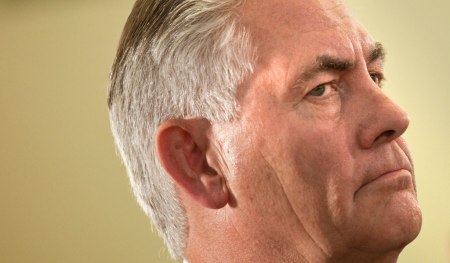
U.S. Secretary of State Rex Tillerson (Photo: Brendan Smialowski/Getty Images)

Political analysts always say that Trump was elected because people wanted change from an outsider. Tillerson is not bringing change. When it comes to Islamism, it’s the same-old same-old. Possibly worse.

****************************

The Trump Administration still hasn’t designated the Muslim Brotherhood as a Foreign Terrorist Organization as it was expected to do. Designation falls under the purview of Secretary of State Tillerson, who has chosen the Muslim Brotherhood and its backers in Qatar and Turkey over their Arab rivals.

Tillerson recently signaled his opposition to designating the Muslim Brotherhood in mid-June. He only has negative things to say about the idea.

His main point is that the Brotherhood’s political parties have representatives in governments like those in Bahrain and Turkey. That is irrelevant. If it was such a problem, Bahrain itself wouldn’t have banned the Brotherhood and the U.S. wouldn’t be dealing with the Lebanese government that has Hezbollah in it, which is designated as a Foreign Terrorist Organization.

Tillerson also repeated the “non-violent” and “moderate” Muslim Brotherhood propaganda. He claimed that the Brotherhood’s political parties in governments “have become so by renouncing violence and terrorism.” That was false when the Obama Administration said it, and it is false now.

The disappointment in Tillerson’s position is made exponentially greater by the fact that now is an optimum time to designate the group.

The Arab world is putting unprecedented pressure on Qatar over its support of the Brotherhood and other jihadists in the Islamist swarm. Muslim foes of the Brotherhood are left wondering where the U.S.stands because Trump and Tillerson aren’t on the same page.

Counter-terrorism expert Patrick Poole goes so far as to assert that Tillerson is “sabotaging” Trump’s foreign policy and urges his departure from the administration.

While President Trump expressed his support for the Arab measures against Qatar and unequivocally described Qatar as a major terrorism-financier, Tillerson did the opposite. He described Qatar as “very reasonable” in its reaction to the Arabs’ pressure.

His spokesperson read a scripted statement accusing the Arab states of having ulterior motives, saying the U.S. is “mystified” by their complaints. The State Department even cast doubt on the credibility of the Arabs’ accusations, claiming that they haven’t provided supporting details. Qatar’s lavish sponsorship of terrorism and extremism is uncontestable.

As Poole documents, far from offering support for those Arab states opposing Qatar, Tillerson publicly made moves towards Qatar’s Turkish allies and increased criticism of Qatar’s Saudi adversaries. The Trump Administration also agreed to sell up to 36 fighter jets to Qatar right after the Arabs began their campaign.

Tillerson even signed a counter-terrorism agreement with Qatar, spitting in the faces of the Arab countries fed up with Qatar’s repeated breaking of its promises to change its behavior. Immediately after signing the deal, Qatar reiterated its firm commitment to Hamas (and therefore, the broader Muslim Brotherhoodorganization of which it is an official branch).


Tillerson’s Ties to Qatar

People are inevitably influenced by those they surround themselves with, especially if that interaction is lucrative. Perhaps Tillerson’s favoring of Qatar has something to do with the close relationship he had with the Qatari government as a businessman with ExxonMobil, which has a decades-long association with the rulers.

ExxonMobil was a founding member of the U.S.-Qatar Business Council in 1996, an entity created by the Qatari regime. Tillerson was a senior official at the time. Another listed founding member is Al-Jazeera, the jihadist-friendly propaganda network run by Qatar and the Brotherhood. One of the Arab states’ top demands is the closure of the network headquartered in Doha.

After becoming chairman and CEO of ExxonMobil, Tillerson became a member of the U.S.-Qatar Business Council’s advisory board. He apparently held this position up until when he became Secretary of State, as his name is still listed with that title on the website.

The Vice President of ExxonMobil Production’s name is currently listed as a member of the Council’s board of directors. Al-Jazeera officials also appear on the advisory board and board of directors.

The organization’s website says that the U.S.-Qatar Business Council “played a major role in the formation of Qatar Foundation International (U.S.-based).” The Qatar Foundation headquartered in Doha is a major promoter of Islamist extremism, particularly the Muslim Brotherhood, including Islamists in America.

When the Arab campaign against Qatar began, the Qataris immediately began utilizing their contacts to try to win the State Department over. It deployed its lobbyists in America and they had leverage: The West’s three biggest energy companies, including ExxonMobil, were trying to strike a deal with the Qatari government for expanding liquified natural gas production.

But Qatar isn’t the only country working aggressively to influence U.S. foreign policy in a direction favorable to the Muslim Brotherhood. Turkey’s government is also leading the Islamist charge.


Tillerson’s Ties to Turkey

ExxonMobil is a member of the U.S.-Turkish Business Council. The chairman is Ekin Alptekin, the very same Turkish businessman at the center of the controversy with President Trump’s former National Security Adviser, General Michael Flynn.

Alptekin’s company had a $600,000 contract with Flynn to promote the Erdogan government’s interests. Flynn’s firm registered as a lobbyist but did not register as a foreign agent. The Justice Department’s National Security Division began an investigation last November. Flynn registered as a foreign agent of Turkey after he was fired and replaced by General H.R. McMaster.

We do not currently know of direct dealings between Tillerson and Alptekin, but ExxonMobil’s involvement in the U.S.-Turkish Business Council highlights how his prior relationship with the Turkish government may influence his behavior.

At a time when Erdogan has few defenders, the Islamist dictator finds a supporter in Tillerson.

On July 9, Tillerson traveled to Istanbul to receive an award from the World Petroleum Congress. There, he heaped praise upon those who defended Erdogan against a coup attempt last year, going so far as to describe the Islamist government as a democracy. He said:

“Nearly a year ago, the Turkish people – brave men and women – stood up against coup plotters and defended their democracy. I take this moment to recognize their courage and honor the victims of the events of July 15, 2016. It was on that day that the Turkish people exercised their rights under the Turkish constitution, defended their place in a prosperous Turkey, and we remember those who were injured or died in that event.”

Tillerson doesn’t defend Erdogan in all circumstances, as he did condemn the Turkish security personnel who attacked protesters in Washington D.C. in May. But that’s not exactly a bold stand; it’s something that any public official would condemn.

When it comes to the tough issues, Tillerson has sided with Qatar and Turkey, even when it contradicts the commander-in-chief who picked him for secretary of state.


On designating the Muslim Brotherhood, Tillerson sides with Qatar and Turkey

When the Arab states piled unprecedented pressure on Qatar for its sponsorship of terrorism and extremism including the Brotherhood and Hamas, Tillerson sided with Qatar and Turkey.

When it comes to last year’s coup in Turkey, Tillerson sided unequivocally with Erdogan’s Islamist dictatorship. He didn’t even necessarily have to talk about it during his visit to Istanbul. He chose to.

When it comes to the Kurds, our best allies in fighting ISIS, Tillerson’s State Department sided with Turkey in criticizing the Iraqi Kurds’ referendum on independent statehood. It also implied opposition to Kurdish independence, reacting to the referendum with a statement in support of a “united” and “federal” Iraq.

Political analysts always say that Trump was elected because people wanted change from an outsider. Tillerson is not bringing change. When it comes to Islamism, it’s the same-old same-old. Possibly worse.


To sanction [Venezuela], or not

July 25, 2017

To sanction, or not, Venezuela News and ViewsDaniel Duquenal, July 24, 2017

So the talk is on sanctions again since the US/Trump have announced that they are considering strong sanctions if Maduro insists on electing a constitutional assembly next Sunday.

What I am dismayed for is to read that some people that should know better do not want sanctions. One example is Moises Naím who is usually so right on things but who is not quite this time around (1). The argument advanced by those who oppose sanctions are that 1) they do not work 2) they hurt the population more than the regime and 3) they can boost the regime if this one can wrap itself in the flag of nationalism.

Yes and no, and the more so in the case of Venezuela.  Let’s try to clarify ideas as I did for the electoral fraud of next Sunday.

We cannot judge Venezuelan situation on the basis of other examples because the conditions are unique. Venezuela is actually a war torn economy upon which not a single bomb has fallen. As such the population is already going through lack of food, lack of medicine, lack of basic services, and all getting worse by the day. Any of those refusing sanctions should explain to us how things can get much worse. Yes, they can, we can get outright killed but that could also happen without sanctions.

Would sanctions work? It depends on two things, which type of sanction and the will to enforce them. I agree with Naim on this part: for Trump to stop Venezuelan oil imports would not do much and if anything gain sympathy for the regime. But there are other options with oil. The one I would like is to forbid the sale of gasoline and gasoline components to Venezuela. The shortages of gas would certainly affect us a lot, but would also affect the regime a lot.  It would be difficult for the regime to replace its US purchases because they would need to sell oil to the US, get paid and only then buy cash in hand from other countries since the regime has no more credit. Buying gas and condiments to the US can be a much easier swap, faster to obtain for a country who lacks of everything but gas. You know where our priorities are…….

But I digress. My point is that there are different type of sanctions, some that may actually be more effective than stopping oil purchases. It could be even as simple as a 2 dollar tax per barrel on Venezuelan import to finance shale oil exploration. Venezuela financing the competition that would put it out of the market. No embargo, we can still sell oil to the US…..

But would those sanctions be used effectively by the regime? At first maybe. But a little bit only. The regime has spent so much time attacking the evil empire in the North and yet nobody associates the current crisis with the United States. Well, outside of the yellow dog chavistas.  What worked for the Castros will not work as easily for chavismo. Too many inside chavismo are aware that the crisis comes from the corruption and incompetence and the “I do not give a shit” attitude of the camarilla around Maduro and the army.  On this I am not as sanguine as Moises Naim.  The regime has wrapped itself too much around the flag for 18 years. The poor thing is just worn out.

Finally the “it does not work” argument. Well, it did work for South Africa. The salt boycott of India is a strategy that a determined people can use though in Venezuela people hate sacrifices of any type: pais de antojados.  It failed in Cuba because the US made it unilateral without managing to get real allies first, a mistake it did not do with Iran or Russia.

I suppose that what I am trying to say is that sanctions would more likely fail because of the nature of the Venezuelan people than the sanctions themselves. We do not want to suffer even though we self inflicted our current suffering.  But it is “ours” so at some level people do not mind as much as they should.  I know, there is no logic but that is the way people are here. My house keeper speaks volumes against Maduro and food shortages. And yet she has to go to her first protest march. She has no time. She is afraid of tear gas. She does not fit in. She whatever excuse, but I have heard her swear at Maduro when she comes back from a food line empty handed. Go figure.

So what to do?  Sanctions we must receive. But they should be bold and harsh against anyone in the regime, the type of sanctions that will make it impossible for them to leave Venezuela or enjoy the loot outside of Venezuela.  Also Venezuela should be excluded from as many organizations as possible under the excuse of pariah state. These humiliations will pay off. Mercosur is already on its way to boot Venezuela out.

Unfortunately there will be a need for sanctions that piss off el pueblo, who will be hurt anyway by the sanctions against the regime personnel who will try to compensate their overseas losses by further looting inside.  In Cuba the people never had a choice as to whether support Castro against the US and the embargo. In Venezuela we still can do it and should be told so.

So, messers Trump and Rubio, bring sanctions out. Just do not start with oil embargo.

————————————
1) While I was looking for the reference for the Naim article I fell upon this pretty despicable piece of anti Semitic garbage. The web page Entorno Inteligente that once upon a time was worth checking up has become a haven of the worst kind of chavismo. That entry shows you how far on the deep end chavismo has gone.

State Department Lawyers Removing References to ISIS ‘Genocide’ Against Christians, Other Religious Minorities

July 25, 2017

State Department Lawyers Removing References to ISIS ‘Genocide’ Against Christians, Other Religious Minorities, Washington Free Beacon , July 25, 2017

(Please see also, Trump State Dept Unsure Why Palestinian Terrorists Kill Israelis. — DM)

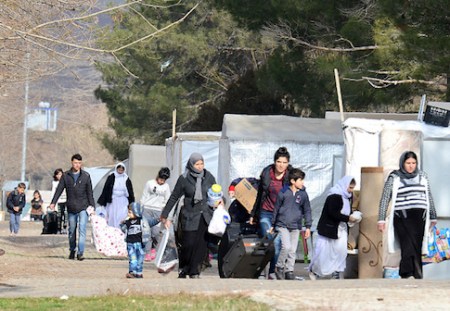
Yazidi refugees carry their belongings in Diyarbakir, southeastern Turkey, as they change their refugee camp / Getty Imagesfood or water. / AFP / ILYAS AKENGIN (Photo credit should read ILYAS AKENGIN/AFP/Getty Images)

Obama holdovers in State Department’s legal office are responsible, critics say

The State Department’s top lawyers are systematically removing the word “genocide” to describe the Islamic State’s mass slaughter of Christians, Yazidis, and other ethnic minorities in Iraq and Syria from speeches before they are delivered and other official documents, according to human rights activists and attorneys familiar with the policies.

Additionally, Democratic senators are delaying confirmation of Mark Green, Trump’s pick to head the U.S. Agency for International Development who has broad bipartisan support.

These efforts guarantee that Obama-era policies that worked to exclude Iraq’s Christian and other minority religious populations from key U.S. aid programs remain in place, the activists said.

Richard Visek, who was appointed by President Obama as head the State Department’s Office of Legal Adviser in October 2016, is behind the decision to remove the word “genocide” from official documents, according to Nina Shea, an international human rights lawyer who directs the Hudson Institute’s Center for Religious Freedom.

“I don’t think for a minute it’s a bureaucratic decision—it’s ideological,” said Shea, who also spent 12 years as a commissioner on the U.S. Commission on International Religious Freedom, or CIRF, from 1999 to 2012.

A State Department spokesman on Monday said he would look into the matter and respond.

The latest moves from the State Department’s Office of the Legal Adviser appear aimed at rolling back then-Secretary of State John Kerry’s March 2016 genocide determination. Kerry’s much-anticipated genocide designation came after months of equivocation and detailed documentation by interested parties that the Islamic State is responsible for genocide against Yazidis, Christians, and Shia Muslims.

It was one of the few times in history that the United States designated ongoing mass murders against ethnic or religious minorities as meeting the legal definition of genocide laid out in a 1948 treaty. That agreement requires signatories, including the United States, to take steps to “prevent and punish” genocide.

A bipartisan group of Capitol Hill lawmakers and activists, including Sen. Marco Rubio (R., Fla.) and Rep. Robert Aderholt (R., Ala.) were hoping the designation would help direct millions of dollars in U.S. relief funds to Christian, Yazidi, and other persecuted religious minority communities.

ISIS murders and kidnappings have decimated the Christian population in Iraq, which numbered between 800,000 and 1.4 million in 2002, reducing it to fewer than 250,000 now. Without action, activists and charities say, Christians could disappear completely from Iraq in the near future.

After meeting with Pope Francis in May, President Trump vowed to do everything in his power to defend and protect the “historic Christian communities of the Middle East.”

Activists and Catholic leaders are now calling on Trump to turn the rhetoric into action on the ground and help get U.S. aid to these persecuted communities trying to rebuild their homes and their lives in Iraq.

These advocates want the State Department, the U.S. Agency for International Development (USAID), and the United Nations to allow church groups and other religious-affiliated relief organizations to receive government aid, a practice prohibited during the Obama administration.

In early May, Congress allocated more than $1.3 billion in funds for refugee assistance and included specific language to try to ensure that at least some of the money is used to assist persecuted religious minorities, including Christians, Yazidis, and Shia Muslims—all groups the State Department deemed victims of genocide in 2016.

Nevertheless, only $10 million is specifically earmarked for Christians, Yazidis, and other religious minorities. The Trump administration has until the end of September, when the stop-gap funding bill runs out, to ensure it distributes the funds in the most effective way.

“There is congressional legislation … that calls for the U.S. government to stop excluding the genocide-targeted minorities in Iraq,” Shea said. “This has been a pervasive problem that this aid has not been getting to them.”

“Iraq is home to one of the four largest remaining Christian communities in the Middle East that are about to become extinct,” she said. “Presidents George W. Bush and Barack Obama made catastrophic mistakes that left these communities on the brink of extinction, but it’s going to be on President Trump’s watch as to whether they survive or become extinct—it’s going to be his policies that make or break the situation.”

Instead of going through Iraqi government agencies or other internationally recognized groups, activists say the best way to get the aid to Christians and other persecuted minorities is through local Iraqi Catholic dioceses and parishes and other religious organizations, such as the Knights of Columbus, which have spent years on the ground working with these communities.

The money would be specifically designated for relief efforts for these persecuted communities and could not be used for other purposes, such as church-building or more general church operations.

Groups say the special allocation is needed because Christians, Yazidis, and other religious minorities often do not go to Muslim-dominated refugee camps out of fear they will be targeted, killed, or kidnapped.

After the Iraqi army retook Mosul from the Islamic State with the help of U.S. forces, much international attention has focused on helping rebuild the Sunni community so that ISIS cannot regain its influence there through sleeper cells or other supportive Islamic terrorist groups.

Shea said Christians will also play a key role in stabilizing the area in and around Mosul if they have enough aid to rebuild their homes in the area and other parts of Northern Iraq.

They could also combat Iran’s colonization of northern Iraq, where pro-Iranian militias are buying up Christian land in the area to try to broaden their influence.

“Christians and Yazidis need to be able to go back to their towns just to hold them—it’s a big national security priority for the U.S.,” she said.

In late June, Rubio, along with GOP Sens. John Cornyn of Texas, James Lankford of Oklahoma, and Ben Sasse of Nebraska, sent a letter to Secretary of State Rex Tillerson urging him to ensure that the 2017 omnibus appropriations are distributed to “vulnerable and persecuted religious minorities, including victims of genocide designated” by former Secretary of State Kerry.

“It would be a deathblow to pluralism and the prospect of religious freedom and diversity in any future Iraq,” the senators wrote, if these victims of genocide don’t receive the humanitarian aid Congress tried to direct to them.

In responding to the senators’ letter on July 10, the State Department avoided the question of whether it would allow Catholic or other charitable organizations to receive the appropriations in order to help the Christians, Yazidis, and other religious minorities.

Instead, Charles Faulkner of State’s Bureau of Legislative Affairs cited a list of U.S. efforts to help the “plight of religious minorities in Iraq” and said the department “shares your grave concern about the situation facing Iraq’s religious and ethnic minorities.”

The letter also restates the State Department’s policy and that of the United Nation’s of distributing U.S. relief based on means-tested need, instead of the genocide designation providing some priority for targeted communities on the verge of extinction.

“The U.S. government has also provided more than $1.3 billion in humanitarian assistance since 2014 for vulnerable Iraqis in Iraq and in the region,” the letter stated. “This assistance is distributed according to individual need, and many members of minority groups have benefited from it because of their unique vulnerabilities.”

Faulkner said the State Department “makes efforts” to ensure that the needs of “minority community members” are “taken into consideration,” when there are concerns that these communities don’t have access to assistance.

In addition to U.N. stabilization projects in Iraq, he said State’s Bureau of Democracy, Human Rights and Labor is managing 22 grants and “interagency agreements” in Iraq, and “since 2004 has been the lead U.S. government entity programming directly to support inclusion of religious and ethnic minorities and other marginalized populations in Iraq.”

No thanks for foiling terrorists at the mosque

July 25, 2017

No thanks for foiling terrorists at the mosque, Washington Times, , July 24, 2017

(Old Wesley Pruden can write a pretty bitter editorial. Good for him! — DM)

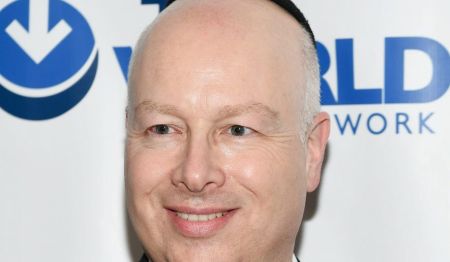
Jason Greenblatt. (Associated Press)

The metal detectors have infuriated the Palestinians because they will make it difficult to ambush police and to spill blood, some of it no doubt of innocent Arabs, as part of their peace initiative.

**********************************

It’s time to beat up on the Jews again, particularly the Jews in Israel and the West Bank. Once more they’re not standing still enough to enable the Palestinians to maim and kill.

Killing by stealth is what the Palestinian freedom fighters do best. They’re pretty good at it, particularly when they get to prove their manly courage against women and children. They’re bravest of all against infants. A Palestinian terrorist almost never flinches when an infant shakes his rattle at him.

The terrorists are upset this time because the Israelis installed metal detectors at the entrance to the al-Aqsa mosque in the Old City of Jerusalem after three Arab Israelis shot dead two Israeli police officers just outside the mosque, using guns they had smuggled into the compound.

The metal detectors have infuriated the Palestinians because they will make it difficult to ambush police and to spill blood, some of it no doubt of innocent Arabs, as part of their peace initiative. Slaying a few innocents is merely collateral damage in the name of Allah. Poor Allah, the crimes committed in his name and in his “defense.” It’s not entirely clear why Allah would need defending by mere mortals, but there is much in Islam that is difficult to understand.

Mahmoud Abbas, the president of the Palestinian Authority and ever eager to pour something flammable on troubled waters, to be helpful to someone passing by with a match aflame, said his government would “freeze contact on all levels” with Israel until the metal detectors are removed. This is negotiation, Middle East style: resolution on terrorist terms first, negotiations later.

Blowing the trumpet usually used to call retreat, the Israeli Security Cabinet is discussing ways to “reduce tensions,” including a “review” of the continued use of metal detectors to take weapons out of the hands of terrorists. The Trump White House dispatched its special envoy for international negotiation, Jason Greenblatt, to Jerusalem Sunday night to try to “end the bloodshed.” He will need extraordinary luck.

Mr. Greenblatt will “be closely coordinating” with Jared Kushner, President Trump’s 60-minute man for defusing trouble everywhere. Mr. Kushner deserves a trip to a war zone as relief from defusing tensions within the family, and particularly his own tense relationship with Donald Trump Jr. over the fallout from the young Mr. Trump’s conversations about whatever it was he talked to a Russian lawyer about.

It’s always one darn thing after another in the Middle East, and particularly between the Israelis and the Palestinians. Nothing will ever be settled, of course, until one side dies, either in battle, in brawling, or of old age. The Arabs have tried conventional warfare, even starting one war with Pearl Harbor-like stealth and surprise. They took their usual licking, and even that didn’t work, though it is true that the Arab military colossus enjoyed only a 6 to 1 advantage. Ganging up on women and children is all that a defeated Colossus can do.

Donald Trump sent Mr. Greenblatt aloft with a statement condemning the violence, not just condemning it but this time “utterly” condemning it, and that’s condemning it to the uttermost. This is the soft approach, which might work against Upper or Lower Slobbovia, but probably not against the likes of the Palestinians, the North Koreans or the gallant regiments of ISIS.

The attempt to calm troubled land and water gained new urgency with the murder of most of an Israeli family finishing their Shabbat supper Friday night in the West Bank settlement of Halamish. The killer looked typical.

Omar al-Abed, 19, who lived in a nearby village, broke through a window and surprised the family with an unregistered knife, stabbing and slashing with stealth and surprise, killing the father, about 60, and his son and daughter, in their 40s, before they could gather their wits to fight back. Several grandchildren listened to the slaughter, terrified, hiding in another room. Their grandmother was slashed, too, but survived. The killer was wounded by an Israeli soldier who heard their screams and arrived with a gun.

The killer told his captors that he bought the knife two days earlier to avenge the metal detectors at the Temple Mount. It’s obvious to everyone that precautions against violence are unnecessary in the Middle East. Why can’t the Jews give assistance to those who only want to kill them?

The Israeli Defense Force distributed a photograph of the killer taken from his Facebook account — where else but Facebook? — and supplied a translation of his vow to avenge the metal detectors. “Take your weapons and resist,” he wrote to others. “You start a war amongst us and Allah will judge you for it.” Hamas, the terrorist organization, praised the slaughter of the Israel family as “heroic.” Of course. But if Allah is just, he might favor the Jews.

US mulls sending arms to Kiev, doesn’t view move as ‘provocative’

July 25, 2017

Source: US mulls sending arms to Kiev, doesn’t view move as ‘provocative’ – US special envoy to Ukraine — RT News

© Ukrainian Defence Ministry

Washington is considering sending “defensive” weapons to Ukraine, US special representative Kurt Volker says. He insists the potential move, long desired by Kiev, would not be “provocative.” It comes as Moscow warns against fueling Ukraine’s civil war.

In an interview with the BBC on Tuesday, Volker, who was appointed by Secretary of State Rex Tillerson as the US special representative for Ukraine negotiations in July, said that US authorities are pondering whether to ship armaments to Kiev.

Read more

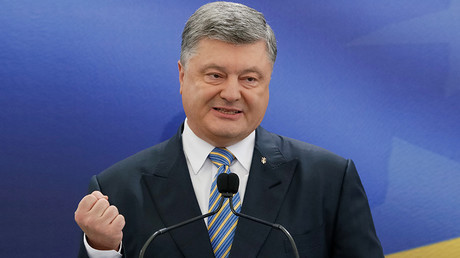
Ukrainian President Petro Poroshenko © Valentyn Ogirenko

Noting that the discussion is currently focused on “defensive weapons, ones that would allow Ukraine to defend itself and to take out tanks, for example,” Volker argued that such supplies “would actually to help [sic]” Kiev fend off alleged encroachments from Moscow.

Volker fell short of providing any indication of when such a deal could be reached between Washington and Kiev, saying that he is “not again predicting where we go on this.”

However, he claimed that despite the unresolved conflict in eastern Ukraine, Washington does not view such a move as “provocative.”

“I think that argument that it would be provocative to Russia or emboldening of Ukraine is just getting it backwards,” Volker told the BBC, adding that the US believes a “new strategic dialogue” with Moscow is needed to resolve the Ukrainian conflict, which has recently seen a spike in violence.

Volker, who is a former adviser to US Senator John McCain and a former US ambassador to NATO, previously described the conflict between Donbass rebels and Kiev as a “hot war” and an “immediate crisis,” as opposed to a frozen conflict. Volker visited Ukraine on Sunday, offering comments on camera and posing with Ukrainian servicemen before driving off in an armored vehicle.

Ukraine’s President Petro Poroshenko said in June that Kiev had almost worked out an agreement with Washington on defensive weapons. Hailing the progress reached on “defensive agreements” with the US, the Ukrainian leader claimed the parties “have an almost consensual text of the agreement [about the arms supplies].” Poroshenko voiced hope that the deals would be finalized within the present fiscal year.

Poroshenko’s assurances came on the heels of his meeting with US President Donald Trump, Defense Secretary James Mattis, and other senior US officials during a visit to Washington in June. Poroshenko said he discussed the issue with Tillerson, adding that the agreement could be signed once Mattis arrives in Ukraine.

While no official date for the visit has been announced, the Ukrainian ambassador to the US, Valery Chaly, said in June that Kiev had invited Mattis, Tillerson, and US Secretary of Energy Rick Perry to visit Ukraine before the end of the year. Tillerson visited Ukraine earlier this month.

Last week, fighting in Donbass that had seemingly subsided in recent months again intensified, claiming at least 12 lives. The surge in violence sparked concern among observers and mediators of the Minsk agreements and was addressed during a telephone conversation between the leaders of Russia, Ukraine, France, and Germany – known as the ‘Normandy Four’ – on Monday.

While negotiations surrounding weapons supplies to Ukraine currently appear to concern only “defensive” weapons, Ukrainian authorities have repeatedly said they are eager to receive “lethal” arms from the US.

READ MORE: Stop inventing fictional threats from Russia – Putin to Le Figaro

Russia has warned Washington against fueling the civil conflict in Ukraine by sending lethal weapons to Kiev.

“We have repeatedly said that any actions provoking tensions on the disengagement line [in eastern Ukraine] and in general further aggravating the already difficult situation [in the region], will only distance us from the moment of settling this domestic Ukrainian issue,” Vladimir Putin’s spokesman, Dmitry Peskov, told reporters.

Last week, Ukraine’s defense minister, Stepan Poltorak, reiterated that Kiev is waiting for Washington to greenlight the transfer of lethal arms to Ukraine, as proposed by the US Senate Armed Services Committee in June.

Following the proposal, an unnamed US State Department official told RIA Novosti that the US has not yet made up its mind on whether to supply lethal arms to Kiev.

READ MORE: $700bn Pentagon bill funds US presence in E. Europe & weapons for Ukraine

Israel-Jordan crisis over, diplomats leave embassy

July 24, 2017

Israel-Jordan crisis over, diplomats leave embassy, DEBKAfile, July 24, 2017

DEBKAfile adds: The resolution of the diplomatic crisis between Jerusalem and Amman over this incident did not settle the Israeli-Palestinian impasse over Temple Mount. An Israeli-Jordanian deal was almost certainly struck to ease the crisis over the security measures Israeli installed at the shrine after two of its police officers were shot dead there by terrorists. But any such deal will depend on Palestinian approval, and that remains to be ironed out in further negotiations.

********************************

The diplomatic crisis between Jordan and Israel lasted a day and-a-half before it was resolved. By late Monday, July 24, the Israeli embassy staff was free to leave Amman and drove through the Allenby Bridge crossing on their way home. Among them was the security guard, who Sunday shot dead two Jordanians in a struggle after he was stabbed with a screwdriver. The Jordanian authorities demanded his handover for their investigation and subjected the embassy to a lockdown for most of the day to prevent their departure. Israel rejected this demands on the grounds that the guard had diplomatic immunity.

During the day, Shin Bet Director Nadav Argamon and Donald Trump’s special envoy Jason Greenblatt travelled to Amman to clear up the crisis with senior Jordanian officials. Jordan’s King Abdullah and Prime Minister Binyamin Netanyahu were kept continuously in the picture.  When the two leaders spoke directly Monday evening, the end of the crisis was clearly at hand.

While he was in Amman, Argaman invited Jordanian security officials to come to the embassy and view a reconstruction of the contested incident and participate in the questioning of the guard.

DEBKAfile adds: The resolution of the diplomatic crisis between Jerusalem and Amman over this incident did not settle the Israeli-Palestinian impasse over Temple Mount. An Israeli-Jordanian deal was almost certainly struck to ease the crisis over the security measures Israeli installed at the shrine after two of its police officers were shot dead there by terrorists. But any such deal will depend on Palestinian approval, and that remains to be ironed out in further negotiations.

DEBKAfile described the incident that provoked the diplomatic crisis between Jordan and Israel as it happened on Sunday:

An incident at the Israeli embassy in Amman Sunday, July 23, left two Jordanians shot dead and an Israeli stabbed and in serious condition. Monday morning, amid reports of an impending evacuation of embassy staff, the building was surrounded by Jordanian forces which prevented departures and entries. This followed a long confrontation overnight between the Jordanian and Israeli governments, most likely at the highest level. Amman demands the Israeli guard surrendered for the investigation into the incident. Israel refuses on the grounds that he has diplomatic immunity.

After the story was held back for several hours by the Israeli and Jordanian authorities, the versions which sparked this development released early Monday, combined with earlier international media reports, left more questions than answers.

According to the Israeli official version, an incident occurred in the “space of the Israeli embassy” which is located in the high-end Rabiyeh district of Amman, when a Jordanian workman who came to repair a piece of furniture at the home of the Israeli security guard, attacked him with a screwdriver. The guard pulled a gun and shot him and another Jordanian man described as “the landlord.”

Jordanian General Intelligence stated that when word was received of a shooting at a residential building used by the Israeli embassy and “within its space,” a security force was sent over and locked it down prior to investigating the incident and its circumstances. This account describes three injured individuals, including an Israeli national.

It is not clear in either account whether the Jordanian assailant came from outside and entered one of the most heavily guarded embassy compounds in Amman, or was a member of the embassy staff – in which case his security clearance by Jordan and Israel would have been high.

Other Jordanian sources describe the Jordanian assailant as a member of the embassy’s maintenance staff with whom the Israelis serving in Jordan were well acquainted.

International media carried various accounts hours before the story was officially released for publication. According to one, the Israeli guard was stabbed in a quarrel with a Jordanian and then shot him several times in the chest. The Israeli was then taken in “unstable condition” to hospital. Israel was said to have begun evacuating the Amman embassy.

The two governments appeared to have been engaged in an all-night discussion, most likely at the highest personal level of Prime Minister Binyamin Netanyahu and King Abdullah.

On Friday, thousands of Jordanians protested in Amman against Israel over the installation of metal detectors on Temple Mount, a site in the heart of Jerusalem that is sacred to both Muslims and Jews in Jerusalem. They were installed as a protective measure, after a terrorist on July 14 shot dead two Israeli police officers who were guarding the Lion’s Gate entry to the compound.

Since then, the Waqf and Palestinian leaders have instructed Muslims to refrain from entering Temple Mount for worship at Al Aqsa, but to hold prayers in the street outside the compound.  Major disturbances ensued in Jerusalem and other parts of the country and spilled across the border to Arab capitals, including Amman.

Israel later installed new security cameras on Temple Mount, while considering an alternative to the hotly contested metal detectors. But Waqf and Palestinian officials declared emphatically that no security measures installed by Israel for protecting worshippers and visitors to the shrine will be accepted. The Waqf takes its orders from Amman. The Temple Mount crisis has blown up into a major diplomatic incident between Israel and Jordan.

Right Angle – CALEXIT: Promises, Promises….

July 24, 2017

Right Angle – CALEXIT: Promises, Promises…., Bill Whittle Channel via YouTube, July 24, 2017

(Yes, but you don’t go. — DM)


U.S. Agency Promoting Trade With Iran Despite Trump Opposition

July 24, 2017

U.S. Agency Promoting Trade With Iran Despite Trump Opposition, Washington Free Beacon, July 24, 2017

(Please see also, Trump State Dept Unsure Why Palestinian Terrorists Kill Israelis. Fire the Obama hold-overs or put them where they can not impair President Trump’s agenda. How about air-conditioned igloos in northern Alaska?– DM)

Pistachio trees at an Iranian field that farmers left behind due to the lack of water / Getty Images

The U.S. Department of Agriculture is promoting increased trade with Iran, despite clear opposition to this policy by the Trump White House, according to multiple sources who described the agency’s behavior as rogue and part of a lingering effort by the former Obama administration to promote international trade with the Islamic Republic.

A July report released by USDA praises the Obama administration’s efforts to open trade with Iran following the landmark nuclear agreement that dropped major sanctions on the Islamic Republic. The report contradicts White House policy on Iran, which has taken an increasingly hardline against increased relations with Iran under President Donald Trump.

The report is being viewed by administration insiders and regional experts as the product of efforts by the former Obama administration to promote positive propaganda about Iran in a bid to boost support for the Iran deal.

These sources viewed the report as a sign that Trump administration agencies, including USDA and even the State Department, are taking increasingly rogue action contradicting official White House policy on a range of key issues.

“White House National Security Adviser H.R. McMaster should call his office,” according to Michael Rubin, a former Pentagon adviser and expert on rogue regimes. “A key component of his job—and one that his predecessors let slide—is to coordinate policy across departments. Alas, it seems that the USDA wants to pursue an independent foreign policy, one that is detrimental to broader U.S. national interests.”

The USDA report, which touts renewed prospects for trade between the United States and Iran in light of the Iran deal, outlines “the potential for new opportunities for U.S. producers in the long run.”

The report further touts the Iran deal as an opportunity to help Iran engage with international markets, including those in the United States, to sell products such as pistachios and caviar.

“The lifting of the U.S. import ban on Iranian agricultural products, including pistachios and caviar, [represents] a large new market for Iran’s most valuable export crops,” according to the USDA report. “Arguably as important, however, was the removal of certain U.S. ‘secondary sanctions,’ penalties levied on foreign persons and companies seeking to do business in Iran, particularly in its finance, banking, insurance, and energy sectors.”

“This significant change allows Iran to attract foreign investment, import equipment, and adopt new technologies, all of which bear on Iran’s agricultural production and consumption,” according to the report.

The report further claims that the United States could face competition from Iran in regards to the pistachio market and urges the American market to brace for such a scenario.

“One example of the JCPOA’s [Joint Comprehensive Plan of Action] possible effect on U.S. producers relates to pistachios,” the report states. “With relaxed import restrictions from Iran, U.S. producers potentially face new competition from the world’s largest pistachio producer and second largest pistachio exporter. Decades of sanctions and trade restrictions have pushed Iran out of the large U.S. and European markets, but news reports have suggested that Iranian pistachio imports could resurge.”

One veteran Iran analyst who is in regular contact with the White House described the report as propaganda meant to falsely promote Iranian moderation and the benefits of legitimizing the regime.

“As with Obamacare, the Obama administration conscripted the entire federal government to propagandize on behalf of the Iran deal,” the source said. “The intelligence community produced politicized reports falsely hinting at Iran moderation. The State Department produced reports saying that the Iran deal was working. The Treasury department dismantled its anti-proliferation infrastructure and then declared it couldn’t find anyone to sanction for proliferation.”

“So it’s not surprising the Agriculture Department was tasked with producing pro-deal propaganda about how the deal would benefit Americans,” the source added. “What’s surprising is that the Trump administration hasn’t managed to put a stop to that nonsense.”

Saeed Ghasseminejad, an Iran expert at the Foundation for Defense of Democracies, said the report contradicts efforts by the White House and Congress to increase pressure on Iran as a result of its illicit ballistic missile program and ongoing support for terrorism.

“The White House and Congress seek to put pressure on the mullahs in Tehran, at the same time we see that other parts of the U.S. government are endorsing and recommending policies which are not in line with the White House and Congress’ goal,” Ghasseminejad said. “The Islamic Republic of Iran is a strategic enemy of the United States; unfortunately many in DC prefer to forget this basic point.”

USDA did not respond to multiple requests for comment on the report’s origins and who authorized its production.

Lessons from Europe’s Immigrant Wave: Douglas Murray Cautions America

July 24, 2017

Lessons from Europe’s Immigrant Wave: Douglas Murray Cautions America, Investigative Project on Terrorism, Abigail R. Esman, July 24, 2017
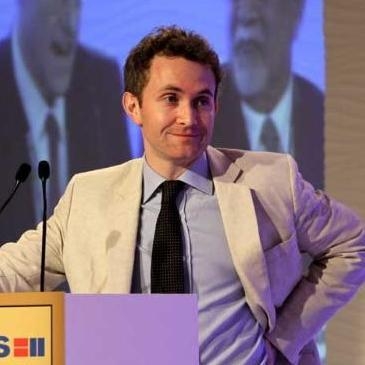
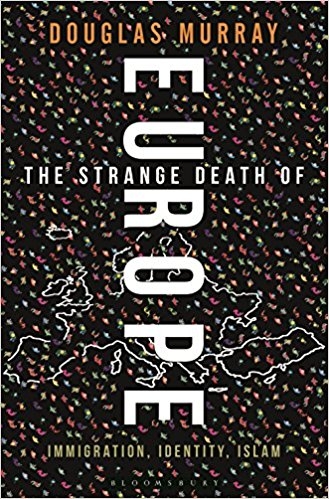
Douglas Murray has long voiced his concern about the growing influence of Muslim culture on the West. The associate editor of Britain’s Spectator, a frequent contributor to the Wall Street Journal, and the founder of the Centre for Social Cohesion, a think tank on radical Islam, he has built an international reputation for his opposition to the demographic changes of the West and the threats to its traditions. In his latest book, The Strange Death of Europe: Immigration, Identity, Islam (Bloomsbury, 2017), he attacks all of these subjects as they relate to the current crisis of migration from the Middle East.

It is a controversial book, particularly for Americans and Jews, but one which also makes important arguments against the multiculturalist ideal. That ideal, which once led much of domestic policy across Europe and the United States, has proven not only a failure, but a threat to the values and national security of Western civilization.

The Investigative Project on Terrorism recently spoke with Murray about his book and the concerns that drove him to write it.

Abigail R. Esman: As an American, a Jew, and an immigrant myself to the Netherlands, there are aspects of your arguments against immigration and asylum that are troublesome to me. I come from a country where we are all immigrants, or our parents or grandparents were likely immigrants. You talk for instance of families where “neither parent speaks English as a first language,” yet my husband is Australian and I am American and neither of us speaks Dutch as a first language. So naturally, I come at these arguments with some concern. Are you saying, basically, close the borders?

Douglas K . Murray: It’s only for me to diagnose what’s happening – to see the truth about what is going on. Policy makers will make their own decisions. I have obviously broad views on it, which is that I think you can’t continue at the rate we have now, and I think you have to be choosy about the people you bring in. But you are right, and there are two groups of people who have had trouble with some of the basic things in this book: one is people of Jewish background, and others who come from nations of immigrants, like America. But Britain isn’t a nation of immigrants – we have been a static society with all the benefits and ills that this brings. And I think it is dishonest to say it is the same thing. I realize people who are predominantly Jewish have a particular sensitivity to it, but I think that that’s a particular issue. And why do we say one migration is just like the other It’s like saying because two vehicles went down the same road they are the same vehicle.

ARE: How is it different?

DKM: In the UK, when Jewish migration happened more than a century ago, the main thing was integration, integration into the society, wanting desperately to be part of British society. Why do synagogues in the UK have a portrait of the Queen? And after services, they often sing the British national anthem. It’s very moving. It’s an effort to demonstrate this is what we are and this is what we want to be. You’d be hard pressed to find a mosque with a picture of the queen who sing the anthem.

ARE: That element of integration is crucial, I agree. In America, in fact, immigrants in the past and often even today are eager to give their children Anglicized names: “Michael,” not “Moishe,” “Henry,” not “Heinrich.” Yet you do not see the name changes in Muslims these days. Why do you think that is?

DKM: Because there is less of a feeling to integrate. They want to stay with the country they’ve left but not deal with its economics. Some people find it flattering – that people want to move to your country – they say well, it shows what a wonderful place we are. No, it shows that your economics work better.

ARE: You also write about Muslim enclaves in Europe where “the women all wear some form of head covering and life goes on much as it would if the people were in Turkey or Morocco.” How is that different than, say, Chinatowns, or Orthodox Jewish neighborhoods in America and say, Belgium, where women wear wigs and men have peyas, or sidelocks?

DKM: The example of Chinatown-like places is a good comparison. These are places that are mini-Chinas, they are enjoyed and liked by people because they are a different place. Well, if people want to have a mini-Bangladesh, that’s one vision of a society. It’s not the vision we were sold in Europe. It was not meant to be the case that portions of our cities were meant to become totally different places. In the 1950s the British and other European authorities said we have to bring people into our countries and we will get a benefit in labor. But if they had said that the downside is that large portions of the area would be unrecognizable to their inhabitants, there would have been an outcry.

And the issue of them being different from Hasidic communities – you’re right, they are similar. You can go to Stamford Hill in North London and see most of the men in hats and so on and that’s because that’s an enclave that wants to keep to itself. That raises questions: one, people don’t mind that, for several reasons – one is the recognition that Orthodox men don’t cause troubles. We don’t have cases of Orthodox men going out and cutting off people’s heads. If four Jewish men from Stamford Hill had blown up buses some years back there would be concern about these enclaves.

And also those enclaves are not growing. If it was the case that these enclaves were becoming areas where all the city was hat-wearing Orthodox Jews, then people would say wait, what is that? You can applaud that or abhor it, but it’s important to mention.it.

ARE: In the Netherlands, which has some of the toughest immigration policies in the world, people from certain countries are required to take “citizenship” courses before they can even enter Dutch borders. They have to learn the language, they have to learn about Dutch values, and that no, you can’t throw stones at Jews and gay people and that gay marriage is legal and women wear short dresses. Would you recommend other countries take on the Dutch policy of citizenship courses?
DKM: I make this point in the book. You say we could have done more and better, but the fundamental thing is that none of it was ever expected in the first place. No one ever thought that we would be in the situation we are now in. We didn’t expect them to stay. That’s a very big misunderstanding. Why wouldyou ask people to become Dutch citizens if you expect them to go home in five years? Why if you only expect them to stay in Britain for only 10 years? But then we realized they would stay and then we said, “we have to let them practice their own culture.” But for us to have acted as you suggest we would have had to know [at the time].

So yes, I think it’s a bare minimum for Europe to have the Dutch policy, even at this very late stage. I’m of the inclination that this is too little too late, but I wish everyone luck with it.

ARE: What about Yazidi women, Syrian Christians?

DKM: Again, it comes down to the Jewish question – because people think that every refugee is like a Jew from Nazi Germany. But if you were to think of a group that was facing an attempt to wipe them off the face of the earth then yes, you’d have the Yazidis. But there are people on all sides of the Syrian civil war, which are a minority of people coming to Europe – these are people fleeing sectarian conflict, but none of them are fleeing an effort to wipe them out as a people. So the lazy view, and it is quite often pushed by Jewish groups which I think is a mistake – is to suggest that it is similar to Nazi Germany. And I wish more care were taken in this.

ARE: Is this in your mind a way of stopping radical Islam? Because so many of the radicalized Muslims are actually converts. How would it help?

DKM: We know that people who convert to anything tend to be fundamentalist. But the important thing is, if you were pliable to be converted, available to be converted, then it raises the question of what kind of Islam do we have in these countries? If it were people finding Sufism, rather than hardcore Salafism, maybe it would be different. I have a friend who is a Muslim who was on a trip some years ago who told me the story of introducing a Muslim woman to one of the senior clerics at Al-Azhar and she wouldn’t shake his hand. He asked her why not. She said, “Because I’m Muslim.” So he asked her how long she’d been a Muslim, and she said “Six years.” He said, “I’ve been a Muslim for eight decades.” And then he turned and said to his friend in Arabic, “What kind of Muslims are you making in Britain?”

ARE: One thing the American Muslim community seems to have over its European brethren is its successful integration into society. Yet at the same time, some of the worst of the radicals are in fact American-born. We have people like Linda Sarsour, who wears the mantle of feminism, but who is really a Trojan horse for the Islamists. She has said things like “Our number one and top priority is to protect and defend our community. It is not to assimilate and lease any other people in authority.” What are the dangers of that kind of message?

DKM: I once spent an evening with Linda Sarsour. She is a very unpleasant, very radical girl. Filled with hate. I was the one having to defend America to Americans in an American audience against an American opponent. What she told that night was all lies, which you would tell either because you are dumb, which she isn’t, or because you want to spread propaganda, which she does.

I just think she is of a type. There are various sides to the issue that are important. There’s an “us” question and a “them” question. The “them” question is, what do people like that believe, what are they doing and how vile are they? But in a way, the “us” question is bigger. Why do we let them do this? What is wrong with America at this time in its history that an obvious demagogue like her can end up leading a feminist march [the 2017 Women’s March]? That’s an illness of America. She’s just a symptom of that.

ARE: And similarly, the Rushdie affair was effective in quashing further expression and criticism related to Islam. And Charlie Hebdo took that to an extreme. We haven’t had anything that severe, but there were the South Park threats and the attempted attack on the Mohammed cartoon contest in Garland. You blame European politicians and media for failing to recognize that those who were shouting “fire” were in fact the arsonists. This seems to be a global challenge – that any criticism or critique of Islam gets shouted down as inherently bigoted. In the U.S., the Southern Poverty Law Center places Maajid Nawaz on a list of “anti-Muslim extremists” for criticizing some tenets of the faith and advocating modernization and reform. In Europe the facts are very pessimism-causing. At the same time, though, there was certainly support for Charlie Hebdo, though you seem to deny it in your book, after the shootings. What’s the proper response to that form of a heckler’s veto?

DKM: I agree with the point. The only ways to reject the assassin’s veto is for civil society to be stronger on the question, for governments to ensure that people deemed to have ‘blasphemed’ are protected (as in the case of Rushdie) and that those who incite violence against them (such as Cat Stevens during the Rushdie affair) are the ones who find themselves on the receiving end of prosecutions. That and – obviously – ensuring that blasphemy laws aren’t allowed in through the back door via new ‘hate speech’ laws and the like.

ARE: In the chapter on multiculturalism, you describe interest groups which “were thrown up that claimed to represent and speak for all manner of identity groups.” These self-appointed voices then become the go-to groups for government. To keep the money flowing, they make the problems facing their community appear worse than they really are.” Is that a universal behavior for interest groups? We certainly see that in the U.S. with CAIR and ISNA.

DKM: Every group is vulnerable to that. With every human rights achievement, there are always some people left on the barricades. And the ones who linger on the barricades linger on without any home to go to. And you get these people who are stranded after it’s over and they have to hustle as if everything was as bad as it once was. Sometimes they are telling the truth; sometimes they wave a warning flag, but for the moment it seems particularly in America every group is claiming that this is basically 1938. It’s a tendency of every commune or group that wants awareness raised.

But it’s true, it’s especially prevalent of Muslim groups because if you keep claiming that you are the victim, then you never have to sort out your own house. And the groups that come to Europe and America, they never have to get their house in order if they spend all their time claiming they are victims of genocide and persecution and so on. And this is a familiar story.

ARE: So what would be your lesson, then, for America, especially in a book which clearly is about Europe?

DKM: Well, it is about Europe, certainly, but it’s connected to the debate America is now beginning to have. The first is to be careful with immigration. We’ve all had the same misunderstanding, the same thought that our societies are vast, immovable, unchanging things to which you could keep bringing people of every imaginable stripe and the results will always be the same. And I think that is just not the case, depending on the people who are in them. So we must take care with what kind of immigration we encourage, and at what pace, and that is something America should be thinking of, as everyone else should.

But America will have a harder time with this, because everyone in America has this vulnerability we don’t have in Europe, which is that we are all migrants. And you have the sense of ‘who am I to keep anyone out?’

ARE: I don’t think that’s the American view. I think it’s more that we all became part of this fabric, and we expect that the new immigrants will, too. But not all of them do.

DM: The whole thing actually seems to be unraveling, more than in Europe. In Europe, we don’t like to think in terms of racial terms. But all anyone in America talks about is race.

ARE: I don’t think so….

DKM: Maybe; but your vision of original sin in America seems to have become all so overwhelming. Your leading cultural figures, like Ta-Nehisi Coates, have this image of America born in terrible sin. The Atlantic’s front cover recently was all about slavery. You would get the impression that slavery only ended about 12 months ago. You are going over and over this in America – this endless sense of original sin. You are discussing reparations for slavery in 2017. You’d be hard-pressed to find publications in the UK calling for reparations to our past. Find me a mainstream publication that runs such a thing in Europe, even of WWII reparations.

So it’s symptomatic of something badly wrong at the structure of the public discussion.

ARE: Which suggests that we should do what?

DKM: What you have to listen out for is very straightforward: are the people raising such issues raising them because they want America to improve, or because they want America to end? I think this is a very central issue. Are you speaking as a critic, or as an enemy of the society in question? If you think the society can do no good, then you are speaking as an enemy. If you think there are things that have been done, that are wrong, that should be righted, campaign for them, speak out for them. Sometimes if you’re lucky you can get a posthumous rectification. But it sounds to me like a lot of this talk is from people who hate America. They don’t want to improve it. They want to end it.

So the lesson is – be careful about immigration. Be choosy. And another is a pretty straightforward one which is to work on the people who are there not to fall into the victim narratives of their special interest groups. And to focus on the “we.” I’ve always felt more optimistic for America in this regard, for the same reason I feel more optimistic than others do about France: because I think there is a very specific identity there, which it is possible to become a part of. I think it’s something other Western European countries, have not accomplished in the same way. So basically to strengthen their own identity.

ARE: Do you consider yourself a pessimist?

DKM: I think in Europe the facts are very pessimism-causing. I think it would be a strange person who would look at 12,000 people landing in Lampedusa, all young men, all without jobs, all without futures, and think, ‘That’s going to go really well. These are going to be just like the Jews of Vienna. These are going to be the receptacles of our culture.’ I don’t see it happening.