Archive for July 2017

Turkey will not tolerate Kurdish state & ‘terror havens’ on its borders

July 9, 2017

Source: Turkey will not tolerate Kurdish state & ‘terror havens’ on its borders – Erdogan — RT News

FILE PHOTO: Turkish forces and members of the Free Syrian Army are seen at the al Baza’a village on the outskirts of al-Bab town in Syria © Khalil Ashawi / Reuters

Ankara will respond decisively to any threats on its borders, Turkish President Recep Tayyip Erdogan declared at the end of G20 summit in Hamburg, warning against any push by the Kurds to secure their own independent region.

The Kurds have been the main fighting force battling jihadist on the ground in Iraq and Syria, playing an essential role in the US-led coalition’s campaign against Islamic State (IS, formerly ISIS/ISIL) terrorists in Mosul and Raqqa.

Read more

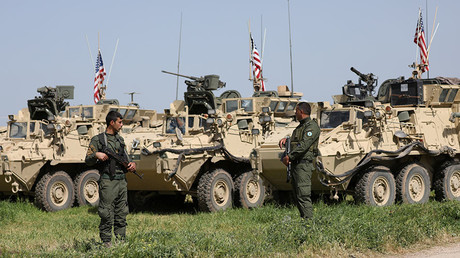
Kurdish fighters from the People's Protection Units (YPG) stand near U.S military vehicles in the town of Darbasiya next to the Turkish border, Syria April 29, 2017. © Reuters

In May, the US Department of Defense confirmed the delivery of heavier weapons to US-allied Kurdish fighters which the US believes are needed to outmaneuver the Syrian government and retake the city of Raqqa from IS.

“We will definitely not remain silent and unresponsive to the support and arming of terror organizations next to our borders and the forming of terror havens in the region,” Erdogan warned Saturday at the conclusion of the G20 in Germany, Turkish Radio and Television Corporation quoted.

The Turkish government has urged the US to reverse its decision to broaden support for Syria’s Kurdish-led Syrian Democratic Forces (YPG), stating that it is unacceptable for a NATO ally to support “terrorist groups.”

Ankara perceives the YPG as terrorists allied with the Kurdistan Workers’ Party (PKK), a militant movement whichTurkey has been battling for three decades. And while Washington agrees with Ankara’s designation of the PKK as a terrorist organization, the US rejects the idea that Kurdish forces in Syria or Iraq should be equated with the PKK.

Read more

Damaged vehicles that belonged to Kurdish fighters from the People's Protection Units (YPG) are transported from their headquarters after it was hit by Turkish airstrikes in Mount Karachok near Malikiya, Syria April 25, 2017. © Rodi Said

Turkey also feels threatened by the Kurds in Iraq, especially after the US pumped millions of dollars into the Iraqi army which relies heavily on Kurdish Peshmerga fighters.

Last month Iraq’s Kurdish region announced that they will hold an independence referendum in September. Erdogan spoke out against the move, fearing that it might produce a domino effect leading to Kurdish-controlled autonomous areas (cantons) in northern Syria to declare independence as well.

“We do not support the idea of a divided Iraq, and a referendum would hurt the peace and stability in the country,” Erdogan said in Hamburg. “If division starts in the north, it would extend to Turkmens, Arabs and there can even be a sectarian-based division between Shias and Sunnis.”

Erdogan emphasized that Turkey will not allow a Kurdish state to be established in northern Syria. However, despite repeated reports that the Kurds in Syria want to create their own state, there’s been no official moves to suggest that an independence declaration is imminent.

Ceasefire deal brokered by Russia & US enters into force in southwest Syria

July 9, 2017

Source: Ceasefire deal brokered by Russia & US enters into force in southwest Syria — RT News

© Alaa Al-Faqir / Reuters


A major ceasefire deal agreed upon earlier by Russia, the United States, and Jordan has taken effect in the southwestern part of Syria. The truce to end hostilities and deliver aid to war-torn areas will be enforced by the three countries’ militaries.

The ceasefire and de-escalation agreement negotiated by Russia, the US, and Jordan on Friday took effect across southwest Syria on Sunday at noon Damascus time (09:00 GMT).

Read more

FILE PHOTO A general view shows damaged buildings in a rebel-held part of the southern city of Deraa, Syria © laa Al-Faqir

The truce extends to Syrian government forces and rebel groups in the provinces of Daraa, Quneitra, and Suwayda.

Commenting on the issue, Russian Foreign Minister Sergey Lavrov said that Russian, American, and Jordanian experts had worked out the details of the truce, which says the US and Russia bear shared responsibility in ensuring that the ceasefire is respected by all parties, the minister said.

Lavrov added that the ceasefire is aimed at getting aid deliveries through to war-ravaged areas and arranging contacts with opposition groups. A monitoring center in Amman, Jordan’s capital, will oversee the truce.

President Vladimir Putin, who discussed the issue with his US counterpart, Donald Trump, at the G20 summit in Hamburg, called the ceasefire agreement “a breakthrough, to a certain extent,” noting that the deal was made possible by Washington’s “more pragmatic stance” on working with Russia.

While little is known about how the truce will play out on the ground, it is understood that Russian, American, and Jordanian forces will be deployed to the area to stabilize the situation.

“In the first stage, Russian military police, as well as the Americans and the Jordanians, will ensure security around this de-escalation zone covered by the ceasefire,” Lavrov explained.

Russia’s foreign minister stressed that the ceasefire agreement clearly states that “Russia, Jordan, and the United States are committed to Syrian sovereignty and territorial integrity, as well as UN Security Council resolutions that pave the way to political reconciliation.”

Read more

© Stanislav Filippov

The United Nations, in turn, has stated that it appreciates the international effort being made to bring lasting peace to this part of Syria.

“This is a step in the right direction,” UN Deputy Special Envoy for Syria Ramzy Ezzeldin Ramzy told reporters in Damascus, as cited by Reuters.

“All of this leads to supporting the political process,” he added.

Moscow has also engaged neighboring Turkey and Iran to push for the creation of safe zones in other Syrian provinces. The three countries adopted a memorandum on the creation of four security zones in Syria during peace talks in Kazakhstan’s capital, Astana, in early May.

Extremist groups, including Islamic State (IS, formerly ISIS/ISIL) and Jabhat al-Nusra (Al-Nusra Front), will be separated from the ‘moderate’ opposition in security zones set up in the cities of Idlib, Latakia, and Homs, as well as parts of Aleppo. Under the memorandum, all hostilities between government forces and the armed opposition should cease within the safe zones.

Checkpoints and observation posts will be installed along the de-escalation lines within the safe zones, which should provide free movement for unarmed civilians and humanitarian access to areas under the control of the guarantor states.

“The fact that the United States and the Russians have agreed on the ceasefire will make it more possible to be implemented,” Professor Seyed Mohammad Marandi of the University of Tehran told RT.

“The Iranians, the Syrians and the Russians believe that the more peace there is in Syria, the more pressure will be on the extremists to end the war, because ordinary people will see their lives back to some sort of normality,” he said.

It’s True: Liberals Hate Western Civilization

July 9, 2017

It’s True: Liberals Hate Western Civilization, Power LineJohn Hinderaker, July 8, 2017

(Stop calling them “Liberals.” They are leftists and probably proud of it. — DM)

President Trump’s superb speech in Poland has been praised by most observers, including Paul. On the Left, however, Trump’s speech has been criticized for its principal virtue, the president’s spirited defense of Western civilization. Here are some of the many such instances.

Amanda Marcotte writes at Salon: “Trump’s alt-right Poland speech: Time to call his white nationalist rhetoric what it is.”

Trump argued that Western (read: white) nations are “the fastest and the greatest community” and the “world has never known anything like our community of nations.” He crowed about how Westerners (read: white people) “write symphonies,” “pursue innovation” and “always seek to explore and discover brand-new frontiers,” as if these were unique qualities to white-dominated nations, instead of universal truths of the human race across all cultures.

Why, exactly, should we “read white people”? Trump said not a word about race in his speech. While the peoples that developed Western culture were of course predominantly white, Western civilization is not limited to one race. Just ask, say, Thomas Sowell or Yo-Yo Ma. The obsession with race is the Left’s, not Trump’s.

He also portrayed this Western civilization as under assault from forces “from the South or the East” that “threaten over time to undermine these values and to erase the bonds of culture, faith and tradition that make us who we are.”
***
And yet, even though Trump was fairly begging to be labeled a fascist with his speech painting the purity of white civilization as under threat from racialized foreigners….

But wait! Doesn’t the threat from the East come from Russia? And aren’t Russians white? On the Left, facts are always secondary, at best, to the Narrative. Finally, this howler:

Breitbart gushed about how Trump was calling for “protecting our borders” and “preserving Western civilization,” and bizarrely compared the speech to Ronald Reagan’s “tear down this wall” speech, even though the Berlin Wall is the gold standard in the kind of border security and cultural “preservation” that Trump has made his political career calling for.

Great point, Amanda! Just like Trump’s wall on the southern border, the East Germans built the Berlin Wall to keep out the throngs of West Berliners that were trying to get in illegally.

Next, Sarah Wildman at Vox: “Trump’s speech in Poland sounded like an alt-right manifesto.”

In his address, Trump cast the West, including the United States and Europe, on the side of “civilization.” With an undercurrent of bellicosity, he spoke of protecting borders, casting himself as a defender not just of territory but of Western “values.” And, using the phrase he had avoided on his trip to Saudi Arabia, he insisted that in the fight against “radical Islamic terrorism,” the West “will prevail.”

Is this what is meant by “alt-right”? I am so old, I can remember when 95% of Americans would have thought that such propositions verged on the self-evident.

Common Dreams (“Breaking News & Views For the Progressive Community”): “‘Disturbing’ Undertones Detected in Trump’s Bizarre Poland Speech.”

Honing in on Trump’s repeated emphasis on “the will” and his declaration that “our civilization will triumph,” many made connections between the speech and an infamous 1935 Nazi propaganda film titled “Triumph of the Will,” which was directed by Leni Riefenstahl and based on the 1934 Nuremberg Rally.

You can’t make this stuff up.

Peter Beinart in The Atlantic:

In his speech in Poland on Thursday, Donald Trump referred 10 times to “the West” and five times to “our civilization.” His white nationalist supporters will understand exactly what he means. It’s important that other Americans do, too.
***
The West is a racial and religious term. To be considered Western, a country must be largely Christian (preferably Protestant or Catholic) and largely white.

But Israel is pretty universally regarded as Western, and Western values derive largely from Jewish history and culture.

The most shocking sentence in Trump’s speech—perhaps the most shocking sentence in any presidential speech delivered on foreign soil in my lifetime—was his claim that “The fundamental question of our time is whether the West has the will to survive.” … Trump’s sentence only makes sense as a statement of racial and religious paranoia. … A direct line connects Trump’s assault on Barack Obama’s citizenship to his speech in Poland. In Trump and Bannon’s view, America is at its core Western: meaning white and Christian (or at least Judeo-Christian). The implication is that anyone in the United States who is not white and Christian may not truly be American but rather than an imposter and a threat.

Like Trump’s daughter and son-in-law? Beinart’s rant verges on the insane.

Jonathan Capehart in the Washington Post: “Trump’s white-nationalist dog whistles in Warsaw.”

This is the same crowd that brays about the superiority of “Western civilization” and its contributions in the history of the world conveniently ignores (or perhaps is just plain ignorant about) what we’ve adopted from Muslims and the Middle East. Those symphonies Trump says “We write” (ahem) would be real lame without the influence of the Middle East and Muslims. According to Salim al-Hassani, chairman of the Foundation for Science, Technology and Civilization and editor of “1001 Inventions,” which chronicles “the enduring legacy of Muslim civilization,” told CNN years ago that the lute, musical scales and the ancestor of the violin are all part of that legacy.

Carlyn Reichel, former speechwriter for Joe Biden, in Foreign Policy: “Trump Has Reshaped Presidential Rhetoric Into an Unrecognizable Grotesque.”

Like staring into a fun-house mirror, the trappings of an American president delivering a landmark speech abroad were there — certainly there were deliberate echoes of President John F. Kennedy’s historic speech in Berlin — but it was all reshaped into an unrecognizable grotesque.

With each paragraph, strong statements about defending freedom and standing against the forces of oppression were replaced by a narrow vision of the world rooted in an even narrower ideology. For Trump, the boundaries of “civilization” only extend to those who share his definition of “God” and “family” — that is, a Judeo-Christian worldview and power structures that continue to be dominated by white men.

So you can’t celebrate or defend Western civilization without being denounced by liberals as a white nationalist, a fascist, and so on. It is good to know where they stand.

Cartoons and Video of the Day

July 9, 2017

Andrew Klavan via YouTube


H/t Power Line — CNN edition


H/t Vermont Loon Watch


Iran seeking nuclear weapons technology, German intel says

July 9, 2017

Source: Iran seeking nuclear weapons technology, German intel says – Arab-Israeli Conflict – Jerusalem Post

ByBenjamin Weinthal
July 8, 2017 16:32
Tehran spies on ‘declared enemies’ Israel and Jewish institutions in Federal Republic.
Iran missile

 A ballistic missile is launched and tested in an undisclosed location, Iran, March 9, 2016. . (photo credit:REUTERS)

Damning German intelligence reports emerged in June and July revealing the Iranian regime’s continued pursuit of nuclear weapons and missile technology in defiance of international sanctions and UN resolutions.

A federal intelligence report also said that the Islamic Republic targets Jewish and Israeli institutions with espionage.

According to the German state of Hamburg’s intelligence agency: “there is no evidence of an complete about-face in Iran’s atomic polices in 2016” [after the Islamic Republic signed the JCPOA accord with world powers in 2015, designed to curb Iran’s nuclear program in exchange for sanctions relief]. Iran sought missile carrier technology necessary for its rocket program.”

Germany’s federal domestic intelligence agency – the rough equivalent of Shin Bet – said in its report on Tuesday: “The State of Israel, its representatives and supporters as well as members of the Jewish religious community are among the declared enemies of Iran. Even the agreement made between Iran and the Western world to settle the nuclear conflict has not changed this attitude. Therefore, Iranian intelligence-related organizations continue to spy on (pro-)Jewish and Israeli targets in Germany.”

The Hamburg intelligence report cited a case involving federal prosecution of three German citizens for violations of the Federal Republic’s export economic law because the suspects furnished 51 special valves to an Iranian company that can be used for Iran’s sanctioned Arak heavy water reactor. The valves, the report noted, “can be used to develop plutonium for nuclear weapons.” Iran pledged, under the JCPOA deal, to “dismantle the [Arak] facility,” the intelligence officials wrote.

An intelligence report from the southwestern state of Baden-Württemberg stated, “Regardless of the number of national and international sanctions and embargoes, countries like Iran, Pakistan and North Korea are making efforts to optimize corresponding technology.”

According to the Baden-Württemberg report, Iran sought “products and scientific knowhow for the field of developing weapons of mass destruction as well missile technology.” The 181-page document cites Iran’s illicit cyberware, espionage, terrorism and weapons of mass destruction procurement activities 49 times.

A telling example of Iran’s evasion sanctions strategy involved the assistance of a Chinese front company. The intelligence agency wrote that a Chinese import-export company contacted a company in the southern German state that sells “complex metal producing machines.” The Baden-Württemberg report outlined that the technology would aid Iran’s development of ballistic missiles.

Germany’s Federal Office for Economic Affairs and Export Control issued an end-use receipt for the Chinese purchase. Intelligence officials notified the manufacturer that the merchandise was slated to be illegally diverted to Iran. “This case shows that so-called indirect-deliveries across third countries is still Iran’s procurement strategy,” wrote the intelligence officials. Sophisticated engineering and technological companies are situated in Baden-Württemberg and it has long been a target for illicit Iranian procurement efforts.

A third state intelligence report from June said that in the 2016, “German companies located in Rhineland-Palatinate were contacted for illegal procurement attempts by [Pakistan, North Korea and Iran]. The procurement attempts involved goods that were subject to authorization and approval on account of legal export restrictions and UN embargoes. These goods, for example, could be used for a state’s nuclear and missile programs.”

Germany’s national intelligence agency (the Federal Office for the Protection of the Constitution or BfV) did not include Iran’s activities in Baden-Württemberg, Rhineland-Palatinate and Hamburg in its report.

It is unclear why Germany’s federal intelligence document omitted significant data and information on Iran’s continued drive to obtain nuclear weapons technology in the states. German remains Iran’s most important trade partner.

The 339-page federal document wrote that Iran has not stopped its missile and rocket programs: “The amount of evidence found for attempts to acquire proliferation-sensitive material for missile technology/ the missile program, which is not covered by the Joint Comprehensive Plan of Action, remained about the same.”

The report said, however, that there was “significantly less evidence of Iranian attempts to acquire proliferation-sensitive material for its nuclear program. As far as the BfV was able to verify such evidence, it did not reveal any violation of the Joint Comprehensive Plan of Action.”

According to the federal document, “The Russian Federation, the People’s Republic of China and the Islamic Republic of Iran are the major players behind espionage activities that are directed against Germany. Cyberattacks can now also be attributed to presumed government agencies in Iran.”

The second anniversary of the JCPOA will be marked on Friday.


Macron to Putin: ‘We can move to new phase in Russia-France relations’

July 8, 2017

Source: Macron to Putin: ‘We can move to new phase in Russia-France relations’ — RT News

French President Emmanuel Macron (L) and Russian President Vladimir Putin (R) attend a bilateral meeting on the second day of the G20 summit in Hamburg, Germany, July 8, 2017 © Ian Langsdon / Reuters

Russia and France can now move to a new phase in bilateral relations, French President Emmanuel Macron told his Russian counterpart, Vladimir Putin, on the sidelines of the G20 summit in Hamburg, Germany.

“On the subject of bilateral and regional issues, I welcome the quality and the intensity of the work that has been established since [meeting in Versailles in May],” Macron told Putin.

Putin said that Russia continues to implement all the Versailles agreements concerning bilateral relations between Moscow and Paris.

“We are moving towards all directions which we discussed in Versailles,” he said.

Putin and Macron vowed to improve relations and jointly address international problems during their first official meeting in Versailles in May.

The French president admitted at the time, however, that he had “some disagreements” with his Russian counterpart, but said that the two leaders discussed them openly in a “frank exchange of views.”

According to Macron, serious international problems cannot be resolved without Moscow. France is interested in intensifying cooperation with Russia, particularly in resolving the Syrian crisis, he said, adding that this issue demands “an inclusive political solution.”

President Putin welcomed Macron’s statement, saying that Moscow and Paris are determined to cooperate in resolving the crises in Syria, Ukraine and the Korean Peninsula, as well as to fight terrorism together.

Putin: Trump different than on TV, we can restore relations with US

July 8, 2017

Source: Putin: Trump different than on TV, we can restore relations with US — RT News

The Donald Trump seen on television is different from the one in real life, Russian President Vladimir Putin said at the G20 summit, adding that after his meeting with the US leader in Hamburg, he felt like relations between the two countries could at least partially be restored.

As for personal relations, I think that they are established,” Putin said of his Friday meeting with Trump.

The Trump we see on TV is very much different from the real person.

I think that if we continue building our relations like during our conversation yesterday, there are grounds to believe that we’ll be able to – at least partially – restore the level of cooperation that we need,” Putin said.

Putin said that the issue of alleged Russian meddling in the US election was addressed by Trump during their conversation.

Putin reiterated that there is no reason to believe that Russia meddled in the US electoral process in 2016.

He [Trump] asked many questions on that subject. I answered those questions as best I could. I think he took it into consideration and agreed with me, but you should really ask him how he feels about it,” the Russian president said.

Read more

Russia's President Vladimir Putin shakes hands with U.S. President Donald Trump during their bilateral meeting at the G20 summit in Hamburg, Germany July 7, 2017 © Carlos Barria

Regarding cybersecurity, the Russian leader said that he and Trump “agreed that there should never be a situation of uncertainty, especially in the future, in this sphere.”

The US president and I agreed that we’ll create a working group and work together on how to jointly monitor security in cyberspace, how to ensure unconditional compliance with international legal norms, and how to prevent interference in internal affairs of foreign countries,” Putin said.

If we manage to organize this work – and I have no reasons to doubt that – then there will be no more speculation on this topic [of Russia meddling],” he added.

Speaking on the allegations of Moscow’s interference in the affairs of foreign countries, Putin blamed the foreign media for doing exactly that in Russia.

“If you analyze the German, French and European media, in general – they’re the ones who are constantly meddling in our internal affairs. But we feel confident and it doesn’t bother us,” he explained.

The situation in Syria was also addressed during the press conference, with Putin saying the new US administration had a “more pragmatic” stance on the issue.

Read more

FILE PHOTO A general view shows damaged buildings in a rebel-held part of the southern city of Deraa, Syria © laa Al-Faqir

I think the [US] position became more pragmatic. It doesn’t seem to have changed drastically [compared to the Obama administration], but there’s an understanding that we can achieve a lot by joining forces,” he said.

This approach by Washington made possible the agreement on the southern de-escalation zone in Syria, which was “one of the breakthroughs” during Friday’s talks with Trump, the Russian president added.

Putin stressed the importance of the de-escalation zones for maintaining the territorial integrity of the Syrian state after the conflict.

The de-escalations zones “should become a prototype of such territories, which would be able to cooperate with each other and with the official [government in] Damascus,” he explained.

The Russian president addressed comments by US Secretary of State Rex Tillerson and other Washington officials, who insisted that the Syrian conflict would be not be solved while President Bashar Assad remains in power.

Mr Tillerson is a very respected person and the bearer of a Russian order. He has been decorated with the Order of Friendship. We love and respect him. But he’s not a Syrian citizen, after all, and the future of Syria and the political future of President Assad should only be determined by the Syrian people,” he said.

It’s a positive development that Putin and Trump have achieved “some kind of personal chemistry,” Martin Summers, journalist and political commentator, told RT.

Summers added, however, that it is still to be seen if the US president can persuade his administration to start mending ties with Moscow.

“It is to be hoped that it is possible that relations could be improved because obviously they have been in a pretty poor state up to now. I think the problem for the Russian side and for everybody really is how much Trump is in charge of his own administration. Because it is quite clear that the CIA, the Pentagon and so on are often wrong-footing Trump moves. And therefore there is some question about whether he can deliver whatever he discussed with Vladimir Putin,” he said.

Iran is on board new US-Russia truce deal in Syria

July 8, 2017

Iran is on board new US-Russia truce deal in Syria, DEBKAfile, July 8, 2017

The limited deal struck by Trump and Putin provides Israel and Jordan with a partial measure of relief, because Iran will certainly be allowed to complete its military intervention in other parts of Syria in return.

[W]hen the dust settled from the fanfare surrounding it, it began to be realized that the US and Russian presidents had reached very little consent on any issue excepting only the limited Syrian truce.

That too affects only a single limited front on which the US president focused to demonstrate loyalty with US regional allies, Israel and Jordan. But given the ephemeral nature of all former truces agreed between the two powers – and the strategic goals Iran and Hizballah are pressing for in Syria – DEBKAfile’s military sources, expect the fighting in southwestern Syria to flare up pretty soon after the ceasefire goes into effect.


******************************

“The United States, Russia and regional countries reached a ceasefire deal in southwestern Syria,” a US official said on Friday, July 7 after the Presidents Donald Trump and Vladimir Putin ended their hotly-anticipated first encounter in Hamburg. He was referring to Iran and its consent to a ceasefire going into effect Sunday, July 9.

DEBKAfile reports that this was a significant breakthrough in one the most volatile fronts of the six-year Syrian war with direct impact on Israeli and Jordanian security. Our sources reveal that Tehran was persuaded to come on board this limited ceasefire in urgent phone conversations ahead of the summit between Russian Defense Minister Sergey Shoigu and Iran’s National Security Adviser Adm. Shamkhani.

Russia and Iran are the main international backers of Syrian President Bashar Assad while Washington supports some of the rebel groups fighting for his ouster.

Tehran’s consent to giving up the military operations it has been sponsoring along Syria’s borders with Israel and Jordan is no doubt part of a US-Russian tradeoff for Iranian gains on other Syrian fronts which would be of equal or greater value to its interests.

For Iran, the big gain would be its military control of the eastern front along the Syrian-Iraqi border, as the key to opening up its coveted land corridor from Iraq into Syria.

“Still a lot of work to be done,” the US official said

Reporters expected US Secretary of State Rex Tillerson to provide more details of the deal, including how the US and Russia proposed to extend the ceasefire in southwestern Syria to other war fronts.

The limited deal struck by Trump and Putin provides Israel and Jordan with a partial measure of relief, because Iran will certainly be allowed to complete its military intervention in other parts of Syria in return.

US Secretary of State Rex Tillerson, who attended the summit along with Russian Foreign Minister Sergey Lavrov, was upbeat:  “I think this is our first indication of the US and Russia being able to work together in Syria, and as a result of that, we had a very lengthy discussion regarding other areas in Syria that we can continue to work together on to de-escalate the areas and the violence.

Tillerson went on to say: “Once we defeat ISIS, we will work together toward a political process that will secure the future of the Syrian people.” He added: “We see no long-term future for Bashar Assad.”

Tillerson also disclosed that Trump confronted Putin, at the start of their meeting, with the allegations of Russian meddling in the 2016 election. The Russian leader flatly denied the charge. However, Secretary Tillerson said that this confrontation should relieve some of the pressure on the president at home.

Regarding the North Korean missile crisis, Tilleson said shortly that the present situation is “unacceptable” but very few options remain. “We are asking North Korea to come to the table, and still calling upon China to act on North Korea.”

The Putin-Trump encounter scheduled for 30 minutes on the sidelines of the G20 summit ran on to two hours, 16 minutes. But when the dust settled from the fanfare surrounding it, it began to be realized that the US and Russian presidents had reached very little consent on any issue excepting only the limited Syrian truce.

That too affects only a single limited front on which the US president focused to demonstrate loyalty with US regional allies, Israel and Jordan. But given the ephemeral nature of all former truces agreed between the two powers – and the strategic goals Iran and Hizballah are pressing for in Syria – DEBKAfile’s military sources, expect the fighting in southwestern Syria to flare up pretty soon after the ceasefire goes into effect..

The Greatest Hostage Rescue in History -The Raid on Entebe – YouTube

July 8, 2017


Stephen Cohen on Tucker Carlson Praises Trump-Putin Meeting as Most Important Summit since World War II

July 8, 2017

Stephen Cohen on Tucker Carlson Praises Trump-Putin Meeting as Most Important Summit since World War II, American ThinkerPeter Barry Chowka, July 8, 2017

Tucker Carlson: Professor, the first thing you notice is just how much the press is rooting for this meeting between our president and the Russian president to fail. Why would they want it to fail?

Stephen Cohen: It’s a kind of pornography. Just as there is no love in pornography, there is no national interest in this bashing of Trump and Putin. As a historian, let me tell you the headline I would write instead, about what we witnessed today in Hamburg. “Potentially New Historic Detente Anti-Cold War Partnership Begun by Trump and Putin but Meanwhile Attempts to Sabotage It Escalate.”

I think what we saw today was potentially the most fateful meeting between an American and Russian president since the war time [WW II]. The reason is, is that the relationship with Russia is so dangerous and yet we have a president who might have been crippled or cowed by these Russiagate attacks on him, and yet he was not. He was, I think, politically courageous. It went well. They did important things. And this will be astonishing to be said, I know, but I think maybe today we witnessed President Trump emerging as an American statesman. I think it was a very good day for everybody.

***************************

A familiar feature of Tucker Carlson’s nightly prime time Fox News channel program is for Carlson to debate – and usually one-up – a representative of the political left. On occasion, he has welcomed a liberal who seems to agree with or at least to buttress his own conservative position.  One such guest, who has been on the program a number of times in recent months, is Stephen F. Cohen, Ph.D., an American scholar and professor emeritus of Russian studies at Princeton University and New York University. Cohen, 78, is an unabashed liberal. He is a contributing editor to The Nationaccording to Wikipedia “the most widely read weekly journal of liberal/progressive political and cultural news, opinion, and analysis.” Since 1988, Cohen has been married to Katrina vanden Heuvel, the longtime, reliably left-of-center editor of The Nation.

On the occasion of President Trump’s first one-on-one meeting with Russian President Vladimir Putin in Hamburg on July 7, Carlson welcomed Cohen as the second guest on his program the same evening. Cohen is “an actual expert on the subject and a Russian speaker,” Carlson noted in his introduction. In the 4½ minute long segment, the experienced and independent-minded Cohen shredded many of the arguments put forward by the “resist” commentators and academics who were quick to dump on the Trump-Putin meeting as they have similarly jumped on the unproven Russia-Trump-collusion bandwagon since it took off last fall.

The video of the Carlson show segment with Cohen is highly recommended viewing.


Some excerpts:

Tucker Carlson: Professor, the first thing you notice is just how much the press is rooting for this meeting between our president and the Russian president to fail. Why would they want it to fail?

Stephen Cohen: It’s a kind of pornography. Just as there is no love in pornography, there is no national interest in this bashing of Trump and Putin. As a historian, let me tell you the headline I would write instead, about what we witnessed today in Hamburg. “Potentially New Historic Detente Anti-Cold War Partnership Begun by Trump and Putin but Meanwhile Attempts to Sabotage It Escalate.”

You said I was an expert. I actually do have one expertise. I’ve seen a lot of summits, as we call meetings between American and Russian presidents. I was present at some, and even participated in the first George Bush’s summit preparation. When he met with Gorbachev, he invited me to Camp David to debate before his team.

In that context, I think what we saw today was potentially the most fateful meeting between an American and Russian president since the war time [WW II]. The reason is, is that the relationship with Russia is so dangerous and yet we have a president who might have been crippled or cowed by these Russiagate attacks on him, and yet he was not. He was, I think, politically courageous. It went well. They did important things. And this will be astonishing to be said, I know, but I think maybe today we witnessed President Trump emerging as an American statesman. I think it was a very good day for everybody.

In reply to Carlson’s follow-up question, Cohen noted:

You’ve got three major actors being demonized in America: one is of course Putin, second is Trump, but then the leader of Syria, President Assad, is demonized here.

Cohen went on to cite the major achievement of the Trump-Putin summit:

They formed an alliance and that means that we will side for now with Russia with Assad. That will be assailed in Washington because he’s [Assad] loathed in Washington almost as much as Trump and Putin.

Why is Assad so loathed, Carlson asked.

Cohen: When the Syrian civil war began five or six years ago, there were a lot of dirty hands in that mix, including American ones. Everybody was arming somebody. So we have a monstrous war going on there with so many groups being armed by so many different states. The thing about Assad for me has always been – and maybe this is parochial – but he has been the protector of the Jews, of the Christians, and of the non-Jihadist Islamic population in Syria – at a time when the main threat there, the Islamic State, ISIS, chops off the heads of these people. It seems to me that we should stick with Assad until we defeat these people [ISIS].

Cohen wrapped up his interview with these comments:

Focus if you will [on] something that both Trump and Putin said today. They said we are meeting, we have agreed, and we promise positive things to come. In other words, they have formed a political partnership and now it goes forward. But it will be viciously attacked and already is if you look at the press today here.

When I set out to write this article, I didn’t intend to transcribe and quote so much of the Carlson-Cohen interaction. But once I got started, it was hard to know when to stop. Cohen, in my opinion, illustrates his impressive intellect and communications skills by filling the entire time given to him – only about 3½ minutes total when Carlson’s three questions are subtracted – with eminently quotable comments.