Archive for June 2017

A nuclear trip wire for North Korea

June 29, 2017

A nuclear trip wire for North Korea, Washington TimesDaniel Gallington, June 28, 2017

(Don’t pussyfoot around. — DM)

Illustration on locking down North Korea’s nuclear weapons threat by Linas Garsys/The Washington Times

ANALYSIS/OPINION:

Now that North Korea has a bunch of nukes and is testing ways to deliver them by ballistic missile, we need to address the stark realities of what this new threat really means for us.

And just as important — what it should mean for them.

However, before we begin, it should now be a reality for us that negotiations with fat boy Kim Jong-un’s regime are a total waste of our time, energy and money, just as they were with his stroked-out father’s crew.

Politically, of course, this result was the collective failure of our State Department, the Clinton, Bush and Obama administrations, together with the defective concept of the “Six Party Talks.” The only “accomplishment” was to provide the time and diplomatic cover for the Democratic People’s Republic of Korea’s nuke program, plus give the regime lots of oil and money in the process. In short, the Six Party Talks enabled North Korea’s nuke weapons program. If this sounds familiar, Barack Obama and John Kerry made the same mistakes with Iran.

So, North Korea is now a dangerous nuclear rookie and we must develop — and articulate — policies that reflect, in the words of Defense Secretary James Mattis, the “clear and present danger” they represent.

What should our new policies look like? What should be the “red lines,” and what North Korean behaviors should cause virtually automatic responses from us? As this is a whole new ball game, what should be the thresholds for our responses and what should we be telling the Russians and Chinese about it?

This because nothing we do in response to North Korean aggressive behaviors should come as a surprise to anyone.

It also seems clear we need both short- and longer-term strategies. Along with this approach, we should rule out a number of troublesome scenarios for possible armed conflicts with North Korea — in other words, let’s also define those situations in which we simply will not “play.”

Shorter-term strategies: The short term is, for a number of reasons, the most dangerous. This is because it’s the nuclear muscle-flexing stage for the fat boy and also the period he is most likely to make a mistake or do something dumb. For this same reason, it’s also the period when our responses should be in the virtually “automatic” mode, including pre-emptive strikes.

While there are a number of scenarios that should be addressed, there are a few that deserve special attention. In this category should be a pre-planned nuclear response option for each North Korean action:

• Preparations for a massive artillery attack on Seoul.

• Massing troops at the border.

• Interception of ocean or coastal traffic.

• Interception of aviation.

• Launch of any ballistic missile with an aggressive trajectory.

Longer-term strategies: These should be developed with urgency, but on a different track from the shorter-term ones. In this category should be:

• Discussions with the Japanese for a cooperative nuclear relationship.

• Re-positioning nuclear assets — and nuclear-capable assets — to and around the Korean peninsula.

• Excluding North Korea from any relevant diplomatic discussions; maximizing all types of sanctions — in the U.N. and domestically; terminating any remaining Six Party benefits.

• Working trade embargoes; interceptions of suspicious commerce; very aggressive information operations.

Defining when we won’t “play”: This category is as important as the other two — maybe more so, because it is the essence of deterring the fat boy from doing something stupid. Here are some things we won’t do in context of any conflict or confrontation with the North:

• A land war on the Korean peninsula — been there, done that.

• A build-up of our conventional forces in the region in response to North Korean aggressive behaviors — gradualism does not work.

• Any kind of negotiations with the North — they have given up this option.

Combined, these strategies are intended to have a simple “message” for the North Korean regime: We have defined the limits of your behavior. If you cross the lines, our response will be quick — and pre-emptive if we decide you are about to do something dumb. The response will be nuclear if that is appropriate for the risk you present to us — and in that event, you will cease to exist as a political entity.

Perhaps as important as promulgating these strategies is that they be articulated publicly and fully briefed to our allies and enemies alike.

A useful analogy: During the Cold War, we had a SIOP — a Single Integrated Operational Plan — that included a targeting doctrine (promulgated during the Carter administration) that focused on the top Soviet leadership. My personal experience during the ‘80s was that the leadership-targeting aspect of the SIOP got the attention of the Soviets, along with President Reagan’s Strategic Defense Initiative.

Will the fat boy behave differently if we promulgate the strategies described above? That’s his choice, of course, but if he doesn’t, he should realize that the slightest miscalculation on his part, let alone a dangerous overt act, could cause the end of him and his regime. In short, he has no margin for error — nor do we — and it should surprise no one.

• Daniel Gallington served through 11 rounds of bilateral negotiations in Geneva as a member of the U.S. Delegation to the Nuclear and Space Talks with the former Soviet Union.
Nikki Haley’s Comments on Iran Highlight Russian-Related Complications

June 29, 2017

Nikki Haley’s Comments on Iran Highlight Russian-Related Complications, Iran News Update, Edward Carney, June 29, 2017

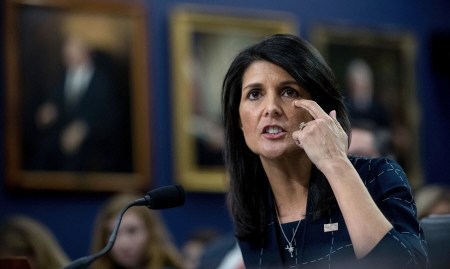
On Tuesday, Nikki Haley, the US ambassador to the United Nations delivered testimony to the House panel on foreign operations, a subcommittee of the Appropriations Committee in the US House of Representatives. In that testimony, Haley addressed multiple issues relating to the Islamic Republic of Iran, thereby reasserting the Trump administration’s assertive policies toward the Iranian regime. By most accounts those policies are still emerging, but they have already come to include purposive outreach to other adversaries of the Islamic Republic and a program of expanded sanctions on matters such as Iran’s ballistic missile program.

However, those efforts to confront and contain the Islamic Republic are arguably complicated by other aspects of the Trump administration’s policy commitments, including a focus on domestic issues and an effort to improve relations between the US and Russia, which boasts close relations with Iran in the areas of trade and military cooperation, especially as it relates to the Syrian Civil War.

While the US supports moderate rebel groups fighting against the dictatorship of Bashar al-Assad, the Iranians and Russians have been credited with turning the war in favor of Assad. Various Shiite militias are currently operating as proxies for Iran in that war, and the Iranian Revolutionary Guard Corps is increasingly playing a direct role in the conflict. Meanwhile, Russia has been providing air support for pro-Assad ground operations since 2015.

Western commentators, including officials in the Trump administration, have variously accused Russia and Iran of ignoring or actively facilitating human rights abuses by the Assad regime, including an April chemical weapons attack that killed at least 80 people in a rebel-controlled civilian area.

As the Associated Press points out, Ambassador Haley’s comments to the House panel came shortly after the White House had issued a warning to Syria regarding alleged preparations for another such chemical attack. The article specified that Pentagon officials had confirmed the intelligence underlying that warning, involving particular movements at the same Syrian air base that had been used as the staging area for the previous chemical attack on Khan Sheikhoun.

White House Press Secretary Sean Spicer said of Assad that “he and his military will pay a heavy price” if they follow through with apparent plans for another “mass murder attack using chemical weapons.” But the AP quoted Haley as saying that the administration’s remarks were not intended only for Assad, but also for Russia and Iran. Both of the Syrian allies joined in denying Assad’s responsibility for the attacks, with some officials insisting that the chemical weapons had originated in a rebel warehouse at the site of a conventional military airstrike.

The dispute over this issue and the subsequent US cruise missile strike on Shayrat air base can be seen as early examples of the escalation between Iranian allies and adversaries which is still going on to this day. In fact, Haley’s effort to fold Russia and Iran into a warning directed more explicitly against Syria is reminiscent of an incident earlier in June wherein a member of Iran’s Revolutionary Guard said that a ballistic missile strike on eastern Syria had been intended largely as a warning to the US and Saudi Arabia.

Those two traditional adversaries of the Islamic Republic have been expanding relations under the Trump administration, sometimes with explicit reference to shared anxieties over expanding Iranian influence and meddling in the broader Middle East. President Trump’s visit to Riyadh in May for an Arab-US summit coincided with the signing of trade agreements that included 110 billion dollars in arms sales to the Arab Kingdom.

But at the same time that the White House is openly siding with Saudi Arabia and its regional allies against the Iranian regime, it does not appear to be giving up on the prospect of improved relations with Russia. In fact, the Western strategy for a political solution to the Syrian Civil War seems to presently involve the expectation that Russia can be encouraged to rein in the Islamic Republic and prevent it from further sabotaging ceasefire agreements.

Recent developments have cast doubt upon the practicality of this strategy however. As the US has taken a more direct role in defending rebel groups, even resorting to the shoot-down of at least two military controlled drones and a Syrian warplane, Russia has responded by threatening to target US aircraft and to halt the use of a hotline intended to prevent mid-air collisions between the multiple powers operating in the skies over Syria.

Haley’s comments on Tuesday were indicative of a roughly matching increase in American criticism of Russia. And this criticism was not limited to the issue of chemical weapons. Haley also explained that Russia’s position on the UN Security Council allowed it to stymie US efforts to sanctions Iran and hold it to account for ongoing misbehavior in matters including the development of the Iranian nuclear program.

“[The Iranians are] going to continue their nuclear capabilities and we just gave them a lot of money to do it with,” Haley said, referring to the 2015 nuclear agreement that President Trump has described as “the worst deal ever negotiated.” She went on to highlight concerns about Iran’s sponsorship of terrorism, suggesting that nuclear weapons could find their way into the hands of terrorist groups at some point in the future, and that Russia would effectively prevent the US and its allies from doing anything to stop this.

“Yes, we would love to sanction Iran; and, yes we will continue to be loud about it; and, yes, Russia will veto it,” Haley said, according to the Washington Examiner.

But this is not to say that the Trump administration has positively brought an end to its strategy of attempting to improve relations with Russia. In fact, various reports suggest that this endeavor is even standing in the way of congressional legislation aimed at increasing national-level sanctions on both Iran and Russia. The Countering Iran’s Destabilizing Activities Act passed the Senate two weeks ago by a margin of 98 to 2, but it was subsequently stalled in the House on procedural grounds, leading Democrats to argue that the House Republican leadership was trying to protect the president’s Russian agenda.

The prospects for resolution appeared to grow dimmer on Tuesday when the Washington Post reported that energy lobbyists were urging lawmakers to reevaluate the bill on the grounds that its restrictions on doing business with Russian companies could have a punishing effect on American firms and foreign firms doing business in the US. These objections could bolster the prospects of the House leadership sending the bill to various committees for review and markup – a process that could delay a final vote by months.

As it concerns Iran, the bill would include sanctions on Iran’s ballistic missile activities and also extend all terrorism-related sanctions to the Revolutionary Guard Corps, for which Trump has urged designation as a foreign terrorist organization. This position has not changed, and it seems that neither has the Trump administration’s hardline approach to Iran policy. Some have suggested that the emerging policy is pointing in the direction of regime change, though this has not become a declared position as yet.

The Washington Examiner pointed out that one member of the House panel on foreign operations, Republican Representative Hal Rogers, had directly raised the prospect of regime change on Tuesday, asking Nikki Haley whether it is an option. The ambassador’s only response was “I don’t know.”

This coming Saturday, the National Council of Resistance of Iran will hold its annual Free Iran rally, which will include explicit calls for regime change driven by a domestic opposition movement within the Islamic Republic. The event is expected to be attended by tens of thousands of Iranian expatriates, plus hundreds of policymakers and experts from the US, Europe, and throughout the world. Notably, these dignitaries will include figures with close ties to the Trump administration, such as John Bolton, who served the second Bush administration in the position now occupied by Haley.

Obama-appointed judges dismiss Supreme Court ruling, continue blocking Trump’s immigration crackdown

June 29, 2017

Obama-appointed judges dismiss Supreme Court ruling, continue blocking Trump’s immigration crackdown, Washington TimesStephen Dinan, June 28, 2017

President Trump met Wednesday with what the White House identified as “immigration crime victims” to urge passage of House legislation. (Associated Press)

President Trump may have won a partial victory at the Supreme Court this week, but other federal judges remain major stumbling blocks to his aggressive immigration plans, with courts from California to Michigan and Atlanta limiting his crackdown on sanctuary cities and stopping him from deporting illegal immigrants he has targeted for removal.

The judges in those deportation cases have rejected Mr. Trump’s argument that he has wide latitude to decide who gets kicked out, without having to worry about district courts second-guessing him on facts of the case.

Instead, the judges said, they get to decide their jurisdiction, and that extends to reviewing Mr. Trump’s immigration policy.

One judge in Michigan ordered the Homeland Security Department to freeze all deportation plans for about 200 Chaldean Christians arrested over the past two months and scheduled to be sent back to Iraq. Nearly every one of them has a criminal record.

A judge in Atlanta ordered the department to reinstate the temporary deportation amnesty — known in governmentspeak as the DACA program — for Jessica Colotl, an illegal immigrant Dreamer whose past made her a target for deportation, officials said.

“The public has an interest in government agencies being required to comply with their own written guidelines instead of engaging in arbitrary decision-making,” said Judge Mark H. Cohen, breaking new ground in establishing legal rights for some illegal immigrants.

On Tuesday, a federal judge in California ordered the Border Patrol to improve its treatment of illegal immigrant children caught sneaking across the border. She said she was troubled by stories from illegal immigrants who said they were kept in dirty rooms without private toilets and sometimes had to wait up to 12 hours for their first meals.

When they were fed, it wasn’t enough, concluded Judge Dolly M. Gee.

Judge Gee ruled that the Border Patrol must provide the children with soap, toothbrushes and toothpaste, and access to showers.

Notably, all four of the judges — including one in San Francisco who blocked part of Mr. Trump’s executive order against sanctuary cities — were appointed to the bench by President Obama.

“Almost all of the judges are acting outside of established law,” said Hans von Spakovsky, a senior legal fellow at The Heritage Foundation who served as a Justice Department lawyer in the Bush administration.

For David Leopold, a former president of the American Immigration Lawyers Association, the judges are heroes upholding the Constitution when the political branches of government won’t.

“You’ve got the Republicans playing ball in the Senate and the House. The only institution that’s putting a check on this guy is the judiciary,” he said.

The Trump administration is fighting all the rulings but has had little luck convincing lower-court judges of Mr. Trump’s powers on immigration.

Mr. Trump, though, has had success at the Supreme Court, which issued a 9-0 decision this week reviving part of his travel ban executive order, which imposes a 90-day pause on some visitors from six majority-Muslim countries and a 120-day halt to all refugee admissions.

Reversing several lower-court rulings — all also issued by judges appointed by Democrats — the Supreme Court said Mr. Trump could stop refugees and visitors when they don’t already have “bona fide” close connections to people or entities in the U.S. For those who do have close connections, however, they have rights that must be respected.

Homeland Security is working out how it will interpret those directives, but analysts are deeply divided on what it means and whether the justices delivered a message to lower courts to back off their criticism of Mr. Trump.

Where lower-court judges pored over Mr. Trump’s campaign statements and perused his Twitter account looking for evidence to use against him, the Supreme Court took the president’s executive order at face value.

“The Supreme Court treated this like a normal case, like a normal executive action. So certainly this has to affect — probably not all judges, but certainly some,” said Ilya Shapiro, editor-in-chief of the Cato Institute’s Supreme Court Review.

He said that could set the stage for a return to the posture of the Obama years, when many of his actions were challenged in court but were greeted with seriousness by the judges who heard the cases — what legal scholars have come to call the “presumption of regularity.”

“I don’t think we’re there yet,” Mr. Shapiro said. “The [president’s] constant tweets — not just about immigration but lots of things — feed the fire of the resistance.”

Mr. von Spakovsky called the Supreme Court ruling “a slap in the face” to the judges who ruled against the broad swath of the president’s immigration plans.

“These judges are clearly hoping these cases don’t get appealed, don’t get to the Supreme Court, because if they do, they’re going to get overturned,” he predicted. “The lesson to them is they need to quit making political decisions based on the fact they don’t like the president and his policy, and start making legal decisions that follow binding precedent.”

Some analysts said the key part of the Supreme Court’s ruling was showing deference to the president’s national security decision-making. The justices said his judgment had to carry weight, particularly when it came to people who don’t have a connection to the U.S. and therefore don’t have constitutional rights to be weighed.

The court will hear broader arguments in the travel ban case in October.

Mr. Leopold said he initially saw the ruling as a loss for immigrant rights advocates, but after rereading it he concluded it’s a major win for his side and a slap at Mr. Trump.

“This is a rebuke,” he said. “They weren’t harsh in their words. It was very professional … But if you read between the lines, they basically say, ‘No, no, we’re not going to defer to you on national security here.’”

He also said the ruling is much more limited in empowering Mr. Trump than it might seem and that few people will be snared by the part of the executive order that the court revived, targeting those without close connections to the U.S.

But on Wednesday evening, the State Department issued a new set of visa guidelines to U.S. embassies on the six affected countries that was much narrower than immigration advocates might have hoped.

Refugee agencies argue that most refugees already in the pipeline have close connections because their names have already been forwarded for placement in the U.S. Immigrant rights advocates said anyone with a job offer, a relative living in the U.S. or who are part of a school program will also be exempted.

Advocacy groups said earlier Wednesday that if they thought the president was being too stingy, they would head back to the courts and likely the same lower-court judges who first ruled against Mr. Trump.

Mr. Leopold said that, far from being chastened, those judges will now feel emboldened by the Supreme Court.

“I think it stiffens the spine because they’re looking at this and they’re basically being upheld on the injunction,” he said. “Those judges have not been overruled.”

Hamas’ Catch-22

June 29, 2017

Hamas’ Catch-22, Israel Hayom, Prof. Eyal Zisser, June 29, 2017

The dilemma facing Israel, and perhaps Egypt as well, is whether to tighten the noose around Hamas’ neck or, conversely, turn on the power and ease the pressure in an effort to sidestep entanglement in Abbas’ own grudge match with Hamas. Abbas, for his part, is trying to kill three birds with one stone: Hamas, Dahlan, and Israel — trying to embarrass the latter by making it the focus of international criticism. Water and electricity are one thing; visas abroad for Haniyeh and his cohort another thing altogether.

**********************

The voices rising from Gaza are not of war and certainly not of triumph, but of distress. It has been 10 years since its people took Gaza by force, and Hamas is not only looking at a dead end, but a Catch-22. Even as Qatar, its primary benefactor, is under a diplomatic barrage from its neighbors; the cries of despair are still emanating from Gaza, where residents are paying the price for Hamas’ isolation in the Arab world.

These are no longer the days of Muslim Brotherhood rule in Egypt, when Turkey and Qatar did as they pleased across the Arab world, and when Hamas leaders freely globe-trotted from capital to capital. Now, Hamas leader Ismail Haniyeh is caged in; forced to wait until his Egyptian guard feels like letting him out.

Cairo has its own grudge against Hamas. It wants to see action first and foremost, such as the buffer zone being built along Gaza’s border with Egypt, intended to prevent terrorists from Islamic State’s Sinai branch from finding shelter inside Gaza under Hamas’ blind eye.

Thus, bereft of outside support and facing boiling distress at home, the Strip is convulsing from one crisis to the next. With so many people struggling to keep their heads barely above water (in the dark no less), Hamas is now even willing to consider waiving a white flag and handing over the keys to Mohammed Dahlan — Palestinian Authority President Mahmoud Abbas’ detested political rival — who could very well be the only one capable of turning things around in Gaza.

Hamas hopes that Dahlan will suffice with the symbolic and powerless position of prime minister. But Dahlan is not a child, and with backing from Egyptian President Abdel-Fattah el-Sissi — and perhaps with a wink and a nod from Israel, as well — he can pull the rug out from under Hamas.

The dilemma facing Israel, and perhaps Egypt as well, is whether to tighten the noose around Hamas’ neck or, conversely, turn on the power and ease the pressure in an effort to sidestep entanglement in Abbas’ own grudge match with Hamas. Abbas, for his part, is trying to kill three birds with one stone: Hamas, Dahlan, and Israel — trying to embarrass the latter by making it the focus of international criticism. Water and electricity are one thing; visas abroad for Haniyeh and his cohort another thing altogether.

Humor | Coast Guard intercepts millennial migrant vessel trying to flee to Cuba

June 29, 2017

Coast Guard intercepts millennial migrant vessel trying to flee to Cuba, Duffel Blog, June 29, 2017

MIAMI — A month after a report regarding the Coast Guard seeing a decrease in Cuban migration, a U.S. Coast Guard crew and surrounded a group of American millennial migrants off Sands Key, Florida Thursday afternoon.

A Coast Guard helicopter was over the water as the crew of the vessel was seen trying to get cell phone reception about two miles away from the island around 2 p.m. About seven men and two women were seen on the boat which was described as a makeshift outboard with a “Vote for Bernie” and “War is Terrorism” bumper sticker on the hull. The group was trying to reach Cuba when they were intercepted by a U.S. Coast Guard cutter and a U.S. Customs & Border Protection vessel.

“We immediately launched two Coast Guard small boats off our vessel, along with our law enforcement partners in the Miami area who responded to the scene,” said Lt. Commander Dave McKim with the U.S. Coast Guard. “They seemed to have been fleeing from what they call an insane dictator running a totalitarian regime.”

Coast Guard officials said at first the group refused to stop but complied after guardsmen told them over a loudspeaker that Arcade Fire was putting out a new album. Once the migrants stopped, officials said they discovered several reusable Whole Foods bags filled with kale chips and kombucha as well as worn copy of High Times.

“They were wearing scarves, Birkenstocks, and all appeared to have dreadlocks. It’s a tough spot. Our men and women displayed tremendous professionalism with these migrants despite the fact they smelt like a drifter tent filled with diarrhea,” said McKim.

Following the incident, U.S. Customs and Border Protection issued a statement:

“U.S. Customs and Border Protection Air and Marine Operations’ agents encountered a non-compliant vessel packed with stinky hippies who were trying to flee to Cuba. Millennial Migrant interdiction agents successfully deployed the Dank Weed Launcher System tool to interdict the vessel.”

Under the Black Hippie Foot policy, the group was brought to the nearest concert festival and set free among their kind, who embraced them with good vibes. The U.S. Coast Guard overheard the group planning a second attempt, saying that their very lives would be at risk when Trump launches his Anti-Liberal Death Squads before going to war with North Korea. Authorities were searching for two more members in the group but apparently refused to step foot on the vessel due to “extreme sea sickness” and “lack of access to quinoa bowls.”

The U.S. Coast Guard says the number of American millennial migrants trying to make it to Cuba has increased, keeping their crews busy.

“We have seen a steady increase in the number of millennial migrants who feel as though their rights are slowly being stripped away. We’ve also seen an increase in a crippling fear of living in Florida,” said McKim.


Why James O’Keefe Is a More Honest Journalist than the MSM

June 29, 2017

Why James O’Keefe Is a More Honest Journalist than the MSM, PJ MediaRoger L. Simon, June 28, 2017

The rap on James O’Keefe — whose latest bombshell caught CNN’s quasi-Marxist star pundit Van Jones with his well-tailored pants down — is that his Project Veritas videos are “unfairly edited.”

I have news for O’Keefe’s critics. All videos (and films) are basically unfairly edited, as Sergei Eisenstein and the early Soviet directors demonstrated a hundred years ago. It’s the nature of the medium. Some things get left out and others put in.

Nevertheless, the video or movie camera is a recording device. On close examination, looked at specifically, the actual photographs and recordings finally don’t lie, juxtapose them how you will. Van Jones did say “Russia is a nothingburger!” The network’s John Bonifield did call CNN’s Russia narrative “bullsh$t” concocted for the money. The repellent lady from Planned Parenthood did offer to sell fetal parts. The equally repellent Democratic Party operatives did instigate violent demonstrations at Trump rallies to make the candidate’s supporters look like thugs. O’Keefe himself did walk back and forth undeterred across the Rio Grande from Mexico to the USA dressed as Osama bin Laden to show the pathetic level of our border security.

I could go on. There are many more, including examples unmasking the shibboleths of voter registration, but the point is obvious. Despite some selective editing (but not any that materially alters the facts) and sometimes overly portentous music (why bother when you have the goods?), what James O’Keefe reports is true. It happened.

Because they so often rely on leaks — no photographs, videos or anything like them, often nothing concrete at all — what the New York Times, Washington Post, CNN and so many others (even the front pages of the Wall Street Journal, alas) report is very often, one is tempted to say most often, either a distortion or an outright lie. This is particularly true when what they are reporting has political relevance — and so much does.

If not the root cause — that’s uncontrolled and unacknowledged bias — this excessive reliance on leaks has seriously exacerbated the precipitous decline of the mainstream media. For much of our media, leaks are an opium-like drug that clouds their thinking and to which they are literally addicted. They are waiting for the phone to ring like the junkie is waiting for his next fix. That the leakers all have motivations of their own, known and/or unknown, yet are able to remain anonymous to the public, makes what they leak almost de facto dubious and unreliable, in fact dangerous (as well as illegal, obviously).

Yet the MSM reporters gobble them up, eager to scoop their competitors and at the same time — much like overweight, self-satisfied picadors — weaken Trump and his administration for the final kill, doing, in their own eyes anyway, good works while advancing their careers.

O’Keefe has revealed them to be fools, remarkably unsophisticated in their response to his revelations. (Jeff Zucker, et al., looked like dimwits walking into the most obvious trap by dismissing Bonifield as a mere “medical” producer with the famous Van Jones already queued up for humiliation.)  At this point, only the most naive believe what the MSM says. CNN is already a joke, but the NYT, WaPo, etc. are not far behind. We are all reading Pravda now.

Ironically, Woodward and Bernstein are responsible for a lot of this. They made a giant success off leaks, turning journalists into culture heroes (really false gods) to be portrayed by Redford and Hoffman in the movies. Generations of aspiring journalists sought to follow in their footsteps — to be these false gods. Only there was no there there. No Nixon to upend. So they turned Trump into the New Nixon and manufactured a crime to go along with it.

W & B also inadvertently encouraged a new kind of leaker that is endemic today. Call him or her the “score settler,” a loathsome character lurking in the bowels of the Deep State or intelligence agencies, a remnant of the previous administration, who thinks his or her reasons for telling a partial, misleading truth are justified, are for the public good, when they are almost invariably only for their own good or some supposed ideological good they wish to impose regardless of the wishes of the voters in a democracy. (These are both often enmeshed.)

This created an extreme, almost pathological, will-to-believe the leakers on the part of the MSM as illustrated by the recent firings (sorry, “resignations”) of three CNN employees in the face of a $100M lawsuit. One of these credulous employees, Eric Lichtblau, was once a Pulitzer Prize winner at the New York Times.

Woodward, to his credit, seems to have recognized how extreme the situation has become. He chided the NYT today, saying, “Fair-mindedness is essential.” His own paper, under Bezos, has become even worse. But never mind. Give him credit for a half-truth. (By the way, CNN’s Jeff Zucker is a working stiff compared to Jeff Bezos. What’s Bezos’ excuse?)

But more importantly — it’s over. Well, if not over, a new, positive rung has been reached. The MSM, as we knew it, is, if not destroyed, seriously wounded.  They are — channeling a phrase from the Vietnam Era — a “pitiful, helpless giant.”  The work begun in 2004 when many of us spoke out against Dan Rather’s deceitful promulgation of the forged Bush National Guard papers on “Sixty Minutes” has, thanks to O’Keefe and others, not to mention the irrationality of the MSM itself, finally reached a critical mass. If only Andrew Breitbart were here to see it.

Celebrate for ten seconds. But as another of the original group, Glenn Reynolds, keeps reminding us — don’t get cocky.

Trump to start implementing travel ban on Thursday

June 28, 2017

Trump to start implementing travel ban on Thursday, Washington ExaminerKelly Cohen, June 28, 2017

The Supreme Court also announced it will hear oral arguments on the case in its October term. (AP Photo/Ted S. Warren, file)

The Department of Homeland of Security will begin partially implementing President Trump’s immigration executive order on Thursday, days after the Supreme Court reversed two lower court rulings that had completely blocked implementation.

DHS spokesman David Lapan told the Washington Examiner implementation will “begin tomorrow and we’ll release additional information then.”

Lapan added that DHS will continue to “work with the Departments of State and Justice on the way forward for implementation of the executive order based on the Supreme Court’s ruling.”

The Supreme Court on Monday lifted most of the lower-court injunctions against Trump’s executive order, which will temporarily ban travel to the United States from six Muslim-majority countries for foreign nationals who lack any “bona fide relationship with any person or entity in the United States.”

The Supreme Court also announced it will hear oral arguments on the case in its October term.

With that decision, the court disregarded lower court rulings that said the order was aimed at excluding people because of their religion, and that the White House didn’t offer enough justification for the order.

Three Supreme Court justices also went further by arguing that the court should have immediately allowed the entire order to take effect.

“I agree with the court that the preliminary injunctions entered in these cases should be stayed, although I would stay them in full,” Justice Clarence Thomas wrote in a dissent that was joined by Justices Samuel Alito and Neil Gorsuch. “The decision whether to stay the injunctions is committed to our discretion … but our discretion must be ‘guided by sound legal principles’.”

Trump EPA to Dump ‘WOTUS’; Frees 247 Million Acres of Farmland

June 28, 2017

Trump EPA to Dump ‘WOTUS’; Frees 247 Million Acres of Farmland, BreitbartChriss W. Street, June 28, 2017

(According to Democrats.org, “We will work to build a stronger rural and agricultural economy. Great! Perhaps they will send President Reject Obama with a small row boat to “navigate” some of the mud puddles and irrigation ditches WOTUS declared “navigable waters.”  — DM)

Ron Sachs/CNP/MediaPunch/IP

American Farm Bureau Foundation warned that a plain-reading of WOTUS meant that federal regulatory control could be asserted over any land surface that had ever experienced rain flow, had been flooded, or had irrigation ditches. Farmers argued that the federal regulatory redefinition could usurp state control of water use for America’s entire 247,417,282 acres used in row-crop cultivation.

************************

The Environmental Protection Agency (EPA) announced Tuesday, to the delight of rural America, that the Trump administration is moving to rescind the Obama era’s “Waters of the United States” (WOTUS) regulatory rule.

WOTUS gave the federal government effective authority over water use on 247 million acres of American farmland.

EPA Administrator Scott Pruitt, together with Secretary of the Army for Civil Works Douglas Lamont, signed a proposed regulatory rescission of WOTUS. As soon as the proposed rule change can be published in the Federal Register, under Docket ID No. EPA-HQ-OW-2017-0203, the public will have a 30-day comment period to “review and revise” the definition of “waters of the United States.”

The EPA took to Twitter at #WOTUS to call its action a significant step to return power to states and provide regulatory certainty to the nation’s farmers and businesses. The EPA added that its decision is consistent with the Executive Order signed by President Trump on February 28, aimed at “Restoring the Rule of Law, Federalism, and Economic Growth by Reviewing the ‘Waters of the United States’ Rule.”

The Obama administration’s WOTUS regulatory expansion cleverly redefined the term “navigable waters” to include “intermittent streams.” Environmental activists hailed the WOTUS’s expansion of federal jurisdiction over land and water use as an essential common-sense-rule to protect water for wildlife and drinking water supplies for 117 million Americans.

But the American Farm Bureau Foundation warned that a plain-reading of WOTUS meant that federal regulatory control could be asserted over any land surface that had ever experienced rain flow, had been flooded, or had irrigation ditches. Farmers argued that the federal regulatory redefinition could usurp state control of water use for America’s entire 247,417,282 acres used in row-crop cultivation.

The basis for federal jurisdiction over “navigable waters” lies in the U.S. Constitution’s Commerce Clause [Article 1, Section 8], which gives the federal government extensive authority to regulate interstate commerce. The U.S. Supreme Court ruled in the landmark case of Gibbons v. Ogden (1824), that federal law has precedence in licensing vessels that moved in and out of U.S. ports.

The Commerce Clause was expanded with the passage of the “Rivers and Harbors Appropriation Act of 1899,” which forbid building any unauthorized obstruction to the nation’s “navigable waters” and gave enforcement powers to the U.S. Army Corps of Engineers.

President Nixon tremendously expanded the Commerce Clause with the passage of the Clean Water Act of 1972, which was supposed to create a national policy that would protect America’s public drinking water supply from contamination.

There currently are 18 federal lawsuits in various U.S. District Courts and about 22 federal appeals court petitions in various districts over WOTUS. The U.S. Court of Appeals for the Sixth Circuit issued a nationwide stay on October 9, 2015 against WOTUS’s enforcement under the Clean Water Act. The case was quickly appealed and the Supreme Court decided to take the case just days before the Trump inauguration Day

California’s U.S. House Majority Leader Kevin McCarthy released the following statement:

The Waters of the U.S. rule was a ridiculous usurpation of power by the EPA—so ridiculous that bipartisan majorities in the House and Senate voted to overturn the rule last year. The federal government has no right to regulate intermittent streams, creeks, and ponds, especially when that water is on private property. The Trump Administration’s decision today to withdraw this rule makes things right by getting Washington out of what it had no right to be involved with in the first place.

Republican Speaker of the House Paul Ryan (R-WI) issued the following statement:

The West has finally won in the battle over the Obama administration’s WOTUS rule. This regulation would have been a disaster for the West and rural communities across the country, giving Washington near-total control over water resources. The livelihoods of American farmers, ranchers, and entrepreneurs were at stake. I applaud the Trump administration for siding with American jobs and rescinding this harmful rule.

Articles In Gulf Press: The Escalation In Gaza – A Result Of Qatar, Iran, Turkey Toying With Lives Of Innocent Palestinians

June 28, 2017

Articles In Gulf Press: The Escalation In Gaza – A Result Of Qatar, Iran, Turkey Toying With Lives Of Innocent Palestinians, MEMRI, June 28, 2017

Following the June 27, 2017 Israeli airstrikes in Gaza in response to the firing of a rocket from Gaza into Israel, articles in the Gulf press attacked Hamas and the countries that support it: Qatar, Iran and Turkey. The articles – published against the backdrop of the inter-Gulf tension and the Boycott imposed on Qatar, chiefly by Saudi Arabia, the UAE, Bahrain and Egypt – blamed Hamas of the firing of the rocket into Israel, and claimed that it was escalating the situation in Gaza on purpose in order to serve the interests of its three patron countries. These countries, said the articles, place innocent Palestinians in danger in order to divert global attention away from the Gulf crisis. 

The following are excerpts from two articles on this topic:   

‘Al-Ittihad’ Editorial: Qatar, Iran, Turkey Use Gaza As Bargaining Chip, Toying With The Lives Of Its Innocent People

Muhammad Al-Hamadi, editor of the UAE daily Al-Ittihad, wrote: “On June 27, without any warning, the Arabs woke up to discover that Gaza had been bombarded. Why? What has happened that we don’t know about? What did the Gazan Palestinians do to find themselves under Israeli fire? Has a third intifada broken out? Has the battle for the liberation of Jerusalem begun?

“In practice, none [of the above] happened. All [that happened was] that those who trade in the Palestinian problem, who are themselves in trouble, remembered an old bargaining chip that they have long been using successfully, [and decided] to use it in the dire circumstances that have befallen their friend Qatar, which serves as their open bank [account]. They thought that [using this bargaining chip] would be a good way to divert the Arabs’ attention away from Qatar and focus it [instead] on Gaza and its residents who are being bombarded with missiles by the Israeli enemy.

“This conduct of Qatar and its allies, in Palestine and elsewhere, is despicable. How disgraceful it is that some are willing to toy with the lives of innocents and with the future of small children in Gaza in order to achieve political aims. For a long time now, some [elements] – chiefly Iran, Qatar and Turkey – have been toying with the Palestinian cause and they were successful, but the cost was high: hundreds and even thousands of innocent Palestinians who have been martyred or wounded and crippled. What was the [Palestinian’s] reward? The reward was a donation drive among Arab and Muslim countries that raised millions. [But only] a handful of riyals and dinars was handed out to the disaster-stricken Palestinians. It is always the case that the [Gazan] people get crumbs, while the rest goes to the loyal partner, Hamas.

“We have said from the beginning of the boycott of Qatar that the game is over, but Qatar apparently isn’t listening. Continuing this transparently [wicked] behavior will no longer avail [it], because the peoples are no longer fooled. If in the past they trusted the propaganda of the ideologically recruited Al-Jazeera channel, which serves certain goals, today the peoples no longer watch Al-Jazeera and are no longer influenced by it and by other Arab or foreign channels. Information has become very accessible, and [cyber]space has opened up in [this] era of new media. Nobody has a monopoly on the facts, and it is no longer possible to deceive the peoples. That is what the Palestinian people discovered on July 27. It discovered that there are those who want to exploit it and drag it into a new confrontation with the Israeli enemy, while those who plan [the confrontation] stay in five-star hotels in Doha and Istanbul and in other capitals that shelter the leaders of the Muslim Brotherhood and of terror.

“Our friends in Gaza informed us that the [Gaza] Strip was not bombarded and that only two Israeli missiles were fired in response to the rocket fired from Gaza into Israel. Everyone knows that Qatar is the one that is ‘bombarded’ and boycotted. Who gains from the firing of the rocket and from the situation in which Gaza is bombarded?”[i]

Saudi Columnist: Qatar, Iran Sponsor Hamas, Which Uses Gazans As Human Shields

Hani Al-Zahiri wrote in the Saudi ‘Okaz daily: “It has been centuries since our region has seen a political gamble as terrible as the Iranian and Qatari regimes’ [current] gamble with the lives and the cause of the Palestinians. These two [regimes] adopted the Muslim Brotherhood’s Hamas organization, and supported it by every means when it staged an uprising against the legal Palestinian leadership [the PA] and took over Gaza, and then turned the innocent residents [of Gaza] into a human shield for the Hamas leadership.

“The state of the Gaza Strip in the face of the Israeli bombardments, which usually come in direct response to Hamas actions, reminds us of  [a situation in which] a man kidnaps a girl and then provokes [the soldiers in] a military base to open fire on him and uses the girl as a human shield. The kidnapper in this case is Hamas and the girl is Gaza and its helpless people. The portly Hamas leaders meet in Doha and Tehran, laugh around tables laden with delicacies and order their young [fighters] to open the gates of Hell to the Palestinians by [shooting] firecrackers – which they call ‘rockets’ – at Israeli [army] posts, so that Gaza will be bombarded and women, children and the elderly will die. Then Hamas [officials] will come out, condemn this on satellite channels, and demand support and funds to rescue the Palestinian people, before going back to their feast, safe and sound. In the meantime the entire world will watch the suffering of an unarmed people that has no means to defend itself.

“Everything that has happened to the Palestinians since Hamas took over them indicates that their second enemy, after Israel, is Qatar and Iran, which are using a tinderbox named Hamas to burn them in order to achieve purely political aims… The question now is why, on the day before yesterday [June 26], Qatar and its allies prompted Hamas to fire on Israeli positions, thus inviting Israel to respond by bombarding Gaza. The answer is clearly that this was a despicable attempt and a new political gamble by the Qatari regime, aimed at easing the noose of the Gulf boycott [of Qatar, a boycott] which prompted calls to sue [this regime] in the international [court] for the black [crime] of supporting terror. Today [Qatar] desperately needs to divert the world’s attention in another direction, even at the expense of the life and blood of a defenseless people… The Qataris and Iranians will exploit the event to utter phrases of pretended sympathy for the Palestinians, but only the people in Gaza know that they are the victims of this pair of plotters [Qatar and Iran].”[ii]

______________________

[i] Al-Ittihad (UAE), June 28, 2017.

[ii] ‘Okaz (Saudi Arabia), June 28, 2017.

Van Jones: Russia is “Nothing burger”– American Pravda: CNN Part 2

June 28, 2017

Van Jones: Russia is “Nothing burger”– American Pravda: CNN Part 2, Project Veritas via Youtube, June 28, 2017