Archive for April 2017

Russia? No, the Pony in the Manure Is the Corruption of our Intelligence Officials

April 2, 2017

Russia? No, the Pony in the Manure Is the Corruption of our Intelligence Officials, American ThinkerClarice Feldman, April 2, 2017

There’s so much in print and online about the House and Senate intelligence committees and Russian “collusion” with Trump that I can’t blame people with real lives to lead who just throw their hands up and garden or go hiking. Some will assume there’s got to be a pony in there somewhere, as Ronald Reagan used to joke about the kid digging through manure. I think there is, but it isn’t that Russia corrupted the 2016 election, it’s that Obama and his closest aides, including some at the highest level in the intelligence community, illegally intercepted one or more Republican candidates’ communications before the election, circulated them widely to their cohorts and then tried to use this information to defeat and later to hamstring Trump when Hillary — to their surprise — lost the election.

I also suspect that the attacks on Flynn have nothing to do with his Russian contacts which he disclosed, but, rather, to misdeeds respecting the Middle East, particularly Iran, the country he observed as Obama’s head of the DIA.

The Surveillance and “Unmasking” of Trump and his Associates 

We learned this week that surveillance of Trump began long before he was the Republican nominee, and that the names in the intercepted communications were “unmasked” — that is, identified by name or context — by someone high up in the intelligence community.

In addition, citizens affiliated with Trump’s team who were unmasked were not associated with any intelligence about Russia or other foreign intelligence, sources confirmed. The initial unmasking led to other surveillance, which led to other private citizens being wrongly unmasked, sources said.

“Unmasking is not unprecedented, but unmasking for political purposes… specifically of Trump transition team members… is highly suspect and questionable,” an intelligence source told Fox News. “Opposition by some in the intelligence agencies who were very connected to the Obama and Clinton teams was strong. After Trump was elected, they decided they were going to ruin his presidency by picking them off one by one.”

Nunes and Surveillance Reports

The best summation of this week’s distraction — respecting chairman of the House intelligence committee, Devin Nunes — is Victor Davis Hanson’s which I urge those of you interested to read in its entirety.

First, the central question remains who leaked what classified information for what reasons; second, since when is it improper or even unwise for an apprehensive intelligence official to bring information of some importance to the chairman of the House Intelligence Committee for external review — in a climate of endemic distrust of all intelligence agencies?[snip] Nunes also said that the surveillance shown to him “was essentially a lot of information on the President-elect and his transition team and what they were doing.” Further, he suggested that the surveillance may have involved high-level Obama officials. When a reporter at Nunes’ second March 22 press conference asked, “Can you rule out the possibility that senior Obama-administration officials were involved in this?” Nunes replied, “No, we cannot.” Ipso facto these are startling disclosures of historical proportions — if true, of an anti-constitutional magnitude comparable to Watergate. Given the stakes, we should expect hysteria to follow, and it has followed. [snip]

Some notion of such intrigue, or rather the former nexus between Congress, the Obama administration, the intelligence agencies, and the monitoring of incoming Trump officials, was inadvertently disclosed recently by former Obama-administration Department of Defense deputy assistant secretary and current MSNBC commentator Evelyn Farkas. In an interview that originally aired on March 2 and that was reported on this week by Fox, Farkas seemed to brag on air about her own efforts scrambling to release information on the incoming Trump team’s purported talks with the Russians. Farkas’s revelation might put into context the eleventh-hour Obama effort to more widely disseminate intelligence findings among officials, one that followed even earlier attempts to broaden access to Obama-administration surveillance.

In any event, the White House invited  the highest ranking  members of the House and Senate intelligence committees to come view the documents themselves. Adam Schiff did, and reported he’d seen what Nunes had, after which he did not deny the intercepted communications contained nothing about Russia or Trump. They clearly were of no national intelligence significance, but rather, as Hanson noted, were evidence that the prior administration was snooping on political adversaries using the apparatus of the state to do so.

We also learned this week that Hillary (despite her uncontested mishandling of classified information when she was Secretary of State), and her aides, including Farkas, were given access to classified information long after she left the Department of State which, with Farkas’ admission on MSNBC, underscores the apparent misuse of intelligence from her end.

FBI Director James Comey and former DNI James Clapper

As for Comey, Hanson notes:

There is no need to rehash the strange political career of FBI director James Comey during the 2016 election. As Andrew McCarthy has noted in his recent NRO analyses, news accounts alleged that Comey’s FBI investigations of supposed contacts between General Michael Flynn and the Russian ambassador were shared with Obama-administration officials — but why and how we are not sure. Comey himself was quick to note that his agency is investigating supposed collusion between Team Trump and Russia, but he refused to comment on whether or not the FBI is investigating possibly inappropriate or illegal intercepts of Trump officials and the surely illegal dissemination of intercepted info through leaks to favorable media.

But there’s much more to be said about him and his “investigation” which seems to be continuing only to cover his own backside.

The FBI was concerned that the ill-secured DNC internet communications were being hacked and sought to examine them. The DNC refused and engaged an outfit called Crowd Strike to do the job. Crowd Strike reported the Russia had likely tapped their server. There’s no explanation of why Crowd Strike was chosen, why the FBI allowed this, and why it apparently relied on that outfit’s findings. Recently Crowd Strike has walked back many of its claims after a VOA report that the company misrepresented data published by an influential British think tank.

And then there’s the dossier compiled by the former British intelligence agent Christopher Steele. If you recall, this dossier was commissioned through a DC firm, Fusion GPS, by Hillary to dig up opposition research on her opponents, and when she dropped it, unnamed Republicans followed up on the contract. At some point (accounts vary about how this occurred), dog in the manger John McCain got it and widely distributed it to the press and political figures. These Republicans, too, dropped the service, at which time the FBI picked it up, though they claim not to have paid GPS. Comey apparently has based his still ongoing “investigation” on it. The dossier is utter bunk. Ironically, it is Fusion GPS that is tied to Russian intelligence.

“It is highly troubling that Fusion GPS appears to have been working with someone with ties to Russian intelligence — let alone someone alleged to have conducted political disinformation campaigns — as part of a pro-Russia lobbying effort while also simultaneously overseeing the creation of the Trump/Russia dossier,” writes [Senator] Grassley.

Akhmetshin hired Simpson and Fusion GPS last year to work on a campaign to roll back the Magnitsky Act, a law passed in 2012 which imposed sanctions against a handful of Russian criminals accused of human rights violations.

The law was named in honor of Sergei Magnitsky, a Russian lawyer who was killed by jail guards in 2009. Magnitsky was working for Bill Browder, a London-based investor who once operated in Russia, when he uncovered a $230 million fraud being carried out by the Russian government.

After Magnitsky’s death, Browder began lobbying U.S. lawmakers to enact sanctions against Russian criminals engaged in human rights abuses.

In a FARA complaint submitted in July, Browder laid out the case that Akhmetshin conducted a covert lobbying campaign to hinder the Global Magnitsky Act, an expansion of the original law.

The report is not worthy of consideration, but the FBI and Rep. Adam Schiff did apparently rely on it, drawing into question the FBI’s “independence from politics” and Schiff’s credulity or venality:

Citing current and former government officials, the New Yorker reported the dossier prompted skepticism among intelligence community members, with the publication quoting one member as saying it was a “nutty” piece of evidence to submit to a U.S. president.

Steele’s work has been questioned by former acting CIA director Morell, who currently works at the Hillary Clinton-tied Beacon Global Strategies LLC. Beacon was founded by Phillippe Reines, who served as Communications Adviser to Hillary Clinton while she was secretary of state. From 2009-2013, Reines also served in Clinton’s State Department as the Deputy Assistant Secretary of State for Strategic Communications. Reines is the managing director of Beacon…

Morell, who was in line to become CIA director if Clinton won, said he had seen no evidence that Trump associates cooperated with Russians. He also raised questions about the dossier written by a former British intelligence officer, which alleged a conspiracy between the Trump campaign and Russia…

Morell pointed out that former Director of National Intelligence James Clapper said on Meet the Press on March 5 that he had seen no evidence of a conspiracy when he left office January 20.

“That’s a pretty strong statement by General Clapper,” Morell said.

Regarding Steele’s dossier, Morell stated, “Unless you know the sources, and unless you know how a particular source acquired a particular piece of information, you can’t judge the information — you just can’t.”

Morell charged the dossier “doesn’t take you anywhere, I don’t think.”

“I had two questions when I first read it. One was, How did Chris talk to these sources? I have subsequently learned that he used intermediaries.”

Morell continued:

And then I asked myself, why did these guys provide this information, what was their motivation? And I subsequently learned that he paid them. That the intermediaries paid the sources and the intermediaries got the money from Chris. And that kind of worries me a little bit because if you’re paying somebody, particularly former FSB officers, they are going to tell you truth and innuendo and rumor, and they’re going to call you up and say, “Hey, let’s have another meeting, I have more information for you,” because they want to get paid some more.

I think you’ve got to take all that into consideration when you consider the dossier.’

Maybe Comey is continuing the investigation to blur his own role in the Obama administration’s improper and illegal snooping on his party’s opponents. He has not closed the investigation despite its apparently flimsy basis, perhaps to protect himself. He was supposed to report this investigation in a timely manner to the Congressional and Senate intelligence committees and did not.

As a correspondent with some knowledge of these matters related to me:

“When push comes to shove, no investigation gets opened, no FISA order is applied for, without James Comey’s say-so.  They can bluster, but it’s damned hard to get rid of an FBI Director without a very, very public stink.  He could have said no, but he didn’t.  That means the investigation is bound to focus on him.  And count on it — the decision to short circuit Congressional oversight was probably pushed on him by those same people, but once again, it was ultimately his decision.  He could’ve gone to the Committee, but he didn’t.  His decision, his responsibility.”

His view is strengthened by Comey’s obfuscation at a Congressional hearing:

The counter-intel investigation, by his own admission, began in July 2016. Congress was not notified until March 2017. That’s an eight month period – Obviously obfuscating the quarterly claim moments earlier.

The uncomfortable aspect to this line of inquiry is Comey’s transparent knowledge of the politicized Office of the DNI James Clapper by President Obama.

The first and second questions from Stefanik were clear. Comey’s understanding of the questions was clear. However, Comey directly evaded truthful response to the second question. When you watch the video, you can see Comey quickly connecting the dots on where this inquiry was going.

There is only one reasonable explanation for FBI Director James Comey to be launching a counter-intel investigation in July 2016, notifying the White House and Clapper, and keeping it under wraps from congress. Comey was a participant in the intelligence gathering for political purposes — wittingly, or unwittingly.

As a direct consequence of this mid-thought-stream Comey obfuscation, it is now clear — at least to me — that Director Comey was using his office as a facilitating conduit for the political purposes of the Obama White House.

John Brennan

It’s possible that the tissue-thin, incredible Steele “dossier” was not the only disinformation source. At the Spectator there’s a plausible account of how Obama’s CIA director John Brennan worked with Hillary and certain Baltic figures to discredit Trump with the charge of collusion with Russia.

Brennan pushed for a multi-agency investigation of the Trump campaign, using as his pretext alleged intelligence from an unnamed Baltic state. That “intelligence” was supplied at the very moment Baltic officials had their own political motivation to smear Trump.

“Last April, the CIA director was shown intelligence that worried him. It was — allegedly — a tape recording of a conversation about money from the Kremlin going into the US presidential campaign. It was passed to the US by an intelligence agency of one of the Baltic States,” reported the BBC’s Paul Wood.

Is it just a coincidence that Brennan got this tape recording from a Baltic State intelligence agency in April when officials in the Baltic States were up in arms over candidate Trump? Recall that in March of 2016 — the month before Brennan allegedly got the recording from Baltic spies — Trump made remarks about NATO that the press was hyping as hostile to the Baltic States. [snip]

Hillary and her allies in the media seized on these remarks and ripped Trump on the false claim that, if elected, he would “pull out of NATO,” leaving Latvia, Lithuania, and Estonia to fend for themselves against Russia.

Such fearmongering set off an anti-Trump panic in political circles within the Baltic States. Out of it came a steady stream of stories with headlines such as: “Baltic States Fearful of Trump’s Nato Views” and “Estonian Prez Appears to Push Back on Trump’s NATO Comments.”

[Snip]

Both Brennan and officials in the Baltic States had strong incentives to help Hillary and hurt Trump. That Brennan and some Baltic spies teamed up to inflate the significance of some half-baked intelligence from a recording isn’t surprising. Only in such a feverish partisan milieu would basic questions go unasked, such as: Is it really a good idea to investigate a political opponent on the basis of a lead provided by a country that wants to see him lose?

Flynn

Flynn was Obama’s head of the DIA (Defense Intelligence Agency) and served only days under Trump. Reports this week initially made it appear that he was under investigation for ties to Russia, but it is more obvious to me that he knows about skullduggery by the prior administration in the Middle East, most likely Iran, and wants protection against the sort of unwarranted prosecutions Ted Stevens and Lewis Libby suffered at the hands of vindictive Democrats and their minions. The charges against him are being leveled by former Obama aide Sally Yates, who has utterly discredited herself earlier by her demonstrably false claim that the White House blocked her from testifying to Congress when the documentation clearly shows she was not.

Perhaps the easiest thing to do is to just consider everything the Democrats say, directly or through the media, which just prints as truth handouts from the same Democratic sources, as a lie. You’d save a lot of time and most likely be right.
 

David’s Sling to come online as latest component to Israel’s air defense shield

April 2, 2017

Source: David’s Sling to come online as latest component to Israel’s air defense shield – Israel News – Jerusalem Post

ByJPOST.COM STAFF
April 2, 2017 12:07


Israel’s medium-to-long-range missile interceptor is due to become fully operational on Sunday afternoon.

David's Sling

David’s Sling, the final piece of Israel’s air defense shield, is set to come online Sunday afternoon.

Prime Minister Benjamin Netanyahu, Defense Minister Avigdor Liberman, Air Force Commander Maj.-Gen. Amir Eshel and Brig.-Gen. Zvika Haimovich, commander of the Aerial Defense Division are due to attend the launching ceremony.

Speaking ahead of the ceremony, Netanyahu said that “this afternoon we are going to make the anti-missile defense system David’s Sling fully operational. It is important news, all of Israel’s civilians have experienced the important achievement of the Iron Dome systems against strategic short-range missiles in the last campaign against Gaza.”

“David’s Sling is a system that covers the ranges in between, it has immense significance [when it comes to] Israel’s security, and I would like to praise the people of the Defense Ministry, the IDF, research and development and all the other elements that acted to enable this system to be operational. We are defending the homefront,” he added.

Israel’s air defenses currently include the Iron Dome, designed to shoot down short-range rockets and the Arrow system which intercepts ballistic missiles outside of the Earth’s atmosphere. The David’s Sling missile defense system is designed to intercept tactical ballistic missiles, medium- to-long-range rockets, as well as cruise missiles fired at ranges between 40 to 300km.

Together the systems will provide Israel will a comprehensive protective umbrella able to counter threats posed by both short and mid-range missiles used by terror groups in Gaza and Hezbollah as well as the threat posed by more sophisticated long-range Iranian ballistic missiles.

The system comes online as tensions have risen along both the northern and Gaza border.

Hamas has threatened to retaliate against Israel following the assassination of a senior operative and Syria has threatened to fire Scud rockets towards Israel should the Jewish state continue striking targets in the war-torn country.

Hezbollah is known to have various long and medium-range missile systems, including the Iranian-made Fajr-5, the M-600 rockets, Zeizal-2, and the shorter-range M75 and Katyushas. But according to a senior IDF officer in the IAF’s Air Defense Division, the terror group is continuously working and acquiring missiles with larger warheads and longer range.

It is believed that in the next war with the Lebanese terror group Israel will be bombarded by thousands of rockets possessed by Hezbollah.

David’s Sling is a joint Israeli-US project, with Israel’s Rafael Advanced Defense Systems collaborating with American defense contractor Raytheon, which also produces the Patriot missile system. Other components of the system were developed by Elta- a subdivision of Israel Aerospace Industries (IAI)- which developed the system’s radar, and the Elisra subdivision of Elbit Systems, which developed the command and control mechanisms.

Is the Iranian regime facing a Kurdish uprising?

April 2, 2017

Source: Is the Iranian regime facing a Kurdish uprising? – Middle East – Jerusalem Post

By
April 1, 2017 22:06

Kurds are divided among the states of Iraq, Turkey, Syria and Iran. East Kurdistan, or Rojhelat as Kurds call it, is the Kurdish area in Iran.
A KURDISH peshmerga soldier stands at a lookout near Bashiqa in northern Iraq

During the Newroz Kurdish spring New Year celebrations, the Democratic Party of Iranian Kurdistan (PDKI) called on Kurds in Iran to hold widespread celebrations across the Kurdish areas.

“This call was well received by the people of Kurdistan and these celebrations were heavily politicized, and in some cases and places it was a direct opposition to the regime,” writes Mustafa Hijri, the secretary-general of the PDKI.

The PDKI was founded in 1945 and has been at the forefront of the struggle for Kurdish rights for 70 years. Since last year there have been increased clashes between Kurdish fighters and Iranian forces, particularly the Iranian Revolutionary Guard Corps.

“Some of our Peshmerga [Kurdish fighters] units and groups are stationed inside East Kurdistan [in Iran] and are with and amongst our people, conducting organizational and political activities,” says Hijri. “The regime is terrified of these activities from these independent militant groups, along with the presence of our Peshmerga Forces inside the homeland, and the widespread support and assistance to our forces.”

Kurds are divided among the states of Iraq, Turkey, Syria and Iran. East Kurdistan, or Rojhelat as Kurds call it, is the Kurdish area in Iran. Whereas the Kurdistan Regional Government in northern Iraq enjoys autonomy and Kurds in Syria have carved out a semi-autonomous area since 2014, Kurds in Iran lack many rights.

Iran plans to hold elections in May and the world’s eyes will be focused on whether the country takes a turn toward a more extreme-right government or remains with its current leadership that has been attempting to open the country more to the West since the Iran nuclear deal.

“My message to the world is to not fall for the Iranian propaganda and so-called election, because there is no such thing as a free and fair election [in the Islamic Republic],” assert Hijri. “This regime is not capable of holding a fair and free election; the supreme leader selects the so-called representatives and the president. These representatives hold no power or authority to bring about any change, and the last four years of President [Hassan] Rouhani is a prime example of this fact.”

The PDKI describes Kurdish life in Iran as one where people live under “militarization” with “oppressive, suppressive, marginalizing, exclusionary policies and practices along with state-sponsored and state-sanctioned discrimination, denial and violence.” Will Kurds, who make up around 10% of Iran’s 77 million people, boycott the election? Hijri thinks that those who do vote will only do so because of coercion.

Since the PDKI was forced into exile following the Islamic Revolution in 1979, it has maintained itself in the Kurdish region of northern Iraq. In the 1990s, Iran tried to attack its bases and in 2011 threatened to attack the border area of Iraq should Kurdish activity continue.

According to Hijri, the Islamic Republic has intensified pressure on Baghdad to expel Iranian-Kurdish political parties from Iraq. This would include not only the PDKI, but presumably also other Iranian-Kurdish parties such as the Party of Free Life of Kurdistan (PJAK), the Kurdistan Freedom Party (PAK) and Komala. “A hundred [Iraqi] politicians and parliamentarians have thus far signed the motion and their goal is to expel East Kurdistan political parties.”

As the battle for Mosul comes to an end, the Iraqi central government may face tensions with the Kurdish region. This involves not only pre-2014 struggles over disputed areas that were put on hold when ISIS attacked Iraq, but also tensions over the Iranian relationship with Baghdad and the close relations the Kurdish region has with Turkey. The Iranian Kurds are caught in the middle of potential disputes, fighting an Iranian regime that is at the height of its power, while the Kurdish region in Iraq fears being destabilized by any cross-border fighting.

Iranian Kurds are also divided into several factions, which may undermine their ability to generate any kind of major uprising. However, if the US were to designate the Revolutionary Guards as a terrorist organization, that could give impetus for a focus on Kurdish demands in Iran. Certainly the success of Kurds in Syria and Iraq is an inspiration to those in Iran who would like to see the Kurdish flag flying freely on Newroz and other national days.

Analysis: Rebooting US foreign policy in the Middle East

April 2, 2017

Source: Analysis: Rebooting US foreign policy in the Middle East – Middle East – Jerusalem Post

By
April 2, 2017 06:42

The Trump administration is still trying to define its goals.
Netanyahu Trump

Benjamin Netanyahu and Donald Trump at a White House press conference in Washington , US on May 15, 2017. (photo credit:REUTERS)

The Obama years were a curious blend of isolationism and limited interventions.

American troops were not pulled out of Afghanistan and there was a relentless fight against terrorist organizations in the Middle East by way of drones and bombing raids. Small groups of elite forces were dispatched to Syria and Libya for intelligence gathering and advisory purposes only.

What was missing was a global strategy which could have stopped the Middle East descent into chaos. The vacuum thus created gave free rein to Iran’s both open and stealthy penetration efforts; it also brought back Russia.

Moscow has now almost regained the positions held by the Soviet Union in Syria and Egypt and is strengthening its hold on Libya. A similar lack of decisive American resolve allowed China to adopt increasingly aggressive tactics in South China Sea and enabled Russia’s annexation of Crimea and division of Ukraine. The question is whether the Trump administration is willing and able to embark on a policy of active intervention, especially in the Middle East, to defuse threats and bring a measure of stability. It might be too late, however, to dislodge well-entrenched intruders that timely measures would have kept out.

America has a long history of vacillating between isolationism and aggressive foreign policy, and yet its intervention was decisive in ensuring the triumph of democratic regimes in two world wars, as well as in the lengthy Cold War. This was not Obama’s way. He mostly shunned active intervention, often at the price of losing the American power of dissuasion.

Yet during his presidency, the Middle East went through one of its most violent periods since the end of World War I and the emergence of new states following the Sykes-Picot Agreement. A revival of radical Sunni Islam rivaled Iran’s efforts to export its Shi’ite revolution and led to gradual destabilization, a process escalated by the Arab Spring in 2011.

What started as the spontaneous demand for freedom and democracy ended in the strengthening of Islamic extremism, bringing about the demise of Arab nation states that had formed the backbone of the region. Syria, Iraq, Yemen, Libya, Somalia and, to a lesser measure, Lebanon are no longer functioning.

America was strangely absent while its allies in the region were bearing the brunt of the devastating process, leading to its inability to act as an effective deterrent on the world stage and the very real risk of a rogue state or organization making use of weapons of mass destruction, such as the chemical weapons used in Syria.

Obama refused to help the Green Movement, which took to the streets throughout Iran in 2009 to protest massive fraud in the presidential election. He did nothing while the regime gained back control of the nation using extreme brutality, ultimately defeating the people, tightening its grip on the country and putting an end to any hope of change. Although Iran is busy promoting its Shi’ite revolution and threatening the stability of Sunni regimes while calling for the destruction of Israel, Obama entered into a nuclear agreement with Tehran that will not prevent the country from creating weapons after the terms of the accord expire, and it does not address the ongoing development of missiles that could be equipped with nuclear warheads.

In Egypt, Obama abandoned Mubarak, his longtime strategic ally, and called on him to resign, transferring his support to the Muslim Brotherhood, although he knew, or should have known, that they were bent on setting up an Islamic dictatorship – a goal they achieved with disastrous results that the present regime is still fighting to correct.

He encouraged Europe to get rid of Muammar Gaddafi, promising to “lead from behind” and supplying weapons and ammunitions for bombing raids – and then left Europe to deal with the shambles: a civil war in Libya and a stream of refugees from Africa, as well as Russian penetration that could threaten southern Europe.

He refrained from giving his support to the Syrian uprising in 2011, though arming the moderate Sunni insurgents before Jihadi groups moved in might have toppled Assad, cutting off Iran from its Hezbollah proxy in Lebanon. Indeed, he let Assad get away with breaching a succession of so-called “redlines” – including the use of chemical weapons.

The premature withdrawal of American troops from Iraq made it possible for ISIS to establish itself while the Iraqi army crumbled. Setting up a coalition of Western and Arab countries to fight the terrorist organization by means of sending planes to bomb its forces was taking the easy way out, to avoid putting boots on the ground. It was obvious from the very beginning that it was imperative to destroy ISIS while it was still too weak to resist, and the fighting today in Mosul and Raqqa, and the toll on the civilian populations, clearly display the price to be paid by not acting in time.

This, of course, does not mean that the former president is responsible for the state of chaos in which the Middle East finds itself today.

For hundreds of years, there has been warfare between Arabs on a tribal, ethnic or religious basis. However, America had been a stabilizing presence in the Middle East since the ’40s and has been instrumental in appeasing tensions. By, in effect, withdrawing from the region, Obama created a vacuum. A position doubtless born of ideological considerations and the belief in peaceful and noninvasive diplomacy nevertheless let the enemies of America further their own interests without fear of reprisal.

The Trump administration is still trying to define its goals. On the one hand, it cannot remain indifferent to a situation which threatens world peace. On the other hand, it may choose to focus on America’s very real domestic problems. During his campaign, President Donald Trump promised to destroy ISIS and said he intended to confront Iran while coming to an understanding with Russia regarding its presence in the Middle East. Not an easy task, since Moscow is well-entrenched in the region, and a deal might involve give-and-take in the matter of sanctions and a compromise in Ukraine. But serious negotiations will not be possible as long as the FBI is conducting an investigation into alleged links between Trump’s close advisers and Putin.

What the president should do, meanwhile, is to work hard to rebuild the trust of his erstwhile allies and convince them that America is determined to promote its interests – and theirs. He needs to revive the old alliance of pragmatic Sunni countries – Egypt, Saudi Arabia, the Emirates – against Iran. And yes, he needs to do something about Iran.

Whether he does or not is anybody’s guess for now. He has, however, already taken a few positive steps regarding the Arab-Israeli conflict, and that’s a welcome change.

The writer is a fellow of The Jerusalem Center for Public Affairs and a former ambassador to Romania, Egypt and Sweden.

Why Iran’s supreme leader fears gender equality

April 1, 2017

Why Iran’s supreme leader fears gender equality, American ThinkerHassan Mahmoudi, April 1, 2017

(Many Western “feminists” complain about their abject misery and don “pussy hats” to make their points. They ignore the far worse situations of their sisters in Islamist regimes such as the Islamist Republic of Iran, while proclaiming the benefits of Islamist fundamentalism. — DM) 

The mullahs of Iran and their fundamentalist disciples are not only the enemy of the people of Iran, but also the enemies of all Middle East nations and the entire world.

In particular, in so far as it concerns women, fundamentalism targets and jeopardizes all the achievements that women have made to date.

Therefore, confronting the Iranian regime should be the immediate goal of women’s struggle all over the world. Women’s international sisterhood and solidarity demands that they support the fight against the fundamentalist regime of Iran.

**************************

For the ayatollahs, women’s rights are a matter of puppetry, with yes-women parroting whatever the mullahs’ line for the day is. For Iran’s real women’s rights champions, the picture is very different. They can demonstrate why the ayatollahs are terrified of equality.

Iran’s Supreme Leader Ali Khamenei, in his address to the nation on the occasion of Nowruz, the Persian New Year, claimed that gender equality is a “Zionist plot” aiming to corrupt the role of women in society. He told a meeting of religious speakers in Tehran that Iranians should resist feminist ideas last March 20.

Khamenei claimed that men and women are equal in the “ascendance of spiritual positions, the power of leadership, and the capability to lead humankind.”

For Khamenei, the occasion of Nowruz, or any national celebration or religious holiday, is nothing but a cynical means of safeguarding his dictatorship. So of course he can make preposterous claims as he did above. In ayatollah-ruled Iran, women’s rights are not about empowering women but just another way to lie to society about state policies. Nothing explains it better than to use the maxim of Adolf Hitler, who said: Make the lie big. Make it simple. Keep saying it, and eventually people will believe it. The ayatollahs use this maxim. But the people in Iran and especially women have never believed his words.

In other contexts, the ayatollah has sung a different tune.

Khamenei said: “the effort to establish equality between men and women was “one of the biggest intellectual mistakes” of the Western world.”

Grotesquely enough, Khamenei has quislings in state women’s groups who echo his sentiment, expressing approval.

One is Minou Aslani, head of the Women’s Basij organization in Iran, affiliated with the Iran Revolutionary Guards Corps (IRGC), which cracks down on women for any sign of independence. It has called the promotion of gender equality illegal and demanded that the country’s powerful judiciary take action against people who speak out against such state-sponsored discrimination, according to the semiofficial Mehr news agency. On Dec. 06, 2016, she condemned efforts to increase the number of women in parliament. Pushing for greater female participation threatens to “distort” the identity of Iran’s women, she said.

Her ‘thinking’ couldn’t be less like those of normal women’s rights activists operating under great pressure in Iran. In a roundtable discussion called Women in Leadership, the Experience of the Iranian Resistance, Mrs. Maryam Rajavi the President-elect of National Council of Resistance of Iran expressed the authentic reality. I have permission to reprint her thinking in full and share it now:

The Iranian women’s struggle for freedom and equality has lasted one-and-a-half centuries. Iranian and Western historians who have studied the developments of the past 150 years in Iran have clearly attested to this reality.

Over this span of time, we have seen vanguard women who rose up and proved their competence in various arenas despite the reigning culture and policies of tyranny and misogyny. This phenomenon was most significantly demonstrated in women’s courageous participation in the anti-dictatorial struggles over this period.

Women’s struggle is essentially the best and most comprehensive indicator of progress in a given society. How can we measure the advances of a society towards real progress and development? The answer is to the extent it endeavors to achieve freedom and equality.

In the absence of gender equality, any political, economic or social progress would be ineffective, fleeting, or reversible.

From this vantage point, the uprisings which led to the 1979 overthrow of the Shah in Iran marked a major leap forward through women’s remarkable and extensive participation in street demonstrations. This new phenomenon unveiled the Iranian people’s widespread desire for progress. At the same time, it revealed a shocking contradiction:

One the one hand, the ruling regime quickly adopted regressive and despotic policies and caused appalling backwardness. On the other hand, the Iranian society was broadly seeking freedom and democracy, and sought to make social progress and advancements.

Such contradiction led in the first step to a major clash. The barbarity and savagery of the new regime drenched the Iranian revolution in blood.

The Role of Women in the Iranian Resistance

Women’s active participation in confrontation with the mullahs’ religious fascism formed the corner stone and foundation of resistance against the regime.

Quantitatively, women’s participation in this struggle was extensive since the outset. Qualitatively, they were brave, efficient and selfless.

Tens of thousands of women were tortured or executed in the struggle against the ruling fundamentalist regime. These events were particularly transpiring in the 1980s.

If women did not have powerful motivations, and if they had not set their sights on a bright and magnificent horizon, they would have definitely been intimidated by the merciless tortures and massacres that were unprecedented in our contemporary history. But, instead, the clampdown made them even more determined and resolute.

Women’s role rapidly became more pronounced in the post-revolution developments in Iran. They became the pivotal force of the movement.

Today, women hold key and leadership positions in the resistance movement. They make up more than 50 percent of the members of the Resistance’s parliament-in-exile.

The guiding principles of women’s role in the Iranian Resistance can be summarized as the following:

First, the struggle of the women of this movement for equality has been deeply intertwined and connected to the broader struggle for freedom in Iran. Therefore, it has targeted the ruling dictatorship, which is a religious tyranny, while combating its forced religious edicts, misogyny and inhumane discriminations.

Second, they have waged a foundational struggle against objectification of women while defying the gender-based ideology that forms the central tenet of inequality.

Third, women have recognized their mission and mandate in leading this movement while discovering and subsequently implementing in practice the fact that the hegemonic role of women in this perseverance provides a liberating force and propeller.

Fourth, the pioneering women have linked their struggle to the efforts and struggle of the resistant and equality-seeking men of the movement. They see it as an important part of their responsibilities to support the men of the movement in the struggle against inequality and against patriarchal thinking and culture.

The Emergence of Islamic Fundamentalism

Iranian women have gained many valuable experiences in their struggle against the ruling religious tyranny, which is the source of Islamic fundamentalism.

A cursory review of the history of the origins of fundamentalism and its essence will aid us in explaining this point more clearly.

Since the late 18th century and early 19th century, in the geographical region that hosts most of the Islamic countries – extending from North Africa to the Caucuses, Central Asia and the Indian Ocean – under the shadow of major political, social and technological developments in the world, the people engaged in struggles to change their destiny. They sought to gain freedom, independence, rule of the law, as well as economic and social progress. Why did this wave wash over Islamic countries?

In such a setting, several destructive factors set the groundwork for the emergence of Islamic fundamentalism. Ignorance, lack of education and backwardness are, of course, some of the contributing factors. Additionally, however, one can mention the interventions and mistakes committed by western governments in these countries, whose catastrophic effects, including invasions and the displacement of peoples and destruction of national social institutions of the countries of the region produced deep antipathy and a sense of resentment toward western countries. This fact has been verified today by quite a few western thinkers and even politicians.

Western governments gave support to dictatorial regimes and thus destroyed the middle class, produced an uneven economic and social growth, and eliminated nationalist parties and freedom-loving movements in these countries.

The Defining Impact of the Iranian Regime

The ascendance to power of Khomeini and his allies in exceptional and unique historical circumstances marked the exact moment when Islamic fundamentalism as we know it entered the global stage. This was a horrendous power-thirsty and profoundly misogynous force founded on religious discrimination. It instituted its backward sharia laws as a mechanism to establish a religious tyranny, and became a model of governance for fundamentalist groups.

In reality, dictatorships like the previous regime of Iran were too weak and corrupt to be able to stand against the waves of people who demanded freedom and particularly against the power of women and youths.

So, instead, religious fundamentalists undertook the mission to crack down on and suppress them.

The Essence of Fundamentalism

At its core, what does Islamic fundamentalism want to oppose or stand against? Is it the world of Islam lining up against the West or in particular against Christianity and Judaism?

The answer is NO. The truth is that the real dispute is not between Islam and Christianity, Islam and the West, or Shiites and Sunnis. It is, rather, a confrontation between freedom and subjugation, and between equality and injustice.

Islamic fundamentalism, in essence, represents a backlash against the overwhelming tendency of the peoples of the region, especially women and youth, towards freedom, democracy and equality.

Enmity against Women

It should now be clear why fundamentalism focuses its wrath and violence against women more than anyone else. It is because women’s emancipation was the central theme of the demands of the enormous tide of people who sought a new order, freedom and equality.

Women emerged as a new force in the 1979 revolution in Iran and played a remarkable role.

For this reason, the role of women rapidly evolved and became more prominent in the course of the developments after the revolution, turning into the pivotal force of movement and struggle.
They were in the frontlines of resistance in torture chambers; they were in the front lines of demonstrations during the 2009 uprising; and they were in the front lines of the command structure in the National Liberation Army of Iran.

In contrast to this, enmity to women lies at the heart of Islamic fundamentalism and suppression of women is the central component for the suppression of the entire society.

Why did the mullahs need to revive the laws of past millennia in the final years of the 20th Century?

Why did they commit such inconceivable crimes under the name of Islam?

The answer is because they faced a widespread and general desire that could only be confronted and contained by naked oppression.

The Iranian regime innovated most of the cruelties and evil crimes that were later

The Iranian Resistance and its vanguard women launched their fight against a regime which not only was the enemy of the people of Iran but the main threat to the entire Middle East.

We have been warning since three decades ago that Islamic fundamentalism is a global threat.

Over the past 15 years, this threat has emerged in the form of terrorism and conflicts in the Middle East.

Today, we can see that European capitals have not remained immune from terrorist crimes carried out by fundamentalists. Wherever fundamentalists guided by the mullahs enter the scene, their terrorism and destruction quickly begins.

In conclusion, I would like to underscore the imperative and necessity for the entire world to confront this ominous phenomenon.

The mullahs of Iran and their fundamentalist disciples are not only the enemy of the people of Iran, but also the enemies of all Middle East nations and the entire world.

In particular, in so far as it concerns women, fundamentalism targets and jeopardizes all the achievements that women have made to date.

Therefore, confronting the Iranian regime should be the immediate goal of women’s struggle all over the world. Women’s international sisterhood and solidarity demands that they support the fight against the fundamentalist regime of Iran.

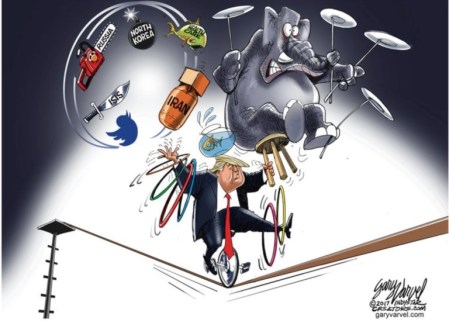
Cartoons and Video of the Day

April 1, 2017

Latma-TV via YouTube


H/t Power Line


H/t Vermont Loon Watch


H/t Town Hall


The way forward on the Iran Nuclear Deal under President Trump | TheHill

April 1, 2017

Source: The way forward on the Iran Nuclear Deal under President Trump | TheHill

The way forward on the Iran Nuclear Deal under President Trump

The way forward for the Iran nuclear deal under President Trump is to tighten enforcement of the Joint Comprehensive Plan of Action (JCPOA, aka, the nuclear deal) and impose sanctions on Iran’s ballistic missile program rather than dismantle the JCPOA.

Breaking News

On Mar. 26, 2016 at an American Public Affairs Committee (AIPAC) meeting, coauthor Raymond Tanter heard Vice President Mike Pence declare, “After decades of simply talking about it, the president of the United States is giving serious consideration to moving the American embassy from Tel Aviv to Jerusalem.”

If President Trump were to relocate the U.S. embassy to Jerusalem, however, it is likely to be opposed by many American allies like Saudi Arabia that are important in pushing back against Iran in the region.  The relocation of the U.S. Embassy to Israel distracts from the greater issue of how to restrain Iran’s malevolent influence in the Middle East in the context of the JCPOA.

In prior years, AIPAC policy conferences focused on hot topics like the Iran nuclear deal; the 2017 conference, however, centered on adjusting to new realities like the JCPOA. Issues considered at one of this year’s breakout sessions dealt with “Holding Iran Accountable,” and the discussion centered on conversations between two types of pundits in Washington: those focused on the Iran nuclear deal and those on non-JCPOA topics like non-nuclear sanctions, ballistic missile testing, state-sponsorship of terrorism, arms shipments to Hezbollah (Party of God), and human rights violations by Iran.

The key matter at hand remains the way forward for the Iran nuclear deal under President Trump. He has already indicated an unwillingness to accept the deal as written under the auspices of the previous administration and the other major powers.

Issues

There are several topics the Trump administration confronts regarding the JCPOA: heavy water, inspections, compliance, and nuclear sanctions. Heavy water reactors permit use of natural uranium as fuel, while light water reactors require enriched uranium, which is much more difficult to produce. As a member of Congress, President Trump’s Director of Central Intelligence Agency, then-Rep. Mike Pompeo cosponsored a bill passed by the House on July 13, 2016, that prevents Iran from purchasing heavy water from the United States.

Inspections of Iran’s nuclear facilities are necessary to ensure compliance, so Iran is unable to “breakout,” “sneakout,” or “creepout.” The last one concerns both open and covert, legal and illicit activities designed to negate JCPOA restrictions prior to the agreed-upon time in which Tehran would be able to do so.

In prepared remarks before the House Foreign Affairs Subcommittee on the Middle East and North Africa, Michael Eisenstadt of The Washington Institute for Near East Policy (TWI) testified that although Iran’s missiles are conventionally armed, many could deliver a nuclear weapon if Iran were to ever acquire such a capability. While the nuclear accord will likely defer such an eventuality, it did not impose new constraints on Iran’s missile program.On the contrary, UNSCR 2231 of July 20, 2015, loosened them, with provisions for lifting them in eight years, if not sooner.

In exchange for Tehran’s agreement to the nuclear deal, the Obama administration granted Iran flexibility for ballistic missile testing. UNSCR 2231 certified the deal, replacing the prohibition with accommodating language: “Iran is called upon not to undertake any activity related to ballistic missiles designed to be capable of delivering nuclear weapons.”

As reported by The Hill, on May 31, 2016, Sens. Robert Menendez, (D-NJ) and Mark Kirk, (R-IL), introduced legislation in 2015 that would extend the sanctions law for 10 years. Sen. Kelly Ayotte, (R-NH), backed by 18 other GOP senators, introduced a separate bill to extend the law through 2031 and require new sanctions tied to Iran’s ballistic missile program.

On Mar. 23, House and Senate legislators introduced bills that would increase sanctions on Iran for its ballistic missile tests and other destructive behavior. Tzvi Kahn, a senior Iran analyst at the Foundation for Defense of Democracies, states that, “The two bills are consistent with U.S. obligations under the 2015 nuclear deal, represent a bipartisan effort to advance an objective that both President Trump and President Obama have endorsed: deterring Tehran’s non-nuclear aggression in the region.”

The foregoing issues were raised in the context of candidate Trump’s stated view that the Obama administration negotiated badly: At one time, he called for tearing up the nuclear deal: “My number one priority is to dismantle the disastrous deal with Iran,” coauthor Tanter heard Trump tell the AIPAC Policy Conference in Mar. 2016. Immediately after the election, on Nov. 14, 2016, however, one of Trump’s advisors said if Trump cannot renegotiate its terms, he may kill it.

Soon, President Trump must decide whether to extend executive order waivers the Obama administration used to suspend some of the non-nuclear sanctions imposed on Iran and how scrupulously to hold the Iranian regime to account for infractions of the JCPOA. On Mar. 1, 2017, Laurence Norman of the Wall Street Journal reported that European officials are growing in confidence President Trump will not shred the nuclear accord. “The test of that will come in May, when the president must decide whether to extend executive waivers that the Obama administration used to suspend some sanctions.”

The Way Forward

In testimony before the House Foreign Affairs Committee on Feb. 17, 2017, David Albright, President of the Institute for Science and International Security and a former weapons inspector whom the Trump administration has consulted on the Iran nuclear deal, testified at a congressional hearing entitled “Iran on Notice.”

Albright’s bottom line: “The Trump administration appears committed to maintaining the JCPOA. This decision makes good sense. But the administration also recognizes that if the deal is to survive and serve U.S. national security interests, the JCPOA needs to be more strictly enforced and interpreted, and its most significant weaknesses need to be corrected.” We concur with the views of Albright as a point of departure for President Trump to consider, per some of his short-term steps.

First, insist Iran create and implement a strategic trade control system that meets international standards and will be subject to review by the Joint Commission mentioned in the JCPOA; second, plug the loopholes in the JCPOA, including ambiguities that permit Iran to obtain heavy water that has not been approved by the “Procurement Working Group;” third, draw on the expertise of the U.S. Department of Justice to pursue extradition and prosecution of  those involved in outfitting Iran’s nuclear, missile, or conventional weapons programs in defiance of U.S. laws and sanctions.

In short, the way forward for the Iran nuclear deal under President Trump is to renegotiate the JCPOA, rather than dismantle it.

Dr. Raymond Tanter served as a senior member on the National Security Council staff in the Reagan-Bush administration and is now Professor Emeritus at the University of Michigan. Edward Stafford is a retired Foreign Service officer; he served in Political-Military Affairs at the State Department, as a diplomat with the U.S. Embassy in Turkey, and taught at the Inter-American Defense College.

With Turks out, Raqqa operation is short of tanks

April 1, 2017

Source: With Turks out, Raqqa operation is short of tanks

DEBKAfile Exclusive Analysis April 1, 2017, 11:33 AM (IDT)
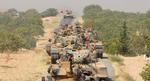
Turkish tanks deployed in Syria

Turkish tanks deployed in Syria

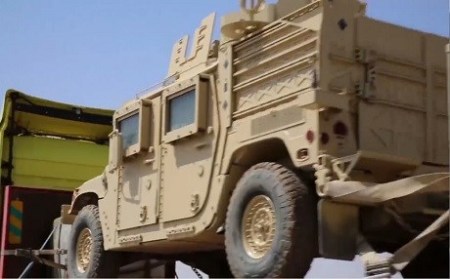
US armored Humvees driving this week from Iraqi Kurdistan to Syria
Except for one missing factor, the United States is in advanced preparations for the operation to oust the Islamic State from Raqqa, its Syrian stronghold, as Mission Mosul winds down in Iraq. Tuesday, March 28, a large convoy of trucks, with the KRG numbers plates of the semiautonomous Kurdish government of Iraq, crossed into Syria at the Semalka border post. Some were heavily laden with arms and ammunition; others hauled armored personnel carriers.

debkafile’s military sources report that the convoys were carrying the war materiel a US airlift is dropping at the KRG capital of Irbil. It includes quantities of heavy submachine guns and light artillery for the Syrian Democratic Forces which are about to lead the US-backed assault on Raqqa.
Two-thirds of the 50,000-60,000-strong SDF consists of Syrian YPG Kurdish militiamen (which can muster up to 75,000 fighters with reserves); the other third are Arab tribesmen from northern Syria.

Three days later, on March 30, Ankara suddenly announced the termination of Operation Euphrates Shield, which was launched with the Turkish invasion of Aug. 24, 2016 and its occupation of 6,000sq,km of land in northern Syria, including later the town of Al Bab, north of Aleppo.

While Ankara claimed Thursday that the Euphrates Operation was terminated after accomplishing its mission, our military sources report that the Turkish army missed its three main objectives:

1. It failed to lay down a 650sq.km security zone ranging from the Turkish-Syrian-Iraqi triangle at one end to the Mediterranean,atn the other.

2. The key Syrian town of Manbij remained in the hands of the SDF i.e. Kurdish control.

3. Turkish troops were unable to dislodge the YPG forces strung along the Turkish border.

Turkey was forced to abandon those objectives by a combined ultimatum slapped down by the US and Russia to cut short its Operation Euphrates, debkafile’s military and intelligence sources report.

The Kurdish heads of the SDF had warned the two powers that they would undertake to lead the Raqqa offensive only on two conditions: First, they demanded guarantees that the Turkish troops deployed to their rear would not take advantage of their absence to seize defenseless Kurdish towns and lands and; secondly, that the Turkish army would not take part in the Raqqa offensive, in any shape or form.

Over and above the official statement, Ankara was also obliged to pledge that Turkish forces would not advance one inch outside their current lines in northern Syria.
To give their ultimatum teeth, American troops took up positions at Manbij opposite Turkish lines, while the Russians moved a unit into the eastern Syrian Kurdish enclave of Afrin facing the Turkish border.

American weapons shipments were meanwhile arriving to arm the SDF force preparing to storm Raqqa. It was then discovered that by excluding any Turkish military role in the operation (as they did for the Mosul offensive), the Americans had left the Kurdish fighters without a tank force for leading the assault. This could have been provided by the Turkish army.

The importance of tanks for the operation is assessed by comparing the military challenges posed by the Mosul and Raqqa offensives.

The battle for Mosul is already going into its seventh month – and still not over – although it is being fought against 2,000 ISIS jihadis by 100,000 Iraq troops backed by American elite forces and heavy artillery.
More than 3,000 jihadists are present to defend Raqqa, according to intelligence estimates put before the US command planners of the operation. They include local Arab tribesmen some of whom they hope may desert, although this is far from certain.
Military experts watching American preparations for the Raqqa operation find that the US planners’ estimate that no more than 15,000 troops are needed capture Raqqa is over-optimistic; and without a tank force, even massive US air support may not be enough to win the day. The APCs the Americans are flying in for the Kurdish units are too few.

At the same time, a decision in Washington to supply tanks would certainly be met with Russian and Turkey objections. It would moreover set the operation back by several months while Kurdish crews are taught how to use them in operational combat.

Iran: A “Paper Tiger”

April 1, 2017

Iran: A “Paper Tiger,” Iran Focus, March 31, 2017

(What would Russia do? Please see also, Iran’s Elections: A Breaking Crisis? — DM)

London, 31 Mar – While Iran calls for the destruction of Israel, according to some experts, an American or Israeli attack against the Islamic Republic’s nuclear and military sites would be fairly easy to execute. This is because, although Iran points to technological advancement in their military, it is actually has overextended itself in Syria.

A report published in March by the Middle East Media Research Institute (MEMRI), noted Iran has backed off their provocations against U.S. Navy vessels, and has even ceased their threats to sink these ships in the Persian Gulf. The report continued, “The slogan ‘death to America’ has disappeared almost entirely from the official discourse of regime spokesmen, including Iranian Supreme Leader Ali Khamenei himself, as have public burnings of the American flag.”

Fars News Agency reported on March 26, that deputy chief of staff of Iran’s armed forces, Brigadier General Masoud Jazayeri, warned the U.S. to be more careful about its warship movements in the Persian Gulf, which is a softer warning than we’ve heard in the past from Iranian leaders.

President and founder of MEMRI, Yigal Carmon, has stated that Iran’s claims of domestic development of military technologies are “complete nonsense,” but said that the country’s acquisition of North Korean missiles is concerning. Carmon said further, that Iran imports North Korean missiles and renames them to give the impression that they were domestically developed.

He explained that Iranian media publishes stories every few weeks about success of their military programs. One such story in January 2013, announced that Iran’s Space Agency had sent a monkey into space, yet pictures of the monkey before and after the “mission” failed to match up. “Iran does not create any quality military equipment, they only are able to buy from abroad. What do they invent to counter U.S. ships? All they are able to come up with is suicide speed boats,” he said.

Iran has also “displayed what they claimed to be domestically built submarines, but when we saw the picture that they put out, we saw that the size would be good for the Baltimore aquarium,” said Carmon.

The ballistics test Iran conducted in January failed. Carmon believes that Iran poses no real challenge to the U.S. “If the U.S. or Israel attack Iran’s nuclear sites and military targets, it will be a done deal,” he said.

A comparison of American and Iranian financial resources may bolster this argument. Fox News columnist Jonathan Adelman, an international studies professor at the University of Denver, wrote in February, “Look at the figures. The American GDP of over $18 trillion is more than 40 times the GDP of Iran ($450 billion)…. Given all this, the fear of Iran getting nuclear weapons still remains real. But, even more real is the notion that the biggest power in the world, plus three significant regional powers (Israel, Egypt and Saudi Arabia), could handle Iran if they would put their minds to it.”

Iran sank $6 billion annually of its resources into the Syrian Civil War, according to Bloomberg News.

Dr. Harold Rhode, a distinguished senior fellow at the Gatestone Institute, and a former U.S. Defense Department official, has stated that while America is strong both militarily and internally, Iran and North Korea “appear strong, but are weak and rotten inside.” Rhode said that while Iran is trying to develop nuclear weapons, it is destroying its country by inaction on domestic problems such as its water crisis. London-based NGO Small Media published a study in March 2016, saying that Iran “faces an unprecedented crisis of water resources that threatens to render vast swathes of the country near-uninhabitable within the coming decades.”

A dangerous opium drug problem is also facing Iran. Rhode speculated that Iranian authorities could crack down on drugs, but ignore it instead, in order “to keep the people preoccupied so they don’t concern themselves with overthrowing the government.”

Rhode believes the American or Israeli approach should be one of strength, but said, “Do we need to have a massive invasion [of Iran]? No. We must show that this regime cannot do what is necessary to keep themselves in power.”

There are alternatives to “actual physical attacks,” such as electronic warfare, when it comes to confronting Iran, according to MEMRI’s Carmon.

Rhode said other options should be considered before putting troops on the ground, including bringing about regime change. “We live in very stable societies, we expect changes to come slowly, but that is not how it works in totalitarian societies like Iran. The moment the people see the regime has lost its ability and willingness to keep itself in power, the regime will topple very quickly, as happened to the shah in 1979. The shah was not willing to do what was necessary to put down the rioting,” he said, and called Iran a “potentially a paper tiger” adding that it is “our job to encourage regime change—and we can.”

Iran’s Elections: A Breaking Crisis?

April 1, 2017

Iran’s Elections: A Breaking Crisis? American ThinkerShahriar Kia, April 1, 2017

(If and to the extent that this analysis is correct, we should provide clandestine assistance to the Iranian resistance, both in and outside Iran. In view of the hostility between the current Iranian regime and the Arab League, it might well be willing to do its part. — DM)

The 12th presidential election in Iran will be held on May 19th. These polls are taking place at a time when the regime in Tehran, and especially Supreme Leader Ali Khamenei, are facing three distinct crises.

a)  Khamenei, suffering from prostate cancer, sees his days as numbered and must designate a successor. From March 2015 he has held various sessions with senior regime and Revolutionary Guards (IRGC) officials for this very purpose. Khamenei insists that his successor be clarified prior to his death.

b)  A major policy overhaul in Washington following the end of Obama’s tenure. This has terrified Iran and placed this regime in intense isolation on the international stage and across the region in the face of Arab and Islamic countries.

c)  The presidential election crisis in May.

Khamenei, witnessing his establishment coming to its knees during the 2009 uprisings, is extremely concerned about a repeat scenario. In such circumstances, the possibility of his entire regime crumbling at the hands of a revolting population is very serious and even likely. Khamenei is weighing how to properly engineer the elections while not providing any pretext for popular upheaval.

In contrast to the viewpoints of various parties in the West, the rifts inside Khamenei’s faction and those supporting Iranian President Hassan Rouhani does not arise from a difference between two so-called “moderate” and/or “hardline” mentalities. The fact is that the sham election is a dispute over two solutions aimed at safeguarding and maintaining a religious dictatorship in power, furthering their expansionism and ambitions.

Both factions, including Khamenei and the current formerly represented by the influential Ali Akbar Hashemi Rafsanjani, believe in resorting to a domestic crackdown, obtaining nuclear weapons, meddling in the internal affairs of other countries such as Iraq and Syria, and using instability and terrorism leverage as a tool to pursue their foreign policy. The only difference is how to advance in their goal to realize these objectives. Therefore, when we are talking about two factions, we must not mistakenly compare the Iranian regime with today’s advanced democracies.

Khamenei is considered very weak due to the current crises his regime is facing. In contrast to last year, when he constantly lashed out at Rouhani for the deal sealed to curb Iran’s nuclear program and similar initiatives sought for other purposes, Khamenei refused to mention Iran’s current political crises. Furthermore, following the major U.S,-Iran policy change, Khamenei has set aside his stereotype threats against the U.S. and maintained a state of hesitancy in his remarks.

Khamenei and Election Engineering

Candidates for Iran’s presidential elections will register from April 11th to the 16th. The ultraconservative Guardian Council, a 12-man body directly and indirectly appointed by Khamenei himself, will weigh the candidates’ qualifications from April 17th to the 27th. The elections are scheduled for May 19th.

Iran’s presidential elections always feature a large number of candidates. However, the main candidates from the two main factions must receive Khamenei’s explicit or implicit approval.

“Rouhani’s candidacy was confirmed after gaining the approval of the establishment’s senior officials,” according to the Ebtekar daily.

By establishing the “Popular Party of Revolutionary Forces” and the membership of the same individuals who elevated firebrand Mahmoud Ahmadinejad as president from the ballot boxes back in 2005, Khamenei has revealed signs of how he has engineered the upcoming elections.

In his “Nowruz” message marking the Iranian calendar New Year, Khamenei came to admit his role in the results of the 2009 presidential election.

“I entered the 2009 [presidential election] and stood firm,” he said. In his remarks, Khamenei warned about the May election by stipulating, “I will stand firm and intervene.”

It is worth noting the IRGC command, and especially Quds Force chief Qassem Suleimani, are seeking the candidacy of Ibrahim Reisi, who is also considered one of Khamenei’s options as his successor. Khamenei has yet to reach a final decision over Reisi’s candidacy in the May elections. If he registers as a candidate and fails to become president, his chances of succeeding Khamenei will be severely undermined. And if Khamenei seeks to select Reisi as the next president at all costs, he faces the severe possibility of instigating nationwide uprisings.

What is the Forecast?

Naturally, due to the numerous different elements facing Khamenei and his regime’s factions, forecasting even the near future is quite a challenging task. However, there are three different scenarios facing Khamenei:

1) Eliminating Rouhani and selecting a candidate meeting his standards, and that of the IRGC.

2) Rouhani is severely weakened after losing Rafsanjani, considered a major pillar in the regime’s apparatus. He will be reappointed as president on the condition of succumbing to the hegemony of Khamenei and the IRGC.

3) Rouhani views Khamenei weak in the balance of power and stands as a major opponent against his faction.

Of course, Khamenei prefers to realize the first scenario. If concerns of nationwide uprisings cancel this possibility, he will give in to the second scenario.

Although Rouhani is in favor of the third scenario, considering the society’s powder keg conditions and losing the support of Rafsanjani, such a turn of events would be considered dangerous for both the regime’s factions. This outcome can bring an end to the public’s fear of the regime’s domestic crackdown machine and ignite a new nationwide uprising. This is a red line for both of Iran’s factions.

Those supporting Khamenei, and especially the IRGC, seek to eliminate Rouhani from these elections. However, Khamenei cannot take very bold measures and officially oppose Rouhani’s candidacy. When confirming Rouhani’s candidacy, Khamenei asked him to hold coordinating meetings with Sulemani and IRGC chief Mohammad Ali Jafari. This request brings us closer to the second scenario.

However, the Iranian people and their organized opposition, symbolized in the National Council of Resistance of Iran (NCRI), consider such elections under the mullahs’ regime as baseless and demand free and fair elections held under the United Nations auspices. Such polls are only possible through regime change in Iran and establishing a democratic system.