Archive for March 2017

French Elections: Populist Revolution or Status Quo?

March 22, 2017

“If the Macron bubble doesn’t pop, this may portend the realignment, not just of French politics, but Western politics in general, away from the left-right division that has defined Western politics since the French Revolution, towards a division between

by Soeren Kern
March 21, 2017 at 5:00 am

Source: French Elections: Populist Revolution or Status Quo?

  • “If the Macron bubble doesn’t pop, this may portend the realignment, not just of French politics, but Western politics in general, away from the left-right division that has defined Western politics since the French Revolution, towards a division between the people and the elites.” — Pascal-Emmanuel Gobry, French political analyst.
  • “This divide is no longer between the left and the right, but between patriots and globalists.” — Marine Le Pen, French presidential candidate.

The presidential election in France officially got underway on March 18, when the Constitutional Council announced that a total of eleven candidates will be facing off for the country’s top political job.

The election is being closely followed in France and elsewhere as an indicator of popular discontent with traditional parties and the European Union, as well as with multiculturalism and continued mass migration from the Muslim world.

The first round of voting will be held on April 23. If no single candidate wins an absolute majority, the top two winners in the first round will compete in a run-off on May 7.

If the election were held today, independent “progressive” candidate Emmanuel Macron, who has never held elected office, would become the next president of France, according to several opinion polls.

A BVA market research poll for Orange released on March 18 showed that Marine Le Pen, the leader of the anti-establishment National Front party, would win the first round with 26% of the votes, followed by Macron with 25%. Conservative François Fillon is third (19.5%), followed by radical Socialist Benoît Hamon (12.5%) and Leftist firebrand Jean-Luc Mélenchon (12%).

For the first time, the two established parties, the Socialist Party and the center-right Republicans, would be eliminated in the first round.

In the second round, Macron, a 39-year-old pro-EU, pro-Islam globalist (platform here), would defeat Le Pen, a 48-year-old anti-EU, anti-Islam French nationalist (platform here), by a wide margin (62% to 38%), according to the poll.

Macron, a former investment banker, was an adviser to incumbent Socialist President François Hollande, one of the most unpopular presidents in modern French history. A long-time member of the Socialist Party, Macron served in Hollande’s cabinet for two years as economy minister until August 2016, when he resigned to launch his rival presidential bid to “transform France.”

Macron, whose core base of support consists of young, urban progressives, has tried to position himself in the political center, between the Socialists and the conservatives. His meteoric rise has been propelled by a scandal involving Fillon — who is the subject of a criminal investigation over allegations that he used government money to pay his wife and children more than €1 million ($1.1 million) for jobs they never did — and because the Socialists fielded Hamon, a nonviable candidate who has promised to pay every French citizen over 18, regardless of whether or not they are employed, a government-guaranteed monthly income of €750 ($800). The annual cost to taxpayers would be €400 billion ($430 billion). By comparison, France’s 2017 defense budget is €32.7 billion ($40 billion).

Macron’s ascendancy comes amid heightened worries over security. More than 230 people have been killed in attacks in France by Islamic radicals during the past two years. The latest attack, on March 18, involved a 39-year-old French-Tunisian jihadist who proclaimed that he wanted to “die for Allah,” and was shot dead after he tried to seize a soldier’s weapon at Orly Airport in Paris.

Shortly after the attack, Le Pen accused Macron and the rest of France’s political establishment of “cowardice in the face of Islamic fundamentalism.”

In an apparent effort to bolster his national security credentials, Macron on March 18 announced a surprise proposal to restore compulsory military service. He said he would require men and women between the ages of 18 and 21 to serve one month in the armed forces.

“I want each young French person to be able to experience military life, however brief,” Macron said. “This is a major project of society, a real republican project, which should allow our democracy to be more united and the resilience of our society to be increased.” Macron, if elected, would become the first president in modern French history not to have performed military service.

Observers say that Macron’s national service proposal — which copies Le Pen’s proposal to reintroduce compulsory military service for a period of at least three months — is an attempt to siphon votes away from Le Pen and Fillon, both of whose campaign platforms call for a strong national defense.

Macron’s proposal, which will require an estimated €15 billion ($16 billion) upfront, and another €3 billion ($3.2 billion) each year to maintain, has been met with derision because of its exorbitant cost and dubious contribution to national security. Le Monde reminded its readers that France spends a similar amount (€3 billion annually) on nuclear deterrence.

Fillon’s spokesman, Luc Chantel, said the proposal was “absurd and unrealistic” and added:

“Either it is a measure designed to discourage students from quitting school, and this is not the mission of the army, or it is training for the defense of France, and one month is a joke, it is a discovery camp.”

Some of Macron’s other policy positions include:

  • European Federalism: Macron has repeatedly called for a stronger European Union. At a January 14 political rally in Lille, he said: “We are Europe, we are Brussels, we wanted it and we need it. We need Europe because Europe makes us bigger, because Europe makes us stronger.”
  • Single European Currency: In a January 10 speech at the Humboldt University in Berlin, Macron, speaking impeccable English, said: “The truth is that we must collectively recognize that the euro is incomplete and cannot last without major reforms. It has not provided Europe with full international sovereignty against the dollar on its rules. It has not provided Europe with a natural convergence between the different member states. The euro is a weak Deutsche mark, the status quo is synonymous, in 10 years’ time, with the dismantling of the euro.”
  • Migration Crisis: Macron has repeatedly praised German Chancellor Angela Merkel’s open-door migration policy, which has allowed more than two million mostly Muslim migrants into Germany since January 2015.

    In a January 1, 2017 interview with Süddeutsche Zeitung, Macron accused critics of Merkel’s open-door migration policy of “disgraceful oversimplification.” He said: “Merkel and German society as a whole exemplified our common European values. They saved our collective dignity by accepting, accommodating and educating distressed refugees.”

    In a February 4 rally in Lyon, Macron mocked U.S. President Donald Trump’s pledge to build a wall with Mexico: “I do not want to build a wall. I can assure you there is no wall in my program. Can you remember the Maginot Line?” he said, referring to a failed row of fortifications that France built in the 1930s to deter an invasion by Germany.

  • Islamic Terrorism: Macron has said he believes the solution to jihadist terrorism is more European federalism: “Terrorism wants to destroy Europe. We must quickly create a sovereign Europe that is capable of protecting us against external dangers in order to better ensure internal security. We also need to overcome national unwillingness and create a common European intelligence system that will allow the effective hunting of criminals and terrorists.”
  • Islam: Macron has said he believes that French security policy has unfairly targeted Muslims and that “secularism should not be brandished to as a weapon to fight Islam.” At an October 2016 rally in Montpellier, he rejected President Hollande’s assertion that “France has a problem with Islam.” Instead, Macron said: “No religion is a problem in France today. If the state should be neutral, which is at the heart of secularism, we have a duty to let everybody practice their religion with dignity.” He also insisted that the Islamic State is not Islamic: “What poses a problem is not Islam, but certain behaviors that are said to be religious and then imposed on persons who practice that religion.”
  • National Defense: Macron supports NATO, and has pledged to increase French defense spending to reach 2% of GDP by 2025 — a level to which all NATO members agreed in 2006. At the same time, Macron believes in the need to create an “autonomous” European defense capability, also known as a European Army, which would duplicate military capabilities which already exist within NATO.

An Ifop poll for the Journal du Dimanche published on March 18 found that French voters are divided into “two quasi-equal blocks” about Macron’s honesty and his ability to govern. According to the survey, only 46% of French people believe he will be “able to guarantee the safety of the French people.” More than half (52%) of respondents said they were “worried” about Macron, while 52% said they doubted his honesty.

In an interview with BMFTV, Laurence Haïm, a Canal+ reporter who was accredited to the White House and who recently joined Macron’s team, described Macron as the “French Obama.” She added: “I think that in today’s world we need renewal, from someone young, who is not a politician. He wants to make the democratic revolution.”

So what is driving Macron’s political ascendancy? French analyst Pascal-Emmanuel Gobry explains:

“The best way to look at Macron is as a kind of anti-Le Pen, or, to stretch the bounds of logic even further, a ‘populist from the top.’ If Le Pen is anti-establishment, Macron is the incarnation of the French establishment, a graduate of ENA, the top civil service school that trains the country’s elites, and a member of the Inspection des Finances, the most elite civil service track. His only experience in the private sector is through the revolving door as an investment banker. And yet, Macron sounds off populist rhetoric: His candidacy, he says, is about sweeping out a corrupt system (even as he is supported by the vast majority of the French establishment).

“It would be only slightly churlish to say that the parts of the system Macron wants to do away with are the democratic ones; witness his full-throated support for the EU in a country that has rejected it at the polls. Macron supports various liberalizing reforms, and Angela Merkel’s welcoming policy towards migrants. He is, of course, a social liberal. In a country that takes culture very seriously, he has argued that there is ‘no such thing’ as French culture; rather, there are many cultures with which the French perform a kind of synthesis. His biggest donors seem to be French tax exiles residing in London and Brussels.

“In other words, he is the mirror image of the political realignment that is transforming Western politics. If the familiar motley crew of populists — Trump, Le Pen — are the candidates for those who lost out from globalization, then Macron is the candidate of the winners. In both cases, they seem to make old left-right divisions obsolete. If the Macron bubble doesn’t pop, this may portend the realignment, not just of French politics, but Western politics in general, away from the left-right division that has defined Western politics since the French Revolution, towards a division between the people and the elites.

Le Pen agrees. At a rally in Lyon on February 5, she said:

“The old left-right debates have outlived their usefulness. Primaries have shown that debates about secularism or immigration, as well as globalization or generalized deregulation, constitute a fundamental and transversal divide. This divide is no longer between the left and the right, but between patriots and globalists.

“The collapse of traditional parties and the systematic disappearance of almost all of their leaders shows that a great political re-composition has begun.”

At that same rally, Le Pen launched a two-pronged attack on globalization and radical Islam. She also promised French voters a referendum on remaining in the European Union in order “to allow us to recover our four sovereignties: monetary, economic, legislative and territorial.”

She went on to articulate exactly what is at stake for France in this election:

In all respects, this presidential election is unlike previous ones. Its outcome will determine the future of France as a free nation and our existence as a people.

After decades of errors and cowardice, we are at a crossroads. I say it with gravity: the choice we will have to make in this election is a choice of civilization.

The question is simple and cruel: will our children live in a free, independent, democratic country? Will they still be able to refer to our system of values? Will they have the same way of life as we did and our parents before us?

Will our children, and the children of our children, still have a job, a decent wage, the possibility of building up a patrimony, becoming an owner, starting a family in a safe environment, being properly cared for, to grow old with dignity?

Will our children have the same rights as us?

Will they live according to our cultural references, our values ​​of civilization, our style of living, and will they even speak our French language, which is disintegrating under the blows of political leaders who squander this national treasure — for example, by choosing a slogan in English to promote the candidacy of Paris to host the 2024 Olympic Games?

Will they have the right to claim French culture when certain candidates for the presidential election, puffed up by their own empty-headedness, explain that it does not exist?

I ask this important question because, unlike our adversaries, I am interested not only in the material heritage of the French, but I also want to defend our immaterial capital. This immaterial capital is priceless because this heritage is irreplaceable. In fact, I am defending the load-bearing walls of our society.

The choice for French voters is clear: Le Pen is the anti-establishment change candidate and Macron is the pro-establishment status quo candidate.
In the current French presidential election campaign, Marin Le Pen (right) is the anti-establishment change candidate and Emmanuel Macron (left) is the pro-establishment status quo candidate. (Image source: LCI video screenshot)

Le Pen is offering voters an historic opportunity to reassess relations with the European Union, reassert national sovereignty and stanch the flow of mass migration from the Muslim world. By contrast, Macron is offering voters increased European federalism, the transference of yet more national sovereignty to the European Union, and the further multiculturalization of French society.

If polls are any indication, French voters appear to be more comfortable with the status quo. The populist revolution that began in June 2016 when British voters decided to leave the European Union, and cross the Atlantic in November when Americans elected U.S. President Donald J. Trump, will not be spreading to France in 2017.

Soeren Kern is a Senior Fellow at the New York-based Gatestone Institute. Follow him on Facebook and on Twitter.


Arrest of Gaza manager exposes Hamas’s Turkish connection

March 22, 2017

Even though Jerusalem and Ankara restored ties, organizations in Turkey continue to assist the Islamist terror group’s efforts to attack Israel

March 21, 2017, 11:49 pm

Source: Arrest of Gaza manager exposes Hamas’s Turkish connection | The Times of Israel

Ismail Haniyeh, Gaza Strip’s Hamas premier, left, and his Turkish counterpart Recep Tayyip Erdogan salute the lawmakers and supporters of Erdogan’s Islamic-rooted Justice and Development Party at the Parliament in Ankara, Turkey, January 3, 2012 (photo credit: AP)

The arrest and interrogation of Muhammad Murtaja, the manager of the Gaza branch of the Turkish International Cooperation and Development Agency (TIKA), should set off alarm bells in Israel.

Murtaja was arrested last month on suspicion that he was working on behalf of Hamas, the Shin Bet announced on Tuesday. The 40-year-old Murtaja was arrested as he attempted to travel from Gaza to Turkey.

 The arrest exposes deep ties between Hamas and organizations in Turkey, which is of particular concern as Jerusalem and Ankara have just restored relations after years of acrimony.

According to the indictment, there is a deep suspicion that someone residing in Turkey not only sought to use Murtaja to transfer money to the Hamas terror group, but also to give the organization’s military wing sensitive military intelligence concerning Israel.

Most of the indictment focuses on the blatant way in which Murtaja and his associates from Hamas’ military wing, the Izz Ad-Din Al-Qassam Brigades, shamelessly sought to profit from aid that was meant to go to impoverished residents of the Gaza Strip.

Murtaja’s first scheme involved food packages bought with money given to him by TIKA which were supposed to be distributed to needy families in Gaza. He instead handed over some 7,000 of these 14,000 packages to Hamas operatives.

Muhammad Murtaja, 40, arrested by the Shin Bet for allegedly helping funnel money from Turkish charities to the Hamas terrorist group. (Coordinator of the Government's Activities in the Territories)

Muhammad Murtaja, 40, arrested by the Shin Bet for allegedly helping funnel money from Turkish charities to the Hamas terrorist group. (Coordinator of the Government’s Activities in the Territories)

In another instance he gave the Turkish organization the names of 8,000 fictional families. The money meant to feed them instead went to purchase food for Hamas.

On the boxes of the food packages was a sticker on which it was written in English “a gift from the Turkish people to the Palestinians.” In some cases, members of Hamas’s military wing removed the stickers and then sold the food at inflated prices back to Gaza residents.

This is definitely not the first case of its kind.

After Qatar financed the construction of thousands of new housing units in the southern Gaza city of Khan Younis for families who lost their homes in the 2014 Gaza war, the apartments were ostensibly given to the families for free, although Hamas demanded a “connection fee” to the electricity and water lines amounting to thousands of shekels from each family.

However, the bigger problem from Israel’s perspective is buried in the smaller print of the indictment — Murtaja’s mission to obtain satellite pictures in Turkey of sensitive military sites in Israel. These were intended to be used by Hamas to improve the targeting accuracy of its rocket arsenal in its next war with Israel.

Murtaja, who has been a member of Hamas’ military wing since 2008, studied structural engineering in Turkey. He speaks Turkish fluently and lives in the middle of Gaza City, and for years was a member of the “Shati Brigade” in Hamas’s military wing.

Most likely due to his Turkish language skills, Murtaja was selected to work at TIKA on behalf of the Izz Ad-Din Al-Qassam Brigades. Before that he worked with the Turkish Humanitarian Relief Foundation, known by its Turkish acronym IHH.

Illustrative: A Turkish ship with an IHH banner heading toward Gaza in 2010. (Moti Milrod/Pool/Flash90)

Illustrative: A Turkish ship with an IHH banner heading toward Gaza in 2010. (Moti Milrod/Pool/Flash90)

IHH, which Israel officially considers to be a terrorist organization, was behind the 2010 Mavi Marmara flotilla, in which nine activists were killed after attacking Israeli commandos who boarded their ship as they tried to breach Israel’s blockade of Gaza.

Among his different roles with the groups, Murtaja served as a translator for Hamas leaders Ismail Haniyeh and Ismail Radwan during their meetings with officials from the Turkish organizations.

Murtaja himself, according to his testimony, was present at a number of meetings in which suitcases stuffed with cashed were handed over to senior Hamas officials by employees from TIKA and IHH.

According to Murtaja, he was eventually approached by members of the Hamas branch for research and development, who explained to him that the terror group was seeking to improve the accuracy of its rockets and wanted to acquire more accurate satellite imagery rather than rely on Google Maps. Murtaja was told that the source for such advanced maps was Turkey and he promised to use his contacts there in order to try to obtain them.

Murtaja first turned to an associate of his at IHH, Yatim Yamaz, who promised Murtaja he would do everything possible to get the maps.

Despite the dangers he knew were involved in leaving Gaza for Israel on his way to Turkey, Murtaja decided to go ahead with the trip anyway.

This was most likely on the assumption that his Turkish partner would be able make good on his word that he had connections to Turkish intelligence. Otherwise he would not have implored Murtaja to make the journey to Turkey, expecting him to return to Gaza with information that would have endangered the lives of many Israelis.

WATCH: 2,000 reservists train for war in Gaza with surprise drill

March 22, 2017

Four reserve brigades given 24 hours notice for largest exercise of its kind this year; army says it’s unrelated to tensions on the border

March 21, 2017, 9:04 pm

Source: WATCH: 2,000 reservists train for war in Gaza with surprise drill | The Times of Israel

ome 2,000 reserve soldiers were called up this week to simulate war in the Gaza Strip, as part of the military’s largest planned exercise of 2017, the army said.

The surprise drill began on Sunday. It was conducted by the Sinai Division, the Southern Command’s reserve division. The exercise included four reserve brigades — two infantry and two armored brigades.

 The soldiers simulated war in Gaza, including a ground invasion into the Hamas-run coastal enclave.

IDF Chief Gadi Eisenkot visited the exercise in order to “assess the preparedness of the division for emergency,” the army said.

IDF Chief of Staff Gadi Eisenkot, right, visits a surprise exercise led by Brig. Gen. Sa'ar Tzur, left, on March 21, 2017. (IDF Spokesperson Unit)

IDF Chief of Staff Gadi Eisenkot, right, visits a surprise exercise led by Brig. Gen. Sa’ar Tzur, left, on March 21, 2017. (IDF Spokesperson Unit)

“We have put preparedness at the top of the IDF’s list of priorities. This is evident from the increased training program,” Eisenkot told the reservists.

In war, the army chief said, “cunning is what makes the difference — and that’s what we need to get, with the understanding that if there is a need for another [military] campaign, we will know how to surprise in every way, to prevent enemy achievements.”

In that way, Eiesnkot said, the army will be able to make the next operation “as short as possible.”

Israel has fought three major rounds of conflict with Hamas since the Islamist terror group seized control of Gaza from Mahmoud Abbas’s Fatah in 2007. The most recent such conflict, Operation Protective Edge, saw 50 days of fighting, including a ground offensive. In all, 74 Israelis were killed, 68 of them soldiers. Thousands of rockets and mortar shells were fired by Hamas and other Islamic terror groups at Israeli towns and cities, where damage was limited by Israel’s Iron Dome missile defense system. Hamas also utilized tunnels dug under the border to carry out attacks. The UN and Palestinians said 2,251 Palestinians, including 551 children, died in Gaza, where Israel’s counterstrikes caused widespread devastation. Israel said that up to half of those killed on the Palestinian side were combatants, and blamed the civilian death toll on Hamas for deliberating placing rocket launchers, tunnels and other military installations among civilians.

Israel says Hamas, which avowedly seeks Israel’s destruction, has since rebuilt larger rocket arsenals capable of hitting the entire country, and is again digging attack tunnels.

Israel is now drawing up contingency plans to evacuate up to a quarter-million civilians from border communities to protect them from attacks from Hamas, Hezbollah or other terror groups, it was reported Tuesday.

The reservists were given 24 hours notice ahead of this week’s exercise. Eight percent of those called up did not attend, the army said.

Brig. Gen. Sa’ar Tzur, the head of the Sinai Division, oversaw the exercise, which also included artillery, combat intelligence and combat engineering elements.

A tank takes part in an IDF drill on March 21, 2017. (IDF Spokesperson Unit)

A tank takes part in an IDF drill on March 21, 2017. (IDF Spokesperson Unit)

The surprise drill was in addition to a smaller exercise conducted by the IDF’s Home Front Command in southern Israel this week.

As part of the the Home Front Command exercise, the incoming missile alert system in southern Israel was tested on Tuesday morning.

The IDF spokesperson said the exercises were planned in advance and not tied to recent tensions with Gaza and jihadists in Sinai.

On Saturday, two rockets were launched from the Gaza Strip toward Israel. One exploded near the city of Ashkelon, north of Gaza, causing no casualties or damage. The second apparently fell inside Palestinian territory.

The Israel Defense Forces responded with tank fire and air strikes at several Hamas targets in the Strip. There were no reports of casualties.

Two days before, a rocket fired from the Gaza Strip struck in an empty field in the Sdot Negev Regional Council near Netivot.

In response, Israeli jets struck two Hamas installations in the north of the Gaza Strip.

Urgent Messages to the Muslim World

March 22, 2017

Urgent Messages to the Muslim World, Gatestone InstituteNonie Darwish, March 22, 2017

A dangerous message is being sent to the Muslim world by the West: There is nothing that moderate Muslims or anyone else should fear from radical Islamic terrorism! Look at us Western governments! We are bringing in refugees who cannot be vetted even if they are ISIS infiltrators. In fact, we in the West are so goodhearted that we are encouraging many organizations to operate legally in the West under the banner of the Muslim Brotherhood — even organizations that are sympathetic to the terrorist group Hamas and that are pledging to overthrow us!

The West, by taking all the Syrian refugees, is emptying Syria of any kind of resistance to the Caliphate (ISIS). The West’s compassion, by taking in the refugees escaping ISIS, will end up leaving only the radicals to rule unopposed in Syria and Iraq. This, in US foreign policy, is not compassion; it is gross negligence and reckless endangerment.

“Tough love” is badly needed when dealing with the Muslim world. We must say: No, we cannot accept your jihadist aspirations. We cannot accept you forcing your way of life on the world; your way of life is unacceptable to us. Before you send your refugees, you must end your “us against them” jihadist culture. The civilized world no longer finds your aspirations for an Islamic Caliphate tolerable.

The first reaction of the U.S. after 9/11 should have been to stop visas from all majority-Muslim countries, except for those of utmost importance. But our politicians’ hands were tied — not by fear of a backlash from Islamic countries, which probably expected a U.S. boycott, but by fear of a backlash from the Western media and Western progressives.

The decision to keep Muslims, refugees and others pouring into the US after 9/11 was wrong and has not done Islam and Muslim reformers a favor. Here is why:

The chaos and bloodshed in the Muslim world, even in the most moderate of Muslim nations, such as Turkey, is between Muslims who want to enforce Islamic sharia law, totally and upon everyone by a theocratic government, and those who want less sharia by installing military rule. The West does not understand that the only form of government that can stand up to a totalitarian Islamic theocracy is a military one and no other. Who could imagine that a military junta could be considered the only savior from Islamic tyrannies that require everyone to live totally, 100%, under the laws of sharia?

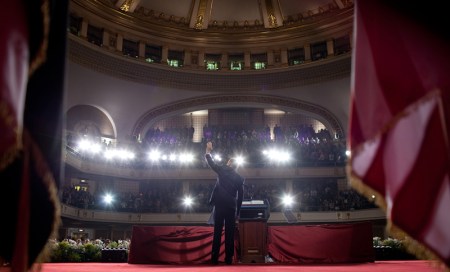
When former U.S. President Barack Obama honored the Muslim Brotherhood with his first major speech as president, who were his guests of honor in the first rows? Leaders of the Muslim Brotherhood. The less-radical Islamist military form of governments in the Middle East were left out and thus weakened. Then Egyptian President Hosni Mubarak, who had a murky relationship with the Muslim Brotherhood, got the message. He did not attend. With Obama’s move, the balance of power between the two combative forces over control of government immediately favored the Muslim Brotherhood. It officially, for the first time since its founding in 1928, took control of the Egyptian government after the 2011 chaos of the “Arab Spring.” A year later, 22 million Egyptians had to undergo a bloody counter-revolution to bring back the type of government Egyptians have always favored over an Islamic theocracy.

When former U.S. President Barack Obama gave his first major Presidential speech in Cairo, in 2009, his guests of honor in the first rows were leaders of the Muslim Brotherhood. The less-radical Islamist military form of governments in the Middle East were left out and thus weakened. (Image source: White House)

Now, another, dangerous, message is being sent to the ordinary citizens of the Muslim world by the liberal West: There is nothing that moderate Muslims or anyone else should fear from the possible infiltration of radical Islam! Look at us, Western governments! We are bringing in refugees who cannot be vetted even if they are ISIS infiltrators. Although the Muslim Brotherhood is illegal and considered a terrorist organization in several Muslim countries, we in the West do not mind them at all. In fact, we in the West are so kind-hearted and welcoming that we are encouraging many organizations to operate legally in the West under the banner of the Muslim Brotherhood — even organizations that are sympathetic to the terrorist group Hamas and that are pledging to overthrow us! See how we are courageous, self-confident and free of “Islamophobia”!

By embracing the Muslim Brotherhood as not dangerous to free societies and by bringing in refugees from terror-infested areas of the Middle East, we are sending a message to moderate Muslims in the Middle East: Citizens in the West are not even bothering to protect their free system from being conquered by sharia-lovers, so perhaps the dreams of the Caliphate are not that bad after all.

The West, by taking all the Syrian refugees, is not just sending the above “unintended” message; it is also emptying Syria of any kind of resistance to the Caliphate (ISIS). The West’s compassion, by taking in the refugees escaping ISIS, will end up leaving only the radicals to rule unopposed in Syria and Iraq.

A US foreign policy that recommends absorbing unvetted Muslim refugees has been advocated as compassion, but in fact it is gross negligence and reckless endangerment to U.S. citizens, Western freedoms and democracy.

There are unintended consequences to rescuing all Muslim refugees:

  • We are telling Muslim reformists, wrongly, especially in the Middle East, that there is nothing to fear from ISIS infiltration.
  • By not declaring the Muslim Brotherhood a terror organization we are yet again legitimizing and empowering it.
  • By not showing the proper angry response to Islamic terrorism, the West is not perceived as gracious, but as weak.

By taking in Islam and its refugees without proper vetting, the West is not doing either Islam or Muslims any favor: for the reformists, it is shutting out any hope of reform.

Tough love is badly needed when dealing with the Muslim world. We must say: No, we cannot accept your jihadist aspirations. We cannot accept you forcing your way of life on the world; your way of life is unacceptable to us. Before you send your refugees, you must end your “us against them” jihadist culture. The civilized world no longer finds your aspirations for an Islamic Caliphate tolerable.

If the West has the courage to do that, perhaps one day history will attribute the reformation of Muslim world partly to strength and conviction of Western resolve against tyranny and human suffering.

7 Nations to Join IAF’s Biggest Air Drill in Its History

March 22, 2017

Source: 7 Nations to Join IAF’s Biggest Air Drill in Its HistoryThe Jewish Press | JNi.Media | 24 Adar 5777 – March 22, 2017 | JewishPress.com

Photo Credit: U.S. Embassy Tel Aviv via Wikimedia

American, Italian and Israeli pilots at Blue Flag 2013

Israel Air Force will host the air forces of seven countries this fall, in the largest and most complex air exercise in its history, DefenseNews reported Tuesday.

Close to 100 aircraft and hundreds of pilots and crews from the US, Greece, Poland, France, Germany, India and Italy will participate in Blue Flag, biennial, two-week maneuvers exercising planning, targeting and coordinated command and control in high-threat theaters.

Advertisement

The first Blue Flag took place in November 2013 at Ovda Air Force Base in Israel. The exercise, which included several foreign air forces, was aimed at expanding international cooperation. In 2015, the second Blue Flag included the air forces of the US, Greece and Poland.

IAF chief of international affairs Lt. Col. Richard Hecht told DN that “everybody wants to engage and cooperate with the IAF. It’s a privilege.”

Claiming bragging rights as the new humility, Hecht boasted that “people are seeing there’s a lot to learn from Israel. In our tiny airspace and in the environment around us, things are so intense. The Russians are here. … Many of the world’s air forces are passing through here on their way to operations in Syria and elsewhere in the region. So we provide a sort of battle lab in which forces can hone a spectrum of skills needed to combat growing threats.”

Hecht declined to reveal what is being planned for this year’s Blue Flag, but is safe to assume that the combined forces will conduct hundreds of sorties in Israel’s sky, practicing air-to-air battles, ground attacks on fixed- and moving targets, and maneuvering over surface-to-air batteries and shoulder-launched missiles.

Ahead of International Day, UN rights chief urges governments to target hate speech, crimes

March 22, 2017

On the eve of the International Day for the Elimination of Racial Discrimination, the United Nations human rights chief today reminded Governments around the world that they have a legal obligation to stop hate speech and hate crimes, and called on people everywhere to “stand up for someone’s rights.”

20 March 2017

Source: United Nations News Centre – Ahead of International Day, UN rights chief urges governments to target hate speech, crimes

Students watch a performance by their peers at Barros Barreto School, in Salvador, Brazil. The performance tackled social issues such as racism and gender discrimination.. Photo: UNICEF/Claudio Versiani

20 March 2017 – On the eve of the International Day for the Elimination of Racial Discrimination, the United Nations human rights chief today reminded Governments around the world that they have a legal obligation to stop hate speech and hate crimes, and called on people everywhere to “stand up for someone’s rights.”

“Politics of division and the rhetoric of intolerance are targeting racial, ethnic, linguistic and religious minorities, and migrants and refugees. Words of fear and loathing can, and do, have real consequences,” the UN High Commissioner for Human Rights, Zeid Ra’ad Al Hussein, said.

The UN High Commissioner’s statement comes ahead of the International Day for the Elimination of Racial Discrimination, marked annually on 21 March. The theme for this year is ending racial profiling and incitement to hatred, including as it relates to people’s attitudes and actions towards migration.

“Words of fear and loathing can, and do, have real consequences”

At the Summit for Refugees and Migrants in September 2016, UN Member States adopted a Declaration strongly condemning acts and manifestations of racism, racial discrimination, xenophobia and related intolerance.

The Summit also sparked the UN’s Together initiative to change negative perceptions and attitudes aimed at refugees and migrants.

In his statement, Mr. Zeid said that States do not have any excuse to allow racism and xenophobia to fester.

States “have the legal obligation to prohibit and eliminate racial discrimination, to guarantee the right of everyone, no matter their race, colour, national or ethnic origin, to equality before the law,” the senior UN official said.

He urged Governments to adopt legislation expressly prohibiting racist hate speech, including the dissemination of ideas based on racial superiority or hatred, incitement to racial discrimination, and threats or incitement to violence.

“It is not an attack on free speech or the silencing of controversial ideas or criticism, but a recognition that the right to freedom of expression carries with it special duties and responsibilities,” Mr. Zeid said.

To promote human rights, the UN High Commissioner’s office, known by its acronym OHCHR, is asking people around the world to , “Stand up for Someone’s Rights Today”. The campaign urges people to take practical steps in their own communities to take a stand for humanity.

Focus on Border Wall as Visa Overstays Create Illegal Immigrant Crisis

March 21, 2017

Focus on Border Wall as Visa Overstays Create Illegal Immigrant Crisis, Judicial Watch, March 21, 2017

While the Trump administration focuses on securing the southern border, most illegal immigrants enter the United States legally and stay after their visa expires, a new study reveals. That’s because, incredibly, the U.S. doesn’t have an adequate system to assure the foreigners leave when they’re supposed to. This has been a serious problem for years and in fact some of the 9/11 hijackers overstayed their visa to plan the worst terrorist attack on U.S. soil. More than a decade and a half later little has changed. Securing the famously porous southern border is essential to national security but so is a reliable system that cracks down on visa overstays.

How bad is the problem? More than half of the undocumented people living in the U.S. entered the country with visas that expired, according to a report issued this month by a New York-based think tank dedicated to studying international migration. The study analyzes Department of Homeland Security (DHS) statistics from 2014 and finds that two-thirds of foreigners who arrived did not cross the border illegally, but rather were admitted on non-immigrant temporary visas and overstayed their period of admission or otherwise violated the terms of their visas. “Overstays accounted for about two-thirds (66 percent) of those who arrived (i.e., joined the undocumented population) in 2014,” the report states.

Visa overstays exceeded illegal border crossings, Entries Without Inspection (EWI), every year since 2007, the report says, and 600,000 more overstays than EWIs have arrived since 2007. Most illegal immigrants in the U.S. come from Mexico, the DHS figures used to compile the report show, about one-third of them visa overstays. This translates into 4.5 million visa overstays from Mexico in the year that was studied. California has the largest number of overstays (890,000), followed by New York (520,000), Texas (475,000), and Florida (435,000). Not surprisingly, California and Texas have the biggest chunk of illegal border crossers from Mexico, with 1.7 million and 1.3 million respectively. Other states, such as Hawaii, Massachusetts, Connecticut and Pennsylvania, also have large numbers of visa overstays, the report states.

The study was actually published to make a case against building a wall on the U.S.-Mexico border, but in the process highlights the visa overstay crisis which compromises national security just as much as the porous border. Judicial Watch has reported on both for years and obtained public records that help illustrate the severity of the matter. The bottom line is that Islamic terrorists are using both avenues to enter the U.S. As part of an ongoing investigation on the Mexican border, Judicial Watch has published a series of articles documenting how Middle Eastern terrorists have joined forces with Mexican drug cartels to infiltrate the U.S. and train in southern border towns near American cities. Sources include local, state and federal law enforcement officials as well as military figures on both sides of the border.

The threat created by visa overstays has also been well documented. Just last year Judicial Watch obtained DHS figures showing that more than half a million foreigners with expired visas—like four of the 9/11 jihadists—remained in the country, thousands of them from terrorist nations like Pakistan, Iraq, Yemen, Libya and Syria. More than 45,000 Mexicans overstayed their visa, according to the DHS records, and thousands more from El Salvador, Ecuador, Venezuela and China. The visas are granted for “business or pleasure” and the foreigners come via sea or air port of entry. For nearly a decade a number of federal audits have offered the alarming figures associated with visa overstays, including one released back in 2011 that estimates half of the nation’s illegal immigrants entered legally with visas.

A few years after the 2001 terrorist attacks Congress launched a system that was supposed to track the entry and exit of foreign nationals by using electronically scanned fingerprints and photographs. But five years and $1 billion later, the system, U.S. Visitor and Immigration Status Indicator Technology (US VISIT), still had serious flaws. A few years later the investigative arm of Congress, the Government Accountability Office (GAO), published a report confirming that nearly half of the nation’s illegal aliens entered the U.S. legally and overstayed their visas undetected. In the years that followed the government did little to improve what has developed into a dire national security disaster. In 2011 yet another federal audit confirmed that the U.S. had lost track of millions who overstayed their visas and two years later the crisis intensified when DHS lost track of 266 dangerous foreigners with expired visas. The government determined that they “could pose a national security or public safety concerns,” according to the director of Homeland Security and Justice at the GAO.

World Shrugs as Hizballah Prepares Massive Civilian Deaths

March 21, 2017

World Shrugs as Hizballah Prepares Massive Civilian Deaths, Investigative Project on Terrorism, Noah Beck, March 21, 2017

Like the terror group Hamas, Hizballah knows that civilian deaths at the hands of Israel are a strategic asset, because they produce diplomatic pressure to limit Israel’s military response. Hizballah reportedly went so far as offering reduced-price housing to Shiite families who allowed the terrorist group to store rocket launchers in their homes.

********************************

Hizballah leader Hassan Nasrallah recently warned Israel that his Iran-backed terror group could attack targets producing mass Israeli casualties, including a huge ammonia storage tank in Haifa, and a nuclear reactor in Dimona.

Also last month, Tower Magazine reported that, since the beginning of the Syrian civil war, Iran provided Hizballah with a vast supply of “game-changing,” state-of-the art weapons, despite Israel’s occasional airstrikes against weapons convoys.

In a future conflict, Hizballah has the capacity to fire 1,500 rockets into Israel each day, overwhelming Israel’s missile defense systems. Should such a scenario materialize, Israel will be forced to respond with unprecedented firepower to defend its own civilians.

Hizballah’s advanced weapons and the systems needed to launch them reportedly are embedded across a staggering 10,000 locations in the heart of more than 200 civilian towns and villages. The Israeli military has openly warned about this Hizballah war crime and the grave threats it poses to both sides, but that alarm generated almost no attention from the global media, the United Nations, or other international institutions.

Like the terror group Hamas, Hizballah knows that civilian deaths at the hands of Israel are a strategic asset, because they produce diplomatic pressure to limit Israel’s military response. Hizballah reportedly went so far as offering reduced-price housing to Shiite families who allowed the terrorist group to store rocket launchers in their homes.

But if the global media, the UN, human rights organizations, and other international institutions predictably pounce on Israel after it causes civilian casualties, why are they doing nothing to prevent them? Hizballah’s very presence in southern Lebanon is a flagrant violation of United Nations Security Council resolution 1701, which called for the area to be a zone “free of any armed personnel, assets and weapons” other than the Lebanese military and the U.N. Interim Forces in Lebanon (UNIFIL).

The resolution also required Hizballah to be disarmed, but the terror group today has an arsenal that rivals that of most armies. Hizballah possesses an estimated 140,000 missiles and rockets, and reportedly now can manufacture advanced weapons in underground factories that are impervious to aerial attack.

“Israel must stress again and again, before it happens, that these villages [storing Hizballah weapons] have become military posts, and are therefore legitimate targets,” said Yoram Schweitzer, senior research fellow at Israel’s Institute for National Security Studies (INSS).

Meir Litvak, director of Tel Aviv University’s Alliance Center for Iranian Studies, agrees, adding that global attention would “expose Hizballah’s hypocrisy in its cynical use of civilians as… human shields.”

Even a concerted campaign to showcase Hizballah’s war preparation is unlikely to change things, said Eyal Zisser, a senior research fellow at the Moshe Dayan Center for Middle Eastern and African Studies. Hizballah exploits the fact that “the international community is too busy and…weak to do something about it,” Zisser said. All of “these talks and reports have no meaning. See what is happening in Syria.”

Israel has targeted Hizballah-bound weapons caches in Syria twice during the past week. Syria responded last Friday by firing a missile carrying 200 kilograms of explosives, which Israel successfully intercepted.

If Hizballah provokes a war, Israel can legitimately attack civilian areas storing Hizballah arms if the Israel Defense Forces (IDF) first attempts to warn the targeted civilians to leave those areas, Litvak said. But “it will certainly be very difficult and will look bad on TV.”

While Sunni Arab states are generally united against the Shiite Iranian-Hizballah axis, Litvak, Zisser, and Schweitzer all agreed that Israel could hope for no more than silent support from them when the missiles fly.

Indeed, the “Sunni Arab street” is likely to be inflamed by the images of civilian death and destruction caused by Israel that international media will inevitably broadcast, further limiting support for Israel from Iran’s Sunni state foes.

Rather perversely, the Lebanese government has embraced the very terrorist organization that could cause hundreds of thousands of Lebanese civilian deaths by converting residential areas into war zones. “As long as Israel occupies land and covets the natural resources of Lebanon, and as long as the Lebanese military lacks the power to stand up to Israel, [Hizballah’s] arms are essential, in that they complement the actions of the army and do not contradict them,” President Michel Aoun told Egyptian television last month. Hizballah, he said, “has a complementary role to the Lebanese army.”

Aoun’s declaration means that Lebanon “takes full responsibility for all of Hizballah’s actions, including against Israel, and for their consequences to Lebanon and its entire population, even though the Lebanese government has little ability to actually control the organization’s decisions or policy,” said INSS Senior Research Fellow Assaf Orion.

MK Naftali Bennett, a veteran of Israel’s 2006 war with Hizballah, believes that Lebanon’s official acceptance of Hizballah and its policy of embedding military assets inside residential areas removes any constraints on Israeli targeting of civilian areas. “The Lebanese institutions, its infrastructure, airport, power stations, traffic junctions, Lebanese Army bases – they should all be legitimate targets if a war breaks out,” he said. “That’s what we should already be saying to them and the world now.”

In a future war, Hizballah is certain to try bombarding Israeli civilian communities with missile barrages. Israel, in response, will have to target missile launchers and weapons caches surrounded by Lebanese civilians.

But it need not be so. Global attention on Hizballah’s abuses by journalists and diplomats could lead to international pressure that ultimately reduces or even prevents civilian deaths.

Those truly concerned about civilians do not have a difficult case to make. Hizballah has shown a callous disregard for innocent life in Syria.

It helped the Syrian regime violently suppress largely peaceful protests that preceded the Syrian civil war in 2011. Last April, Hizballah and Syrian army troops reportedly killed civilians attempting to flee the Sunni-populated town of Madaya, near the Lebanese border. In 2008, its fighters seized control of several West Beirut neighborhoods and killed innocent civilians after the Lebanese government moved to shut down Hizballah’s telecommunication network.

Hizballah terrorism has claimed civilian lives for decades, including a 1994 suicide bombing at Argentina’s main Jewish center that killed 85 people . As the IDF notes, “Since 1982, hundreds of innocent civilians have lost their lives and thousands more have been injured thanks to Hizballah.”

If world powers and the international media genuinely care about avoiding civilian casualties, they should be loudly condemning Hizballah’s ongoing efforts – in flagrant violation of a UN resolution – to cause massive civilian death and destruction in Lebanon’s next war with Israel.

Report: Iran accuses Russia of giving Israel codes for Syrian air defenses

March 21, 2017

Source: Report: Iran accuses Russia of giving Israel codes for Syrian air defenses – Arab-Israeli Conflict – Jerusalem Post

ByYASSER OKBI/ MAARIV HASHAVUA
March 21, 2017 15:53


Kuwaiti daily quotes Iran Defense Ministry source as saying Iran was able to change the codes without Russia’s knowledge, enabling Friday’s missile launch against Israeli aircraft.

S-300

S-300 anti-aircraft missile. (photo credit:REUTERS)

Iran has accused Russia of giving the codes for Syria’s anti-aircraft missiles to Israel, a senior official in the engineering department of Iran’s Defense Department told the Kuwaiti daily Al-Jarida on Monday.

According to the report, much remains unknown about Israel’s attack on a Hezbollah weapons convoy and the Syrian response to the Israeli fighter jets early Friday morning. Israel has reportedly attacked dozens of times in Syrian territory since Hezbollah joined the Syrian civil war in 2012, but Friday marked the first time that an anti-aircraft missile had been fired at an IAF jet.
Al-Jarida’s Tehran correspondent, Farzad Qassemi, cited a source in the Iranian Defense Ministry as saying that Iranian experts had changed the operation codes for the Syrian air defense system, which is what enabled the anti-aircraft missiles to be used against the Israeli Air Force on Friday morning.

According to the source, Damascus and Tehran “were shocked” every time the Russian-made air defense system did not work to defend Syria’s airspace, or even give notification that the air space had been penetrated in order to evacuate outposts prior to the airstrike. The systems are supposed to identify the takeoff of Israeli Air Force jets from their bases because of the small distance between the countries and is even supposed to attempt to target the planes and any missiles that are fired from them.

According to the source, the Iranians and the Syrians suspected that Russia gave the codes for the air defense system to Israel and even refused the requests of Tehran and Damascus to check the codes. “Iran has the ability today to change the Russian security codes since it received the advanced Russian S-300,” the source added. “This came after it received reports that Israel got the operation codes for the missile system. In Iran, they even expanded their knowledge when they built the Bavar-373 air defense system – which is a domestic copy of the Russian S-300 – in order that the systems would work together during an attack.”

According to the source, three weeks ago, during Iranian military maneuvers, Iranian engineers hacked into the codes of the S-300, but when the Bavar-373 was not working in conjunction with the Russian air defense system the experiment was suspended.

The source said further that the Iranian Defense Ministry sent several engineers to Syria to change the codes of the air defense system that was under the control of the Syrian army, without Moscow’s knowledge. “They succeeded in changing some of the codes last month and therefore when the Israel fighter jets took off from their bases – the air defense system succeeded in identifying them and firing interceptor missiles at them and at the missiles they had launched.”

The source added that “the Syrian radar treated Israeli fighter jets as friendly planes in the past and not as enemy planes, which proves that Israel knew the codes of the missile system.”

According to the source, the identification of the Israeli fighter jets taking off enabled Hezbollah to evacuate the outpost and even to launch a missile toward the military base from which the fighter jets had taken off. “The missile launched by Hezbollah toward Israel was worth some $2,000, whereas the missiles used by Israel to intercept it were worth some $3 million,” the source added.

The Iranian source said further that in a report sent to the Russian military command, the Russians were asked if someone penetrated the Syrian air defense system. Both the Iranians and Syrians were awaiting an answer.

Netanyahu: Israel policy in Syria unchanged

March 21, 2017

Source: Netanyahu: Israel policy in Syria unchanged | Live Updates | The Times of Israel

Russia has not changed its policy vis-a-vis its coordination with the Israeli air force over the Syria, Prime Minister Benjamin Netanyahu says, denying reports that Moscow over the weekend decided no longer to allow Israel to attack targets in the war-torn country after one such strike nearly hit a Russian asset.

“If there’s intelligence and operation feasibility, we strike, and so it will continue,” he tells reporters in his Beijing hotel as he wraps up the official part of his three-day visit to Chinese capital.

Netanyahu says that he told Russian President Vladimir Putin during their recent meeting in Moscow that Israel will continue to thwart attempts by Iran and its terrorist proxies such as Hezbollah to smuggle advanced weapons to Lebanon via Syria.

“Our policy is consistent, and this is what I told Putin,” the prime minister says.

Israel launched several attacks targets in Syria in recent days, one of which nearly hit a Russian asset. Moscow subsequently summoned Israel’s ambassador to Russia, Gary Koren, to note its protest. Syria’s ambassador to the UN later said that Russia had changed its policy and no longer grants Israel freedom of action over Syrian skies.

Israel does not inform the Russian forces stationed in Syria ahead of attacks there, out of fear for the Israeli pilots.

“We are very careful not to hit whoever is not supposed to be hit,” Netanyahu says.

— Raphael Ahren