Archive for January 2017

Thank Obama for Iranian Missile Tests

January 31, 2017

Thank Obama for Iranian Missile Tests, PJ MediaAndrew C. McCarthy, January 31, 2017

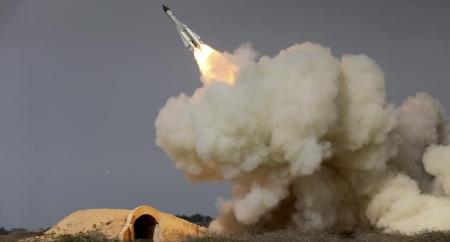
notamissile(Amir Kholousi, ISNA via AP)

There is great shrieking from the “international community” over Iran’s ballistic missile test over the weekend, the latest of what the Wall Street Journal reports is nearly a dozen such tests since President Obama’s Iran nuclear deal — the Joint Comprehensive Plan of Action (JCPOA) — went into effect last year. The United Nations Security Council, which endorsed the deal even though no party has actually signed it, is set to hold an “emergency meeting” today to discuss the matter.

What is there to discuss?

French foreign minister Jean-Marc Ayrault said it best in complaining that such tests are “contrary to the spirit” of the JCPOA.

When they talk about a violation of the “spirit” of a pact, you can be certain that there has been no violation of the letter of a pact — i.e., the thing that is required for there to be a real, actionable violation.

The provocative missile tests further elucidate the obvious: Iran’s nuclear program is about developing nuclear weapons — which Iran will be able to do consistent with the terms of the JCPOA. But regardless of the crying and gnashing of teeth at the emergency meeting, the tests do not violate the JCPOA.

For that, we can thank Barack Obama.

Prior to the JCPOA, Iran’s ballistic missile activities were barred by a series of UN resolutions backed by American and international sanctions. But sensing Obama’s desperation to complete the JCPOA at any cost, and by indulging any fiction, Iran threatened to walk away from the table unless the restraints on missiles were eliminated.

Obama quietly accommodated the mullahs — despite having repeatedly told the American people that the negotiations were confined to nuclear activities, and that his administration would hold a hard line on Iranian missile development and terror promotion.

There was nothing in the JCPOA about ballistic missiles. When Obama brought the deal to the Security Council, however, he used its endorsement vehicle — Resolution 2231 — to undermine the missile sanctions. The pertinent paragraph is buried deep in the resolution (Annex B, Paragraph 3 — scroll all the way down to page 99 of 104). It states (italics is mine):

Iran is called upon not to undertake any activity related to ballistic missiles designed to be capable of delivering nuclear weapons, including launches using such ballistic missile technology, until the date eight years after the JCPOA Adoption Day[.] …

Notice three things:

  1. The words “Iran is called upon” not to undertake ballistic missile activity. That is not the same as being forbidden to do so. Because of the way the JCPOA was codified in the resolution – for what the parties will call international law purposes — the former proscription against ballistic missile activity has been watered down to a mere encouragement of Iran not to engage in such activity. In UN-speak, a country’s ignoring what the Security Council “calls upon” it to do does not even rise to the level of a tsk-tsk letter from the principal. It is just a suggestion along the lines of “Pretty please don’t fire missiles after we’ve told everyone how moderate you are.”
  2. Then there is the fiction: the paragraph refers to “missiles designed to be capable of delivering nuclear weapons.” Bear in mind the fraud on which the JCPOA is based: Iran has no intention of manufacturing or otherwise acquiring nuclear weapons. Therefore, so the story goes, Iran would not build missiles “designed to be capable of delivering nuclear weapons.” We, like the Obama administration, are supposed to ignore what Iran’s missiles are technologically capable of doing and trust the stated intentions of the world’s chief sponsor of jihadist terror.
  3. The resolution not only abandons the prohibition against missile activity; even the insipid suggestion that Iran not engage in such activity is only operative for eight years. After that, they can do what they want … just as, after no more than 15 years, they are free to develop nuclear weapons free and clear.

How could Obama have agreed to such disastrous terms (in addition to giving the mullah’s over $100 billion in sanctions relief — including ransom cash)? The Obama administration illusion was that Iran was in the process of a powerful, inevitable reform movement that would, in the course of eight to 15 years, transmogrify it into a normal, reasonable, moderate nation-state. According to this thinking, by the time the JCPOA ran its course, Iran would be so benign it would probably not want nuclear missiles; and even if it did, that would be no problem because, by then, its regime would have evolved into a stable pillar of the international community.

Of course, we now know this was a consciously false narrative that Obama peddled to sell the Iran deal to the public — orchestrated by deputy national security adviser Ben Rhodes, with the help of an echo chamber media.

Iran ratcheted up missile development almost immediately after the JCPOA went into effect. The missiles test-fired last March were inscribed “Israel must be wiped out.” In Tehran, that’s known as “the spirit” of the agreement.

Mexico: Blame Canada

January 31, 2017

Mexico: Blame Canada, Strategy Page, January 31, 2017

(Endemic corruption, cartels, crime, an unpopular president and other bad stuff in Mexico? It must be imperialistic America’s fault. Therefore, remittances should be encouraged and all U.S. border controls eliminated. At least Obama would agree. — DM)

The government announced it would spend $50 million to hire lawyers in the United States to defend Mexican citizens there illegally and faced with deportation. This is all about money and a lot more than $50 million. The Mexican central bank tracks how much money Mexicans abroad send home and in 2016 it was $25 billion, almost all of it from Mexicans in the United States and much of it from Mexicans in the United States illegally. That remittance cash accounts for more foreign exchange than Mexican oil exports. The remittance income is rising. It was nearly $22 billion in 2013 and is expected to rise to $28 billion in 2017, unless the United States enforces its immigration laws like Mexico does. Mexico has for decades tolerated illegal migration to the United States because the corruption and bad government in Mexico did little to provide jobs for the growing number of unemployed Mexicans and created a lot of potentially troublesome young men and women. Tolerating and, for many Mexican politicians, openly supporting the illegal migrants, was a popular policy and the government came to regard it as a right. But it was also about money and the remittances created a huge source of foreign currency flowing back to Mexico.

There’s more to it than money. After years of being accused of permitting the abuse of Central American migrants who enter Mexico the government agreed pay more attention to border security on its own southern border. Many of the illegal migrants from Central American are heading for the United States and that was not seen as a Mexican problem. But criminal gangs increasingly robbed and kidnapped the migrants and the government did very little to stop that. The gangsters often attacked Mexican citizens as well. Mexico has more severe laws against illegal immigration and illegal migrants than the U.S.  It also enforces them more vigorously than does the U. S. By mid-2014 Mexico agreed to undertake Operation Sur which was supposed to curb illegal Central American migrants from entering Mexico. Operation Sur increased surveillance operations along Mexico’s southern border and improved border inspections. The government also tried to improve registration of legal migrants. In addition to the criminals, local police forces in southern Mexico have been accused of extorting money from illegal migrants and police corruption has long been a major problem. Despite Operation Sur, Mexico did little halt illegal migration across its northern border.

All this was noticed in the U.S. and politicians there found themselves under increasing pressure to enforce American migration laws as vigorously as Mexico (and Canada) did. By 2016 that brought to power an American government that seemed serious about applying Mexican practices to illegal migrants and actually did so. That was unpopular in Mexico and will probably lead to unexpected changes inside Mexico. But the practice of blaming your northern neighbor for your problems is losing its punch even in Mexico.

January 28, 2017: Police discovered the decapitated corpses of three policemen from the town of Huimanguillo (Tabasco state). The victims were slain near the border with Veracruz state.

January 27, 2017: In the south (Yucatan state) the government announced the arrest of three men suspected of smuggling drugs for the Sinaloa cartel. One of these, Roberto Najera Gutierrez, was described as a senior cartel leader and one of cartel boss Joaquin Guzman’s top lieutenants. The other two individuals are also Sinaloa cartel operatives. Gutierrez has directed drug trafficking operations from Central American countries and he has been especially active in Chiapas and Yucatan states.

January 24, 2017: The government confirmed the January 19 arrest (in Sinaloa state) of Juan Jose Esparragoza Monzon, the son of a senior member of the Sinaloa cartel. Monzon is suspected of investing cartel funds in real estate in Mexico as well as being involved in violent crimes in Baja California state.

January 23, 2017: Colima state had 607 murders in 2016 versus 189 in 2015. That is a 220 percent increase. A turf war between the Sinaloa and Jalisco New Generation cartels is engulfing the state, with the seaport of Manzanillo the prize. Around 700,000 people live in Colima. The 2016 summary was announced just before state security officials said it believed that that Jalisco New Generation cartel gunmen were responsible for the murders of a dozen people in the state between January 19 and 23. Seven headless corpses were found near Manzanillo on January 21.

January 19, 2017: The government announced that Sinaloa cartel commander Joaquin Guzman had been extradited to the U.S. Media called the unexpectedly rapid extradition a “surprise.” In U.S. federal court in New York Guzman pled not guilty to a 17-count indictment. He faces narcotics trafficking and money laundering charges. He is also accused of ordering murders and kidnappings in the U.S.

January 17, 2017: Oil theft continues to plague the national oil company, Pemex. Attempts to sue U.S. oil companies that sold stolen petroleum products have not been successful. Pemex lost a lawsuit in December 2016 that ultimately involved 23 U.S. companies and several individuals. It was trying to recover money from the sale of stolen products. Cartels sell the stolen oil and (in some cases) refined products to all buyers, including buyers in the U.S. Pemex’s suit failed because the defendants successfully argued they did not know the oil was stolen.

January 16, 2017: Government once again said that foreign companies should not fear investing in Mexico due to fear of violence.

January 14, 2017: A Mexican federal court ordered a drug lord to pay around $1 million in indemnities for the 1985 murders of a Mexican pilot and a U.S. DEA agent. The criminal ordered to pay was identified as Ernesto Fonseca Carrillo, a co-founder of the Guadalajara cartel. The murdered DEA agent was Enrique Camarena and his family will receive around $465,000.

January 11, 2017: The price of tortillas is once again increasing. They have gone up almost 20 percent in the last six months. When the price of corn and other staple goods increase, the government faces instant criticism. For the record, the price of eggs and milk has also spiked. President Enrique Pena’s poll ratings are already miserable. The majority of Mexican citizens believes his government is corrupt. Pena is trying to blame macro-economic and a new administration in the U.S. Fuel prices have increased and the peso has slipped against the dollar.

January 10, 2017: Security official said that police used surveillance photos from a parking lot to identify and then arrest Zia Zafar. Is accused of shooting and wounding U.S. consular official in Guadalajara on January 6. Zafar is a U.S. citizen from California and was extradited to the U.S. on January 9.

January 8, 2016: Protests continue over the rise in gas and diesel prices. Prices have increased 20 percent since January 1 when the government began reducing fuel subsidies. Authorities now estimate 1,500 people have been arrested for looting businesses and attacking gas stations.

January 6, 2017: Police in Ciudad Juarez broke up a gas price increase protest demonstration that tried to block the international bridge to El Paso, Texas. On the evening of January 5 demonstrators occupied customs offices on the international bridge. A government spokesman in Mexico City said that at least four people have died in violence related to gasoline price increase protests.

Los Zetas cartel gunmen ambushed a senior state prosecutor and three police officers in Tamaulipas state. Ricardo Martinez Chavez was the regional director of the Tamaulipas Attorney General’s Office. The attack occurred near the town of Nuevo Laredo.

January 2, 2016: Protests against the increase in fuels prices are spreading throughout the country. The fuel price increase kicked in on January 1 and the violence began on January 2nd. The government is trying to create a competitive energy market. Protestors are using the term “gasolinazo” to describe their gripe. The term translates as “gasoline-punch.” A group of protestors in Mexico City noted that President Enrique Pena promised that prices would drop after competition was introduced. However, in the initial phases of the program, prices are increasing.

December 31, 2016: The government is saying that reports are false that gunmen in the Jalisco New Generation Cartel threatened to burn down gas stations to protest impending price increases. However, for some 24 hours the claim raced around the internet and the Jalisco Attorney Generals Office began an investigation of the allegation.

December 30, 2016: Los Zetas cartel gunmen in Nuevo Laredo kidnapped four Mexican citizens who had just been deported from the U.S. The four men were rescued by Mexican Army soldiers who stormed the house where the victims were being held for ransom.

Muslim Brotherhood Front Organizations, U.S. and Canada

January 31, 2017

Muslim Brotherhood Front Organizations, U.S. and Canada, Gatestone InstituteThomas Quiggin, January 31, 2017

(Islamophobia alert: As any fool knows, Islam is the religion of peace and all Muslims are peaceful. Besides, brotherhood should be encouraged, not criminalized. –DM)

It appears possible that a Trump Administration will crack down on Islamist extremist groups in the USA. It also appears probable that this will have a spill-over effect into Canada and Europe through greater attention to border security and issues of funding terrorism. These groups, which have already drawn attention to themselves, may start feeling the heat sooner rather than later.

The 2008 Holy Land Relief terrorism funding criminal trial resulted in multiple convictions and was touted as the one of the largest terrorism financing trials in American history. Expectations were high that the 2008 trial would be followed by further trials involving the listed unindicted co-conspirators such as CAIR USA and the Islamic Society of North America.

However, with the appointment of Eric Holder as the U.S. Attorney General in 2009, all further actions on this file appear to have been frozen. Holder would later speak at a conference supporting one of the unindicted co-conspirators.

It is not clear if the ongoing criminal investigation focuses only on those individuals leading IRFAN at the time of its delisting as a charity and listing as a terrorism entity, or if the investigation also includes those who helped found IRFAN. This may be an important distinction, as the Canada Revenue Agency stated that IRFAN was deliberately created and designed to circumvent Canadian terrorism-funding rules.

It appears possible that the Trump Administration will crack down on Islamist extremist groups in the USA. This would likely have a spill-over effect into Canada and Europe, though greater attention to border security and issues of funding terrorism.

U.S. Senator Ted Cruz last week submitted legislation to designated the Muslim Brotherhood as a Terrorist Organization.

Cruz (R-TX) earlier had a bill in the Senate which would not only ban the Muslim Brotherhood in the U.S. but also three of its front groups: Council for American Islamic Relations (CAIR) USA, Islamic Society of North America (ISNA) and the North American Islamic Trust (NAIT). These American-based front groups have corresponding chapters or organizations in Canada as well.

Muslim Brotherhood front organizations and their members have an ongoing problem with criminal activity, terrorism-funding activities and overall negative relations with legal authorities. These problems range from being listed as terrorist groups, being charged for weapons possession and an even an arrest for alleged sexual charges involving a 12-year-old girl. Several of the charges are consistent with the extremist nature of the Muslim Brotherhood itself, given its commitment to violent political change. Both criminal investigations and terrorism listings in North America, for instance, have been directly related to terrorism funding for Hamas, itself a branch of the Muslim Brotherhood.

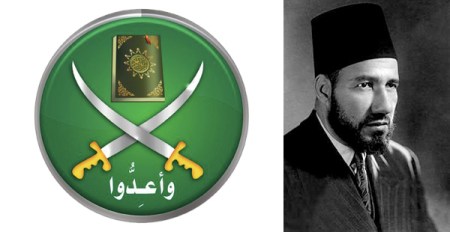
2254The emblem of the Muslim Brotherhood, and its founder, Hassan al-Banna.

The future is also uncertain for a variety of groups and individuals related to the criminal trials surrounding the Holy Land Foundation for Relief and Development, formerly known as the Occupied Land Fund. The 2008 criminal trial resulted in multiple convictions and was touted as the one of the largest terrorism financing trials in American history. Expectations were high that the 2008 trial would be followed by further trials involving the listed unindicted co-conspirators such as CAIR USA and the Islamic Society of North America. However, with the appointment of Eric Holder as the Attorney General of the United States in 2009, all further actions on this file appear to have been frozen. Holder would later speak at a conference supporting one of the unindicted co-conspirators. It is not yet clear if the next U.S. Attorney General will direct that the files be re-activated.

CAIR USA has been repeatedly identified as a Muslim Brotherhood front organization. It was listed as a Muslim Brotherhood front organization and as a terrorism entity by the United Arab Emirates in 2014. CAIR USA employees and former employees have a rather dubious history of criminal activity. Among those CAIR USA employees charged with criminal offences or deported have been Randall Ismail Royer (weapons and explosive charges), Bassam Khafagi (bank and visa fraud), Ghassan Elashi (terrorism financing of Hamas), and Nabil Sadoun (deported for ties to terrorist groups). Other members and fund-raisers for CAIR USA have also been charged.

In Canada, the Royal Canadian Mounted Police investigation (Project Sapphire) into the International Relief Fund for the Afflicted and Needy (IRFAN) continues. IRFAN was one of four Muslim Brotherhood front groups identified during testimony to the Canadian Senate in 2015. The others were Islamic Relief Canada, the Muslim Association of Canada and the National Council of Canadian Muslims, formerly known as CAIR CAN. CAIR CAN, according to the U.S. State Department and a multiplicity of other sources, is the Canadian chapter of CAIR USA.

IRFAN had its charitable status revoked for funding terrorism in 2011 and was subsequently listed as a terrorism entity by the Government of Canada in 2014. It is not clear if the ongoing criminal investigation focuses only on those individuals leading IRFAN at the time of its delisting as a charity and listing as a terrorism entity, or if the investigation also includes those who helped found IRFAN. This may be an important distinction, as the Canada Revenue Agency stated that IRFAN was deliberately created and designed to circumvent Canadian terrorism-funding rules.

Another of the four front groups, the Muslim Association of Canada (MAC), also made the news in 2015. At that point, it was alleged that IRFAN continued to received funding from the Muslim Association of Canada even after IRFAN had its charitable status revoked for funding terrorism in 2011. This information came from an RCMP search warrant that was used to raid IRFAN premises in Mississauga and Montreal. In addition to funding issues, the MAC and IRFAN are connected to each other through common board members and their association to Hamas. IRFAN was funding Hamas and the MAC is one of only two organizations outside of Egypt that openly states it is a Muslim Brotherhood adherent group.

The Islamic Society of North America (Canadian Chapter) has also had its problems. Along with a variety of internal fraud issues, the ISNA Development Fund had the charitable status of its “Development Fund” revoked for terrorism funding. The terrorism-funding money in question was sent to the Relief Organization for Kashmiri Muslims (ROKM) with the ultimate aim of supporting Jamaat-e-Islami, widely known as the Muslim Brotherhood’s sister group in south Asia.

The Muslim Student Association

Another group, the Muslim Student Association (MSA) of the United States and Canada was established in January 1963 by members of the Muslim Brotherhood (MB) at the University of Illinois, Urbana-Champaign campus. Its creation was the result of Saudi-backed efforts to create a network of international Islamic organizations in order to spread its Wahhabist ideology. It was essentially “an arm of the Saudi-funded, Muslim Brotherhood-controlled Muslim World League.”

The following individuals have all been identified as members of the MSA at a variety universities in Canada. They have all been either charged with terrorism offences or died as suicide bombers at the behest of ISIS:

  • Ahmed Sayed Khadr from the University of Ottawa. Khadr was killed on October 2, 2003, along with al-Qaeda and Taliban members, in a shootout by Pakistani security forces near the Afghanistan border. An al-Qaeda website profiling “120 Martyrs of Afghanistan” described him as a leader in Bin Laden’s organization and praised him for “tossing his little child [Omar] in the furnace of the battle.”
  • Chiheb Esseghaier was convicted in 2015 for his role in the attempted bombing of a cross-border VIA Rail train.
  • Khadar Khalib has been charged with terrorism-related offenses and is believed to have killed in Syria while fighting for ISIS.
  • Awso Peshdary, born in Ottawa, was arrested in February 2015 as part of operation “Project Servant” by the RCMP Integrated National Security Enforcement Team. He was charged with participation in the activity of a terrorist group.
  • John “Yahya” Maguire was also born in the Ottawa area, but went off to Syria and become infamous for his ISIS recruiting video. He has also been charged with terrorism offences in absentia.
  • Youssef Sakhir, Samir Halilovic and Zakria Habibi are/were from Sherbrooke Quebec, but are now listed as missing and believed to be fighting in Syria.
  • Muhannad al-Farekh, Farid Imam and Maiwand Yar have all had charges laid against them for terrorism-related offences. Their whereabouts are unknown, but they may be in Pakistan.
  • Calgary suicide bomber Salma Ashrafi was the President of his Muslim Student Association before dying in a suicide bombing in Iraq.

Chiheb Battikh and the Muslim Association of Canada

In December 2012, Chiheb Battikh of Montreal attempted to kidnap the son of a billionaire and hold him for ransom. The Tunisian-Canadian was identified by the Tunis Tribune as being “close to Ennahda” or the Muslim Brotherhood. The French language Journal de Montréal did a five-page story on him following his conviction. Among the issues raised by the paper was Battikh’s long time position on the board of directors for the Muslim Association of Canada as well as his position as the director of education for them. The issue of whether the kidnapping was intended to help fund the new Canadian Institute of Islamic Civilization was raised as well. Battikh had been in charge of that fundraising effort and the project had been in trouble.

The Trump Administration

Some of President-elect Donald J. Trump’s advisors have strong views on the Muslim Brotherhood. Included among these are Walid Phares, who favors banning the Muslim Brotherhood in the U.S. Other advisors include Frank Gaffney, and Pieter “Pete” Hoekstra, both of whom are well acquainted with Muslim Brotherhood activities

Outlook

A variety of Muslim Brotherhood front groups have drawn attention to themselves through terrorism funding and other forms of alleged criminal behavior. CAIR USA (and others) have also been involved in lawfare — suing critics to silence them. Altogether, this activity and their own allegedly criminal actions have drawn greater attention to them and increased, rather than decreased, the amount of research done on them. With the rising, often Islamist-inspired, violence in Europe, the Middle East and South East Asia, more attention will be drawn to the sources of the extremism that are producing and funding terrorism.

It appears possible that a Trump Administration will crack down on Islamist extremist groups in the USA. It also appears probable that this will have a spill-over effect into Canada and Europe though greater attention to border security and issues of funding terrorism. These groups, which have already drawn attention to themselves, may start feeling the heat sooner rather than later.

Hated by those who hate Russia

January 31, 2017

Hated by those who hate Russia

by Iben Thranholm

Source: Hated by those who hate Russia | The Vineyard of the Saker

Recently Marie Krarup, a member of the Danish Parliament for the Danish People’s Party – contacted me to say that the EU task force East Stratcom has placed me on a list branding me as a pro-Russian propagandist and is accusing me of spreading Russian disinformation.

This organisation was set up in March 2015 by the European Council to implement an action plan on strategic communication to address what it labels ”Russia’s on-going disinformation campaigns”, allegedly aiming to destabilize European democracy. To this end, East StratCom ”publishes two public weekly newsletters to stay up to date with the latest disinformation stores and narratives”. Have a look at EastStratcoms website.

This was shocking news to me. Marie Krarup requested a consultation with Danish Minister for Foreign Affairs Anders Samuelsen. She found that the task force accusation violated my constitutional rights under Danish law to exercise freedom of speech, and found this to be stark evidence of the EU usurping undemocratic and totalitarian privilege to list commentators, pundits and journalists that criticize EU policies and EU leaders.

The minister disagreed. He stated that Iben Thranholm deserved her listing as a pro-Russian agent and should remain so listed. He indicated that I was hired by the Kremlin to destabilize Europe. Despite the consultation, this remains his position. No action has been taken to amend the list. No further comment has been offered on the case in the media.

The consequences may be dire. If the conflict with Russia escalates, the state will have the right to imprison me as an enemy of the state. Already now I have been branded a traitor and unpatriotic. Many opinion leaders and colleagues have composed and published an open letter criticizing the ministry. Social media have been brimming with support, but my government remains stubborn in its accusation that I am a Russian agent. This means that I am no longer protected by the state of which I am a national.

For the last couple of years, I have used Russian English-language media like RT op-ed section and Russia Insider for publishing my thoughts on the way the Western elites’ hatred of Christianity weakens and undermines Western culture.

My choice of non-Western media like RT as a platform is certainly not motivated by any payment from Putin. No, it is rooted in the fact that as a conservative Christian Catholic, my thoughts and views are simply increasingly difficult to get published in Europe.

For years now I have had to work as an independent journalist. No editor will take on the risk of employing a person who is open and outspoken about his or her Christian faith, let alone Catholic faith, the way I am. Christians are socially marginalized, derided, and viewed with suspicion if not actually as mentally disturbed. The few Christians left are either secularized – gone native by agreeing with the establishment – or have taken a vow of silence for fear of the political correctness storm troopers. They have no impact on European culture. Their salt has lost its power to keep society from putrefaction.

The article that landed me on the East Stratcom list dealt precisely with the way the elite abused arguments of Christian charity to abandon registration of the identity of who entered which country and for adopting a blanket open-border policy when the tsunami of refugees and immigrants flooded across Europe’s borders in 2015. Their hatred of Christianity certainly does not keep them from abusing arguments of Christian charity divorced from its context when it suits their own agenda.

Allow me to quote some passages from the article, entitled “Misguided Compassion Threatens to Become the Downfall of Europe”

Europe is like Judas, betraying its Christian tradition with the traitorous kiss of false compassion in order to obliterate the last vestige of Christian civilization in Europe. True charity always springs from a higher moral absolute, a clear distinction between right and wrong, good and evil. False charity offers compassion for the criminal and not the victim. No charity for the woman who is victimized by rape but pity for the perpetrator, the rapist. Such pity is a gross perversion.”

In spite of their use – or rather abuse – of “loving one’s neighbor”, politicians are devoid of the Christian basis for distinguishing good from evil. Our politicians promote the forces of evil and utterly abandon their victims. This is merely an extension of the policies of the West in the Middle East since the invasions of Iraq and Afghanistan. Western politicians consistently identify evil as good, and good as evil. They unleash destructive forces to rampage unimpeded and oppress good wherever the West enters the scene with its military or economic warfare.”
 
The fierce hatred of the Western political elite for Christianity has robbed Europe of its moral compass. Using Christian arguments for waging war on Christianity and Christian culture is a vile demonic parody. From a spiritual perspective, it is clear that Europe has made an unholy alliance with islamism in order to annihilate its Christian civilisation. This diabolical scam wears a cloak of goodness and humanitarianism, but it is really a manifestation of moral decay and false altruism that threatens to bring about Die Untergang des Abendlandes, the end of Christian Europe”.

At the consultation in the parliamentary committee meeting, the minister alleged that my article contained lies and myths that fitted into a Kremlin narrative of the decline of the West, and that my arguments bore no relation to reality.

One may agree or disagree with this interpretation. The question is whether this makes me a Russian agent or an enemy of the state. The task force offers no proof of an agreement between the Kremlin and me. For the good reason that no such contract exists. It is an allegation, pure and simple. At the consultation, the minister refuses to take a position on the matter of principle involved in placing participants in the social debate on the list. He merely dismisses my statements as lies.

It is highly revealing that the task force pounces on this article on this subject, because it deals precisely with distinguishing between the truth and lies, and points out that the political elite has entirely lost its ability to distinguish between the truth and lies. This abandonment of truth is far and away the greatest threat to world peace in this day. Russia is not.

Today’s politics are entirely beyond the irrelevant left/right and red/blue paradigm.The real issue is truth v lies, good v evil, right v wrong.

The American election campaign blew this truth wide open. There was hardly any real policy debate, but reams of lies were revealed as masquerading as truth. In its wake, the unspeak designers launched the phenomenon of “fake news” in order to regain control of the narrative. The EU task force has also been set up for achieving a monopoly for the EU version of acceptable reality. The war on truth rages on after President Trump’s inauguration, and the presstitute media now intensify their campaign to brand Trump as a liar.

What irony that a very long epoch of relativism of values, during which the political elite and intellectuals decided that there is no truth, has now ended abruptly with a frenzied claim that truth is all that matters. What immense irony that those who taught young people that there is no truth now exalt themselves as truth tellers, and then hurls accusations of lying against any who does not toe the line of their pragmatic version of truth. The pinnacle of sad irony is that generations reared on the absence of truth from reality now clamor for truth. They have lost faith in the assumption that the media they trusted blindly are telling them the truth.

The media have been roundly exposed as liars. Yet the media claim that the exposure of their lies is a lie and that people who want the truth are lying. Those who tell the truth are blamed as liars, while the media adamantly maintain that they are the truth tellers. Confused? The world has moved from the usual conflicts in the realm of geopolitics and economics to moral and spiritual warfare. The world now witnesses an epic confrontation between the truth and lies, light and darkness, that was kept invisible for so long.  A spiritual war is raging between those who choose good and those who choose to call good what is evil.

Yet who is prepared and equipped for this epic battle of our day? Relativism of values has rendered many, if not most, completely without solid ground and the first idea of what is good and what is evil, utterly unable to recognize truth and defend themselves against lies. They have learned no rudiments on discerning because they have grown up with no spiritual foundation and no inkling of Christian truth. This is a big problem, as it is impossible to understand the world today if one has no spiritual eyes with which to see.

No one can fight for truth, which is spiritual without the ability to recognize truth and distinguish it from the lie. Without the spiritual understanding, no one has the weapons to fight against evil and lies. The chaotic struggle raging in journalism and social media today is a visible expression of this spiritual war.

Alexander Solzhenitsyn said that “godlessness is the first step to the Gulag”. When EU politicians adopt unconstitutional methods for listing political opponents or people who publish moral truth, they declare their godlessness before God and man, and wage war against Christianity and Christian culture. When the state and its ideology place themselves in God’s seat, all hell breaks loose. Democracy offers no guarantee: collectivism can exercise totalitarianism under democracy’s banner. The freedom of speech is now violated in Europe and there is now no freedom for journalists to speak the truth as they see it.

In the 1940s, George Orwell wrote “during times of universal deceit, telling the truth becomes a revolutionary act.” This is our precise position today. Journalists must therefore accept it as a badge of honor and courage when the establishment brands them as liars and pro-Russian propagandists, for this is the highest evidence that they are speaking the truth. They must see themselves as freedom fighters and find comfort and strength in the words of Christ in the Gospel: “truth will set you free.”

On Boycotting Radical Islamic Nations

January 31, 2017

On Boycotting Radical Islamic Nations, Gatestone InstitueNonie Darwish, January 31, 2017

The interviewer seemed shocked to hear that I do not have any Arab or Muslim friends who are protesting President Trump’s ban, and that many immigrants of Islamic origin support the ban and are fed up and embarrassed by what jihadists are doing.

The lesson America needs to know is that the West is not doing Muslims a favor by constantly treating them as children who should be shielded from reality. They hungry for the truth: that their educational system and mosque preaching are full of incitement, are abhorrent, hate-filled and the foundation upon which violent jihad is built.

Muslims need to know that the world does indeed have a justifiable and legitimate concern about Islam and actions done in the name of Islam by Muslims.

Muslims need to look at themselves in the mirror and see the world from the point of view of their victims. Instead, the West is sacrificing its culture, values, laws, pride and even self-respect.

It might compassion that leads the West to take in millions of Muslim refugees but it is reckless compassion. Do Westerners question the motivation of Islamic theocracies as to why ultra-rich Arab nations are sending us their refugees but taking in none?

Some “tough love” is urgently needed if Muslims are to be motivated to change and reform.

Early this morning an Arabic radio station in the Middle East called asking my opinion about President Trump’s ban on refugees and citizens of seven Muslim nations. The radio host, who sounded angry over the ban, was a Christian Arab. She was surprised to hear that I supported the ban and think that it should have taken place the day after 9/11.

She then asked me if I knew any Arab American activist who was against the ban because she wanted to interview someone against the ban. She seemed shocked to hear that I do not have any Arab or Muslim friends who are protesting the ban, and that many immigrants of Islamic and Middle East origin support the ban and are fed up and embarrassed by what jihadists are doing.

She said that all she sees on CNN and other channels are riots that portray almost all Americans supporting Muslims and against Trump. I am upset over the success of the leftist propaganda all over the Middle East. It brings back memories of the life of the hate indoctrination and misinformation I lived under for most of my life.

What would Muslim countries do to the West, I asked, if 19 American terrorists flew airplanes into Arab capitals and their government and military headquarters? What did she think Arabs would do if every week or so American terrorists would conduct synchronized killing sprees all over the Muslim world, gunning Muslims down, blowing them up with homemade pressure cookers, ramming into crowds with trucks? There was silence.

She then started calming down and said that of course she is against terrorism, “but”. I asked: “Do you see what jihad did to your Christian community in the Middle East?” She was silent for a minute, then it occurred to me that she might be afraid to continue the conversation because her bosses were probably Muslims.

I was sure she was going to hang up on me, but to my surprise she asked me to please hold. Then she was back, live from the studio, and started interviewing me and asked the same questions on air. I poured my heart out in Arabic to the Arab listeners.

The lesson here is that Arabs are hungry to hear the truth; this Arab station, instead of rejecting these ideas, ended up putting them on air. The lesson America needs to learn is that the West is not doing Muslims (especially the reformists) a favor by constantly treating them as children who should be shielded from reality.

Muslims need to know that the world does indeed have a justifiable and legitimate concern about Islam and actions done in the name of Islam by Muslims. Muslims need to look at themselves in the mirror and see the world from the point of view of their victims. Instead, the West is sacrificing its culture, values, laws, pride and even self-respect. Muslim culture needs a wake-up call telling them that, sooner or later, non-Muslim nations will close their doors to any kind of Muslim immigration if the jihad culture continues. That will also be a strong message to Muslims already in the West who still believe in jihad.

2256President Donald Trump signs an executive order restricting immigration, January 27, 2017. (Image source: Reuters video screenshot)

The Muslim people are hungry for the truth: that their educational system and mosque preaching are full of incitement, abhorrent, hate-filled and the foundation upon which violent jihad is built. The Islamic commandment to do jihad sacrifices Muslim men, women and children to kill and get killed.

As long as the West continues its appeasement of Islamic jihad, Islam will never reform and the West will lose. So far, the West has continued to extend a lifeline to the religion of Islam; a religion for which the number one enemy is the truth, and which struggles to suppress the truth.

It might be compassion that leads the West to take in millions of Muslim refugees, but it is reckless compassion. Why isn’t Saudi Arabia taking refugees temporarily until things settle down in Syria and Iraq? Do Westerners question the motivation of Islamic theocracies, as to why ultra-rich Arab nations are sending us their refugees but taking in none?

Who is really benefiting from the policy of appeasement, the acceptance of Sharia-stricken theocracies and their jihadist, hate-filled education? Some “tough love” is urgently needed if Muslims are to be motivated to change and reform.

You’re Fired!

January 31, 2017

You’re Fired! Front Page MagazineMatthew Vadum, January 31, 2017

(Please see also Trump Fires Acting Attorney General. There Prof. Turley explains why President Trump was right to fire the acting Attorney General. 

Trump clearly has the right to fire Yates.  Indeed, Yates’ action (and rationale) contradicts long-standing Justice Department policies on such issues.

— DM)

sfg

President Trump last night fired the insubordinate acting Attorney General Sally Yates after she ordered federal prosecutors to ignore Trump’s lawful emergency executive order restricting travel and immigration from Islamic terrorist-infested nations.

The Yates termination may foreshadow a major house-cleaning at the U.S. Department of Justice. That agency is overrun by left-wing careerists who have no respect for the rule of law and who operate under the legally and morally grotesque assumption that aliens, including suspected terrorists, ought to enjoy all the same rights as U.S. citizens.

Yates “has betrayed the Department of Justice by refusing to enforce a legal order designed to protect the citizens of the United States,” Trump said in a press release. “This order was approved as to form and legality by the Department of Justice Office of Legal Counsel.”

He called Yates “an Obama Administration appointee who is weak on borders and very weak on illegal immigration.”

“It is time to get serious about protecting our country,” Trump continued. “Calling for tougher vetting for individuals travelling from seven dangerous places is not extreme. It is reasonable and necessary to protect our country.”

Last night President Trump also relieved acting Immigration and Customs Enforcement (ICE) Director Daniel Ragsdale of his duties. No reason for the decision had been reported at press time. The new acting ICE director is Thomas D. Homan who has been executive associate director of ICE Enforcement and Removal Operations (ERO) since 2013.

When the U.S. Senate was considering Yates’s nomination for deputy attorney general in 2015, Sen. Jeff Sessions (R-Alabama), whose nomination as attorney general is pending in the Senate, made his opposition known. According to Politico, Sessions “urged his colleagues to defeat Yates” objecting “to what he said was her involvement in defending the federal government against a lawsuit 26 states have filed challenging unilateral actions Obama took in November to grant millions of illegal immigrants quasi-legal status and work permits.” Sessions described the Obama actions as “presidential overreach.”

Hours before Trump ended Yates’s employment, Yates  took the extraordinary step of directing Justice Department attorneys to refuse to defend Trump’s executive order in court.

“I am responsible for ensuring that the positions we take in court remain consistent with this institution’s solemn obligation to always seek justice and stand for what is right,” she wrote in a letter to lawyers at the Department of Justice. “At present, I am not convinced that the defense of the executive order is consistent with these responsibilities nor am I convinced that the executive order is lawful.”

“Consequently, for as long as I am the acting attorney general, the Department of Justice will not present arguments in defense of the executive order, unless and until I become convinced that it is appropriate to do so,” she wrote.

Yates’s tenure as acting attorney general ended around dinnertime last night. Around 9 p.m. the president replaced her with Dana Boente, U.S. Attorney for the Eastern District of Virginia.

Boente will serve in the post “until Senator Jeff Sessions is finally confirmed by the Senate, where he is being wrongly held up by Democrat senators for strictly political reasons,” Trump said.

Harvard Law professor emeritus Alan Dershowitz described Yates as “a terrific public servant” who “made a serious mistake here.”

“This is holdover heroism,” he said. “It’s so easy to be a heroine when you’re not appointed by this president and when you’re on the other side.”

Reaction on Twitter was predictably ridiculous.

Unsurprisingly, the nearly-impeached former Attorney General Eric Holder expressed support for Yates.

Holder tweeted last night, “Sally Yates: person of integrity/attorney with great legal skill. Has served this nation with distinction. Her judgment should be trusted.”

Leftist column writer and Obama idolator E.J. Dionne tweeted, “Monday Night Massacre: Trump fires Sally Yates, Acting AG who refused to defend his indefensible #MuslimBan. History will remember her well.”

Football player Rob Carpenter tweeted, “AG upholds the law. Dictator wanna be says you don’t agree with me. You’re fired.”

Actor Jason Alexander tweeted, “King Trump fired the Attorney General. So law and constitution, which he sworn on a bible to protect now clearly mean nothing. Like truth.”

Yates may have a lucrative career ahead of her on the public speaking circuit. Maybe MSNBC will give her a talk show. The Left takes care of its own.

All of this drama flows from the executive order President Trump signed Friday that suspends travel from Muslim terrorism-plagued countries.

The executive order blocks visas for 90 days for “immigrants and non-immigrants” from the terrorism-producing Muslim-majority countries of Iran, Iraq, Libya, Somalia, Syria, Sudan, and Yemen.

The order also prevents refugees from entering the U.S. for 120 days, indefinitely halts the entry of Syrian refugees, and adjusts downward the cap on refugee admission into the U.S. to 50,000 during the current federal fiscal year which ends Sept. 30, 2017.

The presidential directive also requires the government to keep Americans informed about terrorism-related activities and crimes committed by foreign nationals in the U.S. and to report on the individuals’ immigration status.

Critics have mischaracterized the executive order as a Muslim immigration and travel ban. It is an odd critique given that the three countries with the largest Muslim populations –Indonesia, Pakistan, and India– aren’t included in the order.

Groups funded by radical financier George Soros are behind a lawsuit challenging the order.

On Saturday evening Obama-appointed Judge Ann M. Donnelly of the Eastern District of New York blocked part of the executive order and prevented the Trump administration from deporting arrivals detained in airports across the nation. The restraining order preserves the status quo for those who arrived in the country shortly after the executive order was signed if they have visas or lawful permanent resident status.

Before Donnelly’s narrowly drawn restraining order was issued Saturday evening, near-riots broke out as leftist freak shows descended on airports across America. Demonstrators were horrified that some individuals were actually being detained at ports-of-entry as required by the president’s 100 percent legal and constitutional executive order. The left-wing hissy-fit consisted of radicals trespassing and endangering airport security by staging disruptive in-your-face protests at airports around the country.

The HAMAS-linked Council on American-Islamic Relations (CAIR) is playing a major role in the protests against the executive order, Lee Stranahan reports at Breitbart. The group has been organizing demonstrations and promoting opposition to the order on social media. The United Arab Emirates has declared CAIR a terrorist organization.

To no one’s surprise, former President Barack Obama praised the airport protesters, saying through a spokesman he was “heartened by the level of engagement taking place in communities around the country.”

“Citizens exercising their Constitutional right to assemble, organize and have their voices heard by the elected officials is exactly what we expect to see when American values are at stake,” the spokesman said Monday.

Obama intends to conduct his own shadow presidency and attack the Trump administration for years to come. The former president has rented a fancy house on Embassy Row in the nation’s capital that is expected to serve as his anti-Trump administration war room.

Failed presidential candidate Hillary Clinton (D) tweeted Saturday night, “I stand with the people gathered across the country tonight defending our values & our Constitution. This is not who we are.”

Meanwhile, although left-wing law professor Jonathan Turley said he disagrees on policy grounds with Trump’s executive order he argues it is nonetheless legally bulletproof.

“The law does favor President Trump in this regard,” Turley said Sunday on CNN’s “Fareed Zakaria GPS” show. “I don’t like this order. I think it’s a terrible mistake — but that doesn’t go into the legal analysis. The Court has been extremely deferential to presidents on the border.”

The courts won’t buy the left-wing talking point that the order constitutes a ban on Muslim travel and immigration, Turley explained.

“I do not believe a federal court will view this as a Muslim ban,” he said.

I don’t think the court can. Regardless of what the court may think of President Trump’s motivations, the fact that other Muslim countries are not included is going to move that off the table and what’s going to be left is whether the president has this type of authority. Historically, courts have said that he does.

Americans who want their country back after eight years of Obama-created lawlessness don’t need to get upset at the chaos left-wingers are trying to generate to undermine President Trump.

In this case the law is on their side.

The Latest Applicant to be “The Muslim Voice”

January 31, 2017

The Latest Applicant to be “The Muslim Voice”

by Denis MacEoinJanuary 31, 2017 at 4:30 am

Source: The Latest Applicant to be “The Muslim Voice”

  • Secularism may be accepted in a Christian society but it can never enjoy a general acceptance in an Islamic society.” — Yusuf al-Qaradawi.
  • The acceptance of a legislation formulated by humans means a preference of the humans’ limited knowledge and experiences to the divine guidance: “Say! Do you know better than Allah?” (2:140)…. For this reason, the call for secularism among Muslims is atheism and a rejection of Islam. Its acceptance as a basis for rule in place of Shari’ah is downright riddah [apostasy]….” — Yusuf al-Qaradawi.
  • We Muslims believe that Allah is the sole Creator and Sustainer of the Worlds…. If they do not [observe His injunctions and to judge according to them], then they commit kufr [unbelief], aggression, and transgression.” — Yusuf al-Qaradawi.
  • There have never been any effective democracies in the Islamic world.
  • The idea that human beings can replace God as legislators is obnoxious to classical Islamic thought and to modern Islamist convictions. Men and women do not choose how to live: God has been there first.
  • Several of the ECFR’s own pronouncements indicate an unwillingness to compromise with European norms.
  • “The Shari’ah is for all times to come, equally valid under all circumstances. The Muslim insistence on the immutability of the Shari’ah is highly puzzling to many people, but any other view would be inconsistent with its basic concept.” — Yusuf al-Qaradawi.

The European Council for Fatwa and Research (ECFR) plays an important role in the Fiqh al-‘Aqalliyyat (“Jurisprudence for Minorities”) world. It is now based in Dublin, having been founded in London in 1999 by the Federation of Islamic Organizations in Europe. Apart from issuing fatwas (principally those of leading Muslim Brotherhood ideologue, Shaykh Yusuf al-Qaradawi), it aims to supervise the education in Europe of local imams, to bring together Muslim scholars living in Europe, to resolve issues that arise on the continent (and UK) while operating with strict respect for shari’a law (which implies there should be no compromise), and to establish itself as an approved authority wherever Muslims live as minorities. This latter aim would suggest that the ECFR might one day possess an authority that would override that of local and national shari’a councils, and its members would expect to be the first and perhaps only voice to which parliaments and parliamentary bodies would lend an ear in their deliberations on how to treat their Muslim minority communities.

Despite the claim of the ECFR and other bodies involved in guidance for Muslims living outside Islamic jurisdiction to work towards a modus vivendi with Western governments, laws and cultural norms, the members of the ECFR nevertheless tend to approach this challenge in a way that can make the rapprochement problematic. Two matters engage much of their attention, namely secularism and democracy. Al-Qaradawi has spoken and written clearly on these. In one of his books, he separates Christian and Muslim beliefs:

Secularism may be accepted in a Christian society but it can never enjoy a general acceptance in an Islamic society. Christianity is devoid of a shari’ah or a comprehensive system of life to which its adherents should be committed. The New Testament itself divides life into two parts: one for God, or religion, the other for Caesar, or the state: “Render unto Caesar things which belong to Caesar, and render unto God things which belong to God” (Matthew 22:21). As such, a Christian could accept secularism without any qualms of conscience….

The acceptance of a legislation formulated by humans means a preference of the humans’ limited knowledge and experiences to the divine guidance: “Say! Do you know better than Allah?” (2:140)…. For this reason, the call for secularism among Muslims is atheism and a rejection of Islam. Its acceptance as a basis for rule in place of Shari’ah is downright riddah [apostasy]…. This concept is totally different from that of Muslims. We Muslims believe that Allah is the sole Creator and Sustainer of the Worlds. One Who “…takes account of every single thing” (72:28); that He is omnipotent and omniscient; that His mercy and bounties encompasses everyone and suffice for all. In that capacity, Allah revealed His divine guidance to humanity, made certain things permissible and others prohibited, commanded people observe His injunctions and to judge according to them. If they do not do so, then they commit kufr [unbelief], aggression, and transgression.” [1]

Al-Qaradawi considers himself to be a moderate, but that is not always obvious from the positions he takes. He originally rejected democracy, but later advanced the proposition that liberal democracy functions in majority Islamic countries as an alternative to dictatorship and tyranny. The problem with this should be obvious. There have never been any effective democracies in the Islamic world. Democracies require a secular approach that involves the separation of church and state even where religion is given an important role to play.

The idea that human beings can replace God as legislators is obnoxious to classical Islamic thought and to modern Islamist convictions. Men and women do not choose how to live: God has been there first. He has sent down his laws through the Qur’an, the utterances of the Prophet, or the deliberations of the law schools. Since shari’a is all-embracing, only the most emboldened reformers dare to limit it to devotional or personal issues, to go so far as to make observance of its rulings a matter for individual choice, or even to relegate the bulk of it to history.

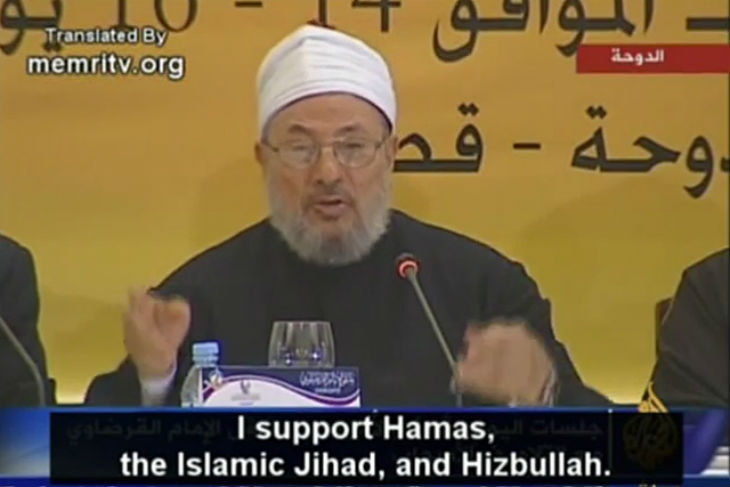
Yusuf al-Qaradawi (Image source: MEMRI video screenshot)

Several of the ECFR’s own pronouncements indicate an unwillingness to compromise with European norms. One fatwa issued by al-Qaradawi tackles the question of challenges to the applicability of shari’a, in answer to which he says, among other things:

The Shari’ah is for all times to come, equally valid under all circumstances. The Muslim insistence on the immutability of the Shari’ah is highly puzzling to many people, but any other view would be inconsistent with its basic concept. Those who advise bringing it into line with current thinking recognize this difficulty. Hence they recommend to Muslims that the legal provisions in the Qur’an and the concept of the Prophet as law-giver and ruler should be “downgraded”.

But, as the manifestation of Allah’s infinite mercy, knowledge and wisdom, the Shari’ah cannot be amended to conform to changing human values and standards, rather, it is the absolute norm to which all human values and conduct must conform; it is the frame to which they must be referred; it is the scale on which they must be weighed.

The ECFR is not the only body determined to insist on the immutability and absolutism of shari’a law. According to Soeren Kern:

“the Union of French Islamic Organizations (UOIF), a large Muslim umbrella group linked to the Muslim Brotherhood, has issued fatwas that encourage French Muslims to reject all authority (namely, secular) that does not have a basis in Sharia law.”

References to several other European Islamic bodies may be found in the remainder of Kern’s article.

Dr. Denis MacEoin is the author of Sharia Law or One Law for All as well as many academic books, reports, and hundreds of academic and popular articles about Islam in many dimensions. He is a Distinguished Senior Fellow at the Gatestone Institute.


[1] For a wide discussion of this issue, see Gabriele Marranci (ed.), Muslim Societies and the Challenge of Secularization: An Interdisciplinary Approach, New York, 2010, 2012

Is The Trump Executive Order on Refugees Unlawful?

January 31, 2017

Is The Trump Executive Order on Refugees Unlawful?, Jonathan Turley’s Blog, Jonathan Turley, January 31, 2017

djt

If the 1965 law means what the ACLU has suggested, actions by presidents from Carter to Obama would be facially unconstitutional.  Presidents have routinely identified countries as raising threats requiring special procedures.  President Obama was among them.  There is no requirement that this can only be done in response to an attack or specific threat if the president finds a national security danger.  Courts are loathe to substitute their judgment on such questions for a president.

*********************************

I previously discussed how President Donald Trump has the advantage in a constitutional challenge of this executive order suspending entry for refugees and imposing special limitations on seven stated countries.  As I have noted, this does not mean that there are not legitimate questions raised, particularly over the express preference to be given “religious minorities” under the order. However, the case laws heavily supports a president’s plenary power over such border controls.  There remains however a question over whether the law could be constitutional under a president’s inherent authority but still unlawful under statutory authority.  Most of that argument centers on the Immigration and Nationality Act of 1965, which bars discrimination based on nationality or place of origin.  There are clearly compelling arguments on both sides of this question, but once again I believe that critics may be overstating the 1965 law as making the executive order facially invalid.  As I have repeatedly stated since this executive order was signed, I believe it was a terrible mistake, poorly executed, and inimical to our values as a nation.  However, legal analysis by a court should not be influenced by such personal viewpoints.  The question is solely whether the president is barred statutorily from taking this action.

The federal law relevant to this question stands in oppose tension between provisions that grant sweeping authority to a president while at the same time limiting that authority with regard to certain types of discrimination.  As we previously discussed, the 1952 immigration laws states in Section 1182(f): “Whenever the President finds that the entry of any aliens or of any class of aliens into the United States would be detrimental to the interests of the United States, he may by proclamation, and for such period as he shall deem necessary, suspend the entry of all aliens or any class of aliens as immigrants or nonimmigrants, or impose on the entry of aliens any restrictions he may deem to be appropriate”   That is obviously quite sweeping and supporting of the actions taken under this executive order.

However, in 1965 the Congress enacted the Immigration and Nationality Act of 1965. That laws was designed to end the quota system given numerical preference to certain European countries.  The  operative provision states “no person could be “discriminated against in the issuance of an immigrant visa because of the person’s race, sex, nationality, place of birth or place of residence.”  Congress exempted Cuban refugees but otherwise stated that no discrimination based on national or place of residence would be tolerated.

It is important to recognize what the 1965 law does not do. First, it does not apply to refugees and thus would not impact much of this order.  This deals with immigrants securing visas.  Second, the law does not ban discrimination based on religion.  Third, the law governs visas not later requirements of reporting or other conditions once immigrants are granted entry. Thus, President Carter signed out Iranian for special procedures and deported thousands of them.  Finally, and most importantly, the law was itself amended in 1996.  Congress expressly stated that “procedures” and “locations” for processing immigration applications cannot count as discrimination.  Thus, the Administration could argue that “vetting procedures” are exempted even for non-refugees.

With the exemption of green card holders, the foot print for analysis under the 1965 language has been reduced further by the Administration.  Notably, the Office of Legal Counsel reviewed these laws and signed off on the legality of the executive order.  I expect it was due to these exemptions and the amendment.

That does not mean that there is not a compelling argument to make but it is not as facially clear as has been suggested.  Like the OLC, I would still give the advantage to the Administration.  However, this is clearly the best foundation for challenge.

Of course, that leaves a potential conflict between the statute and inherent president authority in a rehash of past cases like U.S. v. Curtiss-Wright.  In that opinion, the Court held:

It is important to bear in mind that we are here dealing not alone with an authority vested in the President by an exertion of legislative power, but with such an authority plus the very delicate, plenary and exclusive power of the President as the sole organ of the federal government in the field of international relations–a power which does not require as a basis for its exercise an act of Congress, but which, of course, like every other governmental power, must be exercised in subordination to the applicable provisions of the Constitution.

Presented with such a conflict, the provision could be narrowly construed.  Courts have long adopted interpretations that would avoid such conflicts.  If there is a narrow interpretation of the 1965 law that would avoid the conflict, it traditionally has been favored by federal courts.

The challenge to the order is also burdened by history.  If the 1965 law means what the ACLU has suggested, actions by presidents from Carter to Obama would be facially unconstitutional.  Presidents have routinely identified countries as raising threats requiring special procedures.  President Obama was among them.  There is no requirement that this can only be done in response to an attack or specific threat if the president finds a national security danger.  Courts are loathe to substitute their judgment on such questions for a president.

So where does all of that leave us?  It leaves us with a good-faith challenge to an executive order, but a challenge that will have to clear away a host of existing cases to prevail.  Could it happen?  Sure, but it is important not to overstate the authority in the area or allow passions to overcome analysis.  At most the 1965 law would be relevant to part of the order and even for that portion (on the seven identified countries) the Administration has strong arguments on the basis of inherent plenary authority and statutory exemptions.


Russia freezes Syrian, Iranian military movements

January 31, 2017

Russia freezes Syrian, Iranian military movements, DEBKAfile, January 31, 2017

putinstopsyriaeng480

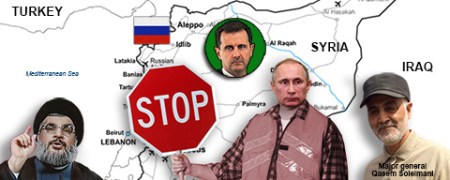
The ban came from Moscow to prevent military reprisals against the Putin-Trump deal for Syria.

Iran can no longer doubt that the two powers, America and Russia, have ganged up to push the Islamic Republic out of their way. Trepidation in Tehran was articulated on Monday, Jan. 30, at a convention staged in the Iranian capital to celebrate 515 years of Iranian-Russian relations, an anniversary that would not normally be marked by a special event.

****************************

An order to remain stationary was issued Thursday night, Jan. 26, by the Russian Commander in Syria Lt. Gen. Alexander Zhuravlev to the high commands of the Syrian army and of the Iranian and Shiite forces positioned in Aleppo, as well as Hizballah units in all parts of Syria. Gen. Zhuravlev, acting on instructions from Moscow, prohibited any movement by those forces out of their current positions as of noon local time.

DEBKAfile’s military and intelligence sources report that the order banned the opening of new battlefronts anywhere in Syria and the movement of Syrian air force units between bases.

This order has been obeyed to date.

The ban came from Moscow to prevent military reprisals against the Putin-Trump deal for Syria. There was no mention of penalties for disobedience, but the tone was peremptory. The three army commanders did not need reminding that the Russians are capable of using their electronic warfare systems to disrupt unauthorized military movements, jam their communications, and withhold fuel, ammo and spare parts to create havoc in their armies.

lieutenant_general_alexander_zhuravlev_120Russian Lt. Gen. General Alexander Zhuravlev

Moscow has never resorted to extreme action of this kind in previous Russian military interventions in Middle East lands.

The decision was taken shortly after the Kremlin was notified that US President Donald Trump had agreed to join forces with President Vladimir Putin in Syria.

Since then, the Trump administration has kept all dealings with Moscow over Syria under a cloak of secrecy, including the outcome of President Trump’s first phone conversation with his Russian counterpart Vladimir Putin. All other concerned parties, such as Israel, have been left groping in the dark about what happens next.

The Russian standstill order in Syria came shortly before the US presidential decree that barred Iranians from entering the United States (along with the nationals of six other terror-prone Muslim countries)

Iran can no longer doubt that the two powers, America and Russia, have ganged up to push the Islamic Republic out of their way. Trepidation in Tehran was articulated on Monday, Jan. 30, at a convention staged in the Iranian capital to celebrate 515 years of Iranian-Russian relations, an anniversary that would not normally be marked by a special event.

In his opening remarks, Foreign Minster Mohammed Zarif Javad said: that Iran and Russia “need to have far more extensive relations,” and “few countries in the world have relations as deep and historical as Iran and Russia.” This sounded like an appeal to Moscow for protection against the new US president. It most likely fell on deaf ears. Putin is fully engaged in promoting his new relations with Donald Trump.

Smoking Out Islamists via Extreme Vetting

January 31, 2017

Smoking Out Islamists via Extreme Vetting, Middle East Forum, Daniel Pipes, January 28, 2017(?)

(Please see also, A Muslim Reformer Speaks Out About His Battle Against Islamism And PC. — DM)

On January 27, President Donald Trump signed an executive order to implement his proposed “extreme vetting” of those applying for entry visas into the United States. This article by Middle East Forum President Daniel Pipes, who has written extensively on the practicality and enforceability of screening for Islamists, is an advance release from the forthcoming Spring 2017 issue of Middle East Quarterly.

3570Smoking Them Out (1906), Charles M. Russell.

Donald Trump issued an executive order on Jan. 27 establishing radically new procedures to deal with foreigners who apply to enter the United States.

Building on his earlier notion of “extreme vetting,” the order explains that

to protect Americans, the United States must ensure that those admitted to this country do not bear hostile attitudes toward it and its founding principles. The United States cannot, and should not, admit those who do not support the Constitution, or those who would place violent ideologies over American law. In addition, the United States should not admit those who engage in acts of bigotry or hatred (including “honor” killings, other forms of violence against women, or the persecution of those who practice religions different from their own) or those who would oppress Americans of any race, gender, or sexual orientation.

This passage raises several questions of translating extreme vetting in practice: How does one distinguish foreigners who “do not bear hostile attitudes toward it and its founding principles” from those who do? How do government officials figure out “those who would place violent ideologies over American law”? More specifically, given that the new procedures almost exclusively concern the fear of allowing more Islamists into the country, how does one identify them?

I shall argue these are doable tasks and the executive order provides the basis to achieve them. At the same time, they are expensive and time-consuming, demanding great skill. Keeping out Islamists can be done, but not easily.

The Challenge

By Islamists (as opposed to moderate Muslims), I mean those approximately 10-15 percent of Muslims who seek to apply Islamic law (the Shari’a) in its entirety. They want to implement a medieval code that calls (among much else) for restricting women, subjugating non-Muslims, violent jihad, and establishing a caliphate to rule the world.

For many non-Muslims, the rise of Islamism over the past forty years has made Islam synonymous with extremism, turmoil, aggression, and violence. But Islamists, not all Muslims, are the problem; they, not all Muslims, must urgently be excluded from the United States and other Western countries. Not just that, but anti-Islamist Muslims are the key to ending the Islamist surge, as they alone can offer a humane and modern alternative to Islamist obscurantism.

Identifying Islamists is no easy matter, however, as no simple litmus test exists. Clothing can be misleading, as some women wearing hijabs are anti-Islamists, while practicing Muslims can be Zionists; nor does one’s occupation indicate much, as some high-tech engineers are violent Islamists. Likewise, beards, teetotalism, five-times-a-day prayers, and polygyny do not tell about a Muslim’s political outlook. To make matters more confusing, Islamists often dissimulate and pretend to be moderates, while some believers change their views over time.
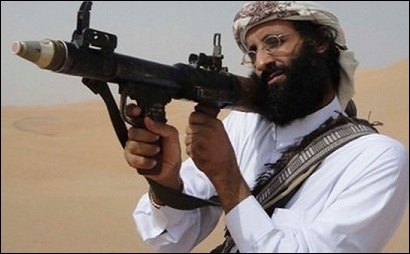
3567In 2001, the Pentagon invited Anwar al-Awlaki to lunch. In 2011, it killed him by a drone strike.

Finally, shades of gray further confuse the issue. As noted by Robert Satloff of The Washington Institute, a 2007 book from the Gallup press, Who Speaks for Islam? What a Billion Muslims Really Think, based on a poll of over 50,000 Muslims in 10 countries, found that 7 percent of Muslims deem the 9/11 attacks “completely justified,” 13.5 percent consider the attacks completely or “largely justified,” and 36.6 percent consider the attacks completely, largely, or “somewhat justified.” Which of these groups does one define as Islamist and which not?

Faced with these intellectual challenges, American bureaucrats are unsurprisingly incompetent, as I demonstrate in a long blog titled “The U.S. Government’s Poor Record on Islamists.” Islamists have fooled the White House, the departments of Defense, Justice, State, and Treasury, the Congress, many law enforcement agencies and a plethora of municipalities. A few examples:

  • The Pentagon in 2001 invited Anwar al-Awlaki, the American Islamist it later executed with a drone-launched missile, to lunch.
  • In 2002, FBI spokesman Bill Carter described the American Muslim Council (AMC) as “the most mainstream Muslim group in the United States” – just two years before the bureau arrested the AMC’s founder and head, Abdurahman Alamoudi, on terrorism-related charges. Alamoudi has now served about half his 23-year prison sentence.
  • George W. Bush appointed stealth Islamist Khaled Abou El Fadl in 2003 to, of all things, the United States Commission on International Religious Freedom.
  • The White House included staff in 2015 from the Council on American-Islamic Relations (CAIR) in its consultations, despite CAIR’s initial funding by a designated terrorist group, the frequent arrest or deportation of its employees on terrorism charges, a history of deception, and the goal of one of its leaders to make Islam the only accepted religion in America.

Fake-moderates have fooled even me, despite all the attention I devote to this topic. In 2000, I praised a book by Tariq Ramadan; four years later, I argued for his exclusion from the United States. In 2003, I condemned a Republican operative named Kamal Nawash; two years later, I endorsed him. Did they evolve or did my understanding of them change? More than a decade later, I am still unsure.

Uniform Screening Standards

Returning to immigration, this state of confusion points to the need for learning much more about would-be visitors and immigrants. Fortunately, Trump’s executive order, “Protecting the Nation from Foreign Terrorist Entry into the United States,” signed on Jan. 27, 2017, requires just this. It calls for “Uniform Screening Standards” with the goal of preventing individuals from entering the United States “on a fraudulent basis with the intent to cause harm, or who are at risk of causing harm subsequent to their admission.” The order requires that the uniform screening standard and procedure include such elements as (bolding is mine):

  1. In-person interviews;
  2. A database of identity documents proffered by applicants to ensure that duplicate documents are not used by multiple applicants;
  3. Amended application forms that include questions aimed at identifying fraudulent answers and malicious intent;
  4. A mechanism to ensure that the applicant is who the applicant claims to be;
  5. A process to evaluate the applicant’s likelihood of becoming a positively contributing member of society and the applicant’s ability to make contributions to the national interest; and
  6. A mechanism to assess whether or not the applicant has the intent to commit criminal or terrorist acts after entering the United States.

Elements 1, 3, 5, and 6 permit and demand the procedure outlined in the following analysis. It contains two main components, in-depth research and intensive interviews.

Research

When a person applies for a security clearance, the background checks should involve finding out about his family, friends, associations, employment, memberships, and activities. Agents must probe these for questionable statements, relationships, and actions, as well as anomalies and gaps. When they find something dubious, they must look further into it, always with an eye for trouble. Is access to government secrets more important than access to the country? The immigration process should start with an inquiry into the prospective immigrant and, just as with security clearances, the border services should look for problems.

3572Most everyone with strong views at some point vents them on social media.

Also, as with security clearance, this process should have a political dimension: Does the person in question have an outlook consistent with that of the Constitution? Not long ago, only public figures such as intellectuals, activists, and religious figures put their views on the record; but now, thanks to the Internet and its open invitation to everyone to comment in writing or on video in a permanent, public manner, and especially to social media (Facebook, Twitter, etc.), most everyone with strong views at some point vents them. Such data provides valuably unfiltered views on many critical topics, such as Islam, non-Muslims, women, and violence as a tactic. (Exploiting this resource may seem self-evident but U.S. immigration authorities do not do so, thereby imposing a self-restraint roughly equivalent to the Belgian police choosing not to conduct raids between 9 p.m. and 5 a.m.)

In the case of virulent, overt, outspoken jihadis, this research usually suffices to provide evidence to exclude them. Even some non-violent Islamists proudly announce their immoderation. But many Islamists adopt a milder and subtler tone, their goal being to appear moderate so they can enter the country and then impose Shari’a through lawful means. As suggested by some of the examples above, such as Abou El Fadl or CAIR, research often proves inadequate in these instances because cautious Islamists hide their goals and glibly dissimulate. Which brings us to entrance interviews.

Entrance Interviews

Assuming that lawful Islamists routinely hide their true views, an interview is needed before letting them enter the country. Of course, it is voluntary, for no one is forced to apply for immigration, but it also must be very thorough. It should be:

Recorded: With the explicit permission of the person being questioned (“You understand and accept that this interview is being recorded, right?”), the exchange should be visibly videotaped so the proceedings are unambiguously on the record. This makes available the interviewee’s words, tone, speech patterns, facial expressions, and body language for further study. Form as well as substance matters: does the interviewee smile, fidget, blink, make eye contact, repeat, sweat, tremble, tire, need frequent toilet breaks, or otherwise express himself in non-verbal ways?

Polygraph: Even if a lie detector machine does not, in fact, provide useful information, attaching the interviewee to it might induce greater truth-telling.

Under oath: Knowing that falsehoods will be punished, possibly with jail time, is a strong inducement to come clean.

Public: If the candidate knows that his answers to abstract questions (as opposed to personal ones about his life) will be made public, this reduces the chances of deception. For example, asked about belief for the full application of Islamic laws, an Islamist will be less likely to answer falsely in the negative if he knows that his reply will be available for others to watch.

3568Look for inconsistency by asking the same thing in different ways. An example: “May a woman show her face in public?” and “Is a male guardian responsible for making sure his women-folk don’t leave the house with faces uncovered?

Multiple: No single question can evince a reply that establishes an Islamist disposition; effective interviewing requires a battery of queries on many topics, from homosexuality to the caliphate. The answers need to be assessed in their totality.

Specific: Vague inquiries along the lines of “Is Islam a religion of peace?”, “Do you condemn terrorism?” “How do you respond to the murder of innocents,” depend too much on one’s definition of words such as peace, terrorism, and innocents to help determine a person’s outlook, and so should be avoided. Instead, questions must be focused and exact: “May Muslims convert out of Islam, whether to join another faith or to become atheists?” “Does a Muslim have the right to renounce Islam?”

Variety in phrasing: For the questions to ferret out the truth means looking for divergence and inconsistency by asking the same question with different words and variant emphases. A sampling: “May a woman show her face in public?” “What punishment do you favor for females who reveal their faces to men not related to them by family?” “Is it the responsibility of the male guardian to make sure his women-folk do not leave the house with faces uncovered?” “Should the government insist on women covering their faces?” “Is society better ordered when women cover their faces?” Any one of the questions can be asked in different ways and expanded with follows-up about the respondent’s line of reasoning or depth of feeling.

Repeated: Questions should be asked again and again over a period of weeks, months, and even longer. This is crucial: lies being much more difficult to remember than truths, the chances of a respondent changing his answers increases with both the volume of questions asked and the time lapse between questionings. Once inconsistencies occur, the questioner can zero in and explore their nature, extent, and import.

The Questions

Guidelines in place, what specific questions might extract useful information?
3574Zuhdi Jasser (L) with the author as teammates at a 2012 Intelligence Squared debate in New York City.

The following questions, offered as suggestions to build on, are those of this author but also derive from a number of analysts devoting years of thinking to the topic. Naser Khader, the-then Danish parliamentarian of Syrian Muslim origins, offered an early set of questions in 2002. A year later, this author published a list covering seven subject areas.

Others followed, including the liberal Egyptian Muslim Tarek Heggy, the liberal American Muslims Tashbih Sayyed and Zuhdi Jasser, the ex-Muslim who goes by “Sam Solomon,” a RAND Corporation group, and the analyst Robert Spencer. Of special interest are the queries posed by the German state of Baden-Württemberg dated September 2005 because it is an official document (intended for citizenship, not immigration, but with similar purposes).

Islamic doctrine:

1. May Muslims reinterpret the Koran in light of changes in modern times?

2. May Muslims convert out of Islam, either to join another faith or to be without religion?

3. May banks charge reasonable interest (say 3 percent over inflation) on money?

4. Is taqiya (dissimulation in the name of Islam) legitimate?

Islamic pluralism:

5. May Muslims pick and choose which Islamic regulations to abide by (e.g., drink alcohol but avoid pork)?

6. Is takfir (declaring a Muslim to be an infidel) acceptable?

7. [Asked of Sunnis only:] Are Sufis, Ibadis, and Shi’ites Muslims?

8. Are Muslims who disagree with your practice of Islam infidels (kuffar)?

The state and Islam:

9. What do you think of disestablishing religion, that is, separating mosque and state?

10. When Islamic customs conflict with secular laws (e.g., covering the face for female drivers’ license pictures), which gets priority?

11. Should the state compel prayer?

12. Should the state ban food consumption during Ramadan and penalize transgressors?

13. Should the state punish Muslims who eat pork, drink alcohol, and gamble?

14. Should the state punish adultery?

15. How about homosexuality?

16. Do you favor a mutawwa’ (religious police) as exist in Saudi Arabia?

17. Should the state enforce the criminal punishments of the Shari’a?

18. Should the state be lenient when someone is killed for the sake of family honor?

19. Should governments forbid Muslims from leaving Islam?

Marriage and divorce:

20. Does a husband have the right to hit his wife if she is disobedient?

21. Is it a good idea for men to shut their wives and daughters at home?

22. Do parents have the right to determine whom their children marry?

23. How would you react if a daughter married a non-Muslim man?

24. Is polygyny acceptable?

25. Should a husband have to get a first wife’s approval to marry a second wife? A third? A fourth?

26. Should a wife have equal rights with her husband to initiate a divorce?

27. In the case of divorce, does a wife have rights to child custody?

Female rights:

28. Should Muslim women have equal rights with men (for example, in inheritance shares or court testimony)?

29. Does a woman have the right to dress as she pleases, including showing her hair, arms and legs, so long as her genitalia and breasts are covered?

30. May Muslim women come and go or travel as they please?

31. Do Muslim women have a right to work outside the home or must the wali approve of this??

32. May Muslim women marry non-Muslim men?

33. Should males and females be separated in schools, at work, and socially?

34. Should certain professions be reserved for men or women only? If so, which ones?

35. Do you accept women occupying high governmental offices?

36. In an emergency, would you let yourself be treated by or operated on by a doctor of the opposite gender?

Sexual activity:

37. Does a husband have the right to force his wife to have sex?

38. Is female circumcision part of the Islamic religion?

39. Is stoning a justified punishment for adultery?

40. Do members of a family have the right to kill a woman if they believe she has dishonored them?

41. How would you respond to a child of yours who declares him- or herself a homosexual?

Schools:

42. Should your child learn the history of non-Muslims?

43. Should students be taught that Shari’a is a personal code or that governmental law must be based on it?

44. May your daughter take part in the sports activities, especially swimming lessons, offered by her school?

45. Would you permit your child to take part in school trips, including overnight ones?

46. What would you do if a daughter insisted on going to university?

Criticism of Muslims:

3575Denying the Islamic nature of ISIS reveals much about a Muslim.

47. Did Islam spread only through peaceful means?

48. Do you accept the legitimacy of scholarly inquiry into the origins of Islam, even if it casts doubt on the received history?

49. Do you accept that Muslims were responsible for the 9/11 attacks?

50. Is the Islamic State/ISIS/ISIL/Daesh Islamic in nature?

Fighting Islamism:

51. Do you accept enhanced security measures to fight Islamism, even if this might mean extra scrutiny of yourself (for example, at airline security)?

52. When institutions credibly accused of funding jihad are shut down, is this a symptom of anti-Muslim bias?

53. Should Muslims living in the West cooperate with law enforcement?

54. Should they join the military?

55. Is the “war on terror” a war on Islam?

Non-Muslims (in general):
3573Praying at the Hindu Temple in Dubai, founded 1958.

56. Do all humans, regardless of gender, ethnicity, sexual orientation or religious beliefs, deserve equal rights?

57. Should non-Muslims enjoy completely equal civil rights with Muslims?

58. Do you accept the validity of other monotheistic religions?

59. Of polytheistic religions (such as Hinduism)?

60. Are Muslims superior to non-Muslims?

61. Should non-Muslims be subject to Islamic law?

62. Do Muslims have anything to learn from non-Muslims?

63. Can non-Muslims go to paradise?

64. Do you welcome non-Muslims to your house and go to their residences?

Non-Muslims (in Dar al-Islam):

65. May Muslims compel “Peoples of the Book” (i.e., Jews and Christians) to pay extra taxes?

66. May other monotheists build and operate institutions of their faith in Muslim-majority countries?

67. How about polytheists?

68. Should the Saudi government maintain the historic ban on non-Muslims in Mecca and Medina?

69. Should it allow churches to be built for Christian expatriates?

70. Should it stop requiring that all its subjects be Muslim?

Non-Muslims (in Dar al-Harb):

71. Should Muslims fight Jews and Christians until these “feel themselves subdued” (Koran 9:29).

72. Is the enslavement of non-Muslims acceptable?

73. Is it acceptable to arrest individuals who curse the prophet of Islam or burn the Koran?

74. If the state does not act against such deeds, may individual Muslims act?

75. Can one live a fully Muslim life in a country with a mostly non-Muslim government?

76. Should a Muslim accept a legitimate majority non-Muslim government and its laws or work to make Islam supreme?

77. Can a majority non-Muslim government unreservedly win your allegiance?

78. Should Muslims who burn churches or vandalize synagogues be punished?

79. Do you support jihad to spread Islam?

Violence:

80. Do you endorse corporal punishments (mutilation, dismemberment, crucifixion) of criminals?

81. Is beheading an acceptable form of punishment?

82. Is jihad, meaning warfare to expand Muslim rule, acceptable in today’s world?

83. What does it mean when Muslims yell “Allahu Akbar” as they attack?

84. Do you condemn violent organizations such as Boko Haram, Hamas, Hezbollah, Islamic Jihad, the Islamic State, Al-Qaeda, Shabaab, and the Taliban?

Western countries:

85. Are non-Islamic institutions immoral and decadent or can they be moral and virtuous?

86. Do you agree with studies that show non-Muslim countries such as New Zealand to be better living up to the ideals of Islam than Muslim-majority countries?

87. Is Western-style freedom an accomplishment or a form of moral corruption? Why?

88. Do you accept that Western countries are majority-Christian or do you seek to transform them into majority-Muslim countries?

89. Do you accept living in Western countries that are secular or do you seek to have Islamic law rule them?

90. What do you think of Shari’a-police patrolling Muslim-majority neighborhoods in Western countries to enforce Islamic morals?

91. Would you like to see the U.S. Constitution (or its equivalents in other countries) replaced by the Koran?

This interview:

92. In an immigration interview like this, if deceiving the questioner helps Islam, would lying be justified?

93. Why should I trust that you have answered these questions truthfully?

Observations about the Interviews

Beyond helping to decide whom to allow into the country, these questions can also help in other contexts as well, for example in police interrogations or interviews for sensitive employment positions. (The list of Islamists who have penetrated Western security services is a long and painful one.)
3569Islamists are hardly the only ones who condemn Israel. Here Jewish Voice for Peace activists protest.

Note the absence of questions about highly charged current issues. That is because Islamist views overlap with non-Islamist outlooks; plenty of non-Islamists agree with Islamists on these topics. Although Leil Leibowitz in contrast sees Israel as “moderate Islam’s real litmus test,” Islamists are hardly the only ones who demand Israel’s elimination and accept Hamas and Hezbollah as legitimate political actors – or believe the Bush administration carried out the 9/11 attacks or hate the United States. Why introduce these ambiguous issues when so many Islam-specific questions (e.g., “Is the enslavement of non-Muslim acceptable?”) have the virtue of far greater clarity?

The interviewing protocol outlined above is extensive, asking many specific questions over a substantial period using different formulations, probing for truth and inconsistencies. It is not quick, easy, or cheap, but requires case officers knowledgeable about the persons being interviewed, the societies they come from, and the Islamic religion; they are somewhat like a police questioner who knows both the accused person and the crime. This is not a casual process. There are no shortcuts.

Criticisms

This procedure raises two criticisms: it is less reliable than Trump’s no-Muslim policy and it is too burdensome for governments to undertake. Both are readily disposed of.

Less reliable: The no-Muslim policy sounds simple to implement but figuring out who is Muslim is a problem in itself (are Ahmadis Muslims?). Further, with such a policy in place, what will stop Muslims from pretending to renounce their religion or to convert to another religion, notably Christianity? These actions would require the same in-depth research and intensive interviews as described above. If anything, because a convert can hide behind his ignorance of his alleged new religion, distinguishing a real convert to Christianity from a fake one is even more difficult than differentiating an Islamist from a moderate Muslim.

Too burdensome: True, the procedure is expensive, slow, and requires skilled practitioners. But this also has the benefit of slowing a process that many, myself included, consider out of control, with too many immigrants entering the country too quickly. Immigrants numbered 5 percent of the population in 1965, 14 percent in 2015, and are projected to make up 18 percent in 2065. This is far too large a number to assimilate into the values of the United States, especially when so many come from outside the West; the above mechanism offers a way to slow it down.

As for those who argue that this sort of inquiry and screening for visa purposes is unlawful; prior legislation for naturalization, for example, required that an applicant be “attached to the principles of the Constitution” and it was repeatedly found to be legal.

Finally, today’s moderate Muslim could become tomorrow’s raging Islamist; or his infant daughter might two decades later become a jihadi. While any immigrant can turn hostile, such changes happen far more often among born Muslims. There is no way to guarantee this from happening but extensive research and interrogations reduce the odds.

Conclusion

Truly to protect the country from Islamists requires a major commitment of talent, resources, and time. But, properly handled, these questions offer a mechanism to separate enemy from friend among Muslims. They also have the benefit of slowing down immigration. Even before Trump became president, if one is to believe CAIR, the U.S. Customs and Border Protection Agency (CBP) asked questions along the lines of those advocated here (What do you think of the USA? What are your views about jihad? See the appendix for a full listing). With Trump’s endorsement, let us hope this effective “no-Islamists” policy is on its way to becoming systematic.


Appendix

On January 18, 2017, just hours before Donald Trump became president of the United States, the Florida office of the Council on American-Islamic Relations (CAIR) filed ten complaints with the Customs and Border Protection Agency (CBP) for questioning Muslim citizens about their religious and political views. Among the questions allegedly asked were:

1. Are you a devout Muslim?

2. Are you Sunni or Shia?

3. What school of thought do you follow?

4. Which Muslim scholars do you follow?

5. What current Muslim scholars do you listen to?

6. Do you pray five times a day?

7. Why do you have a prayer mat in your luggage?

8. Why do you have a Qur’an in your luggage?

9. Have you visited Saudi Arabia?

10. Will you every visit Saudi or Israel?

11. What do you know about the Tableeghi-Jamat?

12. What do you think of the USA?

13. What are your views about Jihad?

14. What mosque do you attend?

15. Do any individuals in your mosque have any extreme/radical views?

16. Does your Imam express extremist views?

17. What are the views of other imams or other community members that give the Friday sermon at your mosque?

18. Do they have extremist views?

19. Have you ever delivered the Friday Prayer? What did you discuss with your community?

20. What are your views regarding [various terrorist organizations]?

21. What social media accounts do you use?

22. What is your Facebook account username?

23. What is your Twitter account username?

24. What is your Instagram account username?

25. What are the names and telephone numbers of parents, relatives, friends?

CAIR also claims a Canadian Muslim was asked by CBP the following questions and then denied entry:

1. Are you Sunni or Shia?

2. Do you think we should allow someone like you to enter our country?

3. How often do you pray?

4. Why did you shave your beard?

5. Which school of thought do you follow?

6. What do you think of America’s foreign policy towards the Muslim world?

7. What do you think of killing non-Muslims?

8. What do you think of [various terrorist groups]?

Finally, CAIR indicates that those questioned “were held between 2 to 8 hours by CBP.”