There’s no joy at 1600 Pennsylvania Avenue. They never planned for this. In their arrogance and hubris, they were sure that it could never happen. And then it did.
There is no plan at the White House.
They also never thought this could or would happen.
Obama said for months on the campaign trail that he’d consider Donald Trump’s election a personal repudiation. And it was. The Senate and House results leave no question, as if there could be one.
A reality has slipped through their fingers. Four more years of a Democrat in the White House would make much of how Obama reshaped the government irreversible. A woman following a black man would drive home how there was no turning back to the old ways. Filling that Supreme Court seat would cement it for a generation.
Sorry, no.
But you can see the lack of preparedness in Obama’s stumbling awkward statement this morning. His pregnant pauses at key points. His difficultly even pronouncing “President Elect Trump”. There really was no plan for the impossible.
President Barack Obama and aides are keeping smiles on their faces, but a sense of doom has descended on the White House.
Doom! Freak out!
But the freak-out has been kept in check – in public, at least. Obama stood calmly on Wednesday afternoon promising a smooth transition, coolly urging supporters and disappointed voters to nurse their wounds and get back into the arena.
The world order has been shaken. Everything that everyone thought they knew about politics is wrong
The slaves are rebelling. This was not supposed to happen.
Obama, watching the returns come in from the White House residence until late into the night, was stunned and disappointed, Earnest said.
Shoe. Other foot.
The plan was for Obama to stay in Washington for at least two years, moving to a house a few miles away while his younger daughter finished high school. Either that plan will change, or that home will likely become the base of a government in exile…
What about Elba?
And there will no doubt be renewed calls in some quarters for Michelle Obama, who could run though her husband constitutionally cannot, to look at 2020 as the saving grace.
Sure. She’s as qualified as Hillary. And about as likable. When in doubt, double down on dynasty.
The White House staffers who massed into the Rose Garden to hear some kind of comfort or explanation cried and hugged, the shock running through their bodies.
For President Barack Obama, Donald Trump’s presidential victory is nothing less than a nightmare.
His longstanding vision for progressive change faced sharp and unexpected repudiation Tuesday night from voters still fuming at their perceived diminished prospects. By Obama’s own admission, the major pieces of his presidential legacy are now subject to a gutting by a successor he resents deeply.
It was encouraging Wednesday to hear that President Obama intends to emulate President Bush, who generously provided Obama with a highly informative and smooth transition process.
Running the Executive Branch is a daunting task, so there is no aspect of the transition to a new administration that is unimportant. But obviously, the most crucial focus for New Jersey Governor Chris Christie, who is heading up President-elect Donald Trump’s transition team, must be national security.
That transition is going to be more complicated than it should be, but there are things Gov. Christie can do – better to say, people he ought to consult — to make sure his team is getting accurate information.
The Bush National Security Council was very good about putting together briefing books so their successors could hit the ground running. The problem now, however, is the trustworthiness of what is in those books.
As PJ Media has reported, a highly disturbing report by a congressional task force this summer found that the Obama administration had politicized its intelligence product.
Rep. Mike Pompeo (R-KS), who has been stellar on national security issues and was among the leaders of the task force (comprised of the Intelligence, Armed Services, and Appropriations Committees), put it this way when the report was issued:
After months of investigation, this much is very clear: from the middle of 2014 to the middle of 2015, the United States Central Command’s most senior intelligence leaders manipulated the command’s intelligence products to downplay the threat from ISIS in Iraq.The result: consumers of those intelligence products were provided a consistently “rosy” view of U.S. operational success against ISIS. That may well have resulted in putting American troops at risk as policymakers relied on this intelligence when formulating policy and allocating resources for the fight.
The intelligence manipulation became a controversy in 2015, when 50 intelligence-community whistleblowers complained that their reports on the Islamic State and al-Qaeda terror networks were being altered.
The manipulation, driven by Obama’s Office of the Director of National Intelligence (ODNI) and carried out in the Defense Department by senior Central Command (CENTCOM) officers, aimed to downplay the jihadist threat.
This is a reckless practice I have written about several times over the last eight years (see, e.g., here). The Obama administration has made a concerted effort to miniaturize the terrorist threat in order to project a mirage of policy success.
Intelligence has routinely been distorted — portraying the networks as atomized, largely detached cells that are not unified by any overarching ideology — in an attempt to make them appear smaller and less threatening. Basically, a nuisance to be managed rather than an enemy to be defeated.
Even when the terrorists are on the march, the administration claims they are in retreat. Indeed, less than 24 hours after four Americans, including our ambassador to Libya, were killed by al-Qaeda-affiliated jihadists in the 2012 siege of Benghazi, President Obama stated this in a political fundraising speech:
A day after 9/11, we are reminded that a new tower rises above the New York skyline, but al-Qaeda is on the path to defeat and bin Laden is dead.
Intel manipulation ran rampant after Obama fired Marine General James Mattis, CENTCOM’s commander, in 2013. General Mattis had the irksome habits of demanding clear-eyed assessments of America’s enemies and forcing administration policymakers to confront the potential consequences of their ludicrously optimistic assumptions, particularly regarding Iran’s behavior. Obama officials replaced him with Army General Lloyd Austin.
Meanwhile, it was made clear to the Pentagon that because the president made campaign commitments to end the U.S. mission in Iraq, he did not want to hear information contradictory to his narrative that withdrawing our forces was the right thing to do. After retiring, Army General Anthony Tata confirmed that an ODNI official instructed the Defense Department not to put in writing assessments that portrayed al-Qaeda and ISIS as fortified and threatening.
The result, of course, was that the president was told what wanted to hear.
This eventually led to Obama’s infamous assertion that ISIS was merely a “JV” terrorist team. Naturally, when the JV team rampaging through Iraq and Syria rendered that judgment embarrassing, the White House shifted the blame to General Austin, pushing him out the CENTCOM door.
The administration has done more to sculpt the narrative than quell the enemy. So Gov. Christie and his team will need to regard with skepticism any briefing books Obama’s transition coordinators supply.
Of course, Team Trump already has a tremendous resource to rely on: retired Army General Michael Flynn, the former head of the Defense Intelligence Agency (and the author, along with PJ Media columnist Michael Ledeen, of The Field of Fight, which pleads for a desperately needed strategy for fighting the global war against jihadists and their allies). Like General Mattis, General Flynn (in 2014) was pushed out of his job because he rejected the politicization of our intelligence product for purposes of low-balling the terrorist threat. He knows his stuff, knows what we are up against, and will be a major asset not only to the transition, but to the Trump administration.
I would also respectfully suggest that Gov. Christie consult with General Mattis and General Jack Keane: smart, experienced former commanders who have given a great deal of thought to, and sound advice to Congress regarding, the current administration’s strategic and intelligence voids.
In understanding global jihadist networks — who the players are, how the organizations collude and compete — Tom Joscelyn, editor of The Long War Journal, is the best expert in the United States, bar none. While his value would be limitless, Tom is especially knowledgeable about the jihadists released from Guantanamo Bay, many of whom have gone back to the jihad.
Yet again, this is a context in which briefings from the Obama administration would be suspect. The president adheres to another narrative driven by foolish campaign promises, namely: the cost of Gitmo as a “recruiting tool” for the enemy outweighs the benefit of detaining committed, capable, anti-American jihadists. To justify both this absurd premise and the release of the terrorists, the administration watered down intelligence that supported holding the terrorists as enemy combatants who posed continuing danger to the United States.
The new administration needs accurate information for purposes of grasping the threat and formulating sound detention policy.
Finally, it is vital to understand “Countering Violent Extremism,” the Obama administration’s strategic guidance — their playbook for military, intelligence, and law-enforcement officials on how to approach and respond to terrorism. CVE is where the dereliction that I have labeled “willful blindness” has devolved into compulsory blindness.
Under CVE guidelines, the fact that Islamic-supremacist ideology spurs the jihadist threat and knits together terrorists and their sponsors is no longer just consciously avoided; taking notice of it is verboten.
The most thoroughgoing critique of this lunacy is Catastrophic Failure: Blindfolding America in the Face of Jihad. Its author is Stephen Coughlin, a trained military intelligence officer and an attorney who has made a point of learning how Islamic law principles inform the goals and tactics of our enemies. Steve is extraordinarily informed about the administration’s wayward assumptions. If the Trump transition team wants to check the premises on which their work is based, he’s the guy.
Let’s welcome President Obama’s assurances of a seamless transition to the Trump administration. But my best unsolicited advice to Gov. Christie: When it comes to briefing books, don’t believe everything you read.
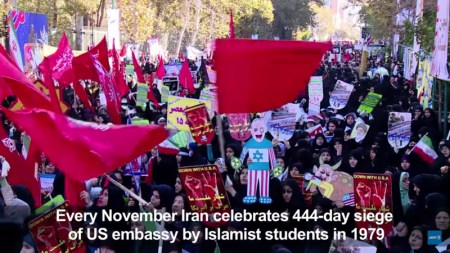
Chants of “Death to America” and “Death to Israel” were heard across Iranian cities as thousands of Iranians marked the anniversary of the seizure of the U.S. Embassy in Tehran and the taking of 52 American hostages for 444 days by militant students.
The State Department’s reaction is classic: ignoring these developments and continuing with appeasement policies.<
These anti-American demonstrations are not rhetoric, but are the cornerstone of Iran’s revolutionary principles and foreign policies, which manifest themselves in Iran’s support for terrorist proxies, support for Assad’s regime, and the scuttling of US and Israeli foreign policies in the region.
Many other Iranian officials who were engaged in attacks against the US currently serve in high positions. Hossein Salami, who enjoys one of these high-level positions, is the deputy commander in chief of the Islamic Revolutionary Guards Corps. He stated at the rally: “America should know that if they do not honor their agreement in the nuclear deal, we will resume uranium enrichment…”
After eight years of President Barack Obama’s policies of appeasement, Iran’s threats, such as “Death to America,” and “Death to Israel,” have grown even louder.
This week, the Iranian government orchestrated one the largest anti-American and anti-Israeli demonstrations, since 1979, echoing Iran Supreme Leader, Ayatollah Ali Khamenei’s recent messages.
The government provided facilities for the protesters. Chants of “Death to America” and “Death to Israel” were heard across Iranian cities as thousands of Iranians marked the anniversary of the seizure of the U.S. Embassy in Tehran and the taking of 52 American hostages for 444 days by militant students.
According to the Tehran-based bureau of the Los Angeles Times,
“The demonstrators brought by buses to the former embassy complex included young and old, university students, military staff and employees of state-run companies who voiced opposition to the nuclear deal Iran signed with the United States and world powers… Many echoed Iran’s Supreme Leader, Ayatollah Ali Khamenei…. Almost 1 in every 10 demonstrators at the former embassy — now widely dubbed a “den of espionage” — carried placards with Khamenei’s words: ‘We do not trust America.'”
Iranians protest outside the former US embassy in Tehran, on the anniversary of its storming by student protesters in 1979. (Image source: AFP video screenshot)
The chants were accompanied by burning American and Israeli flags, and Stars of David. This all is occurring in a country that is presided over by the so-called “moderate” president of Iran, Hassan Rouhani and his foreign minister, Javad Zarif; both continue to argue that Iran is a constructive state actor, does not hold hostility against any country, and that Tehran is looking to improve ties with the West and the international community — so long as Iran’s objectives are met.
The State Department’s reaction is classic: ignoring these developments and continuing with appeasement policies. State Department spokesman Mark Toner stated that the White House is not going to change its policies towards Iran:
“Like any country, there’s heated political rhetoric that comes out, and I’m just not going to respond to every instance of that in this case. No one likes to see this kind of hyper-charged rhetoric on the part of any government anywhere, and anti-American sentiments expressed. But again, we’re not going to base our whole relationship going forward … on these kind of heated political remarks.”
However, these large-scale anti-American demonstrations are not rhetoric, but are the cornerstone of Iran’s revolutionary principles and foreign policies, which manifest themselves in Iran’s support for terrorist proxies, support for Assad’s regime, and the scuttling of US and Israeli foreign policies in the region.
In fact, alleging crimes against the US plays very well within the political establishment of Iran. For example, one of the hostage takers who occupied the US embassy, Masoumeh Ebtekar, has climbed the political ladder remarkably. She was first the editor-in-chief of Keyhan International, an Iranian state-owned newspaper, and close advisor to the Supreme Leader. Later she was appointed as the head of the Environment Protection Organization of Iran during the “reformist” administration of President Mohammad Khatami. Afterwards the “moderate” President Rouhani appointed her as the Vice President of Iran, the first woman to serve such position.
The Agence France-Presse (AFP) news agency scored an interview with her during the “Death to America” rally. She boasted about taking US hostages and US documents from the embassy: “Revealing these documents was very similar to what WikiLeaks is doing these days. It was the WikiLeaks of that time.” According to the AFP,
“She now regrets the diplomatic isolation that followed the embassy siege, but she is still proud of their work in releasing documents found in the CIA’s files — some painstakingly reassembled after embassy staff frantically shredded as many as possible when the students stormed the building.”
Many other Iranian officials who were engaged in attacks against the US currently serve in high positions.
Hossein Salami, who enjoys one of these high-level positions, is the deputy commander in chief of the Islamic Revolutionary Guards Corps (IRGC). He stated at the rally, in reference to the role of the IRGC in the bombing of the U.S. Marines barracks in Lebanon, “In 1983, the flames of Islamic revolution flared among Lebanese youth for the first time, and in a courageous act, a young Muslim buried 260 United States Marines under the rebels east of Mediterranean Sea.”
Last week, Ayatollah Ali Khamenei reasserted his stance against the US more firmly, saying, “The US system is far away from values of humanity, death to America means death to a system which has nothing to do with humanitarian values.” Khamenei also dismissed diplomacy with the United States, arguing that these negotiations “will not resolve our problems… We should resolve the problems ourselves and with reliance on our capabilities and the young forces inside the country.”
Iran’s anti-American policies are buttressed and supported by Iran’s powerful military institutions, domestic militia groups such as the Basij, Iran’s proxies such as Hezbollah, and the hundreds of thousands of people who join these kinds of “Death to America” demonstrations. Iranian leaders evidently enjoy powerful loyalist employees and supporters.
As a passionate protestor told the Euronews, “We are here to chant slogans, and our slogans are a strong punch in the face of America. America can never touch our country, and as our leader said, America can’t do a damn thing.”
In addition, Hossain Salami, the acting commander of the IRGC, pointed out at the rally that: “America should know that if they do not honor their agreement in the nuclear deal, we will resume uranium enrichment and send the agreement … to the museum.”
Accordingly, “crowds chanted support for the Syrian government and other Shiite Muslim-led regimes in the Middle East, saying, “We will never give it up.”
For eight years, Washington pursued total appeasement policies with Iran. The four rounds of crippling UN Security Council sanctions, which took decades to put in place, were lifted immediately. Iran’s ballistic missile ambitions and test firings of missiles, in violation of the UN resolutions, were ignored. The expanding militaristic role of the Revolutionary Guard was taken lightly.
None of these appeasement policies changed the political calculations of Iranian leaders towards the US and Israel. In fact, based on these developments, Iranian leaders became more emboldened and empowered, to the extent that they repeatedly harass naval ships of the world’s superpower without fearing any repercussions. Iran uses its proxies to attack US ships.
“Death to America” and Iran’s anti-American policies will not change if the US continues to appease Iranian leaders. For Iran, appeasement policies do not mean diplomatic initiatives; concessions mean only weakness.
Sadness reigns in progressives’ America – a grief so profound as to provoke outbreaks of acute liberal insanity. But the grief, anxiety, and outright fear affecting progressive America for the moment must surely pale against those same emotions within Clinton, Incorporated, whose future fortunes have done a disastrous one-eighty since early Wednesday morning.
Think about it for a moment: with no more promise of future access to the presidential inner circle, what third-world government or major global enterprise truly wants to pay a cool half-mil to a now not so cool Bill for his special insights? Do you suppose that all those Wall Street swells are breathlessly waiting to hear the unique perspectives of a now not the first female president at a tidy 250 grand a pop? Sure they are.
But of course, the influence-peddling speeches were just chump change, mere walking around money for high rollers like Hill and Bill. The real cash, the huge multi-million-dollar payoffs that even bought pre-presidential secretary of state access, has until now come in the form of donations to the various non-profit entities the Clintons created to funnel their filthy lucre into – huge amounts of cash that could be washed, rinsed, dried, possibly even nationally dyed before being made available to maintain their one-percent lifestyle. It occurs to me that perhaps there is no longer a waiting list of sheiks and Middle Eastern potentates eager to pony up petro-dollars to ensure that a Clinton presidency maintains a firm grip on the now closed tap of federal petroleum resources, as the current occupant of the Oval Office long has.
In six months or so, when the new U.S. attorney general appoints a special prosecutor to investigate the Clinton Foundation and all its related entities, does any of us really believe that Fortune 500 companies are going to be as keen as they once were to have themselves listed as donors to anything that has the Clinton brand on it? Without the family-White House link, will billionaires feel so warmly inclined toward neophyte investor and Clinton son-in-law Mark Mezvinsky, whose now defunct Greek hedge fund apparently “lost” huge sums of its investments? Ever wonder just where “lost” investments end up?
What could be even more disastrous for the Clintons would be if many of the major donors to their charities should decide they’ve been sold a bill of goods and demand refunds of very substantial quids, for which there will not now, nor ever, be the much anticipated quos. With reports that very little of the Clinton charitable donations have actually been applied to charitable deeds, such donors would seem to have a reasonably credible motive for demanding that their donations be returned. Just a few demands could trigger a financial run on the charity itself and multiple lawsuits against other associated Clinton business enterprises, for profit or not. How could the Clintons defend against such claims, with the response that the donations were actually made to obtain political favor?
With new donations dwindling and donors demanding refunds, lawsuits piling up, and an aggressive special prosecutor seeking evidence of ongoing crimes, it’s quite likely that the future is not going to be quite as rosy as the Clintons had pictured it prior to Tuesday. It is even more likely that it’s going to end in a way that at least half of America is going to find extremely gratifying.
It’s my opinion that the idea of Crooked Hillary escaping justice was a hugely motivating factor for voting against her, even by those who didn’t like Trump. They were adamant they did not want to see the Democrats reward her for her corruption.
And for those of you who will be quick to respond that Obama will simply pardon the Clintons, you will only be partially correct. He can pardon them for federal offenses. However, he has no authority to pardon them for future federal offenses, from state offenses, or from civil lawsuits arising from their corrupt behaviors. That reality leaves a lot of prosecutorial and litigation doors open to a pair of grifters with a long list of political enemies.
Then US Secretary of State Hillary Rodham Clinton meets with former Egyptian president Mohammed Morsi in Cairo, Egypt, Wednesday, November 21, 2012 (AP/Egyptian Presidency)
Reaction in parts of the Middle East on Wednesday to Donald Trump’s surprise election victory was perhaps as unexpected as the win itself.
In Egypt, the leadership, including President Egyptian President Abdel-Fattah el-Sissi, had trouble hiding its satisfaction with Hillary Clinton’s defeat.
According to Egyptian media, Sissi was the first world leader to call and congratulate Trump. He wished Trump well and expressed the hope that his term would lead to a flourishing of American-Egyptian ties.
What Sissi did not say out loud, but was expressed for him by one of his confidants in the Egyptian parliament, Mustafa Bakri, was that the Trump victory is seen as “a knockout blow for the Muslim Brotherhood.”
Republican President-elect Donald Trump, flanked by members of his family, speaks to supporters during election night at the New York Hilton Midtown on November 9, 2016. (AFP/Timothy A. Clary)
This satisfaction was echoed in other Arab countries — including the Gulf States, and even Saudi Arabia — where they have not forgotten or forgiven Clinton and US President Barack Obama for their support for the Arab Spring.
Arab leaders have never been able to understand the stance adopted by Clinton, when she was secretary of state, that supported 2012’s democratically elected Muslim Brotherhood in Cairo.
The Egyptian media busied itself Wednesday publishing flattering quotes that Trump has made in the past about Sissi, and describing the “shock” in rival countries like Qatar, which support the Muslim Brotherhood.
One of the papers reported at length on the $1 million donation from Qatar to the Clinton Foundation. The Qatari-based Al Arab, by contrast, described Trump’s victory as “an unprecedented political earthquake.”
In the so-called pro-Muslim Brotherhood countries Qatar and Turkey, indeed, reaction was muted, with both adopting a wait-and-see attitude to Trump’s future Middle East policy.
Iran, meanwhile, was certainly not panicking. Brigadier General Hossein Salami, deputy commander of the Iranian Revolutionary Guards, said that Trump’s election did not necessarily mean that Washington’s policies towards Iran would change, including on the nuclear deal that Trump has so bitterly criticized.
An Iranian woman walks past a mural on the wall of the former US embassy in the Iranian capital Tehran on November 9, 2016. (AFP/Atta Kenare)
For the Palestinians, however, there was evident disappointment.
The Palestinian Authority in Ramallah would have preferred to see Clinton win and push Israel toward restarting peace negotiations where they left off. Still, their disappointment with Obama has also had an effect. For eight years they waited for a real development under him and it never came.
Now, the Palestinians believe there is even a smaller chance that Obama will initiate some kind of dramatic policy move or take up their case at the United Nations Security Council in the last two months of his term.
However, some Palestinian politicians do hold out hope that a Republican president could surprise. They privately note that some GOP presidents in the past — George H.W. Bush, for instance — have taken a tough line on Israel and the settlements. And they argue that Trump will not fulfill his campaign promise to move America’s embassy in Israel from Tel Aviv to Jerusalem.
Donald Trump’s first appointment – one he could announce urbi et orbi within the week, if the person I have in mind is willing – should be that of Ayaan Hirsi Ali as the next American ambassador to the United Nations.
What are her qualifications?
She is supremely intelligent, articulate – soft-spoken but steely – in speech, a lucid and impassioned writer, and, what never hurts in making a case at the U.N. or on television, unusually attractive.
She has written four books: The Caged Virgin: An Emancipation Proclamation for Women and Islam; Infidel: My Life; Nomad: From Islam to America. A Personal Journey Through the Clash of Civilizations; and Heretic: Why Islam Needs a Reformation Now.
Were she to be appointed, those books will no doubt be reprinted, and read, by diplomats at the U.N. who want to find out more about her, by people in chanceries all over the world, and even in courses on Islam (those that are not taught by propagandists for the faith).
She was born in Somalia, and spent her first nine years there. She then lived in Saudi Arabia and Kenya before moving to the Netherlands. There she worked with mistreated Muslim women, learned Dutch, and became a member of the lower house of the Dutch Parliament.
In the Netherlands, Ayaan Hirsi Ali had the freedom to study and question Islam, which ultimately led to her abandoning the faith forever. But she did not drop the subject. She did not forget what so disturbed her about Islam, a faith which, through no fault of her own, she was born into. She has seen Islam as it was practiced in Somalia, in Saudi Arabia, in Europe and in the United States. She was a friend of Theo van Gogh, with whom she made the movie Submission, about the position of women in Islam. For his pains, van Gogh was murdered by a Muslim. Ayaan Hirsi Ali moved to the United States.
As the American representative at the U.N., she would make the freshly-minted charge that the presidential election signaled the triumph of “white nationalists” look ridiculous. And on meeting with her predecessor to discuss the job, Hirsi Ali would be able to speak truth to Power.
And she would be able to drive the Muslim representatives mad with fury as no one else possibly could. Every attempt at Taqiyya or Tu-Quoque by these representatives will be held up by her for inspection and mockery. She will be able to quote – and will be sure to quote – from the Qur’an and the Hadith. What will they say? How can they respond? That she doesn’t know what Islam is all about? She knows.
Ambassadors from the non-Muslim lands have so far not dared to speak truthfully about Islam. No doubt some are willfully ignorant, or intolerably stupid, while others have a hypertrophied fear of offending the Muslims who are now in their midst, living in the countries that these diplomats represent. Ayaan Hirsi Ali’s ability to discuss Islam with authority, to quietly but relentlessly refute what the defenders of the faith offer, will at first be a source of secret delight. And then some of those formerly fearful representatives will be emboldened to add their voices to what started out as a chorus of one: Ayaan Hirsi Ali.
There is one more thing. It’s the matter of security. Wherever Ayaan Hirsi Ali goes, wherever she speaks, there must be bodyguards. There are already plenty of guards all over the U.N. But more would be needed to guard a particular person, Ayaan Hirsi Ali. There are logistical problems. There is the extra cost. But it would be worth it. The very presence of those bodyguards would be a constant reminder to everyone of the threat of Muslim terrorism and of what Ayaan Hirsi Ali, and others who leave Islam and proclaim the reasons for their apostasy, must endure. And that’s not a bad thing. It should even be possible to have the U.N. pay the bill for her security, because “the terrorism that threatens Ayaan Hirsi Ali threatens the world” – or at least for the American government to loudly make that request of the U.N. and, if turned down, at the very least make that refusal widely known, or even threaten to deduct the cost of that extra security from what our government contributes to the U.N.
As they used to say on Delancey Street, what’s not to like?
During his campaign, President-elect Trump called West’s agreement with Iran “the worst deal ever negotiated,” said his top priority would be to “dismantle the disastrous deal with Iran” • Iranian President Rouhani adamant U.S. cannot renege on agreement.
News Agencies and Israel Hayom Staff
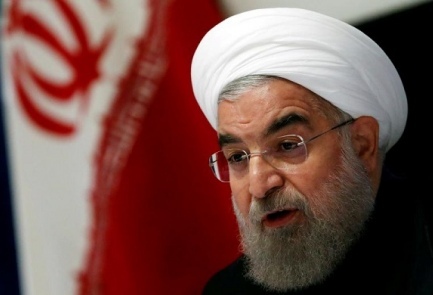
Iranian President Hassan Rouhani at the United Nations General Assembly in New York, in SeptemberPhoto credit: Reuters
Donald Trump’s election as president raises the prospect the United States will pull out of the nuclear pact it signed last year with Iran, Western media hedged Wednesday.
Outgoing President Barack Obama’s administration touted the deal as a major foreign policy achievement, saying it was the best way to suspend Tehran’s drive to develop atomic weapons, but the agreement was harshly opposed by Republicans in Congress.
During his campaign, Trump repeatedly blasted the deal, calling the nuclear agreement a “disaster” and “the worst deal ever negotiated,” warning it could lead to a “nuclear holocaust,” and pledging that if elected, his top priority would be to “dismantle the disastrous deal with Iran.”
By contrast, Trump conceded it would be hard to revise a deal cemented by a United Nations Security Council resolution.
Iran’s President Hassan Rouhani said Wednesday there was “no possibility” for Trump to renege on the nuclear deal.
“Iran’s understanding in the nuclear deal was that the accord was not concluded with one country or government but was approved by a resolution of the UN Security Council and there is no possibility that it can be changed by a single government,” Iranian media quoted Rouhani as saying.
“The United States no longer has the capacity to create Iranophobia and to create a consensus against Iran,” he said. “The constructive engagement policies of Iran toward the world, and the fact that international sanctions have been lifted, have placed the Iranian economy on a road where there is no possibility of going backward.”
French news agency AFP quoted Iranian Atomic Energy Organization spokesman Behrouz Kamalvandi as saying Iran “is prepared for any change.”
Meanwhile, the latest report by the International Atomic Energy Agency, released Wednesday, confirmed Iran was sticking to its commitments.
The Islamic republic “has not enriched uranium above low purities; its uranium stockpile stayed below agreed levels; and it has not pursued the construction of its heavy water reactor at Arak,” the report said.
Trump’s Israel advisor: “Trump doesn’t view settlement building as an obstacle for peace” Jason Greenblatt, one of Trump’s senior level advisors who will likely be appointed as Trump’s Middle East envoy, described the President-elect’s emerging policy: “It’s certainly not Mr. Trump’s view that settlement activity should be condemned.”
Jason Greenblatt, one of President-elect Donald Trump’s senior level advisors, will most likely be appointed as the US envoy to the Middle East and will rewrite a foreign policy differing from that of US President Obama and Secretary of State John Kerry. This morning (Thursday), Greenblatt was interviewed by Israel’s Army Radio explaining Trump’s stances and stressed: “He is not going to impose any solution on Israel.”
“It is certainly not Mr. Trump’s view that settlement activity should be condemned,” Greenblatt said during Israel’s Army Radio broadcast this morning. “Building over the Green Line is not an obstacle for peace.”
Trump giving a speech following his victory Photo Credit: CNN/Channel 2 News
“He believes that Israel is in a very tough situation needs to defend itself,” Greenblatt added mere hours after Israeli Prime Minister Benjamin Netanyahu congratulated Trump regarding his victory during a phone conversation between the two.
Greenblatt also indicated that Trump’s stance against returning land to the Palestinians derives from Israel’s 2005 Gaza disengagement: “He does not view the settlements as an obstacle for peace. I think he would use the expulsion of Jewish communities from the Gaza Strip as proof of that.”
Contrary to the Obama administration which attempted utilizing various measures in order to renew peace talks, Greenblatt feels that Trump will act differently regarding the Israeli-Palestinian conflict: “Peace has to come from both sides and he does not plan on intervening in the matter.”
Donald J. Trump in Scranton, Pa., this week. His win foreshadowed an America more focused on its own affairs while leaving the world to take care of itself.Credit Damon Winter/The New York Times
JERUSALEM — Donald J. Trump’s stunning election victory on Tuesday night rippled way beyond the nation’s boundaries, upending an international order that prevailed for decades and raising profound questions about America’s place in the world.
For the first time since before World War II, Americans chose a president who promised to reverse the internationalism practiced by predecessors of both parties and to build walls both physical and metaphorical. Mr. Trump’s win foreshadowed an America more focused on its own affairs while leaving the world to take care of itself.
The outsider revolution that propelled him to power over the Washington establishment of both political parties also reflected a fundamental shift in international politics evidenced already this year by events like Britain’s referendum vote to leave the European Union. Mr. Trump’s success could fuel the populist, nativist, nationalist, closed-border movements already so evident in Europe and spreading to other parts of the world.
Global markets fell after Tuesday’s election and many around the world scrambled to figure out what it might mean in parochial terms. For Mexico, it seemed to presage a new era of confrontation with its northern neighbor. For Europe and Asia, it could rewrite the rules of modern alliances, trade deals, and foreign aid. For the Middle East, it foreshadowed a possible alignment with Russia and fresh conflict with Iran.
“All bets are off,” said Agustín Barrios Gómez, a former congressman in Mexico and president of the Mexico Image Foundation, an organization dedicated to promoting its reputation abroad.
Crispin Blunt, chairman of the foreign affairs committee in Britain’s House of Commons, said, “We are plunged into uncertainty and the unknown.”
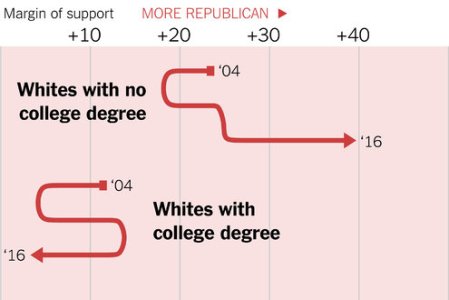
How Trump Won the Election According to Exit Polls
Based on exit polls, the 2016 presidential election seems to have dramatically redefined how certain demographic groups vote.
OPEN Graphic
Many linked Mr. Trump’s victory to the British vote to exit the European Union and saw a broader unraveling of the modern international system. “After Brexit and this election, everything is now possible,” Gérard Araud, the French ambassador to the United States, wrote on Twitter. “A world is collapsing before our eyes.”
The election enthralled people around the world on Tuesday night: night owls watching television in a youth hostel in Tel Aviv; computer technicians monitoring results on their laptops in Hong Kong; and even onetime oil pipeline terrorists in Nigeria’s remote Delta creeks, who expressed concern about how Mr. Trump’s election would affect their country.
It is hardly surprising that much of the world was rooting for Hillary Clinton over Mr. Trump, who characterized his foreign policy as “America First.”
Polls indicated that Mrs. Clinton was favored in many countries, with the exception of Russia. Last summer, the Pew Research Center found that people in all 15 countries it surveyed trusted Mrs. Clinton to do the right thing in foreign affairs more than Mr. Trump by ratios as high as 10 to one.
Mr. Trump’s promise to pull back militarily and economically left many overseas contemplating a road ahead without an American ally.
Photo
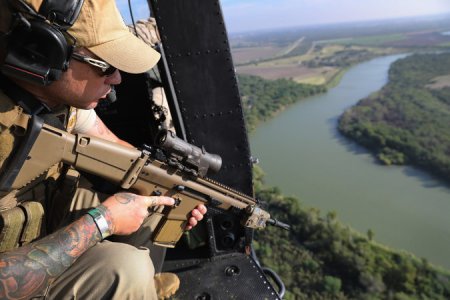
A Customs and Border Protection agent scanning the Rio Grande on the border with Mexico in McAllen, Tex., in October. Mr. Trump’s success could fuel the populist, nativist, nationalist, closed-border movements already evident in Europe and spreading to other parts of the world.Credit John Moore/Getty Images
“The question is whether you will continue to be involved in international affairs as a dependable ally to your friends and allies,” said Kunihiko Miyake, a former Japanese diplomat now teaching at Ritsumeikan University in Kyoto. “If you stop doing that, then all the European, Middle Eastern and Asian allies to the United States will reconsider how they secure themselves.”
In Germany, where American troops have been stationed for more than seven decades, the prospect of a pullback seemed bewildering. “It would be the end of an era,” Henrik Müller, a journalism professor at the Technical University of Dortmund, wrote in Der Spiegel. “The postwar era in which Americans’ atomic weapons and its military presence in Europe shielded first the west and later the central European states would be over. Europe would have to take care of its own security.”
Norbert Röttgen, chairman of the German parliamentary committee for foreign policy and a member of the ruling party, said Mr. Trump was “completely inadequate” to his office. “That Trump’s election could lead to the worst estrangement between America and Europe since the Vietnam War would be the least of the damage,” he said.
Perhaps nowhere was Mr. Trump’s win more alarming than in Mexico, which has objected to his promises to build a wall and bill America’s southern neighbor for it.
“I see a clear and present danger,” said Rossana Fuentes-Berain, director of the Mexico Media Lab, a think tank, and a founder of the Latin American edition of Foreign Affairs. “Every moment will be a challenge. Every move or declaration will be something that will not make us comfortable in the neighborhood — and that is to everyone’s detriment.”
With about $531 billion in trade in goods last year, Mexico is America’s third-largest partner after Canada and China. Supply chains in both countries are interdependent, with American goods and parts shipped to Mexican factories to build products that are shipped back into the United States for sale. Five million American jobs directly depend on trade with Mexico, according to the Mexico Institute.
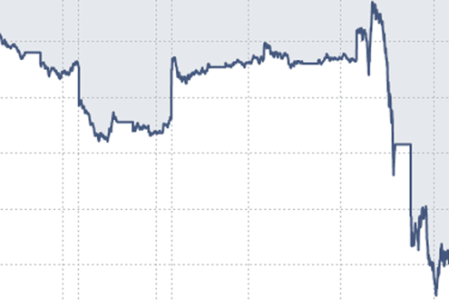
How the Markets Reacted to Trump’s Stunning Upset
As Donald J. Trump began to solidify his path to the presidency on Tuesday night, international markets fell sharply. Wall Street was expected to react similarly, but was up on Wednesday.
OPEN Graphic
The Mexican peso immediately fell 13 percent after the election, its biggest drop in decades. Mr. Barrios Gómez, the former congressman, predicted a short-term peso devaluation of 20 percent and a Mexican recession “as supply chains across the continent become sclerotic and investments dry up.” The business community, he said, was “freaking out.”
The economic fallout will probably reverberate farther. Izumi Kobayashi, vice chairwoman of Keizai Doyukai, a Japanese business group, predicted a drop in foreign investment in the United States as executives skeptical of Mr. Trump wait to see what he does.
“He has been focusing on the negative side of the global markets and globalization,” Ms. Kobayashi said. “But at the same time it is really difficult to go back to the old business world. So how will he explain to the people that benefit and also the fact that there is no option to go back to the old model of business?”
The uneasiness with Mr. Trump’s victory overseas ranged far beyond the country’s traditional partners. Abubakar Kari, a political-science professor at the University of Abuja, said most Nigerians believed a Trump administration would not bother with issues outside the United States.
“If Trump wins, God forbid,” Macharia Gaitho, one of Kenya’s most popular columnists, wrote on Tuesday before the votes came in, “then we will have to reassess our relations with the United States.”
One of the few places where Mr. Trump’s victory was greeted enthusiastically was Russia, where state-controlled television has been feasting on the circuslike elements of the American election. Not since the Cold War has Russia played such a big role in a presidential election, with Mr. Trump praising Mr. Putin and American investigators concluding that Russians had hacked Democratic email messages.
Photo
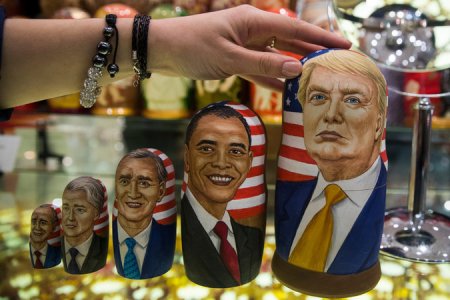
Traditional Russian dolls, called matryoshkas, depicting, from left, Presidents George Bush, Bill Clinton, George W. Bush and Barack Obama and the president-elect, Donald J. Trump, in a shop in Moscow.Credit Pavel Golovkin/Associated Press
“Trump’s presidency will make the U.S. sink into a full-blown crisis, including an economic one,” said Vladimir Frolov, a Russian columnist and international affairs analyst. “The U.S. will be occupied with its own issues and will not bother Putin with questions.”
“As a consequence,” he added, “Moscow will have a window of opportunity in geopolitical terms. For instance, it can claim control over the former Soviet Union and a part of the Middle East. What is there not to like?”
Others tried to find the upside. Mr. Blunt, the British lawmaker, said he was heartened by Mr. Trump’s selection of Gov. Mike Pence of Indiana as his running mate and thought that Britain might be the exception to the new president’s hostility toward trade deals.
Israel was another place where Mr. Trump enjoyed some support, mainly because of the perception that he would give the country a freer hand in its handling of the longstanding conflict with the Palestinians. But Prime Minister Benjamin Netanyahu and other Israeli leaders and commentators worried about a broader disengagement from a Middle East awash in war, terrorism and upheaval.
“Decisions cannot be postponed,” said Yohanan Plesner, a former member of the Israeli Parliament now serving as president of the Israel Democracy Institute. “The situation in Syria is very chaotic. The unrest in the region is continuing. America has to decide whether it wants to play an active role in shaping the developments of the region.”
And even some countries that might expect to see some benefits from an American retreat worried about the implications. Counterintuitive as it might seem, China was concerned about Mr. Trump’s promise to pull American troops back from Asia.
“If he indeed withdraws the troops from Japan, the Japanese may develop their own nuclear weapons,” said Shen Dingli, professor of international relations at Fudan University in Shanghai. “South Korea may also go nuclear if Trump cancels the missile deployment and leaves the country alone facing the North’s threats. How is that good for China?”
For American voters, that was not the point. After decades of worrying about what was good for other countries, they decided it was time to worry about what was good for America. And Mr. Trump promised to do just that, even if the rest of the world might not like it.
VIENNA, Nov 9 (Reuters) – Iran has exceeded a soft limit on sensitive material set under its nuclear deal with major powers, the U.N. atomic watchdog said on Wednesday, hours after Donald Trump – who has strongly criticized the agreement – won the U.S. presidential election.
It is the second time Tehran has surpassed the 130 metric tonne threshold for heavy water, a material used as a moderator in reactors like Iran’s unfinished one at Arak, since the deal was put in place in January. It had 130.1 tonnes of the material on Tuesday, the watchdog said.
The last time Iran overstepped that mark was brief, passing without major criticism from the other countries that signed the nuclear deal last year. But there are questions about whether the incoming Trump administration will react to such incidents the same way.
“On 2 November 2016, the director general expressed concerns related to Iran’s stock of heavy water to the vice president of Iran and president of the Atomic Energy Organization of Iran, … Ali Akbar Salehi,” the International Atomic Energy Agency (IAEA) said in a confidential report seen by Reuters.
The IAEA is policing the restrictions placed on Iran’s nuclear activities under the deal it signed with the United States, Russia, China, Britain, France and Germany. The agreement also lifted international sanctions against Tehran.
Iran told the agency it would prepare to transfer 5 tonnes of heavy water out of the country, as provided for in the deal, and a senior diplomat said Iran planned to carry out the shipment in the coming days.
A U.S. State Department spokesman, speaking at a regular news briefing in Washington, confirmed Iran’s intention to export the excess heavy water.
“It’s important to note that Iran made no effort to hide this, hide what it was doing from the IAEA,” spokesman Mark Toner said.
Rather than setting a strict limit on heavy water as it does for enriched uranium, the deal estimates Iran’s needs to be 130 tonnes and says any amount beyond the country’s needs “will be made available for export to the international market”.
Trump has called the agreement, one of President Barack Obama’s top achievements, “the worst deal ever negotiated” and said he would “police that contract so tough they (the Iranians) don’t have a chance”.
Iran also exceeded the heavy-water limit in February, with 130.9 tonnes. (Additional reporting by Arshad Mohammed in Washington; Reporting by Francois Murphy; Editing by Richard Balmforth and Paul Simao)









 anneinpt
 artaxes
 danmillerinpanama
 davidking1530
 Peter Hofman
 Joseph Wouk
 Peter
Peter Louisiana Steve
 WarSclerotic
Recent Comments