Archive for August 2016

With The Terror Threat Growing, Europe Changes Course

August 31, 2016

With The Terror Threat Growing, Europe Changes Course, Investigative Project on Terrorism, Abigail R. Esman, August 31, 2016

Sixteen years ago, when Dutch commentator Paul Scheffer published his “Multicultural Drama” declaring that multiculturalism in the Netherlands had failed, the response was swift and angry. Critics across Europe called him racist, bigoted, nationalistic. Others dismissed his views as mere rants and ramblings of a Leftist in search of a cause.

Not anymore.

With over 275 people killed in 10 Islamic terrorist attacks since January 2015, Europeans harbor no more illusions about the multiculturalist vision: where immigrants from Muslim countries are concerned, that idealist vision has more than just failed. It has produced a culture of hatred, fear, and unrelenting danger. Now, with European Muslim youth radicalizing at an unprecedented rate and the threat of new terrorist attacks, Europe is reassessing its handling of Muslim communities and its counterterrorism strategies and laws.

Among the changes being considered are a reversal of laws that allow radical Muslims to receive handouts from the very governments they seek to destroy; restricting foreign funding of mosques; and stronger surveillance on private citizens.

Chief among the new counterterrorism approaches is a program to coordinate intelligence data among European Union countries – a tactic that has not been pursued with any regularity or such depth before now. But following the November attacks in Paris, the Dutch intelligence agency AIVD initiated weekly meetings among intel agencies from all EU countries, Switzerland, and Norway, with the objective of sharing information, exchanging new clues, insights, and suspect alerts, and discussing improvements to a Europe-wide system of counterterrorism and intelligence.

Through these meetings and the improved shared database, it is now possible for each country to contextualize its intelligence and understand links between individuals and various groups from one city to another – and so, between radicals and radical groups as they pass through a borderless EU.

Concurrently, EU members are now beginning to share information about web sites and even details about private citizens where needed. Most countries had been reluctant to make such exchanges, citing both privacy concerns and the need to protect their sources. Other cooperative efforts include an EU initiative begun in February 2015 to counteract Islamic extremist propaganda. The project received a major €400 million boost in June, indicating the high priority Europe now places on fighting recruitment.

Earlier this month, Europol began a new effort to screen refugees still awaiting placement in Greek asylum centers. According to a report from Europa Nu, an initiative between the European parliament and the University of Leiden, Europol agents “specifically trained to unmask and dismantle terrorists and terror networks” will be dispatched to the camps to try to prevent terrorists from infiltrating the flood of refugees to Europe.

Some EU measures, however, have been based more in politics than counterterrorism, including efforts to crack down on the ability of radical Muslims to benefit from welfare programs. British citizens, for instance, reacted with outrage when it was discovered that the family of “Jihadi John” had received over £400,000 in taxpayer support over the course of 20 years. In Belgium, Salah Abdeslam, the terrorist accused of participating in the Nov. 13 Paris attacks, pulled in nearly €19,000 in welfare benefits from January 2014 and October 2015, according to Elsevier. And Gatestone reports that more than 30 Danish jihadists received a total of €51,000 in unemployment benefits all while battling alongside the Islamic State in Syria.

Such concerns have also spread to the United States. Earlier this year, U.S. Rep. Bruce Poliquin, R-Maine, introduced the “No Welfare For Terrorists Act.”

“Terrorist victims and their families should never be forced to fund those who harmed them,” he said in a statement. “This bill guarantees this will never happen.”

But not all of Europe’s new approaches to the terror threat are being coordinated out of Brussels. Many more, in fact, are country-specific, such as England’s decision to follow an example set earlier by the Netherlands and Spain, separating jailed terrorists and terror suspects from other prisoners. The measures follow others the country adopted after the July 7, 2005 bombings of a London underground and buses, to criminalize “those who glorify terrorism, those involved in acts preparatory to terrorism, and those who advocate it without being directly involved,” the New York Times reported.

In fact, prisons worldwide, including in the U.S., have long been viewed as warm breeding grounds for radicals and potential terrorists. Ahmed Coulibaly, the gunman at the Porte de Vincennes siege in January 2015, was serving time for a bank robbery, for instance, when he met Cherif Koauachi, one of the Charlie Hebdo attackers. Both converted to Islam there. It was in that same prison that the two encountered Djamel Beghal, an al-Qaida operative who attempted to blow up the American Embassy in Paris in 2001.

Hence many experts now argue in favor of isolating those held on terrorism-related charges as a way to stop them from radicalizing their fellow inmates.

Yet British officials have until now resisted creating separate wings for terror suspects, arguing that doing so gives them “credibility” and makes it harder to rehabilitate them. But a recent government report on Islamist extremism in British prisons forced a change in thinking, in part by noting that “other prisoners – both Muslim and non-Muslim – serving sentences for crimes unrelated to terrorism are nonetheless vulnerable to radicalization by Islamist Extremists [sic].”

Similarly, France, the site of the worst attacks of the past two years, also balked at first at the idea of separating terrorists from other prisoners, arguing that doing so “forms a terrorist cell within a prison.” But the Charlie Hebdo attacks of January 2015 changed all that. Now, officials are even going further, looking at other potential sources of radicalization: the mosques.

Shortly after the Bastille Day attack in Nice, Prime Minister Manuel Valls announced plans to ban foreign financing for French mosques as part of an effort to establish a “French Islam,” led by imams trained only in France. France hosts dozens of foreign-financed mosques – many sponsored by Saudi Arabia and Morocco – which preach Salafism, an extreme version of Islam practiced in the Saudi Kingdom and the root of much radical Islamist ideology. And according to a new report on counter-radicalization, about 300 imams come from outside France.

That same report also calls for “regular surveys” of France’s 4-5 million Muslims,according to France 24, in order “to acquire a better understanding of this population in a country where statistics based on religious, ethnic, or racial criteria are banned.”

Both proposed measures have been met with resistance. The “surveys,” as even the report itself notes, are a means of circumventing laws against gathering information on the basis of religious criteria – and so, go against democratic principles. And many French officials also oppose the ban on foreign funding for mosques, arguing that French government intervention in places of worship contradicts separation between church and state. Besides, they claim, radicalization doesn’t take place there anyway.

But Dutch authorities and counter-extremism experts are not so sure. The announcement earlier this month that Qatar would finance an Islamic center in Rotterdam, for instance, set off alarms even among Muslim moderates, including Rotterdam’s Moroccan-born mayor Ahmed Marcouch. There are good reasons for this. The Salafist Eid Charity, which sponsors the project, has been on Israel’s terror list since 2008, according to Dutch daily NRC Handelsblad. Moreover, in 2013 the U.S. Treasury Department accused the charity’s founder, Abd al-Rahman al-Nu’aymi, of providing funding for al-Qaida and its affiliates, and named him a “specially designated global terrorist.”

Plans for the center sound much like those of the now-abandoned plans for New York’s “Ground Zero mosque,” with sports facilities, prayer space, tutoring for students, Islamic child care, and, reports Dutch newspaper Volkskrant, imam training.

Yet the center’s prospective director, Arnoud van Doorn, a convert to Islam and former member of the far-right, anti-Islam political party PVV, insists that any fears about the project are unfounded. “Our organization has nothing to do with extremism,” he told theNRC. “We want only to provide a positive contribution to Dutch society.”

Notably, though, France’s proposal to ban foreign mosque funding and the Qatari backing of the Rotterdam center point to some of the deepest roots of Europe’s radical Islam problem, and, despite all the new initiatives now underway, the greatest challenges to ending it. When Muslim immigrants came to Europe in the 1970s, they carved prayer spaces wherever they could: the backs of community grocery stores, in restaurants and tea rooms. But these soon became too small to handle the growing Muslim population. Mosques – real mosques – would have to be built.

But by whom? The Muslim communities themselves were too poor. Western governments, wedded to the separation of church and state, could not subsidize them with taxpayer funds. And so the door was opened to foreign – mostly Saudi – investment, and the placement of Saudi-trained and Saudi-backed imams in European mosques. Europe had, in essence, rolled out the welcome mat for Salafism.

Now they want to roll it in again. But is it too late? Even as Western intelligence is now uniting to fight radical Islam, Islamic countries are pooling together in Europe to expand it. The result, as Manuel Valls told French daily Le Monde, is that, “What’s at stake is the republic. And our shield is democracy.”

Hence as the number attacks against Western targets increase, many Europeans are coming to understand that preserving the core of that democracy may mean disrupting some of the tenets on which it’s built, like certain elements of privacy, for instance, and religious principles that violate the freedom that we stand for . It is, as it were, a matter of destroying even healthy trees to save the forest. But in this tug-of-war between the Islamic world’s efforts to shape the West, and Western efforts to save itself, only our commitment to the very heart of our ideals will define who wins this fight.

Cartoons of the Day

August 31, 2016

H/t Joop

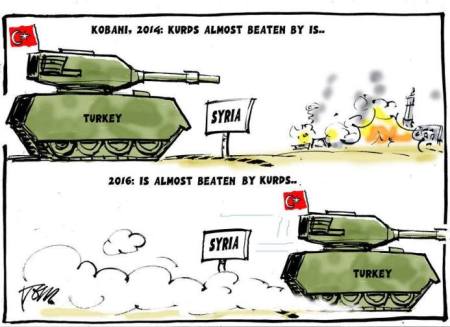
is kurds


H/t Indyfromaz

extremists (1)


H/t Vermont Loon Watch

separated-at-mirth-1


Mutti Merkel Finally Admits: Germany Mishandled the Refugee Crisis

August 31, 2016

Mutti Merkel Finally Admits: Germany Mishandled the Refugee Crisis, PJ MediaMichael Van Der Galien, August 31, 2016

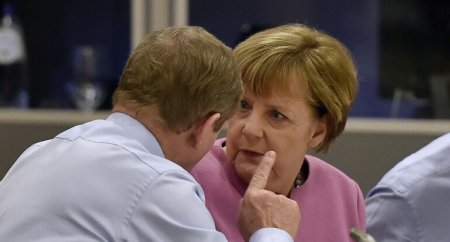
merkel eyesIrish Prime Minister Enda Kenny, left, speaks with German Chancellor Angela Merkel during a round table meeting at an EU summit in Brussels on Friday, Feb. 19, 2016. British Prime Minister David Cameron pushed a summit into overtime Friday after a second day of tense talks with weary European Union leaders unwilling to fully meet his demands for a less intrusive EU. (Martin Meissner, Pool)

German Chancellor Angela Merkel finally had admitted that she made serious mistakes in dealing with the refugee crisis.

In an interview published today in a German newspaper, Mutti Merkel explains:

There are political issues that one can see coming but don’t really register with people at that certain moment – and in Germany we ignored both the problem for too long and blocked out the need to find a pan-European solution.

She continues:

We said we would deal with the problem at our airports since we don’t have any other external EU boundaries. But that doesn’t work…We didn’t embrace the problem in an appropriate way. That goes as well for protecting the external border of the Schengen area.

This is downright shocking coming from Merkel. A blind man could see that she mishandled the crisis by opening her welcoming arms to an unlimited number of immigrants from the Middle East — people who do not share German culture and values — but Merkel constantly bragged:“Wir schaffen das,” meaning “We can do this.” Obviously, Germany couldn’t, but it’s mighty kind of her to finally admit her mistakes.

Sadly, that’s where our praise for Merkel has to end.

The reason Merkel admitted that she mishandled the situation isn’t that she’s truly sorry for turning Germany into one big refugee camp; it’s that she feels a rival and new conservative party breathing down her neck. I’m talking, of course, about Alternative für Deutschland (Alternative for Germany).

The AfD has a few important ideas: to limit immigration, to reduce spending, and to dismantle the European Union by returning it to the trade bloc it was supposed to be in the first place. If the AfD gets its way, Germans will pay significantly lower taxes while their country gets its sovereignty back. It seems to me that these aren’t bad ideas — which doesn’t mean I also support every single one of their other policy proposals.

This new party is quickly rising in the polls, while polls also show that up to two thirds of German voters want Merkel out at the next elections.

In other words, Merkel is only admitting she made “mistakes” (by the way, they weren’t mistakes as much as conscious policy decisions caused by her firmly held belief in multiculturalism) because she fears she might lose next year’s elections.

Merkel is and will always be a believer in multiculturalism and the Great European™ project. The only way for Germans to take their country (and their taxes!) back is by ousting her.

U.S. Offers Reward for ISIS Militant Who Had U.S.-Funded Training

August 31, 2016

Report: State Dept Offers $3M Reward for ISIS Militant Who Received U.S.-Funded Training

BY:
August 31, 2016 10:27 am

Source: U.S. Offers Reward for ISIS Militant Who Had U.S.-Funded Training

The State Department is offering up a $3 million reward for information about a former Tajik special operations colonel-turned Islamic State leader who reportedly once attended U.S.-funded counterterrorism training courses.

The State Department’s “Rewards for Justice” program on Tuesday offered a reward of as much as $3 million for information leading to the location, arrest, or conviction of Gulmurod Khalimov, who served as a Tajik special operations colonel, police commander, and military sniper before joining ISIS. A statement announcing the reward said that Khalimov commanded a police special operations unit in the Ministry of Interior of Tajikistan.

Reuters, citing an unnamed State Department official, reported that Khalimov attended five U.S.-funded counterterrorism courses in the United States and Tajikistan between 2003 and 2014 before joining ISIS.  Khalimov publicly appeared as an ISIS member, calling for attacks against America and other countries, in a propaganda video in May 2015 and was labeled a “special designated global terrorist” by the State Department in September of the same year.

The statement released by the agency on Tuesday made no mention of Khalimov’s past counterterrorism training.

“Khalimov is a former Tajik special operations colonel, police commander, and military sniper. He was the commander of a police special operations unit in the Ministry of Interior of Tajikistan,” the department said. “He is now an ISIL member and recruiter. In May 2015, he announced in a 10-minute propaganda video that he fights for ISIL and has called publicly for violent acts against the United States, Russia, and Tajikistan.”

The anonymous official who spoke to Reuters said that Khalimov’s training included “crisis response, hostage negotiation, and tactical leadership.” The official indicated that the ISIS militant poses a particular threat because of his past training.

The training was reportedly funded through the State Department’s antiterrorism assistance program, which “trains civilian security and law enforcement personnel from friendly governments in police procedures that deal with terrorism,” according to the program website.

The number and location of the courses Khalimov attended in the United States remain unclear.

The Washington Free Beacon reported last year that Khalimov’s defection to ISIS coupled with the group’s infiltration of the Malaysian military raised concerns among U.S. officials that ISIS was gaining military expertise.

Khalimov is also wanted by the government of Tajikistan and was added to the sanctions list of the U.N. Security Council’s ISIL (Da’esh) and al-Qaida Sanctions Committee earlier this year.

Turkey vows to attack US-backed Kurdish militia in Syria

August 31, 2016

Source: Turkey vows to attack US-backed Kurdish militia in Syria

Turkey warned Monday it would carry out more strikes on a US-backed Kurdish militia in Syria if it fails to retreat, as Washington said President Barack Obama will meet his Turkish counterpart over the weekend.

Turkish forces pressed on with a two-pronged operation inside Syria against Islamic State (IS) jihadists and the Syrian Kurdish People’s Protection Units (YPG), shelling over a dozen targets.

The strikes against the YPG are hugely sensitive as the outfit — seen as a terror group by Ankara — is allied with Turkey’s NATO partner the United States in the fight against IS in Syria.

Ankara has said it killed 25 Kurdish “terrorists” in strikes on YPG positions on Sunday — meaning the two US-backed partner forces are now fighting each other.

Pentagon spokesman Peter Cook said the clashes were “unacceptable and a source of deep concern.”

He called for steps to de-escalate the situation and said Washington had once again told the YPG to retreat east of the Euphrates. This has “largely occurred,” he added.

US Defence Secretary Ashton Carter later said he had appealed to both sides not to fight.

“That’s the basis of our cooperation with both of them — specifically not to engage one another,” Carter said.

Two US defense officials told AFP that SDF forces had “all” withdrawn east of the Euphrates, but they said some Kurdish people remained to the west.

Turkey’s operation aims to push the YPG back across the Euphrates to prevent it joining up a region east of the river already under its control with a Kurdish-held area to the west.

– ‘Ethnic cleansing’ –

Ankara fears the emergence of an autonomous Kurdish region in Syria would bolster Kurdish rebels across the border in southeastern Turkey.

The situation in northern Syria is yet another complication in the country’s already tangled civil war, and potentially throws a wrench in US plans to defeat the Islamic State group in the region.

US Vice President Joe Biden said last week that Washington had ordered the YPG to retreat or risk losing American support. But Ankara says it had seen no evidence of this.

President Obama will meet his Turkish counterpart Recep Tayyip Erdogan on Sunday in China on the sidelines of the Group of 20 summit, with Syria high on the agenda, top aide Ben Rhodes announced Monday, stressing the need “to stay united.”

It will be the first meeting between the two leaders since a failed coup attempt in Turkey on July 15.

Turkish Foreign Minister Mevlut Cavusoglu accused the Kurdish militia of “ethnic cleansing” in the mainly Arab area around the city of Manbij, west of the Euphrates, which the YPG wrested from IS earlier this month.

Turkey considers the YPG an offshoot of the Kurdistan Workers Party (PKK), which has waged a deadly insurgency on Turkish territory for over three decades.

On Monday, the Turkish air force launched air strikes on PKK bases in northern Iraq, state media said.

– ‘Deep concern’ –

The Britain-based Syrian Observatory for Human Rights said at least 40 civilians were killed in Turkish shelling and air strikes on pro-Kurdish positions in northern Syria on Sunday.

Ankara strongly denies killing any civilians.

The army said 10 more villages had “been cleared of terrorist elements” Monday by Turkish-backed anti-regime Syrian fighters.

A 400-square-kilometre (154-square-mile) area has been cleared since the operation began on August 24, it added.

President Erdogan said in a statement the offensive would continue until “the threat of Daesh and YPG/PKK is over.” Daesh is an acronym for IS.

On Monday, at least five people were injured in the Turkish town of Kilis by rockets fired across the border from an IS-held area, NTV television reported. The army returned fire, the report said.

Ankara-backed forces faced little resistance when they captured the IS border stronghold of Jarabulus last week, days after a suspected IS suicide bombing killed 55 people in southeast Turkey.

But the standoff with the Kurdish militia has been intense, with a Turkish soldier killed on Saturday in a YPG rocket attack on his tank.

– ‘Turkey’s crimes against humanity’ –

The Turkish army said it had fired 61 times on targets in northern Syria in the previous 24 hours. It did not say which group was targeted.

Deputy Prime Minister Numan Kurtulmus said all relevant parties had been forewarned of Turkey’s operation in Syria, including the regime of President Bashar al-Assad, a bitter enemy of Ankara who had been informed by its ally Russia.

Syria’s official Sana agency said Damascus had written to the UN Security Council to protest Turkey’s “crimes against humanity” in the country.

What if Chaos Were Our Middle East Policy?

August 31, 2016

What if Chaos Were Our Middle East Policy? Front Page Magazine, Daniel Greenfield, August 31, 2016

isis-caliphate

Sum up our failed Middle East policy in a nine-letter word starting with an S. Stability.

Stability is the heart and soul of nation-building. It’s the burden that responsible governments bear for the more irresponsible parts of the world. First you send experts to figure out what is destabilizing some hellhole whose prime exports are malaria, overpriced tourist knickknacks and beheadings. You teach the locals about democracy, tolerance and storing severed heads in Tupperware containers.

Then if that doesn’t work, you send in the military advisers to teach the local warlords-in-waiting how to better fight the local guerrillas and how to overthrow their own government in a military coup.

Finally, you send in the military. But this gets bloody, messy and expensive very fast.

So most of the time we dispatch sociologists to write reports to our diplomats explaining why people are killing each other in a region where they have been killing each other since time immemorial, and why it’s all our fault. Then we try to figure out how we can make them stop by being nicer to them.

The central assumption here is stability. We assume that stability is achievable and that it is good. The former is completely unproven and even the latter remains a somewhat shaky thesis.

The British wanted stability by replicating the monarchy across a series of Middle Eastern dependents. The vast majority of these survived for a shorter period than New Coke or skunk rock. Their last remnant is the King of Jordan, born to Princess Muna al-Hussein aka Antoinette Avril Gardiner of Suffolk, educated at the Royal Military Academy, Sandhurst, and currently trying to stave off a Muslim Brotherhood-Palestinian uprising by building a billion dollar Star Trek theme park.

The British experiment in stabilizing the Middle East failed miserably. Within a decade the British government was forced to switch from backing the Egyptian assault on Israel to allying with the Jewish State in a failed bid to stop the Egyptian seizure of the Suez Canal.

The American experiment in trying to export our own form of government to Muslims didn’t work any better. The Middle East still has monarchies. It has only one democracy with free and open elections.

Israel.

Even Obama and Hillary’s Arab Spring was a perverted attempted to make stability happen by replacing the old Socialist dictators and their cronies with the political Islamists of the Muslim Brotherhood. They abandoned it once the chaos rolled in and stability was nowhere to be found among all the corpses.

It might be time to admit that barring the return of the Ottoman Empire, stability won’t be coming to the Middle East any time soon. Exporting democracy didn’t work. Giving the Saudis a free hand to control our foreign policy didn’t work. Trying to force Israel to make concessions to Islamic terrorists didn’t work. And the old tyrants we backed are sand castles along a stormy shore.

Even without the Arab Spring, their days were as numbered as old King Farouk dying in exile in an Italian restaurant.

If stability isn’t achievable, maybe we should stop trying to achieve it. And stability may not even be any good.

Our two most successful bids in the Muslim world, one intentionally and the other unintentionally, succeeded by sowing chaos instead of trying to foster stability. We helped break the Soviet Union on a cheap budget in Afghanistan by feeding the chaos. And then we bled Iran and its terrorist allies in Syria and Iraq for around the price of a single bombing raid. Both of these actions had messy consequences.

But we seem to do better at pushing Mohammed Dumpty off the wall than at putting him back together again. If we can’t find the center of stability, maybe it’s time for us to embrace the chaos.

Embracing the chaos forces us to rethink our role in the world. Stability is an outdated model. It assumes that the world is moving toward unity. Fix the trouble spots and humanity will be ready for world government. Make sure everyone follows international law and we can all hum Lennon’s “Imagine”.

Not only is this a horrible dystopian vision of the future, it’s also a silly fantasy.

The UN is nothing but a clearinghouse for dictators. International law is meaningless outside of commercial disputes. The world isn’t moving toward unity, but to disunity. If even the EU can’t hold together, the notion of the Middle East becoming the good citizens of some global government is a fairy tale told by diplomats while tucking each other into bed in five-star hotels at international conferences.

It’s time to deal with the world as it is. And to ask what our objectives are.

Take stability off the table. Put it in a little box and bury it in an unmarked grave at Foggy Bottom. Forget about oil. If we can’t meet our own energy needs, we’ll be spending ten times as much on protecting the Saudis from everyone else and protecting everyone else from the Saudis.

Then we should ask what we really want to achieve in the Middle East.

We want to stop Islamic terrorists and governments from harming us. Trying to stabilize failed states and prop up or appease Islamic governments hasn’t worked. Maybe we ought to try destabilizing them.

There have been worse ideas. We’re still recovering from the last bunch.

To embrace chaos, we have to stop thinking defensively about stability and start thinking offensively about cultivating instability. A Muslim government that sponsors terrorism against us ought to know that it will get its own back in spades. Every Muslim terror group has its rivals and enemies waiting to pounce. The leverage is there. We just need to use it.

When the British and the French tried to shut down Nasser, Eisenhower protected him by threatening to collapse the British pound. What if we were willing to treat our Muslim “allies” who fill the treasuries of terror groups the way that we treat our non-Muslim allies who don’t even fly planes into the Pentagon?

We have spent the past few decades pressuring Israel to make deals with terrorists. What if we started pressuring Muslim countries in the same way to deal with their independence movements?

The counterarguments are obvious. Supply weapons and they end up in the hands of terror groups. But the Muslim world is already an open-air weapons market. If we don’t supply anything too high end, then all we’re doing is pouring gasoline on a forest fire. And buying the deaths of terrorists at bargain prices.

Terrorism does thrive in failed states. But the key point is that it thrives best when it is backed by successful ones. Would the chaos in Syria, Nigeria or Yemen be possible without the wealth and power of Saudi Arabia, Qatar and Iran? Should we really fear unstable Muslim states or stable ones?

That is really the fundamental question that we must answer because it goes to the heart of the moderate Muslim paradox. Is it really the Jihadist who is most dangerous or his mainstream ally?

If we believe that the Saudis and Qataris are our allies and that political Islamists are moderates who can fuse Islam and democracy together, then the stability model makes sense. But when we recognize that there is no such thing as a moderate civilizational Jihad, then we are confronted with the fact that the real threat does not come from failed states or fractured terror groups, but from Islamic unity.

Once we accept that there is a clash of civilizations, chaos becomes a useful civilizational weapon.

Islamists have very effectively divided and conquered us, exploiting our rivalries and political quarrels, for their own gain. They have used our own political chaos, our freedoms and our differences, against us. It is time that we moved beyond a failed model of trying to unify the Muslim world under international law and started trying to divide it instead.

Chaos is the enemy of civilization. But we cannot bring our form of order, one based on cooperation and individual rights, to the Muslim world. And the only other order that can come is that of the Caliphate.

And chaos may be our best defense against the Caliphate.

A Candidate’s Death Could Delay or Eliminate the Presidential Election

August 31, 2016

A Candidate’s Death Could Delay or Eliminate the Presidential Election Chaos would ensue if a vacancy emerges near Election Day.

By Steven Nelson | Staff Writer

Aug. 30, 2016, at 4:55 p.m.

Source: A Candidate’s Death Could Delay or Eliminate the Presidential Election | US News

American democracy would break new ground if Hillary Clinton or Donald Trump left a presidential ticket vacancy before the Nov. 8 general election. Getty Images

The presidential election could be delayed or scrapped altogether if conspiracy theories become predictive and a candidate dies or drops out before Nov. 8. The perhaps equally startling alternative, if there’s enough time: Small groups of people hand-picking a replacement pursuant to obscure party rules.

The scenarios have been seriously considered by few outside of the legal community and likely are too morbid for polite discussion in politically mixed company. But prominent law professors have pondered the effects and possible ways to address a late-date vacancy.

“There’s nothing in the Constitution which requires a popular election for the electors serving in the Electoral College,” says John Nagle, a law professor at the University of Notre Dame, meaning the body that officially elects presidents could convene without the general public voting.

“It’s up to each state legislature to decide how they want to choose the state’s electors,” Nagle says. “It may be a situation in which the fact that we have an Electoral College, rather than direct voting for presidential candidates, may prove to be helpful.”

Both major parties do have rules for presidential ticket replacements, however, and Congress has the power to change the election date under Article II of the Constitution, which allows federal lawmakers to set dates for the selection of presidential electors and when those electors will vote.

But Congress would be up against a de facto December deadline, as the Constitution’s 20th Amendment requires that congressional terms expire Jan. 3 and presidential terms on Jan. 20. Though it’s conceivable to split legislative and presidential elections, they generally happen at the same time. And if the entire general election were to be moved after Jan. 3, Congress effectively would have voted themselves out of office.

Yale Law School professor Akhil Reed Amar considers in a 1994 article in the Arkansas Law Review the possibility of a special presidential election being pushed to after Jan. 20, with the speaker of the House serving as acting president until an election could pick “a real president for the remainder of the term.” But he tells U.S. News that scenario probably is far-fetched.

Is it possible for the election to be delayed until after Jan. 20, leaving both the offices of president and vice president temporarily vacant? Perhaps, Amar says, but “it wouldn’t make sense if it were permissible, given there actually are answers. Why would you ever do that?”

Amar recommends an up to four-week postponement of Election Day if a candidate dies just before voting, or even if there’s a major terrorist attack.

The possible last-minute replacement of a candidate attracts some cyclical coverage, but this year the scenario would play out after consistent conjecture about the health of Democrat Hillary Clinton and hidden agenda of Republican Donald Trump.

Trump, 70, would be the oldest person elected president, but his health has received less coverage over the election cycle than apparently unfounded speculation he will drop out. Clinton, 69 in October, would be the second oldest president-elect, months younger than Ronald Reagan in 1980.

Although Clinton’s coughs and stumbling have earned speculative headlines on the news-driving Drudge Report, her doctor, Lisa Bardack, said she “is in excellent physical condition and fit to serve.” Trump physician Harold Bornstein, meanwhile, wrote he would be “the healthiest individual ever elected to the presidency.”

Old age doesn’t rule out a full presidency. Reagan served two terms before dying at 93 in 2004. Other recent officeholders have lived beyond the life expectancy for the general population. Gerald Ford died in 2006 at 93. George H.W. Bush, 92, and Jimmy Carter, 91, are still living.

If something were to happen to Clinton or Trump before the election, rules established by the Republican and Democratic parties do offer guidelines for what to do.

If Clinton were to fall off the ticket, Democratic National Committee members would gather to vote on a replacement. DNC members acted as superdelegates during this year’s primary and overwhelmingly backed Clinton over boat-rocking socialist Sen. Bernie Sanders of Vermont.

DNC spokesman Mark Paustenbach says there currently are 445 committee members – a number that changes over time and is guided by the group’s bylaws, which give membership to specific officeholders and party leaders and hold 200 spots for selection by states, along with an optional 75 slots DNC members can choose to fill.

But the party rules for replacing a presidential nominee merely specify that a majority of members must be present at a special meeting called by the committee chairman. The meeting would follow procedures set by the DNC Rules and Bylaws Committee and proxy voting would not be allowed.

DNC member Connie Johnson, a former Oklahoma state senator who supported Sanders, says it would be most appropriate for the DNC to give the nomination to the runner-up if Clinton were to die or drop out before the election.

“I believe that’s why Sen. Sanders stayed in the contest,” she writes in an email. “As to whether the party would adopt what would appear to be a common sense solution in the event of [Clinton] no longer being able to serve – that would remain to be seen. There was so much vitriol aimed at Sen. Sanders and his supporters by [Clinton supporters] that they would likely want ‘anybody but Bernie’ in order to save face and maintain control.”

The Republican National Committee’s rules potentially allow for greater democratic input, but don’t require it. If a vacancy emerges on the ticket, the 168-member RNC would decide whether to select a replacement on its own or “reconvene the national convention,” which featured 2,472 voting delegates, that met over the summer.

If RNC members make the choice themselves, the three members representing each state, territory and the nation’s capital – a committeeman, committeewoman and the local party chairman – would jointly have “the same number of votes as said state was entitled to cast at the national convention.”

RNC rules allow for state delegations to split their vote and for members to vote by proxy.

Richard Winger, editor of Ballot Access News and an expert on presidential election history, says state election officials likely would be compelled to accept a major party’s request to swap candidates, citing precedent set in 1972 when states allowed Democrats to replace vice presidential nominee Thomas Eagleton, who was revealed to be a shock therapy patient, with Sargent Shriver.

Winger says every state but South Dakota also allowed the prominent 1980 independent candidate John Anderson to swap his vice presidential candidate Milton Eisenhower for former Wisconsin Gov. Patrick Lucey.

Still, if the central party organizations were to upset electors with an unpalatable pick, it’s possible many could bolt.

Edward Foley, a law professor at Ohio State University, says “the Supreme Court has never ruled that electors can be forced to obey their pledge” to vote for a particular presidential candidate, leaving open the door for mass defections or, in the event of a post-election candidate death, an en masse vote flip.

John Fortier, director of the Democracy Project at the Bipartisan Policy Center, says he’s not certain that Congress would reach consensus on moving an election date if a candidate died, meaning parties would need to formally – or informally – decide on a replacement. If the election date was moved by Congress, Fortier says ongoing absentee or early voting would make for a mess.

Though not legally required, Fortier says parties may decide on an easy fix and loudly encourage electors to support their existing vice presidential nominee. A party legally could pick someone else, but he says a desire for legitimacy in the eyes of the public may force its hand.

With more than two centuries of history, the U.S. does have some examples of candidate deaths, though none with a catastrophic impact.

In 1872, presidential candidate Horace Greeley died about three weeks after winning about 44 percent of the popular vote as a Liberal Republican supported by Democrats against incumbent Republican Ulysses S. Grant. Presidential electors chose between various alternatives, but because Greeley had lost, his death did not sway the election’s outcome.

In another case, Republican running mate James Sherman died six days before the 1912 general election. He wasn’t replaced on ballots and the matter was rendered moot by the GOP’s crushing defeat.

Amar, author of a forthcoming book touching on candidate death, outlines four distinct scenarios that would warrant special consideration because of the wording of the 20th Amendment: a death before an election, a death after an election but before electors meet in December, a death between electors voting and Congress counting votes in January, and the time between Congress confirming the election and the Jan. 20 inauguration.

The three post-election time frames identified by Amar are distinguished by whether the candidate technically is considered “president-elect.” That designation is covered by the 20th Amendment, which allows in case of a president-elect’s death that he or she be replaced by the vice president-elect. But in their narrowest sense, those amendment terms only cover part of January.

Though all considerations accounting for a candidate’s death are hypothetical, they could at some future point become less so.

“We should never forget 9/11 was a local election day in New York,” Amar says.

Black Lives Matter Kills People

August 31, 2016

Black Lives Matter Kills People, Bill Whittle Channel via YouTube, August 30,2016

The Latest Erdogan-ISIS Plot against Kurds

August 31, 2016

Source: The Latest Erdogan-ISIS Plot against Kurds – Blogs – Jerusalem Post

On August 24 Turkish-backed Islamists entered Jarablus without any resistance from ISIS. The Turkish pretext was to expel ISIS from Jarablus, but all the signs suggest that the military invasion is in fact directed against Syrian Kurds.

Each one of Erdogan’s conspiracies against Kurds in Syria and south east Turkey begins with a terrorist attack, supposedly by ISIS, which for some mysterious reason keeps silent, neither claiming nor denying responsibility. Thus, whenever there is a terrorist attack on Kurdish civilians in Turkey, one can bet that a Turkish plan has just begun to unfold.

Here is the scenario this time: on August 20 a Kurdish wedding in a city near the Syrian border was attacked, and we have been told by Turkish officials that the attacker was an ISIS member. ISIS did not respond to this allegation one way or the other, like all the past cases of terrorist attacks in Turkey for which ISIS has been blamed. However, ultranationalists carrying Turkish flags and shouting “Allah u Akbar” attacked the Kurdish mourners who were trying to bury dozens of victims, most of whom were children. The aftermath followed a similar pattern to that of other terrorist attacks on Kurds for which Ankara has blamed ISIS.

In spite of the mounting evidence of Ankara’s support for and collaboration with ISIS, Erdogan would have us believe that the latest Turkish military invasion in Syria was launched with the express purpose of expelling ISIS from Jarablus. It is obvious that the preparations for the invasion were not the work of a couple of days. In addition to the ten Turkish tanks and special forces that took part in the invasion, more than 5,000 heavily armed Turkman and Arab Islamists were involved.

The bottom line is that, contrary to what Joe Biden has been told, the Turkish invasion has nothing to do with expelling ISIS from Jarablus. If anything, Ankara’s aim was to protect Islamists including ISIS from the People’s Protection Units (YPG) and Women’s Protection Units (YPJ). Since the liberation of Manbij, the YPG, YPJ, and their allies in the Syrian Democratic Forces have been advancing quickly to Jarablus, which is exactly why Turkey decided to make a move.

Turkey had more than two years to “expel” ISIS. Why is that Erdogan has only now chosen to actively address the “threat” of ISIS? Also, is it not strange that ISIS withdrew from Jarablus without fighting, enabling (other) Turkish-backed Islamists to take complete control of the city within hours of the beginning of the operation? ISIS has never withdrawn from any town without first putting up a furious fight.

Once again, the signs speak to this invasion being yet another manifestation of the strategic alliance between Turkey and ISIS to deceive the world. Erdogan’s regime repeatedly warned Kurds not to advance to Jarablus and even called the Euphrates a “red line” after Kurdish forces liberated Kobane despite Erdogan’s support for ISIS in the fight for that city. It is very telling that Erdogan chose to call his military intervention Euphrates Shield; ISIS had been entrenched on the west side of the Euphrates for more than two years and Kurds were primed to change that reality.

To make things worse, Biden, deceived by another Turkish maneuver, has not hesitated to deny support to Kurdish forces west of the Euphrates, in spite of those same forces having been referred to again and again as the “best ally on ground” in the war against ISIS.

Turkey has been busy expanding its alliances in the region, including those with countries such as Russia and Iran. Meanwhile, Al-Assad’s recent aggression in Hasaka and Ankara’s friendly language towards Damascus signal that Al-Assad is also included in Turkey’s new circle of trust.

If there is one thing Turkey, Iran, Iraq, and Syria have always agreed on it is their absolute hostility towards any Kurdish political sovereignty. Everyone knows it is perhaps too late to stop Iraqi Kurds from declaring their own state, so Erdogan has been actively using Barzani to further his anti-Kurdish politics in both Turkey and Syria. Erdogan knows very well that the only way to effectively break the Kurdish spirit is to secure a Kurdish ally, and Barzani has been playing that role for years in opposition to the progressive liberation movement in both Northern Kurdistan, in Turkey, and Western Kurdistan, in Syria.

The Islamists who entered Syria from Turkey today will open a new front against Kurds. Jarablus is just the entrance point. The goal is all of Rojava. Of course, Kurds will not give up easily, but being under an embargo from all sides and without American or Russian support, the rest of the story will prove to be awfully familiar: once again Kurds have been betrayed and left to be torn apart by their colonizers. This tragic cycle has been reoccurring since the emergence of the first Kurdish liberation movements in the early 20th century immediately after the division of Kurdistan among its new colonizers.

http://saladdinahmed.com

Bill Clinton: Rebuild Detroit with Syrian Refugees

August 31, 2016
Published on Aug 29, 2016

Speaking during the Clinton Global Initiative, Bill Clinton states that he wants the U.S. to open the borders and bring in masses of Syrian refugees to rebuild Detroit.

Full video: http://www.breitbart.com/2016-preside…

In the video, Clinton discusses the migrant crisis with billionaire and mass migration enthusiast Hamdi Ulukaya of the Chobani yogurt empire.