Lt. Gen. Flynn at GOP Convention via YouTube, July 21, 2016
(Please see also, Terrorism in The Therapeutic Age — DM)
Lt. Gen. Flynn at GOP Convention via YouTube, July 21, 2016
(Please see also, Terrorism in The Therapeutic Age — DM)
Critics of “Gays for Trump” Party Miss the Point, Clarion Project, Elliot Friedland, July 21, 2016
 The advert for the “WAKE UP” event, featuring Donald J. Trump as a superhero with Milo Yiannopoulus and Pamela Geller as sidekicks. (Photo: Screenshot from Twitter)
Rather than mocking and dismissing this event, those who oppose such rhetoric would do well to start addressing the issue at hand in a serious and committed way, beginning with naming it — Islamist extremism — and ending with destroying it.
************************
Gay rights activists have not traditionally found a political home on the right. Yet gay activist and alternative-right icon Milo Yiannopoulus wants to change that, arguing that while the Republican party may not love homosexuality, Islam wants gays dead, and therefore gay people should support Trump (who Milo calls “Daddy”).
This was the theme of “WAKE UP,” billed as “the most fab party at the RNC,” which brought Milo together with controversial activist Pamela Geller who has gained notoriety for her “Draw Mohammed”cartoon competition as well as billboards in New York which read: “In the war between the civilized man and the savage, support the civilized man. Support Israel. Defeat Jihad.”
The event was panned by media outlets such as Salon in a piece which shrugged off the event as a “virulently anti-Islam party at the RNC” and The Nation, which slammed it as “Islamophobes, White Supremacists, and Gays for Trump—the Alt-Right Arrives at the RNC.”
Teen Vogue said the event “perpetuates Islamophobia.” The Nation’s piece revealed the alarmingly open presence of white nationalists at the event and the seemingly small numbers of gay people who showed up.
Dutch politician Geert Wilders, who spoke at the event, referred to Europe as “Eurabia” and said, “Islam is the problem.”
But critics who were aghast at this flagrantly un-PC stance, completely missed why sections of the LGBT community are turning to Trump.
If they would have looked to France, they would have seen that gay support for the far right has already happened there. In 2015 a national scandal occurred when it emerged that the winner of France’s largest gay magazine’s beauty contest was an outspoken supporter of France’s right wing Front Nationale.
As early as 2012, 26% of the gay community in Paris supported the Front Nationale, as opposed to 16% of straight people.
The rationale is startlingly simple. Milo’s cult status as an online provocateur has been generated by making controversial statements and pushing the accepted boundaries of discussion. He has been able to tap into the large and growing alt-right movement — a disparate collection of mostly young white males who support socially liberal policies but who hold the left in contempt for their perceived abandonment of liberal values when it comes to human rights abuses committed in the name of Islam.
Because of this, Milo and others make the argument that only the right will stand up to defend gay people against Islamist extremism.
The movement also partially consists of white nationalists and racists, who are able to maintain their foothold because they have consistently spoken out against radical Islam (and indeed Islam in general.)
Put simply, people would rather be racist than dead.
“If you’re like us, the massacre in Orlando last month was a giant wake-up call,” the flier for the event read. “As gay Americans, we could no longer stay silent about a barbaric ideology that wants us dead and that actively threatens the freedoms of all Americans.”
So far, so good.
However the ideology in question is not Islam, as Geert Wilders would argue, but is Islamism, the theocratic political project which seeks to impose the religion of Islam over everyone in the world and implement sharia governance, complete with hudud punishments. This ideology does threaten the freedoms of all Americans.
Tarring all Muslims with the same brush is not only morally wrong, but also facilitates the very thinking propagated by the Islamic State and other Islamist groups –- by dividing the world into two camps, Muslims and non-Muslims.
However, the refusal of the elites around the world — with a few notable exceptions such as the former Prime Minister of the United Kingdom David Cameron — to correctly name and challenge the issue has created a vacuum.
People know there is a problem and know that it needs to be tackled.
When the Muslim Brotherhood-linked groups such as the Council on American Islamic Relations (CAIR) object to billboards calling on Muslims to talk to the FBI if they become suspicious of terrorism, when President Obama and Hillary Clinton point blank refuse to name the ideology at fault, people will start to draw their own conclusions about who is to blame and take action accordingly.
Therefore in the absence of leaders who are not afraid to name the problem as one of Islamist extremism, people will be drawn to someone with a clear message offering simple solutions, like Trump’s proposed ban of Muslims entering the country, which was praised at the “WAKE UP” event.
“After what happened in Orlando, I can’t imagine not being for Donald Trump right now,” the founder of the LGBT group “Twinks4Trump” which was involved in the event said. “This election will not be about bathrooms or who’s going to bake our wedding cakes.”
Milo took to the stage wearing a T-shirt saying, “We shoot back” with a submachine gun in rainbow colors emblazoned on its front. This powerful image will be a sweet and soothing balm to a section of the LGBT community which is looking for answers.
The way in which the argument was put forward at “WAKE UP” was a simplistic misunderstanding, blaming the entire faith of Islam for the actions of a subset of its practitioners.
Rather than mocking and dismissing this event, those who oppose such rhetoric would do well to start addressing the issue at hand in a serious and committed way, beginning with naming it — Islamist extremism — and ending with destroying it.
Because in the land of the blind, the one-eyed man is king.
Philadelphia’s police union is angry with Hillary Clinton and the Democratic National Convention for giving speaking roles to family members of police shooting victims but not to family members of police officers who died in the line of duty.
John McNesby, president of the Fraternal Order of Police Lodge 5, told Philadelphia’s local CBS affiliate that the speaker choices were “putting salt in the wound” and promoting an “anti-police movement.”
The union also released a statement that it was “insulted” by the exclusion of police widows and family members, according to the Philadelphia Inquirer:
“It is sad that to win an election Mrs. Clinton must pander to the interests of people who do not know all the facts, while the men and women they seek to destroy are outside protecting the political institutions of this country,” the statement read. “Mrs. Clinton, you should be ashamed of yourself if that is possible.”
The statement came days after the Clinton campaign announced that former President Bill Clinton would speak Tuesday night along with members of Mothers of the Movement, a group that includes Gwen Carr, mother of Eric Garner; Sybrina Fulton, mother of Trayvon Martin; and Lezley McSpadden, mother of Michael Brown.
Clinton’s campaign responded Wednesday, noting that two members of law enforcement are scheduled to speak at the convention, including former Philadelphia Police Commissioner Charles H. Ramsey.
The Palestinians: Refugee Camps or Terrorist Bases? Gatestone Institute, Khaled Abu Toameh, July 21, 2016
♦ The 450,000 Palestinians in Lebanon are still banned from several professions, especially in the fields of medicine and law. They refer to these restrictions as apartheid measures. The Lebanese apartheid measures against Palestinians are rarely mentioned in the Western media and international human rights groups. The UN does not seem overly concerned about this discrimination.
♦ Palestinian refugee camps in Lebanon have become in the past few decades bases for various innumerable militias and terrorist groups.
♦ The United Nations Relief and Works Agency for Palestinian Refugees, UNRWA, is formally in charge of the refugee camps in Lebanon, including those that are now providing shelter to Islamist terrorists.
♦ The Lebanese authorities are increasingly running out of patience with the growing Islamist threat.
ISIS is on the mind of the Palestinian Authority (PA) leadership. Top PA officials have expressed concern that jihadi groups, including ISIS, have managed to infiltrate Palestinian refugee camps in Lebanon.
Lebanese authorities are also worried — so worried that they have issued a stiff warning to the Palestinians: Stop the terrorists or else we will take security into our own hands.
According to Lebanese security sources, more and more Palestinians in Lebanon have joined ISIS and the Al-Qaeda-affiliated Al-Nusra Front, a Sunni Islamist militia fighting against Syrian government forces. In response, the Lebanese security forces have taken a series of measures in a bid to contain the problem and prevent the two Islamist terror groups from establishing bases of power in the Palestinian refugee camps in Lebanon.
According to some reports, dozens of Palestinians from Lebanon who joined ISIS and Al-Nusra Front have been killed or wounded in Syria in recent months. Most of those who were killed have been buried in Syria, the reports said.
Alarmed by the success of ISIS and Al-Nusra Front in recruiting dozens of Palestinians to their ranks, the Palestinian Authority leadership this week sent Azzam Al-Ahmed, a senior advisor to President Mahmoud Abbas, to Beirut for urgent talks with Lebanese government officials on ways of containing the escalation. The PA leadership fears that the heightened activities of the two terrorist groups in the refugee camps will force the Lebanese army to launch a massive military operation to get rid of the terrorists, who pose an immediate threat to Lebanese national security.
Al-Ahmed, who is in charge of the Lebanon Portfolio in the Palestinian Authority, held a series of meetings with Lebanese government officials in a bid to avoid a security showdown between the Lebanese army and the Palestinians living in the country’s refugee camps. Following a meeting with Lebanese Interior Minister Nihad Al-Mashnouk, the Palestinian envoy said that the talks focused on the need to take “joint steps to ensure security stability in the Palestinian refugee camps.” According to Al-Ahmed, the talks also dealt with ways to prevent certain parties, especially ISIS and Al-Nusra Front, from exploiting the Palestinian refugee camps to threaten Lebanon’s security interests.
Lebanese security officials have reported direct contacts between ISIS leaders in Syria and some senior Islamist figures in the Ain Al-Hilweh refugee camp, the largest camp in Lebanon, with a population of more of than 120,000 — half of them refugees who fled Syria since 2011. The officials said that one of the commanders of ISIS in Syria, Abu Khaled Al-Iraqi, has stepped up his contacts with Palestinians in Ain Al-Hilweh in recent weeks, in preparation for launching terrorist attacks against Lebanese targets. The Lebanese have named a number of Palestinians from Ain Al-Hilweh evidently serving as ISIS representatives in Lebanon: Emad Yasmin, Helal Helal, Abed Fadda, Nayef Abdullah and Abu Hamzeh Mubarak.
Last week, Palestinian sources revealed that one of the jihadi leaders in Ain Al-Hilweh, Omar Abu Kharoub, nicknamed Abu Muhtaseb Al-Maqdisi, was killed while fighting alongside ISIS in Syria. The sources said that he is only one of hundreds of Palestinians from Lebanon who have joined ISIS and the Al-Nusra Front.
The Lebanese government has informed the Palestinian Authority leadership in Ramallah that at least 300 jihadi terrorists are now barricaded inside Ain Al-Hilweh. “The situation has become intolerable and we can no longer turn a blind eye to this threat,” the Lebanese warned the PA.
The Islamist terrorists who have found shelter inside Ain Al-Hilweh have repeatedly warned the Lebanese authorities against launching a military attack against the refugee camp.
In a recent sermon for Friday prayers, Sheikh Abu Yusef Aqel condemned Lebanon’s mistreatment of its Palestinian population. He pointed out that under Lebanese law, Palestinians are banned from working in 72 professions. Referring to reports in the Lebanese media about the threats emerging from the Palestinian camps, Sheikh Aqel said:
“If these (Lebanese) media outlets were really affiliated with the resistance, as they claim, they would have focused on the suffering of a people that was displaced from its homeland more than 70 years ago. They would also have focused on the fact that Lebanon bans this people from working in 72 professions.”
Aqel is referring to the circumstance that until a decade ago, a total of seventy-two professions were restricted to Lebanese only. The Lebanese government issued a memorandum on June 7, 2005 permitting Palestinians refugees to work in fifty of these seventy-two professions. However, Palestinians in Lebanon are still banned from several types of jobs, especially in the fields of medicine and law. The 450,000 Palestinians living in Lebanon refer to these restrictions as apartheid measures.
The Lebanese apartheid measures against Palestinians are rarely mentioned in the Western media and international human rights groups. The United Nations does not seem overly concerned about this discrimination, apparently because it is practiced by an Arab country against Arabs.
Lebanon has never been comfortable with the presence of the Palestinians on its soil. That is precisely why the authorities have turned the twelve Palestinian refugee camps in Lebanon into ghettos. These ghettos are off-limits to the Lebanese security forces. As a result, these camps have become in the past few decades bases for various innumerable militias and terrorist groups. Until a few years ago, the major Palestinian Fatah faction was the dominant group controlling the refugee camps in Lebanon. No longer. Today, it has become evident that many other groups such as Hamas, Islamic Jihad, ISIS and Al-Qaeda have established bases of power inside the camps.
It is worth mentioning that the United Nations Relief and Works Agency for Palestinian Refugees (UNRWA) is formally in charge of the refugee camps in Lebanon, including those that are now providing shelter to Islamist terrorists.
 The Wavel refugee camp for Palestinians, near Baalbek in Lebanon, which is administered by UNRWA. (Image credit: European Commission DG ECHO)
Back to PA anxiety. Undoubtedly, the Palestinian Authority leadership is concerned that many of its erstwhile loyalists in Fatah have defected to the various jihadi terror groups. These groups are now posing a major threat not only to Lebanon’s security and stability, but also to the PA and its president, Mahmoud Abbas, who feel helpless in the face of the Islamist tsunami sweeping the Palestinian refugee camps in Lebanon.
Abbas and his PA have clearly lost control over the millions of Palestinians living in the neighboring Arab countries, including Lebanon, Syria and Jordan. This is in addition to the fact that Abbas and the PA have nearly no control over Palestinian refugee camps in the West Bank and Gaza Strip, where various jihadi groups and other secular militias and gangs are now in control.
The hands of the Palestinian Authority leadership are now tied: the PA cannot regain control over the refugee camps in the West Bank, Gaza Strip and the Arab countries. There is also nothing that Abbas can do to stop the residents of these camps from joining ISIS, Al-Qaeda, Hamas and Islamic Jihad.
All what is left for Abbas to do is to try and prevent a catastrophe from falling on the heads of the Palestinians in these camps, especially Lebanon, where the Lebanese authorities are increasingly running out of patience with the growing Islamist threat.
“The Lebanese army will not allow terrorism to find a safe place in Ain Al-Hilweh or any other part of Lebanon,” cautioned a Lebanese security source. “We will not allow Ain Al-Hilweh to become a hotbed for terrorism and be used as a launching pad to explode the situation in Lebanon. We will face any such attempt with force and firmness.”
The Palestinians’ biggest fear now is that Ain Al-Hilweh will meet the same fate as the Nahr Al-Bared refugee camp in Lebanon, which was almost entirely destroyed by the Lebanese army in 2007. Then, the presence of Islamist terrorists belonging to the Fatah Al-Islam group inside Nahr Al-Bared triggered heavy clashes during which the Lebanese army used artillery and helicopter gunships to attack the camp, home to some 40,000 Palestinians. At least 158 people were killed and hundreds wounded in the fighting, which also left many families homeless.
Busy with more pressing issues, Abbas was unable to make the trip to Lebanon himself. What is the urgent business that prevented him from showing up in person to try to prevent catastrophe for his people in Lebanon? His grand tour, an end-game bid to win support for an international Middle East peace conference that would choke Israel into submission.
Abbas is next slated for Paris, where on July 22 he is scheduled to meet with President François Hollande to discuss the latest French initiative to “solve” the Israeli-Palestinian conflict. Hollande might do better to turn inward to consider how his own country will manage the latest wave of Islamist terrorism. Abbas, for his part, is unlikely to broach with Hollande the incendiary situation in the Palestinian refugee camps, where ISIS and Al-Qaeda are gaining the upper hand.
President Of Pro-Kremlin Think Tank RIAC: Clinton, The Policy Professional, Preferable To Novice Trump, MEMRI, July 21, 2016
(Please see also, Russian Commentator On U.S. Elections: Clinton Is Better For Russia. — DM)
Igor Ivanov, the President of the Russian International Affairs Council (RIAC), and a former Russian Federation foreign affairs minister (1998–2004) attempted to prepare his readers for Hillary Clinton’s expected victory (the article was obviously written before the polls narrowed Clinton’s margin over Donald Trump). [1] Ivanov realizes that Russian public and elite opinion dislikes Clinton as “obsessed with human rights” and believes that Donald Trump can turn the page on US-Russia relations as he is not bound by Obama’s legacy. Moreover, the Russian elites have bitter memories of former U.S. president Bill Clinton whom they view as the architect of NATO’s eastward expansion into countries that were formerly Warsaw Pact members or Soviet republics. [2] Ivanov paints a rosier picture of Russia-US relations under Bill Clinton. Contrasting the rational and predictable behavior he expects from Hillary Clinton with the inconsistent and unpredictable behavior expected from Trump, Ivanov regards a Clinton victory as the preferable outcome.
In addition to bowing before an “inevitable” Clinton victory the Russian leadership maybe warming to the Democratic candidate due to Secretary of State John Kerry’s visit to Moscow and his lengthy talks with Russian President Vladimir Putin and Russian Foreign Minister Sergey Lavrov on greater US military cooperation with Russia in Syria.[3]
While some commentators take a cynical view of the talks and claim that ramped-up cooperation with Russia is an attempt by the Obama Administration to impress the American voters prior to the elections, or an admission that Washington’s Syria policy is bankrupt, Russia probably regards institutionalized cooperation mechanisms as a step forward. Ivanov claims that such cooperative mechanisms in all spheres and on all levels were missing in the 1990s, and their establishment would put US-Russia relations on a firmer footing.
Ivanov’s article appears below:
‘It Is…Easier To Achieve An Agreement With Experienced Professionals…A ‘Newcomer’ In International Politics Is… Harder To Work With’
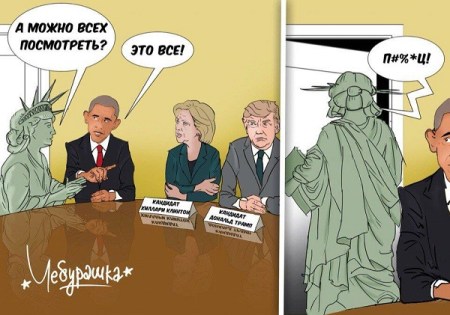 Twitter.com/sharzhipero, May 23, 2016.
On the table badges: candidate Hillary Clinton, candidate Donald Trump.
Statue of Liberty: Can I see all of them [all candidates for the U.S. presidency]?
U.S. President Barack Obama: That’s all of them
Statue of Liberty: Oh, f**k..
“Less than four months remain before America elects its President; the dramatic struggle has entered its final phase. […] As the polls show, it is widely assumed in Russia that the arrival of Donald Trump in the White House would benefit this country more than victory by Hillary Clinton. A populist and fierce opponent of the Washington establishment, Trump could, they say, turn the page in U.S.-Russia relations, which have seen better times, and open a new chapter without regard to the ‘legacy’ of Democrat Barack Obama.
“Hillary Clinton is known to arouse mixed feelings among Russians. Some know her as a relentless and at times inflexible negotiator. Others view her as a politician obsessed with human rights. And still others say that Moscow has always gotten along better with Republicans than with Democrats.
“My experience over the years – and I have talked face-to-face to the leaders of many countries – is telling me that there are hardly any substantial grounds for such fears or hopes. It is usually easier to achieve an agreement with experienced professionals, even if they are inflexible negotiators and difficult partners. They are predictable, rational, and they are well aware of their limitations. A ‘newcomer’ in international politics is usually harder to work with: the lack of experience often translates into inconsistent and unpredictable behavior; it leads to subjective, emotional and at times erroneous decisions that can be very hard to rectify later on.
“Speaking on June 17 [2016] at the Saint-Petersburg International Economic Forum, President Putin recalled his positive experience of working with the forty-second President of the United States, Bill Clinton.[4] I was Minister of Foreign Affairs at the time and remember those days very well. There was more than enough disagreement and difference between our countries back then too. But, unlike recent years, mutually respectful dialogue was never broken off and there was an understanding of how important U.S.-Russia relations were in terms of international stability. Naturally, Mrs. Clinton has her own view of American foreign policy. However, there is evidence that the ‘family experience’ will to a certain extent influence her actions if she wins the November election.
‘It Would Be Naïve To Believe That The State…Of Our Relations With The U.S Are Defined Exclusively By Who Sits In The Oval Office’
“This is not, however, the most important point. It would be naïve to believe that the state and dynamics of our relations with the United States are defined exclusively by who sits in the Oval Office, and that there is some easy and painless way to overcome the deep crisis in our bilateral relations. Miracles don’t happen in international politics. U.S. foreign policy has always been bipartisan, greatly inert, and the outcome of the presidential race alone cannot overturn the existing state of affairs.
‘It is hardly realistic to hope that the new administration will ‘come to its senses’ and be easy to deal with. No matter who wins the presidency, the strategic goal of preserving global leadership will remain unchanged, [all emphases added] though certain adjustments to the international agenda are, of course, possible.
“U.S.-Russia relations have entered a phase where the negative attitude that has accumulated over recent years has essentially grown into full-blown confrontation. This runs counter to our national interests and those of the United States as well. So it is important to take steps that would help reverse this dangerous trend. If we decide to wait and see what the new U.S. President and his or her team do, we lose time, and with it we lose the initiative.
“Frankly speaking, we failed to create a solid foundation for U.S.-Russia relations after the end of the Cold War. We did not try hard enough, engrossed in solving current international problems. This, in my view, makes the launch of a new negotiation process between Washington and Moscow the key goal, a process that would help develop common principles for our relations and jointly developed mutual commitments reflecting the interests of both sides.”
‘To Meet Just To Look Into Each Other’s Eyes Is Not Enough Anymore’
“What should we do first? This is the hardest part.
“In my mind, we first need to start working on arranging a bilateral summit. The longer it takes for such a meeting to happen, the more negative feelings will pile up. The meeting must be thoroughly worked through and it must have a strategic and future-oriented outcome. In today’s situation, to meet just to ‘look into each other’s eyes’ is not enough anymore.[5]
“Clearly, such a meeting will not solve all the numerous controversies we have at once. But this should not be the goal either. The meeting must set the course for the development of bilateral relations and form the necessary mechanisms for cooperation, which would help gradually overcome the present situation where cooperation in matters of strategic importance is held hostage by existing differences.
“Interaction at the presidential level will of course continue to remain the key element of the U.S.-Russia dialogue. But such interaction has to be complemented with a wide range of bilateral mechanisms, each devoted to a key area of cooperation. We need to breathe new life into the Strategic Stability Group,[6] where our two countries are represented by the leaders of the foreign and defense ministries. Dialogue between intelligence agencies has to be institutionalized as well. This would enhance mutual trust and create an atmosphere conducive to cooperation in fighting terrorism and in other fields. Particular attention needs to be paid to economic cooperation. Business-to-business cooperation has not become the shock-absorber that would limit or at least reduce the negative impact of differences in other areas. There is need for a mechanism that would stimulate economic cooperation at the governmental level, which would in turn promote better relations between our two countries in general.
“Another consultation mechanism should be created at the level of civil society. It should involve political and public figures, representatives of the media, science and culture – all those who influence public opinion in Russia and in the U.S. The proposed streamlining of U.S.-Russia dialogue might seem cumbersome and unrealistic at first. Unfortunately, it is the very lack of such a tight framework for dialogue on a wide range of pressing issues that has brought us to where we are today.
“In his telegram to President Obama on the occasion of Independence Day on July 4 this year, President Putin emphasized that ‘the history of US-Russia relations shows that when we act as equal partners and respect each other’s lawful interests, we are able to successfully resolve the most complex international issues for the benefit of both countries’ peoples and all of humanity.’
“Let us hope that Washington would take this invitation to dialogue seriously.”
Endnotes:
[1] Russiancouncil.ru, July 16, 2016
[2] See MEMRI Special Dispatch no. 6520, Russian Commentator On U.S. Elections: Clinton Is Better For Russia, July 19, 2016.
[3] Wall Street Journal, July 14, 2016.
[4] During the Plenary session of St Petersburg International Economic Forum, Putin said: “I worked with Bill Clinton, although for a very short time, and we had a very good relationship. I can even say that I am grateful to him for certain moments as I was entering the big stage in politics. On several occasions, he showed signs of attention, respect for me personally, as well as for Russia. I remember this and I am grateful to him. About Ms. Clinton. Perhaps she has her own view on the development of Russian-U.S. relations. You know, there is something I would like to draw [your] attention to, which has nothing to do with Russian-U.S. relations or with national politics. It is related, rather, to personnel policy. In my experience, I have often seen what happens with people before they take on a certain job and afterward. Often, you cannot recognize them, because once they reach a new level of responsibility they begin to talk and think differently, they even look different. We act on the assumption that the sense of responsibility of the U.S. head of state, the head of the country on which a great deal in the world depends today, that this sense of responsibility will encourage the newly elected president to cooperate with Russia and, I would like to repeat, build a more secure world.” Kremlin.ru, June 17, 2016.
[5] Ivanov appears to be referring to the June 2001 summit between Vladimir Putin and George W. Bush at the conclusion of which Bush told the press” “I looked the man in the eye. I found him very straight-forward and trustworthy – I was able to get a sense of his soul.” BBC.co.uk, June 16, 2001.
[6] Russia has established strategic stability groups with other countries and not only with the U.S. For example, in January 2003, the first meeting of the strategic stability group of Russia and Pakistan met to thrash out questions of proliferation of weapons of mass destruction and their delivery systems. Mid.ru, January 16, 2003.
Terrorism in The Therapeutic Age, Front Page Magazine, Bruce Thornton, July 21, 2016

We know what is going to follow the latest terrorist murder in Nice. Shrines to the dead will instantly spring up. Conclaves of citizens will gather at sorrowful demonstrations filled with ecumenical clichés. The media will profile selected victims, wringing every ounce of pathos out of their tragedy. Twitter will be inundated with sentimental bromides and ephemeral hashtags, and politicians will give solemn and empty speeches laced with even emptier threats.
Welcome to terror in a therapeutic age.
What we will not read are passionate demands from most citizens of Western governments that mind-concentrating force be unleashed on those responsible for the latest slaughter of the innocents. Nor will we hear stirring speeches from our political leaders that forcefully make the moral case for war against the murderers and their enablers.
Obsessing over feelings and emotions is what many moderns reflexively substitute for meaningful action. Righteous anger and burning revenge of the sort that fired up Americans after the Pearl Harbor attacks are too “mean” and “hurtful,” and require a serious commitment and exorbitant risk. Displaying emotion is cheap and gratifying and offends no one. Indeed, such displays demonstrate the purveyors’ superior “we are the world” sensibilities and sensitivity. It is “conspicuous compassion,” as Alan Bloom called it, as much a status symbol as Veblen’s conspicuous consumption. It’s how people show themselves to be civilized and advanced, too sophisticated for retrograde emotions like avenging anger. That’s so Old Testament.
In the therapeutic world, conflict is to be resolved by peace, love, and understanding. Or as our Attorney General said after the Orlando jihadist massacre, “Our common humanity transcends our differences, and our most effective response to terror is compassion, it’s unity and it’s love.” Thus the institutional instruments for resolving our differences with the jihadists are diplomatic engagement, foreign aid, economic development, negotiated agreements, and careful nurturing of our enemies’ self-esteem. We must flatter them, stroke their egos, attend to their grievances, censor any unpleasant facts about their religion. Pretend, as Obama does, that Islam, the “religion of peace” and has absolutely nothing to do with Muslim terrorism, or what he prefers to call “violent extremists.” Assert, like Hillary, “Let’s be clear: Islam is not our adversary. Muslims are peaceful and tolerant people and have nothing whatsoever to do with terrorism.”
The problem is, we live in a world of people with radically different ideas about the goods they should pursue, and who don’t give a damn about “peace, love, understanding,” or the opinions of Western infidels about their religion. Whatever their potential is for possessing and recognizing a “common humanity,” in practice this possibility remains mostly unexpressed in their traditional religious tenets. Rather, Muslim jihadists––and hundreds of millions of ordinary Muslims–– limit their compassion, sympathy, and respect for humanity to fellow Muslims, and deny them to the infidel or heretic. That’s why zakat, the personal obligation for Muslims to make charitable contributions, for the most part restricts that charity to other Muslims.
The only “common humanity” pious Muslims recognize is the divine obligation for all humans to become Muslim. Their highest goods are not democracy, prosperity, leisure, and tolerance, but obedience to Allah and his laws. And millions of them view violence in the name of Allah as the divinely justified instrument for creating a world in which “all men say there is no god but Allah.”
Appeals to a “common humanity,” then, are useless as appeasing flattery for dealing with a man who, willing to die and kill in the name of Allah, drives a truck over men, women, and children, killing, mangling, and dismembering them. Flattery only confirms the jihadist’s belief that the infidel West is populated by godless hedonists eager only to enjoy life for one more day, and so are willing to sacrifice their freedom and rights for the short-term pleasures of la dolce vita. They are unworthy of compassion, for they no longer know what is worth dying and killing for. They have forgotten what Lincoln called the “awful arithmetic,” the tragic reality that some people must die today so that more people don’t die later––the gruesome calculus that the Allies followed to defeat fascism, Japanese imperialism, and Nazism.
Over forty years ago, the great Soviet dissident Alexandr Solzhenitsyn in his Nobel lecture identified this chronic weakness that permeates the West:
The spirit of Munich has by no means retreated into the past; it was not a brief episode. I even venture to say that the spirit of Munich is dominant in the twentieth century. The intimidated civilized world has found nothing to oppose the onslaught of a suddenly resurgent fang-baring barbarism, except concessions and smiles. The spirit of Munich is a disease of the will of prosperous people; it is the daily state of those who have given themselves over to a craving for prosperity in every way, to material well-being as the chief goal of life on earth. Such people––and there are many of them in the world today––choose passivity and retreat, anything if only life to which they are accustomed might go on, anything so as not to have to cross over to rough terrain today, because tomorrow, see, everything will be all right. But it never will! The reckoning for cowardice will only be more cruel. Courage and the power to overcome will be ours only when we dare to make sacrifices.
These comments about the Soviet Union and the West are just as true today about the “fang-baring barbarism” of Islamic jihad. The surreal denial of the nature of the enemy and his religious motivations; the symbolic military gestures that serve public relations and political advantage rather than a strategy for defeating the enemy; the unwillingness to accept the eternal tragic realities of war and instead create suicidal rules of engagement vetted by pettifogging lawyers; and the refusal of citizens to pay the price necessary for destroying the enemy––all reflect the disease that Solzhenitsyn identified.
The problem is one of morale, not ability. We can destroy ISIS. Even the fictional Peter Quinn, from the series Homeland, knows how: put 200,000 troops in a country indefinitely or “bomb Raqqa into a parking lot.” In the real world, Asia Times columnist “Spengler” agrees. Wage total war both against the enemy abroad and against fellow travelers and sympathizers at home.
But don’t hold your breath. The political will for such action does not exist among a significant number of Americans. They would rather feel than act. Meanwhile, they indulge lachrymose sentiment, a luxury of the pampered rich. They call for “diplomacy” and “engagement,” the tried and true camouflage for the fear to act. They prefer to spend money on more and more government provided “butter” rather than on guns, as they move on to the next episode of televised tragedy in between bouts of Pokémon Go.
Meanwhile, the reckoning for our cowardice grows ever closer and ever crueler.
Exclusive — Sarah Palin to Ted Cruz: Delete Your Career
20 Jul 2016
Source: Exclusive – Sarah Palin to Ted Cruz: Delete Your Career – Breitbart

BRENDAN SMIALOWSKI/AFP/Getty Images
Palin, whose endorsement of Cruz’s long-shot Senate bid in 2012 was credited by Cruz himself as the reason why he won the race that launched his national political career, gave the following statement to Breitbart after delegates booed Cruz off the stage at the Republican National Convention on Wednesday night:
Turns out Ted Cruz’s partner, Carly Fiorina, had a more graceful exit from the political stage than he had.
Cruz’s broken pledge to support the will of the people tonight was one of those career-ending “read my lips” moments. I guarantee American voters took notice and felt more unsettling confirmation as to why we don’t much like typical politicians because they campaign one way, but act out another way. That kind of political status quo has got to go because it got us into the mess we’re in with America’s bankrupt budgets and ramped up security threats.
It’s commonplace for politicians to disbelieve their word is their bond, as evidenced by Cruz breaking his promise to endorse his party’s nominee, evidently thinking whilst on the convention stage, “At this point, what difference does it make?” We’ve been burned so horribly by that attitude that voters won’t reward politicians pulling that “what difference does it make” stunt again. Politicians will see — it makes all the difference in the world to us.
Palin also passed along the following video:
Ted Cruz Booed After Failing to Endorse Trump: ‘Vote Your Conscience’
Source: Ted Cruz Booed as He Tells Republicans: ‘Vote Your Conscience’
Cruz congratulated Donald Trump on winning the party’s nomination, but stopped short of endorsing Trump outright, saying merely that he wanted to see the party’s principles prevailing in November.
He urged voters: “Please: don’t stay home in November.” But then he added: “If you love our country, and love your children as much as I know that you do, vote your conscience.”
“I appreciate the enthusiasm of the New York delegation,” he said, as he was booed.
Prior to that, Cruz had focused on the conservative principles at the core of the party.
He began with a lighthearted metaphor as he spoke in the Quicken Loans Arena, reflecting on the Cleveland Cavaliers’ recent historic victory in the NBA Finals. “LeBron James just led an incredible comeback victory, and I am convinced America is going to come back, too.”
Cruz went on to describe one of the fallen Dallas police officers, Michael Smith, who was killed by a sniper at a Black Lives Matter protest less than two weeks ago. “I have no idea who he voted for in the last election, or what he thought about this one, but his life was a testament to devotion.”
“He protected the very protesters who mocked him because he loved his country and his fellow man.”
Cruz went to to describe the stakes in the upcoming election — namely, that each person could tell their children “that we did our best for our country.”
And the country’s bedrock principle, Cruz said, was simple: “Freedom matters.”
He then drew a clear distinction between the parties: “Of course, Obama and Clinton will also tell you that they care about our country’s future. And I want to believe them. But there is a profound difference in our two visions of our country’s future.”
On terror and trade, on education and employment, on immigration and the Internet, Cruz spelled out stark disagreements between Democrats and Republicans — focusing, interestingly, on Obama and not his would-be successor.
“Freedom means free speech, and not politically correct safe spaces,” Cruz added, nothing that the Bill of Rights applied equally to all, including “gay or straight.”
On abortion, Cruz said: “Freedom means that human life is precious and must be protected.” And he reminded the gathering: “Our party was founded to defeat slavery … Together, we passed the Civil Rights Act, and together we fought to eliminate Jim Crow laws. That’s our collective legacy — although the media will never share it with you.”
And then, Cruz delivered those fateful words: “Vote your conscience.”
The boos and interruptions never ceased after that, with chants of “We want Trump!”
He concluded with a call to unity: “The case we have to make to the American people … is to commit to each of them that we will defend freedom and be faithful to the Constitution.”
But Cruz left the stage having divided the party.
Update: A Cruz supporter told Breitbart News: “I think it was entirely selfish. I think he’s ruined his future. Everybody was right about him. It’s a character thing.”
Another attendee described Cruz’s address as a “slap in the face” and “toying with the convention.”
Reactions were even harsher behind the scenes. Dana Bash of CNN reports that Cruz entered a donor suite at the arena after the speech, and was told, to his face, that he was a “disgrace.” One man was so angry at Cruz that he had to be “physically restrained,” and Heidi Cruz had to be escorted from the convention floor because of heckling by Trump delegates.
Eric Trump tried valiantly to mollify the crowd with a stirring address, albeit one beset by technical difficulties, and former Speaker of the House Newt Gingrich did his best as well, but almost nothing could overshadow what Cruz had done.
The crucial phrases from Cruz’s address in the prepared version of the text, highlighted in yellow for reporters, were:
We deserve leaders who stand for principle. Unite us all behind shared values. Cast aside anger for love. That is the standard we should expect, from everybody.
And to those listening, please, don’t stay home in November. Stand, and speak, and vote your conscience, vote for candidates up and down the ticket who you trust to defend our freedom and to be faithful to the Constitution.
The final address of the evening, by Gov. Mike Pence of Indiana, was solid, but spoke of a “united party” and uniting the nation.
Update #2: Jonathan Swan at The Hill reports that aides to Ted Cruz pleaded with him to endorse his former rival, but the Texas senator refused:
Just hours before Ted Cruz took the stage for his convention speech Wednesday night, senior members of Cruz’s team were still pushing him to endorse Donald Trump.
Cruz never wanted to endorse Trump and is still furious about the personal attacks the GOP presidential nominee made on his family during the primary campaign, sources familiar with the speech preparations told The Hill.
But top aides had concluded he needed to formally endorse Trump at the Republican National Convention.
For Cruz, it was always personal.
[…]
Still, some aides to Cruz, a Republican senator from Texas, were pushing him to endorse Trump for the sake of his own political future.
Cruz has indicated intentions to run for president again in 2020, and he has a team forming behind him to execute that plan. 2020 was the unspoken undertone beneath the drafting Wednesday night’s speech.
Update #3 (Michelle Moons):
Shortly following Cruz’s speech, Former Speaker of the House Newt Gingrich asked the crowd to consider carefully the implication of Cruz’s words.
“Ted Cruz said you can vote your conscience for anyone that will uphold the Constitution. In this election, there is only one candidate who will uphold the Constitution.”
He continued, “If you want to protect the constitution of the United States, the only possible candidate this fall is the Trump-Pence Republican ticket.”
Update #4: Throughout the broadcast of Pence’s speech, CNN highlighted every area of policy disagreement between the two candidates on the Republican ticket:
For all that, CNN’s political analyst, Gloria Berger, called Pence’s speech “pitch-perfect.”
Update #5: CNN’s Ana Navarro, a former Jeb Bush surrogate who is no fan of Trump, panned Cruz’s speech.
While you should always “vote your conscience,” she said, if you’re invited to dinner, “You don’t eat the food, drink the wine, and then piss on the carpet. It was tacky.”
Update #6: Hillary Clinton has weighed in, tweeting Ted Cruz’s taglin
Update #7: Gov. Chris Christie of New Jersey seems visibly shaken as he speaks to CNN’s Dana Bash, telling her that Cruz’s speech was “selfish” and that he had broken his pledge — not to Trump, but to all the candidates.
He adds that America can now see why Cruz has “richly deserved” his bad reputation among colleagues on Capitol Hill.
Update #8: CNN’s Jake Tapper makes the best case for Cruz — without agreeing with it, saying that Cruz does not believe Trump is a conservative, and that he is planning to run again for president as the “conscience” of the party.
Update #9: One of the other highlighted lines in the prepared version of Cruz’s speech was: “And citizens are furious — rightly furious — at a political establishment that cynically breaks its promises and ignores the will of the people.”
Now that Cruz is being accused of having broken his promise to support the party’s nominee, it is a rather ironic line.
Update #10: Trump aide Michael Cohen tells CNN that Cruz’s speech was “political suicide.”
Update #11: Trump tweets that he had seen Cruz’s speech in advance, and allowed him to deliver it anyway:
If true, then Trump — who was seen applauding Cruz in the wings during his address — may have enjoyed watching Cruz self-destruct.
Update #12: Cruz’s speech, as delivered, and checked against delivery by Michelle Moons:
Update #13: Neil Munro has collected different reactions from delegates on the floor of the convention:
“It was the perfect speech and it was completely ruined by the booing.” said Texan Richard Morgan.
Cruz implicitly endorsed Trump, and repeatedly urged voters to vote against Clinton, he said. Some Cruz supporters still aren’t quite ready to accept Trump — partly because of the butter campaign fight — but will be ready to back him as the election draws nearer, he said.
“I think it is right for today — people still don’t want him to well out” to Trump, he said.
The speech, he added, was “very unifying until the delegations started booing.”
But Mark, a delegate from outside Texas, said the speech crystalized widespread suspicion of Cruz’ s motivations and character.
“Cruz does what he does for the real activists, [the non-endorsement] was a betrayal and that’s how it is going to be taken.”
“You just probably saw a political career vaporize before your eyes. “
“He did, in a way,” endorse Trump, said one Oklahoma delegate, who supported Cruz. “I don’t think it will be as big a deal as everybody thinks,” he added.
“I’m disappointed [he did not endorse] — I would have liked to see him do it, but I also understand why he didn’t” because of the hard feelings left after a tough campaign, he said.
“If Trump loses, Cruz is done,” said Ken Henry, from Alaska. “He didn’t say it … he never said ‘I endorse Donald J. Trump.”
“There was consternation on the floor,” said Cynthia Henry, a delegate and committee member from Alaska.
“You’ve just seen a man commit suicide,” said Don, a delegate from Arizona. “This reminds me of George H. Bush saying ‘Read my lips, no new taxes,” and then he goes out [and makes a tax increase deal] with Tip O’Neill.”
Erin Swanson, a Texas delegate, said that the Trump campaign knew the contents of the speech, “they knew it was not a formal endorsement.”
Cruz is an elected U.S. Senator,who represents Texas conservatives, she said. “I never expected Ted to fully endorse … Cruz would lose a lot of credibility [in Texas] if he endorseed Trump,” she said.
“Teump needs to work to unify the party, and he should not have alienated people by interrupting the speech.”
Chris Ford, another Texas delegate, said: “It definitely was not an endorsement … it is not his style,” adding that Trump should not try to bully an elected Texas Senator.
“It doesn’t bother me, “ said Boyd Smith, a California delegate.”We’re allowed out own agency to say what we say.”
“I don’t think there’s a split… people are entitled to express their views.”




 anneinpt
 artaxes
 danmillerinpanama
 davidking1530
 Peter Hofman
 Joseph Wouk
 Peter
Peter Louisiana Steve
 WarSclerotic
Recent Comments