Archive for May 2016

Europe’s Leaders Blast Bill Over Democracy Jibe: ‘The Mouth Belongs To Clinton, The Voice Belongs To Soros’

May 20, 2016

Europe’s Leaders Blast Bill Over Democracy Jibe: ‘The Mouth Belongs To Clinton, The Voice Belongs To Soros’

by Raheem Kassam

20 May 2016

Source: Europe’s Leaders Blast Bill Over Democracy Jibe: ‘The Mouth Belongs To Clinton, The Voice Belongs To Soros’

Getty

Top European leaders have blasted Bill and Hillary Clinton following a war of words about the commitment to democracy of both the Polish and Hungarian governments. One leading figure insisted Mr. Clinton “needs a medical test” following his remarks.

Bill Clinton upset NATO allies in a broadly unreported gaffe accusing Poland and Hungary of thinking “democracy is too much trouble” and wanting to have an “authoritarian dictatorship.” This is despite the fact that Poland recently held elections turfing out the establishment political parties in an election with a higher turnout than Mr. Clinton’s re-election in 1996.

Poland’s newly elected Prime Minister Beata Szydlo called Clinton’s words “unjustified and simply unfair”, adding: “With all due respect, and without using coarse words [Clinton] exaggerated and should apologize to us”.

Mr. Clinton’s remarks came during a Hillary for President campaign rally in New Jersey this week, where he claimed: “They want (Russian President Vladimir) Putin-like leadership. Just give me an authoritarian dictatorship and keep the foreigners out”.

“Sound familiar?” he asked, in a broadside against GOP presumptive nominee Donald Trump.

But in Mr. Clinton’s attempts to use foreign affairs against Mr. Trump, he angered one of NATO’s most important members: Poland, and one of the few countries holding back the tide of migration into Europe: Hungary.

“If someone says there is no democracy in Poland today, that means he should have a medical test,” blasted the head of Poland’s Law and Justice party Jaroslaw Kaczynski.

And his comments were echoed by Hungarian Prime Minister Viktor Orban, who used the incident to highlight the multi-million dollar connections between the Clintons and Hungarian left-wing billionaire George Soros.

Speaking to Hungarian radio on Friday, Mr. Orban blasted: “Hungarians and Polish people rightfully expect more respect from the actual and the former leaders of the United States. I like what the president of the Polish governing party said, although it is harsh, but his reference to the [Clinton’s] need for medical help made many Hungarian hearts beat [in agreement].”

He said, refusing to repeat Mr. Kaczynski’s words: “what is permissible for Jove is not permissible for an ox” – a literary reference implying Mr. Clinton believes he is a god, while the Hungarians are just cattle.

“[B]eyond the American campaign, the remarks made about Hungary and Poland… have a political dimension,” Mr. Orban said, accusing Mr. Clinton of repeating Soros-inspired campaign lines: “These are not accidental slips of the tongue. And [the number of] these slips or remarks have been multiplying since we are living in the era of the migrant crisis. And we all know that behind the leaders of the Democratic Party, we have to see George Soros.”

“And George Soros published his six points supporting the Muslim migration to Europe, in which he announced that at least one million Muslims should be allowed [into Europe] each year, that they must be provided a safe path and that Europe should be happy to get such a chance and shouldn’t be defending against it. He also said that it will cost a lot of money, which he’d loan.”

“So, here, in Central Europe a shadow power exists, which is linked to George Soros, he is one of the most important sponsors of the Democratic Party, so I have to say that although the mouth belongs to Clinton, the voice belongs to George Soros. And since Hungary is where it is, I mean geographically it is where it is and wants to protect its national sovereignty and security, we are a blockade for this Soros plan in America. They will not carry it out here as long as Hungary has a government working in the national interest.”

Writing in the Observer, NATO-expert John R. Schindler notes: “Polish hard feelings regarding Mr. Clinton’s comments aren’t difficult to decipher. In the first place, the statement that any Polish government wants to emulate Russia in any way seems calculated to offend. Memories of long and brutal occupation by the Kremlin are fresh and fears of Mr. Putin run deep, in light of on-going Russian aggression against Poland’s neighbors. Poles are not much fonder of Russians than Jews are of Germans, a fact Mr. Clinton—who touts his foreign policy accomplishments in the White House—should understand.”

Bloomberg has reported that after an 11-year hiatus from large-scale political campaign funding, Mr. Soros has handed Mrs. Clinton around $13 million so far, “already more than his total disclosed spending in the last two presidential elections combined”.

“Soros’s personal fortune stands at about $24 billion, according to the Bloomberg Billionaires Index… The Open Society Foundations say they have spent some $13 billion over the past three decades.”

Critics point to Mr. Soros’s funding behind anti-Polish government groups since the elections, as well as worsening Europe’s migrant crisis by funding open borders activists and “refugee” aid groups.

Federal Judge Orders ‘Deceptive’ DOJ Lawyers to Take Ethics Classes

May 20, 2016

Federal Judge Orders ‘Deceptive’ DOJ Lawyers to Take Ethics Classes, PJ Media, May 20, 2016

(Cf. John Kerry: Enthusiastic Proponent of a ‘Borderless World’. How about a lawless world too?– DM)

Judge-Hanen.sized-770x415xc

In a stunning rebuke to the Department of Justice Thursday, U.S. District Judge Andrew Hanen ordered annual ethics classes for the DOJ attorneys who were “intentionally deceptive” during the course of executive amnesty litigation. At issue was whether the DOJ intentionally misled the judge into believing that Obama’s DACA amnesty program would be halted until he made a ruling on a lawsuit brought by 26 states.

From November of 2014 until February of 2015, while the judge was still deciding the case, the Department of Homeland Security gave more than 108,000 illegal immigrants three-year reprieves. They did this after DOJ lawyers led him to believe that they would halt the program during that period. The 26 states who filed a lawsuit were thus misled into “foregoing a request for a temporary restraining order,” Hanen wrote in his blistering decision. “Such conduct is certainly not worthy of any department whose name includes the word ‘Justice.'”

Via the Washington Examiner:

The facts of the deception are not in doubt, Hanen emphasized. “[DOJ] has now admitted making statements that clearly did not match the facts,” he said in the May 19 opinion, first noted by the National Law Journal. “It has admitted that the lawyers who made these statements had knowledge of the truth when they made these misstatements … This court would be remiss if it left such unseemly and unprofessional conduct unaddressed.”

As punishment, Justice Department attorneys who wish to appear in any state or federal court within the 26 states that brought the lawsuit have to undergo annual ethics training. “At a minimum, this course (or courses) shall total at least three hours of ethics training per year,” he wrote.

In another case, such “egregious conduct” would lead him to strike the government’s pleadings, but Hanen decided not to take that step because the Supreme Court heard oral arguments in the case in April.

“The national importance of the outcome of this litigation outweighs the benefits to be gained by implementing the ultimate sanction,” Hanen wrote. “Striking the government’s pleadings would not only be unfair to the litigants, but also unfair, and perhaps even disrespectful, to the Supreme Court as it would deprive that Court of the ability to thrash out the legal issues in this case.”

Hanen cited multiple instances in which Justice Department attorneys claimed that Department of Homeland Security directive announced in November of 2014 would not be implemented until February 18, 2015, even though they knew that DHS had begun implementing a portion of the order that pertained to the original “deferred action for childhood arrivals” policy announced in 2012.

Justice Department attorney Kathleen Hartnett told Judge Hanen during a January 2015 hearing that nothing would be happening with regard to DACA until Feb. 18, 2015. On Feb. 16, 2015, Hanen sided with the states and issued a preliminary injunction blocking Obama’s actions. Then he found out that the reprieves and work permits had been continuing all along.

That March, the exasperated judge chastised Hartnett for lying to him in January. “Like the judge, the states thought nothing was happening,” Hanen said. “Like an idiot, I believed that”:

A flustered Hartnett repeatedly apologized to Hanen for any confusion related to how the reprieves and work permits were granted.”We strive to be as candid as possible. It truly became clear to us there was confusion on this point,” she said.

Hanen seemed genuinely disappointed that he could not disbar the DOJ attorneys who lied to him, but he did ban them from practicing law in Texas:

The court does not have the power to disbar the counsel in this case, but it does have the power to revoke the pro hac vice status of out-of-state lawyers who act unethically in court. By a separate sealed order that it is simultaneously issuing, that is being done.

In the meantime, perhaps the court-ordered ethics classes will help the “confused” lawyers understand the concept of “justice” a little better.

John Kerry: Enthusiastic Proponent of a ‘Borderless World’

May 20, 2016

John Kerry: Enthusiastic Proponent of a ‘Borderless World’ Front Page MagazineMichael Cutler, May 20, 2016

john_kerry_senator_from_ma-2 (1)

How the Secretary of State’s globalist agenda renders him unfit for his job.

John Kerry’s Department of State is responsible for functions that are so essential to the well-being of America and Americans that the Secretary of State is in the line of succession to the U.S. Presidency.

On May 6, 2016 Time Magazine published the transcript of the commencement address Kerry delivered at Northeastern University.

Here is an important excerpt from his remarks:

“I think that everything that we’ve lived and learned tells us that we will never come out on top if we accept advice from soundbite salesmen and carnival barkers who pretend the most powerful country on Earth can remain great by looking inward and hiding behind walls at a time that technology has made that impossible to do and unwise to even attempt,” Kerry said. “The future demands from us something more than a nostalgia for some rose-tinted version of a past that did not really exist in any case.”

His delusional statement that it is impossible and unwise to look inward or attempt hide behind walls should give us all a serious “cause for pause.”  His blatantly globalist philosophies are diametrically opposed to oath of office and responsibilities and America’s best interests.

It is, perhaps understandable that Kerry, a key member of the Obama administration would not want Americans to “look inward” because looking inward will disclose the rot and dysfunction that America is now suffering from.  Record levels of heroin addiction, a rapidly shrinking middle class, wage suppression and contrary to labor statistics, record levels of unemployment by working age Americans.

On May 12, 2016 CBS News posted an Associated Press report, “Middle class shrinks in 9 of 10 US cities as incomes fall.”

As for “hiding behind walls”- metaphorically, our borders are America’s walls.  With the growing threats posed by ISIS and other international terrorist organizations and transnational criminal gangs and organizations, our borders must be secured and seen for what they truly are- our first and last line of defense. I discussed these issues in my recent video, Michael Cutler Moment: Obama’s Pathway to the ‘Borderless World’.

During his commencement address Kerry referenced the Boston terror attack- stating:

And as we were reminded earlier, you are still mourning the tragic loss of Victoria McGrath and Priscilla Perez Torres. Even before, on Patriot’s Day 2013, when Victoria was among those hurt by a terrorist’s bomb, this community felt the weight of a wounded world. So this morning, we grieve and we celebrate all at the same time.

Yet Kerry ignored that the Tsarnaev brothers, who carried out that deadly attack, were admitted into the United States with visas the State Department issued or that the recent San Bernardino, California terror attack involved a woman, Tashfeen Malik, who was admitted into the United States on a K-1 (Fiancee) visa.

While CBP (Customs and Border Protection) Inspectors inspect aliens seeking to enter the United States, the State Department issues visas to aliens who are required to secure visas prior to entering the United States.  It also determines policies concerning the admission of refugees into the United States.

Indeed, over the past several decades, most of the terrorists who have carried out, or attempted to carry out, attacks in the United States were aliens who had been admitted into the United States with visas.

The State Department is an integral component of border security and hence, national security.

The 9/11 Commission focused considerable attention on the lack of integrity to the visa adjudications process.  The preface of the “9/11 Commission Staff Report on Terrorist Travel” begins with the following paragraph:

It is perhaps obvious to state that terrorists cannot plan and carry out attacks in the United States if they are unable to enter the country. Yet prior to September 11, while there were efforts to enhance border security, no agency of the U.S. government thought of border security as a tool in the counterterrorism arsenal. Indeed, even after 19 hijackers demonstrated the relative ease of obtaining a U.S. visa and gaining admission into the United States, border security still is not considered a cornerstone of national security policy. We believe, for reasons we discuss in the following pages, that it must be made one.

Page 54 contained this excerpt under the title “3.2 Terrorist Travel Tactics by Plot:”

Although there is evidence that some land and sea border entries (of terrorists) without inspection occurred, these conspirators mainly subverted the legal entry system by entering at airports.

Each year roughly one half million nonimmigrant aliens who are admitted into the United States subsequently violate their terms of admission.  This should cause the State Department to consider how to more effectively screen aliens who apply for visas but under Kerry’s “leadership,” this has not been done.

Carefully scrutinizing aliens who seek visas and entry into the United States, especially given the multitude of threats we face today is not a matter of “isolationism” but of commonsense.

Kerry went on to note:

“Now, graduating class, I got to tell you, you really do look spectacular. I want you to – I mean, just look around you. Classmates of every race, religion, gender, shape, size – 85 countries represented and dozens of languages spoken. You are the most diverse class in Northeastern’s history – in other words, you are Donald Trump’s worst nightmare.”

That statement is disturbing for two reasons.  First of all, commencement addresses are not supposed to be campaign events.  Second- the statement outrageously accuses anyone who believes the United States must secure its borders- especially in a historically perilous era, is demonstrating xenophobia or racism.

Our immigration laws are utterly and totally blind as to race, religion and ethnicity.

It is also disconcerting, but not surprising, to note that Kerry expressed delight that Northeastern University has so many foreign students in attendance.  His State Department issued every one of those foreign students their visas.  On April 29, 2016 ICE issued a press release, “ICE releases quarterly international student data” that included the following:

Based on data extracted from SEVIS (Student and Exchange Visitor Program) March 7, 2016 international student enrollment at U.S. schools increased 6.2 percent compared to March 2015. In March, there were 8,687 U.S. schools with SEVP certification to enroll international students, a three percent decrease from the previous year.

Forty percent of international students studying in the United States, equaling almost 479,000 individuals, were enrolled in science, technology, engineering and mathematics (STEM) coursework. Approximately 417,000 international students from Asia pursued STEM studies, an increase of 17 percent since March 2015.

The ICE press release went on to note:

Other key points from the report include: 77 percent of all international students were from Asia. The top 10 countries of citizenship for international students included: China, India, South Korea, Saudi Arabia, Canada, Vietnam, Japan, Taiwan, Brazil and Mexico.

I have written a number of articles on why educating so many foreign students at our universities undermines national security and also has a negative impact on American workers. Two such articles are: Educating Our Adversaries and Educating ‘Engineers of Jihad’ at US Universities.

Kerry used his address to decry poverty around the world and while celebrating the growth of the middle class in foreign countries, ignored how increasingly, poverty in American cities undermines U.S. national security and public safety and destroys the futures of millions of poverty-stricken American children as America’s middle class faces extinction.

Consider this excerpt from his commencement address:

“Today, extreme poverty worldwide has fallen below 10 percent for the first time in history. The revolution that is taking place on a global basis has brought hundreds of millions of people in India, hundreds of millions of people in China into the middle class. And while that’s welcome news, we’re not satisfied because 700 million people still have to survive on less than what it costs for us to grab a couple of Dunkin Donuts a day, because the gap – the gap that was referred to earlier between rich and poor – remains far too wide.”

The New York Post reported on the economic crisis in the United States in its article, “America’s middle class is headed toward extinction.”  This topic is one I wrote about in one of my earlier articles, Immigration ‘Reform’: Engineered Destruction of the Middle Class.

Kerry’s commencement address that touted the growth of the middle class in China and India, while blithely ignoring the economic plight of Americans and America’s middle class, made his speech far more appropriate for the Secretary General of the United Nations than the U.S. Secretary of State to deliver at Northeastern University.

Peace: A deceptive, dictatorial word

May 20, 2016

Peace: A deceptive, dictatorial word, Israel Hayom, Martin Sherman, May 20, 2016

No matter how many far-reaching compromises and gut-wrenching concessions Israel has made, they have never been enough to elicit any commensurate counter-concessions from the Arabs. Indeed, rather than satiate the Arab appetite, they have merely whetted it, with each Israeli gesture only leading to further demands for more “gestures.”

****************************

After a long absence, “peace” is back in the headlines, due in large measure to this week’s visit to Israel by French Foreign Minister Jean-Marc Ayrault, who came to try to promote a new French initiative that somehow, by as yet unspecified means, would resuscitate the moribund “peace process.”

Perversely planned to take place without either Israel or the Palestinians, the principal protagonists, the conference has now fortuitously been delayed to accommodate the schedule of U.S. Secretary of State Kerry, who apparently had better things to do than take part in yet another doomed charade to forge “peace” in the Middle East.

However, despite its ill-conceived rationale and dauntingly dim prospects, the planned summit can and should serve one constructive purpose: to focus attention not only on what the quest for the elusive condition of “peace” really entails, but on the even more fundamental question of what is actually meant, and what can realistically be expected, when we talk of “peace” as a desired goal, particularly in the context of the Middle East and particularly from an Israeli perspective.

Indeed, the need for such clarification becomes even more vital and pressing because of recent reports of possible Egyptian involvement in attempts to initiate “peace” negotiations with Arab regimes teetering on the brink of extinction and involving a perilous Israeli withdrawal to indefensible borders. All this in exchange for grudging recognition as a non-Jewish state by a partially no longer existent, partially disintegrating, Arab world.

A dictatorial word

It takes little reflection to discover that, in fact, “peace” is a word that is both dictatorial and deceptive.

It is dictatorial because it brooks no opposition. Just as no one can openly pronounce opposition to a dictator without risking severe repercussions, so too no one can be openly branded as opposing peace without suffering grave consequences to personal and professional stature.

Life can be harsh for anyone with the temerity to challenge the tyrannical dictates of the politically correct liberal perspectives. As British columnist Melanie Phillips remarked several years ago in an interview on Israel’s Channel 1: “Believe me, it [failing to abide by political correctness] has a very chilling effect on people, because you can lose your professional livelihood, your chances of promotion, you lose your friends.”

In a surprisingly candid admission, The New York Times’ Nicholas Kristof wrote that “universities are the bedrock of progressive values, but the one kind of diversity that universities disregard is ideological. … We’re fine with people who don’t look like us, as long as they think like us.”

This peer-imposed doctrinaire uniformity has had a debilitating impact on the quality of intellectual discourse in general, and on the question of “peace” in the Middle East in particular.

A New York Times opinion piece by Arthur C. Brooks cautioned: “Excessive homogeneity can lead to stagnation and poor problem solving.” Citing studies that found a “shocking level of political groupthink in academia, he warned that “expecting trustworthy results on politically charged topics from an ideologically incestuous community [is] downright delusional.”

A deceptive word

The considerable potential for defective analysis in the intellectual discourse on such a politically charged topic as “peace” also accounts for another detrimental attribute of the word.

Not only is it rigidly dictatorial, but, perhaps even more significantly, “peace” is a grossly deceptive word. It can be, and indeed is, used to denote two disparate even antithetical political situations. On the one hand, “peace” can be used to describe a state of mutual harmony between parties, but on the other hand it can just as aptly be used to characterize an absence of violence maintained by deterrence.

In the first meaning, “peace” entails a situation in which the parties eschew violence because they share a mutual perception of a common interest in preserving a tranquil status quo. In the second meaning, “peace” entails a situation in which violence is avoided only by the threat of incurring exorbitant costs.

The significance of this goes far beyond semantics. On the contrary. If it is not clearly understood, it is likely to precipitate calamitous consequences.

The perilous pitfalls of ‘peace’

It is crucial for practical policy prescriptions not to blur the sharp substantive differences between these two political realities. Each requires different policies both to achieve and, even more importantly, to sustain them.

The misguided pursuit of one kind of peace may well render the achievement — and certainly the preservation — of the other kind of peace impossible.

Countries with the mutual harmony variety of “peace” typically have relationships characterized by openness and the free movement of people and goods across borders. As in the relationship between Canada and the U.S., there is little or no effort needed to prevent hostile actions by one state against the other. Differences that arise are not only settled without violence, but the very idea of using force against each other is virtually inconceivable.

By contrast, in the second, deterrence-based variety of peace, such as those between the U.S. and USSR during the Cold War or between Iran and Iraq up to the 1980s, the protagonists feel compelled to invest huge efforts in deterrence to maintain the absence of war.

Indeed, whenever the deterrent capacity of one state is perceived to wane, the danger of war becomes very real, as was seen in the Iraqi offensive against an apparently weakened and disorderly Iran after the 1979 Islamic Revolution.

In this type of “peace,” there is no harmonious interaction between the peoples of the states. Movements across borders are usually highly restricted and regulated, and often prohibited.

It is not surprising to find that peace of the “mutual harmony” variety prevails almost exclusively between democracies, since its characteristic openness runs counter to the nature of dictatorial regimes.

The perils of pursuing one type of peace (mutual harmony) when only the other type (deterrence) is feasible were summed up over two decades ago by Prime Minister Benjamin Netanyahu in his acclaimed book “A Place Among the Nations: Israel and the World.” In it, he calls for making a clear distinction between the “peace of democracies” and the “peace of deterrence.”

“As long as you are faced with a dictatorial adversary, you must maintain sufficient strength to deter him from going to war. By doing so, you can at least obtain the peace of deterrence. But if you let down your defenses … you invite war, not peace,” he wrote.

Much earlier, in 1936, Winston Churchill underscored the dangers: “The French Army is the strongest in Europe. But no one is afraid of France. Everyone knows that France wants to be let alone, and that with her it is only a case of self-preservation. … They are a liberal nation with free parliamentary institutions. Germany, on the other hand, under its Nazi regime … [in which] two or three men have the whole of that mighty country in their grip [and] there is no public opinion except what is manufactured by those new and terrible engines — broadcasting and a controlled press fills unmistakably that part [of] … the would-be dominator or potential aggressor.”

Compromise counterproductive

To grasp the potential for disaster when a policy designed to attain a harmonious outcome is pursued in a political context in which none is possible, it is first necessary to recognize that, in principle, there are two archetypal configurations. In one, a policy of compromise and concession may well be appropriate; in the other, such a policy will be devastatingly inappropriate.

In the first configuration, an adversary interprets concessions as conciliatory, and feels obliged to respond with a counter-concession. Thus, by a series of concessions and counter-concessions, the process converges toward some amicably harmonious resolution of conflict.

However, in the second configuration, the adversary sees any concession as a sign of vulnerability and weakness, made under duress. Accordingly, such initiatives do not elicit any reciprocal gesture, only demands for further concessions.

But further concessions still do not prompt reciprocal moves toward a peaceable resolution. This process ill necessarily culminate either in total capitulation or in large-scale violence, either because one side finally realizes that its adversary is acting in bad faith and can only be restrained by force, or because the other side realizes it has extracted all the concessions possible by non-coercive means, and will only win further gains by force.

In such a scenario, compromise is counterproductive and concessions will compound casualties.

Whetting, not satiating, Arab appetites

Of course, little effort is required to see that the conditions confronting Israel today resemble the latter situation far more than the former. No matter how many far-reaching compromises and gut-wrenching concessions Israel has made, they have never been enough to elicit any commensurate counter-concessions from the Arabs. Indeed, rather than satiate the Arab appetite, they have merely whetted it, with each Israeli gesture only leading to further demands for more “gestures.”

If in any “peace” negotiations such compromises undermine Israeli deterrence by increasing its perceived vulnerability, they will make war, not peace, more imminent.

Indeed, it was none other than Shimon Peres, in recent years one of the most avid advocates of the land-for-peace doctrine (or dogma), who, in his book “Tomorrow is Now,” warned vigorously of the perils of the policy he later embraced.

After detailing how surrendering the Sudetenland made Czechoslovakia vulnerable to attack, Peres writes of the concessions Israel is being pressured to make today to attain “peace” : “Without a border which affords security, a country is doomed to destruction in war. … It is of course doubtful whether territorial expanse can provide absolute deterrence. However, the lack of minimal territorial expanse places a country in a position of an absolute lack of deterrence. This in itself constitutes almost compulsive temptation to attack Israel from all directions.”

e also warns: “The major issue is not [attaining] an agreement, but ensuring the actual implementation of the agreement in practice. The number of agreements which the Arabs have violated is no less than number which they have kept.” Since then, of course, their record has hardly improved.

Will Netanyahu 2016 heed Netanyahu 1993?

In 1996, shortly after Netanyahu was elected prime minister for the first time, Ari Shavit of Haaretz interviewed him on positions he had articulated in “A Place Among the Nations.”Shavit: “In your book, you make a distinction between … a harmonious kind of peace that can exist only between democratic countries, and peace through deterrence, which could also be maintained in the Middle East as it currently is. Do you think we need to lower our expectations and adopt a much more modest concept of peace?”

Netanyahu: “One of our problems is that we tend to nurse unrealistic expectations. … When people detach themselves from reality, floating around in the clouds and losing contact with the ground, they will eventually crash on the rocky realities of the true Middle East.”

Let us all hope that Netanyahu of today will heed the advice of Netanyahu of then. It is the only way Israel will be able to avoid the ruinous ravages of the deceptive and dictatorial word “peace.”


Islamic State Threatens Global War With Israel

May 20, 2016

Islamic State Threatens Global War With Israel

by Breitbart Jerusalem

19 May 2016

Source: Islamic State Threatens Global War With Israel

Sipa via AP Images

The Jerusalem Post reports: Islamic State threatens Israel in an article in its weekly newsletter this week, saying that unlike Hamas, the “war on Israel will not be limited by geographical boundaries or by international norms.”

According to the article in the Al-Naba newsletter identified by the Jihad and Terrorism Threat Monitor of MEMRI (the Middle East Media Research Institute) and shared with The Jerusalem Post, Israel feels threatened by ISIS because of the “collapse” of neighboring states and the Sunni terrorist group’s advance toward the borders of the Jewish state.

For this reason, Israel has started to fight against Islamic State in Sinai and Syria, it says, adding that the entire world is now an arena for the fight against all the “polytheist combatants, including the Jews,” who are legitimate targets. Israel is using jets to attack Islamic State in Sinai, the article claims.

Islamophobia Forum Features Panelists Linked to Terror and Bigotry

May 20, 2016

Islamophobia Forum Features Panelists Linked to Terror and Bigotry, Front Page MagazineJoe Kaufman, May 20, 2016

>address>kj_1

This month, the Muslim Students Association (MSA) at Florida Atlantic University (FAU) will be sponsoring a panel discussion about Islamophobia. Islamophobia is a modern-day term used mainly by Islamists to describe an unwarranted fear or hatred of Islam and/or Muslims and a term also used by the like to, more appropriately, shut down any conversation about the radical element found within the Muslim community. Not surprisingly, the majority of the event’s panel is made up of those linked to terrorism and bigotry, themselves.

The title of the forum, which is scheduled to take place at FAU in Boca Raton, on May 23rd, is ‘ISLAMOPHOBIA, Voices from the Muslim Community.’ The flyer for the event displays the photos of five panelists, at least three of which have known ties to terrorism. They are Maulana Shafayat Mohamed, the imam of the Darul Uloom mosque, located in Pembroke Pines, Florida; Wilfredo Amr Ruiz, the legal counsel for the Florida chapter of the Council on American-Islamic Relations (CAIR); and Bassem Abdo Alhalabi (al-Halabi), an Associate Professor at FAU.

Shafayat Mohamed is the imam at Darul Uloom. He founded it in October 1994. Since then, it has become a haven for al-Qaeda associates. “Dirty Bomber” Jose Padilla was a student at Darul Uloom. Now-deceased al-Qaeda Global Operations Chief Adnan el-Shukrijumah was a prayer leader there. And Darul Uloom Arabic teacher Imran Mandhai, Hakki Aksoy and Shueyb Mossa Jokhan hatched an operation at the mosque to blow up different structures, including area power stations, Jewish businesses, and a National Guard armory.

Shafayat Mohamed, himself, has been thrown off a number of boards in Broward County due to his outspokenness against homosexuals. In February 2005, an article written by him was published on the Darul Uloom website, entitled ‘Tsunami: Wrath of God.’ In it, he claims that gay sex caused the 2004 Indonesian tsunami. Shafayat Mohamed’s article doesn’t just target homosexuals. It also attacks Jews and Christians. In the piece, he claims that most Jews and Christians, whom he refers to as “People of the Book,” are “perverted transgressors.”

Another of the Islamophobia forum participants is Wilfredo Ruiz. Ruiz is the attorney for CAIR-Florida.

CAIR was established in June 1994 as part of a terrorist umbrella group headed by then-global head of Hamas, Mousa Abu Marzook. In 2007 and 2008, CAIR was named by the US Justice Department a co-conspirator for two federal trials dealing with the financing of millions of dollars to Hamas. Since its founding, a number of CAIR representatives have served jail time and/or have been deported from the United States for terrorist-related crimes. In November 2014, CAIR, itself, was designated a terrorist group by the United Arab Emirates (UAE) government.

CAIR-Florida reflects the extremism of its parent organization. In August 2010, CAIR-Florida Executive Director Hassan Shibly, who has denied that Hezbollah is a terrorist group, wrote, “Israel and its supporters are enemies of God…” In July 2014, CAIR-Florida co-sponsored a pro-Hamas rally in Downtown Miami, where rally goers shouted, “We are Hamas”and “Let’s go Hamas.” Following the rally, the event organizer, Sofian Zakkout, wrote, “Thank God, every day we conquer the American Jews like our conquests over the Jews of Israel!”

Ruiz is also the legal advisor for Zakkout’s group, the American Muslim Association of North America (AMANA). AMANA regularly promotes white supremacist and former Ku Klux Klan leader David Duke. In fact, the latest posting on AMANA’s Facebook page is an anti-Jewish David Duke video. In July 2010, the Anti-Defamation League (ADL) condemned AMANA for posting onto its website homepage another anti-Semitic Duke video. The ADL described the video as being “venomous.” The video was posted right above an expose about Ruiz.

A third participant at the Islamophobia forum is Bassem Abdo Alhalabi.

Bassem Alhalabi has been an Associate Professor at FAU’s Department of Computer Science and Engineering, since August 2002. Prior to arriving at FAU, Alhalabi was located in Tampa at the University of South Florida (USF), working as an assistant to USF Professor Sami al-Arian, while al-Arian was a leader in Palestinian Islamic Jihad (PIJ). Alhalabi co-authored publications with al-Arian and, when applying to FAU, he used al-Arian as a reference. In May 2006, al-Arian was sentenced to 57 months in prison, after pleading guilty to providing services to PIJ.

Alhalabi has been in trouble with the law, himself. In March 2010, Alhalabi was arrested for physically assaulting two individuals during a Muslim Capitol Day function in Tallahassee, Florida. The assaults took place an hour apart from one another. And in June 2003, the US Department of Commerce charged Alhalabi with illegally shipping a $13,000 military-grade thermal imaging device to Syria, a state sponsor of terrorism.

Alhalabi is a Director and co-founder of the Islamic Center of Boca Raton (ICBR). During his leadership, for three years, the ICBR website had an essay prominently posted on it, stating, “Jews are people of treachery and betrayal… As the Muslims and Jews are enemies residing in opposing religious and doctrinal camps, it is not possible for them to be brought together unless one is made to submit to the other by force… [Muhammad] said, ‘You will fight the Jews and will prevail over them, so that a rock will say, O Muslim! There is Jew behind me, kill him!’”

The contact for the FAU event is Abdur Rahman al-Ghani (aka Samuel Pittman), Events Coordinator for the Islamic Foundation of South Florida (IFSF). Al-Ghani’s Facebook is littered with anti-American, anti-Jewish and Islamic supremacist language and images. In December 2012, he wrote, “Zionist/Israelis are not holy people. They are demonic and the most evil on earth.” In March 2012, he posted a graphic stating, “ISLAM WILL DOMINATE THE WORLD.” And in February 2012, he posted a bloodied CIA logo with the caption, “Wiping out the CIA.”

While the FAU event wishes to portray Muslims as having suffered from the prejudice of others (‘Islamophobia’), it seems that those involved in the event are immersed in bigotry, themselves, where homosexuality is professed to cause natural disasters, where white supremacist David Duke is placed on a pedestal, where Christians are cursed, and where Jews are labeled “demonic” and okay to murder.

‘Islamophobia,’ in the eyes of those behind the FAU forum, in reality, is not a way for people to learn about the suffering within the Muslim community – not at all. Instead, Muslim victimhood is being used as a vehicle to silence those who look to expose their and their terror supporting compatriots’ sinister words and deeds.

Beila Rabinowitz, Director of Militant Islam Monitor, contributed to this report.

Perception as deterrence – Israel’s new Defense Minister

May 20, 2016

Perception as deterrence – Israel’s new Defense Minister, American ThinkerRon Jager, May 20, 2016

The recent news that Avigdor Liberman, a former Israeli Foreign Minister and head of the Yisrael Beiteinu party, a small right-wing party, will replace Moshe “Bogie” Ya’alon as the new Israeli defense minister  and has been portrayed by the Israeli media and their elitist opinion makers with dismay and stupefaction.  In Tel-Aviv, a city known for its progressive and leftist inclination, many muttered that the municipality should start opening up the air raid shelters as Lieberman’s appointment hit the airwaves. Lieberman, a politician feared and despised by the Israeli left, is being demonized and delitigitimized even before his appointed has gone into effect. Yet the potential appointment of Avigdor Lieberman as Defense Minister has thrown the whole Palestinian leadership and Israeli Arab politicians into a frenzy, making the reaction by Israel’s leftist elite seem mild. Claiming that Israel is adopting characteristics of a fascist regime and calling for the boycott of Israel; stating that “the Israeli government is sending a message to the world that Israel prefers extremism, dedication to the occupation and settlements over peace,” and encouraging blatant racism, are only a fraction of the derogatory and slanderous accusations against a veteran politician who has been democratically elected.

The potential appointment of Avigdor Lieberman to the position of Defense Minister may very well herald a new and more effective deterrence against the Palestinians’ desire to get up in the morning and murder a Jew. The Palestinian Arab perception of Lieberman as a person who believes in the sanctification of power, ruthlessness, violence, and ignorance with murderous potential can very well be exactly what will cause the Palestinians to adopt a more realistic assessment of what a negotiated settlement will look like.

This is their dilemma, and this is their choice. Either continue and deny reality, taking their chances with a Defense Minister who is perceived as having no problems with employing a strict crackdown wherever Palestinian terror erupts, who has no qualms about enforcing strict rules of engagement, making it crystal clear that Israel’s strategy is based on the adage of our Sages, “If someone rises to kill you, kill him first,” or begin to negotiate seriously and honestly to achieve a sustainable peace agreement with Israel. The perception of Avigdor Lieberman by the Palestinian Arabs could very well facilitate this change.

As Israel’s strategic deterrence and capabilities have been proven to be highly effective in recent years with land, sea, and air strategic capabilities becoming literally impenetrable, the main task facing Israel’s Defense Minister will be primarily in the Palestinian theatre. The Middle East, being a region highly susceptible to a cultural disposition to base one’s reaction on who how one perceives one’s enemy, may very well bring the Palestinian Arab leadership to fold their cards and start the arduous and unavoidable process of negotiating with Israel.

For the majority of the past eight years, President Obama and State Department “experts” have been treating the Israeli-Palestinian conflict as the central generator of political upheaval ravaging the Middle East. They do not realize just how marginal the conflict with the Palestinian Arabs has become or understand that as far as the Sunni Arab nations of the Middle East, the future Palestinian State, should it be established, will be just another failed Arab nation in perpetual conflict with its own people and with her neighbors.

As far as the Palestinian Authority (PA) that resides in Ramallah is concerned, the lack of legitimacy in the eyes of their own people is only exceeded by the widespread and institutionalized corruption by its leaders, sustained by international funding from the United States and the European Union. Having rejected over the years any possibility of a negotiated settlement, the PA leadership have proven without a doubt that they have no intention of reaching any agreement.. The only goal of the Palestinian Arab leadership has been to gain territories and use them for the next attack aimed at minimizing and weakening Israel. Apart from that, there is nothing: No democracy, no economy, no law and no future for the Palestinian Arabs other than being in a perpetual cycle of meaningless and unsuccessful conflict with Israel. Israel will continue to move ahead and forge alliances with Sunni Arab neighbors and the Palestinian Arabs will wallow in their misery as they continue to deny reality and believe in their own made-up propaganda narrative.

The unprecedented political changes having taken place in the Middle East in recent years mainly due to Obama’s irresponsible and failed strategic policy decisions have resulted in new emerging alliances between Israel and her neighbors. Despite the challenges that Iran continues to pose to Israel and the potential of her leaders who might use the conflict with Israel as a means of rallying political support in her war with the Sunni Arab nations, the threat of renewed conventional conflict between Israel and her Arab neighbors has been downgraded, while more realistic scenarios envision a greater focus on economic cooperation and regional stability. Although it is far too early to predict the success of the new political alliances and strategic order that will eventually emerge from the changes in the Arab world, the inherent asymmetry of the conflict between Israel and the Palestinian Arabs will maintain this conflict on low burner for the foreseeable future with sporadic eruptions of terror and limited missile attacks similar to what that the Israeli population has had to endure in recent years.


Obama Admin Will Not Commit to Barring Iranian Access to U.S. Dollar

May 19, 2016

Obama Admin Will Not Commit to Barring Iranian Access to U.S. Dollar, Washington Free Beacon, , May 19, 2016

(On and on it goes; where it stops or if it will nobody knows. — DM)

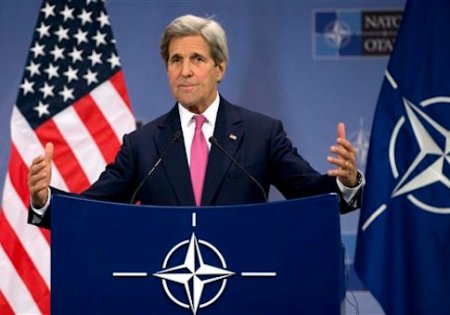
U.S. Secretary of State John Kerry speaks during a media conference at NATO headquarters in Brussels on Thursday, May 19, 2016. NATO foreign ministers this week will discuss how the alliance can deal more effectively with security threats outside Europe, including by training the Iraqi military and cooperating with the European Union to choke off people-smuggling operations in the central Mediterranean. (AP Photo/Virginia Mayo)

U.S. Secretary of State John Kerry speaks during a media conference at NATO headquarters in Brussels on Thursday, May 19, 2016.  (AP Photo/Virginia Mayo)

The Obama administration will not commit to halting its effort to help Iran access the U.S. dollar, despite past commitments to do so, according to a new congressional inquiry obtained by the Washington Free Beacon into the Treasury Department’s refusal to uphold its promises.

Leading senators are threatening to block all consideration of Treasury Department nominees until the administration ends its bid “to enable Iranian access to U.S. dollars” throughout the international financial system, according to a letter sent Thursday to the Treasury Department by Sens. Marco Rubio (R., Fla.) and Mark Kirk (R., Ill.).

Potential Iranian access to the U.S. dollar has caused friction between Congress and the Obama administration, which initially vowed during negotiations with Iran that such a move was out of the question.

However, senior administration officials, including Secretary of State John Kerry, have publicly sought to encourage Europeans to reengage in business with the Islamic Republic following last summer’s comprehensive nuclear agreement.

“We want to make it clear that legitimate business, which is clear under the definition of the agreement, is available to banks,” Kerry said in London last week.

The administration has been intentionally side-stepping questions about methods to give Iran backdoor access to the U.S. dollar, according to senior congressional sources informed of the matter.

The administration has assured lawmakers it will not grant Iran direct access to the U.S. financial system. However, it will not discuss backdoor methods in which U.S. dollars are given to Iran via international banks, source said.

“Whenever the administration gets asked whether it’ll allow Iran’s terror-sponsoring regime access to dollarized transactions outside of the U.S. financial system, a transaction that some people are starting to refer to as ‘Z-turn’ transactions, it flat-out avoids the question and instead says it doesn’t plan to allow Iran to engage in so-called ‘U-turn’ transactions or direct access to the U.S. financial system, something which lawmakers already know,” the source explained.

“This is the equivalent of giving an answer about oranges when you’ve been repeatedly asked about apples, and doesn’t change the fact that the critical questions about ‘Z-turn’ transactions for Iran really need to be clearly answered by the Treasury Department, once and for all,” the source said.

The apparent shift in the administration’s rhetoric on the issue has deepened concerns on Capitol Hill about alleged White House efforts to mislead Congress and the American people about the contents of the nuclear deal.

Rubio and Kirk are threatening to block all Treasury Department nominees from Senate consideration until the Obama administration answers questions about efforts to help Iran get access to U.S. dollars in the international marketplace, according to the letter obtained by the Free Beacon.

“We are disappointed that you ignored the request in the March 30th letter from Senators Rubio and Kirk to provide ‘assurances that the United States will not work on behalf of Iran to enable Iranian access to U.S. dollars elsewhere in the international financial system, including assisting Iran in gaining access to dollar payment systems outside the U.S. financial system,’” the senators wrote. “We do not support the consideration of Treasury Department nominees until our request is directly answered.”

Kirk and Rubio initially petitioned the Treasury Department in March to seek firm assurances that officials would commit to blocking Iranian access to the U.S. dollar.

The Treasury Department, in a May 11 response to Kirk and Rubio’s initial inquiry, declined to address specific questions regarding efforts to promote Iranian access to the U.S. dollar via foreign transactions outside the American financial system.

A month ago, the Obama administration launched a quiet push on Capitol Hill to reassure lawmakers that it would not grant Iran any access to the U.S. dollar or American financial markets, according to a Free Beacon report at the time.

That stance appears to have shifted in recent weeks, prompting concern from Iran deal critics such as Rubio and Kirk.

The Obama administration is now going above and beyond the purview of the nuclear agreement to help boost Iran’s economy, the senators allege.

“In its determined effort to provide Iran’s terror-sponsoring regime with benefits that were not expressly included in the ill-conceived Joint Comprehensive Plan of Action, the Administration is on a path toward undermining the reputation of the United States as a global leader in antimoney laundering and countering terrorism financing,” they write.

“Access to the U.S. dollar is not an international right. But if Tehran wants access, the onus should be entirely on Iran to clean up its act—including by verifiably ending its sponsorship and financing of terrorism, its ballistic missile program, and its human rights abuses against the peoples of Iran and other nations—and reduce the risks that any financial transaction with Iran poses to the global financial community,” the letter states.

The outgoing Obama administration is waging a public campaign to encourage businesses to reenter the Iranian market place, which has been known as a key front for money laundering and terrorism funding, despite Iran’s continued pursuit of ballistic missile technology, which could carry a nuclear payload over great distances.

“Sadly, the Administration appears to be more focused in capitulating to Tehran than in forcing Iran’s terror regime to fundamentally change its behavior,” the lawmakers write. “It’s high time for the U.S. to stop making unreciprocated concessions and to start holding Iran fully accountable for continuing its dangerous and destructive behavior.”

The Senate Banking Committee is scheduled to hold two hearings on Iran next week and sources disclosed that this issue will be a primary focus for Congress.

How Terrorists and Dictators Silence Arab Journalists

May 19, 2016

How Terrorists and Dictators Silence Arab Journalists, Gatestone InstituteKhaled Abu Toameh, May 19, 2016

♦ That is the sad state of journalism in the Arab world: “If you’re not with us, then you must be against us and that is why we need to shut your mouth.” A journalist who does not agree to serve as a governmental mouthpiece is denounced as a “traitor.”

♦ Hamas shut the Gaza offices of Al-Arabiya in July 2013, under the pretext that the station broadcasted “incorrect news” about the situation in the Gaza Strip. The closure did not receive much attention from the international community and human rights organizations. Had the office been closed by Israel, there would have been an international outcry, with journalists screaming about Israeli “assaults on freedom of the media.”

♦ Al-Arabiya, like many other Arab TV stations, has a bureau in Israel, and its reporters enjoy more freedom reporting out of Jerusalem and Tel Aviv than they do in the Arab world. Today, the only free and independent Arabic newspapers in the Middle East can be found inside Israel.

Thirty-five Arab journalists have been fired since the beginning of April as a result of a campaign of intimidation and terrorism waged against them by Hamas and Hezbollah.

The journalists were working for the Saudi-owned pan-Arab Al-Arabiya television news channel, based in Dubai Media City in the United Arab Emirates. The network was previously rated by the BBC among the top pan-Arab stations.

But life for Al-Arabiya reporters has never been easy. Like most Arab journalists covering the Arab and Islamic countries, they too have long faced threats from various parties and governments.

That is the sad state of journalism in the Arab world: “If you’re not with us, then you must be against us and that is why we need to shut your mouth.” A journalist who does not agree to serve as a governmental mouthpiece is denounced as a “traitor.”

The absence of democracy and freedom of speech in most Arab and Islamic countries has forced many Arab journalists to relocate to the West. In the past four decades, some of the Arab world’s best journalists and writers moved to France and Britain, where they could work without fearing for their lives.

But in the Arab world, freedom of the media remains a far-fetched dream. There, if you are not threatened by the government, there is always someone else who will find a reason to target you.

The case of the Al-Arabiya journalists is yet another example of the dangers facing media representatives who do not toe the line or who dare to challenge a government or a terrorist group.

Earlier this week, Al-Arabiya announced that it was firing its eight workers in the Gaza Strip — three years after the Hamas government decided to shut the station’s offices there. The workers are Mohamed Jahjouh, Jamal Abu Nahel, Hanan al-Masri, Rula Elayan, Mahmdouh al-Sayed, Sha’ban Mimeh, Ala Zamou and Ahmed al-Razi.

In an email to the workers, the Al-Arabiya management wrote:

“We appreciate your work with us during the previous period. You were all an example of professional performance, but the time has come for the hard decision after we exhausted all attempts to reopen the offices, which were forcibly closed, as you know, by the party that controls the street in the Gaza Strip.”

Hamas shut the Gaza offices of Al-Arabiya in July 2013, under the pretext that the station had been broadcasting “incorrect news” about the situation in the Gaza Strip. In addition to the closure, Hamas also confiscated the equipment and furniture with an estimated value of $500,000, and prevented the employees from entering the offices.

1609Hamas shut the Gaza offices of Al-Arabiya in July 2013, under the pretext that the station had been broadcasting “incorrect news” about the situation in the Gaza Strip. (Image source: JN1 video screenshot)

The closure of the Al-Arabiya offices in the Gaza Strip did not receive much attention from the international community and human rights organizations. Had the office been closed by Israel, of course, there would have been an international outcry, with journalists around the world screaming about Israeli “assaults on freedom of the media.”

Here is an unpleasant fact: Al-Arabiya, like many other Arab TV stations, has a bureau in Israel, and its reporters enjoy more freedom reporting out of Jerusalem and Tel Aviv than they do in the Arab world. Today, the only free and independent Arabic newspapers in the Middle East can be found inside Israel.

In the West Bank and Gaza Strip, the only newspapers available are those that serve as an organ for the Palestinian Authority (PA) and Hamas. Many Arab journalists feel unsafe working under the PA in the West Bank. For the PA and Hamas alike, criticism is a crime.

Just this week, for example, Palestinian Authority security officers arrested journalist Tareq Abu Zeid in Nablus after confiscating his personal computer and mobile phone. No reason was given for Abu Zeid’s arrest. He joins scores of other journalists and bloggers who have been arrested or interrogated by the PA in recent years.

Even Arab countries that once used to boast of being a base for free media, such as Lebanon, are no longer able to defend journalists from threats and violence.

Last month, Al-Arabiya also closed its offices in Beirut, citing “security concerns.” In a statement, the Saudi-owned station said that the decision to quit Beirut was taken “out of concern for the safety” of its 27 employees.

The decision is believed to be the direct result of threats by the Iranian-backed Hezbollah militia. Hezbollah is furious with Saudi Arabia and other Arab countries for their recent decision to label the Shiite militia as a terrorist group.

Al-Arabiya’s decision to close its bureau in Beirut came shortly after suspected Hezbollah thugs went on the rampage inside the offices of the Saudi-owned newspaper Asharq Al-Awsat, destroying equipment and furniture.

The attack came after the pan-Arab newspaper published a cartoon marking April Fool’s Day, which was deemed “offensive” to Lebanon and its flag. The message behind the cartoon was that Lebanon has become a failed state because of the growing power of Hezbollah and Iranian meddling in the internal affairs of the country — something that has prevented the election of a new Lebanese president.

The crackdown on Arab journalists and media outlets by Hamas, Hezbollah and many Arab governments (including the Palestinian Authority) is not only aimed at silencing critics, but also at hiding from the world what life is like under dictators and terrorists. In light of the fact that Al-Arabiya’s staff has been recently decimated, advocates of freedom of the media might wish to tune in.

A fractured Democratic Party threatens Clinton’s chances against Trump

May 19, 2016

A fractured Democratic Party threatens Clinton’s chances against Trump, Washington PostDavid Weigel, May 18, 2016

(How many disappointed Sanders supporters will vote for Trump in the general election? — DM)

When Sen. Bernie Sanders of Vermont took the stage this week after falling short in the Kentucky primary, supporters of Hillary Clinton wondered whether he would finally soften his tone and let her move on to a general election against Donald Trump.

They didn’t have to wonder for long.

Sanders credited Clinton’s victory to “a closed primary, something I am not all that enthusiastic about, where independents are not allowed to vote.” He commanded the Democratic Party to “do the right thing and open its doors and let into the party people who are prepared to fight for economic and social change.” And then he promised that he’s staying in the race until the convention. “Let me be as clear as I can be: We are in ’til the last ballot is cast!”

The performance prompted cheers across a crowd of about 8,000 in Carson, Calif., highlighting the mistrust and alienation that Sanders’s most ardent fans feel about Clinton, the Democrats and their “rigged” system. Yet the whole spectacle also sent shudders through those supporting Clinton, who are growing increasingly irritated by Sanders’s ever-presence in the race — and nervous that he is damaging Clinton.

All of it seems to have come to a head in recent days, as bitterness on both sides has boiled over and prompted new worries that a fractured party could lead to chaos at the national convention and harm Clinton’s chances against Trump in November. Two realities seem to be fueling it all: The nomination is, for all intents and purposes, out of Sanders’s reach yet his supporters are showing no signs of wanting to rally behind Clinton.

“If you lose a game that you put your heart and soul into, and you lose squarely, you can walk off the court and shake someone’s hand and say, ‘Well done,’ ” said Rep. Diane Russell, a Maine legislator and Sanders supporter. “If you don’t feel like the game was working fairly, it’s hard to do that.”

On the other side is this view: It’s also hard to win a general election with a protracted, divisive primary battle that won’t go away. “The way he’s been acting now is a demonstration of why he’s had no support from his colleagues,” said former Massachusetts congressman Barney Frank.

Sanders supporters are crying “fraud” over delegate selection and threatening to sit out the election. They have promised to press their case to the convention floor. It happened in 2008, in the final throes of Clinton’s failed bid against Barack Obama. What remains unclear is whether this year’s divisions will go deeper or longer.

An explosive weekend convention in Nevada, where Sanders supporters turned on the state party chairwoman for overruling their challenges and seating Clinton delegates, exposed the depth of the acrimony. In his statements since then, Sanders has made no attempt to heal it.

Sanders is also keeping his supporters riled up by making what many Democrats view as an unrealistic, and even dishonest, view of his candidacy, given Clinton’s large lead in delegates.

“There are a lot of people out there, many pundits and politicians, they say Bernie Sanders should drop out, the people of California should not have the right to determine who the next president will be,” he said at Tuesday’s rally, insisting that the state had enough pledged delegates to put him over the top.

Increasingly, Sanders’s most passionate supporters claim that the primary has been rigged. A Reddit user’s chart comparing the first wave of exit polls with Clinton’s stronger-than-expected performances has been circulated — most famously by Sanders surrogate and actor Tim Robbins — as evidence of election fraud.

Clinton’s 16-point victory in New York is explained by the state’s onerous registration rules and by the still-unexplained purge of Brooklyn voter rolls. Anyone questioning her lead of three million votes can find solace in a CounterPunch article titled “Clinton Does Best Where Voting Machines Flunk Hacking Tests.”

“Do these people read newspapers?” said Bob Mulholland, a California superdelegate and Clinton supporter who has accused Sanders supporters of harassing his peers. “Are they reading some chain email with bogus numbers? I hold Sanders somewhat responsible for this, because he comes across on TV as a very angry old man, riling people up.”

As Kentucky slid away from Sanders on Tuesday, some of his supporters saw a culprit in Alison Lundergan Grimes. The secretary of state and 2014 candidate for U.S. Senate, a longtime supporter of Clinton, even went on CNN to declare Clinton the winner.

“Hillary doesn’t even care anymore,” wrote one Sanders supporter, tweeting a link to a story about alleged fraud in Kentucky.

“Yet another state we would’ve won if everyone could vote,” another supporter wrote on Reddit.

“Better watch out for illegal conduct by Grimes since she said electing Clinton is more important than doing her job,” tweeted another.

The evidence for the last claim was a video clip from a rally with Clinton and Grimes, where the secretary of state said she was “not only here to do my job” but also to back her candidate. It was cut and distributed by America Rising, a conservative opposition research firm adept at finding wedges between Clinton and the left.

As Sanders has fallen behind Clinton, more conservatives have looked for ways to exploit the angst. On Tuesday morning, Fox News sent a morning-show host to the streets of New York to ask voters if the primary had been rigged for Clinton. Dan Backer, the conservative attorney and treasurer of the pro-Trump Great America PAC, has egged on Sanders supporters on Facebook with pep talks like “Bernie will win the most primaries and can still take the most pledged [elected] delegates while narrowing the total vote gap.” Trump has also announced a kind of snarky solidarity with Sanders, telling voters and Twitter followers that the senator should bolt the party over his foul treatment.

“Bernie Sanders is being treated very badly by the Democrats — the system is rigged against him,” Trump tweeted Wednesday morning. “Many of his disenfranchised fans are for me!”

The Sanders campaign has endorsed none of this — but it hasn’t tamped it down. Sanders’s sympathetic response to the Nevada convention fracas angered the state and national party, with DNC Chairwoman Debbie Wasserman Schultz comparing the worst scenes there to the violence at Trump rallies. Asked if there had been any actual fraud in the primaries, Michael Briggs, Sanders’s spokesman, suggested that the Democratic Party’s infrastructure had been sabotaged in a way that hurt one candidate.

“Most state parties tried to do a good job,” he said, “but often they are short on resources and there are institutional impediments to a fair process, like super-early registration, party-switch deadlines, closed primaries, complicated party registration rules, bad voter lists.”

Sanders himself has made harder-to-argue cases against the Democratic primaries. The truncated debate schedule struck supporters of both candidates as unfair, something the party seemed to acknowledge by tacking on more of them in March and April. Although Clinton is on track to win a majority of pledged delegates, Sanders has suggested that early support for Clinton among superdelegates, the party leaders and elected officials who get an automatic convention vote but are not bound by their state’s popular vote created a barrier no candidate could scale.

“It is absurd that you had 400 establishment Democrats on board Hillary Clinton’s campaign before anybody was in the race,” Sanders told MSNBC’s Rachel Maddow in an interview last week. “That stacks the deck in a very, very, unfair way for any establishment candidate, and against the wishes of the people.”

At the same time, Sanders and his supporters argue that superdelegates should consider bolting Clinton and backing him, based on polls that show him leading Trump as her favorables sink. That irritates Clinton supporters on two levels: by suggesting that the voters got it wrong and by dismissing the judgment of the sort of elected leaders whom any president would need to pass an agenda.

“If you believe you represent the people, and the people are uncooperative with your goal of winning, you have to find some explanation,” said Frank, whose appointment to the DNC rules committee sparked anger from Sanders’s supporters. “Look — I understand you have some disagreements, but does the overwhelming view of the black leadership, LGBT leadership, women’s leadership — does that count for nothing?”

As they contemplate Sanders’s “contested contest” at the Philadelphia convention, Clinton supporters think warmly back to 2008. By the time those primaries concluded, as many as 40 percent of Clinton voters said they could not support Barack Obama. The most dedicated PUMAs (Party Unity My A–) became TV stars; the vast majority of Clinton holdouts eventually went for the ticket. While Clinton’s favorable rating with Sanders supporters has been falling, many of his endorsers think that can be reversed.

“I want people to see this as a fair process, because I’m not in the ‘Bernie or Bust’ camp,” said Russell, the Sanders supporter from Maine. “I love this campaign, but I love my country more. And I tell the ‘Bernie or Bust’ people, if you’re angry at the end of this, you’re not going to take it out on the DNC. You’re going to take it out on the most vulnerable people — the ones we are fighting for.”