Archive for March 2016

Jihad in Brussels

March 24, 2016

Jihad in Brussels

by Judith Bergman March 24, 2016 at 6:00 am

Source: Jihad in Brussels

  • “Islam belongs in Europe…. I am not afraid to say that political Islam should be part of the picture.” — Federica Mogherini, EU High Representative for Foreign Affairs and Security Policy.
  • The Western narrative represents a complete refusal to examine the doctrines of Islam, out of fear of offending Muslims. This is not a purely European phenomenon. The Obama Administration ordered a cleansing of training materials that Islamic groups deemed offensive.
  • One crucial aspect of sharia that which the West refuses to internalize is the injunction to perform jihad, both violent and non-violent.
  • “[T]he most important factor is Belgium’s culture of denial… Observers who point to unpleasant truths such as the high incidence of crime among Moroccan youth and violent tendencies in radical Islam are accused of being propagandists of the extreme-right, and are subsequently ignored and ostracized.” — Teun Voten, a Dutch cultural anthropologist who lived in a Muslim area of Brussels between 2005 and 2014.

Federica Mogherini, the EU’s High Representative for Foreign Affairs and Security Policy, said on June 24, 2015, at a conference aptly named “Call to Europe V: Islam in Europe”:

“The idea of a clash between Islam and ‘the West’… has misled our policies and our narratives. Islam holds a place in our Western societies. Islam belongs in Europe…. I am not afraid to say that political Islam should be part of the picture.”

Nine months later, the ignorance, willful blindness and sheer incompetence regarding even the most basic tenets of Islam, which Mogherini betrayed in her statement has reaped yet another lethal result. What she said is fairly representative of the view aired in public by the European political and cultural establishment.

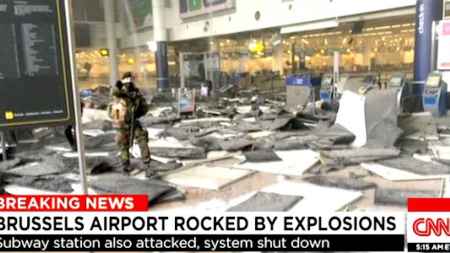
Thirty-one people were killed and around 300 wounded in Brussels on March 22, in the bombings of Brussels airport and Maalbeek metro station, at the heart of the European Union itself. ISIS took responsibility for these latest terrorist attacks

Mogherini, at an official press conference in Jordan, broke down in tears during her comments on the day’s terrorist attacks. But the pain she, as one of the highest-profile representatives of the EU, exhibited on behalf of the many killed and wounded in Europe, is self-inflicted. It is Europe’s immunity to facts that has led directly to the current state of utter chaos in European security matters.

Predictably, ISIS tried to justify the attacks by claiming that Belgium was targeted because it was “a country participating in the international coalition against the Islamic State” — despite Belgium having participated only in a limited bombing campaign in Iraq that ended nine months ago. Clearly, the Iraq campaign had nothing to do with the Brussels attacks, but served as a useful excuse because this kind of reasoning feeds into the dominant narrative in Europe, as expounded by Federica Mogherini.

The current Western narrative represents a persistent and unfaltering refusal to examine the doctrines of Islam, out of fear of offending Muslims. This refusal is not a European phenomenon. The White House ordered a cleansing of training materials that Islamic groups deemed offensive as far back as five years ago. In 2013, the Washington Times also reported that countless experts on Islamic terrorism were banned from speaking to any U.S. government counterterrorism conferences, which include those of the FBI and the CIA. Government agencies were instead ordered to invite Muslim Brotherhood front groups.

Western political and military establishments, as well as media and cultural elites, refuse to examine the political and military doctrines of Islam, and make them a subject of honest intellectual inquiry. When they are facing an enemy that uses these very doctrines as its reason for being, this refusal can only be described as gross malfeasance and reckless endangerment.

The political and cultural elites regularly communicate a deep fear that the fight against terrorism, if taken too far, may compromise the very democratic values and freedoms that this fight is meant to preserve. What they ignore is the irony that, by abdicating the right freely to inquire about — and discuss — the nature of Islam, they have already compromised the most fundamental democratic value: freedom of thought, expressed by freedom of speech.

Political Islam is indeed already very much a part of the picture in Europe, but not quite in the way Mogherini imagined it.

The political and military doctrines of Islam — the political Islam to which Mogherini so casually refers — are codified in Islamic law, sharia, as found in the Quran and the hadiths. Unlike prevailing misconceptions on Islam, these doctrines are not, in mainstream Islam, subject to mitigating interpretations, as often preached and practiced.

The Islamic injunction to perform jihad, both violent and non-violent, seems an aspect of sharia the West refuses to internalize. CIA director John Brennan, in a 2010 speech to the Center for Strategic and International Studies, when he was deputy national security advisor for homeland security, described jihad as,

“a holy struggle, a legitimate tenet of Islam, meaning to purify oneself or one’s community, and there is nothing holy or legitimate or Islamic about murdering innocent men, women, and children.”

This is simply not true. As Dr. Majid Rafizadeh writes, the Quran is not open to interpretation:

“The Qur’an has descended, word for word, from the creator Allah, through Muhammad. This is accepted throughout the entirety of the Islamic word… a true Muslim, who represent[s] the real Islam, should be the one who follows and obeys Allah’s words (from the Qur’an) completely. As a result, anyone who ignores some of the rules is not, and cannot be, considered a reflection of Islam, a good Muslim, or even a Muslim.”

Sheikh Muhammad Abdullah Nasr, a scholar of Islamic law and graduate of Egypt’s Al Azhar University, explained in November 2015 why the prestigious institution, which educates mainstream Islamic scholars, refuses to denounce ISIS as un-Islamic:

“The Islamic State is a byproduct of Al Azhar’s programs. So can Al Azhar denounce itself as un-Islamic? Al Azhar says there must be a caliphate and that it is an obligation for the Muslim world. Al Azhar teaches the law of apostasy and killing the apostate. Al Azhar is hostile towards religious minorities, and teaches things like not building churches, etc. Al Azhar upholds the institution of jizya [extracting tribute from religious minorities]. Al Azhar teaches stoning people. So can Al Azhar denounce itself as un-Islamic?”

Yusuf al-Qaradawi is an extremely influential Islamic cleric and jurist. He spiritual leader of the Muslim Brotherhood, as well as chairman of the International Union of Muslim Scholars, president of the European Council for Fatwa and Research, and the host of a popular Al-Jazeera TV program about sharia. Qaradawi has stated that,

“the shariah cannot be amended to conform to changing human values and standards. Rather it is the absolute norm to which all human values and conduct must conform.”

Turkey’s President Recep Tayyip Erdogan, also an Islamist leader, has repeatedly rejected Western attempts to portray his country as an example of “moderate Islam.” He states that such a concept is “ugly and offensive; there is no moderate Islam. Islam is Islam.”

The jihadists who carry out terrorist attacks in the service of ISIS are merely following the commands in Quran 9:5, “Fight and kill the disbelievers wherever you find them…” and Quran 8:39, “So fight them until there is no more fitna [strife] and all submit to the religion of Allah.”

Of course, not all Muslims adhere to this view of sharia. Many devout Muslims, including Egypt’s President Abdel Fattah el-Sisi, have said they wish to reform it.

There is, however, a persistent refusal by many in the West to acknowledge that sharia is the doctrine with which jihadists justify the war they wage on the West. This refusal is a most dangerous form of dishonesty; it has arguably already cost hundreds of lives on both American and European soil.

Unless Islam is radically reformed, and progressive Muslims are supported in a serious way (instead of bypassed in favor of Muslim Brotherhood fronts and other questionable organizations), these kind of terrorist attacks — and worse — could well become even more common throughout the West.

The infantile refusal of many government leaders to face the hard facts about the nature of Islam’s tenets, as opposed to indulging in fanciful utopian fantasies, will not change the plans of jihadists; it will only embolden them.

There is now speculation that the terrorist attacks in Brussels might have been revenge for the arrest of Salah Abdeslam, who was apprehended last week as a suspect in the Paris terrorist attacks of November 13, 2015. This speculation misses the point. This time, the excuse is the arrest of a high-profile terrorist; with the next attack, the excuse will be something else. There is never any shortage of things that “offend” jihadists. The heart of the matter, however, is the criminally negligent way in which European and American officials deal with the fundamental issue of the doctrines of Islam.

In a revealing article published November 21, 2015, Teun Voten, a cultural anthropologist who lived in the Muslim majority Molenbeek district of Brussels between 2005 and 2014, asks himself how Molenbeek became the jihadi base of Europe. His answer:

“…the most important factor is Belgium’s culture of denial. The country’s political debate has been dominated by a complacent progressive elite who firmly believes society can be designed and planned. Observers who point to unpleasant truths such as the high incidence of crime among Moroccan youth and violent tendencies in radical Islam are accused of being propagandists of the extreme-right, and are subsequently ignored and ostracized.

“The debate is paralyzed by a paternalistic discourse in which radical Muslim youths are seen, above all, as victims of social and economic exclusion. They in turn internalize this frame of reference, of course, because it arouses sympathy and frees them from taking responsibility for their actions. The former Socialist mayor Philippe Moureax, who governed Molenbeek from 1992 to 2012 as his private fiefdom, perfected this culture of denial and is to a large extent responsible for the current state of affairs in the neighborhood.

“Two journalists had already reported on the presence of radical Islamists in Molenbeek and the danger they posed — and both became victims of character assassination.”

This terror-enabling culture of willful ignorance and denial continues up until today — compounded by the lack of a central and unified security authority in Brussels. The city has 19 mayors, one for each borough assembly — as exemplified by the current mayor of Molenbeek, Françoise Schepmans.

One month prior to the Paris attacks, Schepmans received a list “with the names and addresses of more than 80 people suspected as Islamic militants living in her area,” according to the New York Times. The list was based on information from Belgium’s security apparatus, and included three of the terrorists behind the Paris attacks, including Salah Abdeslam. “What was I supposed to do about them? It is not my job to track possible terrorists,” Mayor Schepmans said. “That is the responsibility of the federal police.”

Federica Mogherini, the EU’s de facto foreign minister (posing at left with Iranian Foreign Minister Javad Zarif) said last year, “Islam belongs in Europe…. I am not afraid to say that political Islam should be part of the picture.” Françoise Schepmans (right), mayor of the Molenbeek district of Brussels, received a list with the names and addresses of over 80 suspected Islamic militants living in her area. “What was I supposed to do about them? It is not my job to track possible terrorists,” she said. “That is the responsibility of the federal police.”

This lack of accountability can only exacerbate an already dire situation. Far more damning, according to reports, is that Belgian authorities had accurate advance warnings that terrorists planned to launch attacks at Brussels airport and in the subway — yet they failed to act. This extremely lax approach to security appears to be a widespread problem in the Belgian — and probably European — political and security apparatus.

If there is to be any hope of fighting the terror threats against the West, and actually bringing public life back to a semblance of normality, at an absolute minimum the politics of willful ignorance, political correctness, and denial will have to go.

Judith Bergman is a writer, columnist, lawyer and political analyst.

ISIS, oil & Turkey: RT films trove of jihadist docs detailing illegal trade with Ankara (EXCLUSIVE)

March 24, 2016

ISIS, oil & Turkey: RT films trove of jihadist docs detailing illegal trade with Ankara (EXCLUSIVE)

Published time: 24 Mar, 2016 03:00 Edited time: 24 Mar, 2016 05:12

Source: ISIS, oil & Turkey: RT films trove of jihadist docs detailing illegal trade with Ankara (EXCLUSIVE) — RT News

Islamic State documents, including invoices, which militants abandoned while retreating in haste. / RT

An RT Documentary crew filming in northern Syria has seen Islamic State (IS, ISIS/ISIL) documents abandoned by retreating terrorists and found by the Kurds that, along with captured IS recruits, provide a stunning insight into the alleged Turkey-IS oil trade links.

Shortly after the outbreak of the Syrian war, IS became a game-changer in Iraq and, in particular, Syria. Beheadings on camera, mass killings, and enslavement, as well as apparent connections to the Paris and Brussels attacks had become synonymous with the terror group, giving it wide publicity.

Running a viable militant organization with such remarkable capabilities would be impossible without some logistical and financial support from the outside.

Turkey, which has been actively engaged in the Syrian war since the outset, has repeatedly denied claims that it is aiding IS. However, while Ankara insists that it is the jihadist group’s sworn enemy, facts on the ground often tell a different story.

RT has spoken to several witnesses who were involved in Islamic State’s trade activities and accessed the terror group’s documents, which provide insight into how and where foreign militants enter Syria to join the terrorist “state.”

Abandoned buildings used by ISIS militants in northern Syria.

Detailed oil invoices

The RT Documentary team did most of its filming in the town of Shaddadi, located in the Syrian province Hasakah, which has been partly overrun by IS jihadists. Following the liberation of Shaddadi, which is home to some 10,000 people, RT filmed Kurdish soldiers walking around what used to be the homes of IS fighters and examining piles documents that had been left behind.

Some of the files seized at the scene turned out to be detailed invoices used by IS to calculate daily revenues from their oil fields and refineries, as well as the amount of oil extracted there. All the documents had Islamic State’s symbol at the top.

Example of an Islamic State invoice specifying the quantity of oil sold.

The files showed that “IS has kept very professional records of their oil business,” said the author of the new RT Documentary on Islamic State filmed in northern Syria, who chose to remain anonymous for security reasons.

Every invoice included the name of the driver, the vehicle type driven, and the weight of the truck, both full and empty, as well as the agreed upon price and invoice number.

One of the discovered invoices dated 11 January, 2016, says that IS had extracted some 1,925 barrels of oil from Kabibah oil field and sold it for $38,342.

IS oil goes to Turkey – IS fighters come via Turkey

RT spoke to local residents who had been forced to work in the IS oil industry about what it was like working at the terrorist-controlled oil refinery and where the extracted oil was sold.

The locals attested that “the extracted oil was delivered to an oil refinery, where it was converted into gasoline, gas and other petroleum products. Then the refined product was sold,” the RT documentary’s author said. “Then intermediaries from Raqqa and Allepo arrived to pick up the oil and often mentioned Turkey.”

Important information revealing the connection between IS and Turkey was provided by a Turkish militant previously captured by the Kurds. The IS recruit said on camera that the terrorist group does, in fact, sell oil to Turkey.

“Without even us asking the fighter directly, he admitted that the reason why it was so easy for him to cross the Turkish border and join IS was, in part, due to the fact that Turkey also benefited. When asked how, he said that Turkey gets something out of it – something such as oil.”

RT was also able to speak with a Kurdish soldier in the area, who displayed a collection of passports he had gathered from the dead bodies of IS fighters. The documentary crew’s exclusive footage shows the documents of several jihadists who had come from all over the world, including countries such as Bahrain, Libya, Kazakhstan, Russia, Tunisia, and Turkey.

Passports belonging to Islamic State fighters bearing stamps from Istanbul, Turkey.

Most of these foreign fighters seemed to have come via Turkey, as all of their passports contained entry stamps issued at Turkish border checkpoints.

A YPG member also provided some photos that were retrieved from a USB drive allegedly belonging to future IS militants. One photo showed three men standing in front of the Obelisk of Theodosius, known today as Sultanahmet Meydani, a famous landmark in Istanbul. The next photo showed the three among other fellow militants somewhere in Syria – all armed and equipped.

One of the IS fighters that RT interviewed revealed that there had been no border guards waiting for them when they crossed from Turkey into Syria.

Islamist propaganda printed in Istanbul

Turkey’s logistical support for extremist fighters trying to overthrow Syrian President Bashar Assad’s government, or at least its non-interference with their cross-border movements, has been widely reported, but little has been said about the ideological support coming from Turkish soil.

Among the documents left behind by the terrorists at an IS-run hospital, RT’s crew discovered an Islamist propaganda leaflet printed in Arabic titled “How to wage a perfect battle against the criminal Assad’s regime,” which described ways to combat the Syrian government.

Curiously, the brochure was printed in Turkey, with the cover openly displaying the postal address and phone number of an Istanbul printing house, supplemented by Facebook contacts.

Cover of an Islamist, anti-Assad propaganda leaflet printed in Istanbul, Turkey.

“Many of the people spoke about the connection with Turkey. Turkey is the direct neighbor of IS. If it was willing to close the ‘connection’ between Turkey and IS, the terrorist organization could no longer survive,” the author of the RT documentary said, recalling interviews with Kurds and captured IS recruits. “If IS would stop receiving weapons, new recruits, food, and other help from Turkey, then IS would lose a big sponsor.”

Turkey benefits from Islamic State because the terrorist group provides it with cheap oil and is fighting both Syria’s government and Kurdish population. This is an opinion shared by both Kurds and their mortal enemies from the jihadist organization. The IS documents obtained by RT may provide additional evidence revealing the dirty game being played by the government of Turkish President Recep Tayyip Erdogan in Syria.

Emory To Hunt Down Those Who Chalked Support For Trump On Sidewalks and Walls

March 24, 2016

Emory To Hunt Down Those Who Chalked Support For Trump On Sidewalks and Walls, Jonathan Turley Blog, Jonathan Turley, March 24, 2016

(Please see also, American Fascists. — DM)

495px-donald_trump_by_gage_skidmore

We have been discussing how colleges and universities are expanding the range of micro aggressions and hostile or hate speech to troubling levels in terms of free speech and associational rights. Now the expression of political views in the presidential election has been added to speech that students have declared threatening. Someone at Emory chalked the name of Republican candidate Donald Trump around campus. Nothing unusual about that. Students often chalk up statements on sidewalks for causes or candidates. It would not be seen as in any way unusual and the next rain brings a clean slate. However, the statement of support for Trump has led to a protest calling for the supporter to be punished or expelled and for the President to express condemnation of such political affiliations. The students want a statement of support for Trump to be treated as the same as the writing of a swastika. The students have said that they feel threatened in the wake of the statements of political support for Trump.

Students organized immediately after seeing the statements of support and had a meeting with Emory President James W. Wagner to demand action. Students demanded to know “Why did the swastikas [on the AEPi house in Fall 2014] receive a quick response while these chalkings did not?” They were not happy when Wagner reportedly responded that that was a case of an outside threat. The questions reportedly became more pointed like “What do we have to do for you to listen to us?” One student demanded that Emory send out a University-wide email to “decry the support for this fascist, racist candidate.” To his credit, Wagner refused to denounce a presidential candidate. The students then demanded diversity hires into the “higher positions” of the University, including the Board of Trustees and the faculty in general.

What was particularly chilling is the demand for action on faculty members who have not publicly denounced Trump or his views under the view that “[Faculty] are supporting this rhetoric by not ending it.” This failure, the students insisted, have created a threatening environment and that “people of color are struggling academically because they are so focused on trying to have a safe community and focus on these issues [related to having safe spaces on campus].”

Wagner is reportedly preparing an email and has launched an investigation to find the culprit. University police are looking at security cameras. What will they do if they find some student with the incriminating chalk? Will she or he be expelled or disciplined or publicly denounced?

I have some obvious concerns about such action. My primary concern is whether this is the truly the first time in the history of Emory University that students or faculty made political statements on sidewalks. I doubt it. Would the same effort to hunt down the writers occur if the writing referred to Sanders or Black Lives Matter or Greenpeace? If not, this would seem a content-based effort that raises serious issues of free speech. Moreover, the expectation of some of these students that faculty should be pushed to denounce Trump like some Pol Pot reeducation camp is chilling.

I have written previously how free speech is under attack in the West and we appear to be raising one of the most anti-free speech generations in the history of our country. In the name of “tolerance,” we are treating free speech as the scourge of society and a right that must be carefully controlled to “protect” others. These students believe that political views are now within the gambit of threatening speech. We have come full circle from the sixties where baby boomers discovered political and social activism on campuses — a time of great upheaval but also great exploration. However now that students and staff are embracing a conservative, the desire is to have official condemnations and investigations. Trump has clearly generated both great support and great opposition. His views, however, (particularly on immigration) are shared by millions of citizens. Indeed, those same views are prevailing in part of Europe. This is a wonderful opportunity to have a passionate and substantive debate. Why not let all political flowers bloom on campuses? Rather than immediately seek to silence those with countervailing views, the first inclination should be to engage in the debate and value the exchange of ideas.

Before Wagner takes action, the faculty should at a minimum ask for the university to address how it has previously addressed chalk art and political statements. If all chalking is now going to be treated as an offense, will the university be distinguishing art but not political art? The problem with chalk crimes is, forgive the pun, drawing lines on what is prohibited or permitted speech.

What do you think?

Soldier arrested after shooting disarmed, prone assailant in head

March 24, 2016

Soldier arrested after shooting disarmed, prone assailant in head Army says it will investigate after video comes to light showing aftermath of a stabbing attack on Israeli forces in Hebron

By Judah Ari Gross March 24, 2016, 3:09 pm

Source: Soldier arrested after shooting disarmed, prone assailant in head | The Times of Israel

An IDF soldier was arrested Thursday after a video appeared to show him shooting an incapacitated Palestinian assailant who had earlier stabbed an Israeli soldier in Hebron on Thursday morning.

In the video, which was first released on Palestinian social media, the disarmed Palestinian can be seen lying on the ground and barely moving.

The soldier then appears to speak with another soldier, before cocking his weapon and firing at the unarmed Palestinian assailant from a few meters away, hitting him in the head.

The Palestinian was one of two who attacked and moderately wounded an IDF soldier near the Tel Rumeida neighborhood, a tiny enclave of Jewish homes in the predominantly Palestinian city of Hebron.

An unnamed witness told the Palestinian Ma’an news he saw that the soldier walked up and “opened fire at him from zero range.” The witness also indicated the assailant may have still been alive before being shot.

The Palestinian Ministry of Health identified the two Palestinian attackers as Ramzi Aziz al-Qasrawi, 21, and Abed al-Fattah Yusri al-Sharif, 21.

It was not immediately clear which of the two appears in the video.

A picture showing the knife allegedly used in a Hebron stabbing attack, next to an IDF helmet, on March 24, 2016. (courtesy)

A picture showing the knife allegedly used in a Hebron stabbing attack, next to an IDF helmet, on March 24, 2016. (courtesy)

The soldier is partially blocked from view by other members of his unit when the shot is fired. However, the impact of the bullet can be seen in the video.

Afterward, the Palestinian can be seen bleeding from the head.

“This appears to be a serious violation of the IDF code and of what is expected of IDF soldiers and officers,” the army said in response to the video.

The Military Police will begin looking into the incident and the soldier has “been suspended from his position until the end of the investigation,” the IDF said. The soldier was detained for further questioning.

The shooting would appear to be part of a controversial practice known as “confirming the kill,” in which soldiers make sure assailants are dead by shooting them in the head. The army has disavowed the practice in the past.

“From time to time there have been some statements by senior officials on the side of abiding by the law and preventing unnecessary use of force,” B’Tselem spokesperson Sarit Michaeli said. “However, these comments go against public remarks to the contrary,” she said, referring to statements by Public Security Minister Gilad Erdan.

“It’s impossible to judge the situation the combatants are in,” Erdan told Channel 10 news last month after video surfaced of Border Police officers shooting a Palestinian assailant multiple times after he had been subdued. “Every day there are attempts to stab them and the civilians around them. There have been incidents in which (security forces) fired, the terrorist was not killed, and then he managed to stab again,” he said.

Israel has come under criticism from Europe and the United States for allegedly using excessive force in stopping Palestinian terrorists. The Palestinian Authority and some countries, notably Sweden, have accused Israel of extra-judicial executions — something Israel has vigorously denied.

IDF Chief of Staff Gadi Eisenkot attends a Foreign Affairs and Defense Committee meeting at the Knesset in Jerusalem on March 15, 2016 (Yonatan Sindel/Flash90)

IDF Chief of Staff Gadi Eisenkot attends a Foreign Affairs and Defense Committee meeting at the Knesset in Jerusalem on March 15, 2016 (Yonatan Sindel/Flash90)

Speaking to high school students in the coastal city of Bat Yam recently, IDF Chief of Staff Gadi Eisenkot said that a soldier must shoot to kill perpetrators of terrorist attacks only if there is an immediate threat to human life.

“When there’s a 13-year-old girl holding scissors or a knife and there is some distance between her and the soldiers, I don’t want to see a soldier open fire and empty his magazine at a girl like that, even if she is committing a very serious act,” Eisenkot said. “Rather he should use the force necessary to fulfill the objective.”

“The army can not speak in slogans such as ‘kill or be killed,’” he said in response to a student’s question on the IDF’s “lenient” rules of engagement.

This incident in Hebron marked the first attack since Saturday, breaking a rare calm spell amid a wave of violence in the West Bank and Israel that has raged for nearly half a year.

In the nearly six months of Palestinian terrorism and violence since October, 29 Israelis and four foreign nationals have been killed. About 190 Palestinians have also been killed, some two-thirds of them while attacking Israelis, and the rest during clashes with troops, according to the Israeli army.

Israel closed off the West Bank from Wednesday to Saturday as a preventative measure against attacks during the Jewish holiday of Purim, the IDF announced on Tuesday.

The closure began at 1:00 a.m. on Wednesday and is expected to end at 11:59 p.m. on Saturday, the army said.

Entering and exiting the West Bank will be forbidden for Palestinians during those three days, with the exception of “humanitarian, medical and exceptional cases,” according to an IDF statement.

Awakening from denial

March 24, 2016

Awakening from denial, Israel Hayom, Ariel Bolstein, March 24, 2016

In the hours after the Brussels attacks, Belgium was a country in shock. The train stations were flooded with uniformed security forces, some of them soldiers in full combat gear. But alongside their impressive equipment, there was an obvious lack of purpose in their deployment on the ground. They too did not know what to do, nor what to defend against.

The next day, this feeling seemed to grow stronger. The authorities appeared to be doing what was expected of them: They published the terrorists’ names, they carried out arrests, they declared three days of mourning, and they made statements full of determination and national unity. But nobody dared to ask aloud: Determination against what? And unity in the face of whom?

High school students stood for a moment of silence in the Market Square in Bruges. Passers-by scribbled messages of strength, love and peace on the pavement outside the Brussels Stock Exchange. But not a word was said about those who are not interested in love and peace.

As befits a country that loves visual expression (Belgian comics, anyone?), Belgian media responded to the attacks with a wave of caricatures and pictures that broadcast a message of unity. All the Belgian icons were recruited to the mission, from Tintin to the “peeing boy” statue and even Belgium’s famous potato fries. In one of the pictures, a figure holds a sign that reads, “We are all Belgium,” joined by a bunch of other figures holding signs that read, “We are all Paris,” “We are all Mali,” and “We are all Ankara.” The phrase “We are all Israel” was nowhere to be found. This total invisibility of Israeli terror victims was, of course, no coincidence.

There was also a notable absence of the words “radical Islam” in local media reports, despite the fact that the attacks were not random. The establishment prefers not to call the problem by its name. One could still think that the victims’ lives were claimed by some kind of natural disaster or chance occurrence. For years, political correctness has blinded Europeans, including the Belgians, and silenced every voice that didn’t toe the line.

Citizens saw more and more robes and burqas in the streets of Europe’s cities, but the elites sent out the message that everything was fine. Incitement flowed from the local mosques, but it was interpreted as the gentle breeze of multiculturalism. Western values began to retreat, and in many places, radical Islam dominated. Suddenly, even the police began to fear conflict with the thugs in the Muslim neighborhoods — and these saw that as a victory, a sign that they could get away with anything. First, there were attacks against the Jews. A cultural war brewed right under the noses of Belgium’s citizens, but they refused to take a closer look, despite the pungent odor of hatred that rose from the nests of radical Islam inside Europe.

And now, when the problem has gotten out of control, it seems that Belgium’s opinion leaders are still burying their heads in the sand. But that sand is no longer as pleasant and welcoming as it once was, and the echoes of the blasts can be heard through it. Yet, the sad reality is even more painful. The average person is starting to back away from the political correctness that does not provide security. Moreover, the average person is starting to understand that the enemy is not figurative — it has a name, and it subscribes to the ideology of radical Islam, even if those words are censored by the media.

“We are in shock, but this shock has helped us understand you, the Israelis,” a Brussels train conductor told me quietly after asking where I was from. Perhaps this is the beginning of the awakening from denial.

Hashtag: We Are Neville Chamberlain

March 24, 2016

Hashtag: We Are Neville Chamberlain, Front Page Magazine, Ann Coulter, March 24, 2016

brussels-airport

Immigration is the new “No Nukes/Save the Whales” movement, only with more body bags.

After the mass murder committed by Muslims in San Bernardino, which came on the heels of the mass murder committed by Muslims in Paris, Donald Trump proposed a moratorium on Muslim immigration.

Explaining the idea on MSNBC’s “Morning Joe,” he talked about how Muslim immigration was infecting Europe: “Look at what happened in Paris, the horrible carnage. … We have places in London and other places that are so radicalized that the police are afraid for their own lives. We have to be very smart and very vigilant.”

Trump’s reference to London’s no-go zones was met with a massive round of sneering, which is what passes for argument in America these days. Jeb! said Trump was “unhinged,”

Sen. John McCain (R-AZ) called him “foolish,” and former vice president Dick Cheney said Trump’s remarks went “against everything we stand for and believe in.” (Based on Trump’s crushing primary victories, Cheney is no longer qualified to say what “we” believe in.)

To prove Trump wrong, reporters called British authorities and asked them: Are you doing your jobs? They responded, Why, yes we are! The head of London’s police said, “Mr. Trump could not be more wrong,” and London mayor Boris Johnson called Trump’s comments “utter nonsense.”

Within days, however, scores of rank-and-file London policemen begged to differ with their spokesmen, leading to the following headlines:

UK Daily Mail: ‘TRUMP’S NOT WRONG — WE CAN’T WEAR UNIFORM IN OUR OWN CARS’: Five Police Officers Claim Donald Trump Is Right About Parts of London Being So ‘Radicalised’ They Are No-Go Areas

The Sun: ‘THERE ARE NO-GO AREAS IN LONDON’: Policemen Back Trump’s Controversial Comments

UK Daily Express: ‘TRUMP IS RIGHT!’ Police Say Parts of Britain Are No-Go Areas due to ISIS Radicalisation

Then, in January of this year, Trump talked specifically about the Muslim invasion of Brussels on the Maria Bartiromo show. “There is something going on, Maria,” he said. “Go to Brussels. … There is something going on and it’s not good, where they want Sharia law … There is something bad going on.”

The New York Times headlined a story on the interview: “Donald Trump Finds New City to Insult: Brussels.” News is no longer about communicating information; it’s about imparting an attitude. Trump is rude, so whether he’s right is irrelevant. As the saying goes, “Better dead than rude.”

Indignant Belgians took to Twitter, the Times reported, “deploying an arsenal of insults, irony and humor, including images of Belgium’s beloved beer and chocolate.” Liberals have gone from not understanding jokes to not understanding English. When Trump talked about unassimilated Muslim immigrants demanding Sharia law, I don’t think he was knocking Belgium’s beer and chocolate.

Rudi Vervoort, the president of the Brussels region (who evidently survived this week’s bombing), rebuked Trump, saying, “We can reassure the Americans that Brussels is a multicultural city where it is good to live.”

After multiculturalism struck this week, Vervoort said, “I would like to express my support to the victims of the attacks of this morning …” Twitter bristled with supportive hashtags, the Belgian flag and professions of solidarity. The Times editorialized: “Brussels, Europe, the world must brace for a long struggle against this form of terrorism.”

All this would be perfectly normal if we were talking about an earthquake or some other natural disaster — something humans have no capacity to prevent. But Muslims pouring into our countries and committing mass murder isn’t natural at all. It’s the direct result of government policy.

It’s as if the government were dumping rats in our houses, and then, whenever someone died of the plague, those same government officials issued heartfelt condolences, Twitter lit up with sympathetic hashtags and the Times editorialized about effective rodent control, but no one ever bothered to say, Hey! Maybe the government should stop putting rats in our houses!

When people are killing in the name of their religion, it’s not an irrelevancy to refuse to keep admitting more practitioners of that religion.

But this is the madness that has seized Europe and America — a psychosis Peter Brimelow calls “Hitler’s revenge.”

Apparently, what we have learned from Hitler is not: Don’t kill Jews. To the contrary, the only people who openly proclaim their desire to kill Jews are … Muslims.

What we’ve learned from Hitler is not: Don’t attempt to seize hegemonic control over entire continents. The only people vowing to conquer the world are … Muslims.

And what we’ve learned from Hitler is not: Beware violent uprisings of angry young men. The only hordes of violent, angry young men are, again … Muslims. (And Trump protesters.)

But instead of learning our lesson and recoiling with horror at this modern iteration of Nazism, we welcome the danger with open arms — because the one and only lesson we’ve learned from Hitler is: DON’T DISCRIMINATE!

American Fascists

March 24, 2016

American Fascists, Bill Whittle Channel via You Tube, March 23, 2016

(What will America be like in a few years? It’s unpleasant to contemplate. — DM)


AIPAC’S pathetic apology to Obama

March 24, 2016

AIPAC’S pathetic apology to Obama, New York Post, Seth Lipsky March 23, 2016

Trump at AIPACDonald Trump Photo: AP

‘Unprecedented” is the word the Washington Post is using for the apology issued by the American Israel Public Affairs Committee for the applause given to Donald Trump at its conference this week.

AIPAC is shocked — shocked — that The Donald criticized President Obama from the lobby’s stage. And that Trump’s jibe was greeted with a gleeful ovation from thousands of pro-Israel activists.

It happened when Trump was marking the betrayals by the United Nations, which, he said, is “not a friend of democracy, it’s not a friend to freedom.” It’s not even, he added, a friend to America or Israel.

“With President Obama in his final year — yay!” The Donald exclaimed. “He may be the worst thing to ever happen to Israel, believe me, believe me. And you know it, and you know it better than anybody.”

That’s what prompted AIPAC’s president, Lillian Pinkus, to apologize. “We are deeply disappointed,” she said, “that so many people applauded a sentiment that we neither agree with or condone.”

Forgive me, but the right word for AIPAC’s apology is “chickens – – -.” And it’s not just because Hillary Clinton’s address, with her jibes at Trump and other Republicans, was the most partisan speech at AIPAC.

It’s also because AIPAC has always been a stage for putting things into sharp relief. Of course President Obama isn’t literally the worst thing that’s ever happened to Israel (we Jews have had more than our portion of woe).

It’s hard, though, to think of a presidency as disappointing to Israel as Obama’s has been. Who, after all, was that “senior Obama administration official” who used “chickensh – – -” to describe Benjamin Netanyahu?

The insult was reported by The Atlantic not long before Netanyahu addressed a joint meeting of Congress. The magazine reckoned it marked the moment when, as its headline put it, “the crisis in US-Israel relations is officially here.”

No one is placing bets on this driving Jewish voters out of the Democratic Party and into the arms of the GOP.

The landscape is littered with erroneous predictions that Jews are going to start voting Republican, a fact that I’ve learned from personal experience in the newspaper line.

It’s not too soon, though, to say that we’re at a remarkable moment. Before Trump made his appearance at AIPAC, after all, there were warnings of all sorts of protests and walkouts.

In the event, the man who’s been endorsed by David Duke (and belatedly repudiated it) received a warm reception, marked by standing ovations. It prompted the editor of one Jewish newspaper, Jane Eisner of the Forward, to write that she was “ashamed.”

“The applause,” she wrote, “began after he uttered his very first sentence.” Soon some in the crowd were standing and clapping. “And, when he threw the red meat that he brilliantly feeds his other crowds, there were cheers as they gobbled it up.”

And no wonder. Trump railed against the articles of appeasement on which the Obama administration agreed with Iran. And this is not a Likud-versus-Labor thing. Both Netanyahu and the opposition’s Isaac Herzog opposed the pact with the ayatollahs.

As does every GOP candidate who addressed AIPAC this year, including Ted Cruz most forcefully. John Kasich declared that in the wake of Iran’s latest missile tests he would suspend the agreement.

The only candidate at AIPAC who actually supports the Iran appeasement is Hillary Clinton. Her chutzpah is so thick that it could be carved up with a chain saw and used to make bomb shelters — a point well-marked in The Post’s editorial Wednesday.

At AIPAC, she warned against the Republicans. She said the GOP would give them a “glimpse of a potential US foreign policy that would insult our allies, not engage them, and embolden our adversaries, not defeat them.”

If AIPAC’s delegates seemed momentarily confused, it’s no doubt because they thought she was talking about herself again. Or the reset with Russia, the war she plumped for in Libya or her victories in Afghanistan.

No wonder Trump, Cruz and Kasich got so much applause. AIPAC knows deep down that the Democrats have been a disaster in foreign policy. If any apologies are owed, they’re by the Democrats — even if that would be “unprecedented.”

Israeli security firm’s advice on Brussels airport security unheeded

March 24, 2016

Source: Israeli security firm’s advice on Brussels airport security unheeded

DEBKAfile Special Report March 24, 2016, 9:56 AM (IDT)

 The Belgian government some weeks ago hired an Israeli firm, International Security Defense Systems, to inspect security arrangements at the Zaventem airport of Brussels.
The ISDS experts, who were asked for advice on improvements, submitted initial recommendations for urgent upgrades. However those improvements had not been installed by Tuesday, March 22, when Islamist terrorists hit the airport’s departure hall with exploding suitcases, claiming more than 30 deaths and injuring scores of victims..

ISDS, which is also responsible for the security system at the 2016 Olympic Games in Brazil, was not alone in underlining the urgency of security upgrades at Zaventem airport in recent weeks. On Feb. 29, European Union security agencies called for an immediate overhaul of the security measures at Belgian airports and borders, which were wide open to access by terrorists and lacked the tools for inspecting passengers on arrival and departure.

After the attack, it turned out that Ukrainian security guards, who had been hired and posted at the airport, had mostly deserted their stations. The few remaining there had carried out only cursory checks.
Not only was Zaventem airport wide open to hostile infiltration, so too is Brussels’ second airport Charleroi, the terminus for flights to and from Algeria, Tunisia and Turkey. Although the Belgian authorities were warned that Charleroi presented Islamic State terrorists with an open door from those countries into Europe, passengers passing through were still not subjected to searches, even when they headed to Zaventem for connecting flights.

Finally, under the shock of terror, Belgium decided to stem the flow of terrorists by keeping its air space and airports shut to traffic Thursday.

Both Western and Israeli counterterrorism experts meet with skepticism the stream of reports the Belgian authorities and media were still putting out Thursday about the identities of the terrorists who struck the airport and Metro, their numbers and their methods of operation. An Israeli security expert commented that these reports don’t match the evidence and leave too many questions unanswered to be credible.
The account of the taxi driver, who said he had driven three terrorists to the airport, is one example. He said that his cab was too small for the five heavy suitcases they wanted to load onto his cab, so they only loaded three. Did that mean that five suitcase bombs were to have been blown up at the airport? And what happened to the two left behind?

Also at odds with the official claim of suicide bombers are the black gloves that two terrorists wore on their left hands, obviously covering remote control mechanisms for the bombs in the luggage carts they were pushing through the departure hall.

Despite the spreading shock effect of the airport attack, it is also becoming clear that the terrorists only accomplished the first part of their jihadist mission. The Islamic State, which approved the operation, had  envisaged a much bigger atrocity. This is attested to by the discovery of three bags containing identical kits of firearms and ammunition, a bomb belt, two AK-47 automatic rifles, magazines and hand grenades – all intact and unused. The police detonated them by controlled explosion.

Those kits were concealed in advance in apparent readiness to strike the emergency teams, the medics, the security forces and the other first responders when they arrived to tend the victims of the first attack. The kits were placed at strategic points,  either by an advance team of terrorist operatives masquerading as airport personnel, or a staff employee.
When investigators examined the submachine guns, they found that someone had tried to fire one of them and it jammed. This might explain why the second half of the Brussels airport atrocity, the mega-massacre, was stalled.

By sheer chance, therefore, hundreds of Belgian security officers and emergency aid personnel were saved from being trapped from three directions in a ball of fire.

Belgian police and security units have been chasing desperately, with very few intelligence clues, for a broad network of at least 20 Islamists, who must have spent months setting up the complicated Brussels operations at the airport and Metro station.

The planning would have involved exhaustive reconnaissance, the precise study of the targeted locations, arms providers, logistics, finance, communications and prepared escape routes – before the bombers went in.

AIPAC Rebukes Trump’s Obama Truth telling, Ignores Hillary’s Insult to AIPAC

March 24, 2016

AIPAC president admonishes Trump and AIPAC audience for “attacks” on Obama, but Hillary love for Iran Deal was no problem.

By: Lori Lowenthal Marcus

Published: March 24th, 2016

Source: The Jewish Press » » AIPAC Rebukes Trump’s Obama Truth telling, Ignores Hillary’s Insult to AIPAC

Lillian Pinkus, president of AIPAC speaks at the Policy Conference. March 21, 2016.
Photo Credit: YouTube screen capture

On Monday, Mar. 21, four Americans who are competing to be the next President of the United States spoke to the thousands gathered in Washington, D.C. at the policy conference of the American Israel Public Affairs Committee.

In what should be considered a shocking breach of etiquette, the morning after those speeches, the president of AIPAC gave a verbal spanking to one of the speakers.

The four speakers on Monday were the Democratic frontrunner, Hillary Clinton, and the three remaining Republican candidates in the race, Donald Trump, Sen. Ted Cruz (TX) and Gov. John Kasich (OH).

Vermont Sen. Bernie Sanders chose not to attend the AIPAC conference.

It’s hard to come up with a more familiar face at AIPAC than Clinton. Her speech was warmly applauded by the crowd and she threw out lots of the standard tropes: “defending our ally in the Middle East” and the “unbreakable bond between Israel and the U.S.”

The audience also responded appreciatively when Clinton repeatedly attacked Republican frontrunner Trump. Nor did they boo when she spoke positively about perhaps the most important – and detested – foreign policy issue of the past year, the Nuclear Iran Deal.

AIPAC spent an unprecedented nearly $30 million in advertising and lobbying efforts to kill the Iran Deal. That was because AIPAC leadership decided the deal was far too dangerous for Israel and for the United States for them to sit on the sidelines. There are many who believe AIPAC badly – perhaps permanently – damaged its reputation by pouring so much money and other resources into fighting the terrible deal, and losing.

And yet, Hillary Clinton praised the deal during her talk to the AIPAC policy conference on Monday. Of that Iran Deal, Clinton said,: “I really believe the United States, Israel and the world are safer as a result.”

Lillian Pinkus, AIPAC’s president, did not chide Clinton for, essentially, rubbing AIPAC’s nose in its loss on the Iran Deal. Nope, that would be bad form.

But what Pinkus did go after was criticism of President Barack Obama, who was, of course, the architect and chief cheerleader of the disastrous Nuclear Iran Deal. It was also Obama who said in words and later in deeds that he wished to put daylight between the U.S. and Israel.

According to reports, Pinkus was tearful when she gave a statement, flanked by her top officers, apologizing for one of the speakers who dared to actually call Obama on his misdeeds towards Israel.

In the context of rumored threats that the President was going to impose a “solution” on Israel in a U.N. Security Council Resolution, Donald Trump said to the AIPAC policy conference that Obama was “in his last year in office.” He then extemporaneously added “yay.” The audience responded with a roaring cheer and thunderous applause. Trump continued with: “Obama may be the worst thing to ever happen to Israel,” which was met with more, albeit subdued, applause.

Near the end of his talk, Trump said what so many pro-Israel Americans fervently believe, which is that “Hillary Clinton and Barack Obama have treated Israel very, very badly.”

That so many in the audience applauded those statements by Trump – though he is not generally a favorite in the American Jewish community – should have lifted the blinders from the eyes of the firmly-cemented-in-the-Democratic-party AIPAC leadership. It didn’t.

Instead, Pinkus and her team decided to attack Trump for making his statements, thereby injecting their own political orientation to the mix.

No harsh words for Clinton who praised the Nuclear Iran Deal, AIPAC’s sworn nemesis, but a “tearful condemnation” of Trump for daring to speak from his heart about the current president, and an admonishment for those in the crowd who dared to applaud Trump’s temerity.

This was the statement made by Lillian Pinkus, president of AIPAC:

Standing before you are the lay and professional leadership of this organization.We speak on behalf of the Board of Directors and professional staff.

From the moment this conference began, until this moment, we have preached a message of unity.

We’ve said, in every way we can think of, “Come Together.”

But last evening, something occurred which has the potential to drive us apart. To divide us.

We say unequivocally that we do not countenance ad hominem attacks, and we take great offense to those that are levied at the President of the United States of America from our stage.

While we may have policy differences, we deeply respect the office of the President of the United States and our President, Barack Obama.

We are disappointed that so many people applauded a sentiment that we neither agree with nor condone.

Let us close this conference in recognition that when we say we must “Come Together,” we still have a lot to learn from each other. And we still have much work to do—because broadening the base of the American pro-Israel movement is essential and our unity is our strength.

Let us pledge to each other that in this divisive and tension-filled political season that we will not allow those that wish to divide our movement—from the left or the right—to succeed in doing so.

Thank you.

There are many in the pro-Israel and Israeli community who believe that the Nuclear Iran Deal is opening the door to another Holocaust. But at AIPAC, “Come Together” was the priority, rather than “Never Again.”