The video is no longer available on You Tube. However, it is available in an update to this article.
According to Conservative Tree House, he has appeared in Islamic State videos. I do not know whether this is one of them
The video is no longer available on You Tube. However, it is available in an update to this article.
According to Conservative Tree House, he has appeared in Islamic State videos. I do not know whether this is one of them
Chilling revelations: Diyarbakır, city of the dead and missing (RT EXCLUSIVE)
Published time: 12 Mar, 2016 09:22
Source: Chilling revelations: Diyarbakır, city of the dead and missing (RT EXCLUSIVE) — RT News
RT took an exclusive look into the mass killings of civilians allegedly committed by the Turkish military, filming the mourning of those who lost their loved ones as a result of the ongoing crackdown.
Friday prayers in Diyarbakir have also become a manifestation of the deep divide between the locals and the Turkish government.
In a further effort to quash Kurdish descent, Turkish authorities now require imams to read government-approved sermons. Thousands of local Kurds are protesting this move by boycotting the city’s main mosque and holding prayers in a nearby park.
The imam speaks in both Kurdish and Turkish, condemning the government’s actions.
RT’s William Whiteman witnessed Turkish military helicopters flying overhead in Diyarbakir, while the explosions and gunfire of the continuing military operation could be heard.
In the city’s Sur district, Turkish security services have continuously waged a military operation against the Kurdistan Workers’ Party (PKK) and its affiliated groups, as part of the ongoing government operation across the region.
Whiteman spoke to the weeping mother of 17-year-old girl Rozerin Cukur. She was killed in a military bombardment of Sur while she was visiting the district with friends in early January. With access to the area now cut off by the fighting, her body has never been recovered. Sadly, she is one of many such cases.
Rozerin’s father, Mustafa, could be found at a nearby memorial for the missing dead.
“We saw the news of her death reported on state TV and the internet. The reports included Rozerin’s ID information, discovered beside her body,” the father told RT.
Through hunger striking, the families here have managed to pressure the government into returning just two of the missing bodies. But the condition they were in was appalling.
“Of the bodies that have been recovered, parts of their flesh and internal organs had been eaten by a stray dog,” Mustafa said. “The bodies were riddled with thousands of bullet holes. It seems that the military continued to shoot them long after they were dead.”
“They were only identifiable through DNA testing,” Mustafa claimed.
RT spoke to the co-presidents of the local Kurdish People’s Democratic Party (HDP) branch about the plight of these families.
“Of the local residents killed in Sur, 14 bodies are yet to be recovered. They have been lying in the open for a long time, first under the siege, and now under the curfew,” Ömer Önen, co-president of HDP office of Diyarbakir, told RT. “Without the bodies, the families have been unable to hold funerals.”
Önen explained that by denying the people in Diyarbakir the right to give their loved ones a traditional Islamic burial, the Turkish government is violating human rights and the sanctity of religious traditions.
Every Saturday in Diyarbakir, the families of people who disappeared during the peak of the Turkish-Kurdish conflict in the 1980s and ‘90s gather to demand information on their missing loved ones. Now they are being joined by the families of new victims, with Rozerin’s parents among them.
Previously RT showed exclusive footage from the city of Cizre, destroyed by Turkish government forces during an anti-Kurdish military operation that ended there only two days ago.
The Turkish government offensive on the mostly Kurdish southeastern regions of the country was launched back in July of 2015 with strict 24-hour curfews imposed on several Kurdish towns.
On Friday RT requested comments on the ongoing anti-Kurdish crackdown in Turkey from aid groups and rights organizations, such as HRW, MSF International, the ICRC, the OHCHR, and Amnesty International. There has been no answer so far.
In the meantime, Turkey has claimed it will continue its operations against Kurdish militia – to ensure peace in the region.
“We will continue our operations to eliminate the PKK. This is necessary to ensure peace in the region,” said Efkan Ala, the Turkish interior minister.
Washington says Ankara has the right to fight terrorists, but only within international law.
“While we have certainly acknowledged Turkey’s right to defend itself against terrorists, and the PKK is a terrorist organization that we have recognized [as such], we have also, and I’ve said it many times from this podium, called on [Turkey] to do so in accordance with the international law and obligations that they [Turkey] have,” US State Department spokesman John Kirby said.
Turkey bombs multiple PKK locations in northern Iraq, 67 militants killed
Published time: 12 Mar, 2016 17:02
Source: Turkey bombs multiple PKK locations in northern Iraq, 67 militants killed — RT News

Turkish F-16 fighter jets. © Fatih Saribas / Reuters
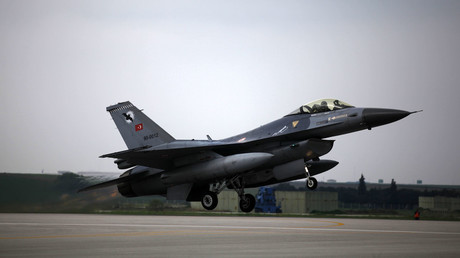
Turkish warplanes have attacked PKK targets in northern Iraq, including the headquarters of the PKK leadership situated right on the Iraq-Iran border in the Qandil Mountains, reportedly hitting the settlements of Avasin, Basyan, Haftanin, Metina and Qandil, Reuters reports, citing the army.
The airstrikes took place on Wednesday, March 9, according to Turkey’s state-run Anadolu Agency. The agency cites an unnamed security source who claimed that 14 F-16 and F-4 fighter jets participated in the assault, bombing PKK camps, arms depots and bunkers.
Beginning July 2015, after the two-year truce between Ankara and the Kurds was scrapped, Turkey has been delivering regular airstrikes against Kurdish militia in neighboring Iraq and shelling Kurdish settlements in Syria as well.
The PKK is demanding autonomy for Kurds in Turkey’s south-east, and is listed as terrorist organization #1 by the Turkish government.
READ MORE: ‘Out of question’: Erdogan rules out Turkish troop withdrawal from Iraq
In early December 2015, Turkey deployed about 150 troops and 25 tanks to a base in Iraq’s Nineveh province, without bothering to get permission from Baghdad. Ankara argued that its soldiers were sent to northern Iraq after a threat from Islamic State (IS, formerly ISIS/ISIL) to Turkish military instructors training anti-terrorist forces in the area.

Turkey’s president Recep Tayyip Erdogan rejected a request from Baghdad to withdraw the troops, claiming that the Turkish military is present in Iraq “as instructors.”
On Friday, Turkish Interior Minister Efkan Ala said that Ankara is preparing another military operation against the Kurdish PPK in the country’s south-east. The minister announced plans to introduce curfews in three districts, saying that eight other districts have been “cleared of terrorists.”
In an interview Friday at the Foreign Ministry in Moscow, Russian Deputy Foreign Minister Gennady Gatilov criticized Turkey for shelling Kurdish positions on Syrian territory, alleging that Ankara is turning a blind eye to arms supplies to terrorists.
Gatilov stressed that such practices must stop in order “to provide a more constructive atmosphere for the intra-Syrian talks and a more durable cease-fire,” Bloomberg reported.
and watch the attack on him :
Sharia Law or One Law for All? Gatestone Institute, Denis MacEoin, March 12, 2016
♦ Here is the fulcrum around which so much of the problem turns: the belief that Islamic law has every right to be put into practice in non-Muslim countries, and the insistence that a parallel, if unequal, legal system can function alongside civil and criminal law codes adhered to by a majority of a country’s citizens.
♦ Salafism is a form of Islam that insists on the application of whatever was said or done by Muhammad or his companions, brooking no adaptation to changing times, no recognition of democracy or man-made laws.
♦ The greatest expression of this failure to integrate, indeed a determined refusal to do so, may be found in the roughly 750 Muslim-dominated no-go zones in France, which the police, fire brigades, and other representatives of the social order dare not visit for fear of sparking off riots and attacks. Similar zones now exist in other European countries, notably Sweden and Germany. According to the 2011 British census there are over 100 Muslim enclaves in the country.
As millions of Muslims flow into Europe, some from Syria, others from as far away as Afghanistan or sub-Saharan Africa, several countries are already experiencing high levels of social breakdown. Several articles have chronicled the challenges posed in countries such as Sweden and Germany. Such challenges are socio-economic in nature: how to accommodate such a large influx of migrants; the rising costs of providing then with housing, food, and benefits, and the expenses incurred by increased levels of policing in the face of growing lawlessness in some areas. If migrants continue to enter European Union countries at the current rate, these costs are likely to rise steeply; some countries, such as Hungary, have already seen how greatly counterproductive and self-destructive Europe’s reception of almost anyone who reaches its borders has been.
The immediate impact, however, of these new arrivals is not likely to be a simple challenge, something that may be remedied by increasing restrictions on numbers, deportations of illegal migrants, or building fences. During the past several decades, some European countries – notably Britain, France, Germany, Sweden, and Denmark — have received large numbers of Muslim immigrants, most of them through legal channels. According to a Pew report in 2010, there were over 44 million Muslims in Europe overall, a figure expected to rise to over 58 million by 2030.
The migration wave from Muslims countries that began in 2015 is likely to increase these figures by a large margin. In France, citizens of former French colonies in Morocco, Algeria, and some sub-Saharan states, together with migrants from several other Muslim countries in the Middle East and Asia, form a population estimated at several million, but reckoned to be the largest Muslim population in Europe. France is closely followed by Germany – a country now taking in very large numbers of immigrants. There are currently some 5.8 million Muslims in Germany, but this figure is widely expected to rise exponentially over the next five years or more.
The United Kingdom, at around 3 million, has the third largest Muslim population in Europe. Islam today is the second-largest religion in the country. The majority of British Muslims originally came from rural areas in Pakistan (such as Mirpur and Bangladesh’s Sylhet), starting in the 1950s. Over time, many British Muslims have integrated well into the wider population. But in general, integration has proven a serious problem, especially in cities such as Bradford, or parts of London such as Tower Hamlets; and there are signs that, as time passes, assimilation is becoming harder, not easier. A 2007 report by British think tank Policy Exchange, Living Apart Together, revealed that members of the younger generation were more radical and orthodox than their fathers and grandfathers – a reversal almost certainly unprecedented within an immigrant population over three or more generations. The same pattern may be found across Europe and the United States. A visible sign of this desire to stand out from mainstream society is the steady growth in the numbers of young Muslim women wearing niqabs, burqas, and hijabs – formerly merely a tradition, but now apparently seen as an obligatory assertion of Muslim identity.
In Germany, the number of Salafists rose by 25% in the first half of 2015, according to a report from The Clarion Project. Salafism is a form of Islam that insists on the application of whatever was said or done by Muhammad or his companions, brooking no adaptation to changing times, no recognition of democracy or man-made laws. This refusal to adapt has been very well expressed by Iran’s Ayatollah Ruhollah Khomeini:
“Islam is not constrained by time or space, for it is eternal… what Muhammad permitted is permissible until the Day of Resurrection; what he forbade is forbidden until the Day of Resurrection. It is not permissible that his ordinances be superseded, or that his teachings fall into disuse, or that the punishments [he set] be abandoned, or that the taxes he levied be discontinued, or that the defense of Muslims and their lands cease.”
The greatest expression of this failure to integrate, indeed a determined refusal to do so, may be found in the roughly 750 zones urbaines sensibles in France, Muslim-dominated no-go zones, which the police, fire brigades, and other representatives of the social order dare not visit for fear of sparking off riots and attacks. Similar zones now exist in other European countries, notably Sweden and Germany.
In the UK, matters have not reached the pitch where the police and others dare not enter. But in some Muslim-dominated areas, non-Muslims may not be made welcome, especially women dressed “inappropriately.” According to the 2011 British census there are over 100 Muslim enclaves in the country. “The Muslim population exceeds 85% in some parts of Blackburn,” notes the scholar Soeren Kern, “and 70% in a half-dozen wards in Birmingham and Bradford.” There are similarly high figures for many other British cities.
Maajid Nawaz of the anti-extremist Quilliam Foundation has spoken of the growing trend for some radical young Muslims to patrol their streets to impose a strict application of Islamic sharia law on Muslims and non-Muslims alike, in direct breach of British legal standards.
In Britain “Muslims Against the Crusaders” have recently declared an Islamic Emirates Project, in which they are seeking to enforce their brand of sharia in 12 British cities. They have named two London boroughs, Waltham Forest and Tower Hamlets, among their targets. Little surprise then that in these two boroughs hooded “Muslim patrols” have taken to the streets and begun enforcing a strict view of sharia over unsuspecting locals. The “Muslim Patrols” warn that alcohol, “immodest” dress and homosexuality are now banned. To add to these threats, all this is filmed and uploaded onto the internet. Now, in East London, some shops no longer feel free to employ uncovered women or sell alcohol without fear of violent payback.
Nawaz goes on to write: “[T]he Muslim patrols could become a lot more dangerous and, perhaps willing to maim or kill if they are joined by battle-hardened jihadis.” Muslims have been beaten up for smoking during Ramadan; non-Muslims have been forced to leave for carrying alcohol on British streets.
A recent report by Raheem Kassam cites British police officers who admit that they often have to ask permission from Muslim leaders to enter certain areas, and that they are instructed not to travel to work or go into certain places wearing their uniforms.
Here is the fulcrum around which so much of the problem turns: the belief that Islamic law has every right to be put into practice in non-Muslim countries, and the insistence that a parallel, if unequal, legal system can function alongside civil and criminal law codes adhered to by a majority of a country’s citizens. More than one non-Muslim has been ordered to leave “Islamic territory,” and some radicals have attempted to set up “Shariah Controlled Zones,” where only Islamic rules are enforced. Stickers placed on lampposts and other structures declare: “You are entering a Shariah Controlled Zone,” where there can be no alcohol, no gambling, no drugs or smoking, no porn or prostitution, and even no music or concerts.
And that is not all. Soeren Kern wrote in 2011:
A Muslim group in the United Kingdom has launched a campaign to turn twelve British cities – including what it calls “Londonistan” – into independent Islamic states. The so-called Islamic Emirates would function as autonomous enclaves ruled by Islamic Sharia law and operate entirely outside British jurisprudence.
The Islamic Emirates Project, launched by the Muslims Against the Crusades group, names the British cities of Birmingham, Bradford, Derby, Dewsbury, Leeds, Leicester, Liverpool, Luton, Manchester, Sheffield, as well as Waltham Forest in northeast London and Tower Hamlets in East London as territories to be targeted for blanket Sharia rule.
All of this is, of course, illegal. The illegality could not be clearer. Here we see self-appointed disaffected Muslim entities, who take action to exercise the power of imposing law on the streets of European cities, and in practice the writ of Islamic law runs in many towns and cities. Not long ago, considerable numbers of Muslims from Paris and the surrounding region would enter the city and take over entire streets in order to perform the noon Friday prayer. Traffic was blocked, residents could neither enter or leave their homes, businesses had to close because customers could not reach them; and all the while, the police stood by, watching but not interfering, knowing that, if they acted to preserve the law a riot would ensue. Videos of these incidents are available online. In places where gangs of radicals operate as if they are a mafia, crimes such as honor killings, female genital mutilation (FGM), expulsion or worse of individuals considered apostates, and more, are known to take place. More commonly, many Western states are powerless to prevent forced and underage marriages, compulsory veiling, polygamy, and more.
The police, afraid of charges of racism and “Islamophobia,” are reluctant to take action: In 2014 and 2015, the police and social workers turned a blind eye for years to Muslim gangs grooming, prostituting, and raping young white British teenagers in cities such as Oxford, Birmingham,Rochdale and Rotherham. Professor Alexis Jay’s report on the situation in Rotherham alone showed serious failings on the part of several bodies from the police to social services. The offenses in these cases were, of course, a breach of sharia law, not an enforcement of it.[1] Yet there seems to have been an attitude, too, that Muslims are entitled to behave as they wish, and that British law enforcement is irrelevant. In the trial of nine men in Rochdale, Judge Gerald Clifton states in his sentencing that “All of you treated the victims as though they were worthless and beyond any respect – they were not part of your community or religion.” This statement alone seems to illustrate the heart of this problem.
But the clash between Islamic law and national law in several European countries has focussed more than anything on the establishment of sharia councils or sharia courts. These have provoked a wider debate than even Islamic finance, now well situated within the international banking system even though it is as if Germany under the Third Reich had its own banking system in which all transactions would go exclusively to strengthening the Third Reich. In the UK this year, it has been revealed that, in order to finance extensive repairs to the House of Lords and the House of Commons, a deal has been done to use Islamic bonds. One result of this is that peers and MPs will not be allowed to have bars or to consume alcohol on their own premises.
The Sharia court debate has been particularly intense in the United Kingdom, where attempts (some successful) to introduce sharia within the legal system have been made since 2008. Speaking to the London Muslim Council in July of that year, Britain’s leading judge, Lord Chief Justice Phillips, declared that he believed the introduction of sharia into the UK would be beneficial to society, provided it did not breach British law. It is that stipulation which has not been adhered to. Not many months earlier, in February, Rowan Williams, the Archbishop of Canterbury, Britain’s leading churchman — also, as Phillips, with a seat in the House of Lords — expressed the view that it would be appropriate for British Muslims to use sharia. He argued that “giving Islamic law official status in the UK would help achieve social cohesion because some Muslims did not relate to the British legal system.” He went on to say,
“It’s not as if we’re bringing in an alien and rival system; we already have in this country a number of situations in which the internal law of religious communities is recognised by the law of the land … There is a place for finding what would be a constructive accommodation with some aspects of Muslim law, as we already do with some kinds of aspects of other religious law.”
That is where the debate began. Williams’s call for the introduction of sharia was rejected at once by the Prime Minister, Gordon Brown, and by the Conservative peer and shadow minister for community cohesion and social action, Sayeeda Warsi. Warsi, herself a Muslim, argued as follows:
“The archbishop’s comments are unhelpful and may add to the confusion that already exists in our communities … We must ensure that people of all backgrounds and religions are treated equally before the law. Freedom under the law allows respect for some religious practices. But let’s be absolutely clear: all British citizens must be subject to British laws developed through parliament and the courts.”
One year before, however, sharia had already entered the country. An organization called the Muslim Arbitration Tribunal had set itself up on the basis of the 1996 Arbitration Act. It allows individuals and businesses to enter into mutually agreed consultation in which a third party decides between their competing arguments. Mutual agreement is, of course, the central plank on which the legislation is based. Muslim tribunals are limited to financial and property issues. They use sharia standards for intervention, not just between Muslims, but even between non-Muslims who wish to settle disputes using sharia standards. Since 2007, the MAT has opened tribunals in Nuneaton, London, Birmingham, Bradford, and Manchester. They are all considered legal, and their rulings can be confirmed by county courts and the High Court.
Acquiescence to the regularization of sharia within UK legal processes received a major boost for a short time when, in March 2014, the Law Society issued guidance to permit high street solicitors to draw up “sharia compliant” wills, even though these might discriminate against widows, non-Muslims, female heirs, adopted children and others. When the debate grew more heated and the Law Society was severely criticized, some months later it withdrew the guidelines and apologized for having introduced them at all. It was a healthy expression of the way open debate in democratic societies achieves results.
By that time, however, there were around 85 sharia councils operating — most of them openly, some behind the scenes, across the UK. They had all been granted recognition by the establishment. These councils are often confused with the arbitration tribunals, but are, in fact, quite different. A council (sometimes termed a court) functions as a mediation service — also legal in British law. However, the decisions of these councils have no standing under British law. They are usually composed of a small number of elderly men with varying degrees of qualification in Islamic law, and they generally issue advice or fatwas [religious opinions] based on the rulings of one or another of the main schools of Muslim law.
It is these councils that are the greatest cause for concern, especially the limited range of matters on which they issue judgements: marriage, divorce, child custody, and inheritance. In all of these areas, the concerns rest principally on the treatment of Muslim women. Among the leading critics of Sharia on these grounds is one of the most visionary members of Britain’s House of Lords, Baroness Caroline Cox.[2] The first thing she did after her elevation to the peerage was to set off in a 32-ton truck for Communist Poland, Romania, and the Soviet Union, to bring medical supplies behind the Iron Curtain. She was one of the first Western politicians to take the threat of Islamism seriously, setting out her arguments in a 2003 book, The ‘West’, Islam and Islamism. Is ideological Islam compatible with liberal democracy? .
This concern with Islamism and its incompatibility with secular democratic norms focuses especially on the application of sharia law within countries such as the UK, where all citizens are considered to be equal under the law. Speaking about sharia courts in 2011, Baroness Cox declared,
“We cannot sit here complacently in our red and green benches while women are suffering a system which is utterly incompatible with the legal principles upon which this country is founded… If we don’t do something, we are condoning it.”
Recently, she authored a report entitled, A Parallel World: Confronting the abuse of many Muslim women in Britain today, published by the Bow Group. In it, she not only describes the problems faced by many Muslim women before Sharia councils, but provides extensive testimony from women who have been discriminated against and abused by these “courts.”[3]
In May 2012, Baroness Cox introduced her first Arbitration and Mediation Services (Equality) Bill in the House of Lords. The bill had its second reading in October that year, but went no farther. It was backed, however, by a considerable body of evidence presented in a document, Equal and Free?, from the National Secular Society. In June, 2015, Cox introduced a modified version of the bill. It had its second reading in October, and in November it reached the committee stage. It still has to pass a few stages before it may possibly move to the House of Commons, one day perhaps to receive Royal Assent and become law. It received a very warm reception from members of the Lords, with only one dissenting opinion, that of Lord Sheikh, a Muslim peer who sees little or no fault in anything Muslims say or do. However, the government minister, Lord Faulks, argued that current civil legislation is all that is needed to guarantee justice for Muslim women.
Matters are far from as simple as the government would like them to be. Sharia law is not a cut -and-dried system that can be easily blended with Western values and statutes. There is no problem when imams or councils hand out advice on the regulations governing obligatory prayer, fasting, pilgrimage, alms-giving, the appropriateness or inappropriateness of following this or that spiritual tradition, or even whether men and women may sit together in a hall or meet without a chaperone. For pious Muslims, those are things they need to know, and although the advice they may receive on some rulings will differ according to the school of law or the cultural practices of their specific community, that has no bearing whatever on British law.
But much more goes on beneath the surface. One problem is that it is difficult if not impossible to reform sharia. Legal rulings are fossilized within one tradition or another and given permanency because they are deemed to derive from a combination of verses from the Qur’an, the sacred Traditions, or the standard books of fiqh or jurisprudence. It is, therefore, hard to restate laws on just about anything in order to accommodate a need to bring things up-to-date within terms of modern Western human rights values. Many Muslims today may be uncomfortable about the use of jihad as a rallying cry for terrorist organizations such as the Islamic State, but no single scholar or group of scholars is entitled to abolish the long-standing law of jihad. Innovation (bid’a) is tantamount to heresy, and heresy leads to excommunication and hellfire, as has been stated for centuries. The growing influence of Salafi Islam is based precisely on the grounds that any revival of the faith means going back to the practices and words of Muhammad and his companions, not forwards via reform.
In the sharia councils there appears to be no formal method for keeping records of what is said and decided on. There is next to no room for non-Muslims to sit in on proceedings, and, as a result, neither the government nor the legal fraternity has any regular means of monitoring proceedings. Even Machteld Zee, whose forthcoming book, Choosing Sharia? Multiculturalism, Islamic Fundamentalism and British Sharia Councils, will be the first academic analysis of what happens in the councils, only spent two afternoons at a council in Leyton and an afternoon at one in Birmingham. Unannounced spot checks by qualified government-appointed personnel are not permitted. There is nothing remotely like the government schools inspection body, Ofsted, which has periodically (albeit not always correctly) gone into Muslim schools. So there is really no way of knowing just what happens, apart from the testimonies of women who have reported abusive or illegal practices.
Magistrates’ courts, county courts, and crown courts are all entirely transparent (except for matters dealt with in camera), full records are kept, and members of the public are free to visit and observe. The risks of allowing councils to pass judgements without there being an inspectorate to observe them are obvious. And if full records of proceedings are not kept, it will always be difficult to go back to examine a case in full should legal issues arise at a later date.
Furthermore, the British legal system has no say in the appointment of sharia council panels. There appears to be no agreed mechanism for appointments, and the source and identity of candidates remain causes for concern in several ways. There is no single range of qualifications for Muslim scholars (‘ulama) or jurisprudents (fuqaha’). Most will attend some sort of madrassa [Islamic religious school], and many will sit at the feet of a particular sheikh to obtain an ijaza from him: usually this means he is given permission to teach from a book written by that sheikh. Some will finish a course of study, but there may be little coherence. Growing numbers have qualifications from UK-based madrassas, notably from the Darul-Uloom in Bury or the higher standard equivalent in Dewsbury, although there are other Darul-Ulooms in the UK. In London, the junior classes are inspected by Ofsted, others not. Bury and other madrassas belong to the radical Deobandi form of Islam (based in northern India, Pakistan, Bangladesh, and Afghanistan). The Pakistani madrassas from which the Taliban emerged were and are Deobandi in belief. Many Saudi-funded madrassas in Pakistan have been used to recruit for jihad.
The Wahhabi-influenced Deobandis control a majority of mosques in Britain, but they are far from the only group with mosques and other institutions.[4] There are also smaller numbers of Salafi imams and scholars, many of whom come from Saudi-funded madrassas.[5]
This situation grows more complicated when one adds the larger numbers of scholars and jurisprudents emerging from colleges in Pakistan, Bangladesh and India. These tend to be very conservative and still play a major role providing imams and members of Sharia councils.
In sum, these variations in training, qualifications, linguistic abilities, and so on mean that there is no level playing field for expertise, but that there is considerable latitude with regard to the interpretation of sharia law. Very often, scholars with adherence to one branch of Islam will violently disagree with others. It is generally reckoned that sharia councils and Muslim Arbitration Tribunals are conservative, with few advocates for the Universal Declaration of Human Rights in sight.
Finally, there is a less-known feature of modern sharia theory that impacts on Europe, North America, and elsewhere in the West. In classical Islamic theory, the world is divided between the Realm of Islam (Dar al-Islam), territories ruled by Islamic governments, and the Realm of War (Dar al-Harb), regions under non-Muslim control. Strictly speaking, a Muslim who finds himself living in a non-Muslim country is obliged to leave it and return to a Muslim state, usually somewhere within a Muslim empire. Strictly speaking, it is proper, even obligatory, for Muslims to live in non-Muslim countries when those countries are under Muslim rule, regardless of the size of the two populations. All the early Islamic empires had a majority of non-Muslims. Muslim expansion and imperialism meant that Muslims controlled territories where, at first, they were not in a majority. These territories were considered as Dar al-Islam. Later, when Muslims were expelled from places such as Portugal and Spain, those countries became Dar al-Harb and in the view of many Muslims, it became necessary to fight them in order to return them to Islam, as is happening with regard to Israel today.
When, in the 19th and 20th centuries, non-Muslim forces took control of Muslim lands, compromises became necessary. However, during the late 20th century and increasingly in the current one, large numbers of Muslims came to live in Western countries. With the 2015 influx of refugees into Europe, Muslims living outside Islamic territories have been faced with dilemmas about the application of sharia, especially where it conflicts with the civil laws of their host countries.
The response of many Muslim scholars has been to develop a new form of Islamic jurisprudence, fiqh al-‘aqaliyyat, “jurisprudence of the minorities.” This began in the 1990s, mostly through the efforts of two Muslim scholars, Shaykh Taha Jabir al-Alwani and Shaykh Yusuf al-Qaradawi. Alwani is president of the Graduate School of Islamic and Social Sciences in Ashburn, Virginia (now part of the Cordoba University), and is the founder and former president of the Fiqh Council of North America, an affiliate of the Islamic Society of North America (ISNA). ISNA itself has, of course, long been identified as a front organization for the hardline Muslim Brotherhood. That connection becomes more visible when one looks at Qatar-based Yusuf al-Qaradawi, one of the leading ideologues of the Muslim Brotherhood. Qaradawi’s television program, al-Sharīʿa wa al-Ḥayāh, attracts an international following of some 60 million, and his comprehensive online fatwa site, Islam Online is consulted by millions.
 The Muslim scholars Yusuf al-Qaradawi (left) and Taha Jabir al-Alwani (right) developed a new form of Islamic “jurisprudence of the minorities,” which partly concerns whether non-Muslim countries with large Muslim minorities are still considered the “Realm of War”
The principles under which the jurisprudence for minorities operates are somewhat complex. Part of the debate concerns whether non-Muslim countries with large Muslim minorities are still the “Realm of War;” the notion is generally rejected. If Western states are not in a state of war with Islam, then Muslims are not obliged to leave them to seek refuge in an Islamic country. In that event, it is necessary to interpret sharia rulings to make it possible for Muslims to live in territories to which they have migrated, or in which they find themselves for limited periods, as in staying abroad to study. However, adjustments to Western ways do not permit actual change to sharia.
In 1997, the government of Qatar provided funding to establish an institution known as the European Council for Fatwa and Research, based in Dublin, Ireland. The council, whose president is Qaradawi himself, was set up under the auspices of the Federation of Islamic Organizations in Europe, another front for the Muslim Brotherhood, with close associations to the Muslim Brotherhood’s Palestinian branch, Hamas. The ECFR has 32 members, roughly half from European states, the rest from North America, North Africa, and the Gulf. Its fatwas do little to integrate sharia norms within European societies. One fatwa declares:
“Sharia cannot be amended to conform to changing human values and standards; rather, it is the absolute norm to which all human values and conduct must conform; it is the frame to which they must be referred; it is the scale on which they must be weighed.”
The true significance of the ECFR and its international cast of member jurists is that it is an extra-territorial body that passes judgements, provides legal solutions, and adjudicates on all aspects of Islamic law. Its impact on national sharia courts, such as the British Muslim Arbitration Tribunal and the UK Islamic Sharia Council, cannot be calculated easily, but is certain to play an important role. If one reads the fatwas of the ECFR and the many online fatwa sites, it is clear that national sharia bodies in Western countries are operating outside the confines of British, French, and other legal systems. No European or American state can exercise full control over who serves on such councils, who influences them, and which rulings inspire their judgements.
Although the ECFR is the leading fatwa body in Europe, several other national organizations — in France, Germany, and Norway, for example — issue fatwas in other languages. Everywhere, the approach is much the same. Whether through conventional jurisprudence or the jurisprudence of minorities, there seems no clear path to improved assimilation of Muslims into European societies, and no accommodation of sharia law alongside Western, man-made law.
Unless reform enters the thinking of the Muslim clergy, Salafi Islam will continue to beckon Muslims to the past. Under strict sharia, the question remains: what is to become of the growing millions of newcomers for whom Western law codes are of secondary value — for whom they are, perhaps, just an obstacle in the path towards an ultimate goal of total separation from host societies?
In Sharia Law or One Law for All, I drew attention to another level of sharia rulings that provide fatwas for numbers of British Muslims, in particular of the younger generation. These are online sites: “fatwa banks.” Individuals or couples send questions to the muftis who run the sites, and receive answers in the form of fatwas that are considered authoritative. The questions and answers are preserved in galleries of rulings, which can be browsed by anyone seeking advice. The sites are by no means consistent, differing from one scholar to another. But they do provide an insight into the kinds of rulings that may be given in the sharia councils.
For example:
Some of these fatwas advise illegal actions and others transgress human rights standards as they are applied by British courts. They show vividly just how questionable it is to permit a parallel system of law within a single national system.
Brownshirts invade Trump rally, American Thinker, Shelby Williams, March 12, 2016
(Ted Cruz, with his normal sense of fair play and justice, has argued that Trump is responsible for the Chicago mess:
Judging by comments posted at Free Republic, many Cruz supporters have switched to Trump due to Cruz’s comments.– DM)
The invective against Donald Trump has recently reached new heights, as his detractors have dusted off the old “Hitler” comparisons and brought them to the fore. Even Bill Mahar jokingly compared the Donald to Hitler in a segment on his show. Needless to say, such misguided attempts at castigating Trump sickeningly diminish the real atrocities committed by the real Hitler. These people show how little they know, but in addition, last night they showed their hypocrisy.
In advance of a Trump rally on the University of Illinois-Chicago campus on Friday night, protestors flooded the arena with the express goal of shutting down the event. Physical altercations are reported to have taken place between the protestors and Trump supporters. With the safety of his supporters in mind, Trump rightly cancelled the event. When this was announced, the protestors erupted in applause, their mission accomplished—to stifle opposing points of view.
Many of the protestors were heard to have chanted “Bernie! Bernie!” after the cancellation was announced. I doubt Bernie Sanders would openly condone what took place at the arena, but he has condoned – even praised – the totalitarian tactics of the Castro brothers. Would he call on his supporters to refrain from such actions hostile to the First Amendment? Scanning social media this evening, I’ve seen some Bernie supporters laudably condemn what occurred, but I’ve seen just as many, if not more, claiming these are Trump’s just deserts.
I have no doubt that the perpetrators of last night’s lawlessness applaudingly condoned the likening of Donald Trump to Adolf Hitler, all the while engaging in real actions straight out of the playbook of the Sturmabteilung—the infamous “Brownshirts.” Mechanically enforcing the will of the Nazi party, the Brownshirts disrupted meetings of opposing parties, employing force and violence to make their mark and discourage dissent. This is precisely what these thugs did last night, abandoning the law and civil discourse to perversely embrace the tactics of a man and a party they witlessly accuse Trump and the Republican party of embodying.
This, though, is a hallmark of Statists — they accuse their opponents of doing what they themselves do. They make the comparison to Hitler without a sense of irony, carelessly analogizing Trump’s proposal to temporary ban the entry of Muslims to the United States to Hitler’s Final Solution. They call Trump a fascist and shamelessly employ fascist tactics against him and his supporters.
Regardless of what one thinks about Donald Trump, he has a right to speak, and his supporters have a right to peaceably assemble. Those rights are enshrined in the First Amendment to our Constitution. Our nation cherishes that right and has historically celebrated the ability of opponents on an issue to speak their minds and debate. However, it’s a right which Statists on college campuses embrace when it’s their message they want to shout from the rooftops, but which they condemn when faced with differing viewpoints. The selective application of freedom of speech is no freedom at all.
The left paints themselves as eminently tolerant of others, but that façade crumbles when put to the test. Just look at the excoriation of Caitlyn Jenner by the left when the transgendered reality star made supportive statements about Ted Cruz. Last night was no different. Trump comes to Chicago, where he has many supporters, but his leftist detractors rule the day through intimidation, violence, and anarchy. The mob ruled last night, giving the civil political process our nation has long enjoyed a miss.
The Chicago Police did an admirable job of keeping a bad situation from going worse, but I fear this lot of students cum Brownshirts will only embolden others. Given the circumstances, I believe Trump did the right thing to cancel the rally, but he has sent a message: you can silence me by adopting such tactics. For Statists, this could serve as an open invitation to storm rallies across the country, inciting violence and usurping the rule of law.
Just as Trump and his supporters have the right to assemble and speak, his opponents likewise have the right to peaceably protest. They do not have the right to overrun Trump’s rallies, nor to silence opposition. This is an important point. The rights we enjoy in this nation are not enjoyed the world over. We have the opportunity to speak and debate and engage in the free flow of ideas. This is the very foundation of the civil society. The first step toward tyranny is to remove that ability.
This ideology says, “If I don’t like what you have to say, it’s perfectly justifiable to shut you down.” Of what else is such an ideology capable? History gives us the answer, and it’s deeply troubling. To be sure, it’s a long road from point A to point Z, but for those to whom the end justifies the means, it’s a smooth, straight road.
Sisters Marina and Alexandra Prokopovych were beaten at their high school in Rakytne, with even teachers joining in the beating; their father Dmytro suffered fourteen concussions from similar attacks during his childhood.
Alexander J. Apfel, TPS
|
They were assisted by the International Fellowship of Christians and Jews (IFCJ), which has been spearheading a project of bringing Jews to Israel from countries engulfed by war.
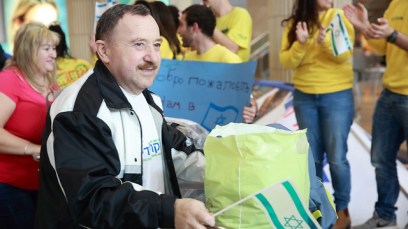
Sisters Marina and Alexandra Prokopovych, aged 17 and 15 respectively, were among the new immigrants who arrived in Israel. They had lived in the small suburb of Rakytne. Both were severely beaten at their high school in what began as a nationalistically-motivated attack, but which spilled over into overt anti-Semitism.
IFCJ Director of Communications Tali Aronsky told Tazpit Press Service (TPS) that the girls were called “separatists” and “Zhids” (Jews) prior to the assault because they spoke Russian instead of Ukrainian.
“The girls sustained serious injuries as a result. One suffered concussions and had to get stitches. Even the teachers joined in the beating. The father remembers similar things that happened when he was younger, but he decided that it was time to leave when it happened to his daughters,” she said.
Dmytro Prokopovych, the girls’ father, also remembers that he had switched schools three times due to his ethnicity. He himself suffered fourteen concussions from similar attacks during his childhood and he maintains that anti-Semitism is still very prevalent in post-Soviet Ukraine.
“I recently discovered that my family’s real surname is Evenbach and not Prokopovych. It was my grandfather’s surname. My father would not be admitted to university with this surname in Soviet times so he changed it to his mother’s maiden name,” Dmytro recalls.
IFCJ founder Rabbi Yechiel Eckstein decided that efforts to rescue Jews in countries with prevailing anti-Semitism were insufficient. The IFCJ then began actively searching for Jews suffering in countries affected by war. Many of the immigrants receive additional funds since they were forced to leave behind homes that have become essentially worthless due to the conflicts.
“We don’t wait for the Ukrainians to call us up. We go to them and we also give them more support. We offer them $1,000 per family and $500 for every child in addition to what they get from the government,” Aronsky told TPS.
The new immigrants will be given guidance and career advice. Aronsky said that the organization has also reached out to other countries such as Venezuela, Uruguay, Turkey, and even several Arab countries and has managed to bring some 2,355 Jews to Israel. Aronsky was unable to divulge the identities of the Arab countries due to security concerns for the Jews involved.
Source: Israel Hayom | In Atlantic interview, Obama talks Iran, Cairo speech and Netanyahu
U.S. President Barack Obama on Cairo speech: “My argument was this: Let’s all stop pretending that the cause of the Middle East’s problems is Israel” • The Atlantic’s Jeffrey Goldberg explores moments of tension between PM Netanyahu and Obama.
 |
Much has been written about the ups and downs in the relationship between Prime Minister Benjamin Netanyahu and U.S. President Barack Obama, but a new profile piece in The Atlantic provides a unique glimpse into the tensions between the two and gives Obama a chance to reflect on his failures in the Middle East.
The article, titled “The Obama Doctrine” and written by journalist Jeffrey Goldberg, looks to sum up Obama’s foreign policy and finds that the Middle East does not top his list of priorities.
Goldberg recalls a meeting between Netanyahu and Obama in 2011, which Obama remembers having gone poorly. According to the article, Netanyahu began the meeting with “something of a lecture” about the dangers and difficulties faced by Israel in the Middle East.
“Obama felt that Netanyahu was behaving in a condescending fashion,” Goldberg writes. At one point during the meeting, Obama interrupted Netanyahu and said, “Bibi, you have to understand something. I’m the African American son of a single mother, and I live here, in this house. I live in the White House. I managed to get elected president of the United States. You think I don’t understand what you’re talking about, but I do.”
According to Goldberg, Obama reached a number of conclusions about the world and America’s role in it during his time in office. “The first is that the Middle East is no longer terribly important to American interests,” he writes, adding that “the innate American desire to fix the sorts of problems that manifest themselves most drastically in the Middle East inevitably leads to warfare…”
Even the part of the article that deals with the Islamic State group states the Obama doesn’t believe in getting involved with the Middle East. “The rise of the Islamic State deepened Obama’s conviction that the Middle East could not be fixed — not on his watch, and not for a generation to come,” Goldberg writes. The article then recalls an anecdote shared by Obama’s advisers, wherein he compared Islamic State to the Joker from the 2008 Batman movie “The Dark Knight.”
According to the article, Obama said, “There’s a scene in the beginning in which the gang leaders of Gotham are meeting. These are men who had the city divided up. They were thugs, but there was a kind of order. Everyone had his turf. And then the Joker comes in and lights the whole city on fire. ISIL [Islamic State] is the Joker. It has the capacity to set the whole region on fire. That’s why we have to fight it.”
“Israel is not the problem”
If there is a country that is subject to a lot of criticism from Obama, it’s Saudi Arabia. Goldberg cites a conversation between Obama and Australian Prime Minister Malcolm Turnbull, in which the latter asked Obama, “Aren’t the Saudis your friends?” Obama responded by saying, “It’s complicated.”
The article then quotes Obama saying that the Saudis should “share” the region with Iran: “The competition between the Saudis and the Iranians — which has helped to feed proxy wars and chaos in Syria and Iraq and Yemen — requires us to say to our friends as well as to the Iranians that they need to find an effective way to share the neighborhood and institute some sort of cold peace.”
As the interview goes on, it seems that Obama regrets some of the decisions he has made regarding the Middle East. For example, Goldberg writes, “When I asked Obama recently what he had hoped to accomplish with his Cairo reset speech, he said that he had been trying — unsuccessfully, he acknowledged — to persuade Muslims to more closely examine the roots of their unhappiness.”
Obama is then quoted as saying, “My argument was this: Let’s all stop pretending that the cause of the Middle East’s problems is Israel.”
Regarding Syria, which takes up a significant part of the article, Obama believes that America was right not to intervene. “He was tired of watching Washington unthinkingly drift toward war in Muslim countries,” Goldberg writes.
Source: Israel Hayom | Obama’s Middle East
Ruthie Blum
This was a busy week for the Obama administration. On Tuesday, U.S. Vice President Joe Biden arrived in the Middle East to meet separately with Prime Minister Benjamin Netanyahu and Palestinian Authority President Mahmoud Abbas.
One presumes this was part of a flimsy effort to get some peace-brokering going — or at least to bang on the lid of the jar, to loosen it for the U.S. State Department or the French government. Whatever.
Lo and behold, however, upon landing at Ben-Gurion International Airport, where he was greeted by a slew of Israeli dignitaries, including the defense minister, the whir of ambulance and police car sirens put a bit of a damper on the festivities. A terrorist was in the midst of a 20-minute stabbing spree spreading from the area of Jaffa Port to the Tel Aviv promenade. During his rampage, which was finally stopped by a quick-witted guitar player who chased and hit him with the instrument, enabling police to finish the job, the 22-year-old Palestinian managed to seriously injure many innocent people and to kill American graduate student and U.S. Army veteran Taylor Force.
Nor was this bloody attack the only one of the afternoon. Within the space of two hours, terrorists in Jerusalem and Petach Tikvah had also landed Israeli victims in the hospital with serious bullet and knife wounds.
Nevertheless, Biden was whisked off to the Peres Center for Peace, where he met with former Israeli President Shimon Peres, whose delusions of a new Middle East are only matched by those of Obama. Indeed, both secretly — and not so secretly — hold Netanyahu responsible for the lack of progress in realizing their dreams.
Biden was pretty annoyed, then, when Abbas failed to condemn the terrorist attacks, which were merely the latest in the current surge of Palestinian violence that has been taking its toll on Israel since September.
But Abbas wasn’t the only leader who embarrassed the Obama administration this week. The Islamic Republic of Iran, which has been test-firing ballistic missiles while bragging about their destructive capabilities and long range, on Wednesday went as far as to launch missiles engraved with the words “Israel must be wiped out” in Hebrew. After blaming Netanyahu for sticking his nose where it doesn’t belong during the lead-up to the signing of the nuclear deal between Iran and world powers — and assuring him that the agreement would better for everybody, including Israel — Obama’s people were not too happy about having to find a way to dismiss this little piece of evidence to the contrary.
Meanwhile, the State Department was caught with egg on its face, when the International Atomic Energy Agency revealed that sanctions weren’t the only things lifted as a result of the nuclear deal; the requirements for providing details of Iran’s nuclear activities were also curtailed.
Luckily for Obama, news emerged that Netanyahu had canceled a planned trip to Washington next week to attend the annual AIPAC conference — and, by extension, a purported meeting with Obama — without letting the powers-that-be in D.C. know about it. This gave the administration the opportunity to turn the focus away from terrorists, both lone-wolf and state-sponsored, and return it to Netanyahu’s ostensibly bad behavior.
All the above took place between Tuesday and Wednesday.
On Thursday, a massive piece by Jeffrey Goldberg came out in the April edition of The Atlantic. In the article on “The Obama Doctrine,” the president whined about being misunderstood on the one hand, and doubled down on his “leading-from-behind” policy on the other.
Obama probably didn’t get a chance to read the whole thing, however, unless Goldberg had submitted an early draft for White House approval, because he was busy preparing to receive a welcome visitor: Canadian Prime Minister Justin Trudeau.
Like Obama, Trudeau was elected on the basis of a liberal hope, change and handouts agenda, replacing a leader who had zero tolerance for radical Islam or moral parity between the West and the Third World, while considering Israel a true and natural ally, without caveat. Indeed, Trudeau is like an Obama clone.
So it is no wonder that the two peas in a dubious pod got along famously; thick as thieves, so to speak. Nor is it surprising that what they touted as “central challenges” included climate change and refugees.
Addressing Trudeau and his wife on the White House lawn, Obama beamed at his guests. “It’s long been said that you can choose your friends but you cannot choose your neighbors,” he announced.
Yes, Mr. President, that’s what Israel has been trying to tell you for the last seven years. But you haven’t been listening.
Ruthie Blum is the web editor of The Algemeiner (algemeiner.com).
Source: Israel Hayom | Obama gratuitously harms alliances
Elliot Abrams
American alliances are not in good shape these days, with many countries worrying that President Barack Obama does not value the alliances, their own role in those alliances, or the commitments our alliances imply to the safety of states that are to some degree dependent on the United States.
It is therefore mysterious why the president decided to inflict further damage in interviews with The Atlantic. One can think easily of two famous moments when such comments, and those not even by a president, had dire effects. In January 1950, Secretary of State Acheson spoke about the American defense perimeter in Asia, saying our “defensive perimeter runs along the Aleutians to Japan and then goes to the Ryukyus. … The defensive perimeter runs from the Ryukyus to the Philippine Islands.” Excluded here was Korea, and many analysts have said this speech contributed to the decision by the North to invade South Korea several months later. On July 25, 1990, the U.S. ambassador to Iraq met with Saddam Hussein and said: “We have no opinion on your Arab-Arab conflicts, such as your dispute with Kuwait. Secretary [of State James] Baker has directed me to emphasize the instruction, first given to Iraq in the 1960s, that the Kuwait issue is not associated with America.” Eight days later, Saddam invaded Kuwait.
Words have consequences. In these recent interviews, the president undermined trans-Atlantic relations and relations with Saudi Arabia and other Gulf allies.
Take his comment on the Russian invasion of Ukraine:
“The fact is that Ukraine, which is a non-NATO country, is going to be vulnerable to military domination by Russia no matter what we do. This is an example of where we have to be very clear about what our core interests are and what we are willing to go to war for.”
Well, it is actually an example of saying something off the cuff that can only encourage further Russian aggression and demoralize Ukrainians fighting for their country. Why say it, even if you think it?
Take this from Obama’s recent interview with Jeffrey Goldberg in The Atlantic:
“‘The competition between the Saudis and the Iranians — which has helped to feed proxy wars and chaos in Syria and Iraq and Yemen — requires us to say to our friends as well as to the Iranians that they need to find an effective way to share the neighborhood and institute some sort of cold peace,’ he [Obama] said. ‘An approach that said to our friends “You are right, Iran is the source of all problems, and we will support you in dealing with Iran” would essentially mean that as these sectarian conflicts continue to rage and our Gulf partners, our traditional friends, do not have the ability to put out the flames on their own or decisively win on their own, and would mean that we have to start coming in and using our military power to settle scores. And that would be in the interest neither of the United States nor of the Middle East.”
Saudi Arabia has been an American ally since 1945, and now faces an aggressive Iran with troops and proxies all over the Arab world (Lebanon, Iraq, Syria, Yemen) and with a nuclear weapons and ballistic missile program. Other American allies border it and share its fears: Jordan, Kuwait, Bahrain (where the Fifth Fleet is located), and the United Arab Emirates. What does the president have to say to calm their fears? Nothing. Instead he builds them, and suggests that he looks upon growing Iranian power with indifference — or even with approval.
To those comments he added criticisms of the United Kingdom and France, as if he were concerned lest any key allies be left out.
It’s worth mentioning as well this line from the New York Times:
“The portrait that emerges from the interviews is of a president openly contemptuous of Washington’s foreign-policy establishment, which he said was obsessed with preserving presidential credibility, even at the cost of blundering into ill-advised military adventures.”
Those advisers who told him he was sacrificing his credibility when — for example — he failed to enforce his red line on Syria, were right. Presidential credibility can never be the goal of American foreign policy, but it is an important asset. Foreign leaders, whether hostile or friendly, must be able to trust that when the president says something, he means it and will stick to it. Allies rely on the United States, but “the United States” is an abstraction. In fact they rely on the words of the top officials with whom they interact; for them, in this sense the president is in fact the United States. Obama’s deprecation of presidential credibility is alarming for Americans, and dangerous for its friends.
Obama seems “openly contemptuous” of anyone who disagrees with him, and has seemed so for seven years. The problem in his eyes is not that there are tough policy questions, and difficult decisions, and several sides to hard questions. Nope, there is his view and there are the ignorant, unintelligent views of those who differ, of whom he is indeed “openly contemptuous.”
Those who think the tone of American politics is ugly because participants disrespect each other might consider how much of that tone originates with or is worsened by the president.
In any event, his comments in this interview will not help the national security interests of the United States. They will undermine the confidence of allies. It is anyone’s guess why he felt that these thoughts should have been spoken now.
From “Pressure Points” by Elliott Abrams. Reprinted with permission from the Council on Foreign Relations.




 anneinpt
 artaxes
 danmillerinpanama
 davidking1530
 Peter Hofman
 Joseph Wouk
 Peter
Peter Louisiana Steve
 WarSclerotic
Recent Comments