Archive for February 2016

Palestinians: Kerry and the Game of Obfuscation

February 22, 2016

Palestinians: Kerry and the Game of Obfuscation, Gatestone InstituteKhaled Abu Toameh, February 22, 2016

♦ “intifada” is simply a further phase in a larger plan to destroy Israel. When the plan began officially, with the establishment of the PLO in 1964, there were no “settlements” — not until after the June 1967 War — so what exactly were the Palestinians planning to “liberate”?

♦ The current conflict is not about “defending” any mosque from being contaminated by the “filthy feet” of Jews: it is about seeing Israel forced to its knees. Abbas and others seek to reap delicious political fruits from this “intifada.”

♦ Here is a novel idea: Kerry could put pressure on the Palestinian and Jordanian leadership to cease anti-Israeli incitement and indoctrination. Now that would be pressure well applied.

♦ Abbas is expected to become a partner in the fight against ISIS and radical Islamist groups. All well and good. Why then is he not expected to stop cheering on and glorifying young Palestinians who attack Jewish Israelis?

U.S. Secretary of State John Kerry is back in town. This time he is meeting with Jordanian and Palestinian leaders about “ongoing security issues in the region and continued tensions between Israel and the Palestinians.”

For those not involved in political newspeak, here is a translation:

“Ongoing security issues” = the Islamic State terror group (ISIS).

“Tensions between Israel and the Palestinians” = the ongoing wave of Palestinian stabbing, car-ramming and shooting attacks that began in October 2015.

Jordan and the Palestinian Authority (PA) fighting ISIS? Now that’s an idea! Jordanian King Abdullah and PA President Mahmoud Abbas ending “tensions” between Israel and the Palestinians? Let’s think about that.

Kerry comes back, but never calls a spade a spade. The “tensions” to which he deceptively alludes are knifings and car-rammings. And what is the biggest spade that Kerry avoids calling by its name? The new generation of Palestinians brainwashed to believe that Israel can be defeated with knives and car-attacks.

This “intifada” is simply a further phase in a larger plan to humiliate and destroy Israel. This plan began officially, with the establishment of the Palestine Liberation Organization (PLO), in May 1964. At that time there were no “settlements” — not until after the June 1967 War — so what exactly were the Palestinians planning to “liberate”?

The plan continued in 1974, at the twelfth session of the Palestinian National Council in Cairo, with the 10-point “Phased Plan” (see Appendix below for full text of the Phased Plan). Article 2 called for “armed struggle” (terrorism) to establish “an independent combatant national authority” that is “liberated” from Israeli rule.

Contrary to Palestinian leaders’ pap, the current conflict is not about “defending” any mosque from being contaminated by the “filthy feet” of Jews: it is about seeing Israel forced to its knees. Abbas and others seek to reap delicious political fruits from this “intifada.”

That is why, in his meeting with Kerry, Abbas made it clear that he intends to pursue unilateral moves to impose a solution on Israel, with the help of the international community.

Abbas also told Kerry that he intends to continue with his efforts to seek a UN Security Council resolution condemning Israel over “settlement construction.”

Never mind that on Palestinian maps, all of Israel is regarded as one big “settlement.”

1271Palestinian Authority leaders, official television, schools and media outlets often display maps showing Palestine stretching from the River Jordan to the Mediterranean Sea. The maps do not show the existence of Israel.

But back to Kerry. His “tensions” imply two sides engaged in some kind of a dispute that has aggravated a situation and strained relations between them, instead of what it really is: Palestinians openly trying to supplant Israelis — the entire state.

So the game of obfuscation continues. No doubt, we will witness more pressure on Israel to make concessions that will supposedly ease the “tensions.”

Kerry and his friends either do not “get it” or do not want to “get it.” Palestinians are waging an out-and-out war against Israel with the goal of making Israelis suffer to a point at which they will beg their leaders to capitulate. In the Palestinian view, such behavior pays off royally.

It is a Palestinian commonplace that the two previous uprisings — in 1987 and 2000 — brought major achievements to the Palestinians.

The first “intifada” led to Israel’s recognition of the PLO as the “sole legitimate representative of the Palestinians” — a move that was followed by the signing of the Oslo Accords and the creation of the Palestinian Authority.

The second “intifada,” the Palestinians argue, led to Israel’s full withdrawal from the Gaza Strip in the summer of 2005.

And so we arrive at the newest wave of attacks. As the saying goes: Step-by-step.

Kerry would like to see an end to the Palestinian attacks on Israeli Jews. The only problem is that his vacuous rhetoric prevents him from having a snowball’s chance in a Middle Eastern summer from attaining that goal.

Let us also not underestimate Palestinian Authority rejectionism. On the eve of the Kerry-Abbas meeting, Palestinian Authority officials were quoted as saying that they did not expect anything positive to come out of the talks “because the U.S. remains biased in favor of Israel.”

As always, the Palestinian stance is, “My way or the highway.”

Moreover, Kerry is dreaming if he thinks that President Mahmoud Abbas or King Abdullah are able to stop the attacks on Israelis. Neither has the mandate or the credibility to do so. In any case, they and their media outlets are too busy with their anti-Israeli ranting to do much on that score.

Thus far, not a word has been uttered by either of the two Arab leaders that could be even vaguely interpreted by their people as “stop killing Israelis.” In the Palestinian Looking Glass, it is Israel that is responsible for the deadly attacks. After all, claims that are untrue about Israelis “storming and desecrating the Al-Aqsa Mosque and other Islamic holy sites” are provocative, to say the least.

Here is a novel idea: Kerry could put pressure on the Palestinian and Jordanian leadership to cease anti-Israeli incitement and indoctrination. Now that would be pressure well applied. And it does not even require funding.

President Abbas is expected to become a partner in the fight against ISIS and radical Islamist groups. All well and good. Why then is he not expected to stop cheering on and glorifying young Palestinians who attack Jewish Israelis?

When Kerry and his crew finally wake up to the fact that it is precisely this incitement that is driving Palestinians into the open arms of ISIS, Hamas and other terror groups, perhaps, finally, we will be able to hope for “easing tensions in the region.”

Meanwhile, Kerry is back blathering about peace in the Middle East. Unfortunately, he seems incapable of calling a spade a spade — especially when that spade’s name is Palestinian prevarication.
Of Topic, open for discussion .

February 22, 2016

Why Women DESTROY NATIONS * / CIVILIZATIONS – and other UNCOMFORTABLE TRUTHS

Please watch full before commenting .

What to Expect in Iran

February 22, 2016

What to Expect in Iran, Gatestone InstituteJagdish N. Singh, February 22, 2016

♦ “The destruction of Israel is non-negotiable.” — Mohammad Neza Naghdi, Commander of Iran’s Basij paramilitary force.

♦ Sanctions relief will mainly benefit Ayatollah Khamenei and members of the Revolutionary Guards: they control up to one-third of Iran’s economy.

♦ Part of the Iranian regime’s grand strategy is to inflict “death to America” and replace it with its own radical version of Islamic governance. Ayatollah Khamenei himself called for America’s destruction amid nuclear negotiations.

♦ Officials also believe Iran is indirectly funding the Islamic State (IS) in the Sinai. “Suitcases of cash” are sent directly to Hamas officials in the Gaza Strip; part of the money is then transferred to IS.

♦ Iran now poses an even greater threat. If democracies today continue their present policies towards Iran, it will only embolden Iran’s regime to continue its quest to obtain nuclear weapons as well as its terrorism and human rights violations.

Humanity seldom seems to learn its lessons. The governments of the world’s leading democracies appear to be suffering from this predicament in their nuclear dealings with the Islamic Republic of Iran. To avoid catastrophe, democracies need quickly to correct their course.

One of the fatal blunders of Western democracies is their repeated commitment to appeasing and delaying action against aggressive regimes. Between the two World Wars, despite plenty of evidence of the widely-declared global racist agenda of Germany’s Adolf Hitler, democratic powers waited to take action until it was too late. Hitler was able to carry out a genocide that continues to haunt many nations.

Today, Western democratic governments, with their Eastern counterparts such as India, seem on a similar course in dealing with the Islamic Republic of Iran.

The domestic and international agenda of the Khomeinist government is publicly documented. Since the Iranian Revolution of 1979, part of the regime’s open grand strategy is to inflict “death to America,” the leader of the free world, and replace it with its own radical version of Islamic governance. Under the current Supreme Leader Ayatollah Ali Khamenei and his Islamic Revolutionary Guards Corps (IRGC), Iran has been gaining influence across the Middle East, Latin America, the Caribbean and South Asia. Despite nuclear talks with the West, Iran’s goal of “death to America” remains. The Ayatollah himself even called for America’s destruction amid nuclear negotiations.

Currently, Iran is a major player in aiding the autocratic regime of Basher al-Assad in Syria, the Houthis in Yemen, Hezbollah in Lebanon, Palestinian Islamic Jihad and Hamas in the West Bank and Gaza and the Islamic State (IS) in Egypt’s Sinai Peninsula.

To advance its imperial agenda, Iran has proceeded to develop its conventional and nuclear ballistic missile program. According to Director of National Intelligence James Clapper, Iran has “one of the largest inventories of ballistic missiles in the Middle East.”

In line with Iran’s missile development program, Iran’s Revolutionary Guard Navy Rear Commander, Ali Fadavi, announced: “Based on the fifth five-year plan, we should materialize our objective of mass-producing military speedboats with the speed of 80 knots per hour… and are equipped with missiles with a range of 100km; the vessels no one can catch.”

Aside from its military aspirations, since the fall of the Shah in 1979, successive Iranian governments have voiced their plans to annihilate the State of Israel, the only pluralist democracy in the Middle East, and an effective military deterrent to Iran’s designs in the region.

Hostile messages have been pouring forth from Iran. Mohammad Neza Naghdi, Commander of the Basij paramilitary force, stated in clear terms in April 2015, that, “The destruction of Israel is non-negotiable.”

Major General Yahya Rahim Safavi, a former IRGC commander and a top military aide to Khamenei, warned in May 2015, that “More than 80,000 missiles are ready to rain down on Tel Aviv and Haifa.”

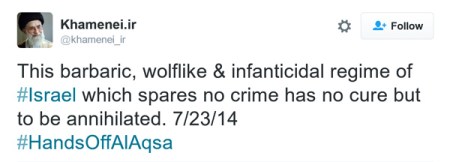
As late as November, Iran’s Supreme Leader Khamenei himself tweeted, “This barbaric, wolflike & infanticidal regime of #Israel which spares no crime has no cure but to be annihilated.”

1477

Bewilderingly, Western democracies have chosen to overlook Iran’s speeches and actions. They chose instead to appease the regime. Last July, despite genuinely serious reservations expressed by international strategic and military experts (including retired American military officers), the United States, United Kingdom, France and Germany – the four democracies in the P5+1 — concluded a nuclear deal with themselves that they proposed to Iran. Iran so far has not signed the deal, and apparently even if it did, according to the U.S. Department of State, the deal would not be legally binding.

Tehran will greatly benefit financially from the terms of the nuclear agreement in the months to come. Under the administration of President Barack Obama, nuclear sanctions against Iran have been lifted. To advance the deal and make it more appealing to Iran, the president has also agreed to pay Iran a $1.7 billion settlement for $400 million in “frozen” assets held in the United States since 1981.

The Society for Worldwide Interbank Financial Telecommunication (SWIFT), “the electronic bloodstream of the global financial system,” had disconnected 15 Iranian banks from its system in 2012. after coming under pressure from both the United States and the European Union at the height of efforts to curb Iran’s nuclear ambitions. Today, SWIFT is ready to let those banned banks, including the Central Bank of Iran, use its system once again. Iran now has an even greater ability to fund its terrorist proxies around the world.

European political and business leaders have been rushing to Tehran to sign new agreements. On January 28, in Paris, Iran’s President Hassan Rouhani and France’s President Francois Hollande signed major business deals, including a joint venture between car-makers PSA Peugeot Citroen and Iran’s Khodro. Iran is in the process of buying 118 Airbus passenger planes to update its aging fleet. The construction group Bouygues and the French airport operator ADP are now set to build an extension for Tehran’s airport, while Vinci, another construction firm, has been commissioned to design, build and operate new terminals for the Mashhad and Isfahan airports. The French oil company Total has agreed to buy Iranian crude oil, and agreements in shipping, health, agriculture and water provision have also been signed.

Democratic India is also cultivating relations with Iran. In a meeting in May, India’s Minister of Road Transport and Highways, Nitin Gadkari, and Iranian Transport and Urban Development Minister, Abbas Ahmad Akhoundi signed a Memorandum of Understanding on India’s participation in the development of the Chabahar Port in Iran.

The Chabahar project will impart strategic leverage to India and its access to Afghanistan and energy-rich Central Asia by bypassing Pakistan. The distance between the Chabahar Port and Gujarat – India’s westernmost state, located near the Persian Gulf, is less than the distance between Delhi and Mumbai. Transit times are estimated to be reduced by a third. Indian firms have already agreed to lease two existing berths at the port and operate them as container and multi-purpose cargo terminals.

The Chabahar project, New Delhi calculates, will be highly beneficial. As India has invested over $2 billion in Afghanistan, the Indian government plans to link the Chabahar port with the Zaranj-Delaram road it built in Afghanistan, thereby opening alternative routes to Afghanistan and enhancing access to regional and global markets.

Russia and China, permanent members of the UN Security Council, are also strengthening their cooperation with Iran. Both Russia and China adopted a policy of ambivalence towards Iran and saw to it that sanctions imposed by the West were not too tough. They also repeatedly blocked attempts at sanctioning Iran’s ally, the current Syrian regime, out of concern over financial ties in the region.

China is also capitalizing on the lifting of sanctions against Iran. Chinese President Xi Jinping rushed to Iran after the so-called nuclear agreement to discuss a 25-year strategic cooperation plan. In a landmark deal worth up to $600 billion, Xi committed to increase trade between the two nations during the next decade. Beijing and Tehran also agreed to enhance security cooperation through intelligence-sharing, counter-terror measures, military exchanges and coordination. Incidentally, despite international sanctions, China-Iran trade increased from $3 billion in 2001 to more than $50 billion in 2014.

Given its fanatical and sectarian ideological agenda, Iran is likely to use the new funds to boost its armament program and ongoing clandestine terror acts. Sanctions relief will mainly benefit Khamenei and members of the IRGC: they control up to one-third of Iran’s economy.

Iran now poses an even greater threat to the entire civilized world. The pattern of Tehran’s behavior shows the government can never be trusted on any promises it makes not to advance its nuclear weapons program. Khamenei has made an open declaration that Tehran will not allow effective inspections of its military sites or interviews with its nuclear scientists.

The links of the IRGC’s Qods Force with Hezbollah, Hamas, Palestinian Islamic Jihad, the Houthis and other terror militias pose a major threat to peace and stability in the Middle East.

Hezbollah’s networks have expanded over the years, infiltrating Latin America and the Caribbean through Shiite cultural centers in the region. According to an official Argentine report, Tehran has established its terrorist, intelligence and operational networks throughout Latin America as far back as the 1980s. Iran’s intelligence activities in the region are being conducted directly by Iranian officials or through its proxy, Hezbollah. Criminal activity may already be underway in Brazil, Colombia, Chile, Paraguay, Uruguay, Suriname and Trinidad and Tobago. Iran’s involvement in the cocaine trade has bolstered the regimes regional access and strengthened ties with its allies in Venezuela, Ecuador, Bolivia and elsewhere.

According to senior Western intelligence officials, the IRGC has transferred tens of millions of dollars to Hamas to be used for weapons, military equipment and training, and that Iran also delivers arms and funds to Hamas through the Red Sea and the Sinai. Officials also believe Iran is indirectly funding the Islamic State (IS) in the Sinai. “Suitcases of cash” are sent directly to Hamas officials in the Gaza Strip; part of the money is then transferred to IS.

Tehran’s links with Hamas and IS are part of a grander strategy of using proxy forces to gain hegemony over the Middle East and undermining American allies such as Egypt and Israel. In Lebanon, Iraq and Syria, Iran seeks to preserve its influence. By fighting IS, Iran strengthens existing pro-Iran regimes and maintains its relevance in the region.

While Iran does support IS indirectly in the Sinai, the government’s goal is to weaken the current Egyptian regime and the Sunni Arab alliance between Egypt, Saudi Arabia and Jordan. It has no problem with IS gaining strength in the Sinai right now. If IS does gain more power in the Sinai, Iran can use it to impose its own agenda in the future. Tehran evidently wants to use IS victories against Sunni states as an opportunity to take over.

Iran also supports the Gaza-based terror group al-Sabireen [“The Patient Ones”], established in the wake of previous tensions between Iran, Hamas and Islamic Jihad. The group has about 400 followers and its emblem is identical to that of Hezbollah. Each member receives a monthly salary of $250-$300, while senior members receive at least $700. Annually, the terror group receives a budget of $10 million from Iran, smuggled in suitcases through tunnels along the border with Egypt. Potential members are wooed by al-Sabireen through familiar channels of philanthropy and education. The group’s publications refer to the United States as “the source of superpower terrorism,” and its slogan is, “The road to the liberation of Palestinian goes through Karbala” — a Shiite holy city in Iraq.

Al-Sabireen has extended its operations from the Gaza Strip to the West Bank and Jerusalem with Iran’s backing. Hisham Salim, the founder of al-Sabireen, admitted that his group is directly financed by Iran. “We have an armed branch whose goal is to wage war on the Israeli occupation everywhere,” Salim said. “Within this framework we have members in the West Bank and Jerusalem.”

The Obama administration has forged ahead with its Iran policies despite knowing the regime’s support of global terrorism. U.S. President Barack Obama himself spoke about Iran’s terror activities in a press conference last year. “Now, we’ll still have problems with Iran’s sponsorship of terrorism; its funding of proxies like Hezbollah that threaten Israel and threaten the region; the destabilizing activities that they’re engaging in, including place like Yemen,” he said, adding that the nuclear “deal is not contingent on Iran changing its behavior. Its not contingent on Iran suddenly operating like a liberal democracy.”

History urges those living in democracies today to rein in their governments and correct their fatal Iran policies. The world cannot afford to overlook the damage of these governments. If democracies today continue their present policies towards Iran, it will only embolden Iran’s regime to continue its quest to obtain nuclear weapons as well as its terrorism and human rights violations.

Newsmax Prime | Raymond Ibrahim and Nonie Darwish discuss the latest US airstrike in Libya

February 22, 2016

Newsmax Prime | Raymond Ibrahim and Nonie Darwish discuss the latest US airstrike in Libya, Newsmax TV via You Tube, February 19, 2016

Shoigu in Tehran to rescue Putin’s plan from Assad’s Iranian-backed obstructionism

February 22, 2016

Shoigu in Tehran to rescue Putin’s plan from Assad’s Iranian-backed obstructionism, DEBKAfile, February 22, 2016

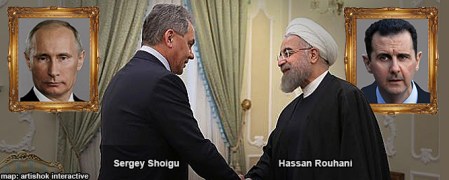
Shoigu_Ruhani

President Vladimir Putin this week mounted a rescue operation to unsnarl his blueprint for a solution of the Syrian crisis from the blockage placed in its path by none other than Bashar Assad. The Syrian ruler won’t hear of Moscow’s proposals for ending the war, or even the cessation of hostilities approved last week in Munich by the 17-member Syria Support Group.

DEBKAfile reports that the strains between Moscow and Damascus this week have blown back onto the working relations between the Russian, Syrian and Iranian military commands running the war in Syria.

US Secretary of State John Kerry, referring to the lack of progress toward a ceasefire during a visit to Amman Sunday, Feb. 21, pointed mainly at the Syrian opposition. Its High Negotiations Committee insists first on an end to the sieges, a halt on Russian bombardment and the inclusion of the jihadist Nusra Front in the ceasefire.

But, according to our sources, the main monkey wrench has been thrown into the mix by Assad.

When Putin discovered that the Syrian ruler had won the secret backing of Tehran in h is refusal, he decided to send the supreme commander of the Russian campaign in Syria, Defense Minister Gen. Sergei Shoigu, to Tehran Sunday, Feb. 21, with a personal message for President Hassan Rouhani.

Gen. Shoigu laid before Rouhani the extent to which Russian intervention had turned the tide of the Syrian war in favor of the regime, and the great advantages of a political resolution that would end the conflict in a way that enhanced Russian and Iranian influence in the region to the maximum.

The Russian general stressed that at the end of the proposed political process, Assad would be required to step down. This concurrence was incorporated in the Putin-Obama deal for working together to solve the Syrian crisis.

But Rouhani was unmoved, according to the statement he issued at the end of the interview.

“The crisis in Syria can only be solved through political negotiation and respect for the rights of the country’s government and people, who are those taking the final decision regarding its future,”  he said.

This was taken in Moscow as Iran’s rejection of at least one element of the Putin plan – imposing a solution on Assad – but not the plan in its entirety. This qualified response was meant to nudge Moscow closer to Teheran and Moscow and pull away from Washington.

The Shoigu mission therefore did not lessen the strains between Russia, Iran and Assad – at least for now, according to DEBKAfile’s sources.

Although all the parties concerned agree that the war must be ended by political means, those means are the subject of controversy between Moscow and its allies. The Russians are seeking a staged advance towards the final goal by first scaling down military operations, the while gradually refocusing their efforts on political and diplomatic arrangements.

But Syrian and Iranian leaders want to keep the focus on the military course.

Moscow wants the Assad regime to make concessions for paving the way to a cease-fire, and to accept a transitional government taking over in Damascus with representation for the opposition. The Syrian dictator would then gradually transfer his powers to the stand-ins as they assume responsibility for the various branches of government.

But both Assad and Tehran are adamantly opposed to a transitional government being installed – or any other political steps being pursued – before the rebel forces are totally defeated in non-stop military operations – first in the north and then in the south.

Neither the Syrian ruler nor Iran show any sign of relenting, or appreciating that the dramatic progress achieved in the past month by Syrian army, Iranian and Hizballah forces were down to Russian military support and especially its air campaign against their enemies. They feel safe in their intransigence because they assume that Putin can’t afford to abruptly pull his military support from under their feet to make them bow to his demands.

After five months in which Moscow and the Russian air force have provided the Iranian leadership and Assad with signal victories on the ground, President Putin has been brought up short by the same Iranian-Syrian negative obstructionism, that has defied every effort to end the brutal five-year war, which has cost 470,000 lives, left 1.9 million injured, displaced half the country’s population of 23 million and left a Syria ravaged beyond recognition.

Off Topic | President Donald Trump and Vice President Ben Carson

February 21, 2016

President Donald Trump and Vice President Ben Carson, Dan Miller’s Blog, February 21, 2016

(The views expressed in this post are mine and do not necessarily reflect those of Warsclerotic or its other editors. — DM)

President Trump and Vice President Carson will be an excellent team. Each has qualities the other lacks: Carson is modest and soft spoken, Trump is not. Trump knows how business works and how to negotiate deals. Carson does not. Both love America and want to help us to make her great again.

Trunp ground game

Donald Trump interview, February 18th:

Not Donald Trump, but how some see him:

Recent speech by Ben Carson:

Not Ben Carson, but how some see him:

All too often, our perceptions of candidates are based, not on what they actually say and do, but on what opposing candidates and their supporters claim.

Oh well.

Here are Newt Gingrich’s remarks on Trump’s future after his South Carolina Republican primary win.

Don’t want Trump/Carson? Then let’s just keep things the way they are because the country’s in the very best of hands. Isn’t it?

Excuse me. I need some medicine.

50 ISIS fighters killed in Syria regime Aleppo advance: monitor

February 21, 2016

50 ISIS fighters killed in Syria regime Aleppo advance: monitor

Source: 50 ISIS fighters killed in Syria regime Aleppo advance: monitor – Al Arabiya English

Residents inspect damage after an airstrike on the rebel held al-Fardous neighbourhood of Aleppo, Syria February 18, 2016. (Reuters)

At least 50 ISIS group fighters have been killed in the last 24 hours in an advance by Syrian government forces east of Aleppo city, a monitor said Sunday.

The Britain-based Syrian Observatory for Human Rights said the fighters were killed in clashes as well as strikes by Russian forces that are waging an aerial campaign in support of government troops.

Since Saturday morning, Syrian government forces have taken more than a dozen villages from ISIS jihadists around a stretch of highway that runs east from the northern city of Aleppo to the Kweyris military base.

The advances have consolidated government control over the stretch of highway leading to Kweyris, which they seized in November.

“The army has encircled ISIS in 16 villages south of the road. The regime wants to take these villages to consolidate its position in the east and southeast of the province,” said Observatory chief Rami Abdel Rahman.

The advances follow a major regime operation in northern Aleppo against rebel forces that has allowed them to virtually surround the opposition-held east of Aleppo city.

Off Topic:  Donald Trump and the New Age of Andrew Jackson

February 21, 2016

Source: Donald Trump and the New Age of Andrew Jackson | Observer

Mr. Jackson put a fire in the belly of the heartland


First there was Ron Paul. Then there was Sarah Palin. Then there was Rick Perry. Now there is Donald Trump.

No, wait. First there was Andrew Jackson.

Andrew Jackson, the seventh President of the United States, might be among the most important of presidents. He gave expression to the common people, the people of the earth and the heartland, in direct opposition to the Colonial establishment from Richmond to Boston, and brought it to an end. Mr. Jackson changed everything.

Today we face a similar paradigm of a broad rural spirit vs. the Eastern Establishment as we did in the day of Mr. Jackson. Birth pains, perhaps, or growing pains, as this time America makes a permanent paradigm shift from an essentially Eastern-based economic culture to a heartland and Western economic culture; the East receding, the heartland ascending.

Commentator Rich Lowry caught the Jackson drift in a recent New York Post article, Donald Trump’s Appeal is as American as Andrew Jackson’s.

“After the Paris attacks, conventional wisdom held that Republican voters would finally turn away from political outsiders and reward candidates representing sobriety and experience. No one stopped to consider that, actually, voters might be drawn to the guy who memorably said of ISIS that he would “bomb the [expletive] out of them,” Mr. Lowry writes.

“In large part, Donald Trump is a Jacksonian, the tradition originally associated with the Scotch-Irish heritage in America and best represented historically by the tough old bird himself, Andrew Jackson. Old Hickory might be mystified that a celebrity New York billionaire is holding up his banner (but, then again, Jackson himself was a rich planter). Trump is nonetheless a powerful voice for Jacksonian attitudes.”

‘He could never speak on account of the rashness of his feelings. I have seen him attempt it repeatedly, and as often choke with rage. He is a dangerous man.’

I made the case about five years ago that the Tea Party at its best was a Jacksonian movement, quite reminiscent of the rural uprising Mr. Jackson brought to Washington in the 1830s. Others suggested at the time that this would be the rising political temperament of the rising American century.

“Since New Hampshire state Rep. Dan Itse brought his challenge to ObamaCare, citing Thomas Jefferson’s Kentucky Resolutions, in February 2009, we have been seeing a new age of Jefferson. Judge Andrew Napolitano now plays primetime “fighting for freedom” five nights a week… a 26-state challenge to the federal government moves to the Supreme Court. But the turning ahead might best belong to Andrew Jackson. It was the rustic warrior from Tennessee who first fired up the common folk west of the New River and laid their claim to governance. He is much misunderstood and occasionally maligned, but Jackson might well be considered the spirit father of the current red-state uprising.”

Two years into the Obama administration America entered a turning. Governors of 26 states followed New Hampshire’s lead and collectively challenged the federal government. They did so again a few years later, against Mr. Obama’s executive order on immigration—and in these past weeks, 25 governors joined to refuse the distribution of Syrian refugees. Following New Hampshire’s initiative, states have begun to think for themselves.

“The most important thing that has happened in the last two years is that the states have learned that they don’t have to do what the federal government tells them to do,” I wrote back then.

Mr. Jackson put a fire in the belly of the heartland; a fire felt in the red states today and a fire that potentially will not go out. He brought a full shift of generational attitudes. When that happens, the generations which are being passed over appear to experience the end of the world. And what they say about the new people rising will be appalling.

“I feel much alarmed at the prospect of seeing General Jackson President,” Thomas Jefferson said in an interview with Daniel Webster in 1824. “He is one of the most unfit men I know of for such a place. He has had very little respect for laws and constitutions, and is, in fact, an able military chief. His passions are terrible. When I was President of the Senate, he was Senator; and he could never speak on account of the rashness of his feelings. I have seen him attempt it repeatedly, and as often choke with rage. He is a dangerous man.”

There’s more. Much more.

This is not far in tone from what was said about Sarah Palin when she first appeared and sent the Establishment press to the fainting couch. And the adolescent ridicule about Mr. Perry’s eye glasses. And despicably, everything about Texan about him. Google Donald Trump today.

Mr. Trump in my opinion is a harbinger of a vast transition occurring in America, which started more than a decade ago and will one day—perhaps soon—hatch. He is the Trickster, like John Brown, like Bob Dylan, who signals a rising of new archetypes ahead and promises “a hard rain gonna fall” on those left behind; like the rise of Abraham Lincoln and the warrior spirit of the North which would follow Mr. Brown, or the rise of the Civil Rights Movement and the Sixties which would follow Mr. Dylan.

And as it was in those periods, from whatever rises here today, there will be no turning back.

Disclosure: Donald Trump is the father-in-law of Jared Kushner, the publisher of Observer Media.

US State Secretary Kerry: Provisional agreement in principle reached on Syria truce terms

February 21, 2016

US State Secretary Kerry: ‘Provisional agreement in principle’ reached on Syria truce terms

Source: US State Secretary Kerry: Provisional agreement in principle reached on Syria truce terms – Daily Sabah

AA Photo

Secretary of State John Kerry said Sunday that a “provisional agreement” has been reached on a cease-fire that could begin in the next few days in Syria’s five-year civil war.

Kerry said he spoke in the morning with Russian Foreign Minister Sergey Lavrov to discuss terms of a cease-fire and the two now must reach out to the parties in the conflict.

He declined to go into the details of the agreement, saying it “is not yet done.” But he said he hoped President Barack Obama and Russian President Vladimir Putin would talk soon and that after that, implementation could begin.

“The modalities for a cessation of hostilities are now being completed,” Kerry said. “In fact, we are closer to a cease-fire today than we have been. A cessation of hostilities … is possible over the course of these next hours.”

The Russian Foreign Ministry seemed to stop short of Kerry’s announcement. The ministry said Lavrov and Kerry spoke on the phone Sunday for a second day in a row and discussed “the modality and conditions” for a cease-fire in Syria that would exclude groups that the U.N. Security Council considers terrorist organizations.

Fighting has intensified in Syria during recent weeks and an earlier deadline to cease military activities was not observed. The United States, Russia and other world powers agreed Feb. 12 on a deal calling for the ceasing of hostilities within a week, the delivery of urgently needed aid to besieged areas of Syria and a return to peace talks in Geneva.

U.N. envoy Staffan De Mistura halted the latest Syria talks on Feb. 3, because of major differences between the two sides, exacerbated by increased aerial bombings and a wide military offensive by Syrian troops and their allies under the cover of Russian airstrikes. The humanitarian situation has only gotten worse, with an estimated 13.5 million Syrians in need of aid, including 6 million children.

“Peace is better than more war,” Kerry said, standing next to Nasser Judeh, the foreign minister of Jordan, which hosts 635,000 Syrian refugees. “A political solution is better than then a futile attempt to try to find a military one that could result in so many more refugees, so many more jihadists, so much more destruction, and possibly even the complete destruction of Syria itself.”

However, he reiterated the long-time U.S. position that any political solution to the conflict will not work if Syrian President Bashar Assad remains at the helm of the nation. “Make no mistake. The answer to the Syrian civil war will not be found in any military alliance with Assad,” Kerry said. “Let me make that clear.”

He said Russia now has to talk with the Syrian government and Iran, which backs Assad, and the U.S. has to talk with the opposition and members of the International Syria Support Group. He said he knows that not every party will automatically agree to the agreement reached for a ceasefire.

“There is a stark choice for everybody here,” Kerry said.

“I know how much work remains and I don’t know if everyone is going to meet their commitments,” Kerry said. “I can’t vouch for that the United States can’t make certain of that.”

He said enforcement issues still need to be resolved in addition to how any breeches will be addressed.

“These are details that have to be determined if it going to be effective,” Kerry said.

Erdoğan to Obama: Turkey to stop shelling YPG only if YPG, Russia, Assad abide by Munich deal

February 21, 2016

Erdoğan to Obama: Turkey to stop shelling YPG only if YPG, Russia, Assad abide by Munich deal

Deniz Zeyrek – ANKARA

Source: Erdoğan to Obama: Turkey to stop shelling YPG only if YPG, Russia, Assad abide by Munich deal – MIDEAST

The fall of the town of Azez in northern Aleppo province where the Turkish military is pushing ahead with its cross-border artillery shelling campaign against U.S.-backed Syrian Kurdish militia positions in Syria would mean emergence of a new refugee influx and security problem for Turkey, Turkish President Recep Tayyip Erdoğan told his U.S. counterpart, President Barack Obama. The People’s Protection Units (YPG), the militia force of Syria’s Democratic Union Party (PYD), and the Assad forces backed by Russia have been acting in cooperation, Erdoğan told Obama in an 80-minute telephone call on Feb. 19.

“Their goal is not fighting against ISIL [the Islamic State of Iraq and the Levant]. If Azez falls, Turkey will face a serious migration and security problem. If [Syrian President Bashar al-] Assad, Russia and the YPG abide by the agreement reached in Munich, then artillery fires will be ceased,” Erdoğan responded, when Obama reiterated the U.S. call for the Turkish Armed Forces’ (TSK) shelling of campaign of the YPG to stop.

The Turkish president was referring to a Feb. 12 deal reached by the 17-nation International Syria Support Group (ISSG) in Munich where many of the key actors in the Syrian conflict, including Damascus ally Russia, agreed on a proposed ceasefire and to increase humanitarian access.

Turkey will not let the continued building of a “corridor” south of its borders, Erdoğan said.

“Our artillery fires have this aim and will continue. We will never sit back and watch formation of such an illegitimate entity at our borders,” he told Obama, according Hürriyet reports citing sources from the Turkish president’s office and Turkish diplomatic sources.

As Obama expressed his condolences to Erdoğan over a Feb. 17 suicide car bomb attack that killed 28 people, many of them soldiers, in the heart of the capital city of Ankara, Erdoğan reiterated that they had “no doubt” that the YPG carried out the attack. As of Feb. 19, the Kurdistan Freedom Hawks (TAK), a group that once had links to the outlawed Kurdistan Workers’ Party (PKK), claimed responsibility for the bombing.

President asks for unconditional US support against YPG

Calling on the United States to give unconditional support in the fight against Syrian Kurdish militants, Turkish Prime Minister Ahmet Davutoğlu said on Feb. 20 he did not rule out the responsibility of the YPG, calling TAK a “proxy” that claimed the bombing to shield the international reputation of the YPG.

The YPG’s political arm has denied the group was behind the Ankara attack and said Turkey was using the bombing to justify an escalation in fighting in northern Syria.

“The only thing we expect from our U.S. ally is to support Turkey with no ifs or buts,” Davutoğlu told a news conference following a five-hour security meeting with members of his cabinet and other officials.

“If 28 Turkish lives have been claimed through a terrorist attack, we can only expect them to say any threat against Turkey is a threat against them,” he said.

Turkish Foreign Minister Mevlut Cavuşoğlu earlier accused the United States of making conflicting statements about the militia group.

Cavuşoğlu has also claimed that U.S. Secretary of State John Kerry told him the YPG could not be trusted, in what Cavuşoğlu said was a departure from Washington’s official position.

“My friend Kerry said the YPG cannot be trusted,” Cavuşoğlu said at a news conference during a visit to Tbilisi on Feb. 19, referring to call with Kerry that took place on Feb. 18.

“When you look at some statements coming from America, conflicting and confused statements are still coming…. We were glad to hear from John Kerry yesterday that his views on the YPG have partly changed.”

As of Feb. 20, Çavuoğlu held telephone conversations with both Kerry and Saudi Foreign Minister Abdel al-Jubair, Turkish diplomatic sources told Hürriyet Daily News on Feb. 21, without elaborating on content of talks or on who initiated the talks.

February/21/2016


