Archive for February 29, 2016

French nuke carrier for sea-air drill with Egypt ahead of Libya offensive

February 29, 2016

French nuke carrier for sea-air drill with Egypt ahead of Libya offensive, DEBKAfile, February 29, 2016

Tahya_MisrFrench-built Egyptian frigate “Tahya Misr”

[T]he joint French-Egyptian naval-air force drill about to take place is the most substantial sign that a real operation to confront ISIS in Libya may finally be about to go forward.

***************************

The French nuclear-powered aircraft carrier Charles de Gaulle is steaming through the Red Sea on its way to the Mediterranean via the Suez Canal for joint maneuvers with the Egyptian navy in preparation for a reduced coalition offensive against Islamic State’s deepening grip on Libya. DEBKAfile’s military sources, reporting this, say it will be the Egyptian navy’s first joint exercise with a nuclear-powered aircraft carrier; and also the first drill to be conducted by the new Egyptian missile frigate Tahya Misr (Long Live Egypt!),  which underwent a series of exercises after it was delivered by the French DCNS naval shipbuilders last June.

The Charles de Gaulle departed the Persian Gulf Monday, Feb. 22 and is due to reach the eastern Mediterranean in the first week of March. The Egyptian frigate’s weapons systems can shoot down planes and ballistic missiles as well as striking naval or ground targets. Its weapons systems can shoot down planes and ballistic missiles as well as striking naval or ground targets. But the vessel has been stripped of its regular electronic warfare and satellite communications systems for the exercise – apparently after a quiet understanding between France, Egypt and Israel.

The Egyptian frigate was originally designed to secure the Suez Canal against potential terrorist attacks from the Islamic State networks in the Sinai Peninsula and their offshoots in the Canal cities of Port Said, Ismailia and Suez. The warship was moved into the Mediterranean after President Francois Hollande and Egyptian President Abdul-Fatteh El-Sisi moved forward on plans for a joint assault with Italy to root out ISIS positions in Libya.

The three powers have agreed to launch this offensive in late April or May, DEBKAfile’s military and counterterrorism sources report.

The joint naval exercise will meanwhile drill coordination between the French and Egyptian navies and air forces in readiness for the combat operation. They will practice landing fighter-bombers taking off from the Charles de Gaulle decks at air bases in Egypt’s western desert near the Libyan border, for refueling, reloading munitions or emergency landings, when damaged by enemy fire.

They will also rehearse joint marine landings from French and Egyptian warships.

Our sources report that the trilateral assault plan has undergone repeated revisions in recent weeks, mainly because President Barack Obama has had second thoughts about his initial scheme for the United States to lead the operation in Libya – this time from the front.

His first plan was for a large marine contingent to land on the Libyan coast under heavy air cover. But lately, he can’t decide whether to deploy any US troops at all and inclines towards leaving the main onus of the anti-ISIS campaign in Libya to European and Middle East armies.

A final decision is expected by our Washington sources to substantially scale down the original plan. The dithering in Washington has led to delays in Paris, Cairo, Rome and London on drawing up a final list of ISIS targets to be hit and the size of the invasion forces, although the operation is just weeks away and time is pressing.

Islamic State commanders, viewing this lack of resolve, are beginning to feel safe in their Libyan strongholds, after drawing confidence from the recent downsizing of coalition strikes against its forces and bases in Iraq and Syria.

Since a small coalition vanguard for the main offensive landed in Libya last year, nothing much as happened to hold back ISIS advances in Libya,  except for US drone strikes.

The White House spokesman Josh Earnest said this week that President Obama planned to address the terrorist organization’s advances in Libya with top military officials.

Also this week, Libyan military officials reported that 15 French Special Operations experts had been in Benghazi for the past two months, assisting Libyan national troops in fighting the extremists. According to another report, a “small number” of British advisers has joined US military operatives who are giving local militias “tactical training in Misrata.

However, the joint French-Egyptian naval-air force drill about to take place is the most substantial sign that a real operation to confront ISIS in Libya may finally be about to go forward.

Sweden’s Migration Industry

February 29, 2016

Sweden’s Migration Industry, Gatestone InstituteNima Gholam Ali Pour, February 29, 2016

♦ That Sweden is a “humanitarian superpower” is a myth that needs exposing once and for all. The recent migration wave to Sweden has made some people poor and others very, very rich. It is all about money, and it is about winners and losers.

♦ If liberal journalists outside Sweden believe that rape is humanitarian, then Sweden has a humanitarian migration policy.

♦ Meanwhile, thousands of “unaccompanied refugee children” are disappearing. and no one knows where they are.

♦ There is nothing “noble” in Sweden’s migration policy — far from being a good example of how a migration policy should function, it is a disaster, and its final result is chaos, conflict, and corruption.

When you talk to journalists from the U.S. or the UK, they often seem to think that Sweden is a humanitarian superpower that has received refugees because the Swedish government is following some ideology based on doing good deeds.

That Sweden is a humanitarian superpower, eager to lead by example, is a myth that needs exposing once and for all. The recent migration wave to Sweden has made some people poor and others very, very rich.

Every day one reads news in Sweden about the winners and the losers in the migration industry. One of the winners in Sweden’s migration industry is ICA Bank. In November 2015, it invoiced the Swedish Migration Agency $8 million for providing asylum seekers prepaid cards. For every cash withdrawal, ICA Bank takes a $2 fee, and for every prepaid card activated, it takes $21. ICA Bank won the contract without any competition; its contract with the Migration Agency extends to March 2017.

Many asylum accommodations in Sweden are run by private operators and are making huge profits. In 2015, the 30 largest companies that run the asylum accommodations invoiced the Swedish Migration Agency an estimated $109 million. The losers, on the other hand, were the Swedish taxpayers who had to finance these decisions.

In November 2015, it was reported that Sweden’s Migration Agency had paid $174 million during an 11-month period to private sector property owners for asylum seekers’ accommodation.

Many of the companies running the asylum accommodations have a profit margin of over 50%.Defakon Renting AB has a profit margin of 68%. Nordic Humanitarian AB has a profit margin of 58%. Fastigheterna på Kullen AB has a profit margin of 50%.

The biggest private company running asylum accommodations, Jokarjo AB, is owned by Bert Karlsson, known in Sweden primarily as director of a record label. In the early 1990s, Mr. Karlsson was the leader and founder of a political party, New Democracy, that advocated reducing immigration to Sweden. Between 1991 to 1994, as a representative of his party, he sat in the Swedish parliament. In 2015, his company billed the Swedish Migration Agency $23.9 million. Mr. Karlsson explained his business plan for running a home for asylum seekers in a simple sentence: “My idea is to make it cheaper and better than anyone else.”

One method he used to make his business more profitable is that asylum seekers have to buy their own toilet paper, apparently despite having agreed with the Migration Agency to provide asylum seekers with toilet paper, sanitary napkins and diapers. In December 2015, the Swedish media revealed that asylum seekers have to buy all these products themselves.

One can only imagine the situation for asylum accommodations run by minor private operators.

This is what the Swedish “humanitarian superpower” is actually about. It is all about money, and it is about winners and losers.

The companies running the asylum accommodations are becoming rich at the Swedish taxpayers’ expense; at the same time, asylum accommodations are not managed properly.

Here are a few of the violent incidents that happen every day:

On January 25, 2016, the police arrived at an asylum accommodation in Annerstad, southern Sweden, after hearing of a brawl there between Syrians and Afghans. When the police arrived, according to their report, no one — not even the people working there — could speak Swedish.

In January 2016, there were reports that a ten-year old boy at an asylum accommodation in Västerås had been raped repeatedly. In February 2016, there were reports that a boy at an asylum accommodation in Maglarp, in southern Sweden, had been raped by two other boys at the same asylum accommodation.

If liberal journalists outside Sweden believe that rape is humanitarian, then Sweden has a humanitarian migration policy.

What is actually happening in Sweden, however, is that private companies are making millions of dollars at taxpayer expense, while the newly arrived migrants are living a horrible existence in which rape and other abuses are a part of daily life. This is what other European countries will experience if they follow Sweden’s liberal migration policy.

Children who come to Sweden without parents (“unaccompanied refugee children“) must, according to the Swedish law, be assigned a legal guardian. The guardian, instead of the parents, is responsible for the child’s personal relationships and managing daily affairs. In December 2015, it was reported that there are guardians responsible for up to 29 unaccompanied refugee children, and who earn more than $7,000 a month. It is not, of course, possible for one guardian to take care of 29 unaccompanied refugee children. The migration industry in Sweden has created opportunities for people with no conscience to become wealthy. Meanwhile, thousands of unaccompanied refugee children are disappearing and no one knows where they are.

Another part of the migration industry that has grown of late are foster homes for unaccompanied refugee children. In February, reports surfaced that one of the heads of the Swedish Migration Agency also runs the private company, Starkfamn Familjehem AB: a business that provides foster homes to unaccompanied refugee children. It is not only people in the private sector are making money from the migration industry, but also people working inside the state apparatus who want to do well.

1487The biggest private company running asylum accommodations is owned by Bert Karlsson (left). In 2015, his company billed Swedish taxpayers $23.9 million. His homes require asylum seekers to buy their own toilet paper, apparently despite having agreed with the Migration Agency to provide asylum seekers with toilet paper, sanitary napkins and diapers. Wafa Issa (right) is head of the Migration Agency for the Stockholm region. She also runs a private company that is paid to provide foster homes to unaccompanied refugee children.

One of the losers is the Swedish police. They have reported that they can no longer cope with their jobs because they cannot handle the hundreds of young men in Sweden right now from Morocco and other countries in North Africa.

When you talk with journalists from Britain or the United States who think that Sweden’s migration policy is a role model, you have to think of those journalists who once saw the Soviet Union as a model. Communism did not work; Sweden’s migration policy does not work. That Sweden is a “humanitarian superpower” is truthfully nothing but marketing: the Green Party and some Social Democrats want to export Sweden’s liberal migration policy to the rest of Europe.

Although a small clique in Sweden have become millionaires because of the migration industry, the schools, police, social services and taxpayers in Sweden have lost a lot and have a difficult and uncertain future. There will be major conflicts in Sweden. There is nothing “noble” in Sweden’s migration policy. The Swedish migration model, far from being a good example of how a migration policy should function, is an embarrassment and a disaster, and its final result is chaos, conflict, and corruption.

Cartoon of the Day

February 29, 2016

Via The Jewish Press — The Definition of Chutzpah

Murdering-Chutzpah


Invasion of Europe .

February 29, 2016

Typical refugee behavior or just invaders ?

North Korea’s Nuclear Missile Threat: Very Bad News

February 29, 2016

North Korea’s Nuclear Missile Threat: Very Bad News

by Peter Pry and Peter Huessy

February 29, 2016 at 5:30 am

Source: North Korea’s Nuclear Missile Threat: Very Bad News

  • A careful technical reading of the DoD report clearly confirms that North Korea can strike the U.S. mainland with nuclear missiles right now. But the casual or non-expert reader can get the false impression that President Obama was right to assert that there is no nuclear missile threat from North Korea.
  • Given this overwhelming evidence of North Korea’s ability to strike the U.S. mainland, how strange that most major news outlets have never reported that North Korea already has nuclear-armed missiles that can strike the U.S.
  • The DoD report was inexplicably silent about North Korea’s current nuclear and missile capability, which could kill millions of Americans in an EMP attack — as warned by both the 2004 and 2008 Congressional EMP Commission reports.
  • The EMP Commission and the authors of this article believe that North Korea tested what the Russians call a Super-EMP weapon.
  • It is time to stop wishful thinking — that everything is fine, that diplomacy will work — and to face reality.
  • Space-based missile defenses will offer a realistic prospect of rendering nuclear missile threats obsolete, thus neutralizing the growing nuclear missile threats to the U.S. from North Korea, Iran, China, and Russia.

The mainstream media and their stable of “experts” consistently underestimate North Korea’s missile and nuclear weapon capabilities. The gap between how the media report on the North Korean nuclear missile threat and the reality of the threat has become so wide as to be dangerous.

In the aftermath of North Korea’s latest nuclear test on January 6, 2016, for instance, and its launch of a mock satellite on February 7, 2016, the American people were told that North Korea has not miniaturized a nuclear warhead for delivery by missile nor could the missile strike the U.S. with any accuracy.

Mirren Gidda, for example, writing in Newsweek, inexplicably claims “International experts doubt that North Korea has manufactured nuclear weapons small enough to fit on a missile.”

Yet this commonplace assertion that North Korea does not have nuclear-armed missiles is simply untrue.

Eight years ago, in 2008, the CIA’s top East Asia analyst publicly stated that North Korea had successfully miniaturized nuclear warheads for delivery on its Nodong medium-range missile. This capability indicates that the Nodong is able to strike South Korea and Japan, or, if launched off a freighter, even the United States.[1]

In 2009, European intelligence agencies at NATO headquarters also told the media that North Korea’s Nodong missiles were armed with nuclear warheads.[2]

In 2011, the Director of the Defense Intelligence Agency (DIA), Lt. General Ronald Burgess, testified before the Senate Armed Services Committee that North Korea has weaponized its nuclear devices into warheads for arming ballistic missiles.[3]

And as it turned out, North Korea achieved a long-range missile capability to strike the U.S. at least as early as 2012, according to testimony of administration officials before Congress. North Korea’s accomplishment occurred a bare two years outside of the fifteen-year “safe” window promised by the CIA in 1995.

In February and March of 2015, former senior national security officials of the Reagan and Clinton administrations warned that North Korea and Iran should be regarded as capable of delivering by satellite a small nuclear warhead to make an EMP attack against the United States.

In numerous articles that should have made media headlines — by Dr. William Graham (President Reagan’s Science Advisor, Administrator of NASA, and Chairman of the Congressional EMP Commission), Ambassador R. James Woolsey (President Clinton’s Director of Central Intelligence), Ambassador Henry Cooper (former Director of the Strategic Defense Initiative), and Fritz Ermarth (former Chairman of the National Intelligence Council) — have gone largely ignored by much of the media.[4]

On April 7, 2015, at a Pentagon press conference, Admiral William Gortney, Commander of North American Aerospace Defense (NORAD), responsible for protecting the U.S. from long-range missiles, warned that the intelligence community assesses North Korea’s KN-08 mobile ICBM could strike the U.S. with a nuclear warhead.

And on October 8, 2015, Gortney again warned the Atlantic Council: “I agree with the intelligence community that we assess that they [North Koreans] have the ability, they have the weapons, and they have the ability to miniaturize those weapons, and they have the ability to put them on a rocket that can range the [U.S.] homeland.”[5]

Given this overwhelming evidence of North Korea’s ability to strike the U.S., how strange that network and cable television and most major news outlets have never informed the American public that North Korea already has nuclear-armed missiles that can strike the United States.

Just weeks prior to North Korea’s fourth illegal nuclear test of an alleged hydrogen bomb on January 6, 2016, and prior to North Korea’s second successful orbiting of a satellite a month later, the Department of Defense (DoD) finished, in late 2015, a report to Congress. The report, which was not released to the public prior to the recent 2016 North Korean tests, appeared to be low-balling the North Korean nuclear missile threat.

The DoD report — finally released on February 12, 2016 — acknowledges that North Korea does indeed have a mobile ICBM: the KN-08. It is armed with a nuclear warhead that “likely would be capable” of striking the U.S. mainland, but “current reliability as a weapon system would be low” because the KN-08 has not been flight-tested.

Such hedging language about the KN-08 echoes repeated past assurances by the Obama Administration to the American people that North Korea does not yet have a miniaturized nuclear missile warhead, and cannot deliver on its threats to strike the United States.

The earlier DoD report from 2015 had also downplayed the North Korean nuclear missile threat by comforting readers that, “The pace of its progress will also depend, in part, on how much aid it can acquire from other countries.” Yet the DoD report is replete with evidence that North Korea is in fact receiving copious aid from Russia and China — including Golf-class ballistic missile submarines and an SS-N-6 submarine-launched ballistic missile from Russia.

Kim Jong Un, the “Supreme Leader” of North Korea, supervises the April 22 test-launch of a missile from a submerged platform. (Image source: KCNA)

The DoD report from 2015 also acknowledges that North Korea is developing another system for a nuclear strike on the U.S., delivered by satellite; but also notes that the system currently lacks “a reentry vehicle.” However, a nuclear EMP attack delivered by satellite requires no reentry vehicle.

In short, the DoD report was inexplicably silent about North Korea’s current nuclear and missile capability, which, if used, could kill millions of Americans in an EMP attack — as warned by both the 2004 and 2008 Congressional EMP Commission reports.

A careful technical reading of the DoD report clearly confirms the very bad news that North Korea can strike the U.S. mainland with nuclear missiles right now. But the casual or non-expert reader can get the false impression from the report, as no doubt was intended, that President Obama was right to assert that there is no nuclear missile threat from North Korea. As one newspaper article on the DoD report declared in its headline, “Pentagon: North Korea Lacks Technology For Anti-U.S. Nuclear Strike.”

When not downplaying the missile and nuclear developments in North Korea, media reports tended to also discover benign North Korean motives for their missile and nuclear tests or technical arguments designed to lessen their import. One BBC report quoted Andrea Berger, for instance, from the Royal United Services Institute in London, who assured everyone that North Korea “wants a peace treaty with the USA” but “seems to believe that it will not be taken seriously until it can enter talks on this issue with sizeable military strength.”

The New York Times also echoed other analyses, claiming, “Although North Korea can learn much about the technology to build ballistic missiles from satellite launches, putting a satellite into orbit does not guarantee an ability to deliver a nuclear warhead on an intercontinental ballistic missile.”

The New York Times then further diminished the North Korean threat by commenting, “North Korea has never tested a ballistic-missile version of its Unha-series rockets. [And] after four nuclear tests by the North, Western analysts were still unsure whether the country had mastered the technology to build a warhead small enough to mount on a long-range missile” or “survive the intense heat while re-entering the atmosphere, as well as a guidance system capable of delivering a warhead close to a target.”[6]

North Korea’s H-Bomb

The dominant media assessment of North Korea’s nuclear test also followed the same “minimalist” pattern as its coverage of North Korea’s satellite-launch missile test.

The most common assumption by critics downplaying North Korea’s test was that the bomb was no more than 10 kilotons in strength and thus not anywhere near as advanced as a hydrogen bomb, as the North Korean’s claimed, nor appreciably different from previous North Korean tests.

Again, the conventional wisdom missed the real news. Let us explain.

Henry Sokolski, of the National Proliferation Education Center (NPEC), and Dr. Peter Vincent Pry, the Executive Director of the Congressional EMP Task Force, a former top staffer on the House Armed Services Committee, a former CIA analyst, and the co-author of this essay, both said “Not so fast.”

First, U.S. intelligence on North Korea is not perfect. Second, the test could very well have been what is known as a “boosted fission weapon” (which such experts as former Secretary of the Air Force and Reagan’s Deputy National Security Adviser Tom Reed believes it was),[7] rather than a primitive fission atomic bomb.

Remember, the U.S. and other intelligence services have not detected uranium or plutonium (A-Bomb fuels) in any of the North Korean tests, but they have detected tritium (H-Bomb fuel) in at least one. A boosted weapon could explain this anomaly.

One Rand analyst also thinks the test might have been of a boosted fission weapon, and uses a different seismic model that gives a test yield of 50 kilotons (KT) and not the 6-10 KT reported by South Korea and widely used by press reporting on the issue.

What Sokolski implies is that North Korea may be getting help from Russia or China, a possibility that changes the framework of how we in the U.S. have traditionally approached and dealt with proliferation of nuclear weapons, particularly the possible sophistication of nuclear threats from aspirant states.

If North Korea and Iran are getting help from Russia or China, as retired U.S. Northcom Commander General (Retired) Charles Jacoby agrees they are,[8] and do not have to rely only on their indigenous capabilities, their nuclear and missile programs at any time could be more advanced than is commonly thought. There is also the possibility that such advanced technology could be sold to other rogue regimes or by all of them to each other.

North Korea could, in fact, already have the H-Bomb. Everyone assumes that the North Korean test was not an H-Bomb because the seismic signal indicates that the yield was too low for an H-Bomb.

But North Korea could very well have conducted a “decoupled” nuclear test. In a decoupled test, the nuclear explosion is in a large cavern filled with shock-absorbing materials to reduce the seismic signal and conceal the true yield of the test. North Korea would not need help from Russia or China to do a decoupled test. It is both easy and well within North Korea’s capabilities.

A decoupled test could reduce the seismic signal by more than 10-fold. Thus, a test that looks like 10 kiloton yield in the seismic signal could have had a yield of 100 KT. Also, a 50 KT seismic signal could really have been a 500 KT test. Such high yields are in H-Bomb territory.

Alternatively, North Korea could be testing only the primary or first stage of a much more powerful two-stage H-Bomb.

In the last decades of the Cold War this is what the U.S. did to comply with the Threshold Test Ban Treaty (TTBT). The U.S. rarely tested its H-Bombs to full yield — both to comply with the TTBT and because if anything went wrong with a warhead, the problem would most likely be in the first stage.

After the July 1974 Threshold Test Ban Treaty (TTBT)[9] between the USA and the USSR, the U.S. never tested a nuclear weapon of more than 150 kilotons. Most tests were far below the 150 kiloton level and many were below 10 kilotons. And the U.S. has not tested to any yield in the past twenty years because component testing suffices even for America’s most powerful nuclear weapons.

Can the U.S. get away with this because its scientific knowledge is so much better than that of other nations? Russia, China, Britain, and France are not testing their H-Bombs either, as such testing is not necessary to be confident the bombs work. Israel developed the H-Bomb without testing it. South Africa was on the way to doing so, without testing, when it dismantled its arsenal under pressure from the Reagan administration.

Pakistan and India claim to have tested H-Bombs; many of the “instant experts” dismissing the North Korean threat, however, also insist Pakistan and India are not being truthful because the test yields were like North Korea’s recent test, also supposedly “too low.”

Most “experts” cannot believe that North Korea and Pakistan could duplicate what the superpowers have done and reinvent the H-Bomb. None appears to remember that critical design information for thermonuclear weapons was leaked by a magazine, The Progressive, when it published the article. “The H-bomb Secret.”[10]

The Carter administration, losing its case in the U.S. Supreme Court, objected to, but failed to stop, its publication. And “The H-Bomb Secret” is but just one example of copious critical design information for nuclear weapons that has been leaked, stolen, or foolishly declassified.

The EMP Commission and the authors of this article believe that North Korea tested what the Russians call a Super-EMP weapon. It better explains all the data.

Super-EMP Nuclear Warhead

The EMP Commission warned in its 2004 report, that “Certain types of relatively low-yield nuclear weapons can be employed to generate potentially catastrophic EMP effects over wide geographic areas, and designs for variants of such weapons may have been illicitly trafficked for a quarter-century.”

A Super-EMP weapon is designed to produce gamma rays, not a big explosive yield. So a Super-EMP weapon is consistent with all the North Korean tests, including low yield tests, such as the first 3 KT test, and two other suspected North Korean tests. Those were sub-kiloton yet also showed evidence of traces of tritium.

Because a Super-EMP weapon is low-yield, and not designed for blast effects, it can be easily tamped when tested. That possibility could account for America’s inability to detect any plutonium or uranium from North Korea’s tests.

One design of a Super-EMP weapon, of Russian origin, is virtually a pure fusion weapon, so that after an explosive test, there would be little or no plutonium or uranium to detect. As a Super-EMP weapon is, essentially, a very low-yield H-Bomb, it would be consistent with North Korea’s claim.

North Korea’s two successful satellite launches — of the KSM-3 in 2012 and the KSM-4 in 2016 — both look like tests of a Fractional Orbital Bombardment System (FOBS). The FOBS, a Soviet-era secret weapon, would, like a satellite, launch a warhead into low-earth orbit. The FOBS could therefore disguise a nuclear EMP attack as a peaceful space launch. It would conceal the intended target because its flight path masked that information. FOBS would also have allowed the Soviets to attack the United States from over the South Pole, the opposite direction from which U.S. early-warning radars and missile-interceptors, under the North American Aerospace Defense Command (NORAD), are oriented, both during the Cold War and today.[11]

North Korea’s KSM-3 satellite orbits the Earth at precisely at the right trajectory and altitude for making a surprise nuclear EMP attack on the United States — practicable only if the North Koreans have a warhead small enough for delivery by satellite, as a Super-EMP warhead would be.

North Korea has also flown a Nodong medium-range ballistic missile (MRBM) over Japan at an altitude consistent with a potential EMP attack.

Russian experts, one Chinese military commentator, and South Korea’s military intelligence all claim that North Korea has Super-EMP warheads. If we follow the rules for “all sources analysis,” this data should not be ignored.

In November 1999, the North Korea Advisory Group of the U.S. Congress reported that they were convinced that North Korea was developing nuclear weapons, despite the 1994 Agreed Framework deal with the United States, under which North Korea promised to not build such weapons. At the time, the Clinton Administration claimed no such work was being done by the North Koreans.[12] Yet we now know the Advisory Group was right, and the Clinton Administration wrong.

Implications for the Nuclear Missile Threat from Iran

The late Israeli Prime Minister Yitzhak Rabin warned us that it was a terrible mistake to hold talks with North Korea in Beijing in 1994 in an effort to persuade North Korea to stop missile exports to the Middle East.[13]

Rabin said that instead of trying to solve the problem, “North Korea tried to fool Israel. North Korea demanded $1 billion to stop the sales.” At the same time, according to Rabin, North Korea received hundreds of millions of dollars from Iran to produce missiles with longer ranges, threatening not only America’s Middle East allies but allies elsewhere, once the North Koreans received financial help from Iran’s mullahs.

The bottom line is that North Korea and Iran are strategic partners who cooperate on missile technology and probably nuclear technology. As both receive help from Russia and China, it is time to stop wishful thinking — that everything is fine, that diplomacy will work — and to face reality.

North Korea has nuclear-armed missiles that threaten the U.S. mainland — right now. Defending our homeland from that threat is an imperative, including protecting our full electrical grid, other critical infrastructures and of course our cities. And if North Korea has such a capability, how close is Iran to such weaponry?

The mainstream media must face these facts and start reporting that North Korea has nuclear-armed missiles that threaten the United States — right now. Defending the homeland now, including its critical electrical grid, from a nuclear EMP attack is imperative.

What should the United States therefore do?

First, the President should declare that a nuclear EMP attack on the United States is an existential threat to the American people and would warrant an all-out retaliatory response.

The President should prevent North Korea from further developing its long-range nuclear missile capabilities and capabilities to perform EMP attacks. The U.S. could surgically destroy — on the launchpad — any North Korean space-launch vehicle (SLV) or long-range missile prior to launch, or shoot down any SLV or long-range missile launch, including North Korea’s KSM-3 and KSM-4 satellites.

The administration should also provide support to, and work in close consultation with, the newly re-established Congressional EMP Commission. Their primary goal should be to protect DoD assets, military critical infrastructures, and the civilian electric grid that provides 99% of the electric power needed to sustain DoD power-projection capabilities.

The Congress also should immediately pass the Critical Infrastructure Protection Act (CIPA), which passed the House unanimously and now awaits action in the Senate. CIPA empowers the Department of Homeland Security to work with the utilities, State governments and emergency planners at all levels of government, to develop plans to protect and recover the national electric grid and other civilian critical infrastructures from an EMP attack.

Finally, the next President should revive President Ronald Reagan’s vision of the Strategic Defense Initiative (SDI) and develop and deploy space-based missile defenses. Space-based missile defenses will offer a realistic prospect of rendering nuclear missile threats obsolete, thus neutralizing the growing nuclear missile threats to the United States from North Korea, Iran, China, and Russia.

Dr. Peter Vincent Pry is Executive Director of the EMP Task Force on National and Homeland Security, a Congressional Advisory Board, and served in the Congressional EMP Commission, the Congressional Strategic Posture Commission, the House Armed Services Committee, and the CIA. Peter Huessy is President of Geostrategic Analysis, Senior Defense Consultant to the Mitchell Institute of the Air Force Association, and teaches nuclear deterrent policy at the US Naval Academy.


[1] Interview with CIA East Asia Division Chief Arthur Brown by Ruriko Kubota and Yosuke Inuzke, “DPRK Has Produced Small-Type Nuclear warheads,” Sankei Shimbun, Tokyo: October 1, 2008.

[2] “Spy Agencies Believe North Korea Has Nuke Warheads,” Agence France Presse, March 31, 2009.

[3] Lt. General Ronald Burgess, Director, Defense Intelligence Agency, “Worldwide Threat Assessment: Statement before the Committee on Armed Services, U.S. Senate,” Washington, D.C.: March 14, 2011 and “North Korea Nukes Might Fit On Missiles, Aircraft,” Global Security Newswire: NTI, March 14, 2011.

[4] “Experts: Iran Now A Nuclear-Ready State, Missiles Capable Of Hitting US” Newsmax (February 1, 2015); “When Iran Goes Nuclear,” Washington Times (March 2, 2015), and Ambassador Henry Cooper and Dr. Peter Vincent Pry, “The Threat To Melt The Electric Grid,” Wall Street Journal (April 30, 2015); Ambassador Henry Cooper, “North Korea’s H-Bomb–And Iran’s?” Family Security Matters (January 12, 2016).

[5] Admiral William Gortney, Commander, North American Aerospace Command, “Protecting the Homeland,” remarks at the Atlantic Council, October 7, 2015.

[6] The New York Times apparently does not understand that an EMP strike delivered with a nuclear warhead does not re-enter the atmosphere nor is accuracy particularly an issue. Detonated thirty to seventy kilometers high roughly over the center of the eastern seaboard of the United States would be sufficient; and “Why Does the New York Times So Hate Missile Defense?“, Gatestone Institute, June 11, 2013.

[7] Personal Conversation with Secretary Tom Reed by Peter Huessy, February 9, 2016 at the Institute of World Politics.

[8] Author’s Conversation with General (Retired) Charles Jacoby at Real Clear Defense forum on ballistic missile defense issues, February 9, 2016.

[9] Treaty between the United States of America and the Union of Soviet Socialist Republics on the Limitation of Underground Nuclear Weapon Tests (and Protocol Thereto) (TTBT). BUREAU OF ARMS CONTROL, VERIFICATION, AND COMPLIANCE Signed at Moscow July 3, 1974. Entered into force December 11, 1990.

[10] United States of America v. Progressive, Inc., Erwin Knoll, Samuel Day, Jr., and Howard Morland, 467 F. Supp. 990 (W.D. Wis. 1979), was a lawsuit brought against The Progressive magazine by the United States Department of Energy (DOE) in 1979. A temporary injunction was granted against The Progressive to prevent the publication of an article by activist Howard Morland that purported to reveal the “secret” of the hydrogen. Though the information had been compiled from publicly available sources, the DOE claimed that it fell under the “born secret” clause of the Atomic Energy Act of 1954.

[11] In Air Power Australia, “The Soviet Fractional Orbital Bombardment System Program“, Technical Report APA-TR-2010-0101 by Miroslav Gyurosi, January 2010.

[12] North Korea Advisory Group, Report to the Speaker, November 1999.

[13] The talks between Israel and North Korea were held in June 1993; see NTI-Jerusalem Post 18 Dec 1994, page 2, Rabin: “Earlier Talks with North Korea over missiles were a Major Mistake.”

Erdoğan says he does not obey or respect top court ruling on jailed journalists

February 29, 2016

Erdoğan says he does not obey or respect top court ruling on jailed journalists

February 28, 2016, Sunday/ 12:32:10/ İPEK ÜZÜM | ISTANBUL

Source: Erdoğan says he does not obey or respect top court ruling on jailed journalists


Erdoğan says he does not obey or respect top court ruling on jailed journalists

President Recep Tayyip Erdoğan speaks to reporters before departing for an African tour on Feb. 28. (Photo: DHA)

President Recep Tayyip Erdoğan said on Sunday he does not obey or respect the decision by the Constitutional Court declaring that the imprisonment of two prominent journalists for a report on alleged illegal arms transfers to Syria amounted to a violation of their rights.

Cumhuriyet Editor-in-Chief Can Dündar and its Ankara representative Erdem Gül were freed in the early hours of Friday after 92 days in jail following the top court’s ruling. The court said the journalists’ right to freedom and security, the right to express their thoughts and freedom of the press under articles 19, 26 and 28 of the Constitution, respectively, were violated.

“The Constitutional Court may have reached such a verdict. I would only remain silent. I am not in a position to accept it,” Erdoğan told reporters before departing for a visit to African countries. “I do not obey it nor do I respect it.”

Dündar and Gül were arrested on charges of espionage and aiding a terrorist organization in November after the publication of video footage purporting to show the National Intelligence Organization (MİT) helping to send weapons to Syria when they were intercepted in 2014 by gendarmerie forces. The arrest drew international condemnation and revived concern about media freedom in Turkey.

Erdoğan, who had described the interception of the MİT trucks as an act of espionage aimed at undermining Turkey internationally, vowed that Dündar would pay a “heavy price” for reporting on the incident. “I will not let him go [unpunished],” he said back in November.

“The media cannot have unlimited freedom. These reports are an attack on the current president of this country,” Erdoğan said on Sunday. “This has nothing to do with freedom of expression at all. This is an espionage case.”

He also said the İstanbul 14th High Criminal Court, which is overseeing the two journalists’ trial and ruled for their release in line with the decision of the Constitutional Court, could have resisted the top court’s ruling and refused to free them.

“That would have invalidated the Constitutional Court ruling or those who were freed would have appealed to the European Court of Human Rights,” he said.

Despite their release from prison, Dündar and Gül are still facing possible life sentences in a trial, which is due to start on March 25. The indictment against the two journalists seeks an aggravated life sentence, a life sentence and 30 years of imprisonment on separate charges including “obtaining and revealing secret information pertaining to the security of the state for espionage purposes,” “seeking to overthrow the Turkish government” and “aiding an armed terrorist organization.”

Erdoğan’s remarks lead to strong criticisms

Erdoğan’s remarks on the Constitutional Court’s decision about Gül and Dündar attracted strong criticisms from intellectuals, jurists and politicians.

Main opposition Republican People’s Party (CHP) Deputy Chairman Sezgin Tanrıkulu said Erdoğan has to respect and implement both the Constitution and the decisions of constitutional institutions as befitting his current position.

Tanrıkulu said: “A president cannot disregard the Constitution. If he says such a thing, this clearly implies he also does not respect the current constitutional order in the country. He is also encouraging people not to respect the Constitution and the court rulings.”

Bülent Tezcan, the deputy parliamentary group chairman of the CHP, also reacted against Erdoğan’s statement on Twitter on Sunday. He said Erdoğan does not recognize the Constitution, adding, “Now, he [Erdoğan] is calling on the courts to not recognize the laws and the Constitution.”

Constitutional law professor and Peoples’ Democratic Party (HDP) deputy Mithat Sancar said he was not surprised by Erdoğan’s recent statement, underlining Erdoğan has not been respecting constitutional laws since he was elected president in August 2014. “Not only with his statements, he has also violated the Constitution with his acts. One of the most typical violation is engaging in an electoral campaign as though he was the chairman of a political party [ruling Justice and Development Party (AK Party)] before the June 7 election,” Sancar said.

Saying Erdoğan engaged in similar acts that do not comply with the Constitution while he was serving as prime minister before he was elected president, Sancar stated: “Actually, the AK Party has never been at peace with the rule of law. When it feels it is necessary, it puts the laws aside. When it also feels the need, it uses these laws against its opponents in the harshest manner.”

Responding to critics who accuse him of violating his constitutional limits, Erdoğan had said he was elected by the nation and is determined to use his authorities “to the end.”

“You can either accept it or not. Turkey’s government system has been de facto changed in this regard. What should be done now is to finalize the legal framework of this de facto situation with a new Constitution,” Erdoğan said during a speech on Aug. 16, 2015.

‘Erdoğan staged a coup on anniversary of Feb. 28’

CHP deputy Özgür Özel held a press conference in Parliament on Sunday. Reminding that Sunday marks the anniversary of the Feb. 28, 1997 post-modern coup, Özel accused Erdoğan of staging a coup on the anniversary of Feb. 28 coup.

“Erdoğan made a coup against the judiciary on the anniversary of Feb. 28. He attempted to adjust the higher judiciary,” Özel stated.

Nationalist Movement Party (MHP) parliamentary group chairman Oktay Vural said Erdoğan has admitted that Turkey is no longer a state being ruled by law. Speaking at a press conference in Parliament on Sunday, Vural said that Erdoğan also gave an order to the local court during his speech, but Erdoğan had promised to respect the supremacy of law during his presidential oath.

“If you say you don’t respect the court ruling, this means you don’t think of a state as being ruled by law. There is no supremacy of law, but you have the law of superiors in your mind. This one-man, pro-coup mindset is against the rule of law and the supremacy of law. This is a typical example of the Feb. 28 [coup],” Vural maintained.

Contemporary Journalists Association (ÇGD) President Ahmet Abakay said the president is obligated to respect the Constitutional Court. “However, we know that the president does not respect even the Constitution via his practices and statements. This situation does not comply with a democratic country. The state administrators have to respect the laws, Constitution and the judicial bodies and they are binding for them. But now in Turkey, the administrators do not respect the law,” Abakay said.

Pointing to Erdoğan’s remarks that the trial of Dündar and Gül was not a case of freedom of expression but an espionage case, Abakay said this is not true. He added: “This is not an espionage case. For a journalist, whether a report is factual or not is important. Erdoğan has never said the report [of Cumhuriyet daily] was a lie. He even confirmed it by saying, ‘So what if the trucks were filled with weapons?’ Reporting is the duty of those friends [Gül and Dündar] and they just did their job.”

Commenting on Erdoğan’s remarks that the local court should have resisted the ruling of the top court, Abakay also said his statement was actually a clear threat against those judges who gave the decision. “He tells the judges in what way they should give their rulings,” Abakaya added.

Veteran journalist Hasan Cemal also posted a tweet on the issue on Sunday, stating: “I don’t know what to say; you become tongue-tied, when you look at Erdoğan’s reactions against the Constitutional Court’s ruling. I repeat this: Stability is nothing more than a dream in a country with Erdoğan, who is disregarding the law in such level.”

Journalist Özgür Mumcu addressed Erdoğan in a tweet on Sunday, saying: “You are now in your palace because the Constitutional Court, which you say don’t respect, did not decide to shut down your party previously. If people also had not respected that ruling of the court, where would you be now?”

Emin Çapa, CNN Türk’s senior economy editor, also commented on the issue, saying that Erdoğan can say that he does not agree with the ruling, but he holds a position in which he is obligated to respect court rulings and implement those rulings.

The Constitutional Court’s ruling, which Erdoğan is highly critical of, was praised by members of the European Parliament, Council of Europe and diplomats on Friday.

Pointing out that the top court’s ruling reveals its implicit acknowledgment that pre-trial imprisonment is an act of illegal confinement, Rebecca Harms, president of the Greens in the European Parliament, noted that freedom of expression and opinion must not be labeled a criminal offense since pluralism and freedom of speech are basic prerequisites of a viable democracy.

Daniel Höltgen, Council of Europe spokesman, said in a statement on Thursday evening that he was glad to hear of the Constitutional Court’s decision to release the two journalists. “I trust that the Constitutional Court will continue to assert itself for the sake of freedom of expression in Turkey, relying on the European Convention on Human Rights,” Höltgen said.

Commenting on the Constitutional Court’s decision on her Twitter account on Thursday evening, European Parliament’s Turkey rapporteur Kati Piri also welcomed the ruling and said both Dündar and Gül should be freed soon.

Russian TV crew films Turkish fortifications, tanks on Syrian border (PHOTOS, VIDEO)

February 29, 2016

Russian TV crew films Turkish fortifications, tanks on Syrian border (PHOTOS, VIDEO)

Published time: 29 Feb, 2016 02:02

Source: Russian TV crew films Turkish fortifications, tanks on Syrian border (PHOTOS, VIDEO) — RT News

A Russian TV crew has managed to obtain video proof of Turkey’s increased military presence on the Syrian border, as it filmed fortifications and tanks on the frontier.

The lodgments are heavily fortified by tanks and self-propelled guns, REN-TV crew reported from the scene.

Shells and other ammunition are being delivered to the Turkish positions, which are shelling Kurdish forces in Syrian territory, according to the report.

“The barrels of the tanks and self-propelled guns are pointed in the direction of the mainly Kurdish Syrian city of Kobane,” the journalist said.

There were at least six or seven tanks in the area and the Turkish forces on the border can be deployed in Syria “in an instant,” according to REN-TV.

Read more

© Ammar Abdullah

Meanwhile, the area appeared to be very active, as Turkey continued to transport various supplies to the border.

The REN-TV journalists spoke to the mostly Kurdish locals, who openly accused Turkey of being “friends” with the Islamic State fighters that had earlier raided nearby houses. The extremist fighters took the most expensive things from the homes, including “money and jewelry,” they said.

The residents also provided evidence proving that various military crimes had taken place and described how Turkey and Islamic State forces had opened fire on locals trying to flee the area – and then stolen their cars.

“There were 30 cars moving towards the border when Turkish military and Daesh fighters opened fire on the vehicles, a lot of them caught fire. Terrorists ended up taking the vehicles that could still drive,” resident Beker Ramadon told REN-TV.

Moreover, in the city of Jarabulus, which is located in the north of Syria near the Turkish border, residents told the journalists that local houses are being destroyed by Turkish tanks.

“Turkish tanks fired at and destroyed a house five days ago,” a Kurdish fighter said, pointing to the rubble.

The REN-TV reporters tried to determine where the fire had come from and noticed a couple of hidden tanks in the pictures they had taken from the crime scene.

During the first night of the Syrian ceasefire, more than 200 Islamic State fighters crossed the Turkish border into Syria and another 100 came up from the Syrian city of Raqqa before joining forces near Kurdistan, the Russian center for reconciliation said in a report.

READ MORE: 9 violations of Syrian ceasefire in 24 hours – Russian monitors

The journalists said the fighting had intensified quickly after that, adding that if not for the brave efforts of the Kurdish forces in Syria, the city could have been easily overrun by the terrorists.

There have also been reports of a heavy artillery attack on the Kurdish town of Tel Abyad in northern Syria near Kurdistan. However, Turkish military sources denied to Hurriyet that its forces had been involved in any cross-border shelling.

The much-anticipated Syrian ceasefire was brokered by leading world powers, including the US and Russia. It aims to pave the way to reconciliation between the Syrian government and “moderate” rebel forces, which would together agree on a peaceful political transition for the country.

The terrorist groups in Syria, such as Islamic State and Nusra Front, are excluded from the ceasefire, which took effect at midnight on February 27.

In an interview earlier this week, Turkey’s Prime Minister, Ahmet Davutoglu denied that Turkey had any intent to invade Syria. According to the PM, it was unlikely that such a move would be supported by its Arab allies, which have already criticized Ankara for sending troops into northern Iraq.

At the same time, Davutoglu told CNN Turk that the Syrian ceasefire plan will not be considered binding if it threatens Turkey’s security, adding that Ankara will continue to fight the Syrian Kurds and ISIS, taking all the “necessary measures.”

In an Al-Jazeera interview this week, Davutoglu also admitted that Ankara was, in fact, supporting armed groups in Syria.

“How would they be able to defend themselves if there was no Turkish support for the Syrian people? … If there’s a real moderate Syrian opposition today, it’s because of Turkish support. If the [Assad] regime isn’t able to control all the territories today, [it’s] because of Turkish and some other countries’ support,” he said.

Snipers from Hebron arrested

February 29, 2016

2 brothers from Hebron arrested for carrying out shooting attacks It has been released that 2 Palestinian brothers were arrested during a Shin Bet, IDF and Israeli Police joint operation. They are suspected of carrying out shooting attacks against IDF soldiers and civilians in recent months.

Feb 29, 2016, 2:15PM Becca Noy

Source: Snipers from Hebron arrested | JerusalemOnline.com

image description
Photo Credit: Shin Bet/Channel 2 News

The Shin Bet, IDF and Israeli Police arrested 2 Hebron residents who carried out shooting attacks against Israelis in recent months, in which 4 Israelis were injured.

The brothers are 23-year-old Hamas activist Nazar Fisal Muhammad Bedui and 33-year-old Akram Fisal Muhammad Bedui. In the beginning of November, the 2 committed a shooting attack near the Cave of the Patriarchs, in which 2 Israelis were injured. At the end of the month, they fired at a car that was traveling to the same area. No one was harmed in this terror attack. In the beginning of January, the 2 brothers fired again near the same location. A 20-year-old woman was injured in this attack.

image description
1 of the brothers Photo Credit: Shin Bet/Channel 2 News

Nazar was brought in for questioning on January 9th and a week later, his brother carried out another terror attack, in which no one was injured. Akram admitted in his interrogation that he carried out the last attack to deflect the suspicions against his brother who was arrested.

North Korea’s Sanctions Loophole

February 29, 2016

North Korea’s Sanctions Loophole, Wall Street Journal, February 28, 2016

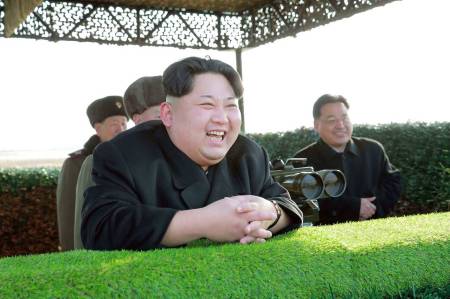
Happy KimThis undated picture released from North Korea’s official Korean Central News Agency on February 27, 2016 shows North Korean leader Kim Jong-Un smiling during the inspection of the test-fire of a newly developed anti-tank guided weapon at an undisclosed location. PHOTO: KCNA VIA KNS/AFP/GETTY IMAGES

The Obama Administration is touting the latest United Nations sanctions as a milestone against North Korea’s nuclear and missile programs. We’d like to believe it too, but a close look at the draft Security Council resolution offers many reasons to doubt.

The resolution would double the number of blacklisted North Korean individuals and state entities, adding Pyongyang’s atomic-energy and space agencies. Luxury goods banned from export to North Korea would grow to include watches, yachts and snowmobiles. A ban on sales of aviation fuel targets state-owned airline Air Koryo, while a ban on sales of rocket fuel targets Kim Jong Un’s missile program.

More significant are efforts to cut Pyongyang’s access to hard currency and smuggled weapons technology. The sanctions expand the list of banned arms and dual-use goods, and they require states to inspect all cargo transiting their territory to or from North Korea by sea, air or land. They would also squeeze North Korean mineral exports, including coal and iron ore, which in 2014 accounted for 53% of Pyongyang’s $2.8 billion in exports to China, per South Korean state figures.

Overall the blacklist of North Korean proliferators is growing by only 12 individuals and 20 entities to a total of 64; the U.N.’s former blacklist on Iran was far larger at 121. In any case, none of these matter if China won’t rigorously enforce them—which it has never done.

There are other loopholes and oversights. The nominal ban on North Korean mineral exports applies only to purchases that demonstrably fund illicit activities, rather than “livelihood purposes.” Yet money is fungible, so Chinese coal purchases excused on livelihood or humanitarian grounds will still channel hundreds of millions of dollars to the regime.

The sanctions also do nothing about the Chinese oil transfers that keep the Kim regime alive. Or Chinese purchases of textiles from mostly state-run North Korean factories that have quadrupled to $741 million a year since 2010 and recently ensnared Australian surf brand Rip Curl in a supply-chain controversy. Or the 50,000-plus North Korean laborers overseas, largely in China and Russia, earning some $230 million a year for their masters in Pyongyang.

U.S. officials say China has new incentive to back sanctions because it wants to block South Korea’s recent moves to deploy the U.S.-built Thaad missile-defense system. That may be why China wants to look cooperative, but the new sanctions aren’t enough to justify walking back on Thaad. China still views the North as a political buffer against South Korea, a thorn in the side of Japan and the U.S., and a diplomatic card to play at the U.N. So China has long played a double game of rhetorically deploring North Korea’s nuclear program while propping it up in practice.

The better way to squeeze the North is closer cooperation among Washington, Seoul and Tokyo to sanction Chinese banks that facilitate trade with Pyongyang. This worked a decade ago until the Bush Administration fell for more of China’s diplomatic promises. China won’t get serious about stopping North Korea until it sees that the U.S. and its allies are serious.