The attacker has fled the scene in the South Hebron Hills and remained at large
Archive for January 2016

Cartoon of the Day
January 17, 2016
Iran is Training Obama Like a Dog
January 17, 2016Iran is Training Obama Like a Dog, Front Page Magazine, Daniel Greenfield, January 17, 2016
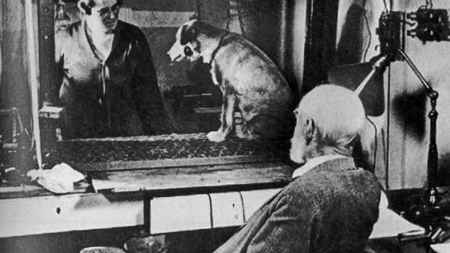
Obama and his team are celebrating as if they were FBI agents who successfully conducted a cash for hostages exchange while the criminals went free.
The “diplomacy” that they’re celebrating is one in which Iran gets what it wants and occasionally frees hostages. But since Iran can take more hostages at any time, and since it now has more motivation than ever to do so, there’s nothing to celebrate.
With animals, there’s sometimes a question of who is training whom. Is the owner training the dog to do tricks in exchange for treats. Or is the dog training the owner to give treats in exchange for not making a mess on the floor.
This is the essential question in power relationships.
What Obama has going on with Iran isn’t mutual. It’s a relationship in which Iran’s “moderates” show that Western governments can be trained to give them what they want or they’ll make a mess on the floor by taking hostages or blatantly violating nuclear protocols.
Part of this training program involves deliberate messes so that the number of treats and the owner’s anxiety is redoubled.
Iran creates a crisis. Obama rushes treats and then claims it’s a diplomatic success.
Kerry and co. claim that Iran is being trained to negotiate problems diplomatically. But Iran knows how to do that already. As the nuke negotiations showed, it’s much better at it than Obama and Kerry are. Iran knows how to use diplomacy, but its intentions are not diplomatic. So instead it’s using diplomacy to train Obama and his European allies to dispense more treats even as it continues to pursue a nuclear weapons program.
And the most pathetic part of this is that Obama and the Europeans have been trained to treat every payout like a victory.
Iran’s Commitment to Shia in the Region
January 17, 2016Iran’s Commitment to Shia in the Region, Gatestone Institute, Lawrence A. Franklin, January 17, 2016
♦ Iran’s commitment to Shi’ite interests seems firmly linked to its idea of its mission, as well as to the survival of its revolutionary regime. Iran’s theocracy is likely willing to pay a high price to safeguard this legacy. The West should not expect Iran to reduce its presence in Syria or Iraq, even under severe military pressure.
♦ As the Obama Administration continues to reward Iran for violating its agreement not to build nuclear weapons under the nuclear Non-Proliferation Treaty (NPT), and violating its agreement not to build nuclear-capable missiles, and its refusal to sign the worthless “Iran Deal,” its presence is set to become even more unpleasant as it becomes more prominent.
The West does not seem to appreciate the intensity of Iran’s commitment to its Shi’ite cousins in Syria. The West also seems not to comprehend the depth of Iran’s spiritual ties to its centuries-old role as the champion of Shi’a Islam.
Much Western journalistic commentary addresses Iran’s commitment to the Assad regime in Damascus. Left underreported is the profound sense of shared religious identity between the Shia of Iran and the Shi’a Alawi minority of Syria. Iran’s determination to maintain Alawi supremacy in Syria transcends any personal attachment to the Assad administration.
In light of this month’s execution of a leading Shi’ite preacher Nimr al-Nimr by Saudi Arabia and the consequent heightened tension between Tehran and Riyadh, it might help policymakers to understand that the religious divide between Shi’ite and Sunni Muslims as an inveterate and unbridgeable chasm as that between ISIS and the United States.
 Parts of the Saudi embassy in Tehran were burned on January 2, when a mob of Iranians attacked and ransacked the diplomatic mission. The attack came in response to Saudi Arabia’s execution of Shi’ite preacher Nimr al-Nimr the same day.
Iran’s Shi’ite Ayatollahs are on record declaring that Syria’s Alawites are genuine Shi’ites[1], a question finalized after a centuries-long dispute. The Iranian Shi’ite establishment had questioned the Syrian Alawi inclination to venerate Jesus, Mohammad and Ali as a pale reflection of the Christian theological concept of the Holy Trinity. Moreover, some Iranian Mullahs were not comfortable with the Alawi practice of celebrating Christmas. Iran evidently felt obligated to extend a protective cover to its Shi’ite co-religionists.
Another dimension of Iran’s support for regional Shi’ism is its close operational relationship with the Lebanon-based terrorist group, Hezbollah — the political arm of Lebanon’s Shi’ites. The links are so close that Tehran has been able to mobilize thousands of Lebanese Shi’ite volunteers to fight in support of the Assad regime in Syria. Iran’s theological ties to Lebanon’s Shi’ite Muslims also are deep and longstanding.
Iran’s sense of responsibility for Shi’ism beyond its borders seems linked to the historical Islamic world-power contest for hegemony between Sunni and Shi’ite Muslims. The Sunni, for centuries, have dominated and persecuted the Shi’ites, even in states where the Shiites have been in the majority. This century is first time the Shi’ites have started successfully to challenge Sunni supremacy in the region of the Persian Gulf. The George W. Bush Administration replaced Iraq’s ousted Sunni President, Saddam Hussein, with a basically Shi’ite leadership. And the Obama Administration, thorough the promised infusions of up to $150 billion (much of which Iran will presumably use to increase its terrorist activities worldwide), has paved the way for Iran to have the capability to assemble nuclear weapons and missile delivery systems.
But perhaps even the Americans could not, in an electoral system, have prevented Shi’ite predominance in a country where the Shi’ites constituted about two-thirds of Iraq’s population.[2]Next-door Iran is at least 75% Shi’ite.[3] The theological cadre from both countries receives its religious training in many of the same seminaries in Qom, Iran and Najaf, Iraq. Much of Iraq is now controlled by militia groups loyal to Tehran, not to Baghdad.[4]
Iran is also extending assistance to Bahrain’s Shi’ites, the vast majority of the island’s population.[5] Iran, which had controlled Bahrain before the island was colonized by Great Britain in the 19th century, had agreed to London’s grant of independence to the Gulf state in 1971. The agreement had served British imperial interests in the region. Yet Iran has evidently never been comfortable with the arrangement. The final secession of Bahrain from Iranian patrimony remains an open wound to Iran’s national pride. The Bahrain issue is particularly sensitive, as the United States Navy’s 5th Fleet is now headquartered there. The fleet’s naval assets enable the U.S. to guard the Persian Gulf below Iran’s southern border.
A religious reason, however, also motivates Tehran’s role in Bahrain. For more than two centuries, Bahrain has been governed by the al-Khalifas, a Sunni family originally from Qatar,[6]and sustained in power by Iran’s regional and religious arch-rival: Saudi Arabia. The Sunni ruling family in Riyadh even financed the construction of a 14-mile bridge linking Saudi Arabia and Bahrain, enabling a quick response to any possible move by Tehran to re-establish its dominance in the island. In 2011, Riyadh dispatched military units to Bahrain to suppress protests by the country’s Shi’ites, who were demanding more representation in keeping with their majority status on the island.
Iran also maintains extensive ties to the Shi’ite minority in Saudi Arabia’s Eastern Province, where most of the country’s oil fields are. The Saudi National Guard does not permit demonstrations against Riyadh’s policies. Imams who preach any opposition sentiment to the House of Saud are immediately imprisoned. One imam, Nimr, al-Nimr, was executed by the Saudis this month, presumably as a warning to Shi’ites in Saudi Arabia not even to think any dissenting thoughts.
Iran’s sense of duty to Shi’ite communities outside the Arab Middle East has also earned it influence, particularly in South Asia[7] and West Africa[8].
Iran’s commitment to Shi’ite interests seems firmly linked to its idea of its mission, as well as to the survival of its revolutionary regime. Iran’s theocracy is likely willing to pay a high price to safeguard this legacy. The West should not expect Iran to reduce its presence in Syria or Iraq, even under severe military pressure.
As the Obama Administration continues to reward Iran for violating its agreement not to build nuclear weapons under the nuclear Non-Proliferation Treaty (NPT), and violating its agreement not to build nuclear-capable missiles, and its refusal to sign the worthless “Iran Deal,” its presence is set to become even more unpleasant as it becomes more prominent.
Dr. Lawrence A. Franklin was the Iran Desk Officer for Secretary of Defense Rumsfeld. He also served on active duty with the U.S. Army and as a Colonel in the Air Force Reserve, where he was a Military Attaché at the U.S. Embassy in Israel.
[1] In 1972 Shi’ite cleric Ayatollah Hasan Mahdi al-Shirazi issued a Fatwa ruling that Shia and Alawis are “two synonymous words.” Ayatollah Musa al-Sadr, who disappeared on a visit to Libya reconfirmed al-Shirazi’s Fatwa. See also The Vanished Imam by Fouad Ajami, 1986. p 174.
[2] Encyclopedia Britannica (1997) and various other compilation sources support the statistics cited. However, B.E. claims the percentage of Shia among Iran’s Muslims is about 93%.
[3] Encyclopedia Britannica. Kuwait 30%, Syria/15%, Pakistan 15-20%, Bahrain/65%.
[4] The Council on Foreign Relations Initial Background Paper on Militia Groups in Iraq by Lionel Beehnor and follow-on versions, 9 June 2005.
[5] Encyclopedia Britannica.
[6] Al-Khalifa has governed Bahrain directly or indirectly since 1783.
[7] The key pro-Iranian militia/terrorist group in Pakistan’s mega-city of Karachi is the Tehrik-e-Jafaria.
[8] Iran has just lodged diplomatic protest against the alleged Nigerian Army’s recent massacre of Shi’a Muslims.
Progress of sanctions relief will quicken Iran’s power struggle, spur clash with Saudi Arabia
January 17, 2016Progress of sanctions relief will quicken Iran’s power struggle, spur clash with Saudi Arabia, DEBKAfile, January 16, 2016
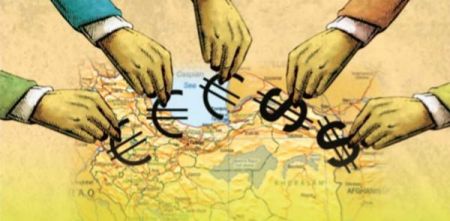 The nuclear accord implementation by Iran and the lifting of sanctions may not survive the radical opposition in Tehran – not least, because Iran exports will further depress oil prices.
The nuclear watchdog confirmed Saturday night, Jan. 16, that Iran had fulfilled its side of the nuclear deal with the six world powers and that sanctions could be lifted, after US Secretary of State John Kerry, EU’s Federica Mogherini and Iran’s Foreign Minister Mohammad Javad Zarif had been kept hanging about for the IAEA’s from early morning for a verdict worth some $100-150 billion to Tehran. The wording did not explicitly confirm that Iran had met all the terms of the nuclear deal or that it had mothballed most of its uranium-enrichment centrifuges.
From the start, the deal was viewed with deep suspicion by Israel, Saudi Arabia and US lawmakers. Even the White House spokesman Josh Earnest was moved to comment Friday that “the United States wants to make sure that Iran doesn’t cut any corners.”
DEBKAfile’s intelligence and Iranian sources account for the delay in publishing the nuclear watchdog’s report by the “corners” Iran was still trying to cut. According to our sources, Iran had managed to dodge compliance with key terms of the nuclear deal. Nine tons of enriched uranium were indeed shipped to Russia, but most expert watchers are dubious about three other commitments:
1. Washington and Tehran have claimed that the Iranians fulfilled their commitment to pour concrete into the core of the Arak reactor to disable its capacity for producing plutonium. Two days ago, on Thursday, Iranian officials denied this had been done: Only a token operation may have taken place, if any.
Officials associated with Iran’s radical Revolutionary Guards, which fought tooth and nail against the nuclear accord, commented that instead of pouring concrete into the Arak reactor, it should be poured into the hearts of President Hassan Rouhani and Foreign Minister Zarif, for negotiating the accord with the six powers.
Such comments rarely reach the Western media. They are important because they mirror the fierce power struggle ongoing in Tehran, which is heavily fueled by infighting over the nuclear deal and sanctions.
2. That deal provided for the number of centrifuges enriching uranium at the Natanz center to be reduced from 19,500 to 5,050. Our sources report that 9,000 are still in operation.
3. There is no confirmation that the number of centrifuges operating at the underground facility of Fordo was cut down to one thousand, as agreed.
On top of these deviations, the Obama administration admitted last week that the dispute over Iran’s nuclear-capable ballistic missiles, which were tested last month, is still open, in defiance of UN Security Council resolutions. This makes Tehran liable to a fresh set of sanctions, as US officials too have indicated.
The capture of two US patrol boats by the Revolutionary Guards speedboats last Tuesday, with the 10 American sailors aboard forced to surrender before they were released, was clearly a last-ditch attempt by Iran’s radicals to derail the nuclear accord before the Saturday deadline was reached.
That will not be the last such episode: Iran’s radicals may embark on more such actions to counteract the nuclear deal by striking more American targets and looking for trouble with Saudi Arabi and its Gulf allies.
The fact is that the hard-line factions in Tehran don’t want the sanctions lifted, because they see them as net profit for President Rouhani and his moderate conservatives and his leading backer, former president Hashem Rafsanjani, head of the powerful Assembly of Experts.
Iran’s Finance Minister Ali Tayyebnia gave the radicals fodder when he said last week that even $100 billion in cancelled sanctions would not haul the Iranian economy our [sic] of crisis or balance the state budget, because the country’s indebtedness is far in excess of that huge amount.
The Iranian-Saudi row is another factor that could upset the nuclear deal, although paradoxically, since oil prices sank below $30, the Guards and Riyadh have a common interest in its collapse.
Iran’s expected return to an already glutted market – through the removal of sanctions – will drive prices down further. This, neither the Revolutionary Guards Corps, which control Iran’s oil sector, nor the Saudis want to see.
The spiral of hostility launched with the Saudi execution of the prominent Shiite cleric Nimr al-Nimr, followed by the mob attack on the Saudi embassy in Tehran and consulate in Meshaad, and the multiple severance of diplomatic and commercial ties between the Gulf emirates and Tehran, may have the effect of reversing the downward trend of oil prices with a sudden spurt.
Therefore, the rosy prospect the Obama administration paints of a successful landmark deal for curbing Iran’s nuclear capabilities is a far cry from being realized.
Therefore, the rosy prospect the Obama administration paints of a successful landmark deal for curbing Iran’s nuclear capabilities is a far cry from being realized.
U.S. lifts sanctions against Iran, says nuclear deal obligations have been met
January 17, 2016U.S. lifts sanctions against Iran, says nuclear deal obligations have been met, Washinton Times, Dave Boyer, January 16, 2016
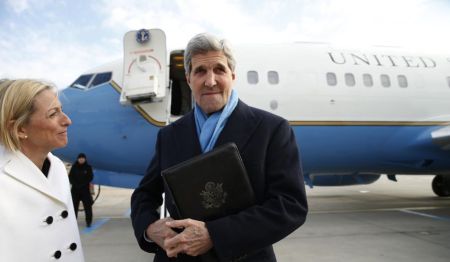 U.S. Secretary of State, John Kerry, is greeted by the U.S. Ambassador to Austria, Alexa Wesner, left, as he steps from his plane Saturday, Jan. 16, 2016, upon his arrival in Vienna, Austria on what is expected to be “implementation day,” the day the International Atomic Energy Agency (IAEA) verifies that Iran has met all conditions under the nuclear deal. (Kevin Lamarque/Pool Photo via AP)
Completing a major diplomatic effort over the objections of many in Congress, President Obama lifted economic sanctions against Iran Saturday after the U.N. atomic watchdog agency determined that Tehran has complied with the deal to curb its nuclear program in exchange for sanctions relief.
In a statement, Secretary of State John F. Kerry said the sanctions termination provisions of Iran’s landmark nuclear agreement are now in effect.
Mr. Obama signed the orders Saturday afternoon, saying Iran’s compliance with the deal “marks a fundamental shift in circumstances with respect to Iran’s nuclear program.”
The U.S. and Iran also carried out a prisoner swap Saturday, with Iran releasing an American pastor, a Washington Post reporter and three other Americans who had been held.
Removing the sanctions is part of the international agreement reached last year among Iran, the U.S. and five other world powers when Iran agreed to curbs on its nuclear program in exchange for sanctions relief.
Certification by the International Atomic Energy Agency will allow Iran to immediately recoup some $100 billion in assets frozen overseas. Iran will also see huge benefits from new oil, trade and financial opportunities after Western sanctions against it are lifted.
IAEA director general Yukiya Amano said Saturday this means “relations between Iran and the IAEA now enter a new phase. It is an important day for the international community. I congratulate all those who helped make it a reality.”
In Congress, Speaker Paul D. Ryan, Wisconsin Republican, said the administration was lifting sanctions “on the world’s leading state sponsor of terrorism.”
“As the president himself has acknowledged, Iran is likely to use this cash infusion — more than $100 billion in total — to finance terrorists,” Mr. Ryan said. “This comes just weeks after Tehran’s most recent illegal ballistic missile test, and just days after [Iranian forces] detained 10 American sailors. A bipartisan majority in the House voted to reject this deal in the first place, and we will continue to do everything possible to prevent a nuclear Iran.”
House Foreign Affairs Committee Chairman Ed Royce, California Republican, said the “flawed” deal is allowing Iran to keep much of its nuclear infrastructure.
“The ayatollah won’t even have to cheat to be just steps away from a nuclear weapon,” Mr. Royce said. “Meanwhile, tens of billions of dollars in sanctions relief will now start flowing to Iran’s Islamic Revolutionary Guard Corps. Since the nuclear deal was signed, Iran has twice violated U.N. resolutions to test ballistic missiles, fired rockets within 1,500 yards of the U.S.S. Truman, and seized 10 American sailors — all while propping up the murderous Assad regime in Syria. Iran will use this deal to become more militarily aggressive and dominate the region.”
At the same time, the administration engaged in a high-profile prisoner swap with Tehran. Iran agreed Saturday to release four detained Americans in exchange for seven Iranians held or charged in the U.S., while a fifth American detained in Iran, a student, was also released in an unrelated move.
The wife of an Idaho pastor who is among four detained Americans being released from Iran says the news is “a huge burden lifted off.”
Naghmeh Abedini told The Associated Press on Saturday that after she learned that Iran was going to release Pastor Saeed Abedini, she woke her kids up and told them, “Daddy was coming home.”
She said in a telephone interview from Boise that “they were just excited. They couldn’t believe it.”
The Boise man was detained for compromising national security, presumably because of Christian proselytizing, in September 2012. He was sentenced in 2013 to eight years in prison.
Republican presidential candidates Sens. Ted Cruz of Texas and Rand Paul of Kentucky welcomed the release of Mr. Abedini, and Democratic presidential candidate Sen. Bernie Sanders of Vermont said the exchange shows “diplomacy can work even in this volatile region of the world.”
Republican presidential hopeful Sen. Marco Rubio of Florida and other Republicans say Americans should never have been captured in the first place, and Mr. Rubio blamed the administration’s willingness to do prisoner swaps in the past.
In Iowa, Mr. Rubio said that governments were taking Americans hostage because they believe they can gain concessions from the Obama administration. He mentioned the June 2014 swap in which the United States exchanged Army Sgt. Bowe Bergdahl, who had been held by the Taliban for five years, for five top Taliban commanders at Guantanamo Bay, Cuba.
The publisher of The Washington Post says he “couldn’t be happier” to hear that the paper’s reporter, Jason Rezaian, had been released from Iran’s Evin Prison on Saturday.
In a statement, publisher Frederick J. Ryan Jr. also says more information will be available once he has more details and can confirm Mr. Rezaian has safely left Iran.
Mr. Rezaian had been held more than 543 days on espionage and related charges. He is among four detained Americans released Saturday in exchange for seven Iranians held or charged in the U.S.
Among the seven Iranians affected by the U.S.-Iranian prisoner swap is Bahram Mechanic, who has been jailed since his indictment last April on charges of illegally exporting microelectronic technology to Iran.
Defense lawyer Joel Androphy said his client was “elated” to be pardoned Saturday but says Mechanic has “been incarcerated for nine months for a crime that he’s just accused of but did not commit.”
Two other defendants in the case, Khosrow Afghahi and Tooraj Faridi, are also among those being offered clemency.
Mr. Androphy said the products his client was accused of providing to Iran were essentially surge protectors but the Justice Department “blew it up into some sort of national security terrorism threat.” He says Mechanic is “basically a victim of the trade issues between the United States and Iran.”
The Problem with Islam Is Aggressive Scripture, Not Aggressive ‘Traditionalism’
January 17, 2016The Problem with Islam Is Aggressive Scripture, Not Aggressive ‘Traditionalism’ National Review, Andrew C. McCarthy via The Counter Jihad Report, January 16, 2016
(Islamic tradition is based on Islamic scripture, which Muslims generally rely on religious authorities to interpret for them. To rely on one’s own lay scriptural interpretations is considered a great sin. Unless Islamic religious authorities are moved to give preference to early verses from the Qu’ran — which were abrogated by later verses — divorcing Islamic tradition from unabrogated scriptures will likely be very difficult if not impossible. — DM)
 Reading the Koran at a mosque in Bahrain. (Mohammed Al-Shaikh/AFP/Getty)
On the Corner this week, the eminent Jim Talent touted (with some reservations) an essay about “moderate Islam” by Cheryl Bernard. A Rand Institute researcher, she is also a novelist, a defender of war-ravaged cultures, and the wife of Zalmay Khalilzad, the former U.S. ambassador to post-Taliban (or is it pre-Taliban?) Afghanistan. With due respect to Dr. Bernard, who does much heroic work, I believe the essay highlights what is wrong with Western academic analysis of Islam.
The problem comes into focus in the very title of Senator Talent’s post, “Aggressive Traditionalism.” That is the attribute of Islamic societies that Dr. Bernard blames for the frustration of her high hopes for “moderate Islam.” In truth, however, the challenge Islam poses for moderation is not its tradition; it is Islamic doctrine — the scriptural support for traditional sharia and Islamic supremacist ideology.
I give Bernard credit. She is the unusual strategist who is willing to admit failure — in this instance, of the strategy of promoting “moderate Islam” as the antidote to “radical Islam.” But even this concession goes off the rails: She maintains that the strategy was somehow “basically sensible” despite being “off track in two critical ways.” The real problem, though, is not the two errors she identifies but the fatal flaw she fails to address: The happenstance that there are many moderate Muslims in the world does not imply the existence of a coherent “moderate Islam.” Try as she might, Bernard cannot surmount this doctrinal hurdle by blithely ignoring the centrality of doctrine to a belief system — without it, there is nothing to believe.
But let’s start with the two critical problems she does cite. The first is the matter of defining what a “moderate” is. Bernard concedes that she and other thinkers adopted a definition that was “too simplistic” — meaning, too broad. It made “violence and terrorism” the litmus test for “moderation.” This enabled what she labels “aggressive traditionalists” to masquerade as moderates.
Who are the “aggressive traditionalists”? Muslims who, though nonviolent themselves, “harbor attitudes of hostility and alienation” against non-Muslims. The failure to account for the challenge that “aggressive traditionalism” poses for moderation led to the second flaw Bernard admits: the undermining of “integration” — a reference to Muslim assimilation (or the lack thereof) in the West.
This is fine as far as it goes. In fact, Bernard is quite correct about the main challenge posed by hostile, alienated, integration-resistant Muslims: Even if they are personally nonviolent, the communities they create become “the breeding ground for extremism and the safe harbor for extremists.”
But “extremism” about what? This is the salient question, and it is one Bernard studiously ducks. The error is implicit from the very start of her essay (my italics):
Over the past decade, the prevailing thinking has been that radical Islam is most effectively countered by moderate Islam. The goal was to find religious leaders and scholars and community ‘influencers’ — to use the lingo of the counter-radicalization specialists — who could explain to their followers and to any misguided young people that Islam is a religion of peace, that the term jihad refers mainly to the individual’s personal struggle against temptation and for moral betterment,and that tolerance and interfaith cooperation should prevail.
Plainly, the “prevailing thinking” casually assumes “facts” not only unproven but highly dubious. Bernard takes it as a given not only that there is an easily identifiable “moderate Islam,” but also that this . . . what? . . . doctrine? . . . attitude? . . . is the most effective counter to “radical Islam.”
But what is moderate Islam? She doesn’t say. She maintains that there are countless moderate Muslims who, by her telling, embrace “Western values, modern life and integration.” In fact, she assumes there are so many such Muslims that they constitute the “mainstream” of Islam. Yet, that proposition is not necessarily true even in the West, where Muslims are a minority who might be expected to assimilate into the dominant, non-Muslim culture; and it most certainly is not true in the Muslim-majority countries of the Middle East.
Even worse is Bernard’s assertion — uncritical, and without a hint that there may be a counter-case — “that Islam is a religion of peace, [and] that the term jihad refers mainly to the individual’s personal struggle against temptation and for moral betterment.”
As is the wont of Islam’s Western apologists, Bernard is attempting to shield from examination what most needs examining. Her reliance on the potential of “moderate Islam” to quell “radical Islam” is entirely premised on the conceit that Islam is, in fact, moderate and peaceful. Her assumption that the vast majority of Muslims can be won over (indeed, have already been won over, she seems to say) to Western values is premised on the conceit that those values are universal and, hence, locatable in the core of Islam — such that “tolerance and interfaith cooperation should prevail” because Islam is all for them.
Islam, however, is not a religion of peace. It is a religion of conquest that was spread by the sword. Moreover, it is not only untrue that jihadrefers “mainly” to the individual’s internal struggle to live morally; it is also untrue that the Islamic ideal of the moral life is indistinguishable from the Western conception.
To be clear, this is not to say that Islam could not conceivably become peaceful. Nor is it to say that jihad could not be reinterpreted such that a decisive majority of Muslims would accept that its actual primary meaning — namely, holy war to establish Islam’s dominance — has been superseded by the quest for personal betterment. To pull that off, though, will require a huge fight. It cannot be done by inhabiting an alternative universe where it has already been done.
That fight would be over doctrine, the stark omission in Bernard’s analysis. I do not think the omission is an oversight. Note her labeling of faux moderates as “aggressive traditionalists.” Citing “tradition” implies that the backwardness and anti-Western hostility she detects, to her great dismay, is a function of cultural inhibitions. But what she never tells you, and hopes you’ll never ask, is where Islamic culture and traditions come from.
Alas, they are direct consequences of Islamic scripture and sharia, the law derived from scripture. She can’t go there. She wants Islam to be moderate, but its scriptures won’t cooperate. She must rely on tradition and culture because traditions and cultures can and do evolve. Scripture, by contrast, does not — not in Islam as taught by over a millennium’s worth of scholars and accepted by untold millions of Muslims. Mainstream Islam holds that scripture is immutable. The Koran, the center of Islamic life, is deemed the “uncreated word of Allah,” eternal. (See, e.g., Sura 6:115: “The Word of thy Lord doth find its fulfillment in truth and justice: None can change His Words: For He is the one Who heareth and knoweth all.”)
Bernard must blame aggressive traditionalism because if the problem is aggressive doctrine rooted in aggressive scripture, then it’s not changing any time soon — or maybe ever. Moreover, she is not in a position to challenge doctrine and scripture without deeply offending the believers to whom she is appealing. They are taught that any departure from centuries-old scholarly consensus is blasphemy.
The story Dr. Bernard tells of Islamic intransigence in her own Northern Virginia neighborhood is instructive. A Muslim-American friend of hers is a social worker who finds jobs for Muslim immigrants. He lands openings for a group of Somali women in a hospital laundry service; but the women first tell him they must check with their imam, then they turn down the jobs because they will not be allowed to wear their hijabs. The social worker and Bernard are exasperated: Why don’t the women and their adviser grasp that because hijabs could get caught in the machinery and cause injury, there is a “pragmatic reason” for departing from the traditional Islamic norm?
Notice: Bernard never considers, or at least never acknowledges, that there is doctrinal support for every decision the Somalis make: The scriptures instruct Muslims to consult authorities knowledgeable in sharia before embarking on a questionable course of conduct; they instruct Muslim women to wear the veil (particularly in any setting where they will be exposed to men who are not their husbands or close relatives). And while pragmatism suggests to the rational Dr. Bernard and her moderate, Westernized social-worker friend an obvious exception to Islam’s usual clothing rule, mainstream Islam in the Middle East and Somalia admonishes that Western reliance on reason and pragmatism is a form of corruption, a pretext for ignoring religious duty.
Doctrine is the answer to virtually every immoderate instance of aggressive “traditionalism” Bernard complains about: the separation of men from women in the mosque, and the decidedly poorer accommodations (“often unacceptable and even insulting,” as Bernard describes them) to which women are consigned; the separation of the sexes in work and social settings; the instructions not to trust or befriend “unbelievers”; the admonitions to resist adopting Western habits and developing loyalty to Western institutions. There is scriptural support for every one of these injunctions.
From the fact that she has moderate, “modernized” Muslim friends, who do not comport themselves in such “traditional” fashion, Bernard extravagantly deduces that tradition is the problem. She never comes close to grappling with doctrine — i.e., the thing that most devout Muslims believe is what makes them Muslims. The closest she comes is the fleeting observation that her moderate social-worker friend “is a scholar [presumably of Islam] and a professor who emigrated from a conservative Muslim country.” The obvious suggestion is that if he is not troubled by the flouting of traditional Islamic mores, surely there must not be any credible scriptural objection. But if it is relevant that her friend is a scholar, is it not also relevant that there are thousands of other scholars — scholars who actually do Islamic jurisprudence rather than social work for a living — who would opine that sharia requires these traditional behaviors and that it is the social worker who is out of touch?
When Dr. Bernard’s husband, Ambassador Khalilzad, served in Kabul, he midwifed the new Afghan constitution that purported to safeguard Western notions of liberty while simultaneously installing Islam as the state religion and sharia as fundamental law. In short order, Afghanistan put former Muslims who had publicly renounced Islam on capital trial for apostasy. Dr. Khalilzad, Secretary of State Condoleezza Rice, and other Western officials and intellectuals pronounced themselves duly shocked and appalled — notwithstanding that anyone with a rudimentary knowledge of Islamic scripture knows that it calls for public apostates to be killed.
To great American embarrassment, the apostates had to be whisked out of the country lest the incompatibility of civil rights and sharia become even more painfully apparent. It is worth acknowledging, however, that what chased them out of Afghanistan was not aggressive traditionalism. It was Islamic doctrine, which simply is not moderate. Looked at doctrinally, the challenge for “moderate Islam” is . . . Islam.
— Andrew C. McCarthy is as senior policy fellow at the National Review Institute and a contributing editor of National Review.
Nuclear watchdog holds up report on Iranian compliance
January 16, 2016Nuclear watchdog holds up report on Iranian compliance, DEBKAfile, January 16, 2016 7:17 PM IDT
The International Atomic Energy Agency’s report on full Iranian compliance with the nuclear accord signed with the big powers was due to be released Saturday morning, and so trigger the lifting of international sanctions. However, by Saturday evening, the report was still held back in view of difficulties that remained to be ironed out over Tehran’s fulfillment of its obligations.
Sweden: State-funded Muslim “Sniper” Training
January 16, 2016Sweden: State-funded Muslim “Sniper” Training
January 15, 2016 by TNO Staff
Source: Sweden: State-funded Muslim “Sniper” Training – The New Observer
The Swedish state is funding a “sniper” training course for recently-arrived Third World “refugees” as part of their “integration program”—despite the ever-growing refugee-terrorist attacks across Europe.

The almost unbelievable plunge into insanity—started two years ago already—was reported—in a positive pro-refugee light—by the Allehanda newspaper in Sweden, under the title “Fired up for Sniping,” (Laddade för prickskytte, literally “Charged up for Sniping”) and shows a large number of Third Worlders being taught how to target shoot with “sniper” target rifles on a formal shooting ground in Sollefteå, central Sweden.

The Allehanda informs its readers that the “sniping course” began on a “small scale in the Fall,” but then for reasons which are obvious, but which the Swedish newspaper ignores, “interest exploded” among the nonwhite invaders to take the course.
When the Allehanda visited the shooting range, “more than 50 immigrant youths were on the course,” honing their shooting skills.
Even more incredibly, the sniping course is being paid for by Sweden’s state-funded Migration Agency as an “integration” program into Swedish society.
“Young people from all over the world—Syria, Afghanistan, Africa, [and] South America” are taking sniping lessons, the Allehanda said, and some of them are “interested and very talented,” the paper quoted course supervisor Birgit Höglin as saying.

The program is offered as part of the language course at the local upper secondary school, Höglin said, saying that the benefits of the program are “much more” than just teaching the invaders how to use sniping rifles.
“Here they talk Swedish in other social contexts, meet new people, and hang out. It is especially good for their vocabulary,” Höglin said.
It seems of no concern to these liberals that every single terrorist attack on Europe in 2015 was carried out by “refugees.”
State-funded sniper training for “young immigrants” seems so out of place that such an undertaking is firmly in the realm of the insane, and would, if not actually happening, be the subject of some bizarre joke.
Unfortunately, it is not.


Daniel Greenfield Moment – Islam’s American Identity Crisis
January 16, 2016Daniel Greenfield Moment – Islam’s American Identity Crisis, The Glazov Gang via You Tube, January 15, 2016
(Please see also, How Islam in America Became a Privileged Religion. — DM)




 anneinpt
 artaxes
 danmillerinpanama
 davidking1530
 Peter Hofman
 Joseph Wouk
 Peter
Peter Louisiana Steve
 WarSclerotic
Recent Comments