Ayaan Hirsi Ali on the Challenge of Radical Islam, You Tube, January 3, 2015
(It’s an hour and six minutes long but well worth watching. — DM)
Ayaan Hirsi Ali on the Challenge of Radical Islam, You Tube, January 3, 2015
(It’s an hour and six minutes long but well worth watching. — DM)
Executed Saudi Shiite Cleric al-Nimr Backed Terror Attacks on America, Front Page Magazine, Daniel Greenfield, January 3, 2016

The Saudi justice system is cruel and barbaric. But occasionally they get one right.
The media is scuttling to turn Sheikh Nimr al-Nimr, a Shiite leader so great they named him twice, into a martyr after the Saudis put him down on terror charges. But Nimr al-Nimr was a terror leader. There are no shortage of quotes from him endorsing terrorism, backing Iran and calling for Iranian intervention in Saudi Arabia.
And yes, he hated America too.
Sheikh al-Nimr also made various anti-American references, claiming that America “wants to humiliate the world.” In the case of America striking Iran, al-Nimr stated that “Iran has the right to close the Straits of Hormuz, to destroy the Zionist enemy, and to strike at American bases and American interests anywhere.”
Nimr was an agent of Iran. We, these days, have no ability to execute traitors. The Saudis do.
Saudi Arabia is full of Sunnis who say most of the same thing. Nimr got it because he was a Shiite and backed Iran. We don’t actually have a dog in this fight, but we can say good riddance to another enemy. The media has tried to turn Nimr and his relative Ali Mohammed al-Nimr into martyrs. But let’s remember how their Iranian bosses treated protesters during the Green Revolution.
The Nimrs at least weren’t raped beforehand. That’s more than those murdered by their Shiite terror regime in Iran can say.
Taraneh Mussavi may or may not be that green-clad girl who was arrested at a demonstration near the Ghaba Mosque on June 27. The girl who was raped, suffered from a torn uterus and a torn anus, landed at a Karaj hospital, and was finally found dead in an unknown cemetery in northern Iran. Regardless, her name is the secret name for all the women who have been raped in prisons since the 1979 Revolution. What I want to say is that Taraneh Mussavi is not just one individual.
Mehdi Karroubi writes: “Some individuals have raped detained girls with such force as to cause tears and injuries to their sexual organs.” His claim may be entirely false, but that does not make any difference. The following are not exceptions: When Azar Al Kanaan (Nina Aghdam) speaks in front of the camera about how she was raped at Sanandaj prison. When Roya Toloui speaks of how she was raped by her interrogator. When Monireh Baradaran writes in her book Simple Truth, about Tahereh, a woman remembered by most prisoners from the 1980s, a beautiful woman who lost her sanity after being raped by a Pasdar [“Revolutionary Guard”]. When [Canadian Iranian Journalist] Zahra Kazemi’s dead body is covered with cement and her attorney, Shirin Ebadi asks the court, “Why the victim’s clothing was torn and bloodied in a particular location.” When the report from the coroner’s office states that Zahra Bani Yaghub was raped in the Basij headquarters’ detention center in Hamadan.
Published reports are available about these types of torture committed against women political prisoners after the 1979 Revolution. The most systematic type of reported rape has been the rape of virgin girls who were sentenced to death by execution because of political reasons. They were raped on the night before execution. These reports have been substantiated by frequent statements from the relatives of women political prisoners. On the day after the execution, authorities returned their daughter’s dead body to them along with a sum considered to be the alimony. Reports state that in order to lose their virginity, girls were forced to enter into a temporary marriage with men who were in charge of their prison. Otherwise it was feared that the executed prisoner would go to heaven because she was a virgin!
This was the sort of thing that the Nimrs and other Iranian agents want to spread. No one will weep for either the House of Saud or the Shiite Islamic Revolution or ISIS when they are gone.
As the Mideast Descends into Chaos, Israel Must Have Defensible Borders, The Jerusalem Center via You Tube, January 3, 2015
(Would the “two state solution” be a “final solution” for Israel? — DM
The Mullahs Thank Mr. Obama, Power Line,
The American people should know that we have sustained a defeat without a war, the consequences of which will travel far with us along our road.
******************
Yesterday’s Wall Street Journal carries an incisive editorial (“The mullahs thank Mr. Obama,” accessible here via Google) on developments with the Islamic Republic of Iran. Every step along the way, Iran proves itself the mortal enemy of the United States, and yet President Obama thinks otherwise.
Iranian intentions are clear. Their actions comport with their announced view of the world. When the mullahs chant “Death to America,” we have no ground for believing they don’t mean it. No ground, that is, other than wishful thinking.
As John put it, it is difficult to reconcile Obama administration policies strengthening the Iranian regime with a good faith intention to pursue peace in the Middle East or to advance the national security interests of the United States. We can only infer that Obama’s highly ideologized view of the world is immune to experience.
The Journal’s editorial provides this handy summary of current complexities:
The U.S. and United Nations both say Iran is already violating U.N. resolutions that bar Iran from testing ballistic missiles. Iran has conducted two ballistic-missile tests since the nuclear deal was signed in July, most recently in November. The missiles seem capable of delivering nuclear weapons with relatively small design changes.
The White House initially downplayed the missile tests, but this week it did an odd flip-flop on whether to impose new sanctions in response. On Wednesday it informed Congress that it would target a handful of Iranian companies and individuals responsible for the ballistic-missile program. Then it later said it would delay announcing the sanctions, which are barely a diplomatic rebuke in any case, much less a serious response to an arms-control violation.
Under the nuclear accord, Iran will soon receive $100 billion in unfrozen assets as well as the ability to court investors who are already streaming to Tehran. Sanctioning a few names is feckless by comparison, and Iran is denouncing even this meager action as a U.S. violation of the nuclear deal. Iranian President Hassan Rouhani responded to the sanctions reports on Thursday by ordering his defense minister to accelerate Iran’s missile program. Your move, Mr. Obama.
Opponents of the nuclear accord predicted this. Mr. Obama says the deal restricts Iranian action, but it does far more to restrict the ability of the U.S. to respond to Iranian aggression. If the U.S. takes tough action in response to Iran’s missile tests or other military provocations, Iran can threaten to stop abiding by the nuclear deal. It knows the world has no appetite for restoring serious sanctions, and that Mr. Obama will never admit his deal is failing. The mullahs view the accord as a license to become more militarily aggressive.
Further proof came Wednesday when U.S. Central Command acknowledged that Iranian Revolutionary Guard vessels last week fired several rockets that landed within 1,500 yards of the aircraft carrier Harry S. Truman. A Revolutionary Guard spokesman Thursday denied the incident but a day earlier the semiofficial Tabnak news agency quoted an unnamed Iranian official as saying the rockets were launched to warn the U.S. Navy away from “a forbidden zone” in the Persian Gulf.
The Strait of Hormuz is one of the world’s most heavily trafficked waterways, and the USS Truman carrier group has every right to sail there. By any measure the rocket launch was a hostile act that could have resulted in American casualties.
This follows Iran’s arrest in October of Iranian-American businessman Siamak Namazi, who according to Iranian media reports is being held in Evin Prison though no charges have been filed. The reports suggest that Mr. Namazi is suspected of spying because he is one of the World Economic Forum’s “Young Global Leaders.” That’s the dangerous outfit that sponsors the annual gabfest in Davos.
Iran has also shown its gratitude for the nuclear deal by convicting Washington Post reporter Jason Rezaian on absurd charges of espionage. The Iranian-American has been held for more than 500 days.
The White House’s media allies are blaming all of this on Iranian “hard-liners” who are supposedly trying to undermine President Rouhani for having negotiated the nuclear deal. Memo to these amateur Tehranologists: The hard-liners run Iran.
The American people should know that we have sustained a defeat without a war, the consequences of which will travel far with us along our road.
Deputy National Security Adviser Ben Rhodes renders his deep thoughts via Twitter (below).
In the annals of inanity, this is Hall of Fame material.
The Iran deal will be implemented. The United States has an Embassy in Havana. #change.
Source: Israel Hayom | Report: Hezbollah ‘adamant’ to avenge archterrorist’s death
“The decision to retaliate over [Samir] Kuntar’s death has been made, and it’s final. There’s no turning back. The days when Hezbollah was willing to accept the killing of its operatives by Israel are over,” Hassan Nasrallah tells Lebanese media.
|
Hezbollah head Sheikh Hassan Nasrallah
|Photo credit: AFP
|
Hezbollah will no longer “accept Israel killing its operatives” and it has made up its mind to exact revenge over the recent death of terrorist Samir Kuntar, Lebanese media reported Thursday.
Kuntar was killed on Dec. 19 in an airstrike near Damascus. Hezbollah head Sheikh Hassan Nasrallah has accused Israel of assassinating the infamous terrorist, and vowed that a “painful retaliation will follow.”
The threat prompted Israel to use third-party mediators to warn Nasrallah that any attempt by the Shiite terrorist group to escalate tensions on the Israel-Lebanon border would meet a forceful Israeli response.
According to Lebanese media, Nasrallah met with a German mediator in Beirut several days after Kuntar’s death. The mediator told him that any retaliation by Hezbollah would earn a wide-scale Israeli reaction, perhaps even to the tune of a military campaign in Lebanon.
Nasrallah reportedly replied, “The decision to retaliate over Kuntar’s death has been made, and it’s final. There’s no turning back. The days when Hezbollah was willing to accept the killing of its operatives by Israel are over.”
The Hezbollah-affiliated Al-Manar television quoted Nasrallah as saying, “To us, whatever the consequences and threats, which we don’t fear, we can’t tolerate and forgive those who shed the bloods of our fighters and brothers anywhere in the world.”
The military had no official comment on the report.
Meanwhile, IDF Chief of Staff Lt. Gen. Gadi Eizenkot toured the northern sector Wednesday, and was briefed by GOC Northern Command Maj. Gen. Aviv Kochavi on the troops’ deployment given the threats from both Lebanon and Syria.
The military is said to be bracing for a potentially significant terrorist attack on the Israel-Syria border by jihadi radicals, including the Islamic State-affiliated Yarmouk Martyrs Brigade.
According to a military source, other threats include terrorist attacks on strategic points along the border, a threat posed by the al-Qaida-affiliated Nusra Front, which operates in Syria.
The military’s threat assessments include potential border incursions, the use of roadside and car bombs against troops patrolling the border, and projectile fire at both military and civilian targets.
While the IDF remains vigilant, a defense official told Israel Hayom that the terrorist groups in Syria and Lebanon were currently not considering Israel a priority, as they have to dedicate the resources available to them inward. Nevertheless, he said the threat could not be discounted, as these groups, and especially Islamic State, have declared Israel their enemy.
Source: Israel Hayom | Defying US sanctions threat, Iran boosts missile program
Iranian President Hassan Rouhani orders acceleration in missile production • White House delays recently revealed plan to impose new sanctions on Iran over its missile program amid growing tensions over the nuclear agreement, Wall Street Journal reports.
|
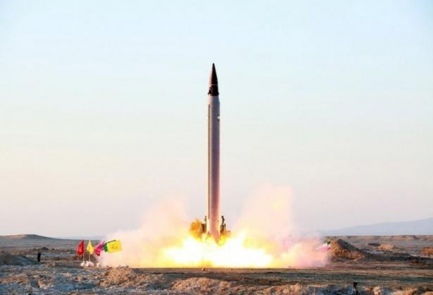
An Iranian Emad rocket launched as part of a missile test held in October
Photo credit: Reuters
|
Iranian President Hassan Rouhani ordered his defense minister on Thursday to expand Iran’s missile program, in defiance of Tehran’s deal with the West and a U.S. threat to impose sanctions over a ballistic missile test Iran carried out in October.
Under the landmark agreement it clinched with world powers in July, Iran is scaling back a nuclear program that the West feared was aimed at acquiring atomic weapons, in return for an easing of international sanctions. It hopes to see these lifted early in the new year.
But sources familiar with the situation said on Wednesday that Washington was preparing new sanctions against international companies and individuals over Iran’s testing of a medium-range Emad rocket on Oct. 10.
The escalating dispute centers on the types of missile that the Islamic republic is allowed to develop and whether they are capable of, or designed to, carry nuclear warheads.
“As the U.S. government is clearly still pursuing its hostile policies and illegal meddling,” Rouhani wrote in a letter to Defense Minister Hossein Dehghan, published by the Islamic Republic News Agency, “the armed forces need to quickly and significantly increase their missile capability.”
“The Defense Ministry, with the support of the armed forces, is tasked with putting in place new programs by all available means to increase the country’s missile capability,” he added.
U.S. officials have said that under the nuclear deal, the Treasury Department retains a right to blacklist Iranian entities suspected of involvement in missile development.
Iranian officials have said Supreme Leader Ayatollah Ali Khamenei would view such penalties as violating the nuclear accord.
Earlier Thursday, Iranian Foreign Ministry spokesman Hossein Jaber Ansari condemned the U.S. plans to impose additional sanctions as “arbitrary and illegal.”
In a recent report, a team of U.N. sanctions monitors said that the Emad rocket tested by Iran was a ballistic missile capable of delivering a nuclear warhead, making its test fire a violation of a U.N. Security Council resolution.
Ballistic tests by Iran are banned under Security Council resolution 1929, which was enacted in 2010 and remains valid until the July nuclear deal between Iran and world powers goes into effect. Once it does, Iran will still be “called upon” not to undertake any ballistic missiles work designed to deliver nuclear weapons for a period of up to eight years, according to a Security Council resolution adopted in July, right after the nuclear agreement was reached.
Iran says the resolution would ban only missiles “designed” to carry a nuclear warhead, not “capable of” carrying one, so it would not affect its military program as Tehran does not pursue nuclear weapons. Iran has called Emad a conventional missile.
In his letter to Dehghan, Rouhani said Iran’s missile program had nothing to do with its nuclear program and that the missiles have “not been designed to carry nuclear warheads.”
The Iranian missiles under development boast much improved accuracy over the current generation, which experts say is likely to improve their effectiveness with conventional warheads.
Meanwhile, The Wall Street Journal reported Thursday that the White House has delayed the decision to impose new financial sanctions on Iran over its ballistic missile program.
Citing U.S. officials, the report said the Obama administration was preparing to sanction nearly a dozen companies and individuals in Iran, Hong Kong and the United Arab Emirates for their role in developing Iran’s ballistic missile program.
The U.S. sanctions were expected to be formally announced this week, the newspaper said.
The Obama administration is committed to combating Iran’s missile program and the sanctions being developed by the U.S. Treasury Department remain on the table, the report said, citing officials privy to the issue.
But U.S. officials offered no definitive timeline for when the sanctions would be imposed, the newspaper said. At one point, they were scheduled to be announced on Wednesday morning in Washington, according to a notification the White House sent to Congress, the Journal reported.
Imposing such penalties would be legal under the nuclear agreement with Iran, officials said.
Source: Israel, the US and Iran: An unstoppable train bound for a crash – International – Jerusalem Post
The biggest story of 2015: The completion of a nuclear deal between the world powers and Iran and its effects on the US-Israel alliance.

WASHINGTON – At midnight on July 13, 2015, fortified for their 18th sleepless night, journalists in Vienna were put on notice: A landmark deal governing Iran’s nuclear program was finally at hand.
The White House had taken several days quietly preparing for this moment. They knew what was coming: A fanfare announcement of the Joint Comprehensive Plan of Action (JCPOA) to govern Iran’s nuclear program, with a ceremony in Austria and complementary televised speeches from US President Barack Obama and Iranian President Hassan Rouhani.
Those events would swiftly be followed by a relentless onslaught of political opposition in the form of ads, of money, of Prime Minister Benjamin Netanyahu.
Israeli and American officials now say open conflict between their governments was inevitable, and compare the 2015 crisis to an unstoppable train bound for a crash. That train left its station of origin back in 2011, when a back channel first opened with Iran in Oman; but it was in 2015 when the effects of the US-Israel crisis were most acutely felt, when the public first began to truly understand why the two governments so dramatically diverged.
The White House long knew why Israel opposed not any nuclear deal with Tehran but – from its point of view – any achievable deal: any agreement that Tehran would actually go along with. The Obama administration understood that Israel sought to deny Iran the strategic benefits of a nuclear program vast and efficient enough to secure Tehran as a nuclear weapons-threshold state. That standard was never shared by the administration; Iran is and will always be a threshold state, US officials privately say, and preventing them from acquiring the weapon itself is all the US could reasonably do.
And yet the Israeli government saw a systematic breakdown of a position based, from its point of view, in moral authority and practical strength: A willful surrender of the high ground by the US to accept Iran as a threshold state, and a decision by the president not to reflect Israel’s position in talks to which they were not directly a part.
Two years of private negotiations between American and Israeli officials on the sidelines of the nuclear talks began with deep distrust: Israel was kept in the dark when the talks first began, and learned of them not through US-Israeli defense cooperation, but by spying on the comings and goings of unmarked US government planes in Muscat.
As talks proceeded without Israel’s priorities reflected in Washington’s negotiating position – a posture US officials defend to this day, arguing that Netanyahu’s idea of a deal was Iran’s total capitulation – the Israeli government, in 2015, came to the conclusion that it had no choice but to bring its argument to the public.
The prime minister’s pivotal speech to the US Congress in March, to him and his aides, was ultimately the product of those failed private efforts to get the Obama administration to represent Israel’s position in the nuclear negotiations. Israel had no choice, its political class determined, but to speak out publicly, and loudly.
So on July 13, the White House was prepared for what would come next from Jerusalem. The announcement would come the following day; but in the meantime, officials set up a basement office that would serve as a war room against opponents – Democrats and Republicans alike.
Top officials, the president included, would lobby congressmen on an individual basis as they never had before. A special Twitter account would push the White House narrative, told elegantly and confidently on a special White House website explaining the benefits of the JCPOA.
Israel’s policy to go public – which debuted with leaked details of the deal by Israeli officials to The Jerusalem Post in November 2014 – set the stage for a yearlong feud unlike any other in the history of the alliance.
Now entering a new year, with implementation of the deal all but assured, data suggest the product of that feud was a sharpening partisan divide in the US over Israel, over its leadership and its role in American politics.
A poll released by the Brookings Institution’s Center for Middle East Policy in December found that unfavorable views of Netanyahu among Democrats increased sharply from 22 percent in 2014 to 34% in 2015.
While Netanyahu is the world’s most admirable leader amongst Republicans – tied with the late Ronald Reagan – he barely registers with Democrats, only 18% of whom view him favorably.
After debate over the nuclear deal gripped Congress in September, now precisely half of Democrats say Israel has too much power over American politics.
Israel’s government points to different figures: Over half of Democrats are either wary or disapprove of the nuclear deal, according to Pew Research Center polling, and a definitive majority of the American electorate as a whole disapproves. Americans now consider Iran’s nuclear program even more of a threat to the well-being of the US than they did a year ago.
The great divergence over Iran of 2015 will have a direct effect on the year to come for these reasons: The moment, like few in modern times, provided the American people with a policy contrast between the US and Israel on a matter of importance to both peoples. When Americans go to the polls, 59% say that a candidate’s position on Israel will matter to them.
At a forum hosted by Brookings last month, Hillary Rodham Clinton, the likely Democratic nominee for the presidency in 2016, spoke on these trend lines, emphasizing her personal commitment to Israel while warning of a growing generational divide.
“With every passing year we must tie the bonds tighter, reach out to the next generation to bring them with us and do the hard necessary work of friendship because there is a new generation in both countries today that does not remember that shared past,” she said to the think tank in Washington on the first night of Hanukka.
“Young Americans who didn’t see Israel in a fight for survival again and again,” she continued, “young Israelis who didn’t see the United States broker peace at Camp David or kindle hope at Oslo or stand behind Israel when it was attacked – they are growing up in a different world and the future of our relationship depends on building new ties for a new time.”
The policy effects of the JCPOA, secured in a tumultuous year of diplomacy, will be felt in precisely eight years with regard to centrifuge and ballistic missile development; in 10 years with regard to the efficiency and size of Iran’s nuclear infrastructure; in 15 years or longer for some other provisions, including key international requirements on transparency and access. It will be felt in short order as Israel monitors the development of Sunni nuclear programs and the strengthening of Shi’a proxy armies regionwide.
The political effects in the US will be immediate. Fallout from the fight in 2015 will have long coattails, sure to shape the most important decision of all for the fate of the nuclear deal: the next occupant of the Oval Office and guarantor of the unsigned nuclear pact.




 anneinpt
 artaxes
 danmillerinpanama
 davidking1530
 Peter Hofman
 Joseph Wouk
 Peter
Peter Louisiana Steve
 WarSclerotic
Recent Comments