Archive for December 2015

Obama Contradicts Himself on Middle East Strategy

December 22, 2015

Critics: Obama Contradicts Himself on Middle East Strategy Says he toppled Gaddafi to avert a humanitarian crisis, but failed to do the same in Syria

BY:
December 22, 2015 5:00 am

Source: Obama Contradicts Himself on Middle East Strategy

Barack Obama

Recent remarks by President Obama highlight his conflicting approach to dictators in the Middle East, critics say, opening him to charges of an inconsistent and contradictory strategy toward regimes and humanitarian crises in the region.

In his final press conference of the year Friday, Obama defended his efforts to topple former Libyan autocrat Muammar Gaddafi in 2011 as part of an international coalition. Gaddafi was “a dictator who was threatening and was in a position to carry out the wholesale slaughter of large numbers of people,” he said. He added that the United States and allied nations worked “to avert a big humanitarian catastrophe that would not have been good for us.”

“Those who now argue, in retrospect, we should have left Gaddafi in there seem to forget that he had already lost legitimacy and control of his country, and we could have—instead of what we have in Libya now, we could have had another Syria in Libya now,” he said.

Unlike in Libya, Obama has declined to apply substantial pressure on the regime of Syrian dictator Bashar al-Assad throughout four years of civil war, critics say. Despite declaring in 2011 that, “the time has come for President Assad to step aside,” Obama chose not to launch airstrikes against the Assad regime after it used chemical weapons in 2013, an apparent violation of a “red line” set by the president.

Additionally, the administration scrapped its train-and-equip program for Syrian rebels in October after acknowledging that it had been a failure and had only yielded a few battle-ready fighters.

As a result, analysts say Syria has become the locus of one of the world’s worst humanitarian crises in decades, with more than a quarter of a million people dead and millions of refugees fleeing to neighboring countries and Europe. Amid the chaos of the civil war, ISIS established a base of operations in the country and used Assad’s brutality as a recruiting tool to attract foreign fighters and disillusioned Sunni Muslims in the region.

Michael Rubin, a former Pentagon official and Middle East expert at the American Enterprise Institute, said that Obama has prioritized rhetoric over action in Syria.

“There is a window of opportunity when resolving any crisis, but rather than pass through that window, Obama prefers simply to admire his own reflection,” Rubin said. “Had he acted early in Syria, he could have contained or resolved a problem before it metastasized.”

The White House declined to comment on Obama’s divergent approaches to Libya and Syria.

Libya, too, has devolved into a civil war after Gaddafi’s fall and become a safe haven for ISIS. The terrorist group has established a significant presence in parts of the country with about 5,000 fighters.

Obama admitted on Friday that his administration should have “some accountability for not moving swiftly enough and underestimating the need to rebuild government [in Libya] quickly.”

The president’s mistake in Libya, Rubin said, was not attempting to prevent a humanitarian disaster but rather failing to help Libya establish security and governing institutions after Gaddafi’s ouster.

“Obama’s real failure was to refuse to secure Gaddafi’s weapons depots,” he said. “The instability across the Sahel can be traced to Obama’s fateful decision to lead from behind.”

The United Nations Security Council announced  Friday it had endorsed a new plan to end Syria’s civil war, including a new constitution and elections in 18 months. However, the fate of Assad under such a transition remains unclear.

Obama said at the press conference that “Assad is going to have to leave in order for the country to stop the bloodletting.” Yet there might be more wiggle room for the authoritarian leader. A political transition should aim to assure Russia and Iran—two staunch allies of Assad—that “their equities are respected” in Syria, Obama said.


Abbas: ‘Palestinian Authority No Longer Exists’

December 22, 2015

’ Mahmoud Abbas proclaims the ‘Palestinian Authority’ no longer exists — it has officially been replaced by the “State of Palestine.”

By: Jewish Press Staff

Published: December 22nd, 2015

Source: The Jewish Press » » Abbas: ‘Palestinian Authority No Longer Exists’

Abbas sent them to kill

Photo Credit: Palwatch.org

Palestinian Authority leader Mahmoud Abbas proclaimed Monday at a news conference in Athens that the entity formed under the internationally recognized Oslo Accords — the Palestinian Authority — no longer exists; it has officially been replaced by the “State of Palestine.”

Following his meeting with Prime Minister Alexis Tsipras, Abbas said:

“Regarding this issue of a passport under the name Palestine State, we are about to proceed to the passport replacement and the issuance of a new passport within one year or even less.

“We have already changed all documents issued by ministries and public services and they now bear the name ‘State of Palestine,’ he said.

“We no longer accept from anyone to use the name ‘Palestinian Authority.’”

The declaration made by Abbas — if taken seriously — could have some unique ramifications for those who live within PA-controlled territories and are “citizens” of those areas.

Israeli security personnel quietly support the entity in some delicate situations and basic energy infrastructure such as electricity, water and gas is provided through Israeli cooperation. Tax monies are also collected by Israel on behalf of the Palestinian Authority and transferred to the entity on a monthly basis, with a great hue and a cry if there is any delay.

If in fact Abbas now runs an entirely new nation, clearly there is no longer any need for any of this: all Israeli services can and may be cut off, possibly instantaneously.

Any aggression against Israel emanating from its territory could be construed as an act of war, perhaps justifying a “proportionate response.” How soon then might it be until Israel really invaded and re-occupied the territory that Arab instigators whine about as “occupied” ?

Meanwhile, although the Greek parliament voted unanimously on Tuesday to approve a resolution recognizing the Palestinian Authority as a new independent Arab country, the vote does not bind its government in any way.

There will be no formal recognition by Greece, according to a statement released by the Greek foreign ministry, so as “not to disturb good relations with Israel.”

Prime Minister Alexis Tsipras recently met with Israel’s Prime Minister Benjamin Netanyahu in Jerusalem, in addition to his meeting with Abbas in Ramallah. The meeting between Tsipras and Netanyahu ended with both in good spirits.

“We must underline the imperative need to begin a substantial, a credible peace process, but with a clear political target,” Tsipras told reporters Monday after meeting with Abbas.

“A process that will give again hope to the Palestinian people, but also to the Israeli people, for a better future, for a peaceful coexistence of two peoples in the same region.”

More than half of PA citizens (60 percent) polled in September (1,397 adults) by the Palestinian Center for Policy and Survey Research, however, clearly support stabbing attacks and a violent intifada. Moreover, 66 percent believe an uptick in violence will serve them well.

In addition, more than half (54 percent) expressed outright opposition to the so-called “two-state solution” that has been consistently forced on both Israel and the Palestinian Authority by the United States and the European Union for decades. Even more – 70 percent – are opposed to a single-state “solution” in which Arabs and Jews will coexist with equal rights.

The bottom line: Palestinian Authority Arab citizens have not wavered one iota from their original belief in 1948 that the State of Israel must be annihilated and the Jews either exterminated or otherwise somehow removed from the region. The only question in their minds is how best to accomplish that goal.

For anyone outside of this region to delude themselves into thinking otherwise, and to form any foreign policy involving Israel’s interests based on such an error would be foolhardy and utterly dangerous for all Israeli citizens, be they Jews, Christians or Muslims.

Iran provokes the world as Obama does nothing

December 22, 2015

Iran provokes the world as Obama does nothing, Washington Post, The Editorial Board, December 20, 2015

(The interesting thing about this article is that it states the opinion of the Washington Post Editorial Board. — DM)

IRAN IS following through on the nuclear deal it struck with a U.S.-led coalition in an utterly predictable way: It is racing to fulfill those parts of the accord that will allow it to collect $100 billion in frozen funds and end sanctions on its oil exports and banking system, while expanding its belligerent and illegal activities in other areas — and daring the West to respond.

Unfortunately, the Obama administration’s response to these provocations has also been familiar. It is doing its best to downplay them — and thereby encouraging Tehran to press for still-greater advantage.

We’ve pointed out how the regime of Ayatollah Ali Khamenei has unjustly sentenced Post correspondent Jason Rezaian to prison and arrested two businessmen with U.S. citizenship or residence since signing the nuclear accord. There have been no penalties for those outrageous violations of human rights. Now a United Nations panel has determined that Iran test-fired a nuclear-capable missile on Oct. 10 with a range of at least 600 miles, in violation of a U.N. resolution that prohibits such launches. Moreover, it appears likely that a second missile launch occurred on Nov. 21, also in violation of Security Council Resolution 1929.

The U.S. response? “We are now actively considering the appropriate consequences to that launch in October,” State Department official Stephen Mull testified at a Senate committee hearing Thursday. In other words, there have so far been none — other than a speech by the U.S. ambassador to the United Nations blaming the Security Council for the lack of action. As for the second missile launch, the administration claims to be investigating it, though it likely has in its possession the intelligence necessary to make a judgment.

It’s not hard to guess the reasons for this fecklessness. President Obama is reluctant to do anything that might derail the nuclear deal before Iran carries out its commitments, including uninstalling thousands of centrifuges and diluting or removing tons of enriched uranium. The same logic prompted him to tolerate Iran’s malign interventions in Syria, Yemen and elsewhere, along with the arrest of Mr. Rezaian, while the pact was under negotiation.

U.S. officials argue that Iran’s nonnuclear violations make it all the more important that the nuclear deal be implemented. But that ignores the clear connections between the missile launches and Tehran’s ambitions to become a nuclear power. The only practical military purpose of the missiles the regime is testing is to carry atomic warheads. And while missile launches are not prohibited by the nuclear pact itself, the separate resolution banning them remains in effect until the deal is implemented, after which a new resolution takes effect that calls on Iran not to develop such missiles for eight years.

By flouting the U.N. resolutions, Iran is clearly testing the will of the United States and its allies to enforce the overall regime limiting its nuclear ambitions. If there is no serious response, it will press the boundaries in other areas — such as the inspection regime. It will take maximum advantage of Mr. Obama’s fear of undoing a legacy achievement, unless and until its bluff is called. That’s why the administration would be wise to take firm action now in response to the missile tests rather than trying to sweep them under the carpet.

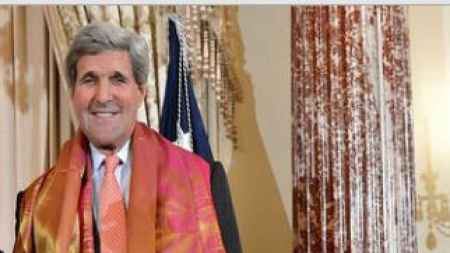
Kerry Tells Iran Congress Visa Requirements will be Waived

December 21, 2015

Kerry Tells Iran Congress Visa Requirements will be Waived, Front Page Magazine, Daniel Greenfield, December 21, 2015

kerry (1)

The Ayatollah and his terrorists needn’t worry, John Forbes Kerry and Barack Hussein Obama have their back.

The Obama administration, pushing to support international trade with Iran, has advised the country’s rulers not to worry about new U.S. legislation that clamps visa restrictions on people who have traveled to Iran.

Iranian officials have publicly complained the new U.S. rules will unfairly target travelers who visit Iran and could dampen investment interest in their country.

Secretary of State John Kerry wrote his Iranian counterpart on Saturday to assure him the visa changes approved by Congress last week won’t undermine business opportunities in Iran or violate the terms of the nuclear agreement between global powers and Tehran in July. Mr. Kerry said the administration was exploring ways to ensure visitors to Iran aren’t unfairly blocked from entering the U.S.

He specifically cited the State Department’s ability to expedite visa applications and to issue longer-term, multiple-entry travel documents. He also said the White House had the power to issue waivers to potentially exempt individuals from the new travel laws.

Americans can’t get waivers, but enemies of the United States can always get waivers from Obama. Despite Iran’s latest weapons tests, Kerry wrote to Iran that…

Thanks for a constructive meeting yesterday. I wanted to get back to you in response to your inquiry about amendments to our Visa Waiver Program. First, I want to confirm to you that we remain fully committed to the sanctions lifting provided for under the JCPOA. We will adhere to the full measure of our commitments, per the agreement. Our team is working hard to be prepared and as soon as we reach implementation day we will lift appropriate sanctions.

I am also confident that the recent changes in visa requirements passed in Congress, which the Administration has the authority to waive, will not in any way prevent us from meeting our JCPOA commitments, and that we will implement them so as not to interfere with legitimate business interests of Iran. To this end, we have a number of potential tools available to us, including multiple entry ten-year business visas, programs for expediting business visas, and the waiver authority provided under the new legislation.

Now let’s frantically bend over backward for the terrorists.

Germans Stock Up on Weapons for Self-Defense

December 21, 2015

Germans Stock Up on Weapons for Self-Defense, Gatestone InstituteSoeren Kern, December 21, 2015

(Something similar seems to be happening in America. I don’t wonder why, since only “widows and three year old orphans” are on the rampage. It must be due to Islamophobia, racism and other non-multicultural, anti-German-values notions. The obvious solution is to ban all guns and other weapons for Germans.– DM)

♦ The scramble to acquire weapons comes amid an indisputable nationwide spike in migrant-driven crime, including rapes of German women and girls on a shocking scale, as well as physical assaults, stabbings, home invasions, robberies and burglaries — in cities and towns throughout the country.

♦ German authorities, however, are going to great lengths to argue that the German citizenry’s sudden interest in self-defense has nothing whatsoever to do with mass migration into the country, despite ample evidence to the contrary.

♦ The spike in violent crimes committed by migrants has been corroborated by a leaked confidential police report, which reveals that a record-breaking 38,000 asylum seekers were accused of committing crimes in the country in 2014. Analysts believe this figure — which works out to more than 100 crimes a day — is only a fragment: many crimes are not reported.

♦ “Anyone who asks for the reasons for the surge in weapons purchases encounters silence.” — Süddeutsche Zeitung

Germans, facing an influx of more than one million asylum seekers from Africa, Asia and the Middle East, are rushing to arm themselves.

All across Germany, a country with some of the most stringent gun-control laws in Europe, demand is skyrocketing for non-lethal self-defense weapons, including pepper sprays, gas pistols, flare guns, electroshock weapons and animal repellants. Germans are also applying for weapons permits in record numbers.

The scramble to acquire weapons comes amid a migrant-driven surge in violent crimes — including rapes, robberies and aggravated assaults — in cities and towns throughout the country.

German authorities, however, are going to great lengths to argue that the German citizenry’s sudden interest in self-defense has nothing whatsoever to do with mass migration into the country, despite ample evidence to the contrary.

In recent weeks, German newspapers have published dozens of stories with headlines such as: “Germany is Afraid — And Grabs for the Weapon,” “Germans are Arming Themselves: The Demand for Weapons Explodes,” “More and More People are Buying a Weapon,” “Security: Hands Up!” “The Need for Security Increases,” “Boom in Weapons Stores,” and “Bavarians are Arming Themselves— Afraid of Refugees?

1393The German daily newspaper Die Welt recently produced a video report about Germany’s surge in sales of self-defense weapons, which was titled “The Weapons Business is Profiting from the Refugee Crisis.” (Image source: Die Welt video screenshot)

Since Germany’s migration crisis exploded in August 2015, nationwide sales of pepper spray have jumped by 600%, according to the German newsmagazine, Focus. Supplies of the product are now completely sold out in many parts of the country and additional stocks will not become available until 2016. “Manufacturers and distributors say the huge influx of foreigners in recent weeks has apparently frightened many people,” Focus reports.

According to KH Security, a German manufacturer of self-defense products, demand is up by a factor of five, and sales in September 2015 — the month when the implications of German Chancellor Angela Merkel’s open-door migration policy began to dawn on many Germans — were the highest since the company was founded 25 years ago. The company says there is an increased demand not only for self-defense weapons, but also for home alarm systems.

Another manufacturer of self-defense products, the Frankfurt-based company DEF-TEC Defense Technology, has reported a 600% increase in sales this fall. According to CEO Kai Prase:

“Things took off beginning in September. Since then, our dealers have been totally overrun. We have never experienced anything like this in the 21 years of our corporate history. Fear: This is not rational. The important term is: ‘refugee crisis.'”

The same story is being repeated across Germany. According to the public broadcaster, Mitteldeutscher Rundfunk, citizens in Saxony can regularly be seen queuing up in large numbers waiting for gun shops to open.

A store owner in the Saxon town of Pirna said he is now selling up to 200 cans of pepper spray each day, compared to five cans a week before the migrant crisis began. He said he is seeing many new customers who are not the typical clientele, including women of all ages and men who are buying weapons for their wives.

Günter Fritz, the owner of a gun shop in Ebersbach, another town in Saxony, told RTL News, “Since September, all over Germany, also at my shop, sales of self-defense products have exploded.” He added that his clients come from all walks of life, ranging “from the professor to the retired lady. All are afraid.”

Andreas Reinhardt, a gun shop owner in the northern German town of Eutin, said he now sells four to five self-defense weapons each day, compared to around two per month before the recent influx of asylum seekers. “The current social upheaval is clearly driving the current rush to self-defense,” he said. “I never thought that fear would spread so quickly,” he added.

Eric Thiel, the owner of a gun shop in Flensburg, a city on the Baltic Sea coast, said that pepper spray is no longer available: “Everything is sold out. New supplies will not arrive until March. Everything that has to do with self-defense is booming enormously.”

Wolfgang Mayer, the owner of a gun shop in Nördlingen, a town in Bavaria, said he has an explanation for the surge in gun licenses: “I think with the influx of refugees, the rise in break-ins and the many tricksters, the people are demanding greater protection.”

Mayer added that there is a growing sense within German society that the state cannot adequately protect its citizens and therefore they have to better protect themselves. “Since the summer, sales of pepper spray have increased by 50%,” Mayer said, adding that buyers are mainly women, of all ages — from the student in the city up to the widowed grandmother.

Pepper spray and other types of non-lethal self-defense weapons are legal in Germany, but a permit is required to carry and use some categories of them. Officials in all of Germany’s 16 federal states are reporting a spike in applications for such permits, known as the small weapons license (kleinen Waffenschein).

In the northern German state of Schleswig-Holstein, nearly 10,000 people now hold a small weapons license, an “all-time record level,” according to the regional interior ministry. Retailers in the state are also reporting an “unprecedented surge” in sales of self-defense weapons, with supplies of pepper spray sold out until the spring of 2016.

In Saxony, retailers are reporting an unprecedented boom in sales of pepper spray, tear gas, gas pistols and even cross bows. Some stores are now selling more self-defense weapons in one day than they did in an entire month before the migrant crisis began.

Saxon officials are also reporting a jump in the number of people applying for the full-fledged firearms license (großen Waffenschein). The rush to arms can be attributed to a “subjective decline in the people’s sense of security,” Saxon Interior Minister Markus Ulbig said.

In Berlin, the number of people holding a small weapons license increased by 30% during the first ten months of 2015 compared to the same period in 2014, while the number of those holding the full-fledged firearms license jumped by some 50%, according to local police.

In Bavaria, more than 45,000 people now hold a small weapons license, 3,000 more than in 2014. This represents a “significant increase,” according to the regional interior ministry. As in other parts of Germany, Bavarian retailers are also reporting a boom in sales of self-defense weapons, including gas pistols, flare guns and pepper spray.

In Stuttgart, the capital city of Baden-Württemberg, local gun shops are reporting a four-fold increase in sales of self-defense weapons since August. One shop owner said she now sells more weapons in one week than she normally sells in one month. She added that she has never seen such high demand.

In Heilbronn, another city in Baden-Württemberg, local officials report that sales of pepper spray have doubled in 2015. According to one shopkeeper, the demand for pepper spray began surging in August, when many mothers started purchasing the product for their school-aged daughters. “Our clients are extremely afraid,” the shopkeeper said. “We are seeing this everywhere.”

In Gera, a city in Thuringia, local media reported that at one store, the entire inventory of 120 cans of pepper spray was sold out within three hours. The store, which subsequently sold out of another batch of 144 cans, is now on a waiting list to obtain more because of supplier shortfalls.

A woman in Gera who bought pepper spray for her 16-year-old daughter said:

“I think it is fundamentally proper for me to protect my daughter. She is at that age where she is out alone in the evening. If she says she needs this for protection, I think this is not unjustified. Of course, due to the current situation that we now have in Germany. We just do not know who is here. There are quite a lot of people who are not registered.”

The same trend toward self-defense is being repeated in the German states of Brandenburg,Mecklenburg-Vorpommern, Saxony-Anhalt and North Rhine-Westphalia, where spiraling levels of violent crime perpetrated by migrants is turning some neighborhoods into no-go zones.

Apologists for mass migration are accusing German citizens of overreacting. Some point to recent studies — commissioned by pro-migration groups — which claim, implausibly, that the number of crimes committed by migrants is decreasing, not increasing.

Others deny that the rush to self-defense has anything to do with migrants at all. They blame a variety of different factors, including the early darkness associated with the end of daylight savings time, the jihadist attacks in Paris (which occurred in November, three months after sales of self-defense weapons began to spike), and the need for protection from wild wolves in parts of northern Germany.

The Süddeutsche Zeitung described the deception this way:

“Anyone who asks for the reasons for the surge in weapons purchases encounters silence. Officially, the regulatory agencies say that anyone who applies for the small weapons license does not need to provide a justification and therefore the government offices have no explanation. ‘But it is true that sometimes we clearly get the message that they are afraid because of the refugees,’ says one, on condition that his name and office will not be mentioned in the newspaper. ‘People have already told me: I want to protect my family.’ We have reported this to the Ministry…

“The retailers also say nothing officially about the reasons for the increase in sales. Call a small gun shop. Many refugees arrived at the end of August, and since September the numbers are up, can there not be a connection? ‘If you do not use my name: Sure, what else?’ Says the man on the phone. The people who come to the store are afraid. They believe that among the refugees there are ‘black sheep.’ Some customers openly admit it.”

Empirical evidence shows an indisputable nationwide spike in migrant-driven crime, includingrapes of German women and girls on a shocking scale, as well as sexual and physical assaults, stabbings, home invasions, robberies, burglaries and drug trafficking.

The spike in violent crimes committed by migrants has been corroborated by a confidential police report leaked to a German newspaper. The document reveals that a record-breaking 38,000 asylum seekers were accused of committing crimes in the country in 2014. Analysts believe this figure — which works out to more than 100 crimes a day — is only a fragment: many crimes are not reported.

Not surprisingly, a new poll shows that 55% of Germans are pessimistic about the future, up from 31% in 2014 and 28% in 2013. The poll shows that 42% of those between the ages of 14 and 34 believe their future will be bleak; this is more than double the number of those (19%) who felt this way in 2013. At the same time, 64% of those aged 55 and above are fearful about the future.

The poll also shows that four-fifths (79%) of the German population believe the economy will deteriorate in 2016 due to the financial burdens created by the migration crisis, and 70% believe that member states of the European Union will drift further apart in the coming year. The most predictable finding of all: 87% of Germans believe their politicians will experience a decline in public support during 2016.

The Pentagon’s Groveling Apology to China for Flying Near a Contested Island

December 21, 2015

The Pentagon’s Groveling Apology to China for Flying Near a Contested Island, National Review, Tom Rogan, December 21, 2015

(Will Obama ever go away? If and when he does, will his replacement be a comparable little man upon the stair who isn’t there?

Last night I saw upon the stair,
A little man who wasn’t there,
He wasn’t there again today
Oh, how I wish he’d go away.. — William Hughes Mearns (1875–1965)

— DM)

On November 13, President Obama claimed that ISIS was “contained.” One day later, ISIS painted bloody red lines on Paris streets. The credibility of American foreign policy took another big hit.

Then came Saturday’s Wall Street Journal report that last week, “an American B-52 bomber on a routine mission over the South China Sea unintentionally flew within two nautical miles of an artificial island [Cuarteron] built by China.” This seemed like good news, suggesting that Obama was challenging — under cover of an “unintentional” foray — China’s imperial project in the East China and South China Seas. That would be welcome, because China’s project intends to subjugate U.S. allies, seize lucrative energy reserves, and dominate crucial trade routes. And Obama seems to realize this. At November’s APEC summit, he offered “shared commitment to the security of the waters of this region and to freedom of navigation.” In October, President Obama sent an American destroyer within twelve miles of another artificial Chinese island.

My hopes in the president were misplaced.

First off, it’s telling that the White House hasn’t commented on the B-52 report. This is the administration’s go-to response for a story they want to go away (if the administration likes the story, we get leaks and Hollywood movies).

But the Pentagon’s response has been equally telling. Instead of broadcasting that America will reject China’s claims in the East China and South China Seas, and instead of asserting that American forces will of course operate in international territory, the Pentagon groveled before China, offering apologies. The Journal reports that the B-52 aircrew is being investigated and that the Pentagon is hinting that “bad weather” led the crew to make a mistake. It’s Scapegoating 101.

Unfortunately, this supplication to China is also Strategic Incompetence 101. First, as evidenced by this situation, if the U.S. is unwilling to operate over international waters without qualification, those waters become Chinese. This yields the strategic initiative to China. It also contradicts the B-52 deployment in the first place. Assuming that the B-52s were flown from Guam (the closest squadron deployment), this must have been a mission focused on China. In part, that’s because B-52s have advanced oceanic-surveillance capabilities. But with Guam a significant distance away from the South China Sea — 2,200 miles — this mission clearly wasn’t for flight hours.

After all, while China carves its empire, Obama continues to claim that his China policy is successful. This success is proven, he says, by China’s pledge to try to cap its carbon emissions by 2030. It’s an unbinding, unenforceable pledge from a socialist kleptocracy.

Nevertheless, the true absurdity of Obama’s delusion is clear only in the light of history. Imagine if President Truman had allowed Stalin to seize Berlin in 1948 in return for Stalin’s pledge to try to hold free elections in 1964. On the contrary, consider how President Truman actually dealt with Stalin during the 1948–1949 Berlin crisis (in which Stalin blockaded Berlin’s western zones). Vastly outgunning U.S. forces in Germany, the Soviets threatened war. But when the question arose of whether or not the United States was going to stay in Berlin, Truman declared: “No discussion . . . we are going to stay — period.” He launched the Berlin airlift and put his faith in American deterrent power and American values. And he won the day.

Of course, today, many would castigate Truman’s blunt speak as gung-ho idiocy, unbefitting of “smart power” and nuanced American leadership in a complex world. But Truman knew that the conduct of an effective statesman isn’t just about dealing with the moment, but also about anticipating the horizon. General Clay, commanding U.S. forces in Berlin during the crisis, also understood this truth. Consider Clay’s cable to Washington at the start of the crisis: “We are convinced that our remaining in Berlin is essential to our prestige in Germany and in Europe. Whether for good or bad, it has become a symbol of the American intent.”

Truman knew that if the United States abandoned the small territory of Berlin, that action would eviscerate American credibility around the world and the Soviets would gain the strategic upper hand in the Cold War. Allies would doubt America’s word, and our adversaries would know America’s weakness. Sadly, last week’s B-52 incident proves that President Obama does not grasp that purpose and credibility are essential components of an effective foreign policy. And American enemies are taking advantage: In 2016, expect historic foes China and Russia to strengthen their alliance against us.


The battles in N. Syria will determine the fate of the peace process

December 21, 2015

The battles in N. Syria will determine the fate of the peace process, DEBKAfile, December 21, 2015

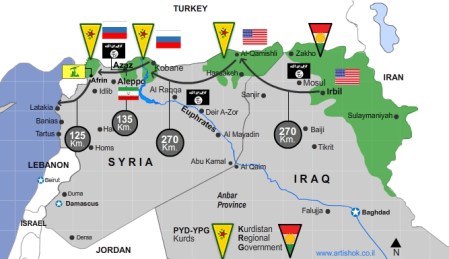
Syria_Iraq_Kurdsweekly

The US-Russian plan, approved by the UN Security Council as the lever for activating a political process towards ending the five-year Syrian war, can only go so far towards its objectives. The process is not capable of halting the fighting or removing Bashar Assad from power; just the reverse: progress in the talks is heavily dependent on the state of play on the battlefields of the north while the Syrian dictator’s ouster is a fading issue.

The limitations and obstacles facing the UN-endorsed US-Russian plan are summed up here by DEBKAfile’s analysts:

1. The understanding reached by the Obama administration and the Kremlin in the past month was first conceived as a stopgap measure. It was never intended to bring the calamitous Syrian war to an end or remove Assad, but rather to provide a pretext to account for the expansion of Russia’s ground operation and gloss over America’s military deficiencies in the Syrian conflict. Taking it as carte blanche from Washington, President Vladimir Putin felt able to announce Saturday, Dec. 19, that “the Russian armed forces have not employed all of their capability in Syria and may use more military means there if necessary.”

2. President Barack Obama has stopped calling for Assad’s removal as the condition for ending the war and is silent on the expanding Russian military intervention. Obama and Putin have in fact developed a working arrangement whereby Putin goes ahead with military operations and Obama backs him up..

3. Almost unnoticed, on Dec. 17, the day before the Security Council passed its resolution for Syria, all the 12 US warplanes that were deployed a month earlier at the Turkish air base of Incirlik for air strikes in Syria were evacuated. This happened at around the same time as Russia deployed to Syria its Buk-M2-SA-17 Grizzly antiaircraft missile systems. The presence of this system would have endangered American pilots had US air strikes over Syria not been halted. The upshot of the two evidently coordinated moves was the US withdrawal of most of its military resources for striking the Islamic State forces in Syria and the handover of the arena to the Russian army and air force.

4. In another related development, Friday, Dec. 18 the German intelligence service, BDN, leaked news that it had renewed its contacts with the Assad regime’s intelligence services and German agents were now visiting Damascus regularly. The import of this change is that Berlin no longer relies on US intelligence briefings from Syria and, rather than turn to Moscow, it prefers to tap its own sources in the Syrian capital.

5. Washington and Moscow are still far apart on the shape of the transitional government mandated by the Security Council resolution

The Obama administration wants Assad to hand presidential powers over the military and of all security-related and intelligence bodies to the transitional government, which is to be charged with calling general and presidential elections from which Assad will be barred.

Putin won’t hear of this process. He insists on a transitional government being put in place and proving it can function before embarking on any discussion of its powers and areas of authority.

The two presidents agree that the transition will need at least two years, overlapping the Obama presidency by about a year and dropping the issue in the lap of his successor in the White House.

6. The US and Russia don’t see to eye to eye either on which Syrian opposition organizations should be represented in the transitional government and which portfolios to assign them. On this question, both Washington and Moscow are at odds with the Persian Gulf states, Saudi Arabia, Qatar and the UAE, which back some of the organizations labeled as terrorist by Moscow.

7. But it is abundantly clear that the Obama administration is ready to wash its hands of the Syrian rebel movement and most of all, abandon Turkish President Tayyip Erdogan to give the Russians an open remit.

On Saturday, Dec. 19, Putin turned the screw again on Erdogan when he said he had no problem with the Turkish people, adding, “As for the current Turkish leadership, nothing is eternal.”

In support of Moscow, Obama meanwhile leaned hard on the Turkish president in a telephone conversation, to remove Turkish forces from northern Iraq. Ankara responded that Putin’s comment was not worth a response and denied hearing of any such US request.

Ankara may be feigning ignorance but it must realize by now that Moscow and Washington have joined forces to pus the Turkish military out of any involvement in northern Syria and Iraq.

8. This US-Russia collaboration against Turkey is having a dramatic effect on the war in northern Syria along the Turkish border. DEBKAfile’s military and intelligence sources report it opened the door to the secret deal between Washington and Moscow to divide the areas of influence in northern Syria between them – essentially assigning the Kurdish enclaves north of the Euphrates river and bordering on Iraq to American influence (see map), and the areas west of the Euphrates up to the Mediterranean to Russian control. This deal (first revealed by DEBKA Weekly 688 on Dec. 4) effectively squeezes Turkey out of any role in the Syrian conflict.

9. The ongoing battles in northern Syria near the Turkish border will have a greater impact in shaping the future of Syria and its unending conflict than any UN resolution. Participating in the fighting at present is a very big mixed cast: Russia, the Kurdish YPG militia, most of the important rebel groups, including radical Sunni organizations tied to Al Qaeda, such as the Nusra Front and Ahram al-Sham, Iran and Shiite Hizballah, and the Islamic State.

It is only when one of these forces gains the upper hand in this free-for-all, that there will be progress toward a political solution on ending the war.

Algerian Army Marching Drill: Kill, Slaughter, and Skin the Jews

December 21, 2015

Algerian Army Marching Drill: Kill, Slaughter, and Skin the Jews, MEMRI-TV via You Tube, December 21, 2015


According to the blurb beneath the video,

In a marching drill of the Algerian National Gendarmerie, the soldiers chant: “Turn your guns towards the Jews… in order to kill them… slaughter them… and skin them.” The video was posted on the Internet on November 1 to mark Algeria’s Revolution Day, but the post did not state when the video was filmed.

Berserk

December 21, 2015

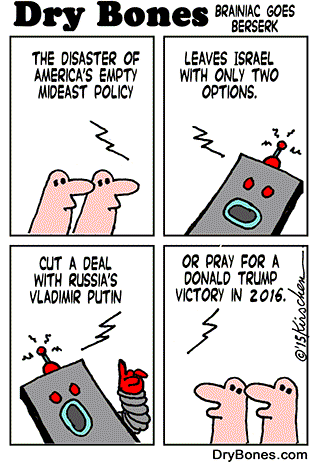
Berserk, Dry Bones, December 20, 2015

D15C01_1

Whenever I do a cartoon attacking President Obama I am hit with charges that I am a racist. I have learned to get around this by attacking “the White House” or John Kerry instead.

There are other “accepted” positions that I must observe in order to be taken seriously by a large part of our Jewish constituency. One of these “accepted” positions is the idea that Israel needs to stay firmly in America’s pocket. Another “accepted” position is the idea that Donald Trump is a dangerous, crazy, racist, clown. In order to stave off the knee-jerk response to a cartoon challenging these ideas in today’s cartoon, I had to present them as being the insane ramblings of an out-of-control computer-robot who has gone berserk!

Obama Admin: Congressional Crackdown on Terror Will Violate Iran Deal

December 21, 2015

Obama Admin: Congressional Crackdown on Terror Will Violate Iran Deal, Washington Free Beacon, December 21, 2015

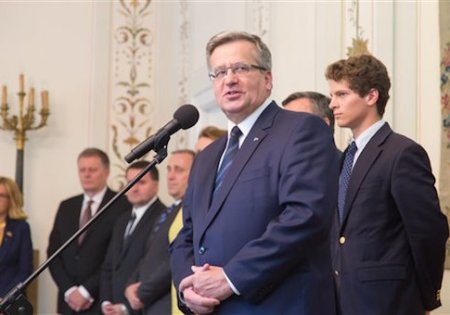
Polish President Bronislaw Komorowski met with outgoing United States Ambassador to Poland Stephen D. Mull. Ambassador have received state distinctions from President in Belweder Palace in Warsaw. | Warsaw, Poland, 07 July 2015 (Photo by Mateusz Wlodarczyk/NurPhoto) *** Please Use Credit from Credit Field ***

Stephen Mull / AP

Senior Obama administration officials are expressing concern that congressional attempts to tighten laws preventing terrorists from entering the United States could violate the Iran nuclear agreement and prompt Tehran to walk away from the agreement.

Congress is considering measures that would tighten the Visa Waiver Program to make it harder for potential terrorists to legally enter the United States by increasing restrictions on individuals who have travelled to countries with prominent terrorist organizations from bypassing security checks upon entering the United States.

Iranian officials have in recent days repeatedly issued threatening statements to the Obama administration, saying that such moves would violate the nuclear agreement, and the Obama administration last week conveyed the Iranian anger to American lawmakers.

Stephen Mull, the State Department official in charge of implementing the Iran deal, warned the Senate Foreign Relations Committee late last week that these congressional efforts “could have a very negative impact on the deal.”

Under the revised law, which came in the week of a deadly terrorist attack in California, individuals who have travelled to Iran—a lead sponsor of global terrorism—would no longer be eligible to participate in the Visa Waiver Program, which permits individuals from 38 partner nations to more easily enter the United States.

Congress remains concerned that gaps in the program could prevent federal law enforcement officials from detecting terror-tied individuals before they are granted entrance to U.S. soil.

However, a portion of the Iran nuclear deal mandates that the United States not take any action that could harm Iran’s economic relationships with other countries. Iranian officials maintain that the new restrictions violate this passage of the deal.

Ali Larijani, the speaker of Iran’s parliament, said last week that these tightened measures “are aimed at harassment” and that they “blatantly violate the nuclear agreement,” according to comments carried by the Iranian state-controlled press.

Larijani warned that this action will detonate the deal before it has even been implemented.

“If the Americans pursue the plan, they will destroy an achievement with their own hands since it is against the [nuclear deal] and it will trouble them,” he warned.

Rep. Patrick Murphy (D., Conn.) echoed these concerns last week when he questioned Mull during a Senate hearing.

Visa waiver reform efforts include “a naming of Iran such that individuals who have travelled to Iran will no loner be eligible for the visa waiver program,” Murphy said. “There has been a suggestion because there is an element of the agreement that obligates us to not to take steps that would stop economic relations between other nations and Iran that we could perhaps be in jeopardy of breaching the agreement.”

Mull agreed with this assessment.

“I have heard from very senior, and Secretary [of State John] Kerry has as well, from very senior officials of differing European allies of ours that it could have a very negative impact on the deal,” he said.

Sources working with Congress on the Iran deal criticized the Obama administration for attempting to stymie increased action on terrorism due to its desire to preserve the nuclear deal.

“According to the Obama administration’s latest interpretation, the nuclear deal allows Iran to test ballistic missiles in violation of international law, but does not allow Congress to prevent terrorists from coming into the United States,” Omri Ceren, the managing director of press and strategy at The Israel Project, a D.C.-based organization that works with journalists on Middle East issues, told the Washington Free Beacon.

Seyed Araqchi, Iran’s deputy foreign minister, also warned that Iran is prepared to “take action” against the United States for implementing visa restrictions.

Iran’s latest threat to break the deal comes amid numerous Iranian provocations, including multiple tests of advanced ballistic missiles, acts prohibited under United Nations Security Council resolutions.

The Obama administration repeatedly said that, while it does not agree with those launches, they do not violate the nuclear deal.