Archive for December 2, 2015

Nuclear Agency Says Iran Worked on Weapons Design Until 2009

December 2, 2015

Nuclear Agency Says Iran Worked on Weapons Design Until 2009, New York Times

(Please see also, Iran threatens to walk away from nuke deal. — DM)

[W]hile the International Atomic Energy Agency detailed a long list of experiments Iran had conducted that were “relevant to a nuclear explosive device,” it found no evidence that the effort succeeded in developing a complete blueprint for a bomb.

In part that was because Iran refused to answer several essential questions, and appeared to have destroyed potential evidence in others.

**********************

VIENNA — Iran was actively designing a nuclear weapon until 2009, longer than the United States and Western intelligence agencies have publicly acknowledged, according to a final report by the United Nations nuclear inspection agency.

The report, based on partial answers Iran provided after reaching its nuclear accord with the West in July, concluded that Tehran conducted “computer modeling of a nuclear explosive device” before 2004. It then resumed the efforts during President Bush’s second term and continued them into President Obama’s first year in office.

But while the International Atomic Energy Agency detailed a long list of experiments Iran had conducted that were “relevant to a nuclear explosive device,” it found no evidence that the effort succeeded in developing a complete blueprint for a bomb.

In part that was because Iran refused to answer several essential questions, and appeared to have destroyed potential evidence in others.

The report, issued here Wednesday evening to the 167 countries that make up the board of the agency, is intended to complete a decade-long attempt to determine what kind of progress Iran made toward the technological art of designing a warhead that could fit atop a nuclear missile.

The completion of the report is one of the steps that Iran had to take — along with dismantling centrifuges and shipping nuclear fuel out of the country — before sanctions will be lifted under the nuclear deal.

Mr. Obama and his secretary of state, John Kerry, concluded this year that it was more important to secure a deal that will, if carried out fully, prevent Iran from gaining the material to build a bomb for at least 15 years than making it admit to past activities. So, the report’s publication allows the deal to go through, no matter how definitive or inconclusive the final result.

But Iran’s refusal to cooperate on central points could set a dangerous precedent as the United Nations agency attempts to convince other countries with nuclear technology that they must fully answer queries to determine if they have a secret weapons program.

The agency’s bottom line assessment was that Iran had a “coordinated effort” to design and conduct tests on nuclear weapon components before 2003 — echoing a United States national intelligence estimate published in 2007 — and that it had conducted “some activities” thereafter.

“These activities did not advance beyond feasibility and scientific studies” and the acquisition of technical capabilities, the agency concluded. The efforts ended “after 2009,” or just as Mr. Obama was taking office and accelerating the sanctions and cyber sabotage program against Iran’s nuclear facilities that ultimately brought Iranian officials to the negotiating table.

Tehran gave no answer to one quarter of the dozen specific questions or documents it was asked about, leaving open the question of how much progress it had made.

The report, titled “Final Assessment of Past and Present Outstanding Issues Regarding Iran’s Nuclear Program,” will not satisfy either critics of the nuclear deal or those seeking exoneration for Iran. Instead, it draws a picture of a nation that was actively exploring the technologies, testing and components that would be needed to produce a weapon someday, without coming to a conclusion about how successful that effort was.

The agency’s director, Yukia Amano, said last week that the document would not be “black and white,” and that assessment proved correct.

Nothing in the report suggests that Iran will prevent the I.A.E.A. from monitoring its production of nuclear fuel for the next decade and a half, the crucial element of the July agreement. But Iran’s refusal to answer some of the questions also does not portend well for its transparency about its activities.

At Iran’s Parchin complex, where the agency thought there may have been nuclear experimental work in 2000, the agency said “extensive activities undertaken by Iran” to alter the site “seriously undermined the Agency’s ability” to come to conclusions about past activities.

Diplomats familiar with the compilation of the report said that they met “experts” in Iran, but would not say if they met the leader of the effort, Mohsen Fakhrizadeh. (Other diplomats said Mr. Fakhrizadeh was definitely not among those the inspectors met.) One diplomat said Iran had said it feared the scientists could be assassinated if they were identified. The agency appeared to have visited two laboratories.

Time and again, the agency seemed close to rejecting Iranian arguments that its experimentation was for civilian purposes. The inspectors found that Iran’s nuclear program was “suitable for the coordination of a range of activities relevant to the development of a nuclear explosive device” and that its experiments have “characteristics relevant to a nuclear explosive device.”

In one or two areas, notably a document provided by Western intelligence agencies indicating that Iran was looking at how to make uranium metal, a step needed for a weapon, it found “no indication of Iran having conducted activities” related to the document.

Recently, as the report’s publication approached, Iran’s position of complete denial that it had sought a bomb seemed to soften. In October, a former Iranian president, Ali Akbar Hashemi Rafsanjani, told journalists in Tehran that the nation had considered making nuclear arms during its war with Iraq in the 1980s but backed away.

“We sought to have that possibility for the day that the enemy might use a nuclear weapon,” he was quoted as saying. “That was the thinking. But it never became real.” He said nothing about what happened up to 2004 or the more sporadic efforts beyond.

The issues the I.A.E.A. addressed in Wednesday’s report date back a decade. Starting around mid-2004, thousands of pages of detailed evidence of Iran’s suspected research on how to design a weapon were collected by intelligence agencies in the United States, Israel and Europe, and eventually turned over to the agency’s inspectors here in Vienna.

Some of the evidence came from a laptop computer smuggled out of Iran by a person American and German officials identified as an Iranian technician, who had access to some of the most sensitive results from two secret Iranian nuclear projects. Both appeared related to different technologies needed to design a nuclear warhead, including the vital process of building a detonation system to fit inside the nose cone of Iran’s Shahab-3 missile, Persian for shooting star.

Iran claimed that the documents were fabrications, part of a Western conspiracy to set the groundwork for bombing the country’s nuclear facilities or overthrowing the government. The technician apparently never made it out of the country; he remained in Iran after sending the laptop out with his wife and family.

“We never figured out if he was imprisoned or executed,” a former intelligence officer involved in the operation said in an interview in 2008.

The year before that interview, however, the American intelligence community had warned the Bush administration of a surprising finding: While Iran once had a full-scale weapons development effort underway, it had suspended the project sometime in late 2003, shortly after the American invasion of Iraq.

“Prior to 2003 they had a full-scale Manhattan Project,” said Gary Samore, Mr. Obama’s top nuclear proliferation expert in the first term. After that, he said, the effort was sporadic, even as Iran pressed ahead to build the facilities to produce uranium fuel — the program that was rolled back and frozen by the agreement reached in July.

Even after the 2007 report, though, I.A.E.A. inspectors pressed Iran to address the questions raised in the documents. In 2008, the agency’s chief inspector gathered officials from around the world into a large auditorium here and displayed the evidence to them. This included, memos signed by Mr. Fakhrizadeh, the elusive academic who ran the program for the Islamic Revolutionary Guards Corps, and Iranian videos appearing to show how to detonate a weapon in an “air burst,” much as the bomb exploded high over Hiroshima, Japan, in 1945.

In 2011, frustrated that Iran had failed to honor several agreements to answer questions and turn over documents, the atomic agency published a list of a dozen issues — “possible military dimensions,” in bureaucratic jargon — that it had to clear up before it could close Iran’s file.

But as the deal got closer last spring, Mr. Obama and Mr. Kerry had to make a crucial decision: whether it was worth jeopardizing the deal by insisting that Iran must admit to its past activities. From all indications since then, the president seemed to have decided it was more important to get commitments about limiting future activities than forcing Iranian officials to admit to a past the country insists never happened.

Mr. Kerry, pressed on the question of Iranian disclosure of past activities by Judy Woodruff on the “PBS NewsHour,” said: “They have to do it. It will be done. If there’s going to be a deal, it will be done.” But weeks later, he said United States intelligence agencies already had “perfect knowledge” of Iran’s activities, suggesting that a public confession was not necessary.

The result was a carefully designed diplomatic compromise. Iran had to meet deadlines to turn over documents, but the agreement did not specify how complete the disclosures had to be, whether important scientists had to be interviewed or whether inspectors had to be allowed into the sensitive research sites, including some universities, where the work happened.

Prime Minister Benjamin Netanyahu reports from the  climate conference in Paris 

December 2, 2015


Obama’s $150 Billion ‘Signing Bonus’ To Iran Hits Legal Snag

December 2, 2015

Obama’s $150 Billion ‘Signing Bonus’ To Iran Hits Legal Snag, Jewish Business News, December 2, 2015

Iran's President Hassan Rouhani smiles while replying to a question during a news conference on the sidelines of the 69th United Nations General Assembly at United Nations Headquarters in New York September 26, 2014. REUTERS/Adrees Latif

Iran’s President Hassan Rouhani smiles while replying to a question during a news conference on the sidelines of the 69th United Nations General Assembly at United Nations Headquarters in New York September 26, 2014. REUTERS/Adrees Latif

As part of July’s nuclear deal, President Barack Obama agreed to release Iranian assets that have been frozen in US banks since the takeover of the US Embassy in Tehran in 1979. But Shurat HaDin – Israel Law Center, a non-profit legal assistance group based in Tel Aviv, has sent a letter to 11 American banks warning them that releasing the money now would be a violation of a current US court order intended to compensate victims of Iran-sponsored terrorism.

The banks addressed in the letter are believed to be holding frozen Iranian assets, and awaiting certification by the administration than Iran has met certain preliminary benchmarks for the release of that money.

US courts, however, have awarded judgments to a number of American families against the Iranian government as victims of terrorism perpetrated by Iran-sponsored terror groups such as Hamas and Hezbollah.

One such case dates back to Sept. 4, 1997, when Hamas executed triple suicide bombings on the Ben Yehuda Street pedestrian mall in Jerusalem. The attack killed five Israelis and severely injured a number of Americans.

Families of those Americans injured in the bombing filed suit against the Iranian regime for damages. Iran is a financial and military patron of Hamas. The case, Rubin v. The Islamic Republic of Iran, was decided in favor of the plaintiffs. Yet previous efforts to attach certain Iranian assets, notably museum artifacts being repatriated to Iran, have failed. A number of courts have ruled that historical artifacts are not exempt from sovereign immunity, and thus cannot be seized to make payment.

Cash, however, appears to be another matter.

On Oct. 26, the plaintiffs obtained a Citation to Discover Assets in the federal district court in the Northern District of Illinois. The granting of this proceeding takes the plaintiffs’ case one step further, in that it permits them to discover what assets the Iranian government has frozen in the U.S., for the purposes of collecting the judgment against them.

“Because Iran hired counsel in the antiquities proceeding in Chicago, we had the chance to serve their attorneys with the citation. As a result we can act to restrain the banks from releasing funds,” says Nitsana Darshan-Leitner, director of Shurat HaDin.

Those accounts are not a matter of public record. This has led to some confusion about the amount that could actually end up being repatriated to the Iranian government under the terms of the deal.

Shurat HaDin’s letter to the 11 US banks states, “You are hereby warned that all accounts maintained by your financial institution at any of its branches in the name of Iran, the Central Bank of Iran, the Naftiran Intertrade Company, the National Iranian Oil Company, the National Iranian Tanker Company or any other agency or instrumentality of Iran are restrained and subject to a lien in favor of my clients under United States law.”

Shurat HaDin notes that, to date, $43 billion has been awarded to US victims of Iranian-sponsored terror, and that if that money leaves the country, there is little to no chance that those claims will ever be paid.

For Darshan-Leitner, this isn’t just a legal matter — it’s a moral one.

“They want to ensure that what happened to these people doesn’t happen to other innocent families,” she says. “We all understand that allowing these frozen funds to be returned to Tehran ensures that terror groups like Hamas and Hezbollah will have the resources to continue their extremist violence against Jews and Westerners. After Paris, could you imagine providing a $100 billion to ISIS (Islamic State)? This is the exact same situation.”

The logic of Islamic intolerance

December 2, 2015

The logic of Islamic intolerance, Front Page MagazineRaymond Ibrahim, December 2, 2015

we_1

A sermon delivered by popular Saudi Sheikh Muhammad Salih al-Munajjid clearly demonstrates why Western secular relativists and multi culturalists—who currently dominate media, academia, and politics—are incapable of understanding, much less responding to, the logic of Islamic intolerance.

During his sermon, al-Munajjid said that “some [Muslim] hypocrites” wonder why it is that “we [Muslims] don’t permit them [Western people] to build churches, even though they allow mosques to be built.”  The Saudi sheikh responded by saying that any Muslim who thinks this way is “ignorant” and

Wants to equate between right and wrong, between Islam and kufr [non-Islam], monotheism and shirk [polytheism], and gives to each side equal weight, and wants to compare this with that, and he asks: “Why don’t we build them churches like they build us mosques? So we allow them this in return for that?”  Do you want another other than Allah to be worshiped?  Do you equate between right and wrong? Are Zoroastrian fire temples, Jewish temples, Christian churches, monks’ monasteries, and Buddhist and Hindu temples, equal to you with the houses of Allah and mosques? So you compare this with that? And you equate this with that?  Oh! Unbelievable, for he who equates between Islam and kufr [non-Islam], and Allah said: “Whoever desires a religion other than Islam, never will it be accepted from him, and in the Hereafter he will be among the losers” (Koran 3:85).  And Prophet Muhamad said: “By Him in whose hand is the life of Muhamad (By Allah) he who amongst the Jews or Christians hears about me, but does not affirm his belief in that which I have been sent, and dies in his state (of disbelief), he shall be of the residents of Hellfire.”

What’s interesting about the sheikh’s zealous diatribe is that, although “intolerant” from a Western perspective, it is, in fact, quite logically consistent and reveals the wide gap between Islamic rationalism and Western fantasy (despite how oxymoronic this dichotomy might sound).

If, as Munajjid points out, a Muslim truly believes that Islam is the only true religion, and that Muhammad is its prophet, why would he allow that which is false (and thus corrupt, cancerous, misleading, etc.) to exist alongside it?  Such gestures of “tolerance” would be tantamount to a Muslim who “wants to equate between right and wrong,” as the sheikh correctly deplores.

Indeed, not only does Islam, like traditional Christianity, assert that all other religions are wrong, but under Islamic law, Hindus, and Buddhists are so misguided that they must be warred against until they either accept the “truth,” that is, converting to Islam, or else being executed (Koran 9:5). As for the so-called “people of the book”—Jews and Christians—they may practice their religions, but only after being subdued (Koran 9:29) and barred from building or renovating churches and synagogues and a host of other debilitations that keep their (false) religious practices and symbols (Bibles, crosses, etc.) suppressed and out of sight.

From an Islamic paradigm—where Allah is the true god and Muhammad his final messenger—“intolerance” for other religions is logical and difficult to condemn.

The “altruistic” aspect of Islamic “intolerance” is especially important.  If you truly believe that there is only one religion that leads to paradise and averts damnation, is it not altruistic to share it with humanity, rather than hypocritically maintaining that all religions lead to God and truth?

After blasting the concept of interfaith dialogue as beyond futile, since “what is false is false—even if a billion individuals agree to it; and truth is truth—even if only one who has submitted [a Muslim] holds on to it,” the late Osama bin Laden once wrote that “Battle, animosity, and hatred—directed from the Muslim to the infidel—is the foundation of our religion. And we consider this a justice and kindness to them” (The Al Qaeda Reader, pgs. 42-43).

Note the altruistic justification: It is a “justice and kindness” to wage jihad on non-Muslims in the hopes that they convert to Islam.  According to this logic, jihadis will always be as the “good guys”—meaning that terrorism, extortion, sex-jihad, etc., will continue to be rationalized away as ugly but necessary means to altruistic ends: the empowerment of, and eventual world conversion to, Islam.

All of this logic is alien to postmodern Western epistemology, which takes for granted that a) there are no objective “truths,” certainly not in the field of theology, and that b) religion’s ultimate purpose is to make this life as peaceful and pleasant as possible (hence why “interfaith dialogue” in the West is not about determining the truth—which doesn’t exist anyway—but finding and highlighting otherwise superficial commonalities between different religions so they can all get along in the now).

The net result of all this? On the one hand, Muslims, who believe in truth—that is, in the teachings of Islam—will continue attacking the “false,” that is, everything and everyone un-Islamic.  And no matter how violent, Islamic jihad—terrorism—will always be exonerated in Muslim eyes as fundamentally “altruistic.” On the other hand, Western secularists and multiculturalists, who believe in nothing and deem all cultures and religions equal, will continue to respect Islam and empower Muslims, convinced that terrorism is an un-Islamic aberration destined to go away—that is, they will continue disbelieving their own eyes.  Such is the offspring of that unholy union between Islamic logic and Western fallacy.

The New French “Résistance”

December 2, 2015

The New French “Résistance,” Gatestone InstituteGuy Millière, December 2, 2015

  • Some spoke of “resistance,” but to them, resistance meant listening to music. A man on a talk show said he was offering “free hugs.”
  • A French judge, Marc Trevidic, in charge of all the major Islamic terrorism cases over the last ten years, said a few days before the November attacks in Paris that the situation was “getting worse” and that “radicalized groups” could “carry out attacks resulting in hundreds of deaths.” He was quickly transferred to a court in northern France, where he has been assigned to petty crimes and divorce cases.
  • All the French political leaders know that the situation is out of control, but not one will say so publicly. Not one has asked the government why it took almost three hours for the police to intervene during the attack at the Bataclan Theater, where 89 people were murdered and over 200 wounded.
  • France’s political leaders are apparently hoping that people will get used to being attacked and learn to live with terrorism. In the meantime, they are trying to divert the attention of the public with — “climate change!”

Several weeks have passed since Islamist attackers bloodied Paris. France’s President François Hollande is describing the killers as just “a horde of murderers” acting in the name of a “mad cause.” He adds that “France has no enemy.” He never uses the word “terrorism.” He no longer says the word “war.”

France never was, in fact, at war. Police were deployed on the streets. Special Forces had to “intervene” a few days later in the Paris suburb of Saint-Denis. That was it.

French forces did bomb positions of the Islamic State in Syria; and Hollande traveled the world to find coalition, but could not. Now he says he wants to turn a page. The French public seems to want to turn a page, too.

From the beginning, pacifism and appeasement filled the air. A German pianist came to playJohn Lennon’s Imagine in front of the Bataclan Theater; since then, other pianists have come. On the Place de la République, people assemble every evening to sing more songs by the Beatles: All You Need Is Love; Love Me Do. Candles are lit, and banners deployed, calling for “universal brotherhood.”

Those invited to speak on TV about what happened allude to “senseless acts.” They do not blame anyone.

Some spoke of “resistance,” but to them, resistance meant listening to music. To others, it meant having a drink with friends in a bar. In a widely circulated video, a man tries to reassure his child. “They have guns,” he mutters, “but we have flowers.”

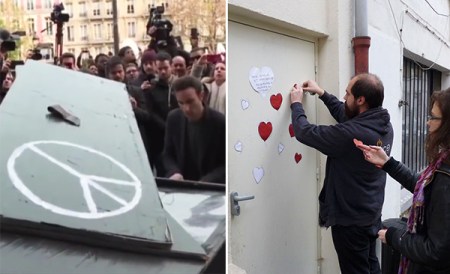
Heart-shaped stickers are posted on mosques. Words such as “We love you” and “We share your pain” are written on the hearts.

1372

Just after the attacks, French philosopher Michel Onfray said that France for many years had led Islamophobic bombings against the Muslim world, so “it was logical if the Muslims now attacked France.”

When his words were used in an Islamic State propaganda video, and reporters asked him if he regretted what he said, he replied, “No.”

A man who lost his wife in the Bataclan massacre said on a talk show that he would live in the future as he did before; that he had no hatred at all against the murderers, just compassion. Another man on a different talk show said he was offering “free hugs.”

If some French think otherwise, they are silent.

All political leaders in France speak like Hollande. They say the country must show “unity” and “solidarity.” All of them know the mood of the vast majority; even those who might want to say more, stay silent.

Almost no one mentions radical Islam. Those who do, prefer the word “jihadism,” and rush to emphasize that “jihadism” is “not related to Islam.”

Hollande, when he still spoke of war, said that France had “an enemy.” He avoided the word “Islamic,” instead referring to the Islamic State by its Arabic acronym, “Daesh.”

He knew that “Daesh” could not be defeated without an American intervention that would not take place. With symbolic gestures, he did the best he could.

He also seems to know that the main enemy of France is not in Syria or Iraq, but inside the country: France already finds herself defeated.

More than half the Islamists who attacked Paris on November 13 were Muslims born and raised in France. Mohamed Merah, the murderer of Jewish children in Toulouse in 2012, and those who attacked the satirical magazine Charlie Hebdo and the kosher supermarket in January all were Muslims born and raised in France.

Over 750 no-go zones — autonomous areas ruled by radical imams and Muslim gangs — exist in France.

Radical imams and Muslim gangs also control most of France’s prisons: 70% of prison inmates in France are apparently Muslim. Non-Muslim inmates are attacked and threatened; many are forced to convert to Islam.

A British survey published in 2014 showed that 16% of French approve of the Islamic State. Among people aged 18-25, the proportion rose to 27%. Within the French Muslim population, the numbers are undoubtedly higher.

More than 1000 French Muslims have left France to fight for the Islamic State. At least 400 havereturned without being stopped or vetted at a border. Thousands of radicalized French Muslims have never left. Many are good, loyal citizens; but many could have learned all they wanted to know on the internet and on Islamic satellite television stations. Still others — hundreds of thousands of French Muslims — are not radicalized but are ready to help the radicalized ones; ready to host them or offer them asylum.

More than 10,000 French Muslims are classified as extremely dangerous by the police and are linked to “jihadist activities”. They are registered in what the French government calls “S files,” but there is no way to monitor their whereabouts. Placing them all in detention centers would involve a complete break with what is left of the rule of law in France.

All of the French Muslims who participated in the November 13 attacks were registered in “S files,” but that did not change anything. They were free to act, and they did.

For the first time in Europe, suicide bomb attacks took place. The explosive used to make suicide belts, triacetone triperoxide (TATP), is powerful and extremely sensitive to friction, temperature change and impact. Making belts containing TATP requires a “professional.”

A French judge, Marc Trevidic, in charge of all the main Islamic terrorism cases over the last ten years, said a few days before the November attacks that the situation was “getting worse,” was now “out of control,” and that “radicalized groups” established in the country could “carry out attacks resulting in hundreds of deaths.” He was quickly transferred to a court in Lille, northern France, where he was assigned to petty crimes and divorce cases.

All the French political leaders know that Marc Trevidic is right — that the situation is out of control — but not one will say so publicly. Not one has asked the government why it took almost three hours for the police to intervene during the attack at the Bataclan Theater, where 89 people were murdered and over 200 wounded. There are simply not enough well-trained police, and not enough weapons in the hands of the police, and not enough bulletproof vests.

For the next few months, more soldiers and police officers will be placed in front of public buildings, synagogues, churches and mosques, but “soft” targets, such as theaters, cafés and restaurants, are not protected. It is as easy to enter a theater in Paris today as it was on November 13. French police do not have the right to carry a weapon when they are on duty.

In a few weeks, French military actions against the Islamic State will doubtless stop. President Hollande, the French government, and most French political leaders probably hope that the French will soon forget the attacks. They know that the problems are now too widespread to be solved without something resembling a civil war. When more attacks occur, they will talk of “war” again. They are supposedly hoping that people will get used to being attacked and learn to live with terrorism.

In the meantime, French politicians are trying to divert the attention of the public with — “climate change!” The conference in Paris will last a fortnight. President Hollande says he wants save the planet. He will be photographed next to America’s Barack Obama and China’s Jiang Zemin.

French journalists are no longer discussing jihad; they are discussing “climate change.”

Until December 11, at least, Paris will be the safest city.

In June 2015, five months after the January attacks, French Prime Minister Manuel Valls said that the French had to “adapt to Islam”. In November, he added that “Islam has to stand up to jihadism”. The French Council of the Muslim Faith, offering “condolences” to the families of the victims, specified that Muslims were “victims” too, and that they should not be “stigmatized.”

Regional elections will be held on December 6th and 13th, the same time as the conference on climate change.

Polls show that the rightist party, National Front, will almost certainly win in a landslide. Marine Le Pen, leader of the National Front, did not depart from the calls for “unity” and “solidarity.” She is, however, the only politician to say unambiguously that the main enemy is not outside the country, but within. She is also the only politician to say that a return to security implies a return to border controls. A National Front victory does not, however, mean that Marine Le Pen will win the 2017 presidential election: all the other parties and the media might band together against her.

France’s National Front is part of the increasingly popular rejection of the European Union. Thei nvasion of Europe by hundreds of thousands of mostly Muslim migrants has strengthened that stance. The Islamist attacks in Paris, combined with the state of emergency decreed in Belgium for several days after the attacks, have helped this rejection to gain more ground. In addition, the news that several of the Paris terrorists came to France among illegal migrants — and had successfully used false Syrian passports to enter Europe, where they could go from country to country unhindered — did not help.

The rise of populism is slowly destroying the unelected, unaccountable, and untransparent European Union. Many European mainstream journalists see this change as a “threat.”

The real threat to Europe might be elsewhere.

“The barbarians,” wrote the commentator Mark Steyn, “are inside, and there are no gates.”

After the attacks in Paris, Judge Marc Trevidic, again, raised the possibility of simultaneous attacks in several cities in France and in Europe. He said that if these attacks took place, the situation would become “really serious”. He said he had documents to show that Islamist groups were planning to organize such attacks. If the suicide bombers, he said, had been on time at the Stade de France, before the 79,000 spectators had entered, the death toll could have been worse. He concluded that too little had been done for too long, and that now it was probably too late.

During the November 27 official ceremony in Paris honoring the victims of the attacks, a song, If We Only Have Love, by Jacques Brel — selected by President Hollande – was sung: “If we only have love – We can melt all the guns – And then give the new world – To our daughters and sons.”

How could an Islamist not be moved by that?

Obama accepted $1.3 million dollars in gifts from the Saudi royal family

December 2, 2015

Obama accepted $1.3 million dollars in gifts from the Saudi royal family

The U.S. government’s official federal accounting report was released last week and revealed the list of gifts to federal employees from foreign governments in 2014. According to the report, the late Saudi King Abdullah bin Abdulaziz spent over a million dollars on jewelry for Michelle Obama alone.

Dec 02, 2015, 09:00AM | Ateret Horowitz

Source: Obama accepted $1.3 million dollars in gifts from the Saudi royal family – JerusalemOnline

Photo Credit: Reuters /Larry Downing

The U.S. government’s official annual accounting report was released last week and revealed the list of gifts to federal employees from foreign governments in 2014. The list published a day before Thanksgiving shows that former Saudi King Abdullah bin Abdulaziz Al Saud was especially generous with the Obama family.

 The late Saudi King Abdullah bin Abdulaziz showered the president and his family with gifts valuing over $1.3 million. The gifts included two gold men’s wristwatches valued at $85,240 and a set of diamond and emerald necklaces, earrings, rings and bracelets worth $560,000 for the First Lady. In April of 2014, King Abdullah gave Michelle Obama another set, this one worth $570,000. The king who died earlier this year also gave the Obama daughters, Sasha and Malia, jewelry worth $80,000.

The monarch gave Obama another white gold men’s wristwatch with leather band in April 2014, with a value of $67,000 and a gold-plated brass replica of the Makkah Clock Tower in Mecca on a marble base, estimated at $57,000. Under the heading “circumstances justifying acceptance,” the report stated: “Nonacceptance would cause embarrassment to the donor and the U.S. government.”

President Barack Obama and First Lady Michelle Obama (January 27, 2015) greeted by Saudi Arabia's King Salman

President Barack Obama and First Lady Michelle Obama (January 27, 2015) greeted by Saudi Arabia’s King Salman Photo Credit: Reuters/Channel 2 News

The U.S. law requires that the president must turn over all of the gifts that he received during his service to the National Archives or other institutions for the purposes of storage or display. However, if Obama would like to keep any of the gifts, he has to pay the fair market value for them.

The report moreover reveals that Israeli Prime Minister Benjamin Netanyahu offered a $440 photograph of the first U.S. consulate in Jerusalem circa 1888.

UN Teachers Glorify Knife Attacks Against ‘Jewish Apes And Pigs’

December 2, 2015

UN Teachers Glorify Knife Attacks Against ‘Jewish Apes And Pigs’

by Deborah Danan

2 Dec 2015

Source: UN Teachers Glorify Knife Attacks Against ‘Jewish Apes And Pigs’

TEL AVIV – Despite repeated promises to stop the incitement, United Nations teachers in the Palestinian territories are glorifying knife attacks against what they term “Jewish apes and pigs,” the Geneva-based NGO UN Watch reported.

The United Nations Relief and Works Agency for Palestine Refugees in the Near East (UNRWA) has imposed temporary suspensions on some of its Palestinian educators but nevertheless many of them continue to incite to violence, including posting images on social media of Palestinians brandishing blood-soaked knives with epitaphs encouraging the murder of “Zionist and Jewish apes and pigs.”

Last year, UNRWA received a total of $1 billion US in funding, largely from the EU and US.

UN Watch’s executive director Hillel Neuer asserts that the disciplinary action that UNRWA is currently administering is clearly not working. “Giving a slap on the wrist sends the message that it’s business as usual. Instead, those who incite to racism or murder should be fired, under a zero tolerance policy,” he said in a statement.

UN Watch further called for donor countries, including the US and the UK, to establish an independent commission of inquiry to investigate UNRWA’s pervading culture of impunity for perpetrators of racism and incitement.

“The UN and top funders of UNRWA such as the United States government must act immediately to terminate employees who are inciting murderous anti-Semitism and fueling the deadly pandemic of Palestinian attacks against Israeli Jews that have claimed the lives of innocent men, women and children,” said Neuer.

Neuer continued, “It’s time to put an end to the pattern and practice of UNRWA school principals, teachers and staff members posting anti-Semitic and terror-inciting images, a recurring theme that suggests a pathology of racism and violence within UNRWA.”

He also slammed the practice of UNRWA Spokesman Chris Gunness to bury reports of incitement by boycotting newspapers and NGOs that dare to report on them. Gunness spearheaded a campaign to discredit the NGO, turning to Twitter in an “Appeal to journalists: Please don’t turn UN Watch baseless allegations about anti-Semitism into a ‘he said she said’ story. It is a non-story.”

According to Neuer, the educators’ incitement to violence is in “gross violation” of UNRWA’s own regulations. Recent examples on teachers’ Facebook pages include posts of graphic images of the bloodied corpses of Israelis and texts that extol the terrorists as sacred martyrs. One teacher posted an image of a woman wearing miniature knives as earrings and bore the caption, “New accessories for Palestinians.”

Israel extremely nervous over Russian operations on its Golan border

December 2, 2015

Israel extremely nervous over Russian operations on its Golan border, DEBKAfile, December 2, 2015

Netanyahu_speaks_with_Putin_Paris_30.11.15

Moscow may be giving Hizballah and Iran an umbrella for achieving their longstanding design to displace the Syrian rebels with Revolutionary Guards and Hizballah forces and deploy them along Israel’s Golan border.

**********************

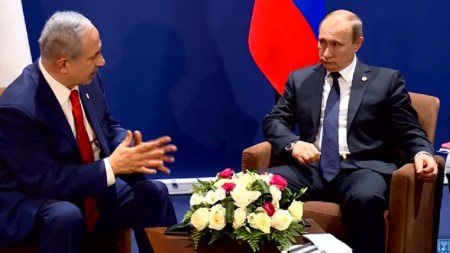
On the outside, Israel is all smiles and full of praise for way the coordination with Moscow is working for averting clashes between its air force and Russian warplanes over Syria. This goodwill was conspicuous in the compliments Prime Minister Binyamin Netanyahu and President Vladimir Putin traded when they met on the sidelines of the Paris climate summit Monday, Nov. 30.

But the first disquieting sign appeared Tuesday, Dec. 1. Senior Russian and Israeli officers were due to meet in Tel Avid to discuss strengthening the cooperation between the two army commands. But no word from Moscow or Jerusalem indicated whether the meeting had taken place.

DEBKAfile’s military sources report that this week, the show of optimism is giving way to an uneasy sensation in the offices of the prime minister, Defense Minister Moshe Ya’alon and the IDF Chief of Staff Lt. Gen. Gady. They suspect an ulterior motive behind Russia’s military movements in southern Syria, especially its air strikes against Syrian rebels, just across from Israel’s Golan border.

In particular, Moscow may be giving Hizballah and Iran an umbrella for achieving their longstanding design to displace the Syrian rebels with Revolutionary Guards and Hizballah forces and deploy them along Israel’s Golan border.

This suspicion gained ground when Tuesday, Dec. 1, the day after the Putin-Netanyahu encounter, the combined Iranian-Syrian-Hizballah units expanded their thrust from the southern Syrian town of Deraa to the Golan town of Quneitra, within sight of Israel’s defense positions.

All that day, heavy battles raged over the rebel-held line of hills running from a point just south of Quneitra to the Israeli-Syrian-Jordanian border junction. The combined force was supported by Russian air strikes and heavy tanks and artillery, seen for the first time in this war arena.

When the fighting resumed Wednesday, the IDF placed its Golan units on high alert and an extra-vigilant eye was trained on this battle.

The Iranian-Syrian-Hizballah side is gaining a distinct advantage from the deep feud dividing rebel ranks. The Islamic State and the al-Qaeda-affiliated Syrian Nusra Front forces are tearing into each other with suicide bombers and explosive cars. Tuesday, an ISIS-rigged bomb car blew up at Nusra headquarters near Quneitra (see photo).

ISIS_car_bomb_in_Quneitra_nusra_1.12.15

But this also means that an Islamic State force has come dangerously close to the Israeli border.

However, even more perils are in store if Bashar Assad’s army backed by Iran, Hizballah and Russia manages to capture the hills opposite the Golan:

1. Two years of unrelenting Israeli military and intelligence efforts to keep Hizballah and Iranian forces away from its Golan border will have gone to naught.

2.  Hizballah will open the door for Iranian Revolutionary Guards officers to set up a command center right up to the Israeli border.

3.  Israel’s steadfast policy and military action to prevent advanced Iranian weapons reaching Hizballah in Lebanon via Syria will be superseded. On the Golan, Hizballah will have gained direct access to any weapons it wants directly from Syria and be able to deploy them at far shorter distances from Israeli targets than from their firing positions in Lebanon.

4.  Vladimir Putin attaches extreme importance to recovering southern Syria from the rebel forces backed by the US and Israel, because he regards the threat to the Assad regime as great from the south as it is from the north or the center.

5.  Israel faces a grave dilemma between keeping up its “honeymoon” with Moscow by giving way on its essential security interests, or taking the bull by the horns and keeping the enemy at bay, whatever the cost to the understanding reached with Putin.

Officials in Jerusalem point out that the threat to Golan peaked just hours after the Russian leader met the prime minister in Paris. Putin is conducting a hands-on policy on Syria and keeps close track of the slightest occurrence on the battlefield. He must have been perfectly aware of the state of play on the Golan when he met Netanyahu, but nonetheless kept it out of their conversation.

Russian military reveals new details of ISIS funding

December 2, 2015

Russian military reveals new details of ISIS funding Live updates

Published time: 2 Dec, 2015 12:12 Edited time: 2 Dec, 2015 12:12

Source: Russian military reveals new details of ISIS funding — RT News

( This report is shattering.  For Turkey as well as for its NATO apologists.  It will be interesting to see how the MSM will deal with it. – JW )

The Russian Defense Ministry is giving a major media briefing to outline measures to combat international terrorism. The military operation in Syria is expected to dominate the event.
  • 02 December 2015

    12:18 GMT

    Three main routes of oil smuggling to Turkey have been established. One goes to Turkish ports on the Mediterranean coast, where the oil is shipped to other nations.

  • 12:17 GMT

    The Defense Ministry showed aerial footage of oil tankers. The vehicles were said to be travelling across the Syrian-Turkish border in their hundreds.

    12:17 GMT

    Embedded image permalink

    @mod_russia: aerial, space surveillance reveal 3 main oil smuggling routes to Turkey…

  • 12:14 GMT

    Cutting the flow of oil is a necessary condition for defeating IS. Russia is conducting airstrikes on oil pumps, refineries, transport tankers and other parts of the oil infrastructure. The strikes have resulted in the loss of half of all oil smuggled by the terrorists.

  • 12:13 GMT

    Turkey is the main buyer of oil smuggled by terrorists in Syria and family members of Turkish President Recept Erdogan are involved.

  • 12:12 GMT

    The Russian Defense Ministry is giving a media briefing, during which it will present evidence of sponsorship of international terrorism. Three senior military officials are taking part: Deputy Defense Minister Anatoly Antonov, Deputy Chief of Operations Sergey Rudskoy, Chief of National Military Control Center Mikhail Mizintsev.

China Vows ‘Enhanced Cooperation’ with Russia Against Terror

December 2, 2015

China Vows ‘Enhanced Cooperation’ with Russia Against Terrorism

by Frances Martel

1 Dec 2015

Source: China Vows ‘Enhanced Cooperation’ with Russia Against Terror

Chinese President Xi Jinping announced Monday his nation would work to take on a broader role in the international war against terrorism, promising Russian President Vladimir Putin China would be at his disposal to aid in anti-terror efforts. Russia has deeply involved itself in the Syrian civil war on the side of Syrian dictator Bashar al-Assad.

The meeting between the two heads of state occurred on Monday, as they were in attendance at the international climate change summit in Paris. Chinese state news outlet Xinhua reports that their meeting focused largely on the fight against radical Islam, particularly the Islamic State (ISIS) in the Middle East. “Xi said against the backdrop that tremendous changes have taken place in global anti-terrorism situation, China stands ready to work with the international community, including Russia, to combat terrorism and uphold the common interest of the world,” China reports. The “international community” remark leaves the door open for China to work with other nations involved in hostilities in Syria and Iraq as well as other nations struggling to curb radical jihadist ideology.

The Xinhua report does not explicitly single out radical Islam, however. It notes that Putin responded to Xi’s offer of cooperation by saying “Russia would like to work with China to enhance cooperation in such areas as anti-terrorism, and adamantly promote democracy in international relations.”

While the article did not mention any specific terrorist threats, both nations are facing significant recruitment of their citizens by the Islamic State, Russia in the Muslim-majority population of Chechnya and China in western Xinjiang province, home to most of the nation’s Muslim Uyghurs.

Following the talk between the world leaders, Russian news agency ITAR-TASS reported that Russian Prime Minister Dmitry Medvedev would be visiting China from December 14 to 17. The announcement does not mention terrorism cooperation, instead noting that Medvedev will discuss with Chinese officials “a wide range of issues of trade-economic, scientific-technical, investment and industrial cooperation, as well as bilateral humanitarian and cultural exchanges.”

China and Russia are also set to be working on a media project, according to Russian propaganda outlet Russia Today. Yuri Shuvalov, identified as the head of the State Duma Committee for Mass Media, said the media project would launch in 2016 as part of “the year of the Russian and Chinese mass media.”

Russia and China have taken significantly different approaches to the turmoil currently engulfing Syria and Iraq. Russia has taken an active military role in Syria to defend its ally Assad, claiming to be targeting the Islamic State with airstrikes, but in reality spending most of its efforts in regions of the country largely devoid of ISIS activity. While pro-Russian Pravda claimed in September that China had strengthened its presence in the Mediterranean Sea, little came of the report and there is no indication of active Chinese military operations in the region.

The decision to stay out of Islamic State territory has triggered a perilous dispute with Turkey, whose forces shot down a Russian fighter jet in November the Turkish government claims had violated the nation’s airspace.

The Chinese Foreign Ministry has largely stayed out of the dispute, save for issuing a statement urging Russia and Turkey to “increase communication to avoid further escalating the situation. The international community should earnestly strengthen coordination and cooperation in the fight against terrorism to avoid this kind of incident from happening again.” And while Chinese Ambassador to Moscow Li Hui was among the first officials Russia consulted following the incident, Turkey summoned its Chinese ambassador, as well, and the Chinese government took no sides in public statements.

China’s relationship with the Turkish government has been recently strained by its relationship to Xinjiang’s Uyghur population. The Turkish government issued a statement in July rebuking China for cracking down on the public observance of Ramadan, a Muslim holy month, with the Turkish Foreign Ministry stating it was “deeply concerned” and “saddened over the news that Uighur Turks have been banned from fasting or carrying out other religious duties in the Xinjiang region.” The government of Turkey considers Uyghurs ethnic Turks and, as such, the duty of Turkey to protect.

Turkish nationalist protesters expressed themselves more pointedly, attacking a Korean tourist group and a Chinese Uyghur restaurant owner, mistaking both for ethnic Han Chinese. A Turkish nationalist leader excused the protesters by noting that Asian “slanted eyes” can be confusing to young Turks.

Despite these tensions experts tell the South China Morning Post they do not expect China to take sides, despite its significantly warmer relations with Moscow than Ankara. “China will urge both sides to maintain restraint and solve the disputes through negotiation, but it has no interest in becoming a mediator and getting entangled in others’ disputes. The two countries are telling different stories… What they are fighting about is far more complicated than an airspace violation,” said Peking University international affairs expert Jia Qingguo.

Few expect China to take on a more significant military role in the larger scheme of the war against the Islamic State, either, as Chinese officials have been keen to offer only diplomatic solutions to the war on terror. In a statement last week, for example, Foreign Ministry Spokesman Hong Lei offered as solutions “relevant UN resolutions… carry[ing] out more cooperation in blocking cross-border flow of terrorists, cutting off the secret financing channels for terrorism, and fighting cyber terrorism.” Efforts by Chinese military officials did not appear on the list.

Even in response to the murder of Fan Jinghui by the Islamic State announced this month, the Chinese government responded with a statement in which it declared that it “will continue to enhance counter-terrorism cooperation with the international community and safeguard world peace and tranquility,” without mentioning specifics.

The beheading of Fan is the latest in a series of actions by the Islamic State that appear designed to tempt China into a military role against them. Xi’s statement alongside Putin is a sign that China may be willing to cooperate with allies like Russia on an elevated basis, though it fails to send the message that China is interested in any activities on the ground, or even diplomatic efforts between anti-ISIS nations.