Archive for November 2015

Poor Silly Russia! She Doesn’t Realize the West is Surrounding Her for Her Own Good

November 29, 2015

Poor Silly Russia! She Doesn’t Realize the West is Surrounding Her for Her Own Good Will Hollande’s outreach to Moscow break the vicious circle of Atlantic geopolitical nihilism?

Matthew Dal Santo

Source: Poor Silly Russia! She Doesn’t Realize the West is Surrounding Her for Her Own Good

Symbolized by French President François Hollande’s visit the other day to the Kremlin, one of the most stunning results of IS’s attacks in Paris was the immediate push it gave some members of the Western alliance to reach out to Russia. IS’s blood lust may have created the circumstances for the beginning of a potentially significant rapprochement between leery geopolitical areas.

How far this rapprochement will go, remains to be seen.

Though it wasn’t his intention, former NATO General-Secretary Anders Fogh Rasmussen earlier this month reminded us that, hidden in a squabble over Europe’s post-Cold War history, the obstacles in the way of wide-scale cooperation between Russia and the West—including not just IS and Syria but also Ukraine—are structural and ideological, rather than merely political.

Decrying ‘The Kremlin’s Tragic miscalculation’, Rasmussen lodges the blame for the present impasse with Moscow: Russia ‘fundamentally misjudged the West’s intentions and created an entirely unnecessary confrontation that undermines both sides’ interests.’

By vacuuming up the former Warsaw Pact states of Central and Eastern Europe (and three former Soviet Socialist Republics) in the late 1990s and early 2000s, Rasmussen argues, NATO and the EU meant Russia no harm. On the contrary, they were doing Moscow a favour, creating an arc of peace and prosperity on Russia’s Western borders from which Russia has profited immensely.

Blinded by zero-sum thinking, the Kremlin couldn’t see this. Rather, just as the capstone of the West’s win-win geopolitics was being set in place in the form of the EU’s Association Agreement with Ukraine, the Kremlin inexplicably restarted the Cold War.

The liberal Rasmussen is flabbergasted. How could the Kremlin fail to see that Russia’s future lay in ‘working with Western powers to enhance shared prosperity’ rather than geopolitical confrontation?

The former NATO general-secretary repeats the usual pieties about strengthening democracy and human rights being the only goal of the EU’s Eastern Neighborhood Policy, with its alleged ‘open door’ towards Russia. But his account never ventures an answer to the question: Why did Moscow fail to see the West’s intentions for what they—factually, objectively, empirically—were? Why did it see NATO and, later, EU expansion as a threat?

Lacking an answer, all Rasmussen can do is assure us that. ‘Russia’s interpretation was patently wrong—and I can say so with full authority’, apparently unaware of the solipsism in reference to his role as Danish prime minister and chair of the 2002 EU summit.

‘The truth is that the young democracies of Central and Eastern Europe sought to join the EU and NATO […] because they longed for peace, progress and prosperity. It was those countries’ ambitions, not some vendetta against Russia, that drove EU and NATO expansion.’

But are we really to believe that NATO and EU expansion was an act of charity rather than politics? That decisions about the alliance’s future lay not with leaders in existing NATO capitals but in the hands of supplicants for membership? That Prague, Warsaw and Tallinn were in the driver’s seat rather than Washington and Brussels?

The answer, of course, is no. In fact, Rasmussen perfectly expresses what Chatham House expert Richard Sakwa calls the ‘geopolitical nihilism’ of the West’s “New Atlanticism, the ideological manifestation of a Western alliance both more militant in advancing its interests and more culturally aggressive’ than the old NATO.”

Of course, Rasmussen gets some things right. One of them is that NATO expansion had nothing to do with threatening or encircling Russia. It didn’t. It had everything to do with justifying that organization’s existence after the purpose behind its 1949 creation—deterring a Soviet invasion of Western Europe—had been fulfilled. For NATO to survive, it had to expand—not for the sake of deterring a Russian threat to Europe, since there was none, but in order to preserve the ‘Atlantic Community’, that consensus of interests between the elites (and sometimes the societies) of Western Europe and North America that the Cold War had midwifed, but which myriad forces now threatened to dissolve. (The high-flown rhetoric that surrounded the launch of the Euro about the EU becoming an independent pole in a multipolar world seems quaint today.)

Faced with the prospect of extinction, NATO reneged on the commitments made to Soviet leader Mikhail Gorbachev in 1989 and set about its expansion plans—not to ‘threaten’ Russia but to save itself and a united North Atlantic community, from extinction. That Moscow (along with many distinguished Western analysts who warned publicly against it, including George Kennan, author of the original 1940s ‘containment theory’) objected, was of no consequence: what mattered was the preservation of the alliance as an end in itself.

Western leaders were telling the truth when they said this had nothing to do with Russia, but the result was no less tragic. By failing to order their priorities, by trying to pursue two incompatible ends (to preserve the North Atlantic security system while proclaiming NATO’s desire to work with Russia as a partner rather than an adversary), US and EU leaders sowed the seeds of the present confrontation.

NATO expanded until expansion itself summoned into existence the threat it originally lacked; the EU shelved its plans for an independent European defence capability and folded its defense and security policy into NATO in the 2007 Lisbon Treaty. This effectively militarized the EU and transformed what were once two discrete and separate organizations—NATO and the EU—into different faces of a single Euro-Atlantic community. European statesmen learned to cultivate that doublespeak we’re so familiar with today, whereby Europe would become ‘stable, peaceful, whole and free’—by excluding Europe’s greatest power.

Rasmussen complains that despite two decades of Western ‘goodwill’ Russia is ‘far from our strategic partner; it is our strategic problem’. Little wonder.

It’s not just that no great power in history has allowed other powers to dictate the scope and nature of its interests. In the Western Hemisphere the United States never has and today, China shows that things will be no different in East Asia.

Rather, the heart of the new Atlanticism is about a certain closing of the North Atlantic (and especially European) mind which, in Sakwa’s words, makes the new Atlantic system ‘increasingly unable to reflect critically on the geopolitical and power implications of its own actions’. Its founding liberal assumptions become an ‘“ideological project’ of universalizing dimensions that effectively denies those excluded from its ranks the capacity to define—and ultimately to possess—their own interests.”

In the end, it was this that provoked the Ukraine crisis. Russia’s longstanding historical, cultural, political, economic and strategic interests were simply not considered worthy of consideration.

Today, the deeply intertwined structures of NATO and the EU have coalesced into an ‘empire by invitation’, where no invitation ever can or will be addressed to the Kremlin, and according to whose norms Russia in its present form not only will always fall short but in fact cut the figure of a scarcely legitimate mendicant at Europe’s door.

The tragedy here, as Rasmussen’s muscular rhetoric makes clear, is that the liberal-universalist logic of the new Atlanticism not only generates conflict with those who don’t share it, but also renders the pursuit of compromise—the basic task of classical diplomacy—conceptually and practically impossible. Diplomacy becomes appeasement and ‘appeasement will not lead to peace; a conciliatory approach will only prolong the conflict’, Rasmussen writes.

‘The sooner the West convinces Russia that it will not back down, the sooner the conflict will be over. Only then will Russia return to the path of constructive cooperation with NATO, the EU and US—and a more prosperous future’.

Thus, the West’s expectations of conformity acquire undertones of threatened force. Relations with countries outside this neo-Atlantic empire of the mind become a trial not only of strength but of armed ideologies—and when the other side’s ideology cannot be discerned, it is invented, as many Western commentators have sought to do by invoking ‘Russian imperialism’ or an exaggerated ‘Eurasianism’ to explain Russian foreign policy. Indeed, when Sakwa writes that ‘sanctions, media campaigns, and covert operations are all part of the comprehensive attack on outsiders and antagonists’, he means those going on in the West—not Russia.

Hollande’s visit to Moscow opens up the possibility of reviving a pragmatic coordination of interests between Russia and France with a long history behind it, and which, depending on French boldness and Russian flexibility, has the real potential to alter the balance of power and influence in Europe. By acting independently of Washington, Brussels and Berlin, Paris’s outreach to the Kremlin has momentarily transcended the logic of the ‘New Atlanticism’.

Yet whatever momentum Hollande’s visit may have created, hopes (or fears) of a ‘grand bargain’ between Russia and the West on Ukraine and Syria would appear premature. For the foreseeable future, real geopolitical cooperation between the two may in fact have become impossible.
The Rape of Sweden

November 29, 2015

The Rape of Sweden, Pat Condell via You Tube, November 4, 2015

(Please see also, Islam, rape, and the fate of Western women. — DM)


Islam, rape, and the fate of Western women

November 29, 2015

Islam, rape, and the fate of Western women, American ThinkerCarol Brown, November 29, 2015

Muslim men rape non-Muslim women (and girls) in disproportionately high numbers in countries with growing Muslim minority populations. Rape of infidel women is part of Islamic law and Islamic tradition. As such, it’s been going on for centuries.

This article is about the current threat Muslim rapists pose to non-Muslim women. In order to keep this article to a reasonable length, the focus is on the rape epidemic in Europe, but suffice it to say rape jihad is a gruesome reality the world over.

Perhaps there is no European country where rape has reached epidemic proportions as it has in Sweden, a country now known as the “rape capital” of Europe. Sweden ranks Number 2 on the global list of rape countries. From 1975 to present, rape in Sweden has increased 1472%. Based on this model, it is now projected that one in four Swedish women (and sometimes little girls) will be raped. Rape of men and boys is also on the rise.

Making this nightmarish situation worse, the authorities hide what’s going on, make outlandish excuses for it, and/or side with the rapists. Dhimmitude has taken hold. Few, if any, will state the truth: that the majority of rapes in Sweden are committed by Muslim males.

Of note, a large number of Muslim rapists are under the age of 18 and, if brought to “justice,” receive exceedingly light sentences (even lighter than the absurd non-punishment adults receive) because they are considered juveniles. And so they are released back onto the streets in a flash. To commit more rape. Related to this issue is the fact that many Muslim men in Sweden are classified as “unaccompanied children” when they arrive.

The sickness that has taken over Swedish culture is so shocking that in one case where a Somali Muslim was found guilty of raping a dying woman to death (which is horrific enough), the judicial system refused to send him back to Somalia because they determined he would be just as much a risk to women in Somalia as he would be to women in Sweden. And so Swedish women were disregarded out of deference to Somali women.

(To learn more about the rape epidemic in Sweden see here, here, here, here, here, here, here, here, here, here, here, here, here, here, here, here, here, here, here, here, here, here, here, and here.)

But Sweden is not the only European country where rape has become commonplace. Importing Muslims en masse has taken a toll across the continent. With the recent avalanche of young Muslim males sweeping across Europe, violence is rising even further. Including rape.

In the United Kingdom rape is occurring on such a massive scale that women no longer feel safe taking a taxi cab. Meanwhile, Muslim child sex trafficking gangs have become so pervasive it is estimated there may be as many as one million victims. One million! It has been referred to as rape on an “industrial scale.” And how has this massive attack against non-Muslim girls in the United Kingdom been addressed by the authorities? They’ve covered up the truth, often blaming the victims. Political leaders, the police, the courts, the media. You name it. They’re overflowing with cowards, leaving children to suffer the unthinkable horrors of kidnapping, torture, and rape.

(To learn more about rape, including child sex trafficking operations in the UK, see here, here, here, here, here, here, here, here, here, here, here, here, here, here, here, here, here, here, here, here, here, here, here, here, here, here, here, here, here, here, here, and here.

In Holland, sex trafficking gangs run by Muslim men are also on the rise. In Germany, rape committed by “asylum seekers” is skyrocketing as rape by Muslim men is explained away as “cultural misunderstandings.” So to avoid such “misunderstandings” girls are told to cover up lest they draw attention to themselves and be raped.

In Austria, women are feeling the impact of this current avalanche of Muslim invaders, as when a 72-year-old woman was recently raped by a 17-year-old “asylum seeker.” In France, gang rape is on the rise. As with the rest of Europe, if the rapists are brought to trial they barely serve time for their heinous crime. In Spain, the situation is so dire that women don’t leave their house after dark for fear of being raped by Muslim men.

In Denmark, more than half of convicted rapists are Muslims. In Norway, there has been a dramatic spike in rapes. In Oslo, 10% of females over the age of 15 have been raped by Muslim men with Muslim men guilty of 100% of the rapes against Norwegian women. Rape in Oslo is now so common that hotels hand out key chain alarms when people check in and increasingly Norwegian women only go out in groups. As is the case throughout the West, anyone who speaks the truth about this is labeled a “racist.”

(To learn more about rape jihad across Europe, see here, here, here, here, here, here, here, here, here, here, here, here, here, and here.)

Meanwhile, in the face of this savagery, our political leaders, the media, academics, Muslims, feminists, and/or garden variety lemmings assert that Islam respects women, that it does not sanction the mistreatment of women, and/or that Western culture is a rape culture on par with ISIS. But no matter how persistently or how deeply these fools keep their increasingly vulnerable heads in the sand, it will not change reality. Quite the opposite. By denying the truth, these liars, apologists, and moral relativists fuel violence, rape, torture, enslavement, and death.

We must (more than) make up for the damage they inflict. So let us get about the task of educating others to make sure this reality does not take hold in America. Let us do our part to make sure that women and girls in the United States do not wind up victims of rape jihad.

Huge hat tips: Counterjihad Report, Pat Condell, Atlas Shrugs, and Gatestone Institute, with additional hat tips to: Jihad Watch, The Conservative Papers, Creeping Sharia, The Glazov Gang, and Ruthfully Yours


IAEA’s PMD Report Is Being Written In Negotiation With Iran, Not Independently

November 29, 2015

Statements By Iranian Deputy Foreign Minister Abbas Araghchi Indicate: IAEA’s PMD Report Is Being Written In Negotiation With Iran, Not Independently, MEMRI, November 27, 2015

(Here’s a link to a July 16, 2015 interview in which Kerry stated,

“The possible military dimensions, frankly, gets distorted a little bit in some of the discussion, in that we’re not fixated on Iran specifically accounting for what they did at one point in time or another,” Kerry said. “We know what they did. We have no doubt. We have absolute knowledge with respect to the certain military activities they were engaged in. What we’re concerned about is going forward. It’s critical to us to know that going forward, those activities have been stopped, and that we can account for that in a legitimate way.”

— DM)

Araghchi’s interview indicates that Iran has been following the writing of the IAEA report and has been submitting comments to the IAEA and the P5+1, and has in fact been exerting constant pressure on Amano and on the P5+1 in order to ensure that the PMD dossier be closed and the report be worded unequivocally and to Iran’s complete satisfaction.

********************

In a November 25, 2015 interview on Iranian television, Iran’s deputy Foreign Minister Abbas Araghchi said that he recently held talks with IAEA director-general Yukiya Amano on “closing the Possible Military Dimension (PMD) dossier”, and the latter filled him in about “some of the points he is to present” in the upcoming IAEA report on this issue. Araghchi noted that he had also spoken with the Americans and Europeans in Vienna, and had understood from them that “they too were heading towards closing the PMD dossier.” [1]

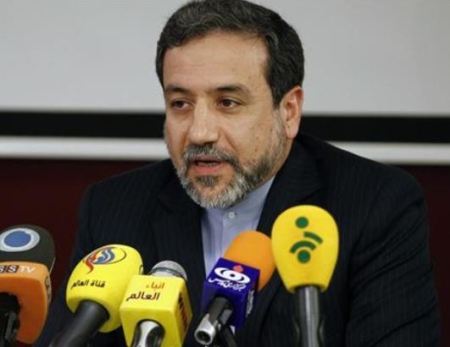
25842Abbas Araghchi (Image: Press TV, Iran)

It should be recalled that Ali Akbar Salehi, the head of Iran’s Atomic Energy Organization and a member of the nuclear negotiation team, said in a June 21, 2015 interview on Iranian television that Iran had “reached understandings with the IAEA” on the PMD issue, and added: “Now there is political backing [of the P5+1], and the [PMD] issue should be resolved.” He stated further: “By December 15, [2015], at the end of the year, the issue [of the PMD] should be determined. The IAEA will submit its report to [its] board of governors. It will only submit it. The Joint Comprehensive Plan of Action will continue independently of the results of this report. We have reached understandings with the IAEA… The technical issues are now being resolved in a political framework. They have set a time frame and, God willing, the issue must be resolved by December 15.” In response to the interviewers’ remark that the IAEA has “a bad record” (in terms of cooperating with Iran), Salehi stated: “In short, they [the IAEA] will be the losers. As I have said, the issue has received political backing. The work of [the IAEA] must be reasonable. They cannot do anything unreasonable. When there is no political backing, they do whatever they want, but now there is political backing, and the issue should be resolved.”[2]

In a recent news conference, Amano said that that “the report will not be black and white,” and that the PMD issue “is an issue that cannot be answered by ‘yes’ or ‘no'”.[3]

In his November 25 interview, Araghchi said: “In the next few days our experts will be in contact with the IAEA experts, and if necessary they will bring up additional points. I may also meet with Amano again… They [our experts] told us there were some weak points in the IAEA report and I commented on them. I am optimistic that they will be corrected…”

He added: “I don’t think there is any plan behind the scenes to leave the PMD dossier open. We have not received any indications that there is a plan [of this kind] behind the scenes. In any case I provided the Americans and Europeans with the necessary comments.”

He stated further: “On December 1, 2015, we expect this report to be published and submitted to the [IAEA] Board of Governors. A special board meeting has been scheduled for December 15, 2015, in which a resolution on the IAEA report will be taken. During this time [until December 15], the P5+1 group will submit a [draft] resolution [to the IAEA Board of Governors] with the objective of  closing the PMD dossier, and [this draft resolution] will come up for a vote in its December 15, 2015 meeting. Also, on December 7, 2015, there will be a meeting of the JCPOA Joint Commission in Vienna, attended by [representatives of] Iran and the P5+1, in which we will discuss the P5+1 [draft] resolution on closing the PMD. We have taken all the necessary steps so that on December 15, 2015, [the IAEA Board of Governors] will resolve to close the PMD dossier and this issue will be put to rest.”

According to Araghchi, “if the [IAEA] Board of Governors does not close the PMD dossier, the process of implementing the JCPOA will stop. Hence, the P5+1 must decide between the PMD and the JCPOA… In the past, the P5+1 chose the JCPOA. The [Supreme] Leader [Khamenei]’s letter on Iran’s implementation of the nuclear steps [a document published by Khamenei in October 21 detailing 9 additional conditions for Iranian compliance with the JCPOA][4] likewise emphasizes that they must choose between the JCPOA and the PMD.”[5]

According to Iran’s Press TV news agency, Araghchi said in the same interview: “If Yukiya Amano or the [IAEA’s] board of governors will present their report in such a way that it does not meet the stipulated commitments, the Islamic Republic of Iran will also stop [the implementation of] the JCPOA.”[6] In this statement, Araghchi implies that Iran has received commitments that the PMD dossier will be closed.

Araghchi’s interview indicates that Iran has been following the writing of the IAEA report and has been submitting comments to the IAEA and the P5+1, and has in fact been exerting constant pressure on Amano and on the P5+1 in order to ensure that the PMD dossier be closed and the report be worded unequivocally and to Iran’s complete satisfaction.

It should also be recalled that the inspection of the Parchin military facility, carried out to determine whether Iran’s program had military dimensions, consisted of Iran submitting samples that were not collected in the presence of IAEA inspectors and were later submitted to the IAEA, so that their origin cannot be absolutely determined.

As for the steps currently being taken by Iran to comply with the JCPOA, Araghchi clarified that “none of the steps so far taken by Iran in this matter contravenes the [Supreme] Leader’s letter…  and, as far as I know, [we] are still in the stage of dismantling the inactive centrifuges.” (Both Iranian Atomic Agency Spokesman  Behrouz Kamalvandi and Iranian National Security Council secretary Ali Shamkhani have indeed said that Iran has transferred inactive centrifuges from one facility to another, but no active centrifuges have been dismantled).[7]


Endnotes:

[1] ISNA (Iran), November 25, 2015.

[2] See MEMRI TV Clip No. 5014,  We Have Reached Understandings with the IAEA about the PMD; Technical Issues Are Now Being Resolved on a Political Level, July 21, 2015.

[3] Reuters.com, November 26, 2015.

[4] See MEMRI Daily Brief No.65, MEMRI: ‘The Emperor Has No Clothes,’ October 30, 2015.

[5] ISNA (Iran), November 25, 2015.

[6] Press TV (Iran), November 26, 2015.

[7] Kamalvandi: ISNA (Iran), November 3, 2015; Shamkhani: Fars (Iran), November 10, 2015.

The Accomplices Have Their Backs Against the Wall

November 29, 2015

The Accomplices Have Their Backs Against the Wall NATO knows its Turkish member’s ties to ISIS will be revealed if Russia succeeds in Syria

German Economic News

Source: The Accomplices Have Their Backs Against the Wall

Originally Appeared at German Economic News; Translated by Susan Neumann

NATO is extremely nervous, because it knows that the truth about the relationship of NATO-member Turkey to the Islamist terror group (IS) will come to light if there is a Russian victory in Syria. If the refugees are able to return, Erdogan won’t have them as a pawn to extort money [from the EU]. It’s clear who’s interested in an escalation of the conflict.

The reaction of the Western alliance on the shooting down of a Russian bomber show that NATO is very nervous. It’s on the verge of losing control of Russia in Syria. The great Turkish ride out, which was most likely planned by the secret services, looks more like a desperate symbolic act than a carefully considered commando operation. The Russian Ambassador to NATO, Alexander Grushko, called it shadow theatre.

The reason why NATO is looking for shady place to hide is the fact that Putin named those who shot down the Russian aircraft accomplices of the terrorists. Turkey is a NATO country. The alliance is confronted with the official accusation of terrorism for the first time. Until now, NATO has been the only one to slap others with the terrorist label. The real reason for their nervousness is tangibly rooted in the military.

The hopes of NATO and their secret services are being dashed on the rocks. US President Barack Obama has been running a different political course than that which NATO and their secret services would want. Obama wants to get out of the Syria war. He’s admitted that the mission has failed — and the idea of “regime change” has taken a heavy beating, to say the least. Obama has arranged it with Russian President Vladimir Putin that the Russians take over the IS-project. This has been devastatingly humiliating for the neocons, NATO, and the secret services.

After that, Russia began fighting terrorists who were allies of the US military. From the very beginning, Putin has stood in the way of the western military’s desire to cover up their manipulations Syria. The Islamic State and the military advisers of both Turkey and the Pentagon are now facing defeat in Syria.

US President Obama knows this as well. His message to Putin is therefore remarkably diplomatic. After a meeting at the White House with French President Francois Hollande, President Barack Obama said that if Moscow had a “change of strategy,” there would be “great potential” for cooperation. “Russia is welcome to be a part of our broad coalition.” It’s Obama’s half-hearted attempt to make it appear to NATO that they can bring Russia under control.

Why indeed, should Russia change its strategy, above all now? The Russians have kept repeating that the reason they’ve involved themselves militarily in Syria is because NATO has failed. One can believe that, because the Russians know that a fight to uncover terrorist cells is anything but easy. In order not to end up like the Americans in no man’s land, the Russians have made skillful alliances with Iran, Iraq, and China; and have even allowed Israel to have access to their information.

The military successes of the past few weeks have put the Western mercenary troops in dire straits. Obama’s added invitation for the Russians to join in is the real reason why NATO is so nervous. Obama says Moscow should work in close military cooperation and target their air strikes on the IS rather than the moderate rebels. They should also support political change in Damascus.

Russia has supported the change in Damascus for weeks. Moscow has repeatedly said that it doesn’t insist on Assad being president in the long run. The Russians do say, however, that it must be the decision of the Syrian people. This position is also shared by Iran. Russia has also submitted a transition plan of Syria, post-war. Within 18 months a new constitution could be drafted and new elections could be held. If anybody needed to make a strategic change, it would be the Western alliance. They have presented no political concept other than the battle cry, “Assad must go!”

The main worry of NATO, and Turkey in particular, lies in the risk that a Russian victory could uncover all the goings-on, of how the West and especially the Turkish government cooperated with the terrorists in the region. [If the Russians are victorious,] it will show the refugee debate in a completely different light, and it will become clear how the Turkish President Recep Tayyip Erdogan cynically abused the refugees as bartering chips for his ambitions. It will also show that Erdogan’s war against the PKK is a completely disproportionate war, one in which the Kurdish civilian population was brutally attacked. One will also recognize that the West only has the Turkish government and Saudi Arabia as its allies, in a region with two Islamist governments.

Erdogan can still blackmail the totally incompetent EU and the German chancellor, who is totally over her head — by demanding billions of euros in protection money for the refugees. If the Russians truly succeed, however, in bringing peace to Syria — and in such a way that a majority of the refugees can return to their homeland — then Erdogan suddenly has a bad poker hand. Turkey is of course totally unsuitable to be included in the EU under Erdogan. Everybody in Brussels knows it. The visa-free travel is also a grotesque idea. Every day there are new incidents of how business can be conducted with fake Turkish passports — especially in Turkey. Then there’s the three billion euros that Erdogan demands from European taxpayers for the refugees. What’s going to happen with the money? Integration of refugees in Turkey? Better accommodation in the camps? No corruption, complete transparency?

This whole outlook makes Erdogan’s government and its intelligence agencies feel justified in shooting down a Russian fighter jet. They need an escalation of the situation, because they have their backs to the wall. That also makes Erdogan unpredictable in this conflict. He has a lot to lose.

For documentation purposes, we’ve published the report by the Germany Press Agency on NATO’s statement about the shoot-down. It proves that military units were not invented to think.

Turkey: Wrong Partner to Fight Terror

November 29, 2015

Turkey: Wrong Partner to Fight Terror, Gatestone InstituteBurak Bekdil, November 28, 2015

  • In Erdogan’s usual Sunni supremacist language, he accused the victims of jihad rather than the jihadists.
  • “New tragedies will be inevitable,” Erdogan said, “if the rising racism in Europe and other countries is not stopped.” Yet Erdogan willingly ignores the rising racism, xenophobia, and anti-western, jihadist sentiments that increasingly command the hearts and minds of his fellow Turks.
  • How should Erdogan fight Islamic terror — something he does not believe exists? One of Erdogan’s famous remarks is, “there is no Islamic terror.” But he thinks that “just like fascism,” Zionism is a crime against humanity.
  • It is so funny that the free world cannot see that its ally in fighting the jihadists is another jihadist.

Racism is bad, no doubt. But it cannot be the reason why jihadists kill “infidels,” including fellow Muslims in Muslim lands. Sadly, the free world feels compelled to partner with the wrong country in its fight against Islamic terror.

The host of this year’s G-20 summit, which came right after the Nov. 13 Paris attacks, was Turkey’s President Recep Tayyip Erdogan. In his usual Sunni supremacist language, he accused the victims of jihad rather than the jihadists. “New tragedies will be inevitable,” he said, “if the rising racism in Europe and other countries is not stopped. Racism, coupled with enmity against Islam, is the greatest disaster, the greatest threat.”

Yet Erdogan willingly ignores the rising racism, xenophobia, and anti-western, jihadist sentiments that increasingly command the hearts and minds of his fellow Turks. A quick look at a few sports games and fan behavior in recent weeks would reveal much about the Turkish mind and heart.

On October 13, three days after a twin suicide bomb attack in Turkey’s capital, Ankara, killed more than 100 Kurds and pro-Kurdish, leftist and secular Turks, the central Anatolian province of Konya, a hotbed of political Islam in Turkey, hosted a Euro 2016 football qualifier between Turkey and Iceland. Before the kick-off, both teams stood for a moment of silence to protest the bomb attack — a typical gesture to respect the victims. Sadly, the moment of silence was marred by whistles and jeers: apparently the football fans of Konya were protesting the victims, not their jihadist killers.

Anyone under the impression that the whole world stands in solidarity with Paris should think again. Hundreds of Turkish fans booed and chanted “Allahu Akbar” (“Allah is greater” in Arabic) during a moment of silence for the Paris attack victims before a Turkey-Greece soccer friendly. Once again, the Turks were exhibiting solidarity with the terrorists, not their “infidel” victims.

More recently, on Nov. 21, Turkish police had to deploy 1,500 policemen so that Turkish fans could not harm the visiting Israeli women’s national basketball team. One thousand five hundred police officers at a women’s basketball game! Despite that, Turkish fans threw objects at Israeli players as they were singing Israel’s national anthem. Fans also booed the Israeli players while others applauded the fans who threw the objects.

Unsurprisingly, Turkish fans waved Palestinian flags. Israeli women basketball players were barred from leaving their hotel other than for training and the game.

None of that is surprising although, at least in theory, Turkey is a candidate state for membership in the European Union. A new study by Pew Research Center revealed that 8% of Turks have a favorable opinion of the Islamic State (IS), higher than in the Palestinian territories, where support for IS stands at 6%, and only one point lower than in Pakistan. Nineteen percent of Turks “do not know” if they have a favorable or unfavorable opinion of IS — which means 27% of Turks do not have an unfavorable opinion of the jihadist killing machine. That makes more than 21 million people! Of the countries polled, Lebanon boasted a 100% unfavourable opinion of IS and Jordan, 94%. In Indonesia, the world’s most populous Muslim country, 4% reported a favourable opinion of IS, half of Turkey’s.

This is Erdogan’s “neo-Ottoman” and increasingly Islamist Turkey. After the Paris attacks, this author saw tweets that called the victims “animal carcass;” that said “now the infidels will lose their sleep out of fear;” and others that congratulated the terrorists “who shouted Allah-u aqbar.”

Meanwhile, and so funny, the free world cannot see that its ally to fight the jihadists is another jihadist. How should Erdogan fight Islamic terror – something he does not believe exists? One of Erdogan’s famous remarks is, “there is no Islamic terror.” But he thinks that “just like fascism,” Zionism is a crime against humanity.

826 (2)Turkish President (then Prime Minister) Recep Tayyip Erdogan, right, meeting with Hamas leaders Khaled Mashaal (center) and Ismail Haniyeh on June 18, 2013, in Ankara, Turkey. One of Erdogan’s famous remarks is, “there is no Islamic terror.” (Image source: Turkey Prime Minister’s Press Office)

There is a Turkish saying that could perhaps describe the free world’s alliance with Erdogan’s Turkey against jihadist terror: “Kuzuyu kurda emanet etmek” (“to trust the wolf with the sheep”).

Russian S-400 missiles turn most of Syria into no-fly zone, halt US air strikes

November 28, 2015

Russian S-400 missiles turn most of Syria into no-fly zone, halt US air strikes, DEBKAfile, November 28, 2015

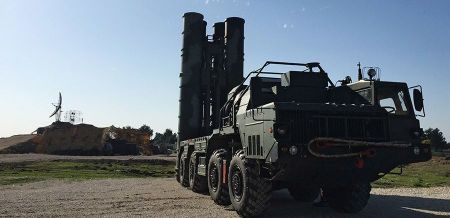
2746772 11/26/2015 An S-400 air defence missile system is deployed for a combat duty at the Hmeymim airbase to provide security of the Russian air group's flights in Syria. Dmitriy Vinogradov/Sputnik

2746772 11/26/2015 An S-400 air defence missile system is deployed for a combat duty at the Hmeymim airbase to provide security of the Russian air group’s flights in Syria. Dmitriy Vinogradov/Sputnik

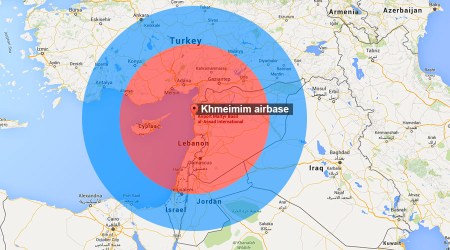
S-400_range_map_25.11.15

The deployment of the highly advanced Russian S-400 anti-air missiles at the Khmeimin base, Russia’s military enclave in Syria near Latakia, combined with Russia electronic jamming and other electronic warfare equipment, has effectively transformed most of Syria into a no-fly zone under Russian control.

Moscow deployed the missiles last Wednesday, Nov. 25, the day after Turkish warplanes downed a Russian Su-24. Since then, the US and Turkey have suspended their air strikes over Syria, including bombardments of Islamic State targets. The attacks on ISIS in Iraq continue without interruption. Turkey is now extra-careful to avoid flights anywhere near the Syrian border.

Both the US and Turkey are obviously wary of risking their planes being shot down by the S-400, so long as Russian-Turkish tensions run high over the Su-24 incident.

Friday, a US-led coalition spokesperson denied that the absence of anti-IS coalition air strikes had anything to do with the S-400 deployment in Syria. He said “The fluctuation or absence of strikes in Syria reflects the ebb and flow of battle.”

However, DEBKAfile’s military sources confirm that neither the US, Turkey or Israel have any real experience in contending with the Russian S-400, which uses multiple missile variants to shoot down stealth aircraft, UAVs, cruise missiles and sub-strategic ballistic missiles. Its operational range for aerodynamic targets is about 250 km and for ballistic targets 60 km. The S-400 can engage up to 36 targets simultaneously.

Thei range covers at least three-quarters of Syrian territory, a huge part of Turkey, all of Lebanon, Cyprus and half of Israel.

Since the downing of their warplane, the Russians have put in place additionally new electronic warfare multifunctional systems both airborne and on the ground to disrupt Turkish flights and forces, Lt. Gen. Evgeny Buzhinksy revealed Friday. Turkey has countered by installing the KORAL electronic jamming system along its southern border with Syria.

An electronic battlefield has spread over northern Syria and southern Turkey, with the Russian and Turks endeavoring to jam each other’s radar and disrupt their missiles. In this, the Russians have the advantage.

With the Americans, Russians and Turks locked in a contest over Syria, and the Israeli Air Force’s freedom of action restricted by objective conditions, some comments made at week’s end by Israeli military and security officials sounded beside the point.

Thursday, Nov. 26, a senior Air Force officer remarked that Israel is being careful to avoid friction with Russia, despite that country’s expanding military presence in Syria. “Russia is now a central player and can’t be ignored. But we each go our own way, according to our own interests,” the officer noted.

“Our policy is not to attack or down any Russian plane. Russia is not our enemy.”

The officer said that Israeli and Russian officers maintain telephone contact. “We don’t notify or ask for anything; we just do our jobs,” he said.

According to DEBKAfile’s military sources, this is not a true picture. Israel does get in touch with the Russians when their planes get too close to Israeli aircraft. There was no need to state that Israeli won’t shoot down Russian planes, as though this was self-evident, because in the current volatile situation, circumstances may change in a trice. Is it in Israel’s interest to fly into air space loaded with electronic warfare waves? But what if Russian warplanes come over the Golan as part of a blitz to destroy Syrian rebels in southern Syria, some of which are backed by Israel?

Avigdor Liberman: Israel is the largest financial backer of Palestinian terror

November 28, 2015

Liberman: Israel is the largest financial backer of Palestinian terror

Source: Avigdor Liberman: Israel is the largest financial backer of Palestinian terror – Israel News – Jerusalem Post

Yisrael Beytenu leader Avigdor Liberman on Saturday came out swinging at Prime Minister Benjamin Netanyahu, saying his handling of the wave of terror that Israel is facing was “catastrophic.”

At a cultural event in Tel Aviv, Liberman said that in order to extinguish terror, its sources that incite it, its finance and its commanders must be dealt with. He said that when these elements have immunity there is no chance to stamp out the terror.

“Without a shadow of doubt targeted assassinations must be renewed because they are effective. The terrorists are continuing to dig tunnels and manufacture long-range missiles.”

On the Hamas ruled Gaza Strip, Liberman said there was no need to conquer the territory but that Israel must disturb the routine of terrorists there.

Liberman also said that Israel was the largest financier of Palestinian terror.

“Every family of a Palestinian terrorist who is killed, receives from Abu Mazen [Palestinian Authority President Mahmoud Abbas] 14-15 thousand shekels a month that the Palestinian Authority gets from Netanyahu.

Liberman said that the money transferred to the PA comes from taxes that Israel collects for it, and that there was no reason to continue transferring the funds because the Palestinians were in breach of agreements regarding their use.

Last month a Channel 2 News survey found that Liberman was best-equipped to fight Palestinian terrorism.

According to the poll, 73 percent of Israelis are dissatisfied with Prime Minister Benjamin Netanyahu’s response to the current wave of terrorism. He came only in third place in answers as to who would fight terrorism best and take care of security problems, with only 15% choosing Netanya hu.

Liberman came in first place, with 22% of the respondents choosing him, and Education Minister Naftali Bennett (Bayit Yehudi) was in second, with 17%. Former IDF chief of staff Lt.-Gen. (res.) Gabi Ashkenazi got 10%, 5% of those polled chose opposition leader Isaac Herzog (Zionist Union), and 4% Yesh Atid chairman Yair Lapid.

Liberman has also recently called for the government to deny residency to those living in east Jerusalem who are involved in terrorist activity.

Israel should also “begin using emergency law and institute a military government everywhere it is necessary to eradicate terrorism,” he said.

“I remind the prime minister and cabinet members: words do not stop terrorists. Security is gained through an iron fist.”

Erdogan: Downing of Turkish jet with S-400 missile would mean aggression

November 27, 2015

Erdogan: Downing of Turkish jet with S-400 missile would mean aggression

27 November 2015 / 11:19

Source: APA – Erdogan: Downing of Turkish jet with S-400 missile would mean aggression

Baku. Malahat Najafova – APA. In case a Turkish jet gets shot down by the Russian S-400 surface-to-air missile system in Syrian airspace, Ankara will regard it as an aggression.

Turkish President Recep Tayyip Erdogan made the remarks in a statement to CNN International of the possibility of the Russian S-400 surface-to-air missile system targeting Turkish warplanes in case they enter Syrian airspace.

Erdogan did not rule out the possibility of such an incident.

“In this case Turkey will be forced to take measures that will certainly not be discussed. And of course it would be an aggression against our rights of sovereignty and it’s the natural right of the state to protect those rights. We do not want to see any escalation of the situation in the region. We do not want to become a party to that. But those who side with Syria and escalate the tension, I think, are the responsible parties to this,” the Turkish president stressed.

Asked whether he saw the moving of the Russian S-400s into western Syria as a threat to Turkey and other coalition members who may be flying sorties in this region, the Turkish president said Russia has been providing military support to Syria since long ago – since the rain of Bashar Al-Assad’s father.

“Russia has sold or given this kind of systems to Syria. It’s impossible to say that this is something new and did not take place last year,” said Erdogan.

Share

Erdogan’s Mistake: Russia May Now Initiate Own ‘No-Fly Zone’ Over Syria

November 27, 2015

Erdogan’s Mistake: Russia May Now Initiate Own ‘No-Fly Zone’ Over Syria

17:33 27.11.2015

Source: Erdogan’s Mistake: Russia May Now Initiate Own ‘No-Fly Zone’ Over Syria

President Erdogan’s mistake in shooting down the Russian Su-24 bomber ‘has waived the green light’ for Russia to initiate a ‘no-fly zone’ by deploying additional fighter power and air defense systems in Syria, US columnist Jim W. Dean notes.

 The US-led coalition’s recent provocation against the Russo-Syrian counter terrorism campaign has “put nothing but torpedoes into its own sinking international credibility,” according to US columnist and managing editor for Veterans Today Jim W. Dean.

Dean stresses that the destruction of the ISIL oil tanker fleet, which NATO had been “somehow” unable to detect for over a year, has predictably prompted outrage from those who have long been benefitting from the illicit oil trade.

We suspected the tanker-crushing move would make the people who had been marketing ISIL’s oil, the Kurds and Turkey, unhappy enough to be provoked into a blunder themselves. We did not have to wait long, with the militarily-senseless shooting down of the Russian SU-24 bomber by the Turkish F-16s,” Dean narrates in his recent article for New Eastern Outlook.

The US columnist emphasizes that it is obvious that Turkey would never dare to carry out such a provocation “without clearing it with the US and NATO, as they would be dragged into anyway.”

Turkish reports that they knew nothing about the origin of the Su-24 bomber jet sound completely unconvincing.

“Did they expect us to believe that their radar was not working, nor the US-coalition drones or spy satellites that monitor the Syria-Iraqi battlefield 24/7?” Dean asks with a trace of irony.

However, NATO with Secretary General Stoltenberg has supported Turkey. Still, there were a number of NATO envoys who expressed their concerns regarding the matter. They pointed to the fact that Turkey did not make attempts to escort the Russian bomber out of its airspace.

The Turkish claim that the Russian plane had entered the country’s airspace has fallen apart at the seams since Russia presented the recording of their air combat radar plotting maps.

“They showed the Russian planes flying near the border, and the Turkish planes making their attack runs south, which actually took the Turks into Syria,” Dean underscores.

The whole incident looks very fishy: the Turkish provocation has triggered justified suspicions among  European lawmakers. Some of them have gone even so far as to blame Ankara for collaboration with ISIL, the US columnist notes.

Still, Turkey’s provocation has not worked: the Kremlin immediately disavowed any hints of a military response, Dean emphasizes.

Instead, Russia has deployed its advanced S-400 Triumf air defense system with the capability of hitting targets at ranges of up to 400 kilometers to Hmeymim air base in Syria. Furthermore, Russia’s Moskva 11,500-ton warship has reached the shores of Syria in order to ensure the security of Russian aircraft in the region.

Interestingly enough, the Turkish Hurriyet media outlet reported Friday that “the Turkish army has suspended flights over Syria as part of an ongoing joint military campaign with the United States against the Islamic State of Iraq and the Levant (ISIL) after it shot down a Russian jetfighter.”

Turkey used its last ‘freebie’ by shooting the Russian plane down. There will be no Western coalition no-fly zone in northern Syria, for which some Senators and presidential candidate crazies were trying to get headlines advocating; at least not the kind they wanted,” Dean points out.

Now, Russia can create a “defensive bubble” over Syria. Moscow does not want to do this, he notes, but it has been forced to. Russia has repeatedly made attempts to form a real coalition with Western countries and their partners in order to smash ISIL, but the West turned a deaf ear to its proposal.

“Erdogan’s mistake in shooting the bomber down has waived the green flag for Putin to bring in enough fighter power for the Syrian coalition to initiate a no-fly zone on any uninvited airstrikes anywhere inside Syrian if attacks on Russian planes were continue,” the US columnist emphasizes.